Ten years after the 2015 Addis Ababa Conference on Financing for Development, the finance development doctrine of “Billions to Trillions,” popularized by the World Bank, is alive and kicking. At the Fourth Conference on Financing for Development, taking place in Seville this week, a renewed push for private investments was high on the agenda. And no wonder: attendees at the conference from the private sector totaled 6,000; they counted for 40 percent of the 15,000 people in attendance and six times as many as those invited from civil-society groups the world over.
“Investment” has been a watchword throughout the conference. The Bank’s International Finance Corporation, the private sector lending arm of the Group, reminded an official audience at the roundtable on “leveraging private business and finance” of the words of its president, Ajay Banga: “Official Development Assistance is a rounding error compared to the trillions needed to achieve the Sustainable Development Goals.” This is the argument put forward to justify the relentless promotion of initiatives aimed at attracting private investors to development and climate-related projects.
The IFC’s representative at the conference spoke enthusiastically about private capital mobilization. “The only scalable path to sustainable development is private-sector solutions,” he said. In other words, the plan is to promote initiatives that package the SDGs up into investable opportunities.
This was again underscored by the representative of the Organization for Economic Co-operation and Development (OECD), even though it was accompanied by recognition of the fact that the amount of private finance so far mobilized has failed to live up to the expectations of its advocates. Nonetheless, “private-sector solutions” were a central theme during the week in a great number of the 130 initiatives announced as part of the Sevilla Platform for Action. At the International Business Forum, convened in parallel to the conference, private-sector actors reiterated this agenda.
Representatives of the Global Investors for Sustainable Development Alliance, a group of leaders of major financial institutions and corporations, including commercial banks, asset managers, and insurance companies from across the world, and the International Chamber of Commerce, took part in a roundtable on private business and finance. The Alliance advocated for an “expansion of de-risking tools,” among which were mentioned “political risk insurance,” a “conducive regulatory environment,” and the avoidance of imposing “undue compliance burdens on businesses.” The conference was not without its tensions, with civil society representatives voicing their criticism both in the official room and in other parallel events, but they were greatly outnumbered by the private sector.
By now, the pact between private finance and development appears complete. As Rodolfo Lahoy, from IBON International, put it: “private finance and large capital are treated as life-vests of a sinking development agenda, despite contrary evidence of corporate abuse and rights violations in the global South.” He argued that, “the development agenda is sinking because of the current development model based on extraction of environmental, social and financial resources in a system that prioritizes the power of profit.”
Through de-risking measures and regulation aimed at creating bankable investment opportunities for private actors, states delegate obligations and offer profits to entities that are not necessarily aligned with public interest and national development priorities. Civil society organizations, including the European Network for Debt and Development, raised a red flag about the outsized role of the corporate sector in what should be an intergovernmental process meant to address the structural barriers that undermine financing for sustainable development. The call was clear: we need “an evidence and rights-based discussion on the role of private finance in development, on the basis of the right to development principle.”
Indeed, an evidence-based approach to the role of the private sector in development is critical. Civil society and academics have warned against the high risks of policies aimed at attracting private investors, as they can result in negative impacts on sustainable development needs and the human-rights obligations of states. These concerns also apply to the European Union’s Global Gateway strategy, which promotes the use of development aid to de-risk private investments in the countries of the global South, while risking the diversion of scarce development resources to serve the EU’s geopolitical and commercial interests.
The Compromiso de Sevilla, which reflects the new global consensus on financing for development, recognizes the difficulties in implementing this agenda and the need for a greater focus on quality. As the document states (paragraph 31): “Despite increased attention to innovative finance instruments such as blended finance and adoption of sustainable business and finance legislation, investment in sustainable development has not reached expectations, nor has it adequately prioritized sustainable development impact.”
The Compromiso also calls for “policy frameworks and incentives for private investment, at the national and global levels, that promote sustainable development, building on lessons learned since the adoption of the Addis Ababa Action Agenda.” Yet, as civil-society organizations have stated, it falls short of concrete actions to advance on globally agreed standards and measures to regulate private investments in the public interest.
Despite the lack of evidence that the majority of development and climate projects in global South countries are bankable, Sevilla has provided a space for promoting new iterations of a failed approach. Critically, it has also provided a platform for civil-society organizations as well as scholars to set out their agenda, raising calls for public finance to be recognized as the main driver of development and not as a residual safety net for market failures. This includes calls for greater policy space for socio-economic structural transformation of countries in the global South, including the implementation of green industrial policies. Without this, the high risk of undermining rights, accountability, and exacerbating debt, inequalities, and the climate crisis cannot be underestimated.
Comments Off on The Welfare State and Its Discontents
Ajay Banga, the World Bank Group’s president, has a favorite line: “Poverty is a state of mind.” It was in his speech at the IMF/World Bank Annual meeting last October, and he repeated it at the opening ceremony of the fourth Finance for Development Conference (FfD4) in Seville this week. Widely derided as trafficking in quasi self-help incantations rather than structural explanations, his catchphrase was also at odds with the FfD4 outcome document. The Seville Compromiso conceives of poverty as a social ill, to be tackled through institutional reform. Paragraph 27i, for example, offers a direct commitment to strengthening the welfare state: “We will provide support to developing countries that aim to increase social protection coverage, including those that aim to do so by at least two percentage points per year.” At a historical juncture where a Labour Party government in the UK and a Republican administration in the US are actively destroying social protection, this is a remarkable paragraph.
First, let’s clarify the concept. The International Labour Organization (ILO), the UN agency in charge of promoting universal social protection, defines social protection as a measure that “guarantees access to healthcare and income security over a person’s life course, with benefits in cash or in kind.” It is a social contract to protect citizens from “sickness, maternity, disability, unemployment, old age or loss of an income earner” (i.e. from capitalist cyclical instability). Perhaps poverty is not so much a state of mind, but a state of the welfare state.
At the ILO panel on paragraph 27i in Seville, I joined representatives from the Ministries of Finance of Mexico, Brazil, and Zambia, alongside employer and union representatives, to explore how countries can create fiscal space to achieve the Seville target. We learned from the official presentations that coverage is always and everywhere a political choice. Under AMLO and now Claudia Sheinbaum, Mexico achieved a considerable welfare expansion, with notable efforts on the spending side (decoupling access to social protection from formal employment, prioritizing marginalized communities, integrating social protection with social inclusion). Brazil under Lula, against furious political opposition denouncing “fiscal extravagance,” combined tax progressivity (tax on offshore investment, lower consumption tax, and addressing tax distortions that benefited corporations) with an expenditure review to structurally increase coverage. Even more impressively, Zambia—the first African country to default on a Eurobond during the Covid-19 pandemic’s decimation of its copper export earnings, soon after to be hit by an extended drought—managed an annual increase in social protection coverage of 2 percent. This was in part thanks to their strong national development plan, and in part because it deployed social protection as an essential countercyclical tool.
From the audience, Dr. Anygba Hod Kwadzo, the Chief Economist of ITUC Africa, asked the tough question: is 2 percent ambitious enough? Throughout the Seville negotiations, the ITUC had pushed for a higher target. The ILO’s flagship World Social Protection 2024 report had painted a stark picture of today’s stunning global inequality: a 12:1 spending gap between the welfare states of the global North on the one hand, and the barebones budgets of the world’s poorest nations on the other. Rich countries spend about 25 percent of GDP on welfare—an entire political economy of redistribution that remains structurally unavailable to nations where 2 percent GDP social spending is the cruel norm. Across the board, pensions are the largest spending item, varying from 10.5 percent of GDP (including nonhealth benefits for older people) in Europe, to 1.7 percent in Africa. Most shockingly, out-of-pocket expenditure on healthcare is increasing globally; it pushed 1.3 billion people into poverty in 2019. With that in mind, the 2 percent target looks distinctly unambitious. Poor countries need a lot more fiscal space, as well as official development aid, to substantially improve coverage.
The Seville Compromiso acknowledges some of the fiscal constraints that structurally limit welfare spending. It mentions illicit financial flows, the debt distress affecting many global South countries (read our Dispatch on the para 50f controversy around the UN framework convention on debt resolution), and it calls for progressive taxation to redress decades of tax injustice that has benefited financiers, corporations, and the wealthy. But in the current geopolitical context, it is unlikely that these constraints, which require multilateral cooperation, will be removed any time soon.
Financiers’ grab of the social contract
As readers of my critical macrofinance work know, fiscal space is always and everywhere a monetary-fiscal issue. This is hardly a secret in the world of financiers: central banks can easily create and destroy fiscal space. Just think about central bank purchases of government debt during Covid-19, when we all thought the neoliberal taboo against monetary financing was finally dead. (How naive we were.) And it wasn’t just rich countries: in Colombia, Mexico, the Philippines, India, Malaysia, Indonesia, and South Africa, centralbanks bought government debt in large quantities.
Alas, as we learned in Seville from an insider to negotiations, when it came to the FfD4 document, central banks insisted that they be kept out of it. They were successful in that bid: central banks are only directly mentioned once—in relation to digital currencies and stable coins. It’s a testament to the fact that the political power of technocratic public institutions extends across borders and into UN processes. A document that examines in detail the foreign and domestic, public and private resources that could finance development does not consider, not even once, the most important institution of public money creation: the central bank. It’s another reminder of the fact that we still live with the neoliberal macro pillars (zombies?) of the Washington Consensus.
Instead, the Seville development model quietly entrusts capital with “social protection.” Since the 2015 conference in Addis Ababa, that model has been focused on investible development: investible health, investible water, investible infrastructure, and investible education. “Maximizing” the power of private finance—what I’ve elsewhere called the Wall Street Consensus—this model actively promotes private ownership of welfare provision, with subsidies from the state and development institutions—all under the banner of “mobilizing,” “leveraging,” or “blending” public and private finance to entice private investors. As Ajay Banga put it on Monday, the World Bank is simplifying its guarantees (a derisking or blending instrument) for its strategic priority areas of private capital mobilization in health and infrastructure. But private hospitals either demand high user fees, or high public subsidies via public-private ownership (recall out-of-pocket expenditure on healthcare pushed 1.3 billion people into poverty in 2019). Health is the bit of the social contract where investors demand returns that are incompatible with development outcomes.
This is not just a progressive viewpoint. As Trump assumed office in January, a bipartisan Republican-Democrat Senate report entitled Profits over Patientsgave a scathing assessment of the role that financiers—in that case private equity—play in healthcare. The product of a year-long bipartisan inquiry, with access to the internal documents of two private equity healthcare giants—Apollo Global Management and Leonard Green & Partners—it illustrated in chilling detail how financiers had literally spilled blood for profits via a relentless focus on cost cutting—lowering labor costs and increasing patient volumes, with little to no concern for patient outcomes or quality of care.
Is the rapid march of barbarians inside the health system a pathology of the US only? If the US model is the result of a chronically underfunded public-health system and a pension system looking for returns via private equity, then the conditions for its replication elsewhere are ripe. The infrastructural dependence of the state, any state, on Wall Street—be it for housing, for health, or for a myriad of other public services—is increasing everywhere, and the Seville Compromiso is fully in its hold.
Take India, Ajay Banga’s birth country, one of the most unequal countries in the world. In April 2025, the business press was excitedly covering the spectacle of Blackstone, KKR, and Swedish private equity organization EQT circling Sahyadri Hospitals—a 1,200-bed private hospital chain being flipped by the Ontario Teachers’ Pension Plan after just three years. Private equity giants, the press announced, were “joining the race” to acquire an attractive asset.
Pause for a second to consider that a public Canadian pension fund in the global North was profiting from an expensive private hospital in a country where 63 million people are pushed into poverty annually by medical bills; where rural maternal mortality rates rival war zones (174 deaths/100,000 live births) and where 80 percent of specialists serve just 20 percent of the population. Workers’ capital, once touted as the pathway to a fairer, kinder capitalism, is reinforcing a deeply unequal health system in a country far away from the North Atlantic centers of power.
The scramble for India’s investible health assets is but one front in private equity’s relentless global expansion. The numbers paint a stark story: according to the Private Equity Stakeholder Project, PE firms deployed capital to at least 115 investments in hospital services across Asia, Africa, and Latin America (including forty-five buyouts and seventy growth investments) between 2017 and 2024. The pace only accelerated in 2023, with twenty-nine deals spanning twelve countries, a surge underscoring healthcare’s dual role as crisis-resistant commodity and emerging-market growth area. The vanguard of this expansion was American: US private equity funds weaponizing their domestic healthcare model globally, often with the backing of public pension fund capital!
These deals have often taken place under the explicit logic of the presiding investible health model—now reaffirmed at Seville. Official development aid and multilateral development bank risk-sharing mechanisms actively subsidize hospital acquisitions by private equity groups. Take TPG’s Evercare Health Fund. It benefited from a £50 million derisking investment from the British development agency British Investment Fund, alongside France’s Proparco, Germany’s Deutsche Investitions- und Entwicklungsgesellschaft (DEG), and the World Bank’s International Finance Corporation (IFC). And so did TPG’s CARE hospitals.
Thus, when TPG pitched to investors a 17–20 percent internal rate of return for its health assets, it pitched rents extracted from systemic asymmetries. Consider the implicit subsidy: such returns (nearly triple the S&P 500’s historical average) rely on suppressing labor costs, attracting concessional subsidies, and pricing care at the razor’s edge of affordability in economies where 40 percent of health expenditures still come from out-of-pocket payments.
In our UN Expert Report, we called for developmental carve-outs to ringfence social infrastructure from de-risked private ownership in areas such as education, health, or water. Social infrastructure should remain public infrastructure, financed by progressive redistributive fiscal policies. But the outcome document does not envision such carve-outs. It instead promises to “promote well-designed public-private partnerships that share both risks and rewards fairly, ensuring public resources benefit proportionately from successful projects.” But what does it mean for a PPP hospital in Turkey to share its excessive profits with the public sector? Fairness here is simply incompatible with development outcomes.
A bolder move to generate trillions in public financing for development would be to nationalize pension funds. This alone would shrink private equity, along with the power of asset managers that overshadows Seville, by at least a third. It would also reduce financiers’ lobby for investible health. If it sounds impossible, a 2018 ILO report on “Reversing Pension Privatisation” shows that it is not. The Report characterizes the Washington Consensus push for pension privatization as “three decades of failure” that have undermined social security—and documents in detail the experience of eighteen countries that reversed that process. Social protection is always and everywhere a political choice.
Comments Off on Who’s Afraid of a Fair Debt Architecture?
The fourth Financing for Development Conference officially kicked off in Seville this Monday, as world leaders gathered with broad smiles to congratulate one another for the good work already achieved. That work was the FfD4 outcome document, which had been agreed upon by most UN member states—excluding the US, notably—in advance of the meeting. Known as the “Compromiso de Sevilla,” which translates as the “Sevilla Commitment,” the document could more accurately be described as the “compromise of Seville.” Though many member states had pushed for commitments to ambitious, structural reforms, the final revised text saw these either removed or diluted—often due to the policy priorities of global North governments. The section on sovereign debt is no exception.
Expectations
Amid a full-blown debt crisis that even the IMF acknowledges as a derailment of sustainable development goals, there were high hopes for FfD4 to deliver on debt reform. Long-pursued proposals for a new multilateral legal framework addressing debt resolution and crisis prevention made it into the initial drafts of the outcome document. Small Island Developing States, the Africa Group, and countries like Cuba, Brazil, and Pakistan defended the need for such reform in order to overcome dysfunctional and creditor-dominated decision-making on sovereign-debt issues.
Civil society groups pushed for a UN Framework Convention on Sovereign Debt. Discussed and agreed on by all member states, the framework would encompass a global consensus on the rules, principles, and structures of the various stages of the debt cycle. The long overdue establishment of a multilateral sovereign debt resolution mechanism would be one of the main elements of this convention. But it would also deal with rules and tools for responsible lending and borrowing, debt transparency, and other elements of debt management in order to prevent future crises.
For months, however, the proposal met fierce opposition from most creditor countries, Europeans in particular. The EU, the UK, and Switzerland, as well as Japan, Canada, South Korea, and Saudi Arabia, all strongly opposed the idea of an intergovernmental UN group to discuss and agree on reforms to the global debt architecture. China insisted on leaving debt to the non-inclusive G20 forums. As borrowing countries kept pushing for an agreement on starting a UN process to discuss gaps in the debt architecture, with a view toward establishing a debt convention, the co-facilitators of the process ended up proposing a diluted compromise text. The final agreement includes an intergovernmental process, but with only the purpose of “making recommendations” (paragraph 50f). This last-minute addition dramatically weakens the Compromiso.
In other areas there have been similar outcomes. Instead of an agreement on binding responsible lending and borrowing rules, a working group to be co-convened by the UN Secretary General, the IMF, and the World Bank (as if these last two had a track record of responsible lending themselves) was established. Instead of an independent, open and binding debt registry, the Compromiso urges the consolidation of existing debt databases at the World Bank, while “respecting privacy and data protection.” Instead of a push for a multilateral debt resolution mechanism, the document encourages the G20 to improve the Common Framework.
In the end, instead of a commitment to redress the imbalances of a creditor-dominated system, the outcome is a weak mandate that some want to limit further to an annual discussion in New York. All in all, it protects the status quo and leaves borrowers outside of the decision-making process. At a time when one of the worst debt crises the world has ever seen is suffocating public budgets, threatening the entire Sustainable Development Goals agenda, and preventing action on the climate crisis, those suffering the worst impacts will continue to have no say in the future. And as the saying goes, “if you don’t have a seat on the table, you’re on the menu.”
What now?
The question of debt is central to the present and future prospects of global South countries, particularly in Africa, so the fight is not over. More side events have been devoted to the issue of sovereign debt than to any other at Seville. There are several things to keep an eye on, both at Seville and in the following months and years:
+ False solutions: This week we can expect the announcement of the “Sevilla Platform for Action” (SPA), an initiative by the Spanish government to set up coalitions of the willing to support various initiatives, including the “Global Hub for Debt Swaps for Development.” Debt swaps, also included in the outcome document, are often presented as a win-win solution, addressing debt within the context of fiscal constraint. But debt swaps are no silver bullet. They are neither efficient enough to create sufficient fiscal space, nor can they adequately address debt sustainability problems.
+ Borrowers club: Both the outcome document and the SPA initiative include proposals to support further coordination amongst borrowing countries. UNCTAD is hosting a proposal on a Borrowers’ Forum and the “Compromiso de Sevilla” agrees to “establish a platform for borrower countries with support from existing institutions, and a UN entity serving as its secretariat.” Increased coordination among borrowers is good news; the international financial architecture has long been dominated by creditors who coordinate through the Paris Club and the G20. The proposal states that the platform could focus on discussing technical issues, sharing information and experiences in addressing debt challenges, increasing access to technical assistance and capacity-building in debt management, coordinating approaches, and strengthening borrower countries’ voices in the global debt architecture. It’s a positive proposal; whether it will be fully funded and operationalized is another question.
+ Corrupt debt: The “Compromiso de Sevilla” includes the commitment to curb corrupt borrowing and lending including by utilizing the UN Convention Against Corruption (UNCAC) to “explore options to make such contracts unenforceable.” This is a win, albeit a minor one. The aim is to ensure that lenders engaging in corrupt deals which produce indebtedness cannot enforce payment. The next UNCAC Conference of State Parties will take place in Doha in December, which will be an opportunity to push for this to become a reality.
+ UN Debt Convention: A UN Debt Convention is sorely needed, as is a UN Tax Convention. The latter was rejected at Addis Ababa in 2015, but it is today under negotiation at the UN General Assembly. A similar process could take place with the Debt Convention. The discussions at the UN 2nd Committee and General Assembly may be a faster option than the agreed intergovernmental process to discuss debt architecture. In any case, civil society will continue working for this, and will be supporting those borrowing countries that want to see a fairer and more equitable debt architecture in place.
+ A global debt movement: Twenty-five years ago there was a massive mobilization for debt justice, and we won extensive debt cancellation. 2025 is again a Jubilee year, and civil-society organizations, faith groups, and social movements around the world are coordinating to fight for unconditional debt cancellation and systemic reform. Petitions are being signed across the world calling for debt justice. For now, as the debt crisis rolls on amid deepening global austerity, billions of people’s lives depend on fighting for, and winning, debt justice.
Multilateralism might be broken, but it is not dead yet. Or so we should conclude from the multilateral negotiations ahead of the fourth edition of the UN Financing for Development conference, about to begin in Seville. A once in a decade meeting, the last FfD was hosted by Ethiopia in 2015; this year it will be hosted by Spain over four days from June 30—without the participation of the US, which officially withdrew from the conference two weeks ago. As is the case with all UN processes, FfD4 will involve extensive intergovernmental negotiations to reach a consensus on a final outcome document, with civil society organizations, international development institutions, and corporations all lobbying to contribute.
The four co-facilitators—Mexico, Nepal, Norway, and Zambia—tasked with the “writing pen,” released an “elements paper” in November and a “zero draft” in January. UN Members then negotiated the wording in several PrepCom meetings in New York, until with unusual punctuality the final draft was agreed on June 16 ahead of the Seville meeting—an easier task without the participation of Washington.
I have followed the process closely as a member of the UN’s International Commission of Experts convened by the Spanish government and will attend the meetings in Seville. In a series of dispatches published at Phenomenal World, I will report on the meetings as they occur and explore what they mean for the future of development finance going forward. In this first dispatch, I explore the context and negotiations leading up to Seville.
The Billions to Trillions hijacking of FfD3 in Addis Ababa
From the turbulent perch of the present, 2015 seems like a lifetime ago. That year, a trifecta of UN agreements announced transformative global ambitions on climate and development. In July 2015, 193 UN Member States agreed to the Addis Ababa Action Plan of the Third International Conference on Financing for Development (FfD3). Solving the financing question, the UN Secretary-General Ban Ki-moon stressed, provided “the foundation of a revitalized global partnership for sustainable development that will leave no one behind.” In September of that year, UN members signed the Agenda 2030 for Sustainable Development, a “broad and universal policy agenda” aiming to “transform our world” through a new set of Sustainable Development Goals. Then, the Paris Agreement in December marked a new direction in climate politics. Climate action was no longer synonymous with carbon pricing, but instead a long-term project of economic transformation.
The FfD3, the World Bank reported, was marked by “one stark difference from previous gatherings in Doha and Monterrey: unequivocal acceptance that the financing will have to come from private as well as public resources.” The change was inaugurated in part by the sheer force of a new Bank-created motto for financing development: “From Billions to Trillions.” Public, concessional funding in the billions could unlock trillions in private investment. To meet the aims of the social development goals, the Bank claimed, required trillions in financing, which could only materialize through “a paradigm shift… a financing framework capable of channelling resources and investments of all kinds—public and private, national, and global.” It was music to many ears, eager to hear that trillions of investment only required small amounts of public expenditure.
What had been the catalyst for change? Like its sister Bretton Woods institution, the IMF, the Bank had been suffering a crisis of legitimacy as the vehicle of the Washington Consensus. External critique and internal rebellion had multiplied against the global economic liberalization paradigm. In one famous episode, US Treasury Secretary Larry Summers demanded that the Bank’s Chief Economist, Joseph Stiglitz, be forced out. Stiglitz had been a vocal IMF critic after the 1997 East Asian crisis, even once advising Ethiopia against the IMF and US Treasury demands for financial liberalization. Summers was furious to see an insider echo the progressive voices that blamed the Bretton Woods institutions for lost decades across the global South. Stiglitz left the Bank.
The World Bank eventually revised the Washington Consensus with a new emphasis on market-failure and social sustainability. But geopolitical and ideological shifts were underway. The tide was turning back towards state involvement in the economy, as countries across the global South wondered how to emulate China’s success story. At the same time, China’s Belt and Road Initiative preoccupied Washington with the concern that geopolitically strategic infrastructure investment might build a credible alternative to US-dominated global order and its Bretton Woods institutions.
The Bank needed a new development paradigm—albeit without radical change. The world of illicit financial flows, ever lessening corporate tax, committed fiscal restraint, and neoliberal constraints on public money creation would remain intact. What the “billions to trillions” slogan captured was a desire to get public money to activate the power of private cash—billions for investible trillions, would be a more accurate description of the new paradigm.
I have termed this new paradigm the Wall Street Consensus, to capture the new vision of SDG development as an asset class. The investible development paradigm involves new development partners in institutional investors seeking the right risk-adjusted returns. This means, for example, a new hospital becomes investible once private investors can count on concessional funding from the World Bank or local fiscal resources. The principle is to shield private investors from certain risks. For such investors, the trillion dollar question became “just how much derisking can I get from the state and international development institutions?”
According to this logic, rich countries could agree to “mobilize” USD100 billion a year by 2020 for developing countries, since the language of mobilization did not require them to specify how much they would fork up in concessional funds. Financiers found their preferred solution to the USD 1.5 trillion infrastructure financing gap in the FfD3 document. As articulated by BlackRock CEO Larry Fink, a year earlier, it proposed “a natural partnership.” “Most governments,” he said, “simply don’t have enough cash for the projects they need, and investors are looking for new sources of return in increasingly difficult and correlated financial markets.” Public money, via an infrastructure bank, would constitute “this sort of big and bold initiative—an act of confidence by the government—that investors want and need, and which can help unleash the power of private dollars.”
Closely echoing Fink, the FfD3 document pleaded with “long-term institutional investors, such as pension funds and sovereign wealth funds, which manage large pools of capital… to allocate a greater percentage to infrastructure, particularly in developing countries.”
The derisking development model, and its Billions to Trillions shorthand, brought together financiers looking for stable returns in a world of low interest rates, politicians animated by transformative ambitions but too timid to challenge the ideological and institutional restrictions on fiscal space, development activists and officials that saw an opportunity in the new SDGs, and geopolitical hawks in the US seeking to counteract China’s BRI. The implication was that transformative ambitions could be funded by inviting Wall Street to invest in infrastructure without the need for institutional and political change.
From Addis to Seville
As preparations for the meeting in Seville began in 2024, participants agreed on one thing: the Billions to Trillions promise was, in the words of Charles Kenny of the Centre for Global Development, a “fiction.” Even the World Bank had ceased its talk of the trillions of dollars to be poured into development. This was not for lack of trying. In 2017, its president had declared that “to get to the trillions, we needed to change the way we do our work.” With the approval of the first Trump Administration, the Bank had to shift from being a lender to being an investor that “systematically de-risks both projects and countries to enable private sector financing.” The Bank would extend guarantees or take first loss tranches in private investments across health, education, housing, energy, nature, biodiversity, and water, helping these new SDG asset classes yield reliable cash flows for institutional investors.
The Bank also announced a new Maximising Finance for Development (MFD) initiative that same year. The plan was to hardwire the imperative of mobilising private trillions into staff incentives and programs, including the Strategic Country Diagnostics and Country Partnership Frameworks, the new InfraSAP (Infrastructure Sector Assessment) and Country Private Sector Diagnostics. This was an initiative that was explicitly about raising money, the question of actually using that money for development had completely disappeared from view.
But by 2023, in a quiet admission of failure, references to both the Trillions agenda and the MFD disappeared from the Bank’s public documents. An OECD assessment delivered a particularly unpleasant arithmetic. Every dollar of multilateral investment mobilized just 30 cents of private investment. The trillions were simply not there.
Progressive critics had an explanation: the model was fundamentally flawed. Investors demanded returns on their infrastructure assets that were simply incompatible with developmental goals of universal access to high quality social infrastructure, and governments could not find the fiscal resources to subsidize such returns
But the “investible development” model had still bigger problems. The new development partners, the Bank’s chief economist Indermit Gill pointed out in 2024, were in fact taking more money out of the global South than they were putting in. “The financing landscape for development has been upended,” he wrote. “Since 2022, foreign private creditors have extracted nearly USD141 billion more in debt-service payments from public-sector borrowers in developing economies than they have disbursed in new financing.” The Covid-19 pandemic and the interest rate hikes of the US Federal Reserve had produced new fiscal pressures, once again revealing the faultlines of the global financial architecture. External debt distress loomed large across the global South, with total debt-servicing costs (principal plus interest payments) reaching an all-time high of USD1.4 trillion in 2023. Global North-led debt relief and restructuring initiatives, like the Debt Service Suspension Initiative and the Common Framework for Debt Treatments, made little progress in forcing the involvement of private creditors. Countries that were promised trillions in private investment were instead paying trillions in debt service, often redirected from public spending on health and education. Reform of the debt architecture would thus become a pressing priority, and a sticking point in the Seville negotiations.
But while the rhetoric shifted away from “Trillions,” the general model retained its dominance. In the run up to Seville, both rich countries and financiers continued to push it. The Biden Administration had embraced it enthusiastically. National Economic Council head Brian Deese had come to the Administration from BlackRock, where, in 2018 he oversaw a new Climate Finance Partnership between BlackRock, the governments of France and Germany, the Hewlett Foundation and the Grantham Environmental Trust. The CFP Fund was a blended finance vehicle, in which governments and philanthropies gave BlackRock USD 100 million, to mobilize climate investment in the global South. It notably purchased the controlling stake in the Lake Turkana Wind Power project in Kenya. The Kenyan state’s generosity towards Wall Street ultimately became so controversial that the government was forced to impose a moratorium on power purchasing agreements, while local manufacturing groups complained that high energy costs were undermining industrialization efforts.
Rather than drawing the lessons from this (and numerous other) episodes of “investible development,” the Biden Administration instead promoted another derisking effort, the G7 Partnership for Global Infrastructure and Investment (PGII). Launched in 2022, PGII would “invest and mobilize up to USD 600 billion by 2027 to narrow the infrastructure investment gap in partner countries,” a “strategic opportunity for developing countries to accelerate progress towards achieving the Sustainable Development Goals (SDGs) and the targets of the Agenda 2030.” At the June 2024 G7 meeting in Italy, the panel on PGII saw heads of state listen to Larry Fink stress that global infrastructure investment could not be shouldered by taxpayers. Rather, he argued, “we should look at the growing pool of private investment.” While the Billions to Trillions slogan had fallen out of favor, desriking remained the model for global development policy.
The Seville commitment
The outcome document of the FfD4 process offers some signs of where the consensus is headed next. Saliently, it is clear that the Seville process has remained a prisoner of the Trillionsmodel. The section of the document on domestic resource mobilization notwithstanding, commitments to derisking run throughout. Parties emphasize the need to “develop an enabling policy environment which facilitates private investment in agriculture and food systems, and the role that public investments can play in incentivizing and derisking private investments.” There is strong language on working to “strategically attract foreign development investment, including from institutional investors, into developing countries building on national planning frameworks.”
There is even stronger language in the section on “Private Capital Mobilization”: “We will work to increase the mobilization ratio of private finance from public sources by 2030 by strengthening the use of risk-sharing and blended finance instruments, such as first-loss capital, guarantees, local currency financing, and foreign exchange risk instruments, taking into account national circumstances. We invite MDBs and DFIs to harmonize and strengthen impact metrics to support mobilization targets, building on ongoing work, and to align incentives with maximizing sustainable development impact tailored to national needs.” Point 33.o expresses support for extending the WB Guarantee Platform, a new “one-stop shop” to mobilize private finance. It calls on MDBs to introduce “innovative financial instruments such as portfolio guarantee platforms.” Indeed, that Section includes only a single point on aligning derisking with development outcomes, and twelve points on initiatives to scale up derisking. The climate commitments call for “assessing and improving the mobilization of finance from all sources to address the global biodiversity finance gap by 2030.”
The consensus diagnosis emerging from FfD4 for why trillions of investment have not appeared is that more carrots are needed. There is an acknowledgement of tension between the goals of increasing returns to investors and development goals of nations. The outcome document notes that blended finance may skew benefits towards private investors, that governments and MDBs have allowed investors to cherry-pick revenue-generating assets in middle-income countries (80 percent of blended finance still flows there), that there is little transparency which in turn may generate significant fiscal burdens and debt sustainability problems. These are significant concessions to the critics of the investible development model.
But the FfD4 document glosses over the institutional mechanisms that could improve developmental outcomes. In the UN Expert report commissioned by the Spanish government published in February, we provided clear suggestions on building an institutional framework for countries to closely govern derisking. We stressed that “the quantity, quality and types of finance mobilized have proven insufficient for the task,” and suggested: (a) new institutions and metrics to measure, monitor and, through conditionality, align “investible” projects with development outcomes; (b) fair public-private partnerships, that transparently divided the risks and benefits between the state and the private investors it subsidises; (c) criteria for fiscally responsible derisking, including ceilings on contingent liabilities and derisking debt rules to limit long-run fiscal costs. The FfD4 document falls far short of such suggestions. It calls for “clear monitoring and accountability mechanisms” but without conditionalities. On debt sustainability in blended finance, it calls for monitoring rather than hard ceilings on contingent liabilities.
The Expert FfD4 report called for developmental carve-outs, or ringfencing social infrastructure from derisked private ownership in areas such as education, health, or water. This is a shift away from the old language of “mobilization.” Since universal access to high-quality public goods is incompatible with investors’ demands for adequate returns, social infrastructure should remain public infrastructure, financed by progressive redistributive fiscal policies. But the outcome document does not envision such carve-outs, and instead promotes “well-designed public-private partnerships that share both risks and rewards fairly.” It fails to point out that private rewards are the consequence of either high public subsidies or high user fees.
In parallel, a commitment in the earlier zero draft “to close financing gaps in the provision of essential public services, such as health, education, energy, water and sanitation, and building social protection systems” was deleted from the final document.
Reforming the global debt architecture
Throughout the process leading up to the Seville conference, global South countries in various formations (the Small Island Developing States (SIDS), the Africa Group, Pakistan and Brazil) called for the creation of a UN Framework Convention on Debt. Insisting on a formal UN process was not naive idealism, but rather a bid to wrest deliberative control away from the closed-door clubs where Northern financial might prevails.
By shifting deliberations to the UN General Assembly’s one-state-one-vote system, debtor nations hoped to improve the fairness and transparency of debt resolution mechanisms. To support the proposal, European civil society organisations offered concrete steps for the UN process: a multilateral sovereign-debt resolution mechanism, binding responsible lending and borrowing principles, an automatic mechanism for debt relief in the wake of catastrophic external shocks, a global debt registry and critically, domestic legislation in creditor countries to contribute to effective debt resolution by mandating private creditor involvement.
These proposals systematized the measures necessary to dismantle the debt architecture that disproportionately benefits private creditors who enjoy ironclad legal protections enforced by New York and London courts. The Zero Draft surprisingly took steps in that direction:
Building on existing work, the review of the sovereign debt architecture envisioned in the Pact for the Future and the United Nations Secretary-General’s update on progress and proposals, we will initiate an intergovernmental process at the United Nations, with a view to closing gaps in the debt architecture and exploring options to address debt sustainability, including but not limited to a multilateral sovereign debt mechanism.
This paragraph turned out to be one of the points of substantive controversy. In the Seville document, paragraph 50f survived in a much weaker form, with references to a multilateral sovereign debt mechanism deleted, replaced by gestures towards dialogue and recommendations:
Building on existing work, the review of the sovereign debt architecture envisioned in the Pact for the Future and the update by the United Nations Secretary-General on progress and proposals, we will initiate an intergovernmental process at the United Nations, with a view to make recommendations for closing gaps in the debt architecture and exploring options to address debt sustainability, including through holding a dialogue among Member States of the United Nations, the Paris Club, and other official creditors and debtors, along with the IMF and World Bank, other multilateral development banks, private creditors and other relevant actors.
According to Eurodad, the European Union and the UK wanted the paragraph on sovereign debt reform removed altogether. They eventually accepted a diluted wording to allow for formal agreement, while dissociating from that paragraph. (“Dissociation” allows countries—in this case the EU, Canada, Republic of Korea and Japan—to sign the FfD4 document without considering themselves bound by a particular paragraph.) Notably, China did not dissociate from 50f. Beijing recognizes the global South’s debt crisis as leverage to fracture the Bretton Woods monopoly. Meanwhile, the overall message from the North was clear: sovereignty stops where BlackRock’s yield curve begins.
After assuming office in May 2022, Costa Rican president Rodrigo Chaves announced his intentions to revamp the country’s electricity sector. By October, his government introduced Law 23.414 to give private companies a more prominent role in the currently state-dominated energy sector, both in electricity generation and transmission. Legislative discussions of the project remained in full swing in the spring of 2025.
The introduction of Law 23.414 inaugurated unprecedented efforts to promote energy privatization. Framed as a “harmonization of the national electricity system,” the law proposes to dismantle one of Latin America’s most stable and socially-oriented electricity sectors. Industry proponents claim it will not only attract private investment and reduce costs, but also achieve greater competition and investment in renewable energy, necessary to meet growing demand and ensure reliable service. The threat of power rationing in May 2024 was seen as further evidence of state mismanagement. As critics such as the ecologist organization FECON (Costa Rican Federation for Nature Conservation, or Federación Costarricense para la Conservación de la Naturaleza) have warned, “Privatization means replacing a universal model with one that will guarantee private business at the cost of the social service of electricity.” In reality, the announced power rationing last year was ultimately avoided, but the underlying risk was caused by lack of rainfall, which had affected the availability of hydropower, the backbone of Costa Rica’s electricity system. In Costa Rica, the climate crisis will at the very least result in an energy crisis, but privatization does not appear as a comprehensive solution.
Chaves’s bid to privatize electricity can be viewed amid the contemporary surge of right-wing figures implementing neoliberal policies under the auspices of populist reactions against the “establishment.” His victory came off the heels of the Covid-19 pandemic, during which Costa Rica, heavily dependent on tourism, was severely shaken by travel restrictions and lockdowns. A former World Bank employee, Chaves was removed from his post due to a record of sexual harassment. While voicing an anti-establishment narrative, Chaves has attempted to erase what remains of Costa Rica’s social democratic state.
Since the 1980s, Costa Rica, once known for its welfare state, strong public education, and health care system, as well as the absence of a military, has come under increasing pressure from international financial institutions seeking neoliberal reforms. Under President Óscar Arias (2006–2010), the free trade agreement with the US known as CAFTA was narrowly approved in a national referendum despite massive opposition from civil society. The agreement was a watershed moment toward market-oriented policies. The current reform proposal builds on this momentum while targeting a key element of the country’s public services.
Across Central America, governments have privatized the energy sector in the last thirty years. To a limited extent, Costa Rica opened up to private energy projects in 1990. Honduras opened the energy market in 1994, and Nicaragua changed the legal framework for electricity in 1995. Guatemala, El Salvador, and Panama soon followed suit, and together these countries established a regional electricity market. Expectations were high, not only for the creation of a Central American market, but also for the hope of sending electricity exports north by connecting the Central American grid to Mexico. The transmission line, SIEPAC (Central American Electric Interconnection System, or Sistema de Interconexión Eléctrica para Países de América Central) became operable in 2014. The regional electricity market has thus compelled a turn to privatization across the isthmus. Costa Rica has managed to maintain its publicly-owned model, until now.
Building a giant
The ICE (Costa Rican Institute of Electricity, or Instituto Costarricence de Electricidad) has supported Costa Rica’s social democracy since the mid-twentieth century. In the 1920s, protests against the American and Foreign Power Company (a subsidiary of the Electric Bond and Share Company, which in turn was owned by General Electric) led to the nationalization of all hydroelectric power production. The result was the SNE (National Electricity Service, or Servicio Nacional de Electricidad ) in 1928. However, during the Great Depression, coverage remained limited. It was only after the 1948 civil war that the Founding Council of the Second Republic under President José Figueres established the ICE in 1949.
Between 1950 and 1980, the state embarked on large-scale development plans to spur industrialization and economic growth. This included state-owned corporations whose production ranged from sugar to aluminium, and included policies of import substitution and investment in technology and innovation. The government’s plans were modeled on the development paradigm of the United Nations Economic Commission for Latin America and the Caribbean and saw the nationalization of banks, the passage of landmark labor rights legislation, and the abolition of the army. At the unique juncture marking the end of the civil war, this development model was supported by industrialists, small businesses, small and mid-sized peasants and farmers, and public sector workers, while it was opposed by traditional land-owning factions and non-progressive clergy. Costa Rican social democracy also hedged in the more radical demands for social change by landless peasants, jornaleros, and other marginalized groups.
The ICE held a state monopoly on energy generation, forming part of a new, social-democratic state that would provide the most essential services for its citizens and do away with electricity shortages and lack of access. The provision of electricity was seen by politicians as a cornerstone of social development, along with health care, education, and water supply. Essential infrastructure provided by the state was meant to build a stronger middle class, allow for more long-term policy goals, and ultimately, encourage more equally distributed economic growth.
The ICE formed the core of the Costa Rican solidarity model of energy, allowing energy to assume a fundamentally social function. Electricity was provided based on the principles of universality and solidarity. Access to electricity is guaranteed as a public right, and tariffs are uniform across the entire territory. Prices are based on consumption and sector. The Regulatory Authority for Public Services (ARESEP) fixes these prices and tariffs and has a mediating function. This structure ensures that remote or economically marginal regions pay the same rates as urban centers, thus avoiding the spatial price asymmetries typically produced by market-driven energy systems. The state invested heavily to extend the grid to all parts of the country, making social equity a component of the technical infrastructure. The ICE remains Costa Rica’s single buyer. Four cooperatives have owned smaller-scale to off-grid transmission lines, and the municipalities of Heredia and Cartago have supplied energy in some urban areas for which they have geographically defined concessions since the 1960s, while the ICE is responsible for national coverage. Between the 1960s and 1990s, the ICE rolled out near universal electricity coverage across the country.
The ICE was thus essential to Costa Rica’s development, living standards, and economic position in Latin America, including its consistently high ranking across global development indicators. The ICE has also been influenced by popular mobilization, which has often made it more progressive than intended by initial state planning objectives. In the 1950s, neighborhood councils refused payments and organized marches against rate hikes by the American and Foreign Power Company, which still owned the electricity transmission system. These pressures finally achieved the nationalization of the grid in 1958, a sensitive issue given the global context and involvement of US interests, notably General Electric’s telecommunications investments in the Central American nation.
Creeping toward privatization
In the 1980s, protests—particularly those led by alliances of lower and middle class groups—succeeded in slowing electricity price increases imposed by the ICE. However, structural adjustment programs by the International Monetary Fund (IMF) and the World Bank in the 1980s and 1990s placed Costa Rica under economic pressure. In 1990, law 7200 allowed private electricity generation, as long as those private producers together did not exceed 15 percent of the total capacity. Later, more private generation was allowed under the “Build, Operate, Transfer” label, where the ICE would buy privately produced electricity and later transfer the electricity plant into public ownership.
The last thirty years reveal the ongoing debilitation of the ICE. The major point of inflection was the “Combo,” a privatization reform package attempted by liberal politicians in 2000. The “Combo,” politicians argued, would attract investment in energy and telecommunications, but for that end, it had to dismantle the ICE’s monopoly in electricity distribution alongside that of generation. In response, a broad coalition of activists, unions, experts, student organizations, and the ecological movement united to defend the ICE. The mobilizations were not only driven by economic concerns, but also by deeply held cultural and political values associated with ICE as a pillar of Costa Rica’s identity. With hundreds of protests and road blockages each week, protesters almost brought the country to a standstill. They forced the government to retreat on the “Combo,” and the ICE remained under public ownership. The story of the ICE is thus one of state planning that is responsive to collective demands: since 2021, more than 99 percent of households are connected to the grid. Today, the ICE handles generation, transmission and distribution, although regional (municipality-owned) cooperatives also exist.
However, the ICE’s current state is much more complex. Since the 2000s, ecological groups, especially in the south of Costa Rica, have drawn attention to the ecological and social risks of hydroelectric power plants. Both the ICE and private companies have planned energy generation projects on numerous rivers, both mid- and large-scale, which have met massive resistance from the population. In particular, activists have criticized ICE’S planning as exclusive, top-down, and inconsiderate, ignoring community concerns and starting constructions prematurely. Inhabitants, especially in rural areas, consider the drying up or rerouting of rivers for the operation of hydropower plants unacceptable.
Protesters have defended the protection of ecosystems and the importance of rivers as social spaces. One particularly controversial project was the El Diquís hydroelectric project, which would have been the largest in Central America, with a proposed capacity of 650 MW. The project was formally planned by the ICE in 2006, with construction initially scheduled for 2009 to 2016. It would have flooded parts of territory of the Térraba indigenous community without adequate consultation, a clear violation of International Labour Organization (ILO) Convention 169 on indigenous rights. After years of opposition from ecologists and indigenous organizations, the project was ultimately abandoned in 2018.
The “Harmonization” law
The “Harmonization” law, introduced earlier this year, reignited the dispute between a vision of energy as a profit-oriented sector or as a solidarity model. By the end of March 2025, however, the Special Commission for Energy decided to pause the disputed project after lengthy parliamentary debate. “Harmonization” in the government’s proposal meant that private corporations who produce energy—owners of run-of-the-river hydropower plants or wind turbines, but also thermal plants—would be on equal footing with the ICE and allowed to sell electricity directly to large consumers themselves. This would replace the current highly regulated solidarity system and create a national market for electricity production and distribution. The state would lose control over the energy sector, the foundations of the model of energy production behind the ICE.
In the current model, electricity provision is not determined by competition, but rather the need to guarantee general coverage. The ICE currently buys electricity from private generators at long-term prices, but in 2021, the ICE did not renew existing contracts, considering conditions to be too unfavorable for the state. Relations between the ICE and private electricity generators have since been tense. The Association of Private Energy Producers (ACOPE) has repeatedly urged ICE to use the electricity produced by disconnected plants. Since the ICE is the main distributor and purchases energy from private companies, it can theoretically decide which plants remain connected to the grid.
Source: Luis Arias y Lucia Rodriguez
Unsurprisingly, the industrial sector in turn argues that electricity prices for industry are too high, and the Costa Rican Chamber of Industry is heavily in favor of privatizing energy. According to the Chamber, the electricity demand has grown much more than expected in the past years, and the lack of installed capacity means more fossil fuels are used for generation, causing electricity prices to rise. Industrialists are arguing this may lead to more electricity rationing, arguing:
Where will the energy to attend this growing demand come from? We see this initiative as an opportunity to open space for more investment in electricity generation through renewables, which will guarantee that us consumers will in the next years enjoy a continuous, high quality service, but above all at competitive prices.
Activists have countered that this is, of course, an argument for better management rather than privatizing the sector. ANEP, one of the ICE’s unions, even suspected that recently appointed ICE managers had deliberately switched off ICE’s thermal back-up plants in August 2022, to then contract private thermal plants in October 2023, as the state utility’s electricity generation dropped. According to ANEP, this was “a plan designed to weaken the institution . . . to justify the opening (privatization) of the electricity sector.” It appears the thermal plants have now become even more important, balancing out in part the loss of reliable hydropower. In a market-based sector, the ICE would still shoulder the burden: it would have to mediate fluctuations of electricity flow in the system and back up electricity in times of scarcity.
Trade unions, ecological movements, and academics have strongly criticized the proposed legislation, warning of growing social injustice, as rising energy prices as a result of market-based mechanisms would particularly affect rural and economically weaker sectors of the population. They argue that electricity, characterized by universal coverage and considered a “bien común” (common good),1While Costa Rica’s Political Constitution does not explicitly define energy as a common good, Article 50 recognizes natural resources and essential services—such as energy—as matters of public interest, thereby aligning them with the principles of the common good. could become a luxury product as a result of the planned reforms. Profits would be privatized while losses would continue to be shouldered by the public sector—especially if ICE is forced to buy electricity from private companies at high prices.
Union representative Sergio Ortiz, president of the Asociación Sindical Costarricense de Telecomunicaciones (ACOTEL), argued the only thing the initiative would harmonize “are the private interests of the country’s large consumers and energy producers so they can maximize their profits.” ICE staff have also expressed concern, emphasizing that despite ongoing criticism of the institution, “an opening could even be dangerous to manage, very delicate.”2Interview with ICE engineer, 13th June, 2022).
Ecological groups such as Movimiento Ríos Vivos have also suggested that in a deregulated market, corporate interests could drive the reactivation of previously rejected hydropower projects. Experience from neighboring countries such as Panama and Guatemala shows that large hydropower plants under private management have led to deforestation, loss of biodiversity, and displacement of local communities. These risks are receiving increased attention in Costa Rica, as the opening of the energy market threatens to weaken democratic control.
Cheaper energy, price hikes, or transnational business?
Echoing industry’s demands, Chaves repeatedly promised to “get the electricity rates down” quickly, as he did in July 2022, and he ultimately reduced prices in January 2025. However, this price decrease came at the cost of major risks to the system, including electricity shortages. This decision went against the recommendation of ARESEP, the entity regulating electricity prices, which had advised a 30 percent increase in prices in 2024, with slight differences between the ICE and the municipal distribution companies, given its debt for electricity imports and for private thermal plants from the previous year.
Still, compared to the rest of the region, Costa Rica has the best developed electricity grid and the lowest electricity prices. Prices have fluctuated, as the ICE has reduced prices for residents at moments when its budget allowed. In 2022, when exports were high, consumer prices for electricity fell by almost 20 percent. Gains were forwarded to consumers and reinvested, and ARESEP has been, since 1990, responsible for a “social” politics of electricity prices. Contrary to the government’s argument that competition in rounds of tenders for private generators would reduce prices, data show that prices would increase. Starting with the necessity of corporations to satisfy shareholders, profit transfer into reducing prices would be unlikely. In fact, prices would likely rise.
Average energy prices in Central American countries
Source: Statistics from the electronic subsector the countries in the Central American System of Integration (2022).
Institutional changes envisioned in the “Harmonization” law will also have a big socio-economic impact: The control entity CENCE would move from the ICE to the Ministry for Environment and Energy MINAE. A new, “coordinating entity” would assume its responsibilities in reacting to demand. When interviewed, two representatives of the energy union SITET (Industrial Union of Electric and Telecommunication Workers, or Sindicato Industrial de Trabajadores Eléctricos y Telecomunicaciones) warned that this represents a politicization of the system: “[This] technical entity, the heart of the system, will cease to have technical criteria, and political criteria will interfere.” It is indeed questionable if the control of the system will then shift with each government cycle and who will be responsible for making decisions to avoid instabilities in the grid.
Time and again, private generators have demanded the possibility to feed their electricity into the transnational grid. Under the “Harmonization” law, private companies could sell electricity directly abroad through the regional grid—effectively becoming electricity exporters themselves. An anonymous energy sector insider argued “ICE controls everything. ICE does not allow another operator, another transmitter, another distributor to enter.” Now, private energy producers could finally “bypass” the ICE and move directly to the regional market. Opening exports up would also completely change the idea of responsibility for the national system: “When it sells its surplus electricity to the rest of Central America, ICE may jeopardize national demand. ICE must not sell energy, for example, to Nicaragua or Guatemala, at a more profitable price instead of supplying it to businesses or households within Costa Rica,” stated union spokesperson Jorge Coronado.3Interview with the authors.
Evolution of the electrical coverage index in Costa Rica
Source: Index of National Electric Coverage, Costa Rica
Between 2018 and 2022, electricity exports through the SIEPAC transmission line soared, and the state translated the profits into lower consumer prices. But low rainfall meant that in 2023, electricity exports fell by a shocking 86 percent. In 2024, the surplus of energy that Central American countries could generally export to the regional electricity market shrank by 22.8 percent compared to 2023. This may mean that the prospects for private exporters, if exporting separately from the ICE, are not as positive as the government expected when it first introduced the privatization plans in 2022.
On the other hand, the ICE, heavily dependent on the large hydropower plants built between the 1970s and 1990s, largely failed to plan for climate crisis. Already, the volatility in rainfall has made the power generation from the country’s large hydropower plants unpredictable. In 2024, these plants entered into critical conditions, with historic lows in their reservoirs. Hydropower challenges, combined with the switch-off of the thermal plants and the reduction of electricity trade across Central America through the transnational transmission line SIEPAC, has resulted in widespread electricity shortages. Critics of the ICE argue that the crisis was man-made—a claim with some merit. The El Niño phenomenon, the cause of the drought, was anticipated but ignored by ICE management and the government. Some have even claimed that the increased reliance on private thermal plants, despite their higher costs, was a deliberate choice to weaken the ICE and the case for public management.
Energy democracy in balance
The privatization of electricity is only one part of the government’s broader neoliberal agenda, in the midst of a political landscape characterized by high social inequality, rising crime, and increasing violence. A 2023 analysis by the University of Costa Rica (UCR) found that the Chaves government is deliberately discrediting the public health insurance system, the Caja Costarricense de Seguro Social (CCSS). His government has failed to ratify the Escazú Agreement, a regional agreement on the protection of human and environmental rights, and has suggested opening gas plants and legalizing gold mining. Impunity for the murderer of Jehry Rivera, an environmental activist assassinated in 2020, also speaks to the violence of Chaves’s environmental record. The indigenous land rights activist had protested the Diquís hydroelectric project and sought to defend indigenous territory. The perpetrator—though publicly admitting to the crime and receiving a court sentence of twenty-two years—was acquitted in 2024. Moreover, Chaves’s repeated attacks on the judiciary and bouts of corruption have showcased disturbing parallels to the right-wing governments of Donald Trump and Nayib Bukele.
While the Energy Commission paused the government’s initiative for privatization, debates around the future of Costa Rica’s energy sector are far from over. Some progressives have suggested that the pause is simply a tactical move ahead of the upcoming elections. At stake is more than just a technical or economic adjustment, but rather the preservation of a development model that has long ensured equitable access and shaped the country’s social fabric. Nonetheless, discussions around alternatives for energy production and decentralization, ranging from solar and off-grid solutions to mid-scale energy cooperatives, have increasingly entered the national sphere. These models not only offer the potential to reduce the country’s dependency on large-scale projects—often associated with high social and environmental costs—but also promote genuine energy sovereignty, particularly for indigenous peoples and other remote communities, while maintaining a reliable grid for urban Costa Ricans that can prove resilient to growing climate crisis.
The uncertain future of the ICE prompts a revaluation of Costa Rica’s solidarity model and its place in an increasingly transnational mode of energy production and distribution. Debates over energy invoke debates around democratic control over energy supply through political participation, societal self-determination, and sovereignty. Market-oriented technical solutions will likely fail to resolve these fundamental tensions rooted in the identity of the Costa Rican state.
In June 2023, the annual meeting of Kroger shareholders heard a motion requesting the company to annually report pay gaps across race and gender among its 430,000 workers. Introduced by Sam Dancy, an African American worker at the company and thirty-year member of the Seattle-based United Food and Commercial Workers’ Local 3000, the motion resulted in the unusual interruption of the meeting by Kroger’s then-CEO Rodney McMullen, who personally apologized to Dancy for discrimination he had faced in the workplace. However, McMullen then urged the shareholders to vote down Dancy’s proposal, arguing that such reporting was unnecessary because Kroger’s employees were represented by the UFCW.
Despite the CEO’s protest, the motion passed with 51 percent of votes. In response, Kroger has for the past two years been engaged in enhanced disclosure, issuing financial and corporate statements and data necessary to comply with the shareholders’ decision.
In their most recent disclosure, in April 2025, the company claimed straightforwardly that their workers do not face a racial or gendered wage gap. As Kroger shareholders convene for their 2025 meeting on June 26, it is therefore worth considering how the company came to this conclusion and how it compares to raw payroll data UFCW has for Kroger grocery stores where its members work.
Control in the workplace
At unionized businesses, the union is not only a way of increasing wages for workers, but also of leveling the playing field among them. In general, the collective bargaining process limits managers’ discretion over pay and so tends to flatten racial and gendered wage gaps within occupations. But control does not stop at the contract. Substantial sociological research shows that managers contribute to occupational segregation by “relying on racial and gender stereotypes in assessing workers, using those stereotypes to recruit workers thought to be most subservient, recruiting through specific worker networks, and telling stories about worker groups that naturalize unequal outcomes.”1Jill Lindsey Harrison and Sarah E. Lloyd, “New Jobs, New Workers, and New Inequalities: Explaining Employers’ Roles in Occupational Segregation by Nativity and Race,” (<)em(>)Social Problems(<)/em(>) 60(3) (2013: 281–301). doi:(<)a href='https://doi.org/10.1525/sp.2013.60.3.281'(>)10.1525/sp.2013.60.3.281(<)/a(>). In this way, in both unionized and nonunionized workplaces, managerial discretion over hiring, promoting, and firing can lead to increased wage inequalities.2John-Paul Ferguson, “The Control of Managerial Discretion: Evidence from Unionization’s Impact on Employment Segregation,” (<)em(>)American Journal of Sociology(<)/em(>) (<)em(>)121(<)/em(>) 3 (2015: 675–721). doi:(<)a href='https://doi.org/10.1086/683357'(>)10.1086/683357(<)/a(>).
The decline of the labor movement and the growth of corporate power has meant that both racial and gendered wage gaps have widened within and between occupations,3Jake Rosenfeld and Meredith Kleykamp, “Organized Labor and Racial Wage Inequality in the United States,” (<)em(>)American Journal of Sociology(<)/em(>) (<)em(>)117(<)/em(>) 5 (2012:1460–1502). doi:(<)a href='https://doi.org/10.1086/663673'(>)10.1086/663673(<)/a(>). with firms having increasing control over workers’ lives in and outside of the workplace.4Elizabeth Anderson, (<)em(>)Private Government: How Employers Rule Our Lives(<)/em(>), Princeton Oxford: Princeton University Press (2017). Even when unions are present, managerial discretion impacts occupational segregation and inequality within the workplace, as managers who control hiring and staffing determine which workers are in which occupations. While UFCW can impact the wages of employed workers and prevent firings, it is not able to control who is hired into the workplace. Kroger’s shareholder resolution offers a case study of how occupational segregation can limit a union’s powers to reduce inequalities, but also how unions can respond.
Corporate power in action
UFCW is no stranger to labor strife in California. In 2003, having reached an impasse over contract negotiations, Albertsons, Safeway, and Kroger locked out 59,000 workers for 145 days after workers went on strike against cuts to healthcare and retirement benefits.5Joel Jordan, “‘With Such Victories, Who Needs Defeats?’: The Southern California Grocery Strike,” (<)em(>)New Labor Forum(<)/em(>) (<)em(>)13(<)/em(>) 3 (2004: 46–55). This protracted conflict lasted until February 29, 2004, when the union membership voted to accept a tentative agreement. The result of the lockout was a concessionary contract, one which contained a “two-tier” provision where members who were hired after that date would receive lower pay and fewer benefits than veteran workers. This two-tier contract caused considerable workplace inequality, and the generational divide among employees has hindered the union’s efforts to build solidarity and fight for a better workplace. In subsequent rounds of negotiations, UFCW locals around the country have attempted to reverse the effects of this two-tier system.
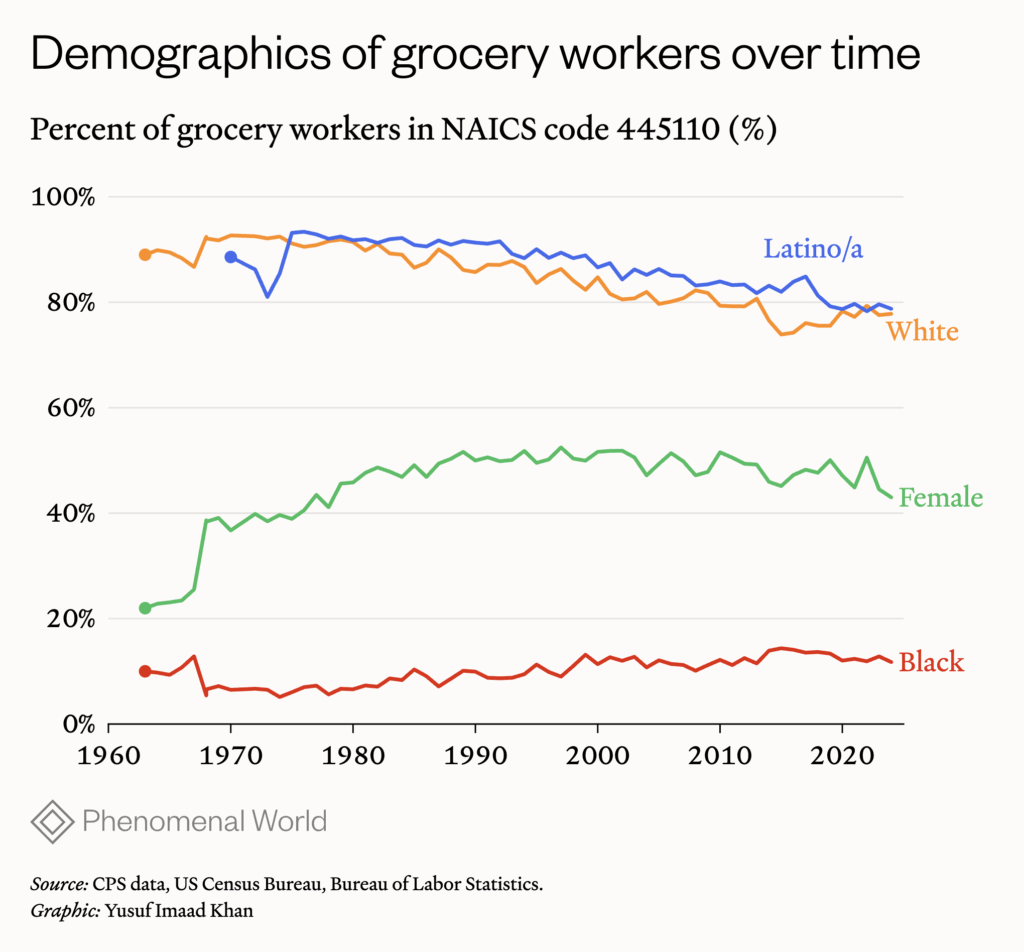
The showdown between the union and grocery companies in 2003 was a notable moment in a longer history of change in the grocery industry. Retail work has become increasingly feminized; the percent of female grocery workers grew from 21 percent to 42 percent between 1963 and 2024.
This shift was accompanied by the degradation of conditions for grocery work. Just as the demographics of the retail grocery workforce have shifted toward women, the lifelong, well-paying career of grocery store clerks has gradually become increasingly part-time and unstable.
Occupational segregation at Kroger
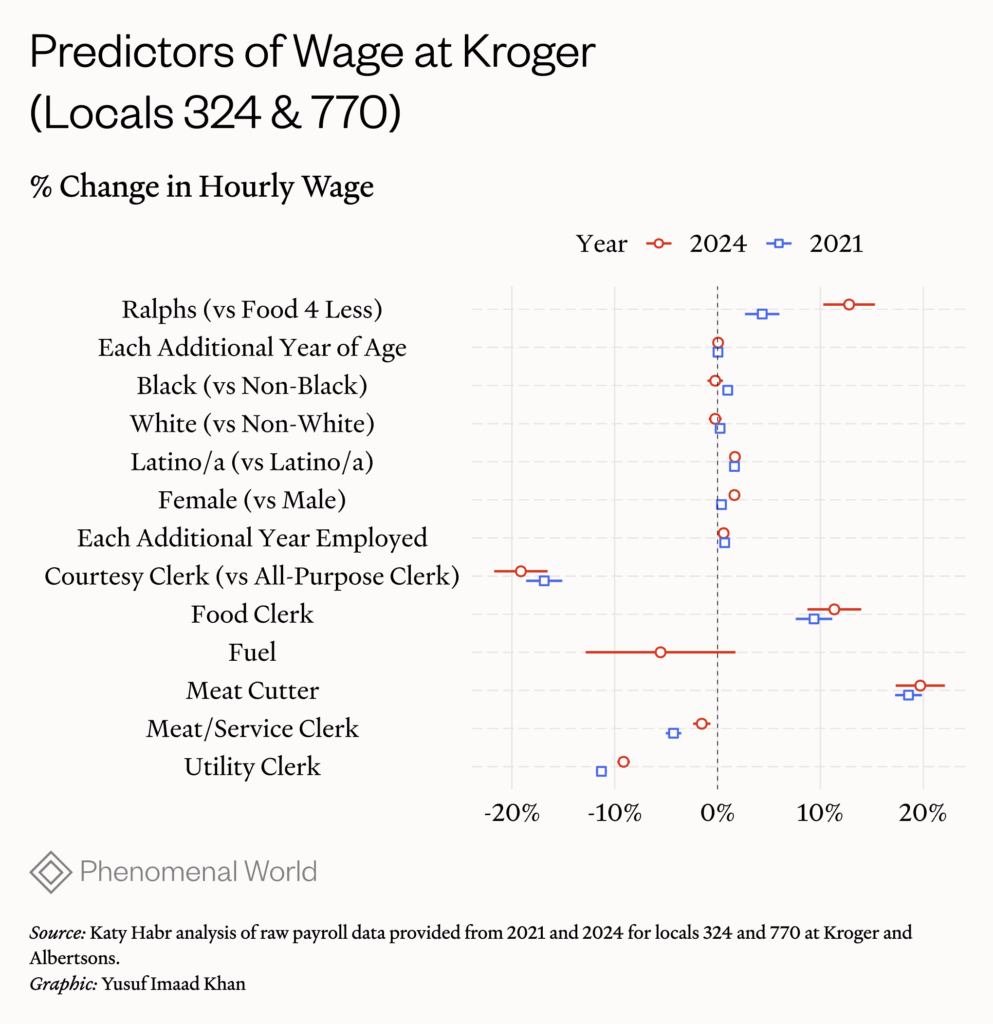
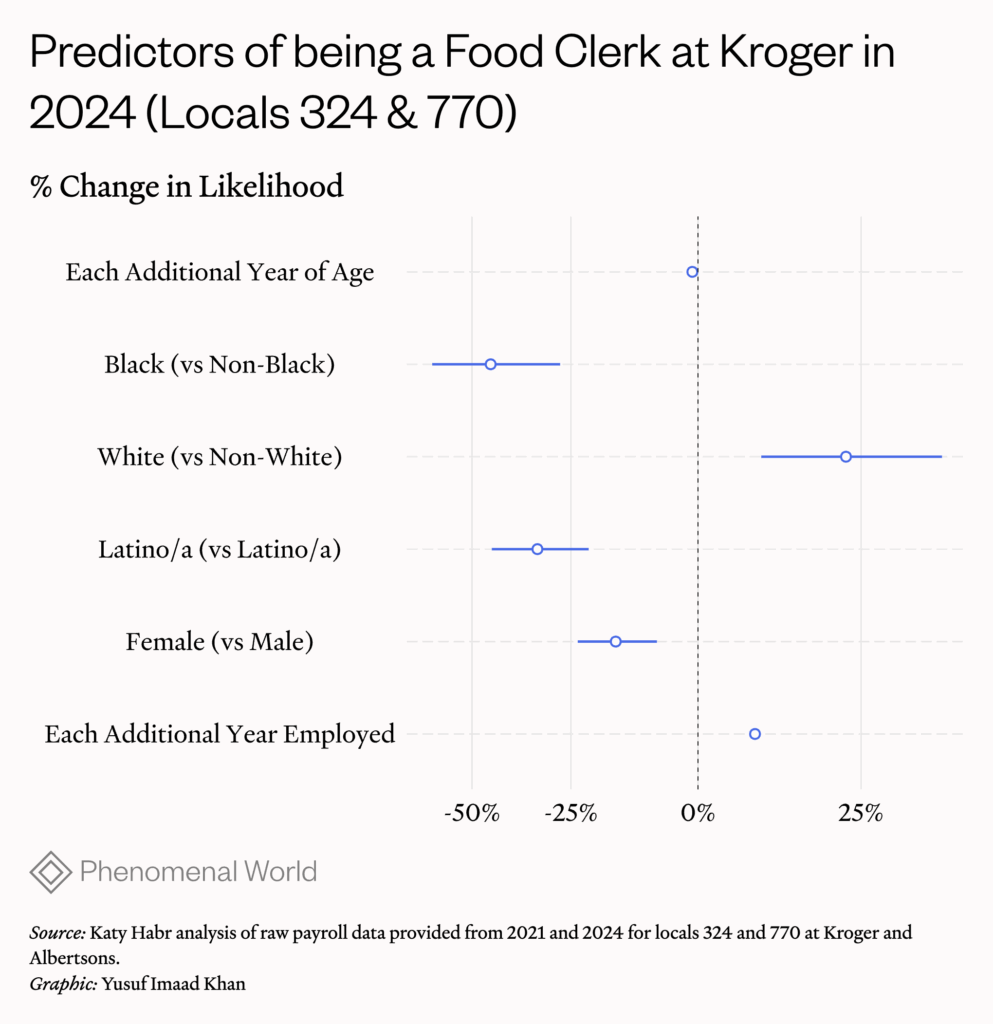
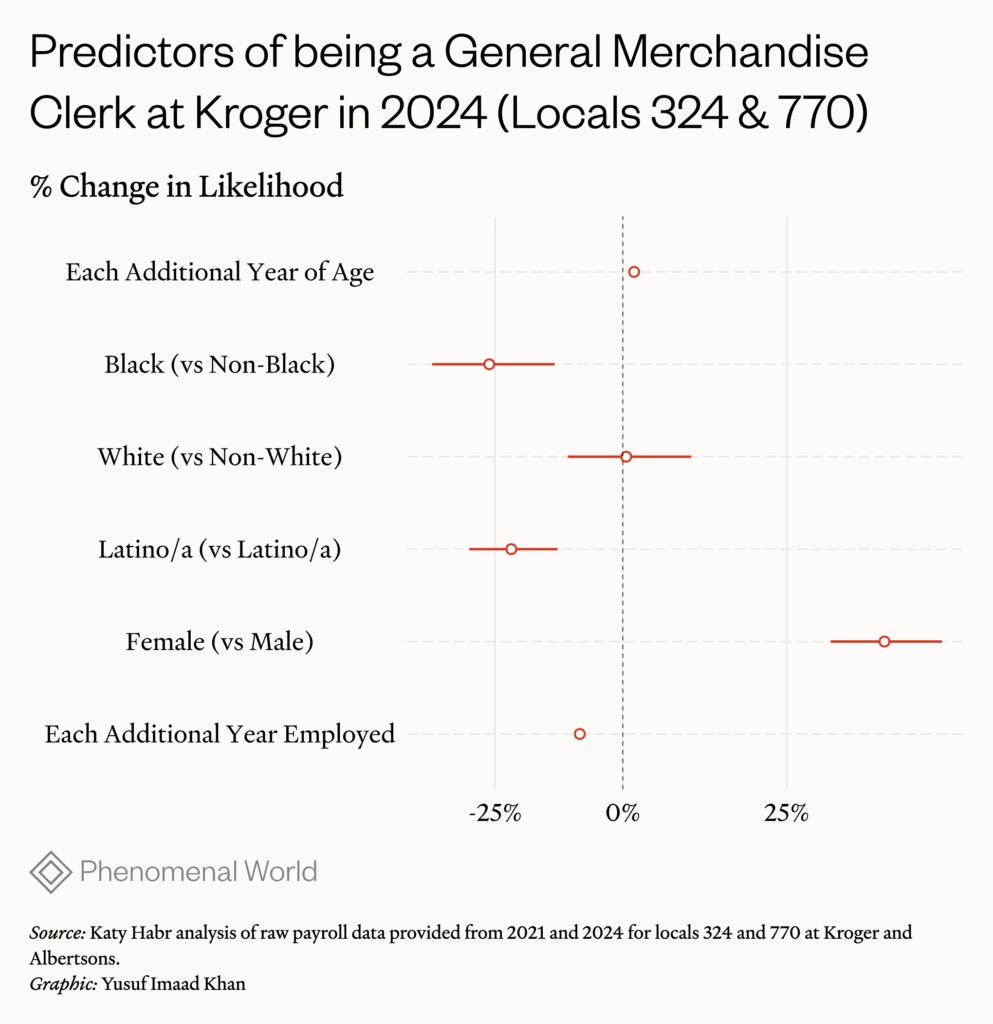
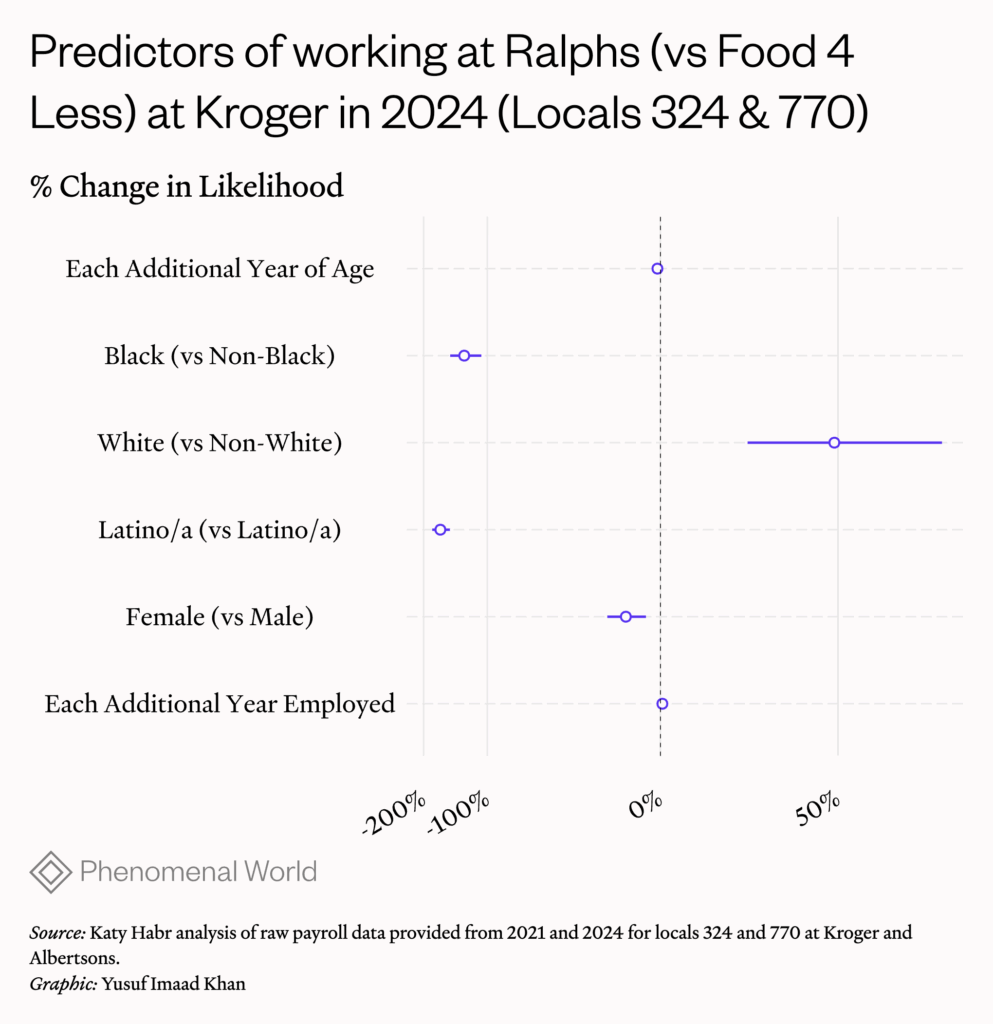
In April 2025, Kroger—which operates two subsidiaries in Southern California: Ralphs and Food 4 Less—released its shareholder-mandated report on wage disparities within its workforce by race and gender. The unsigned, one-page disclosure argued that there are no significant differences in pay by racial group when controlling for “position, tenure, hours worked, performance, geographic location, and collective bargaining unit.”
The reality, however, is more complicated. Union contracts standardize pay rates both across and within different job categories. At UFCW, these categories are called wage classifications. Kroger has nine wage classifications in the Southern California contracts: Food Clerks, Courtesy Clerks, General Merchandise Clerks, and Meat Cutters at Ralphs; All-Purpose Clerks, Fuel Clerks, Utility Clerks, Warehouse Clerks, and Meat Service Clerks at Food 4 Less. These different wage classifications comprise all job titles of workers included in the bargaining unit.
Because workers within the same wage classifications are paid roughly the same (accounting for wage steps, which are based on career hours worked in that job title), Kroger’s statement is both true and unhelpful. The second figure below displays demographic and job related wage predictors for 18,662 Kroger workers in UFCW Locals 770 & 324, who are 40 percent female, 8 percent Black, 49 percent Latino/a, and 22 percent white. It shows that controlling for wage classification nullifies any significant effects of race and gender on wages.
If controlling for job titles shows no pay disparities, this demonstrates that the union contract is working, and wages are standardized. However, it does not tell us much about the reality of inequality in the grocery industry.
As some UFCW leaders have long suspected, Kroger’s hiring and promotion into each wage classification are heavily racialized and gendered. Drawing from the same Kroger payroll data, we see substantial occupational segregation. For example, 96 percent of workers classified as Meat Cutters are male. As the figures below shows, Kroger tends to hire particular demographics into its Food Clerk and General Merchandise Clerk wage-classifications.
White workers at Kroger are 1.26 times or 26 percent more likely than non-white workers to be Food Clerks. Women at Kroger are 14 percent less likely to be Food Clerks than men. Food Clerks are also more likely to have moved up to the top rate of pay within that wage classification: 85 percent of workers in the Food Clerk Classification are paid the highest rate or are department heads. In contrast, Kroger’s General Merchandise Clerks, who work in apparel, floral, and non-food areas, are 1.45 times or 45 percent more likely to be women.
The median hourly wage for Food Clerks in California is $26.75, while for General Merchandise Clerks in was $17.98 in 2024. There are also more General Merchandise workers than Food Clerks at Kroger, with General Merchandise Clerks making up 35 percent of the sample in contrast to 24 percent for Food Clerks. With these large wage differentials, Kroger’s occupational segregation only further exacerbate wage inequality within its workforce.
As these figures show, the wage inequality happening at Kroger is not because of the company’s discriminatory treatment within each job title, but because of how the company hires and promotes people into different job titles. Observing this occupational segregation reveals significant racialized and gendered wage disparities.
Similar analysis shows that the same dynamics are present at the grocery chain Albertsons, which owns the subsidiaries Vons and Safeway in Southern California and has many of the same wage classifications as Kroger, and which negotiates its collective bargaining agreement with UFCW at the same time as Kroger does.
As the figure above shows, racialized and gendered divides exist not only within the same workplaces but across Kroger’s different subsidiaries. Ralphs is Kroger’s higher-end subsidiary that serves wealthier customers—the median household income in zip codes with a Ralphs is $99,584. At Ralphs, workers are 63 percent more likely to be white than non-white. Men are 14 percent more likely to work at Ralphs than women.
Meanwhile, workers at Food 4 Less, a low-cost Kroger subsidiary (in zip codes where median household income is $66,724), are 1.14 times or 14 percent more likely to be women. Workers at Food 4 Less are 253 percent more likely to be Black, and 409 percent more likely to be Latino/a. This segregation across subsidiaries has a significant impact for workers. Workers at Ralphs are paid on average $2.24 more dollars per hour than those at Food 4 less.
What is there to do?
Despite Kroger’s assurances that pay gaps do not exist within its workforce, UFCW is not convinced. In Southern California, the union has introduced a bargaining proposal that aims to bridge the wage gap. This proposal would do two things: First, it would make the wages of General Merchandise Clerks equal to that of Food Clerks within three years. Second, it would decrease the number of hours it takes to move up between wage steps, from 900 to 600 hours, and therefore the amount of time required to reach the top level of pay. This means workers would reach the top pay level after 5,400 hours instead of 7,800.
By bringing the wages of General Merchandise Clerks up to those of Food Clerks, and making it easier to reach the top level of pay, UFCW is hoping to close the gap between workers of color and white workers. Simulated data of the results of this wage proposal, included in the figure below, show that it would decrease the Black-White wage gap at Ralphs from $2.00 in 2025 to 93 cents in 2027. While this proposal would greatly benefit Ralphs workers, it does not impact Food 4 Less workers, whose lower pay will need to be addressed with more comprehensive changes to the company’s wage scales in the next Food 4 Less bargaining round.
Union representation and collective bargaining are effective in reducing inequality between workers with the same jobs. However, the gendered and racialized ways in which workers are slotted into different jobs remains a problem that unions must creatively solve. Managerial rights, a clause included by default in almost every collective bargaining agreement, reduces the ability of unions to close wage gaps by allowing managers to hire and promote workers in ways that perpetuate racial and gendered inequalities. External factors such as residential segregation, educational disparities, and other forms of structural inequality also contribute to this occupational segregation, underscoring the need for unions to bargain beyond bread and butter issues. These facts belie Kroger’s claim that its workforce is not segregated by race and gender, and bring into question its report to its shareholders.
Method Note: figures based on raw payroll data provided from 2021 and 2024 for locals 324 and 770 at Kroger and Albertsons.
Comments Off on Industrial Policy and Imperial Realignment
More than 2500 industrial policies were recorded in 2023—more than half of them from the US, Europe, and China. Advanced economies and developing countries alike are embracing more interventionist policies and engaging in policy experimentation.
Across the former, industrial policy now drives advances in artificial intelligence (AI), semiconductors, quantum computing, and clean energy; strengthens supply chain resilience; and “reshores” critical production. Across the latter, industrial policy is leveraged to integrate firms into global value chains, attract foreign investment, and enable “green industrialization” through critical minerals extraction and renewable energy production.
The normalization of industrial policy could mark a historic shift for developing countries. Over the past four decades, their ability to autonomously deploy industrial policies has been severely restricted, in a process described by Ha-Joon Chang as “kicking away the ladder” of catch-up development. A new consensus that re-legitimizes these tools could provide them with greater policy space to pursue instruments and practices hitherto off limits.
Yet the multiplication of industrial policies signals neither normalization nor consensus. Rather, industrial policy is increasingly the object of contestation over the norms and practices of state interventionism. Key actors—including advanced economies, emerging powers, and global governance institutions—diverge over (1) its appropriate form (2) its governance (3) its scope, (4) its objectives, and (5) the policy space available for state-driven experimentation.
In practice, industrial policy is being deployed asymmetrically across the global economy. Both the capacity to pursue transformative industrial policies and the form that enacted industrial policies take remain enormously shaped by global financial and monetary hierarchies, integration into global supply chains, and geopolitical positioning. The pace at which advanced economies and less-developed countries are adopting industrial policies is diverging, with the former better positioned to take advantage of the current period of turbulent change. The policy tools and instruments primarily mobilized by advanced and less-developed economies also differ significantly, reflecting unequal capacities for industrial policy experimentation. These differences are reflective of structural imbalances of state agency within the global economy: advanced economies operate with few restrictions, geostrategically significant emerging economies enjoy selective flexibility, while low-income countries face continued marginalization.
A transforming policy space
As critical development scholars have long argued, the past four decades have seen a significant erosion of “development policy space”—the ability of states, particularly in the global South, to autonomously design and implement national development strategies. Such constraints have been particularly acute in industrialization efforts, where developing states encounter legal, financial, and institutional barriers to deploying interventionist policies.
These constraints have stemmed from three primary sources: (1) the dominance of neoliberal policy norms, entrenched through structural adjustment programmes and conditional lending under the Washington Consensus; (2) binding international economic law, particularly within multilateral trade and investment agreements; and (3) provisions embedded in bilateral and regional trade and investment agreements. Collectively, these constraints have severely limited the ability of developing countries to pursue industrial policy, effectively impeding catch-up development.
The renewed interest in industrial policy may signal a loosening of these constraints. First, the ideological dominance and—perhaps more accurately—coherence of neoliberalism have waned, weakening the appeal of policies that prioritize limited state intervention and the primacy of the private sector in development. As a result, spurning industrial policy has become increasingly difficult, particularly as advanced economies themselves adopt more interventionist strategies. While a coherent alternative paradigm to neoliberalism has yet to emerge—with emergent forms of state capitalism intersecting with extant market-oriented imperatives—we may be entering what Ilene Grabel terms a period of “productive incoherence” in global economic and financial governance, a phase of unsettled development norms in which policy experimentation is increasingly possible. The absence of a coherent and effective disciplinary framework arguably expands policy space and the scope for experimentation with instruments that diverge from the “traditional” neoliberal playbook. Further, there is scope for such experimentation to shape the formation of new global norms on the issue.
Second, the erosion of the multilateral trade regime offers potential flexibility for developing countries to implement industrial policies. The World Trade Organization’s (WTO) dispute system has been effectively neutralized by the US blockage of all new Appellate Body appointments. As Kristen Hopewell highlights with regards to Indonesia and India’s export restrictions and subsidy programs that violate WTO rules, developing countries have exploited this legal vacuum—what she terms “appealing into the void”—to continue industrial policy practices deemed inconsistent with WTO rules. This could embolden policymakers in the global South to pursue industrial strategies without immediate fear of legal repercussions or consequences.
Persisting constraints
Despite its promise, the revival of industrial policy space cannot be divorced from broader structures of power in the global financial and monetary system. Empirical evidence confirms a stark asymmetry in industrial policy deployment, with wealthier countries implementing significantly more interventions than their lower-income counterparts.
Table 1: Global incidence and distribution of industrial policy according to country-income quintile (GDP per capita), 2010-2022.1Adapted from Juhász, Lane and Rodrik (2023)
The ability to deploy industrial policy is deeply shaped by financial and monetary constraints. Compared to advanced economies, emerging and developing economies (EMDEs) face greater fiscal limitations, including lower tax revenues and an inability to borrow in domestic currencies. Consequently, they depend on external financing for development and industrialization—often under restrictive conditions that constrain policy autonomy. Under conditions of “international financial subordination,” developing countries are particularly vulnerable to financial and exchange rate instability, sudden shifts in global liquidity conditions, and precarious sovereign borrowing. Sustaining external capital inflows typically requires offering high returns to international investors, reinforcing incentives to adhere to conservative economic policies despite the growing space for industrial policy experimentation. In developing contexts where foreign investment is perceived as risky, even minor deviations from economic orthodoxy risk triggering the risk of capital flight and/or non-investment, making policy experimentation a costly prospect.
Moreover, the form industrial policy takes—namely the concrete mix of policy tools, instruments, institutional arrangements, and regulatory frameworks—differs markedly between EMDEs and advanced economies. As Figure 1 illustrates, EMDEs primarily rely on “trade-distortive” measures, such as import and export restrictions, whereas advanced economies make greater use of direct financial grants and state aid—policy instruments that depend on government expenditure. While this general trend has been complicated by the Trump administration’s recent implementation of a raft of trade-distortive tariff measures, and the specter of concomitant in-kind responses by advanced economies worldwide, it is nevertheless true that there is a North-South divide in terms of the form of industrial policy implemented.
Figure 1: Trade Distortive Industrial Policy Tools in 2023 by Income Group2Evenett et al., 2024
This divide is also a consequence of the South’s financial subordination. Where industrial policy is deployed by countries dependent on external investment, policy packages are likely to rely more on “carrots”—such as generous subsidies, grants, tax incentives, subsidized loans, and guarantees—rather than ‘sticks’ like hard rules, limits, or penalties. Industrial policy in these contexts is also more likely to rely on price signals and market coordination rather than a strong state-led directive or disciplinary approach. It is also likely to adopt a narrow form of government intervention focused on adjusting risk-return profiles in strategic industries and sectors, or “de-risking” projects as a means to crowd-in private investment. However, the widespread use of such de-risking strategies entrenches financial dependencies, particularly for countries already structurally subordinated within global financial and monetary hierarchies, further increasing their risks of and exposure to debt distress and sudden capital flight.
This is not to suggest that developing countries lack agency in designing and implementing industrial policy plans in pursuit of strategic visions. It does however reveal that industrial policy operates within a global political economy shaped by power asymmetries and the subtle violence of the global monetary and financial system. The critical question is, therefore, not simply whether industrial policy space is expanding, but rather what kind of industrial policy is being pursued, under what conditions, and at what costs; particularly regarding public transfers to the private sector and the reinforcement of existing power and economic inequities.
Geopolitical competition
Intensifying geopolitical competition is both driving and shaping many of the structural imbalances. Technologically advanced economies are engaged in a process of competitive emulation, where industrial policies are strategically and continually deployed in response to the policies deployed by geoeconomic rivals. This industrial policy race generates a multiplier effect particularly evident in subsidy competitions—such as the “green subsidies race”—and escalating defensive trade measures, including tit-for-tat tariffs on electric vehicles.
Certain developing countries are particularly well-positioned to benefit from this geopolitical competition. Referred to as “connector countries” by the IMF or “geopolitical swing states” by Goldman Sachs, nations such as Hungary, Poland, Morocco, Vietnam, Indonesia, Malaysia, and Mexico stand to gain due to their geostrategic proximity to key markets and/or possession of strategic assets, including critical transition minerals, established export-oriented industries, and abundant skilled labor (or combinations thereof). These countries are also prime candidates for “China+1” strategies, whereby firms seek to reduce exposure to geopolitical risks by diversifying production beyond China.
The EU Green Deal, for instance, promotes domestic cleantech investment while sourcing renewable energy from African countries such as Morocco, Namibia, and South Africa. Further, and even prior to the recent raft of tariff measures by the Trump administration, the US has been restructuring strategic supply chains to reduce reliance on Chinese firms through “reshoring” and, more significantly, “friendshoring”—deepening economic ties with allied states. Heightening US-China tensions may benefit countries such as India, where Apple is now looking to source the entirety of the more than 60mn iPhones sold annually in the US by the end of 2026.
Many “connector countries” and others in the global South are actively scaling up their industrial ambitions in response to this evolving geoeconomic landscape. Some have adopted a strategy of “polyalignment,” leveraging diverse financial partnerships to fund industrial development while avoiding alignment with any single country or geopolitical bloc. Their objective is to attract investment by positioning themselves as stable and strategic partners for multiple global powers.
Morocco, for instance, is courting investment from a wide range of partners—including France, Germany, Spain, the US, China, the UK, Portugal, Turkey, the UAE, Saudi Arabia, Israel, South Korea, and Russia—to finance its green industrial policy. This “polyalignment” strategy has been highly successful so far, with announced greenfield FDI in Morocco surging from $3.8 billion in 2021 to $20.4 billion in 2023. Similarly, Vietnam has attracted substantial FDI inflows in manufacturing from Singapore, Japan, the US, Korea, and China, recording $4.33 billion in January 2025 alone—a 48.6 percent year-on-year increase. Mexico has also seen a wave of investment in its electric vehicle (EV) sector by Tesla (US), CATL (China), alongside European and Korean firms. Likewise, Indonesia has pursued an aggressive strategy of attracting foreign investment into “new developmentalist” projects in nickel mining and downstreaming, which saw FDI reach $55 billion in 2024, a 21 percent increase on the previous year, with the top four sources being Singapore, China, Malaysia and the US. Thus the combined expansion of industrial policies driven by competition over advanced technological sectors may, in turn, spur further industrial policy experimentation in some global South countries.
Rebuilding the ladder?
Though it presents new opportunities, this new context preserves the overwhelming power imbalances that characterize the global economy. Developing countries remain dependent on policy shifts and changing priorities of the wealthier nations in the global North.
For example, having made a concerted effort to utilize its nickel deposits to develop industries producing key components of clean-energy technologies—such as EV batteries—Indonesia found itself partly locked out of its biggest intended market, the US, once the Inflation Reduction Act (IRA) was passed in 2022. The IRA excluded from its subsidies any products made by entities with more than 25 percent Chinese ownership. With Chinese companies constructing 90 percent of Indonesia’s nickel smelters and establishing several battery-focused processing plants, this left the country’s industrial strategy stranded, and despite several attempts at negotiating exemptions, the US refused to budge on the issue, insisting that Indonesian significantly reduce China’s role in the industry, a difficulty given the paucity of alternative funding sources.
Competition may also cannibalize developing countries, particularly those within the same region, as they compete for investment and industrial opportunities. For example, Hungary, Czechia, Slovakia, and Poland are competing to position themselves as an EV production and export base connecting East Asian and European supply chains to rich western European markets. But ultimately, French, German, Korean and Chinese automakers will choose to invest in a limited number of production sites. Hungary, Serbia, Slovakia, Poland, and the Czech Republic simply cannot all become critical nodes of EV production networks in Central and Eastern Europe. Similarly, in Asia, not everyone can benefit from “China+1” strategies. India, Vietnam, Thailand, Cambodia, Malaysia, and others fiercely compete over key segments of the semiconductor, photovoltaics, and electronics supply chains, with risks of a race to the bottom. Further, China already dominates key supply chain nodes and actively pursues industrial policy. Its monopolized control over critical machinery, heavy equipment, and critical transition minerals makes it especially difficult for other countries to establish high-value manufacturing.
In recent months, China has tightened its formal and informal export controls on EV battery and critical mineral processing technologies in response to the US and EU’s increasingly aggressive tariffs on EVs and other commodities. This is not only hampering the ability of Taiwanese, American, and other firms to move part of their manufacturing and assembly operations out of China in response to geopolitical risks, but the Chinese party-state is also explicitly targeting India in a bid to prevent the latter from positioning itself as a privileged destination for the relocation of manufacturing operations. In short, China is using its control of strategic economic networks to sabotage another country’s attempt at polyalignment.
The chaotic return of Trump to the White house also adds considerable risks and uncertainty to the economic prospects of “connector countries.” The problem is not only Trump 2.0’s erratic behavior and his systematic use of bullying as a mode of power, it is also that his reckless deployment of tariffs to reshape the contours of the world order risks upending the global trading system and the international financial architecture. Needless to say, this would not bode well for polyalignment strategies and export-oriented industrial policies in the global South.
Finally, while environmental goals, manufacturing jobs, and economic growth are often framed as complementary, their pursuit through competitive industrial policy in fact creates tensions between them. Green development depends on effective industrial policy, yet its uneven application poses broader risks, particularly as wealthier nations’ climate policies remain unilateral, highly competitive, and often exclusionary. By limiting the diffusion of key technologies, intellectual property, and know-how, and erecting trade and investment barriers in the name of geopolitical competition, these policies risk making clean technology more expensive and slowing the global energy transition. Thus, for example, by excluding Chinese EVs from its market, the US has little chance of meeting its emission reductions targets, given the underdeveloped state of the industry in America. In short, when multiple countries pursue green industrialization policies simultaneously, success in (re)industrialization for some may come at the expense of others.
Towards a three-tiered hierarchy of global industrial policy
Taken together, these dynamics may deepen and ultimately consolidate a three-tiered hierarchy of global industrial policy deployment. At the top of this hierarchy, rich technologically-advanced economies with vast fiscal capacities and strategic control of global value chains may enjoy wide latitude in deploying increasingly muscular industrial policies as they aggressively compete with each other, while attempting to contain economic crises, domestic political polarization, and accelerating climate change. These already structurally advantaged nations would consolidate and extend their economic lead and technological supremacy.
The second group would comprise geostrategically significant large emerging economies with selective flexibility to deploy industrial policy to position themselves as key nodes in restructured production networks, rather than passively integrate into global markets. Their success would depend on their ability to secure technology transfers and favorable financing terms, particularly with respect to clean tech and climate finance. It would also depend on their ability to navigate a turbulent geopolitical context and rapid realignments in the imperialist hierarchy of global capitalism. This in turn will influence their ability to craft ambitious, long-term green industrial strategies that promote structural transformation, ecological sustainability, and broad-based development.
For many other developing countries, however, policy space is likely to remain severely constrained and policy experimentation will carry heightened risks. External conditions will continue to demand deference to the perceived exigencies of private investors and these countries may be increasingly vulnerable to the whims of hegemons old and new.
The greatest risk, then, is that the contemporary industrial policy revival does not rebuild the ladder of catch-up development, but raises it further out of reach. In sum, it may not only leave some countries behind, but marginalize them further.
With a pin of Javier Milei’s signature chainsaw affixed to her jacket, Managing Director of the International Monetary Fund Kristalina Georgieva threw her support behind Argentina’s new administration in Washington last month. During a press conference at Washington’s Spring Meetings, she urged Argentinians “to stay the course” and back Milei at the upcoming legislative elections in October. “It’s very important that they don’t derail the will for change,” she said.1Legislative elections are scheduled to be held in Argentina on October 26, 2025. Half of the seats in the Chamber of Deputies and a third of the seats in the Senate will be elected. Some districts also have provincial deputies elections. On some occasions national and local elections are conducted simultaneously and in others there are in different dates.
After publicly endorsing Milei’s economic achievements since coming to power in December 2023, Georgieva approved a new bailout package of USD 20 billion. This comes despite the fact that Argentina has yet to repay a single dollar of the $45 billion loan originally issued in 2018 under Mauricio Macri, and later formalized in 2022 by Martín Guzmán under an Extended Fund Facility (EFF) program.2Until February 2025, Argentina paid $12.5 billion to the IMF (<)a href='https://www.clarin.com/economia/pagaron-fmi-us-12500-millones-intereses_0_U70hDEF2tL.html'(>)in interest(<)/a(>). Together, the old and new loans make Argentina the IMF’s largest borrower by a wide margin, accounting for 34 percent of the Fund’s total outstanding credit—amount so far to $65 billion capital, plus interest—almost four times that of the second-largest borrower, Ukraine, a country in the middle of a years-long war.
Argentina’s toxic affair with the IMF has a long and complicated history. It was the last country in Latin America to join the institution, in 1956, and for the last forty-five years, it has co-governed Argentina through a revolving door of Stand-By Arrangements (SBAs) and three EFF programs. In other words, nearly two-thirds of Argentina’s modern economic history has unfolded under the IMF’s watchful eye—and often meddling hand.
President Milei, for all his libertarian branding, evokes a distinct sense of déjà vu. His economic team is less a bold new vanguard than a familiar cast of technocrats identifiable from previous neoliberal experiments—many of which ended in spectacular crises. The man who gifted Georgieva the chainsaw pin is Federico Sturzenegger, now Minister of Deregulation and State Transformation. He played a central role as Secretary of Economic Policy during the infamous megacanje of 2001: a controversial debt swap that deepened financial instability and helped precipitate Argentina’s worst economic collapse to date.3Sturzenegger was formally charged for his alleged role in the Megacanje operation. As a former official in the Ministry of Economy in the early 2000s, he was accused of participating in the planning and execution of the debt swap without fully disclosing the risks and adverse financial consequences for the Argentine state. The charges centered on the claim that Sturzenegger, along with other officials and international bankers, engaged in financial maneuvers that prioritized short-term debt relief but ultimately worsened the country’s fiscal outlook. However, the highly corrupt judiciary system dismissed the charges after fifteen years of legal disputes—during Macri’s administration. Despite still being under investigation, Macri appointed Sturzenegger as Director of the Central Bank in 2016 (CIS, 2014; Infobae, 2016). Other appointments have reinforced this pattern. Figures from Carlos Menem’s administration (1989–1999), such as Guillermo Francos, and even Menem’s nephew, Martín Menem—now President of the Chamber of Deputies—feature prominently.
From the Macri era (2015–2019), familiar names return: Patricia Bullrich, Santiago Bausili, and most notably, Luis Caputo. Caputo as well as Bausili were former JP Morgan and Deutsche Bank directors. Both were business partners in Anker consulting company. Perhaps the most striking irony lies in Milei’s past condemnation of Caputo. In a 2018 interview, Milei accused Caputo of having “sold out” and having “smoked $15 billion from the IMF,” as well as being responsible “for the disaster in the Central Bank.” Today, that same Caputo serves as Milei’s Minister of Finance, while Bausili is President of the Central Bank. So much for the much touted independence of Argentina’s current economic policy.
Against this backdrop, the IMF’s decision to approve yet another financial lifeline raises unavoidable questions. Lending fresh funds to the team that has repeatedly driven the country into crisis is either a leap of faith on the Fund’s part or the product of institutional amnesia. The scale of Argentina’s borrowing now poses systemic risks not just to the country, but to the Fund. As the IMF candidly admitted in its own ex-post evaluation, the 2018 Stand-By Arrangement “has created substantial financial and reputational risks to the Fund.” In this high-stakes gamble, the chainsaw may yet come full circle.
Reputational risks
The Italian sociologist GiovanniArrighi theorized that any cycle of accumulation led by a hegemonic power will include a phase of material and financial expansion, followed by stagnation and crises, often leading to broader ruptures in global leadership.4Giovanni Arrighi, (<)em(>)The Long Twentieth Century: Money, Power, and the Origins of Our Time(<)/em(>), Verso (1994). According to Arrighi, world hegemony refers to a state’s ability to lead and govern a system of sovereign nations, often involving transformative actions that reshape the system’s functioning.
Hegemony differs from simple domination. Unlike a dominant power’s dependence on coercion, hegemony is strengthened by intellectual and moral leadership and the ability to frame conflicts in universal terms. When a hegemon loses legitimacy, it ceases to be hegemonic. Global hegemony, therefore, arises not just from power among states, but also from a state’s capacity to represent the collective interests of its own citizens and others. For Arrighi, the US claim to hegemony following World War II relied on its ideological leadership of Bretton Woods institutions like the IMF and the World Bank, as well as the UN, all of which promoted development and peace and countered the Soviet influence. As the US reorganized the “free world,” the Bretton Woods institutions and the UN became tools of American hegemony; when they couldn’t serve this role, their functions were limited.
The IMF has 191 member countries but the US is by far the most powerful. Its voting power reflects this. It holds 16.5 percent of the total votes, giving it effective veto power over major decisions, which typically require an 85 percent majority. The top five countries collectively hold 38 percent of the voting power, while the top ten countries account for over 52 percent, reflecting a significant concentration of influence among a small group of powerful economies.
Successive failures in stabilizing the global economy and providing developmental paths for the countries of the global South like Argentina means that the IMF is now experiencing substantial financial and reputational risk.5International Monetary Fund (IMF), Ex-post evaluation of exceptional access under the 2018 Stand-By Arrangement—Press release and staff report (2021). https://www.imf.org/en/Publications/CR/Issues/2021/12/22/Argentina-Ex-Post-Evaluation-of-Exceptional-Access-Under-the-2018-Stand-By-Arrangement-511289 Considering the increasing role of China as a lender of last resort and the expansion of a Sinocentric network of development banks, this is no minor issue.
Argentina and the IMF
Argentina has had a long and complex relationship with the IMF, marked by recurring cycles of debt, crisis, and restructuring. Since 1958, it has entered into over twenty IMF arrangements—primarily Stand-By Arrangements and Extended Fund Facilities—totaling more than 133 billion SDRs in agreed funds, $177 billions, 60 percent of which were drawn. These programs have consistently come with strict macroeconomic conditionalities, often focused on fiscal austerity, inflation control, trade liberalization, and structural reforms.
In 1944, Argentina had been excluded from the Bretton Woods agreement due to concerns over its lack of political alignment with the United States and its neutrality during World War II. With the overthrow of the Juan D. Perón government during the “Revolución Libertadora” in 1956, Argentina was finally welcomed to the club.
The first agreements, signed in the late 1950s and 1960s, were modest in size and aimed at monetary stabilization and foreign reserve accumulation, introducing Argentina to IMF-style fiscal discipline, and eliminating key development assets such as the railway network.6By the 1940s, Argentina had the largest railway network in the American continent achieving over 47,000 km. The first agreement signed with the IMF in 1958 among other goals aimed to “eliminate” most of the railroads.
In December 1982, Argentina’s central bank nationalized nearly $17 billion of private debt, concluding a period of Kissinger-backed dictatorship (1976–1983) characterized by some of the earliest experiments with neoliberal restructuring. The decision paved the way for the debt crisis of the 1980s and subsequent deindustrialization and adjustment reforms policies in hand with social repression. The Latin American debt crisis unfolded in the context of escalating US interest rates, prompting Argentina to enter into a series of larger SBAs. These included measures such as currency devaluation, public sector downsizing, and tight wage controls, all of which contributed to recessionary pressures and political unrest amid rising inflation and social discontent.
In the 1990s, Argentina embraced the Washington Consensus and so entered into what became known as its era of “carnal relations” with the US. The 1991 SBA and the 1992 EFF supported Carlos Menem’s reforms, particularly the convertibility plan that pegged the peso to the US dollar. IMF-backed policies included mass privatizations, trade liberalization, and fiscal consolidation. However, by the late 1990s, vulnerabilities deepened. The 1996 SBA and 1998 EFF aimed to sustain convertibility, but external shocks and rising debt levels set the stage for a devastating crisis.
At the turn of the millennium, Argentina signed a new 16.9 billion SDR loan, followed by a Supplemental Reserve Facility of 6.1 billion SDR in 2001 as its economy spiraled into collapse. The IMF demanded further deficit reduction, labor market reform, and continued commitment to the currency peg. These measures were widely seen as deepening the crisis, which culminated in the 2001 debt default, the largest in global history at the time.
In 2003, during the post-crisis transition, Argentina signed two new SBAs to stabilize its economy and begin restructuring its debt. These programs marked a shift from a program of strict austerity policies geared toward recovery. Then, in a historic move, President Néstor Kirchner announced the full repayment of IMF debt in December 2005—approximately $9.9 billion. By 2006, Argentina closed the IMF’s office in Buenos Aires, symbolically severing ties. Kirchner criticized the Fund’s role in Argentina’s crisis, stating the country was “burying an ignominious past” of externally imposed economic policies.
“We will return”: the largest loan of IMF’s history
Georgieva is not the first IMF director to show signs of political favoritism in Argentina. In 2020, Mauricio Claver-Carone, who served as the United States Executive Director at the IMF and was a crucial advisor to the first Trump administration on Latin America, asserted that “Everything Trump did at the IMF was to assist Macri and prevent Peronism from returning to the Casa Rosada.”
It was under President Mauricio Macri in 2018 that Argentina returned to the IMF with a record-setting $57 billion loan. Some argue that the IMF approved the loan—its largest ever, anywhere in the world—to politically support Macri’s re-election in 2019, despite clear warning signs that the program was unsustainable. This perception of partisan interference tarnished the institutional neutrality expected from the IMF.
The program aimed to restore market confidence but imposed harsh conditions: zero growth in the monetary base, sharp fiscal consolidation, and a market-driven exchange rate. The 2018 agreement was struck quickly and quietly, leading to accusations that the terms were opaque and negotiated behind closed doors without democratic oversight or public debate. This raised questions about its legitimacy, even if not outright illegality under international law; the deal only worsened recession and poverty, ultimately failing to stabilize the economy. It also violated Argentina’s domestic law and the IMF’s own rules.
According to Argentina’s Constitution, major international financial agreements—especially those involving sovereign debt—should be approved by Congress. Macri’s administration negotiated the $57 billion agreement (eventually drawn down to $45 billion) without prior legislative ratification.7The (<)em(>)Coordinadora de Abogadxs de Interés Público(<)/em(>) (Lawyers for Public Interest Coordinator) led the (<)a href='https://fmiargentina.com'(>)legal disputes (<)/a(>)in the judiciary to declare the nullity of the IMF loan in 2018. The deal was later formalized by Alberto Fernández’s Minister of Economy Martín Guzmán, who regularized it in 2022 via an Extended Fund Facility, which achieved congressional approval only after the fact.
Several experts and former IMF officials have argued that the loan breached the IMF’s Articles of Agreement.Much of the 2018 disbursement was used to support the Argentine peso and finance capital outflows, which contradicted the Fund’s core mission, stated in Article I, according to which the IMF is supposed to ensure general economic and balance of payments stability. Article 6 states that “A member may not use the Fund’s general resources to meet a large or sustained outflow of capital.” But the Argentine Central Bank found that most of the funds were used to pay off foreign investors and support capital flight, rather than fund productive investment or structural reform.8Banco Central de la República Argentina (BCRA). (2020). Mercado de cambios, deuda y formación de activos externos 2015–2019. https://www.bcra.gob.ar/Noticias/publicacion-de-informe-mercado-cambios-deuda-2015-2019.aspThe ex-post evaluation by the IMF mentions the term “capital flight” twenty-one times and recognizes that “capital flight undermined the restoration of international reserves.”
Critics argued that the program lacked a credible macroeconomic plan and sustainable debt path. The Fund recognized something similar in its ex-post evaluation, acknowledging that “the SBA has created substantial financial and reputational risks to the Fund.” The evaluation concluded with five major recommendations that, half a decade later, appear to have been ignored:
First, it is essential that they incorporate realistic assumptions. Second, programs should be tailored to country circumstances, including political economy considerations, which could entail using unconventional measures if standard macroeconomic policies are unlikely to deliver. Third, the analysis of risks underlying key judgments made when applying the Exceptional Access Framework should be clearly laid out and communicated to the Board. Fourth, ownership, which should be understood in a broader societal sense, should not preclude a candid assessment of possible better policy choices and program outcomes. Fifth, effective external communication is essential in securing proper buy-in at different levels and the intended catalytic effect. Finally, an appropriate burden sharing is needed when entering into exceptional access arrangements.
Guzman’s laws
In 2021, President Alberto Fernández placed the Minister of Economy, Martin Guzmán, in charge of renegotiating the controversial IMF loan. Amid an unprecedented global pandemic, the war in Ukraine, and a shifting international financial landscape, Guzmán led a widely criticized negotiation that secured neither a reduction in principal nor meaningful relief on interest payments. Moreover, Guzmán’s negotiations were notably secretive—even to senior political leaders and foreign affairs officials—undermining any potential for building internal consensus.
Despite acknowledging the IMF’s role in “financial gambling,” and approving a political loan that constituted “fraud,” Martín Guzmán formalized the questionable loan through an EFF—essentially replacing the original debt with a new one, under slightly modified terms. The original Stand-By Agreement had been legally dubious, yet Guzmán effectively “legalized” it and postponed capital payments instead of challenging its legitimacy. Guzmán also introduced Law 27.612, the so-called “Guzmán Law,” which required Congressional approval for new international financial agreements, particularly those involving the IMF.
Guzmán aimed to promote gradual fiscal adjustment, reserve accumulation, and protect social spending—a softer stance compared to previous IMF arrangements. However, none of the EFF program’s objectives were achieved. Inflation, already high, spiraled out of control and exceeded 200 percent; Guzmán had little choice but to resign, which he did in July 2022. Public frustration over rising prices and declining living standards paved the way for Milei’s electoral victory in late 2023. Guzmán’s docile strategy was a failure: the negotiations were innocuous.
Even the “Guzmán Law” proved largely symbolic. President Javier Milei’s administration circumvented it by issuing a Decree of Necessity and Urgency (DNU) to approve a new Extended Facility Program worth 15.3 billion SDR (approximately $20 billion). His success in doing so illustrated how little resistance even substantial financial agreements may face within Argentina’s fragile institutional framework, plagued by corruption and entrenched political decay.
Within the larger context, the victory over the surcharges seems more like a sideshow than a real resolution of Argentina’s illegitimate loan from the IMF.
The second round
Milei’s new IMF loan is structured under a forty-eight-month EFF arrangement for Argentina, totaling $20 billion (or 479 percent of its IMF quota). This adds to the existing $45 billion, with an immediate disbursement of $12 billion. A first review is scheduled for June 2025, with a corresponding disbursement of approximately $2 billion just a few months before the October elections. The funding is intended to stabilize Argentina’s currency and address urgent debt obligations. Given that the targets will not be met, the IMF has decided to postpone the review date from June 13 to the end of July—another reminder that the loan is less about technical or economic sustainability than pure political discretion.
The disbursed $12 billion has already been used to purchase liabilities from Argentina’s Central Bank—in other words, to move funds from the Treasury to the Central Bank. With this financial “magic,” the total amount of reserves will remain stable; when held by the Treasury, they count as part of gross reserves because they are recorded as “encumbered” deposits; and once they are transferred to the Central Bank’s assets, they become net and liquid reserves, available for intervention if necessary within a banded floating exchange rate system. This opens new avenues for carry trade in a context of over-valued pesos, sitting pretty for a future flight of capital.
Regarding repayment dynamics, the IMF emphasizes the need for Argentina to rebuild its foreign reserves from low levels. Regaining market access and managing global risks will require further enhancements to the foreign exchange (FX) and monetary regime, alongside a careful, sequenced easing of FX restrictions.
As of early 2025, the Argentine peso is the most overvalued currency on The Economist’s Big Mac Index; it is sitting at 56.7 percent against the US dollar (Bloomberg, 2025). This has contributed to a slowdown in the liquidation of commodity exports. In response to concerns from the agribusiness sector, Finance Minister Luis Caputo suggested producers engage in carry trade strategies to increase returns. Rural associations, in turn, replied:
The productive sector we represent has received statements from national officials that are troubling. First, we were advised to engage in financial speculation—an activity entirely unrelated to our core mission. Our work is to generate real, exportable wealth, which over the years has allowed successive governments to confiscate a total of $200 billion.
It remains unclear how the Argentine government intends to truly recapitalize the Central Bank’s reserves; this would entail doing so through sustainable means rather than by increasing external debt. So far, the government has relied on a “blanqueo de capitales” ( capital regularization or tax amnesty) scheme—often criticized for enabling large-scale money laundering. A total of $32 billion in assets was declared, including $22 billion in cash deposits via Special Regularization Accounts (CERA) and Settlement and Clearing Agents (ALyC), and almost $10 billion in other assets such as real estate, vehicles, and corporate shares. Coincidentally or not, the current Minister of Justice in Milei’s administration, Mariano Cúneo Libarona, previously served as the defense lawyer for several of Argentina’s most prominent drug traffickers.
Argentina’s debt traps
During his April 2025 visit to Buenos Aires, US Treasury Secretary Scott Bessent expressed strong support for Argentina’s economic reforms under President Javier Milei, particularly the government’s fiscal, monetary, and exchange rate adjustments. He highlighted the $20 billion IMF Extended Fund Facility and additional loans from the World Bank and the Inter-American Development Bank as crucial to stabilizing Argentina’s economy.
While endorsing these reforms, Bessent also raised concerns about China’s growing influence in Latin America, describing Chinese loan agreements in the global South as “rapacious.” In a pointed remark, he suggested that Argentina should terminate its swap agreement with China once it accumulates sufficient reserves. The swap line, valued at $20 billion, has only been partially activated, with $5 billion drawn so far. The figure below shows the implication of the SWAP in Argentina’s Central Bank reserves.
In response, the Chinese Embassy in Argentina issued a statement of “deep discontent,” rejecting Bessent’s characterization of Chinese financial agreements as “predatory.” The embassy emphasized that China’s engagements with developing nations, including Argentina, are mutually beneficial and free of political conditions. This exchange underscores the complexity of Argentina’s ties with both the US and China, reflecting broader tensions between Western and Eastern powers in the geopolitical arena.
Ironically, Bessent’s criticism of Argentina’s $5 billion swap with China contrasts with his approval of Argentina’s ballooning IMF debt, which now stands at $65 billion. Comparing these figures raises the question as to where the real debt trap lies—in the East or in the West?
A month later, on May 16, Mauricio Claver-Carone, former IMF director responsible for the largest loan in the Fund’s history to the Macri administration, stated: “As long as the country has the swap, it is tied to China and depends on that swap to stay economically afloat. Therefore, Argentina is not free.” The Chinese Embassy in Argentina responded: “His remarks on the China-Argentina cooperation through the currency swap are full of clichés, prejudices, and manipulations characteristic of the Monroe Doctrine.”
The IMF itself has acknowledged that China’s financing assurances are vital for Argentina’s economic stability, particularly for refinancing the PBOC swap and sustaining hydro-dam projects tied to Chinese funding. This assessment directly contradicts Bessent’s and Carone’s rhetoric, revealing a tension between US political goals and Argentina’s economic realities.
Moreover, in both official and informal meetings, the Central Bank of Argentina has explicitly stated that it expects to receive the $2 billion disbursement from the IMF next month, regardless of whether it misses the target for rebuilding foreign reserves in the upcoming review. They believe that cutting pensions, eliminating strategic ministries, and shrinking the middle class are sufficient goals; it remains unclear where the surplus is currently being directed, as it is not being used to rebuild foreign reserves.
There is a historical irony. The neoliberal experiments imposed by the US-backed dictatorship in 1976, and the later adoption of the Washington Consensus in the 1990s, contributed to Argentina’s deindustrialization, transforming it into a commodity-exporting economy. Industry’s share of GDP plummeted from over 50 percent in the mid-1970s to roughly 20 percent by the 2000s. Exactly the consequences of neoliberal policies leading to de-industrializations are drivers of Argentina’s dependency on the Chinese markets.
Today, Argentina’s exports consist largely of raw commodities like soybeans, beef, and barley, which remain its primary source of foreign currency. China has been Argentina’s second-largest export destination since 2009, though this relationship has weakened in recent years. Argentine exports to China fell to $5.2 billion in 2023, down from $7.9 billion in 2022. By 2024, China had dropped to fourth place among Argentina’s trade partners, and by May 2025, exports to China had dipped below $1 billion.9INDEC, Estadísticas del Comercio Exterior (2025). (<)a href='https://comex.indec.gob.ar/#/'(>)https://comex.indec.gob.ar/#/https://comex.indec.gob.ar/#/(<)/a(>)
Despite this decline, China remains critical for Argentina’s trade, especially for key exports like soybeans and beef—products the US struggles to source from Argentina due to domestic production. Consequently, Argentina remains tethered to China to sustain its ability to service IMF debt. However, the growing reliance on raw commodity exports—primarily to import Chinese manufactured goods—has widened Argentina’s trade deficit with China. Swap agreements have been essential for maintaining trade during balance-of-payments crises. In fact, the Chinese swap line enabled Argentina to repay IMF interest charges in 2023 after Guzmán’s resignation.
China’s long-term investment strategy in Argentina, particularly through large-scale infrastructure projects like the Patagonian hydroelectric dams, has yielded limited short-term results. As of 2024, the Néstor Kirchner dam was only 20 percent complete, and the Jorge Cepernic dam is still less than half finished. US vetoes have blocked Chinese-backed nuclear projects, and Belt and Road Initiative plans in Argentina have yet to advance beyond the drawing board.10Haro Sly, M. J., & Hurtado, D. (2023). Hacia la convergencia de trayectorias en ciencia y tecnología que se bifurcan: Desafíos de la cooperación de Argentina y China. In M. Andrés (Ed.), (<)em(>)Argentina-China 50(<)/em(>) (<)em(>)años de relaciones diplomáticas: Cooperación, desarrollo y futuro(<)/em(>) (pp. 115–133). Ministerio de Ciencia, Tecnología e Innovación y Academia China de Ciencias Sociales. https://www.argentina.gob.ar/sites/default/files/c_2023-05-08-argentina-china.pdf This calls into question both the efficacy of China’s strategy and the sustainability of Argentina’s dependence on Chinese financing.
This geopolitical and economic backdrop underscores the challenges facing the IMF as a lender of last resort to countries like Argentina. The Fund’s financial and reputational risks are increasingly entangled with the recurring debt crises it seeks to manage—and often exacerbates.
As Giovanni Arrighi’s theory of hegemonic cycles emphasizes, hegemony involves not just coercive dominance but also intellectual and moral leadership—shaping the rules of the international system so as to promote a developmental path representing collective interests internationally. The relative decline of US hegemony and the failure of Bretton Woods institutions to foster sustainable development raises profound questions about the future of global governance. China’s expanding role as an alternative creditor and the rise of Sino-centric financial institutions has yet to break the core-periphery dynamics set by the US, but the possibility of a new narrative is emerging.
Proxy tensions in Argentina have hindered China’s ability to advance its planned projects, but they have also undermined the US strategy to isolate China, as Argentina remains reliant on Chinese markets and financing.
Argentina’s current political climate further complicates its navigation through these global tensions. President Milei’s reforms— implementing an alignment with IMF orthodoxy—have deepened the country’s cycle of debt dependency in an increasingly unstable global context. The low voter turnout in the 2025 local elections reflects a broader disillusionment with the political establishment and waning public confidence in the viability of Argentina’s long-term development strategy.
No major political force has articulated a clear and actionable vision for escaping the debt traps imposed by Western financial institutions. Opposition parties, including various Peronist factions, have offered little more than rhetorical condemnation of the IMF’s latest loan agreement, without pursuing concrete alternatives or mobilizing any substantive resistance. The political establishment has no idea how to build a new development path for the country. Though the citizens and social movements that defined Argentina’s 2001 rebellion remain scattered today, whispers of change are stirring from below.
The 29th Conference of the Parties to the UNFCCC (COP29) was the much-anticipated “finance COP.” Negotiators were tasked with replacing the previous $100 billion target with a more ambitious New Collective Quantified Goal on Climate Finance (NCQG). After tense last-minute discussions, the developed countries eventually committed to “taking the lead” on providing “at least [$]300 billion per year by 2035,” out of a $1.3 trillion total.
The return of US President Donald Trump has cast further doubt on the credibility of the NCQG. Having already withdrawn again from the Paris Agreement and announced a 90-day USAID spending freeze, the Trump Administration will likely redirect much if not all of the US’s planned multi-billion dollar annual climate finance contributions in the coming years, creating a sudden funding shortfall that will be difficult to fill.
Global South states have already begun to look elsewhere to meet their financing needs. COP29 controversially gaveled through new rules for carbon-credit trading under Articles 6.2 and 6.4 of the Paris Agreement, which the COP29 presidency claimed “could reduce the cost of implementing national climate plans by $250 billion per year.” Amid the final stages of NCQG negotiations, Bahamian Prime Minister Philip Davis also announced a $300 million debt-for-nature swap. This was the fifth such agreement orchestrated by the US NGO The Nature Conservancy (TNC), which its CEO championed as an “effective market-based solution” to address the global biodiversity and climate “funding gap.” Before COP29, a coalition of environmentalist NGOs announced their collective ambition “to unlock up to $100 billion in climate and nature finance” by scaling up debt-for-nature swaps.
Across these two “non-traditional,” market-based financing approaches—country-to-country carbon-credit trading and debt-for-nature swaps—lies a common denominator: the world of offshore finance. Offshore companies have already been at the center of some of the worst carbon-credit trading scandals in existing Voluntary Carbon Markets (VCMs), and offshore jurisdictions have played a central role in arranging commercial debt-for-nature swaps. In fact, the World Bank has played an unlikely role in condemning the reliance of recent swaps on “offshore special-purpose vehicles and trust funds,” rather than “country systems already in place.”1In response, the Bank has developed its own “debt-for-development” approach framework alongside the IMF and (<)a href='https://www.worldbank.org/en/news/press-release/2024/12/05/c-te-d-ivoire-s-debt-for-development-swap-enabled-by-the-world-bank-group-will-free-up-funds-for-education'(>)signed its first agreement(<)/a(>) with Côte d’Ivoire in December 2024.
For those who view the global green transition as an exercise in natural capital “portfolio management,” the offshore world is perhaps a natural ally. After all, tax havens have long played a pivotal role in the functioning of financial globalization. But what is at stake goes far beyond the question of generating additional finance. The rise of green offshore finance threatens to encase biodiversity and climate policymaking within global South states and across the multilateral system, locking in a standardized set of biodiversity and climate financing, governance, and policy measures for decades to come.
The task of financing the green transition further raises the specter of the global development project’s repeated failures. It is in this context that the offshore world has emerged as a site for mediating the green transition’s endemic contradictions.
The widening finance gap
The question of developed-country climate financing is by no means settled, with the “Baku to Belém Roadmap to 1.3T” providing ample opportunity for more ambitious commitments by COP30. However, COP29 has exposed the ever-widening gap between the willingness of global North states to provide concessional climate finance and the sheer scale of global South climate adaptation and mitigation needs. A similar rift is reflected in the Kunming-Montreal Global Biodiversity Framework’s annual financing target of $200 billion by 2030, for which developed countries have committed to providing at least $20 billion by 2025 and $30 billion by 2030.
The idea of a persistent biodiversity and the climate financing “gap” has proven politically generative for proponents of private financial solutions. In 2015, the World Bank famously outlined the “billions to trillions” approach, arguing that bilateral and multilateral financiers should use public resources to help scale up private investment in sustainable development. The very notion that public financing cannot meet global climate adaptation and mitigation needs— requiring private finance to step in and fill the gap—is central to arguments in favor of blended finance and derisked Public Private Partnerships (PPPs).
Such solutions have been robustly criticized in these pages on grounds of cost, efficacy, and fairness. While the notion that private finance can resolve existing biodiversity and climate finance shortfalls endures, faith in the “magic pony of private finance” is wavering, particularly due to a lack of clarity regarding how most biodiversity and climate finance projects could ever be made “investible.” Indeed, World Bank Chief Economist Indermit Gill has dismissed this new approach as a “fantasy.” For Gill, “the risk-reward balance cannot be allowed to remain as lopsided as it is today, with multilateral institutions and government creditors bearing nearly all the risk and private creditors reaping nearly all the rewards.”
Yet global North states have so far resisted efforts to generate and redistribute additional public financing and resources for the green transition. The current moment is plagued by a dual pessimism regarding both the prospects for raising developed country climate finance ambitions and for the private sector investing at scale in climate adaptation and mitigation in the global South.
Beyond the first-order issue of generating new financing sources, the question of how the money should be spent looms large. The resulting trade-offs between local and transnational authority, environmental efficacy and justice, and state versus market control appear insoluble. They reflect the collision of different philosophies of climate action, from the UNFCCC’s commitment to upholding common but differentiated responsibilities to a market-based commitment to “valuing nature to save it.” Different financing models have profound implications for the degree of policy space afforded to global South states, local self-determination and indigenous sovereignty, the achievement of non-environmental development outcomes, the penetration of financial globalization, and the degree of international control over project implementation.
In response to these dilemmas, biodiversity and climate financiers are increasingly turning to the world of offshore finance.
Going offshore
After first emerging in the interwar years, offshore tax havens proliferated during the era of decolonization. Postcolonial self-determination prompted the flight of imperial capital to offshore jurisdictions, many of which were current or former British dependent territories. Financial liberalization in the 1970s led to several further waves of expansion. Absent alternative sources of revenue, numerous micro-states embraced the offshore model, selling off sovereign rights relating to taxation, international regulation, and even citizenship. The sustained rise of offshore finance reflects both imperial continuities in the structure of the global economy and a form of responsive statecraft in the face of international financial subordination.
With increased global capital mobility came further opportunities for billionaires and transnational corporations to engage in jurisdictional arbitrage, evading accountability, scrutiny, and ultimately democratic control. This dimension of the offshore world enables what Jason Sharman describes as “the pursuit of a calculated ambiguity, which refers to the ability to give diametrically opposed but legally valid answers when responding to the same question from different audiences.” It is this “calculated ambiguity” that is becoming increasingly valuable for biodiversity and climate financiers, as well as biodiverse global South states.
Offshore financial centers already play an established—and controversial—role in global development financing. Development finance institutions use offshore financial centers to implement PPPs and invest in private equity funds. Like many private companies, they do so to minimize investment risk and secure favorable legal and regulatory conditions, even at the expense of financing and legitimating the offshore industry writ large.
However, the offshore world offers unique advantages for navigating the dilemmas of the global green transition. By moving control of the planet offshore, proponents of carbon credit trading and debt-for-nature swaps can argue that biodiversity and climate financing is simultaneously controlled by local and international actors and aligned with both climate justice and market-based prerogatives. The turn to offshore is therefore as much about the question of who pays as the terms on which they do so.
In attempting to resolve some tensions, offshore financial mechanisms produce others, in part through what Julia Dehm portrays as the clash between the public law commitment to transparency and the private law commitment to confidentiality. This tension is central to recent carbon-credit trading controversies and has motivated much of the activist backlash to debt-for-nature swaps. Recent scandals concerning Liberia’s pursuit of country-to-country carbon credit trading and Ecuador’s multi-billion dollar debt-for-nature swaps in the Galapagos and the Amazon provide a window into the broader stakes of “non-traditional,” market-based climate and nature financing. They reveal the degree to which Article 6.2 carbon credit trading and commercial debt-for-nature swaps respectively rely on both the tools and the overarching logics of the offshore world, with severe long-term implications for state sovereignty and local self-determination.
Liberia and the international carbon credit trade
In advance of COP28, the UAE-based company Blue Carbon LLC infamously announced draft Memorandums of Understanding (MOUs) for carbon credit harvesting across vast swathes of Kenya, Liberia, Tanzania, Zambia, and Zimbabwe. The size of the agreements—they cover between 8 and 20 percent of each country’s land mass—has provoked accusations of “green grabbing” and a “new ‘scramble for Africa’.”
Through these MOUs, Blue Carbon LLC sought to gain a first-mover advantage in the global market for country-to-country carbon credit trading under Article 6 of the Paris Agreement, which enables countries “to transfer carbon credits earned from the reduction of greenhouse gas emissions to help one or more countries meet their climate targets.” The Paris Agreement allows for such trades either through direct exchanges of Internationally Transferred Mitigation Outcomes (ITMOs) under Article 6.2 or through a centralized carbon credit trading mechanism under Article 6.4. In practice, both mechanisms structurally allow heavy polluting states to offset their emissions.
Since the Paris Agreement was adopted in 2015, Article 6 has been the subject of persistent controversy. This is owing to widespread concerns about the poor quality of carbon credits issued through the 1997 Kyoto Protocol’s Clean Development Mechanism and existing Voluntary Carbon Markets, which many private corporations use to meet their net-zero targets, as well as opposition to the financialization of nature.
Nonetheless, COP29 adopted new guidance on “cooperative approaches”to Article 6.2 rules regarding the trading of Internationally Transferred Mitigation Outcomes (ITMOs) and established the “rules, modalities, and procedures” for a centralized carbon credit trading mechanism under Article 6.4. The former guidance affords significant flexibility for generating and exchanging ITMOs, leading to additional concerns about the transparency, accountability, and integrity of Article 6.2 carbon credit trading.
Such flexibility also paves the way for scaling up Article 6.2 carbon credit harvesting linked to “avoided emissions.” Most avoided emissions credits purport to capture how preventing deforestation through initiatives such as REDD+ reduces carbon emissions in comparison to the counterfactual. They have been particularly controversial in Voluntary Carbon Markets, due to their lack of integrity and dubious equivalence with direct emissions reductions. In practice, the generation of avoided emissions credits shifts the locus of responsibility for meeting climate targets from those who have contributed the most to climate change to those who have contributed the least.
With the clarification of Article 6.2 rules, numerous biodiverse countries in the global South have moved to establish legal frameworks to trade ITMOs. According to UNEP, as of May 16 2025, ninety-eight Article 6.2 agreements have already been signed among sixty countries, concentrated predominantly in Asia. Many more, including the Blue Carbon LLC agreements, are potentially in the pipeline.
Liberia’s experience is particularly instructive regarding the potential future of Article 6.2 carbon credit trading. In response to the proposed MOU with Blue Carbon LLC, Liberian civil society organizations warned that the agreement would violate its forest and land rights laws, as well as the ownership rights of local communities. A coalition of international NGOs also raised the alarm on Blue Carbon LLC, revealing its links to the UAE royal family and lack of carbon markets experience.
Of the countries that signed MOUs with Blue Carbon LLC, Liberia was arguably the most exposed as it lacked an established carbon credit legal framework. Following civil society backlash to the MOU, the Liberian National Climate Change Steering Committee (NCCSC) halted carbon trading until it had developed new rules and regulations. According to Emmanuel Urey Yarkpawolo, the Executive Director of Liberia’s Environmental Protection Agency (EPA), these rules will “emphasize balance between environmental goals and economic well-being of our people and take care of concerns about Indigenous people’s rights, including alternative livelihood means.”
As Liberia aims “to participate in the global carbon market in the next 12–24 months,” the MOU with Blue Carbon LLC remains a live prospect. In Zimbabwe, Blue Carbon LLC is already soliciting bids for ITMOs linked to its projects, despite both the initial backlash to the agreement and ongoing controversies regarding carbon credits generated from Zimbabwe’s Kariba REDD+ project. While the Zimbabwean government has sought to negotiate better terms for its carbon credit projects, it ultimately watered down new regulations, allowing project developers to maintain a majority stake for the initial contract duration.
For the Liberian government, several issues remain in play, including the asking price for transferring ITMOs, the distribution of revenues generated through carbon credit harvesting, and the degree of local control over forest governance activities. Yet negotiations over these issues are occurring amid a new set of geopolitical and political economy dynamics. Heavy emitters in general, and petro-states in particular, increasingly have powerful incentives to remake the domestic climate and nature governance structures of biodiverse global South states, with the potential to extend far beyond already controversial development and REDD+ interventions. Their capacity to meet agreed climate targets could become increasingly dependent on the “success” of carbon credit harvesting in biodiverse global South states.
Any large-scale move toward carbon credit harvesting in Liberia would transform much of its forested territory into a set of internationalized conservation zones, with potentially severe sovereignty implications. In this context, the offshore world offers a venue for arms-length carbon credit generation. Heavy emitting states can use offshore companies to occupy and manage nature conservation zones in biodiverse global South states. Such invasive interventions would likely be considered intolerable violations of state sovereignty if undertaken directly by their governments. Instead, powerful polluters can create legal distance from carbon credit harvesting, while still ultimately benefiting from the transactions.
The role of offshore finance in carbon credit trading has the potential to be far more extensive than for development interventions through PPPs. Offshore financing vehicles are deployed not just for managing risk or as an extension of neoliberal policy agendas, but also as geopolitical tools for achieving governmental climate policy ends. A similar dynamic is at play in the rise of commercial debt-for-nature swaps, which make the even more invasive move of intertwining debtor state nature conservation governance with external sovereign borrowing.
Ecuador and the resurgence of debt-for-nature swaps
In recent years, commercial debt-for-nature swaps have risen to prominence as another source of “non-traditional,” market-based financing for biodiverse global South states. While debt-for-nature swaps have a long history, recent agreements with Belize, Barbados, Ecuador, and Gabon have operated at a much larger scale by deploying a novel “nature bond” structure. Through this structure, ad-hoc coalitions of international NGOs, investment banks, development financiers, and debtor states convert existing commercial sovereign bonds into new, cheaper “nature loans,” with stringent policy and spending conditions attached.
Despite being marketed as a “lifeline for our planet,” the swaps have been trenchantly criticized, with a coalition of activist NGOs arguing that they “lack transparency,” cannot achieve the “free, prior, and informed consent of citizens affected by these deals,” and “undermine global campaigns for debt justice.”
Ecuador’s 2023 and 2025 debt-for-nature swaps have been the subject of particular scrutiny. The agreements follow a recurring series of debt crises in Ecuador, beginning in the early 1980s. According to Debt Justice UK, in Ecuador, “[o]nly 14 percent of all money loaned between 1989 and 2006 was used for social development projects,” with the remainder spent on repaying sovereign debt.
After the 1998–1999 financial crisis, Ecuador undertook a series of drastic measures, including dollarizing its economy, restructuring its debts, and borrowing from the IMF. However, in 2008, Ecuador began to take a more confrontational approach toward its external creditors. Newly elected Ecuadorian President Rafael Correa launched a commission to evaluate the origins and legitimacy of the country’s debts. Drawing on the nascent odious debt cancellation movement—which rose to prominence in the aftermath of the US-led invasion of Iraq—the commission contended that Ecuador was not obliged to repay corrupt or illegitimate debts. The government consequently defaulted on two sets of sovereign bonds, drawing the ire of sovereign debt markets, before repurchasing them at a steep discount. Nonetheless, by 2020, with its public external debt stocks having more than doubled since 2013, Ecuador was again forced to restructure its sovereign debt.
However, the swap provided Ecuador with minimal debt relief. Ecuador’s total external debt stock stood at over $48 billion even after the transaction, with its public debt-to-GDP ratio falling only marginally from 57 to 55.4 percent. Ecuador’s overall credit rating was also not upgraded. In 2024, Ecuador turned again to the IMF for a four-year, $4 billion loan.
While doing little to address Ecuador’s sovereign debt burden, the swap nonetheless transformed nature conservation governance in the Galapagos. Ecuador is now required to make annual contributions of over $17 million on nature conservation activities.2This figure comprises $5.4 million for the endowment fund and $12 million to be spent directly by the Conservation Trust Fund. The Pew Bertarelli Ocean Legacy Project, in collaboration with nature finance companies Oceans Finance Company and Aqua Blue Investments, established a new, privately-run Conservation Trust Fund to administer the spending. Despite being named the Galapagos Life Fund (GLF), the fund is “a Delaware non-profit, non-stock corporation.” The swap also requires that Ecuador undertake numerous policy measures, including establishing the 11,583-square-mile Hermandad Marine Reserve and increasing the monitoring and regulation of fishing activities. And the proposed penalties for non-compliance with these policy and spending conditions are significant, including substantial step-up payments and even loan default.
To justify this use of conditionality, proponents of the swap have invoked the Kunming-Montreal Global Biodiversity Framework’s 30 by 30 conservation target, according to which signatories must ensure “that by 2030 at least 30 percent of areas of degraded terrestrial, inland water, and marine and coastal ecosystems are under effective restoration.” However, rather than providing an international legal basis for the swap, the overarching framework emphasizes numerous important qualifications to its conservation targets, including the need to achieve the informed consent and participation of Indigenous Peoples and Local communities in decision-making about biodiversity governance.
On this basis, in May 2024, a coalition of Ecuadorian civil society organizations made a formal complaint to the Inter-American Development Bank’s (IDB) Independent Consultation and Investigation Mechanism, arguing that the swap lacked transparency and failed to involve affected citizens in decision-making about the swap. The complaint expressed additional concerns about the potential for powerful external groups to capture conservation spending linked to the swap, the GLF’s registration in Delaware – due to its reputation as a tax haven—and the loss of sovereignty and control over natural resources associated with the agreement.
The 2023 debt-for-nature swap accords with a long history of international assistance efforts sharply prioritizing nature conservation over other economic and social objectives in the Galapagos. The Latin American Network on Debt, Development and Rights (Latindadd) has argued that, “despite the fact that Galapagos receives millions of dollars a year in the name of conservation, local communities still have unmet basic needs such as lack of access to quality water, health care, and a complete re-engineering of the collapsed sewage system and proper wastewater treatment.”
This systemic neglect of community needs makes the lack of consultation over the swap particularly concerning, despite Ecuadorian Minister of Foreign Affairs Gustavo Manrique Miranda’s declaration that the swap “is special because of the participatory process involved in its creation.” To the degree it occurred, community consultation before the swap concerned the marine reserve, rather than the agreement’s financial structure and policy conditionality. As directly acknowledged by The Nature Conservancy (TNC)—the leading architect of commercial debt-for-nature swaps—confidentiality during negotiations is a product of the financial nature of the transactions. Many of the swaps’ financial terms are considered proprietary information, and TNC argues that active consultation before financial close would affect bond market pricing.
In response to the complaint, the IDB reiterated that it “did not constitute or finance” the GLF, leveraging the agreement’s complex offshore structure to minimize accountability. It also stated that the Ecuadorian government “led the process of determining the conservation commitments assumed by the country within the framework of the debt-for-nature swap,” eliding the lack of parliamentary debate over the agreement and the Ministry of Economy and Finance’s belated approval of a regulatory framework for debt conversions that “legitimates retroactively over two years of executed actions by private proponents.”
Ultimately, the process led to a series of minor concessions, including the appointment of a local NGO representative on the GLF board alongside an observer representing the Galapagos community. However, the GLF remains a privately-run, offshore-registered entity, and the swap’s implications for local self-determination and Ecuador’s sovereignty have been left unaddressed.
Yet the debt swap market continues to expand, with a recent flood of agreements being concluded with El Salvador, The Bahamas, Barbados, and indeed with Ecuador for an Amazon Biocorridor Program. This latest multi-billion dollar agreement has already been the subject of controversy regarding its exclusion of Ecuadorian Indigenous groups in the negotiation process.
In September 2024, the Ecuadorian National Assembly also voted to legalize carbon credit markets, reversing course on Ecuador’s previous constitutional prohibition on the trade, and has already begun to purchase avoided deforestation carbon credits. Thus, debt-for-nature swaps and carbon credit harvesting now represent two pivotal planks in Ecuador’s move toward financializing nature. According to Gustavo Manrique Miranda, “our currency is the biodiversity.”
Commercializing green sovereignty
Who governs the planet? And who ought to? These questions lie at the heart of debates about non-traditional financing and the ever-widening biodiversity and climate financing “gap.”
The offshore world is central to the rise of commercial debt-for-nature swaps and carbon credit trading. But the connection runs deeper. Both mechanisms represent the expansion of the offshore phenomenon as a logic of global South statecraft. Rather than becoming tax havens or selling off other regulatory rights, numerous biodiverse global South states are commercializing their sovereignty over the green transition. Absent sovereign debt cancellation or new public climate finance commitments, debt-for-nature swaps and carbon credits are fast becoming some of the only ways to generate new climate and nature financing.
It is therefore unsurprising that long-running participants in the offshore world such as Barbados, Belize, Liberia, and The Bahamas have also been some of the first to embrace these mechanisms. Carbon credit markets and debt-for-nature swaps have also drawn in new participants such as Ecuador and Gabon, in seeking to monetize their biodiversity. Yet the commitments associated with commercializing green sovereignty are arguably more stringent than for states who have adopted the tax haven model. Given their territorial dimensions and integration with external borrowing, carbon credits and debt-for-nature swaps are less reversible than governmental choices over tax policy or citizenship access.
The turn to offshore finance has further collapsed the distinction between biodiversity, climate, and development finance. Climate finance has traditionally been thought of as fundamentally different from development “aid” and related programs of “good governance” promotion, instead representing a form of “restitution” that should be controlled by climate vulnerable states. In part, this is due to the fact that global South states control many of the world’s biodiversity hotspots and retain the option to pursue fossil-fuel driven development pathways that would radically increase global emissions. But this conception of climate finance also recognizes the historical responsibility of developed countries for climate change, and their reparative obligations to the global South.
With global heating already exceeding the Paris Agreement target of 1.5 degrees and biodiversity loss accelerating at a rapid rate, the imperative for global action continues to increase even as biodiversity and climate financing ambitions stagnate. Rather than motivating measures that would curtail the transnational drivers of environmental degradation—including “large-scale agriculture, cattle ranching, logging, and mining”—this is fueling increased international regulatory attention on nature conservation in global South states. It is perhaps for this reason that momentum in the global North behind carbon credit trading and debt-for-nature swaps is surging, just as the push for a fossil fuel phaseout and redistributive loss and damage funding is at its most precarious.
The financing of the green transition is most definitely an issue of burden sharing and political will. Yet it is also a multi-layered battle for jurisdictional control over the future of biodiversity and climate policymaking, with local-national, national-global, local-global, and public-private dimensions. Carbon credits and debt-for-nature swaps are as much vehicles for transnational private control and power over environmental governance as they are non-traditional financing “solutions” to financing shortfalls.
A combination of increased developed country biodiversity and climate finance, ambitious global solidarity levies, unilateral debt cancellation, and the redistribution of Special Drawing Rights could meet the climate adaptation, mitigation, and biodiversity conservation needs of the green transition. But such measures would also sacrifice power and control, a choice which it appears many global North states, NGOs, and private corporations are, so far, unwilling to make.
Hegemonic decline, according to the historian Fernand Braudel, has historically come with financialization. Amid declining profitability in production and trade, capital owners increasingly shift their assets into finance. This, according to Braudel, is a “sign of autumn,” when empires “transform into a society of rentier-investors on the look-out for anything that would guarantee a quiet and privileged life.”1 Braudel, F. (1984). Civilization and capitalism, 15th-18th century. University of California Press, pp. 246 and 266-267.
This specter of Braudelian decline haunts key figures in the second Trump administration. “Tell me what all the former reserve currencies have in common,” Scott Bessent, now Treasury Secretary, mused during the campaign. “Portugal, Spain, Holland, France, UK … How did they lose reserve currency status?” The answer: “They got highly leveraged and could no longer support their military.” While Bessent, a former hedge fund manager, officially denies a program of dollar depreciation, speculators have been driving down the US exchange rate since Trump took office in January. Secretary of State Marco Rubio is the author of a 2019 report on “American investment in the 21st century,” in which he lambasts Wall Street for its shareholder value regime that “tilts business decision-making towards returning money quickly and predictably to investors rather than building long-term corporate capabilities.” His views on finance are shared by self-styled Republican “populists” such as Josh Hawley.
This residual hostility toward Wall Street has marked an ideological rupture in the first months of Trump’s second administration; on the one hand, the President’s “Liberation Day” tariffs have roiled financial markets; on the other, Wall Street has retaliated with financial panics, working to discipline the White House. Whether a coalition of self-styled MAGA populists and Trump’s electoral base—which expects rising living standards and secure jobs delivered via a tariff-led revival of US manufacturing and a deportation-led tightening of the labor market—is sustainable remains a central question of the second Trump administration. Fossil fuel firms and defense-oriented tech companies such as Palantir and Anduril find much to like in militarized nativism. But Trump’s trade policy clearly harms private finance and big tech, two sectors that have consistently supported Trump and expect to be rewarded. Attacking those sectors threatens to alienate the very factions of US capital that have heaved him back into office.
For these capital factions, US decline is relative and can—cue Japan—be managed in a gracious manner. As Giovanni Arrighi observed in 1994, finance has always intermediated, and thus benefited from, hegemonic transitions.2Arrighi, G. (1994). (<)em(>)The long twentieth century: Money, power, and the origins of our times(<)/em(>). Verso. Today, asset management titans profit both from re-balancing US portfolios away from the declining hegemon and from offering fast-growing capital pools from China and other rising Asian economies access to US assets. Big tech, meanwhile, aims at general control over knowledge and economic coordination.3Durand, C. (2024). (<)em(>)How Silicon Valley Unleashed Techno-feudalism: The Making of the Digital Economy(<)/em(>). Verso Books. It has much to lose from geoeconomic fragmentation that could cut it off from access to data, reduce its network effects, increase the cost of its material infrastructure, and push non-aligned polities to pursue digital sovereignty.
In its efforts to revive the American Empire, the Trump administration will thus have to delicately balance the interests of both manufacturing-oriented nativists and capital factions whose interests span the globe. Navigating these competing agendas will pose an enormous challenge to the longevity of the Trumpian coalition—and the stability of the global financial system as a whole.
Private finance backs Trump
The 2016 election brought a dramatic split within Wall Street. While too-big-to-fail banks and “public capital” asset managers rhetorically aligned with Democrats, “private capital,” or alternative asset managers—private equity, venture capital, and hedge funds—emerged as vocal supporters of Trump’s first bid for the presidency. This split mirrored that of the UK, where an emboldened group of private equity and hedge fund moguls had thrown in their support for Brexit, while traditional finance tended to back the Remain camp.4Marlène Benquet and Théo Bourgeron, (<)em(>)Alt-Finance: How the City of London Bought Democracy, (<)/em(>)Pluto: London, 2022.
Alternative asset managers want two things only: tax privileges and deregulation. The single most important factor behind the relentless rise of private finance bosses through the Forbes 400 ranking is the carried-interest tax loophole. Over the past twenty-five years, the “carry”—private fund general partners’ performance-based remuneration—amounted to a staggering $1 trillion.5Phalippou, L. (2024). The Trillion Dollar Bonus of Private Capital Fund Managers (SSRN Scholarly Paper No. 4860083). https://papers.ssrn.com/abstract=4860083 In 2010, Obama tried—and failed—to close the loophole, an effort that Blackstone CEO Stephen Schwarzman nonetheless found appropriate to compare to Nazi Germany’s invasion of Poland. Maintaining the loophole was Senator Kristen Sinema’s twelfth-hour demand on the Biden administration’s Inflation Reduction Act—complementing the broader failure to raise taxes on corporations and the wealthy during the Biden years.
On the deregulation front, the single biggest prize for the private finance faction is access to the vast pool of individual retirement assets. At present, private equity and hedge funds rake in money from super rich individuals and from institutional asset owners. Their largest customer group, by far, are defined-benefit pension funds both public and private—institutional investors with fixed liabilities. Since the 2008 financial crisis, however, individual, defined-contribution plans such as 401(k) and IRA plans have grown twice as fast as their collective counterparts. Today, just under $10 trillion are held in these two kinds of plans, all of which are managed by the stalwarts of Wall Street’s liberal faction: the likes of BlackRock, Vanguard, and State Street.
In its long-term quest to gain access to this giant pool of money, the private finance faction scored its first victory under Trump I. In 2020, the Department of Labor (DOL) under secretary Eugene Scalia, son of the leading conservative Supreme Court Justice Antonin Scalia, issued a letter stating that existing rules already permitted 401(k) sponsors to allocate plan money to private equity firms. To be sure, a DOL letter, as opposed to an iron-clad SEC rule change, sits on weak legal ground, but it is nonetheless significant. Shortly after Trump took office for the second time, the titans of private equity redoubled their efforts to open up the 401(k) spigot, which they believe could double demand for their funds.
There is no mystery about private equity’s determination to gain access to America’s 60 million 401(k) plan participants. The line of attack is clear: by limiting their investment options to publicly traded equities and bonds, regulators deprive 401(k) holders of diversification and returns. Marc Rowan, chief executive of Apollo, has complained that 401(k) funds “are invested in daily liquid index funds, mostly the S&P 500.” Larry Fink, CEO of BlackRock, which has recently moved into infrastructure assets, has similarly bemoaned that these assets are “in private markets, locked behind high walls, with gates that open only for the wealthiest or largest market participants.” BlackRock’s push into private equity represents the broader rightward shift taking place among public-capital asset managers as access to private equity returns is sold to American retirement savers as a step toward greater financial democracy.
In reality, the private equity sector is seeking a bailout for what economist Ludovic Phalippou calls its “billionaire factory.”6 Ludovic Phalippou, “An Inconvenient Fact: Private Equity Returns and the Billionaire Factory,” (<)em(>)The Journal of Investing(<)/em(>),(<)em(>) (<)/em(>)December 2020, 30 (1) 11 – 39. Since 2006, private equity funds’ returns on investments have failed to outperform the stock market—even as its number of billionaires has grown from three in 2005 to twenty-two in 2020. In recent years, such buyout funds have struggled to exit their investments, instead passing them on in a sector-wide game of hot potatoes. In 2024, the private equity sector shrank for the first time in decades. Corporate dealmaking, in the crosshairs in the Biden years, offers one path back to growth. “The industry has been beating the drum on M&A returning partly to justify the amount of capital they’ve raised,” the chief investment officer of alternative-asset manager Sixth Street recently told investors. “The problem is that people paid too much for assets between 2019 and 2022, and nobody wants to sell those assets without an acceptable return.”
With unrealistic return expectations piled up, the surest way of ensuring a profitable exit for current investors is to bring in new investors. Bringing in $1 trillion of “dumb” 401(k) money, industry thinking goes, will allow pension funds, sovereign wealth funds, and large individual wealth owners to exit their holdings with a profit. Smaller savers would be left holding this bag of overvalued assets. In other words, a Ponzi scheme.
Big tech re-alignment
While finance split into two political factions, the Silicon Valley elite marched rightward in astonishing unity. For three decades, tech-entrepreneurs and private-financiers could “move fast and break things” without having to fear major, state-imposed repercussions. Having had it all-too easy, these apex predators’ decided that the Biden administration and the Democratic Party’s mounting anti-trust enforcement needed to be stopped. In that sense, their rallying around Trump’s flag is all about restoring the Obama-Trump antitrust status quo ante. Speaking of the anxiety felt by industry leaders, venture capitalist Marc Andreesen described signs of “social revolution” across both campuses and Silicon Valley, as “a rebirth of the New Left” radicalized the workforce.
Very clearly, companies are basically being hijacked to engines of social change, social revolution. The employee base is going feral. There were cases in the Trump [I] era where multiple companies I know felt like they were hours away from full-blown violent riots on their own campuses by their own employees.
Silicon Valley’s liberalism, it turns out, was a temporary phase linked to a now past maximum-liquidity, minimum-regulation period of US capitalism. Then Covid hit, and the government provided substantial transfers to workers, some of whom felt empowered to voice new demands. At the same time, the Biden administration’s most activist branch, Lina Khan’s Federal Trade Commission, directed its antitrust enforcement toward big tech. Add Biden Treasury Secretary Janet Yellen’s tentative international coordination on corporate taxation and the Democratic President’s rhetorical support for union mobilization, and you can see why Andreesen experienced this as “a giant radicalizing moment” and spent enormous amounts of time on group chats promoting billionaire class consciousness.
Those are the circumstances that led big tech to join private finance as the second capital faction backing the return of Trump. The inauguration day gathering of big tech bosses sealed this alliance. They were rewarded swiftly with a flurry of executive orders that eliminated public safety guardrails for AI companies and regulatory hurdles for crypto firms. Indeed, in contrast to the Biden administration’s swift showdown against Facebook’s plan for its Libra global payment system, launched in 2019 and shelved in 2022, the new administration appears prepared to back the crypto sector with the full faith and credit of the state.
Crypto interests have adopted the private equity playbook by seeking to draw in pension fund money. Since Trump’s re-election, twenty-three states have introduced legislation to allow public entities to invest in crypto. In several cases, bills specifically include public pension funds. And while the “Guiding and Establishing National Innovation for US Stablecoins” (Genius) Act aimed at providing a permissive regulatory framework for stablecoins has passed an important hurdle in the Senate, the DOGE assault on financial regulatory agencies, from the Securities Exchange Commission (SEC) to the Consumer Financial Protection Bureau (CFPB), is weakening oversight and increasing the incentives for risk-taking across the financial system. Little stands in the way of Elon Musk’s plan for an X Money Account in partnership with Visa. The seeds for a much larger version of the Silicon Valley Bank crisis are sown.
The upshot is that the serious financial strain that has troubled the first few months of the new administration may be as much a feature as a bug of the President’s corporate coalition. The ambitions of the new Silicon Valley elite is not only to incapacitate the federal bureaucracy, but also to dethrone Wall Street.
The Fed’s dilemma
This brings us to the decisive arbiter in any showdown involving finance and the state: the Federal Reserve. Notwithstanding a major financial crisis, the Fed has enjoyed a solid run of monetary dominance in US macroeconomic policy. Once the reopening inflation began, monetary policy offered a promising instrument of both financial and price stability, with fiscal policy taking a back seat. The high-pressure economy engineered under Yellen’s go-big-go-early strategy in response to the pandemic slump, combined with rising prices from pandemic supply-chain delays, provided the justification for the Fed to tighten its monetary stance to deflate both financial markets and labor markets.
Under Trump II, however, the Fed is on a much more perilous path. Trump’s tariffs and a weakened dollar make the return of inflationary pressures a distinct possibility. A competent and disciplined administration could perhaps prevent price increases in essentials through strategic stockpiling and price controls.7Weber, I. M., Lara Jauregui, J., Teixeira, L., & Nassif Pires, L. (2024). Inflation in times of overlapping emergencies: Systemically significant prices from an input–output perspective. Industrial and Corporate Change, 33(2), 297–341. (<)a href='https://doi.org/10.1093/icc/dtad080'(>)https://doi.org/10.1093/icc/dtad080(<)/a(>) The current administration is neither competent nor disciplined, however, and DOGE’s systematic assault on the federal government only reinforces the impression that the burden of reining in inflation will fall on the Fed alone.
Here, Jerome Powell faces a dilemma. If inflationary pressures build under the dual onslaught from tariffs and a weaker dollar, the Fed would usually be expected to hike rates. Already, the Fed is allowing bond yields to rise. However, deepening financial stress from higher-than-expected interest rates and lower-than-expected income growth—car owners are missing loan payments at the highest rate in three decades—may force the Fed to step in to prop up asset values, as it did in late 2019 and early 2023, through emergency lending and asset purchases. What is more, Trump and Bessent have made it clear that they want lower interest rates on US government debt—a prospect greatly complicating any project of monetary restraint.
Powell’s dilemma is all the more urgent because the biggest asset of all appears to be on the line: US treasuries’ status as the global safe asset, and therefore the status of the US dollar as the global reserve and funding currency. Official reserve managers’ appetite for US securities has been declining for years, as the dollar share in global reserve holdings fell from 71 percent in 2000 to 57 percent in 2024. Signs of increased concern among bond investors emerged as early as February, when French asset manager Amundi’s chief investment officer noted in response to White House orders weakening securities regulation that “more and more things … are done that could start to erode the trust … in the US system, in the Fed, in the US economy.” In the following weeks, this thinly veiled threat began to materialize with a strong correction of stock markets and, more worryingly, rising US treasury yields. After Trump’s announcement of “reciprocal” tariffs on April 2, the US experienced something extraordinary: capital flight. Should the Fed be pressured into allowing real interest rates to fall as inflation rises, capital flight on a much larger scale is a real possibility.
The goals of eliminating the US trade deficit while preserving the reserve currency status of the dollar have long been understood to be incompatible. Since Robert Triffin’s work of the late 1950s on the “dollar glut,” international monetary economists have understood global economic growth through trade to depend on the availability of reserves. In the absence of a new reserve standard, this has been interpreted as requiring an ample supply of dollars, provided to the rest of the world via perpetual US trade deficits. While a world of eurodollars and unlimited gross cross-border financial flows means global liquidity is not necessarily tied to the US current account, the administration’s ideas for disentangling the two are hardly reassuring. They include, specifically, the promise to “promote the development and growth of lawful and legitimate dollar-backed stablecoins worldwide.” Eric Monnet has called this “cryptomercantilism,” a strategy aimed at extending, rather than undermining, dollar dominance in the global monetary system, since the value of the stablecoins will be backed by dollar assets.
Pitfalls of ruling class rule
Trump’s return to office has exposed the fault lines within the coalition that contributed to his victory. The popular MAGA factions leaned on Trump for his nationalist stance, which has little common cause with mainstream finance and the tech sector’s interest in open global financial and digital markets. Tech and MAGA could potentially meet mid-way on the ambition to revive the US industrial base, but this would challenge the basis of the strong dollar on which both mainstream and private finance depend for their primacy. Even though, as Steve Bannon puts it, “a lot of MAGA’s on Medicaid,” the federal budget recently passed by the GOP-controlled House includes radical welfare cuts championed by private finance. Despite the rhetoric, these spending cuts do not offset the tax reduction: public deficits will be ongoing, just as the administration’s tariff and deregulatory agenda threaten financial stability.
State theorists have long argued that “the ruling class does not rule.” Following Fred Block’s felicitous turn of phrase, liberal democracies have been characterized by a division of labor between capitalists, who run their companies, and “state managers,” who run the government.8Block, F. (1987). The ruling class does not rule: Notes on the Marxist theory of the state. In Revising state theory: Essays in politics and postindustrialism (pp. 51–68). Temple University Press. Since individual capitalists tend to have a hard time seeing beyond their own bottom line, their fortunes depend on state managers’ success in sustaining the conditions for social, ecological, and financial reproduction.
According to Block, the capitalist state navigates its own survival through aggregating interests. The question now arises: will the current US government, in its depleted form, be able to aggregate the interests of the multiple competing factions underpinning Trump II? Tariffs that spare US tech’s manufacturing interests in China but that appease MAGA nationalists, combined with an internationally orchestrated devaluation of the dollar, would go a long way toward sustaining the Bidenomics manufacturing investment boom. Financial deregulation and opening the 401(k) spigots for private equity could be combined with letting high-income tax rates revert from 37 percent to the pre-2017 level of 39.6 percent, as floated by Trump during the House debate on the federal budget. Whether such a consensus will emerge, however, remains to be seen. Just a few months in, the antinomies of Trumponomics are on full display, and without obvious resolution.
 World