Category Archive: Analysis

  1. Lula’s Fiscal Cage

    Comments Off on Lula’s Fiscal Cage

    Among the factors securing Luiz Inácio Lula da Silva’s victorious return to power in the 2022 Brazilian presidential elections, the most important was the promise to increase government spending. The federal budget freeze imposed by Michel Temer in 2016, following the impeachment of Dilma Rousseff, had been in place for six years. Since lifting the caps would require action from the National Congress, in which Lula’s Workers’ Party did not have a parliamentary majority, the new Ministry of Finance under Fernando Haddad was tasked with designing a new rule for negotiations, which he proposed in April 2023.1Of the total 513 deputies, for example, the government’s “official” base—which includes PT, PCdoB, PSOL, Rede, PSB, PSD, MDB, Avante, and Solidariedade—has 231 members. However, this is an unstable base. In general, unrestricted alignment with the Planalto Palace accounts for far fewer votes than the “official” number. Parties such as the MDB and PSD, despite forming part of the base, commonly vote against the executive branch. Furthermore, parties that control ministries, i.e., have positions appointed by the executive branch, such as União Brasil, PP, and Republicanos, despite declaring themselves “independent,” repeatedly adopt openly oppositional behavior. Marked by intense political pressure in favor of austerity, the so-called Sustainable Fiscal Regime (Regime Fiscal Sustentável, or RFS) was finally approved by the legislature in August 2023.

    Two years after the adoption of the RFS, disputes over the public budget already show that the progressive fiscal agenda that brought Lula back to power has shot itself in the foot. Despite attempts by the Ministry of Finance to use the rule’s design to increase tax collection, particularly from the super-rich and by closing tax loopholes, such efforts have been eclipsed by cuts to social benefits and public investments. The nature of the spending cuts have frightening consequences not only for the distribution of income, but for the macroeconomy. By slowing economic growth, they further reduce revenues and thus expenditures available under the rule. A short history of the RFS reveals a clearly self-undermining compromise, since the cuts affect precisely the spending that would have the greatest impact on GDP over time.

    Fiscal turnaround

    Historically speaking, the hegemony of “fiscal discipline” in economic thinking is a relatively recent phenomenon. During the postwar period—spanning the economic recovery in Europe, the expansion of the US welfare state, and attempts to overcome underdevelopment in Latin America, the Middle East, and East Asia—public spending was for decades considered an important instrument of macroeconomic coordination and aggregate-demand management. Starting in the 1970s—in Brazil’s case, especially since the 1980s—the intellectual winds began to change. 

    High inflation and economic stagnation shifted dominant economic thinking toward “fiscal discipline.” Stabilizing public debt and reducing political influence over budgetary decisions came to be seen as essential goals of economic policy. Behind this shift was the idea that a competitive market economy’s internal mechanisms would be sufficient to ensure long-term stability and growth. The state’s fiscal role, therefore, was thought best limited to addressing specific “market failures.” Fiscal rules—institutional instruments to limit “discretion” in the management of the public budget—therefore came to dominate economic policy around the world.

    The goal of insulating the public budget from political interference, however, is a contradiction in terms. An elected government’s fiscal policy is, by nature, an arena for political dispute. The adoption of a particular fiscal rule thus reflects the balance of political forces at a given moment in history. In this sense, fiscal rules do more than their stated objective of ensuring sound public finances: they shape and delimit the political terrain on which the budget dispute will take place. 

    As public spending accounts for a significant portion of aggregate demand, it is the ultimate determinant of national income—in other words, it is the budget that defines who will appropriate what share of that income. It is necessarily a locus of distributive conflict. Lula’s first two terms (2003–2010) were marked by an unprecedented combination of economic growth, social inclusion, and improved fiscal indicators because growth alleviated this conflict. Between 2003 and 2011, the country’s GDP grew by an average of 4 percent per year. Public policies such as Bolsa Família significantly reduced poverty and inequality, while the Brazil Treasury recorded consecutive primary surpluses (budget surpluses after debt payments) and saw its debt-to-GDP ratio fall. Growth paid for both social inclusion and “fiscal responsibility.”

    At the beginning of the last decade, however, this model began to show signs of exhaustion. Distributional conflict within the budget intensified as economic growth slowed during the 2010s. During Dilma Rousseff’s presidency (2011–2016), the external environment became less favorable, the productive structure proved incapable of keeping pace with new demand, and political mechanisms for macroeconomic coordination eroded.2Carvalho, L. (2018). Valsa brasileira: do boom ao caos econômico. Editora Todavia. Not only did the historical window for expanding redistributive policies close, but the country also began to run federal budget deficits. 

    The historical backdrop to Haddad’s RFS is the recent intensification of this conflict within the public budget—a process that has been ongoing since at least the adoption of Temer’s spending cap in 2016.

    The budget dispute in Brazil

    It was in this environment that fiscal austerity discourse, in hibernation during the high-growth Lula years, took over public debate. In 2016, it provided the political basis for Rousseff’s impeachment. The next year, Michel Temer’s administration (2016–2018) instituted its spending cap, a fiscal rule that froze public spending in real terms for twenty years. The proposal showed its limitations from the outset by quickly compressing discretionary spending and, in practice, stifling the state’s ability to function positively. During the administration of Jair Bolsonaro (2019–2022), the National Congress authorized exceptions to the ceiling, and the following year, the rule had to be completely circumvented in order to deal with the Covid-19 pandemic. 

    In this context, the design of a new fiscal arrangement emerged as a top priority  for Lula’s return to the presidency in 2023. The RFS combines a revenue rule, an expenditure rule, and a surplus target to impose a bias on public accounts. Under these rules, expenditure will always grow below revenue, except in the event of an economic crisis or near-zero growth.3 The “primary result target,” refers to revenues after debt service. The RFS determines a range of +0.25 and -0.25 percentage points relative to a (positive?) value proposed annually by the government and approved by Congress. In real terms, primary expenditures may grow up to a limit of 70 percent of the previous year’s revenue growth rate. However, if the previous year’s primary result was below the lower band of the primary result target, the limit on the expenditure growth rate is reduced to 50 percent of the previous years’ revenue growth rate. In addition, the rule introduces a countercyclical mechanism of upper and lower limits on expenditure growth, preventing sharp declines or increases if revenues vary significantly. The real growth rate of spending cannot be less than 0.6 percent or greater than 2.5 percent. Thus, spending will always grow below revenues, unless, in a situation of economic crisis, revenue growth is less than 0.6 percent. This surplus bias implies a progressive reduction in the size of the state as a proportion of GDP. By imposing tight limits on the government’s budgetmaking, the RFS represents a continuation of the post-Dilma pattern. 

    The fiscal-policy scoreboard under the RFS has so far made it clear who wins and who loses: government attempts to increase revenue collected from political and economic power groups have consistently failed, resulting in the most vulnerable segments of the population paying for the soundness of Brazil’s finances. At the same time as total spending is limited, constitutionally guaranteed spending—such as public health and education—further limits budget space for any other progressive projects, particularly those related to combating the climate crisis that require increasing resources for mitigation and adaptation projects.

    The Brazilian Constitution stipulates that at least 15 percent of net current revenue must be allocated to public health spending and 18 percent of tax revenue must be spent on education. Existing welfare statutes also link various benefits and social transfers to the minimum wage (currently indexed above inflation). The aging of the population means that expenses related to the social security system tend to increase. Since spending growth must be lower than revenue growth, and since 32 percent of revenues must be spent on health and education, social benefits and public services are already competing for space in the federal budget. Vying for budgetary inclusion in this mix are also parliamentary amendments—expenditures controlled by the legislature (rather than the executive branch) that are partly mandatory and linked to revenues.4Parliamentary amendments are proposals made by deputies and senators to modify the Annual Budget Law. Over the last decade, the volume of these amendments has grown significantly. Traditionally, it was up to the government to choose whether and when these resources requested by parliament would be released. Recently, however, some of the amendments have become mandatory: they include a minimum budget amount and must be executed by the government.

    The Ministry of Finance has been trying to link RFS-mandated fiscal adjustment not only to spending cuts but also to increased revenue collection. Since the growth rate of spending is linked to the growth rate of revenues, an increase in revenues would reduce the pressure to cut spending and ensure the RFS’s planned budget surplus. Some revenue-raising measures have been successful, such as the taxation of offshore funds, approved in 2024, which generated revenues equivalent to 1 percent of the 2025 budget—R$ 22.8 billion (or US$ 4 billion).5Exchange rate: US$ 1 = R$ 5.65. Others have not, such as the failed attempt to reduce tax expenditures, which in 2024 amounted to 2.1 percent of the federal budget, or R$ 45.1 billion (US$ 8 billion).6Tax expenditures are forms of revenue foregone by the government, generally through subsidies and tax exemptions. In Brazil, there are development programs that grant tax exemptions to less developed regions, income tax refund programs for expenses incurred with private health care and education, payroll tax exemptions for certain sectors and companies, among others. The government also intends to propose an income-tax reform that would establish a minimum effective tax rate for millionaires of 12 percent to 15 percent—this measure could generate budget increases between 2.9 percent and 4 percent, or between R$ 62.8 billion (US$ 11.1 billion) and R$ 87 billion (US$ 15.4 billion).

    In the long term, however, simply increasing revenue is not enough. The RFS’s surplus bias means that revenue growth alone does not ensure compliance with the fiscal rule, as the Minister of Finance himself acknowledges, since the rules require ongoing spending reviews. To generate more fiscal space under the RFS, the revenue growth rate must be increased. And even if it does increase, the growth rate of spending will always be lower than the growth rate of revenue.7 “The real growth rate of spending cannot be less than 0.6% or greater than 2.5%. Thus, spending will always grow below revenues, unless, in a situation of economic crisis, revenue growth is less than 0.6%.”

    The resulting need to cut spending was felt in the first year of the RFS. At the end of 2024, the government announced a broad package that promised to save R$ 327 billion (or US$ 57.9 billion) between 2025 and 2030, equivalent to 2.8 percent of GDP in 2024. The plan included reducing maximum civil service salaries,8Super salaries, for example, reflect a few careers in the civil service, particularly in the judiciary, which receives large benefits outside the payroll. The government’s proposal provided that funds exceeding the legal salary limit would be regulated by a Complementary Law, an instrument that requires an absolute majority to be approved and is less prone to change. The approved version states that individual cases should be dealt with by Ordinary Law, which can be approved by a simple majority and is therefore more susceptible to flexibility.An absolute majority in congress requires a specific percentage of total possible votes from the entire membership of the body, while a simple majority may consist of just those members present to vote for a measure.  limiting the growth of parliamentary amendments,9Since 2013, Congress has changed successive rules to increase its influence over the public budget, making the implementation of individual amendments—changes to the budget proposed by parliamentarians—mandatory and with a minimum allocation of 2 percent of net current revenue. Parliamentary-amendment spending jumped from 0.001 percent of the budget in 2015 to 1.8 percent in 2024. As expected, this element of the package was not approved. cutting tax expenditures (which had already been rejected by the legislature),10The approved text prohibits the granting, expansion, or extension of tax incentives or benefits only in the event of a primary government deficit. and changing the rule for annual minimum wage increases. Changes to FUNDEB, constitutional minimum spending on health and education, and social benefits—such as Bolsa Família, the country’s main cash transfer program—were also discussed.11An education fund, FUNDEB  consists of transfers from the federal government to states and municipalities to assist in financing public education.

    Congress’s assessment of the package highlighted the distributional dispute within the budget. The proposed cuts that survived the December vote will impact some of the most important social spending programs for promoting social justice and reducing inequality in Brazil. Among them are, for example, changes to Bolsa Família—a transfer to formal workers who earn up to two times the minimum wage—and to PROAGRO—a subsidy program for small and medium-sized producers in the agricultural sector. Those that failed would have limited maximum judicial salaries, tax expenditures, and parliamentary-amendment spending. 

    The most important change, however, is in the rule for adjusting the minimum wage. Previously, the amount was adjusted for inflation in the previous year plus the average GDP growth for the two previous years. The government proposed applying to the minimum wage the same rules set by the RFS for total spending, which represents an increase in real terms between 0.6 percent and 2.5 percent—lower than the previous rule. The Congress adopted this change without resistance, which, since they are indexed to the minimum wage, significantly affects the value of most social and welfare benefits.12The consequence of such a change is twofold. First, the countercyclical nature of the Sustainable Fiscal Regime is also reflected in the dynamics of the minimum wage. On the one hand, the average growth rate of the real minimum wage would be lower during periods of significant expansion; on the other hand, it would be higher during times of crisis. However, if Brazil’s potential growth exceeds 2.5 percent, as it did in the early 2000s, the rule could act as an obstacle to taking advantage of the positive effects of reducing inequality associated with the appreciation of the minimum wage.

    In summary, while budgetary privileges were maintained, social benefits were cut. In 2025 alone, the cuts will amount to R$ 34 billion (or US$ 6 billion), equivalent to 1.6 percent of the planned budget. 

    The political economy of fiscal policy

    Limiting evaluation of the RFS to criteria such as balanced public accounts or “fiscal responsibility” shows the rule works well and delivers what it promised. Under the RFS, the government proposes a target value for the “primary result” (budget surplus) that must be approved by Congress, around which actual budget performance can vary by a range of +0.25 and -0.25 percentage points of GDP.13 For further details, see footnote 3. In 2024, the target was zero deficit, and the government delivered a deficit of 0.09 percent of GDP, a result considered positive within the implemented range. The approved cuts, as intended, reduce the size of the state relative to GDP. This limits the executive branch’s ability to shape policies and stimulate development.

    But there is another issue that is relevant to the very sustainability of the “fiscal sustainability regime”: cuts in different areas of spending have different consequences for the rule’s implementation. 

    This is because different forms of public expenditure have different “multiplier” effects. A multiplier  refers to the ability of a kind of spending to generate an impact on national income greater than itself. The size of the multiplier of government spending is determined by how much it increases subsequent private spending, generating a cycle of continuous spending and income. Social benefits, for example, have a high multiplier effect because they are targeted at people with a high marginal propensity to consume, boosting circulation and income for the people who sell to this market.14Cardoso, D. et al., “The Multiplier Effects of Government Expenditures on Social Protection: A Multi-country Study,” (<)em(>)Development and Change(<)/em(>) (<)em(>)56(<)/em(>) (2025): 172–224. Public investments have a high multiplier effect because they generate jobs and induce private investments.15Iasco-Pereira, H. and Duregger, R., “Public investment, infrastructure and private investment in Brazil: is there a crowding-in effect?”, (<)em(>)EconomiA(<)/em(>) (<)em(>)25(<)/em(>), No. 2 (2024). Spending on parliamentary amendments, excessive salaries, and tax exemptions, on the other hand, have a reduced multiplier effect because they reflect increasing incomes for people with a low propensity to consume. These are unproductive forms of public spending from a growth perspective. Estimates indicate that every R$ 1 spent on social benefits in Brazil increases GDP by R$ 2.15 after 25 months. The effect of public investment is even greater, raising national income by R$ 2.60. The nature of the spending cuts means that the final version of the 2024 package not only has the worst distributional consequences but also the most unfavorable macroeconomic effects.

    In addition to the negative effects on the economy, the reduction in income resulting from budget cuts creates even more unfavorable consequences for the goals of the fiscal rule. The state’s revenue-raising capacity depends largely on the level of economic activity. When GDP growth is lower, tax revenues also tend to decline. By cutting spending with a high multiplier effect, the RFS imposes a kind of trap: a reduction in GDP also reduces tax revenue and, consequently, the space for future spending. If the cuts were to fall on spending with a low multiplier effect, it would be possible to improve fiscal indicators under the rule without impacting economic growth so severely—and without increasing social inequalities.

    If the impacts for 2025 are already worrying, the situation is even more serious in light of the budget estimates for 2026: to meet the fiscal surplus target of 0.25 percent of GDP, the government forecasts extra revenues of R$ 118 billion (US$ 20.9 billion) will be needed, about 3.7 percent of projected revenues. If this expectation is not met, federal spending may face even more cuts in the near future. The dynamics behind the approval of the 2024 budget package already indicate what the main targets will be—and who is likely to emerge unscathed. The macroeconomics of distributive conflict, moreover, demonstrates how the RFS can end up sabotaging itself. By reducing economic growth, it decreases revenues and therefore further reduces government expenditure in a vicious cycle. 

    A truly sustainable fiscal arrangement must take into account the multiplier effects of different types of public spending and revenue collection on economic activity  such as income and employment. This is essential not only to ensure the sustainability of the public debt trajectory, but also to guarantee the adequate supply of essential public goods and services. Fiscal adjustment policies that ignore these factors risk compromising future economic growth and, with it, fiscal space itself. Thirty years later, Maria Conceição Tavares’ lesson on the Brazilian economy remains valid: “An economy that says it needs to stabilize first, then grow, and then distribute is a fallacy and has been a fallacy. It does not stabilize, it grows in fits and starts, and it does not distribute.”

  2. Military Unification?

    Comments Off on Military Unification?

    Europe’s defense industry operates in a paradox: it desperately needs the economies of scale that only integration can provide, yet remains trapped in a fragmented landscape that enriches American contractors while impoverishing European taxpayers. Around 55 percent of arms imports by European states between 2019–2023 came from the US, up from 35 percent between 2014–2018. According to the European Parliament, lack of European coordination in defense costs the EU €18–57 billion per year.1Marco Centrone and Meenakshi Fernandes, “Improving the quality of European defence spending: Cost of non-Europe report,” (<)em(>)European Parliamentary Research Service(<)/em(>) (2024). https://www.europarl.europa.eu/thinktank/nl/document/EPRS_STU(2024)762855 A series of EU initiatives, spurred by the war in Ukraine and more recently Donald Trump’s return to the White House, have sought to alter this status quo since 2022.

    In March of that year, the Versailles Declaration signaled a renewed EU commitment to bolstering defense capabilities. Initiatives such as Act in Support of Ammunition Production (ASAP) and the European Defense Industry Through Common Procurement Act (EDIRPA) aimed to stimulate ammunition production and incentivize joint procurement.2Samuel Faure and Dimitri Zurstrassen, “The EU Defence Industrial Strategy: the “Colbertist revolution” will have to wait,” (<)em(>)Research Center for European Analysis and Policy(<)/em(>) (2024). https://leap.luiss.it/publication-research/publications/s-b-h-faure-d-zurstrassen-the-eu-defence-industrial-strategy-the-colbertist-revolution-will-have-to-wait%EF%BF%BC/ Two years later, seeking to address insufficient production capacity, lack of coordination, and foreign dependency, the March 2024 European Defense Industrial Strategy (EDIS) and the European Defense Industrial Programme (EDIP) were established.

    The EDIP provides a €1.5 billion budget and sets ambitious goals for European defense integration. By 2030, it aims for 40 percent of defense equipment to come from collaborative programs, and 50 percent of member states’ military procurement to come from European industry. In July 2025, the Council of the European Union adopted a mandate for negotiations with the European Parliament that introduces significant restrictions: components originating outside the EU and associated countries cannot exceed 35 percent of estimated costs, and a “design authority” requirement ensures EU control over defense product development, with exceptions only for urgent ammunition and missile production. The EDIP framework also includes a €300 million Ukraine Support Instrument designed to integrate Ukrainian defense industry into European structures, marking the first institutional mechanism for systematic defense industrial cooperation with Ukraine.

    The White Paper for European Defense Readiness 2030, released in March 2025, promises to rearm Europe, integrate Ukraine’s defense industry into European structures, close capability gaps through “projects of common interest,” and introduce financing options such as the Security Action for Europe (SAFE) instrument—a €150 billion loan mechanism for joint defense procurement.

    Joint borrowing operations under the SAFE program represent the EU’s first large-scale effort to finance collective defense capabilities. It has been widely characterized as a “Hamiltonian” opportunity to transform the foundations of the EU economy. Adopted by the Council on May 27, 2025, SAFE provides €150 billion in loans to support member states investing in defense industry production through common procurement. Nonetheless, these initiatives face structural obstacles—ones that have defeated every previous attempt at defense integration. The reason lies in a fundamental contradiction embedded in the EU’s architecture since its founding: the attempt to build a common market while exempting the defense sector.

    The contradiction has haunted the EU since its founding. In 1957, the Treaty of Rome marked the formation of the European Economic Community (EEC), establishing a common market between Italy, the Netherlands, France, Belgium, West Germany, and Luxembourg. In this founding document, ambiguities in defense commitments were already made apparent. Article 223 of the Treaty established that member states retained full sovereignty over national defense, noting that they “may take such measures as they consider necessary for the protection of the essential interests of their security which are connected with the production of and trade in arms, munitions and war material.” However, the treaty also stated that “such measures shall not adversely affect the conditions of competition in the common market regarding products which are not intended for specifically military purposes.”

    It was easy to see how these two principles might come into conflict: a European government could invoke Article 223 to justify giving preferential treatment to its national defense contractors when purchasing military aircrafts, arguing this was necessary for the protection of the essential interests of their security. However, these same aircraft manufacturers also produce civilian aircrafts and components that compete in the common market. When the national government’s preferential defense procurement policies give its domestic companies an unfair advantage through guaranteed contracts, cost-plus arrangements, or non-competitive tendering, this artificially strengthens these companies’ financial position and technological capabilities, allowing them to unfairly undercut competitors in the civilian aviation market. So while Article 223 permitted member states to protect their defense industrial base through discriminatory procurement practices, these same practices “adversely affect the conditions of competition in the common market” for civilian products, since most major defense companies operate in both military and civilian sectors simultaneously.

    A union without a military

    The first attempts at European military unification were made in the 1950s under US supervision. Military coordination was seen as a means of both constraining Soviet expansion and embedding the defeated Germany into a broader institutional framework. In 1950, French Foreign Minister Robert Schuman presented a plan to integrate Western Europe’s coal and steel industries. The European Coal and Steel Community, which was founded in 1952, ensured that no signatory could produce enough weapons to combat another signatory.3Treaty establishing the European Coal and Steel Community, signed 18 April 1951, entered into force July 23, 1952.

    Disagreement quickly emerged over the question of German rearmament: whereas the US advocated a powerful German army capable of resisting the Soviets, France sought to control the pace and scope of German military revival. France’s caution stemmed from fresh memories of two devastating world wars and legitimate security concerns regarding a recreated German military power, having been invaded and occupied by Germany twice in less than thirty years. The French government found itself in an extremely difficult position: while they recognized the strategic necessity of a German military contribution against the Soviet threat, they were determined to prevent unrestricted German rearmament while preserving French influence in European security arrangements. In 1950, with the help of financier and diplomat Jean Monnet, French Prime Minister René Pleven proposed the formation of a pan-European army consisting of integrated national military sub-units under supranational control, with France playing a coordinating role.

    A modified and more ambitious version was formalized as the European Defense Community treaty in 1952. This version called for deeper military integration, requiring participating nations to pool significant aspects of their defense sovereignty within a common European framework. After prolonged negotiations and political debates across member states, the proposal was ultimately rejected by the French National Assembly in August 1954. French parliamentarians could not accept what they viewed as an excessive surrender of national sovereignty over defense matters.

    The same year, the Modified Brussels Treaty created the Western European Union. This arrangement was designed to compliment NATO structures while providing a European framework for defense cooperation, particularly to facilitate German rearmament within Western security arrangements. European defense remained anchored in the Atlantic Alliance, and over the following decades, Western European countries developed a structural dependency on US military technology and equipment rather than building independent European defense industrial capacities.

    The Atlantic security framework enabled Western European countries to invest a smaller share of their GDP in defense compared to military superpowers and to concentrate more on civilian industries. Following the EDC’s failure, US protection served to smooth over structural disagreements on defense and maintain claims to national sovereignty.

    The failed attempts at integration in the 1970s and 1980s

    But US defense spending could not do away with the problem entirely. Customs duties on military equipment imports, for example, were used as evidence that military matters were not entirely excluded from EEC deliberations.4Historical Archives of the European Commission, INV 15/2019 415, Note from the European Parliament. Le point de la session. Strasbourg, June 12–16, 1978. And, while national sovereignty in defense remained important, Europe could not afford to fall behind technologically: aerospace was just one sector in which economic competitiveness and defense went hand in hand. In the 1970s, the military market absorbed over 60 percent of European aerospace production.5Historical Archives of the European Commission, COM(75) 475 final, Action Programme for the European Aeronautical Sector, October 30, 1975. In 1975, European Commissioner for Industrial Affairs Altiero Spinelli presented an Action Plan for the European aeronautical sector.

    The plan included an ambitious proposal to create a European Military Aeronautics Procurement Agency.6(<)em(>)Ibid.(<)/em(>) This proposal was driven by a convergence of a severe economic crisis with structural weaknesses in the European aeronautical industry. The recession and fuel price increases had deeply affected the sector, with air traffic growth slowing from 14 percent annually (1959–1969) to just 3.6 percent in 1974.7(<)em(>)Ibid.(<)/em(>) This coincided with European companies beginning to commercialize major programs like Airbus and Concorde, making them particularly vulnerable to poor market timing and competitive disadvantages during this critical commercialization phase. European companies faced structural cost disadvantages due to currency revaluations, higher inflation rates, and shorter production runs compared to American competitors, while airlines became more conservative in their purchasing decisions and more likely to choose proven American models over newer European alternatives.

    The Commission’s proposal aimed to solve the fragmentation crisis through demand consolidation (coordinating European military aerospace procurement to create single, large-scale programs), industrial rationalization (eliminating duplicate programs and focusing resources on fewer, larger programs), and strategic coherence (integrating civil and military aerospace policy).

    The proposal was a direct response to the Council Resolution of March 4, 1975, which acknowledged the strategic importance of aerospace for Europe’s economic and technological position globally and established a framework for information sharing, consultation on new programs, and support for structural consolidation between aerospace companies across member states.8(<)em(>)Ibid.(<)/em(>)

    Crucially, strengthening European industrial policy in the defense sector was urgent because the military market represented 62 percent of the European industry’s sales, yet fundamental divisions among member states were systematically undermining European industrial competitiveness against American dominance. European defense ministries remained torn between intra-European collaboration and cooperation with the United States, creating institutional uncertainty that hampered the development of a coherent European approach. Enhanced collaboration between member states could decisively restore European industrial competitiveness by enabling consolidated procurement across national borders, achieving production runs comparable to American scale, and dramatically reducing unit costs. Coordinated research and development programs would eliminate wasteful duplication while leveraging the increasing convergence between military and civilian technologies—from advanced electronics to telecommunications—that was reshaping modern industrial competition.9Résolution sur la coopération européenne en matière d’approvisionnement en armements, in JO, nº C 163, 10.7.78, p. 23 Without such collaboration, European industrial competitiveness would continue to erode, leaving member states permanently subordinated to American technological and economic hegemony in the strategic defense sector.

    However, member states ignored the Commission’s proposal, preferring to deepen their intergovernmental cooperation through the newly created Independent European Program Group (IEPG).10Faure and Zurstrassen, 2024. This revealed the depth of the sovereignty problem: while member states acknowledged the need for coordination, they fundamentally refused to transfer decision-making power to supranational institutions. They preferred the IEPG’s intergovernmental approach, which allowed them to maintain veto power and protect national champions, over the Commission’s more integrated proposal.

    The fear of losing control over a sector so closely tied to national security and industrial employment proved insurmountable. While the IEPG was established with a complex structure organized around three main commissions (equipment planning, projects, and economics and procedures), officials at the time noted that it could not be considered an armament agency and was insufficient for conducting an active industrial policy, as it primarily focused on harmonizing equipment calendars rather than developing a common industrial strategy.11Historical Archives of the European Union, INV 15/2019 415, Note from Pierre Champenois to Hugo Paemen, March 14, 1978. In fact, a more coherent industrial strategy would likely have made the proposal even more threatening to national sovereignty, as the fundamental issue wasn’t the design of the Commission’s proposal but the reality that member states wanted the economic benefits of integration while preserving the political control that prevented those benefits from being realized.

    A significant initiative emerged in 1978 with the adoption by the European Parliament of the Klepsch Report, which called on the Commission to present an action program for the development and production of armaments through the creation of a single, structured EEC market for military equipment.12Official Journal of the European Communities, C 163/23, July 10, 1978. The report was prompted by the growing recognition that key industries like aerospace and electronics could not develop by dissociating civil and military activities. The Commission’s 1975 program for the aeronautics sector had already established the inseparability of civil and military industries; the same companies operated simultaneously in both markets, producing civilian aircraft and military fighters, commercial satellites and defense communications systems, civilian electronics and military radar systems. They had significant technological interdependence, where advances in civilian jet engines enhanced military aircraft performance, and had financial cross-subsidization, where profits from civilian contracts supported military R&D. They also had industrial base integration (shared manufacturing facilities and supply chains) and technology transfer flows (where military innovations like GPS found civilian applications while civilian computing advances enhanced military systems). Separation was impossible. As M. Klepsch argued, “there can be no industrial policy if one excludes a sector”—particularly one where public procurement played such a dominant role.13Historical Archives of the European Union, AGE, Agence Europe, June 15, 1978, p. 7. The report also proposed gradually creating a European armaments procurement agency, previously suggested by Leo Tindemans in his 1975 report advocating European Union consolidation.

    Ultimately, the Commission acknowledged the report’s merits but concluded its proposals were too ambitious in the present circumstances, noting such an agency would require careful preparation and stronger political support than existed at that time.14Historical Archives of the European Commission, INV 14/2019 256, Note from Fernand Braun to Etienne Davignon. Suggested speaking points in Commission and Parliament (Klepsch Report), July 6, 1978. Political support was limited for several interconnected reasons that reflected the broader constraints of the late 1970s political context. First, the fresh memory of the 1975 failure cast a long shadow over new defense integration proposals. The Commission’s European Military Aeronautics Procurement Agency had been ignored in favor of the intergovernmental IEPG only three years earlier, clearly signaling member states’ preferences for national control over supranational integration in defense matters. Second, the European Parliament found itself institutionally isolated in its defense integration advocacy. Commission officials believed Klepsch’s proposals were overly ambitious for the political circumstances, while member states showed no enthusiasm for Parliament’s defense initiatives. Third, the broader Cold War strategic context prioritized Atlantic solidarity over European defense autonomy. The late 1970s witnessed renewed East-West tensions with accelerating Soviet military buildup, making NATO cohesion paramount.

    Each attempt to create supranational defense industrial institutions foundered on national sovereignty. Member states recognized the economic logic of integration but could not overcome their political reluctance to cede control. Transferring defense decisions to supranational institutions meant loss of control over national survival decisions, dependence on other countries’ choices for essential security needs, and risk of being outvoted on matters of life and death. Moreover, defense industries were major employers in specific regions, creating powerful domestic political pressures. Historical trauma and trust deficits, exemplified by Franco-German tensions, created lasting suspicions.

    Member states faced a fundamental strategic dilemma between the desire for European autonomy from US dominance in NATO and an unwillingness to depend on European partners instead. The fundamental contradiction was that economic logic clearly favored European integration (larger markets, economies of scale) while security logic favored national control (sovereignty, independence, democratic accountability), and political leaders could not reconcile these competing imperatives.

    This created a self-reinforcing cycle where the absence of European-scale institutions perpetuated national approaches, which in turn made future integration more difficult.15(<)em(>)Ibid.(<)/em(>) While welcoming efforts in this area, the Commission committed to thoroughly study the role the EEC could play in this field and recommended more modest initial steps, including consolidating the IEPG with a permanent secretariat.16(<)em(>)Ibid.(<)/em(>)

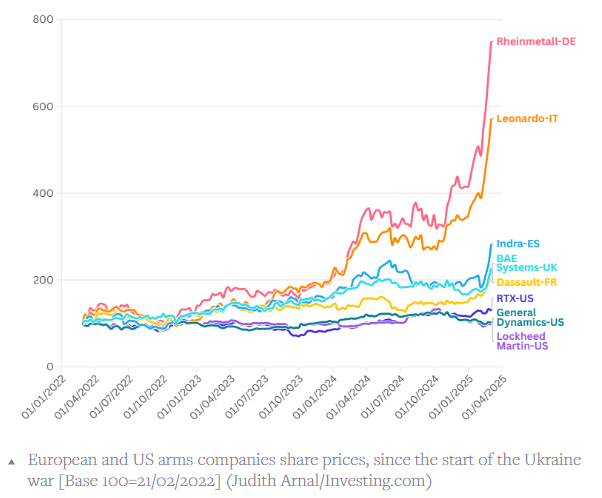
    Despite recognizing the problems posed by US techno-nationalist policies of the late 1970s and 1980s, the EU did not respond with measures to strengthen its own industrial and technological sovereignty in the defense sector. Member states’ interpretation of Article 223 as a general exemption to internal market disciplines meant that defense-related activities remained relatively sheltered from the wide restructuring processes of the 1980s.17Historical Archives of the European Commission, III-A-3, Draft Communication. Defence-Related Industries in the European Community: Towards Structural Adjustment, February 19, 1992. This political regime produced two types of political-industrial preferences, resulting in persistent market fragmentation. Countries with strong defense industries—primarily France, Germany, Italy, Spain, Sweden, and the United Kingdom—valued their national champions, including Dassault Aviation, Leonardo, Rheinmetall, Saab, BAE Systems, Thales, and Safran. Meanwhile, smaller countries like Austria, Luxembourg, Ireland, Belgium, and the Netherlands, as well as Central European countries like Poland and Romania, formed the habit of importing equipment or hosting foreign subsidiaries, typically from the USA or larger Western European countries.18Lucie Béraud-Sudreau and Lorenzo Scarazzato, “Beyond Fragmentation? Mapping The European Defence Industry In An Era Of Strategic Flux,” (<)em(>)Centre for Security, Diplomacy and Strategy (<)/em(>)(2023). (<)a href='https://csds.vub.be/publication/beyond-fragmentation-mapping-the-european-defence-industry-in-an-era-of-strategic-flux/'(>)https://csds.vub.be/publication/beyond-fragmentation-mapping-the-european-defence-industry-in-an-era-of-strategic-flux/(<)/a(>)

    National champions in countries large enough to support a defense industrial base were reinforced by nationally regulated defense procurement practices through non-competitive tendering, cost-plus contracts, and discrimination against foreign suppliers where national capacity existed. These practices established path dependencies that continue to shape European defense markets today.

    The contemporary impasse

    The Maastricht Treaty of 1992 created the European Union and, while envisioning eventual common defense policy, kept defense matters strictly intergovernmental, while the Franco-British Saint-Malo Declaration of 1998 launched the European Security and Defense Policy as cooperation between nation-states rather than genuine supranational integration. Even as US defense industry consolidation following the Pentagon’s 1993 “Last Supper” created competitive pressures, European national champions continued operating in protected domestic markets. Member states had consistently resisted the Commission’s soft law initiatives to liberalize defense markets since the early 1990s, resistance that continued even as American military spending and industrial competition intensified after 9/11.19Samuel B. H. Faure, “EU defence industrial policy: from market-making to market-correcting,” in EU Industrial Policy in the Multipolar Economy, eds. Jean-Christophe Defraigne, Jan Wouters, Edoardo Traversa, and Dimitri Zurstrassen, (<)em(>)Elgar (<)/em(>)(2022). https://www.elgaronline.com/edcollchap/book/9781800372634/book-part-9781800372634-17.xml The institutionalization of the European Security and Defense Policy in 2002 thus paradoxically demonstrated both the demand for European defense cooperation and the persistent unwillingness of states to surrender the national control that made such cooperation structurally ineffective.

    The fragmentation of the European defense market further complicates efforts to achieve strategic autonomy. Whereas the US progressively integrated federal-level markets and military procurement systems ever since the Civil War, developing autonomous federal procurement systems without external dependencies, Europe’s post-WWII defense landscape consists of national champions reinforced through non-competitive tendering, cost-plus contracts, and discrimination against foreign suppliers.20Historical Archives of the European Commission, III-A-3, Draft Communication. Defence-Related Industries in the European Community: Towards Structural Adjustment, February 19, 1992. After 1945, Western European empires crumbled and the geopolitical divide of Europe was decided by the two global superpowers. European political and business elites accepted the military protection and dominant position of the US, surrendering to a high dependency on US technology in the military sector. This choice created a fundamental structural difference: the EU is not a state but a regional integration process with a limited devolution of power from member states to EU supranational institutions, while the US developed centralized federal authority over defense procurement.

    The EU’s excessive dependencies on foreign critical raw materials create additional vulnerabilities when these resources become weaponized in geopolitical disputes. The European defense industry has historically been disadvantaged by much lower public funding for military R&D and a smaller domestic market compared to the US, where massive defense spending—reaching almost triple the combined spending of all EU member states—has fuelled technological innovation through agencies like DARPA and NASA.21Jean-Christophe Defraigne, “Chapter 7: US industrial policy: the not-so-visible hand of the state and securing the dominance of US prime movers,” in EU Industrial Policy in the Multipolar Economy, eds. Jean-Christophe Defraigne, Jan Wouters, Edoardo Traversa, and Dimitri Zurstrassen, (<)em(>)Elgar(<)/em(>) (2022).

    These vulnerabilities are a legacy of the EU’s structural contradiction. There is no EU equivalent to the US Department of Defense. The EU therefore cannot operate an efficient selection process to avoid the unnecessary duplication of national competing projects. Member states keep most of their tax resources, with the EU budget accounting for only 1 percent of the EU’s GDP, while member states expenditures amount to over 20 percent of GDP. This organization enables member states to pursue unilaterally competing national industrial policy within the EU, and often duplicating projects. At the same time, US protection has enabled them to use non-economic geopolitical leverage to gain overseas markets and diffuse their standards, notably in dual technologies.22Defraigne, 2022. This disadvantage is further compounded by the US’ ability to diffuse technological standards internationally using its geopolitical leverage on allied countries, particularly through NATO’s interoperability requirements, which have seriously hampered European defense projects by reducing potential economies of scale for European military producers.23Defraigne, 2022. If applied, the July 2025 EU-US trade deal, which includes EU commitments to purchase “significant amounts of US military equipment” alongside $750 billion in US energy exports, threatens, if it is applied, to further
    entrench rather than resolve Europe’s structural defense dependency on American suppliers.

    The recent EDIP and SAFE initiatives, despite their unprecedented scale and ambition, demonstrate the persistence of these structural contradictions. The July 2025 Council mandate’s restrictions—limiting non-EU components to 35 percent and requiring “design authority”—reveal that even the most recent initiatives remain constrained by the same sovereignty concerns that have defeated European defense integration attempts since the 1950s. Member states remain unwilling to fully surrender control over their defense industrial base, demanding European preference clauses and design authority requirements that echo the protectionist logic of Article 223 of the Treaty of Rome.

    Similarly, while SAFE provides €150 billion in loans, it preserves the primacy of national decision-making processes, requiring Council approval for major decisions and maintaining national fiscal sovereignty. This suggests that even this ambitious financial instrument cannot overcome the structural obstacle that has plagued European defense cooperation since the 1950s: the unwillingness of member states to transfer genuine authority over defense matters to supranational institutions.

    The EDIP also introduces the first-ever security of supply regime in defense, creating a Defense Security of Supply Board composed of member states, the Commission, the High Representative, and the European Defense Agency—to coordinate preventive actions and manage supply crises, reflecting growing awareness of supply chain vulnerabilities. While this new framework represents some degree of institutionalization, it still reflects the hybrid nature of EU defense governance—combining supranational elements (Commission and EU agencies) with intergovernmental control (member state representation and Council approval for individual supply measures), preserving the fundamental tension between integration and sovereignty that has characterized European defense cooperation since the 1950s.

    The planned revision of EU directives on defense and sensitive security procurement—currently scheduled for 2026—may seek to strengthen these existing preferences and close remaining loopholes. Similarly, in April 2024 the European Investment Bank launched a Security and Defense Industry Action Plan waiving the requirement that dual-use projects derive more than 50 percent of their expected revenues from civilian use. This aligns the EIB with other public financial institutions and opens dedicated credit lines for smaller companies and innovative startups in the security and defense sector.

    But these efforts, combined with the revised fiscal rules framework, continue to run up against the EU’s structural constraints. The new fiscal framework allows member states to deviate temporarily from fiscal rules through two escape clauses: the general escape clause and the national escape clause (NEC). The Commission proposes relaxing EU fiscal rules through coordinated activation of the NEC, permitting deviations from member states’ net expenditure paths due to higher defense spending. But an emphasis on overall fiscal sustainability means that member states will have to make difficult trade-offs between defense and other policy priorities. This is especially likely given that spending multipliers are often lower than those for other public investments, like education and infrastructure.

    New initiatives also fail to resolve the tension between national sovereignty and market integration. Defense remains firmly a national competence, with member states retaining control over defense budgets, procurement decisions, and capability priorities. But for European companies to gain scale, they depend on long-term orders and close cross-national collaboration.

    While there have been some notable Franco-German and Franco-Italian defense industry collaborations, the war in Ukraine has not yet produced new European champions in the defense industry. Mergers remain difficult because the institutional path dependencies established during the early years of European integration have created specific mechanisms that perpetuate fragmentation. Countries maintain “golden shares” in defense companies allowing them to block foreign takeovers. National security reviews can veto cross-border mergers even within the EU. Employment concerns are particularly acute—defense plants are often located in politically sensitive regions, and governments fear electoral backlash from factory closures. Each country has developed unique procurement procedures, technical standards, and offset requirements that make integration costly. Defense ministries maintain close relationships with “their” national champions, creating informal barriers to foreign competitors. These accumulated practices form a web of formal and informal obstacles that make creating European defense champions nearly impossible.

    Recent efforts at European rearmament thus face the structural difficulties characterizing the EU since its inception: the tension between national sovereignty and European integration. While EDIP and SAFE represent the EU’s most ambitious defense industrial initiatives to date, their design reveals the persistence of the same fundamental contradictions that have shaped European defense policy for over seven decades. The requirement for national approval mechanisms, sovereignty safeguards, and intergovernmental decision-making processes demonstrate that member states continue to want the economic benefits of defense integration while refusing to surrender the political control necessary to achieve them—the same paradox that hobbled the European Defense Community proposal in 1954 and the European Military Aeronautics Procurement Agency proposal in 1975.

  3. Rebuilding the Kingdom

    Comments Off on Rebuilding the Kingdom

    Saudi Arabia’s Crown Prince Mohammed bin Salman first announced Saudi Vision 2030 (SV2030), an economic diversification-cum-social reform plan, during an interview with Al Arabiya in April 2016. SV2030 vowed to transform Saudi Arabia, proposing fantastical ventures into the future while aggressively deploying capital abroad and opening the domestic economy up via debt issuance, investment code reform, contracting, and capital market reform. Knock-on effects for the world economy were imminent. 

    Facing volatility in the commodities market and growing financial vulnerabilities, the oil-dependent nation has since embarked on an effort to remake itself as a global economic powerhouse. Alongside ever expanding flows of crude to the east and deepening investment ties with China, Saudi Arabia’s moves on the home front looked primed to tilt the axis of global capital accumulation. The nine years since SV2030’s announcement have seen gains across a number of domains. The country has already cleared original targets for female labor-force participation and tourism. It is also likely to meet its goals in the capital markets. Courtesy of Aramco’s limited IPO, the Saudi Exchange now ranks as the ninth largest stock market in the world by market capitalization and the third largest among emerging markets.

    SV2030 has also prompted an enormous wave of construction in its bid to reshape the country’s built environment. Despite its population of just 30 million, Saudi Arabia is poised to host the largest construction market in the world by 2028.1Valentina Pasquali, “Riyadh dominates Saudi Arabia’s construction market”, (<)em(>)Arab Gulf Business Insight (<)/em(>)(June 25, 2024). Neom—the giga-project being conjured out in the western province of Tabuk along the northern shores of the Red Sea—is alone absorbing 20 percent of the global steel supply.2Andrew Hammond, “Neom ‘uses one fifth of world’s steel”, (<)em(>)Arab Gulf Business Insight (<)/em(>)(October 15, 2024). The plan’s housing program aims to achieve 70 percent Saudi national home ownership in 2030; as of 2024, official statistics estimate ownership in the range of 62–65 percent, up from 47 percent in 2016.  Most importantly as pertains to SV2030’s overarching goals, the non-oil economy has expanded at a greater pace than the oil economy in recent years.3 Concerning statistical coding, note that the processing of petroleum is classified as a service activity in government accounts, while petrochemical production is registered as a non-oil output. The construction boom reflects the scale of Saudi Arabia’s rapidly shifting relationship with global financial markets. 

    SV2030 is betting that the world’s great oil power can transform itself into a real-estate empire. The administrative centralization configured to oversee this restructuring has generated a byzantine network of institutional actors operating outside the traditional boundaries of the Saudi state. Managed by a network of foreign consultants, this new formation has weakened government accountability, eliminated transparency, and diminished the influence of longstanding ruling families in the domestic economy.

    There are also immense social consequences to the build: SV2030 is generating polarizing wealth effects within what is already one of the most unequal countries on the planet. An economic model long founded on the distinction between its citizen and migrant labor populations is now generating class divisions within the Saudi national population. Seen in full, these changes point to the political, economic, and social tensions embedded in the ambitious developmental visions being pursued under the reign of King Salman and the Crown Prince Mohammad bin Salman. 

    Vertical administration

    It was exigency that had prompted SV2030. In the lead-up to the Crown Prince’s ascension, commodities markets were rattled by regular bouts of volatility, first in the aftermath of the 2008 financial crisis and then more consequently and lengthily beginning in June 2014. Due to the Saudi treasury’s acute dependence on transfers from Aramco—the company’s contributions represented over 90 percent of government revenues between 2010 and 2014—doldrums in the oil trade posed questions of an existential nature.4Stephan Roll, “A Sovereign Wealth Fund for the Prince”, Research Paper: Stiftung Wissenschaft und Politik (July 2019). As Mohammed bin Salman well knew, dollars and US treasuries would be run down in short order were the deficits of recent years sustained.5For a sense of scale, the net lending/borrowing of the general government averaged out at -10.4 percent GDP between 2014 and 2017. With a 2015 study commissioned by McKinsey Global Institute also sounding the alarm on unemployment, demographic expansion, and a possible energy transition, an intervention was needed.6McKinsey Global Institute, “Saudi Arabia Beyond Oil: The Investment and Productivity Transformation”, Report (December 2015). Growth, social peace, and even regime survival conceivably held in the balance.  

    A project of SV2030’s scale was to require an equally ambitious rewiring of the state. To facilitate SV2030 and consolidate power in the Crown Prince, the traditional administrative state was made more vertical: once the fiefs of select royals, each government ministry is now directed by a loyalist of the Crown Prince and directly subordinate to the Diwan. Whereas family governance was previously organized around a spoils system that doubled as a mechanism for elite coalition maintenance, King Salman has emphasized the supremacy of the ruler. Upon succeeding his half-brother Abdullah in January 2015, Salman announced a leadership reshuffle that ousted the progeny of his predecessor along with other senior family figures from perches atop governorships and ministries. To snuff out sparks of dissent, the King simultaneously appointed his son, Mohammed bin Salman, Secretary of the Royal Court. With the subsequent merger of the King and Crown Prince’s offices within the Royal Court, Salman and son acquired close to total disciplinary reach. Thereafter, the two progressively disavowed the arrangements which had converted public institutions into the inheritable property of particular family lines.

    Accompanying the handling of family business was a transformation in the institutional fabric of the state. Immediately after taking the reins, King Salman abolished eleven supreme councils and dissolved a handful of government ministries. He then established two sub-cabinets, each chaired by his son as of summer 2017, to preside over all economic and security policy: the Council of Economic and Developmental Affairs (CEDA) and the Council of Political and Security Affairs (CPSA), respectively.7Mohammed bin Salman was appointed chairman of the CEDA from the start and took over the CPSA after becoming Crown Prince in summer 2017. The CEDA took on the role of oversight body for SV2030.8Operationally, the Council’s Strategic Management Office was made superintendent, moving across the state without jurisdictional limit, releasing quarterly performance reports, and dispatching its “delivery unit” to whip (or sidestep) the bureaucratic ranks. In its supervisory work, note the Strategic Management Office is aided by the National Center for Performance Management. Chairing both bodies is the Crown Prince’s close confidant and trusted economic advisor Fahad bin Abdullah Toonsi. Through the King’s initial cabinet reshuffle in 2015 and subsequent moves in 2018 (in the wake of Jamal Khashoggi’s murder) and 2020, a crew of technocrats took over all the key posts at the Council of Ministers. The majority came to their posts from previous stops in international finance, their newfound prominence owed entirely to their relationships with the Crown Prince. The era of loyalist banker-technocrats has meant a de facto straightening of the chain of command.

    The Economic Braintrust for SV2030
    NAMEPOSITIONPROFESSIONAL BACKGROUND
    Mohammed al Jaadan– Minister of Finance (2016–)
    – Minister of Economy and Planning (2020–)
    – Chairman of Capital Markets Authority
    – Commercial Law
    – Former Special Adviser to Board of Morgan Stanley Saudi Arabia
    Mohammed bin Abdulmalek al Sheikh– Minister of State Advisor to Crown Prince
    – Chairman of Capital Market Authority
    – Chairman of Saudi Authority for Intellectual Property
    – Member of CEDA
    – Head of Saudi Sports Authority
    – Saudi Arabia Representative to World Bank
    Mohammad al Tuwaijri– Minster of Economy and Planning
    – Minister-ranked advisor to Royal Courtesy
    – Group Managing Director of HSBC Holdings PLC MENA & Turkey
    – Managing Director of JP Morgan
    – Head of Treasury Saudi British Bank
    Fahad bin Abdullah Toonsi– Advisor to Royal Court
    – Secretary General of the Strategic Management Office
    – Board Member for Qiddiya, Neom, AMAALA, and the Red Sea Project
    – Saudi Representative to G20
    – Managing Director of the Crown Prince’s Court
    – PhD Financial Economics and Corporate Governance, King’s College London
    – Senior Manager PriceWaterhouseCoopers
    Yasir al Rumayyan– Governor of the PIF
    – Chairman of Saudi Aramco
    – Chairman of Maaden
    – Chairman of Riyadh Air
    H- ead of Securities Capital Market Authority
    – Board Member Tadawul
    – Head of International Brokerage Saudi Hollandi Bank
    – CEO of Saudi Fransi Capital
    Ahmed bin Aqil Al Khatteb– Minister of Tourism
    – Former head of General Entertainment Authority
    – Advisor to Saudi Royal Court
    – Chairman of Board for Saudi Arabian Military Industries
    – Chairman of Board for Saudi Fund for Development
    – Board Member: PIF, CEDA, National Development Fund. Diriyah Gate Development Authority
    – Founder Jadwa Investments
    Riyadh Bank
    – SABB Bank
    Majed bin Abdulah al Hogail– Minister of Municipalities, Rural Affairs, and Housing
    – Chairman of Saudi Real Estate Refinance Company
    – Chairman of Real Estate General Authority (REGA)
    – Head of Housing Program of Saudi Vision 2030
    – Member of CEDA
    – Board member for Neom, Roshn, Qiddiya, Red Sea Global, and AMAALA
    – Chairman Aljazira Capital
    – Vice Chief Financial Officer Saudi Arabian Monetary Agency
    – Board member Credit Suisse
    Fahad Al Saif– Head of Investment Strategy, Economic Insights, and Global Capital Finance Divisions for PIF– Saudi British Bank
    – HSBC Saudi Arabia
    – Board Vice Chairman Bahri Company
    – Director of Gulf International Bank
    Ahmed al Rajhi– Minister of Human Resources and Social Development
    – Board member for National Development Fund
    – Director of Modon
    Member of National Industrial Company
    – Al Rajhi Holding
    Mohammed bin Saleh al Buty– CEO National Housing Company
    – Advisor to Minister of Municipal and Rural Affairs


    Salman’s institutional reforms also served to reduce the operational autonomy once granted to select pillars of the state. Historically, two institutions had been charged with managing the country’s patrimony: the central bank (SAMA, previously known as the Saudi Arabian Monetary Authority) and Saudi Aramco. Each had been freed from undue political meddling as past rulers identified their own prospects being tied to SAMA and Aramco’s competence. Salman and his son, however, hitched both institutions to their political project. In 2020, SAMA was obliged to transfer $80 billion in foreign reserves to the Public Investment Fund (PIF), chaired by the Crown Prince, and fall in line with the PIF’s asset management and oil rent investment strategies.9See: Alexis Montambault Trudelle, “Diversification meets personalization: the strategic role of the Public Investment Fund in Saudi Arabia”, Analysis: Noria Research (January 2025). Similarly, Aramco was forced into a number of transactions in support of the PIF, including transferring 16 percent of company equity to the Fund, acquiring a 70 percent stake in the PIF-owned Saudi Basic Industries Corporation, and issuing debt to provide the PIF with liquidity (by way of dividend payments). 

    Aramco’s leadership has also been brought under the direct thumb of the royal court. Khalid al-Falih was removed as Chairman  in 2019 and Minister of Energy in 2020. Prior to al-Falih’s dismissal, the Aramco portfolio had always come attached with the top job at the Ministry of Energy, and appointments to the two-file job had been reserved for petroleum doyens of high regard.10The likes of Abdullah Tariki and statesman-like Ahmed Zaki Yamani. Today, nomination to the now-split gigs of Minister and Chairman is governed by a clear political logic. Running the Ministry is the Crown Prince’s half-brother Abdulaziz bin Salman while handling Aramco is the Crown Prince’s trusted advisor Yasir al-Rumayyan. As a result of this reorganization, pockets of institutional independence which formerly stabilized the monarchy no longer exist.

    The parallel state

    Salman’s reforms, jointly aimed at concentrating power and streamlining the roll out of SV2030, additionally served to equip the King and his son with what amounts to a state outside the state: a configuration of new planning, administrative, and financial bodies as well as regime-owned commercial entities, all directly accountable to the Crown Prince. 

    This parallel government relies on an intellectual engine of management consultants and financial professionals, including nationals and foreigners. Manifest in BCG’s enormous new office in the King Abdullah Financial District and in consulting industry revenues coming in well north of $3 billion per annum since 2023, the consultants’ rise infuses planning with both rationalism and risk. Alongside the Crown Prince’s inner circle, the apparatchiks of SV2030—strategists, planners, project managers, and bankers—are a transnational assemblage. Public policy mercenaries chasing short-term contracts are bound to their work neither by ideology nor patriotism and face no disciplinary structures apart from being fired or frozen out (see: PriceWaterhouseCoopers, most recently). If these actors have assisted in turning the focus to efficiency and investment returns, they have also helped marginalize the standing of developmentalism—and all its social contents—within the policy debate.

    The Strategic Management Office (SMO) of the CEDA is in charge of most of the policy planning for SV2030. As coordinator and monitor for the eleven grand “Vision Realization Programs,” the SMO is empowered to bypass or impose itself upon government ministries. Like the Council to which it reports, this office relies heavily on consultants seconded to the government by Boston Consulting Group and Kearney.11Personal correspondence, March 2025. External experts are entrusted with developing the SMO’s strategy, specifying delivery plans and objectives, and managing Vision projects downstream. 

    The PIF plays a significant planning role, too. Once an asset manager of the Ministry of Finance established to foster national industrial champions, the PIF was brought under the direct command of the CEDA in 2015, and its C-suite is dominated by Saudi and expat career finance professionals. That same year, the Fund was also legally restructured as an investment company with full ownership rights over the assets on its balance sheet.12By way of the second move, PIF holdings and activities are registered as part of the private sector in national accounts. In controlling so much of SV2030’s off-budget fiscal spend, it is the PIF’s decisions that materially animate much of the Crown Prince’s diversification strategy.  Given that the board, chaired by the Crown Prince, retains full discretion in making investment decisions, the PIF’s insertion into the policy space amounts to a deeper concentration of royal power.13A consultative role provided by the Investment Strategy and Economic Insights Division.

    A handful of other extra-bureaucratic institutions have come into the planning fold of SV2030. The PIF Program Office, also chaired by the Crown Prince, directs the five Giga Projects—Neom, Roshn, Red Sea Global, Qiddiya, and Diriyah—that together generate much of the demand for new structure and infrastructure. The PIF owns Ardara, a non-Giga real estate development vehicle, and has been the majority-owner of the largest mining company in Saudi Arabia (Ma’aden) since its foundation. The PIF also holds majority positions in many of the leading firms in the cement sector. More recently, the Fund has cobbled together a national steel champion and taken a 30 percent stake in Masdar, the latter specializing in the trading and distribution of building materials.

    Chaired by Minister of Municipalities, Rural Affairs and Housing Majed bin Abdullah al Hogail, the Housing Program Office of SV2030’s mandate encompasses real estate development and strategizing the wider housing transition. Regulation and consumer protection has been turned over to the freshly founded Real Estate Governing Authority (REGA). Established in 2017 and chaired by the same al Hogail, REGA’s regulatory remit is anchored to attracting investment into the built environment. Institutions of SV2030’s parallel state likewise preside over the design and administration of industrial policies related to boosting local content use in construction.14The Ministry of Industry and Mining is not left entirely in the cold, it should be said, as the Future Factories Program runs through its offices. Nevertheless, the main players are the PIF and the National Housing Company (NHC). Through the mother institution, majority-owned subsidiaries, and Giga stock companies, the PIF leads the charge in developing domestic manufacturing capacity while the NHC plays second fiddle. Also part of the SV2030 push, the NHC was established in 2016 as a real estate investment fund. While backed and partially capitalized by the state treasury—and while legally housed within the Ministry of Municipalities, Rural Affairs and Housing—NHC operations are insulated from the traditional state bureaucracy. It supports domestic production of building materials through a number of initiatives, including the Rakaez Program, Logistics City Project, and Industrial Links Program.       

    Three sectors of the parallel state are critical to the funding of the build.15Having only just held its inaugural board meeting, note that the National Infrastructure Fund—which is under the orbit of the NDF, like the REDF—will likely be added to this mix going forward. Essential to the demand and supply sides of SV2030’s real estate agenda are the country’s commercial banks—namely Saudi National Bank (SNB), Alinma Bank, and Riyad Bank. Though none are pure instruments of SV2030, each is primarily owned by the PIF—and all have been enlisted to serve the SV2030 agenda.16The latter fact is attested by the patterns of their credit allocation, which have quite clearly shifted in accordance with the goals of the Housing Program. In the case of SNB, moreover, service to 2030 is made quite explicit. Not only are commitments to SV2030 apparent in the bank’s mission statement, which lists “catalyzing the delivery of Saudi Vision 2030” as an objective and obligation: The PIF’s fingerprints, and by extension SV2030’s, are also all over the 2021 merger which expanded the SNB’s balance sheet and in so doing, facilitated greater lending to targeted sectors. Second, also making a critical financial contribution to SV2030’s build is the Real Estate Development Fund (REDF). Though itself a legacy institution, REDF was repurposed for Vision-service upon its being absorbed by the National Development Fund (NDF).17The NDF was established by royal decree in 2017 to provide capital investment for SV2030. It is chaired by the Crown Prince and its board is comprised largely of the technocrats listed in the table above. Its financing predominantly runs through two channels: Guarantees provided to mortgage lenders and, via the Sakani Program, interest subsidies and down payment supports provided to home buyers.18Through the Sharakat program, the REDF, in conjunction with the Ministry of Municipalities, Rural Affairs and Housing, does also provide financing to builders and developers. Finally, the Saudi Real Estate Refinance Company (SRC), fully-owned by the PIF, is tasked with injecting liquidity into the banking sector and developing the secondary real estate market, providing banks with capital relief, purchasing  mortgages to free up the balance sheets of lenders, and pioneering the securitization effort, on the advice of Blackrock.19Adelaide Changole, “Saudi Arabia Taps BlackRock to Build Mortgage-Backed Securities Market”, (<)em(>)Bloomberg (<)/em(>)(October 23, 2024). In conjunction with Hassana Investment Company, this past January the SRC began bundling and cutting up mortgages for trading on secondary markets.20Nadin Hassan, “SRC and Hassana launch mortgage-backed securities to boost Saudi real estate investment”, (<)em(>)Arab News (<)/em(>)(January 2, 2025); At a more junior level, note that the Roshn Group offers a hand with finances as well.  Also fully-owned by the PIF, this institution indirectly facilitates credit lines to developers working on its massive housing builds. Most recently, it has done so via a syndicated loan arrangement (USD 2.4 billion) with four national banks that will see the Roshn Group backstop credit lines for contracted business partners.

    In one sense, the changes wrought by Salman have served to cohere the bureaucracy of the new ministerial class to the Crown Prince and their collective population of the CEDA. But with everyone forced to manage up, inter-ministry relations, never strong to begin with, have been entirely severed.21Author Personal Correspondence: February 2025. Extreme verticality means that all but those at the top are excluded from the policy process. No one lifted to leadership positions by the Crown Prince are of the ministries they now direct, creating confusion at lower bureaucratic levels as well as uncertainty in execution. The administrative organization of the state is becoming denser and more labyrinthine. Jurisdictional overlap follows, as do government entities working at cross-purposes with one another.22Hadi Fathallah, “Challenges of Public Policymaking in Saudi Arabia”,  Commentary: Carnegie Sada Center (May 2019). David B. Jones, “King-makers or knaves? The role of consultants in domestic policymaking and governance in Saudi Arabia” in Mark C. Thmopson and Neil Quilliam (eds.)(<)em(>) Governance and Domestic Policymaking in Saudi Arabia: Transforming Society, Economics, Politics and Culture(<)/em(>) (I.B. Tauris: 2022).

    While the PIF is not run as a blacksite—a recent auditor’s report from KPMG establishes some basic data—there are still many unknowns about the Fund’s dealings. How to explain, for instance, the 40 percent increase in employee costs in 2023 (a jaw-dropping bill of $15.9 billion)?23Andrew Hammond, “The huge ambitions of PIF come at vast expense”, (<)em(>)Arab Gulf Business Insight (<)/em(>)(September 20, 2024). Gaps of USD hundreds of billions when it comes to book assets and assets under ownership? The about-face in the marketing of Giga Project real estate, now targeting Saudis rather than foreigners? The turnover at the top of Giga projects like Neom and reports of gross executive misconduct?24Rory Jones, “The world’s biggest construction project is a magnet for executives behaving badly”, (<)em(>)Wall Street Journal (<)/em(>)(September 11, 2024).

    The murkiness of procurement instead suggests a shift in primary beneficiaries. Available evidence shows a handful of families—the Al Rajhi, al Muhaidib, Al Issa, al Zamil, al Subeaei, and al Sudairi, many of whom had younger members intersect with the Crown Prince during his time at Jadwa Investments—riding SV2030 to new heights. Furthermore, hearsay abounds that the Crown Prince and his brothers are taking personal cuts on many of the major developments underway.25Author personal correspondence, February 2025.

    The amalgamation of new agencies comprising the parallel government creates ambiguities over who is responsible for policy—and by extension, deserving of blame. In moving expenditures and liabilities off the books, this configuration also obscures the realities of the state’s financial commitments, while subtly vesting the Crown Prince with Leviathan-like authorities and allowing him to micromanage SV2030 and take personal direction of investment operations.

    Debt-financed housing

    In the immediate aftermath of the first Gulf War and during the commodities boom of the early 2000s, Saudi policymakers tried squeezing growth and political legitimacy from the laying of concrete, glass, and rebar.26Rosie Bsheer, “The Property Regime: Mecca and the Politics of Redevelopment in Saudi Arabia”, (<)em(>)Jadaliyya (<)/em(>)(September 8, 2015); Michelle Buckley and Adam Hanieh, “Diversification by Urbanization: Tracing the Property-Finance Nexus in Dubai and the Gulf”, (<)em(>)International Journal of Urban and Regional Research (<)/em(>)38:1 (2014). Like these earlier leaders, the Crown Prince today has entrusted the state with responsibilities for leading new industries and folding select private capitals—both domestic and foreign—into ventures downstream.27For previous iterations, see: Adam Hanieh,(<)em(>) Money, Markets, and Monarchies: The Gulf Cooperation Council and the Political Economy of the Contemporary Middle East(<)/em(>) (Cambridge University Press: 2018). As before, profitability has again been hitched to the super exploitation of a vulnerable workforce.28 See: Staff writer, “Saudi Arabia: ILO Forced Labor Complaint a Wake-up Call”, News Release: Human Rights Watch (June 5, 2024). Last fall, an ITV documentary estimated 21,000 migrant workers had died on construction sites since SV2030’s launch.29Staff Writer, “Saudi Arabia: ITV finds migrants constructing ‘The Line’ at megacity project, Neom, experience egregious labour rights abuse”, Business & Human Rights Resource Centre (October 28, 2024).

    SV2030’s housing program has launched a contracting bonanza. State and state-adjacent entities awarded just short of $147 billion in contracts in 2024, with the power and construction sectors leading the way.30Mohamed Ali Omar and Junaid Ansari, “GCC Projects Market Update”, Report: Kamco Invest (January 2025). Middle East Economic Digest estimates the value of projects currently in the pre-execution stage at $770.5 billion. Narrowing the focus to real estate, the value of projects commissioned between 2016 and 2024 topped $164 billion, with another $250 billion in the hopper.31Roughly one-fifth of this spend has been deployed for Riyadh-based developments, and one-third out west in support of Neom. The full realization of the Crown Prince’s objectives for real estate and infrastructure development will come with a bill of $1.3 trillion. But if there is much that is familiar in Saudi’s latest build, novelties abound as well. The capitals, institutions, and financial engineering involved all break new ground. Appreciated in full, these changes speak to a partial rupture within the Saudi accumulation regime. 

    Named the GCC’s top developer for 2024, the National Housing Company (NHC) is the master real estate developer for SV2030. It projects to bring 600,000 housing units to market by 2030, claims to have added 600,000 jobs to the economy last year, and aims for revenues of approximately $14 billion in 2025.32Edmund Bower, “National Housing Company announces record revenue”, (<)em(>)Arab Gulf Business Insight (<)/em(>)(January 23, 2025). The PIF has wide-spanning commercial holdings in the construction and real estate development space as well. On the contractor side of things, the PIF took equity positions in four major construction companies in early 2023.33The four are AlBawani Holding Company, Almabani General Contractors Company, El Seif Engineering Contracting Company, and Nesma & Partners Contracting Company. At the time of writing, the Fund is also preparing to take over the 36 percent stake that the Ministry of Finance currently holds in the Saudi BinLadin Group.34The MoF acquired this position after the BinLadin Group’s owners were coerced into paying a penance for past deeds during the shakedown at the Ritz Carlton. 

    SV2030’s roll-out of new structure and infrastructure is leaning heavily on government debt. The Ministry of Finance has issued tens of billions in bonds and sukuk per annum in recent years. Aramco has taken on debt in order to indirectly support the build as well: In 2021 and 2024, the company issued a total of $12 billion in medium-term traditional and Islamic bonds, proceeds of which were used to pay dividends to the PIF, amongst other things. The Saudi Real Estate Refinance Company has issued bonds and sukuk as well, and it is expected that the holding companies in charge of the Giga Projects, such as the one overseeing Neom, will join the bond issuance party. 

    Nor has SV2030 debt financing been limited to the selling of fixed-income securities. State and sub-state entities have borrowed billions through the arrangement of private revolving credit facilities. For instance, in 2023, the Ministry of Finance reached an agreement on a ten-year, $10 billion syndicated loan earmarked for construction, with the Industrial and Commercial Bank of China as the main lender.35Saudi Debt Agency Annual Report. This January, the Ministry tapped Abu Dhabi Islamic Bank, Credit Agricole, and Dubai Islamic Bank for a $2.5 billion revolving credit line to fund construction.36Abeer Abu Omar, “Saudi Arabia starts 2025 with a $12 billion bond and PIF loan”, (<)em(>)BNN Bloomberg (<)/em(>)(January 6, 2025). Downstream, the holding company for the Roshn Giga Project—a fully-owned subsidiary of the PIF—also secured a syndicated loan worth SAR 9 billion (~$2.4 billion) from a consortium of domestic banks at the start of 2024. 

    By far the most active in the private credit space, however, is the PIF itself. In 2021 and 2024, the Fund secured three-year credit facilities (extendable up to five years) of $15 billion from an international consortium. In 2018 and 2022, it also borrowed $11 billion and $17 billion, respectively, in the form of unsecured general corporate purpose loans.37Staff writer, “Saudi PIF secures record-breaking $17bn seveny-year senior unsecured term loan”, (<)em(>)Arab News (<)/em(>)(November 30, 2022). To further diversify private credit lines, the PIF moved into the Islamic lending market at the start of 2025 as well. Structured as a Shariah-compliant murabaha facility, the Fund secured a revolving credit line of $7 billion from a consortium of twenty international banks.38Staff writer, “A&O Shearman advises on PIF’s first syndicated murabaha facility”, Client News: A&O Shearman LLP (January 14, 2025)

    Saudi’s commercial banks have also leveraged up to support the build. This was necessary due to the widening gap between deposit growth—relatively weak, especially if one excludes public entities—and borrowing demand. Since the pandemic especially, the latter jumped as a result of the (state-backed) construction boom and (state-backed) spike in mortgage demand. To fund lending, Saudi banks first sold billions in t-bills on domestic markets. Insufficient for capitalizing their needs, they next issued billions in foreign currency bonds and sukuk.39Staff writer, “Saudi Banks’ credit equality may weaken due to external funding reliance”, (<)em(>)Fitch Wire (<)/em(>)(October 21, 2024). Most recently, these institutions have been selling risky, short-term debt (Additional Tier 1 bonds) to free up liquidity for lending.40Tasos Vossos, Abhinav Ramnarayan, and Olga Voitova, “Saudi banks are on risky debt spree to keep funding gigaprojects,” (<)em(>)Bloomberg (<)/em(>)(June 4, 2025).  Graphing external liabilities against credit to home buyers and builders shows the extent to which foreign debt is lubricating the property market.

    Sinews of debt

    SV2030 has changed the country’s incorporation within financial markets. During the first half of 2024, USD-denominated bond and sukuk issuance were such that Saudi Arabia displaced China as the top issuer of dollar debt in emerging markets, the first country to do so in twelve years.41Selcuk Gokoluk, “Saudi Arabia Dethrones China as Top Emerging-Market Borrower”, Bloomberg (June 19, 2024). The Kingdom settled into second position by the close of 2024, recording 51 percent year-on-year growth; in 2025, the country’s USD-denominated fixed income market is expected to jump by approximately another 15 percent to more than $500 billion.42Lest a recent decision by the Accounting and Auditing Organization for Islamic Financial Institutions throws a spanner in the works. Fixed Income Team, “GCC Bonds and Sukuk Market Analysis”, Report: Markaz Research (January 2025); Staff Writer, “Saudi debt capital market to exceed USD 500 bn this year – Fitch ratings”, Enterprise Saudi Arabia (February 5, 2025). With S&P raising the long-term foreign and local currency sovereign rating to A+, debt sales should fly for a number of years still. Saudi Arabia’s capital markets are now also demonstrating that they possess the liquidity and accessibility needed to play a role internationally. In these regards, China’s issuance of a $2 billion bond on the Saudi Exchange last November offers the clearest testament to the ongoing success.43Both the subscription amounts ($39.73 billion) and the yields (but a few basis points higher than US treasuries of equivalent maturities) left impressions. Matt Smith, “Investor demand lowers yields on China’s dollar bonds”, Arabian Gulf Business Insight (January 6, 2025).

    Saudi’s presence in the global financial circuitry is not new, of course. By virtue of petrodollar recycling, Riyadh long served as a constitutive fiber for Wall Street and for Eurodollar lenders. By way of the mega-project boom of the early to mid-2000s, internally-facing funding relations with the HSBCs and Deutsche Banks of the world had been established, too.44See: Buckley and Hanieh (2013). Nevertheless, SV2030 prompted three major shifts. 

    Firstly, SV2030 reversed the primary direction of movement for the capital flows: Rather than petrodollars flowing out, it is debt (and to a lesser extent, equity) financing rushing in which is binding Saudi to external financial networks. The reversal itself is not entirely unprecedented. During the early 1990s, slumping oil revenues led to extensive foreign borrowing and the establishment of a hot treasuries market that was much enjoyed by foreign traders.45Author Correspondence, December 2024: Paris. See as well: Muhammad al Jasser and Ahmed Banafe,”The development of debt markets in emerging economies: the Saudi Arabian experience”, Paper no.11: Bank for International Settlements (2002). Nevertheless, the prevailing direction of capital flows today contrasts with the rest of Saudi’s modern history. 

    Secondly, SV2030 is scaling the use of leverage to unprecedented levels. Even though state and country are far from pressing against debt sustainability-related concerns—the S&P rating attests as much, as does interest expenses absorbing only 3.6 percent of budgetary resources—in relative and nominal terms, the magnitude of external debts has created obligations of meaningful consequence.46Stephane Alby, “EcoPerspectives 1(<)sup(>)st(<)/sup(>) Quarter 2025: Saudi Arabia”, BNP Paribas (January 2025)

    Thirdly, the SV2030 build is diversifying the financial channels and institutions connecting Saudi Arabia and the rest of the world. Via sovereign bond issuance, all the major global book runners have been brought into the fold—the likes of HSBC, JP Morgan, Standard Chartered, Citi, Bank of China, Mizuho Financial Group, Goldman Sachs and BNP Paribas.47Matt Smith, “Saudi Arabia leads international bond issuance”, (<)em(>)Arab Gulf Business Insight (<)/em(>)(September 5, 2024) Via the buyers targeted by the bond’s primary dealers, all the usual asset and index fund managers have been staked in Saudi as well. The borrowing of domestic commercial banks, meanwhile, alongside private lending arrangements organized by the PIF, are tying banks from across the world’s largest financial centers to the construction bonanza. In certain instances, local banking affiliates, like HSBC’s Saudi British Bank and Credit Agricole’s Banque Saudi Fransi, position foreign financial institutions more directly in the fray.

    Equity acquisitions on public exchanges—both in Saudi and on foreign stock markets—grants access to others: Foreign holdings in major developers like Dar al Arkan (and its mother company) connect many international investment houses to SV2030.48Nirmal Narayanan, “Foreign investments surge in Saudi stocks, reaching $1.02 bn in September”, (<)em(>)Arab News (<)/em(>)(October 9, 2024); For a general sense of scale, foreign investors held Saudi equities worth roughly USD 110 billion as of last fall; non-GCC foreign owners are estimated to control 12% of the Saudi Exchange. Regulations that had previously obstructed foreign investment into real estate in Mecca and Medina have been recently lifted, suggesting that the equity channel will soon bring in more foreign capitals.49Staff Writer, “Saudi Arabia allows foreigners to invest in firms with property in Mecca, Medina”, (<)em(>)Reuters (<)/em(>)(January 27, 2025). Smaller deals have integrated lesser creditors into the financial wiring of SV2030, public institutions included. Consider Italy’s state export credit agency SACE issuing loan guarantees worth $3 billion for the Neom Giga Project this past January.50Staff Writer, “Saudi Arabia’s PIF signs $3 billion agreement with Italian export credit agency”,(<)em(>) Reuters (<)/em(>)(March 5, 2025).   

    Viewed in its totality, the financial circuitry behind SV2030 has substantially changed the Saudi state and economy’s relation with the world around it. To extents never seen before, a host of foreign capitals have taken direct positions in the profits being scrounged from the country’s built environment. Through the sinews of debt, the integration of Saudi within global financial markets has also deepened.

    Contracting arrangements have likewise shifted the Saudi state’s relation to foreign capitals. Multinationals from near and far are on the ground today working on hundreds of ongoing projects. The laying of the Riyadh Metro alone brought in everyone from the United States’ Bechtel to Germany’s Siemens to France’s Alstom and Avant Premiere, Italy’s Webuild, Spain’s FCC, and Korea’s Samsung. A brief survey of the wider web of infrastructure and real estate builds reveals the scale of this global constellation.

    Select List of Foreign Partners Involved in SV2030
    FIRMCOUNTRYPROJECT
    WeBuildItalyNeom: Joint venture with Sajco for high-speed train line
    WeBuildItalyTrojena Dam Project
    PowerChinaChinaNeom
    BaosteelChinaJoint venture with Aramco and PIF
    China State Construction Engineering CorporationChinaJoin venture with Diriyah Company and El Seif Engineering Contracting Co.
    China Energy Engineering CorpChinaPhotovoltaic (PV) project
    Jinka SolarChinaJoint venture: PV module project
    Bauer GroupGermanyNeom: Foundation
    KentUnited KingdomJoint venture with Nesma & Partners (engineering and procurement)
    AecomUnited StatesNeom: Infrastructure and Geotechnical Support
    Jacobs EngineeringUnited StatesNeom: Construction Advisory
    Air ProductsUnited StatesNeom: Joint venture with ACWA power for green hydrogen ammonia production
    Kolin ConstructionTurkeyTrojena infrastructure
    SamsungSouth KoreaJoin venture with al Rushaid Petroleum Investment Company (construction technologies)
    FCCSpainRiyadh Metro
    Hill International, Italferr, Sener, Chinese Engineering Construction CompanyUnited States, Italy, Spain ChinaLand Bridge Riyadh-Jeddah
    Orascom Construction, Hassan Allam Construction, Talaat Moustafa GroupEgyptPartnerships with National Housing Company

    Some foreign companies have independently won contracts. Others have been integrated into the build via joint ventures with either private or state-owned firms. At a juncture marked by stagnation in Europe and crisis-adjacency in much of west Asia, this means that the structure of balance sheets and prospects for profitability for many firms are hinging on opportunities in the (re)construction of Saudi Arabia.  

    At the same time, various measures like surety bonds, upskilling projects, and supports for supply chain integration are in place to boost smaller, local businesses in Saudi Arabia.51Reina Takla, Nirmal Narayanan, “Saudi Arabia launches new financing products to boost construction sector”, (<)em(>)Arab News (<)/em(>)(February 14, 2025). Whether with policymaker intent or not, SV2030 is also allowing low-level brokers in the market for construction labor to cash in. Exploiting loopholes pertaining to Saudiization quotas (and taking advantage of citizenship-coded distinctions in legal rights), tassatur entrepreneurs are today collecting sizable rents on the deployment of non-nationals to construction sites.52Anita Hammer and Ayman Adham, “Mobility power, state and the ‘sponsored labour regime’ in Saudi capitalism”, (<)em(>)Work, Employment and Society (<)/em(>)37:6 (2023). For Saudi Arabia’s relatively few though exceedingly well-endowed savers, the country’s equity markets furnish an indirect way to make a de facto state-backed buck on SV2030 as well. Those with holdings in the country’s commercial banks, the primary lenders to the build, are reaping the rewards of record earnings—up 14 percent in 2024, the sector’s net profits topped SAR 80 billion, or $21.33 billion.53Anton Lopatin and Redmond Ramsdale, “Saudi bank earnings aided by lower interest rates, despite liquidity tightening”, Non-rating Action Commentary: FitchRatings (March 10, 2025). With dividend-payout ratios of 50 percent and attendant rises in valuations, it is a good moment for holders of banking stocks.54Zeina Nasreddine and Mohamed Damak, “Saudi Arabia Banking Sector Outlook 2025: Vision 2030 Momentum Continues”, Report: S&P Global Ratings (January 2025). Anyone carving out positions in the country’s many publicly traded real estate investment trusts (REITs), or in her major construction material producers, is also collecting sizable dividend payments.55Dividend schedules are available at: <(<)a href='https://www.saudiexchange.sa/wps/portal/saudiexchange/newsandreports/issuer-financial-calendars/dividends/!ut/p/z0/04_Sj9CPykssy0xPLMnMz0vMAfIjo8ziTR3NDIw8LAz8LTw8zA0C3bw9LTyDvAwMAoz1g1Pz9AuyHRUBMfE6EQ!!/'(>)https://www.saudiexchange.sa/wps/portal/saudiexchange/newsandreports/issuer-financial-calendars/dividends/!ut/p/z0/04_Sj9CPykssy0xPLMnMz0vMAfIjo8ziTR3NDIw8LAz8LTw8zA0C3bw9LTyDvAwMAoz1g1Pz9AuyHRUBMfE6EQ!!/(<)/a(>)

    The big money is accruing to the players with major positions in the financing of the SV2030 construction boom—and to those who control firms benefiting from procurement, project contracting, and (partial or full) PIF incorporation. The leading scions of the banking sector—representatives of the al Rajhi, Olayan, al Sharbatly, al Muhaidib, al Jarallah, al Subeaei, al Mojel, al Zamil, and al Issa families, among others—are flying high. Through holding companies and multisector conglomerates, many of these same persons double dip via construction. There, SV2030 contracting combined with VAT exemptions for real estate activities and the state’s provision of an exceedingly vulnerable workforce allows these companies to mint enormous fortunes. The Royal Institution of Chartered Surveyors’ estimates Saudi construction firms as a population are currently enjoying profit margins in excess of 60 percent.56Staff Writer, “Saudi Arabia’s Construction Sector: A Gateway to Unprecedented Opportunities”, R Consultancy Group: Linkedin post (April 3, 2024). For those operating further afield, incorporation within the PIF has helped turn already strong privately-owned firms into national champions. Such has been the experience for developers Almabani General Contractors and AlBawani Holding Co. as well as energy giant Acwa Power and Hadeed and Rajhi Steel, among others.  

    A new sociology of housing

    The Housing Program of SV2030, which defined 70 percent home ownership by 2030 as its primary objective, emerged from this series of political, financial, and commercial undertakings. As construction continues on a massive scale, winners are already being sorted from losers. Those fortunate enough to already hold property in Riyadh, for instance, have enjoyed substantial appreciations in rent streams and asset values, while the gentry in secondary cities like Jeddah and Dammam are having less luck.57Taking 2024 as an example, property values appreciated in Riyadh by nearly 10% in Riyadh versus just 1 percent in Jeddah and Dammam. See: Oliver Morgan, Mohamed Mousa, Manika Dhama, “Middle East Real Estate Predictions 2025: KSA Market Review”, Report: Deloitte (January 2025); CBRE Research, “Saudi Arabia Real Estate Market Review Q2 2024”, Report: CBRE (August 2024). On the developers’ side, only banks able to leverage mergers and debt flows into larger balance sheets are riding a profit wave powered by mortgage lending and lending to the construction and real estate sectors.58International Monetary Fund, “Financial Sector Assessment Program: Saudi Arabia”, Country Report no.2024/281 (2024). Residents of areas designated for certain luxury redevelopments—like the 500,000–1,000,000 persons evicted from neighborhoods surrounding the old town of Jeddah—have lost their homes. Those acquiring land and property through the state’s eminent domain declarations, alternatively, have very much gotten something for nothing.59See: Staff writer, “Saudi Arabia: ‘Unfathomable’ Jeddah demolitions uproot hundreds of thousands”, (<)em(>)Middle East Eye (<)/em(>)(January 28, 2022); Staff writers, “The Dark Side of Neom: Expropriation, expulsion and prosecution of the region’s inhabitants”, Report: ALQST for Human Rights (February 2023).

    Working toward SV2030’s home ownership objectives on the demand side, the Central Bank increased the maximum loan-to-value ratio for first time buyers from 85 to 90 percent in 2018. More significantly, perhaps, the Ministry of Finance capitalized the Real Estate Development Fund (REDF) to directly support home buyers, by covering VAT payments for first time home buyers and subsidizing a share of their down payments and mortgage loans. Via its fully-owned Saudi Mortgage Guarantees Services Company, the REDF also extends mortgage guarantees and other insurance-type policies to reduce lender risk. Through these mechanisms, the institution has subsidized seven out of ten outstanding mortgages. Its efforts were critical in juicing the commercial banking sector’s staggering increase in retail mortgage lending. From 2016 through the pandemic years, the data shows the extension of credit to home buyers leaping at a remarkable clip. After witnessing a slight lull in 2022 and 2023, the volume of lending bumped back up again near historic highs in 2024. All in all, the stock of retail mortgage loans on the balance sheets of Saudi commercial banks grew more than 600 percent during the years in question. 

    On the supply side, loan guarantees for developers, taxes introduced on vacant land, and a handful of targeted measures attempted to address matters of affordability. The Development Housing Initiative conveys state subsidies to contractors working on low income housing builds. The NHC is now pledging to price its units 20 percent below market rates as well.60Nadin Hassan, “Saudi Arabia’s NHC to offer affordable homes 20% below market rates, CEO says”, (<)em(>)Arab News (<)/em(>)(January 28, 2025). Arguably most central to SV2030’s supply strategy are an assortment of initiatives—many led by the SRC—aimed at turning homes into liquid financial assets. The SRC and Hassana Investment Company—an investment arm of Saudi Arabia’s social security and pension fund—are currently developing a market for mortgage-backed securities, with the technical support of Blackrock and King Street Capital. 

    The SRC’s recent acquisitions of commercial banks’ mortgage portfolios—purchases that also have the effect of freeing up those banks’ balance sheets—have contributed to this securitization process.61Staff Writer, “SNB offloads SAR 3.4 bn mortgage portfolio to Saudi Real Estate Refinance”, (<)em(>)Enterprise Saudi Arabia (<)/em(>)(March 1, 2025). It is expected these portfolios will shortly be cut and bundled into tradable securities.62Adelaide Changole, “Saudi Arabia Taps BlackRock to Build Mortgage-Backed Securities Market”, (<)em(>)Bloomberg (<)/em(>)(October 23, 2024). The assetization of housing has further been advanced through the Capital Market Authority’s October 2016 approval of regulations for REITs. In the years since, sixteen REITs have been established and listed on the Saudi stock exchange, offering domestic and international investors indirect exposure to the housing market. Notably, the largest REITs are run by the investment house of the al Rajhi family and by Jadwa Investments, respectively. The latter is the firm where the Crown Prince cut his teeth in the early 2010s. 

    This collection of policies has lifted the home ownership rate for Saudi nationals into an estimated range of 62–65 percent.63International Monetary Fund, “Financial Sector Assessment Program” (2024): 12. Valentina Pasquali, “Saudi Arabia wows US investors to bolster housing sector”, (<)em(>)Arab Gulf Business Insight (<)/em(>)(September 9, 2024). But the state is incurring both a fiscal burden and contingent liabilities. Even more significant are effects rendered through growing household indebtedness. For those who have managed to join the ranks of property owners post-SV2030, the combination of rising home valuations and high interest rates (even after state subsidies) pushed debt levels into relatively dangerous territory. Presently, debt-service-to-income ratios are averaging out at around 40 percent.64International Monetary Fund (2024). Such repayment obligations leave little budgetary margin, and scarcely little capacity for shock absorption.

    The pressure is heightened by the fact that most Saudi households have little savings. Figures from 2018, the latest available, document an average savings ratio of 1.6 percent  annual disposal income, with 45 percent of Saudis reporting no savings at all. With real wage growth flat in the intervening years and the cost of living increasing substantially—the latter reality reflected in households’ growing reliance on debt when it comes to financing not only major expenditures like automobiles and education, but day-to-day consumption—it is probable that the 1.6 percent ratio is even lower today. 65On disposable income growth since 2018, see: Staff Writers, “The Saudi Report: Part One”, Report: Knight Frank (2024). Also see: Alotaibi Mohamed Meteb, “The conspicuous consumption phenomenon in Saudi Arabia”,(<)em(>) Prague Economic Papers(<)/em(>) 33:6 (2024).Ibrahim Tawfeeq Alsedrah, “Determinants of the personal savings rate in the Kingdom of Saudi Arabia using time saving deposits”, (<)em(>)Heliyon (<)/em(>)10:3 (February 2024); Dayan Abou Tine, “Saudi Arabia records 16% surge in credit card loans in Q1 2024”, (<)em(>)Arab News (<)/em(>)(May 9, 2024); Staff Writer, “Consumer lending made easy through open banking”, Blog: Tarabut.com (June 7, 2023). This all amounts to new property-owning families assuming unprecedented degrees of risk via the housing transition. For many, securing the present requires that their job be retained no matter what. Securing the future, meanwhile, hinges at least partially on their home appreciating in value.

    New housing construction has also created a disjuncture between the kinds of properties coming to market and the kinds that are needed to actually grow ownership ranks.66The average four bedroom villa in Riyadh is currently priced at SAR 2.8 million (or approximately $700,000). A majority of the one million new units estimated to come to market between now and 2030, meanwhile, are expected to be priced north of $1 million. Knight Frank (2024): 40 Housing budgets for 70 percent of Saudi nationals are below the price of the average villa in Riyadh.67Ibid. According to the IMF, 80 percent of retail borrowers are government employees. The state’s fiscal consolidation efforts have focused on reducing the headcount of the civil service—an agenda pursued through in part through golden handshake arrangements with employees but primarily through hiring freezes.68Nadim Kawach, “Saudi Arabia plans cash pay-offs to cut public sector jobs”, (<)em(>)Arab Gulf Business Insight (<)/em(>)(January 13, 2025); International Monetary Fund, “Staff Report: Saudi Arabia Article IV Consultation”, (September 2024). This lending pattern thus reveals the exclusion of younger generations from the property market.69 There are certainly exceptions to the trend. Family wealth affords a workaround for some.(<)sup(>) (<)/sup(>)Education-mediated wage differentials are also allowing a relatively slim fraction of the younger workers in the private sector to become viable borrowers.(<)sup(>) (<)/sup(>)See Knight Frank (2024) and IMF, “Article IV Consultation): 48.

    Private sector employment opportunities from SV2030 are concentrated in low productivity industries like construction, wholesale and retail commercial services, and hospitality. For most young people navigating this labor market, and especially women, the implication is a confluence of weak earning potential and low levels of income mobility. With rents rising in most urban centers, non-extant savings—an average of 2 percent for those between twenty-six and twenty-nine years of age, 4 percent for those thirty to thirty-four, and -4 percent for those thirty-six to thirty-nine—are thereby baked in. The odds of becoming a homeowner are slim. With house prices up 81 percent and apartment prices up 56 percent since 2020 in Riyadh, exclusion from asset ownership is tantamount to falling hopelessly behind.

    The Saudi model

    Since large imports of non-citizen labor into Saudi Arabia began in the 1960s, the local expression of class was mediated by nationality and, per Adam Hanieh, spatialization.70For a full consideration of spatialization, see: Adam Hanieh, “Temporary migrant labour and the spatial structuring of class in the Gulf Cooperation Council”, (<)em(>)Spectrum: Journal of Global Studies (<)/em(>)2:1 (2010). Foreign workers, subject to intensive exploitation and discretionary deportation, at once underpinned capital accumulation and served as a social release valve in times of crisis. While spatialization continues to serve as an organizing principle for Saudi society and Saudi capitalism, SV2030 has changed how class acts on the citizen-national population. In the past, social divisions amongst citizen nationals had been flattened to a non-insignificant degree through public policy. While politics, religion, gender and geography bequeathed profound inequalities, public sector employment and the extension of subsidies and other forms of transfers nevertheless consolidated a broad middle class.

    In our present juncture, these flattening measures are being gradually withdrawn and indeed reversed. Asset ownership, rather than a state job and the income it confers, increasingly arbitrates class positioning. In some ways, this is a continuation of a trend initially powered by a mid-2000s collapse in labor income: Between 2007 and 2018, average household income increased by just 5.3 percent, or less than 0.5 percent per annum, despite average household expenditures growing by 38 percent during the same period.71KPMG (2020): 3 The current moment is novel, though, in that stagnation in labor earnings endures amidst an SV2030-driven spike in asset prices. The divergence closely resembles ones observed in the United States, United Kingdom, and Australia.72See: Lisa Adkins, Melinda Cooper, and Martijn Konings, “Class in the 21(<)sup(>)st(<)/sup(>) century: Asset inflation and the new logic of inequality”, (<)em(>)Economy and Space (<)/em(>)53:3 (2021). In these societies, capital gains, capital income, and intergenerational wealth transfers have crystallized as the syntax of class. The juxtaposition in Saudi Arabia between a post–2021 decline in real wages for Saudi nationals and a post–2021 boom in housing valuations suggests the country is on the same track.73IMF, “Article IV Consultation” (2024): 73

    Mohammed bin Salman’s Saudi Arabia harnesses growth to fixed capital formation and embraces the state as planner and market actor. But it does so through the financialization of housing and debt-financed consumption. The result is a super-powered state without the requisite competence: land filled with structures and infrastructure that provide economic utility only during their construction; a cronyism different in form but not kind from the iteration which preceded it; an increasingly debt-addled consumer society; a labor market generating demand primarily in low end services; and a housing market charged by risk, speculation, and exclusion. Though SV2030 may craft a more viable path to long-term growth, the proposition that it will carve one to social peace is dubious. A mix of carnival and repression may suffice to keep the country’s politics stable. But a great deal of pain, resentment, and deprivation will fester beneath the surface.

  4. After Seville 

    Comments Off on After Seville 

    The fourth UN Financing for Development conference, which concluded in Seville earlier this month, was a high-stakes meeting. The climate crisis is accelerating while climate commitments are weakening; official development assistance is shrinking while debt service is eviscerating poor countries’ education and health budgets. The negotiated outcome from the conference, known as the “Seville Compromiso,” is a mixed bag. The very forces behind the climate-debt crisis—capital’s twin wings, Big Finance and Big Tech—have strengthened their grip on the ambitions for “transformative development.” Around 6,000 corporate lobbyists (nearly half the total attendees) swarmed Seville’s plenary halls, peddling “blended finance,” “capital mobilization” and “AI for SDGs,” while Southern delegates pleaded for debt relief and climate finance. On the other hand, the Compromiso endorsed (on paper) a UN intergovernmental debt architecture process (with opt-outs from rich countries), tax justice, and social protection. In reality, it recycled the magic Billions to Trillions thinking that had become dogma at the  Addis Ababa conference a decade ago—that is, development will only happen if it is investible, if it can mobilize private capital. The Compromiso added a notable qualification: investors should pay closer attention to development outcomes.  BlackRock, we learnt in Seville, should ensure that its “investible” hospital in India, partly subsidized by concessional funding and partly by local health spending, ticks an SDG box. But the real battle raged elsewhere. While debt campaigners debated principles, the “derisking complex”—lobbyists, finance ministries, and multilateral banks—was laser-focused on one goal: how to turbocharge private capital into development assets. 

    Still, multilateralism survived Seville. Its next stage will be COP30 in Belém  in November. The Brazilian hosts are in a delicate geopolitical position. For the first time since he took power in 2012, China’s Xi Jinping snubbed the July meeting of the BRICS countries in Rio de Janeiro, prompting speculations about the group’s cohesion and its future as an alternative to Western (US) hegemony.  In retaliation for what he has termed the “legal mistreatment” of former president Jair Bolsonaro, Trump has threatened 50 percent tariffs against Brazil. For his part, whilst insisting that “Brazil belongs to the Brazilians,” Lula has been careful not to overly  antagonize the US. For instance, Brazil attended the Hague Group’s Emergency Conference for Gaza, convened by South Africa and Colombia in Bogotá, but it did not join the twelve countries that announced formal sanctions against Israel.

    What does this mean for Brazil’s leadership of climate multilateralism? The parties to the COP29 conference in Baku agreed on a Baku to Belem Roadmap. They have called on “all actors to work together to enable the scaling up of financing” to developing countries for climate action, to the tune of “at least USD 1.3 trillion per year by 2035.” Brazil is in charge of developing that Roadmap and building consensus for it until the Belém meeting takes place in November.

    To that end, and as a first step, Brazil launched the COP30 Circle of Finance Ministers in April. The fact that Finance Ministers, and not ministers for the environment, are the first port of call in global climate negotiations is notable. As the late Malawian economist Thandika Mkandawire noted, the Washington Consensus turned Finance Ministries into enforcers of neoliberal orthodoxy. Ministries of Finance, once simply accommodating the decisions of the spending and planning ministries—Ministries of Trade, Industry, Education, and Agriculture—gained ground in the 1960s and 70s, and “palace wars” were fought as the development paradigm shifted from planning to the Washington Consensus. The developmentalist view of economists in spending ministries made way for the technocratic “watchdogs of spending.” Recognizing this, Brazil had little choice but to summon Ministers of Finance, the designated gatekeepers of neoliberalism. It is finance ministers, after all, who find tremendous appeal in the promises of investible investment, hoping that small amounts of public money can activate the power of private cash.

    The Baku to Belem Roadmap to $1.3 trillion, as it is known, appeals to derisking in its very title: private and public finance will be mobilized to raise those $1.3 trillion. Brazil has to craft that Roadmap and build consensus for it until the Belem meeting. It has therefore proposed five strategic priorities for the COP30 Circle of Finance Ministers:

    • Reforming Multilateral Development Banks (MDBs);
    • Expanding concessional finance and climate funds;
    • Creating country platforms and boosting domestic capacity to attract sustainable investments;
    • Developing innovative financial instruments for private capital mobilization;
    • Strengthening regulatory frameworks for climate finance.

    Priorities 1, 3, and 4 seek to enhance the institutional ecosystem of derisking, which, for many in Seville, has so far failed. Derisking lobbyists have a simple explanation: there aren’t enough investible projects—not because investors want high risk-adjusted returns from development, but because the “public” side of the public-private partnership hasn’t delivered on the promised institutional upgrade. Reforming the MDBs, also on the agenda in Seville, is narrowly about enhancing their capacity to mobilize private finance, through instruments such as mobilization target ratios, the World Bank’s guarantee platform, and other measures to coordinate across institutions. Country platforms, promoted as country-owned, coordinating mechanisms for key stakeholders, are intended to smooth over the obstacles to “investibility” that have so far characterized these development efforts. But the Just Energy Transition Partnerships (JETPs) in South Africa, Vietnam, Indonesia, and Senegal are not encouraging for derisking advocates. Adam Tooze once dubbed them “the Paper Tigers of Western climate geopolitics,” and not much has changed since. The JETPs coalitions of private financiers, donors and local governments have not mobilized the billions they promised to, and they are less likely to do so without US participation. Instead, the JETPs have been a vehicle to legitimize the privatization of the energy sector. For instance, South Africa’s JETP is currently focused on derisking private investments in transmission.

    The JETP for Vietnam offers a fascinating case of a country that can flex its transformative muscle against derisking once its government accepts that private returns are excessive. Vietnam has benefited from the current geopolitical tensions, as many Western corporations have shifted out of China to diversity value chains.  Apple, Samsung or Intel have relocated there, attracted in part by Vietnam’s renewable energy strategy. Indeed, since 2017, Vietnam’s state utility EVN has purchased renewable energy at above-market prices, a derisking subsidy intended to attract foreign investors. As EVN got locked into a high-cost derisking strategy, its losses reached USD1 billion by 2023. In response, the Vietnamese government decided to roll back such favorable terms, with investors “raging” over its alleged breach of power contracts.

    Priority 2, expanding concessional finance and climate funds, is also part of derisking capacity building. It could see concessional finance directed into private climate funds, such as BlackRock’s Climate Finance Partnership, started with concessional funding from Japan, Germany and France. Its 2025 Impact report boasts a series of successful “investible energy” projects, including Lake Turkana Wind Power, Kenya’s largest private renewable energy project. The Lake Turkana project sheet confirms again that the Seville Compromiso nod to investible “development outcomes” needs a tighter institutional framework to govern derisking, as detailed in my first Dispatch from Seville. According to BlackRock, Lake Turkana is delivering SDG outcomes on renewable energy, water, access to electricity, etc. But this is highly misleading.

    Lake Turkana Wind Power is an egregious example of green extractivism masquerading as energy sovereignty. It has locked the state-owned Kenya Power into a costly twenty-year power purchase agreement (PPA). By late 2024, a Kenyan parliamentary committee asked the Ethics and Anti-Corruption Commission and the Directorate of Criminal Investigations to probe the state employees that signed the LTWP PPA, while the government imposed a moratorium on PPAs. Local trade unions went further, demanding that Kenya “revoke all PPAs that have been signed with various IPPs and renegotiate better contracts that are flexible and also provide for payment in Kenya Shillings.” 

    Climate Finance Partnership Impact Report, 2025

    Indeed, the “investible renewables” strategy turned out to be more than a fiscal time bomb. It undermines transformative development. Saddling the country with the second highest energy costs on the continent, it has eroded the room for green industrial policy while undermining the competitiveness of local manufacturers. Kenya may try to pull a Vietnam and renegotiate those contracts, but anything perceived to undermine the mobilization of private capital would spark a chorus of outrage. 

    To its credit, Brazil has tried to shift tack on Priority 2 with its Tropical Forest Forever Facility (TFFF) initiative. Should the concept be brought to fruition, it  would initiate a blended finance fund (the Tropical Forest Investment Fund, TFIF) to mobilize private capital for the state, rather than for private owners of investible infrastructure. Brazil wants the TFIF to raise $25 billion in concessional lending from rich countries (although the US commitment is now in doubt) and then issue another $75 billion in debt (presumably fixed income bonds), the proceeds of which would be invested in emerging countries’ sovereign bonds. The interest-rate differential, estimated at around 2–3 percent, would be used to first service TFIF’s senior debt, then to pay interest due on its sponsor capital, and lastly to make results-based payments to tropical-forest countries. While the Global Forest Coalition and other forest activists are rightfully critical of the restorative potential of such market-based initiatives, the merit of this initiative is that it appropriates the language and logic of derisking without privatizing forests, instead aiming to direct resources to public authorities.

    The fifth priority is to strengthen regulatory frameworks for climate finance. It is deliberately ambiguous. It seeks to enlist proponents of two fundamentally opposed approaches to climate finance: derisking and disciplining. For derisking advocates like the Climate Policy Initiative, this is about “appropriate enabling environments” that “could crowd in the required private finance for achieving $1.3 trillion.” It involves “developing and operationalizing sustainable finance taxonomies, integrating climate risk into prudential regulation, and adopting stronger carbon pricing frameworks.” This is the language of the derisking approach to decarbonization: the strongest possible financial regulation is the incorporation of climate risks in prudential regulation, a single materiality (from climate crisis to private financial performance) take that BlackRock and other dirty financiers have long pushed in Europe, where attempts to regulate dirty finance have been strongest. It is the same regulatory language of the Seville Compromiso, which frames decarbonization as a financial stability issue alone, and resorts to weak instruments—weak because of the essentially voluntary nature of the process—like transition plans and climate stress testing.

    But the word “strenghten” invokes a different strategy, one of building state capacity to discipline carbon financiers. Not so long ago, just before the Covid-19 pandemic, European regulators and politicians adopted “double materiality” as the basis for decarbonizing finance – somewhat shockingly, double materiality was also mentioned in the Compromiso, presumably because few understand its rather radical origins. BlackRock lobbied hard against double materiality because it doesn’t just focus state efforts on protecting financiers’ balance sheets from the climate crisis. It recognizes that  financiers’ dirty lending has material effects on the climate crisis itself. A double materiality approach requires the state to penalize dirty credit. This means building state capacity to include a disciplinary aspect—carrots and sticks—in climate-policy that is fundamentally at odds with the derisking agenda that puts private capital in the driver’s seat. Even if the political appetite for brown penalties has diminished everywhere, carbon financiers continue to worry about a future in which Big Green States decide that substantive penalties on dirty finance would rapidly scale up climate finance by redirecting capital flows. Given that Brazil has recently weakened environmental licensing laws, it would seem the derisking approach will dominate Priority 5 too. 

  5. Beyond Neoliberalism?

    Comments Off on Beyond Neoliberalism?

    The globalization that defined the neoliberal period was imagined at a remove from the material world: weightless supply chains composed of transparent logistics networks, just-in-time production and delivery amounting to a seamless world of efficiency and complexity. Neoliberalism’s crisis of legitimacy began with the financial crisis in 2008, but the sudden re-entry of physical problems introduced by the Covid-19 shock—what we called the “geopolitics of stuff” back in 2022—solidified the rebuke. 

    Emblematic of the shift was President Joe Biden’s use of a Korean War-era authority—the Defense Production Act (DPA)—to airlift twenty-seven million tins of goat milk-based baby formula from Australia to the US, to fill a supply gap caused by the shuttering of a Michigan factory caused by the shuttering of a Michigan factory operated by operated by Abbott Nutrition. (The company, which shut the plantplant after its product was linked to two contamination-related deaths, had just increased its dividend to shareholders and announced a $5 billion share buyback program.) After being deployed to meet the nutritional needs of US newborns, the DPA was subsequently used to provide financing support for mining and processing of critical minerals from Australia, Canada, and the United States. From baby formula to mining supply chains, the state was back.

    Neoliberalism’s demise has been well and widely proclaimed. Where market shaping policies were once dismissed with epithets like interventionism and “picking winners,” policy makers now talk openly about disciplining capital and industrial policy. 

    At a conference in Cambridge, UK, at the end of May, academics, think tankers, policymakers, and journalists convened to contemplate this new world “Beyond Neoliberalism.” The gathering was supported by the Hewlett Foundation—a central funder for a range of think tanks and intellectual efforts, many represented at the conference. The event’s stated ambition was to envision an expansive new political order, partaking in a process that co-convener Gary Gerstle described in The Rise and Fall of the Neoliberal Order. Constructing a new order, he wrote: “requires deep-pocketed donors (and political action committees) to invest in promising candidates over the long term; the establishment of think tanks and policy networks to turn political ideas into actionable programs; a rising political party able to consistently win over multiple electoral constituencies; a capacity to shape political opinion both at the highest levels (the Supreme Court) and across popular print and broadcast media; and a moral perspective able to inspire voters with visions of the good life. Political orders, in other words, are complex projects that require advances across a broad front.” 

    The theme of advancements and setbacks loomed large at the conference. Neoliberalism might be declared dead, but how to assess any order stepping into its place? The Democrats’ Bidenomics policy approach was understood as a key episode in the process of asserting a new political order, drawing up new parameters for the relationships of state, society, and market—all of which are now rapidly unravelling at the hand of MAGAnomics. 

    Central tenets of Bidenomics’ post-neoliberal agenda can be found in the proposal for “Rewriting the rules” created in a Roosevelt Institute workshop led by Joseph Stiglitz in 2015. 

    The 2015 Stiglitz “Rewriting the Rules” report formed the kernel of Democrats domestic policy agenda during 2021-2 (Source: Roosevelt)

    After November 2024, the conference asked, what prospects for continuing to rewrite the rules? The greatest present threat to the world economy is the GOP’s MAGA policy agenda, and so the Democrats’ future direction represents the only window for the US to stop being a source of disorder in the world. Can a stable American politics ever be constructed to be a responsible actor in the twenty-first century—on multilateralism, trade, climate, debt, security? While the rest of the world has an existential stake in the Democratic Party’s ability to construct an alternative political coalition and economic program in the US, already nations are working around and without the US. 

    Industrial policy

    The passage of the Inflation Reduction Act sparked a new enthusiasm among policymakers for state capacity to build or develop selected industries. By the end of 2022, Europe was scrambling to pull together a response, and Japan, Canada, Korea, and Australia had announced their own programs. Meanwhile, large developing countries adopted a position of strategic non-alignment as a bargaining chip for trade and technology deals. 

    Source: Nathan Lane and Reka Juhasz

    In a Roosevelt Institute report, Todd Tucker (present at the Cambridge conference) traced the resurgence of industrial policy back to 2015. Two major initiatives launched that year: China released its Made in China 2025 report, with numerical targets and goals for superior manufacturing of advanced technology and clean tech, and the European Commission committed to use the European Investment Bank for industrial policy in the form of the European Fund for Strategic Investment. The EIB was empowered to use new and extended risk-bearing instruments, rather than just grants, and reported to have mobilized EUR500bn of investment in its five-year program (now InvestEU). 

    Source: Was Made in China 2025 Successful? Rhodium

    Throughout the conference, several speakers pointed out the degree of coordination that implementing successful industrial policy requires, including the creative orchestration of disparate policy tools. Ha-Joon Chang described South Korea’s car import bans that were in place until 1988 as it pursued a Hamilton-inspired strategy of localising production, supported by state banks; Jazmin Sierra explained how the Brazilian development bank BNDES developed Brazil’s multinational champions; Angela Zhang set out China’s use of anti-trust as an instrument of both industrial policy and geopolitics.  

    Why did the US turn towards industrial policy, which was resourceful in its use of novel and long-forgotten mechanisms, find it so hard to win at the polls? One explanation is simply time. “Industrial strategy is about thinking long term: which sectors, which tools are you going to use to sustain livelihoods, production, value creation in the future?” explained economist Diane Coyle. She noted the UK Labour government’s ability to effect industrial policy was hampered by a loss of state capacity and domestic skill, particularly in engineering capabilities which were offshored over decades. 

    The misalignment of market-shaping industrial policy and electoral timelines sits atop a deeper impasse gripping the politics of the richer nations of the global North: the crisis of legitimacy faced by a ruling class that has demonstrably failed to improve the living conditions of the majority. Sacha Hilhorst shared her field research on political attitudes in two northern English towns that both went for Brexit, turned from Labour to the Tories, and are growth areas for the far-right Reform Party. The dominant theme was that legitimacy crisis. She encountered a resigned cynicism about politics, with politicians only in it for themselves, and lacking even a bare alignment with their constituents own values, like work ethic: “If you worked like me, I would respect you.” And yet, predominating over narratives blaming immigrants for lost work was the cost of living crisis: food, rent, housing, water, and utilities. This is the terrain on which coalition-building for a progressive industrial policy must situate itself going forward. 

    The South’s post-neoliberalism is different

    With neoliberalism weakened among wealthy countries, it nevertheless persists in the domestic politics of many countries, especially in the global South. The South, we argue, is not having a “post-neoliberal” moment, for two reasons.

    Firstly, the ideology of neoliberalism never took organic root across societies in the first place. Much more so, it was an economic policy suite imposed through the Washington Consensus, and continues to be—by the IMF, liquidity safety net hierarchies, capital markets, and ratings agencies. In spite of and alongside these constraints, many developing countries routinely acted as promoters and owners of capital, whether through state-owned enterprises, especially in dollar-earning extractive industries, or through development banks like Brazil’s enormous BNDES.

    Secondly, where neoliberalism was pragmatically adopted, unlike in the global North, it often legitimated itself by actually delivering economic growth. Plainly: the middle classes of middle income countries have been buoyed by globalization, while their counterparts in wealthy countries have stagnated. 

    Authoritarian‬ populism in middle income democracies like Brazil and India‬ has therefore not‬‭ been led by the economic losers of neoliberal globalization (low‬‭ education, low income, rural) as in the OECD, but by its‬ elite winners (high education, high income, urban). This is‬‭ “retrenchment populism,” as the sociologist Patrick Heller has argued, because it is in‬ reaction to a previous democratic deepening of rights and‬‭ social inclusion led by left-reformist party alliances.‬

    The new world order?

    With the US asserting its raw power-political project in the international sphere, the question is how states create a post-neoliberal international order. Is the end of US-led order good or bad for other countries? The ritualized wisdom of US primacists is that without a liberal benevolent hegemon, the “jungle grows back” and countries face more wars from predatory states thriving in a power-vacuum.  

    “Chaos can be good for developing countries,” Jayati Ghosh declared at the public plenary on the first night of the conference. Gains by many developing countries were made in past eras of instability, she argued, citing Korea in the 1970s, when a hegemon was unable to enforce its rules. In conversation with us, Ghosh pointed out that the US has not delivered the global public goods that are expected of a hegemon: stable export markets, a global financial safety net, and liquidity in crises. “They don’t do any of that,” she said. “Instead what they have done is created extreme degrees of dependence, in which most decisions and legal international architecture are in favour of large multinational capital, especially that based in the US.”

    Now, with the rules of the game changed and conventions upended, “developing countries have an option to think of a different plan—they’re forced to go to plan B. They can move away from export-led development, towards domestic autonomous industrialisation, towards the development of new sectors.” She sees hope in multilateral coalitions pushing for a fairer global tax system that taxes the ultrarich and multinational corporations and in debtors’ coalitions. 

    But such hope confronts a grim landscape. In a pre-2024 election essay, Andrew Elrod contended that the advancements in progressive policy made by Bidenomics were wrapped up in a synthesis of defense industry corporate interests, whose strength would outlast the green tech targeted tax credit system and any non-military expansions of state capacity, labor strength, or social welfare. So far, this much is proving to be true, and part of a global trend.  

    Neoliberalism was born in the Cold War and dominated the globe as an American project of the unipolar moment. If we are in a “post” period, multipolarity and the proliferation of war postures—in many cases now the political glue allowing the state to be brought in (from the US to Germany)—surely must be a part of the story. The global return of war and skyrocketing defense spending are defining features of the chaotic present. The Trumpist offer of a world drowned in oil has few takers as catastrophes accelerate; climate has increasingly become central to national economic and security strategies. By some accounts Bidenomics authorized a new industrial policy sprint around the globe—but the most consequential world-ordering results of that sprint will emerge from contestations that weren’t explored at Cambridge. 

    Meanwhile, the US is taking the state back out. In early 2025, whistleblowers at the baby food maker Abbot said safety procedures are once again being neglected. The FDA gave ProPublica journalists a bland “no comment”; the agency has lost 3,500 staff under the DOGE cuts. 

  6. Fentanyl, Avocados, and Tariffs

    Comments Off on Fentanyl, Avocados, and Tariffs

    Donald Trump’s return to the presidency of the United States has rekindled a regional debate around fentanyl. The lethality of the illicit substance has put the world on  high alert, but the rise of the drug has also threatened the United States’ trade relationship with Mexico and Canada. The Trump administration has already accused Mexican cartels of being primarily responsible for fentanyl trafficking, and Canada of harboring clandestine laboratories operated by these organizations. It is important to consider that the United States’ recently 25 percent tariffs on all Mexican and Canadian imports not covered by the Free Trade Agreement (USMCA), as well as a 10 percent tariff on energy products, have the stated intention of pressuring both countries to crack down on fentanyl trafficking and undocumented migration.

    The introduction of fentanyl into the illegal drug market in the United States has had significant economic repercussions in both countries. Because of its high potency, ease of trafficking, and low cost, fentanyl has altered drug consumption and trafficking patterns, resulting in a global restructuring of the illegal market. The growing presence of illegal fentanyl, in conjunction with supply-focused policies, has shifted the production of this substance from China to Mexico, reduced the rents derived from other drugs such as heroin, and contributed to the diversification of the criminal activities of Mexican cartels.

    Globally, opioid use has led to an alarming increase in overdose deaths. In 2019, around 600,000 deaths were linked to drug use, of which approximately a quarter were due to opioids. In recent years, this crisis has intensified due to the increased use of these substances to treat chronic pain and the illegal proliferation of synthetic opioids. The United States is the country most affected by non-prescription fentanyl abuse, accounting for 98.8 percent of reported global seizures in 2022.1CDC (2025). (<)em(>)Wide-ranging Online Data for Epidemiologic Research (<)/em(>)(CDC Wonder) Between 2010 and 2022 alone, overdose deaths in the US grew by 519 percent, surpassing 100,000 in the last year. This accelerated increase is attributed to the growing use of synthetic opioids (primarily fentanyl), responsible for 68.4 percent of overdose deaths in 2022. In response, the United States has undertaken a series of measures focused primarily on curbing supply, while neglecting the causes of demand. This strategy has not only been ineffective, but it has also had consequences in Mexico.

    While the Trump administration is right to point to the central role of Mexican cartels in the fentanyl crisis, its diagnosis focuses primarily on external actors and ignores domestic policies that could address the increase in demand. The use of tariffs as a punitive measure diverts attention from the causes of the fentanyl crisis and makes it more difficult to coordinate cross-border public policies to target transnational criminal organizations. 

    The opioid crisis

    The rise in fentanyl overdose deaths in the United States is part of the opioid epidemic, a story that can be divided into three stages. The first wave began in the late 1990s, driven by an increase in the prescription of opioid painkillers. During this period, the US pharmaceutical industry actively promoted opioid use to treat pain, minimizing their risks and encouraging physicians to prescribe them.2Van Zee, A. (2009). The promotion and marketing of OxyContin: Commercial triumph, public health tragedy. (<)em(>)American Journal of Public Health(<)/em(>), 99(2): 221-227. Opioids also became cheaper: between 2001 and 2010, the uninsured price of prescription (out-of-pocket) opioids fell by 81 percent. Prescription opioid overdose deaths doubled in that period (see the figure below). 

    Faced with the increase in lethal overdoses from prescription opioids, the US government implemented a series of reforms to restrict their supply, including strict Prescription Drug Monitoring Programs (PDMPs) and the reformulation of extended-release pills like OxyContin. While these measures succeeded in reducing prescription opioid deaths—for example, by 9 percent following the implementation of PDMP—they also led to an increase in demand for illicit opioids.3Meinhofer, A. (2018) “Prescription Drug Monitoring Programs: The Role of Asymmetric Information on Drug Availability and Abuse.” (<)em(>)American Journal of Health Economics(<)/em(>), 4 (4): 504-526.Many users migrated to heroin, due to its greater availability and lower cost. Between 2002 and 2011, 79.5 percent of new heroin users reported previous non-medical use of prescription opioid, while only 1 percent of those using prescription opioids reported previous heroin use.4Muhuri, P. K., Gfroerer, J. C., y Davies, M. C. (2013). “CBHSQ data review,” (<)em(>)Center for Behavioral Health Statistics and Quality(<)/em(>), SAMHSA, 1:17. Heroin overdose deaths subsequently increased dramatically between 2010 and 2013. This phenomenon, known as the second opioid wave, was an indirect consequence of public policies focused solely on restricting supply, without considering its impact on users or establishing comprehensive strategies to care for those who developed dependence.

    Starting in 2013, overdose deaths began to increase dramatically. The main culprit: fentanyl, a synthetic opioid fifty to 100 times more potent than morphine and twenty to forty times more potent than heroin. Although this drug has great advantages in the treatment of severe pain, its increasing availability on the illegal market makes it the central cause of the current crisis. In 2013, only 12.4 percent of opioid overdose deaths had traces of fentanyl; by 2022, this proportion had skyrocketed to 90.2 percent.5CDC, 2025.

    The rapid increase in fentanyl deaths is explained by a combination of factors including its high lethality, ease of smuggling, and changes in supply and demand patterns stemming from its low cost. Its high potency triggers the possibility of a lethal overdose, and because the amount required for each dose is minimal, it can be transported in powder or tablet form, making it easier to traffic than other opioids.

    Due to its low cost, high potency, and ease of acquisition, fentanyl became an attractive substitute for both consumers and traffickers. For the former, it represented a cheaper alternative to prescription opioids and heroin: while an 80 milligram OxyContin tablet can cost as much as $80 on the black market, and a 0.1-gram bag of heroin sells for $20, a fentanyl tablet costs as little as $3. As for traffickers, fentanyl offered them the opportunity to reduce costs and increase their profit margins on the sale of drugs such as heroin. 

    At the retail level, heroin is usually sold at a fixed price, regardless of the demand or purity of the product, so profit margins are adjusted by changing its composition.6Hoffer, L. and Alam, S. J. (2013). “Copping” in heroin markets: The hidden information costs of.Indirect sales and why they matter. In (<)em(>)International Conference on Social Computing, Behavioral-Cultural Modeling, and Prediction(<)/em(>), pages 83-92. Springer. Mixing heroin with fentanyl allowed traffickers to reduce costs more significantly, while maintaining—and even intensifying—the effects perceived by the user. Since its presence is imperceptible to the naked eye, users may consume heroin adulterated with fentanyl without knowing it, which has contributed to the increase in the number of overdoses.

    From China to Mexico

    At the beginning of the third wave, China was the main source of illicit fentanyl consumed in the United States. This synthetic opioid was shipped directly by mail from China or via Mexico and Canada, from where it entered the country by land, hidden in vehicles or in trucks carrying legal merchandise across border crossings. In the early years of fentanyl’s incursion into the illegal market, Mexican cartels served primarily as middlemen rather than producers; between 2016 and 2018, 97 percent of fentanyl seized in the United States was of Chinese origin. There is also no evidence that the cartels were primarily responsible for mixing heroin with fentanyl. In 2019, laboratory analysis conducted on heroin seizures at the southern border indicates that the vast majority of samples contained no adulterants or trace amounts of fentanyl. Evidence suggests that, at the wholesale level, cartels preferred to traffic both substances separately. It is in the US market where they cut heroin with fentanyl for final sale.7Dudley, S., Bonello, D., Lopez-Aranda, J., Moreno, M., Clavel, T., Kjelstad, B., and Restrepo, J. J.(2019). Mexico’s role in the deadly rise of Fentanyl. (<)em(>)Wilson Center(<)/em(>).

    The transition from traffickers to manufacturers occurred in the Mexican cartels, most likely, in response to a series of measures imposed by the Chinese government to limit fentanyl trafficking. Despite the fact that the Chinese government considers the US accusations to be unfounded, the Xi Jinping administration has adopted various policies to control fentanyl and its analogues in response to the growing diplomatic pressure exerted by Washington. For example, at the 2018 G-20 summit, China announced measures to ban the sale, production, and export of fentanyl without a special license, as well as the inclusion of fentanyl analogues in the list of controlled substances.8Felbab-Brown, V. (2022). China and synthetic drugs control: Fentanyl, methamphetamines, and precursors. Alongside these measures, the government strengthened its control of the postal service and created specialized laboratories and units dedicated to investigating fentanyl trafficking. While the Chinese government’s actions were successful in reducing direct shipments of fentanyl by mail, they did not reduce its availability.9 Felbab-Brown, V., 2022. On the contrary, this allowed new competitors to enter the market. Fentanyl production soon shifted from China to Mexico. 

    As of 2019, the DEA has identified Mexico as the new fentanyl epicenter, with cartels such as the Sinaloa Cartel and the Jalisco Cartel-New Generation (CJNG) as the main producers. These groups not only managed to consolidate their control over trafficking corridors to the United States, but also developed the capacity to synthesize fentanyl locally in clandestine laboratories, using precursor chemicals from China  as inputs.

    Figure 2 shows how fentanyl seizures at the US-Mexico border increased by more than 900 percent between 2019 and 2023. While this notable increase can be attributed in part to tighter border enforcement, the magnitude suggests that the main cause is the expansion of fentanyl production by Mexican cartels.

    Criminal diversification

    The expansion of fentanyl resulted in a recomposition of the drug market, altering not only the behavior of consumers in the US, but also the criminal strategies of Mexican cartels, with harsh consequences for the Mexican population. Fentanyl, being much cheaper and more potent than other drugs, reduced demand for traditional drugs such as heroin. This had a substantial impact on Mexico, the main supplier of heroin to the United States, responsible for approximately 90 percent of the heroin consumed in that country. This has harmed poppy farmers, who in 2019 reported a drop in opium prices of between 50 and 80 percent compared to 2017.10Le Cour Grandmaison, R., Morris, N., and Smith, B. (2019). The last harvest? From the US fentanyl boom to the Mexican opium crisis. Journal of Illicit Economies and Development, 1(3):312–329. Marginalized communities whose livelihoods depended on this crop were forced to migrate as a result11 Semple, K. (2019). Mexican opium prices plummet, driving poppy farmers to migrate. (<)em(>)New York Times.(<)/em(>)—between 2017 and 2020, the area under poppy cultivation decreased by 47 percent.12ONDCP (2021). The Office of National Drug Control Policy announces the third consecutive year of reduction in poppy cultivation and potential heroin production in Mexico. (<)em(>)The White House(<)/em(>).

    Likewise, the drop in heroin profitability modified the behavior of Mexican cartels. While organizations such as the Sinaloa Cartel and the CJNG were able to adapt quickly by diversifying into fentanyl production, other criminal groups that relied heavily on the heroin business sought new sources of income. One of the strategies adopted was the extortion of legal sectors. Thus, the avocado sector— with exports exceeding $2.5 billion annually since 2016—became an attractive target for cartels.13 Own estimates based on information from SAGARPA. One factor that facilitated the cartels’ expansion into the avocado sector was the geographic proximity between the main poppy and avocado producing areas. For example, Michoacán, the main avocado producing and exporting state, borders Guerrero, responsible for more than 60 percent of national poppy production.14 Le Cour Grandmaison, R., Morris, N., and Smith, B, 2019. This geographic proximity—a result of the similar agro-climatic requirements for both crops—allowed the cartels to diversify their activities from heroin production to extortion of a sector that, in the last decade, experienced rapid growth as a result of increasing global demand.15De Haro, I. (2025). Avocados: Mexico’s green gold, drug cartel violence, and the US opioid crisis. (<)em(>)World Development(<)/em(>), (<)em(>)191(<)/em(>), 106942.

    As a consequence of this diversification strategy, the avocado sector has suffered millions of dollars in losses due to product theft, as well as “derecho de piso” or rent charges against farmers, packers, and transporters. In the municipality of Tancítaro alone—the main avocado producer in the country—the local government estimated that, in 2014, the Knights Templar cartel obtained approximately $150 million annually in extortion from the avocado sector.16José de Córdoba, “The violent gang wars behind your Super Bowl guacamole,” (<)em(>)The Wall Street Journal(<)/em(>) (2014). https://www.wsj.com/articles/SB10001424052702303277704579349283584121344 This corresponds to almost 10 percent of the total value of avocado exports in that year. On average, seven to ten avocado trucks are stolen every week in the state of Michoacán, resulting in annual losses of up to $5 million. 

    Criminal diversification has also changed the patterns of cartel violence in Mexico. The reduction in demand for heroin increased the rate of homicides and violent robberies in municipalities with avocado cultivation; farm workers are often victims. In contrast, municipalities known for poppy production experienced a decrease in violence, both in the number of homicides and violent robberies.17 De Haro, 2025.

    Despite the changes in violence levels, there is no evidence that cartels—including those previously involved in heroin trafficking—have shifted from poppy to avocado areas. Instead, the increase in violence in avocado municipalities appears to be driven by robbery and extortion by criminal groups already operating in the region, rather than by territorial disputes. Expansion into new areas implies high costs for the cartels, as it requires human resources and capital to compete with other groups. Although income from the avocado sector may help compensate for the loss of heroin revenue, these gains do not seem to justify the risk and investment involved in expanding into new areas under the control of other actors.18De Haro, 2025.

    This pattern of diversification is evidence of a structural transformation in the cartels’ business model, modifying the use of violence to secure rents from legal activities. Thus, the fentanyl boom has contributed, albeit indirectly, to the increase in violence in areas conducive to avocado cultivation. 

    Public policies and international cooperation

    The opioid crisis has highlighted the failures of strategies focused exclusively on supply reduction and the prosecution of criminal groups. While restricting the availability of synthetic opioids in illegal markets is essential, the experience of the first two waves of the epidemic shows that these measures alone are insufficient. The emergence of substances even more potent than fentanyl—such as carfentanil, up to 100 times stronger than fentanyl—and the remarkable capacity of criminal organizations to adapt to changing circumstances, speaks to the urgency of adopting comprehensive public policies that take into account the shifting behaviors of consumers and distributors. 

    This urgency becomes even greater when considering the limits of medical solutions. Although naloxone continues to be the main antidote to reverse the effects of an overdose, its efficacy decreases in the face of synthetic opioids of greater potency and duration, and a medical response now requires multiple higher doses.19Carpenter, J., Murray, B. P., Atti, S., Moran, T. P., Yancey, A., and Morgan, B. (2020). Naloxone dosing after opioid overdose in the era of illicitly manufactured fentanyl. (<)em(>)Journal of Medical Toxicology(<)/em(>), 16:41 48. In such an evolving context, it is essential to move toward a comprehensive approach that combines effective access to treatment for drug users with policies aimed at strengthening the health system and the social welfare of those at risk of addiction.

    At the international level, the epidemic has generated diplomatic and trade tensions through the imposition of tariffs on China, Mexico, and Canada. These actions reflect a punitive logic that externalizes responsibilities and prioritizes political and economic interests over regional cooperation. In the case of China, the tariff war breaks with years of cooperation in the fight against fentanyl. A return to cooperation would be necessary to limit the flow of drug precursors from China to Mexico. The imposition of tariffs on Canada remains questionable given the minimal amount of fentanyl trafficked across the US-Canada border, which accounted for less than 0.2 percent of fentanyl seizures in 2024.20Own estimates based on information obtained from CBP. Meanwhile, in Mexico, the tariff track has been accompanied by the designation of cartels as terrorist organizations. This action would not only allow the United States to block financial flows to Mexico, but it could also be used to justify military and spy operations in Mexican territory.21Leire Ventas, “El gobierno de Trump designa a los carteles mexicanos y al Tren de Aragua como ‘organizaciones terroristas’: qué significa y qué consecuencias puede tener,” (<)em(>)BBC News Mundo(<)/em(>) (2025). https://www.bbc.com/mundo/articles/c805kp4eke5o

    The Americans’ punitive approach has also rendered invisible the Mexican government’s policies in the last four years. Mexico has tightened control over “dual-use” substances, militarized ports and customs, increased the number of National Guard elements on the northern border, and approved a constitutional reform that allows for unofficial pre-trial detention for crimes related to the acquisition and trafficking of chemical precursors and synthetic drugs. These actions have generated significant controversy in Mexico, as they have strengthened military powers and eroded legal rights by violating the presumption of innocence. 

    Still, the current anti-drug policy of Claudia Sheinbaum’s administration lacks solutions to address the root problems of the trade. While a series of social programs have been implemented to reduce poverty, unimpeded recruitment by cartels remains an issue, and the government has gone so far as to deny reports of chemistry students being enlisted by the cartels for fentanyl production. While the Mexican government has pushed a preventative advertising campaign aimed at combating domestic demand for the substance, such action falls far short of resolving the major domestic ravages of fentanyl.22According to a report by the National Commission on Mental Health and Addictions (Conasama), in 2023 there were 430 cases treated related to fentanyl use in the country.

    With its unrelenting focus on the Mexican government and its policies, the Trump administration’s diagnosis of the fentanyl crisis ultimately omits the role of the United States. The fentanyl trade has been intensified by the absence of domestic public health policies to address the American demand for drugs and the lack of regulation on US arms sales, allowing weapons to end up in the hands of Mexican cartels.23 It is unsurprising that (<)a href='https://www.gob.mx/presidencia/prensa/mensaje-traducido-al-ingles-de-la-presidenta-claudia-sheinbaum-pardo-al-pueblo-de-mexico-por-aranceles-de-estados-unidos'(>)President Sheinbaum(<)/a(>) has repeatedly brought up these shortcomings in the face of the tariff threat. Neither trade barriers or militarism will prove able to solve this transnational crisis of public health and armed violence. 

  7. Rearming Europe

    Comments Off on Rearming Europe

    On 6 March, 2025, the European Council—the heads of government of EU member countries plus its President and the President of the European Commission—approved a new €800 billion defense package, ReArm Europe. A central element of the plan is to allow member states to increase public defense spending by up to 1.5 percent of GDP over at least four years, an amount equal to €650 billion. The other €150 billion will come from a new supranational borrowing program, SAFE (Security Action for Europe), the proceeds of which the Commission will use to reinvest in defense loans to member states. Alongside the public spending this enables, regulatory authorities and the European Investment Bank will prioritize lending to defense firms, seeking to attract private investment in the weapons industries. 

    These decisions appear to mark a paradigm shift for Europe’s foreign and defense policy, with significant implications for the global balance of power. Rooted in the 1957 Treaty of Rome and its amendments—at Maastricht in 1992, Amsterdam in 1997, and Lisbon in 2007, among others—the European Union has evolved into a partial state. It is a monetary union with a continental currency and central bank; a fiscal confederation of fragmented tax-and-spending policies, limited by treaty; and it does not have a fully integrated defense or foreign policy. Decision-making in these areas has been ceded to the European Council and the European Commission, which means it requires unanimity among member states, slowing down EU action or allowing a single member to block key initiatives. Defense remains a national competence, meaning the EU lacks its own standing army, while NATO continues to serve as the primary collective defense framework for most EU countries, particularly since many EU member states are also NATO members. 

    The main justification for the EU’s dramatic reorientation toward defense is the proliferation of threats to European security emerging from Russia’s invasion of Ukraine. The Commission also frames this fiscal-policy shift within a broader narrative highlighting the potential economic benefits that European rearmament could bring to the bloc’s stagnating economies. “EU countries will be facilitated to make the necessary investments in our defense capabilities and industry,” remarked Commissioner for Economy and Productivity Valdis Dombrovskis, the former finance minister for Latvia. “This will also boost economic growth, drive innovation and create jobs.” The mechanism for increasing public spending on weapons is to exempt member states from the EU’s Stability and Growth Pact, which since 1997 has limited national fiscal deficits to 3 percent of GDP and total national debts to 60 percent of GDP. 

    Neither the European security nor economic justification is entirely convincing: assessments of Russian military strategy give no indication of a direct threat to EU and NATO member states, and combined with austerity in other economic spheres, the prospects for military investments reviving Europe’s deteriorating economic model remain uncertain. Rather than defense or growth, ReArm Europe aims to enhance Europe’s geopolitical power and prestige within a volatile international order. While the geopolitical and economic impact of rearmament strategy remains uncertain, one outcome is already clear: national budgets will take on new debt burdens, and cuts to social and other public spending are likely to follow.

    Europe’s geostrategic ambiguity

    Military spending within the EU has steadily declined over the past fifty years. Under the US military umbrella, EU member states exhibited reduced demand for weapons, a lack of long-term defense procurement planning, and a shrinking defense industrial base. 

    The turning point came in 2014 with the overthrow of former Ukrainian President Viktor Yanukovych following the Maidan protests. The outbreak of civil war between Kyiv and the self-proclaimed people’s republics, followed by Russia’s annexation of Crimea, marked the beginning of a shift in Europe’s defense posture. Russia’s 2022 invasion prompted EU countries to ramp up their combined military spending from €214 billion in 2021 to €326 billion in 2024. 

    More recently, Donald Trump’s reelection appears to be the catalyst for rearmament. Speaking to the Munich Security Conference in February, for example, Vice President J.D. Vance urged Europe to “step up in a big way” to ensure its own defense. At the same time, the US-led negotiations with Putin over Ukraine have completely excluded European leaders. These events have made it clear that Europe’s ability to project geopolitical power will depend entirely on the strength of its collective military capabilities. 

    In a March 2025 Joint white paper, the Commission argues that in an era marked by escalating threats and intensifying systemic rivalry—particularly from Russia and China—Europe must adopt a more strategic and assertive stance. The paper estimates that Russian defense spending will reach 9 percent of GDP in 2025, surpassing the EU’s defense budget in purchasing power parity.1However, the paper offers no detailed analysis of whether Russia would maintain this level of militarization if the war in Ukraine were to end. It claims that if Russia succeeds in Ukraine, its “territorial ambitions” will further pose a long-term threat to European security. Failing to meet this threat, it warns, would leave the continent increasingly vulnerable to manipulation by powerful economic, technological, and military blocs competing for global influence. 

    At the same time, the Commission white paper highlights that NATO remains the cornerstone of the collective defense of its members in Europe. EU-NATO cooperation is an indispensable pillar for the development of the EU’s security and defense dimension. Unsurprisingly, a recent NATO analysis echoes the Commission’s warnings about Russia, isolating the Alliance’s eastern neighbor as its most significant and direct security threat. It maintains that Putin seeks to fundamentally reconfigure the Euro-Atlantic security architecture by rebuilding and expanding Russian military capabilities and continuing its airspace violations. 

    Assessing Russia’s strategic objectives

    Russia’s expansionary ambitions across the continent, however, are far from certain. The white paper offers little clarity regarding whether the Commission’s plans are based on the assumption of a Russian annexation of all of Ukraine, or whether either party is preparing for military action in the Baltic states, Poland, or Finland. Notably, it also omits any discussion of potential diplomatic avenues for de-escalating tensions with Russia, marking a sharp departure from the EU’s long-standing tradition of prioritizing dialogue and negotiation. In 2019, a RAND corporation report identified five objectives for Russian foreign policy: regime survival and internal stability; preserving its great power status; pursuing economic prosperity (likely through greater cooperation with Europe); maintaining dominance over former Soviet states (including the non-Baltic former Soviet countries in Central Asia: Belarus, Ukraine, Moldova, Georgia, Armenia, and Azerbaijan); and blocking EU & NATO enlargement, particularly within its perceived sphere of influence. 

    In 1997, US president Jimmy Carter’s former national security advisor Zbigniew Brzezinski wrote that while “Russia, despite its protestations, is likely to acquiesce in the expansion of NATO … to include several Central European countries [but] will find it incomparably harder to acquiesce in Ukraine’s accession to NATO, for to do so would be to acknowledge that Ukraine’s destiny is no longer organically linked to Russia’s.” In fact, the RAND report notes that in 2007, Putin described NATO enlargement as “a serious provocation that reduces the level of mutual trust” and expressed concern about NATO bases near Russia’s border. Similarly, in 2016, Russian Foreign Minister Sergey Lavrov wrote that the choice to pursue NATO enlargement “is the essence of the systemic problems that have soured Russia’s relations with the United States and the European Union.” Supporting Lavrov’s claim, declassified documents now show that Mikhael Gorbachev received security assurances against NATO expansion from Bush, Genscher, Kohl, Mitterrand, and Thatcher.

    Have Russian aims significantly shifted since 2019? The Intelligence Outlook of the Danish Intelligence Service published in January 2025 comes to no clear conclusions. The Danish argue that “Russia has ambitions to be a dominating power in a new world order.” However, they add that “Putin’s end goal will probably be the creation of a political and cultural space in which Russia will be free to dominate the security policy of Ukraine and Belarus.” The report does not convincingly explain how attacking a NATO country would advance Russia’s foreign policy objectives—particularly given that, after three years of war in Ukraine, Russia has struggled to break through Ukrainian defenses or achieve a decisive military advantage. The western European intelligence agency is sure to hold open the door to defensive rearmament, writing that “Russia will become more willing to use military force against NATO countries if it believes that NATO either is unable to maintain its military superiority, does not respond to Russia’s military activities, or no longer presents a united front.” In reality, as the report highlights, Russia’s limited success in executing large-scale, coordinated ground offensives suggests that it possesses neither the strategic intent nor the military capability to launch a war against a NATO country. 

    A new European growth strategy

    Rather than an acute security threat, Russian expansion is being strategically instrumentalized by political elites to increase the military power of Europe and especially of Germany. The new German Chancellor, Friedrich Merz, has recently vowed to make the Bundeswehr “the strongest conventional army in Europe” as well as to deploy soldiers beyond its border, moving troops into Lithuania to defend its European neighbor.2Under (<)a href='about:blank'(>)NATO’s force structure(<)/a(>) in Eastern Europe, Germany serves as the framework nation for the battlegroup stationed in Lithuania. For Germany, this expansion comes with economic benefits. As Merz (<)a href='https://www.bundeskanzler.de/bk-de/aktuelles/kanzler-rede-vilnius-2349232'(>)announced(<)/a(>), “Lithuania placed an order for forty-four Leopard 2 main battle tanks under a Bundeswehr framework contract last year,” along with Rheinmetall building a modern production facility for artillery ammunition in Lithuania.

    The premise is that EU countries are significantly increasing their military power to revive the EU sluggish economic performance. Since 2010, the EU has been on a downward economic trajectory triggered by the great financial crisis of 2008 and manifesting as a debt crisis in the southern periphery of the Eurozone. The fiscally “prudent” countries of the EU under the leadership of Germany imposed punitive austerity policies on countries like Greece, Spain and Cyprus, plunging them into recession, impoverishment, rising inequality, and disinvestment. Following that, lockdowns and supply chain disruptions during the Covid-19 pandemic pushed EU countries into a recession and exposed the vulnerabilities in the supply of essential goods caused by the outsourcing of production and deindustrialization. 

    The war in Ukraine has also exposed Europe’s reliance on foreign energy, exacerbated by the slow green transition. This led to higher costs for consumers and businesses and contributed to Germany’s deindustrialization, as its competitiveness depended a lot on cheap Russian gas. EU GDP growth reached only 0.4 percent in 2023 and an expected 1 percent in 2024. Germany, the once industrial powerhouse of Europe, has seen a decline in export market shares compared to other advanced economies and remained in recession throughout 2023 and 2024. France, the other partner of the once powerful Franco-German axis, is also facing economic challenges, with government debt standing at 111 percent of GDP in 2024—13 percentage points above its pre-Covid level—and expected to rise further. In response, French Prime Minister Michel Barnier has proposed a strict 2025 budget with €60 billion in tax hikes and spending cuts, including new taxes on electricity and air travel. 

    According to EU leaders, the heart of the continent’s economic crisis is its growing productivity and innovation gap compared to the US. In key sectors like clean technologies, artificial intelligence, electric vehicles, and telecommunications, China also continues to outpace Europe. Notably, only four of the world’s top fifty tech companies are European. This innovation and productivity deficit presents a significant obstacle to achieving a swift and equitable green and digital (“twin”) transition. 

    While this lag reflects longstanding internal policy failures, the conventional diagnosis about the causes of low productivity and innovation has only recently begun to acknowledge its deeper origins in European fiscal policy. In the southern periphery, the austerity policy legacy of the Eurozone crisis has reduced investment, constrained potential output, curtailed productivity growth, and exacerbated inequalities. Meanwhile, Germany, bound by its strict (“black zero”) fiscal policy, failed to boost domestic demand, invest in infrastructure, or support disruptive innovation, instead relying on the past advantages of its established champions and captive export markets in the Eurozone. Moreover, the EU has traditionally followed a hands-off economic approach, relying on free markets and existing strengths rather than actively shaping industrial policies. This approach has proven insufficient in recent decades, as demonstrated by the missed opportunity in the photovoltaic industry. 

    It was in this context that Mario Draghi delivered his 2024 speech to the European Parliament. Draghi argued that:

    Of all the major economies, Europe is the most exposed to [geopolitical] shifts. We are the most open: our trade-to-GDP ratio exceeds 50 percent, compared with 37 percent in China and 27 percent in the United States. We are the most dependent: we rely on a handful of suppliers for critical raw materials and import over 80 percent of our digital technology. We have the highest energy prices: EU companies face electricity prices that are 2–3 times higher than those in the United States and in China. We are severely lagging behind in new technologies. And we are the least ready to defend ourselves: only ten member states spend more than or equal to 2 percent of GDP on defense, in line with NATO commitments. 

    The Draghi Report suggests substantially increasing the aggregation of defense demand among groups of member states and pursuing further standardization and harmonization of defense equipment. Additionally, it calls for the establishment of EU-level funding to support the development of the EU’s defense industrial capabilities. The Council is now proposing to enable the Commission to carry out all these measures. Draghi’s argument for the spillover effects of defense R&D on other sectors of the economy, as well as on privately funded R&D, has likewise found broader intellectual and academic purchase in Europe.3This is not a new insight. Twelve years ago, in her book The Entrepreneurial State, Marianna Mazzucato explained how the US Department of Defense, particularly through agencies like DARPA (Defense Advanced Research Projects Agency), has been instrumental in funding groundbreaking technologies. She concluded that the military-industrial complex has historically played a key role in driving R&D, with significant spillover effects on civilian industries. In February 2025, the influential Kiel Institute for the World Economy published Guns and Growth: The Economic Consequences of Defense Buildups, a report by the London School of Economics Professor Ethan Ilzetzki. The report argues that Europe-wide GDP will grow by 0.9 percent to 1.5 percent if defense spending increases from 2 percent to 3.5 percent of GDP. It highlights that a transient 1 percent of GDP increase in military spending could increase long-run productivity by a quarter of a percent—both through learning-by-doing and through R&D. Temporary and permanent military buildups, it argues, should initially be financed through public borrowing, with fiscal-structural measures like tax increases or expenditure cuts introduced at a later stage.

    Employers’ associations, think tanks, and rearmament

    European political and economic leaders viewed the Draghi Report as a guiding blueprint for reigniting the EU economy and strengthening its competitiveness. This is understandable, given that the report was overwhelmingly influenced by corporate interests, with 65 percent of written input coming from businesses and only 5 percent from civil society. The two largest European employers’ associations, the European Round Table of Industrialists (ERT) and BusinessEurope, welcomed it enthusiastically, with ERT recently informing the Council how Poland’s strong record and leadership—the Council Presidency sits with Poland until July— can accelerate momentum toward rearmament across the EU.4The Council of the EU Presidency (often referred to as the Council Presidency) is held by a different EU Member State every six months. During its term, the presiding country chairs meetings of the Council of the European Union—also known as the Council of Ministers—and guides its legislative and political work in cooperation with other EU institutions, particularly the European Commission and the European Parliament.

    Indeed, Europe’s largest companies are set to hugely benefit from the spending package. The European Aerospace, Security, and Defense Industries Association (ASD) republished the Kiel report on its website, commenting that it “challenges conventional wisdom that defense expenditure is a financial burden on states, arguing instead that such investment can serve as a catalyst for economic growth, technological innovation, and sustained productivity.” In a February 2025 letter to the German Chancellor, his ministers, and the country’s major party chairmen, the presidents of the Federal Association of the German Security and Defense Industry (BDSV) and the Federal Association of the German Aerospace Industry (BDLI) advocated for a stronger focus on domestic defense companies—“Buy European”—in the coming rearmament initiative. The German Association of Industrialists (BDI), in its Agenda for Growth, published ahead of the German federal elections, highlights the threat posed by Russia. In France, Patrick Martin, the President of the Movement of the Enterprises of France (MEDEF), stated in a televised interview that “we are in a good position in France to have world champions in the defense industry—I’m thinking of Thales, Dassault, Naval Group, and Safran … We must support Ukraine in this tragic situation.”

    The exuberance for the economic stimulus of weapons production for corporate profits can be seen in the graph below showing the stock market performance of Europe’s leading defense manufacturing firms since January 2022. Share prices began the swing upward during 2023. For half the firms—Rhinemetall, Leonardo, Indra, and BAE Systems—share prices during 2024 were double or triple their pre-invasion values.5Found here: (<)a href='https://thenextrecession.wordpress.com/2025/03/22/from-welfare-to-warfare-military-keynesianism/'(>)From welfare to warfare: military Keynesianism – Michael Roberts Blog(<)/a(>). Then the real speculative boom came. In February 2025, four months after Draghi’s competition report and two months after Donald Trump’s victory in the US presidential election, leading Brussels think tank Bruegel proposed “an annual defense spending hike of at least €250 billion in the short term.” Speaking through the Financial Times, Bronwen Maddox, director of Chatham House, declared “defense” spending to be “the greatest public benefit of all” because it is necessary for the survival of “democracy” against authoritarian forces. After Von der Leyen’s Commission announced ReArm Europe just weeks later, share prices catapulted to new speculative highs. Leonardo’s shares doubled in price over the previous summer. Rheinmetall, already quadruple their pre-invasion value before the new year, doubled again over eight weeks. 

    But the advertised benefits are not just for capital. Since the outbreak of the Ukraine war, global defense companies are recruiting workers at the fastest rate since the end of the cold war as the industry seeks to deliver on order books that are near record highs. Rheinmetall, Europe’s top ammunition maker, has proposed taking over idle Volkswagen plants to produce tanks, in addition to converting two existing automotive parts plants to produce defense equipment. Hensoldt, which makes the TRML-4D radar systems being used by Ukraine in its war with Russia, is in talks to take on around 200 workers from major auto parts suppliers Bosch and Continental. “We are benefiting from the difficulties in the automotive industry” Hensoldt’s chief executive Oliver Doerre told Reuters, adding that further investment could more than double annual production of the TRML-4D. 

    European trade unions are also contributing to the construction of the war economy narrative. In a letter addressed to von der Leyen and European Council President António Costa just after their announcement, the European Trade Union Confederation (ETUC) urged that the increase in continental defense spending be understood as an opportunity to embrace a “broader concept of security” including “social objectives.” To achieve these, the ETUC reminded the Commission and the Council of its demand for an urgent suspension and reform of the EU’s economic governance rules “in order to allow for the necessary investments” in “quality jobs, just transitions, industrial policy, strong public services, social protection, security and other EU objectives.” Where growth occurs through defense spending, the ETUC demands “strong social conditionalities” to ensure “full respect of workers and trade union rights.” While the German Trade Union Confederation is notably more cautious on government spending—“loosening the debt brake … remains highly problematic,” its leaders write, because it “creates the possibility of arbitrarily increasing spending along a completely open-ended scale”—it too recognizes “the need to make increased efforts in Germany and Europe to become more capable of defending ourselves together.” 

    But there are different reasons to question the notion that amplified military spending will resolve Europe’s persistent economic stagnation. For Europe to fully capitalize on this stimulus, it is essential that a larger proportion of defense spending remains within the EU. At present, around 80 percent is sourced from non-EU suppliers. In fact, between 2020 and 2024, the United States accounted for 64 percent of arms imports by European NATO members—a significant increase from 52 percent in the 2015–2019 period.6Especially for imports of specific major and high-end defense equipment, the US is the most significant partner while the intra-EU trade plays a rather minor role. The import dependency on US producers is larger especially for modern weapons systems. This situation must be taken into consideration in evaluating the broader claims about the benefits of defense spending-financed economic growth. The technological spillovers and productivity gains suffusing current rhetoric will only be generated by domestic production. But even if policy succeeds in addressing this technological backwardness and dependency, shortening development times from their current Kiel-sponsored forecasts, there are reasons to question the efficiency of this growth strategy. Modern weapons production depends on advanced manufacturing techniques that require relatively little labour, resulting in lower economic multipliers compared to investments in sectors like health, education, or green energy. It generates fewer jobs per euro invested and has limited impact on enhancing the overall productive capacity of the economy.

    The quest for hegemony

    The hegemonic project centered on ReArmEU is still taking shape. What is already visible, however, is that Russia’s invasion of Ukraine has been strategically leveraged to justify increased military expenditure and to enhance Europe’s geopolitical standing. In addition, the current rearmament drive seems to have provided Germany with an opportunity to strengthen its military presence in Europe and gradually transition from a soft-power to a more-assertive, hard-power role within the Community. The social force at the heart of this initiative is European industry, which has been facing increasing competition from China and the United States and stands to gain substantially from such a program. However, the preferential treatment of purchasing European-produced weapons will mostly benefit the German, French, and Italian producers, who are already seeing their orders and share prices increasing.

    On the political level, the project is initiated by segments of the political elite—notably the Social Democratic and Christian Democratic/Liberal parties in Brussels, Berlin, and Paris—which are facing significant domestic political pressure from the far right.7Rising political instability in Germany culminated in snap elections in February 2025, where the far-right Alternative for Germany (AfD) secured second place with 20.8 percent of the vote. Meanwhile, Marine Le Pen’s National Rally has gained momentum, with its candidate for Prime Minister, Jordan Bardella, securing 33.1 percent of the vote. Lacking a substantive geopolitical assessment of the true nature of the Russian threat—and without genuine efforts toward diplomatic de-escalation—these elites exploit the threat narrative to gain domestic political leverage, while also keeping in mind the revitalization of their own industrial base. In parallel, the Brussels bureaucracy, particularly the European Commission, is likely to see its power increase, as it will be responsible for coordinating procurement and raising funds on financial markets. So far, employers’ associations have been following and supporting the political initiatives, although they have not yet stepped forward to shape a public narrative. That role has been taken on by think tanks, which are beginning to offer the necessary ideological justification and to develop in detail the various dimensions of the project. Finally, the major trade unions in Germany and Brussels are likely to play their part by promoting the view that under certain conditionalities the war economy can also benefit workers, thereby ensuring broader social acceptance.

    But who will ultimately bear the cost for rearmament? The new Security and Action for Europe (SAFE) instrument will provide loans—not grants—backed by the EU budget. This implies that the debt burden will fall squarely on national budgets, exacerbating public debt in member states. Moreover, given the EU’s continued adherence to economic orthodoxy and neoliberal principles, these rising expenditures will likely be offset by retrenchments in the welfare state. That could mean pension reductions, healthcare cuts, and wage constraints—all presented as necessary sacrifices, made in the name of homeland security and European unity. After all, there is a price to be paid for defending democracy, as Starmer’s Labour government has been teaching the British people. “When speaking about the war effort,” MEDEF president Patrick Martin explains, “I am not saying that we should raise the legal retirement age in France to seventy. But it does mean that there is a consensus in the country, a shared awareness that this very serious situation requires exceptional measures.”

  8. Technolatinas

    Comments Off on Technolatinas

    The past decade has seen the proliferation of new consumer-oriented technology companies across Latin America, changing how residents of the region interact with retail, services, and banking. These “technolatinas,” as they are called, have managed to establish themselves as profitable and growing businesses. The most prominent among them include: Mercado Libre (MeLi), Latin America’s largest digital platform and an online marketplace with a market capitalization of $50 billion; Magazine Luiza (Magalu), a traditional but now largely digital retailer based in Brazil with a market value of $25 billion; and Nubank, Latin America’s largest digital bank, boasting 70 million customers across the region. 

    Yet despite their significant market growth, technolatinas remain largely dependent on the digital infrastructures owned and operated by companies like Google, Amazon, and Alibaba. The companies that produce these dominant technologies—almost always based in the US and China—centralize data processing and storage tools necessary for the functioning of regionally-based companies. This has produced profound technological and market asymmetries that ultimately reinforce the longstanding economic power imbalances between the North and South.

    The rise of technolatinas and their continued links to big tech are the result of the economic shifts and crises of the past two decades. At the beginning of the twenty-first century, as the global economic system began to turn towards data exploitation as a source of sustained profit and growth, investment has been directed towards risky, yet profitable, sectors in big tech. Intangible assets have gained greater importance, and the control of information and knowledge is becoming increasingly critical for the appropriation of rents.1Haskel, J., and Westlake, S. (2018) Capitalism without capital: The rise of the intangible economy. Princeton: Princeton University Press. Orhangazi, Ö. (2019). The Role of Intangible Assets in Explaining the Investment-profit puzzle. (<)em(>)Cambridge Journal of Economics(<)/em(>), 43(5), 1251-86.

    The persisting dominance of technologies of Apple, Google, and Amazon across the world have led to the consolidation of a global technological oligopoly, in which the processes essential for market growth in the global South have in turn bolstered the accumulation of capital in the global North. Technolatinas, in turn, have found themselves in a peculiar intermediary position within the hierarchy of global technology companies. 

    The global technology oligopoly

    Over the last twenty-five years, big tech has experienced exponential growth and now occupy authoritative positions in the global economy. The leadership of a small group of companies from the United States and China—Google, Amazon, Meta, Apple, Microsoft, Alibaba, Tencent, and Huawei—has dominated strategic segments in cloud computing, big data, artificial intelligence, and connectivity. Some were already national and regional champions, but the new regime of global accumulation has amplified their success. Forbes’ Global 2000 shows how these companies have grown to be the world’s largest firms since 2010: 

    Table 1: Position in Global 2000 of selected firms

    Company201020152020202220232024*
    Google1203913**11710
    Amazon315458226366
    MetaN/A28039343124
    Apple7512971012
    Microsoft492513**1298
    Alibaba162126931335441
    Tencent107330450283538
    Source: Own elaboration based on data from Forbes Global 2000.
    * The index is calculated in April of each year.
    ** Google and Microsoft share 13th place in 2020.
    *** No data: the company was not among the 2000 largest companies in the world.

    Big tech companies operate powerful data centers located across the world, in which they store and manage huge volumes of data (their own and the data of others) and provide processing services to third parties. They operate with three main business models: software development used in different technological platforms, the manufacture of devices equipped with company or third-party software, and the provision of internet infrastructure. The key to the expansion of big tech lies in heavy investments in research and development (R&D), strategic acquisitions, and intangible assets such as advanced algorithms, big data, and physical networks, such as submarine internet cables.2 More information regarding the business model of each of the WGs can be found in Borrastero and Juncos (2020, 2023) available at: https://ri.conicet.gov.ar/handle/11336/146560 and https://revistas.unc.ed(<)a href='https://revistas.unc.edu.ar/index.php/DTI/article/view/40589'(>)u.ar/index.php/DTI/article/view/40589 (<)/a(>)respectively.

    Big tech provides services in multiple interrelated segments of the sector. They compete and cooperate with each other and invest in certain common technologies. For example, in 2015, Google developed and donated to the Linux Foundation an open source system for containerized function automation—Kubernetes—so efficient for cloud application development that it is now supported and widely used in the clouds of Amazon (AWS), Tencent Cloud, iCloud (Apple) and Azure (Microsoft). Thanks to the interactions it facilitates, the software has become the industry standard, granting Google a comparative advantage.

    This type of competition is central to the new logic of digital capital monetization and has three distinctive characteristics. The first is its collaborative and competitive nature: while competing, big tech companies collaborate in certain aspects, such as technological standardization, interoperability, and even collusion.3The U.S. House of Representatives found that Apple had negotiated a deal with Amazon and its Prime Video service in late 2016, whereby Amazon would only have to pay a 15 percent commission to Apple for customers using Amazon’s video service through Apple’s apps, while Apple routinely charged 30 percent See: Borrastero, C. and Juncos, I., The Global Technological Oligopoly and the new techno-economic peripheralization of Latin America, (<)em(>)Documentos de Trabajo e Investigación de la Facultad de Ciencias Económicas(<)/em(>) (UNC) 4(2023). Second, it is oligopolistic, since companies form a group whose capabilities feed back on each other, without excluding the possibility of monopolizing certain market segments.4Even the growth of the Chinese is marked by the geopolitical dispute with the United States in which the GAFAMs are actively participating. See: Borrastero, C. and Juncos, I., El Oligopolio Tecnológico Global, la periferia digital y América Latina, (<)em(>)Desarrollo Económico(<)/em(>), 64(243) (2024): 110–136.  And third, it is hybrid, involving digital and physical technologies and forming increasingly vertically integrated ecosystems.5It is striking, for example, that there are no companies outside the oligopoly that own submarine internet cables, and big tech is also advancing in critical positions for 5G. See: Borrastero, C., State, companies and geopolitical factors in the development path of 5G networks in Argentina, (<)em(>)Estudios Sociales del Estado(<)/em(>) 10(19), (2024): 104–138. This in turn has formed the global technological oligopoly, in which structural changes in the system of global production and innovation have led to a reconfiguration of the international division of labor.6 Borrastero, C. and Juncos, I., The Global Technological Oligopoly, the digital periphery and Latin America, (<)em(>)Economic Development(<)/em(>) 64 (243), (2024): 110–136. 

    Google’s Firmina submarine cable recently arrived in Argentina from the United States. Huawei has a near 50 percent stake in 5G infrastructure in Latin America. Overall, these giants have significantly expanded their presence in emerging markets, strengthening their control of key assets required for technological and economic development. The hyper-concentrated market dynamics in the data-driven digital economy have generated information asymmetries that deepen power imbalances between regions, countries, and actors.7UNCTAD (2021). Digital Economy Report 2021. Cross-border data flows and development: For whom the data flow. Retrieved from https://unctad.org/publication/digital-economy-report-2021. In the international digital division of labor, the mechanisms of technological subordination of the periphery to the center reinforces the traditional digital divide with new forms of predatory rentierism based on data control. The dominance of big tech significantly limits technological autonomy in peripheral regions such as Latin America—more so than in certain parts of Asia, which face different challenges given their form of integration into the global digital value chain. Latin America thus faces a dual technological dependence on the United States and China.

    This dependence has consolidated certain forms of tech-related employment in the periphery. Big tech tends to concentrate low value-added operational tasks in Latin America, reserving strategic developments for their headquarters in the center. Even the managerial positions in the technolatinas are usually occupied by executives from the Northern-based big tech companies. Technological oligopolies have thus redefined historical center-periphery dynamics in Latin America. 

    But these dynamics do not necessarily mean that companies outside the global technological oligopoly are simply burdened with the disadvantages of subordination. There are peripheral players who, while technologically dependent on the giant companies in terms of data processing and storage tools, benefit from their intermediate position in the global value chain through their own ability to develop cutting-edge technologies on a much smaller scale. These local players—the technolatinas—extract value under predatory schemes similar to those of big tech companies. 

    Technolatinas and big tech

    To understand Latin America’s role in this new configuration of the global technology market, we must understand how big tech operates in Latin America and which regional players find success. The region’s marginal place on the map of global technology, instead of implying irrelevance, positions it as a market to be conquered. As elsewhere, big tech companies engage in intense competitive and collaborative activity in Latin America. 

    The major companies have set up subsidiaries for mainly commercial purposes, i.e., sales and/or delivery of products and customer service. Google has subsidiaries in Brazil, Argentina, Mexico, Colombia and Chile. Microsoft also has subsidiaries in Argentina, Uruguay, Colombia, Chile, and Venezuela. AliExpress—the delivery division of Alibaba—has opened commercial offices in Brazil, Chile, Colombia, and Mexico since 2010, and Alibaba has expanded its operations especially in Brazil, strengthening its role as the main supplier of Chinese products through B2B and, increasingly, B2C platforms. Apple has maintained a subsidiary in Chile since 2012, and Amazon has positioned itself as the second most important marketplace in the region, competing with regional e-commerce giants such as Mercado Libre and Magazine Luiza.8 Borrastero and Juncos (2024) “El Oligopolio Tecnológico Global, la periferia digital y América Latina,” available at https://revistas.ides.org.ar/desarrollo-economico/article/view/699/382.

    Big tech also invests heavily in physical infrastructure, such as data centers and submarine cables. In 2011, Amazon installed a major data center in São Paulo, Brazil, which today provides essential services to regional unicorns such as Rappi, Nubank, and MercadoLibre, as well as public institutions. Microsoft also opened data centers in Brazil to compete directly with AWS and carries out promotional activities in artificial intelligence through local partnerships with universities and think tanks.

    Huawei, for its part, has adopted a more aggressive strategy by launching data centers in smaller markets such as Chile and Peru, key countries within China’s digital “Belt and Road Initiative.” Strong diplomatic support from the Chinese government has facilitated Huawei’s rapid expansion in telecommunications and 5G technology in countries such as Brazil, Argentina, and Colombia, among others.

    The provision of digital financial services is another relevant area of competition. Tencent has a stake in Nubank, a leader in Brazilian digital banking, while Google Pay, Apple Pay, and WhatsApp Pay are looking to capture emerging markets by taking advantage of low traditional banking penetration and less stringent regulations. These examples show how competition and cooperation among these companies profoundly shape the Latin American technology landscape.

    The emergence of technolatinas can also be seen as a downstream effect of the expansion of technology business models around the globe. In this regard, three large companies in Latin America stand out: Mercado Libre (MeLi), Magazine Luiza (Magalu), and Nubank. These companies have managed to establish themselves as regional leaders, but they simultaneously face considerable limitations due to their technological dependence on big tech.


    Table 2: Profile of selected technolatinas

    CompanyMain activityFounding yearOrigin country
    Mercado LibreE-commerce, Fintech1999Argentina
    Magazine LuizaE-commerce1957/2016Brazil
    NubankDigital banking, Fintech2013Brazil

    Mercado Libre (MeLi)

    Mercado Libre is currently the largest digital platform in Latin America, operating in eighteen countries. It is the technology company with the highest value in the region, reaching a market capitalization of $49.4 billion dollars at the close of 2022 after surpassing $100 billion in 2021. During the pandemic, it was the sole Latin American company in the Financial Times list of the 100 global companies with the highest earnings. Its business model is a copy of Alibaba’s: an online marketplace for small and medium-sized producers and merchants, and an online payment and credit system—with the technical and operational characteristics of Alipay and Ant Financial, owned by the Chinese group. However, MeLi’s scale is much smaller than that of the giants: in 2019, MeLi’s sales accounted for 4 percent of Alibaba’s sales and 0.8 percent of Amazon’s, and its market capitalization at the close of 2022 is 21 percent of Alibaba’s and 3 percent of Amazon’s.

    MeLi’s business model recognizes the importance of data and AI to process it, especially in its MercadoPago division, where it uses these tools to optimize the risk rating process of debtors. Mergers and acquisitions in MeLi’s business growth strategy are also a frequent and relevant practice. In 2007, the company went public and became part of the Meli Inc. holding company, which made it the first Argentine company to be listed on NASDAQ, and this contribution of funds allowed it to expand in the region, absorbing competitors at a dizzying pace until it obtained the dominant position in e-commerce.9Major acquisitions include its number one regional competitor in this area in 2005 (deRemate.com), Classified Media Group inc. (2008) and its subsidiaries (tucarro.com, tumoto.com, tuinmueble.com, tulancha.com, tuavion.com), Autoplaza (2011), Neosur (2013), real estate portal (2014), Kpl, Metros cúbicos and Silicon Valley e-commerce startup dabee (2015). More recently, in 2021, the firm acquired Kangu Participações S.A. for $26.5 million and Redelcom S.A. for $24.1 million. [fn](<)/p(>) (<)p class='wp-block-paragraph'(>)But despite its size, MeLi does not have its own cloud services system, a strategic infrastructural asset for storing and processing large volumes of data. Instead, MeLi is a customer of Amazon Web Services.[fn] Filipetto, S. and Pontoni, G. (2020). Labor relations and platform economics. The case of MercadoLibre in recent Argentina. Realidad Económica, 50(335), 15-44. By 2018, MeLi was already sending 1TB of data per day to Amazon’s cloud. MeLi’s R&D investment accounted for almost 10 percent of its sales in 2019, while this same indicator was identical for Alibaba and 13 percent for Amazon, although in absolute terms MeLi’s investment volume was much, much lower than that of the global companies: 4 percent of what Alibaba invested and 0.6 percent of what Amazon invested. 

    In addition to its market strategies, MeLi’s profitability is supported by the Argentine state. Despite not being a small or medium-sized enterprise, it has been included in different state promotion incentives for the software industry and the knowledge economy (of 2004, 2011, 2019). As a result, MeLi has been allowed to pay only 30 percent of employer contributions and 40 percent of income tax of what a company of its size owed. 

    The Argentine Central Bank’s financial regulations have also favored the company: MeLi is free from the obligation to encase its wallet balances in government securities that pay the monetary policy rate, and the company has been able to avoid the deconcentration measures. Argentina financial entities cannot carry out operations outside their sector, but MercadoLibre and MercadoCrédito are two companies that make up a single entity that in theory could be divided. MeLi has also received prerogatives from the National Social Security Administration for the payment of benefits through the platform, and exclusivity agreements with different provinces.10Borrastero, C. and Juncos, I. (2024). The Global Technological Oligopoly, the digital periphery and Latin America, (<)em(>)Economic Development(<)/em(>), 64(243), pp. 110-136.

    Magazine Luiza (Magalu)

    Magazine Luiza was founded in 1957 and is headquartered in São Paulo, Brazil. Originally a traditional retailer, it began a digital transformation process in 2016, focusing on online sales and advanced logistics distribution. At the close of 2021, its market value was $25.2 billion, doubling its total sales between 2019 ($5.5 billion) and 2021 ($10.7 billion).11Forbes (2021). Global 2000 Index 2021 edition. Forbes, retrieved from https://www.kaggle.com/datasets/arjunprasadsarkhel/forbes-top-200020172021 This growth was driven mainly by digital sales that rose from $2.38 billion in 2019 to $7.65 billion in 2021.

    Magalu operates more than 1,400 physical stores, twenty-seven distribution centers, and has more than 1,600 online sellers. By 2021, the platform had reached 37 million shoppers in Brazil. Its logistics operations, considered low-cost and high-speed, are organized in the Agency Magalu division, implemented in more than 400 stores, and Magalu Entregas, which managed the shipment of 80 percent of sales made by third parties on its platform in 2021. In addition to retail and logistics, Magazine Luiza has developed its fintech division—MagaluPay—reaching 4.8 million open accounts and delivering 7.2 million credit cards by December 2021. It also created Magalu Ads, focused on digital advertising, which in 2022 registered more than 1,500 sellers using its platform to advertise products.

    The company’s technology division, Luizalabs, employs more than 1,800 engineers dedicated to the internal development of solutions based on big data and machine learning, applied especially to logistics, fintech, and inventory management. According to the company’s annual reports, Luizalabs is a key part of Magalu’s growth and profitability strategy, providing technology-based and value-added services.

    Two other aspects characteristic of large Latin American technology companies appear in the case of Magalu. Like MeLi, the company has made several significant acquisitions in recent years. In 2021 it acquired KaBuM, a leader in technology and video game e-commerce, for $670 million; Hub Fintech, a digital banking platform with more than 25 million users, for $55.3 million; and Vip Commerce, a startup specializing in supermarket digitization, for $12.3 million. Magalu also depends on technologies provided by the global technological oligopoly: the company is a Google Cloud user, which has allowed it to increase traffic levels on its website. The implementation of Google Cloud allowed the company to beat the traffic record on its website on Black Friday 2018. For its part, the Brazilian state has influenced Magazine Luiza’s growth, mainly through regulations and acquisition approvals, rather than direct incentives.The Administrative Council for Economic Defense (CADE), Brazil’s antitrust regulator, has played a crucial role in Magazine Luiza’s expansion by approving strategic acquisitions. In 2021, CADE authorized Magalu’s purchase of fintech Hub Prepaid allowing the company to strengthen its presence in the financial sector.12 Bnamericas (2021). Brazilian Magazine Luiza gets green light to acquire fintech. Available at: (<)a href='https://www.bnamericas.com/es/noticias/brasilena-magazine-luiza-obtiene-luz-verde-para-adquirir-fintech'(>)https:(<)/a(>)//www.bnamericas.com/es/noticias/brasilena-magazine-luiza-obtiene-luz-verde-para-adquirir-fintech?. While we found no evidence of Magalu receiving specific state subsidies, the company has participated in wide-ranging government initiatives. During the Covid-19 pandemic, the company’s work teams moved vaccines around Brazil at a time when the federal government’s response was limited.

    Nubank

    Nubank is the largest digital bank in Latin America, with more than 70 million users in 2022 and a market valuation of $30.79 billion. Its main market is Brazil, although it also has a presence in Mexico and Colombia, as well as an office in Berlin. Nubank offers all the typical services of a traditional bank, but without a physical presence. In 2021, its initial public offering on the New York Stock Exchange raised more than $2.6 billion. Among its most prominent investors are Warren Buffett, Tencent Holdings, and Sequoia Capital.

    In Nubank’s data-driven business model, the capacity to store and process data and the intensive use of artificial intelligence are key. It has approximately 1,000 engineers distributed in seventy-five teams operating from six global technology centers located in Brazil, Mexico, Germany, the United States, Argentina, and Colombia. Part of its executive team comes from large technology companies, including former executives from Facebook, Google, Amazon, and Alibaba. Among the company’s main technological developments is NuCore, a banking platform that works in the cloud, for whose operation Nubank uses Amazon Web Services infrastructure.

    Like big tech companies and their regional analogues, Nubank has made strategic acquisitions. Highlights include Easynvest (a Brazilian investment platform with more than 1.6 million clients), acquired for $451.5 million in 2021; Olivia’s (a US company with subsidiaries in Brazil, specializing in applying artificial intelligence in the retail banking sector with more than 100,000 users on its mobile app), bought for $72 million in 2022; and Cognitec, for which it paid $10.4 million in 2020. 

    Finally, local government regulations and policies have both supported and restricted the firm’s expansion at different moments. Nubank has established partnerships with the Brazilian government and different states to facilitate its clients’ access to digital public services. Recently, 3.2 million Nubank users were linked to the gov.br, giving them access to more than 4.200 digital public services such as the National Digital Transit Document and the SUS public health system. The company has also signed seven new agreements to offer the company’s 100 percent digital consigned loan service (NuConsignado) to the three branches of the Brazilian Armed Forces (Air Force, Navy and Army) as well as the municipalities of São Paulo, Rio de Janeiro, and Belo Horizonte, and the state of Paraná. 

    But Brazil’s Central Bank and the National Monetary Council also recently launched a public consultation to regulate the use of the term “bank” in digital financial institutions, a measure which could force Nubank to obtain a formal banking license or modify its brand. If the regulation is approved, Nubank could either acquire a banking license, which would imply complying with stricter capital, solvency, and governance requirements (and consequently increasing operating costs), or change its brand identity.13In May 2025, Nubank appointed (<)a href='https://www.reuters.com/business/finance/nubank-taps-former-brazil-central-bank-chief-campos-neto-management-team-2025-05-06/?utm_source=chatgpt.com'(>)Roberto Campos Neto(<)/a(>), former president of the Central Bank of Brazil, as vice president and global head of public policy, hoping that his experience in monetary policy and financial regulation will strengthen Nubank’s international expansion strategy and improve its relationship with regulators.

    The digital peripheralization of Latin America

    An examination of the world’s largest technology companies and the newly insurgent technolatinas shows that instead of a challenge to the digital dominance of the global North, big tech has formed a global technological oligopoly that contributes to a new international division of digital labor. As a result, flagship companies based in the center interact with each other through competition dynamics, displacing the rest of the actors across the globe to positions that are increasingly dependent on the basic technologies produced by the oligopoly. 

    These processes have deepened Latin America’s technological dependence. Technolatinas, regardless of whether they can obtain a monopoly or leadership position in a particular segment or stratum of the market, are technologically subordinated to big tech and replicate their business models at the regional level. One specific consequence of this process is that technolatinas often fail to develop successful local suppliers—a pillar of endogenous productive development. Instead, companies absorb local suppliers by buying them, and their scale tends to block the emergence of new players. Given the asymmetrical relationship between technolatinas and other local actors, such as workers and national and subnational governments, technology companies based in Latin America manage to gain significant regional power within this sort of stratified technological oligopoly.

    MeLi, Magalu, and NuBank—the three aforementioned examples of technolatinas—demonstrate how these dynamics play out over a very short time period. These companies have grown their market share, bought out smaller competitors, and received favorable treatment from the state. Even so, all three companies depend on the technologies provided by Google, Amazon, and AliBaba, among others, while competing with subsidiaries of these technological giants in the Latin American market. The dual nature of this interaction confirms the competitive and collaborative nature of the technolatinas, which compete with each other while simultaneously depending on big tech. Even with their impressive growth, technolatinas are unable to escape their peripheral place in the new world order of capital.

  9. BRICS in 2025

    Comments Off on BRICS in 2025

    Subscribe to get The Polycrisis in your inbox.

    A global technological revolution is under way, with China at the helm. China’s leaders call it the mobilization of “new quality productive forces,” referring to “great changes unseen in a century.” In the increasingly hamstrung West, each headline-grabbing advance is read as another “Sputnik moment,” giving rise to fresh anxieties and the push for an ambitious policy response. Such was the case with DeepSeek—a phenomenally efficient and open-source large language model that sucked trillions out of the Wall Street AI bubble—and the Chinese probe that brought back to Earth the first samples of the far side of the moon, in the process accelerating  the space race on militarized satellites with significant implications for the US in the Indo-Pacific.

    Then there is the ongoing Build Your Dreams moment. BYD, China’s leading EV maker leapt out of its home market in a stunning international expansion, threatening the future of European political coalitions grown up around the internal combustion engine and prompting new waves of anxiety among Western policymakers and captains of industry. China’s dramatic surge of investment into the “new three”—EVs, batteries, and solar—is expected to crush oil demand by 5 million barrels a day by 2030. That cheaper green tech is now enabling a hundred plus countries to break free from expensive imported hydrocarbons towards the sunlit uplands of electric self-sufficiency.

    China’s technological dominance is anchored in long-term human capital investments that have produced skilled cadres of engineers and dynamic overlapping techno-industrial firms supported by strong industrial policy and risk-tolerant public finance. (Source: RMI; Kyle Chan.)

    China’s package of automation, digitalization, and electrification offers firms and nations not just carbon-reduction but also—more persuasively—productivity, efficiency, and energy sovereignty. The material basis of the global production, consumption and information systems are being remade. One doesn’t have to be a Marxist to think that will imply a radical transformation in global politics.

    Where will the next Sputnik moment come from? Experts list automated factories, biotechnology and biomedicine, small modular nuclear reactors, drones, sodium ion batteries, and AI processing chips.

    This Chinese predominance in technology is causing what Adam Tooze has termed the “second China shock”. If the first was when China was incorporated into Western and East Asian supply chains, the second runs in reverse: the West, particularly in Europe and particularly around EVs, is looking to be incorporated into theirs. For the first time in two centuries, the West is no longer the leader in future technology, but the follower. It’s in this context that American allies in Europe and East Asia are now beginning to break away from an aggressively transactional US that is trailing in lead technologies. 

    These developments are reshaping the global order and the multi- and bilateral relationships that undergird it. All of the tensions of the moment will be on display at the BRICS forum of middle-income countries that will meet next week in Brasilia. In the last two years, BRICS has doubled its original members to include five new countries—the UAE, Egypt, Ethiopia, Indonesia, and Iran. Under Brazil’s presidency, this year’s forum will focus on green industrialization, climate finance, and sustainable governance. In contrast to BRICS’ original mission of challenging Western institutions, the bloc is now characterized in part by its members’ ambition to strategically insulate from the US, and contains within it a new vision of high-tech sovereignty, powered mostly by clean energy. 

    While the West sees BRICS as an anti-western bloc quixotically dedollarizing, the bloc is now held together less by repulsion to an old order than by attraction to the remaking of the material basis of a new sovereignty in a new era of globalization.

    Hype and reform

    In 2001, the heyday of US-led financial globalization, Goldman Sachs’s Jim O’Neill coined a catchy acronym—BRIC—for a Wall Street emerging markets investment thesis. Brazil, Russia, India and China (South Africa wouldn’t join until 2010) were identified as rapidly growing economies, both in terms of productivity and in terms of currency appreciation. Combined with country-specific data on population, infrastructure, and investment, O’Neill suggested that India’s GDP would eclipse Japan’s by 2032, and that China would be the world’s biggest economy by 2041. These developments, the Goldman analysts speculated, would have ramifications for global investment portfolios and force a change in the West’s dominant position.

    The BRIC forum was formally established in Russia in 2009. It was in part intended to design a response to the 2008 crash that would allow its four member states to insulate from the shockwaves wrought by the financial crisis. Beyond that, members had a common goal of reforming global governance, redistributing voting rights in the IMF and World Bank, improving South–South trade, and expanding local currency settlement.

    In 2014, BRICS—with South Africa now a member—launched institutions to mimic those created at Bretton Woods. The New Development Bank was to provide development finance a la World Bank, and the Contingent Reserve Arrangement was to give liquidity without onerous IMF-style conditionalities. These new institutions, however, remained limited in scope and scale, insofar as they were constrained by strategic differences between the BRICS members, and there was little for the West to feel threatened by. The New Development Bank’s loan book is small relative to its paid-in capital and the Contingent Reserve Arrangement relies on IMF decisions for much of the funding it offers.

    The tone shifted, however, after 2020, when the US and the EU united around Biden’s agenda of confrontation with China and Russia. In 2022 Western powers jointly imposed Russian financial sanctions after the invasion of Ukraine, and aligned on blockades of advanced technology into China. Although Europe balked at the US’s aggressive “decoupling” from China and opted instead for gradual “derisking,” both sides of the Atlantic had become united in their assumption that BRICS was an anti-Western coalition.

    As a result of the war, BRICS itself became necessarily more focused on geopolitics than global governance, pivoting to strategic nonalignment for trade and investments. Significantly, Russia put de-dollarization into the bloc’s 2023–2024 agenda. But dollar dependence for the bloc as a whole was hard to escape. The BRICS development bank stopped doing business in Russia in 2022 because none of the other members wanted to lose access to dollar funding banks.

    Diversify, dedollarize, decarbonize

    With Trump’s reelection, the unity of purpose shared by the EU and the US has begun to crack. Centrist EU leaders now declare that the US is an “enemy of the European project,” and many European countries are pursuing similar goals as some countries in the South. The aim is to reduce exposure to the US and even create a new set of institutions to help enhance sovereignty and counteract the destabilization of trade wars, torn up security arrangements, and an increasingly weaponized dollar system.

    With the north Atlantic bloc under such duress, interest in BRICS is on the rise. Western legitimacy, moreover, lies buried in the rubble of Gaza. New and aspiring joiners to the club have a mix of motivations, as chronicled by the Carnegie Endowment thinktank. For Egypt, which has struggled with dollar shortages and IMF programs for years, transactions in local currencies are attractive. For Indonesia, diversification of trade and diplomatic ties is a show of its long standing non-alignment policy. Nigeria, meanwhile, seeks economic ties with larger countries and a bigger regional role on the continent. For the UAE, the bloc is a way to further its regional influence. Saudi Arabia (invited but not yet accepted) has a similar view. According to Layla Ali at Gulf Research Center, both countries “see the BRICS summit as a strategic platform to expand their diplomatic and economic ties on a global scale.”

    Green industrial cooperation

    A dramatic contest is now taking place within BRICS itself. Oil and gas rich member countries are facing a rising challenge to their growth models from BRICS economies shifting toward greener industrial policy. Those BRICS countries that historically imported large quantities of oil and gas from Russia or Iran are now faced with the rapid growth in renewables; this is the case in China, but also in Brazil, India, and South Africa. The result is that fossil fuels now account for less than half of the bloc’s total electricity generation.

    This hasn’t stopped Russia and Iran from drilling more oil and gas. China’s export of manufactured clean energy generation and electrification, as well as its green tech and financing arrangements, is so far winning converts, but the final outcome remains to be seen. This implicit contest over the dominant energy mix, and the political economy built around it, will decide not just geopolitical power arrangements across the BRICS nations in the decades ahead, but the fate of most of the world’s peoples. In an effort to win this contest, China is building hegemony by exporting not just its green products but also in a structural shift exporting its technology, engineering, supply chains, and financing.  

    Two recent reports by analysts—including Tim—at Clean Energy Finance and Net Zero Industrial Policy Lab spell out examples of green industrial cooperation between China and larger developing countries, while smaller countries continue to largely serve as export markets. Clean Energy Finance estimates that since the start of 2023, Chinese companies have invested over $100bn overseas across 130 clean technologies in a “clean energy tsunami.” 
    Bilateral green industrial cooperation between BRICS members suggest new patterns of economic development utilising two advantages. First, member countries now possess many of the leading green technologies; second, they have fast growing domestic consumer markets providing scale and profits for industrial growth.

    Brazil & China

    Brazil under President Lula is making much stronger moves towards Beijing. Lula directly convinced China’s BYD to invest in a plant in the northeastern state of Bahia, which will be its first EV production hub outside Asia—projected to produce 150,000 vehicles per year. Undoubtedly Brazil’s large consumer market gave Lula negotiating leverage to exchange technology for market access. Spurred on by Lula’s Nova Industria Brasil policy, Bahia is a prime example of the global energy transition at work. Two American giants of twentieth-century industry—Ford and GE—sold their plants in Camacari to BYD and Gold Wind respectively, which are the world’s largest EV and wind turbine manufacturers. To ensure that local value-add and knowhow is created for domestic firms, Bahia’s government negotiated with BYD an R&D center and localization targets. BYD’s first “made in Brazil” car rolled out this week—just in time for the BRICS summit.

    China & UAE

    China and the UAE are cooperating on EVs, solar, and transition metals. The UAE’s bargaining power has increased—winning localization clauses and transfers of intellectual property—as Chinese firms are increasingly tariffed in western markets. Chinese solar firms like LONGi are building local knowledge and skills, exemplified by their solar academy in Dubai, while processing metals sourced from Brazil’s iron mining giant Vale in green steel manufacturing hubs in the Gulf Kingdom.

    India & Brazil

    Not every intra-BRICS collaboration involves China. Brazil and India, both with strong farmers’ coalitions in their legislatures, have focused on cooperation in sustainable biofuels. They plan to lead a Global Biofuel alliance in order to combine resources, expertise, and technology to eventually triple their joint production of biofuels for aviation, cars and shipping. The marriage combines the technological expertise of Brazil with its patents and decades-in-the-making industrial position in biofuels with India’s growing biofuel demand (now the world’s third largest consumer of ethanol) and fast growing passenger aviation.

    No going back

    A popular criticism of the BRICS multilateral initiatives is that they lack effectiveness: the NDB and the CRA are not large enough to do the job, “BRICS Pay” is a fantasy, and coordinated reform efforts within the Bretton Woods voting systems have proven unsuccessful.

    But nevertheless, each country is pursuing strategies for dedollarization and green energy and manufacturing. BRICS is inherently about grasping and shaping a post-American world order, there are now many more nations interested in that project. Larry Summers said it best in 2023: “There’s a growing acceptance of fragmentation, and—maybe even more troubling—I think there’s a growing sense that ours may not be the best fragment to be associated with.”

    The relative progress of the five BRICS countries in dedollarization and green energy and manufacturing. China has made significant progress in non-dollar trade invoicing and commodities pricing; but tackling dollar centrality remains more difficult than advancing on green manufacturing and energy generation. (Adapted from “Can the BRICS de-dollarize the global financial system,” Zongyuan Zoe Liu and Mihaela Papa, 2022.)

    A question animating many is who will own the green industries and their value chains? A recent interview with the chair of metals and mining firm Vale was telling: “’We’re a Brazilian company run out of Canada joint venturing in Indonesia with the Chinese and the Saudis have 10 per cent in us. Welcome to the next stage of the political complexity of the world we live in.” Can bilateral collaborations and Chinese technological advances add up to a systemic change, a shift in the world order? 

    The postwar geopolitical order rested on three pillars: American hegemony, the fossil-fuel energy system, and an open, multilateral trading order. America has now attacked each pillar at the foundation of its hydrocarbon global order.

    There are now two competing global models of energy and influence: one based on fossil fuels, one on green technologies and a new model of sustainable development. China’s technology is finding new markets around the world because lots of people want it. But there is so far no real wraparound support of finance, trade, and tech transfer—as no new international order of sustainable governance has yet been built. The critical question of the future of BRICS lies with its member countries’ willingness and ability to effect broader collaboration in the fields of technology, trade, and finance. A quarter of the way to the twenty-second century, everything is up for grabs.

  10. Monetizing Primacy

    Comments Off on Monetizing Primacy

    Donald Trump’s second term as President of the United States has not been very good for the dollar. The most recent blow to the currency came when the ratings agency Moody’s stripped the US of its AAA rating. When Standard & Poor’s downgraded the US in 2011, the dollar rallied and Treasury yields fell. This time around, however, the market reaction was different—an extension of the pattern established immediately following the announcement of sweeping global tariffs on April 2. In 2011, the Eurozone crisis was reaching a crescendo, making the dollar the safest haven in the international system. In 2025, the voluntary nature of the crisis has triggered considerably different market behavior. Contrary to the expectations of most economists (including administration officials charged with economic policy making), the so-called Liberation Day tariffs led to a sharp weakening of the dollar and momentary spiking of Treasury yields. 

    This in turn has fueled speculation of a broader flight from US assets, marked by a Munchian cover story in The Economist raising the shrieking specter of a dollar crisis. There has also been a mounting stream of stories and commentary that US policies were fueling a broader turn in sentiment against the currency—as suggested in this article about China looking at alternatives to US Treasuries, in invocations by Japan’s finance minister of the country’s US bond holdings as a possible negotiating card, and warnings that Asian countries could decide to reduce their exposure to US assets to the tune of $7.5 trillion.

    The months since April 2 have clarified the multiple contradictory desires of the Trump administration vis-a-vis its position in the global economic hierarchy. It likes US military dominance, low interest rates, and the extraterritorial powers flowing from dollar centrality, and it would like to keep them. It dislikes trade deficits, supply chain vulnerabilities, deindustrialization, and technological catch-up in its adversaries, and would like to stop or slow them. While these goals are framed largely in terms of the intersection of domestic politics and geopolitics, there are also occasional hints of more traditional—and largely benign—macroeconomic preoccupations at the Treasury. These take the form of a desire for global rebalancing, where economies with large trade surpluses in Northern Europe and East Asia simply increase domestic consumption rather than purely relying on exports for growth.  

    On the specific question of the dollar itself, Trump administration policy can be characterized as confused. It wants a weak dollar to spur reindustrialization in the US and a strong dollar to offset any inflationary pass-through from tariffs. It certainly does not want a combination of dollar weakness and higher bond yields, which is generally interpreted as a crisis of confidence in the currency. In addition, this administration is increasingly concerned that high bond coupons will increase the deficit and debt, and seems to think that large foreign inflows into US bonds could help hold down interest rates. Finally, it is absolutely determined to retain the centrality of the dollar in the international monetary system, even though several key administration officials believe—mistakenly—that dollar centrality leads to undesirable dollar strength. 

    Monetizing primacy

    Stephen Miran, Donald Trump’s head of the Council of Economic Advisors, has argued that the dollar’s dominance in the international monetary and financial system comes at a cost. In his post-Liberation Day remarks at the Hudson Institute, he said, “While it is true that demand for dollars has kept our borrowing rates low, it has also kept currency markets distorted. This process has placed undue burdens on our firms and workers, making their products and labor uncompetitive on the global stage.” But he simultaneously understands centrality as an essential pillar of American statecraft, because it enables the extraterritorial projection of power through measures like primary and secondary sanctions, along with export controls. In his now-infamous December 2023 memo heralding a coming “Mar-A-Lago Accord,” Miran writes:

    If the reserve asset is the lifeblood of the global trade and financial systems, it means that whoever controls the reserve asset and currency can exert some level of control on trade and financial transactions. That allows America to exert its will in foreign and security policy using financial force instead of kinetic force.

    Miran also acknowledges that dollar centrality can lead to lower interest rates, “because there is a persistent reserve-driven demand for UST securities, the United States may be able to borrow at lower yields than would otherwise be the case.” He connects the interest burden to the US provision of a global defense umbrella and suggests, borrowing an idea from macroeconomic analyst Zoltan Poszar, that beneficiaries of such protection can be encouraged to finance it by swapping current holdings of short-dated instruments for long-dated debt at below market interest rates: “they could simply write checks to the Treasury that help us finance global public goods.” (This, by the way, is exactly what happened in the second quarter of 1992, when the US ran its only current account surplus as a percent of GDP since 1983, as checks from Gulf allies in the first Iraq war arrived.)

    How should we understand this policy mix? Miran’s goal might best be described as an attempt to monetize the US’s primacy. In his words, “The world can still have the American defense umbrella and trading system, but it’s got to start paying its fair share for them.” The desired outcome of his vision retains the United States’ position as global policeman and reserve provider, while making allied nations “participate in bearing the costs.”

    But Washington’s current foreign policy trajectory does not seem to be in the business of making allies. Washington has imposed tariffs on a broad swathe of countries, and thrown the status of NATO into question—the preeminent commitment to a US-led international security order. Facing frank expressions of a starkly transactional and hierarchical view of diplomacy—as in the case of Trump’s statement that the US should sell allies aircrafts at a quality discount, in case they aren’t always allies—and extreme economic policy volatility, disincentives are mounting for countries tied financially to this security provider.

    The quest for lower US interest rates and for persistent dollar centrality could create international spillovers. On June 17, in a victory for the bipartisan, $119 million 2024 congressional campaign spending spree by the crypto sector, the US Senate passed the GENIUS Act, providing a first step toward a regulatory framework for stablecoins. The global expansion of dollar-based stablecoins—privately-issued digital currency that promises redemption at par—is meant to entrench dollar primacy in the international monetary system and create, per Trump’s crypto czar David Sacks, “trillions of dollars” of additional foreign demand for US Treasuries, thus holding down interest rates. The theory is that this would expand the dollar’s global footprint and the issuers of such liabilities would have to hold US government debt as the counterpart asset. If the theory is proven correct, it would raise a host of financial stability issues both in the US and abroad. 

    In countries where stablecoins are available legally (or accessible through illegal means), currency substitution or capital flight will be made easier—potentially provoking banking crises as deposits evaporate electronically. This could be especially problematic in portions of the global South, where stablecoins could cripple financial stability and enable corruption on a massive scale. 

    But it is important to note that the financial stability risks might not be so completely asymmetric that the US is completely immune from them. Anyone fleeing into dollars might decide to flee out of them—if not into their own currencies then into euros, Swiss francs, or crypto. This could happen for market reasons, or because of fears that assets will be blocked or seized—whether as a function of domestic politics in the US or of geopolitical conflict. And should flight like that happen, then the question of the liquidity of the underlying assets and their current valuation could become an issue, particularly if the issuers have (as yet at least) no recourse to traditional lender of last resort facilities. These systemic problems could be minimized if the stablecoin issuer buys nothing but very short-dated Treasury bills, but that is at cross-purposes with the goal of ensuring cheap long-dated funding for the US government—the Washington obsession that ostensibly justifies the stablecoin strategy to begin with.

    To sum up, what the administration wants is for the US to remain the world’s dominant military power; the dollar to remain the world’s central currency (because this is an attribute that adds extraordinary powers of economic suasion in the service of maintaining a lead in military technologies); and regular inflows of foreign funds for the US government. These inflows could take the form of revenues (“writing a check”), outsize purchases of American defense equipment by US allies, or long-dated loans from foreigners at low interest rates. Primacy is to be preserved—and it is to be paid for by the rest of the world. In other words, primacy is not just to be maintained, but also monetized.

    Does centrality mean strength?

    Lurking behind the administration’s multiple policy goals and its insistence on dollar centrality, there is also a complaint that the currency is too strong. But the simple fact is that the causal links drawn between persistent dollar centrality and persistent dollar strength are far more tenuous than claimed. A freely-floating dollar has been central in the international monetary system for about fifty-two years and it has spent long stretches of that time depreciating (the 1970s; 1986–94; and 2002–2008). What seems to drive extended periods of dollar strength (1981–85; 1995–2002; and 2014–present) is less its centrality than investor expectations of the comparative rate of return on US assets. These rates of return were seen as favorable to the dollar in Reagan’s first term, marked by Paul Volcker’s high interest rates and a series of institutional changes vastly more favorable to capital; during the late 1990s tech boom, which coincided with the Asian financial crisis; and, most recently, the massive increase in US energy production that resulted from the shale revolution. The latter changed America’s balance of payments dynamics and dispelled the worry that the dollar could be a poor international store of value for buyers of commodities priced in dollars. 

    The common argument regarding dollar appreciation asserts that the search for “safe assets” drives the value of the dollar upwards, which leads to boosted imports and reduced exports. The idea is that, through the channel of dollar strength, large capital inflows lead to a widening of the trade deficit, but this is at odds with what happened between 2002 and 2008. During that period, the US current account deficit widened dramatically, reaching the record point as a share of US and world GDP, and yet the dollar fell from 82 US cents to 1.60 against the euro. Thus, the underlying causal mechanism that purports to connect every single instance of outsize American trade deficits to capital inflows that strengthen the dollar seems not to have held in the early 2000s. US trade deficits have widened alongside a strong dollar (1981–85; 1995–2002), and alongside a weak dollar (the 1970s, and 2002–2008), when private investors sold the dollar hand over fist, worried that it was a poor store of international value.

    Another common argument is that the US financial services industry has an interest in currency strength. The claim echoes complaints that London pushed the UK back onto the gold standard at its prewar parity in 1925, thus deepening a British economic slump. But an essential feature of dollar centrality is that banking systems outside the US play a larger role in global dollar intermediation than the US banking system. For example, according to the BIS, cross-border claims of the US banking system denominated in dollars amounted to 2.8 trillion at the end of Q3 2024. But cross-border dollar claims of the Eurozone banking system approached $4 trillion and were roughly $3.1 trillion in Japan, $1.75 trillion in the UK, and about $900 billion in Switzerland. And as noted above, the dollar has remained central in the international monetary system through periods of both strength and weakness. Dollar-centric financialization around the world has continued to expand dramatically since the end of the Bretton Woods system in 1971, furthered by banks in the US, Europe, and Japan, even as the dollar itself has waxed and waned in value. A world of fiat currencies with a single dominant incumbent that serves as a cross-border vehicle for all the world’s banks is very different from the gold standard era, when the links between national banking systems and their currency’s perceived credibility were much tighter.

    Indeed, it is the activity of private global entities rather than the denomination of public reserve assets that is the defining feature of dollar dominance. And that has persisted through periods of weakness and strength. Its role as the leading denomination for both cross-border invoicing and cross-border debt is why the dollar persists as the central currency in the system. For all his reservations about excessive dollar strength, Trump himself has made it clear that he wants the dollar to remain central, threatening 100 percent tariffs against any country that “leaves” it. And this is the bipartisan view in much of official Washington. The architecture of American sanctions, export controls, and extraterritoriality depends on the threat of exclusion from dollar-based financial networks levied not just against primary targets but even those who might transact with them. As technological prowess becomes a critical arena of great power rivalry, the ability to threaten exclusion against entities (whether at home or abroad) believed to be furthering a competitor’s advantage has become an ever bigger part of Washington’s geopolitical toolkit.

    For all of the complaints about the dollar’s centrality being an exorbitant burden, the evidence of it being a macroeconomic problem is historically patchy, and there is little doubt that it is treated in Washington as an extremely valuable geopolitical tool. This might be just an academic aside, were it not for the fact that the joint behavior of the dollar and of US bond yields in recent months has suggested that the exorbitance of the burden might in fact be easing—which might be welcome if it were, in fact, more a burden than a privilege.   

    A world in which the dollar is falling might be appealing to the administration but a world in which the dollar is falling and long yields are rising is decidedly not. As noted above, this is a situation that has spurred not just lots of recent market commentary but also the attention of the Federal Reserve, as noted by Fed Governor Adrianna Kugler. In her words, “the historical relationships and the observed moves in the VIX and interest rates of AFEs would have been associated with a decrease in long-term yields for US Treasury securities and an appreciation of the dollar. As the global economic landscape shifts, it is crucial to examine how possible changes in the role of US financial assets as a safe haven might affect financial stability both domestically and internationally.”

    Macroeconomics and multipolarity

    It is important to note that the historical relationship between the dollar and US rates that Governor Kugler alludes to only dates to the late 1990s and the aftermath of the Asian financial crisis. For more than two decades after that, the world was marked by relatively more austere policymaking in East Asia and the Eurozone, disinflationary impulses from trade globalization, and the dominant shocks stemming from an insufficiency of demand rather than of supply. However, in earlier periods, including the 1970s and the period between the Plaza Accord in 1985 and Robert Rubin taking over as Treasury Secretary in 1995, neither the dollar nor US Treasuries were treated as an automatic safe haven. Steven Solomon’s magisterial book, The Confidence Game, chronicles this phenomenon in detail—which in turn may help contextualize James Carville’s famous comment about wishing to be reincarnated as the bond market. Just to give an example of both the scope of the book and the history of how US currency and bond markets traded in that period, I have excerptedhere is a screenshot of two pages of the chronology below.1From Solomon, Steven. 1995. (<)em(>)The Confidence Game(<)/em(>). (<)/p(>) (<)p class='wp-block-paragraph'(>)1986 (<)br(>)(<)br(>)(<)em(>)Early(<)/em(>)  World economic slowdown and oil price plunge of 40 percent drives Mexico toward its second debt crisis. Dollar fall gathers force.(<)/p(>) (<)p class='wp-block-paragraph'(>)(<)em(>)January 18–19(<)/em(>)  G5, meeting in London, fails to agree on coordinated interest rate cuts.(<)/p(>) (<)p class='wp-block-paragraph'(>)(<)em(>)February 24(<)/em(>)  The Federal Reserve Board “palace coup” against Volcker. The event catalyzes a coordinated interest rate cut by the US, Germany, and Japan.(<)/p(>) (<)p class='wp-block-paragraph'(>)(<)em(>)February–May(<)/em(>)  Mexican officials press for debt relief from US officials.(<)/p(>) (<)p class='wp-block-paragraph'(>)(<)em(>)April 21(<)/em(>)  US and Japan cut interest rates. Japanese leaders are alarmed about the rapid appreciation of the yen and US unwillingness to support the dollar. Private Japanese investor purchases of dollar securities decline markedly.(<)/p(>) (<)p class='wp-block-paragraph'(>)(<)em(>)May 4–5(<)/em(>)  G7 Tokyo economic summit leaders agree to a US Treasury plan for an economic indicators and policy coordination process run by G7 finance ministers in cooperation with the IMF.(<)/p(>) (<)p class='wp-block-paragraph'(>)(<)em(>)Early June(<)/em(>)  Mexican debt default is averted when Volcker rushes secretly to Mexico City and proposes to work for additional relief.(<)/p(>) (<)p class='wp-block-paragraph'(>)(<)em(>)July 6(<)/em(>)  Surprisingly large victory for Japan’s LDP in national elections.(<)/p(>) (<)p class='wp-block-paragraph'(>)(<)em(>)July 22(<)/em(>)  IMF reaches a standby agreement with Mexico on considerably easier terms. It gives bankers until September 29 to reach a financing accord with Mexico on $7.7 billion in new loans.(<)/p(>) (<)p class='wp-block-paragraph'(>)(<)em(>)Summer(<)/em(>)  Fed unilaterally lowers discount rate in July and August. Volcker fears a US and world recession. The market repudiates the last easing, placing dollar stability in jeopardy.(<)/p(>) (<)p class='wp-block-paragraph'(>)(<)em(>)September 2(<)/em(>)  Volcker and Bank of England governor Leigh-Pemberton privately agree to strive for a parallel upgrading of each nation’s bank capital adequacy rules.(<)/p(>) (<)p class='wp-block-paragraph'(>)(<)em(>)September 20–21(<)/em(>)  European monetary officials meeting at Gleneagles prior to the G5/G7 and IMF annual meetings agree to resist further dollar decline through concerted currency market intervention.(<)/p(>) (<)p class='wp-block-paragraph'(>)(<)em(>)End September(<)/em(>)  When the bankers and Mexico fail to agree on terms for the new loan, Volcker and de Larosiere summon bank chairmen to an extraordinary “armtwisting” meeting at which the bankers are effectively ordered to make the loans at a term set by Volcker. Getting commitments from bankers will require six difficult months.(<)/p(>) (<)p class='wp-block-paragraph'(>)(<)em(>)October 31(<)/em(>)  The Baker-Miyazawa Accord, negotiated more than a month earlier, to stabilize the dollar is revealed.(<)/p(>) (<)p class='wp-block-paragraph'(>)(<)em(>)November 4(<)/em(>)  US midterm elections. Democrats gain control of the Senate.(<)/p(>) (<)p class='wp-block-paragraph'(>)(<)em(>)December(<)/em(>)  Fed and Bank of England attain a fully articulated, bilateral regime for bank capital adequacy. They use the threat of implementing it to try to spur negotiations with Japan and Continental European nations to develop world standards.(<)/p(>) (<)p class='wp-block-paragraph'(>)(<)em(>)December(<)/em(>)  Bundesbank tightens, helping trigger an EMScrisis. US and German treasury officials negotiate the outlines of a dollar stabilization for German economic stimulus deal as dollar falls (<)/p(>) (<)p class='wp-block-paragraph'(>)1987(<)/p(>) (<)p class='wp-block-paragraph'(>)(<)em(>)January 11 (<)/em(>) EMS realignment. France swears it will be the last time the DM’s value will appreciate relative to the franc.(<)/p(>) (<)p class='wp-block-paragraph'(>)(<)em(>)January 21(<)/em(>)  Baker and Miyazawa reaffirm their agreement for dollar-yen stability, although the yen has appreciated since their October 31 statement.(<)/p(>) (<)p class='wp-block-paragraph'(>)(<)em(>)January 23(<)/em(>)  Bundesbank lowers German interest rates two days ahead of the German national elections.(<)/p(>) (<)p class='wp-block-paragraph'(>)(<)em(>)January 28(<)/em(>)  February 20 US intervenes on the yen market to support the dollar for the first time. Brazil announces a unilateral interest repayment moratorium on its $81billion debt.(<)/p(>) (<)p class='wp-block-paragraph'(>)(<)em(>)February 22(<)/em(>)  G6 Louvre Accord on target zones for the dollar and coordinated policy actions to reduce the global economic imbalances.(<)/p(>) (<)p class='wp-block-paragraph'(>)(<)em(>)March 20(<)/em(>)  Mexico’s bankers finally sign commitments to lend it $7.7 billion.(<)/p(>) (<)p class='wp-block-paragraph'(>)(<)em(>)Late March(<)/em(>)  Dollar knifes below ¥150, triggering heavy Japanese investor selling and a six-week US bond market crash. The selling accelerates when the US retaliates against Japan’s failure to live up to their bilateral semiconductor trade accord by imposing a large tariff on Japanese electronic products.(<)/p(>) (<)p class='wp-block-paragraph'(>)(<)em(>)April 7–8(<)/em(>)  The G5/G7 informally rebases the yen-dollar exchange rate by widening its reference range around a new midpoint.(<)/p(>) (<)p class='wp-block-paragraph'(>)(<)em(>)April 30(<)/em(>)  In synchronization with easing steps by the Bank of Japan, Volcker reveals that the Fed has tightened monetary policy to brake the dollar’s fall. Renewed inflation fears also stalk the bond market.(<)/p(>) (<)p class='wp-block-paragraph'(>)(<)em(>)May 19(<)/em(>)  Citicorp increases its reserves by $3 billion to 25 percent of its total LDC loans.(<)/p(>) (<)p class='wp-block-paragraph'(>)(<)em(>)May 29(<)/em(>)  Japan approves a ¥6 trillion fiscal stimulus program.(<)/p(>) (<)p class='wp-block-paragraph'(>)(<)em(>)June 2(<)/em(>)  Volcker announces his retirement as Fed chairman.(<)/p(>) (<)p class='wp-block-paragraph'(>)(<)em(>)June 9–10(<)/em(>)  G7 economic summit at Venice endorses a modified economic indicator system to govern the G7 process.(<)/p(>) (<)p class='wp-block-paragraph'(>)(<)em(>)June(<)/em(>)  Breakthrough with Japan in the bank capital adequacy standards negotiations is followed by multilateral acceptance of a new conceptual mechanism in the basic risk-weighted framework.(<)/p(>) (<)p class='wp-block-paragraph'(>)(<)em(>)Summer(<)/em(>)  Fearing renewed inflationary momentum, the Bundesbank and Bank of Japan(<)/p(>) (<)p class='wp-block-paragraph'(>)begin to tighten monetary policy.(<)/p(>) (<)p class='wp-block-paragraph'(>)(<)em(>)August 14(<)/em(>)  A large US trade deficit report triggers a dollar sell-off and bond market crash. The US stock market begins to slide.(<)/p(>) (<)p class='wp-block-paragraph'(>)(<)em(>)September 3(<)/em(>)  Greenspan Fed raises its discount rate. The move inadvertently feeds an upward spiral of rising worldwide interest rates.(<)/p(>) (<)p class='wp-block-paragraph'(>)(<)em(>)September 17, 18(<)/em(>)  Basel Supervisors’ Committee attains basic accord for the first worldwide bank capital adequacy standards.(<)/p(>) (<)p class='wp-block-paragraph'(>)(<)em(>)End September(<)/em(>) Contentious G5/G7 meetings. At the IMF/World Bank annual meetings. Baker and Lawson make proposals to add formality to the Louvre’s skeletal system of managed floating.(<)/p(>) (<)p class='wp-block-paragraph'(>)(<)em(>)October 19(<)/em(>)  “Black Monday” global stock market crash. Baker, Stoltenberg, and Pohl meet in Frankfurt.(<)/p(>) (<)p class='wp-block-paragraph'(>)(<)em(>)November 5(<)/em(>)  The Bundesbank eases monetary policy.(<)/p(>) (<)p class='wp-block-paragraph'(>)(<)em(>)December 2(<)/em(>)  Bundesbank votes to cut its discount rate.(<)/p(>) (<)p class='wp-block-paragraph'(>)(<)em(>)Early December(<)/em(>)  Central bank governors issue a six-month consultative paper outlining the proposed worldwide bank capital adequacy accord.(<)/p(>) (<)p class='wp-block-paragraph'(>)(<)em(>)December 22(<)/em(>)  The G7 “Son of Louvre” telephone accord of new, loose asymmetric ranges is announced. The dollar nosedives.

    The world of disinflationary insufficient demand that followed the Asian financial crisis might also have had certain benefits for the US, particularly in the relationship between US nominal growth and US interest rates—two key factors that determine a country’s debt trajectory, with the third being the so-called primary balance or the government deficit/surplus excluding interest payments. The basic arithmetic is that a rate of nominal growth above the rate of interest on government debt should lower debt/GDP unless the primary fiscal deficit is large. Conversely, running a large primary deficit will lead to faster increases in debt/GDP unless the rate of interest is below the rate of nominal growth. The below chart looks at these three variables over the last five decades and shows why an administration that wants enormous tax cuts is so interested in getting lower long-term US interest rates and/or higher government revenues from foreign sources, whether through expedients like the “century bond,” or foreign governments “writing the US a check.”  

    Even so, the administration’s policies are leading to changes outside the US that are putting some other contenders in a better position to mount a partial challenge to the dollar. If the “Century Bond” scheme was an attempt by the US to monetize primacy by pricing the export of its security umbrella, it seems to be impelling a movement toward import substitution because of concerns about the predictability of American defense guarantees. (Europe in particular has declared its intent to boost defense spending in reaction to US signals.)

    The first market reaction to Europe embracing a more expansionary fiscal policy was to push both German bund yields and the euro higher (bund yields have come down since, but the euro continues to strengthen). The tandem of higher yields and a stronger currency is typically taken to be a sign of market confidence in a government’s policies. A domestic fiscal impulse is being treated as a sign that Europe has less need to rely on exports, and the expansion is not seen as heightening the risk of future repudiation through inflation or default (fears of either would tend to see the currency weaken). Meanwhile, China does seem to be reacting to the tariff threat by taking the need to boost domestic consumption through central government fiscal expansion somewhat more seriously than in the past. In this regard at least, Bessent already seems to be getting some of what he wanted—a shift in the balance of savings and consumption behavior outside the US. And if that persists and expands, that would be a profoundly healthy thing for the global economy by giving it more poles of final demand. 

    What would a multipolar global monetary system look like, with multiple poles of final demand and multiple currencies holding the functions of the reserve? Significantly, such a world would allow for greater synchronicity between real and financial cycles. As I have written elsewhere, the dollar’s central role in the international monetary system means it “drives the global financial cycle, and that is determined to a substantial degree by the Fed’s response to key macroeconomic aggregates within a relatively closed economy … A unipolar force driving the global financial cycle alongside multipolar forces driving local real cycles is a bad idea for financial stability … [suggesting] an argument for a multipolar global monetary system that avoids exactly such a divergence between real and financial cycles across hubs and spokes.”

    But talk of dollar “replacement” is both premature and not necessary for a multipolar global economy. What is more likely is an acceleration of creeping regional displacement with the primary beneficiary, for now, being the euro. That is because it is the only rival that has most of the attributes of the dollar—an open capital account, a large stock of freely tradeable securities denominated in that currency, a massive internationally active banking system, and a central bank willing to act as a lender of last resort. What it has lacked thus far is a deep well of unequivocally safe assets denominated in that currency. The combination of fiscal expansion in Germany and beyond, some joint issuance, and a market sense that geopolitical considerations make the ECB more likely to serve as a backstop for national governments could all help the euro’s case. And European policymakers, including Christine Lagarde, seem to understand that the euro’s place at the table must be “earned.”

    But replacing the dollar’s role in invoicing trade flows is easier than replacing its leading role in cross-border lending, particularly in the form of tradeable securities. This is the big issue with a Chinese challenge. As the currency of a country that is the world’s largest exporter and accounts for roughly a third of global manufacturing value-added, the renminbi has an implicit “real anchor” in terms of its valuation. However, the road to full capital account convertibility for the renminbi may be far away, and its capital markets are not fit for purpose when it comes to large-scale transactions by non-Chinese participants. Even so, it could create a more bank-lending-based renminbi zone with some capital market offshoots that bring in more of its closest trading partners, and provide them with electronic transactions pathways opaque to the US. The latter is not an economic challenge but would certainly be seen in Washington as a geopolitical one. However, the “BRICS currency” that has so aroused Trump’s ire is unlikely ever to get there: even before considering the significant divides between BRICS members that preclude deeper cooperation, a currency without a full-service central bank is a non-starter. 

    For more than a decade now, policywatchers have been warning that an increasingly expansive use of sanctions policy could increase the pressure on the dollar’s central role in the international monetary system. But that pressure was also contained by the reluctance of other contenders (above all, the euro area) to take the fiscal, monetary, and institutional steps that might allow their currencies to assume elements of that centrality. It won’t happen in a hurry, but the Trump Administration’s attempts to monetize and thereby perpetuate American primacy could bring forth the macroeconomic responses that make other currencies emerge as plausible alternatives to the dollar.