
Category Archive: Analysis

  1. An Environment for Business

    Comments Off on An Environment for Business

    Since the thirty-four industrialized countries signed the Kyoto Protocol in 1997, the idea of buying and selling carbon emission rights—the so-called carbon market—has been the main strategy of the United Nations for combating climate change. Named for the third annual Conference of the Parties to the United Nations Framework Convention on Climate Change, or COP3, the Kyoto Protocol gained momentum in 2005, when enough countries ratified the agreement. Ever since, carbon markets have been at the heart of multilateralist diplomacy on climate change, as represented in the Paris Agreement of COP21 in 2015. At COP 29, held in 2024 in Baku, Azerbaijan, the project to administer a global carbon market was finally achieved. Under the UN’s auspices, a country can meet its carbon emission reduction targets by purchasing the results of emission-reduction projects carried out in other countries. Because mitigation costs are usually lower in poorer countries that emit less, rich high-emission countries will be able to meet their contribution to global goals without reducing their own emissions by purchasing global carbon credits.

    The apparent achievement, however, has worked more to shift the discussion away from what really works in combating the climate crisis than to advance meaningful solutions. Rather than public planning aimed at making energy, production, and infrastructure systems independent of fossil fuels, the UN’s strategy for mitigating climate change has been to induce uncoordinated decisions by promoting marginal changes in the current relative price system—in the form of raising the price of carbon emissions and reducing the prices of sustainable alternatives—through the carbon market. Since decarbonizing energy systems involves making investment decisions with interdependent future impacts that cannot be reflected in current market prices, these prices have proven unable to guide and trigger the necessary investment decisions. In the over quarter-century it has taken the UN to achieve it, we’ve seen that a global carbon market is not able to achieve decarbonization at the speed and depth needed on a worldwide scale.

    The climate goes to market

    Carbon markets—purported pricing of the social costs of emissions—have been for decades a favored mitigation strategy in global climate governance.1We refer to “carbon” rather than greenhouse gases as a whole for ease of explanation. Strictly speaking, however, the term “carbon” here refers to carbon dioxide equivalent (CO(<)sub(>)2e(<)/sub(>)), a metric used to compare and standardize the contribution of different types of emissions to global warming. In this metric, each greenhouse gas is equated to the main one, carbon dioxide (CO(<)sub(>)2(<)/sub(>)), based on its global warming potential (GWP). This solution is based on the diagnosis that unchecked emissions are a “market failure.” In economic jargon, the presumption is that markets normally equalize social and private contributions through varying prices to balance supply and demand.2(<)strong(>) (<)/strong(>)In the neoclassical school of economics, this is called “Pareto optimality.” See: Hill, R., & Myatt, T. (2022). The Microeconomics Anti-Textbook: A Critical Thinker’s Guide (2nd ed.). London: Zed Books. When a commercial transaction generates collateral economic benefits or damages to parties not involved, effects not captured by the price of the good or service traded, economists describe the outcome as a market failure.  Suppose the explanation for the problem is limited to the fact that market prices do not pass on accurate information about their social contribution to suppliers. In that case, the solution is to bring (or “internalize,” in economic jargon) such un-priced “externalities” into market prices, thereby correcting the failure.

    To correct the market failure of climate change, according to carbon-market logic, it is sufficient to raise carbon’s price according to this previously unpriced social cost. If emissions cost as much as the economic damage they cause, and that damage is high, then energy producers and users will emit less. Once calculated, the social cost of carbon, previously “external” to the economic activities of the supplying agents, could be charged to each of them. The increased cost of emissions would lead economic agents to review their production and consumption patterns to reduce them. As a result, private consumption and investment would be gradually directed toward low-carbon activities and products, limiting or even reversing global warming and improving social welfare.

    The pricing and charging of the social cost of carbon can be implemented by both the government (through taxes) and the private sector. All forms of pricing and internalization of the previously unpriced social costs of carbon, whether voluntary or mandatory, entail new costs for the companies involved. As a result, once emissions are priced, whether through compulsory taxation schemes or voluntary associations, emitters would seek ways to lower these new costs by either reducing or offset their emissions. Reduction involves so-called green investments (such as energy efficiency gains and clean technologies), while offsetting encompasses mitigation projects (environmental conservation projects, or participation in regulated or voluntary carbon markets). If offsetting is cheaper, more feasible, and faster for an emitter than making its own green investments, then there are strong incentives to offset rather than reduce emissions. 

    This is the argument in favor of carbon markets: they are the fastest and most cost-effective institution for combating emissions. The strategy would be easier to implement than restrictive or punitive regulation. It would be cheaper and quicker for society, because markets mobilize private sector resources through the decentralized operation of the profit motive.

    Fixing the price

    The original sin of offsetting as a way to pay for the social cost of carbon is that, ultimately, this mechanism contributes to delaying green investments. There is clear evidence that markets and carbon taxes have failed to price emissions in line with the climate mitigation goals set out in the Paris Agreement. In 2015, the Intergovernmental Panel on Climate Change (IPCC)—the UN’s research group that informs the COP meetings—estimated that to limit global warming to 1.5°C, a ton of emissions should cost between $170 and $290 ($226 and $385 in 2024). In 2017, the World Bank’s High-Level Commission on Carbon Pricing estimated that the price of emissions between 2020 and 2030 would need to be between $50 and $100 per metric ton ($63 to $127 in 2024 values) to keep global warming well below 2°C. 

    Despite the wide variation among estimates of carbon’s social costs, carbon markets have nevertheless failed to meet either set of price targets. In 2024, only seven carbon pricing mechanisms worldwide—which together covered less than 1 percent of global emissions—reached the World Bank’s minimum price. The prices of all 75 carbon pricing mechanisms in place fell below the minimum IPCC threshold.3 World Bank (2024). (<)em(>)State and Trends of Carbon Pricing 2024(<)/em(>). Washington, DC: World Bank. (<)a href='http://hdl.handle.net/10986/41544'(>)http://hdl.handle.net/10986/41544(<)/a(>). Uruguay’s carbon tax came closest to the IPCC figure, pricing the emission of one metric ton of greenhouse gases at $167.17. At the other end of the spectrum, however, Indonesia’s carbon market charged only $0.61 for the same ton.

    The global carbon market approved in Baku will not overcome this problem. International competition to reduce costs to attract private investment is a systemic feature of the world economy. It creates a coordination problem, making it impossible to establish a single international price for carbon. International divergence in carbon prices undermines an effective system for reducing global emissions.4Stiglitz, J. E. (2013). Sharing the burden of saving the planet: Global social justice for sustainable Development. Lessons from the theory of public finance. In: Stiglitz, J. E., & Kaldor, M. (Eds.). (<)em(>)The quest for security: Protection without protectionism and the challenge of global governance.(<)/em(>) Columbia University Press (pp. 161-204).

    Compounding the absence of a single carbon price is the fact that, to work in theory, charging for the social cost of carbon depends on periodically raising its price. In practice, price increases—when they occur—are quite gradual and unstable (and therefore reversible within unpredictable time frames). This is because price instability is a characteristic of financial markets that trade quotas or credits,5Hache, F. (2019, May). (<)em(>)50 Shades of Green Part II: The Fallacy of Environmental Markets(<)/em(>). Green Finance Observatory, Policy Report. (<)a href='http://dx.doi.org/10.2139/ssrn.3547414'(>)http://dx.doi.org/10.2139/ssrn.3547414(<)/a(>). but also reflects effective corporate political pressure to subordinate the pace of the energy transition to the economic viability of polluting companies—charging low taxes and offering many licenses.6Luke, T.W. (2006). El sistema de degradación sostenible. Capitalismo, naturaleza y socialismo, 17(1), 99-112.In an attempt to reconcile capital accumulation and the gradual resolution of the climate emergency, advocates of carbon markets argue that the prices charged for emissions should be neither too high nor too low, and should progress at a pace compatible with the deadlines to which countries have committed to achieve their climate goals. Too-low price levels may discourage agents from emitting less; in effect maintaining or even increasing the economy’s emissions trajectory. Very high price levels, on the other hand, can disproportionately affect both end consumers, to whom part of the mitigation costs are passed on, and exporting sectors, which compete with goods and services produced in geographies that do not necessarily adopt the same emission restrictions. The fragmented nature of carbon markets thus contributes to the difficulty of a single carbon price ever emerging—or reaching estimates of social cost.

    Pricing outside the market

    In an attempt to reconcile capital accumulation and the gradual resolution of the climate emergency, advocates of carbon markets argue that the prices charged for emissions should be neither too high nor too low, and should progress at a pace compatible with the deadlines to which countries have committed to achieve their climate goals. Too-low price levels may discourage agents from emitting less; in effect maintaining or even increasing the economy’s emissions trajectory. Very high price levels, on the other hand, can disproportionately affect both end consumers, to whom part of the mitigation costs are passed on, and exporting sectors, which compete with goods and services produced in geographies that do not necessarily adopt the same emission restrictions. The fragmented nature of carbon markets thus contributes to the difficulty of a single carbon price ever emerging—or reaching estimates of social cost.7Rafaty, R., Dolphin, G., & Pretis, F. (2025). Carbon pricing and the elasticity of CO(<)sub(>)2(<)/sub(>) emissions. (<)em(>)Energy Economics(<)/em(>), 108298. According to these findings, achieving a projected average decrease of 50 percent by 2030 (compared to 2020), in line with the Paris Agreement, requires a global emissions-weighted carbon price across the global economy of more than $175 per metric ton. This is far from current prices.8See: Lilliestam, J., Patt, A., & Bersalli, G. (2021). The effect of carbon pricing on technological change for full energy decarbonization: A review of empirical ex‐post evidence. (<)em(>)Wiley Interdisciplinary Reviews: Climate Change(<)/em(>), (<)em(>)12(<)/em(>)(1), e681.

    In practice, energy’s inelastic demand means that even if prices rise, users of dirty technologies and fossil fuels will continue to pay, even if they become poorer, because they cannot find feasible substitutes. There are no easily accessible substitute technologies and infrastructure, let alone ones with costs comparable to fossil alternatives. 

    A key problem preventing rapid decarbonization through increased investment is the low profitability observed and expected from renewable energy companies. While the annual return on green energy fluctuates between 6 percent and 8 percent on average, private banks seek to finance projects with returns above 10 percent, a figure typically achieved by fossil fuel companies. The fundamental reason for the unattractive profitability has to do with the structure of the electricity market, which is increasingly separated into generation, transmission, and distribution markets. While oil and gas companies operate in oligopolistic markets, protected by OPEC and with a significant amount of investments already amortized, barriers to entry into renewable production are very low, as the necessary capital goods are available on the international market. As a result, short booms in uncoordinated investment are followed by long periods of overproduction, low prices, and low profit rates.9Christophers, B. (2024). (<)em(>)The Price is Wrong: Why Capitalism Won’t Save the Planet(<)/em(>). Verso Books. Chapters 4 and 7.

    In view of fierce competition, renewable energy generators lack the market power to impose prices and raise profit margins in the face of corporations that dominate the transmission infrastructure, forcing them to pass on cost reductions to prices, thereby maintaining low profit rates. To make matters worse, the market structure means that renewable energy production (solar and wind) is most abundant when energy demand is lowest, which tends to limit prices further: while supply is highest during daylight hours and in warm seasons, demand is highest in cold seasons and during the dark hours of the day immediately before and after the workday. Due to the high cost of storing renewable energy, companies must dispatch energy as it is generated, even if it means accepting unfavorable prices.10Christophers, B. (2024). (<)em(>)The Price is Wrong: Why Capitalism Won’t Save the Planet(<)/em(>). Verso Books. Chapter 5. Furthermore, renewable generation is very land-intensive, which leads producers to seek areas where land is cheaper, generally far from both existing transmission networks and the more densely populated areas where demand is concentrated.

    The strategy for transitioning to renewable energy should not, therefore, begin with raising carbon prices and waiting for the market to offer an alternative solution in the short term. Instead, it must involve government planning for the supply of new green technologies and substitute infrastructure based on sustainable energy. Only after these technologies and infrastructure are accessible can raising carbon prices induce rapid substitution. Until then, consumers and user companies will be hostage to dirty options. Since the main route to decarbonization in most countries involves the electrification of systems and the conversion of sustainable energies into the primary source of electricity, governments should not rely on the magic power of the pricing system to deliver alternative networks out of thin air. Waiting for the creation of alternatives to fossil fuels through market mechanisms delays decarbonization and prolongs the price inelasticity of demand for dirty fuels. And structural inertia is not limited to the electricity system. Fossil fuels are integrated into a socio-technological system with enormous interdependencies, resulting in positive externalities that “lock” users into the existing network and, if not rendering it unviable, greatly hinder the transition to an alternative system through price signals.

    From the year of the Kyoto Protocol (1997) to 2024, fossil fuel consumption increased by 58 percent (just under half of the cumulative growth of global GDP, around 120 percent). As a result, gains in energy efficiency and the use of clean technologies have only marginally reduced the share of fossil fuels in the global energy mix. In the year the Kyoto Protocol was signed, fossil fuels accounted for 85.8 percent of the worldwide energy mix, falling to just 81 percent in 2024.

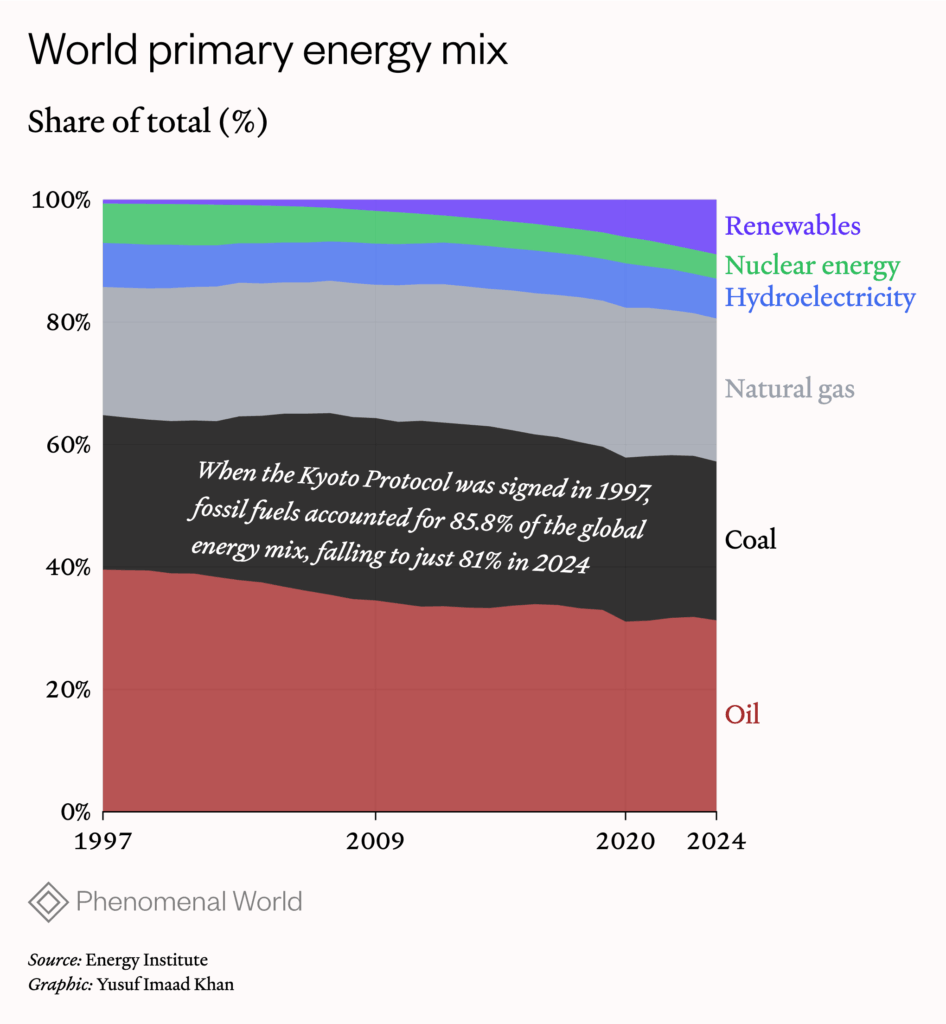
    Forest scarcity

    In view of this failure, the scale required for carbon market offset projects—through environmental conservation, forest regeneration, or reforestation—to ensure net-zero emissions is absolutely unfeasible. Offsetting cannot function as an alternative to decarbonizing energy, production, and infrastructure systems simply because there is not enough land to replant forests.

    To understand why, we must look at not only the disappointing speed of the energy transition, but also the progress of efforts to recapture carbon represented by global carbon credits. Shell, the world’s fourth-largest oil and gas company by market capitalization, purchases carbon credits through forest protection and reforestation, for example. Meeting Shell’s reforestation targets would require, between 2020 and 2030, an area three times larger than the Netherlands, where the company is headquartered.11ActionAid International. (2021, 17 May). Not-their-lands: The land impact of Royal Dutch Shell’s net zero climate target. (<)a href='https://actionaid.org/publications/2021/not-their-lands-land-impact-royal-dutch-shells-net-zero-climate-target'(>)https://actionaid.org/publications/2021/not-their-lands-land-impact-royal-dutch-shells-net-zero-climate-target(<)/a(>).Shell itself claimed that it would be necessary to reforest 700 million hectares—an area equivalent to Brazil—by the end of the century to avoid warming above 1.5 °C, in conjunction with several other mitigation initiatives (such as transitioning to sustainable energy and forest restoration). Even if the other initiatives are successful, Shell’s estimate of the impact of reforestation is highly unrealistic: it assumes an annual carbon sequestration rate of 17 tons per hectare, a figure close to that achieved during the growth of native and biodiverse tropical forests.12Ibid. In 2023, Shell abandoned unprofitable renewable energy projects and announced a major expansion of oil and gas exploration (Christophers, op. cit., loc. 3985). In February 2025, BP announced a 70% cut in investments in renewables to focus on fossil fuels: Moore, M. & Wilson, T. (2025, February 26). BP pivots back to oil and gas after ‘misplaced’ faith in green energy. (<)em(>)Financial Times.(<)/em(>)(<)a href='https://www.ft.com/content/8bcf131f-c820-493f-8ea6-6a35440facd3'(>) https://www.ft.com/content/8bcf131f-c820-493f-8ea6-6a35440facd3(<)/a(>). Since most reforestation opportunities are in temperate forest areas in the Northern Hemisphere,13Bastin, J. F., Finegold, Y., Garcia, C., Mollicone, D., Rezende, M., Routh, D., . . . & Crowther, T. W. (2019). The global tree restoration potential. (<)em(>)Science(<)/em(>), (<)em(>)365(<)/em(>)(6448), 76-79. there is no room to replant tropical forests on this scale. Achieving even less than a third of Shell’s estimate (in a realistic scenario) would require reforesting perhaps more than three times the size of Brazil—assuming the success of the other mitigation initiatives envisaged by the company.

    In even the most optimistic reading, forest offsetting cannot function as an alternative for decarbonizing energy, production, and infrastructure systems. Given the degradation of soils that once supported forests and competing land uses, it would be possible to reforest a maximum of 0.9 billion hectares worldwide, an area capable of absorbing 205 billion tons of carbon in the decades needed for the forests to reach maturity.14Ibid. This is equivalent to only five years of emissions at the current annual rate. The expansion of agriculture, mining, and urbanization has been the leading cause of deforestation between 1990 and 2020, reducing forest coverage worldwide by 178 million hectares.15FAO – Food and Agriculture Organization of the United Nations. (2020). (<)em(>)Global Forest Resources Assessment 2020 – Key findings.(<)/em(>) Rome: FAO. (<)a href='https://doi.org/10.4060/ca8753en'(>)https://doi.org/10.4060/ca8753en(<)/a(>).Even if we could immediately prevent further expansion of these economic frontiers over forests, worldwide forest cover could be reduced by an additional 223 million hectares by 2050 due to the impact of global warming on tropical forests alone. In sum, the socio-technological system based on carbon emissions simply cannot offset sufficient emissions through reforestation and forest restoration to restrict the process forecast to eliminate forests.16The study by Lewis, Wheeler, Mitchard, and Koch (2019) is more pessimistic than that of Bastin et al. (2019), estimating the absorption of 42 billion tons of carbon by 2100, a figure close to carbon emissions in 2024. And that is in the best-case scenario: that the strategy preferred by governments is not the lucrative planting of monoculture forests, but rather the restoration of natural forests. According to the authors’ calculations, monoculture forests would absorb only 1 billion tons of carbon, and agroforestry operations, 7 billion. Therefore, in the worst-case scenario, the entire global potential for reforestation through monocultures would only offset nine (9) days of carbon emissions in 2024. See: Lewis, S. L., Wheeler, C. E., Mitchard, E. T., & Koch, A. (2019). Regenerate natural forests to store carbon. Nature, 568(7750), 25-28.

    In practice, countless forest-conservation projects have been sold without proper proof of their effectiveness. In 2016, a study funded by the European Commission’s Directorate-General for Climate Action concluded that 85 percent of forest mitigation projects were unlikely to achieve “additional” (not overestimated) emissions reductions, compared to only 2 percent that were highly likely to do so.17Cames, M., Harthan, R. O., Füssler, J., Lazarus, M., Lee, C. M., Erickson, P., & Spalding-Fecher, R. (2016(<)em(>)). How additional is the clean development mechanism: analysis of the application of current (<)/em(>)tools and proposed alternatives. Berlin: Institute for Applied Ecology. In 2023, a study by The Guardian and Corporate Accountability analyzed the 50 leading emissions offset projects in the world, concluding that 78 percent were useless, 16 percent were problematic, 6 percent lacked transparent information to allow judgment, and none demonstrated an unequivocal effective contribution.18Lakhani, N. (2023, September 19). Revealed: top carbon offset projects may not cut planet-heating emissions. (<)em(>)The Guardian.(<)/em(>) (<)a href='https://www.theguardian.com/environment/2023/sep/19/do-carbon-credit-reduce-emissions-greenhouse-gases?CMP=Share_AndroidApp_Other'(>)https://www.theguardian.com/environment/2023/sep/19/do-carbon-credit-reduce-emissions-greenhouse-gases?CMP=Share_AndroidApp_Other(<)/a(>).

    The impact of global warming on tropical forests means that reforestation is an unviable alternative to decarbonization. As a smokescreen to allow companies to profit longer from dirty energy, it is self-defeating. Even if the forests that host specific “offset” projects do not disappear in a hundred years, there is a disparity in duration that makes true offsetting unfeasible. Forest mitigation projects have a relatively short lifespan (a maximum of 100 years), but 40 percent of emitted carbon dioxide remains in the atmosphere for more than a century. Between 20 percent and 35 percent of emissions remain for millennia.19Mackey, B., Prentice, I., Steffen, W. et al. (2013). Untangling the confusion around land carbon science and climate change mitigation policy. (<)em(>)Nature Climate Change, 3(<)/em(>), 552-557.

    Public investment pays off

    Among the top emitting corporations, many have financed political and ideological campaigns aimed at discrediting the existence and underestimating the risks of global warming. Where this has failed, they have financed campaigns to discredit public policies aimed at prohibiting emissions and planning investment strategies, coordinating decisions, and allocating resources directly or indirectly in pursuit of structural change. In the United States during the 2024 elections, fossil fuel corporations spent $445 million to elect Donald Trump and other politicians favorable to dirty energy. 

    If this is a symptom of unfair national political systems, in which economic power misinforms and manipulates public opinion and government and legislative decisions, international injustice is even greater. Between 1751 and 2010, just ninety institutions were responsible for 63 percent of greenhouse gas emissions—the vast majority global corporations headquartered in temperate regions less impacted by global warming. Between 2016 and 2022, 80 percent of global emissions came from just 57 such corporations. Although their subsidiaries and subcontractors produce at lower wages and environmental costs in the global South, it is these regions that will be hardest hit by the impacts of climate change. 

    These corporations have appropriated and abused a global common good: the capacity of the atmosphere, soil, and oceans to absorb greenhouse gases. While some of them intend to continue appropriating without limits, others agree to “offset” their future emissions—but not their past emissions—through mitigation projects that are miniscule in scale compared to total emissions. In one way or another, both groups are prolonging the life of a socio-technological system that guarantees them extraordinary profits while accumulating ever greater climate catastrophes.

    This does not mean that carbon pricing and forest offset projects should be discarded. Once an alternative electricity system is in place, carbon pricing could ultimately contribute to accelerating systemic replacement.20Lonergan, E., & Sawers, C. (2022). (<)em(>)Supercharge me: net zero faster(<)/em(>). Agenda Publishing. What should be discarded is the idea, prevalent in the mainstream media worldwide and even at the UN, that charging for the social cost of carbon and its “offsetting” can replace public planning for socio-technological transition.

    This essay is an adaptation of note 12 of Transforma published in March 2025.

  2. Loosening the Markets

    Comments Off on Loosening the Markets

    In the first of two responses to Brent Cebul and Michael Glass, Chelsea Kirk writes about affordable housing in Los Angeles today.

    The guiding logic of contemporary housing policy is disarmingly simple: if we just build more, prices will fall. Expanding supply—by deregulating and streamlining approvals, eliminating rent control, expanding tax credits, and abandoning deed-restricted affordable housing—will entice private developers to build at scale and, in so doing, lower rents for all. It’s a logic that depends, in part, on what economists call “filtering,” meaning that today’s luxury apartments will age into tomorrow’s middle-income rentals, and that yesterday’s middle income rentals will eventually house the working class. A simple and persuasive narrative, it nonetheless fails entirely to account for the role of corporate landlords, financial speculation, and political influence in shaping how housing is built and occupied.

    Deregulation of the market has done nothing to lower rents. Far from delivering affordability, efforts to accelerate private development have done far more to fuel speculation, inflate land values, and displace tenants.

    Los Angeles embodies this contradiction. Its market has been loosened in an effort to, supposedly, fix the housing affordability crisis by increasing supply. In practice, one of the most visible outcomes has been the sale of private, long-inhabited buildings to developers (often registered under a faceless shell company) who in turn evict tenants, many of whom have been resident for ten, twenty, or thirty years. Buildings are demolished in order to make way for higher-density development, which is designed to maximize profits and returns on investment. Often, a handful of “affordable” units will be granted in exchange for permission to build taller than zoning would normally allow.

    For their part, the former tenants must now search for housing in a city where affordable options are scarce. Until recently, they could put their names on a voucher waitlist that runs twenty years, but as of this year, that list has closed due to funding constraints. What usually happens is that people are forced to move farther away, lengthening their commutes, or giving up their jobs altogether. This involves uprooting children from their schools, sometimes from grandparents who provide childcare; it means finding new churches and doctors, making new friends and neighbors.

    New urbanism in Los Angeles

    What economists and supply-side urbanists, i.e. YIMBYs, call filtering never takes place. Instead, units at low rents are torn down to make way for more units at higher, market-rate rents. Because the State of California prohibits municipalities from controlling rents between leases—stabilized rents resetting to market between leases—the units left behind by the new, higher-income tenants are not affordable to a working class household. Paradoxically, as we see, the new density—so celebrated by these supply-side urbanists—has actually eroded existing affordability, replacing it with expensive market-rate apartments all while delivering windfall profits to developers.

    In the case of Los Angeles, new developments almost always undermine working-class neighborhoods—like Koreatown, West Adams, and Westlake—where relatively dense, rent-stabilized multi-family housing already exists. In contrast, resource rich, low-density areas like Brentwood, dominated by affluent homeowners, are largely spared, despite being ideal candidates for the kind of dense development that supply-side advocates claim to support. The developer’s rationale is not hard to understand: it’s far easier and more profitable to demolish rent-stabilized buildings in working-class areas where land is cheaper and political resistance is weak than it is to challenge the political clout of single-family homeowners or acquire their costly land. The return on investment in working-class neighborhoods is higher and, for private developers, that is the only metric that matters.

    The legal mechanism that enables this erosion of affordable rent-stabilized housing—the best defense tenants have against predatory landlords—has been the Ellis Act (1985). This California law allows landlords to “exit” the rental business, and demolition itself has come to count as one such exit. Since 2001, landlords have invoked the Ellis Act to remove more than 30,000 rent-stabilized homes in Los Angeles. Where replacement has occurred, it has overwhelmingly taken the form of market-rate housing, and where it’s been rent-restricted as “affordable,” rents remain far above what displaced tenants can pay.

    Here it is worth pausing to explain what “affordable housing” means in the US. By tradition, a unit is considered “affordable” if rent and utilities cost less than a third of one’s household income. Beginning in the New Deal era, affordability was ensured through public housing, constructed, owned, and operated by local housing authorities with federal support. In periods of high inflation, such as World War II and the Korean War, the federal government also protected affordability through extending price controls to private rents, which local governments have continued—Los Angeles’s municipal Rent Stabilization Ordinance dates to the high-inflation year 1979. Rents in public housing, meanwhile, were tied to tenants’ own incomes.1A 1969 amendment to the Housing Act capped rents in public housing at 25 percent of a tenants’ income, a limit that was raised to 30 percent in 1981. For private rents, the history of regulation has been toward vacancy decontrol, eroding affordability of rent-stabilized housing. Since the 1970s, however, the US has shifted away from producing public housing and regulating private rents, and the meaning of affordability has shifted too, into a market category. Now, the government outsources production to private developers through the Low Income Housing Tax Credit Program (LIHTC, pronounced lie-tech) by giving out $13.5 billion a year in federal tax credits to developers in exchange for building housing based on income limits tied to an area’s median income, not the actual incomes of tenants.

    The LIHTC program has produced about 3.7 million units thus far—roughly 2.5 percent of the national housing stock—but rent levels are no longer set according to household income. Instead, they are set by income limits derived from an entire area’s median income (AMI), with the price system ostensibly “filtering” where tenants live. But in an unequal city like Los Angeles, with a high proportion of wealthy houses, the AMI is inflated. Because rent stabilization allows rents to rise to market between leases, the only places the price system leaves for displaced tenants to “filter” to are often outside the city altogether. LA County’s AMI is $106,600; most recent LIHTC units are reserved for households earning 80 percent of that figure, or $84,280 per annum—an incredibly high income to act as a threshold to affordability. Those eligible for the scheme can be asked to pay $2,121 per month in rent.

    Affordable housing in action

    To make matters worse, because LIHTC is mostly a private enterprise, with only 20 percent of units produced and operated by nonprofit developers, rents are typically raised each year by the allowable maximum increase of up to 10 percent. Corporate landlords such as Blackstone now participate in the program, and once the affordability covenants on these units expire in thirty to fifty-five years, rents will reset to market rates.

    The proponents of deregulation, so-called “YIMBY” urbanists, argue that the loss of rent-stabilized housing is an acceptable trade-off for increased net housing production. A recent study shows that demolitions under the Ellis Act have resulted in a 195 percent net gain in housing units (39,761 added versus 13,455 lost). But this statistic masks that the units destroyed were the city’s most affordable homes, often occupied for decades by working-class families.

    Politically, city leaders present deregulation as proof of urgency and pragmatism; cutting red tape, they claim, will deliver the housing Los Angeles so badly needs. Tenant advocates—and displaced tenants themselves—push back, pointing to developer profits and asking the obvious question: who is this new housing—a studio apartment priced at $2,500 per month, for example—for? But when deregulation is tethered to the slippery concept of “affordable housing,” opposition is perceived as NIMBYism, and support becomes the only acceptable position.

    A recent effort in Los Angeles to increase affordable housing production has only accelerated the loss of rent-stabilized units. Just four days after taking office, Mayor Karen Bass unveiled Executive Directive 1 (ED1), a plan to fast track the approval of projects that are, according to the jargon, 100 percent affordable. Under ED1, new projects must be earmarked either exclusively for households earning up to 80 percent of AMI, or otherwise be mixed-use projects in which up to 20 percent of units can be rented to households earning as much as 120 percent of AMI. This means that a one-bedroom household costs $3,636 per month to rent, and is made available to households earning $145,450.

    Within weeks of ED1’s rollout, working-class tenants across Los Angeles began receiving eviction notices that their homes were being demolished to make way for “affordable housing.” The promise of streamlined approvals and guaranteed profit attracted a flood of opportunistic developers, many with no experience in affordable-housing development. Among the celebrity investors were former NBA players Terry and Tobias Harris, who are spearheading ED1 projects in Echo Park. By July 2024, tenant groups had pressured Bass to issue a revision of ED1, which exempted properties with twelve or more occupied rent-stabilized units.

    Perhaps the most egregious feature of ED1 is that it explicitly excludes single-family zoned neighborhoods from eligibility. The program acknowledges the urgency of affordability—only so long as it does not disrupt the preservation of these single-family zoned districts, which make up 75 percent of all residential land in Los Angeles. Homeowners perhaps remain a more politically powerful constituency than developers, at least in this instance, and the result is that the burden of ED1 has fallen on working-class tenants rather than on the affluent neighborhoods best positioned to absorb new housing.

    Landlords as an interest group

    Yet it would be a mistake to assume that the political influence of real-estate developers has been weakened because single-family homeowners have successfully insulated their neighborhoods. On the contrary, their power operates differently but no less decisively, as the case of Barrington Plaza shows. Originally built through Section 608 FHA financing, the 712-unit complex became the site of Los Angeles’s largest eviction in recent history, when in 2023 the owner, Douglas Emmett, Inc., issued Ellis Act notices to more than 700 households under the pretext of sprinkler retrofits—a blatant misuse of the Ellis Act. The real estate company contributed $400,000 to an independent expenditure supporting the incoming councilmember Traci Park, with employees adding nearly $10,000 more directly to her campaign. After Park took office, and the evictions were issued, no meaningful intervention came from the city. It took two years of private litigation to rule the evictions illegal, but by then the majority of the 522 households who had occupied Barrington Plaza had already moved out.

    The story Cebul and Glass tell about FHA Section 608 is, undeniably, one of egregious profiteering. Developers manipulated cost estimates, inflated land values, and exploited legal loopholes to pocket millions, often with the approval or direct collaboration of FHA officials. The scale of dishonesty and greed was staggering. But the deeper failure wasn’t just the behavior of these builders, as the historians show. It was the political decision to entrust the provision of affordable housing to private actors driven by profit. As Cebul and Glass recognize, this wasn’t a case of a few bad apples; it was a structurally flawed system designed to produce precisely these outcomes.

    If the development and operation of this housing had been carried out by public actors much of this may have been avoided. Policies that rely on profit-seeking developers will always be compromised by the incentive to extract value rather than provide it. Real-estate greed cannot be regulated out of existence so long as private landlords and developers remain central to the system. Section 608 failed not only because some developers acted dishonestly, but because it was built on the flawed premise that private actors, if properly incentivized, would serve the public good. That premise was wrong then, and it remains wrong today.

    A serious response to the housing crisis requires more than tweaks to financing tools or incentives. It demands a departure from the private market system altogether. This means taking on the political power of both homeowner and developer interests, so that governments can be properly pressured to invest in new meaningfully affordable housing.

  3. Adding Value

    Comments Off on Adding Value

    In the United States today, the affordable housing crisis has reached a breaking point. Despite a recent surge of apartment construction, rents have hit record levels. According to the June 2025 “State of the Nation’s Housing” report from Harvard’s Joint Center for Housing Studies, an all-time-high of 22.6 million renters—one in two renters nationwide—are now cost burdened, spending more than 30 percent of their income on housing and utilities. With so much of each paycheck devoured by rent, families are forced to cut back on food, clothes, healthcare, retirement savings, and other essentials. Especially for the poorest households, the rent eats first.

    At the moment, the dominant liberal policy response calls for unleashing “abundance” by enhancing the incentives for developers to build more housing. The idea is straightforward. If the government would reduce zoning barriers, streamline regulations, and offer subsidies to developers, the private market would be free to create enough housing for everyone. But the history of incentive-driven housing development offers a cautionary tale. During the postwar era, federal programs with a remarkably similar logic produced impressive volumes of new rental housing. Yet because the programs lacked adequate public oversight, they did so at the cost of rampant profiteering, flagrant bribery, high rents, and deepening racial inequality. They also helped lay the foundation of the Trump real-estate empire.

    The history of federal incentives for multifamily housing construction shows that this outcome—excessive profits fuelling higher rents—stems from the very structure of the industry. It’s certainly no scandal for a developer to turn a profit. But private actors are also deeply invested in driving up land values over time, which fundamentally undermines the prospect of building abundant housing that will remain affordable. At the same time, builders often recoil at regulations limiting their ability to profit. When the scandals of the 1940s were exposed and Congress tightened oversight to prevent abuse, far fewer developers utilized subsidies for affordable rental housing. Others ended up twisting the initiatives to construct luxury apartments. As debates rage about “a liberalism that builds,” understanding the conditions under which developers might construct multifamily housing is more important than ever.

    War housing

    In 1942, amid wartime housing shortages, Congress launched the Federal Housing Administration (FHA) Section 608 program of “war housing” to spur construction of affordable rentals for defense workers. Rather than directly producing new apartments through public housing authorities, with Section 608 the federal government indirectly subsidized private builders. The FHA did not erect buildings or lend money directly, as local housing authorities did. Instead, the FHA offered insurance for private construction loans, socializing the risks for builders and bankers with American taxpayer dollars as the backstop. In other words, if a developer defaulted on their mortgage, the FHA would make the lender whole.

    Created in 1934 to stabilize the housing and banking sectors during the Great Depression, the FHA’s mortgage guarantees encouraged lenders to offer loans with longer terms, fixed monthly payments, and lower interest rates. As many scholars have shown, policymakers preferred mortgage insurance to direct expenditures because it kept programs off the federal budget, preserved racial segregation through exclusionary underwriting standards, and maintained the fiction of a free market. When housing shortages mounted in defense production areas during World War II, Congress extended these credit supports to rental housing in the form of the Section 608 program for multifamily mortgage insurance. 

    Although seldom remembered today, FHA Section 608 marked an important turning point in federal housing policy. It not only protected banks against potential defaults. It also offered increasingly attractive terms for private builders by significantly liberalizing their insurance terms. Section 608 increased the level of FHA insurance from 80 to 90 percent of the mortgage value, reducing their required down payment to just 10 percent (and savvy builders found ways to lower down payments ever further). The program also lengthened the maximum mortgage maturity from twenty to twenty-five years, allowing for lower monthly payments. This arrangement made banks more willing to lend and builders more willing to construct apartments.

    In terms of production figures, the program delivered impressive results. Between 1942 and 1950, FHA Section 608 underwrote approximately 7,000 apartment complexes, producing a total of 465,674 new rental units nationwide. Most were concentrated in large metropolitan areas, including some 60,000 units in metropolitan New York City, nearly 16,000 units in Chicagoland, and more than 14,000 units in Los Angeles County. But they were also built in all fifty states, including the smaller cities of Butler, Pennsylvania (142 units) and Boise, Idaho (297 units), and even in Puerto Rico (4,947 units). These FHA-insured projects accounted for two-thirds of all new private rentals during that period, and they produced twice as many apartments as public housing over those years.

    Mortgaging out

    Behind those numbers was a system rife with fraud and abuse. After the war, as housing shortages persisted, Congress further liberalized the program. The Housing Act of 1948 shifted the cost calculations of FHA-insured loans from “estimated replacement cost” to “necessary current cost.” Whereas initially builders could only count the cost of replacing the building materials, now they could list the full market value of the land and materials. The change invited speculation by allowing builders who had acquired land cheaply to mark it up to the “current” value amid the postwar housing shortage. With a friendly appraiser or by reselling their land through shell companies, builders could push the value even higher and pocket the difference. There was even an industry term for this process: “mortgaging out,” as in maxing out the mortgage to wring more profits.

    By 1950, as members of Congress were getting wind of profiteering and bribes, the Senate convened hearings to investigate. Called to testify, Rodney M. Lockwood, president of the National Association of Home Builders, dismissed stories about inflated mortgages, calling them mere “barroom talk.” Likewise, the chairman of the Mortgage Bankers Association said that despite “a lot of experience with Section 608 . . . I have seen none that in my opinion were in excess of the cost.” Yet following the hearings, the industry journal Architectural Forum published an explosive exposé describing how “the FHA gold mine” worked: “this miraculous piece of legislation makes it possible for almost anybody of moderate acumen to become an apartment owner without spending a cent of his own money.” With allegations of fraud and graft mounting, Congress quietly allowed Section 608 to lapse in May 1950.

    But when the Department of Justice opened its own follow-up investigation into the Section 608 program, the scale of the abuse discovered was staggering. The unraveling began when a high-ranking FHA official lost $5,000 playing craps at a Virginia Beach casino—about half his annual salary. The FBI found that he had been accepting bribes in exchange for inflated appraisals on FHA-insured mortgages. Whether the builder held the property or, as was often the case, they quickly sold it, renters were left paying artificially high rents to pay down the full mortgage costs.   

    These revelations snowballed into a major scandal, culminating over the summer of 1954 in a new round of Senate hearings. Sensational testimony from builders and FHA officials exposed how profiteering and speculation fueled the apartment boom. Many builders had overstated their construction and land costs in their insurance applications to secure higher mortgage valuations. After obtaining outsized government-backed loans, they built cheaply and slashed labor costs. Ian Woodner, builder of The Woodner and other 608 buildings in Washington, D.C., included the hefty legal fees for his divorce among the construction costs. Charles Glueck, a prominent mortgage broker for 608 projects in Indiana, did the same for receipts from his Florida vacations. Other builders resorted to bribing FHA officials for higher appraisals. The chief FHA appraiser for Los Angeles, John William Salmon, accepted a Ford automobile and $25,000 cash in exchange for an inflated valuation. The assistant director of the New Mexico FHA, Andrew Frost, enjoyed deep sea fishing trips and boozy parties hosted by builders. 

    Committee staffers discovered that builders had taken excess profits in 91 percent of the 1,547 Section 608 projects they investigated. One builder in New York invested just $20,000 in a development and walked away with $4.9 million in windfall profits. Another in Ohio scored a $1.1 million windfall after risking just $4,000 of his own funds. Altogether, the investigations found as much as $500 million in leftover funds (the equivalent of around $6 billion today) had been “mortgaged out.” Aghast at the pilfering of FHA-insured mortgages, the Senate called these sums “unconscionable windfall profits.”

    Windfall profits

    When hauled before Congress in 1954, most builders remained unapologetic. One of the most notorious witnesses was Fred C. Trump, father of the future president. To build the 1,860-unit Beach Haven Apartments in Brooklyn, Trump had invested just $249,000 of his own money. By inflating the land values and adding extra fees on his FHA insurance application, he secured an outsized loan for the dishonest amount. Trump then built the apartments quickly and cheaply, with $3 million leftover as developer’s income rather than physical housing.

    At the hearings, Trump denounced “Washington headline hunters” for “circulating false and misleading stories.” News of his $3 million windfall at the Beach Haven Apartments had prompted tenants to demand rent reductions, and Trump moaned that such negative publicity was “very wrong and it hurts me.” Other witnesses were even more indignant. William J. Levitt, builder of the famed Levittown developments, profited from 608’s cousin, Section 603, for single-family rentals. “The housing was produced,” Levitt shot back at the vexed Senators, explaining that without “certain evils” required by “desperate” postwar circumstances, “you would never have gotten any builder over the age of 16 to go in and venture time, trouble, money, or anything else and get the volume of housing that had to be gotten.” 

    Levitt and Trump identified a central tension in FHA operations. In a sense, the corruption reflected the very design of Section 608. Desperate for new rental units to relieve the housing shortage, FHA officials had come to accept overvaluations as a necessary enticement for builders. While dozens of FHA officials were ultimately prosecuted for accepting bribes, no builders faced any serious legal consequences.

    With the “windfall profits” scandal generating national headlines, Senator Homer E. Capehart, an Indiana Republican, expressed his disgust: “I think it is quite an indictment of the private enterprise system . . . that you just can’t get housing unless the Federal Government guarantees it 100 percent.” In its final report, the Senate committee echoed Capehart’s concerns about the troubling logic of credit liberalization and excessive profits as a necessary stimulus for private housing production: “We are not prepared to accept the premise that adequate rental housing cannot be made available to the American people except when unconscionable profits are realized.” “If that is the only alternative,” the report declared, “it is better that the Government build such projects itself.”

    Segregation by design

    While these revelations became a major scandal, far less discussed were the racial inequalities entrenched by the quest for private profits. As our mapping project on FHA Section 608 makes clear, builders who used the program largely avoided communities of color. Of the 15,672 units of Section 608 rentals built throughout metropolitan Chicago, 82 percent were located in census tracts with 92 percent or more white residents. The patterns were even starker in New York City: in the predominantly white borough of Queens, over 42,897 units of Section 608 were spread across 322 apartment complexes, with only one project—Convent Gardens in Harlem, with just 90 units—built in a Black neighborhood.

    By delegating site selection choices to builders and maintaining discriminatory lending criteria, the FHA rental programs had deepened segregation. But when federal officials attempted to make amends for the racial inequalities of FHA credit operations, they found the resulting regulations left builders much less interested in participating.  

    As Congress pursued the FHA Section 608 investigation, lawmakers were simultaneously debating reforms to urban renewal. Given the racial geography of the hundreds of communities it was planning to destroy, the Housing Act of 1954 established another new FHA program, Section 220, to house displaced families on urban renewal sites. FHA director Albert Cole championed the use of mortgage insurance for urban redevelopment: “Builders who can transform a rolling field into a modern suburb can certainly change a slum into a desirable neighborhood.”

    In response to the windfall profits scandal, however, Congress inserted into its urban renewal housing program strict cost certification regulations and profit margin caps of 5 percent. Crucially, because federal and local governments were involved in acquiring and preparing the land for urban renewal projects, builders were prevented from inflating land values. Given such controls against profiteering as well as other logistical headaches associated with urban renewal projects, builders largely stayed away from Section 220. Over the next decade, hundreds of municipalities undertook thousands of urban renewal projects that disproportionately destroyed communities of color. But Section 220 produced merely 45,000 units of rental housing—less than one-tenth of the total under Section 608. By 1964, nearly a quarter of these Section 220 projects reported “some difficulty” in meeting mortgage payments thanks to construction delays and high vacancy rates. Unable to inflate valuations, Section 220 builders often cut all the amenities, producing drab and desolate housing that failed to retain residents.

    Facing profit caps and stringent cost certifications, many builders instead used Section 220 for luxury construction aimed at the higher end of the rental market. By the mid-1960s, the program had underwritten several notable high-end housing developments on urban renewal sites: Chicago’s Carl Sandburg Village, Los Angeles’s Barrington Plaza, Philadelphia’s Society Hill Towers, and Washington, D.C.’s Capitol Park Apartments. In builders’ hunt for profits, higher rents represented an alternative to cutting amenities.

    When Congress convened another set of hearings in 1966 on Section 220, some representatives questioned the rationale of displacing poor and working-class communities with federal subsidies to make way for luxury housing. By then, however, with many cities losing population and urban rebellions mounting, Congress had abandoned any serious efforts at increasing the supply of affordable housing. Instead, federal housing policy shifted to vouchers, assistance for low-income homeownership, and other demand-side subsidies.

    Limits to abundance

    Much has changed in the decades since these FHA scandals. During the 1960s and 1970s, the Beltway diagnosis of the nation’s housing problem shifted. Instead of aiming to produce large volumes of new rental housing, policymakers began attempting to match tenants with existing rental housing. Yet as the problems of urban disinvestment persisted, the need for new construction became undeniable. In 1986, the Reagan administration created a new financial instrument to entice private lending in otherwise low-profit projects: not through mortgage insurance, but through tax credits like the Low-Income Housing Tax Credit. Meanwhile, FHA mortgage insurance remained the device for stimulating construction of single-family owner-occupied homes, and Congress progressively liberalized terms to make single-family mortgages easier to access—a market tapped by private finance during the George W. Bush era, with world-shaking results. 

    In the aftermath of the subprime mortgage collapse, the goals of national housing policy have swung from expanding home ownership back to increasing the supply of rental housing. Given the return of this goal, the history of public-private rental housing merits reflection. The midcentury FHA scandals show that loosened regulations and public subsidies—the main planks of today’s abundance agenda—are not enough to deliver sufficient affordable housing. Fred Trump did not just exploit the FHA system; he embodied its core logics of liberalized credit, socialized risk, and privatized profits. Trusting the same class of builders and recycling similar incentive schemes would be a mistake. Because developers, homeowners, and local governments are all deeply invested in maintaining or boosting property values, clearing out regulations and pouring in subsidies risks fuelling the same kind of speculative, profiteering frenzy that defined not only the windfall profits scandal but also the 2008 financial crisis.

    Without strong oversight to regulate costs on both the demand and supply sides, the abundance agenda runs the risk of builders inflating costs to pad their profits, undercutting the goal of affordability. Advocates of the abundance agenda, who prioritize speed and thrift, might resist such regulation. But in real-estate markets where profits depend on scarcity and rising land values, any serious housing agenda must confront these structural dynamics. Or, they might learn the lessons of the FHA windfall profits scandal. To once again quote the 1954 Senate report, there is an alternative to subsidizing speculation: “It is better that the Government build such projects itself.”

    An article presenting Brent Cebul’s and Michael Glass’s research on the policy history of multifamily mortgage insurance was featured in June issue of the Journal of American History. A geographic map of FHA-insured rental housing can be found at BuildingInequality.us.


  4. Insurance in the Polycrisis

    Comments Off on Insurance in the Polycrisis

    In April, a senior European insurance executive warned in a viral LinkedIn post that climate change threatened his industry’s existence and, in turn, capitalism itself. “Flooded homes lose value. Overheated cities become uninhabitable. Entire asset classes are degrading in real time, which translates to loss of value, business interruption, and market devaluation on a systemic level,” wrote Günther Thallinger, of Allianz.

    Alarms had been sounding about the threat that climate change poses to housing markets for some time. It was no longer simply the case that weather events threatened to destroy people’s houses; it was that whole swathes of property would no longer be insurable, as companies began to turn down high-risk areas. A year before Thallinger’s warning, the cover of The Economist exhorted, “Climate Change is Coming for Your Home.” It was, the newspaper informed its readers, not just countries like Bangladesh and low-lying Pacific islands that were at risk, but also US housing—the asset class that helped set off the 2008 global financial crisis.

    Our attempt to capture the sprawling, whack-a-mole, crisis-ridden political economy of insurance and climate change

    The real-estate industry, think tanks, and countless media stories since have warned of the coming ruination— a doom loop. At a congressional hearing earlier this year, US Senator Sheldon Whitehouse described the loop: “Climate risk makes things uninsurable. No insurance makes things unmortgageable. No mortgages crashes the property markets. Crashed property markets trash the economy.”

    A 2018 Bank of England paper laid out this scenario, in which insurance is at the heart of a new “Minsky moment” related to climate change: climate change-induced sudden shocks devalue assets that in turn trigger systemic risks to global financial systems, which would look something like this:

    Source: Sandra Batten, Bank of England

    A new consensus is emerging that the destruction wrought by increasing fires, floods, and storms has not only exposed basic amenities like housing to new risk, but that this risk itself is now so extreme and so far-reaching that it threatens the smooth functioning of markets in general. But to date this hasn’t happened, and it’s not entirely clear that it will ever play out as a system-wide financial catastrophe—more likely is that we see more of the same, with intensifying and unevenly distributed social consequences.

    The view from the insurers

    Insurance companies are not in the business of going out of business. If they judge that payouts are becoming too large and frequent to maintain profits, they can—and do—raise premiums, reduce hazards covered, or simply refuse to offer insurance in certain “high-risk” areas.

    In California, where record-breaking wildfires earlier this year collectively accounted for $37.5 billion in insured losses—roughly 70 percent of global insured disaster costs—insurance providers are adapting their models. State Farm and Allstate, the two largest insurers in the country, have both since quit offering insurance across the golden state. They blame California’s government for not allowing them to raise their premiums to a level consistent with profitable underwriting.

    Far from presaging the insurance industry’s collapse, these sorts of steps—higher premiums, the withdrawal of insurance from particular areas—protect the industry, and put the risk burden on home owners themselves.

    Insurance premiums are generally set in one of two ways. In the “risk pooling” approach, there isn’t much differentiation between premiums charged to high and low risk households. If the premiums are “risk-based” they are calculated on the specific risk of each customer (or at least, the insurance company’s estimate of it). 

    The pooled approach helps to socialize losses, but insurers mostly oppose it, arguing that this approach misses an opportunity to signal the risk to oblivious households and even governments—especially as climate change is increasing those risks. When governments provide last resort insurance, or restrict price rises as in California, insurers argue that this cross-subsidizes and encourages the building of ever more valuable structures in ever more hazard-exposed places. 

    Researchers like Paula Jarzabowski, however, point out that this “risk signalling” is barely effective in practice. Housing is not liquid and fungible as an asset class—and neither are the homes and communities that inhabit it.

    Steep insurance-premium hikes are, unsurprisingly, deeply unpopular with voters, and property insurance is often heavily regulated by the state. If not by direct price intervention, this can be in the form of subsidising premiums, backstopping the insurers’ risks, or offering a state-backed insurer of last resort.

    For insurers, these are questions of profitability and market share. But for huge numbers of people, these are existential questions. In the Anglophone countries, for example, housing represents the largest asset for most individuals (not to mention a place to live), and so the political economy of insurance is intrinsically tied to mass politics.

    Even when a government uses insurance mechanisms to incentivize itself to reduce exposure to climate risks, there is no guarantee it will work. In the UK, a public insurer, Flood Re, was created in 2014 with the explicit goal of addressing the trade-off between moral hazard and near-term insurance affordability. It pools flood risk by applying a levy to every household’s insurance policy (of 10 GBP), and puts it into a capital fund that cuts the cost of insurance for those most likely to flood.

    The proposal was that, over twenty-five years, insurance would transition back to full risk-based premium pricing. For this to work would require the UK government to both undertake resilience work and stop development in exposed areas. But that hasn’t happened. Flood Re’s chief executive has warned that not only has the country’s total flood risk grown since the scheme was established, but its ability to source enough re-insurance of its own is probably limited.

    This shaky promise of a pathway to market based operations in the future is what Brett Christophers calls “allusive”: governments’ vaguely gesture to market-based solutions to preclude them from having to substantively deal with flooding in the present. The US equivalent, the National Flood Insurance Program (NFIP), is not attached to any similar goal of eventually leaving high-risk households to the mercy of the insurance market. Instead, it is perversely subsidising building and rebuilding in risky areas—a regressive measure whose benefits skew towards wealthier coastal households.

    Half of the NFIP payouts have gone to just twenty-five counties. The scheme that covers 4.7 million insurance policies has frequently run out of funding and is scheduled to expire again at the end of September with the GOP’s fiscal brinksmanship of shutting down the federal government. The NFIP’s authorization to borrow from the US Treasury will be struck down from $30 billion to $1 billion.

    Adaptation to chronic flooding is a political economy problem from hell. Coastal/river communities are dependent on property taxes to fund budgets for schools and public services. And property values are people’s assets dependent on broader credit & insurance markets. (Source: Rachel Cleetus, Union of Concerned Scientists; Nature)

    Meanwhile, in Australia, where home-property insurance is commercially priced and where the state doesn’t act as the “insurer of last resort,” the market-based “risk signal” premium has been less constrained for most of the last few decades. Australia’s population hugs the coastlines and forested hinterland, both of which are frequently buffeted by increasingly dramatic floods, cyclones, and bushfires. Segments of the country have already become uninsurable. In the tropical north, which is exposed to cyclones, a public re-insurer was finally established to underwrite compulsory cyclone insurance in the area, thanks to the pressure mounted by dozens of public inquiries and reviews. The scheme also provides discounts to households and buildings that “harden” their roofs, doors, windows, and gutters to mitigate damage.

    Engineering financial hope

    How might the insurance industry respond to the problem of shrinking insurability? There is one relatively new development in the industry that is being rolled out to offer more insurance—namely, courting non-specialist finance. Traditionally, insurers hedged against massive payouts by buying their own cover from re-insurers; often in deals struck during the industry’s “conference season” which begins each year in Monte Carlo, and continues in Baden-Baden and Singapore. In the last couple of decades, though, capital from portfolio investors, asset managers, hedge funds, pension funds and the like have been selling this risk cover by buying catastrophe bonds: a debt instrument that pays a handsome interest rate, but defaults if a particular damage or event threshold is reached.

    Anatomy of a Catastrophe Bond. Insurance markets are so confusing yet everything is crystal clear when you are on the wrong end of the stick. Who Pays? Who loses? Who wins? Who invests? (Source: Catastrophe Time, Gary Zhexi Zhang)
    (Source: Reinsurance News)

    About 10–15 percent of re-insurance is done via cat bonds and similar instruments. It is growing fast, although not necessarily faster than “traditional” re-insurance capital. But these markets add an external driver to the supply and demand of re-insurance capital.

    Insurers offer finance capital something more valuable than juicy returns: an asset uncorrelated with market risk. Asset managers have something to gain in the form of diversification: it’s not just that these catastrophe bonds have higher yields than many other assets. The prospect of losing the investment altogether, if the weather and climate systems work against them, is seen as an acceptable risk due to its low correlation: a wildfire or hurricane won’t be connected to, say, a crash in the value of US tech stocks. Or so the logic goes. For managers of large pots of investment money held for purposes like pensions, diversification is an important goal and often, a regulatory requirement. Retail investors too don’t want to miss out on the returns, and are currently fighting for the right to bet on natural disasters.

    Cat bond issuers and investors say that they’ve enabled insurance where it wasn’t otherwise available, and there are attempts to incentivize homeowners to harden their homes to save money on their insurance. They could be a positive externality from financial innovation—or an accident waiting to happen.

    There are signs that we may be in the calm before a storm. For now, between traditional firms and new investors, there is enough re-insurance money available to keep global catastrophe insurance underwriting ticking over. But industry participants like Verisk suggest that the baseline is shifting: average annual losses are rising slowly but steadily in the background as smaller perils like storms and wildfires become more frequent. This might not be obvious—especially to the non-specialist investor—until it suddenly is. Catastrophe insurance is about accounting for the outliers, not the average.

    Parametric insurance

    A more recent and much-hyped innovation in property and disaster insurance is “parametric” triggers. Rather than insurance claims being based on the amount of damage incurred, parametric insurance is paid out when a pre-defined parameter is reached: say, a category 5 hurricane makes landfall in a particular place or with certain wind speeds. If such an event doesn’t quite meet the agreed criteria, but still does a lot of damage, there is no payout. The insurers presumably benefit from their superior ability to model disasters. Benefits to the insured party mostly involve speedier payouts, skipping the time-consuming claims process of traditional insurance.

    Parametric triggers feature in many of the insurance-based climate solutions pitched for developing countries; the history of such initiatives is rich with failures. Last year, Jamaica, despite suffering millions of dollars worth of damage to crops and infrastructure, did not get an insurance payout from its catastrophe bond. Why not? The air pressure from Hurricane Beryl narrowly missed the threshold level specified in the contract. Similarly in 2017, a G7 government backed parametric insurance scheme had a disastrous and erroneous delay in triggering a Malawi famine event payout.

    Political reckoning?

    A dramatic climate-insurance breakdown that shocks the financial system of entire national economies will be preceded by something more banal, but perhaps equally sinister: years of more vulnerable communities getting more squeezed by a combination of ongoing extreme climate events, huge insurance premiums, and with it the quiet retreat of commercially-provided essential services like supermarkets, banking, and telecommunications. More affluent communities, on the other hand, may succeed, for a time, in obtaining public funding to protect themselves and their housing wealth.

    At stake is not the narrow insurers’ view of the “pooling of risks” or a dramatic wake-up moment of a doom loop prophesy, but rather a citizenry bound in “communities of fate” and the moral economy of the welfare state. The politics of insurance, Rebecca Elliot has argued, is ultimately about “what is fair and valuable, what needs protecting and what should be let go, who deserves assistance and on what terms, and whose expectations of future losses are used to govern the present.” On the twentieth anniversary of Hurricane Katrina, those who are devalued, displaced, and disinvested already know what the future on an uninsurable earth looks like for the beautiful and the damned.

  5. Mining After Apartheid

    Comments Off on Mining After Apartheid

    The mining industry has long been considered the fulcrum not only of South Africa’s economy, but of its social and racial order as well. With the discovery of gold in 1886, the mineral revolution turned the disparate colonies under Boer and British rule into the beating heart of the global economy, drawing in black and white workers from across the world and developing new forms of racial labor. As the industry churned out profits, it reshaped South Africa’s  economic landscape, providing remittances for the impoverished countryside while spawning secondary industries that absorbed new waves of workers.      

    The industry’s critical role in South Africa’s racial capitalism made it a key target for the African National Congress upon coming to power in the mid-1990s. The possibilities appeared profound: here was a large, resource rich country on the brink of social and economic transformation. Were it to successfully restructure the mining industry, the ANC hoped, it would provide a model for dismantling the racial inequalities underpinning the rest of South Africa’s economy.

    Ambitions to radically re-order the mining sector, however, soon fell short. Instead of pursuing a program of mass redistribution as many had expected or hoped,  the ANC ultimately pursued a far more neoliberal project, most carefully documented by Gavin Capps. At times in conflict with the old levers of mining capital, at other times shaped by the power they wielded, the ANC came to shelve any proposals to meaningfully nationalize the industry. Instead, it opted for a “custodianship” model, which hinged on a program of black capitalist empowerment—with no effective levers to enforce any trickle down to the majority of South Africans. 

    Racial capitalism

    The pre-1994 mineral laws were maddeningly complex. Even before the introduction of apartheid in 1948, property laws had varied significantly, often determined by race but also by the different legal systems in South Africa’s British and Boer colonies in the nineteenth century. In the late nineteenth century, the colonial governments of South Africa started cordoning off “reserves” for African occupation, the predecessor to full-blown segregationist policies that restricted where Africans could and could not live.

    In the coming decades there were moments of interest in the minerals on this “reserve” land, most notably in the 1920s with the discovery of platinum in South Africa’s northern territories, but there was much uncertainty about what property form these minerals would take: were they private property that could be purchased on the free market, or were the minerals held in communal ownership structures, as the surface land had been designated? The question played out differently depending on the local politics and administrative structures, but once the platinum market went bust in the 1930s, the urgency to confirm the nature of mineral property on the reserves subsided. When the apartheid government formalized the reserves into Homelands—ethnically defined territories, supposedly with self-governing powers—there was little done to standardize or clarify the nature of mineral property in these spaces. Only in the late 1960s did platinum mining begin in earnest in South Africa and a series of deals were struck between the newly established Homeland governments and platinum mining companies, but these were mired in contest and confusion over the nature of the mineral rights.

    Instead, for much of the twentieth century, gold was the focus of mining in South Africa. It so happened that the 1886 discovery of gold on the Witwatersrand was on a white-owned farm and later discoveries were classified as falling under land that could easily be transferred to white ownership. This was significant as it created a relatively simple mineral property regime for gold. Minerals could be cordoned off as private property and sold through a land market. As Keith Breckenridge explained, this made access to gold mining licences relatively simple, precise and consistent.1Keith Breckenridge, “Special rights in property: why modern African economies are dependent on mineral resources” (working paper, Brooks World Poverty Institute, 2008), 3.

    Much has been said about the role of gold mining in the racial capitalism that came to define twentieth-century South Africa. In short, it was in the late nineteenth century that English mining magnates were able to secure finance from the imperial center to initiate large-scale underground operations that made significant profits. Over the decades that followed, Afrikaans-owned companies entered the sector too; it was the combination of cheap black labor and the ability to raise capital that turned the mining industry into the fulcrum of the apartheid economy, allowing for the consolidation of enormous profits in white hands. The British multinational Anglo American held a noteworthy concentration of South African wealth, controlling not only several mining companies but a range of other industrial-sector companies too. This reflected the monopolistic nature of the apartheid economy. By 1990 Anglo American, and two insurance companies—Sanlam and Old Mutual—owned 75 percent of the Johannesburg Stock Market’s total capitalisation.2Roger Southall, (<)em(>)The New Black Middle Class in South Africa(<)/em(>) (Johannesburg: Jacana, 2016), 85..

    Redistribution and its discontents

    The radical break that the 1994 democratic elections presented thus offered an opportunity to standardize mineral laws and, with greater ambition, to give Africans access to the enormous wealth generated by the mining industry. In some of the first policy documents of the time, the ANC gave the impression that it intended to do just that. The Reconstruction and Development Programme (RDP), widely understood as the highpoint of ANC redistributive and progressive policy-making, stated that, South Africa was “one of the richest countries in terms of minerals” but that hitherto,

    this enormous wealth has only been used for the benefit of the tiny white minority. The minerals in the ground belong to all South Africans, including future generations. Moreover, the current system of mineral rights prevents the optimal development of mining and the appropriate use of urban land. We must seek the return of private mineral rights to the democratic government in line with the rest of the world.3African National Congress (ANC), 1994. The Reconstruction and Development Programme, Johannesburg: Umanyano.

    At the same time however, there were equally powerful forces within the ANC alliance pushing in the opposite direction. In the constitutional negotiations leading up to the first democratic elections, the ANC agreed to the sanctity of private property. They feared that radically reconfiguring property relations would jeopardize not only investment in the country, but also the delicately negotiated peace deal itself. The contradictory pull was encapsulated in a 1995 discussion document, co-authored by representatives from government, business, and labor. On the one hand, it stipulated that “mineral rights must be returned to the state.” On the other, it insisted that “the existing system of public and private ownership of mineral rights should be retained.”4Fred Cawood and Richard Minnitt, “A Historical Perspective on the Economics of the Ownership of Mineral Rights,” (<)em(>)The Journal of South African Institute of Mining and Metallurgy(<)/em(>) 98, no. 7 (1998): 375. There were other concerns too. As early as 1990, the General Secretary of the South African Communist Party Joe Slovo recognized the lesser discussed dangers associated with nationalization: “We do not believe that the transfer of ownership from a board of directors to a board of bureaucrats will solve our economic problem,” he said.5Joe Slovo, Interview with Padraig O’Malley, 1990. Archived at http://www.omalley.org.za.

    Concurrent to these developments were efforts to develop a black capitalist class in the new South Africa. This was especially the case after the 1997 Asian stock-market crash sent shockwaves through South Africa’s first cohort of democratically-made black shareholders. Leading ANC figures like future President of the Republic Thabo Mbeki felt it was necessary for the state to take a far more interventionist role in reconfiguring racial ownership across the economy, especially within the white-dominated mining sector. A volatile market and structural barriers to black entry required a stronger hand in forcing racial transformation. Long convinced that a black “patriotic bourgeoisie” was necessary for democratic South Africa’s developmental goals, under Mbeki’s reign the ANC adopted an explicit and expanded commitment to the making of black capitalists.

    These seeming contradictions between the ANC’s commitment to equitable redistribution of resources and its turn to the market has been referred to, by some, as an “elite pact.” As the argument goes, in the dying days of apartheid and in secret meetings, ANC leaders cut themselves into the profits of white capital. This placated the concerns of white business, which feared at best nationalisation and at worst reprisal for their role in propping up the apartheid economy. As such, it had worked hard from the 1980s to forge links to ANC leaders and shape a peaceful path out of apartheid. At the same time,  the relationship with white capital provided a cushy landing for the leaders of the new South Africa, many of whom had been in exile and were disconnected from the struggles on the ground.6Patrick Bond, (<)em(>)Elite Transitions: From Apartheid to Neoliberalism in South Africa(<)/em(>) (University of Natal Press, 2000).

    More convincingly, however, Vishnu Padayachee and Robbie van Niekerk have argued that the ANC found itself positioned in a “neoliberal milieu” that shaped both the ideological framework of the ANC’s negotiators and their sense of what was practically possible. As the ANC had spent much of the struggle focusing on the political question of liberation, and not on economic issues, its negotiators were not sure-footed enough to present viable economic alternatives.7Vishnu Padayachee and Robert van Niekerk, (<)em(>)Shadow of Liberation(<)/em(>) (Wits University Press, 2019). At the same time, the ANC was a broad church, representing various concerns and interests, including those of black and aspirant capitalists. It was in this messy and ideologically fraught environment that a new minerals policy was forged.

    From Bill to Act

    In 2000 the Draft Minerals Development Bill was placed on the table for public comment with the backing not only of the ANC but of a broader alliance including its trade-union partners. The Bill retained some of the ethos of the 1994 RDP statement on mining, but there had been a number of very important shifts in emphasis. While the Bill still recommended the centralization of mineral rights in the hands of the South African state, it now spoke of state “custodianship” rather than nationalisation, making the state the administrator rather than owner of mineral property.. While Dineo Skosana has suggested that, in effect, this created a form of state-led privatisation, the concept remained opaque and did not placate mining executives’ fears.8Dineo Skosana, (<)em(>)No Last Place to Rest: Coal Mining and Dispossession in South Africa(<)/em(>) (Wits University Press, 2025), 29.

    The Bill took an equally unclear stance regarding the choice between elevating an elite Black capitalist class and redistributing mining profits. On the one hand, it required a percentage of all mining companies be reserved for “black economic empowerment partners”; on the other, it ringfenced mining royalties for local and rural development. The latter, the ANC hoped, would give mining affected communities a stake in mineral-resource development and contain protests that had previously endangered mining operations, especially in the platinum rich northern provinces.

    As the Draft Bill was converted into law, three major developments shaped the final legislation. The first was the knock to investor confidence that the Draft Bill posed. In the courts, in the media, and behind closed doors, powerful actors in the mining industry worked hard to build a case for the possibility of capital flight if  nationalization was passed. This was largely successful. South Africa’s premier progressive newspaper at the time, the Mail and Guardian, ran story after story foregrounding the industry’s fears about the Bill. On the eve of attending a mining conference in Canada in 2001, the Minister of Mineral and Energy Affairs, was reported to have been reduced to offering “discreet but emphatic opinions” on the matter.9David le Page and Mungo Soggot, “Mining Companies fight for their rights,” (<)em(>)Mail and Guardian, (<)/em(>)15 March, 2001.

    The second development was, perhaps, less expected. In the late 1980s the powerful mining company Johannesburg Consolidated Investments (JCI) made three dubious deals in Lebowa, one of the platinum rich ethnically-defined Homelands in the north of the country. Unbeknownst to its top political leaders, JCI signed a deal with the Lebowa Development Corporation to secure near unfettered access to mineralized land across the territory. In a confidential commission of inquiry, it was stated that “the consequence of the … agreement is that virtually all platinum reserves in Lebowa are controlled by the JCI group without clear indications of when mining must begin and what royalties will be paid.”10“Oelef Abram De Meyer, “Geheime Verslag Uitgebring Deur Die Kommissie van Ondersoek Na Die Aanwending van Die Lebowa-Inkomstefonds En Beweerde Wanbestuur in Lebowa,” 1991, 26, K428, 1-9, 6/3/1, National Archives of South Africa. The deals soon became an open secret both within the Homeland government and among incoming ANC officials, though they were never officially exposed or taken to court. Along with many other monopoly companies, in 1995 JCI restructured and unbundled, selling off non-core business to streamline its market offerings. As a result of JCI’s break up,  Amplats (Anglo American) took over the company’s pre-1994 mining licences. 

    This was a double-edged sword. Anglo got access to a vast expanse of platinum in the northern part of the country but they now had to fight to hold on to these resources and its competitors saw an opportunity in the proposed legislation to wrest some control from Anglo’s hands. Rearranging mineral ownership would, they hoped, undermine Anglo’s inherited monopoly. This, in many ways, explains the restrained challenge to the nationalisation of the minerals. If, as the argument went, a gentle form of state-centralisation took the previously held mineral rights out of the hands of Anglo American, other mining companies might be allowed to bid for those resources. As platinum prices began to surge, this became an increasingly appealing idea. The result was a fractured mining lobby, speaking with more than one voice on the question of nationalisation.11Gavin Capps, “A Bourgeois Reform with Social Justice? The Contradictions of the Minerals Development Bill and Black Economic Empowerment in the South African Platinum Mining Industry,” (<)em(>)Review of African Political Economy(<)/em(>) 39, no. 132 (2012): 326.

    The third factor shaping the final legislation was the imposition of racial quotas on the mining industry. In the post-apartheid period black economic empowerment and racial transformation were well understood to be non-negotiable.  It would be blindingly short-sighted for any mining company to argue against the need to diversify and transform the ownership structures of an industry which had come to represent the brutality of racial capitalism. A more politically palatable line of argument however did present itself to these companies. They argued that it was not  the state that  should drive the process but mining companies themselves. These companies, it was argued, were best placed to transform the industry and champion racial diversity. Anglo American and others tried hard to demonstrate their clear commitment to this project, hoping to show there was no need for legislative constraint. Anglo American went into partnerships with prominent black businessmen, opening up high-profile mining companies with racially diverse board members and owners. One of the best-known deals from this time was with Patrice Motsepe, Cyril Ramaphosa’s brother-in-law, who went into a 50-50 Joint Venture Agreement with Anglo to establish African Rainbow Minerals. On its own, this did not convince the ANC to dilute the “empowerment” requirements, but combined with another investor panic it gave pause to those arguing for the maximalist position.

    The outcome of both this public and closed-door politicking led to the final version of the Minerals and Petroleum Resources Development Act (MPRDA) of 2002, a major break in South Africa’s law, which has set the measure for all subsequent mineral legislation and policies. Custodianship remained the core thrust of the 2002 Act, turning the South African state into an administrative and regulatory body for private access to minerals.12Dineo Skosana, (<)em(>)No Last Place to Rest(<)/em(>), 29.

    Racial transformation remained present in the letter of the  law, but the demands on the sector had been watered down. To secure mining rights, companies would need to demonstrate just 15 percent “empowerment” in the first five years following the passing of the MPRDA, and 26 percent in the decade thereafter. Importantly, ownership was not the only measure of “empowerment”; “employment equity” and “corporate social responsibility” were added to the “scorecards.” Social and Labour Plans were required for the issuing of a mining licence too, which, the MPRDA’s proponents hoped, would also put pressure on mining companies to interact sensitively with “communities,” contribute to local development, and reconfigure the relationship between mining and exploitation.

    The ringfenced royalty also remained in the final version of the MPRDA but it was of a reduced amount and earmarked for the mining-affected community, rather than contributing to a broader tax base. Working in conjunction with a raft of laws empowering rural chiefs to act as “community representatives,” royalties were soon caught up in the politics of “traditionalism” in the countryside. As Gavin Capps has argued, this was based on an effort to create “community stakeholders” in a mine, a particularly neoliberal logic ripe for corruption and mismanagement. 

    While quibbles remained, the general consensus from both black and white mining companies was that the MPRDA was a valuable piece of legislation that would facilitate relatively smooth access to South Africa’s rich mineral resources. Though there have been several updates to the law and its associated Mining Charter, public opinion  has been far less enthusiastic. Across the platinum belt in particular, as well as in South Africa’s north-eastern province of Mpumalanga and on the coast of the Eastern Cape, mining-affected communities fought tooth and nail against the MPRDA, arguing that it overrode residents’ surface rights and would lead to a wave of post-apartheid “dispossessions.”13Sonwabile Mnwana et al., “Chiefs, Land and Distributive Struggles on the Platinum Belt, South Africa‬,” in (<)em(>)Traditional Leaders in a Democracy: Resources, Respect and Resistance,(<)/em(>) (Johannesburg: Mistra, 2019), 128–52; Skosana, (<)em(>)No Last Place to Rest(<)/em(>). Black mine owners and rural chiefs have been fingered for cashing in on the dividends of a de-racialized capitalist order at the expense of poor, rural, black South Africans, while protests and political assassinations on the mines have become the norm. Despite the PR around the supposedly successful model of the Royal Bafokeng in the North West Province, the vast majority of  “community trusts”—established to distribute mining profits—are at best defunct and at worst, corrupt.14An example of the tensions in community trusts is found in this report: https://amabhungane.org/malema-buddys-mine-leaves-community-reeling/

    But even on its own terms, it’s unclear how successful the legislation has been at nurturing a black capitalist class. In 2015 the Chamber of Mines reported that, on average, 32.5 percent of all mining companies were black owned, but this figure was misleading, as it erroneously included employment in the ownership calculation.15Duma Gqubule, “Transformations in South Africa’s Mining Industry,” in (<)em(>)The Future of Mining in South Africa: Sunset or Sunrise?(<)/em(>) (MISTRA, 2018), 131. In 2018 economist and journalist Duma Gqubule was much more pessimistic about black ownership. He did concede that there was significant public ownership (through South African parastatals such as the Industrial Development Corporation and the Public Investment Corporation) but insisted that less than the 26 percent target of the industry was in black hands.16Andrew Bowman, “Black Economic Empowerment Policy and State–Business Relations in South Africa: The Case of Mining,” (<)em(>)Review of African Political Economy(<)/em(>) 46, no. 160 (2019): 133, https://doi.org/10.1080/03056244.2019.1605587.

    Contemporary developments

    In recent months the MPRDA has been in the news yet again, as a new set of amendments have been under discussion. At the centre of the most recent reporting has again been the empowerment requirements attached to mineral prospecting and extraction. Concerned about the new criteria for prospectors in the latest amendments, senior mining officials in the private sector blasted the Minister of Mineral Resources and Energy, Gwede Manatashe, for creating uncertainty, instability and a fresh set of bureaucratic requirements for the industry. Equally concerning to mining companies is Mantashe’s threat to erode the industry’s gains in a 2021 court case often referred to as “once empowered, always empowered.” As ruled by the Pretoria High Court, mining companies would retain their empowerment status if their black shareholders sold off their shares. 

    How this will be resolved is uncertain. Though South Africa can now showcase a relatively robust black elite thirty-one years after the end of apartheid, it is still comparatively small and has done little to reduce the shocking levels of over 50 percent unemployment and inequality in the country. The ANC’s hope that the MPRDA would drive black capitalist accumulation has fallen short and “transformation” remains a much-contested political project. As Gavin Capps has argued, the legislation has been a “bourgeois reform” at best.17Gavin Capps, “A Bourgeois Reform with Social Justice?”. At worst, it has been mired in contradiction, elite interests, and corruption. Dogged by rent-seeking, violence, and now Trump’s interest in critical minerals, there is little reason to hope that mining in South Africa will be the engine of redistribution of the country’s enormous mineral wealth. 

  6. Green Dreams

    Comments Off on Green Dreams

    “Industrial policy is suddenly fashionable again; even those who once condemned it now claim they always supported it.” —Ha-Joon Chang

    For decades, Mexican leaders have avoided the pursuit of a state-led industrial policy, opting to remain confident that open markets and trade liberalization would drive development. As a result, the Mexican economy remains in a difficult position, beleaguered by slow growth and low innovation. But a new path is on the horizon: the launch of President Claudia Sheinbaum’s Plan Mexico promises to align productivity, sustainability, and social justice. This turn towards state intervention has the potential to lay the foundation for a long-term, green industrial policy, with aspirations to be a regional and even global model. 

    Sheinbaum first presented Plan Mexico in January 2025, which aims to mobilize a portfolio of $277 billion in national and foreign investments toward a national developmental program. The plan, targeting thirteen goals, seeks to reduce poverty and inequality, generate employment, and grow Mexico’s economy, all while boosting national production in strategic sectors, promoting the adoption of value-added activities, and pursuing a green agenda. With the imposition of US tariffs demonstrating the need for greater economic resilience, Sheinbaum recently announced the acceleration of proposed policies meant to strengthen the domestic market. Entailing a significantly expanded role for the state in the national economy, Plan Mexico presents a radical departure from the economic policies that have governed Mexico for the past four decades. 

    Mexico’s earlier shift toward a neoliberal reform agenda was sparked by the 1982 debt crisis. The state’s response included trade liberalization, increased foreign investment, privatization, and fiscal discipline. Inspiration was drawn from the logic of the Washington Consensus, which frowned upon industrial policies, arguing that they generated market distortions. According to this view, the state ought to refrain from promoting strategic sectors, the best industrial policy being no industrial policy at all. Prior to this shift, from 1940 to 1970, Mexico had implemented strategic policies under an import substitution model that promoted industrialization through tariff protection, development banking, and state-owned enterprises. These decades represented Mexico’s golden age, during which the nation achieved an average real growth of 6 percent per year.1Banco de México, Historical GDP Growth in Mexico (1901-2020) https://www.banxico.org.mx/TablasWeb/informes-trimestrales/octubre-diciembre-2020/99B59D58-4537-4A19-A036-81D90F013EF1.html

    The North American Free Trade Agreement (NAFTA), signed in 1994, consolidated the approach set out by the Washington Consensus, prioritizing free trade and export-oriented growth. This strategy used low wages to secure a competitive advantage and lacked coordinated policies to generate greater value-added activities, support local production chains, promote technological adoption, or strengthen national capacities. NAFTA was key in integrating Mexico with the US economy, deepening the country’s structural dependence on its northern neighbor. 

    The agreement hastened a transition from traditional sectors such as textiles, footwear, furniture and small-scale agriculture toward automotives, aerospace, electronics, and agricultural exports. A dual economic structure developed as a result of this shift. One the hand, exports integrated into global value chains utilized assembly processes with low national engineering and design content. On the other hand, a broad fabric of small firms remained trapped with limited access to financing, technology, and qualified human capital. The absence of active policies to support local suppliers, foster innovation, and scale up export sophistication prevented the gains of “new” sectors from spreading to the rest of the economy. As a result, total factor productivity stagnated, and Mexico recorded GDP growth rates of less than 2 percent per year between 1990 and 2014.2Claudia Schatan, Productive transformation, jobs and challenges for human capital formation in Mexico, Friedrich Ebert Stiftung Foundation, Mexico, December 2018, available at: https://library.fes.de/pdf-files/bueros/mexiko/15311.pdf This level was far below what was needed to reduce poverty, close wage gaps, or reach economic convergence with advanced economies. 

    Plan Mexico thus presents a rare window of opportunity to reverse these trends, seeking to reinvigorate national production through strategic industrial policies, directed toward generating employment, reducing poverty, and improving social conditions. But Sheinbaum’s vision for a coordinated industrial policy must overcome the challenges of a turbulent geopolitical environment, weak fiscal capacities, and longstanding political constraints on the Mexican state apparatus. 

    Consequences of the Mexican model

    In the absence of a coherent federal strategy, several states in Mexico—among them Querétaro, Nuevo León, Guanajuato, Jalisco, and Aguascalientes—developed their own initiatives for promoting industrial clusters. These clusters attracted foreign investment and enabled labor specialization. As well documented, Nuevo León and Querétaro became two outstanding laboratories of industrial policy in the country. Nuevo León promoted a network of industrial clusters and now accounts for almost a tenth of Mexican manufacturing exports. Querétaro benefitted from eighteen years of institutional continuity in its Secretariat of Sustainable Development, which allowed it to grow from the automotive sector and become a national leader in aeronautics. The lessons are clear: state and municipal governments, closer to companies, universities, and workers, play a crucial role in shaping suppliers, fostering innovation, and increasing the national content of exports. This experience suggests that a green industrial policy for Mexico should be designed with a subnational perspective, strengthening the technical and financial capacities of local governments and coordinating policies and incentives around a long-term national vision.

    Alongside broader national shifts towards neoliberal models in Latin American countries, other nations, including South Korea, Vietnam, and China, implemented well-coordinated industrial policies that allowed them to develop successful, globally competitive national companies and generate their own technological capabilities. Between 1980 and 2020, China recorded an average real annual growth of 9.2 percent, Vietnam 6.6 percent, and South Korea 5.5 percent, while Mexico barely reached growth of 2.2 percent. Today, faced with a new wave of green reindustrialization, the European Union, the United States, and Brazil have begun to mobilize hundreds of billions of dollars for public investment, favorable regulatory frameworks, and technological innovation directed toward the green transition.  

    Since 2000, Mexico’s GDP has grown on average just 1.7 percent annually, while manufacturing—historically considered the engine of expansion—grew at an even slower rate of 1.5 percent. As a result, GDP per capita remained virtually stagnant, with an average variation of only 0.5 percent per year. 

    Between 1990 and 2022, the total factor productivity (TFP) of the Mexican economy decreased on average by 0.57 percent per year. This is largely explained by the prevalence of labor informality. In 2021, 55.8 percent of the employed population worked informally and generated just 23 percent of GDP, while the remaining 44.2 percent, formally employed, contributed 76.3 percent of GDP. 

    Low productivity limits quality employment, perpetuates poverty, and widens wage gaps. In 2022, 36.3 percent of the population (46.8 million people) was in multidimensional poverty, 7.1 percent (9.1 million people) in extreme poverty, and 43.5 percent failed to reach the minimum income necessary to afford a basic consumption basket. With such weak growth, Mexico has neither the tax base nor the necessary investment momentum to move toward a more sophisticated and sustainable economy. With revenue equivalent to 17.3 percent of GDP in 2022, the lowest in the OECD, the state lacks the capacity to finance social programs and strategic investments. Public investment in science, technology and innovation (STI) has particularly suffered, reaching just 0.27 percent of GDP in 2022, compared to an OECD average of 2.73 percent. Mexico stands far below economies in South Korea (5.21 percent), Germany (3.13 percent), or Brazil (1.15 percent in 2020).

    Times are changing

    With the arrival of Andrés Manuel López Obrador (AMLO), the government’s rhetoric shifted away from neoliberalism and sought to recognize the role of the state in the economy. In AMLO’s six-year tenure, all three economic ministers presented an industrial policy proposal. At the same time, the government promoted infrastructural projects and strengthened the role of state-owned companies such as the national petroleum company, PEMEX, and the Federal Electricity Commission (Comisión Federal de Electricidad, CFE). These initiatives, however, lacked a comprehensive framework that would link them to the promotion of strategic sectors, technological clusters, and innovation incentives that could generate spillover effects on the rest of the economy. Stronger public enterprises saw mixed results, as they lacked a clear strategy to move toward sectors with greater added value and sustainability.

    Alongside these nascent industrial policies, AMLO’s government prioritized a social and labor agenda that heralded major achievements. A sustained increase in the minimum wage and greater regulation of subcontracting managed to reduce poverty (from 41.9 percent in 2018 to 36.3 percent in 2022) and increase formal employment. But social policies—prioritized by many progressive Latin American governments in recent decades—have their limits. In the case of Mexico, these achievements were unable to reverse low productivity and high informality, and they could not substantially expand the tax base. Fiscal and institutional capacities remain limited, and a full economic transformation has yet to take shape. 

    While the government rhetorically eschewed neoliberalism, it did not strengthen the state’s economic apparatus. The Ministry of Economy is particularly illustrative: its operational and technical capacities have been significantly eroded in recent years. Its budget represented 0.2 percent of federal spending in 2019, down from 0.5 percent of federal spending in 2013. Important units in regulation, export promotion, attracting foreign investment, and supporting entrepreneurship were eliminated without resources or alternative structures to replace them. As a result, the Secretariat was limited in its ability to implement a robust, long-term industrial policy.

    The environmental agenda also lagged during this administration. The actual budget of the Secretariat of the Environment fell from around 82 billion pesos in 2017 to 39 billion pesos in 2019. At the same time, trusts were eliminated, suspending stable sources of funding for mitigation and adaptation. Emblematic projects (Tren Maya and the Olmeca Refinery) moved forward with express impact assessments and questionable social consultations, while in the electricity sector, the cancellation of renewable auctions and the reform to the Electricity Industry Law, which prioritizes the CFE’s fossil fuel dispatch, halted new solar and wind investments. This combination of cutbacks, prioritized fossil projects, and regulatory loopholes has undermined the state’s ability to meet its climate goals and lay the groundwork for a sustainable transition. Taken together, these decisions demonstrate the absence of a comprehensive approach that considers energy, economy, labor, and environment in a green, high value-added industrial policy.

    The beginning of a green industrial policy?

    Claudia Sheinbaum’s presidency has renewed aspirations for a broader economic transformation.  Her administration explicitly recognizes the need to advance economic growth, environmental sustainability, and social justice through a long-term productive development strategy aimed at shared prosperity. Plan Mexico, conceived as the framework policy to advance in this direction, is emerging as the articulating force of this vision. Plan Mexico seeks to boost industrialization, strengthen national content in value chains, and reorient the economic model toward higher value-added sectors.

    Sheinbaum, a scientist by training and a former member of the Intergovernmental Panel on Climate Change (IPCC), has placed renewed emphasis on the environmental agenda. During her tenure as Mexico City’s Chief of Government, she supported the Ciudad Solar project, the construction of two modern recycling plants, and a sustainable mobility model moving toward electric transportation and cycling infrastructure.  Sheinbaum has elevated the environmental agenda to a national strategic priority. Her government has expanded electric trains, approved secondary legal reforms to accelerate the energy transition, promoted the first Mexican electric bus, and supported a circular economy pilot program in Tula, Hidalgo. Further major initiatives include the construction of the first national electric vehicle assembly plant —part of the Olinia project—and the launch of the Sol del Norte program in Mexicali, which will invest 200 million pesos to install 5,500 in residences.  The state is once again positioning itself as a strategic actor in development, using public companies, particularly CFE and LitioMX, not only as operators, but also as key planning and investment instruments in the energy and productive transition.

    Under Sheinbaum, those with solid international experience and technical backgrounds have been appointed to key cabinet positions: Alicia Bárcenaormer, former Executive Secretary of ECLAC, as the Secretary of the Environment; Marcelo Ebrard as the Secretary of the Economy; Luz Elena González as Energy Minister; Rosaura Ruíz as the Minister of Science and Technology; Julio Berdegué as the Minister of Agriculture; and Vidal Llerenas as the Undersecretary of Industry and Trade are all examples. The government has created a new business council, coordinated by Altagracia Gómez, to align the private sector with a new development model. The first months of Sheinbaum’s administration have already shown signs of better coordination between agencies compared to AMLO’s six-year term. 

    Unlike other countries in the region, Mexico has a relatively sophisticated productive capacity, which provides it with a realistic and ambitious platform to promote a green transformation. It has abundant renewable resources, strategic proximity to the United States, and a consolidated manufacturing base. The automotive and aerospace sectors, in addition to an emerging digital ecosystem and key segments of the semiconductor chain, can sustain economic complexity. Building on this foundation, the country has the opportunity to design new green industrial policies that simultaneously respond to contemporary geopolitical and climate challenges while meeting the urgent need for a more resilient development model. 

    A green industrial policy should not consider climate action and sustainability as restrictive conditions, but rather strategic levers to trigger investment, innovation, job creation, and competitiveness. The accelerated move in international markets toward green standards, clean technologies, and low-carbon value chains can turn sustainability into a competitive advantage. Delaying this transition would not only entail ecological and social risks, but also economic risks, as it would threaten access to strategic markets and expose the country to technological lag in carbon-intensive sectors with low-value-added activities.

    Mexico has windows of opportunity in emerging industries, so its strategy must be anchored in principles of ecological viability. The country should prioritize clean energy-based sectors, promote environmental upgrading schemes, and consolidate the circular economy. This transformation, however, requires more than resources. It demands solid political coalitions, mission-driven roadmaps, and institutional structures capable of continuous learning. In this framework, the state must go beyond regulation and act as an investor in the first instance, technologically guiding productive trajectories and designing policies with a criteria of geographical equity, social inclusion, and environmental justice. Only with such attention will green industrial policy be able to reconfigure, rather than reproduce, the current structures of power and inequality.

    Plan Mexico

    Plan Mexico offers a compelling path toward a robust and sustainable industrial policy. Technically sound and well structured, the Plan has become a reference for key policies aimed at pursuing development and responding to the US tariff threat. Plan Mexico hinges on the active participation of the state, and broadens proposals introduced in previous years by including energy, infrastructure, communications, education, and innovation. Plan Mexico also pursues a broader geographical approach to recognize and address regional disparities. 

    Plan Mexico’s central objectives are to create quality employment, strengthen the domestic market, and promote national content and import substitution. The plan also establishes targets for training 150,000 more technicians and creating 1.5 million jobs in strategic sectors. In terms of public investment, the plan will support 145 CFE energy projects, create a fund to finance small and medium-sized enterprises, and develop passenger trains, highways, airports, and 100 industrial parks. The Minister of Economy Marcelo Ebrard stated in a recent article: “The priority is to focus on the productive transformation of the country. This implies designing and implementing an industrial policy that strengthens the national content of exports, reduces dependence on imports from outside the region, and develops more advanced productive capacities.”

    To boost strategic sectors, the plan utilizes public procurement, tax incentives, digitized procedures, and financing via development banking, all while promoting an energy policy consistent with the green transition. The plan prioritizes the automotive and electromobility industries, semiconductors, pharmaceuticals and biotechnology, sustainable agribusiness, chemicals and petrochemicals, textiles and footwear, aerospace, digital technologies and water management.  Despite the favorable political moment and the plan’s ambitious design, structural obstacles could still compromise the plan’s viability over time. 

    First, Mexico faces strong fiscal pressure, which has increased in recent years. At the end of 2024, the fiscal deficit reached a level of 5.7 percent of GDP, a level not seen in many years, which forced spending cuts in place of a comprehensive fiscal reform. This fiscal weakness severely limits the state’s ability to boost public investment. Between 2000 and 2023, gross fixed capital formation in Mexico averaged just 22.7 percent of GDP, compared to 39.1 percent observed in East Asia over the same period.

    The design and implementation of a green industrial policy also requires complex and specialized state capacities, but the current institutional structure is weak. The Ministry of Economy and the Ministry of Environment and Natural Resources (SEMARNAT) have both suffered significant staff and budget cuts in recent years. There is also a paucity of experts available to train specialized teams to implement modern industrial policies. 

    Institutional weaknesses are not only technical, but also political. Mexico faces a political economy marked by elite coalitions that have historically operated under schemes of state capture, fiscal privileges, customized public contracts, and low competition. The ineffectiveness of industrial policy in Latin America is commonly blamed on these elite coalitions, and it’s important that Plan Mexico not be misused for extracting rents for economic groups close to political power. 

    Plan Mexico also confronts a new US protectionist policy led by the Trump administration, which has weakened Mexico’s economic integration with the US. New tariffs on steel, autos and electronics, as well as pressure to relocate supply chains, has shed light on Mexico’s key vulnerabilities—the country relies on a single market that purchases more than 80 percent of Mexican exports. The upcoming renegotiation of the USMCA will be key in defining Mexico’s strategic position in the continent. The automotive sector is a main issue of concern. Auto production is central to the national economy, but the sector faces high tariffs, which have added to the pressures of ongoing electrification and automation trends.

    There are also legal uncertainties concerning Mexico’s political and economic apparatuses, and private sector actors have expressed concern about weakened institutional counterweights and regulatory ambiguities. The recently approved judiciary reform—which is poised to replace the country’s established judiciary with newly elected officials—has intensified concerns about respect for the rule of law, judicial autonomy, and regulatory predictability. The cancellation of renewable projects, retroactive changes in public contracts, and uncertainties in the electricity sectors have contributed to the deterioration of the business environment. These ongoing concerns may slow long-term investments, especially in capital- and technology-intensive sectors. Rebuilding confidence will require a long-term permanent strategy and commitments to strengthen the rule of law and guarantee the autonomy of regulators.  

    From ambition to foundation

    Mexico today faces a decisive turning point. Not only did President Claudia Sheinbaum come to power with resounding support—61 percent of the vote—but she has maintained historic levels of citizen approval and holds sufficient legislative backing to advance structural reforms. The combination of political legitimacy, institutional alignment, and productive assets means that Mexico now has an opportunity to pursue a long-term development policy, one which has been absent for more than four decades. 

    This transformative agenda will require three key components: a strategic and participatory governance architecture, a solid and progressive financial system that guarantees sustained investment, and a state with the technical and institutional capabilities to lead complex processes. With this in place, the Mexican government will be able to coordinate with subnational governments, select sectors having structural impact criteria, and channel foreign investment toward national objectives.

    The success of Mexico’s green industrial policy will not depend solely on presidential impulse or the volume of available resources, but on the state’s capacity to design, coordinate, and execute complex strategies consistently in a changing environment. Mexico’s history is replete with cases of well-intentioned plans failing due to a lack of operational capacity. To avoid this fate, governance must combine central leadership at the highest level, interministerial coordination, and regional reach. Industrial policy must also be to survive in the long term, persisting beyond political cycles, avoiding captures, and responding to the technical and political challenges of the productive transformation process. 

    Governing this agenda requires overcoming three historical obstacles: institutional fragmentation, fiscal weakness, and the disconnect between public policies and regional capacities. We must not only design new institutions, but also strengthen existing ones, provide them with qualified personnel, budgetary stability, and technical capacity. In Mexico, the federal executive branch must coordinate with the private sector, state governments, universities, and the general public. Along these lines, we should support initiatives that promote dialogue on sustainable industrial policies, such as the Oxford-Mexico Industrial Policy Co-Lab, a platform that supports collaboration between researchers, the state, and the private sector. 

    Also at stake is the state’s fiscal muscle. With a revenue collection of only 17 percent of GDP—the lowest in the OECD—Mexico lacks the resources necessary to sustain a productive transformation. How can an industrialization strategy then be aligned with a new progressive fiscal pact, one that allows the financing of strategic public goods? Efforts to strengthen development banking, mobilize green funds, and design new financing instruments will not be sufficient without a fiscal horizon that ensures stable, predictable, and strategically allocated resources. 

    Green industrial policy cannot be implemented with weakened institutional structures and limited technical teams. Reversing the process of institutional erosion in key areas such as economics, science, energy, and environment is as urgent as it is complex. It involves rebuilding technical capacities, reactivating interinstitutional cooperation, and connecting knowledge systems with productive development priorities. Without this foundation, policies could become fragmented, inconsistent, and short-term. 

    A central challenge is building an industrial policy that recognizes and strengthens the productive capacities and vocations of Mexico’s diverse regions. Plan Mexico attempts to do this, but its success will depend on state and municipal capacities. Replicating, adapting, and scaling up these experiences could foster a decentralized productive transformation, one which prioritizes local design and considers local linkages, technological capabilities, formal employment generation, environmental impacts, geopolitics, and social welfare. 

    Finally, the role of foreign direct investment, historically treated as an end in itself, should be reevaluated. Attracting capital is necessary, but not sufficient. Investment must be channeled toward clear goals, such as supplier development, technology transfer, talent training, and environmental sustainability. To achieve this, it is essential to build a new institutional framework that replaces the passive logic of the past with an active strategy that articulates a sectoral focus. International experience shows that this can be achieved when the state is clear about the type of investment it is seeking, the conditions under which investment is accepted, and the quid pro quos investment requires. Still, policy capture by special interests, bureaucratic fragmentation, and political reversals remain looming threats. External shocks—most notably changes in US trade policy and energy crises—demand institutional resilience. Mexico thus needs stronger mechanisms for accountability, citizen participation, and constant evaluation. 

    A new industrial policy brings forward the possibility of building a new productive contract, one based on its own capabilities, social inclusion, and sustainability. This economic transformation cannot rest exclusively on technical design or the typical political calculus. Rather, it requires strategic leadership, strong institutions, and popular support. If Mexico succeeds in building this foundation, it could advance a fairer and more resilient development model, one which attests to how a middle-income country can reindustrialize without repeating the mistakes of the past. 

  7. From Domination to Extermination

    Comments Off on From Domination to Extermination

    Israel is one of the most militarized countries in the world. The Israel Defense Forces, and the broader landscape of Israeli security forces, are the core around which the country’s institutions, financial structures, and economy have been developed since David Ben-Gurion ordered the founding of the IDF on May 26,1948. Across the intervening decades, the country’s political economy has developed around this central organizing principle of war, evolving as the nature of war has changed with US foreign policy in the Middle East. 

    In the 1940s, decentralized settler-colonial militias consolidated into a state-owned and publicly managed enterprise for the production of military goods. The Israeli state limited this industry’s exports, a pattern that continued after independence as state-owned weapons manufacturers produced arms for expansionary aims. During the early Cold War and post-colonial period, Israeli military strategy reflected this economic model. Rather than pursuing conventional warfare, settlement was promoted through small military units carrying out ethnic cleansing campaigns with light weaponry. While Israel did import weapons, mainly from France, it equipped these militias primarily through domestic production.

    It was in the aftermath of the 1973 Arab-Israeli War, with the surge in US military financing, that the Israeli military’s procurement practices changed. The new phase in the global Cold War initiated a period of sectoral change inside Israel’s defense industry. The war exposed grave weaknesses in Israeli defense, which had struggled against the Soviet-armed militaries of the Arab countries. Israel’s response was a rapid and steep increase in imports of US weapons systems. But this decision required structural adjustment: in order to strengthen its links with the US defense industry, Israel privatized and liberalized its domestic military apparatus. Throughout the latter decades of the twentieth century, the Israel Defense Forces (IDF) transformed into a high-tech colonial police force, managing the Palestinian populations of Gaza and the West Bank by means of surveillance and control. As weapons imports from the US kept apace, Israel re-oriented its own production towards new specialized technologies of surveillance and incarceration. A new global division of labor in the production of military equipment came into being, one shaped by the War on Terror and the US-led global defense industry until 2023. 

    The genocidal campaign Israel is waging in the Gaza Strip marks a disruption to the decades-long status quo. Since October 7, Israel’s military industry has increasingly sought to supplement its overwhelming dependence on military imports with its own domestic production—a return to its origins in militia-nation mobilized for constant hostilities.  The shift  has been qualitative and quantitative. In producing for domestic consumption, the Israeli military-industrial complex has begun to recompose its production profile around low-tech arms designed for brute destruction and displacement, for products and practices more akin to its founding strategy.

    A settler-colonial state

    The roots of Israel’s arms industry predate the founding of the state itself. Israel Military Industries—the company behind the Desert Eagle and the Uzi—was established in 1933 as a small arms manufacturer to supply early Zionist militias. Its weapons were produced in secret, smuggled, and stashed illegally for use by these armed Zionist groups. The militias that later formed the IDF were armed primarily with Sten submachine guns, mortars, and light armored vehicles—weapons well-suited for intimidating civilians and ultimately effective in the ethnic cleansing of Palestine. These weapons favored small-unit tactics and irregular warfare in rough terrain, aligning with Israel’s early doctrine of high mobility and decentralized command, and exemplifying what Israeli generals often described as the ideal of “a small and smart army.”

    The collectivist settler mentality was essential in shaping the Zionist movement’s militarism, armament strategies, and relationship to the indigenous Palestinian population. Under the leadership of former Israeli Prime Minister David Ben Gurion, leader of the Labor Party and the trade unions, the state monopolized Israeli arms manufacturing. That monopoly over arms production advanced the country’s public sector, with proceeds channeled back into R&D.1Ya’akov Lifshitz, Security Economy, the General Theory and the Case of Israel, Jerusalem: Ministry of Defense Publishing and the Jerusalem Center for Israel Studies (2000). This kind of warmaking also influenced military recruitment policy. To maintain unit cohesion and loyalty, Israel exempted large segments of the population from conscription—Palestinians, Ultra-Orthodox Jews, and later, growing numbers of secular Jews. The strategy proved successful in 1948, 1956, and 1967, when lightly armed, agile units could outmaneuver less organized Arab forces. With the outbreak of war in 1973, however, the limitations of this strategy were quickly exposed.

    The infrastructure of domination

    While Israel’s military success against Egypt, Syria, and Jordan in the 1967 Six-Day War generated overconfidence among Israeli military elites, the 1973 Yom-Kippur war shattered this conception of self-sufficiency, including in arms manufacturing. Large purchases of Russian military equipment by the governments of Iraq and Syria, as well as the explosion of Arab oil revenues and the influx of weapons these purchased, signaled the arrival of a regional weapons build up across many different axes of conflict. When the war began in October, Israeli small units and even air superiority failed to halt the advance of Syrian and Egyptian divisions. Mid-war, Israel turned to imports of US-made arms, necessitating new tactics—and ultimately, a new strategy.

    Dependency on US military financing began in the middle of the Yom-Kippur war and quickly became a key feature of the Israeli arms industry. Israel’s structural hostility to the Soviet-funded Arab socialist governments made it a natural proxy for US Cold War interests. By rescuing Israel from the brink of destruction, the US gained a new state asset for projecting its own power in the Middle East, and a ready opportunity to restructure Israel’s military industry around its own economic and geostrategic priorities.

    In the years that followed, the US used military financing to exert pressure on the sort of technologies and equipment that Israel could produce at home. The Pentagon identified Israeli military research projects that could potentially create competition with American defense companies and negotiated their eventual termination. These included work on an anti-tank missile to compete with the US-made LAU missile, as well as Israel’s flagship arms project—the Lavi jet fighter, developed in the 1980s and designed to surpass the F-16 Lockheed Martin fighter.2Sharon Sadeh, “Israel’s Beleaguered Defense Industry,” Middle East Review of International Affairs Journal, Vol. 5, No. 1, March 2001, pp. 64–77. The Pentagon also monitored Israeli arms exports of systems containing US technology, forbidding their sale to countries like Russia and China.

    Since 1973, Israel has become the largest recipient of US foreign military assistance in the world—and since the 1979 Iranian Revolution the region’s largest buyer of US military equipment by far. Since the Yom-Kippur War began, the US has given to Israel a total sum of over $171 billion in military assistance , not adjusted for inflation and without interest.3Jeremy Sharp, “US Foreign Aid to Israel: Overview and Developments since October 7, 2023,” https://www.congress.gov/crs-product/RL33222, accessed August 2025. This shift in the basis of Israeli military procurement has profoundly reoriented the role of Israel’s own home-grown weapons manufacturers. While the US is the world’s largest arms exporter by a wide margin, Israel has become a major arms exporter in its own right, with the highest rate of per-capita arms exports in the world. While US weapons exports emphasize North Atlantic Treaty Organization (NATO) members, however, most of Israel’s arms export is directed at non-NATO members. 

    The marriage between US and Israeli military interests would have two outcomes. First, under US influence, private arms companies gained prominence over state-owned enterprises in IDF procurement as the country underwent a broader period of intense privatization. Pressures for privatization were heightened as a result of the painful adjustments imposed by the US on arms production as well as military spending cuts reflecting the end of the Cold War. In 1993, a governmental committee headed by Professor Israel Sadan convened to study the future of Israeli military procurement, recommending the privatization of “peripheral” functions, from storage and distribution to logistical acquisitions and even base security itself. Competition among privatized vendors was presented as a cost-saving measure that, Israelis were assured, would not compromise security. Efficiency was the watchword of the day, a principle captured by then IDF head Ehud Barak, who declared, “everything that doesn’t shoot or directly help to shoot will be cut.”4Nadir Tzur, “The Third Lebanon War,” Reshet Bet, July 17th, 2011 http://www.iba.org.il/bet/?entity=748995&type=297, accessed December 2013.

    Privatization was not limited to the arms industry. With the 1985 Structural Stabilization Plan, Israel embarked on a large-scale privatization process of its telecommunication infrastructure and services, Israel’s national airline, the banking sector, and partial privatization in the water, health, and ports.5Yael Hason, Three Decades of Privatization [Shlosha Asorim Shel Hafrata], Tel-Aviv: Adva Center (November 2006). In addition to appealing to US preferences, privatization provided members of the Israeli security elite with lucrative opportunities in the management of private arms companies.

    Second, these private companies would become increasingly embedded with the US-led Global War on Terror. Privatization went hand in hand with specialization in technologies used in cyber-warfare, attack drones and advanced electronic systems for military vehicles.6Sadeh, 2001. Following the Second Intifada and the attacks of September 11, 2001, Israel and the US shared an interest in developing high-tech systems for surveillance, regulation, and control.

    Since 2001, between 70 and 80 percent of Israeli made weapons have been sold as exports. Israeli arms companies have developed a reputation for selling weapons to customers otherwise on the margins: countries under military embargo, rebel groups, militias, states without diplomatic ties to other major weapons’ producers, and even customers who later turned these weapons against Israel.7Jonathan Cook, “Israel Maintains Robust Arms Trade with Rogue Regimes,” Al-Jazeera, October, 2017 https://www.aljazeera.com/news/2017/10/23/israel-maintains-robust-arms-trade-with-rogue-regimes, accessed December 2024. Israel developed this reputation during the 1960s-height of the global Cold War, exporting weapons to Uganda, Angola, Chile, South Africa, Singapore, Taiwan, Nicaragua, Guatemala, and pre-revolution Iran. Later, as the geography of hot wars shifted, its exports shifted to Rwanda, Yugoslavia, Turkey, Azerbaijan, and India. In recent decades, the Gulf States increasingly began to import Israeli weapons. While Israel lags behind the scale of leading global arms exporters such as the US, Russia, the UK, France, and Germany, it achieved the status of the world’s largest per-capita arms exporter in around 2009, after the 2008 invasion of the Gaza Strip killed about 1,400 Palestinians.8United Nations, “5. Estimates of Mid-Year Population: 2002–2011,” Demographic Yearbook, 2013 http://unstats.un.org/unsd/demographic/products/dyb/dyb2011.htm, accessed December 2024; Richard F. Grimmett and Paul K. Kerr, “Conventional Arms Transfers to Developing Nations, 2004–2011, “Congressional Research Service, 7–5700, August 24, 2012; Amnesty International, “Israel/Gaza: Operation ‘Cast Lead’ – 22 Days of Death and Destruction, Facts and Figures,” July, 2009 https://www.amnesty.org/en/wp-content/uploads/2021/07/mde150212009eng.pdf, accessed December 2024.

    In 2003, US President George Bush created the Department of Homeland Security (DHS) with a budget exceeding $59 billion. The DHS and the climate of the GWOT presented the perfect opportunity for Israeli military and security companies to capitalize on their experience in the occupied territories. Israeli companies presented the occupied Palestinian territories as a testing ground for developing products fit for an evolving US Homeland Security project, and Tel Aviv soon became the world capital of the weapons industry’s security sector.9Jonathan Cook, “Israel’s Booming Secretive Arms Trade,” Al-Jazeera, August, 2013 https://www.aljazeera.com/features/2013/8/16/israels-booming-secretive-arms-trade, accessed December 2024. Neve Gordon, “The Political Economy of Israel’s Homeland Security/Surveillance Industry,” The New Transparency, Working Paper (April 28, 2009). The string of Israeli military operations inside Gaza, Lebanon, and elsewhere have been boons for the country’s arms companies, allowing them to market their products as “battle-tested” at the various arms fairs that follow on the heels of each operation.10Sophia Goodfriend, “Gaza War Offers the Ultimate Marketing Tool for Israeli Arms Companies,” +972 Magazine, January, 2024 https://www.972mag.com/gaza-war-arms-companies/, accessed December 2024. By now, these military products have become big business and a key sector of the Israeli economy. In 2012, Israel brought in $7.5 billion thanks to military exports; that same year, former Israeli Defense Minister Ehud Barak reported that 150,000 Israeli households rely on the weapons industry for income.

    The special relationship between Israel and the US is key to all of this. A fundamentally military relationship, the exchange of money and weaponry plays a structuring role in the Israeli economy. While about 75 percent of the $3.1 billion of US military aid to Israel must be spent on American weapons, the rest can be spent on domestically produced arms. This strengthening diplomatic alignment has facilitated industrial integration, as when the US-based Magnum Research shifted production of its Magnum and Desert Eagle pistols to Israel. Today, even when Israel buys US-made weapons, they are often built with Israeli components. Government allocated research funds and joint university research programs have lent an air of scientific legitimacy to technologies of repression. 11Maya Wind, Towers of Ivory and Steel: how Israeli Universities Deny Palestinian Freedom, Verso (2023). In 2018, the wave of privatization and new export demand culminated in the purchase of the state-owned Israel Military Industries by the privately-owned Elbit Systems; the latter, consequently, became Israel’s largest arms company and the twenty-eighth largest arms company in the world by 2019. It supplies militaries not only directly but indirectly as a subcontractor to larger firms such as General Dynamics and Airbus. 12Stockholm International Peace Research Institute (SIPRI) “The SIPRI top 100 Arms-Producing and Military Service Companies, 2020,” SIPRI, December, 2020 https://www.sipri.org/sites/default/files/2021-12/fs_2112_top_100_2020.pdf, accessed December 2024. Elbit Systems clearly embodies the new face of Israel’s arms industry: technologies of oppression, product lines complementary to rather than competitive with US weapons, and global exports that capitalize on the value governments across the globe place on Israel’s experience with occupation.

    In the five decades following the 1973 war, Israel’s state-backed settler-colonial militias had been transformed into a high-tech system for Palestinian oppression. In its now capital-intensive military, weapons firms demonstrate their advanced technology through military assaults on Palestinians and the daily surveillance and control of the occupation.13Yagil Levy, Israel’s Death Hierarchy: Casualty Aversion in a Militarized Democracy, New York: NYU Press (2012).14This is widely referred to as the Palestinian  “laboratory”(<)em(>)—(<)/em(>)a term used in the critical literature as well as by Israeli arms companies themselves.

    Specializing in surveillance systems, riot gear, and incarceration infrastructure, the “laboratory” produced tools ideal for maintaining the occupation but ill-suited for conventional warfare. No longer a combat force, the IDF was transformed into a colonial police army—prioritizing deterrence, humiliation, and the suppression of Palestinian resistance over battlefield supremacy. Tens of thousands of private security guards have been trained in the development and maintenance of these technologies.

    The strategy of extermination

    Israel’s decades-long dependence on this model of high-tech policing of enclosed Palestinian populations was thrown into crisis by the October 7 attacks. Leaked internal investigations from March 2025 reveal that officers dismissed the possibility of a Palestinian attack, believing their deterrence regime to be unbreakable. When Hamas shattered this illusion, Israel’s far-right government reverted to what had seemed until then an outdated form of warfare: US-supplied heavy weapons—artillery, tanks, armed drones, naval bombardment and fighter jets—to use in a prolonged siege of an entire population.

    The genocide being carried out by Israel in Gaza, along with the invasion of Lebanon and airstrikes in Syria, Yemen, and Iran, share one significant feature: they are conducted primarily with imported weapons. The majority of these are subsidized by US taxpayers, though Israel pays a premium on weapons from Germany, Serbia, and increasingly “countries with which we have no diplomatic relations, including Muslim states on all continents,” an Israeli defense establishment official told Ynet in November 2024. As the IDF depleted munitions and equipment in its post-October 7 campaign, Israeli arms dealers have been converted into scavengers among a global arms trade whose prices are inflated by the demand for weapons in Ukraine—trading high-tech weapons systems such as UAVs and computerized equipment in exchange for the basic materiel of shells, gunpowder, and other explosives.15Hussein, 2024. Yoav Zitun, “From deals in the Third World to dubious brokers: a glimpse into the IDF arms race,” Ynet, November 22nd, 2024, (<)a href='https://www.ynetnews.com/article/h1tefly71g'(>)https://www.ynetnews.com/article/h1tefly71g(<)/a(>); Cf. https://www.haaretz.com/israel-news/2024-09-27/ty-article-magazine/.highlight/retired-israeli-general-giora-eiland-called-for-starving-gaza-does-he-regret-it/00000192-33f5-dc91-a1df-bffff4930000, accessed January 2025. According to the Wall Street Journal, by December 2023, the US had delivered to Israel over 5,000 Mk82 unguided bombs, 5,400 Mk84 2,000-pound unguided bombs, 1,000 GBU-39 1,000-pound bombs, and approximately 3,000 JDAM kits. Since October 7, the US provided an estimated $17.9 billion in weapons and ammunition to Israel, in addition to the annual foreign military funding of $3.8 billion and the paid imports of $8.2 billion from US arms companies.16Ellen Knickmeyer, “US spends a record $17.9 billion on military aid to Israel since last Oct. 7,” AP, October 9th, 2024, https://www.ap.org/news-highlights/spotlights/2024/us-spends-a-record-17-9-billion-on-military-aid-to-israel-since-last-oct-7/, accessed August 2025; Hagai Amit, “89 Billion NIS in two years: the numbers behind the buying binge of the IDF in the war,” The Marker, July 27, 2025. https://www.themarker.com/allnews/2025-07-27/ty-article/.highlight/00000198-4735-deec-ab9e-e73f8bc40000, accessed August 2025.

    The transition to a strategy of maximizing destruction has also triggered a return to domestic weapons manufacturing. In the Elbit Systems shareholder conference of 2025, the trend was clear: Israel remains dependent on arms imports, but is attempting to procure as much as possible from domestic companies in order to evade the impact of the growing military embargo against it. Elbit Systems’ share of exports dropped from 79 percent in the first quarter of 2023 to 58 percent in the fourth quarter of 2024. But this recomposition of demand around the company’s founding domestic buyer has not reduced sales. Elbit Systems’ recent financial reports reveal that the company’s revenue and operating profit had surged not due to exports but thanks to “a material increase in the demand for its products and solutions from the Israel Ministry of Defense (IMOD) compared to the demand levels prior to the war.” For the year ended December 2024, the company realized $1.6 billion in profits on $6.8 billion in revenues—compared to $1.5 billion in profits on $6 billion in revenues for 2023. Its order backlog has increased from $17.8 to $23.8 billion. Across the board, Israeli arms companies have seen a flood of orders from the national military.17Yuval Azulay, “Israel’s Arms Industry Profits Soar as Wars Fuel Billion-Dollar Contracts,” Calcalist, August, 2024 https://www.calcalistech.com/ctechnews/article/hkuwdfkic, accessed December 2024. In May 2025, Elbit issued $588 million of new equity, underwritten by Bank of America Securities, J.P. Morgan, Jefferies, and Morgan Stanley.

    As in earlier periods, this economic shift has accompanied changes to military strategy. One telling example is Elbit Systems’ new 155mm Sigma (Ro’em) cannon. At first glance, its development seems paradoxical: Israel faces a critical shortage of 155mm shells, so why invest in a cannon that doubles the rate of fire? The Sigma’s innovations reveal the IDF’s deeper priorities: its robotic autoloader reduces crew requirements from seven soldiers to just two, enabling smaller units to operate with minimal coordination or discipline. With US bombs continuing to flow, and US aid financing Israeli purchases of shells from across the globe, the new equipment can facilitate a reorganization of IDF strategy. 

    The Sigma is a weapon for militia-style bombardment—maximizing destruction per soldier while institutionalizing the very lack of discipline that has characterized Israel’s Gaza campaign. It embodies the IDF’s transformation: a technologically advanced army returning to artillery, where firepower substitutes for strategy, and annihilation replaces occupation.

    These tools are being wielded with the mentality of settler militias. “Artillery and direct tank fire are more effective than expensive precision weapons,” an IDF officer said in November. “Killing a terrorist using a tank shell or sniper, rather than a missile fired from a UAV, is regarded as more ‘professional.’”18Zitun, “From deals in the Third World to dubious brokers: a glimpse into the IDF arms race,” Ynet, November 22nd, 2024, (<)a href='https://www.ynetnews.com/article/h1tefly71g'(>)https://www.ynetnews.com/article/h1tefly71g(<)/a(>) Tanks shell refugee camps point-blank; airstrikes flatten entire blocks to kill single militants. The US doctrine of combined arms and precision strikes is ignored, replaced by indiscriminate annihilation. The weapons industry created to police occupation zones across the global South in the late Cold War has turned inward, to supplement a modern fleet of US-made equipment of maximum destruction. 

  8. Growing Pains

    Comments Off on Growing Pains

    Figueruelas, a small village near Zaragoza, is about to triple its population size. Throughout 2026, 2,200 Chinese workers will arrive to build the European Union’s largest lithium-iron phosphate battery factory. Backed by a €4.1 billion investment from a CATL-Stellantis partnership, as well as funding from Spain’s Next Generation EU strategic investment program (PERTE), the project is set to create 3,000 jobs from 2027 onwards. In a geopolitical irony, it was General Motors who first set up shop in Figueruelas, opening an Opel assembly plant forty years ago.

    The CATL-Stellantis project exemplifies Spain’s ongoing developmental ambitions. In power since 2018, center-left Prime Minister Pedro Sánchez has overseen a striking takeoff of wind and solar power across the country. Renewables generated close to 150 GWh in 2024, up 10 percent from previous years and representing 57 percent of the country’s energy mix. Cheap energy is key to drawing foreign investment, which in turn reorients Spain’s economy toward value-added sectors—electric batteries and vehicles, semiconductors, data centers, perhaps green hydrogen. Eventually, this process may serve to replace or at least balance the country’s historic growth model, which is overreliant on tourism, real estate, and low-paid, seasonal employment in low-productivity SMEs.

    This developmental pathway comes with international and domestic implications. “Liberation Day” caught Sánchez meeting Xi Jinping during his third visit to China in the space of three years. He has so far avoided the subservient relationship that other European leaders have developed with Donald Trump, and demands the EU reconsider its tariffs on Chinese EVs. The Spanish government has also recognized Palestinian statehood, supports efforts by the International Court of Justice and the International Criminal Court to prosecute Israeli war crimes, and keeps pressing for a EU-wide weapons embargo. It has challenged NATO’s push to increase military spending to 5 percent of GDP, provoking an angry backlash from Trump during the Alliance’s recent summit in The Hague. The government’s international priorities lie elsewhere: in a recent United Nations summit hosted in Seville, Sánchez pledged to reach the 0.7 percent of GDP threshold for development aid by 2030.

    Domestically, the government also swims against the tide of global reaction. Migration is a case in point. Spain has received almost 1.5 million migrants—mostly from Latin America and Morocco—in the last three years. These new arrivals, once integrated into the labor market, drive close to four-fifths of economic growth. A legislative initiative to grant regularization and an eventual pathway to Spanish citizenship for almost half a million undocumented migrants is underway. Its track record on civil rights is also impressive, featuring laws that expand trans rights and regulate euthanasia.

    A simultaneous drive to broaden and deepen social rights across the country has witnessed the minimum wage rise by 61 percent in six years (to slightly above €16,500/year), as well as the implementation of a minimum income scheme in 2020. Energy price caps, approved at the European level, have played a critical role reducing inflation from 2022 onwards. Paternity leave has been expanded to nineteen weeks for each parent, up from five in 2018. The Labor ministry’s key proposal in this legislature involves reducing the workweek to 37.5 hours.

    Taken together, these policies reflect a decision to not face an era of intensifying crises with further austerity, which has, since the 2008 financial crash, led to stagnant growth, ballooning unemployment, and social unrest. They also signal that Spain, led by the Spanish Socialist Workers’ Party (PSOE), is positioned as Europe’s last progressive government, notwithstanding those of smaller countries (Malta, Iceland) or those actively courting right-wing voters (Slovakia, Denmark, the United Kingdom). Importantly, to shore up constituents, the PSOE has relied on making alliances with several smaller parties and the radical left.  Currently, the PSOE is part of a government coalition with Sumar, an alliance of small parties stitched together in an unstable arrangement, led by Labor Minister and deputy Prime Minister Yolanda Díaz, who is the architect of a labor reform law that has successfully reduced temporary unemployment. The junior coalition partner plays a minor but critical role steering the executive to take bolder positions, both domestically and overseas.

    This heterodox governing arrangement has proved successful even by orthodox metrics. While the impact of Covid-19 was dramatic in an economy with a large services sector and a preponderance of small firms, Spanish growth has since rebounded: above 6 percent of GDP in 2021 and 2022, and between 2.5 and 3 percent in 2023–2025, far ahead of most other European economies. In December, The Economist upheld Spain as an example for the EU and placed it at the head of its OECD performance ranking. The Wall Street Journal, Financial Times, Goldman Sachs, and Bloomberg have delivered similar accolades. 

    On paper, the model seems a left-wing counter to both Trumpism and European austerity. Sánchez’s achievements stand out further when compared to the disappointing track record of contemporary center-left leaders, such as François Hollande, Olaf Scholz, or Keir Starmer. In practice, however, the Spanish government faces a fraught juncture both at home and abroad. Polls regularly give the conservative People’s Party (PP) and far-right Vox coalition an absolute parliamentary majority. It remains unclear whether the current government will be able to survive through the present legislature, which should last until mid-2027. 

    How can an administration that enacts a successful progressive agenda—and a party that retains and even increases its share of voters while handling a succession of unprecedented crises—become so fragile electorally? To grasp the extent of this vulnerability, it is necessary to understand the coalition’s trajectory and governing dilemmas, the limits of Spain’s new and old growth models, and the EU’s shifting security and macroeconomic priorities.

    Between redistribution and decentralization

    The government’s present ordeals are intertwined with those of its leading party. It is worth noting that Spain’s socialists, unlike other center-left European forces, have remained electorally competitive both quantitatively (in power for twenty-eight out of the forty-seven years since the restoration of democracy) and qualitatively, as they still command critical support from low-income voters. Their key to electoral primacy lies in electoral and governing strategies that cement continuity in the party’s style while granting it flexibility during critical junctures. 

    A central element in these strategies is the PSOE’s relationship with other parties of the left, which at times have challenged its hegemony. As the left-right divide remains profoundly salient in Spain, and is historically correlated with income levels, leading a progressive bloc is key to establish a dominant position within the Spanish party system. This can be achieved by coopting left rivals rhetorically and tactically, opposing them, or developing a combination of cooperative and adversarial tactics. 

    The PSOE’s strategy during the Felipe González years (1982–1996) relied on displacing forces to its left and aligning Spanish society with a broad modernization project. EU accession in 1986, as well as the 1992 Barcelona Olympics and Seville Universal Expo, were showcased as prime examples of what it meant to become an open society and transcend the dictatorship’s backward isolation. This somewhat apolitical drive toward social progress came hand in hand with economic liberalization, pitting the socialists against the broader left, including their own union arm, which broke with the party during the 1988 general strike.

    Prime Minister José Luis Rodríguez Zapatero, in power between 2004 and 2011, sought to recalibrate this model with an inclusive civil rights agenda (featuring an impressive advancement of LGBTQ+ rights) as well as a more cooperative relationship with forces to the party’s left and regionalist Basque and Catalan parties. But this experiment was cut short by the 2008 financial meltdown and the successive adoption of austerity policies, which Zapatero undertook out of a commitment to the European integration process. 

    During his first stint (2014–2016) at the helm of the PSOE, Sánchez, with the PP in power, followed an orthodox script. He attempted to sideline the left populist upstart Podemos, which threatened to become Spain’s leading progressive party, and then tried—and failed—to govern with a centrist, now-defunct party. Once Sánchez refused to abstain and allow the PP’s Mariano Rajoy to continue governing, however, he was ejected from the party leadership by the socialist old guard that had placed him there to begin with.

    Reinventing himself as a firebrand, Sánchez won the 2017 primaries against the entire party establishment. One year later he won a no-confidence vote, following a judicial ruling on a decades-long corruption scandal that involved a sizeable part of the PP’s leadership, including Rajoy. Since then, he has governed not just with support from the broader left, but also from regional pro-independence parties. In addition to a left-leaning economic agenda, Sánchez has pursued progressive social policies and furthered the devolution of powers, especially in Catalonia and the Basque Country.  This combination of redistribution and decentralization allowed the government to weather the July 2023 elections—where polls almost invariably gave the right bloc a majority—welding the center-left’s traditional low-income base with wealthier voters in Catalonia and the Basque Country, among whom the PSOE made significant gains. 

    Since then, however, securing parliamentary support has become a vexing affair. The reason for this is that while the government scraped by on an unexpected victory, it now depends on support from center-right Basque and Catalan parties. These tolerate the executive because they fear a re-centralizing drive from the PP and especially Vox, but—unlike their left-wing regional rivals—will not approve progressive economic legislation. It is worth noting that, while decentralization is critical to maintain the support of regional parties, the government’s redistributive policies garner far broader public support and allow it to shore up most of its voting base. 

    Source: Cadena SER

    Sánchez’s accommodative stance vis-à-vis Catalan nationalists has, somewhat paradoxically, reduced pro-independence feelings from their mid-2010s high. The cooperation of the PSOE toward devolution is in sharp contrast to the Rajoy government’s half-dismissive, half-confrontational approach, which led to clashes between riot police and peaceful protesters, a strengthening of the pro-independence bloc, and an unilateral secession attempt in late 2017, followed by a brief suspension of Catalan self-government. But reconciling redistribution and decentralization has become increasingly fraught. In exchange for their present support, pro-independence leaders have received an amnesty for their involvement in the 2017 events—a demand that Sánchez had previously refused to consider, which galvanizes the Spanish right while splintering the socialist electorate. A fiscal deal between the Spanish and Catalan government, which would enhance the latter’s capacity to collect taxes while reducing its contribution to the former, cements the impression that Sánchez now pursues decentralization at the expense of redistribution and is hostage to the demands of pro-independence leaders. The fact that Catalonia and the Basque Country rank among Spain’s richest regions facilitates the right’s embrace of this discourse, even if it is largely uninterested in redistribution.

    Source: El Diario

    At the same time, Podemos has broken ranks with Sumar, growing loudly critical of the government. The party has even joined the PP and Vox in a number parliamentary votes to weaken the executive. The main effect of these attacks has been to make both Podemos and Sumar crater in polls, and to entrench parliamentary stasis. The government has not been able to approve a new budget since 2023, and its legislative agenda is largely on hold. 

    This vicious cycle is aggravated by constant clashes with Spain’s judiciary. While a number of right wing judges have sought to pressure the government on spurious claims, other revelations have highlighted massive liabilities within Sánchez’s close circle. Key here is a wide-ranging corruption scheme involving kickbacks from infrastructure giant Acciona to two former socialist organization secretaries (the party’s second-ranking position), one of them Transport Minister in 2018–2021 and the other held in pre-trial custody. The sordidness of the affair—which involves leaked audios where they debate their preferred escorts—and the fact that Sánchez’s rise to power came hand-in-hand with a commitment to eradicate the type of party corruption that had brought down Rajoy, have placed the Prime Minister in a vulnerable position. Displaced party rivals are now taking their opportunity to strike back and demand early elections.

    This vulnerability is compounded by the spread of misinformation on social networks. Vox spends every summer fanning the flames of xenophobia in an attempt to cause riots. Recent emergencies (a flood in Valencia, dramatically mismanaged by regional authorities and leaving 228 dead; an electricity blackout that affected the entire country for a whole day; and a catastrophic succession of wildfires in northwestern Spain) were invariably seized upon by extreme right agitators to criticize the government. In both cases, the executive’s sluggish communicational response opened an avenue for further radicalization. The PP’s decision to follow Vox down the path of polarization, recurrently depicting the Prime Minister as an “autocrat,” adds fuel to the fire.

    As things stand, the economy remains Sánchez’s saving grace. But even here the government faces significant headwinds and tradeoffs.

    The limits of Spain’s growth models

    Spain’s relatively strong economic performance in recent years no longer buoys the government’s electoral base. The reason for this has to do with the fact that Spain—similarly to the United States—seems caught between its new and old growth models. If the present trajectory of more affordable solar power and sustained foreign investment in value-added sectors holds, Spain can become a critical energy exporter within the EU while developing a more dynamic and diverse workforce. But this transformation is still in its budding stages. In the meantime, the Spanish economy has not shaken off the dysfunctionalities of its traditional growth model, which is overly dependent on tourism and real estate.

    Source: El Diario

    The first of these dysfunctionalities is unemployment. While the jobs market is now tighter than at any point after the 2008 crash, Spain continues to lead the EU in youth unemployment, which is half of what it was at the height of the Eurozone crisis but still a massive 25 percent for ages 16–24. Structural unemployment holds above 10 percent of the workforce, as does the proportion of working poor. 

    This situation is aggravated by an overheated housing market. The combination of increased demand, coupled with insufficient supply—from the private but more pointedly the public sector, which in recent decades has abrogated its role as a provider of social housing—and speculative practices from both homestaying apps, local landlords, and transnational hedge funds has led to ballooning rent prices: almost 80 percent percent in a decade, and above 100 percent in large cities like Madrid and Barcelona.

    This juncture presents critical tradeoffs for the government. Close to three quarters of Spaniards are homeowners, and partially benefit from soaring real estate prices. But this dynamic makes it impossible for younger Spaniards to access a mortgage, the traditional avenue to achieve middle-class status. It also places extraordinary pressure on tenants, who are increasingly organized and combative. 

    The Socialist Party draws votes from all these cohorts, and therefore faces the electoral dilemmas generated by an asset economy. The Housing Ministry equivocates between cracking down on speculation and adopting rentier-friendly policies without fully satisfying the demands of either tenants or landlords. Furthermore, housing policy is largely a prerogative of regional governments, the majority of which are in the hands of PP/Vox alliances and therefore hardly interested in regulating the sector. The government is thus blamed for a problem it has both limited capacity and willingness to solve. 

    Together with real estate, tourism is the mainstay of present economic growth. It represents 13 percent of GDP, with a staggering 100 million visitors expected to arrive in 2025: twice the number of both all tourists in 2000 and the entire Spanish population today. Besides being associated with rentier dynamics, low-productivity, and temporary jobs, it compounds the housing problem. Over 400,000 apartments and houses are presently geared towards tourists. Government-led attempts to regulate this sector meet both the hostility of homestaying platforms and feet-dragging from conservative municipal governments in key cities like Málaga and Madrid. In Barcelona, fines against AirBnB and attempts to control rental prices have succeeded at driving down standard rates, but have also led to a spike in seasonal rentals, which largely avoid existing regulations.

    Finally, the limited distribution of economic growth dampens its electoral payoff. If during the Rajoy years growth was almost entirely captured by top income earners, presently it largely reflects the increase in the Spanish labor force through migration, which fills up to 90 percent of new jobs and drives 80 percent of economic growth. As political economist Margarita León points out, “we are growing because there’s more of us, not because we live or work better.” At the same time, the Spanish welfare state is not designed to provide inclusive and universal coverage, and reducing income inequality has owed more to successful labor policies than to a redesign of social protection. This progress could be reversed if the housing crisis remains unresolved and migrant workers are not incorporated into the welfare state.

    The old growth model, in short, cannot accommodate an inclusive jobs market and a much-needed reduction in housing prices. It is also threatened by the climate emergencies that Spain already faces, starting with extreme heat throughout the main tourist season (June–September). But an alternative growth model has yet to develop to the point where it can stabilize the government’s electoral base. As Paolo Gerbaudo points out, the rate of Spain’s economic transformation “offers insights on the possibilities and limitations of a market-oriented productivist industrial policy focused on regulation and leveraging private investment.”

    National growth models are unlikely to change in the absence of deep crises, external intervention, or both. In this regard, EU-level dynamics are critical. While European funds during the post-pandemic years steered the change toward the green growth model, the European Commission’s present turn towards rearmament and US subservience offers no comparable opportunities. On the contrary, it poses considerable threats to the government’s agenda.

    From NGEU to rearmament

    Until recently, the EU’s orientation enhanced the government’s progressive goals. The activist response to the Covid-19 pandemic, featuring coordinated investment in vaccines and ambitious recovery plans (Next Generation, SURE, and the European Central Bank’s pandemic emergency purchases program), as well as a four-year suspension of fiscal rules, secured a robust recovery across the EU, in stark contrast to the 2008 crisis.

    This was not an exogenous windfall, but a reflection of the balance of power within EU member states. In the critical weeks that followed the Covid-19 outbreak, Southern European governments, supported by anti-austerity forces that had risen throughout the austerity years (Podemos, Italy’s Movimento 5 Stelle, Bloco de Esquerda in Portugal) managed to join forces with France and convince the German government to support a coordinated, mutualized response to the sanitary and economic crisis. Sánchez combined his credentials as a progressive leader with the orthodox bona fides of his Economy minister Nadia Calviño (2019–-2023) to secure a generous NGEU package, featuring close to €80 billion in non-repayable grants. 

    At home, the recovery program stabilized the left and center-left alliance. Abroad, it allowed Sánchez to develop a strong relationship with Commission President Ursula von der Leyen. In 2024 he secured a powerful vice-presidency for former deputy Prime Minister Teresa Ribera, presently in charge of both EU climate and competition policies.

    Last year’s European Parliament elections, as well as the subsequent reactionary shift across several member states, have nevertheless solidified a rightward drift across the Union. The ongoing rearmament drive, reflected in both the EU preparedness plan and the recent NATO summit, compound this problem. For the first time in his tenure, Sánchez finds himself out of step with the EU mainstream’s priorities. For the left, opposing further increases in defense spending—which is set to reach 2.1 percent of GDP—is a matter of principle. In the words of Sumar’s Pablo Bustinduy, minister of Social Rights, Consumer Affairs, and 2030 Agenda, “the battle within the coalition hinges on driving forward the government’s redistributive agenda, and refusing to reorient our growth model toward the European orthodoxy of competitiveness and militarism, with built-in austerity.”

    Opposing NATO demands is thus essential for Sánchez to safeguard his alliance with the left. It has a strong base of popular support, as Spanish public opinion is largely anti-MAGA. Clashing with the EU is an entirely different matter, however. Spanish society remains pro-European, and is unlikely to rally behind a hypothetical spat with the Council, Commission, or Franco-German axis.

    Spain’s present travails can therefore also be understood as a case study of the extent to which the EU’s rearmament plan—in contrast to the pandemic recovery agenda, or the 2010 austerity regime—shapes the options available to progressive European governments. While a broad conception of security, encompassing military, but also social, climate, and economic goals, could easily garner support from the Spanish government, the present decision to increase military spending along Trump’s guidelines while sacrificing welfare is hardly reconcilable with a left agenda.

    A government at a crossroads

    Resistir es vencer. An adage dating back to the Civil War states that resistance brings victory. It remains to be seen whether Sánchez—who in 2019 published an aptly-titled Manual de resistencia—can continue to embody this axiom. A formidable array of forces, both in Spain and overseas, is presently aligned against the EU’s last progressive government.

    Sánchez holds one last arrow in his quiver. Throughout his career he has recurrently been bailed out by the ineptitude of his right-wing opponents, who adopt such an overwrought tone that they end up provoking a backlash. This is what happened during the June NATO summit. In the aftermath of new corruption allegations within his former inner circle, “Sánchez was against the ropes,” points out Ángel de la Cruz, a left-wing political strategist, “but Trump, [Mark] Rutte, the PP and Vox, with Podemos’ assistance, assembled once more to rescue him.” 

    The Prime Minister also makes his own luck. Under extreme pressure, his instinct typically leads him to take considerable risks—often, as during the NATO summit, by embracing much bolder positions than the more conservative voices in his party and the executive. Sánchez’s ongoing attempt to jumpstart the redistributive agenda follows this pattern.

    Staking out a transformative agenda, instead of simply expressing frustration in the face of right-wing opposition, is the best course of action the government can presently take. It is also the only viable one. If it fails to garner legislative support, it will at least serve to express the coalition’s commitment to deepen economic redistribution, as well as the parties and forces that oppose this agenda.

  9. Coordinating Tamil Nadu

    Comments Off on Coordinating Tamil Nadu

    In a world of geopolitical realignments, Apple has been pursuing a “China plus one” strategy. As the company, like other global corporations, aims to shift its supplier-base away from China, India has emerged as an apparent beneficiary. Over the last few years, a sizable base of Apple suppliers has sprung up in India and a large share of these are based in Tamil Nadu. Apple is not alone in finding the southernmost state in India attractive. 

    While there remains a debate around the role of manufacturing versus services in India’s economic trajectory, a disaggregated state-level analysis shows signs of resilience and momentum in India’s manufacturing story, shedding light on its distinct subnational geography. Amid India’s grand ambitions for manufacturing growth in the twenty-first century, Tamil Nadu stands out as an outlier. Estimates show that the share of manufacturing in Tamil Nadu’s Gross State Value Addition (GSVA) stands at over 24 percent. Tamil Nadu’s manufacturing prowess is also evident in its share of factories in the country. The Annual Survey of Industries 2022–23 shows that the state is home to over 31,517 factories, accounting for around 16 percent of the national total. Tamil Nadu ranks first in the number of factories in the country, with Gujarat in second, and Maharashtra in third. Out of a total factory employment of 18.5 million, the state accounts for one out of every seven manufacturing jobs in the country. 

    Tamil Nadu’s industrial transformation is also apparent from the manufacturing clusters that have evolved to specialize in specific sectors to achieve economies of scale and agglomeration effects. The state primarily exports high value electronics and engineering goods, alongside goods such as readymade garments, handloom products, and leather. The automobile cluster in Chennai, the readymade garments and textiles cluster in Tirupur, the steel and power loom cluster in Salem, the automotive and electronics cluster in Hosur, the fireworks cluster in Sivakasi, to name a few have developed on the back of industrial policies that have prioritized sector-specific manufacturing. 

    The role of industrial policies in shaping the southern state as a manufacturing powerhouse can be traced back at least to 1992 when Tamil Nadu developed its first state-level industrial policy in the aftermath of India’s economic liberalization of 1991. This was followed by state industrial policies in 2003, 2014, and 2021 which together created the conditions for the consolidation of Tamil Nadu’s status as a preferred manufacturing destination. Tamil Nadu continues to actively deploy a range of industrial policies concerning electronics hardware manufacturing, R&D, EVs, semiconductors, and other advanced electronics, all of which play a key role in deepening the manufacturing ecosystem in the state. These are further embedded in a strategy of long-term planning and coordination that has proved essential to the state’s increasingly global manufacturing role today, bearing major implications for India and manufacturing potential across the global South.

    Tamil Nadu in India’s manufacturing puzzle

    During a period in which nations are taking an increasingly inward turn, the role of manufacturing in the economic trajectories of the global South has received renewed attention. Export-oriented manufacturing has been central in trajectories of late industrialization in the post-war period, as evidenced by the experience of the East Asian Miracle. The contemporary evidence, however, is underwhelming. Dani Rodrik’s seminal work on premature deindustrialization shows that for a large number of developing countries, manufacturing growth is shrinking at income levels much lower than when advanced economies began to deindustrialize. India faces a distinct dilemma between manufacturing and services in charting its economic trajectory. Despite the pressures from labor-displacing technological advancements in the manufacturing sector, the rationale for facilitating productive capacity in manufacturing is self-evident. Amid rising geopolitical risks, manufacturing allows India an opportunity to diversify exports, localize supply chains, reduce dependence on input and capital goods imports, address an expanding domestic consumer base, generate employment, and pursue green transition goals. 

    This is an aspect that has received significant attention at the highest levels of governance in the country through industrial policies targeted at facilitating manufacturing capacity. The Production Linked Incentive (PLI) Scheme launched in 2020 remains India’s most ambitious industrial policy that targets specific sectors through financial subsidies between 4–6 percent of incremental sales, contingent on a range of other conditionalities. The basket of sectors under the PLI scheme has increased rapidly from three in 2020 to fourteen today. With a total outlay of over $24 Billion, the government’s grand ambitions for supporting manufacturing growth in the economy are apparent. The PLI scheme can also be seen as the successor of the Make in India program, launched in 2014 with the aim of driving foreign direct investment inflows and developing India as a manufacturing hub .  

    In India’s push towards a manufacturing focused economic trajectory, Tamil Nadu positions itself as the ideal case. This leads us to ask: What are the institutional drivers of Tamil Nadu’s manufacturing transformation? How does the state coordinate its industrial policies in a federal democratic setting? Federal democratic polities like India bring unique constraints and synergies when it comes to the deployment of industrial policies. A key element of this is the divergence in fiscal space for industrial policies and their disciplining and facilitation mechanisms at the federal and the subnational level. Fiscal space for industrial policies is often consolidated at the federal level but given the subnational geographies of manufacturing, their actual coordination and facilitation happens through state-level agencies. It is thus pertinent that industrial policies in federal democratic settings have a coherent subnational strategy across these two dimensions. The institutional drivers of industrial policy at the state level must be resilient in order to overcome these constraints. 

    The literature on developmental states often attributes the success of industrial policy interventions to a particular kind of coordination helmed by a central coordinating agency. This coordination tilts on addressing two types of constraints: institutional and structural. Institutional constraints can be categorized as low state capacity, issues of bureaucratic capture, and rent-seeking. Structural constraints pertain to weak coordination between factors of production, weak backward and forward linkages upstream and downstream of supply chains, low levels of productivity, and poor quality of infrastructure, which lead to high transaction costs and turnaround costs. The need for a central coordinating agency to address these twin constraints is central towards any successful deployment of industrial policy. In Tamil Nadu’s case, this role is played by the Department of Industries, Investment Promotion, and Commerce (DIIPC). 

    DIIPC functions as the central coordinating agency for industrial policy design and investment facilitation related to large-scale, capital-intensive, and strategic industrial sectors in Tamil Nadu. It explicitly excludes Micro, Small, and Medium Enterprises (MSMEs), which fall under the purview of a separate MSME Department. The department operates under the political leadership of the Minister for Industries and is administratively overseen by the Secretary to Government, who is a member of the Indian Administrative Service. It oversees and coordinates a network of functionally specialized nodal agencies that operate under its administrative purview, each tasked with specific mandates to support industrial growth and facilitate manufacturing activity. 

    The central element of DIIPC’s industrial policy approach is Industrial Parks (IPs) and Sector Specific Economic Zones (SSEZs). These are coordinated primarily through the State Industries Promotion Corporation of Tamil Nadu (SIPCOT), a key nodal agency under DIIPC. Established in 1971 to support the growth of medium and large-scale industries in Tamil Nadu, SIPCOT is primarily responsible for setting up industrial parks and coordinating infrastructure facilities within these SSEZs.  Another state governmental agency, Tamil Nadu Industrial Development Corporation (TIDCO), established in 1965, is responsible for coordinating the development of industrial corridors in the state. It is important to note that the early 1960s was a period when quite a few Indian states had passed legislative acts of industrial development to propel their developmental trajectories. Both these agencies were set up in the background of the Tamil Nadu Industrial Development Act of 1965 to deploy a state-level vision of industrial development in Tamil Nadu. 

    Tamil Nadu’s investment facilitation agency, aptly named Guidance, was set up in 1992 and has been the first stop for attracting and coordinating investments across the state. The proactive role of the state in establishing a dedicated investment facilitation agency after India’s economic liberalization in 1991 is a window into Tamil Nadu’s strategic long-term vision of industrial policy. Guidance provides the necessary support for investors and businesses through the lifecycle of industrial projects in the state. The key responsibilities of Guidance include investor outreach, project clearance support, and the management of the Tamil Nadu Single Window Portal, an innovative one stop mechanism for coordinating all the necessary clearances and approvals for investors. Tamil Nadu Industrial Investment Corporation (TIIC), another nodal agency under DIIPC, is responsible for providing and coordinating term and working capital finance for approved industrial projects. 

    Tamil Nadu’s approach to industrial policy is rooted in its unique political economy. The emergence of a specific kind of political elite has successfully managed to superimpose a welfare state over an industrial developmental state. In the aftermath of India’s economic liberalization, two sets of political elites have dominated the state’s politics while prioritizing the development of an industrial and business friendly ecosystem to ensure that the demands on its welfare state can be addressed by fiscal consolidation from enhanced economic activity. This also ensures that a base level of policy continuity, which is not contingent on incumbents returning to power. Political elites across parties have sought to provide businesses an environment which can create what sociologist Peter Evans once famously termed, a “joint project,” where the state and the non-state stakeholders can come together to facilitate industrial transformation. This state-capital relation has been central to Tamil Nadu’s industrial transformation.

    A map of tamil nadu

AI-generated content may be incorrect.
    Source: National Council of Educational Research and Training (NCERT)

    Tamil Nadu’s impressive manufacturing landscape is not recent and has long involved the role of political leaders and bureaucrats. For instance, Chennai’s automobile cluster, which has earned it the moniker of the Detroit of India, can trace its roots to the joint venture between Ford and Mahindra to set up a manufacturing plant in Maraimalai Nagar in 1995 when the political leadership and the bureaucratic setup took it upon themselves to bring the investment to the state. The development and the transformation of the Chennai Automobile Corridor since demonstrates how economies of scale and agglomeration effects have been achieved in the state’s manufacturing sector. Successive political leaderships have further shaped this momentum to fuel industry. Tamil Nadu’s ability to attract Apple investments among others under the current political leadership draws from a historically coordinated approach to state industrial policy.

    Tamil Nadu’s MITI

    The role of DIIPC in Tamil Nadu’s manufacturing trajectory recalls now-canonical insights about industrial policy first associated with the role played by the Ministry of International Trade and Industry (MITI) I in administering Japan’s post-war developmental state. Chalmers Johnson, in his seminal book MITI and the Japanese Miracle: The Growth of Industrial Policy 1952–1975, argues that the emergence and consolidation of a specific type of economic bureaucracy which aligned neither with the binaries of fully bureaucratized command economies or mixed market economies was central in this transformation. The Japanese developmental state essentially declined to participate in the state versus market binary, a political and economic zeitgeist which ran concurrent to the post-war and the Cold War era and continues to do so. Instead, it prioritized a shared project between the state and the private sector. Arisawa Hiromi, one of the key contributors to the study of Japan’s economic history, argued in the 1930s that the roots of Japan’s industrial transformation must revolve around a particular kind of managed economy where the state played a critical role in coordinating economic activity. In the post war era, industrial policies coordinated by MITI built on such ideas of a managed economy.

    The dismantling of the zaibatsu corporate groups during the US occupation of Japan after World War II had provided the preconditions for what we call “institutional Schumpeterianism”—a distinct form of “creative destruction” produced through state action—which was coordinated primarily by MITI in post-war Japan. Established in May 1949 after an overhaul of the erstwhile Ministry of Commerce and Industry (MCI) and the Board of Trade (BOT), MITI played a central role in coordinating various aspects of industrial development in Japan including revitalizing the dismantled zaibatsus, coordinating low-cost development finance primarily through the newly established Japan Development Bank (JDB), coordinating the establishment of industrial parks and provision of necessary infrastructural support, and a range of financial subsidies and protections to nurture specific industries to build productive capacity.  

    Alongside the overhaul of the institutions of post-war Japanese economic planning and the establishment of MITI in 1949, internal bureaus within MITI were organized to focus on trade promotion, investment coordination, and sectoral focus. In addition to these internal bureaus, MITI also worked in close coordination with other ministries in the government and in certain cases had the institutional mandate to actively direct specific aspects it deemed important for its industrial policies. Although the JDB was under the administrative jurisdiction of the Ministry of Finance, the MITI played a major role in directing the bank’s functions, speaking to the broad institutional mandate of the agency. This combination of institutional autonomy and economic bureaucracy was central to MITI’s operations and its ability to administer industrial policies in post-war Japan. 

    MITI’s ability to address the twin structural and institutional constraints to industrial policy provide a blueprint of institutional design for policy coordination in other scenarios. The DIIPC plays a similar role in Tamil Nadu. In the state, the boards of SIPCOT, TIDCO, Guidance Tamil Nadu, and TIIC are all chaired by the Secretary to Government for Industries, ensuring strategic coherence and unified decision-making. Senior officials from finance and other key departments serve across these boards, fostering inter-agency coordination. These agencies complement each other in investment facilitation and infrastructure development for industrial projects. This integrated governance model enables streamlined execution of industrial policies in the state.

    A key institutional mechanism supporting Tamil Nadu’s investment facilitation framework is the high-powered Inter-departmental Committee, also chaired by the Secretary to Government for Industries. This committee comprises senior officials from departments such as finance, energy, environment, and labor, and is responsible for evaluating and recommending strategic investment proposals to the State Cabinet for the approval of incentives and subsidies. In parallel, the State Single Window Committee constituted under the 2017 Tamil Nadu Business Facilitation Rules reviews and approves composite applications for clearances from various departments. Together, these mechanisms ensure integrated, time-bound decision-making that enables faster approvals and improved ease of doing business across the state. These processes are supported by a digital governance layer managed by Guidance Tamil Nadu through its Tamil Nadu Single Window Portal, which is a one-stop portal for investors to electronically secure all business-related approvals, licenses, clearances, and “No Objection Certificates” in a time-bound, transparent, and hassle-free manner. 

    DIIPC has also institutionalized further mechanisms such as the Memorandum of Understanding Monitoring Committee which diligently tracks investment progress and addresses implementation bottlenecks. Engagement with trade bodies and industry associations reinforces a collaborative, facilitative model of governance that aligns public objectives with private investment goals. The role of DIIPC and its nodal agencies is central towards shaping a manufacturing ecosystem in the state around this industrial policy vision of SSEZs. 

    It is no exaggeration to suggest that DIIPC functions as a contemporary MITI at India’s subnational level. DIIPC’s coordinating mechanisms enable the Tamil Nadu state government to embed itself in an ecosystem of strategic industrial players in the private market. The industrial focus of these linkages consequently nurtures a developmental model around manufacturing that upends expectations about the possibilities for manufacturing growth in middle-income contexts.

    The industrial horizon

    Tamil Nadu’s manufacturing transformation is even more impressive when considering the state’s economic conditions around the time of liberalization. In the early 1990s, Tamil Nadu lagged behind states like Maharashtra and Gujarat—historically the engines of India’s economic growth—in investment and industrial development. It is through coherent industrial policies helmed by DIIPC and its nodal agencies that Tamil Nadu has been able to achieve its current status as a preferred manufacturing destination in India. 

    Tamil Nadu’s position as a global manufacturing behemoth also provides compelling evidence to show that successful industrial policies in federal democratic settings are often those that are deployed at a disaggregated, subnational level with well-established institutional coordination between public and private stakeholders. The state appears ideally placed to further leverage this position going forward as it pushes to become a trillion dollar state. Tamil Nadu’s experience is of critical significance for other subnational geographies looking for potential strategies to deploy industrial policies. A key lesson is to focus on centering institutional coordination in their industrial policy design.

  10. How Mexico Doubled the Minimum Wage

    Comments Off on How Mexico Doubled the Minimum Wage

    The minimum wage in Mexico has more than doubled in real terms over the last six years. This is no small feat, especially if we take into account that the policy neither led to feared job losses nor price increases. This was partly because the Mexican minimum wage was well below those of other Latin American countries. With the latest increase, however, Mexico’s minimum wage is now greater than those in half of the region. Each successive increase has helped more people—in the first year, the increase benefited 13.3 percent of the formal labor force and by 2025 it benefited 37.4 percent, representing around 8.4 million workers.1Marco Antonio Gomez Lovera, Luis Felipe Mungía, Karla Neri Hernández, “Effects of the Minimum Wage Increase in the Northern Border Free Zone,” (<)em(>)Conasami(<)/em(>) (2019). (<)a href='https://www.gob.mx/cms/uploads/attachment/file/494772/Efectos_del_salario_m_nimo_en_la_Zona_Libre_de_la_Frontera_-_Direcci_n_T_cnica_Conasami.pdf'(>)https://www.gob.mx/cms/uploads/attachment/file/494772/Efectos_del_salario_m_nimo_en_la_Zona_Libre_de_la_Frontera_-_Direcci_n_T_cnica_Conasami.pdf(<)/a(>)

    With the radical shift in Mexico’s wage policy, these recent increases in the minimum wage—while translating into an average income growth of 25 percent in real terms and a significant decrease in poverty and inequality—have only begun to chip away at corporate power. The share of wages has only grown slightly, and the negligible increase in unemployment and inflation underscores drastic asymmetries in the relationship between employers and workers. The Mexican labor market is extremely monopsonistic,2 In the labor market, a monopsony occurs when there is a single (or very few) employer that concentrates the demand for labor in a region or sector, allowing it to set wages below the competitive level, as workers have few or no viable employment alternatives. This monopsonistic power can occur in contexts such as a mining company in an isolated community, where it is the only specialized employer; in public health systems such as the NHS in the United Kingdom, which hires the majority of doctors and nurses; or in maquiladora plants that dominate employment in certain border areas. In all these cases, the lack of competition among employers weakens the bargaining position of workers and can result in lower wages, reduced labor mobility, and poorer working conditions. in part because there are relatively few large companies, but also due to poor labor law enforcement and weak unions. Common labor practices in Mexico allow firms to exercise more power to determine wages well below what they would be in a perfectly competitive market, which has led to the prevalence of high profits at the expense of working conditions.

    The history of the minimum wage in Mexico

    Analyzing the historical evolution of the minimum wage in Mexico is fundamental to understanding how the Mexican wage policy has become a successful and innovative model. Its implementation has reduced poverty for millions of people and generated unprecedented growth in family income, defying traditional forecasts that linked minimum wage increases with uncontrolled inflation and unemployment.

    In 1976, after nearly three decades of gradual growth, the minimum wage reached an all-time high of $20.76 per day (in 2025 equivalent terms).3 All references to the exchange rate were consulted on June 10, 2025. The following year, however, the country faced an economic crisis marked by hyperinflation and massive unemployment. The authorities responded by freezing wage adjustments below the inflationary pace, which, together with the indexation of other wages to the minimum, led to a 75 percent loss of purchasing power in the following decades.

    After the crisis and into the 1990s, Mexico adopted an economic model based on neoliberal policies centered on trade liberalization, global integration, and building deeper ties within North America. To compete internationally, the government opted to keep wages artificially low, freezing the daily minimum wage at around $5.25 (adjusted to current prices) between 1990 and 2017. This stagnation was only broken with a meager 4 percent real increase toward the end of the period, mainly a result of accumulated social pressures that led the minimum wage to be decoupled from various legal provisions.

    The turning point came in 2018, during the government of Andrés Manuel López Obrador. Faced with growing citizen demand for wage improvements, a team of economists from the progressive-oriented Colegio de México evaluated the feasibility of increasing the minimum wage without destabilizing the economy. Aiming to reconcile social justice with macroeconomic stability, a gradual and technically sustainable recovery strategy was implemented that restored the lost purchasing power within seven years.

    There is also the misconception that the increase in the minimum wage was a consequence of the United States-Mexico-Canada Agreement (USMCA). Rather, the minimum wage policy was designed completely independently of the USMCA, in the absence of any pressure from the United States. The USMCA does not impose a specific increase in the minimum wage; all it establishes, in its Chapter 23 (Labor) and Annex 23-A, is that each party must “adopt and maintain laws and regulations governing acceptable conditions of work with respect to minimum wages,” including that such wages be enforced under domestic law. 

    The new minimum wage policy

    Mexico’s new minimum wage policy was implemented in December 2018, marking the first minimum wage increase in double digits. The minimum wage increased by 16.2 percent for the entire country except for the northern border. This region is what the National Commission of Minimum Wages (La Comisión Nacional de Salarios Mínimos, Conasami) calls the General Minimum Wage Zone (Zona del Salario Mínimo General, ZSMG). However, in the Northern Border Free Zone (Zona Libre de la Frontera Norte, ZLFN)—which comprises the forty-three municipalities that border the United States and all municipalities in the state of Baja California—the minimum wage doubled (increased by 100 percent) starting January 1, 2019. 

    Salary increases were implemented in two phases. The first stage began in 2016, during the government of Enrique Peña Nieto, when constitutional reforms for the “de-indexation of the minimum wage” were approved. This step was taken in consideration of warnings from the business sector and some voices from the labor sphere, who both argued that increasing the minimum wage was unfeasible due to the risk of triggering an inflationary spiral. This claim had some truth to it, since in Mexico many essential components of the economy were linked to the minimum wage. Fines in most cities were expressed in terms of minimum wages; certain private loans and those corresponding to the Instituto del Fondo Nacional de la Vivienda para los Trabajadores (Infonavit) were similarly indexed to the minimum wage. Many collective bargaining agreements provided for wage increases and benefits calculated in terms of the minimum wage.

    Consequently, it was essential to decouple these standards. In 2014, after facing immense public pressure, the government of Mexico City presented the first document which highlighted the need to both increase and de-index the minimum wage. A year later, various leftist legislators, led by the Party of the Democratic Revolution (PRD), formally proposed the de-indexation, with representatives of the labor sector of Conasami supporting the initiative. Finally, in 2016, the minimum wage was separated from these indexes, paving the way for subsequent increases. However, in 2017, despite the announcement of a “historic” increase, the minimum wage barely registered increases of 3.2 percent and 4.7 percent in real terms.

    The second phase would prove more complex, as it involved bringing economic theory, years of advocacy, and popular struggles together to form a successful wage policy. The economic literature had shown that increasing the minimum wage in isolation could harm employment, as was the case of Colombia, where the increase had a dramatic effect on other wages.4 Carlos Arango and Angelica Pachón, “The Minimum Wage in Colombia: Holding the Middle with a Bite on the Poor,” (<)em(>)Banco de la República Borradores de Economía Working Paper(<)/em(>) (<)em(>)No. 280(<)/em(>) (2004); William Maloney and Jairo Nuñez Mendez, “Measuring the Impact of Minimum Wages: Evidence from Latin America,” In (<)em(>)Law and Employment: Lessons from Latin American and the Caribbean(<)/em(>), J. J. Heckman and C. Pagés (eds.), (Chicago: University of Chicago Press, 2004): 109–30. On the other hand, a case such as Brazil showed that the minimum wage had no impact on employment.5 Sara Lemos, “Political Variables as Instruments for the Minimum Wage,” (<)em(>)Contributions to Economic Analysis & Policy 4(<)/em(>), 1 (2005). The Mexican government carried out a series of studies to anticipate all possible scenarios. It was agreed that for the first year of the wage increase, the minimum wage would double in the newly established ZLFN in the north of the country, while it would increase by 16.2 percent in the rest of the country. 

    The business sector immediately opposed the doubling of the minimum wage in the north, arguing that it could generate inflationary pressure, though the sector was also likely hoping to protect its capital gains. The Ministry of Finance and Public Credit (SHCP) and the Presidency decided to create the ZLFN together with a package of tax incentives, including reductions in Income Tax (ISR) and Value Added Tax (VAT). The doubling of the minimum wage would ensure that the tax incentives would translate into direct benefits for workers. The ZLFN would ultimately serve as a control to evaluate the effects of the new minimum wage for the country. 

    Following the first year, the government proposed increasing the minimum wage in the ZLFN slightly above the inflation rate to compensate for the wage compression implied by doubling the minimum wage in one year.6Wage compression is a phenomenon that usually occurs when the minimum wage is increased. It consists of all wages “bunching” very close to the minimum wage, since companies are only obliged to increase up to the minimum wage, while, to compensate for costs, they keep other wages the same. Wage compression disappears after a year or two, depending on the country. In the rest of the country, the 16.2 percent increase in the minimum wage raised it, for the first time in history, above the poverty line. The goal was to subsequently increase the minimum wage nationally by 20 percent (with a margin of error) and exceed a 100 percent increase by the end of the six-year term. 

    The plan proved to be successful and the model estimates were accurate. Despite strong concerns from the business sector, the increases were approved in the first year and, to the surprise of many, the initial inflation data obtained in the north showed lower prices. Inflation continued to be substantially lower that year in the north than in the rest of the country. This finding definitively dispelled the myth that increasing the minimum wage always leads to inflation.

    Capital, labor, and government: the negotiations

    The balance of power between the government and the factors of production has shifted for a variety of reasons. First, the technical rigor of the new Conasami7The Conasami Council is made up of representatives and alternates from twelve economic sectors, including business and labor, totaling twenty-four votes, in addition to the vote of the Conasami president, who represents the government. has helped to discard unevidenced arguments and scare tactics of the business sector aimed at maintaining the minimum wage. Conasami has transformed in recent years from a quiet agency to the public institution issuing the largest number of publications and studies on behalf of the Mexican government each year.8 Conasami studies are available at https://www.gob.mx/conasami. Second, the working class and unions have gained significant momentum, with the labor agenda advancing by leaps and bounds. Third, the political will and gains in confidence of a left-wing movement in government have stifled producer interests.

    The Conasami Council’s reports have filled a gap in informed debate that had hampered progress on reform with both unions and the business sector. In the first years of the minimum wage policy, the business sector only repeated the argument that increasing minimum wage would cause inflation. But as data continued to show low inflation, or even lower inflation, in areas with higher minimum wages, their argument lost credibility. Similarly, evidence showing that the Mexican labor market is monopsonistic and that the minimum wage has zero effect on employment disproved the sector’s argument around decreased employment. With each hike in the wage, the business sector resisted, as higher wages came at the consequence of higher labor costs (although business indirectly benefited from increased consumption). But thanks to a plethora of research, the business sector has been convinced on numerous occasions of the advantages of strengthening the domestic market through higher income for workers. Unions, in turn, were “timid and cautious” at the beginning of the wage increases, relaying concerns similar to those of the business sector. Somewhat ironically, unions expressed greater fears than the companies themselves, despite international cases demonstrating positive effects for workers. Over time, however, unions became more “combative,” even presenting proposals from various unions requesting increases above the established estimates.

    The labor market of 2025 is a very different one from that of 2018. Labor unionism is undergoing a revival. After reaching a minimum unionization rate of 12 percent of formal employees in 2018, the figure has jumped to 12.8 percent in 2024, implying an increase of almost one million unionized people.9National Occupation and Employment Survey (ENOE) of the National Institute of Statistics and Geography (INEGI). In addition, all union movements, including those that had normally been associated with business power and the corporate power of the state, are in favor of increasing the minimum wage, despite opposing it for years.10Sindicalismo blanco, in Mexico, known as sindicalismo charro. Unions are now in favor of increasing vacation days, improving social security, and reducing the hours in a legal work day.

    Finally, the victory of President Andrés Manuel López Obrador in 2018 represented a tide shift. López Obrador was convinced that radical changes were needed in labor and employment. He appointed public servants who, in addition to being very capable, came from the working class. During negotiations with the business sector and the unions, the president, along with Conasami and the Ministry of Labor, intervened on multiple occasions to move the balance in favor of a higher wage increase. 

    High concentration in the labor market

    Globally, the minimum wage is a controversial public policy issue that has generated much debate in economics. Since the publication of Card and Krueger (1994), the empirical evidence has been divided in determining the employment effects of raising the minimum wage. There are studies showing negative effects, positive effects, and no effect. While there is a consensus that a higher minimum wage has a positive impact on the income of those it reaches, the question of adverse employment effects remains relevant.  

    A number of economists have put forth several hypotheses attempting to understand inconsistencies in the empirical evidence. Approaches toward this end can be generally divided into an econometric method, which assesses the impact and relevance of the minimum wage; a legal method, which examines the application of the law; and a method that focuses on the effects on formal or informal sector employment. Recent work also explores the possibility of monopsonistic labor markets.11Some examples are Allegretto, Dube and Reich (2011), Alegretto et al. (2013), Azar et al. (2019), Munguía and Neumark (2020), Munguía (2020).

    In the case of Mexico, there have been several studies on the impact of the minimum wage, especially linked to the new minimum wage policy.12 Conasami (2019), Campos-Vazquez and Esquivel (2021) and Gómez and Munguía (2023) What is most interesting about the Mexican case is that the minimum wage increasingly affects a larger proportion of the working population (13.3 percent in 2019, 24.3 percent in 2020, 27.8 percent in 2021, 29.4 percent in 2022, 28.8 percent in 2023, and 38.6 percent in 2024). This implies that the minimum wage is creeping closer and closer to the average wage. One way to measure the minimum wage is to use an index that results from dividing the average wage by the minimum wage (Kaitz Index). In the figure below, we can see the comparison for Latin American countries. Mexico is in the middle of the table, below Colombia, Bolivia, El Salvador, Argentina, Ecuador, Paraguay, Honduras, and Guatemala.

    This ILO data includes the informal sector in all economies, and therefore the indicator is likely to be high (since the average wage is lower due to informality, but informal workers are not paid the minimum wage). This is why countries like Guatemala and Honduras have such high indicators—the minimum wage is high, but enforcement is weak, so many workers earn below the minimum wage.

    Studies in Mexico tend to focus on the formal sector, where by law the minimum wage is almost always enforced—on average only 0.5 percent of the working population earns less than the minimum wage in the formal sector. Still, the most recent findings show that the minimum wage has had no impact on employment. I argue that Mexico’s ability to increase the minimum wage without negative employment effects is the result of high concentration in the labor market. 

    A recent study in progress, co-authored by Marco Antonio Gomez Lovera and me, analyzes the effects of labor market concentration on wages, employment, and the heterogeneous effect of the minimum wage depending on the level of monopsony. The study calculates the Herfindahl-Hirschman concentration index for employment, measuring the concentration of employment at the municipal level and by sector, ranging from 0, when there is perfect competition in the market, to 1, when there is a single firm that concentrates all employment in the market.  

    The calculation for Mexico shows a high degree of concentration in labor markets. In the figure below, the concentration is mapped for the whole country, where the redder the municipality, the more concentrated the market is. Green municipalities denote competitive markets.

    A map of mexico with different colored areas

AI-generated content may be incorrect.
    Source: Munguía and Gómez Lovera (in development).

    Mexico’s average HHI is 0.81, indicating that in most of the country’s municipalities workers face few job offers. In contrast, the estimated average HHI for the United States is 0.58.13Luis Felipe Munguía Corella, “Monopsony Power and Minimum Wages, (<)em(>)IZA Journal of Labor Economics(<)/em(>) (2020).

    The impact of monopsony on the labor market has been extensively studied from a theoretical point of view.14 Manning (2003) and, Card and Krueger (1995). Card and Krueger (1995) find that first, wages tend to be lower in monopsonistic markets, because firms have more bargaining power and optimize their costs away from the average wage. Second, employment in monopsonistic markets is also lower, since a lower wage in the market reduces the labor supply. Third, companies show extraordinary profits. And fourth, labor productivity moves away from the average wage, meaning that productivity increases without an increase in workers’ wages. The same theory argues that it is possible that increasing the minimum wage has a positive effect on employment, since companies attract more workers with higher wages and produce more. 

    The effect of the minimum wage in a monopsonistic country like Mexico is very different than in countries where there is greater competition. Still, each of the assumptions of the theoretical models can be debated in the case of Mexico. The first assumptions posit that employment and wages tend to be lower when there is higher concentration. The study cited above estimates the effect of HHI on employment and average wage for Mexico. If concentration increases 10 percent, total employment falls 4.75 percent, youth employment falls 5.54 percent, female employment falls 5.10 percent, and the average wage falls 0.51 percent. In regions with more competition, the HHI reaches 0.14, signifying that employer concentration increases by 5.78 times between areas with the lowest concentration and the national average. This implies that the monopsony effect between municipalities is enormous—the average area has 29.4 percent lower wages due to the monopsony effect. 

    When it comes to the question of profits, in Mexico, payment to capital out of the total value added to the economy is completely inverted. In 2021 (latest available data for all countries), 66 percent of total value added was paid to capital, while labor only took 27 percent.15 The number does not add up to 100% because of taxes. In the US, payment to capital is 42 percent and payment to labor is 54 percent; in Chile, payment to labor is 37 percent, and in Colombia it is 34 percent. The Mexican case is unique. 

    High corporate profits in Mexico can be attributed to the difference between productivity and wages. In a perfectly competitive market, labor productivity should move alongside the average wage, but if the degree of monopsony is high, the gap between the variables grows. The figure above shows that, in the case of Mexico, productivity in the industrial sector has increased by more than 160 percent, while wages have only risen 13.2 percent—mainly a result of the minimum wage hikes of the last six years. 

    Our study also determines that the minimum wage has no effect on employment in competitive markets, but it has a positive and very large effect in monopsonistic markets. If the minimum wage increases 100 percent, employment increases 69.7 percent more in monopsony markets than in competitive markets, where it only sees a tiny increase. A 100 percent increase in the minimum wage translates into a 44 percent increase in the average wage in a competitive market and a 54 percent increase in the average wage in a monopsony market—an additional ten points. 

    Labor markets in Mexico are highly concentrated, which gives companies asymmetric power to determine wage levels. The degree of concentration is so extreme that profits for companies in Mexico are extraordinarily high compared to the rest of the world. Labor policies that increase the minimum wage, strengthen union democracy, and eliminate subcontracting could help balance the power between capital and labor, though the path ahead remains difficult. 

    Minimum wages, inequality, and corporate power

    The increase in the minimum wage has generated important socioeconomic benefits, especially for the most vulnerable sectors, without triggering inflationary pressures or affecting employment. There has been a persistent myth that few were actually earning the minimum wage, a claim itself contradicted by the argument that an increase in the minimum wage would lead to inflation. The most recent increase in the minimum wage benefited 8.4 million working people affiliated with the IMSS, making it clear that the policy has a significant scope.16 Conasami, “Propuesta de fijación del Salario Mínimo 2025.” (2024). Available at: https://www.gob.mx/cms/uploads/attachment/file/960834/Propuesta_de_fijaci_n_2025.pdf.

    The real average salary of those affiliated with the IMSS has grown by 25.6 percent above inflation since 2018. This dynamism has boosted domestic consumption: studies indicate that consumption power increased an additional 3.6 percent thanks to these wage improvements. This effect is even more pronounced in regions such as the ZLFN, where consumption is 10.5 percent higher than in the ZSMG, reflecting the direct relationship between wages and spending power.17Ibid.

    Changes to the minimum wage have also reduced poverty: of the 5.1 million people who moved out of poverty between 2018 and 2022, 4.1 million changed their condition exclusively as a result of wage improvements. With most Mexican households depending on formal or informal labor income, the minimum wage can be an effective redistribution mechanism. This rise in wages has not only mitigated food shortages, but it has also facilitated access to basic services such as health and education.18Luis Felipe Munguia Corella and Marco Antonio Gomez Lovera, “The Minimum Wage Impact on Poverty in Mexico.” (2023) Available at SSRN: https://ssrn.com/abstract=4626139 or http://dx.doi.org/10.2139/ssrn.4626139

    The minimum wage has also contributed to closing historically significant gaps. Since the beginning of the wage recovery process, lower-income workers experienced increases of 204.6 percent in the ZLFN and 115.0 percent in the ZSMG, reducing wage inequality by 19.7 percent. In addition, between 2019 and 2024, the gender pay gap decreased by 29 percent, with more marked advances (66 percent) in municipalities with a high concentration of women in poverty.19 Conasami, 2024.

    In the last seven years, increases in the minimum wage have allowed for a significant recovery of its purchasing power: 133.6 percent at the national level and 251.8 percent in the northern region of the country. Nevertheless, challenges persist. Wage policy and Conasami face at least three challenges. The first is to raise the minimum wage to a truly dignified level, which not only covers the basics, but also ensures an adequate standard of living for families, with the goal of reaching the equivalent of 2.5 basic consumption baskets. Conasami plans to achieve this by 2030, and this goal also covers dependents. In Mexico, a typical family has two working people and two economic dependents. The proposal suggests that a minimum wage not only cover two basic consumption baskets, but also include an additional 0.5 baskets, so households can hold savings, invest in education, and improve their well-being. This would require annual wage increases of 12.4 percent, assuming an average inflation rate of 3.5 percent in the coming years. With this trajectory, the national minimum wage would reach 500 pesos per day, equivalent to approximately 15,220 pesos per month.

    The second challenge is updating professional minimum wages, with the aim of revaluing women’s work and reducing gender inequality. Currently, Conasami has a list of sixty-one professional minimum wages intended to guarantee a base income for those occupations that lack union representation or labor organization, as well as for jobs that face precarious conditions, such as the lack of formal contracts or low salaries. This situation disproportionately harms women, since their lower pay is often justified through labor flexibility. Conasami must work with labor and business representatives to agree to renew and adapt this list to the current market realities—taking into account the percentage of women in each profession in order to revalue them through higher minimum wages.

    The third challenge is transforming Conasami into an institution with a broader role in combating monopsony. In addition to setting the minimum wage, Conasami would also be in charge of analyzing the labor market and eradicating practices such as wage abuse or contracts that restrict competition. This would help rectify the balance of power between capital and labor. The current proposal to transform Conasami into a National Institute of Living Wages is one response to the high concentration in Mexico’s labor market. The main function of the new institute would be to identify monopsony practices at the municipal and industrial level. The institute would have the authority to inspect companies, enforce labor standards, and impose sanctions on the companies with abusive labor policies.