Category Archive: Analysis

  1. The Deflationary Bloc

    Comments Off on The Deflationary Bloc

    “An effective way to write the history of the last thirty years of the twentieth century,” economist Albert Hirschman wrote in 1985, “may well be to focus on the distinctive reactions of various countries to the identical issue of worldwide inflation.” Writing just as the global “great inflation” of the 1970s was abating, Hirschman couldn’t have foreseen how right he was. As Claudia Sahm recently wrote in the New York Times, fear of the great inflation of the 1970s still dominates the thinking of the Federal Reserve, even as its recent messages indicate changing winds. (In recent comments, Larry Summers’s warning that two-thousand-dollar checks would cause the economy to run too “hot” and generate inflation betrayed an almost generational blindness on the topic.)

    Economists lack a good understanding of what causes inflation. In introductory macroeconomics curricula, the mantra of Milton Friedman remains central: “inflation is always a monetary phenomenon.” By this, Friedman meant that excessive price growth happens when a state loosens the supply of money, thus over-expanding the monetary base. But recent research has brought this popular doctrine into question. While expanding the money supply seems to be a necessary condition for uncontrolled inflation to occur, it is not sufficient: increases of the monetary base have occurred without any inflationary episodes, and inflationary episodes have happened with only very small increases in the monetary base.

    Contra Friedman, Hirschman suggested that uncontrolled inflation is primarily a political phenomenon that occurs when groups compete over resources. The rapid increase of the price level is a signal that the state can no longer control this competition. What exactly happened in the waning decades of the twentieth century, and why do the ghosts of inflation still haunt our economic and political reality?

    Hyman Minsky’s writings on the collapse of the so-called golden age of capitalism offer some insight by forcing us to engage with how distributive struggles have driven the inflationary and deflationary cycles of the past fifty years. In doing so, we can construct an account of the political economy underpinning the “deflationary coalition” that rules the common sense of our economic policymakers and the policy they write—and the path to a new one.

    Hyman Minsky’s moment

    Minsky became posthumously famous as a prophet of the inherent instability of financial markets. The term “Minsky moment”—the point where a bubble caused by the accumulation of private debt bursts—was coined by PIMCO’s Paul McCauley in the context of the 1998 Russian financial crisis and has become ubiquitous in the financial media. But Minsky’s Financial Instability Hypothesis (FIH), the idea that capitalism has a tendency toward financial crisis, was part of a more elaborate theory of advanced capitalist economies. Minsky believed that as a financial system, capitalism was best defined by the fact that all economic units, including individuals and households, must survive by making cash inflows and matching commitments. This is what he called a “survival constraint”: everyone from industrial firms to individual workers must have cash on hand to pay their debts or else find credit to roll their liabilities over to some future date when they will have cash flows. The ways that societies arrange for the extension and management of these cash flows and credit is a function of their institutions. For Minsky, changes in capitalist distribution and price dynamics can be understood by studying the evolution of these regimes in historical time.

    In his first book-length work, John Maynard Keynes, Minsky analyzed what he called “big government” capitalism. His goal was two-fold. First, he sought to re-interpret Keynes by distinguishing the so-called hydraulic Keynesianism of the postwar era from the author’s actual written work. He argued that postwar governments which boosted inflation through private profits contradicted Keynes’ original system. Keynes believed that the state should facilitate long term economic development by directly planning economic activity, including the distribution of investment over the long run. Postwar American policymakers, however, created a policy that protected private sector profits during downturns. The United States government did not create the structures which could sustain the production of a baseline basket of goods and services from market instability during upswings. Instead, it pumped up aggregate demand via employment in the military-industrial complex and its attendant investment goods.

    The second goal of the book was to warn about the inflationary tendencies of this approach. Government was forcing “overinvestment” in capital intensive industries like auto manufacturing and aerospace. While this created good jobs, it also meant that workers would have more money to spend on things made by less capital intensive, nondurable consumer goods industries. Wage inequality between these two sectors caused increasing industrial conflict. In the United States and Western Europe, a pattern emerged in which managers made wage concessions to the most highly productive workers to keep at bay demands for greater union participation in company decisions, thereby further increasing the demand for consumer goods.

    Because returns to capital intensive goods were high, the investment capital needed to expand capacity in consumer goods was scarce. With rapidly increasing demand, the price of these goods began to rise, leading to a wage-price spiral. In industries with no anticipated profits, capitalists had no incentive to expand capacity. Consequently, output remained stable while prices rose. In the labor market, some workers held on to their jobs while others were relegated to chronic underemployment.

    Minsky’s account differs significantly from those we see in most textbooks. In Minsky’s world, it is not the supply of money that drives the inflationary process but rather developments in the real economy. It is the demand for money that causes the expansion of the availability of the means of payment through the issuance of privately-issued bank credit that can be used to purchase goods. Thus, the supply of money is endogenous to the economic system rather than exogenously given by the central bank. In a modern capitalist economy, the central bank’s role is twofold: it tries to set the price of credit money by acting as an outsized player, and it determines which private credit can be accepted as collateral for government credit—cash or reserves—which remain the “best” means of payment relative to private money. It’s not the ability of central banks to print money, but their ability to contract and expand the issuance of credit money, that fuels economic expansions.

    Importantly, Minsky argued that the policy prescriptions of so-called hydraulic Keynesians originated in a dramatic misreading of Keynes’ understanding of equilibrium. While the hydraulic Keynesians sought to restore long-term equilibrium through short-run interventions aimed at preserving private profits, Keynes held that there was no equilibrium course set by supply and demand. Instead, the key relationship was between the profit expectations of investors and the workers’ final consumption of produced goods. Propping up private profits would do nothing to help rectify these imbalances and instead only create financial instability, driving markups by capitalists realizing their investments. Stable when supported by a highly regulated banking system, “big government capitalism” was therefore vulnerable to bottlenecks caused by the maldistribution of demand across social groups.

    From big government to money manager capitalism

    Starting in the late-1960s, banking in the global economy was increasingly deregulated, and domestic markets began to feel the pressures of inflation. The process began with the erosion of the American balance of payments. As countries recovered from the Second World War, increased imports drove down the price of the dollar relative to gold. Greater international business activity also demanded new sources of credit, which, under Bretton Woods, was restricted by capital controls. This tension gave way to the formation of the Eurodollar market, in which dollar-denominated credit instruments were issued by non-US-domiciled banks. Eurodollars could be used in transactions like money, but, unlike onshore dollars, Eurodollars in the 1960s and 1970s did not yet have an official backstop, and central banks could not control their issuance. The credit supply began to expand and there was no global response to limit it.

    Underlying these proximate causes of growing inflation were the fundamental issues of investment and distribution. The Vietnam-era boom in employment accompanied the growing disparity in wage growth across the high-investment producer goods and lower-investment consumer goods industries. Increasing wages in one sector triggered conflict over wages in the other. This spiral caused a growth in imbalances between wage growth and the availability of consumption goods. This rendered American firms uncompetitive, leading to even more imports and thus destabilizing the Bretton Woods system. As the value of the dollar fell, oil producers increased prices, further lowering profit expectations and disincentivizing investment across the economy.

    If input prices of key commodities—especially oil—were stable, then new demand from workers could have been absorbed by the expansion of new capacity. But the supply side shock of rising energy prices restricted an expansion of investment into the sectors that could satisfy growing demand and thus maintain the overall profits of investors. To realize profits, firms responded by raising prices. The 1970s infamously became an era of “stagflation”—high inflation and slow growth—across the industrialized world.

    To deal with stagflation, governments transitioned to a system which Minsky labeled “money manager capitalism.” This new system was marked by a rapid deregulation of finance and the creation of an economy in which managers of large concentrations of privately-created credit money met credit commitments through quick returns on investment. As a system, it was less stable and more anemic than its big government predecessor, but also less prone to inflation. Importantly, the latter shifted from wages and consumer good prices to financial assets. Credit expansion enabled the purchase and repurchase of financial assets, bidding up their prices irrespective of investment. In doing so, it allowed governments to halt inflation in consumer goods, at the cost of shifting investment away from the real economy and into the financial sector.

    In a 1983 paper, Minsky considered this Friedman-inspired, Volcker-enacted approach:

    The monetarist experiment of 1979-82 demonstrated that if policy is willing to tolerate large scale unused capacity and massive unemployment, transitory success against inflation can be achieved. However, there can be no demonstration that unemployment can be reduced without reestablishing inflation. In as much as the recent price stability was accomplished while the power of the oil cartel was weakened and as a rising dollar contributed to low dollar prices for imports, it is not at all clear that the inflation rate will not jump when these two developments abate.1

    Minsky correctly points out that the “Volcker Shock” ended the era of stagflation by destroying the demand for money. It wasn’t the reduction of the state’s money supply, but the absolute destruction of the private economy that ended the great inflation. And it was changes in the real economy that made Volcker’s shock sustainable. The breaking of the OPEC cartel and the defeat of the labor movement destroyed the barrier to expanding investment and reduced the power of labor to bargain for wages.

    What Minsky did not predict was that this situation would persist for a very long time. In the United States and around the world, deflationary political coalitions have proved to be very durable.

    Asset capitalism and the deflationary coalition

    Despite taking place in different contexts, the processes which allowed for the formation of deflationary coalitions exhibited some common features: governments empowered rentiers, gave some citizens nominal gains as consumers, ensured access to certain classes of growth assets for powerful constituencies, and repurposed the institutions of “big government capitalism” to support financial deregulation. Redistributing gains away from workers, financial deregulation integrated global economies in a manner that allowed states to pursue growth strategies benefiting an exclusive class of rentiers. This new class supported deflationary policies long after inflation posed an imminent threat.

    In the United States, financial deregulation and its attendant deflationary political coalition were embedded in the politics of housing. Housing policy has been integrated with welfare provision since the New Deal, when the Federal Government intervened in credit markets to create a thirty-year fixed mortgage and allow for widespread homeownership. But as Greta Krippner has shown, the stability of this system depended on strict financial regulations that limited the interest rates that banks could charge on deposits. The “savings and loans” bank industry was specifically dedicated to issuing government-backstopped, thirty-year fixed loans. The inflation of the 1970s threatened this system of housing provision, as savers searching for higher returns pulled their money out of savings and loans, and invested it in new, unregulated products like Certificates of Deposit (CDs). Re-regulating these new instruments would carry a high political cost, but neglecting them would risk destroying the housing market.

    In response, American policy makers reacted by deregulating lending while maintaining government protection for housing relative to other consumer borrowing. Thus, housing became a special kind of asset that could both be widely held and appreciate relative to other forms of personal wealth. This avoided explicit “hard choices” about distribution and the rationing of credit by offsetting the losses to wages which followed the Volcker shock. In practice, targeting inflation means that the Federal Reserve and other central banks restrict credit at the point where labor markets begin to tighten. Until recently, central bankers assumed that inflation was at least in part triggered by an increase in employment beyond the Non-Accelerating Inflation Rate of Unemployment (NAIRU). This means that as an economy moves to full employment and workers can bargain for higher wages, central banks will restrict credit to engineer a pullback in the labor market.

    As a result of these policies, a generation of homeowners found themselves with an appreciating capital asset, insured by the government, that could be used as a substitute for falling wages. New Deal housing policy was repurposed from the provision of long-term, stable shelter to a support for asset price inflation. This deal has been very good for a politically powerful cohort of homeowners who purchased their first house in the 1970s and 1980s. Coalitions of older homeowners have defended low taxes on housing relative to other assets and economic activities, such as California’s infamous Proposition 13—itself a reaction to the 1970s inflation. These same voters have made it impossible to build new housing units in high demand areas, jacking up prices on real estate. Housing wealth has become increasingly held by the old, white, and wealthy, while cohorts born after the 1970s have found housing a drag on their net worth. (Lisa Adkins and Martijn Konings argue that the political economy of the United States is now a machine for stealing the opportunity of the young to preserve the livelihoods of the elderly.) The deflationary coalition has been held together by a cohort of powerful voters whose financial position depends on the continual appreciation of capital assets at the expense of wages.

    Minsky’s 1983 prediction of a return to inflation did not come to pass in the United States nor in other advanced countries. The creation of deflationary coalitions around the world supported the shift from wages to capital gains. However, outside these economies, the world did in fact see a second round of inflation, concentrated in post-Communist economies. Soviet command economies which generated growth through investment in capital intensive producer goods experienced inflation not through the growth of prices, but through shortages and declining growth. Workers and managers avoided attempts at improving production due to a lack of rewards—a situation summed in the phrase, “they pretend to pay us, we pretend to work.”

    The liberalization and eventual collapse of Communist economies brought the problem of inflation into the open. To deal with these consequences, post-Communist regimes, including China, controlled the expansion of bank credit and the accumulation of foreign exchange through persistent trade surpluses. Mechanically, this was accomplished by lowering wages relative to productivity. Workers in these economies produced more than they could consume, creating a surplus that could be exported.

    Michael Pettis and Matthew Klein have documented these arrangements in their recent book Trade Wars are Class Wars. In their study discussion of China, Pettis and Klein demonstrated that China’s stabilization of its exchange rate in 1994 kept Chinese wages lower than productivity, allowing for the creation of a long-term trade surplus. And as Victor Shih has shown, this decision was part of a political push to stem inflation in the face of rising consumer demands and the previous decades’ high investment into the country’s Special Economic Zones. Recently, to sustain this set-up, Chinese authorities seem to be borrowing from the West and encouraging Chinese workers to invest in housing so as to avoid an increase in spending on non-durable goods and services that would threaten the export-driven model and bring back the specter of inflation.

    Similar policies were pursued by Germany after unification. Due to the traumas of the 1920s, Germany has largely avoided the inflation that plagued other industrialized economies. A system of sectoral capital-management bargaining and aggressive anti-inflationary policy by the Bundesbank helped West Germany avoid the stagflation of the 1970s by aggressively holding down both the capital and labor shares. However, the same was not true for Communist East Germany. Many observers believed that German unification would necessitate inflationary consequences as the East German economy’s repressed inflation would come into the open. However, German authorities instead fought inflation by virtually halting economic growth. From 2003 to 2005, the German government passed a series of reforms known as the Hartz Reforms to make the German economy competitive by lowering wages and pushing part-time work. Conveniently, this slashing of the labor share came at the same time as Germany entered the Euro, preventing poorer economies in southern Europe from protecting their domestic markets from a flood of German imports.

    The surpluses of exporting countries were sustained at the expense of the American tradeable goods sector and its high paying jobs, thereby continuing to suppress inflation. In turn, however, exporters needed to purchase assets with their dollar-denominated receipts. The American financial sector was more than happy to provide them, financing the consumer credit that made the cycle possible. The demand for dollar assets in the mid-2000s helped fuel the American housing boom that ended in 2008. This cycle of funding and asset distribution connects “money manager capitalism” with “asset capitalism” and is the reason for its durability despite its financial instability.

    Bringing inflation back

    For some observers, a shocking result of the 2008 financial crisis was the “strange non-death of neoliberalism.” Why have neoliberal ideas persisted despite their apparent failures? The question seems less perplexing when we conceive of neoliberalism as a set of economic practices performed by institutions designed to protect the interests of the deflationary coalition.

    Examining the current political landscape through the politics of inflation is illuminating: members of right wing populist movements, for example, are unified by a desire to preserve capital gains on asset ownership, whether they are CEOs of major banks or suburban homeowners needing to compensate for falling wages. The slogans of the Tea Party and the populist right in the United States against new spending clearly demonstrate this fear of inflation.

    In the wake of the Covid-19 pandemic, the same fears are being raised to argue against government support to individuals to sustain public health measures. Instead, those who fueled the backlash against spending and a potential bailout of homeowners in 2008 are now pushing for a rapid reopening of the economy. In Europe, pro-austerity, right-wing coalitions have come into power to maintain the infamous “schwarze null”—the budget surplus so central to conservative politics in Germany and other Northern European surplus economies. Meanwhile, in China, authoritarian retrenchment is rooted in fear of the financial instability posed by the debts of local governments and the need to maintain the consumer repression of households.

    In the period since 2008, and especially since the onset of the pandemic, visions of an alternative to the deflationary consensus have come from a surprising actor: independent central banks (ICBs). A cornerstone of the deflationary policy shift of the 1980s, ICBs are now uniquely positioned to fight for the growing portion of the population that has lost out from the system of asset price inflation, low wages, low goods inflation, and easy financing which has dominated policymaking in recent decades.

    The European Central Bank and the Federal Reserve have begun to re-evaluate the legacy of prioritizing inflation targeting over full employment. So-called unconventional monetary policy is expanding the reach of the central banks into sectors outside the traditional banking system. After 2008, the Federal Reserve used swap agreements with foreign central banks to backstop offshore dollar credit and purchased the collateral of shadow banks outside the conventional banking system. In the past year, the Fed has entered corporate credit markets, thereby lending directly to the real economy, and has also taken halting steps toward lending to municipal governments and small businesses.

    These experiments should be of great interest to those of us who want to see the creation of a wage-led growth economy. The ability of central banks to jump the barrier between the financial and real economies means that their power over the creation and limitation of credit can be used to “socialize finance”—as Minsky advocated for in his recovery of Keynes from the hydraulic Keynesians. Socializing the flow of investment in order to ensure broad prosperity will require institutionalization, perhaps separating the traditional function of central banks from a new kind of national or supranational investment authority designed to rationally distribute credit in ways that would neither be inflationary nor deflationary.

    The control of the inflation-deflation cycle cannot be reduced to apolitical interventions in the supply of money. Rather, breaking this vicious cycle at the heart of capitalism will require us to understand how to best spend that money in a way on the appropriate capacities and goods for each phase of an evolving economic system. Establishing such an “investment rule” should be at the task of a post-deflationary economics. An activist central bank—striving to patch the problems that neoliberal deflationary politics have built—might be the path to achieving Hyman Minsky’s dream of stopping the boom and bust of inflation and deflation, through the socialization of finance.


    1. Hyman Minsky, “Global Consequences of Financial Deregulation” (1986). Hyman P. Minsky Archive. 378. ↩
  2. The Student Debt Crisis is a Crisis of Non-Repayment

    Comments Off on The Student Debt Crisis is a Crisis of Non-Repayment

    Download this article as a PDF here.

    Think of the student debt crisis as an overflowing bathtub. On the one hand, too much water is pouring in: more borrowers are taking on more debt. That is thanks to increased demand for higher education in the face of rising tuition, stagnant wages, diminishing job opportunities for those with less than a college degree, and the power of employers to dictate that would-be hires have the necessary training in advance. On the other hand, the drain is clogged and too little water is draining out: those who have taken on debt are increasingly unable to pay it off.

    The last post in the Millennial Student Debt project used a new database of student debtors and their loan characteristics (matched to demographic and economic data in the American Community Survey) to document the former phenomenon, both in aggregate and particularly as it pertains to disadvantaged communities along multiple dimensions. Specifically, it showed the rapid growth of student debt levels and debt-to-income ratios in the population at large, among people of all income levels. But this growth is concentrated among non-white borrowers, who have higher debt conditional on income and whose increased indebtedness over the past decade-plus is greater than for white borrowers. That racial disparity is particularly pronounced in the middle of the income distribution. It also showed that student-debt-to-income ratios have grown fastest in the poorest communities since 2008. This post uses the same data to document the latter: non-repayment by student loan borrowers is getting worse over time, especially so for non-white debtors.

    Over the last ten years, as outstanding student loan debt has mounted and been assumed by a more diverse, less affluent group of students and their families than was the case for prior cohorts, a common policy response has been to wave away its impact on wealth, both individually and in aggregate, by saying that the debt finances its own repayment. First of all, so the claim goes, student debt finances college degrees that in turn pay off in the form of higher earnings, enabling debtors to repay. Second, expanded allowance for income-driven repayment (IDR), by capping debt service as a share of disposable income, eliminates the worst forms of delinquency and default. The first claim says that repayment is inevitable, the second that it need not take place. Both claims together, however, serve to rationalize higher debt, higher tuition, higher attainment, and the forces driving all three.

    IDR was designed to address a liquidity crunch: since students are graduating with more debt, they may not earn enough immediately upon entering the workforce to pay it down. That failure of earnings to align with debt service obligations means that a program to defer those obligations until earnings are realized would ameliorate delinquency and default, at the cost of capitalizing unpaid interest into a higher principal balance. The creation and expansion of IDR programs in the early 2010s did indeed serve to stop the growth of delinquency by the mid-2010s and reverse it, to the point that the share of accounts delinquent now is lower than it was before the Great Recession, despite the amount of debt and the number of debtors having increased continuously since then. For that reason, many higher education policy analysts have proposed further expanding the program.

    But IDR programs will never be successful as a solution to the student debt crisis, because they’re designed to address a liquidity problem rather than the real problem—solvency. The problem with student debt is a problem of wealth—students and their families are taking on debt because they don’t have enough wealth to afford increasingly-costly, increasingly-mandatory higher education. The debt then itself exacerbates wealth disparities that the higher education it “paid for” doesn’t rectify.

    Moreover, we now have experience with steadily-increasing student indebtedness extending over two whole business cycles, through the expansion of the 2000s, the Great Recession, the long, slow recovery of the 2010s, and now, the current Covid recession. Any idea that temporary economic downturns were responsible for the crisis of non-repayment, and progress would be made up during expansions when labor markets are tight, has now been definitively disproved. What we’ve considered to be economic prosperity of the last ten years, prior to the pandemic, was in fact economically punishing to younger cohorts forced through the wringer of increasingly costly higher education and into a labor market characterized by stagnant wages and deteriorating job ladders.

    The fact that balances continue to grow and not be paid back shows that shifting the cost of higher education onto the backs of students, through state budget cuts, slack labor markets, and employer monopsony power, has resulted in a structural attenuation of the economic life cycle: balances carried further into mid-life, or taken on later in life to finance further education or a family member’s education, impairing economic wellbeing for a widening and diversifying swathe of the population, inhibiting savings, increasing precarity, and draining the very incomes the student debt was supposed to increase.

    Student debt cancellation is inevitable, in part because it’s already happening: a larger and larger fraction of the loans originated in any given year are not going to be repaid at all, and many more will never be fully repaid. For example, as is shown below, 63.8% of the loans originated in 2018 already had higher balances than they did at origination by June 2019. That number is similar, around 60% and rising, for loans originated between 2013 and 2015, meaning that repayment should have begun following any deferment period, but in fact it has not. Rising IDR enrollment corresponds to deteriorating repayment trajectories and growing loan balances over time.

    The policy question is then not whether to cancel student debt, but how? Are we going to rely on increasing IDR and thus kick the ball further into the future, ruining more and more lives as we do so, while still not actually collecting on the government’s loans and potentially imposing a large tax liability when the debt is finally cancelled? Or can we honestly confront and solve a past policy failure in the present by cancelling debt now (and not taxing it), to prevent the debt spiral from getting any worse and rectifying the damage student debt does to household wealth?

    IDR, and even modest cancellation proposals that still leave many borrowers with unpaid loans, underestimate the crisis of non-repayment and rest on the false assumption that entrance into the labor market allows borrowers to achieve solvency. The debate that is trendy to have now—whether cancellation at all is inequitable, how it can be structured to ensure it’s equitable—needs to be compared to a baseline in which the consequences of not cancelling debt are understood to be escalating debt peonage, exacerbating wealth inequality, followed by inevitable cancellation, because the debt won’t be paid back.

    Data

    For this project, we have assembled a dataset that consists of individual credit reports linked to demographic and economic data reported from the American Community Survey using the subject’s zip code. The credit reports are available in several formats: we have both loan-level data and individual consumer-level data. We also have both panel and cross-section data. For the panel data, one million consumers between the ages of 18 and 35 with a positive student loan balance were sampled in 2009, and then followed through 2019. For the cross-section data, one million consumers in that same age range are sampled, independently, in each year from 2009 to 2019. The loan-level data consists of the loans of all of these people, and the loans are linked to individuals with a unique consumer ID.

    Analysis

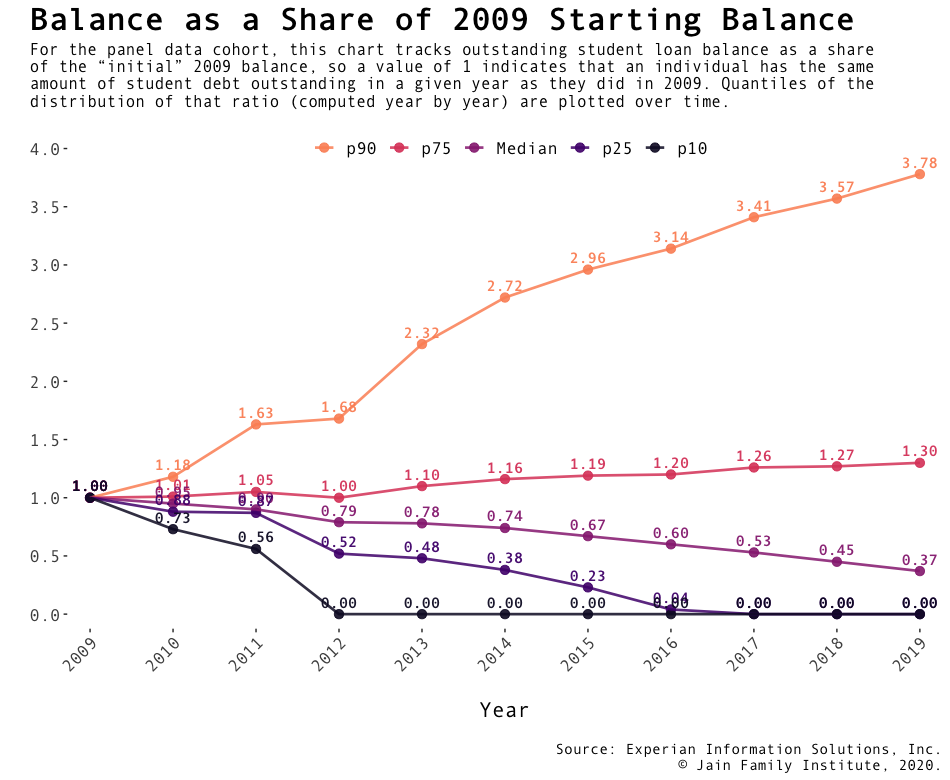
    Figure 1. For the panel data cohort, this chart tracks outstanding student loan balance as a share of the “initial” 2009 balance, so a value of 1 indicates that an individual has the same amount of student debt outstanding in a given year as they did in 2009. Quantiles of the distribution of that ratio (computed year by year) are plotted over time.

    We look first at the panel data cohort, that is, one million individuals (between 18 and 35 years old) with student debt outstanding in 2009. For this chart, it’s important to keep in mind that the standard repayment schedule for student loans is a ten-year uniform payment plan, akin to a fixed-rate mortgage.

    We compute the ratio of the amount of student debt outstanding in each year as a share of that individual’s initial loan balance in 2009. We then compute the quantiles of the distribution of that ratio in each year. Figure 1 plots those quantiles over time. The black and dark purple lines show progress toward repayment for individuals who were probably already on the path to repayment when they were observed in 2009. Approximately 40% of the individuals with outstanding student debt in 2009 had paid off all of their student debt by 2019, within the standard ten-year repayment window (or sooner, given that they were probably already well into repayment in 2009).

    The light purple line, the median of the distribution, by contrast, declines slowly and reaches 0.37 by 2019. That means that over 50% of the borrowers with outstanding debt in 2009 hadn’t fully paid back their student loans ten years later. The 75th percentile stands at 1.3 in 2019, meaning that more than 25% of borrowers with outstanding student debt in 2009 had a larger student loan balance ten years later. The 90th percentile is much higher: 3.78, almost four times as much debt outstanding in 2019 as in 2009.

    The lack of progress toward repayment can be caused by a number of different behaviors, as well as any combination of them: delinquency, enrollment in an IDR plan, and taking on more debt after these individuals were first observed in 2009 by re-enrolling, and thereby likely deferring payments on prior student loans. Given the age parameters of the dataset, it’s likely that a number of borrowers in the 2009 cohort were yet to complete their education at that point, and thus subsequently took out more loans. It’s common for student loans to increase in principal balance over their first few years after origination, due to deferral. On the other hand, the individuals in this cohort sample don’t change over time. Their minimum age in 2009 was 18, so the minimum age of this group in 2019 is 28. Taking on more debt as they get older makes them less likely to pay off the debt they already had. And that pattern of behavior becomes more pronounced for subsequent cohorts, though this dataset does not directly track them over the full ten-year period that we have for the initial 2009 panel cohort.

    Figure 2-5 from a recent Congressional Budget Office report on IDR shows a similar pattern. That chart plots progress to repayment by what CBO calls the “2012 cohort,” which means individuals who began repayment in 2012 (and thus excludes the deferment period on those individuals’ loans prior to that year). That report compares individuals who remained in the standard 10-year repayment plan throughout to those who utilized one of the IDR programs. The former saw their balance decline over time, while, not surprisingly, the latter group’s balance increased. That appears to confirm the interpretation of Figure 1 that a major contributor to the lack of progress toward repayment for many borrowers is enrollment in an IDR plan.

    Again, the purpose of IDR is to prevent a liquidity problem by deferring payments. The alternative is much higher delinquency and default rates than there would otherwise have been, so in that sense, the various IDR programs are a success on their own terms. But they are a failure insofar as they give rise to mounting balances over time, rather than facilitating repayment on a delayed schedule more favorable to borrowers. The structure of IDR—capped payments as a percentage of income in the present, possible cancellation of remaining balance in the far future—presumes that those entering into the program will eventually earn a high enough income to cover their full interest and principal loan payments before the date at which their loans would be cancelled. But many borrowers enter into IDR with no intention or prospect of ever leaving it. In fact, the program itself contains an incentive not to exit it: the cancellation at the end, the balance of which the borrower would otherwise be responsible for. That is why a great deal of student debt cancellation has already been committed to and a rising share of new student loans will never be repaid. The policy question is essentially whether to continue to insist on futile interest payments in the meantime, or to recognize that the underlying debts are un-repayable now. Trying to push people out of IDR programs once they’ve structured their lives and careers to conform to their terms, in order to improve the prospects of repayment, as some have proposed, would likely lead to a flood of delinquencies, as better-paid jobs are hardly abundant and available for the asking in a monopsonized labor market. In any case it would be unfair to borrowers who’ve done as they were told by policy-makers, when in reality it was the policy-makers whose failures led to the crisis of non-repayment.

    The lack of progress toward repayment means that many student loans increase in balance over their lifetime, the opposite of the standard repayment structure in which, following any deferment, principal is steadily drawn down by uniform loan repayments until the loan reaches a principal balance of zero upon full repayment. Thus, another window on the non-repayment of student loans is the share of loans that have a higher principal balance than they did when they were originated. The loan-level data in our credit reporting dataset enables us to compare the current balance on a loan when observed in the dataset to the balance of that loan at origination.

    Figure 2.

    Figure 2 plots the percentage of loans at each observation date that had a higher balance at that point than they did at origination. This is taken from the loan-level cross section data, as opposed to the panel data used for Figure 1. In each year, one million individuals with student debt between the ages of 18-35 are observed, along with all of their student loans. The yellow series shows the share of student loans in each year of the cross section in which the current balance exceeds the starting balance.

    The credit reporting data also includes each individual’s zip code. We match that to zip code-level demographic data from the American Community Survey to try to see how non-repayment differs by race. The pink series shows that same share of loans for individuals who reside in zip codes that are majority white, and the purple series shows that share for individuals who live in majority-minority zip codes. Even though there’s no direct information about the race of the actual individuals in the credit reports, and plenty of non-white people live in majority-white zip codes, while a smaller but still significant share of white people live in majority-minority zip codes, we can be fairly certain from this data that non-repayment is concentrated among non-white borrowers, as measured by loans with a higher balance than their original balance. That racial gap in non-repayment is significant throughout and rises slightly over time even while the overall rate of non-repayment also rises. (Note the kink point in 2016, after which non-repayment across all zip codes increases dramatically.) It’s the case that borrowers with higher balances are likelier to enroll in IDR because the savings from doing so is greater the higher the payments you would otherwise have to make, and higher-balance borrowers are, in general, higher-income. Still it’s also very likely that non-white borrowers are more likely to have enrolled in IDR, since they carry more debt conditional on income than white borrowers do. The pattern depicted in Figure 2, both over time and in the cross-section of zip codes, is consistent with that inference.

    One concern with this metric as a measure of non-repayment is that loans in deferment increase their principal balance as a matter of course, and ‘younger’ loans are more likely to be in deferment. Therefore, it’s theoretically possible that an increasing share of loans with a higher current balance than initial balance reflects the changing age distribution of loans: more loans are taken out cohort-by-cohort, so over time, an increasing share of student loans would be younger and thus more likely to be in deferment. In plotting non-repayment through the share of loans where balances exceed the original, a greater share of student loans would appear by this metric to be in non-repayment status due to a rising share of loans in deferment, not IDR, delinquency, or some other reason pertaining to the non-repayment of loans over their term.

    Figure 3 addresses this concern by illustrating how the student loan age distribution has changed over time. It’s getting older, not younger—itself evidence of declining repayment, and suggesting that the non-repayment or “level” effect outweighs the increased-origination or “composition” effect. Note especially the rising share of loans that are 10+ years old, which is to say, older than the term in which a traditional student loan is supposed to be paid off.

    To return to the bathtub metaphor, overall, the water in the tub is getting ‘older’ because the ‘old’ water that isn’t draining out and thus remains in the tub for longer counteracts the ‘young-ness’ of the ‘new’ water pouring in. The implication for Figure 2, then, is that even though you’d expect more loans to be out of deferment and in repayment due to the mix of loans getting older, we still see increasing balances and therefore not actual repayment. And that, in turn, is further evidence that if we had 10 years of panel data for subsequent cohorts following the 2009 cohort depicted in Figure 1, that data would show even worse progress toward repayment for those younger cohorts.

    Figure 3. The age distribution of the loans in each year of the cross-section (amounting to a million student loan borrowers per year, including all of their loans) has been getting older over time.

    Figure 4 is a further illustration of the phenomenon of non-repayment similar to Figure 2. In this case, years refer to the loan’s origination year (its “vintage”), and the horizontal axis tracks the years since that initial origination year. Thus, we have longer series in the data covering 2009-2019 for loans originated near the start of that time period. As we can see, the share of loans with a higher current balance than initial balance rises vintage-by-vintage. All the vintages show an initial increase within the first few years, likely reflecting high prevalence of deferment for younger loans. They then level off, until the year 2016, which is a kink point for all vintages (thus reflecting the same pattern as in Figure 2). After that year, every vintage includes more loans with a higher current balance than initial balance, despite the fact that each vintage is getting older. And, most importantly, this metric shifts up with each vintage, suggesting that non-repayment is getting worse both over time and across vintages.

    Figure 4.

    The kink point in 2016 likely reflects the expansion of IDR programs toward the end of the Obama administration, with the creation of the REPAYE program and aggressive marketing of other IDR programs as a solution to delinquency, as detailed in the aforementioned CBO report.

    Figure 4 is essentially the mirror image of Figure 15 from the 2015 paper “A crisis in student loans? How changes in the characteristics of borrowers and in the institutions they attended contributed to rising loan defaults” by Adam Looney and Constantine Yannelis. That figure is reprinted below. It tracks loan repayment for successive repayment cohorts (defined, as with the CBO, by the year a borrower started repayment). That also shows repayment dwindling over time and across cohorts. Their data concludes in 2013. Since then, the economy has improved significantly (up until 2020), yet repayment has only gotten worse.

    The subject of the paper by Looney and Yannelis is delinquency and default, primarily by what those authors call nontraditional borrowers, meaning they attended postsecondary education later in life and/or attended for-profit institutions. The authors rightly attribute the influx of non-traditional borrowers into the student loan system as a consequence of the Great Recession and the generally-poor labor market options available to workers in its aftermath, especially those with no postsecondary qualification. The purpose of their paper is to propose IDR as a solution to that rise in delinquency, which it is. In their conclusion, the authors write:

    Because of the ‘life cycle’ of borrowing, delinquencies and defaults are a lagging indicator, and the current [as of 2015] high rate of delinquency obscures some more favorable recent trends. In particular, the number of new borrowers at for-profit and two-year institutions has dropped substantially, due to the end of the recession and to increased oversight of the for-profit sector, which is likely to improve the risk characteristics of future repayment cohorts. Moreover, borrowing by first-year borrowers and other enrolled students has declined, both in the number of borrowers and the amounts borrowed. These factors, coupled with efforts by the Department of Education to expand and encourage the use of income-based repayment programs are likely to put downward pressure loan delinquency in the future, although with a lag.

    This turned out to be an accurate prediction: delinquency has been in decline since that paper was released. But as we have shown, the result is rising balances and the crisis of non-repayment. The idea that deferring currently-due payments would make repayment easier when the labor market improved turned out not to be the case.

    Figure 5.

    We performed one final exercise to identify the effect of non-repayment, which is depicted in Figure 5. For each loan, we calculate the required annual payment amount (which is either the standard repayment schedule for a given initial balance and interest rate or an adjusted amount under IDR) as a share of the total outstanding balance, to see how the cost of carrying student loans has changed over time. Figure 5 plots two histograms for that number, one for all the loans in the cross-section data for 2009, the other for 2019. For reference, a standard 10-year uniform repayment plan would have that number in the neighborhood of 12-13% initially (i.e. when the total balance is highest, before progress toward repayment), depending on the interest rate. Over the life of a loan that is actually being repaid, the number increases since the required annual payment stays the same and the balance decreases. For that reason, as the distribution of outstanding loans gets older (recall Figure 3), we should expect to see the distribution of this annual-payment-to-outstanding-balance ratio shift to the right.

    Instead, we see a much larger share of loans have required payments of zero or near-zero, which likely reflects the advent of IDR between 2009 and 2019. For loans in IDR, this number would decline over time, as the required annual payment amount is capped (conditional on income) and the balance is growing. There are also more significant mass points in the 2019 distribution around 7.5% and 12.5%, which may also reflect IDR required payment levels, although without income data it’s hard to be sure of that. Finally, there are, overall, higher payment ratios in the right half of the distribution, so the variance in the whole distribution has increased a good deal. That is probably for the same basic reason as we see rising variance in progress to repayment in Figure 1 and elsewhere in this analysis: as the federal student loan program has grown in size, more borrowers are coming from low-income and minority communities. As borrowers have diversified, more are in a worse position to repay and therefore suffer from rising balances over time.

    Conclusion

    In light of rising student loan balances and their non-repayment, higher education policy analysts have tended to favor either expanding IDR and streamlining enrollment therein or limiting the reach of IDR and capping loan amounts, in the hope of re-directing students into less expensive institutions and into careers that will, ostensibly, enable them to repay their loans as scheduled. The effect of that is likely to be credit rationing: less advantaged students taking on more expensive private loans or not receiving higher education at all. The effect of expanding IDR is what we’ve already seen: balances mounting over time, with little or no progress toward repayment, even when the economy is as near to full employment as has been achieved in the United States in recent memory. Both of these alternative diagnoses decline to face reality head-on: we already have a great deal of student debt outstanding that isn’t being repaid and isn’t going to be repaid, and that debt resides disproportionately with minority borrowers victimized both by labor market credentialization and a lack of family wealth.

    The implications are dire when it comes to household formation and asset accumulation over the life cycle, which is attenuated for millennials and will be for subsequent generations as well. It also likely inhibits marriage and reduces or delays child-bearing, labor market mobility, and entrepreneurship, not to mention retirement security for families who take on student debt on behalf of their children. The grand experiment in shifting the cost of higher education onto individual students and workers, at the same time as we closed off access to the labor market for anyone without postsecondary credentials, driving a broader and more diverse swathe of the population into the increasingly-expensive higher education system, has resulted in greater educational attainment, but not a better-paid workforce. Instead the debt is a lifetime drag on social mobility, widening wealth disparities between people whose families could pay for their education, or who needed less education in order to qualify themselves for professional careers, and those who had to finance it themselves and who need education to access opportunities that are rationed on the basis of race and class.

    Download this piece as a PDF here.

  3. Data as Property?

    Comments Off on Data as Property?

    Since the proliferation of the World Wide Web in the 1990s, critics of widely used internet communications services have warned of the misuse of personal data. Alongside familiar concerns regarding user privacy and state surveillance, a now-decades-long thread connects a group of theorists who view data—and in particular data about people—as central to what they have termed informational capitalism.1 Critics locate in datafication—the transformation of information into commodity—a particular economic process of value creation that demarcates informational capitalism from its predecessors. Whether these critics take “information” or “capitalism” as the modifier warranting primary concern, datafication, in their analysis, serves a dual role: both a process of production and a form of injustice.

    In arguments levelled against informational capitalism, the creation, collection, and use of data feature prominently as an unjust way to order productive activity. For instance, in her 2019 blockbuster The Age of Surveillance Capitalism, Shoshanna Zuboff likens our inner lives to a pre-Colonial continent, invaded and strip-mined of data by technology companies seeking profits.2 Elsewhere, Jathan Sadowski identifies data as a distinct form of capital, and accordingly links the imperative to collect data to the perpetual cycle of capital accumulation.3 Julie Cohen, in the Polanyian tradition, traces the “quasi-ownership through enclosure” of data and identifies the processing of personal information in “data refineries” as a fourth factor of production under informational capitalism.4

    Critiques breed proposals for reform. Thus, data governance emerges as key terrain on which to discipline firms engaged in datafication and to respond to the injustices of informational capitalism. Scholars, activists, technologists and even presidential candidates have all proposed data governance reforms to address the social ills generated by the technology industry.

    These reforms generally come in two varieties. Propertarian reforms diagnose the source of datafication’s injustice in the absence of formal property (or alternatively, labor) rights regulating the process of production. In 2016, inventor of the world wide web Sir Tim Berners-Lee founded Solid, a web decentralization platform, out of his concern over how data extraction fuels the growing power imbalance of the web which, he notes, “has evolved into an engine of inequity and division; swayed by powerful forces who use it for their own agendas.” In response, Solid “aims to radically change the way Web applications work today, resulting in true data ownership as well as improved privacy.” Solid is one popular project within the blockchain community’s #ownyourdata movement; another is Radical Markets, a suite of proposals from Glen Weyl (an economist and researcher at Microsoft) that includes developing a labor market for data. Like Solid, Weyl’s project is in part a response to inequality: it aims to disrupt the digital economy’s “technofeudalism,” where the unremunerated fruits of data laborers’ toil help drive the inequality of the technology economy writ large.5 Progressive politicians from Andrew Yang to Alexandria Ocasio-Cortez have similarly advanced proposals to reform the information economy, proposing variations on the theme of user-ownership over their personal data.

    The second type of reforms, which I call dignitarian, take a further step beyond asserting rights to data-as-property, and resist data’s commodification altogether, drawing on a framework of civil and human rights to advocate for increased protections. Proposed reforms along these lines grant individuals meaningful capacity to say no to forms of data collection they disagree with, to determine the fate of data collected about them, and to grant them rights against data about them being used in ways that violate their interests.

    Both the propertarian and dignitarian conceptions of data governance improve upon the status quo of data governance. But each is out of step with how data production, as a population-wide practice, results in both benefits and risks for individuals, and their approach—grounded in legal rights to individual freedom—consequently fails to resolve the most urgent questions around data governance. Propertarians rightly identify that data is a social relation—one that is deeply unequal, and thus one that must be reformed. But in an effort to address that inequality, they end up casting data relations as relations of private property or wages that are themselves exploitative. Dignitarians rightly diagnose current forms of data production as extractive. But in an effort to address this extraction, they end up foreclosing the forms of data production that may be vital to achieving robust social welfare provision, while failing to consider the political economic conditions required for individuals to meaningfully exercise the freedoms they do grant.

    Rather than proposing individual rights of payment or exit, data governance should be envisioned as a project of collective democratic obligation that seeks to secure those of representation instead.

    Treating data as property or labor

    Propertarian entitlement may occur in one of two ways. Most reforms propose a property right over data about the subject, in which the data subject may sell usage or full ownership rights. Alternatively, data may be conceived of as a form of the subject’s labor that entitles the data subject to command a wage in a data-labor market. The general notion behind such proposals is that formalizing the market for data about subjects provides a solution to the problems of data extraction. This solution transforms data about the subject into an asset that generates wealth for the subject.

    Legally speaking, this occurs by “capitalizing” a data-asset—coding it via law with protections and features amenable to wealth creation.6 Propertarian data reform posits a solution to the problems of data extraction by fitting data into the existing concepts and legal apparatuses we have around “property” or “work.” The governance of data then becomes the governance (via contract law, property law, and/or employment law and labor law) of property relations or labor relations.

    Propertarian reforms respond to the quasi-enclosure and de facto ownership of data resources by technology companies. By formalizing the current informal propertarian status of data, such reforms directly counteract the collection of data by large firms like Google, Facebook, and Amazon, and formally invalidate the current practice of capturing value from subjects without compensation. Propertarian reforms advance a claim of enhanced individual control or self-determination in the data economy, as well as a redistributive claim: that data subjects are owed some share of the wealth that data about them helps to create.

    There are several reasons to be skeptical of propertarian data reforms and how they conceptualize the problem of data extraction. The first is a pragmatic one: operationalizing the kind of complex and comprehensive micro-payments system suggested by these proposals at the scale they require may simply not be feasible or cost-effective.7

    Second, it is empirically unclear if propertarian solutions can lead to material redistribution or increased control for data subjects. The mere granting of a labor or property right does not guarantee that the conditions underlying the sale of that labor/property will be non-extractive and uncoerced. And the conditions of the current data market are not conducive to small producers or laborers securing good bargains and exerting market power: while large data collectors are highly concentrated, data subjects are hundreds of millions of individuals around the world. Moreover, personal data from any one data subject is essentially value-less by itself, reducing the capacity for individual data subjects to meaningfully exert bargaining power. Under current conditions of collection, data subjects may not be able to overcome individual powerlessness to organize and exert collective bargaining power of the kind that necessitated the creation of traditional labor and employment law. For instance, datafication does not result in the kinds of visceral oppression that spurs organizing and builds counter-power. In contrast with domination in the workplace, data extraction is designed to occur as seamlessly and painlessly as possible, transmitting flows of data in parallel with data subjects living their online and offline lives. As a result, data subjects may lack the conditions necessary to identify as a common social group, uniting to demand better conditions of exchange.

    Third, propertarian data reforms may exacerbate certain civil rights and privacy violations that occur in the digital economy. Consider the recent example of ICE purchasing access to a database that tracks the location of millions of phones—information collected via weather and game apps—to track and arrest suspected undocumented immigrants.8 Paying data subjects at the point of collection does nothing to address uses of such data that may violate the civil rights of others and amplify existing social oppression. In fact, by legitimating the marketplace for data, payment may legitimate downstream practices that result.9 Payment may also incentivize people to share data about themselves and thus further degrade privacy. Because those least able to forego income face added pressure to sell their data, propertarian approaches risk transforming privacy into an even greater privilege than it is today. A data subject may decide the risk of privacy loss is worth the payment provided, but privacy risk is notoriously easy to under-value at the point of exchange. Privacy risk associated with data isn’t static, nor is privacy loss linear—it accumulates and grows over time based on composition effects from multiple sources, varied downstream uses, and new applications. (People who tagged online photos of themselves and their friends in 2009, for example, could not have anticipated that companies contracting with law enforcement in 2018 would use such information for facial recognition.) Finally, data exchanges generate considerable privacy externalities: information about one person may well be used to make inferences applied to another.

    Propertarian reforms concede existing processes of data commodification and mass data extraction in the digital economy. The horse having fled the barn, what data subjects can and should secure is a piece of the action.

    Dignitarian critiques and egalitarian shortcomings

    Where propertarian reforms conceive of data as the subject of individual ownership, dignitarian data governance conceives of data as an expression (or extension) of individual selfhood. Such accounts advance legal rights over personal data akin to natural rights: they obtain in the data subject as an extension of their right to self-determination. The most prominent dignitarian data regime is part of the European data governance regime, which alongside other affirmative data processing obligations, affords universal and inalienable rights over personal information and enshrines data protection and privacy as fundamental rights.10 Other dignitarians argue for extending the human rights framework to data governance, or champion a strengthened consumer-protection regime based in a suite of inalienable consumer rights.

    Many dignitarian reformers claim that data extraction involves not only individual stakes, but also societal ones. Zuboff says the world’s digital information is a public good; the EU Data Protection Supervisor notes that privacy is not “only an individual right but a social value.”11 Yet in practice, the legal solutions advanced under dignitarian conceptions of data governance still primarily subject data to individual ordering. Dignitarian reforms typically grant individuals a set of inalienable rights over their personal information—freedoms secured for data subjects against certain future uses (e.g., use without consent, use that goes beyond the purposes originally given, or use once consent has been withdrawn), and that obtain with respect to data collected about them.12 These negative freedoms secure personal data’s quasi-personhood status in law governed by civil, not contractual, rights.

    Dignitarians argue that by enshrining the alienability of data and regulating personal data production via markets, propertarian data reforms further incentivize unjust self-commodification. This is a form of personal violation and a kind of “legibility harm”—a degree of representation that violates the sanctity of our inner lives. These critiques effectively expose normative concerns one may have over the propertarian embrace of datafication, but they leave other aspects of propertarian reforms unaddressed.

    First, dignitarian critiques do not account for the enduring egalitarian appeal of propertarian reforms. By promising data subjects payment, propertarian reforms articulate a redistributive agenda for the political economy of data. Meager though it might be, such an agenda promises material redistribution for data subjects that dignitarian reforms, on their own normative commitments, cannot provide.13 The redistributive agenda of propertarian reforms respond to claims of injustice based on the inegalitarian social effects of data extraction, not only the personal violation datafication entails.

    Second, dignitarian critiques may chafe against positive accounts of data infrastructures that require large-scale mandatory data collection. Like private technology companies now, systems for social welfare provision—be it healthcare, housing, or a basic income—would almost certainly require rendering individuals legible, in some instances against their will. But they would do so in service of vital democratic welfare state endeavors rather than private gain.

    Dignitarian critiques thus suffer from being simultaneously overly narrow and overly broad. By focusing on datafication’s violation of self, they do not address the economic imperatives that drive such harm nor do they provide a compelling agenda for addressing inequality in the data political economy. At the same time, the focus on datafication paints over meaningful distinctions regarding the purposes of data production and the conditions under which such purposes are determined.

    Data egalitarianism: democratic alternatives

    What these shortcomings suggest is that alternative conceptions of the data political economy are needed. Such alternatives must be resistant to private market governance of the data political economy, attentive to the structural incentives at the root of data extraction, and responsive to the wealth accumulation, privacy erosion, and reproduction of social oppression it facilitates.

    One path forward reconceives data about people as a democratic resource. Such proposals view data not as an expression of an inner self subject to private ordering and the individual will, but as a collective resource subject to democratic ordering. Democratic data governance schemes consider the relational nature of data: information about one individual is useful (or harmful) precisely because it can be used to infer features about—and thus make decisions affecting—others. Data production places individuals in population-based relations with one another; the social effects that result cannot be adequately reduced to individualistic concerns nor can they be addressed via individual-centric institutions. Instead, data production requires legal regimes that can comprehend and govern via population-scale, democratic governance. Scenarios where the exercise of freedom of one necessarily constrains the exercise of freedom of others require public, rather than personal, governance.

    This conception transforms the project of achieving freedom in the data economy from one of reclaiming individual liberty, to one of achieving positive conditions of freedom through collective obligation. Democratic data governance allows us to operationalize the normative force of the impact our actions in the digital economy have on others.14 It also recasts the egalitarian response to unjust wealth accumulation from one of personal repayment to one of collective determination of the purposes for which data infrastructures are developed and the quality of relations under which data collection occurs. Indeed, the ubiquitous and highly attuned feedback structures built for data extraction offer new possibilities for non-market social coordination that revitalize old socialist calculation debates.15 Far from offering terrain on which to re-impose private market ordering, data governance may expand the spheres of contemporary life plausibly retrieved from private governance. Conceiving of data as a democratic resource may thus better achieve relational and distributive justice and point the way towards the positive and essential role data infrastructures will play in any effective state welfare provision.

    Several proto-democratic data governance projects show us how the democratic governance over information flows may be realized. German Social Democrat Leader Andrea Nahler has argued for a national data trust, likening big tech companies to pharmaceutical companies that enjoy a limited right to their products in service of the public good.16 Barcelona implemented a civic data trust to manage its data commons, democratizing data governance so that citizens have a greater say over what data is collected and for which purposes, securing stronger rights over citizen data in its contracts with technology companies, and using its data infrastructures to deepen democratic engagement.17 Labor activists are developing worker data collectives to counter growing workplace surveillance by employers, track and monitor forms of workplace oppression, and document OSHA violations and wage theft.18 Finally, old models of public data collection and management like that of the US Census and its statistical agencies, which adhere to strong purpose limitations and confidentiality rules, may be expanded into more general bodies for the governance of data.

    Depending on the legal instruments involved, such solutions may well treat data as a form of property to be placed under common management or a form of labor to be governed via worker collective. However, all of the examples begin from a commitment to governing data via collective methods, and thus cast data as democratized data-capital or democratically governed data-labor. From the vantage-point of legal governance, then, the question of data’s actual classification—property, labor, or something else entirely—may be less important than the practical governance opportunity its current unsettled state affords. Regardless of what data is, the democratic shortcomings of the law governing labor and the law governing capital should leave one skeptical about slotting data neatly into these regulatory regimes. Why subject data to disempowered and marginalized labor protections, or deeply anti-democratic financial regulation? While egalitarian advocates in each area seek to gain emancipation and re-politicize critical questions of democratic governance, data governance presents an opportunity to leapfrog these struggles altogether to develop true alternatives.


    1. Manuel Castells. The Information Age, vol. 1: The Rise of the Network Society (Cambridge, MA, Blackwell, 1996) 14-16. ↩
    2. Shoshanna Zuboff, The Age of Surveillance Capitalism: The Fight for a Human Future at the New Frontier of Power, Public Affairs, 2019. ↩
    3. Sadowski, Jathan “When Data is Capital: Datafication, accumulation, and extraction.” Big Data & Society, 2019. ↩
    4. Julie E. Cohen. Between Truth and Power: the Legal Constructions of Informational Capitalism. Oxford University Press, 2019 ↩
    5. Eric Posner & Glen Weyl. Radical Markets: Uprooting Capitalism and Democracy for a Just Society. Princeton University Press, 2018 ↩
    6. Once coded as an asset in law, the conceptual distinction between capital (K) and labor (L) vanishes. Both render data as subject to relationships mediated by contracts, and with a bit of legal engineering, L is easily turned into K. Take for example partners in an LLP. They contribute their labor to the corporate entity as in-kind services and take out dividends as a shareholder in lieu of a salary, thus benefiting from the better legal protections and a lower tax rate afforded K for the same exact work that would be performed where it coded as L instead. Beyond law, the concept of “human capital” also attempts to collapse this distinction. See Katharina Pistor, The Code of Capital, Princeton University Press, 2019.  ↩
    7. But critics should be wary of relying on arguments of implementation. While such a payments system may look byzantine and Rube Goldberg-esque from a consumer perspective, as a technical matter these challenges may not be all that different from those of algorithmic auction platform systems and exchanges through which advertisers purchase impressions and clicks from users, and which similarly requires billions of instantaneous transactions at scale. ↩
    8. Blest, Paul, “ICE Is Using Location Data From Games and Apps to Track and Arrest Immigrants, Report Says,” Vice News, Feb 7, 2020, available here. ↩
    9. It is the fact that data is commoditized at all—that ICE was able to purchase access to the database from its provider, Venntel, as opposed to gathering this data itself—that provides ICE such strong legal protection for using this data. Under Carpenter v. United States (2018), ICE may need a warrant to obtain this data from carriers or app companies directly. But because ICE simply purchased access to the database from a data broker, as would any other private entity, a possible Constitutional challenge is skirted entirely.  ↩
    10. European Union Charter, Articles 7&8 ↩
    11. European Data Protection Supervisor ↩
    12. Under Europe’s General Data Protection Regulation, these dignitarian rights are accompanied by a series of affirmative obligations imposed on data processors regarding the storage, transmission, and processing of data. Whether such affirmative obligations supersede the GDPR’s dignitarian rights framework such that they overcome its shortcomings is a matter of scholarly debate.  ↩
    13. Even a robust human rights framework applied to the data political economy may not provide meaningful redistributive effects. While human rights serve as a high-water mark of progressive universal legal rights, they remain compatible with significant and rising levels of inequality, as their embrace in corporate social responsibility efforts alongside sharply rising inequality demonstrates. See: Samuel Moyn’s Not Enough and Jessica Whyte’s The Morals of the Market.  ↩
    14. Scheffler, Samuel, “The Practice of Equality,” In C. Fourie, F. Schuppert and I. Walliman-Helmer (eds.) Social Equality. Oxford University Press (2015), at 31.  ↩
    15. Morozov, Evgeny, “Digital Socialism?,” New Left Review, 2019. ↩
    16. Nahler, Andrea ↩
    17. Smart City Hub, “Barcelona: showcase of smart city dynamics.” Smart City Hub, July 14, 2017.  ↩
    18. WeClock ↩
  4. A Popular History of the Fed

    Comments Off on A Popular History of the Fed

    Since Lehman collapsed in 2008, central banks have broken free of historical norms, channelling trillions into the banking system to prop up global finance and the savings of depositors from Germany to Hong Kong. The corona crash has only accelerated this emancipation. In April, the Bank of England helped the Johnson government finance an ambitious furlough scheme, while the European Central Bank stepped up their older quantitative easing program, pumping liquidity back into the bank sector. Swap lines by state banks have been set up in the United States, while the latest European recovery plan ratified an extension of the Pandemic Emergency Purchase program. Adam Tooze cast all of this as “a remarkable display of technocratic energy and imagination in western financial centers”—necessary to both “control the epidemic” and “restore the world economy.”

    Among these institutions none possess as much luster as the American Federal Reserve. While other banks waver or bow to political leadership, the Federal Reserve’s action is swift and decisive, protecting against financial collapse at home while safeguarding assets abroad. Unsurprisingly, the Fed is often singled out as one of the greatest triumphs of capitalist statecraft, from its creation in 1913 under Woodrow Wilson to its decisive role in the neoliberal counterrevolution of the 1980s under Paul Volcker. Yet while the bank seemed deeply conservative for the intermittent period, its proactive capacity asserted itself with a vengeance in 2008, when Timothy Geithner’s New York Fed almost single-handedly saved the global financial system from collapse.

    Such displays of sweeping and decisive action have warmed even some on the left to central bank power. Rather than rejecting the institutions forged by the capitalist class, progressives have recently called for the power of central banking to be harnessed towards newly imagined social ends. As Benjamin Braun noted in a representative piece, “central bank planning is already here.” The task is to “turn the financial system into a utility-like sector geared towards the public good.” Similarly, Quinn Slobodian envisions central banks facilitating a transition to “economies where uncertainty and hardship are diminished, even after coronavirus has passed.” The Fed might serve as a capitalist savior today, but it could become a weapon for progressive finance tomorrow.

    What would that entail, beyond liquidity injections and conditionality clauses? And to what extent can we reasonably expect “technocratic energy and imagination” to deliver them? The quiet consensus is that central bank stabilization remains necessary for the survival of the current economy. In undertaking stabilization, however, central bankers also increase existing inequalities and empower economic elites around the world. Even if today’s central banks could be democratized, that “democratization” by itself will be insufficient if their field of action remains constrained, shying away from a more ambitious mandate of redistribution and the reorientation of long-term investment.

    The full possibilities, and limits, of present calls for the reform of central banking come into sharp relief when examined in light of the radical campaigns of the American Populist movement of the late nineteenth century. Indeed, early proposals for a Federal agency that could seize the power to print money and redistribute credit originated not among bankers and the accredited, but among an agrarian population desperate for credit and investment—the Farmers’ Alliances of the 1870s and 1880s and the American People’s Party of the 1890s. While the Fed might be, in Ann Pettifor’s words, the “world’s unaccountable central bank” and its governor the “technocratic leader of the world,” some of the Fed’s early advocates were hardly elitist satraps. America’s agrarian radicals formulated bold visions of central banking wielded by the people, as an instrument of capital allocation, developmental state policies, and ultimately a transformed political economy.

    The American Populist movement might seem an unlikely progenitor for the current Federal Reserve. A coalition of mainly Southern and Midwestern agrarians, the Populists and their People’s Party arose out of a flourishing co-operative movement, revolting against low grain prices, scarce credit, and steep freight rates. The party ran for president in 1892, Congress in 1894, and fused with the Democrats in 1896, only to disperse across the political spectrum afterwards.

    More than any of their contemporaries, the Populists obsessed over questions of monetary centralization and control—and their rebellion against reigning liberal orthodoxy nurtured in them a highly experimental approach to the “money question.”1 It was not without precedent. Since the 1860s, when President Lincoln introduced greenbacks to fund the Civil War, the idea that the American state might use its authority to control the money supply from private banks had already stirred the radical imagination. Populists extended these greenback efforts into the 1880s. One of the most pressing problems of the decade was the scarcity of credit and currency in rural areas, which drove an infernal spiral of deflation and price depression. Loosening and widening the base of currency, Populists claimed, would fuel productive investment, raise the price of agricultural produce, and break the power of established merchants, whose hold on currency often went hand in hand with price gouging.

    The most recurrent Greenbacker response—pushed by businessmen, small farmers, and intellectuals alike—to the problem of deflation was a more elastic money supply and so-called fiat currency, terminating America’s attachment to the gold standard. Once this “sound” money dogma was broken and the monopoly of private banks was brought to an end, a fully public bank could freely issue currency and lessen the stringent credit conditions of merchants and corporations. Affordable credit would flow back to regions and sectors underserved by existing private arrangements. Here, central bank reform and opposition to the gold standard formed a natural pair.

    Moving the United States off this standard was a bold endeavor in itself. It required the US government to reclaim private banking prerogatives and start issuing currency. Populists devised a specific version of this public money proposal. The most interesting of these was developed by Texas businessman and self-taught heterodox economist Charles Macune. In the late 1880s, faced with the failure of a more voluntary approach that relied on farmers’ co-operatives, Macune began to rethink the American state’s role as a provider of credit in what he called a “subtreasury” plan.

    The plan’s set up was as radical as it was simple: the subtreasury would allow American farmers to store their grain and other commodities in government-tended warehouses and grant them interest-denoted vouchers, valid for up to a full year, based on the amount of grain they stored. These vouchers would circulate as money—not unlike gold—releasing farmers from costly borrowing and freeing them to wait for opportune times to sell their crops. The plan implied a system of state banks that could tend this deposit system and redirect capital into agrarian communities. Macune partly drew on the French socialist Pierre-Joseph Proudhon’s proposals for a “people’s bank” in these writings, which had also sought to facilitate credit creation across society.2 Envisioning a democratic credit system, Macune hoped to update Lincoln’s vision of a community of smallholders to a corporate era.

    None of these measures came to pass. Macune’s sub-treasury was laughed away in polite society as financial illiteracy, and America remained on the gold standard for more than twenty years. There was, however, partial victory in defeat for the Populists. Congressmen in the early twentieth century relied on large farming constituencies, and state legislatures were still packed with many ex-Populist figures.

    Populist legacies continued to pervade American politics and guaranteed that the debate about central banking did not become the exclusive domain of bankers and financiers, narrowly focused on market volatility. It remained, rather, a significantly politicized terrain with a wide array of participants who claimed the institution’s vast distributional and developmental implications. As Nadav Peer has shown, agrarian lawmakers were intent not merely on shoring up the nation’s crisis-prone financial system, but also on recasting the US economy through reallocation of credit across sectors and geographical regions.3 The policymakers who created the Fed aimed to dislodge the corporate sector’s privileged access to the reserves of the national banks, which circulated via Wall Street brokers. Pushing back against the gravitational tendencies of American banking, they sought to shift resources away from New York to rural communities around the country.

    To execute this gambit, members of Congress from the agrarian periphery defeated the “Aldrich Plan,” authored in collaboration with New York bankers and Harvard economists, for a privately-controlled central bank. Instead, as Elizabeth Sanders has shown, they pressed for a publicly-owned and highly decentralized system, with semi-autonomous regional reserve banks making funds available throughout the nation.4 They aimed to provide cheap credit to noncorporate borrowers, especially in the Midwest and South. They also pushed for the Fed to accept agricultural land as collateral (prohibited to national banks under the existing national system) and extend credit against instruments of exchange that were pervasive in the agricultural parts of the economy. Their explicit goal, as one proponent explained, was “to withdraw the reserve funds of the country from the congested money centers and to make them readily available for business uses in the various sections of the country to which they belong.”

    President Wilson’s temperament and background tallied badly with the radical bent of these reformers. So did the American Bankers’ Association, which condemned these proposals (in a sentiment echoed by respected economists, the New York Times, and other elite organs) as reckless and “socialistic.” Nevertheless, as the Federal Reserve Act moved through Congress, questions of economic distribution—of power and resources, not merely economic volatility—continued to take center stage. Wilson’s Secretary of State William Jennings Bryan (the former bimetallist candidate for President), along with Democrats and Republicans from rural, credit-starved states touted the old Populist line. American banking, they insisted, suffered not from overeager country banks on the periphery, a critique that called for closer supervision from a central authority. Rather, the control of credit had been monopolized and needed to be seized from a tight cohort of Northeastern bankers. They therefore pressured Wilson to include local banking provisions and more dispersed credit facilities in the law. They wrote provisions into the bill that lowered gold reserve requirements and made agricultural paper and warehouse receipts eligible for discounting at regional reserve banks. Finally, they successfully bargained for Federal Land Banks, which massively expanded the availability of credit to farmers at low rates.

    The final Federal Reserve Act was not the pristine expression of any single faction. Instead, it bore the marks of an extraordinarily contentious legislative process. Bankers warned that it put the credit of the “American people” behind anybody who could “draw and sign a bill currency.” Agrarians, in turn, noted that the Act handed the bankers a powerful system that would be relatively insulated from democratic control. Bankers proved the more reluctant party. Congressional representatives from urban-manufacturing regions, with strong business influence, voted against the bill. Agrarian representatives in Congress from both parties overwhelmingly supported it, finally carrying it through Congress. As a genesis story, the making of the bill exudes a deep historical irony. The capacious and resilient Fed that elites inherited (and ultimately co-opted after the First World War) was not an institution of their own design.

    This agrarian Populist origin story might explain why celebrating the Fed’s capacity for stabilization feels historically constraining. But “stabilization” is precisely the reason technocrats have celebrated the Federal Reserve’s actions, both at home and abroad. In the Great Financial Crisis, it refueled an ailing financial system in the US, and in 2009 it stepped into the brink and set up swap lines for struggling European banks. The move was a harbinger of an even more ambitious global role, in which the Fed extended its reach to nearly every banking system on earth. This thrusted a waning American ruling class into the role of a global financial hegemon, losing its industrial capacity while gaining strength with its money supply. (As one recent critic put it, “the United States is not a country with a central bank; it is a central bank with a country.”)

    But does the current economy deserve to be stabilized? In a world with massive inequality and concentrated asset ownership, central bank stabilization inflates corporate balance sheets and blows property bubbles. The results are plain to see. Fed rescue operations cemented the power of financial classes in countries such as Brazil and Turkey, fueling authoritarian backlash. In Europe, QE has turbocharged asset inequality and granted ever more power to shareholders. From the US to the UK and beyond, stock markets have been buoyed by share buybacks on a massive scale. Rushing to cleanse the economy from systemic risk, central banking crisis relief propped up a fundamentally unjust and irrational market system.

    Just as stabilizers do not often ask the question what is worth stabilizing, democratizers tend to elide the question of which institutions are worth democratizing. Too often, plans for bottom-up finance seek to democratize a body whose capacity is little more than a modulator of money flows, without the authority to allocate capital. When they do imagine a democratic and expanded central bank mandate, they do so without a robust sense of expansion in the broader transformative sense, the one which undergirded the Populist period, when “people’s banks” were only a part of a broader repertoire of anti-oligarchic measures. With a view to this history, a truly democratic central bank is still difficult to fathom.

    Today’s Fed hardly represents the “people’s bank” Populists had in mind. Macune’s sub-treasury was more of a public investment bank than a global lender of last resort. The Populist vision emphasized the ability of people’s banks to meaningfully skew market allocation of credit and proactively channel capital flows—activities which contemporary central banks do their best to minimize. As Margaret Myers5 explained in her canonical work, one of the agrarians’ main priorities was to make available not only commercial credit for exchange, but also “long-term credit for the development of new land and new industries.” This sense of urgency around investment in fixed capital made sense in a settler society with a rapidly expanding frontier. Indeed, as representatives from the periphery (farmers and country bankers, but also small manufacturers) repeatedly explained during the Congressional hearings on the Fed, their shared prosperity rested not only on improved liquidity but also on the availability of long-term loans, collateralized by land, livestock, and future crops. This idea of a central bank—anathema to conservative city bankers—closely resembled the financial institutions wielded by many postwar developmental states, in Europe6 and elsewhere,7 which served to spur productive investment and stopped capital from entering into an unproductive rentier mode. At the end of the nineteenth century, American states, too, had a variety of these developmental tools at their disposal, from railroad commissions to antitrust laws to legislative checks on corporate behavior.8

    Reading Populist banking proposals offers three important perspectives on central bank history. For one, it destabilizes a hard opposition between accountability and unaccountability: the question of control over central banks remains important, of course, but it should not obscure the equally important question of what central banks do. As a bottom-up coalition of farmers and workers, Populists cared deeply about popular input and control; their 1892 adoption of the referendum and popular recall of Supreme Court judges spoke to this legacy, as did their persistent skepticism on the prerogatives of a growing administrative state. Yet the notion of direct control of this bank could never outweigh plans regarding its capacity for action—first and foremost when it came to egalitarian credit allocation. For this reason, when push came to shove, populist legislators agreed to surrender some power to a discretionary agency. In terms of content, a Fed with a democracy deficit was better than no Fed at all.

    The history of the Populist plans for the Fed also shifts the debate from stabilization and redistribution to predistribution. American farmers in the late nineteenth century leveraged relatively good access to credit, facilitated in part via political means, to seamlessly assimilate farm improvements such as plows, threshers, harvesters, and fertilizers. This process not only nurtured a highly productive agricultural sector compared to other expanding frontiers around the world, but it also expanded rural demand for manufacturing goods, forging the famous “agro‐industrial complex” that transformed the US into a heavily industrialized economy.9 In the same vein, an expanded, truly democratic central bank would alter the very terms on which political economy operates.

    Finally, the Populist story gives historical heft to some recently floated reform schemes. Central bank planning might already be here and simply be awaiting democratization, but it’s hardly unprecedented. Rather than a historical departure, the democratic empowerment of central banks could fulfill deep-seated democratic aspirations, articulated by farmers, workers, and craftsmen in the turmoil of the First Gilded Age.


    1. Sklansky, Jeffrey. Sovereign of the Market. The Money Question in Early America. Chicago: University of Chicago Press, 2018.  ↩
    2. Proudhonist plans for universal “free credit” drew particular ire from Karl Marx, whose Grundrisse notebooks feature Proudhon as a chief nemesis.  ↩
    3. Orian Peer, Nadav, “Negotiating the Lender-of-Last-Resort: The 1913 Fed Act as a Debate Over Credit Distribution“, Tulane Public Law Research Paper, No. 18-8, 2018. ↩
    4. Sanders, Elizabeth. Roots of Reform: Farmers, Workers, and the American State, 1877-1917. Chicago, IL: University of Chicago Press, 1999.  ↩
    5. Myers, Margaret G. The New York Money Market. New York: Columbia University Press, 1931.  ↩
    6. Monnet, Eric. Controlling Credit: Central Banking and the Planned Economy in Postwar France, 1948–1973. Cambridge University Press, 2018. ↩
    7. Amsden, Alice H. The Rise of “The Rest”: Challenges to the West from Late-Industrializing Economics. Oxford: Oxford University Press, 2004.  ↩
    8. Stefan Link, Noam Maggor, “The United States As A Developing Nation: Revisiting The Peculiarities Of American History“, Past & Present, Volume 246, Issue 1, February 2020. ↩
    9. Meyer, David R. “Midwestern Industrialization and the American Manufacturing Belt in the Nineteenth Century.” The Journal of Economic History 49, no. 4, 1989. ↩
  5. Direct Effects

    Comments Off on Direct Effects

    A 2018 National Academy of Sciences report on American policing begins its section on racial bias by noting the abundance of scholarship that records disparities in the criminal justice system. But shortly thereafter, the authors make a strange clarification: “In many cases there is little informative quantitative data on whether… policing is influenced by the racial or ethnic identity of citizens in a causal sense.”1

    On the one hand, troves of studies demonstrating racial disparities across a range of policing situations. On the other, a lack of data showing policing to be causally influenced by race. What accounts for the gap between evidence of racial disparities and proof of race as a causal influence on those disparities? The report presents a vignette that offers some clues:

    [A] police officer may decide to stop and question or frisk a Black citizen but may decide not to question a White citizen, creating a racial disparity in stops… Based solely on measures of officer’s behavior, however, it is impossible to know whether this behavior was actually racially biased. If the Black and White pedestrians, for instance, acted differently as the officer approached (e.g., nervous versus calm), or if the officer encountered them in different surroundings (at night in an alley versus at noon in the park), or if the officer was searching for a suspect described as Black, an objective observer might conclude that the officer was simply responding to the situation at hand.2

    The takeaway is that robust correlations in observational data offer satisfactory descriptive statistics, but they cannot, at least not on their own, meet the gold standard of scientific explanation—causal explanation. Only social scientists pursuing causal inference methods are equipped to answer sought-after “why” questions: Why are there racial disparities in policing? Is the disparity because of race or because of something else?

    The experts behind the NAS report acknowledge that disparities are because of race in a certain, broad sense—they would not exist if a hierarchical race structure forged and fortified over centuries of racial exploitation, violence, and domination did not also exist. But the causal questions of quantitative social scientific interest are narrower, and seek to identify the effect of race on a particular decision-making process, policy, or outcome. In other words, such questions seek a shorter causal chain from race to some effect, often framed as the “direct causal effect” of race. In this framing, the “indirect causal effects” of race—which may variously pertain to the long histories of racial hierarchy encoded in residential segregation, wealth inequality, health outcomes, and so on—are intermediate outcomes between race and some final effect of interest, say, instances of police violence. These intermediate outcomes must be struck from causal analysis to isolate the direct effect of race. Failing to do so, the reasoning goes, would open the statistical floodgates and force us to incorporate the effect of all factors bearing any causal relationship to race. And surely that won’t do, when the task is to precisely measure the effect of race itself on a particular outcome.

    In these formulations, the “direct effect” of race is supposed to capture something over and above backdrop racial disparities. Their inquiry is into how race causes some outcome, in excess of the broad racial stratification in housing, education, health, and so forth. In the literature, quantification of this “excess” yields an estimate of discrimination on the basis of race.3 Research that addresses this phenomenon typically proceeds by first identifying a particular racial inequality, then causally explaining it, and finally measuring the amount that is specifically “due” to racial discrimination. What is attractive about this methodology is that it appears to transform complex normative and theoretical questions—how does race structure our social world? what is racial discrimination?—into scientifically tractable efforts at hunting causes and effects.

    But the dominant methodology rests on logic that does not work. No amount of meticulous experimental set-up and statistical practice can rescue quantitative social scientists from needing to make assumptions that amount to substantive claims about what race as a social category is and consequently what racial discrimination as a distinctive moral and legal wrong is. Any distinction between “direct” and “indirect” causal effects of race is inherently ambiguous, unless it is accompanied by answers to such basic theoretical and normative questions. This error of ambiguity lies at the core of causal interpretations of racial discrimination. Causal methods naturalize the distinction between direct (and thus discriminatory) effects of race and indirect (and thus legitimate) effects of race, creating what looks like a successful way to bootstrap formal statistical or experimental methods into substantive moral and political judgments. Showing how these approaches perform this remarkable sleight of hand will allow us to better see when social scientific methods are—and are not—well-suited to answer our most urgent questions about injustice.

    In what follows, I discuss a variety of social scientific methods that attempt to compute direct effects of race. Among these, I pay special focus to approaches that make use of causal directed acyclic graphs (DAGs): diagrams that draw causal connections between two entities as arrows between nodes. This is not because I find causal DAGs notably more misleading or wrong-headed than the rest; instead, it is because I find the framework to provide the most transparent articulation of causal inference.

    How to draw a DAG

    Isolating a direct effect of race requires making a distinction between direct and indirect effects, but the distinction is so elusive that it verges on illusory. Any expert DAG drawer will tell you that (almost) any direct effect is really an indirect effect if you zoom further into the relevant causal mechanism. For instance, suppose we are interested in figuring out how someone’s wages are causally dependent on their race. In causal inference terms, we want to compute the direct causal effect of race on wages. One obvious way that race “causes” wages is via racially segmented labor markets. There are two options for rendering this causal fact in DAG form. One representation (see the figure labelled “Complex” below) draws the causal factor in explicit node form as, say, position in segmented labor market, which mediates an indirect effect of race on wages, marked by the black arrow. Alternatively, the causal factor can be embedded into the functional form of the structural equation—think of it as a formula that captures how the causal dependency works—that accompanies the direct effect of race on wages, shown as the blue arrow (see the figure labelled “Simple”). The underlying thought here is that, intuitively, the question of how race “causes” wages takes place against background conditions in which basic structural features of the labor market are assumed to be held fixed, and thus do not need explicit representation in node form. There is no more need to draw out a node representing structural labor market conditions than there is a need to amend the causal arrow match → fire by drawing out the node oxygen.

    The Simple and Complex DAGs present two different representations of the causal relationship between race and wages. Note where their disagreements do and do not lie. Empirical facts and facts about causation do not determine whether the causal factor position in segmented labor market should be represented as a node (as in the Complex representation) or embedded within a structural equation (as in the Simple one). Adherents of both the Simple and Complex representations agree that racial segmentation of the labor market mediates some of the causal effect of race on wage earnings. Where they disagree is over which causal factors should be explicitly represented as nodes in the diagram and which should be assumed away in the background.

    What are the stakes of drawing the line between foreground and background one way or another? The direct effects of race on wages in Simple and in Complex correspond to two different theoretical quantities. The direct effect of race on wages in Complex (the blue arrow) covers strictly fewer causal effects than its counterpart in Simple. In Simple, the indirect effects noted in Complex by the black arrows are instead lumped into the blue direct effect arrow. And so a choice between these two causal diagrams is also a choice between two different direct effects of race, and—if you subscribe to the direct effects view—two different assessments of the extent of racial discrimination on wages. No disagreement about causal facts is needed for controversy to ensue—just a disagreement over what effects should be taken for granted as a part of how race causally works as opposed to what effects should be considered as in principle distinct from race itself.

    This simplified example illustrates a central component of my challenge to the causal inference approach to racial discrimination. The notion of a direct effect of race on some outcome is inherently ambiguous, because adding indirect pathways changes the “direct effect” quantity that is being measured. Furthermore, drawing additional indirect pathways need not show a commitment to the existence of more causal mechanisms. It may simply reflect an invisible shift in the line between foreground and background of a DAG, explicitly foregrounding and nodifying causal factors that had previously been relegated to the background, or vice versa. Model ambiguity is a genuine occupational hazard for the DAG-drawer.

    At this point in the argument, an experienced quantitative social scientist may be frustrated. Haven’t I just made the trivial claim that adding more features into one’s model of how race causally affects some outcome can steal away some of the causal effect of race that “directly” affects the outcome? If so, why did I bring in these causal DAGs at all? I could have illustrated the point with causal interpretations of simple regression analyses, where adding more variables can depress the size of the coefficient for, and thus the causal effect of, race. This point, as a claim about statistics and modeling, is broadly accepted—even banal—among causal inference practitioners. But I want to suggest that the point is not just a matter of good statistical hygiene, of sorting out causal effects into ones due to race “directly” or due to race “indirectly” or due to possibly confounding “non-race” factors. Our social scientific statistical analysis is supposed to get at something in the really existing world. What is all this statistical finagling, disentangling the direct and indirect effect of race, trying to say about that world? On this, I think the causal methodologists have been less explicit.

    A methodology that purifies out the “indirect effects” of race to get at the remaining nugget of discrimination given by the “direct effect” of race can be supported by two different conceptions of discrimination: a negative account and a positive account.4 Discrimination qua direct effect of race can be defined negatively as the remaining effect of race on some outcome after all of the indirect effects of race have been accounted for. This definition is, by construction, model-relative and depends on what I have called the foreground/background line that determines which causal factors are explicitly represented as distinct nodes and which are relegated to the background.

    Alternatively, discrimination qua direct effect of race can be described positively as capturing a particular mechanism by which race directly “causes” certain outcomes—usually, people opt for the “mechanism” of racial animus, commonly taken by social scientists to be some kind of antipathy, prejudice, or generic “distaste” for members of some racial group.5 This definition does not suffer from model relativity, but if it can be computed using standard causal methods, it can only do so by fiat: the just-so assertion that the particular racial disparity that remains just is caused by racial animus.

    Most causal treatments of racial discrimination want to have their cake and eat it too: they hope that, by sifting through all the indirect effects of race and attempting to eliminate non-race confounders, they will ultimately arrive at the discriminatory causal mechanism that is racial animus. The negative account and the positive account thereby happily coincide: the former’s methods can avoid the pitfalls of model relativity using the latter’s posited mechanism of racial animus to judge what should count as an indirect or direct effect of race. It is then no surprise that disagreements about discrimination cash out as a series of statistical skirmishes: what other factors must be controlled for such that all that remains that can cause a racial disparity is pure racial animus? Equivalently, for the DAG-drawer: how can the background/foreground line be drawn so that only non-animus factors are depicted as nodes in the foreground, thus leaving racial animus as the only effect transmitted along the direct effect arrow?

    The positive account thus relies on the thought that, once all other factors have been controlled for, the only mechanism left to explain racial disparities is racial animus. But notice that still, it is only due to background knowledge about race and racial injustice that racial animus is hypothesized as the causal factor that accounts for the statistical gap.

    Consider the famous résumé audit studies, which deliver identical fictional résumés to employers under differently raced names such as Jamal and Greg. (I’ve written about these previously here.) If all disparities that remain after instituting appropriate controls were due to animus, then, strictly speaking, résumé correspondence studies would reveal anti-people-named-Jamal animus rather than a general anti-Black animus. Furthermore, it isn’t the existence of the gap per se that identifies the animus mechanism—a parallel audit study of Katies and Claires showing a gap in the callback rates in favor of Katies would not proffer evidence of an animus against Claires. This is because we have no reason to think that there is a coherent group that is “Claires” which can properly be the target of animus or discrimination in the first place. In these studies, then, it isn’t the plain fact of a disparity that proves the existence of animus, but rather the underlying thought that there could be nothing else to cause such a disparity but the mechanism that is racial animus. But this is to return to the negative account of discrimination qua direct effect: the direct effect of race is defined as what remains after all other causal effects have been accounted for.

    The failure of the positive account of discrimination suggests a reinterpretation of the audit study. If no experimental setup can ensure the sole operation of an “animus” mechanism, and the direct effect of race must be defined negatively, then the problem of model relativity rears its head once more: which causal factors should be foregrounded in the diagram, drawn out of the direct effect of race and represented as distinct causal factors conveying indirect effects of race? This can be understood as a very practical question about the setup of the audit study: which features should be equalized across Jamal and Greg to ensure that the direct effect of race can be correctly identified?

    Left with a wholly negative conception of discrimination, we have little clue about what the direct effect of race really is. Without a sense of what the “direct effect” of race refers to in the world or why we have normative reason to care about it, it is unclear what the purification task of separating out indirect from direct effects is even trying to aim at. Without a guiding principle according to which we decide whether causal factors should be represented as explicit nodes in the foreground or embedded in the background, the exercise of distilling a direct effect of race out of indirect effects is ungrounded and arbitrary. The negative definition becomes an empty formalism—the direct effect of race is everything that isn’t indirect. And the indirect effects? Well, they’re just what should be purified out to get to the direct effect.

    Many quantitative social scientists will reject the circularity: Jamal and Greg of the résumé audit study have been made identical in every respect but their racialized names, and so there are simply no more effects left to account for. If there is any solid purification process that can get at the direct effect, it’s this one.

    But this is, of course, not strictly true. After all, the design of the audit study in fact shows that Greg and Jamal are not indiscriminately made identical. The audit study is not conducted with Gregs and Jamals applying to jobs noting that they both like the color green, have pet guinea pigs, listen to alternative rock, and play basketball on the weekends. They are rather made identical in one key respect: their résumé contents. This particular choice of equivalences belies a substantive moral point about how Jamals and Gregs ought to be treated by employers when they are identical in this particular respect. Further, the audit study’s silence on whether other features between Jamal and Greg are strictly identical suggests something further: even if Jamal and Greg had different favorite colors, that would still not be a reason to justify differential treatment in hiring. But neither of these are straightforward operationalizations of a formal prescription to “make Jamal and Greg equal.” They are substantive accounts of when Jamals and Gregs should be treated the same.

    Audit study proponents are right that it is morally objectionable that Jamals are treated worse in the labor market even when they share identical résumés with Gregs. Where they are wrong is in suggesting that this difference in treatment corresponds to a direct effect of race negatively derived by following a formal rule that defines racial discrimination. Instead, they have filled out a substantive view about when job candidates ought to be treated equally, and interpreted the resulting racial disparity against Jamals as discriminatory. More broadly, they make a mistake in generalizing the correct finding that the audit study effect gives evidence of an instance of discrimination into the broader claim that the audit study is one of the cleanest experimental setups that manages to instantiate what discrimination is. As a standard of nondiscrimination, the racial disparities discovered in audit studies make for a low bar. That Greg and Jamal are identical in these respects and still Jamal is treated worse surely counts as evidence of racial discrimination, but the existence of this gap is by no means what discrimination is.

    The negative account of the direct effect of race operationalizes the thought that nondiscrimination requires similarly situated people be treated similarly. Nondiscrimination on the basis of race says something further: that similar individuals (and groups) must be treated similarly despite the fact that they will be different in at least one significant respect: in their race. This presents an immediate challenge to the task of figuring who is similar to whom. And because of the kind of social category that race is, individuals who seem formally similar may not be substantively similar, and vice versa. So, we have to ask ourselves: how should the social fact of racial difference affect our task of coming to an appropriate sense of similarity?

    One answer might be that it shouldn’t. We can carry on as before with a vague sense of “rational criteria” for employment, arrest, prosecution, and so on, and the demands of non-discrimination on the basis of race can be met if the police or the hiring committee apply whatever rules they find to be “rational” equally among Blacks and whites.6 Of course, to take this task is to translate an ethical notion of “similarity” into a purely instrumental notion of rationality. This is all fine and well and qualifies as an interpretation of the concept of discrimination. But it is important to underline that it is a substantive moral view about what it is for two individuals to be similar despite being differently raced, not a mathematical operationalization of a purely formal notion of “similarity.”

    If discrimination is taken to be equivalent to some direct effect of race, differently raced individuals are similarly situated if they are similar across all “non-race” nodes. A DAG, then, wears its substantive conception of similarity on its sleeve. To draw a mediated effect of race is to draw a causal factor that is distinct from race itself and that carries an effect of race that isn’t the direct effect of race—and thus isn’t discrimination on the basis of race. In the case of the earlier DAG, Complex, it is to assert that facts about one’s position in the segmented labor market are not facts about race “proper.” Then, the effect of the racially segmented labor market on one’s hiring outcomes should not be considered a part of the “direct effect” of race on wages. In the case of the policing vignette given in the National Academy of Sciences report quoted at the top of this essay, to draw police perception of suspect activity as a distinct node is to assert that such “perceptions” can be distinguished from perceptions of race itself. To draw surveillance of public housing residents as a distinct node is to assert that choosing to surveil public housing projects is not a choice about race itself.

    The pattern should now be clear: as more nodes crop up to mediate effects causally linked to race, more of the direct effect of race is sapped out, with each additional indirect effect of race explaining away some of the direct effect. Casual talk about discrimination is rife with claims like these: discrimination is not caused by race but by family criminal history, by neighborhood poverty levels, by occupational segregation. The disparity isn’t because of race but because of differences in proximity to crime. The racial wage gap isn’t due to discrimination on the basis of race; it’s due to the skewed racial composition of various labor market segments. These are the implicit assumptions that justify the statistical choices to condition on, say, the neighborhood of a stop and frisk action or to condition on, say, the identification of “suspect” activity. Here, statistical claims are always substantive claims about what race as a social category is and what it is to discriminate on the basis of it. At the extreme, drawing more and more mediated effects of race vacates out the direct effect of race until poof—it vanishes entirely, and along with it all reasonable complaint of racial discrimination.

    Proponents of causal methods for identifying discrimination often point to the law as validating their approach. Indeed, such statistical analyses often form the evidentiary backbone of legal battles over discrimination. Analysts for each side spar over the validity of a few basic statistical statements, which often take the form:

    P(Outcome | X, Race = Black) ≠ P(Outcome | X, Race = white)

    This is the statistical gold mine (or land mine) of a discrimination case, to show that outcomes among individuals raced Black and individuals raced white are equal or not equal—once everything “relevant” (variable X) has been accounted for.

    For the most part, warring experts are well-qualified to crank the statistical machinery, and interestingly, they mostly agree on how, as a matter of good statistical practice, to compute this estimand. Where they split is in their choices about what should and should not be included in the model or what should or should not be distinguished from the direct effect of race, in other words what features should or should not count toward this ultimate statistical comparison, given racial differences. They disagree on how to resolve model ambiguity, on how to equalize Greg and Jamal—on how to fill in the content of the statistical similarity test.

    This task is, I have argued, a substantive one, and yet statistical skirmishes are rarely framed as such. Read through pages and pages of expert briefs and you will quickly find yourself inundated in the methodological nitty-gritty: adjusting for confounding, charges of omitted variable bias, race coefficients disappearing when additional covariates are accounted for, concern about conditioning on a collider, and so on. Courts accept methodologies that seek to purify out the causal effects of all “non-race” factors to get at the true causal effect of race itself to provide evidence of discrimination or its absence.7 In doing so, they suggest that proving disparate treatment simply amounts to showing that the direct causal influence of the protected category attribute in question is nonzero.

    So the statistical parley goes on and on, while the reasoning behind why we are doing any of this, what theoretical construct we are trying to get at, and, most importantly, what any of this mathematical maneuvering has to do with the substantive question of whether some person or institution has committed the particular moral and/or legal wrong of discrimination on the basis of race is left opaque.8

    To draw a DAG?

    Much of the above can be taken in the spirit of a guide for the cautious DAG user: When you draw a causal diagram that looks to illuminate the causal effects of any social category that functions as an axis of privilege and subordination, you can’t claim to only be using statistical methods to expose social scientific causes and effects. From the start, you are engaging in good old social and political analysis, with all its attendant normativity. Any reasons you have to adopt one causal structure rather than another, or one set of structural equation functional forms over another, are grounded in judgments about how the social world works. These reasons include substantive normative judgments about how race figures in our world and concern for a set of practical political projects regarding race that your theoretical explorations might be in service of. This is precisely what makes defining racial discrimination as the direct effect of race so deceptive. It casts a normative dispute about what kinds of actions should be deemed discriminatory as an empirical dispute about causes. And figuring causes? Well that’s the gold standard of scientific inquiry. We know how to do that.

    The last challenge I will press concerns this basic claim. I worry that we do not know how social categories constituted by unjust social relations act causally in the world—at least not well enough to be able to render them in familiar causal representations. My critique arises from a sense that race “causes” wages in a wholly different way from how striking a match “causes” fire or how smoking “causes” lung cancer. Methods largely built to investigate these latter causal phenomena might simply be unsuited to investigate the former.

    Mostly, though, I question whether it makes sense to depict race as a category that produces various causal effects—each independent of the others and none constitutive of what the category of “race” is in our world. For example, claims such as “X% of Black people killed at the hands of police are explained by the racial wealth gap, not race itself,” or “Y% of the racial disparity would remain in a counterfactual situation in which Black people share the same income distribution as whites” suggest that race produces effects in the world in a modular fashion.9 On the one hand, race “causes” police violence, and on the other, it “causes” a poor-skewed income distribution, such that the two can be mixed and matched: turn off the race-wealth link and you can measure the direct race-police violence and wealth-police violence links.

    It’s true that your average statistician or econometrician won’t bat an eye at claims like these. So allow me: why would we expect the way race “causes” police killings to stay the same in a world in which Black people and white people had the exact same income or wealth distribution? Why would we expect any social causal dynamics in that counterfactual world to be the same as those in our world? Why would we even think that what Blackness is in that world is the same as what Blackness is in ours? If they aren’t the same, why do we care about these quantities at all?

    In the end—and this is where I think causal inference hard-liners such as Judea Pearl are completely on target—the objects of our inquiry do not exist in the world of statistics. We are interested in whether there is, more broadly, racial discrimination, unfairness, injustice in our world and whether, more narrowly, these observational data of racial inequality are a manifestation of it. These are not inquiries about numbers or diagrams—we do not care that race is a causal factor in your diagram. They are questions about the actually existing social world: what happens in it, and what we think should happen in it. Diagrams and models of that world will only be as good as our theories of what’s in it and hopes for what should be.


    1. National Academies of Sciences, Engineering, and Medicine. 2018. Proactive Policing: Effects on Crime and Communities. Washington, DC: The National Academies Press, emph added, 254.  ↩
    2. Ibid, 254-255. ↩
    3. For an illustrative example of this literature, see the recent scholarly dispute about proper causal inference methodology for measuring racial discrimination in policing, in these two papers: “Administrative Records Mask Racially Biased Policing” (May 2020); “Deconstructing Claims of Post-Treatment Bias in Observational Studies of Discrimination” (June 2020). ↩
    4. Some causal inference practitioners focus on purifying out the “confounding effects” to get at the “direct effect” of race. My arguments apply all the same to this way of framing the problem too. ↩
    5. Economists traditionally take it that discrimination comes in two kinds: taste-based and statistical forms. Racial animus is an instance of the former type, in which “distaste” for members of a particular racial group figures in a discriminator’s preferences and hence, utility function. A taste-based discriminating employer therefore experiences some penalty or disutility for hiring a member of the target racial group.  ↩
    6. Indeed, some definitions of discrimination in economics take this exact perspective. ↩
    7. The Reference Manual for Scientific Evidence, a guide published by the Federal Judicial Center to “assist judges in managing cases involving complex and scientific evidence,” has an entire chapter on multiple regression, in large part devoted to discussing the use of this analysis in discrimination cases. ↩
    8. Robin Dembroff, Issa Kohler-Hausmann, and Elise Sugarman have argued that despite their widening application, but-for causation legal tests and doctrines developed for tort law are simply not helpful in discrimination law in, “What Taylor Swift And Beyoncé Teach Us About Sex And Causes,” Penn Law Review 169, no.1. ↩
    9. Some recent studies that reason along these lines: Justin Feldman, Police Killings in the U.S. (People’s Policy Project, 2020); John Clegg & Adaner Usmani, “The Economic Origins of Mass Incarceration”, Catalyst. Vol 3, no 3. (2019); Nathaniel Lewis, New Jim Crow, Class War, or Both? (People’s Policy Project, 2018). It is common practice in such analyses to show how much of a given racial disparity is reduced once class is “controlled for.” When this operation shows a racial gap to shrink by a large factor, the analyst typically interprets the result as showing the primacy of class as an explanatory category for some phenomenon of inequality. This interpretation is standard in statistical analyses, but it assumes that race and class operate in the world as distinct social categories. In contrast, if one thinks (as I do) that racial categories are constituted by relations of social and material subordination and domination—conditions understood in many sociological analyses to be constitutive of class position—one sees an analysis that separates out an injustice being on account of race as opposed to class or vice versa as making a fundamental theoretical error about what race and class are as social categories. ↩
  6. Unceasing Debt, Disparate Burdens: Student Debt and Young America

    Comments Off on Unceasing Debt, Disparate Burdens: Student Debt and Young America

    Explore our maps here.

    Since the Great Recession, outstanding student loan debt in the United States has increased by 122% in 2019 dollars, reaching the staggering sum of \$1.66 trillion in June of this year. Student loan debt has grown faster than other debt types, including auto, credit card and mortgage debt. For many, education is the only pathway towards good employment with benefits, leading to economic and social opportunities later in life. But as college becomes more unaffordable with each passing year, student loans are bridging the ever-expanding chasm between college savings and obtaining an education. The crisis has reached the national political arena, with policymakers recently calling for debt cancellation up to \$50,000 for federal borrowers.

    Our research demonstrates that the student debt crisis has deepened existing inequalities. We found that all young borrowers are saddled with dramatically rising debt since 2009, but low-income groups, BIPOC, and those in their thirties fare worse than others. While richer students have higher absolute debt, low-income students experience massive and growing relative debt burdens. And students in majority-Black and Hispanic zip codes, who are more likely to attend for-profit private institutions, have seen larger debt increases than those in majority-white zip codes. Debt levels have jumped in states like Wisconsin, Michigan, Pennsylvania, and Ohio. Gaining insight into broad trends in debt accumulation, as well as details about the particular demographic or labor market characteristics that shape changes in individuals’ debt burden over time, allows us to more effectively tailor our policy recommendations. For example, our research finds that forgiving $50,000 in student loans would make 80% of young adult borrowers student debt free.

    In December of last year, we undertook a long-term investigation into the roots of America’s higher education crisis. Using a novel measure of access to higher education, the School Concentration Index, we mapped the distribution of higher education institutions across the country and analyzed its relationship to factors like race and income. In our June 2020 report, we uncovered several worrying trends. Worsening enrollment concentration, higher prices, fewer campuses, more education deserts, and the adoption of for-profit models by non-profit institutions have significantly skewed access to higher education across the country. In the latest iteration of our series, we present new findings on the most important symptom of these developments: student debt.

    Multiple factors have contributed to the explosion in student loan debt. Higher tuition and living expenses have made being a student more costly, and labor market credentialization has enticed growing numbers of students to become borrowers.1 But problems with repayment and capitalized interest are also to blame. Behind the scenes, broader aspects of the American political economy impact borrowers and the debt they carry.

    Rising debt

    In the past decade, the growth in total student debt balances outpaced the growth in the real price of college, as well as the growth in tuition and fees. Using annual random samples of credit archives on one million 18–35 year-olds with student loan activity, we closely examined this dramatic rise, documenting a drastic increase in balances per person. Among young adults with at least one student loan in 2019, the median total loan balance owed was \$18,727, a 17.93% increase from 2009 in 2019 dollars; the average total balance for this group increased by 23.09% to reach \$34,839. Percent increases varied across regions as well, with the Great Lakes, Southeast, and New England experiencing the largest percent increases in median student loan debt since 2009.

    The number line below visualizes the ranking of states according to median income and 18-35 year-old median student debt, including the percent change in median debt since 2009 (all dollar amounts adjusted to USD 2019). Certain states like South Carolina exhibited a concerning combination of extremely low median incomes and high median debt balances, which are increasing rapidly. Michigan, Wisconsin, Pennsylvania, and Ohio saw median student debt grow by over 26% between 2009 and 2019. These four states also had median debt among majority-Black zip codes rise by over 68% between 2009 and 2019, whereas the nation as a whole saw majority-Black zip codes’ median debt increase by 54%.

    The original number line for this report used individual data grouped into zip codes, just like the analysis throughout this report. Subsequent JFI research lowered the grouping level to census tract to increase granularity; Shortly thereafter, the number line was updated to reflect these changes. It is available on the MSD Map Page.

    This increase is also present when examining total balance by deferral status. Growing overall load debts have led to higher balances per person, as referenced in the total balance distribution above and by deferral and non-deferral status below. In 2013, median and average total balances really started to climb, likely due to peaking enrollment expansion. Research on outstanding federal direct loans shows that the majority of debtors owe under \$20,000, but a mere 7% of borrowers with balances above \$100,000 hold 36% of overall student debt. Our samples are also skewed in this way, as reflected in the graphs below. Across both federal and non-federal loans, only 15% of borrowers in 2009 owed over \$50,000 in student loans; in 2019, that number had jumped to 20%. In 2019, only 7% of young adult borrowers had over \$100,000 in student loans. By forgiving \$50,000 in student loan debt, 80% of borrowers become student debt-free and 13% have at least half of their debt burden erased.

    More borrowers

    The student debt crisis is characterized by an increasing number of debtors and a greater prevalence of falling behind on payments. With such a large growth in the number of borrowers, the percentage increases in the median and average loan balance among borrowers should be understood as particularly severe. Increasing balances for people with student loans, and an increased number of people with student loans, are crucial vectors for understanding the advent of the crisis.

     Postsecondary Enrollment at Institutions (excludes online-only and graduate-only institutions)  
     Combined TotalPublicPrivate
    2007-200822 M17 M4.9 M
    2010-201125 M18.9 M6.1 M
    2014-201523.4 M17.7 M5.6 M
    2018-201922.2 M17.4 M4.7 M

    Our data highlights the significance of several underlying trends. Post-recession enrollment growth means that more students in aggregate are experiencing deeper indebtedness; during the post-recession enrollment boom, a growing percentage of full-time first-time students at two-year and four-year schools received student loans (45.5% in 2007-08, peaking at 51.2% in 2011-12, and settling to 46.1% in 2017-18). The percentage increase in debtors was more pronounced at certain institutional types—especially concerning is the trend at for-profits, which have poor outcomes, low completion rates, and the highest average prices and default rates.

     Percent of Enrolled Students Receiving Student Loan Aid by School Type  
    Institution Type2000-01Peak post-Recession percentage2016-17
    Public30.7%41.4% (2012-13)38.2%
    Private not-for-profits57.7%64.3% (2010-11)62.3%
    Private for-profits63.5%82.0% (2010-11)73.5%

    However, the numbers above exclude below-two-year institutions; when we include these in the calculation, percentage bloat across institution types became even more pronounced (59.5% in 2007-08, 66.3% in 2010-11, and 59.7% in 2017-18).2 The increase in aggregate students, the increase in the proportion that borrow, and the occurrence of these trends within the confines of schools with poor labor market outcomes is a clear indication of how the Recession escalated the student debt crisis.

    The number, share, and composition of overdue student loans have vacillated over the time period alongside enrollment. Student loan accounts that are past due accounted for 9.9% of loans in 2009, peaked at 11.6% in 2015, and landed at 7% in 2019. But while the proportion of overdue accounts has decreased, the total number of overdue accounts has increased, only possible due to the growth in the aggregate amount of student loans. That means young adults today are juggling more loans than young adults a decade ago. The total number of overdue accounts in 2019 is well above 2009, at 251,469 accounts behind payments—this is down from its staggering peak at 408,385 in 2015.

    When we zoom in on these overdue accounts, the situation becomes even starker, with the share in severe delinquency at 76%. The 2015 expansion in income-driven repayment (IDR) likely explains the improvement we have seen in the share of severe delinquency since 2016 and the attendant reduction in total overdue account balances. Future research in this series will more closely examine the student loan payment patterns and inferred IDR enrollment.

    Unequal distribution

    The gravity of the debt crisis becomes more pronounced in light of demographic disparities. Looking at the relationship between zip code tabulation area (ZCTA) median income and median per-person student loan debt for 18 – 35 year-olds, it’s quite clear that richer zip codes generally experience higher debt burdens.3 But it’s also clear that all income groups are seeing their debt burdens rise at the same pace, with increasing prevalence of extremely high balances among the poorest ZCTAs—more so than in the past. Notably, the debt burden of the lowest income groups in 2018 is higher than that of the high income groups in 2009. All income groups saw increases in median total student debt of at least \$4000 (USD 2019), with the lowest income and highest income zip codes experiencing increases greater than \$5000 (USD 2019).

    The above graphs also reveal the disparity in total balances between majority-minority and majority-white zip codes, which has become more pronounced over the last decade. Research shows that student debt balances are statistically higher for borrowers from Black and Hispanic ZCTAs, and that higher proportions of students from these ZCTAs take out loans. Black students are more likely to attend for-profits and two-year colleges, which have higher default rates than four-year schools. Black students also have a default rate much higher than Hispanic and white students, regardless of school type. While in our data, median total balances increased by 17.93% over the 11 year period, this increase was not uniform across zip codes according to their racial predominance: median total balances in majority-Black zip codes experienced a 54% increase, majority-Hispanic a 42.81% increase, majority-white a 38.12% increase and majority-Asian a 20.63% increase (there was not enough data to determine percent increases in Pacific Islanders, Native Alaskan or First Nation Peoples dominated areas).

    Absolute debt burden is one problem, and relative debt burden is another. Though lower income ZCTAs usually have smaller balances, the debt burden in relation to income in these areas is alarmingly high. And the disparities have widened between 2009 and 2018. The lowest income ZCTAs saw relative debt burdens increase from 56% to 94% over the 11 year time period, whereas the richest ZCTAs saw relative debt burden increase from 32% to 42%. Students from lower income families are enrolling in postsecondary education at increasing rates and borrow at the same rate as middle income households. This trend corresponds to the higher rate of default among lower income borrowers, even though they carry smaller balances than their wealthier peers. Lower income borrowers are also increasingly likely to attend for-profits and two-year colleges, where the default rate is higher than that of four year schools.

    Disparities by age group are an enduring trait of the student loan crisis, with 31–35 year-olds holding the highest median student loan debt. Although student loans make up a smaller share of this age group’s debt, 31–35 year-olds also have a higher prevalence of delinquency on student loans, and they consistently account for a third of the student loan borrowers in our random 18–35 year-old samples. This indicates that the oldest age group in our analysis is incredibly debt-ridden—they have the highest student loan balances, and that student loan debt, on average, accounts for only 20% of their overall debt. It is likely that today’s 31–35 year-olds are benefiting more from IDR plans, which the Obama administration expanded in 2010 and 2015, and are thus making lower payments while interest continues to accrue. Regardless of risk or repayment status, balances are trending upwards for this age group at a rate much higher than borrowers on the whole: 30% and 18%, respectively.

    Student debt and school concentration

    Analyzing the relationship between student debt and the School Concentration Index4 revealed a meaningful overlap. In the binned scatter plot above, ZCTAs were clustered by median income and student loan balance on loans opened in the last twenty-four months, then plotted according to their demeaned SCI and median student loan balance. Our previous reports already outlined the troubling negative relationship between income and SCI; the above graph illustrates the equally worrisome positive relationship between debt and SCI—more concentrated higher education markets have higher balances on recently-opened loans. The causes behind this overlap, and the policy recommendations it necessitates, require further research. But the findings indicate that students in highly concentrated markets may be taking on more debt, either by borrowing according to high priced local markets or by attending schools non-locally. Making the connection between enrollment concentration, prices, and debt levels for geographies is an important part of assessing the debt crisis.

     Median Net Price and Total Student Loan Balance According to Dominant School Type in a ZCTA 2017–18  
     More Publics More For-Profits
     All ZCTAs 
    Student Debt\$16,572\$18,478
    Net Price\$13,639\$14,541
     Majority White Zips 
    Student Debt\$16,657\$18,943 
    Net Price\$13,811\$14,867 
     Majority Black Zips 
    Student Debt\$17,697\$19,485 
    Net Price\$12,327\$15,397 
     Majority Hispanic Zips 
    Student Debt\$12,459\$13,435 
    Net Price\$11,608\$11,665 
     Majority Asian Zips 
    Student Debt\$15,284\$17,264 
    Net Price\$11,300\$11,933 

    ZCTAs with a higher proportion of for-profits than public schools in our analysis, throughout 2009–2019, (for example, Madison, Columbus, Little Rock, Grand Rapids, Salt Lake City, Boise) also experienced higher student loan balances and higher net prices. When classifying zip codes according to racial majority, we see the same relationship across school types. Majority-Black ZCTAs with more for-profits than public institutions see the highest debt balances and net prices. This consistent relationship points to the dual nature of the US higher education crisis: unequal access to an already inadequate public good.

    The student debt crisis is a symptom of various concurrent trends. We discussed the impact of growing enrollment, rising prices, larger balances, the number and composition of borrowers and overdue loans, disparities in balance and repayment on the basis of race and income, and finally market concentration in education. Following the Recession, the enrollment boom and growing percentage of students who borrow exacerbated the already burgeoning crisis. Rising prices, costs of living, and default rates, in tandem with poor labor market outcomes, worked with the enrollment boom to increase balances for borrowers across the income distribution.

    Low income borrowers, while holding smaller balances than their wealthier counterparts, are constrained by significantly higher debt burdens, and as a result, they fall further behind on payments. BIPOC and GenXers have higher balances than their peers and face higher default rates to boot. The make-up and distribution of higher education institutions across the country also seems to have a strong relationship with the debt burdens and prices, with students in highly-concentrated education markets and ZCTAs dominated by for-profit institutions seeing higher debt burdens. The findings support arguments for targeted and broad debt cancellation or relief. But just as the cause for crisis is diverse, so should be the solutions, whether they include increased funding, expansion, regulation, or debt cancellation.


    1. Julie Margetta Morgan and Marshall Steinbaum, The Student Debt Crisis, Labor Market Credentialization,
      and Racial Inequality: How the Current Student Debt Debate Gets the Economics Wrong
      , Roosevelt Institute, October 2018. ↩

    2. Source for these calculations: IPEDS Student Financial Aid Tables. ↩

    3. The relationship between high income and high debt burden has been a chief argument against designing a truly universal student debt jubilee. For more on these arguments and the racial wealth gap, see here. ↩

    4. The school concentration index (SCI) is a measurement that assesses the concentration of higher education institutions in a given geographical region. SCI varies from 0 (perfectly unconcentrated) to 10,000 (complete monopoly) to null (education desert). We’ve computed the SCI for every zip in the US and US territories for 2008–2017, including satellite campuses offering degree programs. (The analysis we discuss in this post was completed using forty-five minute driving distances around higher ed institutions.) For more on the index and its relevance for examining the crisis of American higher ed, see our report from June 2020. ↩

  7. Hot Oil

    Comments Off on Hot Oil

    “Texas [has] the absolute dominant control of the world price of petroleum and its products.”
    – Texas Railroad Commissioner Colonel Ernest O. Thompson, 1935

    Even at the depth of the Great Depression, oil producers were always paid a positive price for their product. But on April 20 of this year, the price of West Texas Intermediate oil traded for negative prices, reaching a record low of negative \$37.86. While oil prices have largely recovered at the time of writing, negative prices indicate deep underlying problems with the oil market. Currently, OPEC+ coordinates with Russia, Mexico, and other oil producing nations to set production quotas and balance supply and demand. Their systematic reduction in oil production prevented the collapse in prices that the United States saw, and the Brent oil contract, a global benchmark, continued to trade for positive prices (on the same day West Texas Intermediate reached subterranean prices, Brent Oil traded for +\$17.36, a spread of over $50). In response to the US disaster, oil producers called for the Texas Railroad Commission (TRC) to regulate oil production to try and balance American oil markets.1

    Yet the Texas Railroad Commissioners maintained that plunging prices would reduce production and balance the market on their own. It is true that US producers, facing negative prices, have rapidly reduced production. But with prices rising, production may return quickly, setting the stage for another crash.

    To prevent this outcome, we need a market proration system that ties oil production to oil demand. This would not be new for the Texas Railroad Commission. From the 1930s until 1972, it was a regulatory approach the TRC invented and implemented successfully. Today, it would require the United States to join OPEC+, and set US oil production jointly with other major producers. This could be done by reviving the federalized system of state production regulations coordinated by the Interstate Oil Compact Commission.

    The benefits of this kind of change would be myriad: the boom and bust cycles of oil production and prices could be dampened, investment in green technologies could be encouraged, and the decline in the oil industry could be better managed to avoid the collapses seen in other communities reliant on extractive industry, like coal.

    The history of the Texas Railroad Commission

    In 1845, Texas joined the United States. As it was a separate nation and not a territory when it became part of the country, Congress allowed Texas to retain control over its public lands, rather than them falling under the jurisdiction of the federal government. These state lands could be used to encourage railroad development and oil would be found under much of these public lands. The vast terrain of the new state made market access difficult, and private railroad companies were reluctant to lay track, fearing that the returns on remote lines would not warrant the degree of investment required to build them. Because of sparse settlement, they also faced little competition, and private companies were expected to set high rates for travel. The Texas Railroad Commission was formed in 1891 to mitigate these concerns.23 While the Texas oil boom would only come a decade later, oil was discovered as early as 1866. Because it was transported on rail and later through pipelines, the Texas Railroad Commission’s regulatory authority over oil expanded to regulate the pipelines as common carriers. As oil production increased, the Texas Railroad Commission mandate was expanded again to include conservation and the responsible extraction of Texas’s natural resources.

    The particular relationship between oil and the laws developed to govern its extraction created a number of problems. Because oil is liquid, a landowner may pump enough to extract oil originally located outside of the boundaries of their property. Rights to oil—and other migratory resources like water, gas, and game animals—are governed by the “law of capture,” which states that oil is the property of whoever first “captures” it. Overpumping to get at migratory oil was encouraged by the law of capture, which led to damage in the oil field. The law of capture incentivized faster depletion because individual producers preferred to pump in the present rather than conserve the oil for other producers later.

    To ensure that oil fields would be viable for longer into the future, the proration system was developed in 1919 to reduce oil production. Wells that could run for an entire month were limited to a few days of operations to reduce production across the board. If one producer wanted to pump more or less, they could trade the right to produce with other producers, keeping total production for a field unchanged.4

    By the next decade, the proration system gained a new economic rationale. The East Texas Oil field, discovered in 1930, covered 140,000 acres, spanned five counties, and held five and a half billion barrels of oil. The land was owned by smallholders who would become the bulk of small-time oil producers, or “independents.” Oil surged out of the field, flooding an oil market already languishing from the Great Depression. Prices collapsed from above a dollar to about a quarter per barrel.5

    Prorationing was the only way to save the industry and keep the precious natural resource from being quickly exhausted. In April 1931, the first proration order was passed, limiting production per well to 1000 barrels per day. Courts struck the order down as price-fixing, and the situation in the East Texas Oil Field deteriorated further. Despite orders limiting production, Texan independents continued to pump, causing prices to drop below a quarter per barrel. Following Oklahoma’s lead, the Governor sent in the National Guard to enforce the orders to restrain production.6

    At the time of the 1932 Presidential election, Texas was one of the most Democratic states in the Union, and Roosevelt carried all of its 254 counties. While Texans were enthusiastic about the Democratic wave, they were wary of the prospect for greater federal control of the oil industry under Harold Ickes and the New Deal. State interests were able to block direct federal control, and a decentralized system developed, with the federal government providing restrictions on any oil produced in excess of state production limits (so-called “hot oil”) to allow states to effectively set their own proration orders.

    Section 9c of the National Industrial Recovery Act of 1933 supported state efforts to restrict production by prohibiting the shipment of hot oil across state lines. Given their power to regulate interstate but not intrastate trade under the Commerce Clause of the US Constitution, the federal government supported state efforts to regulate oil production through police powers—by blocking shipments that exceeded state quotas. While the National Recovery Act was struck down as unconstitutional, the hot oil provisions were revived with the Connolly Hot Oil Act of 1935. This legislation is still in force and available for the federal government to support state level proration efforts today.7

    The market proration system continued to play an essential role during the Second World War. Because proration generated spare capacity, the Texas Railroad Commission could simply allow producers to produce as much as they liked, turning on the spigots to grease the wheels and power the engines of the Arsenal of Democracy.8

    The TRC tried to solicit countries like Mexico and Venezuela to coordinate prorationing after World War II but was not successful.9 And in 1960, OPEC formed, modeled on the successes of the Texas Railroad Commission, and with the direct input of former TRC engineers. By 1972, oil supply in existing fields was declining while oil demand had surged in the postwar boom. Once demand outstripped supply for Texas oil, allowable production was set to one hundred percent and the era of the TRC’s control was effectively over. In a classic case of regulatory capture, once the TRC was no longer in charge of prorationing, it became primarily concerned with serving the interests of the Texas oil business. The TRC’s support for deregulation began in the 1970s and continues today. After the end of prorationing in 1972, the TRC, like the IOCC today, retired from its position of leadership in the oil industry to become simply an industry representative, captured by the sector they were meant to regulate.10

    During its golden age, the Texas Railroad Commission was successful at using regulation to make Texas more prosperous and to conserve Texas’s natural resources. Before prorationing, producers were lucky to get ten percent of the oil in a reservoir, but in the 1980s, experts estimated that eighty percent of the oil in the East Texas oil fields could be recovered, a massive conservation success. Price stability under the TRC proration system is striking compared to the volatility and instability that has prevailed in American oil markets since 1972 (culminating in the negative price fiasco of April 2020).11 In 1957, economist Erich Zimmerman suggested that price volatility before proration deterred exploration.12 The prorationing system therefore encouraged exploration, excess capacity, and lower prices in equilibrium.

    Thanks to the work of postwar petroleum engineer William Murray, the proration system and the regulatory system it encouraged also virtually eliminated “flaring,” an environmentally harmful practice of burning the natural gas released as a byproduct of oil extraction. Due to the deregulation of the 1970s, methane emission from the oil and gas industry today is sixty percent higher than previously estimated by the Environmental Protection Agency.13

    Back to the future?

    To better understand the economic benefits of a proration system, we can turn to the writings of New Deal economist Gardiner Means. In an analysis conducted for the Department of Agriculture on the causes and consequences of the Great Depression on the Agricultural Adjustment Act, Means distinguished between market prices and administered prices. The former are set in impersonal markets that follow standard models of unfettered competition, while the latter are determined by companies who set the quantity of production and the price of the final product. During the depression, Means showed that prices for agricultural products (market prices) collapsed while production in agriculture remained high, resulting in a market glut. By contrast, prices for agricultural machinery (administered prices) fell little, but production rapidly declined. Reasoning that price cuts would not dramatically increase sales because demand was low, these machinery firms chose to cut production while keeping administered prices relatively unchanged in order to preserve profitability.1415

    In order to avoid the sort of plummeting prices and excessive production characteristic of market priced industries, Means proposed a series of production restrictions in the agricultural sector. At the time of his writing, his insights were not applied to oil markets. But in the figure from Means below, showing the relation of price and production drop from 1929 to 1933, we see that, as market prices, petroleum prices fell rapidly during the Great Depression, almost as much as agricultural commodities and more than food products or leather.

    Overproduction relative to market demand could have caused the price to collapse, and surges in demand could have caused them to spike. By setting quotas according to market demand, the proration system was able to reduce price fluctuations and stabilize the oil industry.16

    Similar reasoning could be fruitfully applied to today’s oil market. During the oil bust which occurred in the first quarter of 2020, the demand curve shifted inward and the market cleared at a drastically lower price. As oil producers could not influence the price, they chose between producing and selling at low prices, or halting production. Some may have been perversely incentivized to produce more to avoid bankruptcy until demand recovers, contributing to the growing glut. This process continued until the prices sank low enough that some wells were uneconomical to operate or some producers went bankrupt. At least twenty shale oil producers have gone bankrupt through the summer, including Chesapeake Energy, a major player in the industry and a member of the Fortune 500.17 As demand recovers and price increases accelerate, we can expect remaining producers to reap windfall profits. New producers will enter the market, as memory of the bust fades and the euphoria of an oil boom gains steam. But eventually, like night follows day, an oil bust will return.

    Texas produced forty-five percent of US oil in 1953, and made up forty-two percent of US production in February 2020. It can easily return to its role as leader of a prorationing system. The environmental and economic benefits of proration are indispensable. As the world’s leading oil producer, the United States should return to the framework set up by the Connolly Hot Oil Act and coordinate a pro-ration framework with state regulatory agencies (with the Texas Railroad Commission taking the lead). It should join OPEC+ and coordinate with other large producers like Saudi Arabia and Russia. As an active member, the United States could encourage oil production cuts across the board, multiplying the beneficial climate effects. The United States should be a hawkish member of OPEC+ to encourage lowered production, higher prices, and increased adoption of green technologies. This is the final act of oil’s story, and we can make sure the American oil industry rides into the sunset the right way.


    1. Englund, Will, “Texas and Oklahoma weigh production quotas for oil”. Washington Post, accessed 5/18/2020 https://www.washingtonpost.com/business/2020/04/13/oil-texas-oklahoma/. ↩
    2. Crane, Martin M. “Recollections of the Establishment of the Texas Railroad Commission.” The Southwestern Historical Quarterly 50, no. 4 (1947): 478-486. ↩
    3. Norvell, James R. “The Railroad Commission of Texas: Its Origin and History.” The Southwestern Historical Quarterly 68, no. 4 (1965): 465-480.4.  ↩
    4. Prindle, David F. Petroleum politics and the Texas railroad commission. University of Texas Press, 2011, 6-7. ↩
    5. Childs, William R. The Texas railroad commission: Understanding regulation in America to the mid-twentieth century. Texas A&M University Press, 2005. ↩
    6. Childs 2005, 203, 210. ↩
    7. American Bar Association. Section of Mineral Law. Committee on Special Publications., Murphy, B. McKee. (1972(1949)). Conservation of oil & gas: a legal history, 1948. New York: Arno Press, 82 ↩
    8. Prindle 1981, 42 ↩
    9. Childs, William R. The Texas railroad commission: Understanding regulation in America to the mid-twentieth century. Texas A&M University Press, 2005, 252. ↩
    10. Prindle 1981, 96, 106, 112 ↩
    11. Prindle 1981, 124, 132, 135 ↩
    12. Zimmerman, Erich W. “Conservation in the Production of Petroleum.” New Haven, CT 97 (1957). ↩
    13. Alvarez, Ramón A., Daniel Zavala-Araiza, David R. Lyon, David T. Allen, Zachary R. Barkley, Adam R. Brandt, Kenneth J. Davis et al. “Assessment of methane emissions from the US oil and gas supply chain.” Science 361, no. 6398 (2018): 186-188. ↩
    14. Means, Gardiner Coit. Industrial Prices and Their Relative Inflexibility: Letter from the Secretary of Agriculture, Transmitting in Response to Senate Resolution No. 17, a Report Relating to the Subject of Industrial Prices and Their Relative Inflexibility. Vol. 13. US Government Printing Office, 1935. ↩
    15. Means, Gardiner Coit, Caroline Farrar Ware, Lily Xiao Hong Lee, and Steven G. Medema. The Heterodox Economics of Gardiner C. Means: A Collection. ME Sharpe, 1992. ↩
    16. Prindle 1981, 7-9 ↩
    17. Wethe, David. “Chesapeake joins more than 200 other bankrupt U.S. shale producers”. Accessed 8/29/2020 ↩
  8. Another Lost Decade?

    Comments Off on Another Lost Decade?

    Contrary to common beliefs on fiscal fundamentals, the current debt crisis in the global periphery demonstrates that the solvency of sovereign states is determined by their monetary power. Crucially, liquidity has a cyclical character in the periphery of global capitalism and a countercyclical character in the core.

    During economic booms, when many contracts look safe, private actors are more prone to purchase assets denominated in peripheral currencies, which typically reward higher interest rates. But during busts, perceptions of asset safety can change quickly. Peripheral currency states are therefore vulnerable to rapid withdrawals from contracts denominated in their currency. Sensing risk, private investors seek the safest assets in the global economy, which, despite lower interest rates, guarantee low credit and market risks, high market liquidity, and limited inflation, exchange rate, and idiosyncratic risks.

    The overwhelming majority of safe assets are denominated in the world’s top currency, the US dollar, or other core currencies in the international monetary system. Over half of these are composed of government debt issued by these core states, which is guaranteed by their governments or central banks. Peripheral currency states do not benefit from this stability. The least monetarily powerful states in the world are therefore more vulnerable to exchange rate fluctuations caused by international liquidity booms-and-busts, which subject them to a cyclicality of structural illiquidity and, therefore, sovereign insolvency crises.

    Solvency in the global pandemic

    Covid-19 has triggered what the International Monetary Fund has called the “worst economic downturn since the Great Depression.” Countries at the core of global capitalism have launched an unprecedented set of monetary and fiscal stimuli, allowing them to keep their economies afloat at very low interest rates. In stark contrast, the periphery has suffered major economic and financial crashes, leaving many countries struggling to pay for imports, service their foreign debts, and fund emergency health, food security, and economic recovery programs.

    From January to April of this year, private capital stopped flowing into Developing and Emerging Economies (DEEs). Meanwhile, outflows reached 96 billion dollars, the highest levels in history, as foreign investors sought to shed risk by withdrawing their money from these markets. At the same time, the outbreak of the pandemic has led to a plunge in global trade, foreign direct investment, commodity prices, and tourism. The sharp drop in export earnings expected this year means that an increasing share of revenues in the global periphery is to be spent servicing core currency-denominated debt.

    According to the United Nations Conference on Trade and Development, the funding needs of DEEs (excluding China) will amount to 2.5 trillion dollars this year, and could reach 3 trillion dollars over the next two years. Even if official financing remains constant, the expected public sector shortfall in these countries, including long and short-term debt, is expected to hit 735 billion dollars. While a small part of these funding needs was covered by the Federal Reserve through the extension of swap lines to central banks of emerging markets such as Brazil, Mexico, and South Korea, these arrangements excluded the vast majority of DEEs, which were left unprotected amid a dramatic run towards liquidity in US dollars. This demonstrates the global hierarchy of money in which the core—and sometimes a select group in the periphery—of the system is able to access nonconditional liquidity backstops (and in the case of core states, unlimited ones), while emergency liquidity for the periphery often takes the form of conditional IMF lending or official development assistance (ODA) grants.

    The current situation in the global periphery can be described as a systemic liquidity crisis which is rapidly shifting into a solvency crisis. In this context, policy options are limited. Countries may give an extra pound of flesh by diverting resources to debt service, despite the fact that their economies require increased fiscal spending to address both the health emergency and the economic downfall. Alternatively, those that retain market access may kick the can down the road by resorting to additional borrowing. This may seem easier due to near-zero interest rates in developed economies (which are driving some investors to pile into risky assets in the periphery in a hunt for yield) but sooner than later this may result in a more severe debt crisis. Finally, states can turn to the global periphery’s lender of last resort—the IMF. It is no surprise, therefore, that 100 of the IMF’s 189 members, half of which are low-income countries, have already approached the organization for emergency liquidity assistance. Predictably, dozens of them are at risk of or have already announced sovereign defaults and restructurings. In the coming months, it is likely that even more states will face financial distress.

    In order to resolve the background asymmetries that determine the ability of states to access liquidity, we need to reset the international monetary system. But in the absence of structural reforms, an immediate alternative to cope with the crisis is available through IMF Special Drawing Rights. The SDRs are international monetary assets issued by the IMF against local currency promises of each member country. They are part of a country’s foreign exchange reserves, and can be sold or used for payments to other central banks.

    In 2009, the IMF issued 204 billion SDRs, amounting to 318 billion dollars, to mitigate the effects of the global financial crisis. According to most estimates, the current crisis calls for at least 500 billion dollars of new SDRs, which would give some flexibility to the states that have already applied for IMF loans and grants, as well as to those that at present do not qualify for loans, such as Argentina. Creating SDRs would swiftly introduce indiscriminate international liquidity into the global market, allowing DEEs to implement countercyclical fiscal policies and fight both the pandemic and the looming economic recession.

    But political circumstances are hampering any movement on these fronts. The Spring Meeting of the IMF in April 2020 resulted in strikingly weak measures to mitigate the serious challenges experienced by the global periphery. The agreement on the expansion of SDRs was reportedly blocked by a Trump administration seeking to prevent its geopolitical rivals from gaining access to unconditional resources. Government officials reportedly suggested that a global liquidity boost is not currently required—yet no practical solutions were proposed for the majority of states in the world that need it. Accounting for almost 17 percent of voting powers in the IMF, the US has effective veto power over any agreement. The impasse on SDRs allocation is unlikely to be resolved.

    Debt relief initiatives

    In face of immense political obstacles to even modest reforms to the international monetary system, two significant initiatives have sought to relieve the debt burden of the poorest countries in the world. Firstly, the IMF approved a debt service relief to 27 of its member countries under the revamped Catastrophe Containment and Relief Trust. Secondly, the G20 launched the Debt Service Suspension Initiative (DSSI), which allows 76 International Development Association countries (IDAs) and least developed countries (LDCs) to request an eight month suspension of principal and interest payments on their official bilateral debts with Paris Club members from May 1 through the end of 2020.

    These initiatives seek to allow low-income countries to reallocate the resources that they would otherwise spend in official or multilateral debt service this year to fight the pandemic. However, both of these schemes have considerable limitations. Firstly, by focusing on debt service, they exclude debt stock. Secondly, they rely on the political will of donor contributors to fund grants from existing aid budgets, thereby reducing the availability of concessional resources for other needs. Thirdly, they fall short of providing sufficient debt relief to eligible countries by excluding private debt.

    Even though the G20 “called upon” private creditors to provide forbearance comparable to that offered by Paris Club official creditors, the private sector has declined to voluntarily join any suspension. All three major credit agencies have stressed that requesting private creditor participation on G20-comparable terms could lead to a downgrade of the requesting debtor state. And they have already begun to do it.

    Another element adding complexity to the DSSI is China’s participation in the arrangement. China—the world’s largest official creditor and a non-member of the Paris Club—agreed to join the DSSI in June, although it did not make public the terms, beneficiaries, or amount of money involved. But Beijing does not seem prepared to include China’s development bank loans in the DSSI, possibly because it does not feel obligated to indirectly subsidize New York and London-based hedge funds by freeing up resources that poor countries are likely to use to repay private creditors. In the absence of political or legislative initiatives by core states to enforce the DSSI in their own jurisdictions, it seems unlikely that Chinese banks will join this initiative.

    In any case, the DSSI will likely postpone the sovereign insolvency crisis of eligible states, rather than resolve it. The payments to official creditors frozen by the G20 will all come due between 2022 and 2024, along with the accrued interest. In the meantime, without private sector involvement, the G20’s standstill and multilateral funding may divert resources necessary for recovery to the repayment of private debt.

    Finally, the global periphery debt crisis is not confined to countries included in the DSSI. The initiative only involves IDA-eligible countries and Angola, which the United Nations designates as one of the least developed countries. Thus, it leaves off a group of 50 low and middle-income emerging economies which have significantly more foreign debt—around 95 percent of all sovereign debt owed by the global periphery—and many of whom are experiencing severe economic strain. According to the IIF, these countries may find it hard to borrow large sums in international capital markets this year. In addition, they are likely to have to grapple with increasing fiscal burdens as the recession unfolds.

    It is therefore not a question of whether, but when, further defaults and debt restructurings will occur. Without debt reduction, the prospect of global socioeconomic recovery in the aftermath of the ongoing crisis is seriously compromised.

    Lessons from the 1980s debt crisis

    The magnitude of the challenges posed by Covid-19 is reminiscent of the global periphery debt crisis of 1982. From the 1960s onwards, international commercial banks—mostly based in the United States—significantly expanded their loan portfolio to sovereigns in Latin America and Africa, which relied on petrodollars to finance their developmental enterprises. When Federal Reserve chairman Paul Volcker raised interest rates from about 11 percent in 1979 to 20 percent in 1981, countries were suddenly pushed into sovereign debt crises, while the United States banking system was put at risk.

    The IMF acted as a creditor coordinator during the crisis, leading committees along with the United States government and the largest commercial creditors of each country. The Fund led a variety of programs in debtor states, mostly consisting of harsh austerity measures and structural adjustment programs, including the privatization of national public assets to foreign corporations. Debt relief would only come years later with the Brady Plan, through which countries were allowed to exchange their commercial bank loans for a lesser amount of face value in bonds backed by US Treasuries. However, the impact of the policies adopted to address the crisis on the productive capacity, employment, and social conditions of the countries concerned was so strong that the United Nations Economic Commission for Latin America and the Caribbean (ECLAC) characterized the following years as a “lost decade” for their economic and social development.

    Despite the possible analogies, there are significant differences between the debt crises of 1982 and 2020. This time, the creditor base of sovereign debt is the most diversified in history. Along with Paris Club official creditors and commercial bank debt, today’s creditors consist mostly of non-Paris Club official creditors (China) and a multitude of bond funds.

    This varied creditor base of sovereign debt includes many competing interests and few shared codes of conduct. It is now much trickier to coordinate behind closed doors through the sort of “gentlemen’s agreements“ which permitted restructuring in the past. Furthermore, the level of exposure of hedge funds to emerging market bonds indicates that holdout strategies may become more widespread than in previous crises and include not only high-risk hedge funds (also known as “vulture funds”) but also traditional ones. In this context, consensus is much harder to achieve than in the past.

    The legal governance of sovereign debt

    As a new era of sovereign debt crises arises in the international community, the legal governance of sovereign debt yet again takes center stage. Despite the number and frequency of sovereign debt crises and their harmful implications, the law has historically failed to address such problems in any systematic way. Since Bretton Woods—and despite the transformations in the international monetary and financial system over the past 70 years—sovereign debt has remained one of the least regulated areas of global finance.

    Sovereign debt restructuring is currently based on ad hoc arrangements between the debtor state and its creditors, which can be either official, multilateral, commercial, or composed of bondholders. Private debt contracts are mostly governed by two core jurisdictions on sovereign debt—England and the State of New York. Renegotiations take place through transactional arrangements in which participation is only mandatory when binding contractual majorities are gathered for specific bond issuances. There is no such thing as an international sovereign bankruptcy body like the ones commonly found in domestic jurisdictions on corporate or personal bankruptcy.

    This legal framework prevents effective, timely, and fair resolution to insolvency crises. It is riddled with collective action problems which often result in insufficient debt relief, delays, and asymmetries among stakeholders in the restructuring process—including the various types of creditors and the population of the debtor state. These complexities often make contract-based sovereign debt restructuring a time-consuming activity. Creditor coordination is difficult to achieve, and the process is often unable to facilitate recovery from insolvency for the debtor state.

    When restructuring terms are unsuccessful in tackling unsustainable debt burdens, new sovereign debt crises may be around the corner. Since 1970, more than half of the restructuring episodes with private creditors were followed either by another restructuring or a default within 5 years. The insurmountable obstacles posed by transactional legal arrangements in insolvency scenarios show why every jurisdiction in the world relies on bankruptcy rules in dealing with private insolvency.

    Numerous calls for statutory or contractual-based moratoriums and debt reduction for developing states have proliferated among UN agencies, NGOs, and academics during the pandemic. However, the collective action problems typically posed by any restructuring process are currently exacerbated by the dimension of the crisis (in which many countries are facing or will likely enter into insolvency) as well as the variety of interests involved. Political consensus on any of those terms is particularly hard to achieve if the objective is to ensure the debt reduction levels required for an effective recovery from the insolvency crisis.

    The existing legal governance of sovereign debt restructuring places a disproportionate burden of risk on the debtor state. The Covid-19 crisis is therefore exacerbating the problems already posed by contractual restructuring technologies in times of normality: restructuring terms will likely be too little and too late, and inter-creditor coordination has become impossible despite the urgency of the present situation.

    The plurality of creditors and the diversity of interests among them generates a distributive conflict over the appropriation of public funds which, by definition, are limited during a sovereign debt crisis. In this context, the most leveraged creditors will seek to transfer risk to others in an attempt to obtain full and timely repayment. Thus, official moratoriums alone can end up simply bailing out private bondholders.

    Moreover, once debt restructurings are initiated, minority bondholders may seek to block restructuring arrangements at any time before the courts of the core jurisdictions on sovereign debt. At present, it is unclear whether these courts are equipped to deal with the large number of sovereign debt cases on the horizon. It is not unreasonable to expect that courts will be swamped and that the costs of litigation will rise.

    The need for international sovereign bankruptcy rules

    The economic downturn posed by Covid-19 is intensifying across the world’s most dispossessed territories as states struggle to meet their population’s basic health and nutritional needs. Extreme economic and human loss will be caused by the delay in tackling the global periphery debt crisis. A global deal is urgently needed to provide DEEs the levels of debt relief they need, which otherwise is likely to drag the vast majority of the planet into another decade of economic stagnation.

    But it is also crucial to engage in a structural discussion on the need for adopting an international sovereign bankruptcy mechanism that prevents chaotic crises such as the one we are currently facing from happening again in the future.

    As long as the international monetary system is structured on the basis of a global hierarchy of currencies, sovereign debt crises will not disappear. Rather than being the product of individual characteristics of peripheral states, they are inherent to the asymmetric character of global liquidity. In this sense, the wave of sovereign debt crises triggered by Covid-19 is just a reflection of how the international monetary system is structured.

    An international sovereign bankruptcy mechanism is a crucial matter of global justice. Bankruptcy rules are needed that can distribute the costs of losses in an accountable, transparent, and hopefully fairer manner, creating justifiable legal hierarchies between all the stakeholders involved in sovereign insolvency. These include all types of sovereign creditors, but also the populations of debtor states.

  9. Essential Infrastructures

    Comments Off on Essential Infrastructures

    As social distancing became norm and law in the early days of the Covid-19 pandemic, people turned to video teleconferencing to meet with friends and family, attend religious services, and go on dates. Zoom work accounts became a conduit for maintaining nonwork social ties, and as people came to depend on this enterprise tool, Zoom’s stock valuation soared.1 The pandemic has widened the sphere of life dependent on such market technologies, heightening existing questions around the political, legal, and economic governance of these companies. How should the fabric of social life, especially as it is rewoven by the pandemic, relate to the private ownership of telecommunications?

    Two legal regimes regulate the ownership of and access to telecommunications technology: the market disciplining forces of antitrust law (along with allied concepts like public utilities regulation), and the national security protections of critical infrastructure regulation. Certain applications of the former, concerned primarily with market power, identify privately-owned infrastructures that are “essential,” and regulate firms to ensure that access to that infrastructure is made available to competitors and consumers on reasonable terms. The latter, on the other hand, identifies infrastructures that are “critical,” and regulates them to serve the US’s national and economic security interests.

    But both the market and national security regulatory systems leave in place the business model of telecoms, and consequently, we argue, cannot ensure the civic provision of what are now essential communications tools. While utilities regulation like “net neutrality”—which requires equal and nondiscriminatory treatment of content moving through telecoms infrastructure—may curtail certain malign effects of concentrated market power, it preserves the market dynamics that create the problems in the first place. These two regulatory frameworks are consistent with the continued functioning of what has been called informational capitalism.2 In the economic organization of technology, people are either employees, consumers, “users” whose data can be monetized, or some combination of the three. Firms exert power over individuals who, confined to these roles, do not have collective bargaining power with which to exert their interests.

    If civil society is to retain political autonomy with respect to information technology, it will require exerting democratic political power. In what follows, we outline the history of the two existing legal approaches to regulating telecommunications, and then turn to several policy ideas—including public ownership and bargaining structures—aimed at asserting that power.

    Antitrust: essential facilities and public utilities

    In the 1876 Supreme Court case Munn v. Illinois, farmers successfully lobbied the government to legislate maximum rates that private companies could charge for the storage and transportation of agricultural products.3 In another case, in 1912, the courts determined that rail bridge owners could not refuse passage of their competitors’ railroad cars.4 These two cases illustrate the origins of the essential facilities doctrine, an antitrust tool that prevents the exploitation of infrastructural bottlenecks by a natural monopoly. Although it was developed a century before the internet, the doctrine has informed regulatory thinking about digital platforms: in the 1990s, the Federal Trade Commission investigated Microsoft for abusing its monopoly position by tying Microsoft products to the sale of Windows. Litigation pursuing the essential facilities doctrine followed in 2001 concerning the default installation of Internet Explorer onto Windows operating systems,5 and in 2017, the European Commission ruled that Google had to make its shopping aggregator bid equally with competitors for listing at the top of search engine results.6

    While the essential facilities doctrine intercedes in business-to-business relations, other forms of competition law, like public utilities regulation, intervene in business-to-consumer relations—particularly where the product or service in question is socially or economically essential, like electricity, gas, or water. One type of utilities regulation is the “common carrier” designation, which defines licensed or regulated bodies that transport goods, persons, or in the case of telecommunications, content, for any party on reasonable terms. Online, however, where a great deal of content is user-generated, the business-to-consumer and business-to-business focus of these doctrines has blurred. The application of common carrier designation has been a large part of the net neutrality debate in the US.

    Because it was initially envisaged as a decentralized and unregulated system (as demonstrated by the Telecommunications Act of 1996), the internet was excluded from anything like public utilities regulation until the FCC issued its “Open Internet Principles” in 2005.7 In 2007, Comcast subscribers complained about interference with peer-to-peer applications on the network, claiming violation of the Open Internet Principles, eliciting a succession of back-and-forth between Comcast and the FCC. After the FCC censured Comcast in its first attempt to enforce net neutrality, Comcast brought an action challenging the principles on the basis that the FCC did not have jurisdiction over the behavior of internet service providers.8 The FCC then passed the Open Internet Order in 2010, premised on different statutory authority,9 which required that broadband providers not block or unreasonably discriminate against lawful content or traffic, and be transparent in their network operations.10 These regulations, however, were relatively light-touch, and neglected crucial subjects like rates, tariffs, and network unbundling. While the transparency rule was ultimately upheld, the blocking and discrimination rules were eliminated in a 2014 legal challenge brought by Verizon.11

    In 2015, the FCC sought to implement net neutrality again by regulating ISPs under the broader oversight provisions in Title II of the Communications Act of 1934—the law introduced to address issues of monopoly telephone provision by AT&T early in the 20th century.12 The result was the reclassification of ISPs from “information services” to “telecommunications services,” as well as “common carriers.” Under net neutrality, consumers benefited from content providers being treated “neutrally” by ISP. Shortly after the presidential election of Donald Trump, however, Ajit Pai, the newly-appointed chairman of the FCC, rolled back the net neutrality rules with the “Restoring Internet Freedom Order.”13 The new ruling maintained the transparency requirement but eliminated all other regulatory interventions, instead preferring regulation of ISPs under consumer law as administered by the Federal Trade Commission.

    Reinstating the information service classification ended public utility style regulation, clarified that broadband would be dealt with as a mass-market service at the retail consumer level for both fixed services and mobile, and re-opened the door for paid prioritization of content. Examples of ISP practices breaching net neutrality—typically when those ISPs are large telecommunication firms—include throttling peer-to-peer networks, not running competitors’ payments systems, and privileging single video providers like YouTube while charging extra for data downloaded from other services.14 The end of net neutrality could possibly allow restricting video chat or voice-over-internet protocol applications (like Zoom and Skype), as AT&T tried when Skype started competing with their telephony services. At heart, the information service classification opens the door for further centralization and integration of the internet service and content provision offered by telecommunications behemoths, who are no longer compelled to afford content providers open access to their systems. At the same time as the net neutrality rollbacks, a bill was passed under Trump preventing the FCC from enforcing rules that would require user consent for ISPs to collect and sell user data in data markets.15

    The regulatory debate presently unfolding over “Big Tech”—the online, two-sided market platforms like Uber, Amazon, Google, and Facebook—bears the marks of these legal battles over ISPs. An emerging group of scholars, drawing on the regulatory strategies of the Progressive Era, believe that treating platforms as public utilities might enable governments to intervene in the business model that drives social media platforms to relentlessly pursue engagement at the expense of a democratic information environment. Making the antitrust case, K. Sabeel Rahman has argued that utilities regulation is appropriate for large tech platforms because they have become the infrastructural backbone of much social and economic activity.16 The concentration of power in these platforms generates the same sort of issues as corporate monopoly, such as unreasonable rates, discrimination, and quality of service, which prompted public utilities regulations for railroads and telegraphs in the 20th century.

    Others, like Adam Thierer,17 find the application of utilities regulation an awkward solution. In this account, platforms are not sufficiently analogous to existing utilities, defined as they are by physical infrastructures. In a recent article, Susan Crawford suggests that treating Facebook like a utility would distract from proper oversight over real utilities like telecommunications,18 and that Facebook ought to be treated more like a TV station.

    The public utilities debate is premised on the market being the best means of coordinating the provision of telecommunications systems and services. As more and more of social life takes place through telecommunications systems and privately operated platforms and services, regulation aimed at disciplining providers is not enough. Market discipline enhances the level of competition that has led to various exploitative practices by large tech firms, each incentivized to treat user data as a raw economic resource. In the absence of robust and enforceable privacy and data protection laws, it is not clear that reducing market dominance and increasing competition will cure such abusive data practices. The carrier layer of the internet has become indispensable for social life; it ought to be provisioned as a public good.

    This is not a new argument—innumerable media scholars have commented on the antithetical relationship between privatized and nichefied media on one hand, and democratic and public life, understood as a social good, on the other. Such a position insists these technologies should be civic tools governed by civic values.19 This means asserting public interest as a priority over the extraction of rents—from payments or personal data. Ultimately, it means moving away from understanding consumer attention as a resource to be captured and leveraged into revenue by telecoms. Checking the market power of large firms does not prevent the exploitation of information flows through that infrastructure.

    National security and critical infrastructure

    With the Trump administration’s FCC rollback of utilities-style regulation on telecommunications, a different regulatory logic has come to the fore: geopolitical competition. The 2001 Patriot Act solidified a definition of “critical infrastructure” to mean systems or assets vital to the military security, economic security, or public health of the United States, and has allowed for the increasing power of the Executive over telecommunications. Homeland Security Presidential Directive 7 directed the newly-formed DHS to identify communications and information technology systems as priority targets for defense against terrorism. In 2013, a Presidential Policy Directive built upon this foundation, expanding its ambit into a sector-by-sector approach, including the communications and information technology sectors.

    The reconfiguration of the national security interest in telecom in terms of economic security has made robust domestic regulation unlikely. Whereas the Obama administration’s approach to telecom policy was primarily concerned with expanding access to digital services,20 the Trump administration has been preoccupied with telecommunications infrastructure and services insofar as they are vulnerable to foreign attacks, in particular from China. They have therefore favored more overt legal tools connected to procurement, defense, and investment control.

    The motivations driving legal controls to defend “critical infrastructure” are far from straightforward. In 2018, the National Defense Authorization Act (NDAA) banned the executive branch’s procurement of telecommunications equipment or services provided by companies believed to be state-owned, like Huawei and ZTE.21 This rule followed the logic of cybersecurity supply chain risk management:22 a cyber-component whose production is controlled by a cyber-adversary could be a source of back-door vulnerabilities.

    National security rationale always has an economic dimension, and cybersecurity is no exception. In 1975, the Committee on Foreign Investment in the United States (CFIUS) was established to review the national security implications of foreign investment in the US. The committee has seen a steadily increasing case load since 2008 as telecom and web applications have become central, both commercially and as a security risk. In 2018, the Foreign Investment Risk Review Modernization Act (FIRRMA) expanded the scope of covered transactions to any investment that would give a foreign person access to “material nonpublic technical information” held by a US business.23 In a particularly sensational case, CFIUS forced Chinese divestment from the LGBTQ dating app Grindr because investors might access personal data that “could be exploited by Beijing to blackmail individuals with security clearances.”24 By this rationale, critical information can be hacked both “from below” through a vulnerable component, or “from above” through investment and managerialism.

    The national security framing of these policies can obscure the economic ends they serve. Former Trump National Security Adviser H. R. McMaster’s recent writing offers some insights into the US foreign policy establishment’s view of China as a threat.25 Chief among these is China’s “Military-Civil Fusion” policy, through which all Chinese companies are enlisted in service of national intelligence. The policy gives China the legal fluidity to negotiate the transfer of technology from US firms both as a state and through companies, and to use this new technology both as part of national intelligence and for the economic benefit of Chinese companies.

    For regulators, then, telecommunications and internet applications are “critical” not only from a military perspective, but also from an economic one. Dan Ciuriak has argued that trade wars, applied to the digital context, are best understood as a competition over rents.26 (There has been no shortage of opportunity for Silicon Valley to influence the US government’s understanding of this dynamic: Eric Schmidt, former CEO of Google, currently chairs the Defense Innovation Board and National Security Commission on Artificial Intelligence, advising the federal government at the highest levels about how the competitiveness of US technology companies depends on federal support.)

    In this light, “cybersecurity” initiatives that hamper Chinese telecommunications firm have the additional effect of preventing the flow of infrastructure rents to China. Similarly, security initiatives which prevent Chinese investment in telecom and internet applications, such as CFIUS, keep the flow of these rents in the hands of US persons. US wealth is thereby protected from competition for ownership over rents from American technology. Given this context, where the rents extracted by platform firms are understood as geopolitically significant, it is difficult to imagine national market regulation that tends towards the public provision of telecommunications services.

    The pandemic has not stalled the Trump administration’s pursuit of control over telecoms. An April 2020 Executive Order established a new Committee for the Assessment of Foreign Participation in the United States Telecommunications Services Sector, which provides further executive oversight over the security-related aspects of the telecom sector, with the power to overrule both the FCC and the “safe harbor” results of CFIUS rulings.27 National and economic security interests, combined with executive authority, have pulled control over telecommunications away from democratically accountable administration aimed at civilian welfare.

    Towards collective investment

    We do not know what the consequences will be of having our social lives take place online. But we do know that telecommunications infrastructure is designed to maximize the profits of its owners.

    While the US government increasingly asserts oversight and control over telecommunications and internet application companies, it gives these companies tremendous freedom. The US government never seeks to own its telecom companies; it hardly tries to tax them. However, through its national security policy, it has given them uncontested access to its own territorially bounded source of revenue: US natural persons as “users.” Consequently, it has created, in telecommunications and internet firms, a new class of rentiers. While Covid-19 conditions may not be permanent, private telecommunications will continue to pervade human life, increasing the political stakes of this distribution of power. What will prevent a shift towards a totalitarianism of the rentiers?

    There are meaningful alternatives. The essential facilities doctrine, used to promote interoperability between technology companies, is at the heart of recommendations made by the Electronic Frontier Foundation to the FTC.28 We have discussed its limits as a paradigm, but it is possible that a more competitive, functional market may indeed give consumers more power in relation to the corporations they depend on for the functioning of daily life.

    Beyond antitrust and public utilities, degrees of nationalization take us closer to the provisioning of telecommunications as a public good, as with primary schools, water, and roads. Australia, which shares many of the US’s political and security priorities, has a nationalized broadband network which functions as a wholesale service provider. During the Covid-19 pandemic, it was able to subsidize provision of broadband infrastructure to low income households with new home schooling needs, as well as residential and business customers facing financial hardship. It increased capacity to retailers by 40% at no cost in order to help Australians remain connected on broadband and regional satellite services during social distancing.29 Above the carrier layer, however, the government’s commitment to national communications systems is somewhat more limited. For instance, the government still communicates with the public via Facebook-owned WhatsApp. (By contrast, the Netherlands and some municipalities in Germany have moved towards choosing open source software for civic applications by default.)

    Across the world, a variety of states engage in various forms of what might be called “soft” nationalization, from taking stakes in infrastructure firms30 to creating sovereign wealth funds through taxes on industry. If telecommunications and internet applications must remain profitable monopolies, they can be made subject to public oversight and generate profits for public benefit through partial ownership schemes. There is some irony in the US government’s strict prevention of even noncontrolling foreign ownership of US technology companies for fear that it will benefit China, when the US will not seek out the benefits of ownership for itself.

    Since about 2017, activists, academics, and politicians around the world have been fostering and developing a “new municipalism” movement, which pushes for the municipal appropriation of formerly privatized assets and resources.31 Drawing on the history of “gas and water socialism” and “sewer socialism,” it favors commonly owned civic platforms, community management of public space and services, and municipal dominance over industrial and corporate market actors.32 The goal of the new municipalism is to extend municipal control over digital infrastructure. Within the world of new municipalist platform politics, Barcelona has become a center of democratic action, especially in the world of smart cities, pushing against corporate providers of civic cyber infrastructure.33 The goal is to limit the possibility that data generated through interaction with public space and services will be fed into the political economy of big tech accumulation. During Covid-19, we have already seen some municipalities take these risks seriously: at least one Germany city, Bühl, has provided an open-source video chat platform, Jitsi, to its citizens so that schools and churches could meet during the lockdown.34

    The Covid-19 pandemic has made clear how dependent social have has become on private telecommunications infrastructure. Neither antitrust regulation nor national security regulation are sufficient to prevent the erosion of civic autonomy. Rather, protecting the domains of civic society and private life from being controlled and exploited will require the exercise of democratic will. Policy options that strive to restore the balance of power will arise when people and their governments act to bargain and assert power and terms of use over technology firms.


    1. Iman Ghosh, ”Zoom is Now Worth More Than the World’s 7 Biggest Airlines,” Visual Capitalist, May 15, 2020. ↩
    2. Julie E. Cohen, Between Truth and Power: The Legal Constructions of Informational Capitalism (New York: Oxford University Press, 2019). ↩
    3. Munn v. Illinois, 94 US 113 (1876). ↩
    4. U.S. v. Terminal R.R. Ass’n, 224 U.S. 383 (1912). ↩
    5. U.S. v. Microsoft, 253 F.3d 34, 64 (D.C. Cir. 2001). ↩
    6. “Press Release: Antitrust: Commission fines Google €2.42 billion for abusing dominance as search engine by giving illegal advantage to own comparison shopping service,” European Commission, June 27, 2017. ↩
    7. Federal Communications Commission, FCC 05-151, Policy Statement, September 23, 2005. ↩
    8. Comcast Corp. v. FCC, 600 F.3d 642, (2010). ↩
    9. Primarily, section 706 of the Communications Act 1934. ↩
    10. Federal Communications Commission, FCC 10-201, Report and Order, December 23, 2010. ↩
    11. ^Verizon Communications Inc. v. FCC*, 740 F.3d 623 (D.C. Cir. 2014). ↩
    12. Robert Litan, “Regulating Internet Access as a Public Utility: A Boomerang on Tech If It Happens,” The Brookings Institute, June 2014 ↩
    13. Federal Communications Commission, FCC FCC 17-166, Declaratory Order, Report and Order, and Order, January 4, 2018. ↩
    14. Adi Robertson, “Here’s how companies have flouted net neutrality before and what made them stop,” The Verge, June 11, 2018, ↩
    15. Several states have since attempted to reintroduce those restrictions. (See: “2019-20 Privacy Legislation Related to Internet Service Providers,” National Conference of State Legislatures, 2019.) ↩
    16. K. Sabeel Rahman, “Regulating Informational Infrastructure: Internet Platforms as the New Public Utilities,” Georgetown Law and Technology Review 2, no. 2 (2018): 234-251.  ↩
    17. Adam Thierer, “The Perils of Classifying Social Media Platforms as Public Utilities,” Journal of Communications Law and Technology Policy 21, no. 2 (2013): 249-297. ↩
    18. Susan Crawford, “Calling Facebook a Utility Would Only Make Things Worse,” Wired, April 28, 2018. ↩
    19. See e.g. Mark Andrejevic, “Public Service Media Utilities: Rethinking Search Engines and Social Networking as Public Goods,” Media International Australia 146, no. 1 (Feb. 2013). ↩
    20. More precisely, the Obama administration’s agenda was to expand the notion of the open internet both domestically and abroad. Its net neutrality ruling, as well as its foreign policy, created fertile ground for the growth of US digital services companies. The Trump administration’s reversal of net neutrality reflected a shift in favor of domestic ISPs. In this article, we discuss telecommunications companies inclusive of both digital services and ISPs, though at times these sectors are at political and economic odds. ↩
    21. Scott R. Anderson, Sarah Tate Chambers, and Molly E. Reynolds, “What’s in the New NDAA,” Lawfare, August 14, 2018. ↩
    22. “Cyber Supply Chain Risk Management,” National Institute of Standards and Technology: Computer Security Resource Center, last modified June 22, 2020. ↩
    23. Anthony V. Capobianco et al., “CFIUS Annual Report Highlights Spike in Filings and Scrutiny of Chinese Investments,” Hogan Lovells, Lexology, December 13, 2019. ↩
    24. Georgia Wells and Kate O’Keeffe, “U.S. Orders Chinese Firm to Sell Dating App Grindr Over Blackmail Risk,” Wall Street Journal, March 27, 2019. ↩
    25. H.R.McMaster, “How China Sees the World,” The Atlantic, May 2020. ↩
    26. Dan Ciuriak, “The Economics of Data: Implications for the Data-Driven Economy,” Centre for International Governance Innovation, March 5, 2018. ↩
    27. Scott Feira, Maureen R. Jeffreys, Ronald D. Lee, Peter J. Schildkraut, and Tom McSorley, “‘Team Telecom’ Revamp: New Executive Branch Process for Reviewing Foreign Participation in US Telecom Sector,” Arnold & Porter, April 9, 2020. ↩
    28. Cory Doctorow, “EFF’s roadmap for a 21st Century antitrust doctrine,” Boing Boing, February 28, 2019. ↩
    29. It should be noted however, Australia’s National Broadband Network was born a mediocre technical system, with a carrying capacity 40x lower than its original design (i.e. fibre optic to the node rather than fibre optic to the house). This was the result of a conservative government kowtowing to Rupert Murdoch who saw the nationalized broadband infrastructure as a threat to his cable television interests. ↩
    30. Birgit Jennen and William Wilkes, “Germany Will Take Lufthansa Stake in Landmark $9.8 Billion Bailout,” Bloomberg, May 25, 2020. ↩
    31. Matthew Thompson, “What’s so new about new municipalism?,” Progress in Human Geography (2020): 1-26. ↩
    32. Masha Gessen, “Barcelona’s Experiment in Radical Democracy,” The New Yorker, August 6, 2018. ↩
    33. Evgeny Morozov and Francesca Bria, “Rethinking the Smart City: Democratizing Urban Technology,” Rosa Luxembourg Stiftung, January 2018. ↩
    34. “Palim! Palim!,” Stadt Bühl, last accessed July 24, 2020. ↩
  10. Laws of the Land

    Comments Off on Laws of the Land

    “The Mining Law of 1872,” reported California Democrat Alan Lowenthal in May 2019, “is one of the most obsolete laws still on the books.” At a hearing before the House Subcommittee on Energy and Mineral Resources, Lowenthal was rehearsing a longstanding critique of antiquation against hard rock mineral legislation—a law to privatize federal mineral lands that has remained in place since the nineteenth century.

    For decades, this statute has come under scrutiny, with Congressional hearings on its merits held under every President since George H. W. Bush. Two objections are raised consistently. The first is that, in contrast to developers in other extractive industries, hard rock mining corporations may purchase Western mineral lands from the federal government for the minuscule price of \$5.00 per acre, and are charged no royalties on the resources they extract. This nearly 150-year-old arrangement remains a major gift to multinational corporations: in 1994, the US Interior Department sold about 1,949 acres in Nevada to the Barrick Resources Corporation. The land contained 30 million ounces of gold, which was valued at \$380 per ounce. Sold for just under \$10,000, the land was worth billions. A small royalty commensurate to those of other extractive enterprises would by now have generated hundreds of millions of dollars for the public.

    The second objection is related to the first: because these hard rock mining corporations pay no rents or royalties, the government has been left to pay for the lion’s share of the industry’s environmental consequences. Hard rock mining, like most extractive processes, has major impacts on local landscapes and especially on water supplies. Abandoned mines, which number in the hundreds of thousands in the West, continue to leach toxic wastewater into rivers and streams for decades after production ceases. According to the EPA, mining has polluted roughly 40 percent of all watersheds in the West, which will cost as much as 54 billion dollars to clean up. Furthermore, under the current law, the government has little power to stop a corporation from beginning a new mining project on federal land, even if it is in close proximity to natural, recreational, or Indigenous resources. Senator Ed Markey of Massachusetts, who led a reform effort in 2017 in the wake of a major wastewater spill, described the 1872 mining law as not only “outdated” but ultimately “outrageous.” “We need to ensure,” Markey held, “that these large mining companies pay their fair share to mine on public lands so that we have the revenue to protect public health and the environment by cleaning up the hundreds of thousands of dangerous, toxic abandoned mines in Western states.”

    As told by pro-reform lawmakers, the history of the law recalls familiar myths of the nineteenth-century West. The 1872 Mining Law, according to Rep. Lowenthal, derived from “the Wild West, when Civil War veterans would head West and try to make their fortunes with a pick, a shovel, a donkey, and a dream.” Its purpose was above all to “encourage people to settle the West.” But Lowenthal concluded: “We are no longer in the mid-19th century. And as a Californian, let me assure you: the West is settled!”

    It is true that western settlement was a chief concern when Congress passed the 1872 law. But the policy was also crafted to appease industrial capitalists—not just the lone settler—and to encourage them to invest in mineral extraction. In other words, the law continues to operate as it was always intended to: it maximizes profits for capital owners at the expense of the working class and Native nations, and perpetuates exploitative property relations.

    We tend to think of the United States as a nation founded on the rights of property. To be sure, for most of the nineteenth century, federal land policy followed the overarching logic of privatization, with the aim of, as Tristan Ahtone and Robert Lee recently wrote, transforming “Indigenous territory into settler property.” But there were variations within this tendency, among them the government’s relationship to mineral lands. At the nation’s founding, gold, silver, lead, and other metals—used commonly as a means of exchange (money) and to produce weapons—were considered too politically important to leave to private forces, or as Alexander Hamilton once put it, to “the casual speculations of individual adventure.” Instead of transforming mineral lands into private property, the government retained control and experimented with different kinds of property relations, issuing leases and charging royalties for metal extraction. When federal authorities did begin to privatize mines found on the “public domain”—the land seized from Native nations and held by the federal government—they did so in a patchwork way, often on a case-by-case basis, without establishing any federal mechanism to privatize mineral land.

    A different process unfolded after 1848, when the U.S. incorporated a massive territory from Mexico. There was still no general policy to purchase mineral land from the federal government, but mining on the public domain soared in the 1850s, as miners rushed first to California’s gold fields and then to other sites in the West. Western miners, whose activity was in large part illegal, became a driving force in U.S. colonialism and global capital accumulation. And despite growing pressure, Congress failed to pass legislation that would allow these miners to purchase mineral lands from the government. While there was support for such legislation, national economic policymaking was too heavily steered by southern slaveholders, who were most concerned with expanding slavery to western territories. Other economic issues took a backseat at the national level.

    In the absence of federal policy, miners produced their own vernacular legal codes to structure property rights in mineral extraction. Hundreds of these local rulebooks appeared across the mining West, tending to privilege small, local producers over outside financiers. Their goal was to protect miners—including in their colonial violence—from capitalists and speculators, who might accumulate more property than one party could reasonably mine and drive out cash-poor producers.

    These local codes frustrated capitalists seeking to invest from afar, especially as the western industry incorporated more capital-intensive forms of extraction. Whereas most small gold miners extracted metals near the ground’s surface, their methods were less suited to mine deeply embedded ore from underground rock formations. This shift to industrial mining accelerated in the 1860s and 1870s, more quickly in some places than others. It was rapid in Nevada, which held some of the nation’s first major silver mines. Nevada experienced an intense mining rush beginning on the eve of the Civil War, and was dominated by large corporations and outside investors within a few years. Few and far between was the self-employed miner in Nevada, carrying only, as Lowenthal put it, “a pick, a shovel, a donkey, and a dream.” Instead, mining corporations employed hundreds of mine workers, who earned four dollars a day to extract silver. Class conflict escalated quickly around Nevada’s silver mines, with workers going on strike after a wage cut in 1864.

    The changing landscape of mining pitted wage-earning workers against bosses, as well as local prospectors against outside investors and capitalists against each other. Frustrated by these disruptive conflicts, capitalists grew increasingly critical of local property codes and the people who crafted them. The variability and imprecision of rules came under fire. So too did the property rights granted to on-the-ground prospectors, who were generally first to claim a mine but who often lacked the capital to extract ore. Most significantly, the definition of underground property was itself deeply contested in Nevada’s silver camps, leading to enormous conflict among competing parties. While well-financed companies bought out smaller competitors, they faced one another in multi-million-dollar lawsuits. The most consequential of these disputed whether Nevada’s Comstock Lode was composed of a singular ore body or several parallel ledges and, by extension, how many parties could lay claim to its wealth. As mining corporations solicited scientists to argue on their behalf, they wagered that the social question—the distribution of property and wealth—should hinge on the geological question. In 1864, a referee for the Territorial court decided that the Comstock was indeed composed of a single ledge, reversing the court’s earlier ruling and lending legal force to the corporate consolidation of property.

    The industrial transformation of mining was therefore well underway by the time a newly recomposed Congress revisited mineral land legislation during the Civil War. Of the policies debated, all operated under the assumption that Native polities held no territorial claims to mineral lands. They also, to greater or lesser degrees, aimed to generate federal revenues from western mines, which were now producing millions in unregulated wealth. At one end of the spectrum was a proposal to fund the government’s growing wartime budget with the value generated from mines (this was the most state-centric idea but also stemmed from opposition to a national wartime tax). Another bill aimed to charge a special rent or royalty to extract western minerals from federal lands. A third set of proposals favored privatization but in a highly regulated manner: they would empower the federal government to conduct comprehensive surveys of all underground resources in order to determine their value and sell them off (either at public auction or for \$50 per acre). These proposals also restricted how many acres one person or corporation could mine at once, a provision that would prove disruptive to emergent monopolies. In this moment, in other words, Congress considered alternative systems of property relations that would have privileged public revenues over private profits and decentralized wealth over corporate consolidation.

    The legislation that ultimately passed—including the law still on the books today—looked nothing like these wartime proposals. Instead, Congress was swayed by the vocal opposition of western miners, and especially by a newly elected Senator from Nevada, which became a state in 1864. Among the wealthiest members of Congress, Senator William M. Stewart cut his teeth as an attorney for mining corporations, helping to concentrate mineral property into fewer corporate hands as one of the advocates of the “single-ledge” theory in Nevada’s Comstock district. When he arrived in Washington, Stewart brought these experiences with him, even as he championed the figure of the small, poor western miner.

    Supported by an emergent western political bloc, Stewart persuaded Congress to ratify a “free mining” system. In a series of three laws passed between 1866 and 1872, Congress preserved the right to stake mineral claims on public land, while it allowed miners to privatize mineral land with very little federal oversight and for a much, much lower price than was initially proposed. Such a system was purported to benefit miners of all classes, and indeed, it protected small producers in their efforts to discover new mines and advance colonial processes. But it did little to prevent large mining corporations from accumulating monopolies and enormous unregulated surpluses. In fact, it actively encouraged the concentration of property. It placed no limits on the number of mineral patents one party could purchase; it made the privatization process cheap enough to appease investors but onerous enough to squeeze cash-poor prospectors; it denied the government’s power to reclaim unworked mines after they were privatized; and it granted exclusive underground rights (known as extralateral rights) to whoever claimed an ore body’s most shallow point, known as its “apex.” This allowed a single party—whoever held the apex—to follow a lode mine’s underground “dips and spurs” and to dispossess other claimholders along the way. In this way the apex rule prioritized corporate investment, for as one leading engineer observed, capitalists were encouraged “in the knowledge that the valuable mineral deposit may be followed indefinitely in depth.” Given the difficulties of locating and determining a mine’s apex, the rule also encouraged million-dollar lawsuits of the sort that broke out in Nevada. As a result, while cash-strapped miners and prospectors remained an important social force in colonial dispossession (and central figures in its justification), they shared less and less in the mining industry’s growing wealth.

    The late nineteenth century was an era in which capital accumulation increasingly guided federal policymaking, yielding a large and growing class of landless wage workers. As private property became codified, the wandering miner became the exception, and mine workers entered the ranks of the proletariat: dependent on property owners, governed by the imperative to work for wages. At the same time, mine owners grew dependent on this class of workers, without whom extraction was impossible. In this new relationship, mine workers held unique power to withdraw their labor and bring the system to a halt.

    It was this organization of property, industrial corporations, and wage work that shaped the politics of mine workers’ unions, which formed a militant segment of the labor movement in the late-nineteenth century and throughout the twentieth. Through their organizing, mine unions gained substantial victories on the job, forcing mining corporations to share some wealth with the workers who produced it.

    But fundamental questions about the organization of property and resources grew more marginal as the labor movement began to mature. For the most part, those questions remained the focus of Native anti-colonial politics, which continued to expose the links between privatization and resource extraction, systematic dispossession, and ecological change. (There were of course exceptions: western mine workers at times engaged in struggles to redraw lines between private property and public resources. In the early twentieth century, for example, mine workers and their households in southern Arizona forced mining corporations to stop profiting off of the water they monopolized.) Yet a separation nevertheless hardened between workplace struggles over the conditions of work on the one hand and broader struggles over the structure of property relations on the other.

    This separation remains embedded in the labor movement today. Take for example a recent copper workers’ strike in Arizona and Texas, which began in October 2019 and is ongoing as of June 2020. Some 2000 employees of Asarco, a Tucson-based copper corporation, have gone out on strike after seeing no pay raise for ten years, their health benefits cut, and new exclusions to the company’s pension plan, which creates divisions between newly hired and veteran workers. What’s more, the Supreme Court recently ruled that Asarco owed its employees \$10 million in unpaid bonuses from 2011. The beginning of this squeeze on pay and benefits coincided with Asarco’s historic environmental bankruptcy case: in 2009, after years of legal battles, Asarco agreed to pay a \$1.79 billion settlement (negotiated down from \$3.6 billion) to help clean up polluted water and soil across nineteen states.

    During their current strike, Asarco employees have continued to shine a light on the company’s environmental abuses as part of an ongoing pressure campaign. In one case a union local reported Asarco to federal authorities for posing health and environmental risks while scabs attempted to run the facilities on their own. But ultimately, this strike is about deteriorating pay and benefits at the level of the firm, and not environmental justice. Should Asarco make an offer amenable to the union, the strike will come to a close. Waged dependence on property owners thus reproduces structural divisions between mine workers struggling for a raise and local political forces like the Tohono O’odham, a Native nation in southern and central Arizona, which has struggled for years against mineral privatization, environmental degradation, and the colonial foundations of the mining industry.

    Overcoming these contradictions requires addressing their material foundations. Struggles for a just transition away from extractive work contain the potential to ease workers’ dependence on industries that pollute water sources, reproduce colonial inequalities, and burden current and future generations with enormous costs. There is no shortage of socially necessary labor to clean up abandoned mines, as Edward Manuel, Chairman of the Tohono O’odham Nation, noted in a recent Congressional hearing. But as Green New Deal and Red Deal advocates have insisted, building enough power to prioritize clean-up over extraction and public resources over private profits—and thus to counter billion-dollar mining corporations—will require more than the occasional hearing.