
Category Archive: Analysis

  1. Regime Change?

    Comments Off on Regime Change?

    The centerpiece of shock and awe of the West’s economic response to Russia’s invasion and bombardment of Ukraine was the freezing of Russia’s central bank assets. In the March 7 edition of his Global Money Dispatch newsletter, the Credit Suisse investment strategist Zoltan Pozsar writes that the G7 seizure of Russia’s foreign exchange reserves marks a regime change in the global monetary system. Pozsar pronounces this new regime Bretton Woods III. He anticipates that Asian sovereigns, fearing that their dollar- and euro-denominated foreign reserves are at risk of expropriation in the event of future foreign policy disputes, will park their surplus funds outside of the reach of Western financial authorities. For Pozsar, this heralds the rise of “commodity-backed currencies in the East” and spells the denouement of dollar hegemony.

    In a follow-up piece published on March 31, Pozsar speculates that recent developments will drive China to replace the West as the buyer of last resort of Russian oil. As a result, oil tankers will have to be rerouted from the quicker East-West route via the Suez to a longer passage (one requiring ship transfers) from Russia to China. Geopolitics will shape the reorganization of real infrastructure networks, slowing down supply chains and increasing the cost of credit. Pozsar predicts that this rearrangement of global commodity and money flows presage a new world economic order, one in which China will replace the US as the monetary hegemon. The petrodollar, he envisages, will be replaced by the petro-yuan. 

    Pozsar’s analysis—as well as Adam Tooze’s response to it—appreciates the asymmetry in the world economy: between advanced economies that dominate global finance, and developing countries that produce the majority (about sixty percent) of world GDP. Asia may be the center of gravity of world manufacturing, but European and North American firms still command the bulk of the profits embedded in global supply chains. This tension in the global economy is unlikely to resolve anytime soon, but it has become increasingly fractious. The weaponization of trade policy by the previous Republican administration has only been reinforced by the current Democratic one. Treasury Secretary Janet Yellen’s recent speech advocating “the friend-shoring of supply chains”—wherein the US strengthens trade ties with those it shares strategic interests and “core values,” while severing the rest—captures the new mood. (In her speech, Yellen also calls for revitalizing Bretton Woods based on her view that the dollar-based economic order “benefits us all.”)

    Understanding this emergent world economic order requires complementing Hyun Song Shin’s famous “matrix of balance sheets” approach to financial globalization, with a lens that sees the global dollar system as a matrix of monetary, military, and legal dominance. We are witnessing the waxing of a new chapter in this system—if we are in a new era called Bretton Woods III, it is the most weaponized form of the global dollar system yet. 

    Bretton Woods I

    From 1952 to 1973, Bretton Woods I enforced the subjugation of other currencies to the dollar. Getting gold required converting other currencies, say pound sterling or french franc, into dollars, which were alone convertible into gold. Dollar dominance thus hinged upon a stable exchange rate between dollars and gold. This meant limiting the supply of dollars—easily printable compared to producing gold, a scarce commodity. A rising demand for dollars in the late 1960s made maintaining a fixed parity between dollars and gold increasingly difficult. In August 1971, fearing a dollar crash, President Nixon delinked the greenback from gold. No longer could holders of dollars go up to a bank window and exchange them for gold. De facto, the international monetary order known as Bretton Woods was over.

    Nixon’s decision to remove the dollar from its gold peg was coupled with the threat of trade sanctions unless the Europeans appreciated their currencies, making US exports cheaper and more attractive to the world market. To his G-10 foreign counterparts, Nixon’s Treasury Secretary John Connally infamously declared: the dollar “is our currency, but it’s your problem.” The United States’ abandonment of its management of the world dollar made for more than a decade of economic disorder marked by high inflation and unemployment.

    Pozsar likens the present moment to this structural break in monetary regimes. But we are not back in 1971. When markets appeared unflummoxed in the first week of the Russian war on Ukraine, in the words of the Fed chairman, Jerome Powell, it was because “we have institutionalized liquidity provision.” Powell was referring to the Fed’s swap lines and treasury repo facilities, made permanent last summer, that stand ready to supply dollars to foreign central banks and money markets in case of market turbulence. Compared to the sharp outflow of financial flows from China, and widening spreads on sovereign debt in the European periphery in the days following the Ukraine invasion, the dollar strengthened and inflation expectations in the US appeared well-anchored partly because of the Fed’s assurances that it would stabilize dollar funding markets as the dealer of last resort. 

    As custodians of the dollar—involved in dollar creation and issuance as well as payments clearing and settlement—the Federal Reserve and US Treasury have unparalleled power over the world financial system. An asymmetric world financial system undergirded by a single currency fuels instability. Leaving world money up to the vicissitudes of global currency markets made for decades of financial crises, mostly on the periphery of the global financial system. However, when a gigantic financial bubble burst in the epicenter of the world dollar order in 2007, crisis-fighting interventions became a core part of the Fed’s mandate. Interventionism was its new mantra. 

    If sanctions are the iron fist, swap lines are the velvet glove of the world dollar order. In the last two global financial crises, the Fed’s dollar swaps to foreign central banks—amounting to almost a trillion in 2008 and half a trillion in 2020—were granted to a dozen central banks. In the aftermath of the global financial crisis of 2008, the dollar emerged even more potent in its role as global reserve and trade vehicle currency. The post-2008 global dollar financial cycle means that the dollar dictates fluctuations in world trade, international lending, stock market returns, and global growth. Sovereigns lacking monetary and fiscal autonomy must endure tighter budget constraints, more volatile business cycles, and in times of crisis, sovereign debt defaults. The monetary infrastructure of US hegemony is more expansive and entrenched than ever before.

    Bretton Woods II 

    Undoubtedly, the G7 seizure of Russia’s foreign exchange reserves will prompt China to reconsider its own foreign reserve accumulation strategy in dollars and euros. It may indeed accelerate a push to internationalize renminbi markets down the road, and countries might be incentivized to switch from SWIFT to Cips, the lesser used Chinese cross-border payments system which spans 100 nations. But for now, China remains firmly ensconced in the US’s vast monetary infrastructure. Its lending—purchases of US treasuries or loans financing the Belt and Road Initiative—continues to be largely in dollars. And despite all the talk of Russia and China aligning against Western powers, at the moment it appears that China is blocking the financing of Russian oil sales in order to avoid secondary sanctions imposed by the US. Network externalities are a powerful force in economics.

    While Pozsar argues that the People’s Bank of China “can dance to its own tune,” China cannot escape the fact that the world economy continues to dance to the tune of the dollar. The foreign exchange reserves of governments, global trade, and international debt are all disproportionately denominated in dollars. Export-oriented emerging market economies rely on advanced economy consumers to purchase what they make. Countries pile their export revenues into financial assets denominated in dollars and euros. From the late 1990s onwards, the global economy was characterized by export-oriented economies pegging their currencies against the dollar. Export earnings were poured into the dollar-denominated foreign exchange reserves and the sovereign wealth funds of manufacturing and commodity exporters. The arrangement was provocatively described by Michael Dooley and Peter Garber as “Bretton Woods II,” a collateralized debt swap in which dollar-denominated sovereign reserves purportedly functioned as collateral to secure multinational corporate investment in formerly communist nations like China. 

    The Bretton Woods II hypothesis assumed that the global financial hierarchy was stable. China accumulated more than three and a half trillion dollars in its foreign exchange reserves. Part of this is money that could have been spent on improving the social welfare of Chinese citizens. Two decades later, massive accumulation in dollar-denominated assets continues to buoy up the dollar. The question is: are foreign central banks still willing to bear disproportionate risk by purchasing huge amounts of low-yielding US or euro-debt when hard currency issuers have brandished their ability to expropriate their foreign reserves?

    In a new paper, Dooley, Garber, and David Folkerts-Landau affirm that present events validate their Bretton Woods II thesis. For them, sanctions are not only justified but indeed the “natural” outcome, should countries renege on the “global social contract.” Collateral should be seized if actors behave badly. For them, the “sequestration” of Russian assets sets an example for other nations that the US is capable of exercising its power to usurp dollar assets. The seizures, they argue, will only reinforce to “geopolitically risky” economies that they must put up more collateral to participate in global supply chains.

    Pozsar hazards that China will no longer stabilize global dollar supremacy going forward; that for a variety of reasons—from resource scarcity in the face of climate change and the critical need for commodities in green infrastructure—countries in the East will peg to commodities instead. He neglects to mention that, unlike China, the US is a major oil and gas producer. Ironically, the war has been very good for the US fossil fuel industry. The unprecedented release of US strategic petroleum reserves to ease the supply disruptions wrought by the war were coupled with penalties against US companies not drilling for more oil. The Biden administration’s newly announced joint task-force with the European Commission (which aims to achieve so-called energy security by weaning Europe off of Russian energy) all but guarantees a bigger European market for US liquified natural gas (LNG) at least until 2030. Committing to helping secure energy contracts for US LNG suppliers is a complete turnaround for Europe, which had stopped new US LNG contracts because of ESG concerns. The surge in US LNG exports to Europe is but one indication of how the US is poised to emerge strengthened by the present crisis.

    Weaponizing world money

    A naive perspective on Bretton Woods takes a benign view of dollar hegemony, but world money has always been geopolitical.

    In the mid-twentieth century, sterling still financed almost half of world trade. Oil extracted from Iranian oil fields by British-owned companies was sold in pound sterling. In 1950, the British government ordered sterling area members—its colonial currency bloc which mandated that member governments deposit their hard currency earnings in London—to reduce their purchases of dollar oil produced by American firms and purchase “sterling oil,” instead. Despite having left the Commonwealth, Egypt was coerced into the same arrangement. (Upon leaving the colonial union, when Egypt asked for its sterling balances to be converted into dollars, the UK broke its agreement with Egypt, suspending sterling convertibility just as it had done earlier with India’s foreign exchange reserves.) In 1951, when Mossadegh nationalized the assets of the Anglo-Iranian Oil Company, the British imposed a sanctions blockade on Iran. By 1953, a joint CIA-MI6 operation had ousted Mossadegh from office. When Gamal Nasser nationalized the (British-French) Suez Canal Company in 1956, interrupting the movement of sterling oil through the Mediterranean, Britain, France, and Israel occupied the Suez.

    Since 1950, almost half of all global sanctions have been imposed by the US. Economies such as Iran—sanctioned by President Jimmy Carter in 1979—have been prevented from fully participating in the global economy for decades. The globalization of the 1990s brought with it an increase in sanctions. And the aftermath of the 2008 global financial crisis brought still another increase across the board. Unilateralism is one of the defining features of the sanctions regime: they have mostly been imposed by European states on African nations. 

    Imposed by powerful states on the less powerful, sanctions are the ugly, coercive underbelly of the global economy. It is not unprecedented for the Western powers to expropriate the assets of another country’s central bank. As recently as 2018, the Bank of England impounded $1 billion in Venezuelan gold in 2018 held in its vaults. This occurred despite foreign sovereign immunity acts in US and UK law that clearly articulate the sovereign exception i.e. immunity from asset seizure. 

    The US withdrawal from Afghanistan appears to be a test case for the Biden administration’s use of sanctions as an economic weapon. Biden’s drawdown of US troops in August 2021 put an end to bulk dollar shipments—delivered weekly in pallet-loads carried on planes—to Kabul. (Economies with weak credit and banking systems depend on cash, and the dollar is cash, bar none.) Military withdrawal was followed by monetary warfare. Imposing financial sanctions on the new Taliban government, the US Treasury blocked Da Afghanistan Bank, the country’s central bank, from accessing its foreign exchange reserves held at the New York Fed. Afghanistan relies on auctioning dollars to set its monetary policy. Sanctions seized up DAB functioning, catalyzing a banking crisis. As the dollars disappeared, Afghanistan’s economy imploded. In February 2022, deploying the International Emergency Economic Powers Act, the Biden administration consolidated and froze Afghanistan’s foreign exchange reserves held at the Fed. Later that month, confronted by the worsening famine in the country, the US relaxed some of its sanctions.

    Recent months have seen the extension of this economic warfare. The array of US sanctions against Russia included blocking Russian financial institutions from payment transmission and clearing via financial infrastructures such as SWIFT and seizing the overseas assets of Putin and his associates. These actions were enabled by the legal umbrage of emergency powers whose enhanced use dates back to the 2001 USA Patriot Act. The economic war also entailed a flurry of diplomatic interventions. This included sending American envoys to Venezuela to negotiate reopening its petroleum reserves to world markets (which requires removing US sanctions on the country); cajoling OPEC members to produce more oil to tamp down increases in energy prices; a G7 declaration in which the US joined Europe in committing to cap fossil fuel prices if necessary; and sending the US deputy national security advisor and architect of the sanctions, Daleep Singh, to India to scold its government for purchasing discounted Russian oil (no such anger was meted out for the Germans who have continued purchasing Russian energy). Exerting pressure on oil-producing nations to increase production while assuring G7 citizens that energy independence was inextricably linked with clean energy in the long run, legislating new regulations on cryptocurrency, and pressing forward on a Fed-backed digital dollar were some of the moves made by the Biden administration. These Herculean efforts to stabilize the petrodollar order came on the heels of a policy dilemma faced by the Fed in which curtailing inflation via interest rate hikes are likely to have a detrimental impact on the world economy. 

    The scale and scope of Russian financial sanctions and their shifting tactical nature—which initially targeted the country’s two biggest banks and exempted Russian energy exports from sanctions but then evolved into expropriating Bank of Russia’s foreign reserves and an import ban by the US on Russian petroleum—is a blow to its rents-driven economy. This economy has been shaped by the legacy of US-led shock therapy that crashed the ruble in 1998. The sanctions cascaded into the removal of Russian investment grade bonds from the three major bond market indices. The departure of Western corporations including BP, Russia’s largest foreign investor, has compounded its economic free fall.

    Although capital controls and interest rate hikes imposed by the Russian central bank have lifted the ruble from its collapse in the early days of the Ukraine war, frozen out the global financial infrastructure, Russia’s external debt of around $194 billion is increasingly illiquid. Russia’s recent interest payments worth $117 million on its dollar-denominated sovereign debt, processed via US correspondent banks, were approved by US authorities, averting sovereign default. However, on April 4, the US treasury did not allow about $600 million in outstanding principal and coupon payments on Russian bonds to be processed. US national security advisor Jake Sullivan announced that the US would no longer permit Russia to make debt payments through US banks. The explicit intention of catalyzing a “non-friendly” nation into a sovereign debt crisis evokes that decisive moment in 1956 when Eisenhower threatened the British government that the US would tank sterling securities unless the Brits pulled out of Suez. It was the one instance of US sanctions accomplishing their intended foreign policy objective. 

    Bretton Woods III

    The emerging economic order thus exhibits an escalation of dollar weaponization. The G7 seizures of Russian central bank assets are unprecedented in their scale. Russia’s foreign exchange reserves held offshore are estimated at $300 billion: two orders of magnitude larger than those of Afghanistan. The world’s third largest oil producer, Russia accounts for more than a tenth of global oil and gas production. Its petrodollars—dollars earned through sales of oil exports—are deposited offshore in global money markets. (Prior to the sanctions, 80 percent of Russia’s foreign exchange transactions and half its trade was conducted in dollars.) Russia’s turbo-capitalists have billion-dollar investments in the world’s financial capitals. Not just private wealth in real estate in Knightsbridge or football clubs like Chelsea—whose sale by its Russian magnate Roman Abramovich has been complicated by sanctions placed on him by the UK government—but also sovereign funds lent out in London’s money markets. According to Pozsar, Russia has lent out about $200 billion in the global foreign exchange swap market. (London is a dominant hub of this global market.)

    The coordinated G7 asset seizure of Russia signals how the western economic order has coalesced at the very echelon of the global monetary hierarchy. This comes at the cost of wider multilateralism. The neutral stance adopted by thirty-five economies to abstain from the UN General Assembly vote condemning Russia is a complex one—signaling conflicting allegiances in the face of hardening battle-lines. (This sentiment was vividly captured by Daleep Singh on his recent trip to India: “Friends don’t set red lines . . . We are very keen for all countries, especially our allies and partners, not to create mechanisms that prop up the ruble and that attempt to undermine the dollar-based financial system.”) One third of the world, mostly in the Global South, lives under US sanctions. War-propelled supply shortages in wheat and other commodities on top of pandemic-related strife is compounding precarity in these countries. Following fuel and food riots, states of emergency have been declared in Sri Lanka and Peru.

    Economic lawfare is part of this freshly weaponized landscape. Consider the global dollar system itself as a money-military matrix backed by legal armature. Its major capitals are New York and London. The largest cross-border financial flows are between Wall Street and the City of London. The Eurozone with its budgetary strictures is a peripheral monetary jurisdiction in the offshore-dollar system. Much of the world’s money—from international debt securities to gold—is housed in New York and London. A one-square-mile that holds the world’s largest foreign currency markets, in key forms of dollar-financing such as derivatives, the City of London surpasses Wall Street. More than ninety percent of derivative contracts such as foreign exchange swaps—a key form of global funding—are dollar-based. New York and London also dominate the global legal profession. Half of dispute resolution across the world occurs in the courts of England and Wales and about a quarter occurs in New York State. Transnational law bears the insignia of American unilateralism. The US second circuit, which includes New York (the jurisdiction involved in the DAB imbroglio), leads in applying extraterritorial judicial rulings. Meanwhile, the US bristles against other sovereign states applying their laws extraterritorially against US residents. Lawyering through the sanctions has proven very lucrative for Anglo-America. 

    Interwoven into Anglo-American legal and financial wealth-defense networks is a transnational security apparatus. Five Eyes, the world’s most powerful intelligence-sharing network, is an Anglosphere arrangement. The forever wars were led by the US and the UK as joint occupying powers. The global span of Britain’s military network is only second to that of the United States. Aukus, the 2021 defense pact between the US, the UK, and Australia, signals a renewed “interoperability” between forces. While not directly mirroring it, this new cooperation is occurring alongside increases in the Australian and Canadian dollars in foreign exchange reserves. The coincidence of hard and soft power—Five Eyes and Fedwire—represents the integration of military, legal, and economic force.

    Cui bono?

    We are all subjects of this new if nebulous economic order—it can be called “Bretton Woods III”—marked by acute dollar encroachment and its weaponization of the world economy. Resurgent state interventionism in the wake of the pandemic has been followed by renewed state aggression. While codependency between China and the US (evocatively described as “Chimerica”) was a characteristic trait of Bretton Woods II, Bretton Woods III is a virulent strain of the global dollar system. The Russian invasion of Ukraine—whose roots go back to NATO enlargement in Eastern Europe—countered by a Western economic blockade unravels its logic in real time. While Anglo-American sanctions against Iran were intended to decimate its oil exports, US sanctions against Russia exempted its energy sector. Excluding Russian petroleum and gas exports (as well as agriculture and derivatives contracts) from sanctions—to stabilize fossil fuel prices and financial markets in the West—to an Anglosphere import ban on Russian energy is the unfolding and unpredictable shape of weaponized globalization today. 

    The last few weeks have highlighted the destruction wrought by weaponizing the world dollar. Lawfare between Russia and the G7 has only intensified. Demands by the Russian government for its gas exports to be paid in rubles rather than dollars were deemed a breach of contracts by the German government. The United States’ block of Russia’s payments on two dollar-denominated sovereign bonds (underwritten in English law) has led Putin’s administration to seek legal action in its own courts against the measures preventing Russia from paying back its debt and recovering its seized central bank reserves.

    That the appreciating dollar will once again inflict pain on the poorer parts of the global economy is already evident. Stability at the core of the global dollar system, ensured by any means necessary, will be countered by tremendous instability in the periphery. The complexities of wielding the world dollar as a weapon in economic warfare restage the old dilemmas of hegemonic currency management. There are at least two ways a weaponized global dollar regime can play out. Aligning regimes in the Indo-Pacific and MENA with the North Atlantic apex of the world dollar order via military and monetary aid is the predictable path. (Countries receiving dollar liquidity tend to be entwined in the global networks of US banks and military networks.)

    Proponents of benevolent hegemonic stability like Charles Kindleberger and Ronald McKinnon, meanwhile, advocated for defanging the dollar order via multilateralism. For McKinnon, this meant that the Fed should take its responsibility as the world’s central bank more seriously. (This is not an easy task: curbing inflation through interest rate hikes has deleterious financial outcomes for developing economies that conduct business and borrow in dollars, and raises questions regarding the ability of a sovereign currency to suffice as stable world money.) The current Fed under Powell has taken a step in this direction through in its wider liquidity provisioning to sovereigns. The swap line network could be expanded much further. A yet more democratic complement to swap lines would deploy the surveillance and forensic technologies at the hands of the Fed and Treasury to shut down tax evasion and offshore tax havens. A step in this direction, last year’s global minimum tax deal has yet to be implemented.

    The G7 energy ministers’ March 10 joint statement in response to the Ukraine invasion advocates cleaner routes to energy independence. Promising “uninterrupted flow of energy for the most vulnerable populations,” the statement at first glance reads like messaging written by a progressive green organization, but ultimately entangles clean energy with the deleterious nationalism of “energy security.” Perverse politics can follow from this marriage: Boris Johnson is courting Saudi money to finance a sustainable aviation plant in the UK, while persuading Saudi Arabia to increase oil production. 

    A defanged world dollar order would involve basic income provisioning for vulnerable communities via Fed accounts, fair debt restructuring for poor economies whose futures have been hobbled by onerous debt burdens (countries with large dollar-denominated debt are at increased risk for banking crises), and public financing for green infrastructure in the Global South. Yet the world economy seems to be headed in the opposite direction. World military expenditures surpassed an unprecedented two trillion dollars in 2021. US expenditures alone make up forty percent of this figure. Concurrently, the global campaign to vaccinate the poorer nations against the virus has faltered. The American administration has the capacity to de-weaponize globalization. But this would require a shift in strategy away from “friend-shoring” via military and monetary alliances towards a truly new multilateralism in international monetary affairs. Giving up some of the dollar’s exorbitant privileges may free the US from some of the burdens of economic hegemony.
  2. Economic War and the Commodity Shock

    Comments Off on Economic War and the Commodity Shock

    The war in Ukraine has unleashed both geopolitical and economic strife, and nowhere is the latter clearer than in the volatile commodities market. Commodities prices have fluctuated wildly since the Russian invasion began and the US-led coalition retaliated with extraordinary sanctions on Russia’s financial system and trade networks. Few outside the American intelligence community expected Russia to invade; even fewer expected Russia’s rivals to so forcefully and swiftly confront the belligerent power with such a sweeping raft of economic sanctions.

    While diplomatic relations with Russia have been deteriorating for more than a decade, the Western attempt to sever all economic relations with the country may mark a historical turning point. For the first time in decades, the world finds itself in an economic crisis originating not with the financial sector, but in the real economy. The economic disruptions of war itself and the breakdown of financial and trade ties with Russia—a global commodities powerhouse—have had repercussions around the world. Rising fertilizer prices are threatening the viability of Peruvian rice farms. The loss of Ukrainian neon production is driving up costs for Taiwanese chip manufacturers, already squeezed for capacity in recent years. The blockade at the port of Odessa threatens a general food crisis for the Middle East and North Africa. And the metals exchanges are in disarray as pricing chaos pushes margin calls ever higher.

    To shed light on the economic confrontation between the West and Russia, and how it may be reordering the global economy, we spoke with Bloomberg columnist Javier Blas, co-author of The World For Sale: Money, Power, and the Traders Who Barter the Earth’s Resources, and Cornell historian Nicholas Mulder, author of The Economic Weapon: The Rise of Sanctions as a Tool of Modern Warn. A recording of the full conversation can be viewed here. This transcript has been condensed and edited for clarity.

    A conversation with Javier Blas and Nicholas Mulder

    ALEX YABLON: What was happening in commodity markets before the war broke out, and before sanctions were imposed?

    JAVIER BLAS: The commodity market was already going through a period of stress before Russia invaded Ukraine, for several reasons. Investment in new production capacity came down significantly over the last few years, and lower prices led financiers to leave the sector. Pressure from climate change and attempts to reduce reliance on fossil fuels have played a role, and all of this has combined to tighten the market, as demand recovered fully after two years on Covid-19. Before the invasion, we were already seeing high prices across a spectrum of commodities from copper in metals, to crude oil and coal in energy, to corn in the agriculture market.

    I would have expected prices in 2022 to be higher than in 2021 even if the war had not started. But the market has tightened beyond expectations. The cost of oil is now at $100, agricultural commodities are reaching all-time highs, and metals are trading at incredible levels. If you had asked me if we would ever see the price of nickel at $100,000, I would have said absolutely not, but that happened only a few weeks ago—doubling the previous peak of about $50,000 in 2007.

    AY: What sanctions have been imposed? And what is the relationship between the actual economic measures that the West has imposed and then the self sanctioning and fear that has spread through the markets?

    NICHOLAS MULDER: We’ve seen a dramatic ratcheting up of existing pressure. There were already sanctions on Russia since 2014, but they hadn’t had a major effect on markets. (In April 2021, the US Treasury put sanctions on Russian sovereign debts. It caused a small ripple for about a day or so in Russian government bonds, which quickly subsided.) Since December, there had been a conscious effort to develop the prospect of a severe sanctions package in response to the Russian military buildup. The aim was to deter Russia by raising the cost of them undertaking any action. 

    Some of those sanctions kicked in two days before the invasion, when Putin recognized the Donetsk and Luhansk People’s Republics. Since then, we have seen a torrent of sanctions in a number of packages—the EU is now already on to its fifth package—that have gone for sectors that hitherto hadn’t really been affected. The SWIFT decoupling was announced first for a small number of financial institutions, and the list has now grown and new institutions have recently been added, which is progressively blocking every Russian financial institution from access to the SWIFT international telecommunications network. 
    It’s now difficult to make new foreign direct investments in Russian equities and enterprises. Another major move is the very wide-ranging export ban on sensitive high-tech components from Russia, aspects of which had been pioneered by the Trump Administration in 2018–2019 to target China. At that time they focused on discrete companies, but these are used against the nation as a whole. And finally, the sanction that many have seen as the most dramatic was the freezing of a large part of the assets of the Russian Central Bank. This raises questions about the future of dollar hegemony, and how Russia will accumulate earnings, and brought attention to how potential embargoes against remaining Russian commodities exports may play out, precisely now that a large part of accumulated earnings of hydrocarbon exports have been frozen.

    But in this high price market, there are of course still exports taking place, and we are looking at very large daily and weekly revenues that those exports are bringing in. That is where the focus of discussion about future sanctions will be in the next days and weeks.

    AY: What are you watching for as those raw materials that drive the Russian economy do come under sanctions?

    NM: In the weeks leading up to the invasion, as the military buildup started reaching critical force, a number of commodity prices went up in anticipation. There were even people speculating that this was part of the plan—the military buildup was a way of actually raising the price of Russia’s most valuable exports. Of course, militarily, heavily armed petro states have this Munchausen-like power to raise the price of their own vital exports.

    The speed with which these measures were imposed triggered a major reaction by the global corporate sector, and this is why the sanctions against Russia have become such an incredible global macroeconomic event. They went hand in hand, of course, with widespread moral outrage and public relations concerns over continuing to do business with Russia as it’s waging this war of aggression in Ukraine, but some of these companies ordinarily weren’t really troubled by human rights concerns before the war. One explanation for this is that there’s clearly a fear of future sanctions, which leads to overcompliance. I think that has pushed up closing prices massively.

    The war is the direct cause of Ukraine not being able to export—shipping through Odessa is blocked. In Russia, it’s not so much military factors as much as the global corporate backlash against the Russian economy. Insurance, shipping, and many other factors are much more difficult to arrange. In Europe, a point has been reached where all the relatively painless sanctions have been imposed, and now a pretty acute and heated political argument over burden-sharing is emerging: the recent EU package that included transports and shipping immediately led small member states like Malta, Cyprus, and Greese, with large merchant marines, to push for carve outs. There are no painless options left, and it’s going to be a question of who takes the burden. Different sectors will hit different countries in that regard.

    AY: Are reputational risk and moral outrage the kinds of things that normally weigh heavily on commodity producers? Javier, your book doesn’t us give that impression.

    JB: Commodity traders usually put morals to one side and describe themselves as apolitical. The same commodity traders that were happy to deal with Pinochet in Chile were at the same time doing business with Castro in Cuba. They didn’t care about politics, they only cared about money. Now, some of these traders rely on banking finance, and the banks do care about where you do business because they have shareholders. That is the point of pressure, but we are seeing that at the moment that exports are still flowing out of Russia. 

    The back of the envelope calculation is that every day, the world is paying Russia roughly about a billion dollars a day for its natural resources. The bulk of that is coming from oil and gas, with a bit of coal, metals, and agricultural commodities. As long as it remains legal, commodity traders will do it. The justification that they will give is, “We are here to provide business, we are supplying the products that are on demand. So if the world wants to stop demanding those products, we’re happy to stop supplying them.”

    AY: Right, and they are not just continuing to flow. You noted recently that gas flows are at an all time high.

    JB: In the gas market in particular, gas that flows through pipelines that connect Russia to Europe via Ukraine have been rising over the last few weeks. They hit a four-month high earlier this week. This is due to how long term contracts for gas work, but there is also an incentive for European utilities to buy today and maximize their volumes from Gazprom, because it’s cheaper than to buy on the spot market.

    AY:  Is there precedent for such a diplomatic effort to isolate and coerce not just a producer of oil but a producer of basically every major commodity? Russia is the largest commodity exporter in the world, central to the world supply of so many raw materials, and it is being cut out of the world economy.

    JB: We have seen examples in the past where we have tried to drive exports of a particular country to almost zero, preventing that country from exporting its oil. Iran is an example, but perhaps a better example is Iraq after the invasion of Kuwait in 1990, when the United Nations imposed an embargo on Iraqi oil. That embargo stayed in place for many years after the war ended. But Iraq was effectively only a supplier of oil. The problem is, as you note, that Russia is a major supplier of multiple commodities. There are very few things in the world made of natural resources where you can say, “This piece of hardware that I have on my hands contains no commodities from Russia.”

    In many cases, the commodities produced by Russia are taken for granted, because they don’t play a massive role in the global economy like oil. But the disruptions hold massive repercussions for the rest of the global economy. Neon and chips are one example, titanium is another. Russia is one of the world’s largest producers of titanium, and this super strong metal is used on alloys for the aerospace industry. Boeing and Airbus are going to have trouble with titanium shortages if we impose sanctions.

    NM: We have more historical experience trying to sever the imports of commodities going into countries than we have with trying to prevent exports of commodities. If you think about crucial commodity cut offs, there are many interwar examples, some of which I study in my book. In the Cold War period, there were embargoes against states like Rhodesia and South Africa. They actually were also commodity exporters, mainly of metals, but they were all poor in oil. Oil was always a crucial commodity, and there was a big international effort around embargoes. Much of the commodity trading industry also tried to find ways of getting around it very ingeniously. 

    It’s only really since Iraq in the 1990s, which led to the Oil-for-Food Program, and then more recently, Iran and Venezuela, that the international community has tried to reduce commodity exports of countries to zero. It seems that it is more difficult to restrict exports than imports. They both have leakage, but one of the main issues is that in order to stop commodity exports, you need to be able to close off all the potential markets that they might be able to go into. In a world economy that is as complex as ours, there are many ways of intermediating these trades. Even in the Iran case, despite the maximum pressure campaign, the UAE and Malaysia have been very important conduits for Iranian oil exports to China. Even on the very small scale, hundreds and thousands of dirt motorbikes in Balochistan bring oil across the border into Pakistan where it can be sold at an incredible premium on street markets. 

    We still have yet to see what the long-run effect will be from the use of oil exports embargoes as a strategic weapon, but it does seem to inflict severe damage. Venezuela is a good case of that: the oil sector depends on foreign technology, and the restriction has led to an enormous collapse in oil production, reducing GDP by three quarters of what it was in 2013. In Russia, the question is: how can you do that not just for oil and gas, but against potentially all these other things? Is that even possible? Are there substitutes available? Is there sort of fungibility of resources in our global supply chain?

    AY: You’ve said before that you are concerned that we could be on the verge of the first sanctions induced global recession. What raises that specter for you?

    NM: It is not a certainty, and there’s a lot that we can do to avert it. Advanced countries that have already had quite a lot of stimulus, where incomes are not the problem, are relatively buffered. But in the developing world, the higher prices of quality imports really eat into the welfare and the wellbeing of people. 

    From a global macroeconomic stability standpoint, we are in far from ideal circumstances to be using sanctions—let alone at this size. In the global financial cycle, there’s already a flow out of emerging markets and into the core of the world credit system, the dollar-based system. This was already an issue in terms of rising debt servicing costs for much of the Global South, and now there’s a heightened price of importing commodities that are much more expensive—food, energy, and so on.

    In Asia and Europe, there’s a serious chance that much of global growth will be eroded this year. The US is in a slightly better position, but the question is how long it can hold on. I was at a meeting earlier this week with some economists where one of them actually said that they estimate the chance of the hard landing in the US also being something like 35 to 40 percent, simply because inflation expectations have gotten so out of kilter.

    AY: Javier, you alluded to the nickel crisis from a few weeks ago. Why has the crisis put so much stress on commodity exchanges and the financial side of commodity production? What are the economic consequences if traders can’t make their margin calls, if exchanges continue to freeze up?

    JB: What we have seen is a rapid shock to the system. We can use the example of nickel to explain the situation. Nickel was a market that was slightly on a deficit, but there was an expectation that perhaps this year would see a surplus. A Chinese metal tycoon known as Big Shot had gone short on nickel, expecting the price to go down. But when Putin invaded Ukraine, the market saw the worst case scenario—losing access to Russia’s nickel supply—and the price went up.

    When you buy or sell a financial commodity product by a future on the exchange like the London Metal Exchange, you just pay a fee, an initiation margin call, and then your broker buys on your behalf the full position. If the market moves against you, you pay a bit more margin, and if the market goes in your favor, you get a bit more money from your broker. As the market was starting to go up, the Big Shot position was underwater and the brokers were demanding more money from this position. When the whole market is caught in that situation, we get a short squeeze, which forces everyone who was betting on the downside to buy back their positions because they are facing billions of dollars of margin calls. It got to a point where the market went up 250 percent in about thirty-six hours, with margin calls in the billions. The exchange had no option but to shut down trading. This is a very unusual situation; it only happens once every few decades that a major commodity market has to shut down.

    What if a similar situation were to happen in the oil, wheat, or gas market? What would be the consequences for the global economy? Are the commodity traders and the commodity exchanges “too big to fail”? Their failure will bring chaos to the global economy not through the credit channel but through the real economy, perhaps through shortages or crippling high prices.

    AY: One interesting recent story is that Tesla managed to escape the nickel crisis because it had a much more integrated supply chain for these vital metals. What does this tell us about the commodity markets? Could these stresses lead big firms to pursue vertical integration?

    JB: The current structure of the market is very much a result of forces in the global economy since World War Two. Oil in particular is more recent. Until the mid 1980s, oil was a vertical industry where Exxon would produce oil in Exxon wells, to be refined in ExxonMobil refineries, to be sold on Exxon petrol stations. That market broke apart with the wave of nationalization of the 1960s and 1970s, particularly in the Middle East. All of a sudden, different petro states in the Middle East, North Africa, West Africa had oil to sell for the first time. They didn’t have foreign investors, so they called the commodity traders to buy and sell on the spot this new freely tradable oil. That was the birth of the modern industry as we know it today.

    The industry in general over the last few years has grown accustomed to the globalization wave and just-in-time inventories. I think that is going to change with the war—everyone is going to try to hold more stocks or perhaps move to vertical integration. 

    Commodity trading is a sector which is opaque and privately owned in general. Only a few families and individuals own these companies, they are not listed on the market, and they don’t need to disclose as much information. Some companies won’t even say how much money they make every year or who owns the companies. Policymakers have already woken up to this industry that is very large, hidden in plain sight, and completely unregulated.

    AY: In your book, Nick, you describe how in the run up to World War Two, the specter of sanctions provoked powers like Germany, Italy, and Japan to sort of build up resource autarky. In this context, Russia is starting off from a very different position: they have the resources, and the sanctioners are the importers. Is the situation reversed here?

    NM: There are useful similarities to be drawn between the 1930s and now, but one big difference is that the 1930s in the wake of the Depression was a period of global deflation. Today, you also have over thirty industrial democracies in the North Atlantic and in Asia that have imposed severe sanctions against one of the world’s largest emerging markets.

    It’s important to keep in mind that proceeding with the oil and gas embargo, for example, in Europe, has further global macro implications for the rest of the world. There’s going to be a bidding war for a limited amount of liquified natural gas (LNG). The gas that Europe is not getting through pipelines from Russia will have to come through ships at some LNG terminal. Europe is directly competing with the world, especially with Asia, which moved much earlier already to LNG imports. To my mind, that points to the need for some sort of global gas consumption quota system. 

    There’s a temptation to use very powerful interest rate hikes to lower demand so that the price can be brought down. But I think that demand should be organized through diplomacy rather than destroyed through interest rate hikes. That’s a challenge, but you could think in terms of the reverse of the exporters conundrum. We don’t need only OPEC action, but we actually need a kind of OPEC for gas consumption, so we avoid a bidding war and keep global price pressures manageable. Today, we must manage an inflationary environment, we’re not dealing with the consequences of deflation, and we have more tools available than in the 1930s. The central issue is burden-sharing.

    Watch the full discussion here.

  3. Austerity and Renewables

    Comments Off on Austerity and Renewables

    After weeks of rising domestic pressure, a spiraling economic crisis, and the swift loss of crucial military support, Pakistan’s Prime Minister Imran Khan was removed from office last weekend following a vote of no confidence. The political turmoil is the latest in a worrisome series of events in the country—the price of food has risen sharply in recent months, along with gas and other essentials. And Pakistan’s rupee plummeted against the dollar, raising concern that higher bills for basic imports may deplete its dollar reserves.

    Khan’s erratic style went from being seen as an asset—bucking pressures from Western lenders—to a liability, ​​as the government reversed course on key policies and contributed to heightened economic instability. In a speech following his election, Khan’s successor, interim Prime Minister Shehbaz Sharif, said the former cricket player and socialite had run a government that was “corrupt, incompetent and laid-back.”

    His dismissal comes as the war in Ukraine and rate hikes by the US Federal Reserve pose immense challenges for heavily dollar-indebted developing countries. A late January poll found that two-thirds of Pakistanis considered double-digit inflation to be the biggest problem facing the country. But tens of thousands protested across the streets of major cities on Sunday night, showing their support of Khan and echoing his unsubstantiated claim that the ouster was a result of US meddling.

    In the months leading up to the current crisis, wrangling with the International Monetary Fund (IMF) hastened Khan’s waning popularity in Parliament. Earlier this year, the IMF released part of a long-delayed loan conditional on Pakistan’s passage of a new budget measure raising sales taxes on imports, energy, and ordinary consumer items. 

    Entwined in tense negotiations over financing, Khan’s government agreed in January to impose those unpopular tax hikes in order to win the loan installment, including, crucially, taxes on renewables that critics warned could damage its nascent solar and wind markets. Khan then reversed course, announcing that he would break with some pledges by cutting petrol and diesel prices as a short-term relief measure. New taxes on the fledgling renewable sector, however, remained. The result of the negotiations is that the IMF has reimposed loan conditions that directly contradict its own stated aims of upping the cost of carbon and fostering renewable energy.

    Pakistan is not the only country where IMF assistance could undermine the clean energy transition. In Mozambique and Indonesia, for example, IMF policy advice opened the door to greater investment in the coal sector and left the domestic power sector more exposed to climate-linked financial risk. But the situation is particularly severe in Pakistan, where the IMF-approved budget cuts development spending and imposes a greater burden on the country’s narrow and inflation-battered tax base. The new taxes on renewable equipment could weaken investor confidence and delay growth in the country’s markets for solar, wind and electric cars, according to several analysts including Pervez Tahir, Pakistan’s former chief economist.

    The new tax regime is already driving up solar panel costs for vulnerable energy customers like farmers in the province of Sindh, who rely on solar energy in rural areas with spotty access to electricity. Since the passage of the budget, the cost of solar panels is estimated to have spiked by 30 percent. The rising costs, alongside fresh taxes on agricultural materials, contributed to anger at the Khan government. In February, farmers staged protests against the administration, gaining the backing of opposition parties. Environmental groups have taken aim at both Khan and the IMF, arguing that the Fund is undermining its new stated focus on climate-linked risk. 

    IMF-backed austerity

    On World Environment Day in June 2021, Khan delivered a speech demanding that richer nations take more action to combat climate change, given the inequalities of carbon emissions and climate risk. Domestically, Khan, the founder of the centrist Pakistan Tehreek-e-Insaf Party (PTI), pledged in 2020 to produce 60 percent of the nation’s energy from renewables by 2030, end coal projects in favor of hydroelectricity, and convert 30 percent of the nation’s cars to electric vehicles.

    January’s new budget followed nine months of deadlock during which the Fund denied Pakistan access to a $6 billion Extended Fund Facility (EFF), a loan program, over its refusal to adopt belt-tightening measures and hit higher tax collection targets. Talks became more promising in June, as the US prepared to pull out of Afghanistan. The Biden administration reportedly used IMF funding as a bargaining chip to push for greater cooperation with Islamabad for its Afghan operations. But Khan, who campaigned against overreliance on international aid, held off for several months before agreeing to raise taxes.

    The IMF has for years criticized Pakistan’s tax regime, arguing that its many exemptions undermine growth and create distortions. To foster a more competitive business environment, it has pushed for a simpler system and a widespread policy of what it calls tax “harmonization.” 

    The Khan government passed the latest budget—actually a Supplementary Finance Bill or “mini-budget,” outside the regular fiscal cycle—to address the IMF’s concerns and access renewed financing. It promised dramatically higher fiscal revenues from sales taxes including on renewables by imposing a 20 percent tax on solar and wind and a 12 percent higher sales tax for imported electric vehicles—effectively crippling the renewable energy sector, which relies heavily on imports.

    As expected, the new taxes have raised upfront capital costs and made renewable energy developers more reluctant to enter the market. “We made our financial conclusions based on the numbers when there was no sales tax,” said one renewable energy developer backing a utility-scale wind and solar project in the country. (The developer asked not to be named, since the project is under active review.) He added, “we won’t say that we won’t make any kind of investment, but of course we will be reassessing our choices.”

    Under the new budget, debt servicing is also predicted to increase. Debt servicing remains a consistent barrier to green energy transitions across much of the Global South, including sub-Saharan Africa and Latin America, but the case of Pakistan is especially dire. From 2012 to 2022, out of total net revenue receipts of Rs100, Rs85 went towards debt servicing, compared to Rs51 and Rs20 for India and Bangladesh, respectively. The nation’s debt-to-GDP ratio ranks 151st in the world, and economists have warned of a coming debt trap, with harsher conditionalities and an even greater dependence on borrowing for funding the nation’s civil service salaries, pensions and defense spending. 

    Broadening the tax base

    Pakistan has one of the world’s lowest tax-to-GDP ratios, partly owing to low state capacity and high informality. The IMF frequently cites that ratio in pressing for greater discipline on granting tax concessions. The Fund argues that Pakistan’s complex fiscal federalism model—with multiple tax administrations and different tax systems for goods and services—lead to revenue administration fraught with “fragmentation and inefficiencies.”

    “You hear it all the time: ‘tax exemptions lead to distortions,’” said attorney Zain Moulvi. Liberal civil society groups like Moulvi’s organization, the Alliance for Climate Justice and Clean Energy, share the overall goal of broadening the tax base in order to distribute the burden more widely. But they say that in practice, the IMF’s ideological insistence on revenue-raising and closing loopholes has led to regressive taxes that strangle smaller sectors and the existing tax base. “They always go for easy money,” said Ikramul Haq, a Lahore-based tax expert. The IMF and Pakistan’s Federal Board of Revenue (FBR), he said, typically withdraw the lowest-hanging sales tax exemptions, while leaving in place tax breaks for powerful groups.

    Meanwhile, untaxed perks for the powerful persist. The new budget originally would have taxed goods imported by foreign diplomats and top government officials, including the president and prime minister, but those changes were subsequently withdrawn. Judges who sit on the country’s top courts have long enjoyed tax-free allotments of phone calls, water, and gas for electricity, and 200 liters of gasoline each month. The Chiefs of Staff of the armed forces are given an untaxed “sumptuary allowance” for entertainment. A 2011 report by Pakistan’s Center for Investigative Reporting found that nearly 70 percent of federal lawmakers didn’t file a tax return.

    But under pressure to raise revenue, the government has instead opted to close loopholes for smaller and less politically powerful sectors—a tactic that frequently proves ineffective, since those sectors often don’t generate high taxable profits. Proponents of the new budget have made a similar ideological case for closing tax exemptions on all sectors including renewable energy. “But if cigarettes are used in the president’s house,” Haq said, “they are tax free.”

    The IMF this month announced a push for steeper taxes on high-earning professionals. Critics like Moulvi say that this move does little to patrol oligarchs such as the real estate tycoon Malik Riaz, or to reverse sweeping tax exemptions for industry. Customs duties and corporate income taxes remain relaxed in special economic zones set up for Chinese contractors. 

    Ultimately, the focus on closing a few, highly visible tax breaks for the rich may be something of a distraction. All told, the exemptions for official perks cost the country Rs30 billion or around $164 million in 2019, according to a report from the Federal Board of Revenue (FBR). Tax exemptions for “rich and mighty” classes are not unique to developing countries like Pakistan. Though NGOs have focused on elite tax-skirting, even the United States, the biggest voting bloc in the IMF, allows the richest Americans to pay almost no taxes. 

    Even so, the problem of eliminating tax exemptions bears scrutiny—not least since it’s cited by multilateral institutions at politically opportune moments and used, in practice, to impose regressive fiscal policy. Instead of advocating for tax “harmonization” to fund development initiatives, many civil society groups favor a focus on debt forgiveness and green financing tools such as debt-for-nature swaps.

    Renewables omitted from essential goods

    Even the IMF selectively invokes the principle of removing all tax breaks. In a 2019 report, it acknowledged that efforts to reduce distortions in the tax system should exclude “basic food and medicines.” In its February review of the EFF loan program, the IMF again made allowances on tax concessions for “basic food, live animals for human consumption, and health- and education-related goods.”

    Renewable energy infrastructure is not on this list of basic goods. Alongside renewables, mobile phones, laptops, agricultural machinery and flavored dairy products will face steep taxes, affecting broad swaths of Pakistan’s population.

    The omission of renewables from the IMF’s list of goods not only disregards Pakistan’s domestic clean energy goals, it also cuts against the Fund’s growing emphasis on climate risk metrics in global lending. In the latest Comprehensive Surveillance Review—a document that updates the Fund’s strategic direction every five years—officials pledged to consider financial stability risks from climate in their influential Article IV surveillance reports on member countries. The taxes on renewables reveal a disjunct between these high-level aims and the IMF’s insistence on austere tax policy, which in practice biases the energy sector towards fossil fuels. 

    To greenlight the latest loan disbursal, the IMF accepted dubious promises from the Khan government on the speed at which it could raise tax revenue. In a letter to the IMF Director, the central bank governor and finance minister project that in the coming year, federal tax revenue would grow by more than 25 percent. That jump in tax collection would be highly unlikely, said Haq, given Pakistan’s ongoing struggle to build state capacity for tax enforcement.

    In the review, the IMF and Pakistan said that the dramatic surge in tax collection would be achieved by raising the petroleum development levy, a tax on gas and diesel. The IMF has for several years urged wider adoption of carbon taxes by member countries to discourage fossil fuel use. But carbon taxes are politically unpopular, and just a month after the letter from top finance officials, Khan reversed course and cut gas and electricity prices. If the IMF were consulting more with local groups, several critics said, they could have anticipated that reversal.

    Entrenched interests

    Renewables enjoyed their brief moment in the sun starting in 2019, when Pakistan waived the recently reimposed taxes on solar and wind equipment to spur growth in the sector. That same year, the provinces of Sindh and Balochistan saw massive power failures, a frequent occurrence despite sprees of energy infrastructure building. Millions of Pakistanis still lack access to grid electricity—a challenge that could be quickly addressed with distributed solar panels. 

    “Sindh is massively in support of wind and solar because it’s rich in those resources, it’s free, the people are so far-flung, and it’s hard to get gridding into the region,” Moulvi said. Solar panels in particular could provide cheaper distributed access to electricity for small-scale uses like water purification systems and wells, but distributed solar is less popular with the World Bank, which sets the agenda for much of Pakistan’s foreign energy investment.

    Under criticism for financing coal and fossil fuel development, the World Bank has pivoted to large-scale hydropower, where it is easier to attract private sector financing. For instance, IndiGrid, a prominent developer in the Himalayas, is backed by American private equity group KKR. These projects employ a small army of consultants and contractors, from environmental impact assessors to developers, but their rapid construction, often in the seismically active Himalayas, has been hazardous. Despite those risks, environmental advocates think the World Bank’s hydropower favoritism could also help explain IMF’s willingness to see higher taxes on equipment for solar and wind.

    Further crowding out renewables, Khan’s government inherited a large pipeline of fossil fuel projects, which the government says shrinks the space for new renewables by creating surplus capacity and little demand for new projects. The nation’s energy has been snarled in geopolitics—a major deal for a Russian-built gas pipeline was set to be finalized this year.

    There is still some domestic support for replacing existing fossil fuel power with cleaner alternatives. Pakistan’s Alternative and Renewable Energy Policy of 2019 is explicitly geared at “displacing” existing fuel sources, not merely leveling the playing field. To achieve that, it could be necessary to keep some tax breaks for the young sector.

    “Even if you did have an Animal Farm taxation regime—everything is taxed equally, there’s no preferential treatment, no exemptions, period—you would still be, in effect, discriminating against renewables, given where they’re starting off in the market,” Moulvi said. “There are entrenched interests that need to be displaced.”

    How Pakistan’s renewables will fare under Khan’s successor remains to be seen. As chief minister of Punjab, Sharif earned a pro-business reputation as a developer of several mega-infrastructure projects. He’s presented himself as a moderate interested in fixing relations with the United States, while also deepening economic ties with China. Sharif now faces talks with the IMF over remaining $3 billion from the EFF program. The rupee soared on Monday following the announcement of his political ascendance, buoyed by optimism at obtaining the loan. 

    Meanwhile, there is a final, painful irony to the IMF undermining its new rhetorical support for clean energy. Even as international financial institutions have stymied greater uptake of renewables, Pakistani advocates of green investment find themselves fighting off claims that there is low domestic support for clean energy. Despite widespread support for cheap renewables, Tahir said, “there’s the perception that solar—and anything civil society is after—is Western agenda.”

  4. A New Public Housing Model

    Comments Off on A New Public Housing Model
    Read the full report here.

    In 2006, the government of Ethiopia embarked on a mission to construct half a million condominium apartments over a twenty-year period in its capital of Addis Ababa—a city of only five million. Now, sixteen years later, the initiative has transformed the city’s housing infrastructure, economy, and urban character. Built upon a unique and complex history of state land ownership, this massive housing initiative has transformed the way of life for a historically rural, agriculture-driven nation. The Integrated Housing and Development Program (IHDP) and the Grand Addis Housing Authority facilitate homeownership for a broad base of local residents by allocating subsidized condos via randomized lottery. The government is responding to the need for affordable urban housing by directly building, financing, and administering sales of condos.

    While other African nations face a similar combination of urbanization and population growth, many such as Tanzania, Senegal, and Kenya, are taking the public-private-partnership approach to large scale housing development, for example by establishing liquidity for lending institutions and building private avenues for mortgage insurance. Those initiatives are largely funded by international financial organizations like the World Bank, and follow models put forward by the “Washington Consensus” that holds private sector growth with public sector cuts as key principles of development.

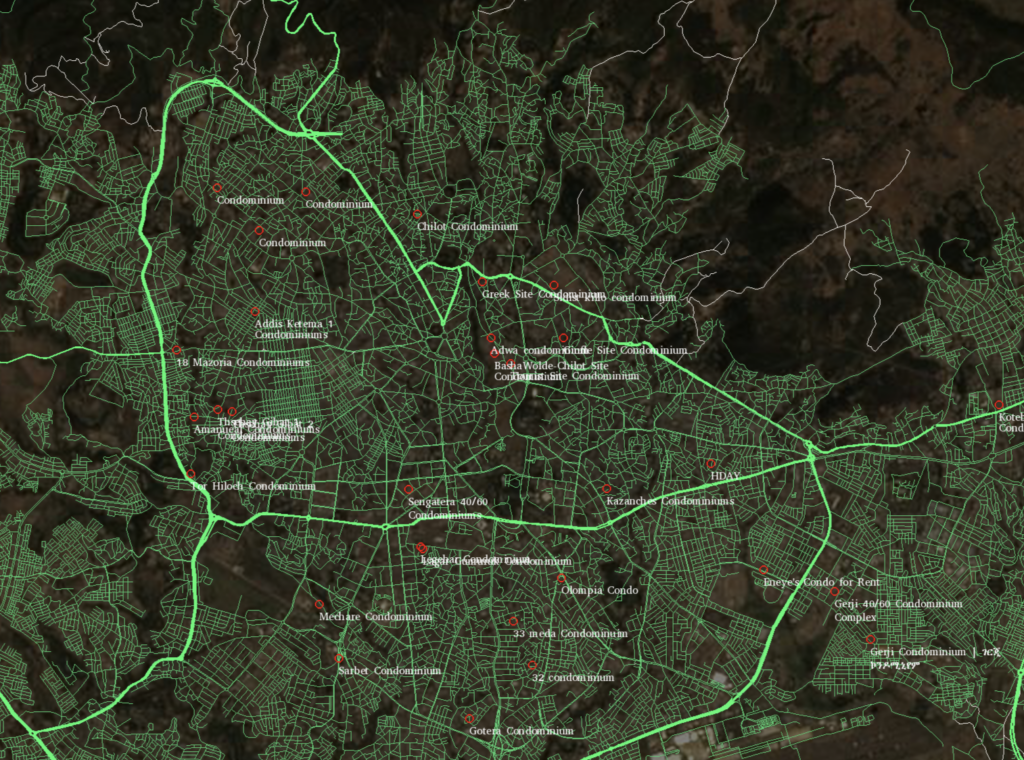
    An image from JFI’s interactive map of Addis Ababa’s new housing sites, which can be found in the full report.

    Ethiopia, in contrast, puts public dollars directly into improving housing and asset ownership for mid- and low-income households, directly building resident equity. This unabashed government involvement and investment derives from Ethiopia’s modern history of socialist alignment, beginning with the 1974 communist revolution. In that revolution, a military government seized nearly all privately owned lands within two years, under conditions of chaos and violence. One outgrowth of that era is that today, fifty years later, the current Ethiopian state continues to legally own the land, which enables the current speed and scale of public projects. More broadly, Ethiopia’s lineage of independence from Western financial institutions and European colonization influences the political potential for public resource use in the present day.

    With accelerating industrialization and urbanization, the nation’s identity is in flux. The state’s development strategy is increasingly aligned with a market ideology, courting foreign direct investment with offers of tax-free economic zones and securing exploitatively low wages in return. Yet the ongoing engagement in state-sponsored development alongside private development has produced tangible benefits for the population during a tumultuous period.

    The attached report sketches the contours of this ambitious public housing initiative: the demographic realities driving the need for such a housing program; a modern political history enabling public allocation of land for population needs; and then the program itself—the factors driving the design development of condo units and the price of purchase. Finally, we consider the social implications of condo ownership: the spatial segregation of economic classes, the isolation experienced by residents in the transition, and local design ideas for condominiums that may better suit a collective way of life.

    Our report draws primarily on interviews conducted with local residents, urban economists, architects, government engineers, and social workers, during a visit in 2018 during in which we stayed in a condominium community. In the interim period, the world, and Ethiopia in particular, have encountered challenging times. Yet the housing program churns along—20,000 new apartment owners picked up their keys in March 2021. For the largely rural people of Ethiopia, it’s like stepping into a new world.

    The full report, the first in JFI’s Social Wealth portfolio, can be found here. On Friday, March 25, join JFI and the authors for a discussion on the report’s key findings and implications for future development. Register here.
  5. Bargaining Chip?

    Comments Off on Bargaining Chip?

    For the global hegemon, pulling the trigger on crisis management seems to consist primarily of posting PDFs to government websites. During the March 2020 financial panic, as the coronavirus first spread throughout the Global North, the Federal Reserve feverishly published term sheets for lending facilities meant to generate dollar liquidity, and the gears of the financial system moved in response. Since February 22 of this year, when Russian troops invaded Ukraine, the Office of Foreign Assets Control (OFAC)—the Treasury Department section in charge of sanctions—has published announcements meant to drain liquidity from the Russian economy. Within a week, the measures had breached “Fortress Russia,” President Vladimir Putin’s attempt to sanctions-proof his country’s economy, and Washington had once again demonstrated its power to deny—or grant—dollar liquidity. What will come next?

    The climb up the sanctions escalation ladder was quick. After the start of Russian strikes, Washington ramped up its economic response. In its first steps, the United States targeted major state development banks and restricted Russian sovereign debt. The next day, OFAC severed the financial links between the global financial system and some of Russia’s biggest banks (including its top two) and choked off financing for some of its biggest firms. Concurrently, the Department of Commerce imposed export controls, limiting supply chain inputs for the Russian aerospace and defense sectors.

    Over the first weekend of the war, after an agreement was reached with Canada and European allies, the United States announced sanctions on the Russian Central Bank—its most aggressive measure yet. Since that peak, Washington has further limited the Russian defense sector, imposed additional export controls targeting Russian refining, and restricted commerce with Belarus to thwart attempts at sanctions evasion. Most recently, the President announced that the United States would be banning the import of Russian oil, gas, and coal to the United States. Throughout, the Treasury Department has steadily added Russian elites and oligarchs to its sanctions list.

    In parallel, the European Union also issued its own sanctions, at the slower pace required to get each of its twenty-seven member countries to agree on each measure. Notably, it limited major Russian banks’ access to Society for Worldwide Interbank Financial Telecommunication (SWIFT), the Belgian financial messaging company that facilitates most global financial transactions.

    Bringing together diplomacy, economic policy, and financial plumbing, US sanctions are the joint effort of the White House, Treasury and State Department. The White House coordinates US strategy. It announces the big decisions, such as the central bank sanctions, and directs the cross-government anti-Russia economic initiatives. The White House’s Deputy National Security Advisor Daleep Singh (who, as head of the New York Fed Markets Group, administered the March 2020 coronavirus panic response) has been at the center of the US planning throughout the current crisis. The State Department handles international communication and coordination. To pacify jittery markets and nervous import-dependent allies, for example, Senior Advisor for Energy Security Amos Hochstein went on Bloomberg to make clear that US sanctions would not target Russian oil. Then, as the pressure for energy sanctions increased, Secretary of State Antony Blinken noted the ongoing “very active discussions” with Europe on a potential embargo. And, finally, after the United States did impose its oil ban, it was Hochstein who suggested that Washington could release oil reserves to cool the price hike and who went to the marquee energy industry conference to urge oil companies to increase production.

    The Treasury, meanwhile, actually imposes the sanctions. This means crafting the technical implementation of the measures. On the energy question, for example, while the State Department handled the messaging, the Treasury Department issued the detailed clarification—the so-called energy carve-out—which explained that oil and gas purchases through sanctioned banks would be allowed.

    For its outsize impact on economic activity and human life, sanctions policy is made with little pomp and scarce administrative procedure. Unlike monetary policy, housed in independent agency, sanctions policy is fully under the political control of the executive branch and faces few constitutional or procedural checks. To explain and enact the energy carve-out, which would affect 12 percent of the global oil trade, OFAC simply posted an “FAQ” on its website.

    Overcompliance

    As with Fed announcements, it is the reaction functions of firms to such statements that gives sanctions their power. Some effects are direct and expected, as in the case of rapid depositor outflows, which ensured that, within a week of the measures’ imposition, the European Central Bank would be closing the EU affiliate of Russia’s largest bank. Elsewhere, sanctions ripple through the economy in less predictable ways: The United States sanctions a Russian firm, a US equity index provider removes it from its index, an asset manager who must mimic the index tries to sell the stock, fails, and the entire market short-circuits.

    During the imposition phase, the biggest ally of a US sanctions regime is overcompliance. The memory of heavy US fines for sanctions evasion and the fear of losing access to the dollar system ensure that companies go well beyond the letter of the law when responding to US measures. (As one German bank official put it to the Wall Street Journal, “Our risk appetite… has been reduced to zero.”)

    Despite the energy carve-out, skittish traders have stayed away from Russian oil, waiting to see whether the United States will convince Europe to ban imports. The effects of such overcompliance build on each other. Lack of market interest has meant that Russian oil is trading below global benchmarks, making it a potentially attractive business proposition. But, after Shell faced popular blowback for legally buying a heavily discounted Russian cargo, traders have continued to avoid Russian oil out of reputational and compliance concerns.

    The complexity of overlapping international sanctions regimes set up in a matter of days has magnified business uncertainty. In doubt, better to stop dealing with Russia altogether. What else should, for example, Singapore banks do when their Monetary Authority sends them a circular politely “reminding them to manage any risks associated with the situation in Ukraine and the sanctions imposed by major jurisdictions”?

    Each day has brought new announcements of companies relinquishing Russian holdings or breaking relationships with Russian clients, whether or not they were legally required to do so. Some measures, like Apple’s removal of Russian outlets Sputnik and RT from the App Store, will be easily undone. Others, such as British oil company BP’s exit from an almost 20 percent stake in Russian oil giant Rosneft, will be irreversible.

    Not all sanctions campaigns achieve such rapid voluntary economic decoupling. The plight of the Ukrainians, the unanimity of Western governments, and the clear illegality of the Russian invasion have made it hard for companies to stay neutral. Firms have paired their press releases disclosing their reaction to the sanctions with announcements of pro-Ukraine humanitarian efforts. By comparison, after the 2014 Russia sanctions, one European executive boasted about learning to use Chinese funding to circumvent Western restrictions. Additionally, the severity of the sanctions and the US and EU governments’ willingness to incur economic losses likely increased overcompliance, by making it clear to companies that Washington and Brussels were serious. The complete break between Russia and the West contrasts with the 2014 experience, when, for example, Germany imposed sanctions against Moscow but deepened its reliance on Russian gas, hardly communicating to firms a willingness to enforce the measures to their maximum effect.

    Sanctions can inflict economic pain in many different ways, and the Russian airline industry has suffered most of them. First, there was disconnection from a key network. Aeroflot, the country’s flagship airline, lost access to back-end flight booking software Sabre, the sort of SWIFT-like invisible-yet-all-important infrastructure that amplifies the effects of sanctions. Next came the commercial squeeze. EU sanctions forced European leasing companies to void contracts with Russian airlines, entitling them, at least in theory, to repossess more than half of Russian aircraft. Fearing the repossession, the Russian government stopped the airlines from flying abroad. Then, a new form of pressure came in the form of export controls. In a new development, the US and EU economic campaigns focused not just on financial measures but on the supply chain as well, limiting the supply of specific physical parts and components to Russian airlines. With limited access to parts, the Russian fleet will slowly degrade as it cannibalizes itself for spare components. On the voluntary front, Manchester United severed its sponsorship deal with Aeroflot.

    The cumulative effect of the Russia sanctions has been catastrophic. Amid the fall-out, Russia imposed strict capital controls, hiked interest rates to 20 percent, and saw its debt downgraded to junk. On Thursday, March 3, J.P. Morgan published estimates that the country’s GDP would contract by 35 percent in the second quarter and 7 percent in 2022. The damage would be comparable in scope to the decline when Moscow defaulted in 1998. Others see the clock winding back to 1918.

    The hard part

    What will the damage do? Before the invasion, transatlantic sanctions on Russia were meant as deterrence. Now, they are a bargaining chip. The United States will impose pain until Russia accedes to its demands. But as preliminary comparisons to the sanctions against Iran and Venezuela suggest, there is no set amount of pain that leads to concessions. Targeted economies can and do stabilize to a sub-optimal sanctions equilibrium. (Indeed, the US intelligence community’s brief to Congress suggests little confidence of a strong relationship between the present economic assault and diplomatic leverage.)

    If sanctions and escalation do open a path to diplomacy, what will matter is articulating what Kyiv, Washington, and Brussels want—and what they will give. All three participants in US sanctions policy will have a role. The State Department will have to coordinate with Ukraine and Europe to develop a clear demand for Russia. And after two weeks of maximalism and widespread awe at the swift and destructive power of the sanctions, the White House will have to remind the public that such measures are a means to an end.

    The Treasury Department’s contribution to diplomacy will be less observable but all-important: ensuring that Washington can make good on its end of the bargain and deliver sanctions relief. The world-historical power of its PDFs and FAQs is effective at ending business, but less so at restarting it. The overcompliance that defines the strength of sanctions at the start of a campaign can turn into a drag on the diplomacy phase. The US can promise that it will lift the sanctions once a deal is reached, but cannot guarantee that firms like Exxon or BP will reverse course themselves.

    The Russian economy will be left with scars. Mundane-seeming steps, like reestablishing links to previously sanctioned banks, take time. Iran learned this in 2016 after the Nuclear Deal when Secretary of State Kerry had to travel to Europe to encourage banks personally to deal with Tehran. In a repeat of the Iran experience (when the country requested access to Boeing planes as part of the nuclear deal), reversing damage to Russian airlines will also be a sticking point. But reconnecting to the Sabre booking platform, leasing a new fleet, or restoring poorly serviced aircraft will take time and Treasury support. And even then, the United States will still not be able to lower insurance rates for Russian airlines that tried to stop the repossession of their planes.

    Two weeks into the war, the economic blow to Russia has exceeded expectations, and the US and EU coalition delivering it has held together. But Washington and Brussels have yet to convert these achievements into a successful defense of Ukraine or the return of peace. The longer the sanctions stay in place, the more pain the Russian economy will suffer, and the more it will consolidate to make itself immune to US pressure. Sanctions may have created some leverage. The hard part is using it.

  6. Eskom, Unbundling, and Decarbonization

    Comments Off on Eskom, Unbundling, and Decarbonization

    South Africa has one of the most carbon-intensive economies in the world. It is also in a staggering and protracted unemployment crisis—the real unemployment rate, including discouraged work-seekers, is near 50 percent. But there remain tens of thousands of workers employed in South Africa’s coal mining and power sector. The combination marks South Africa as a country desperately in need of the ever-elusive “just transition.”

    The announcement at COP26 of an international climate finance deal of $8.5 billion to fund a transition away from coal has been understandably welcomed across the political spectrum. Under the proposed deal, Eskom, South Africa’s state-owned utility, will receive funding to ease the decarbonization process and the transformation to a renewables-based power sector. But this renewable energy will come overwhelmingly from private firms, continuing the path set in motion by decades of policymaking to liberalize and privatize electricity generation.

    The COP26 deal was announced weeks before Eskom chief executive André de Ruyter announced the separation of its transmission wing. The announcement marks the success of the long-term government policy of restructuring or “unbundling” Eskom. Proposed in the post-apartheid era, unbundling would separate the transmission, generation, and distribution functions of the public utility. In the context of the energy transition, it sets South Africa on a path of leaving major investment decisions to the market, with Eskom increasingly relegated to a supporting role in managing the country’s grid.

    In its current form, Eskom is unquestionably an impediment to decarbonization. But as the global market-led transition away from fossil energy continues to flounder, it remains in many ways the only entity plausibly capable of delivering a transition—in particular a just one—for this coal-intensive, highly unequal economy.

    A totalizing energy crisis

    Eskom has been mired in an extraordinary financial and operational crisis for over a decade. The utility is R392 billion (US $24.2 billion) in debt—close to 8 percent of South Africa’s GDP—and is directly cited by ratings agencies to justify poor investment grades, while the government provides regular bailouts on top of servicing its own debt. This burgeoning debt has been used to justify a range of austerity measures, increasing in intensity under the current government of Cyril Ramaphosa, who replaced Jacob Zuma in 2018.

    Zuma resigned prematurely, under insurmountable public pressure. His tenure was marked by what is now called state capture—the “unprecedented ransacking and infiltration of public finances”—throughout the South African state, from its intelligence networks, to its tax collection authority and National Prosecuting Authority, to state-owned companies like Eskom. 

    Eskom was, and remains, a prime target of those networks of state capture, particularly over procurement. The former executives and board of Eskom oversaw activities that ranged from giving contracts to family members to forcing, and then paying for, the sale of a coal mine to a politically connected family. Such corruption often abuses procurement policies intended to support industrialization and black ownership. In their failings, these policies often succeed only in supporting black minority equity owners in large, often foreign firms; the sub-contracting of woefully unqualified companies; or, in the case of Eskom, creating new players in the coal-mining sector, to its own detriment.

    Ramaphosa’s bid for the presidency coincided with the appointment of a new Minister of Public Enterprises and a new board for Eskom, which together appointed Andre de Ruyter as CEO in January 2020. De Ruyter and his largely new group of executives have made Eskom’s debt one of their top priorities and have shrunk it by R91.7 billion (US $6 billion). Critically, money has been recuperated from a few of the litany of corrupt contracts, but much of the overall reduction was driven by the strength of the rand. In line with the utility’s “full-cost recovery” model, it has aggressively sought to recover money from indebted municipalities and the public through increased tariffs.

    For South Africans, even more than the tariffs, it is the rolling blackouts that most strongly characterize the crisis at Eskom. Since 2008, Eskom has increasingly had to turn off the lights—locally referred to as “load-shedding.” Last year saw 1,136 hours of outages, amounting to as much as 15 percent of people’s time, with power interruptions as frequent as three times a day. The roots of this problem lie in the significant delay in bringing the infamous Medupi and Kusile power stations online. Prior failed plans for privatization delayed Eskom’s ability to build new capacity. But after the two projects were cleared, the plants suffered a series of further setbacks, many linked to corruption. The Kusile station was meant to be completed in 2014; it is now slated to be fully running in 2025. In the meantime, Eskom’s aging coal fleet is rapidly breaking down due to negligence of essential lifetime maintenance, which built up under the previous corrupt executive.

    Load-shedding will likely be worse in 2022. South Africa’s only nuclear power plant is set to undergo long-term renovations, and a unit of the Medupi power plant exploded last August. The current executive could not have predicted the latter, but their promises of reduced load-shedding are now backfiring, leading to calls for the firing of De Ruyter by his predecessors and those aligned with them. But De Ruyter’s leadership and the Ramaphosa presidency undoubtedly represent a desperately needed pivot toward good governance. (That Eskom under De Ruyter is being actively sabotaged illustrates the significance of this shift.) But these changes are not enough to bring organized labor—who locate De Ruyter firmly within the government’s long-standing plan to restructure Eskom—on side. Whichever way one views the unbundling—as necessary step or prelude to disaster—De Ruyter is explicitly there to carry it out, and he has seemingly completed the job.

    A changing Eskom

    In 1948, Eskom’s mission statement read as follows: “The South African Electricity Supply Commission sees its task as to render, by the provision of power without profit, a worthy and ever-increasing contribution to the development of South Africa and the welfare of her peoples.” By 2006, the narrative had changed dramatically: “Eskom will grow shareholder value by exceeding the needs of local and foreign customers with energy and related services.”

    With the above juxtaposition, in a 2002 book chapter, former trade unionist Leonard Gentle uses Eskom “as an index of the changing character of the [South African] state.” From 1923, Eskom had primarily acted as a regulator of the large privately owned Victoria Falls and Transvaal Power Company (VFTPC) and other such entities, until its transformation in 1948 toward a consciously progressive and developmental utility. But 1948 is also regarded as the founding of grand apartheid (although formal racial segregation had come decades earlier). Eskom was committed to supplying electricity to the white minority, and guaranteeing super-profits for gold-mining companies in particular. With the expansion of exceptionally cheap electricity, based on the brutal exploitation of black workers, mining profits would thrive. Eskom’s developmental ambitions, then, were rooted in a coalition between mining capital and the racist South African state. This coalition would eventually be shaken.

    The restructuring of Eskom is not explicit privatization, although that has been historically on the table. The increasing power of the anti-apartheid movement, in large part led by now-organized mine workers, heaped immense pressure on the late-apartheid government, which became increasingly reliant on increasingly unsupportive foreign direct investment. South Africa joined the global neoliberal turn, including a raft of reforms at Eskom in 1987 that scrapped its public interest mandate, introduced profit-making, and formed a new capital-friendly regulator.

    In 1990, the privatization and deregulation of Eskom was proposed, but the recently unbanned African National Congress (ANC) and its powerful trade union allies put such proposals to bed. However, as soon as 1998, ANC government policy was to unbundle Eskom, prevent it from building additional capacity, and instruct it to sell off generation assets to ensure 30 percent private ownership by 2004. The historical coalition had remained largely intact, but now had a democratic government. The super-exploitation of mine workers would continue.

    The policy of unbundling originated in the World Bank, which has had cause to seriously reassess its power-sector policies—“full-cost recovery” in particular. Rather than direct privatization, the objective of unbundling is primarily to separate out generation and transmission in order to realize the Independent Transmission System and Market Operator, or “ITSMO.” A central aim of creating such an independententity is to nullify the risk that Eskom would favor its own generation over private producers. But in the 2000s, under pressure from its allies in organized labor, the ANC reconsidered its position. The middle of that decade saw a slew of measures that further corporatized Eskom, but plans for unbundling and partial privatization were shelved. Instead, the private sector, as independent power producers (IPPs), would enter the market by providing new capacity as demand grew. Today, IPPs account for around 11 percent of all capacity. Eskom’s continued crises and the push toward climate policy have provided impetus for the further entry of the private sector. Solar and wind account for 83 percent of IPP capacity; Eskom’s makeup is the polar opposite, with 85 percent of its capacity in coal.

    Faced with a utility enmeshed in coal networks and in a totalizing crisis, unbundling Eskom to pursue a future of private clean energy appeals far beyond the business press. South Africa’s progressive civil society and parts of the left see this as a necessary compromise in favor of reliable power and a clean energy transition. But this is hardly guaranteed to be the case.

    The reality of renewables

    The global rise of variable renewables like wind and solar has been impressive. The last decade saw a 310 percent increase in renewable power generation, and renewable energy accounted for 82 percent of all capacity add-ons in 2020. Still, renewables (excluding hydropower) account for just 5.7 percent of all energy consumed. Of greater concern is the trend in renewables investment. While installed capacity continued to rise, levels of investment in solar and wind have stalled and occasionally dipped over the same period. The International Energy Agency estimates a tripling of current investment levels is required to limit warming to 1.5 degrees Celsius.

    The renewables boom was built on the back of subsidies. When they are removed, as has happened in some cases in Europe, the transition stalls. Now, renewable energy firms have to compete with each other in reverse auctions, driving down prices, which simultaneously erodes profitability. Brett Christophers’s research on BP, Royal Dutch Shell, and Total confirm that—despite their ability to generate profitability compared to the wider sector, and their much publicized net-zero announcements—the big three overwhelmingly choose profitable hydrocarbon activities. The regions where renewables fortunes remain optimistic are increasingly limited to the low-cost environment of the Global South.

    The cheap land and labor of South Africa, coupled with its unmatched solar and wind potential, no doubt make it an attractive site for investment. But this still might not be enough to buck the global trend. Ensuring decarbonization is profitable enough for the market will remain a fundamental challenge. De Ruyter himself has already indicated that the era of twenty-year power-purchase agreements (PPA) is over, and that “the private investor will have to take more business risk.” Another concern in the South African context is precisely this availability of cheap land and labor. Renewable energy projects have already faced contestations from indigenous populations elsewhere. And current Eskom employees who would need to be redeployed into this sector will hardly be willing to give up relatively high wages to join a sector hostile to organized labor.

    Finally, it is not certain that an increase in renewables will solve the energy-supply crisis in South Africa. It may provide some relief when plants need to be shut down for repairs, but peak solar potential does not correlate with peak demand; and Eskom’s current storage capacities (just 244 MWh) and future plans remain limited. Rather, Eskom is set to add 4GW of capacity from gas, a global trend that accompanies power systems with increased penetration of renewables. The plan appears to be Eskom’s generation division taking on the more costly role of providing backup to private renewables through new gas and its existing coal fleet, but giving way to private clean power when it’s available. How this will be economically viable is a mystery, but the slow demise of Eskom’s generation division is a desirable outcome for business interests who have been long intent on replacing it. South Africa needs renewable energy and a just transition, but the complexities require a revitalized public system, integrated with resource planning and state regulators that determine which energy resources are invested in and where, and are accountable to broader democratic politics. The Eskom of today is a far cry from this, but the prospects of such a vision are incompatible with privatization.

    The deal

    The COP26 climate deal is likely to reinforce this preexisting policy trajectory toward the development of a disaggregated energy market, with Eskom in the role of backing up and managing the grid. De Ruyter has consistently spoken of the promise of such a deal for decarbonization, and the South African Presidency’s statement on the deal highlights the intent to “repurpose or repower … coal fired power-stations”; but when comparing the deal’s projected five-year period with Eskom’s plans for capacity additions, its utility-scale renewable energy ambitions are negligible. Further, it is estimated that Eskom will need R180 billion ($11.7 billion) to upgrade its grid to accommodate the planned 30GW of private renewables. Such costs are perennially excluded from analyses of renewables. The first year of the deal remains in a planning stage, and the delivery of the promised funds will almost certainly require the energy sector to continue its liberalization to receive financing that is struggling to find adequate returns on renewables elsewhere.

    If Eskom’s financial crisis is alleviated, as its highest executive and the South African government continue to promise, then it can and must be pressured to build out its own renewable energy. Recent developments suggest that this pressure may come, in part, from organized labor. An analysis by the Alternative Information and Development Centre (AIDC) suggesting public-pension funds can be mobilized toward financing a just transition has been taken up by COASTU, South Africa’s largest trade union federation. The strategy is thus: if Eskom can build out its own renewables, it can continue to be a viable generator. Under favorable political conditions and by retaining a central generation role, a future reconstitution of the utility is more likely. This reconstitution must take place to deploy the future public investment required for decarbonization. The full-cost recovery model has to go. Eskom, like so many other utilities, can never provide reliable power and cover its costs, without drastically increasing fees on a population largely unable to pay current prices. But in powering reindustrialization toward decarbonization—with the production of green hydrogen and electric vehicles, as the preliminary text of the COP26 deal indicates—the future government can draw significant revenues to subsidize Eskom.

    Of course Eskom’s crises extend far beyond its finances. The same corrupt networks that once ran Eskom want it back. Last year saw an attempted insurrection, with nobody held responsible and seeming acceptance of “violence as a weapon to make permanent and inviolable the criminalization of vast chunks of the state.”

    There are no easy solutions. Much of labor was both a victim and active participant in state capture, but any pathway towards decarbonization must involve engaging a cautious and demoralized trade union movement. Rooting out the corruption at Eskom and building the constituency necessary to ensure Eskom’s transformation and survival requires organized labor. As the struggle over the fraught legacy of the transition to democracy and the era of state capture continues, and when multilateral institutions and finance increasingly turn their eyes to the energy transition globally, a transformed Eskom will need to play a central role facilitating anything like a just transition.

  7. A New Developmentalism?

    Comments Off on A New Developmentalism?

    In 2003, led by the government of Néstor Kirchner (2003–2007), Argentina’s developmental agenda regained momentum. From the ashes of privatization, deregulation, and liberalization emerged a consensus agenda that put the public sphere at the center of the growth engine. The argument was a heterodox variation of the trickle-down effect: growth (particularly in the industrial sector) would foster employment, and employment would favor social inclusion. According to Kirchner’s developmental framework, sustained growth could not be left to the market; it had to be reached through intelligent state intervention. 

    The approach echoed that of the 1950s and 1960s UN Economic Commission for Latin America and the Caribbean (ECLAC). Economists like Raúl Prebisch stressed that peripheral countries suffered from falling export prices in a global free trade regime. The famous Prebisch-Singer hypothesis held that falling terms of trade forced Latin American economies to export primary goods in order to pay for the imported capital goods they needed for industrial development. To mitigate this dynamic, peripheral economies needed to protect and subsidize their industrial development by taxing commodities exports, fostering public investment in strategic industries, and strengthening national control over export facilities. 

    In Argentina, state-led development was pursued beginning in the late 1940s under the leadership of president Juan Domingo Perón. The Peronist coalition consisted of both modest capital owners and a growing industrial working class. National firms thrived in the aftermath of the 1930s crises, and a powerfully mobilized labor movement emerged within the growing industrial centers. ECLAC-style developmentalism became deeply interwoven with the stability of the Peronist regime. Upon his expulsion from power in the 1950s, Argentine developmentalism took an international turn. Under alternating military governments, foreign investors were called to provide much-needed savings in hard currency and technology, while local firms were expected to modernize and generate well-paid industrial jobs for an increasingly radicalized working class. But after decades of protection, national firms remained dependent on state protection. With the economic crisis of the 1970s and the fall of Bretton Woods, developmentalism was abandoned and a violent military dictatorship facilitated the imposition of liberal reforms. 

    In order to revive a developmental agenda, Kirchner was tasked with reconstituting a developmental coalition. Given low domestic savings rates, his successor, Cristina Fernández de Kirchner, turned to foreign currency markets to finance industrial initiatives. Rising energy and parts and supplies imports combined with an inability to issue debt on the international capital markets provoked another strategic shift: instead of replacing scarce foreign currency with import substitution, the new goal was to increase exports and receive as much foreign currency as possible. Instead of domestic capital owners, Kirchner’s developmental agenda placed transnational, export-oriented corporations at the head of its developmental program. 

    Fostering domestic development through international corporations necessitated the formation of new “industries”: agribusiness, mining, and energy were set to provide the hard currency needed to pursue public investment. But like their 1950s predecessors in plastics and steel, these new industries depended on the depletion and destruction of natural resources, promoted unplanned organization, and led to growing environmental and social precarity. 

    Green developmentalism

    Current President Alberto Fernández has framed his 2020 Green Productive Development Program (GPDP) in response to these developments. The proposal’s key commitments are to economic and environmental sustainability—decreasing foreign currency reliance, generating well-paying jobs, and promoting industrial development in a climate-friendly way. 

    But in continuing to further industrialization through the export of natural goods, the proposal fails to break the structural dependence of Argentina’s economic development from its ties with transnational corporations. The Fernández government is appealing to foreign investors with new regulations and subsidies for the extraction of shale gas and lithium from territories in the South and the North of the country. In 2012, the recently expropriated gas and oil corporation YPF signed its first agreement with Chevron to develop the “Vaca Muerta” shale oil and gas field in the southern province of Neuquén. Since 2020, millions of dollars have been directed by the state toward fast-forwarding production and exports from the field. In recent years, Ganfeng Lithium and BMW both entered the lithium business through brine mining in the northern provinces of Salta and Jujuy. Additionally, there is the newly confirmed multi-billion-dollar project by the Australian Fortescue (announced during the COP26 meeting) to produce so-called green hydrogen (GreenH2) with salty ocean water and solar-power electricity. 

    Meanwhile, on December 31, 2021, the government approved exploration and future exploitation of potential oil and gas reservoirs in the marine underground, just a few hundred kilometers off the coasts of the fishing port of Mar del Plata. This operation, a collaboration with the Norwegian firm Equinor, will not only risk the livelihoods of local fisheries, but also endanger whales and other marine life in the area. 

    The proposed initiatives constitute a state guarantee of fiscal support and political stability for foreign investors. In most cases, the projects are located in lands disputed by Indigenous communities. In late 2021, a popular mobilization in the southern province of Chubut forced the local government to roll back on a mining project that had been approved without appropriate public debate. Local governments have deployed security forces against public resistance and leveraged derogatory and racist discourse against them.

    Argentina’s recent development initiatives therefore embody the essential contradictions at the heart of green industrialization. The materials of the green transition, which is billed as promoting ecological and social stability, depend on the plunder and pollution of common goods, and the exploitation and disruption of local communities. While these plans will build infrastructure and generate jobs, the effect may wear off once infrastructure construction is complete. As the IMF’s biggest debtor, Argentina is eager to reduce debt in exchange for green investment. But the search for macroeconomic stability may continue to come at enormous social and environmental cost. 

  8. Acute Dollar Dominance

    Comments Off on Acute Dollar Dominance

    The surge

    In early 2020, the “dash for cash” in the US Treasury market prompted the Fed to relaunch its dollar swap lines, which it did in mid-March of that year. In the aftermath of the 2008 Global Financial Crisis (GFC), the New York Fed had established permanent arrangements to supply dollars to five key foreign central banks. But as the emerging pandemic rattled global financial markets, dollar swaps were temporarily extended to nine more foreign central banks. Less privileged foreign central banks not extended such swap lines were instead given access to the Fed’s brand-new Foreign and International Monetary Authorities (FIMA) repurchase agreement facility, which allowed them to exchange their US Treasury securities for dollars as an alternative to dumping the securities for cash in the open market. The move was part of a concerted suite of measures undertaken by the Fed to stabilize dollar funding markets. (Compared to peak swap use of $449 billion, FIMA Repo use peaked at a relatively paltry $1 billion.) That spring, the Fed balance sheet mushroomed from $4 to $7 trillion. The Fed’s decisive actions quashed any doubt that the world’s most powerful central bank would hesitate to assume the mantle of monetary hegemony. As of the beginning of 2022, Fed assets stand close to $9 trillion.

    The coronavirus crisis highlighted stark disparities in financing capacity across the globe. Monetary and fiscal relief amounted to one-fifth of GDP in advanced economies, only six or seven percent of output in smaller economies, and a mere two percent of GDP in the poorest of nations. The US macroeconomy’s rebound—steeper than that of any other rich economy—is an outcome of its $5-trillion-plus stimulus. In 2021, per capita growth in low-income economies was a tenth of that in advanced economies, foregrounding the starkly divergent paths of economic recovery. Increased government spending in response to the pandemic birthed deficits and debt in advanced economies that were twice the size of those in poorer economies. However, given the strictures placed on poorer nations by the international financial hierarchy, for some financially subordinated economies, public debt accumulation has brought sovereign debt default closer to the horizon.

    Original sin, all over again

    Crises catapult change but also entrench hierarchies. Countries granted swap lines saw their currencies stabilize faster than those that weren’t. The post-GFC period has been characterized by acute dollar dominance: global economic conditions are correlated to movements in the greenback. In the growth phase of the dollar cycle, associated with USD depreciation, the world economy is awash in liquidity—propelling credit, trade, and GDP growth. On the downside, dollar appreciation comes with credit tightening, and reduced trade and investment. Other key currency appreciations don’t have the same adverse effect on emerging market (EM) economies. EMs with large dollar-denominated debt exposure are at increased risk for banking crises. The dollar has knit the world economy into a tightly wound ecosystem.

    In the aftermath of the European sovereign debt crises, non-European banks and non-bank financial institutions (NBFIs) ramped up their dollar liabilities. Credit growth is increasingly driven by bond markets and the dollar’s ambit has expanded. Dollar-denominated bond issuance is particularly large in developing economies. About a fifth of global dollar funding involves emerging markets. Foreign involvement in EM borrowing has grown. While equity investment in EMs doubled in the last decade, investment by bond funds in EMs quadrupled. In a bid to shrug off “original sin”—the inability of sovereign states to borrow in their own currency because of their subordinate monetary status—over the last two decades, developing economies have built up their domestic-currency-denominated debt markets. Ninety percent of the sovereign bond market in EMs is now in local currency (LC) bonds. Negative real yields in the Global North have made such bonds a desirable asset class for investors. Accordingly, foreign residents hold about one-fifth of outstanding local-currency EM sovereign bonds.

    However, own-currency bond issuance has not absolved EMs of original sin. On the contrary, they now encounter “original sin redux”: the acute sensitivity of EM bond markets to the global dollar cycle, whereby dollar appreciation amplifies LC bond-market sell-off. The exodus of capital from developing countries in the spring of 2020 was driven by a loss of confidence in local-currency bonds. Foreign-currency-denominated EM bonds proved less flighty.

    Advanced economies continue to be significant sources of funding across asset classes in emerging economies. As the major currency for borrowing and investment internationally, the dollar is a dominant vector for transmitting financial volatility to the Global South. The Fed’s monetary easing in 2020—the Broad Dollar Index fell by almost 7 percent that year—helped spur record levels of borrowing globally. In 2020, global debt surged to an unprecedented $226 trillion. More than half of the increase came from public sector borrowing. Sovereign debt issuance stood at $58 trillion, of which $44 trillion was issued by advanced economies and the rest by emerging markets. Pandemic-related healthcare and social expenditures have led debt issuance in low- and middle-income economies to increase by a third compared to pre-pandemic levels.

    More recently, the Fed’s monetary tightening, via reductions in its asset purchases, has propelled sharp interest rate hikes in the Global South. In a context in which the issuance of foreign-law-governed, foreign-currency-denominated sovereign debt in EMs is at a record-high, this is particularly concerning. As of December 2021, outstanding international debt securities (IDS) were a $27.6 trillion market, almost half of which was dollar denominated. Known as eurobonds, or foreign bonds, IDS are typically issued outside the domestic market in order to attract foreign investment. Government bonds, including those issued subnationally, comprise about half of outstanding IDS in emerging markets. (By contrast, the public sector’s share of IDS in advanced economies is less than a fifth.) Interest rate hikes by EM central banks attempt to anchor inflation expectations and appease foreign investors. Lauded by investment funds seeking returns, higher bond yields make debt repayments more expensive. As the debt pile mushrooms, EM balance sheets—facing currency and maturity mismatch in an environment in which interest rates are often higher than growth—become increasingly prone to economic shocks. Not dissimilar to other countries on the precipice of sovereign default, Sri Lanka owes about a third of its debt to foreign creditors, has only $3 billion left in foreign reserves, and just repaid a $500 million bond. Meanwhile, its citizens are coping with government-mandated power cuts and double-digit inflation.

    Launched in 2020, the IMF’s new integrated policy framework recommended that EMs withstand sharper and deeper currency devaluations to stave off balance of payments crises. A classic instrument in the EM tool kit, currency devaluation is, however, no longer as effective as it used to be. This is because dollar invoicing in global trade is enmeshed with dollar borrowing by firms in global supply chains. For many emerging markets exporters, both costs (of imports and loans) and revenues (export earnings) are in dollars. Fully ensnared in the web of dollar-dependence, they cannot benefit from local-currency devaluation as a competitive strategy. Moreover, relying on price- and exchange-rate changes as shock absorbers is Panglossian economics. Large and unexpected currency devaluations can catalyze into output shocks.

    The debt restructuring impasse

    The dollar’s role as the international reserve and vehicle currency is well known. Much less appreciated is the complex, multilayered configuration of dollar dominance today, structured as it is by the legal and financial apparatus of dollar-denominated debt, amplified by the global dollar cycle.

    The flourishing of poorer nations is limited by their lack of fiscal and monetary autonomy, living as they are under the umbrage of the world dollar order. Efforts to restructure sovereign debt in the Global South have stalled with the Debt Service Suspension Initiative (DSSI), the G20’s pandemic-driven debt moratorium. At the close of the debt suspension period at the end of 2021, 60 percent of low-income countries remain at high risk or are already in debt distress. Ultimately, the success of the initiative has been limited. Fears that DSSI participation would negatively impact credit ratings on sovereign debt has meant that only forty-two of the seventy-three eligible nations have received relief. (Debt held by private creditors was exempted from the program’s remit.) The new G20 common framework for debt restructuring is even more narrow in scope: debt workouts are open only to countries facing sovereign debt default. The only participants thus far (Chad, Ethiopia, and Zambia) haven’t made much progress in restructuring.

    Despite the unprecedented shock that this pandemic posed to the world economy—and in contrast to the dramatic actions of the central banks—the response of multilateral lenders such as the IMF has been remarkably tepid. It took until August 2021, more than fifteen months into the crisis, for the IMF to disperse more than a tenth of its monetary firepower. Of the $650 billion in last year’s IMF SDR issuance, only $21 billion has been directly allocated to low-income countries. To put this in some context, the sum that developing economy governments paid back bondholders in 2020 came to $194 billion.

    More than half of the outstanding stock of international sovereign bonds is written into New York State law. Slightly less than half is governed by the law of England and Wales. More than 70 percent of EM sovereign debt is dollar denominated. More than 90 percent of sovereign bonds issued by countries that qualify under the DSSI are governed by English law. Debt haircuts issued by sovereign creditors will not be enough to stave EM defaults: bilateral creditors represent only one-third of upcoming payments owed by countries eligible for the DSSI. About a third of foreign-held EM sovereign bonds are owned by private creditors, including asset managers and hedge funds. A more sustainable global political economy would be one in which investor power is balanced by countervailing forces.

    Mitigating waves of disorderly debt restructuring requires a global mechanism for sovereign debt restructuring. There is no bankruptcy code for sovereign debt. While, in theory, this might give sovereigns greater elasticity, in practice, it makes for highly asymmetric ad hoc negotiations in which private creditors from the Global North invariably have the upper hand. A slew of creative mechanisms for altering this imbalance have emerged from legal and economic research. Given the widespread macroeconomic instability that confronts the Global South, instead of time-consuming and costly bilateral debt renegotiations that financially strained economies can ill afford in this pandemic, now is the time for debt restructuring to employ the principle of “economic necessity” because of exogenous circumstances. Executive orders from the US Administration could protect sovereign assets housed within the US from usurpation by creditors. The UN Security Council has the capacity—employed in the past to protect oil assets in Iraq from seizure—to enact an immunity shield, legally binding on all member-states, which would exempt assets crucial to national sovereignty from use in debt repayment. In conjunction, debt moratoriums or cancellations could be enacted in UK and US courts, where the majority of sovereign asset seizures by foreign creditors will be fought.

    As Katharina Pistor has argued, markets are carved out by legal doctrine, and resuscitating markets in times of crisis sometimes requires law’s suspension. The legal flexibility required to safeguard markets has been a preserve of the powerful. Stabilizing debt markets in emerging and developing economies can only occur by extending what Pistor calls the “elasticity” of law at the apex of the global legal-financial system to its periphery. Given the disproportionate impact of this crisis on poorer countries that lack the monetary and fiscal capacity of richer nations, it is also a moral imperative. In this era of multiple crises, governments should shape finance to forward the public interest. This requires both incentives and disciplining mechanisms. In light of the pandemic, laws that make private property rights inviolable at the expense of the maximum protection of human lives must be suspended.

    This pertains not only to the neoliberal playbook governing debt restructuring, but also to the intellectual property protections embedded in trade agreements (TRIPS) that prevent poor countries from manufacturing Covid-19 vaccines. Just this week, COVAX, the WHO program created to deliver vaccines to Africa, Asia, and Latin America, revealed that it is fresh out of cash. It needs $5.2 billion to continue vaccine rollout in low-income countries that have received fewer total vaccine doses than richer economies’ residents have total booster jabs. Our crisis-prone system breeds instability whose effects fall unevenly. Unless our disordered world economy is reoriented toward protecting the interests of the majority, it may not withstand this catastrophe—let alone the next one.

  9. Controlled Prices

    Comments Off on Controlled Prices

    In the decades after the Civil War, Andrew Carnegie captured the American steel industry by pushing down prices. So effective was the Scottish-born telegraph operator at reducing costs, breaking cartels, and driving competition into bankruptcy during the downturns of the 1880s and 1890s, that J.P. Morgan bought out the 66-year-old Carnegie to protect the profitability of his holdings and stabilize the nation’s industrial life. When Morgan incorporated U.S. Steel in 1901, the unprecedented combine controlled two-thirds of the nation’s steelmaking capacity. For the next six decades, the company set the price of steel in the American market, anchoring industry prices by cutting last in recessions and raising last in expansions. Under this “price umbrella,” the other dozen companies owning steel factories in the US remained profitable and expanded healthily. Industry-wide, ingot capacity expanded from 21.5 million to 71.6 million tons between the firm’s creation and the eve of World War II.

    Ever since Alfred Marshall first popularized a rough graph of the crossing schedules of supply and demand in 1890, a strain of Anglo-American thinking has fixated on the disruptions caused by the ancient practice of controlling prices. Impose a ceiling too low, theory teaches, and the quantity demanded will outpace the quantity supplied; a floor too high, and producers will build up surpluses above what consumers are willing to absorb at current prices. Because wants are always changing, any ceiling or floor will eventually produce such “distortions.” Limit any price and the whole society may begin to convulse.

    Marshall, Carnegie, and Morgan were contemporaries. But a glaring gap stands between the theories of the economist and the practices of the industrialist. At its most quintessential moment, American capitalism was defined not by the laws of supply and demand, but by concentrations of power within the marketplace.

    Before macro

    Before the rise of macroeconomics that accompanied World War II, price determination was a central problem of economic thought. For a world in which the tempestuous fluctuations of the business cycle brought runaway speculation, widespread bankruptcies, and growing labor militancy, the relationship of price to cost was a critical question. Under classical theory, competitive prices would yield revenues to the firm that covered costs and a normal profit. Firms took rather than gave prices in the market. And competition would check profiteering: where earnings rose well above costs, new producers would enter the market and, with lower prices, bid away customers. In fact, theories about the interrelated movements of price and cost lay at root of some of the earliest empirical studies of the totalizing phenomenon of the business cycle.

    Despite this Marshallian orthodoxy, public intervention into price determination was at the heart of the business world during the period between the Belle Epoque and the Great Depression. To many business-friendly Progressives like Herbert Hoover or Gerard Swope, president of General Electric, government-sanctioned cartels had come to appear as the inevitable tide of history. Even Congress recognized this trend. Both the 1922 Capper-Volstead Act and the 1927 Agricultural Marketing Act, for example, provided federal financing for farmer’s marketing cooperatives and exempted them from antitrust prosecution, allowing them to collude in order to raise selling prices and stem farm bankruptcies. Herbert Hoover’s tenure in Washington was defined by his tolerance for cartel behavior, even encouraging the Department of Commerce to collect and circulate industry prices and costs to help coordinate business behavior. When Franklin Roosevelt entered the White House in the spring of 1933, among his administration’s first legislative priorities were the Agricultural Adjustment Act and the National Industrial Recovery Act: each placed a central authority in Washington in charge of planning supply and prices. (When it was completed in 1936, the new US Department of Agriculture (USDA) South Building in Washington was the largest office building in the world.) During the first two years of the New Deal, tens of thousands of businessmen flocked to Washington from across the nation to sit on over 550 “code authorities,” government-sanctioned cartels established by the National Recovery Administration (NRA) to fix prices in the form of “industry codes.”

    Such comprehensive price control proved unworkable under the eighteenth-century constitution. Like the Estates General of the Bourbon king, Roosevelt’s convention of the nation’s bourgeoisie for an experiment in “industrial self-government” under the NRA quickly erupted into polarizing conflict, not only over the controls themselves but more importantly over who would determine them. Large and small firms turned to the federal courts for relief against prices set by their more powerful or better-organized competitors, but the most explosive conflict was between employers and workers over the price of labor: under the NRA, employees too could elect representatives of their own choosing to sit on the “industry code authorities” that were now planning production. In 1934 alone, general strikes for union recognition erupted into police riots in the cities of San Francisco, Toledo, and Minneapolis. The experiment in industrial cartels lasted twenty-three months, until the Supreme Court in May 1935 serendipitously declared the NRA unconstitutional on behalf of a middle-sized Brooklyn poultry factory.

    The demise of the NRA did not, however, reverse the trend toward planning or its instrument in price control. The upshot for the New Dealers was recourse to regulatory boards for “sick industries”—trucking, bituminous coal, or agriculture, those in which competition drove bankruptcies—where price fixing on a sectoral basis could achieve what the historian Ellis Hawley describes as “partial planning.” Competition, negotiation, and entry remained licensed by new, industry-specific regulatory powers of the “Second New Deal” in those sectors with numerous firms previously competing on price, such as the Populist-era Interstate Commerce Commission, expanded over the trucking industry; the Civil Aeronautics Board, for airlines; the Home Loan Bank Board, for housing finance; the USDA, for agriculture; and the National Labor Relations Board, for wages. Many of these industry boards remained in operation until 1980, as enduring legacies of the New Deal principle of extending public-utility regulation and price control over areas of economic life considered too vital to be left to market forces alone.

    Yet the central thrust of the New Deal project to protect agriculture and raise working-class incomes ran against those areas of concentrated corporate power excluded from industry-specific regulatory boards. These were the core manufacturing firms: U.S. Steel, General Motors, General Electric, the Standard Oil companies. In 1935, administration economist Gardiner Means, toiling away in the Department of Agriculture, had found that prices fluctuated less in these industries in both magnitude and frequency compared to less concentrated sectors such as agriculture, bituminous coal, and light manufacturing. “The essential difference between the two types of prices,” wrote Means, “is that one represents an equating of supply and demand by price while the other represents the equating of production and demand at a price.” The analytical distinction turned on whether an industry was organized in a way to control its own prices.

    “Nothing sacred”

    The eventual postwar acceptance of the Keynesian prescription for government spending has tended to eclipse the more adventurous Depression-era policy interventions. Our understanding of such interventions has enormous implications for the balance between public power and private autonomy, as well as the relationship between democracy, capitalism, and representative government. As President Roosevelt told Congress in 1936, “Private enterprise is ceasing to be free enterprise and is becoming a cluster of private collectivisms; masking itself as a system of free enterprise after the American model, it is in fact becoming a concealed cartel system after the European model.”

    Such problems were intractable under the US Constitution. Forcing down manufacturing prices to expand sales, output, and employment was the order of the day. But how was this to be done? On the one hand were the proponents of antitrust prosecution, who argued that an active competition policy through the courts might restore flexibility to prices grown rigid through consolidated ownership. Yet even industries such as cement, with five or six major national producers, exhibited administered price behavior. “Price leadership” by the most efficient firms was endemic in countless markets. How many companies would the courts require to consider price competition effective?

    On the other hand, those groups left to bargain with the centers of corporate power—labor unions, purchasing cooperatives, chain-store retailers, and various groups of small actors exempted from the antitrust laws—increasingly organized themselves to administer their own incomes, just as the corporate managers did.

    For much of the remainder of the twentieth century, historians described this phase of the late New Deal as a stalemate quickly overcome and forgotten by the German invasions of Poland and France. Alan Brinkley has described the shift toward expanded government spending, and the legitimacy in Washington it brought to Keynesian thinking, as the “end of reform,” while multiple generations of historians have described the period that followed, the late 1940s and the 1950s, as the highwater mark of a “liberal” or “Keynesian consensus.” Yet the shift toward government spending exacerbated rather than alleviated the problem of relating prices to costs. Against the programmatic crosscurrents of antitrust and collective bargaining in the second Franklin Roosevelt administration, prices and costs began to rise on their own, often far before production met capacity, when idle plants and resources lay across the nation.

    The incipient emergency “relief” and public works programs had already signaled this possibility. During the recession of 1937–38, Montana Senator James Murray spoke on the floor of Congress to decry the fact that companies had responded to the government contracts and expanded consumer demand of 1933–36 by increasing prices rather than expanding output and employment. “The Government was spending enormous sums of money for the purpose of putting people back to work and stimulating industry. The industries should have recognized the situation as an unusual and an abnormal one and should have been satisfied with lower prices and should have cooperated with the Government in putting men to work.” As Murray explained, “[T]he royal road to prosperity in this country is for the corporations to allow wages to be raised without raising prices, and that in that way, and only in that way, are we going to have prosperity in the country. We have to spread purchasing power…” The Senator repeated the sentiment throughout his career, urging greater postwar planning in 1944 on the grounds that, while “Government was spending billions of dollars to bring about reemployment, the corporations advanced their prices and skimmed the cream off the Government’s spending.”

    The problem was this: before production met capacity, firms began to raise prices, and even when production did meet capacity, there was no guarantee that higher prices would elicit investments in capacity expansion. Despite the popular memory of US businesses leading the nation to victory in wartime, throughout World War II and into the Korean War major producers such as US Steel resisted expanding capacity. They did so on the grounds that the level of demand required for commercial profitability was an unreasonable basis for private industry planning. During 1940 and 1941, prices rose far out of line with costs as managers, following the lean years of the Depression, exploited the mobilization period to earn back lost profits. After the war, despite 14 million new ingot tons of government-built capacity (about 14 percent of the total), the steel industry continued its high-price policy, arguing that markets could never absorb the volume of production required for a low-price, high-utilization management strategy.

    What about a situation in which capacity was already constrained? During the late 1940s and early 1950s, many economists understood that the composition of spending required to achieve full employment was unlikely to match the available industrial capacity.  Keynes himself wrote in 1943, “[T]he inducement to invest is likely to lead, if unchecked, to a volume of investment greater than the indicated level of savings in the absence of rationing and other controls.” In a period of total industrial war, the need for prompt expansion of output and employment entailed a dramatic shift in the composition of demand away from civilian consumption. In industries where demand outpaced full-capacity operation, threatening shortages, wartime price control passed into government rationing as the instrument used to limit the growth of civilian demand. Harvard economist John D. Black, one of the authors of the Agricultural Adjustment Act (AAA) and an advisor to the USDA, explained during the war that “[t]here is nothing sacred about supply-and-demand determined prices at any time.” 

    The war experience taught that such public control of prices could also serve civilian purposes in peace. And the experience of accelerating inflation in 1933–36, 1939–42, and after the war in 1946–50, taught that government spending, to be effective, might require such controls. Senator Murray’s New Deal sentiments remained near the heart of the Truman-era Democratic Party. On the basis of this experience, Richard Gilbert, Harvard economist and adviser to President Truman’s 1948 reelection campaign, wrote that “If we restrict government intervention to fiscal policy, therefore, we must face the unpalatable alternatives of partial employment on the one hand and continued and perhaps violent economic instability on the other. Some form of control of prices and wages, to supplement fiscal policy, naturally suggests itself…”

    Lawrence Klein, one of the founders of modern econometrics, wrote in 1949 that since the powers over fiscal policy in the United States were given only to Congress, it was:

    inevitable that the Congressional debating techniques will be much too slow and cumbersome to provide the flexibility needed for fiscal policy in a full-employment program. An alternative would be to maintain a skeleton O.P.A. [Office of Price Administration] always ready to step in when the price level shows inflationary tendencies….We must have a planning agency always ready with a backlog of socially useful public works to fill any deflationary gap that may arise; similarly, we must have a price-control board always ready with directives and enforcement officers to wipe out any inflationary gap that may arise.

    If firms held some discretion over their prices, they might choose to meet an expanding demand with higher prices in addition to—or even instead of—higher output and investments in capacity expansion. The drift of Fair Deal intellectuals was toward disabling this employer power to protect owners’ income. Where public authorities considered expanding supply indispensable to national priorities, target sectors expanded under the influence of government investment in plants and equipment. The result was what many began to describe in the late 1940s as the “politically managed economy.” 

    The politically managed economy and its discontents

    Insofar as the New Deal dispensation was indigenously distinct from the Soviet-aligned socialism then flourishing around the planet, price control was central to the project. Throughout the late 1950s, for example, the US Congress held numerous hearings, led by Senators Estes Kefauver of Tennessee, Wright Patman of Texas, and Paul Douglas of Illinois, among others, to demonstrate that profits and prices in heavy industry—such as steel, petroleum, and auto—and in pharmaceuticals rose independently of the two general recessions of the period (1957–58 and 1959–61). 

    But demonstrating that some prices moved upward in recession was far different from drafting a statute and defining the regulatory jurisdiction of new price-control powers. During the Eisenhower administration, labor-aligned politicians in Congress suggested voluntary “price advisory” boards, to which regulated industries would be required to submit prior notice of price increases, but majorities for even such non-control forms of industrial surveillance could not be found in the Cold War atmosphere created by McCarthyism and the new Western insurgents in the Republican Party. 

    Once corporations ceased to be controlled exclusively by shareholder-appointed managers, who was to say what they might accomplish? Throughout the late 1940s and into the 1960s—the period when price controls were most extensively used in the industrial sectors of the North Atlantic—anti-Communist propagandists and economic thinkers began to argue that meeting any particular set of price targets would require an elaborate and inexorably growing set of rules over supply and demand. “Price control,” Joseph Schumpeter wrote in 1946, “unless intended to enforce surrender of private enterprise, is irrational and inimical to prompt expansion of output.” Ohio Senator Robert Taft—the small-business, anti-interventionist candidate for the Republican Party nomination in 1952—wrote to President Eisenhower in January 1953 to complain: “In recent years the people have come to feel that price control is part of the ordinary operation of a free economy, and that belief is very dangerous to continued liberty.” Milton Friedman distilled the argument of the late 1950s and early 1960s. “If prices are not allowed to ration goods and workers, there must be some other means to do so,” he explained in Capitalism and Freedom in 1962. “Can the alternative rationing schemes be private? […] Price controls, whether legal or voluntary, if effectively enforced would eventually lead to the destruction of the free-enterprise system and its replacement by a centrally controlled system.” It was the effort to control supply lurking within the project of price stabilization that produced the late-twentieth- and early twenty-first-century taboo against overtly political control of markets. 

    In lieu of a new independent federal agency, part of the regular responsibilities of the White House between the Eisenhower and the Carter administrations included informal “jawboning”—like Samson, flexing the power of the Office to slay philistines and sway market participants— against high-profile price announcements, usually those accompanying union wage negotiations. In January and February of 1957, for example, President Eisenhower went so far as to publicly threaten to impose wage-and-price controls if companies and unions did not restrain themselves in the marketplace.

    Enthroning the Fed

    Notwithstanding the ideological protest of the Cold War, we never escaped the necessity of economic planning. Despite all odds, the American public today still holds the government responsible for the future. To the person in the street, the agency for such planning is undoubtedly the Federal Reserve, which has won for itself not only the power to veto macroeconomic expansions but the emergency powers to rescue financial markets through targeted asset purchases to prevent securities’ price declines. There is a deep historical reason for popular focus on the Treasury and the Federal Reserve in the current debate over how to respond to inflation: during the last period of sustained inflation, it was central bank policy that took the final decisive initiative in 1979 in the political struggle over public control of prices. This is the implicit context of the recent intellectual controversy over how to control inflation: the fact that new tools would weaken the central bank’s monopoly over economic planning.

    Before Paul Volcker, few labor-friendly policymakers considered the central bank the appropriate tool for short-term economic planning. But in the context of the Vietnam War boom and the Nixon wage-and-price controls, the businessmen’s taboo against government spending and price control began to lose its ideological edge. First, the informal Democratic Party jawboning in the full-employment environment failed to keep the price level flat: the annual change in the price level rose from less than 2 percent in 1962–65 to 3 percent in 1966 and 4 percent in 1968. When Nixon entered office in 1969, he publicly disclaimed any effort to influence prices, formally or informally, instead promising to pursue a “gradualist” policy of fiscal-monetary contraction and laissez faire. The result was to exacerbate price-and-wage increases, which accelerated the annual change in the price level to more than 5 percent for most of 1969–71—confirming the widespread belief that interest-rate policy could do little for short-term high-employment stabilization.

    After the Democrat-controlled Congress twice passed legislation authorizing presidential orders to control wages and prices, Nixon finally imposed controls in August 1971. Over the next two years, inflation slowed considerably. But three planning errors undermined the controls program and helped to discredit it later, during the recessions of 1974 and 1979, when prices again did not fall and when recourse to monetary policy acquired bipartisan appeal. The first planning problem was in agricultural supply for the years 1972 and 1973, when the United States entered into export agreements with the Soviet Union and China. Rather than allowing the USDA to follow the Price Commission recommendation to expand acreage plantings to keep farm prices down, Cost of Living Council Director Donald Rumsfeld and Agriculture Secretary Earl Butz urged higher farm prices to secure Republican votes in the Midwest during the 1972 election. The second planning problem was how to handle organized labor, which was so internally divided and disorganized that there was no prospect of effective cooperation in wage stabilization. The third planning problem was the announcement in January 1973, just months after the election, that the controls would be immediately scaled back and converted into a voluntary system of corporation self-reporting.

    With neither gradual fiscal-monetary contraction nor continued price control able to stabilize the economy by 1973–74, the alternative lay in inducing a deep recession. This was left to the Federal Reserve, which pursued monetary contraction first under Arthur Burns in 1974 and then, famously, under Paul Volcker in 1979. Two further interventions into price-making accompanied the money squeeze. Trade liberalization, debated throughout 1969–74, was finally achieved in fast-track legislation signed by President Ford in 1975. “Deregulation” made a similar advance, on the grounds that it would weaken what Carter adviser Alfred Kahn referred to as “market power inflation.” Why guarantee stability in the old regulated markets of the New Deal when employment and profits in the core industrial sector were falling? In 1979 and 1980, Congress weakened or dismantled price regulation, subsidies, and market entry in airlines, natural gas, trucking, and mortgage banking. In the context of Paul Volcker’s massive interest rate hike, new price competition and the Reagan administration’s stand against organized labor worked to end the struggle over incomes by taking labor out of the picture.

    The fact that the public looks to the Federal Reserve for assurances about the future is obvious to the financial press. It is also evident in the collection of economic statistics. The Federal Reserve is the only agency today responsible for collecting statistics on capacity utilization by industry, a critical metric for estimating unit costs and determining whether a given price increase results from increasing profit margins or from constant markups on rising costs. The previous White House bodies charged with monitoring cost-price relationships—the Council on Wage-Price Stability, the Cost of Living Council, the Council of Economic Advisers, the Office of Price Stabilization, the Office of Price Administration—either became objects of McCarthyist persecution or accommodated themselves to a world in which such microeconomic analysis was considered irresponsible for a public agency to conduct, on the grounds that the only potential use of such data was public control of prices. The origin of the one public data source of earnings and costs by industry that might be used as an alternative to calculate unit costs reveals this history. The Quarterly Financial Reports of the Federal Trade Commission (FTC) originated in the forms required by the World War II-era Office of Price Administration (OPA). When Congress defunded the OPA, the dismantled agency handed its quarterly reporting program to FTC, where it has remained ever since.

    The post-Nixon taboo

    Despite the post-Nixon taboo, price setting continues to characterize the economy of the United States. The consequence of central bank planning has been a stark lack of precision in growth policy. The Federal Reserve is capable of financing growth in only the most general sense, and its planning powers today are inadequate for the type of guided sectoral expansion required for growing the renewable-energy industry, or for disciplining monopolistic organizations in health care, higher education, or housing.

    Take medical care and medicine. When the government expands demand for hospital services, the result is rising prices rather than access. In current dollars, according to the Center for Medicaid and Medicare Services (CMS), per-capita national health expenditures in the US have increased from $355 in 1970 to $10,739 in 2019, or about three thousand percent. The largest price increases have been in prescription drugs, hospital care, and nursing home facilities, which have increased by 525 percent, 317 percent, and 300 percent, respectively, since 1980.1To an index of 100 for 2013, price indexes for these categories rose from a level of 16, 24, and 25, respectively, in 1980. Recognizing the inability of central bank policy to plan effectively in such markets, every administration from Reagan to Obama has attempted some intervention into pricing, short of controlling supply. Reagan increased hospital competition and encouraged the consolidation that now characterizes urban healthcare markets. Obama responded to increased hospital market power by regulating the insurers’ premiums and expenditures, attempting to control the ultimate source of revenues.

    Private market power in medicine is unlikely to continue to escape control. HR3, the drug-price reform bill passed by the House of Representatives in 2019, currently included in the “Build Back Better” social-spending bill, imposes price controls over the pharmaceutical industry. Most journalists focus on the bill’s Title I, which eliminates the George W. Bush-administration’s Medicare Part D prohibition against negotiating prices with pharmaceutical companies. But regardless of this Title I authority, price ceilings would come to US pharmaceutical manufacturers under HR3. The bill’s Title III imposes a ceiling on the prices of the 125 drugs purchased under Medicare’s Parts B and D, not to increase above the rate of the Consumer Price Index. 

    Without authority for discretionary controls over basic commodities such as steel, lumber, and energy, our use of fiscal policy for employment goals is likely to continue the prospect of at least gradually rising prices. Today’s steel industry is a case in point. For decades, American firms have argued for higher prices as a critical protection in a market where, today, half of global capacity is in lower-cost Chinese plants.2“Global excess steel capacity and overproduction in China threaten to unleash new import surges, putting good-paying jobs and investments at risk,” warned the American Iron and Steel Institute, the research and lobbying group for US steel firms.To protect the profits of the American steel companies, President Trump used the authority of the 1962 Trade Expansion Act to impose 25-percent tariffs on the metal. Recently, under President Biden, China ratified the shift to a high global steel price by announcing its own program of output cuts under the rubric of reducing carbon emissions. From $560 per ton in 2019 and 2020, steel prices ballooned to near $2,000 per ton this past autumn. The world price has tripled, and many US free traders are now urging the repeal of the Trump steel tariffs, which the Biden administration has maintained. Despite such profiteering prices, capacity utilization in the US remains around 80 percent, the industry managers’ apparent preference. Capacity expansion in the industry took years and only accelerated after China’s announcement of production cuts. Expensive steel, it seems, benefits both the labor rebalancing program of Biden’s US and the carbon rebalancing program of Xi’s PRC.

    Such a price spike of a general commodity basic to capital equipment and buildings is certain to influence the structure of costs throughout the economy. It is clear in both the economic aggregates and industry-specific surveys that producers across industries are taking the opportunity of the Trump and Biden emergency relief stimulus, and the prospect of sustained development spending on both physical infrastructure and social policy, to raise profit margins. “It hardly seems as though businesses are being forced by costs to push up prices,” writes Dean Baker. “It instead looks like they are taking advantage of presumably temporary shortages to increase their profit margins.” The question of the moment—and the question raised by the history of controls—need not be whether or when to administer price ceilings, but rather whether and why our policy toolkit limits our capacities.

    As a share of Gross Domestic Product, corporation profits corrected for inventories and depreciation were 12.6 percent in Q3 2021, up from 11.1 percent in 2019 and 10.9 percent in 2016. According to the FTC’s Quarterly Financial Reports, operating income for US iron, steel, and ferroalloys corporations was $10.1 billion in Q3 2021, up from a quarterly average of $1.2 billion in 2019 and $849 million in 2016. For US wood products corporations, the same figures were $9.4 billion in Q2 2021, $1.7 billion in 2019, and $1.7 billion in 2016; for US wholesale corporations they were $38.2 billion (Q2), $18 billion, and $16.3 billion. Some might claim these earnings are only due to expanding volumes, but rising prices clearly show otherwise. Others might argue that such profits are necessary to induce entry and expand capacity in these industries, but the same FTC data show few departures in the growth trend of property, plant, and equipment in these sectors comparable to the explosion in their income from operations. It does not seem as if entrepreneurs in these markets expect the current level of demand will persist long enough to validate any dramatic expansions in capacity. But if not, then what is the current round of price increases really for?

  10. Stop, wait, go

    Comments Off on Stop, wait, go

    The new coalition government in Germany, led by Social Democrat Olaf Scholz, is the first time that the SDP, the Greens, and the Liberals have joined together in a single government. The cooperation agreement, published on November 24, was the result of months of multilevel deliberations between the representatives of the three parties. In 178 pages, the text summarizes the key issues that will occupy the government over the next four years, including the response to the pandemic, foreign policy, and important legislative issues such as the increase of the minimum wage and the legal framework for gender identity. The coalition partners have declared that they have “Lust auf Neues”—a desire for something new. But the agreement contains two components which indicate a return to the status quo. 

    The first is the orientation towards state investment. The three-party government intends to significantly increase both public and private investment, particularly in climate protection, digitalization, research, and infrastructure. But, beginning in 2023, public borrowing will return to the tight fiscal limits dictated by the constitutionally enshrined “debt brake,” limited to an annual 0.35 percent of GDP. The German Trade Union Confederation (Deutsche Gewerkschaftsbund, or DGB) and the Federation of German Industries (Bundesverband der Deutschen Industrie, or BDI) both recognize the need for a ten-year plan for public investment and the modernization of German infrastructure. However, each side worries about financing these investments given the tight fiscal margins anticipated in 2023. New inheritance and financial transaction taxes and an increased income tax—proposed in the electoral programs of SPD and the Greens suggested—were abandoned under pressure from the FDP.  The Confederation of German Employers’ Associations (Bundesvereinigung der Deutschen Arbeitgeberverbände, or BDA), which represents the more domestically oriented and less export dependent sectors of German business, praised the agreement (and the role of the FDP) for abandoning tax increases and adhering to the “debt brake.” Approval was echoed by Clemens Fuest, president of the ordoliberal research institute Ifo, who commended the government for refusing to take “the easy way of financing through debt” and instead to “restructure the expenditures.” But divisions among Germany’s ruling elites are made apparent by Finance Minister Christian Lindner’s (FDP) announcement of a 60 billion euro increase in the 2022 national budget devoted to green investments. Lindner has been criticized for leveraging the pandemic-induced fiscal flexibility to push forward unrelated policies.    

    Second, the government’s moderate position on the Stability and Growth Pact (SGP)—the set of rules designed to promote sound public finances and curb excessive budget deficits among EU member states— has placed them partially at odds with key domestic and international actors. The coalition agreement stresses that “the SGP has proven its flexibility”—meaning it is unnecessary to soften its strict regulations to give the weakest member states some breathing space after the pandemic. In addition, the Recovery Fund remains an instrument limited in time and size, while, as the agreement notes, it is in Germany’s fundamental interest that the reconstruction program brings about a rapid and forward-looking recovery throughout Europe after the crisis.

    Following its pre-election position, the BDI criticized the agreement for lacking concrete measures for European investments and the further development of EU fiscal rules. Even though BDA and the Family Companies Association have not taken a position on the issue this time, they have expressed their opposition towards any form of debt mutualization in the past. The president of Ifo also expressed his concerns that the “softening of debt rules” entails the risk of a new round of over-indebtedness in the Eurozone periphery. A new round of bailouts might lead then to the Europeanization of national debt, ultimately putting the burden to the taxpayers of so-called fiscally prudent countries. 

    Germany’s primary partners in the EU/EMU, Italy and France, take the opposite position. Both economies have come out of the euro crisis weaker, and the pandemic has severely affected their public finances. In a recent press conference, Italian Prime Minister Mario Draghi stated that EU fiscal rules “had already proved to be insufficient since the financial crisis… Today the revision [of the rules] is inevitable.” A similar position was advocated in March by the French Finance Minister, Bruno Le Maire, who argued that “we need rules adapted to this new reality [caused by the pandemic].” The recently signed Franco-Italian Quirinal Treaty confirmed their collaboration. In the Treaty, the two leaders agree that “they will consult each other regularly… before important European events.” Even though Le Maire in his recent meeting with Lindner already relativized his previous calls for more flexibility in EU fiscal rules, saying that new rules are “not urgent” and both sides should take as much time as possible to come to a compromise, the upcoming intergovernmental negotiations on the issue are expected to be highly conflictual. 

    At stake—in both the orientation towards state investment and its approach to the SGP—is the German export-oriented growth model. With the goal of achieving high international price competitiveness for German products, Germany prioritizes low indebtedness, low inflation, moderate wage increases, low taxation, and access to cheap credit for domestic firms. Preserving this model means avoiding high public investments financed through debt, without which green and digital infrastructure development, and effective competition with the USA and China, are highly unlikely to occur. 

    These tensions are even sharper with respect to the EMU, particularly given heightened core-periphery imbalances. In the eyes of key figures in the German economic and political establishment, a debt mutualization or permanent Recovery Fund might render EMU a “Transferunion”—former Finance Minister W. Schäuble has already argued that “balanced budgets in countries with high levels of debt are almost unattainable without external pressure.” Nevertheless, a return of the EU to the euro crisis policies that failed on their own terms, resulting in higher ratios of debt to gross domestic product in lower income member states, could be politically and economically unsustainable. 

    The German economic model and policy framework is therefore faced with some new challenges. While the federal government appears to be balancing sides, a more careful examination suggests that the traffic light coalition has already demonstrated a clear tendency towards a “frugal” stance, especially when it comes to the EU. The new government is far more positive towards the issue of domestic public investments, but it remains relatively modest when it comes to the further relaxation of European fiscal rules and EU-induced state investments. This demonstrates the powerful role that national interest still plays in European integration. While German competitiveness relies on a politically united and economically strong EU/EMU, Germany does not have the will (nor the resources, as it has been rightly argued) to undertake the sort of hegemonic role that would contribute towards the overcoming of the core-periphery structural imbalances.