Category Archive: Analysis

  1. A New Labor Regime

    Comments Off on A New Labor Regime

    Since coming to power in 2014, India’s right-wing government led by Prime Minister Narendra Modi has introduced sweeping reforms aimed at strengthening the union government at the expense of the states, and catering to large corporations over smaller establishments and workers. 

    The 2017 Goods and Services Tax (GST) and the 2020 Farm Laws represent distinct ways with which these reforms have been dealt by local governments. The former, which centralized India’s indirect tax regime, was initially met with stiff opposition from the states. Over time, however, this opposition ebbed due to the difficulty of unifying against the government-controlled GST council. By contrast, farmer-led opposition to the agrarian reforms, which would have likely weakened farmers’ bargaining power and left them at the mercy of corporations, was so vociferous that even the proud Modi government was forced to repeal the laws. 

    Which of these paths will characterize the fate of the recently passed labor reforms is yet to be determined. Like the tax and agrarian legislation, the four new Labour Codes—the Labour Code on Wages of 2019, the Labour Code on Industrial Relations of 2020, Labour Code on Social Security of 2020 and Occupational Safety, Health and Working Conditions Code of 2020—strip workers of bargaining power through over-centralization. Their passage, which consolidates 44 different pieces of labor legislation, came without any meaningful debate or discussion.

    Together, the reforms illustrate the Modi government’s attempt to weaken existing structures of formal employment and loosen regulations, with the ultimate effect of shifting power to large employers. Despite their enormous significance, opposition to the reforms has thus far remained lukewarm. In what follows, I take the construction industry as one avenue for studying the context and consequences of the Labour Codes. Reflecting on the experience of class among India’s building workers, I then consider the likelihood of successful resistance.

    Background

    After agriculture and domestic work, the construction industry employs the largest proportion of India’s workforce: 10 percent of all registrations in the union government’s social scheme portal declared their occupation as construction in March of this year.1The portal can be accessed here: (<)a href='https://register.eshram.gov.in/#/web-dashboard'(>)https://register.eshram.gov.in/#/web-dashboard(<)/a(>). Of those workers, 75 percent are male, approximately 90 percent earn less than Rs. 10,000 (roughly $132 USD) per month, and nearly 77  percent come from lower-caste or tribal backgrounds. These features have characterized India’s construction industry for decades.

    Labor laws governing the industry to date have been forced to adapt to effective labor organizing. Over the course of decades, building workers’ unions agitated tirelessly against the Contract Labour (Regulation and Abolition) Act of  1970 and the Inter-State Migrant Workers Act of 1979, arguing that the measures failed to provide an adequate social security net, ensure safe working conditions, and regulate wages and hours. These efforts came to fruition in 1996, with the passage of the Building and Other Construction Workers Act (BOCW).

    The BOCW Act had two key aims: firstly, to regulate the employment conditions of building workers, and secondly, to construct a system of social security benefits specific to their needs. This system was to be  administered by the states-run Building and Other Construction Workers Boards (BOCW Boards). While its practical implementation was far from perfect, the BOCW Act has nevertheless empowered vulnerable workers to make demands on their employer, and equipped them with  pension schemes, maternity grants, marriage grants, education scholarships, and other essential benefits. 

    The Act does this by implementing a 1 percent fee on total-project costs from all construction sites, making one of the rare labor-welfare laws with a built-in financing mechanism. While the new codes retain this mechanism,  they modify nearly everything else—welfare benefits, employer obligations, working conditions, and the very definition of a building worker itself. 

    Centralizing the welfare regime

    Echoing the Modi administration’s reforms in other arenas, the new codes increase the role of the central government in the administration of welfare schemes. Hitherto, local BOCW Boards designed welfare schemes alongside state governments, ensuring that schemes reflected the needs of particular jurisdictions. For instance, while the southern union territory of Puducherry passed a scheme for minimum basic pay due to loss of work during the monsoon season, the Delhi government passed a commensurate legislation for loss of work due to poor air quality. The states are also able to adjust benefits to local economies—while Delhi’s pension scheme amounts to Rs. 36,300 per year, Bihar’s is just 12,000 annually. 

    Now, under the Code on Social Security 2020 (SS Code), the welfare schemes can only be designed by or with the central government. Beyond the political attack on state governments, the reforms neglect financial disparities between states and the specific needs of local populations. The SS Code also broadens the criteria of eligibility for BOCW benefits to include government employees and also enables diversion of funds to hold all forms of properties. In these ways, it weakens the utility of the BOCW for construction workers.2This weakens the legitimacy of “fee” collected from the construction sites to fund the welfare activities for the building workers. The Supreme Court of India had held the said levy  to be constitutionally valid by interpreting it as a “fee” meant for particular purposes, and not a general tax. By allowing the fee collected to be utilized for other purposes than financing the welfare activities, it loses its character of “fee” and its validity comes under question.

    The more subtle impacts of the reforms emerge from their emphasis on digitization. Usurping the power of states to register workers with the BOCW boards, the central government has replaced statutory identity cards with digital ones, and digitized the registration process. Under the BOCW Act, statutory cards empowered workers who may have lacked language and technical skills to assert their rights and receive benefits. Additionally, local registration ensured that claims could be made by vulnerable workers. The digital requirement on cards and registration ignores enormous disparities in digital infrastructure between states and digital skills between workers. Construction workers rarely have the means to pay for a phone, and regular access to internet is well out of reach. In Delhi, the digital registration process reportedly took workers more than an hour and a half to fill. 

    Uneven and arbitrary categories

    The government claimed that consolidating 44 labor laws into four new codes would introduce uniformity and simplicity. But as demonstrated, the codes have obfuscated more than they have clarified. Key to this is the disparity between the definition of a building worker in the  employment regulations and that referenced in the welfare regime. In the former, the category of building worker does not depend on the size of the construction site. But in the latter, only a worker who is employed at a site which employs more than ten workers is eligible for benefits, with the rest considered “unorganized workers.” This definition is especially problematic given the “floating” nature of the construction industry—workers move not just across project sites, but from one contractor to another. 

    In the multiple worker categories which the codes outline, each worker type is entitled to a different set of rights and protections. A person who qualifies as an “employee” has the widest variety of rights and protections, a “worker” has fewer, and a “contract laborer” has even fewer. Even these definitions of “employee,” “worker,” and “contract labor” change across the codes. Under the SS Code, a worker employed through a contractor would fall under the definition of “employee” but this same worker would not qualify as an employee under the remaining three codes. 

    In fragmenting the legal category of worker, the new codes weaken protections and limit access to welfare benefits. Workers struggle to understand which right, duty, and protection covers them, and are consequently prevented from making demands. At the same time, the codes are rather clear for employers. As a result, we can anticipate a string of  arduous court battles aiming to clarify provisions, categorizations and definitions, each with multiple rounds of litigation, to secure each right and definition of a worker under the new regime. These definitions become even more muddled when considering the nature of subcontracting in the industry.

    Contractualization

    The problem of categorization is especially acute in the construction industry, where the majority of the work is distributed from the main contractor to subcontractors, who contract to petty-contractors, who contract to pettier-contractors still, and who, finally, contract to the munshis or the head workers. Even munshis occasionally rely on  jamadars to supply unskilled labor. In almost all cases, the munshi and the jamadar belong to the same socio-economically vulnerable background as the laborers. Under the SS Code, the munshi and the team would qualify as “employees” of the main contractor, but for the purposes of the remaining three Codes, the team may equally be employees of the munshi or jamadar only. Who, then, is responsible for worker protections? Though the BOCW Act was equally ambiguous, it assigned co-responsibility to contractors and establishment owners to cater to the needs of workers. By eliminating the responsibility of the latter, the Labour Codes place responsibility on the poorer elements of the hierarchy and relieve the larger players.3The OSH Code places statutory obligations on the employers to provide safe and fair working conditions primarily for their employees only (Sections 6 and 23). Only the limited duties carved out under Section 6(2) of the OSH Code can be said to apply to building workers. Like duties of employers, all the provisions for the welfare measures (Chapter 6, OSH Code), and the working hours and leaves, provisions concerning overtime work, night shifts, overlapping shifts and double employment, etc (Chapter 7, OSH Code), vary between carving out rights for workers and rights for employees. Section 53 of the OSH Code creates an obligation upon principal employers to extend welfare measures enumerated under Chapter 6 (OSH Code) to all contractual labor as well. Chapter 6 (OSH Code) consists of Section 24 that enumerates welfare measures to be provided to workers. It casts obligations on employers to provide certain facilities if they employ more than the stipulated number of workers. Chapter 7 (OSH Code) and other obligations have been deliberately left out vis-à-vis contractual labors.  

    While the government claims to limit contractualization, the OSH code effectively promotes it—the principal employer only needs to prove that contract labor performs the normal functioning of certain activities. The new codes allow employers to classify even those working continuous, regular hours, as contract labor, stripping them of the rights and protections of permanent workers. The increased reliance on contractualization—largely cheaper and thus advantageous for employers— furthers the divides between permanent and contract laborers, a dynamic that has plagued India’s trade unions over the past three decades.

    A receding regulatory and supervisory state

    In addition to digitizing registration, blurring worker categorization, and encouraging contractualization, the new codes reduce government capacity for regulation and enforcement. While the old regime was not known for its strict enforcement of regulations at construction sites, its powers to inspect and enforce compliance remained intact. Under the new regime, compliance enforcement can only be undertaken with prior notice given to the employer, and the inspector’s powers to seek attendance and gather evidence regarding non-compliance is severely reduced. Physical inspections will largely be replaced with virtual ones, limited to scrutinizing company-filed documents.4Interestingly, there is a penal provision stipulated, if the inspector/facilitator fails to maintain secrecy of their inspections (Section 100, OSH Code). This provision and focus upon secrecy and ensuring non-disclosures in labor law regimes is unprecedented. The said provision is clearly included in order to keep the serving officials vulnerable to the diktats of the powers that may be.

    The power of states to prescribe local safety conditions has been exchanged for standards set by the central government, though no record of these standards exist to date. Similarly, labor unions are no longer entitled to report violations—this power is preserved for government-commissioned labor inspectors. 

    The new inspection regime serves the interests of  the bigger players in the industry—main contractors and subcontractors. With a digitized enforcement system, even the pettiest contractors will struggle to comply with given technology limitations, and the largest (and richest) employers will be able to get away with blatant violations. As a result, workers will be forced to confront an increasingly unregulated and dangerous industry. 

    The future of sectoral demands

    The new Labour Codes illustrate the dangers of consolidation: under the guise of integration and inclusion, the reforms bulldoze decades of labor victories and replace them with minimal rights and protections. Why, then, have the codes seen so little resistance?

    India’s largest central unions have voiced their total rejection of the reforms and advocated for their complete repeal. In doing so however, they ignore the woeful inadequacy of existing regulations. Some, for example, have commented on the new codes’ improvements for gig workers, who are now recognized by the laws for the first time (though many argue the benefits for gig workers have been greatly misrepresented5Proponents argue that the Labour Codes adequately address the latest challenges by becoming applicable to the newest and rapidly growing form of employment—the platform and gig workers (the app-based workers). However, the platform and gig workers are defined separately from other “workers,” “employees,” and even “contract labor.” They find mention only in the Social Security Code. By having this separate definition for the platform and gig workers, their inclusion within the general definitions of “workers” and “employees” becomes doubtful, as such, all the rights and remedies that are guaranteed to the said two categories, are questionable in their application for the platform and gig workers. Further, the Labour Codes fail to address the growing tendency of the app-based employers to project their workers as “partners” in order to exclude themselves from the application of all Labour Codes.). Moreover, the divided and varied nature of Indian labor markets makes it difficult to formulate a representative set of demands. While building workers may advocate for the entire hierarchy of employers—from principal employers to petty contractors—to be equally responsible for safe working conditions, gig workers may prefer to be employed by the employer, as is the case at Uber, Zomato, or another web-based application. Sales workers and those who work on a “piece-rate” basis are fighting to expand the definition of wages to include commissions, granting them access to the rights, entitlements, and protections in current legislation. 

    In a nation with high rates of fluctuating employment and informal work, making demands specific to each sector and the unique characteristics of its labor-market structure may be the ideal strategy. The BOCW Act of 1996—where building workers organized around the specific floating nature of their industry to gain access to formal benefits and rights—is a case in point. But even in this single industry, the reforms threaten the ability to organize. By fragmenting workers into various categories of “employee,” “worker,” and “contract laborer,” and dividing workers’ rights and protections based on these inconsistent groupings, even those working in a single construction site will now face increased difficulties in building and sustaining power. The challenge for the labor movement, then, is to confront the codes’ distinct impacts on each industry and segment of the labor market. So far, the wider coalition led by central unions—and notably lacking sectoral demands—has been unable to mount a meaningful opposition. But through recognizing and articulating these divisions, a common path can be forged. 
  2. Geographies in Transition

    Comments Off on Geographies in Transition

    Though it failed to resolve a number of contentious issues, the COP26 meeting in Glasgow solidified a consensus around the need for a global transition to clean energy. Implicated in this transition is the wide-scale adoption of renewables: we must build larger wind turbines, produce more electric vehicles, and phase down coal factories in electrifying rapidly growing cities. Climate negotiations often refer to the “common but differentiated responsibility” that countries bear in promoting this transformation. But in reality, its protagonists are European governments and high-tech manufacturing companies involved in the production of renewable goods. And their policies have a cost—if the world meets the targets of the Paris Agreement, demand is likely to increase by 40 percent for copper and rare earth elements (REES), 60–70 percent for cobalt and nickel, and almost 90 percent for lithium over the next two decades. 

    The EU’s proposed Green Energy Deal secures critical minerals through open international markets, necessitating mineral extraction at a faster and more intense pace. But if it is to mitigate or overturn historical imbalances between North and South, the clean-energy transition cannot reproduce the same extractive relations underpinning industrial production. In what follows, I examine the green transition both as an opportunity and a challenge for resource-rich countries in the Global South. Importantly, I argue that we need to look beyond traditional growth-oriented industrial policies and the successful “catch up” of East Asian economies to develop inclusive and sustainable green development. 

    New geographies of extraction

    The clean-energy transition is a historically significant moment for resource producers. It involves the intensive and extensive extraction of “rare metals”—metal minerals produced in low quantities and utilized as intermediate inputs in the manufacturing of digital, renewable, and energy technologies. These have also been identified by the US and EU as “critical raw materials” (CRMs), which are both strategically important for industrial competitiveness and at high risk due to possible supply gluts and changes in world markets. The US lists thirty-five critical minerals in order of their importance for national security and wider supply-chain vulnerabilities. EU Commission reports identify thirty critical raw materials, found in Table 1. In this ordering, critical minerals are grouped into three major categories: heavy rare earths (HREEs), light rare earths (LREEs), and platinum group metals (PGMS). The list also includes various ferrous and non-ferrous metals.

    Table 1: Current Global Share of Production and Processing of Critical Minerals


    Material

    Stage
    Main global supplier
    Share
    AntimonyEChina74%
    BaryteEChina38%
    BauxiteEAustralia28%
    BerylliumEUSA88%
    BismuthPChina80%
    BorateETurkey42%
    CeriumEChina86%
    CobaltECongo,DR59%
    Coking coalEChina55%
    DysprosiumEChina86%
    ErbiumEChina86%
    EuropiumEChina86%
    FluorsparEChina65%
    GadoliniumEChina86%
    GalliumPChina80%
    GermaniumPChina80%
    HafniumPFrance49%
    Ho,Tm,Lu,YbEChina86%
    IndiumPChina48%
    IridiumPS. Africa92%
    LanthanumEChina86%
    LithiumPChile44%
    MagnesiumPChina89%
    Natural graphiteEChina69%
    Natural rubberEThailand33%
    NeodymiumEChina86%
    NiobiumPBrazil92%
    PalladiumPRussia40%
    Phosphate rockEChina48%
    PhosphorusPChina74%
    PlatinumPS. Africa71%
    PraseodymiumEChina86%
    RhodiumPS. Africa80%
    RutheniumPS. Africa93%
    SamariumEChina86%
    ScandiumPChina66%
    Silicon metalPChina66%
    TantalumECongo, DR33%
    TerbiumEChina86%
    TitaniumPChina45%
    TungstenPChina69%
    VanadiumEChina39%
    YttriumEChina86%
    StrontiumESpain31%
    Legend
    StageE = Extraction stage, P = Processing stage
    HREEsDysprosium, erbium, europium, gadolinium, holmium, lutetium, terbium, thulium, ytterbium, yttrium
    LREEsCerium, lanthanum, neodymium, praseodymium and samarium
    PGMsIridium, palladium, platinum, rhodium, ruthenium

    Among the minerals listed above, the most significant are rare earth elements (REEs). Table 2 summarizes these seventeen chemically similar metals and their applications across various industries. These metals share a strategic importance due to their numerous industrial applications, mostly as intermediate outputs like alloys and components which are then assembled into higher value-added industrial goods such as electric motors and drones. Rare metals are essential inputs for clean technologies, notably in the mass production of wind turbines, photovoltaic panels, as well as hybrid and electric vehicles.1Patrícia Alves Dias, Silvia Bobba, Samuel Carrara, and Beatrice Plazzotta. 2020. “The Role of Rare Earth Elements in Wind Energy and Electric Mobility.” EUR 30488. Luxembourg: Publication Office of the European Union; Nakano, Jane. 2021. ‘The Geopolitics of Critical Minerals Supply Chain’. Washington, D.C.: Center for Strategic and International Studies.

    Table 2: Rare Earths Elements and their Industrial Applications

    NameSymbolAtomic No.Applications and products
    ScandiumSc21Aerospace materials, consumer electronics, lasers, magnets, lighting, sporting goods
    YttriumY39Ceramics, communications systems, lighting, frequency meters, fuels additive, jet engine turbines, televisions, microwave communications, satellites, vehicle oygen sensors
    LanthanumLa57Catalyst in petroleum refining, television, energy storage, fuel cells, night vision instruments, rechargeable batteries    
    CeriumCe58Catalytic converters, catalyst in petroleum refining, glass, diesel fuel additive, polishing agent, pollution control systems  
    PraseodymiumPr59Aircraft engine alloy, airport signal lenses, catalyst, ceramics, coloring pigment, electric vehicles, fiber optic cables, lighter flint, magnets, wind turbines, photographic filters, welder’s glasses
    NeodymiumNd60Anti-lock brakes, air bags, anti-glare glass, cellphones, computers, electric vehicles, lasers, MRI machines, magnets, wind turbines 
    PromethiumPm61Beta source for thickness gages, lasers for submarines, nuclear powered battery
    SamariumSm62Aircraft electrical systems, electronic counter measure equipment, electric vehicles, flight control surfaces, missile and radar systems, optical glass, permanent magnets, precision guided munitions, stealth technology, wind turbine  
    EuropiumEu63CFL, lasers, televisions, tag complex for the medical field 
    Gadolinium Gd64Computer data technology, magneto-optic recording technology, microwave applications, MRI machines, power plant radiation leaks detector
    TerbiumTb65CFL, electric vehicles, fuel cells, televisions, optic data recording, permanent magnets, wind turbines
    DysprosiumDy66Electric vehicles, home electronics, lasers, permanent magnets, wind turbines
    HolmiumHo 67Microwave equipment, color glass 
    ErbiumEr68Color glass, fiber optic data transmission, lasers
    ThuliumTm69X-ray phosphors
    YtterbiumYb70Improving stainless steel properties, stress gages
    LutetiumLu71Catalysts, positron emission tornography (PET) detectors

    Although mining has long been a staple input for industrialization, mineral extraction for renewables generates new patterns of trade in the energy sector. For example, resource-poor but industrialized East Asian countries like Japan, Korea, and Taiwan compete directly with European and American capital when it comes to renewables. Their car manufacturing, digital and ICT, and intermediate sectors like permanent magnets and semi-conductors all rely on access to raw materials from China and the rest of the developing world. By contrast, EU and US governments have been principally concerned with the fact that non-democratic regimes like China and Russia hold such significant market power in controlling CRM reserves and production. As the clean-energy transition accelerates, East Asia, the EU, and the US are all repositioning themselves in a rapidly changing global-value chain, deploying various diplomatic, trade, and industrial strategies to maintain, if not strengthen, their competitive advantage in a new global economy marked by competition for raw materials, technological innovation, and new manufacturing capabilities. 

    The logic of Europe’s CRM strategy

    The EU views the challenge of accessing critical minerals through a market lens: resource-producing countries simply need to sell their commodities at a higher price on world markets in order to resolve the supply constraint. While this means that the bloc might pay higher prices during commodity swings, critical minerals will remain available in the global market. Such a perspective assumes that market players will separate their economic and political interests. This, indeed, is what has happened since the 1980s, when European governments managed to secure gas from Russia and oil from the Middle East.

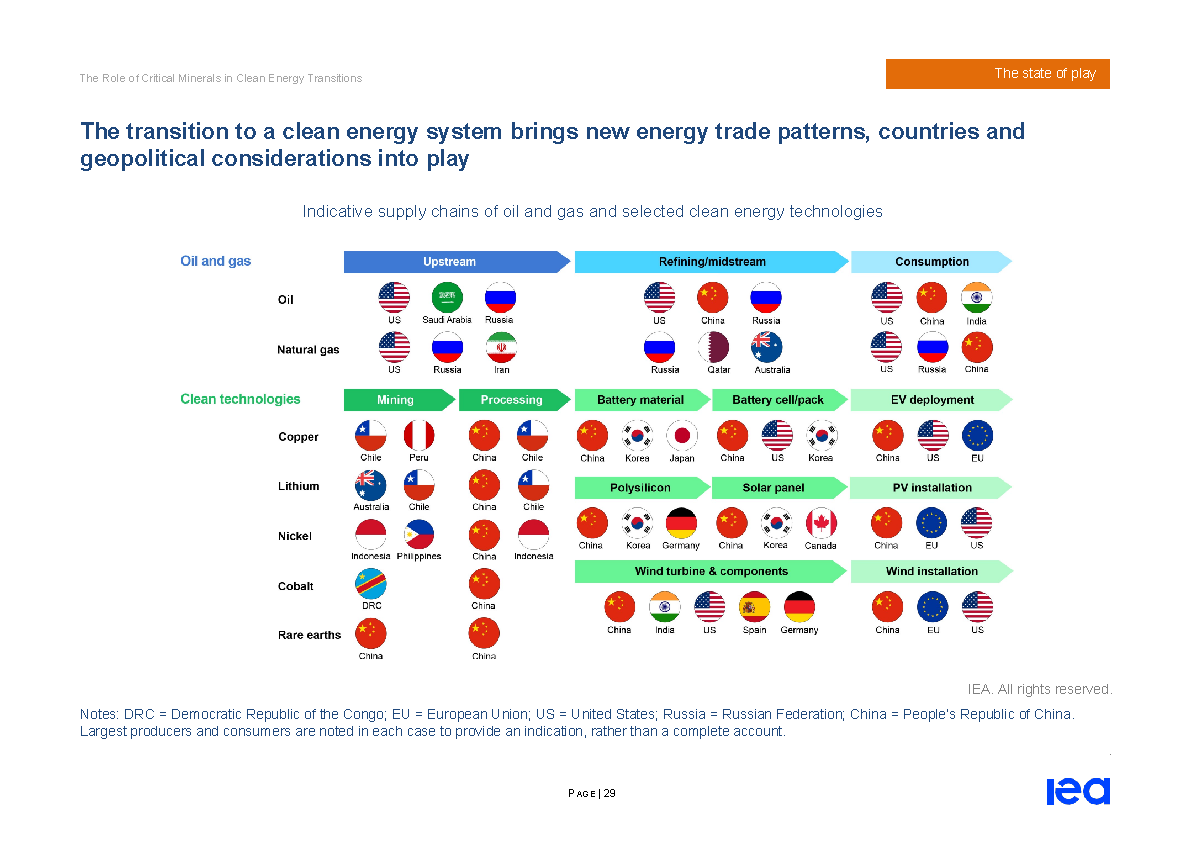
    But as Figure 1 shows, the current energy transition involves more veto players—key among them China. As a result, the EU is forced to reassess its relationship with Africa and Latin America, where substantial reserves of base metals, lithium, cobalt, and platinum are located. Nickel—a major metal needed for the construction of bigger wind turbines, EV cars, and solar panels—is concentrated in the Philippines and Indonesia. Consequently, some strategic repositioning is required for the EU to secure future minerals for green technology.

    Of all the strategic considerations, a growing dependence on China remains the most important. As Table 1 and Figure 1 illustrate, China not only holds the most extensive rare earth reserves, it also exercises control over REE production and processing. China’s share of global production of other key metals—Graphite, Magnesium, Tungsten, Vanadium—further reveals the EU’s dependence. Moreover, recent waves of resource nationalization have suggested that emerging markets are willing and able to bargain for better terms of trade and investment.

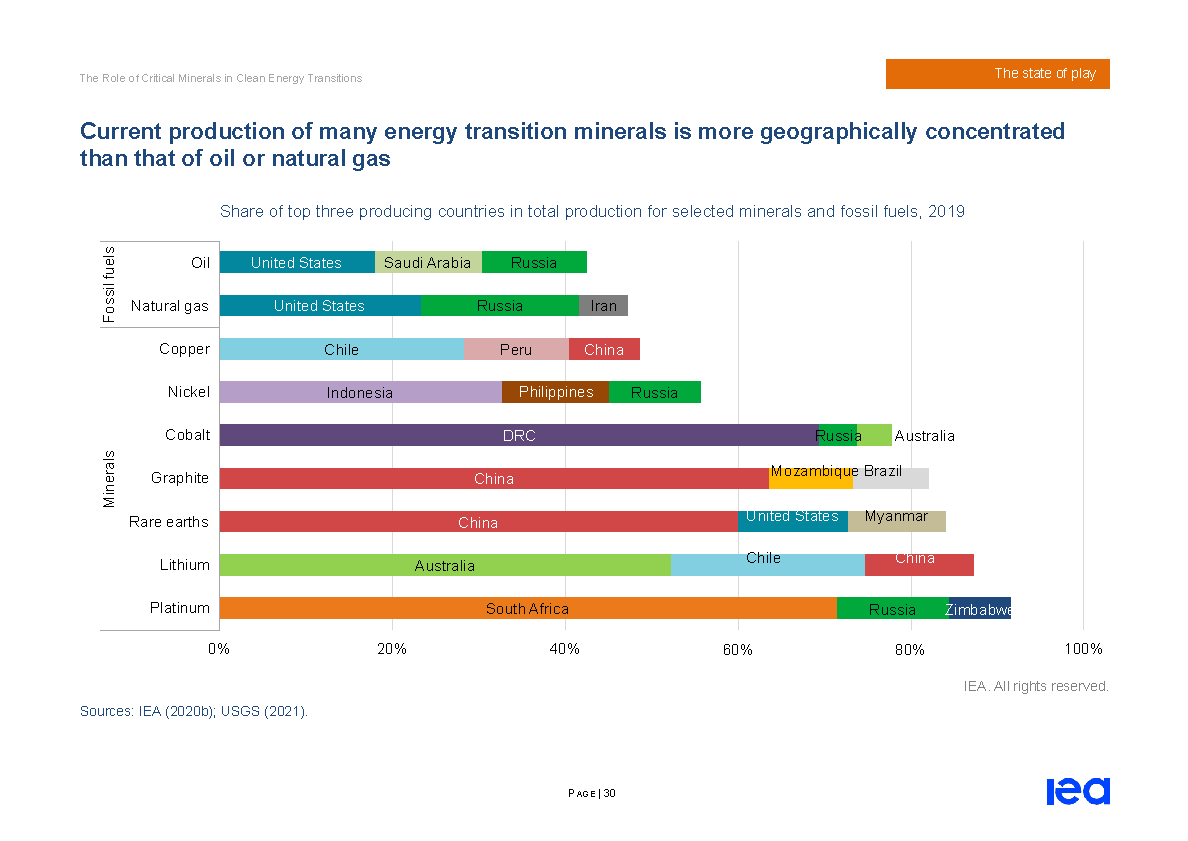
    The EU’s CRM scarcity is an indicator of its potential vulnerability. This is compounded by the concentration of energy-transition minerals. For cobalt, lithium, and REEs, the top three producing countries control about three-quarters of current global outputs. The costs of extracting transition minerals have also increased in response to environmental pressures. For example, Chilean copper ore quality has declined by 30 percent over the past fifteen years. These trends place significant pressures on the EU’s response. Its Strategic Foresight Report recognizes the need to address the redistribution of global power as the geo-economic center of gravity moves definitively eastwards. Consequently, the EU is charting its path to coping with increased competition for resources and rivalry for influence from emerging economies.

    Perhaps unsurprisingly, EU strategy thus appears to be a defense of the current world order. In the past, European powers defended international trade under the guise of comparative advantage. Agricultural and mineral production in developing countries were taken for granted; African and Latin American states were expected to sustain mineral production for the world economy while industrialized countries would sell their manufactured goods. The recently concluded EIT Raw Materials Conference in Brussels in November 2021 reflects a similar free-trade logic. The Commission clearly articulated their intention to promote multilateralism, open access to world markets, and economic globalization. The panel on EU-Africa relations, for instance, emphasized the need to promote “European values” as a public good that African leaders might choose over China’s debt diplomacy. The report cogently captures this:

    Openness, as well as rules-based international and multilateral cooperation, are strategic choices…The history of the European project demonstrates the benefits of well-managed interdependence and open strategic autonomy based on shared values, cohesion, strong multilateral governance and rules-based cooperation [emphasis added].

    But the benefits of the open-market strategy for the Global South are dubious at best. As dependency theorists have argued since the 1960s, trade with global hegemons has often denied policy space for countries in the Global South to transcend their role as primary-commodity producers. Accordingly, commodity exporters are likely to lose against manufacturing based economies due to the price difference of their products in international trade.

    As one of my interviewees suggests, the EU’s lack of knowledge regarding the minerals in its own borders is a direct reflection of its colonial past. Reluctant to embrace mineral production in their own territories, European governments have leveraged the language of comparative advantage to place the responsibility of mineral production on the shoulders of poor, resource-rich countries. The EU’s current framework similarly seeks to justify extractive relationships with world markets through a liberal language. In the 2021 State of the Union Speech, President Ursula von der Leyen presented the bloc’s EU-Indo-Pacific strategy as a preventative measure against the influence of autocratic regimes. The EU Global Gateway—its answer to China’s Belt and Road Initiative (BRI)—emphasized the importance of European values:

    We want investments in quality infrastructure, connecting goods, people and services around the world. We will take a values-based approach, offering transparency and good governance to our partners…We want to create links and not dependencies! [emphasis added].”

    To seriously engage with the historical legacy of colonialism, the EU’s future cooperation and infrastructure strategy must recognize Europe’s historical responsibility for the lack of industrialization in the developing world. This would legitimate demands for more value added from resource-rich states. Crucially, it might help correct the colonial logic of extraction that is deep-seated and widely embedded in European institutions and public debates. If anything, the current shift eastwards could tame the intrinsically Eurocentric perspective dominant in mainstream social sciences.

    Critical minerals: Curse or blessing?

    Resource producers in Africa, Latin America, and Southeast Asia are well-positioned to take advantage of soaring demand for CRMs. For instance, Mongolia, the Philippines, and Indonesia hold significant nickel and copper reserves which can complement the contribution of Latin American producers like Bolivia, Peru, and Chile. The danger lies in the political and economic dynamics of resource dependence. Scholars of the “resource curse” have argued that increased reliance on natural resources for exports and revenues yields slower economic growth, higher propensity for corruption and rent-seeking, and increased likelihood of political violence. 2Beblawi, Hazem, and Giacomo Luciani, eds. 2016. (<)em(>)The Rentier State(<)/em(>). London and New York: Routledge.; Collier, Paul, and Anke Hoeffler. 2004. ‘Greed and Grievance in Civil War’. (<)em(>)Oxford Economic Papers(<)/em(>), no. 56: 563–95. Though its theoretical and methodological assumptions have come under scrutiny,3Di John, Jonathan. 2011. ‘Is There Really a Resource Curse? A Critical Survey of Theory and Evidence’. (<)em(>)Global Governance(<)/em(>) 17 (2): 167–84.; Di John, Jonathan. 2014. ‘The Political Economy of Industrial Policy in Venezuela’. In (<)em(>)Venezuela Before Châvez: Anatomy of an Economic Collapse(<)/em(>), edited by Ricardo Hausmann and Francisco Rodríguez, 321–70. University Park: Pennsylvania State University Press. the resource curse continues to persuade donor agencies who associate corruption, economic mismanagement and predatory behavior with resource-rich national governments. 

    Unable to develop indigenous technology, build inter-sectoral linkages, or mitigate the social conflicts arising from unchecked resource exploitation, resource-rich countries also suffer from commodity specialization. Some have attributed this development malaise to the detrimental effects of external linkages with advanced industrialized countries: as long as resource producers remain commodity exporters, there are very few incentives to promote export diversification and to craft ambitious industrial plans that would break the cycle of extractivist growth. 4Burchardt, Hans-Jürgen, and Kristina Dietz. 2014. ‘(Neo-)Extractivism – A New Challenge for Development Theory from Latin America’. (<)em(>)Third World Quarterly(<)/em(>) 35 (3): 468–86.; Veltmeyer, Henry. 2013. ‘The Political Economy of Natural Resource Extraction: A New Model or Extractive Imperialism?’ (<)em(>)Canadian Journal of Development Studies / Revue Canadienne d’études Du Développement(<)/em(>) 34 (1): 79–95. The historical legacy of extractive-led growth heavily weighs upon the politics, institutions, and interests of these countries. 5Thorpe, Rosemary, Stefania Battistelli, Yvan Guichaoua, José Carlos Orihuela, and Maritza Paredes. 2012. (<)em(>)The Developmental Challenges of Mining and Oil: Lessons from Africa and Latin America(<)/em(>). Basingstoke: Palgrave Macmillan.

    Nevertheless, there are important advantages to mining-based development. First, demands for base metals like nickel, copper, and iron are expected to steadily increase, granting governments time to protect their economies from cyclical boom and busts, design financial infrastructures which maximize mineral rents, and direct investment towards communities at the frontiers of extraction who face its grave socio-ecological consequences. Despite the preponderance of weak states in the Global South, there are notable examples of institutional innovation. For example, Peru has implemented comprehensive mining reforms which better distribute revenue between central and regional governments, alleviating the distributional pressures and socio-environmental consequences of localized resource curse.6Gustafsson, Maria-Therese, and Martin Scurrah. 2019. ‘Strengthening Subnational Institutions for Sustainable Development in Resource-Rich States: Decentralized Land-Use Planning in Peru’. (<)em(>)World Development(<)/em(>) 119 (July): 133–44.; Orihuela, José Carlos. 2018. ‘Institutions and Place: Bringing Context Back into the Study of the Resource Curse’. (<)em(>)Journal of Institutional Economics(<)/em(>) 14 (1): 157–80. Brazil, with its long history of institution-building, was able to promote renewable energy, impose flexible local content requirements to support domestic industrialists, and establish strict environmental licensing procedures in the oil and gas sectors.7Hochstetler, Kathryn, and Genia Kostka. 2015. ‘Wind and Solar Power in Brazil and China: Interests, State–Business Relations, and Policy Outcomes’. (<)em(>)Global Environmental Politics(<)/em(>) 15 (3): 74–94.; Massi, Eliza, and Jewellord Nem Singh. 2018. ‘Industrial Policy and State-Making: Brazil’s Attempt at Oil-Based Industrial Development’. (<)em(>)Third World Quarterly(<)/em(>) 39 (6): 1133–50.

    Second, there is evidence for the success of the so-called ‘resource-based industrialization’ strategy. Brazil’s Petrobras, Norway’s Statoil, and Venezuela’s PDVSA prior to Chavez demonstrated how state enterprises can be utilized to achieve the ‘big push’, natural resources-intensive industrialization. Their emphasis was on developing indigenous technology to create a niche market and to obtain access to downstream networks of consumers, thereby, creating vertically integrated firms capable of competing against international oil companies.  

    Mineral states can pursue resource-based industrialization by promoting industrial policies aimed at processing critical minerals within their domestic markets. Indonesia’s ban on exporting raw nickel and its forcing of international companies to refine and process mineral ores inside the country is one example. Another method has been the strategic deployment of state-owned enterprises (SOEs) in managing natural resource assets—a policy often adopted by countries with limited production capacity. In the best possible conditions, states might also encourage domestic companies to directly compete with international mining companies in the exploration and production stages, as in the example of Brazil’s national oil company Petrobras and regional SOE Codemge. However, this approach requires sophisticated industrial strategies that only countries with sufficient planning and coordination capabilities can implement. Irrespective of the policy choice, the fundamental logic remains: mining is a high-risk industry, requiring enormous capital investments and regularly subject to market failures. States, taking a developmental longer-term horizon, must accept these risks to promote sectoral development.

  3. Leapfrog Logistics

    Comments Off on Leapfrog Logistics

    In Spring 2018, two significant labor disputes broke out at opposite ends of the earth. The first, in Brazil, was an 11 day mass strike of 400,000 truckers in response to successive price increases unleashed by the state oil company, Petrobras, liberalizing diesel prices. The second, in China, was a large strike which spread across the nation in response to low fees paid by digital trucking platforms, which account for a growing share of China’s road freight market. 

    Neither action concluded in decisive victory. Brazilian truckers won temporary diesel price reductions and minimum transport fees, while China is belatedly witnessing regulatory and trade union organizing moves in the trucking sector. But these two incidents—amongst the largest labor actions in the logistics sector in recent years—highlight the increasing importance of labor struggles in sectors associated with commodity distribution. The disputes also call attention to two crucial features of the contemporary global economy: the reliance on logistical planning required to facilitate spatially fragmented production, and the use of digital platforms to mediate socioeconomic life. 

    The growing economic significance of infrastructures and logistics, on the one hand, and digital platforms on the other, are increasingly interdependent trends. Since the logistics revolution of the 1970s, highways, ports, road networks, utility systems and advanced logistical mapping and forecasting have become central to securing the huge volumes of commodities flowing through the global economy—especially as production processes have fragmented and trade in parts and components has expanded.1See Danyluk, Martin. “Capital’s Logistical Fix: Accumulation, Globalization, and the Survival of Capitalism.” (<)em(>)Environment and Planning D: Society and Space(<)/em(>) 36, no. 4 (August 2018): 630–47; and Cowen, Deborah (2014): (<)em(>)The Deadly Life of Logistics(<)/em(>). Minnesota University Press. Global shipping volumes doubled from 5,984 million tons in 2000 to 11,071 million tons in 2019.2UNCTAD, “(<)a href='https://unctad.org/system/files/official-document/rmt2021_en_0.pdf' target='_blank' rel='noreferrer noopener'(>)Review of Maritime Transport(<)/a(>).” 2021. Moreover, digital platform firms increasingly control physical logistics infrastructure, by taking ownership of cloud computing and data centers, internet cabling, telecoms networks, transport systems and satellites. 

    Advances in digitalization and platformization enable technological leapfrogging in the logistics sectors of large Global South economies. The road freight industry has traditionally been dominated by owner-drivers and small-scale informal operators, which together made up 70 percent of fleets in 2009.3 DFID, “(<)a href='https://documents1.worldbank.org/curated/ar/649241468155983939/pdf/579680WP0road0Box353787B01PUBLIC1.pdf' target='_blank' rel='noreferrer noopener'(>)Freight Transport for Development Toolkit(<)/a(>).” 2009. These small-scale operators often drive older vehicles that carry less weight per truck than the new, larger trucks operated by transport companies. Unlike ports, waterways and railways, trucking is one of the most labor-intensive parts of the global logistics sector, employing tens of millions of workers worldwide. 

    A dramatic rise in tonne-kilometres of freight moved by road during the past decade4 International Transport Forum, “(<)a href='https://www.itf-oecd.org/sites/default/files/docs/pre-covid-19-sea-road-freight-growth.pdf' target='_blank' rel='noreferrer noopener'(>)Statistics Brief(<)/a(>).” 2020. has precipitated the rise of digital trucking platforms across the Global South. Often nationally based firms, these trucking platforms consolidate markets, drive cost efficiencies, enhance information flows,5 Sergey Evgenievich Barykin & Irina Vasilievna Kapustina & Elena Viktorovna Korchagina & Sergey Mikhailovich Sergeev & Vladimir Konstantinovich Yadykin & Almakul Abdimomynova & Diana Stepanova, 2021. “(<)strong(>)(<)a href='https://ideas.repec.org/a/gam/jsusta/v13y2021i20p11228-d654101.html' target='_blank' rel='noreferrer noopener'(>)Digital Logistics Platforms in the BRICS Countries: Comparative Analysis and Development Prospects(<)/a(>)(<)/strong(>),” (<)a href='https://ideas.repec.org/s/gam/jsusta.html'(>)Sustainability(<)/a(>), MDPI, vol. 13(20), pages 1-19, October. discipline labor, and centralize investment capital in a sector traditionally dominated by petty capital. Given the global slowdown in productivity growth and profit rates,6Mark Schwartz, Herman. “(<)a href='https://www.phenomenalworld.org/analysis/manufacturing-stagnation/' target='_blank' rel='noreferrer noopener'(>)Manufacturing Stagnation(<)/a(>)(<)em(>).(<)/em(>)” Phenomenal World, 2021. and the challenges for catch-up development in the context of global value chains,7Jostein Hauge (2021): “Manufacturing-led development in the digital age: how power trumps technology,” (<)em(>)Third World Quarter(<)/em(>). cutting costs in logistics is one alternative means for Global South economies to enhance competitiveness. In the long-run, this may entail a shift towards more rail- and water-based transport. In the short- to medium-term, though, digital platforms enable a coordination of older and more labor-intensive modes of logistics like trucking in a more efficient and transparent way. As a result, the penetration of digital platforms into logistics provides an approach to improving the competitive position of individual producers, economic sectors, and national economies.

    Brazil and China constitute two of the world’s largest logistics markets. Both experienced booms in road-based infrastructure investment during the past two decades.8da Rocha, F.V. and Saes, M.S.M. (2018), “Private investment in transportation infrastructure in Brazil: the effects of state action,” (<)em(>)Revista de Gestão(<)/em(>), Vol. 25 No. 2, pp. 228-239.; Zhigang Li, Mingqin Wu, Bin R. Chen, “Is road infrastructure investment in China excessive? Evidence from productivity of firms,” (<)em(>)Regional Science and Urban Economics(<)/em(>), Volume 65, 2017, Pages 116-126. And in their road freight sectors, digitalization has advanced far more quickly than in the Global North, as platforms have come to play an increasingly critical role in transport infrastructure. This may present economic opportunities—for instance, despite lower costs for soy production, Brazilian agribusiness currently suffers from higher costs for logistics due to expensive and inefficient road freight transport. Through rationalization, investment, and downward pressure on wages, platforms could ameliorate this situation. Similarly, in China, more efficient logistics systems may compensate in part for the rising wages of factory workers. A closer look at the digital trucking platforms operating in Brazil and China thus provides a lens through which to observe the transformations that the platformization of logistics may deliver in large economies of the Global South more broadly. These upper middle income economies have been able to leap to the technological frontier: trucking platforms are now restructuring road freight markets, and in the process, they are impacting the working lives of millions of truck drivers.

    Digital freight platforms in Brazil

    Traditionally, the Brazilian trucking sector consists largely of self-employed drivers. Since regulations prevent these drivers from closing freight contracts with shippers, many transport companies hire a small number of formally employed drivers in addition to self-employed truckers who are often disguised wage workers. Official statistics indicate the existence of 546,499 self-employed drivers and 344,231 formally employed drivers in Brazil.9 Confederacao Nacional do Transporte, “(<)a href='https://cdn.cnt.org.br/diretorioVirtualPrd/01e693b9-0b9e-4722-8af8-b13d9660aacd.pdf' target='_blank' rel='noreferrer noopener'(>)Conjuntura do Transporte(<)/a(>).” 2019. But media reports estimate a total number of 1.5 million truck drivers in Brazil—implying an additional 600,000 informal, unregistered drivers. 

    The general characteristics of the industry, and the grievances of truckers (low freight prices and high diesel prices) have not changed much since the 1970s. But the conditions of self-employed truckers have deteriorated since 2014, when Brazil entered an economic crisis that persists to the present. From 2010 on, the Brazilian government facilitated the purchase of new trucks, and the number of truckers started to grow faster than GDP growth. When the economic crisis hit in 2014, transport volumes decreased, but the number of truckers remained constant due to a lack of alternatives on the labor market. With the excess labor in the sector, drivers are not able to obtain higher freight prices whilst the costs for vehicle repair, tires and diesel increase.

    In Brazil, freight transport accounts for 65 percent of all commodity transport, against an average of 30 percent in developed countries, and 42 percent across the Global South. Rail transport carries just 15 percent of all commodities in the country, compared to an average of 40 percent in the Global North and South. The high proportion of road freight transport drives up the costs for commodity producers in Brazil, since buyers pay for the transport price from the port of shipping. Road freight transport is more expensive than other modes once it exceeds 100 kilometers of distance, and due to overcrowded and low-quality roads in Brazil, it is the cause of slower transport times. About 40 percent of road freight trucking in Brazil is for agribusiness: the largest single commodity transported in Brazilian road freight transport is fertilizer, followed by soy.

    The Brazilian road freight transport market has an overall annual turnover of 160 billion real per year (numbers for 2020), of which digital platforms are intermediating a rapidly growing share. App-based trucking started in Brazil in the mid-2000s, but the Covid-19 pandemic ushered in the explosive growth of trucking apps. The CEO of a major platform, Cargo X (whose board members overlap with those of Uber), reported a 75 percent growth in turnover for 202010 Verotti, Angelo. “(<)a href='https://www.istoedinheiro.com.br/um-pe-no-acelerador-outro-no-crescimento' target='_blank' rel='noreferrer noopener'(>)Um pé no acelerador, outro no crescimento(<)/a(>),” (<)em(>)Istoe Dinheiro(<)/em(>), 2021. while FreteBras, a competitor, reported a 62 percent growth in terms of cargo volumes in 202011 Ramos, Andreas: “(<)a href='https://estradao.estadao.com.br/caminhoes/volume-de-carga-transportada-pela-fretebras-cresceu-62-em-2020/' target='_blank' rel='noreferrer noopener'(>)Volume de carga transportada pela FreteBras cresceu 62% em 2020(<)/a(>).” (<)em(>)Estradao(<)/em(>), 2021.. The Fretebras platform now dominates the market with 50 billion real of freight shipped over the platform in 2020, and estimates are that 2021 will see a volume of 80 billion real. Cargo X, meanwhile, claimed that in 2020 their total turnover was around 875 million real. Financial newspaper Valor Econômico estimates that Fretebras covers 80 percent of the market of trucking apps, and competitor Truckpad, one of the first such platforms which came online in 2013, controls a further 10 percent.12 Presinott, Fernanda: “(<)a href='https://valor.globo.com/agronegocios/noticia/2021/06/15/grandes-tradings-criam-empresa-de-frete.ghtml' target='_blank' rel='noreferrer noopener'(>)Grandes Tradings Criam Empresa de Frete(<)/a(>).” (<)em(>)Economico Valor(<)/em(>), 2021. This means that in 2020 all trucking apps combined mediated about half of all road freight transactions, perhaps the largest share among countries with large logistics markets, and far ahead of advanced economies like the United States and Europe.

    Foreign and local players continue to enter the market. The Chinese platform Manbang Group, known internationally as Full Truck Alliance, invested an unknown amount of capital in TruckPad at the end of 2019. Among the new entrants are the large agrotrading companies which are mostly represented by non-Brazilian transnational capital. Recently, they have launched their own apps: US-based multinational Bunge launched the platform Vector in 2020 in a joint venture with the Argentinian logistics operator Target, and Chinese state-owned agrotrading company Cofco is set to join the enterprise.13 Lopes, Fernando: “(<)a href='https://valor.globo.com/agronegocios/noticia/2021/05/06/aplicativo-de-fretes-da-bunge-cresce-e-se-torna-uma-empresa.ghtml' target='_blank' rel='noreferrer noopener'(>)Aplicativo de Fretes da Bunge Cresce e se torna Uma Empresa(<)/a(>).” (<)em(>)Economico Valor(<)/em(>), 2021. On the other hand, four more large agricultural traders, Amaggi, Louis Dreyfus, Cargill, and ADM joined to integrate their logistics data into the trucking app Carguero in 2019, which mediated 2 billion Real in freight in 2020, and is still running as a pilot project awaiting a full launch.

    In November 2021, FreteBras merged with Cargo X to form the new company Frete.com. It received $220 million in investment, primarily from Japanese Softbank Latin Fund and Chinese tech giant TenCent. Brazilian investment bank BTG Pactual and former Florida Governor Jeb Bush were also counted among the contributors. The merger integrates FretBras’s unparalleled user numbers and Cargo X’s deep knowledge of digitalization services. The latter’s key advantage is its algorithmic price setting system, which was difficult to adapt for the freight market, where long unloading times delay payment. Thanks to this merger, more sophisticated Uber-style models for the trucking industry are likely to emerge.

    The rapid advance of Brazil’s digital freight platforms can be explained by the possibilities for leapfrog development enabled by the informal, undercapitalized, and poorly organized nature of the sector. Self-employed truckers represent more than half of the 1.5 million strong trucking workforce, which currently resents the long waiting times and burdensome paperwork. Existing intermediaries also cut into truck driver earnings by collecting 20 to 40 percent of freight prices. Normally, they pay truckers 80 percent of the freight price in advance, and 20 percent upon completion, though this latter portion is frequently unpaid. Before the arrival of trucking platforms, obtaining a freight contract for a self-employed driver typically required waiting anywhere from several hours to several days at the office of an intermediary or a transport company to pick up an order, and then completing more than twenty official forms.

    Apps address some of these issues by displaying demand for jobs in real time. However, there are limits to the platform-based rationalization of Brazil’s freight industry. Most of the country’s freight platforms, including Fretebras, do not set prices, and instead function as bidding marketplaces. Those most often bidding are rarely shippers—instead, they remain the same intermediary transport companies which dominate the non-platform trucking sector. This is because most shippers demand a service package not yet offered by platforms, including functions like insurance, tracking, and planning of routes. As intermediary transport companies increasingly rely on platforms to hire self-employed truckers, they also reduce their formally employed workforce. Fretebras openly advertises that it is 23 percent cheaper to hire self-employed truckers via their platform than to directly employ them. Rising platform usage thus seems likely to lead to a further reduction in the share of formally employed truckers, undermining any progression towards formal employment relations.

    Should this trend hold, it will carry signifiant consequences for the broader labor market. Unlike other platform-based work, trucking is the primary occupation and long-term profession for most self-employed Brazilian truckers. While platforms reduce some pecuniary and time costs for truckers, they also place different segments of the labor market into direct competition with one another. For instance, many truckers operate in specific regions or on specific routes, since they do not want to spend too much time away from home. But enhanced access to information platforms motivates some truckers to alter their routes or expand their field of operations, thus altering the supply of labor in different regions. Freight transport prices in Brazil remained more or less flat during 2021 while diesel prices rose 40 percent, with the effect of an enormous drop in real earnings of self-employed truckers. As in earlier years, self-employed truckers lack the power to demand higher prices from transport companies, and therefore any inflation in inputs cuts into their earnings. Until now, platforms have failed to limit truckers’ vulnerability to the increasing cost of inputs like tires, car parts, and fuel.

    Brazil has seen little in the way of institutional responses to the digitalization of road freight. A simplified electronic transport document, DT-e, was approved by the government in September 2021 and is awaiting implementation. Once fully implemented, DT-e has the potential to eliminate functions currently conducted by transport companies (which act as intermediaries) as well as reduce the relevance of platforms. This is because DT-e would allow truckers’ associations and trade unions to assume intermediary functions and legal responsibility for transport. Whether this poses a major challenge to platform business models remains to be seen. One result of the truckers’ strike in 2018 was the establishment of legally defined minimum freight prices. Despite patchy implementation, employers’ organizations successfully mobilized the Supreme Court to rule on the minimum prices; fees in violation of those prices have been suspended since 2020. The Supreme Court is dragging its feet on the issue since it is neither motivated to confront truckers nor employers. 

    The growth of online truck-hailing in China

    China is the world’s largest employer of truckers by some margin, with around 15 million road freight trucks and about 30 million truck drivers.14Research Center at Chuanhua. “Research report on Chinese truck drivers (No.1): Group characteristics and labor process of truck drivers.” 2018. Most truck drivers are self-employed and work on a freelance basis. Most of them also own their own vehicles, often financed with heavy debts. To take more orders and pay off debts, drivers are constantly on the road, living, eating and sleeping in their trucks. Like in Brazil, significant rigidities and bureaucratization have made working life difficult for truckers. The traditional way for them to secure jobs is to physically attend information stations in local logistics parks, where they pay an information service fee, obtain order information, and bargain over prices. 

    The rapid development of internet technology and huge flows of capital into the sector in the mid-2010s initiated the platformization of road freight operations in China. In 2017, a watershed moment in this process took place: the merger of the two largest players in the online truck-hailing sector, Yunmanman and Truck Alliance founded the largest truck-hailing platform in China, the Manbang Group. Amongst Manbang’s biggest backers are global private equity and funds like Softbank and Sequoia Capital, alongside Chinese funds like Tencent Holdings and Yunfeng Capital. Manbang platforms match truck drivers with shippers directly to improve freight efficiency and reduce empty loads. In 2020, the firm listed on the New York Stock Exchange and was valued at US$21 billion. It claims to have gained RMB 173.8 billion (US$26.6 billion) in gross transaction value, accounting for 64 percent of market share of the GTV of the Chinese digital freight platforms, and fulfilled over 2.8 million truck shipping orders over the previous 12 months.15 Full Truck Alliance, “(<)a href='https://ir.fulltruckalliance.com/Company-Profile' target='_blank' rel='noreferrer noopener'(>)Company Profile(<)/a(>).”

    New business models have also emerged with the growth of platforms. The platform For-U Smart Freight, established in 2015, provides end-to-end fully digitalized services, including pricing and order placing, dispatching, and transportation. It focuses on the full truckload (FTL) market, instead of the less-than-truckload (LTL) market. Its main shippers are large enterprise shippers, such as Deppon logistics, JD logistics, and SF Express. Some other platform companies, such as LaHuoBao and Kuaicheng, are targeted at particular goods classifications, such as hazardous chemicals and coal.

    In contrast to the For-U Smart Freight company, Manbang’s platforms are more popular among gig drivers and small to medium enterprises. Among 2055 drivers surveyed in 201916 Research center at Chuanhua. “Research report on Chinese truck drivers (No.3): logistics enterprises, freight handlers and female truck drivers,” 2019., more than 90 percent claimed that they have used the platforms alongside apps like Yunmanman and Truck Alliance. About 38 percent of drivers used these platforms to get more than one-third of their orders. The platformization of road freight relieves information asymmetry and breaks down some geographical constraints on information: drivers are able to access the order information more easily in broader areas or even across provinces, and there is no longer a need to physically attend local information stations for hours or days at a time to pick up jobs. Truckers can also avoid carrying empty loads on return trips. 

    But due to the predominance of Manbang in the truck-hailing sector, platforms also have established growing rule-setting power. At the early stage, platforms provided a free matching service and allowed drivers and shippers to negotiate prices. Eventually, however, platforms introduced fee schemes for both drivers and shippers. In June 2018, they initiated a policy that prevents truck drivers and shippers from contacting each other to ensure transactions and prices rates were set exclusively via the apps. Platforms also restricted price negotiations through automated pricing. The resulting squeezed profits, combined with rising fuel costs and arbitrary fines, instigated the strike wave of 2018.17Jiangying, Tan. “(<)a href='https://chinachange.org/2018/06/15/truckers-on-strike-and-the-structural-contradictions-of-chinas-logistics-industry/' target='_blank' rel='noreferrer noopener'(>)Truckers on Strike and the Structural Contradictions of China’s Logistics Industry(<)/a(>).” (<)em(>)China Change(<)/em(>), 2018..

    Through referral schemes, bonuses, and zero-down payment truck loans, platforms incentivize market expansion. But while they offer benefits, these incentives also burden new drivers with heavy debts. In order to pay off the monthly mortgage, drivers often need to take more orders at extremely low prices and work longer hours. As a result, drivers bid against each other, lowering prices in a vicious race to the bottom. Interviewed drivers claimed that the prices have been reduced by as much as 30 to 50 percent in the last five years. One driver warned, “for those who just entered this sector and need to pay the monthly mortgage to get a truck, I would strongly recommend they go back to factories and make screws. There is no space to survive in this sector now.”

    Social and policy responses to the platformization of critical logistics infrastructure are more evident in the Chinese case. Informal networks of workers are growing. WeChat channels are widely used among drivers to share information on pricing and pay and publicize negative experiences such as arbitrary decommissioning, often with powerful effects. And the state has increasingly played a larger role, scrutinizing labor conditions in the gig economy. In January of 2022, Manbang and three other road freight platforms (Huolala, Didi Freight, Kaigou) were interviewed by the Ministry of Transport regarding concerns over the arbitrary power over pricing system, increased membership fees, low-price spiral, and illegal transportation of oversized and overloaded vehicles.18Hongyang, Li. “(<)a href='https://www.chinadaily.com.cn/a/202201/23/WS61eb70a6a310cdd39bc8297a.html'(>)Cargo service platforms urged to protect drivers(<)/a(>),” China Daily. January 2022.. The All-China Federation of Trade Unions (ACFTU) has also attempted new ways of organizing such workers. Since October 2021, truck drivers in Anhui Province can join the trade union by registering on an app which provides a range of services for truck drivers (such as communication, insurances etc.) 19 CNR News. “(<)a href='http://www.cnr.cn/ah/ygkx/20211020/t20211020_525637823.shtml' target='_blank' rel='noreferrer noopener'(>)Coordinating trade union with platform: truck drivers in Anhui province joined trade union via online platform(<)/a(>),” October 2021. Whether these measures will  have any material effect on drivers’ conditions and wages remains to be seen. Finally, as part of the broader crackdown on the tech sector in the summer of 2021, the Chinese Cybersecurity Review Office launched an investigation into the data security of Manbang. During the investigation, the apps were taken offline and limited to existing users.

    Infrastructure platformization and the global economy 

    While China is now at the technological forefront of platform logistics, even Brazil’s less technologically advanced bidding apps outstrip technologies deployed in Europe and North America. While the logistics revolution of the 1970s primarily shaped the Global North, trucking apps allow us to study the contemporary leapfrogging of digital logistics in the Global South. Plagued by underinvestment and fragmentation, dominated by intermediaries, and largely shielded from the competitive pressures of the global economy, the trucking industry of the late-twentieth and early twenty-first century promoted business practices that largely harmed workers through long waiting times, dense bureaucracies, and high fees. But despite the efficiency gains they offer, digital trucking platforms intensify labor discipline for drivers who are increasingly working in “sweatshops on wheels.”20Michael Belzer, (<)em(>)Sweatshops on Wheels: Winners and Losers in Trucking Deregulation(<)/em(>). (Oxford University Press, 2000.) 

    Unlike the already flexible logistics labor markets of the Global North,21Viscelli, S. (2016). (<)em(>)The Big Rig: Trucking and the Decline of the American Dream(<)/em(>). (University of California Press, 2016.) rigidities and inefficiencies in Global South logistics present outsized productivity and profitability rewards for platforms able to engage in leapfrog development, using technology to consolidate the market, integrate services, and eliminate barriers to circulation. This mirrors other forms of digital Taylorism sweeping service sectors in the Global South, as work in sectors like parcel and food delivery, ridehailing, and even white collar internet work is subjected to intense datafication, performance management, and control-by-algorithm.22Huang, Hui. “Algorithmic management in food-delivery platform economy in China,” (<)em(>)New Technology, Work, and Employment(<)/em(>), January 2022; Abilio, Ludmila Costhek, Rafael Grohmann, and Henrique Chevrand Weiss. “Struggles of Delivery Workers in Brazil: Working Conditions and Collective Organization during the Pandemic,” (<)em(>)Journal of Labor and Society(<)/em(>) 24, 4 (2021): 598-616; Henrique Amorim and Felipe Moda. “Work by app: algorithmic management and working conditions of Uber drivers in Brazil,” (<)em(>)Work Organisation, Labour & Globalisation(<)/em(>) Vol. 14(1):101-118; Liu, Hong Yu. “Digital Taylorism in China’s e-Commerce Industry: A Case Study of Internet Professionals,” (<)em(>)Economic and Industrial Democracy(<)/em(>), February 2022 What is more, these productivity gains—even where platforms demonstrate aspects of rentierism—are likely to accrue to firms across the economy, improving national competitiveness through lowering logistics costs. 

    As on-location platform services increasingly absorb the tasks of critical transport infrastructure, governments will be incentivized to control and regulate these in new ways to guarantee regularity and universality of supply.23Busch, Christoph, “Regulation of Digital Platforms as infrastructures for services of general interest,” September 2021. China demonstrates the possibilities for governments to exercise substantial sovereign and territorial control over digital platforms.24Barry Naughton, “(<)a href='https://www.wsj.com/articles/what-is-behind-china-regulatory-storm-11638372662.' target='_blank' rel='noreferrer noopener'(>)What’s behind China’s Regulatory Storm(<)/a(>)?”(<)em(>)Wall Street Journal(<)/em(>), December 2021. But the emergence of Brazilian firms at the technological frontier further demonstrate the possibilities for national varieties of digital platforms to emerge in the Global South. These firms can flourish even in an economy like Brazil’s, historically controlled by a comprador bourgeoisie. These new digital national champions signify a deepening techno-economic multipolarity, generalizing the gains, contradictions, and agonies of rapid capitalist development across the continental-scale economies of the Global South.

  4. Farmland Assets

    Comments Off on Farmland Assets

    The election of Jair Bolsonaro in 2018 commenced a long agenda of environmental destruction in Brazil. Before taking office, Bolsonaro had openly threatened Indigenous communities with racist attacks, commenting that Indigenous peoples should not have “an inch of land” and that “Indians in reserves are like animals in zoos.”1G1, “(<)a href='https://g1.globo.com/sp/vale-do-paraiba-regiao/noticia/2018/11/30/indios-em-reservas-sao-como-animais-em-zoologicos-diz-bolsonaro.ghtml?fbclid=IwAR3O0FjxaZQpv99a5wC7Nl-HHmBIyjwBy7h9nbd2DGMJifg6_16LoyWL0Ms'(>)Índios em reservas são como animais em zoológicos, diz Bolsonaro(<)/a(>).” G1 Brasília, November 30, 2018. Targeting the land rights of Indigenous peoples, peasants and quilombolas (rural Afro-Brazilian communities), he articulated a neocolonial agenda to control the land and natural resources of rural communities. 

    Such encroachment on rural communities predates Bolsonaro, and it intersects closely with global crises of climate change and food production. Industrial agriculture has been a driver of climate change,2UNCTAD, (<)a href='https://unctad.org/system/files/official-document/ditcted2012d3_en.pdf'(>)Wake Up Before It is Too Late: Make Agriculture Truly Sustainable Now For Food Security in a Changing Climate(<)/a(>), 2013, p. 4. with chemical inputs destroying local soil and water sources. In Brazil, widespread fires in the Amazon, the Pantanal wetlands, and the Cerrado, the most biodiverse savanna in the world, have been unprecedented in their number and scale in recent years.3Thais Borges and Sue Branford, (<)a href='https://news.mongabay.com/2020/04/rapid-deforestation-of-brazilian-amazon-could-bring-next-pandemic-experts/'(>)“Rapid deforestation of Brazilian Amazon could bring next pandemic: Experts,”(<)/a(>)(<)em(>)Mongabay(<)/em(>), April 15, 2020.

    The expansion of industrial agriculture in Brazil has been an international affair, linking pension funds, university endowments, and major financial actors across the world. After the global financial crisis of 2008, international agribusiness and financial corporations formed alliances with rural oligarchies to operate in the Brazilian farmland market. In recent years, mergers and joint ventures have changed the profile of agribusiness in the country. Land purchases are no longer limited to large-scale Brazilian companies, or even foreign agricultural corporations. Now, financial firms and oil companies have prominent roles in the market as major sources of capital.4Carlos Vinicius Xavier, Fábio T. Pitta and Maria Luisa Mendonça, (<)em(>)(<)a href='https://www.social.org.br/index.php/pub/booklets-english/139-social-and-environmental-impacts-of-sugarcane-production-in-brazil.html'(>)A monopoly in Ethanol Production in Brazil: The Cosan-Shell merger(<)/a(>)(<)/em(>), Rede Social de Justiça e Direitos Humanos, 2011. The entrance of these firms has unleashed new forms of speculation within land markets, with expanded access to credit, and therefore, land purchases. These practices have led to devastating new realities for those living through the changes. 

    Land grabbing in the Cerrado

    The Cerrado, the vast savanna region in the western part of the country, has an area of approximately two million kilometers, representing almost a quarter of Brazil’s territory. Its trees are important sources of underground water, such as the Guarani, Bambuí and Urucuia aquifers, which contribute to the formation of two-thirds of Brazil’s hydrographic regions.5The aquifers contribute to the Amazon (4 percent), Araguaia-Tocantins (71 percent), Western Atlantic and Northeastern Atlantic (11 percent), São Francisco (94 percent), East Atlantic (7 percent), and Paraná and Paraguay (71 percent).

    Central to water and food production, the Cerrado has been a target of an especially predatory form of agricultural real estate speculation. Many of the industrial farms now operating in the chapadas (high plains) were established in areas that were once public lands, making up the homes of peasant, Indigenous, and quilombola communities. Upon moving into these regions, agribusiness corporations take advantage of local operators6Land grabbing or “grilagem” in Portuguese consists of fencing off public land and falsifying land titles. The term comes from the practice of storing counterfeit documents in boxes with crickets (“grilos”). The insects make the falsified documents look old so that they appear to be legitimate. Normally, this strategy involves local rural oligarchies and notary offices. by illegally forging ownership, fencing off the farmland, and displacing local communities. Recent legislation introduced by Bolsonaro aims to further facilitate the privatization of public lands. This process, named land grabbing by local activists, also affects the baixões (lowlands), which also have a long history of housing rural communities.7Fábio T. Pitta, Gerardo Cerdas, and Maria Luisa Mendonça, (<)em(>)(<)a href='https://www.social.org.br/index.php/pub/booklets-english/210-transnational-corporations-and-land-speculation-in-brazil.html'(>)Transnational corporations and land speculation in Brazil(<)/a(>)(<)/em(>), Rede Social de Justiça e Direitos Humanos, 2018.

    Drastic environmental changes have accompanied land grabbing in the region, with major implications for land use. Land previously used to cultivate food crops for local consumption now grows commodities—in many cases, sugarcane for ethanol production and soybean are grown in monocropping plantations. As a resident of a quilombola community in the northeastern Brazilian state of Piauí explained in a Network for Social Justice and Human Rights interview, “We used to live off of fishing and farming. I can still remember the smell of rice when it was being harvested. But now we can no longer grow our crops.”8Interviews with community members affected by land speculation in the states of Piauí and Bahia were conducted by researchers from Rede Social de Justiça e Direitos Humanos (Network for Social Justice and Human Rights, (<)a href='http://www.social.org.br'(>)www.social.org.br(<)/a(>)). For the safety of those interviewed, their names are not disclosed.  

    Water pollution and deforestation are now widespread; the heavy use of pesticides and other chemical inputs sprayed by tractors and airplanes have destroyed local water and food supplies. “The water from the highlands flows down and fills our streams with agro-toxins. The water gets muddy, it stinks. In the river, we see the little fish floating on top of the water, dead. I didn’t see the little fish dead before. When we go fishing now, if we go in the morning, it takes us until noon to catch a little fish. There are no more fish in the river because of the poison,” stated one resident. Deforestation has caused the extinction of endangered species and polluted river springs, affecting biodiversity and rainfall patterns.

    Soybean plantations have destroyed many water sources, leading rivers to dry up across the region. With monocropping extending into forest areas, fires have become more frequent. A resident of the local community described, “We are very concerned with the burnings because the fire destroys all the flora, the pequi flower burns, the cashew burns, it burns the trees that provide food. The fires also cause damage to streams, our streams are no longer filling.” 

    Financialization of farmland

    The devastation in the Cerrado is not simply the result of the outsized presence of domestic agribusiness. The industry’s financial support can be traced to an intricate web of capital flows, connecting funds in New York, London, Germany, and other financial centers in the Global North to Brazil-based firms.

    Beginning in 2002, agribusiness corporations in Brazil started to take advantage of high commodity prices for products such as sugarcane in international markets. Companies began contracting debt in US dollars with the expectation of increasing future exports, and the mills negotiated export contracts in future markets to justify their territorial expansion and mechanization. This inflated the price of agricultural land. At the same time, promises of future production by companies that had previous debts fueled new indebtedness and further territorial expansion. The cycle continued—the strategy of financing existing debts with new funds based on futures markets intensified the scale of industrial agriculture, and therefore the use of natural resources.9Maria Luisa Mendonça, (<)em(>)Economia Política do Agronegócio(<)/em(>) (Sāo Paulo: Annablume, 2018). Brazil is already home to one of the highest concentrations of land ownership in the world—one percent of large landowners control 90 percent of agricultural land—and industrial agriculture has led to even greater concentration of rural property ownership. 

    The global financial crisis of 2008 marked a watershed for agricultural expansion. The price of sugar began to fall along with agriculture commodity prices, and several Brazilian sugarcane companies went bankrupt.10Maria Luisa Mendonça, Fábio T. Pitta, and Carlos Vinicius Xavier, (<)em(>)(<)a href='https://www.social.org.br/index.php/pub/booklets-english/147-the-sugarcane-industry-and-the-global-economic-crisis.html'(>)The Sugarcane Industry and the Global Economic Crisis(<)/a(>)(<)/em(>), Rede Social de Justiça e Direitos Humanos, 2012. While government support for commodities aimed to achieve a positive balance of trade, the fall in commodity prices led to trade deficits. But this drop did not hurt the land market, as some would have expected. Brazilian agricultural companies began to court international markets for access to credit. Land prices continued to rise, attracting the attention of international finance. The flow of financial capital into farmland markets generated speculative bubbles and sharp escalations in land and food prices, with the burdens shifted mostly to rural communities.

    Before 2008, the possibility of a growing global demand for ethanol was used to justify the territorial expansion and monocropping of the sugar-energy industry—sugarcane increasingly replaced local food crops as large corporations took over smaller farms. The global financial crisis, however, led forecasts to change. Ethanol’s economic viability on a large scale depends on market conditions of two major international commodities—sugar and oil—making ethanol function not as a “leading” but a “supporting” commodity in this context.11Ethanol production is only commercially viable if the price of sugar is at a lower rate (since most companies can choose to produce larger amounts of sugar instead of ethanol), and the price of oil is at a higher rate on the market. It is presumed that consumers will not buy ethanol if its cost is more than 70 percent of gasoline’ prices because of the difference in productivity between both fuels. Therefore, ethanol’s commercial viability (<)a href='https://www.cnnbrasil.com.br/business/etanol-ou-gasolina-saiba-qual-combustivel-e-mais-vantajoso-atualmente/'(>)depends on(<)/a(>) these two main commodities, sugar and oil. But given the instability of financial and commodity markets, ethanol was no longer projected to provide energy security in Brazil nor internationally. 

    Despite these consequential market shifts, agribusiness corporations still present themselves as engines of economic development in a commodity-oriented economy. In return, they demand state subsidies for expanding monocropping plantations. The large corporations of the industry commonly measure their contribution to national development by estimating the role of industrial agriculture in Brazilian GDP; they usually place that number between 30 and 40 percent. But this percentage is inflated by the inclusion of “productive chains,” which encompass agrochemical, industrial, commercialization and retail activities, outside of agricultural production itself. The GDP contributions do not consider the various forms of public subsidies, unpaid debt, and other economic, social, and environmental impacts. 

    Over several decades, the agribusiness lobby has continued to receive large amounts of state-subsidized credit12For the harvest period of 2021/2022, the Brazilian government announced its subsidized credit plan, (<)em(>)Plano Safra 2021/2021(<)/em(>), in which $39.34 billion (<)em(>)reais(<)/em(>) (equivalent to about US$8 billion) are allocated to small farmers from a total of $251.22 billion (<)em(>)reais(<)/em(>), while the Brazilian Institute of Geography and Statistics (<)a href='https://www.gov.br/agricultura/pt-br/assuntos/agricultura-familiar/agricultura-familiar-1'(>)(Instituto Brasileiro de Geografia e Estatística – IBGE(<)/a(>)) estimates that small farmers produce approximately 70 percent of food for local markets in the country. to expand plantations in areas with access to infrastructure, vast hydrographic basins, and biodiversity. Even though small farmers produce 70 percent of food for local markets, large agribusiness corporations received the vast majority of approximately US$46 billion in subsidized credit available for farmers in 2021. 

    Even with receiving a steady flow of subsidized credit, the industry has historically generated public debt. Back in 1980, the Brazilian government forgave a US$13 billion debt to agriculture corporations, representing twice the amount of the trade balance for agriculture at that time. Though indebtedness has persisted, access to various types of subsidies and tax incentives has endured. In 1999, the Brazilian government forgave a US$18 billion debt, a year when the announced trade surplus for the agribusiness sector was US$10 billion. Sixteen years later in 2015, while the country was in the midst of an economic crisis, subsidized credit provided by the state program Plano Safra increased by 20 percent compared to the previous year, reaching R$180 billion reais.13According to the Ministry of Agriculture, the amount of governmental loans at subsidized interest rates available for agribusiness for the 2014-2015 harvest period was R$156.1 billion (<)em(>)reais(<)/em(>). For the same period, the amount available for small farmers who produce the majority of food for local markets was R$24.1 billion (<)em(>)reais(<)/em(>). Data from the Ministry of Agriculture show that this amount was equivalent to the trade balance of agribusiness in 2014—US$80 billion dollars at an average exchange rate of 2.5— excluding agribusiness debts. In the 2014-2015 harvest period, the debt of sugar and ethanol corporations alone exceeded R$50 billion, which represented a 12 percent increase compared to the previous year.14Maria Luisa Mendonça, (<)em(>)Economia Política do Agronegócio(<)/em(>) (Sāo Paulo: Annablume, 2018).

    The role of TIAA

    A key case for understanding this trend in farmland speculation—and its transformation following the global financial crisis—is Radar Agricultural Properties. The rural real estate company was founded in 2008 as a joint venture between the largest sugarcane corporation in Brazil, Cosan (with 18.9 percent of shares), and a financial company, Mansilla, which was the main shareholder at that time.15Ministério da Fazenda, (<)em(>)Radar(<)/em(>) (<)em(>)Contrato de capital(<)/em(>), August 27, 2008: www1.(<)a href='http://seae.fazenda.gov.br/littera/pdf/08012009447200882.pdf'(>)seae.fazenda.gov.br/littera/pdf/08012009447200882.pdf(<)/a(>) Data from 2012 indicates that Radar controlled 151,468 hectares of farmland in Brazil, estimated at R$2.35 billion in Brazilian currency or $1 billion in US dollars.16IG Notícias, (<)a href='http://economia.ig.com.br/empresas/2012-11-28/negocio-de-terras-inventado-pela-cosan-ja-vale-r-23-bi-e-pode-ajudar-acoes.html'(>)“Negócio de terras ‘inventado’ pela Cosan já vale R$ 2,3 bi e pode ajudar ações: a Radar, uma imobiliária high-tech de fazendas, que segundo analistas possui valores ‘escondidos’, passará a fazer parte do balanço da empresa,”(<)/a(>) São Paulo, November 28, 2012.

    Radar has a surprising source of capital: TIAA, a pension fund manager for employees in academic, government, non-profit, and research fields in the United States. Assets under TIAA’s management are valued at approximately US$1 trillion. For its speculation in global farmland, TIAA collects capital from other sources in the United States, Europe, and Canada, such as funds AP2 in Sweden, Caisse de Dépôts et Placement du Québec, British Columbia Investment Management Corporation (bcIMC), Stichting Pensionenfonds AEP in the Netherlands, Ärzteversorung WestfalenLippe in Germany, Cummins UK Pension Plan Trustee Ltd., Environment Agency Pension Fund and Greater Manchester Pension Fund in England, and New Mexico State Investment Council in the United States.

    To operate in Brazil, TIAA uses Brazilian subsidiaries Mansilla, Tellus and Nova Gaia Brasil Participações to comply with a Brazilian law that limits foreign ownership of land. In 2020, the National Land Institute, INCRA, investigated TIAA’s acquisitions of farmland and argued that TIAA violated Brazilian ownership laws, because TIAA and its Brazilian subsidies are part of the same economic group. INCRA recommended that all of the lands purchased via TIAA’s subsidiaries since 2010, covering more than 150,000 hectares, be annulled and void.17Associação de Advogados de Trabalhadores Rurais, GRAIN, and Rede Social de Justiça e Direitos Humanos, (<)em(>)(<)a href='https://www.social.org.br/pub/booklets-english/253-tiaa-and-harvard-s-brazilian-farm-deals-judged-illegal'(>)TIAA and Harvard’s Brazilian farm deals judged illegal as fires rage on their properties in the biodiverse Cerrado(<)/a(>)(<)/em(>), December 2020.

    Through TIAA’s investments of their pension funds, staff and faculty at US institutions are tied to environmental destruction in Brazil. The role of US higher education in the country broadens when considering the activities of university endowments. Harvard University, for example, acquired agriculture land by using subsidiaries including Terracal, Caracol Agropecuária and Insolo Agroindustrial to operate in the Brazil’s rural real estate markets. By 2016, the university had acquired more than 405,000 hectares—twice the size of Massachusetts’ total farmland area. In October 2020, the State Court of Bahia issued a sentence blocking the registration of lands for one of Harvard’s largest farmland acquisitions in Brazil, a 107,000 hectare agglomeration of lands known as Gleba Campo Largo. To avoid legal consequences, Harvard transferred its farmland division to a private equity corporation called Solum Partners, a partner of AIG insurance group. It’s likely that INCRA’s criticism applies to Harvard: the university’s new subsidiaries may not actually comply with Brazilian law.

    Through this mechanism, international corporations can “outsource” their land deals, forming several companies with the same administrators and making it appear that they pertain to different owners. The “outsourcing” mechanism has other implications for transparency: with several interrelated subsidiaries, companies obscure the locations of the farms they control, as well as their social and environmental impacts. 

    The pure scale of foreign investment carries major consequences for the price of rural real estate. By creating specific funds to invest in farmland markets, a large pension fund like TIAA can inflate land prices so that they no longer reflect commodity prices. In 2012, land prices rose by an average of 56 percent,18Lourenço Moreira, (<)em(>)A corporação Cosan e a conquista de um território em torno de sua usina de etanol em Jataí, Goiás (2007-2012)(<)/em(>), Instituto de Geociências, UFRJ, 2013, p.58-59. and Radar’s portfolio increased by 93 percent compared to 2011. With TIAA’s backing, Radar currently owns 555 properties in Brazil, with approximately 270,000 hectares of land at a declared value of R$5.2 billion.19Rede Social de Justiça e Direitos Humanos, GRAIN, Inter Pares, and Solidarity Sweden – Latin America, (<)em(>)Foreign Pension Funds and Land Grabbing in Brazil(<)/em(>), November 2015.

    The price of land

    The entrance of pension funds and endowments as financial backers has revealed a stark disconnect between land and commodities. Commodities such as sugarcane, soybean, corn, cotton, and eucalyptus continue to rationalize land prices, but in fact it is Brazil’s massive land area—the fifth largest in the world—which has become the main financial asset. This is indicated through the trajectory and production of the sugarcane industry. Though sugarcane plantations saw a decline in productivity after 2010, their territorial expansion, and the concentration of that expansion among few landowners, persisted. In 2011-2012, the industry acquired even more territory while sugar production stayed the same.20Maria Luisa Mendonça and Fábio Teixeira Pitta. “International Financial Capital and the Brazilian Land Market.” (<)em(>)Latin American Perspectives(<)/em(>) 45, no. 5 (September 2018): 88–101.

    The commodities production that justifies the land acquisitions has upended life for many rural workers. The industrialization of the sugarcane sector has increased unemployment, and for those who remain employed, it has lowered wages. In the state of São Paolo, for instance, the rural worker population declined from 440,000 in 1986 to 94,000 in 2014.21Ibid. In the early 2000s, sugarcane cutters saw both their pay per ton and daily wage slashed as a result of mechanization. The “ethanol boom” of this period was accompanied by an alarming increase in the deaths of sugar workers, mostly attributed to poor labor conditions.

    In areas where monocropping has been introduced, frequent assassinations target Indigenous residents, particularly those seeking to protect public lands from encroachment. Rural activists, who for generations have struggled to secure collective land rights,22Rede Social de Justiça e Direitos Humanos, (<)em(>)(<)a href='http://Rede Social de Justiça e Direitos Humanos'(>)Ribeirinha Community Conquers Collective Right to Land(<)/a(>)(<)/em(>). are now organizing with greater urgency against constant threats of violence. The very presence of these communities has become an obstacle for the financialization, and thus the devastation, of land.

  5. The Price of Oil

    Comments Off on The Price of Oil

    In October 2021, the price of gasoline in the United States rose to its highest level in seven years. There were many reasons for this: surging demand following a year-and-a-half of lockdown, a slower than expected recovery of oil production, and imbalances in products inventories due to energy shortages in Europe and East Asia. Experts believed prices would fall in the new year. Instead, Russia’s invasion of Ukraine in February 2022 sent them to new and historic heights, rattling markets and increasing the US price of gasoline to more than $4 a gallon.

    It is easy to see that the price of oil is one of Joe Biden’s biggest problems, but harder to figure out whether Biden can do much about it. If he can’t, who can? An entire industry exists to predict future changes in the price of oil. Oil companies themselves try to imagine where the price will be, so that they can schedule capital expenditures to meet future demand, often without much success. 

    Today, the volatility of oil prices is taken for granted. But this was not always the case. From the early 1930s to the 1970s, the price of oil in the United States was managed through a combination of voluntary action by private actors and regulatory oversight from state agencies. Crisis in the early 1970s motivated the federal government to institute formal controls over the price of crude oil. While these controls were inexpertly administered and pursued contradictory goals, they succeeded in absorbing the impact of the shock in global oil prices and ensuring access to energy on affordable terms to most Americans. Where the policy did not succeed, however, was in increasing domestic production and making a meaningful impact on oil imports. A second oil shock in 1979 convinced policymakers to do away with controls and helped spawn a militarized commitment to “securing” the oil of the Middle East, the blowback of which we continue to confront today. US power and a free market, many leaders argued, would produce abundant and affordable energy. 

    Examining the history of oil prices reveals two persistent features. The industry has often been subject to various forms of price-setting, both by government and by firms with market power; and at the same time, the entanglement of market forces with geopolitics has meant that true control over the price of energy remains elusive, absent agreements on a planetary scale. Such coordination now appears necessary to counteract the spiraling volatility endangering access to energy and complicating the energy transition away from fossil fuels. To arrest volatility and avoid the worst effects of climate change, it’s time to get oil back under control.

    Out of control

    During the early days of the US petroleum industry in the late nineteenth century, growing demand for oil products drove a constant search for new deposits. Oil produced from the ground belonged to whomever obtained it first according to the so-called “rule of capture,” a concept summarized in the closing scene of Paul Thomas Anderson’s 2007 film There Will Be Blood. With production fragmented among many different companies and without a central authority imposing order, the market went through a constant boom-and-bust cycle.

    To secure their investments, companies managed volatility through vertical integration and concentrating ownership. Oil magnate John D. Rockefeller sought stability of prices through monopolization. At its peak, Rockefeller’s Standard Oil controlled roughly 90 percent of the domestic industry. While Standard was broadly unpopular, oil economist George Stocking argued that “unrestricted competition” led to waste and depressed prices, necessitating a degree of concentration and cooperation to keep profits at a level that allowed for investment in new production.1George W. Stocking, (<)em(>)The Oil Industry and the Competitive System: A Study in Waste (<)/em(>)(Houghton Mifflin Company: Boston MA, 1925), 3, 203. After the US Supreme Court broke up the Standard Oil monopoly in 1911, both the large vertically integrated “majors” and smaller “independents” sought measures to limit competition and prevent overproduction. “The inescapable fact,” according to one editorial in 1928, “is that the oil industry has just so much of a market to supply… too much crude produced means oversupply of products and this results in inadequate returns.”2(<)em(>)The Lamp(<)/em(>), Vol. 11, No. 4, December 1928, “If We Are to Have Equilibrium.” 

    But managing competition was different from managing demand. Amidst the global economic depression of the early 1930s, prices in Texas collapsed from $1 per barrel to as little as $0.06 per barrel. To eliminate rampant price cutting, the majors lobbied state authorities to take action to rein in smaller producers, who they contended were driving the market glut by producing “hot” oil that could not find a market.3Pool Association Agreement, September 17, 1928, from Federal Trade Commission (FTC), (<)em(>)The International Petroleum Cartel(<)/em(>): (<)em(>)Staff Report Submitted to the Subcommittee on Monopoly of the Select Committee on Small Business, United States Senate(<)/em(>) (Washington DC: US Government Printing Office, 1952), 200. In August 1931, the Governor of Texas ordered National Guard troops to the oil fields to shut down production. By 1934, state agencies like the Texas Railroad Commission (TRC) imposed limits on how much oil drillers could produce through centrally organized “pro-rationing” schemes—in effect placing American oil production under government control to ensure stable prices. 

    While the TRC restricted American domestic production, the majors worked to control competition and prevent oversupply on the global market. Experts regarded it as “oligopolization”; critics called it a cartel. An initial private agreement made in 1928 recognized “excessive competition” led to “tremendous overproduction.” After World War II, the majors established an informal oligopoly, the infamous “Seven Sisters” that included BP, Shell, Exxon, Mobil, Chevron, Gulf, and Texaco to control the flow of oil internationally, particularly new production from the fields of the Middle East. 

    The companies linked their commercial priorities to the emerging Cold War, delivering oil to Western Europe through the Marshall Plan and using their market power to establish a price using a “delivered price” based on freight rates from the Gulf of Mexico. This new “posted price” was stable, though high compared to the cost of production: Middle East oil at the wellhead cost as little as $0.10 per barrel while the majors sold it for $1.20. The stability of the system was maintained by the market power of the oligopoly, which managed more than 80 percent of the global oil trade through their own vertically integrated corporate structures. For much of the 1950s, the price for oil shipped from the Middle East was fixed between $1.75 and $2.20 per barrel, depending on its point of departure.4Charles Issawi and Mohammed Yeganeh, (<)em(>)The Economics of Middle Eastern Oil (<)/em(>)(New York: Frederick A. Praeger, 1962), 68. Acting collectively, the majors restrained production in the Middle East, while the TRC did the same in the United States. In each area, the problem was not preventing scarcity, but managing abundance—there was always more supply than demand, necessitating cooperative and restrictive measures.

    While the majors controlled the global market through an oligopoly that restricted competition, restrained production, and kept prices high, smaller independents leveraged political power within the United States to push through protectionist policies, including quotas on the majors’ imports.5Richard H.K. Vietor, (<)em(>)Energy Policy in America Since 1945: A Study of Business-Government Relations (<)/em(>)(Cambridge: Cambridge University Press, 1984), 91-119. For smaller refinery customers, the Kennedy administration introduced a system of “import tickets” to ration imported crude to the highest bidder. Oil industry advocates argued that the quotas were justified on national security grounds, claiming a strong domestic industry would be needed in the event of war with the Soviet Union.6Vietor, (<)em(>)Energy Policy in America Since 1945(<)/em(>), 106-108. In practical terms, however, the quotas raised prices from $2.50 per barrel to $3.50 per barrel between 1959 and 1969 and transferred $6 billion from consumers to oil companies every year.7(<)em(>)An Analysis of the United States Oil Import Quota(<)/em(>), Charles River & Associates (1970), 168. Protectionism in the name of the Cold War kept the price of oil high, benefitting independents and forcing consumers to subsidize domestic oil production.

    Despite subsidies like the import quotas, generous tax breaks, and support from allies in Congress, the domestic American oil industry entered a slow decline in the late 1960s. While domestic production continued to increase, costs rose among older wells and squeezed profits, resulting in a decline in drilling activity and refinery construction after 1964. The majors chose to invest in their fields in the Middle East, where oil could be produced much more cheaply. Oil consumption throughout the Western world grew at a rapid rate, rising to 34 million barrels per day in 1970, and most of this demand was met with Middle East oil as output from the United States stagnated. 

    The choice to control

    Transformations in the global oil market during the 1960s opened the way for a series of debates on the future of domestic oil production. Though the US Department of the Interior confidently predicted continued abundance up until 1980, geologist M. King Hubbert foresaw an inevitable decline in domestic production—rising costs and the slowing rate of reserve replacement were expected to generate a peak around 1970 and a decline thereafter. 

    Among economists, maintaining oil abundance depended on questions of price. Keynesian theorists who had been influential during wartime advocated controlling inflation through price controls, which alleviated inflationary pressure on prices and wages while managing aggregate demand. During WWII, the Roosevelt administration initiated price and wage controls to limit the cost of the war and to aid in keeping the wartime economy from spiraling out of control. Private industry, including oil companies, supported the controls both as measures necessary to win the war and as effective means of maximizing production.8The most prominent defender of price controls as economic policy was John Kenneth Galbraith; see Galbraith, A Theory of Price Controls (Cambridge, MA: Harvard University Press, 1952). As inflation began to tick upward in the late 1960s, progressive Democrats and some economists again advocated for wage and price controls to offset the “cost-push” nexus driving up wages and prices. 

    On the other end of the spectrum were economists like Morris A. Adelman, who, drawing on the work of Harold Hotelling and Erich W. Zimmerman, contended that the price mechanism, once suitably unshackled, would guarantee adequate supplies. Milton Friedman chastised the major oil companies for relying “so heavily on special governmental favors,” and argued that a deregulated industry would cause prices to decline, as greater competition and less protection led to investment and increased production. Opposition to price controls depended on a “quantity theory” of monetary policy, which held that changes in the money supply were the main cause of inflation. “Direct control of prices,” argued Friedman, doyen of the new monetarist school, “does not eliminate inflationary pressures. It simply shifts the pressure elsewhere.”9Milton Friedman, “What Price Guideposts?” in (<)em(>)Guidelines, Informal Controls, and the Market Place: Policy Choices in a Full Employment Economy(<)/em(>), eds. George P. Shultz and Robert Z. Aliber (Chicago, IL: University of Chicago Press, 1966), 97. According to the Adelman school, oil was theoretically limitless so long as the price was permitted to rise during times of shortage, encouraging investment in new and more expensive fields and methods. Abandoning efforts to stabilize the market would unlock oil companies’ potential to satisfy the nation’s energy needs and ultimately serve consumers in the long-term.

    Advocates of “decontrolling” the price of oil found a home in the Nixon administration, which came to power in 1969 determined to shake up American energy policy and combat rising inflation. Budding neoliberal policymakers like William E. Simon, Nixon’s advisor on energy, favored deregulating the price of natural gas and ending the import quotas, allowing both to be governed by market forces, which Simon (in line with the Adelman school) believed would ensure long-term supply.

    Despite the presence of Friedman acolytes like Simon and George P. Shultz in his administration, Nixon chose price controls out of concerns that managing inflation through fiscal-monetary policy alone would sap economic vitality and endanger his chances of reelection. Price controls, which polled at over 60 percent in early 1971, were linked to his simultaneous decision to end the dollar’s convertibility into gold and embrace an expansionary fiscal-monetary policy that would stimulate economic activity.10Hugh Rockoff, (<)em(>)Drastic Measures: A History of Wage and Price Controls in the United States(<)/em(>) (New York: Cambridge University Press, 1984), 201; Daniel Sargent, (<)em(>)A Superpower Transformed: The Remaking of American Foreign Relations in the 1970s(<)/em(>) (New York: Oxford University Press, 2015), 112-116. In August 1971 Nixon ordered a general wage and price freeze, including on the price of domestic crude oil, leaning on advice from Treasury Secretary John Connally.11Meg Jacobs, (<)em(>)Panic at the Pump: The Energy Crisis and the Transformation of American Politics in the 1970s(<)/em(>) (New York: Hill and Wang, 2016), 32-35. For Nixon, embracing controls was a domestic political decision. Yet domestic prices would soon be influenced by events and forces that lay outside the President’s power, as the oligopoly’s system for managing global prices and the TRC’s sway over domestic production began to fall apart.

    Adjusting to crisis

    Price controls, while politically popular, produced complications for normal industry operations. Refiners, for example, had relied on seasonal price changes to adjust their throughputs from gasoline to home heating and residual fuel oil. Price controls were imposed in August 1971 and price levels adjusted monthly. Without clear indications from price changes, refiners’ output lagged behind demand, producing shortages of petroleum products in the winter of 1971–1972 and again more markedly in 1972–1973.12Price Controls and International Petroleum Product Prices,” February 1980 (US Department of Energy), 3. Between 1969 and 1972, the supply glut which had persisted since the 1950s vanished as world consumption boomed under the military stimulus of the Vietnam War and the internal, political imperatives for full employment among the NATO powers and France. Years of falling investment within the United States produced a decline in production, and in 1970 production peaked, just as M. King Hubbert had predicted. By 1972, the TRC allowed producers to pump as much as they could to meet demand at federally controlled prices, ending nearly forty years of prorationing.13Veitor, (<)em(>)Energy Policy in America Since 1945(<)/em(>), 242-243.

    With Middle East oil supplying a large and growing portion of the market—especially in Western Europe and Japan, which had become entirely dependent on imported oil—producer states secured considerable leverage over the majors by the late 1960s, utilizing threats to nationalize their industry or shut off production if their demands were not met. Apart from bringing their oil industries under state control, the OPEC states wanted to raise the price of oil, which the majors had kept stable since the late 1950s. OPEC protested the unequal terms of trade that limited the value of capital goods—vital for economic growth—that member states like Iran, Venezuela, and Algeria could import with their oil export revenues. A stable price eroded oil’s purchasing power. By raising the dollar price of oil, OPEC hoped to gain advantage against American corporations while keeping pace with rising inflation in the West.14Christopher Dietrich, (<)em(>)Oil Revolution: Anticolonial Elites, Sovereign Rights and the Economic Culture of Decolonization (<)/em(>)(New York: Cambridge University Press, 2017). 

    In 1971 the OPEC states secured major price increases from the companies. As energy historian Richard Vietor noted, Nixon’s decision to control the price of oil “coincided with the collapse of the ten-year-old system for petroleum-market stabilization.”15Vietor, (<)em(>)Energy Policy in America Since 1945(<)/em(>), 239.

    The shift in the balance of power between OPEC and the majors complicated the efficacy of Nixon’s controls regime. As the price of imported oil rose past that of domestic crude, smaller refiners in the United States selling at controlled prices were unable to purchase imports as they had done in the past. Refiners had trouble obtaining crude for the 1973 summer driving season, resulting in gasoline shortages and lines at pumping stations—months before the embargo of October, it should be noted—as gasoline retailers did what they could to meet public need by self-rationing limited supplies.16Vietor, (<)em(>)Energy Policy in America Since 1945(<)/em(>), 240.

    In October 1973, OPEC pressed the majors to accept a doubling in their rate of taxation. This, in effect, doubled the price of oil outside the United States, from $2.50 per barrel to $5.10 per barrel. OPEC doubled the price again in January 1974 to $11.65. At the same time, Arab oil producing states declared an embargo on oil shipments to the United States in response to the US resupply of Israel during the October War against Egypt and Syria, while reducing their total production by 25 percent. The result was the first “oil shock”—a simultaneous price increase and supply shortage. 

    The Nixon administration responded to the crisis of October 1973 by expanding the controls program, producing the most ambitious energy management system in American history. The Emergency Petroleum Allocation Act (EPAA) passed in November allocated available crude supplies to refiners all over the country. Imbalances between refiners obtaining old oil versus those with access to new oil were corrected through “entitlements,” introduced in late 1974, which equalized the costs to refiners based on their access to the cheapest crude.17Staff Report to Federal Trade Commission, (<)em(>)An Evaluation of the Mandatory Petroleum Allocation Program, January 15-February 28, 1974(<)/em(>). While “old” oil produced from wells that were active in 1972 (roughly 60 percent of domestic production) was priced at $5.25 per barrel, “new” oil was set at the price of imported oil, roughly $12 per barrel.18Committee on Interior and Insular Affairs, (<)em(>)Estimates of the Economic Cost of Producing Crude Oil (<)/em(>)(Washington DC: Government Printing Office, 1976). The tiered approach was designed to encourage investment in new production under controlled prices, alleviating dependence on imports and offsetting the risk of another embargo. By the time House minority leader Gerald Ford assumed the helm of the disgraced Nixon White House in August 1974, the US market in crude oil had become thoroughly regulated by priority-allocation rationing, a tiered system of government-fixed sales prices, and refinery subsidies to offset the resulting cost differences.

    Measuring success

    The allocation system enforced by the EPAA and its successor, the Energy Policy and Conservation Act (EPCA) passed in 1976, was incredibly complex. It had goals—reducing imports, propping up small producers, and encouraging domestic production, all while protecting consumers from sudden price spikes—that were in some instances contradictory.19Rodney T. Smith and Charles E. Phelps, “The Subtle Impact of Price Controls on Domestic Oil Production,” (<)em(>)The American Economic Review (<)/em(>)68, no. 2 (May, 1978): 428-433. The controls tried to increase production while weaning Americans off imported oil, which policymakers regarded in the post-embargo context as a threat to national security.

    Given the different goals as well as the changing nature of the controls program from 1971 to the period after the price shock of 1973–1974, judging the relative success of the controls’ program was difficult. While crude oil products were used for many different applications, for planners the chief product to worry over was gasoline. One study found that controls lowered refiners’ costs and encouraged them to increase throughput, which increased stocks of gasoline and likely contributed to lower prices at the pump (while the price of crude was controlled, the price of products like gasoline derived from crude prices and was managed less rigidly by the EPAA/EPCA).20James C. Cox and Arthur W. Wright, “The Effects of Crude Oil Price Controls, Entitlements and Taxes on Refined Product Prices and Energy Independence,” (<)em(>)Land Economics(<)/em(>) 54, no. 1 (Feb., 1978), 1-15. Keeping pre-1973 output at the “old” level of $5.25 meant the average domestic price of crude oil hovered between $6.80 and $7.80 from 1974 until January 1976, when new regulations on imported oil raised the price to over $8.00 per barrel.21Kalt, (<)em(>)The Economics and Politics of Oil Price Regulation(<)/em(>), 18. That was significantly lower than $12.50–$13.00, the price that persisted on global markets, though the price did slowly rise as “new” oil and imports displaced “old” oil priced at the lower level. 

    A study by C.E. Phelps and R.T. Smith for the Rand Corporation argued that controls had little impact on the price of gasoline or fuel oil. Crediting Morris Adelman as a key influence, the authors contended that imported petroleum products, and thus trade policy affected by global trends, were the chief influences over the price of gasoline—not the domestic planning program. “Market forces,” argued the Rand economists, “impose a greater discipline on refined products prices than do the FEA controls.”22C.E. Phelps and R.T. Smith, (<)em(>)Petroleum Regulations: The False Dilemma of Decontrol (<)/em(>)(Santa Barbara: Rand Corporation, 1977, vi. Others disputed Phelps and Smith’s findings, citing the relatively small amount of products imports (around 1 percent of total products’ consumption).23Joseph P. Kalt, “Federal Regulation of Petroleum Prices: Regulatory Wealth Distribution,” (<)em(>)Law and Economics Workshop, (<)/em(>)UCLA June 8, 1977. Finding refinery margins to vary markedly from market to market, Robert T. Deacon concluded that controls on crude actually lowered gasoline prices by as much as $0.03 per gallon compared to international prices, proof that controls were effective and disproving the Phelps and Smith thesis.24Robert T. Deacon, “An Economic Analysis of Gasoline Price Controls,” (<)em(>)Natural Resources Journal (<)/em(>)18, no. 4 (Oct. 1978), 801-814. 

    Admittedly, given the profit-seeking ownership of the industry, there was no way for federal policy to increase domestic production while maintaining lower prices. While there were proposals for a “public option,” the US government did not nationalize the oil industry or pursue public oil production, preferring instead to leave the job of investing in new production with the companies. Any “new” oil that came online was sold at the higher-tier price. This produced upward pressure on domestic prices, as refiners were allowed to pass on the cost increases in higher gasoline prices.

    These contradictory impulses to satisfy both the public demand for affordable fuel and the industry owners’ condition for greater investment undermined the government’s stabilization apparatus. Despite tariffs on imported oil, domestic production could not compete with imports, which remained cheaper to produce and more abundant, and supplied a growing share of the US market. Though the US government hoped to reduce imports both for balance-of-payments reasons and to limit US exposure to another embargo, there simply was not enough domestic oil to meet demand. By 1978, the average price of oil within the United States had risen to equal the price on the global market, marking the effective end of the controls regime. Imports accounted for a quarter of total consumption.25Yergin, (<)em(>)The Prize(<)/em(>), 660–661. 

    While the controls remained politically popular, critics argued they were unworkable and unfairly targeted producing companies. Policymakers had drawn advice from geologists and oil executives early in the crisis, but by the late 1970s economists had emerged as a vocal and powerful group influencing policy, with decontrol and neoliberal voices the loudest and best organized. An efficient market, they argued, obviated the need for controls or import quotas, which inevitably produced inefficiencies and sowed the seeds of future shortages.26Yolam Barzel and Christopher D. Hall, (<)em(>)The Political Economy of the Oil Import Quota (<)/em(>)(Stanford, CA: Hoover Institution Press, 1977). The government could best manage energy policy by getting out of the way. By the time President Jimmy Carter confronted his own inflationary spiral, such price theory arguments were a major rhetorical device to use against returning to a more state-directed system of energy planning, particularly when a new geopolitical shock undid what was left of the decade’s energy order.

    Domestic deregulation and global militarization 

    In 1979, the price of oil worldwide tripled. The cause was not coordinated action by OPEC, but a revolution in Iran that shut down that country’s oil production, removing 4.8 million bpd or 7 percent of total supply from the global market. Responding to an anticipated shortage, OPEC producers raised their prices from $13 per barrel to more than $30 per barrel. 

    Rather than satisfy consumer demands for lower prices, President Jimmy Carter advocated for cutting consumption. As American consumers adapted to new world volatility, Carter focused on the national security concerns linked to imported oil. It was under Carter, a candidate favored by environmentalist and progressive Democrats, where a commitment to deregulating energy at home and militarizing US efforts to secure oil abroad became ingrained within US policy. On June 1, 1979 Carter committed to ending price controls through phased price increases, to conclude in 1981.27Jacobs, (<)em(>)Panic at the Pump(<)/em(>), 201. Following the seizure of the US embassy in Tehran in November 1979 and the Soviet invasion of Afghanistan in December, Carter codified the US commitment to station military forces astride the world’s oil fields permanently: “An attempt by any outside force to gain control of the Persian Gulf region will be regarded as an assault on the vital interests of the United States.” 

    Government planning failed for a variety of reasons, not least geopolitical uncertainties. The upheaval of the Iranian Revolution punctuated an ideological shift away from planning in the United States. This shift was felt across the world. As historians Rudiger Graf and Giuliano Garavini have argued, politicians in Western Europe during the 1980s moved toward using market solutions to energy problems after decades of experimenting with state intervention. President Ronald Reagan signed an executive order formally ending price controls on January 28, 1981 after only a week in office, despite continued opposition from Congress.28Jacobs, (<)em(>)Panic at the Pump(<)/em(>), 271 In 1982, Reagan vetoed a bill that would give Congress stand-by authority to institute price controls in the event of a major disruption in imports. OPEC had raised prices and the Arab states had embargoed the United States, but they had not caused gas lines and shortages: “It took government to do that,” Reagan argued.29Jacobs, (<)em(>)Panic at the Pump(<)/em(>), 279.

    Reagan’s surrender to market forces did not resolve the energy crisis. Rather than a change in government energy policy, it was the aggressive deflationary policies pursued by the Federal Reserve under Chairman Paul Volcker between 1979 and 1981 that resolved the imbalance between supply and demand which had persisted throughout the previous decade. As Volcker’s policies raised interest rates to cut inflation, the United States fell into a deep depression and consumption fell from 18.5 million barrels per day to 15.2 million barrels per day between 1978 and 1982. Reagan boasted in 1983 that decontrol had caused gas prices to drop, when in reality it was the slowing economy and an increasing global over-supply that caused prices to dip. 

    In 1985, prices collapsed further and the American oil industry suffered one of the worst downturns in its history. The Carter Doctrine, meanwhile, was demonstrated by the US efforts to protect tankers traveling through the Persian Gulf during the Iran-Iraq War, as well as the enormous demonstration of US military power against Iraq in 1990–1991. The militarized commitment to “securing” Middle East oil remains a feature of US foreign policy, even as its justification grows more nebulous in light of rising non-Middle East oil production.

    The failure of decontrol

    In the 1980s, the US replaced a public-private framework of price controls with a new framework that combined deregulation and muscular foreign policy in the world’s major oil-producing region. The post-oil shock instability has become the norm, rather than the exception, as prices now oscillate and the industry proceeds through a boom-and-bust cycle. Oil-producing states attempt to move markets, but the effects of their measures are imprecise and often limited. Commodities traders, not state bureaucrats, wield more power over the prices of key goods like oil, which now float on an ever-changing market, beyond the scope of Western politicians, oil executives, or OPEC’s oil ministers. But this power is not the power to control, as procyclical trades exacerbate scarcity pricing or short-sell glutted markets. 

    By some measures, decontrol seemed to meet the promises its advocates had made in the 1970s. Between 1985 and 2019 global oil production increased from 60 million barrels per day to 100 million barrels per day, driven by an explosion in demand in the developing world, particularly East Asia. Despite fears of scarcity resurfacing in the early 2000s, high prices and new technology spurred investment in American fossil fuels. Between 2010 and 2019, US oil production doubled from 5 million to more than 12 million barrels per day.

    But despite this new abundance, oil today exists in a nearly constant state of volatility. Surging US production, driven in large part by aggressive investment from Wall Street, glutted the market and caused the collapse in prices in 2014–2016. As OPEC attempted to right markets with coordinated production cuts, capital expenditure dried up as and companies tightened their belts, unsure of whether future demand justified increased spending. In March 2020, the price of West Texas crude dropped to -$30 per barrel, as the market glutted in the face of a demand shock stemming from the COVID pandemic. A year later, as economies reopened, past investment decisions caught up with suppliers as investors doubted whether further spending was justified by uncertainty over future prices. In late 2021 the market tightened, in part due to past investment shortfalls, changing weather conditions, and the demand shock of post-COVID recovery. Geopolitical volatility returned with tremendous force in February 2022, when Russia’s invasion of Ukraine sent prices over $100 for the first time since 2014. Throughout this instability, the geopolitical imperative of control over supply has fueled an expensive, destructive, and ultimately futile US mission in the Middle East.

    New management

    A decade ago, even as concern about climate change gained force, there was little audience for debate about the limits of markets. Today, there is increasing recognition that the necessity of the transition away from fossil fuels may require “abandoning the fetish of the price mechanism in order to plan.” An examination of the history of oil price controls reveals a diverse mix of potential solutions to the current market-driven and geopolitically influenced volatility, a “chaos” and “bedlam” in need of mitigation to a smooth the transition away from fossil fuels.

    From the 1930s to the 1970s, private companies and state regulatory agencies managed the price of oil. The result was an artificially inflated price which nevertheless allowed for a rise in consumption and matched supply with demand. The controls program of the 1970s, though criticized for its inefficiencies, succeeded in allocating energy at a time of profound crisis. It is doubtful that the United States could have avoided dramatic dislocations in 1973–1974 without government intervention in the oil market. 

    The current crisis is of a different variety than the last: rather than allocate limited supply, controls would ensure steady access to abundant supplies while reducing demand as consumers transition, a necessary component in reaching decarbonization targets. It is not altogether clear whether the price mechanism offers the most efficient means toward accomplishing a smooth energy transition away from fossil fuels. Under current geopolitical conditions, prices are volatile and volatility leads to a bunching of capital investments and the persistence of a speculative fossil fuel industry.

    As they did during the two World Wars, controls would offer producers assured profits, removing the uncertainty that comes from the boom-and-bust cycle with which the oil industry has struggled since the 1980s. A system of controls would also be tied to incentives and tax breaks, some of which lie within the scope of President Biden’s proposed (though, it would appear, defunct) Build Back Better plan. More limited means exist within existing policy instruments, including the Strategic Petroleum Reserve, which allows the United States to influence the supply-demand balance both in the short term by adding supply and in the medium to long term through purchases to refill the reserve.

    Though they are certain to resist such regulations, energy companies have already outwardly admitted the need to decarbonize. Assurances that oil prices will remain stable could be tied to policies designed to compel these companies to pursue these goals more aggressively. This transition is already taking place, but should be accelerated in order to avoid an increase in 3 degrees Celsius, as outlined in the 2021 report of the Intergovernmental Panel on Climate Change.

    While the Biden administration is committed to an energy transition, the United States believes the private sector will manage it without state intervention. This is a self-limiting and dangerous presumption. The volatility of the global oil market presents an obstacle to a smooth and rapid energy transition. Policymakers should consider deploying price controls for oil and oil products, in a manner that would aid the energy transition while protecting consumers and facilitating continued economic growth.

  6. Politics and the Price Level

    Comments Off on Politics and the Price Level

    In 1959, the leaders of the Organization for European Economic Cooperation (OEEC, now the OECD) appointed a Group of Independent Experts “to study the experience of rising prices” in the recent history of the advanced capitalist countries. Between the end of World War II and the termination of the Korean War conflict, economic planners had tolerated rising prices as an insurmountable consequence of postwar reconstruction and war-induced commodity speculation. These governments expected inflation to end as economies readjusted following the stalemate in Korea. “In the event, however,” the Group of Independent Experts wrote in their final report, “rising prices proved to be a continuing problem.” 

    The OECD report classified four causes to the inflation of the 1950s: rising wages, monopolistic pricing, excess demand, and what they called “special prices”—those influenced, for example, by foreign governments, bad harvests, or the lifting of government price controls. 

    At a moment when inflation control is back on the agenda, it is worth observing just how little consensus existed—during a period remembered for its supposed social cohesion and intellectual conformity—on these ostensibly technical concerns. By 1961, when the study group released its final report, its members were not even able to agree on concrete findings regarding the causes of inflation. Richard Kahn, the British economist appointed to the group, insisted on including his objection in the final report: “One of us (Richard Kahn) does not believe that the concept of ‘excess demand’ provides a satisfactory method of analyzing the processes of inflation.”1William Fellner, Milton Gilbert, Bent Hansen, Richard Kahn, Friedrich Lutz, Pieter de Wolff, (<)em(>)The Problem of Rising Prices(<)/em(>) (OECD: 1964 [1961]), 9-10, Kahn on 33.

    If unemployment defined the capitalist epoch from its triumph in the Victorian era to its etiolation during the Great Depression, the invention of the managed economy during the 1920s brought a parallel struggle with persistent inflation. Despite the specialized terms of the debate, the historical dissensus over how governments should respond to rising prices has always betrayed other criteria for evaluating techniques of inflation control.2That is, insofar as any of the various indexes constructed for measuring groups of prices can be taken as that ostensibly singular concept. The OECD Group of Independent Experts—who urged restraining wages and reducing government spending—thought “undue attention” was given to indexes and that “making a fetish of the cost-of-living index, in particular, has, in some instances, obstructed sound thinking about policy.” Fellner, et al., 25. These are overwhelmingly political, in that they represent conflicting interests. Akin to the problem of war, when the national interest comes most fully into public scrutiny, conflicts over prices historically persist until particular interests become strong enough to establish as reasons of state their own prerogatives for social change or conservation. The process by which this transcending of politics takes place, and a set of prerogatives becomes common policy, is rarely acknowledged, but it is key to the success of any stabilization. 

    The contributions to this series, largely historical in nature, provide a starting point for considering the politics of the price level. As they show, it is these political criteria that determine the selection and timing of techniques for inflation control. By moderating or exacerbating particular increases in prices or incomes, often with the assistance of public subsidies to demand or to producers, price policies reflect the underlying balance of interests in a nation and their competition for control of the state. Because the composition of incomes ultimately shapes the profile of spending, its demands on the existing level and organization of capacity, and the level of investment in an economy dominated by private enterprise, inflation cannot be properly understood without attention to the institutions that determine incomes. Inflation control policies are thus another lens onto the debate over which private incentives should be protected by the cloak of public interest, and which should not. 

    Explaining the politics of prices 

    Price control was long considered an important instrument of sovereignty. 3“(<)a href='https://harvardlawreview.org/2021/12/price-and-sovereignty/' target='_blank' rel='noreferrer noopener'(>)Price and Sovereignty(<)/a(>),” (<)em(>)Harvard Law Review(<)/em(>) 135, no. 2 (December 2021) 755. The restorationist judge Lord Hale, on whose foundations Blackstone constructed his commentaries, considered the power to regulate excessive prices, along with coinage of currency, one of the fundamental powers of the king. And it was Hale’s phrase “affected with a public interest” that emerged in the United States after the American Civil War as the controlling opinion for the constitutionality of industry regulation. 

    During the eighteenth century, when the Absolutist kingdoms of Europe grappled with the efficiencies to be gained by allowing the emergence of independent profit centers from which to draw tax revenue, the popular assault on an increasingly illegitimate kingly power included this ancient prerogative. Removing state control of prices was understood to further diversify the international division of labor, expand the low price producers, increase productivity, and further drive down prices through the production of greater volumes. Fostering such private initiatives was the very essence of radical politics, inseparable from the reinvention of government as popular sovereignty. Enterprise, long understood to be subject to the sovereign, became a civil liberty. 

    No sooner were the kings’ powers broken than republican governments confronted similar problems of production, distribution, stability, and change. Following Louis XVI’s flight to Varennes, the National Convention, under threat of foreign invasion and embargoed colonial trade, confronted immediate shortages of bread and American commodities—coffee, candles, sugar, among them. Prices rose. To ensure order during the defense of the republic, in 1793 the National Convention passed the Law of the General Maximum, launching an enduring interpretive debate over the economics of price control and money. 4 To finance the obligations of the Bourbon dynasty, the French Constituent Assembly of 1789 had issued paper money backed by lands seized from the Church. As the American economist Seymour Harris asked in 1930, “Were the high prices of subsistence [during the French Revolution] caused by excessive issues of Assignats, or are they explicable in terms of curtailed production and impeded circulation of commodities?” He found evidence for both, and weighed them in favor of the latter. 

    Control of prices has also been a key feature of American law since the nineteenth century. In the early Republic, state governments employed licensing laws to fix minimum charges for such occupations as porters, carters, wagoners, draymen, and wood sawyers. After the Civil War, the political economy in the United States was largely redefined by competition over real income among three classes: farmers; large corporations in manufacturing, processing, and distribution; and industrial workers. Responding to the challenge, state governments in the 1870s fixed the prices charged by grain elevators and railroad corporations. Statute by statute, they enlarged the remit of public rate regulation over the next five decades to include fuel, meat, insurance, housing, and human labor. Under theories of “natural monopoly” elaborated by the founders of the American Economics Association (AEA) the states established public utility commissions. Congress established the Interstate Commerce Commission in 1887, the Federal Reserve Board in 1913, and the Federal Trade Commission in 1914. 

    Following World War I, the US Department of Agriculture undertook a decades-long exploratory program on the problem of declining farm prices and the resulting redistribution of resources from country to town, rural to urban communities. Wealthy organized farmers lobbied repeatedly for the McNary-Haugen acts of 1926–1927, which proposed a government export corporation to purchase surplus commodities at guaranteed high prices for dumping in foreign markets. With the coming of the New Deal, the general suspension of antitrust laws under the National Recovery Administration, and the Supreme Court’s eventual expansive reading of the Constitution’s interstate commerce clause, the taboo against price policy was openly challenged. During World War II, an unprecedented government-financed mobilization program under comprehensive control of prices brought production to capacity, with inflation almost entirely suppressed.

    Contemporary debates on inflation control remain loaded with political conflict. When, by the summer of 2021, the prospect of an accelerating increase in the price level became apparent, economists and journalists turned with expectation to the meetings of the Federal Reserve. The Fed, to its credit, initially announced it would not begin raising interest rates until 2023: the pandemic-induced inflation, Chairman Jerome Powell assured his financial constituency, was “transitory.” This explanation for inaction betrayed the weakness of programmatic full-employment policy after decades of official inattention. Every month of continued rising prices undermined the public basis of the central bank’s program.

    When a few voices attuned to the interests served by the ostensibly apolitical decisions of monetary policy openly questioned the government’s response, the economics priesthood closed ranks in condemnation. Were rising prices and record profits not in part a sign of exploitative corporate prowess? Was an interest rate hike not striking bluntly at the wrong sources of rising prices? NPR gave voice to Obama CEA-chair Jason Furman, who reassured millions of commuters that “Companies always want to maximize their profits. I don’t think they’re doing it any more this year than any other year.” The Wall Street Journal opinion page was more direct: “The White House and congressional Democrats have decided that bashing businesses for rising prices is more politically useful than admitting Washington [is at] fault for the debt-fueled federal spending, misguided incentives and epic money creation that are driving inflation.” So sacred are the tenets of government-by-interest rate that the possibility of discussing alternatives was rapidly foreclosed.

    Meanwhile, business reporters openly noted the perspective of corporate executives to explain rising costs. The Journal’s news desk reported that energy companies use lucrative earnings from record fuel prices to purchase their own stock, rather than to invest in productive capacity. Airline executives boast “We are very, very confident of our ability to recapture over 100% of the fuel price run up.” Business journalists’ conclude matter-of-factly: “Firms flex pricing power.” Asked in May about the cause of rising prices, Powell himself explained: “We see that companies have the ability to raise prices and they’re doing that.” Unremarked is the possibility that such decisions could be restrained, or at least subjected to public scrutiny. 

    Despite early assurances to the contrary, the Federal Reserve has raised its target federal funds rate in two increases of a combined .75 percent since March 2022. This can only moderate price increases through reducing real investment, employment growth, and consumption. “It is time to raise rates,” the New York Times tells its readers. “Though He slay me, yet will I trust in Him.”

    The case of the Cold War

    No period in the history of price setting has more clearly defined present debates than the politics of the Cold War. Writing about the Kennedy-Johnson planning efforts, George Soule, former editor of the New Republic and director-at-large of the National Bureau of Economic Research, explained that “It is the aim of the planners, as a rule, to expand production and to avoid increase in prices.” The Kennedy and Johnson administrations did not have the legal tools for this task. Concentrated points of control in supply chains—“processors and distributors” as Soule described them—were able, in periods of rising demand, to charge more for their products than the rise in unit costs.5George Soule, (<)em(>)Planning U.S.A.(<)/em(>) (Bantam: 1967), p. 151. Rising sales on stable or declining unit costs means rising productivity. The Kennedy-Johnson economists’ goal was to ensure equitable distribution of the gains of rising productivity through a system of wage-price guidelines. But as productivity rose in the 1960s boom, the majority of these gains accrued to corporate balance sheets through higher prices. 

    During the Cold War, the manufacturing industry proved most resistant to guidelines on prices and profits. As Soule wrote, “when there are only a few producers, agreement on prices or the tacit following of a price leader may more easily occur.” The legal scheme bequeathed by the New Deal-cum-Cold War state exempted the power of comprehensive price control from the general police power. Though the Korean War Defense Production Act established military stockpiles and direct subsidies for producers, manufacturers and food processors had lobbied tirelessly, to ensure repeal of its price control titles. 

    In 1961 the Group of Independent Experts of the OECD understood this exemption of manufacturing prices from regulation as a source of inflationary pressure. “For the United States,” they wrote, “there is reason to believe that attempts in a few industries to raise rates of profit at high levels of sales, or to have a lower break-even point, contributed to the rise of industrial prices that occurred” during the 1953-60 period.6A “break-even point” refers to a volume of sales required to recoup costs. Lower break-even points require higher prices, while higher break-even points require lower prices. Accounting for rising costs, the OECD group considered the size of the price rise during the 1950s excessive: “gross profits in certain industries would be very high if something like capacity operations in the economy were attained.” As Lyndon Johnson and the Eighty-Ninth Congress would soon discover, corporate incomes were indeed engorged by the rising capacity utilization stimulated by the Vietnam War. Under the inflation these profits produced, the government was incapable of holding wages to guideline norms. 

    In pursuit of full employment, various governments across the North Atlantic attempted to restrain private pricing and wage-making through productivity guidelines along the American model. Rather than the “price controls” of the wartime decades, economists came to discuss the problem of controlling sectoral and class income claims in terms of “incomes policies,” directed primarily at organized labor. In addition to the annual Economic Report of the President, published by the Council of Economic Advisers; the Federal Republic of Germany published reports recommending guidelines; the French Commissariat général du Plan included guidelines and formal controls under the Fourth, Fifth, and Sixth Plans; the Austrian government established a Price-Wage Commission; and the British published guidelines through its National Economic Development Council and National Incomes Commission, both established in 1962. 

    The economic theory behind these new inflation control programs placed excessive demands on the organized politics of the mixed economies. Within the new councils and commissions for planning the macroeconomy there remained the vestigial rights and privileges of private property. After some success in the early 1960s, such guideline policies almost uniformly failed against the accelerating inflation at the decade’s turn. By the 1970s, economists and administrators sought to give such incomes policies greater force. Denmark had frozen wages in 1963; Great Britain in 1966 and again in 1972. The French froze prices in 1963, the Swedish in 1970, and the Norwegians in 1972. In 1971, the Nixon administration froze both wages and prices for three months, followed by a partial system of wage-and-price controls. 

    None of these efforts succeeded in halting world inflation. There were two reasons for this failure. First was that, given private control of investment, profit limitation often came at the price of capacity expansion. Of all the sectors impacted by the Nixon freeze, for example, none was more important than energy: while the controls insulated the US from the geopolitical price shock from the Middle East, under their restraint on profits the oil companies nevertheless reduced output and shortages developed. “I have yet to see… any firm evidence that efforts of the sector… have produced any significant increase in investment or in employment, and that is the test,” said Jack Jones of the British Trades Union Congress (TUC) of British incomes policies in 1977. “In my view, an industrial strategy which relies only on polite talks with industrialists and trade associations… is not a strategy at all.”7Leo Panitch, “Trade Unions and the Capitalist State,” reprinted in Panitch, (<)em(>)Working Class Politics in Crisis: Essays and Labour and the State(<)/em(>) (Verso: 1986), 205. 

    So long as investment and production remained by law privately controlled, investment decisions were held hostage to private prerequisites on profit rates. The political scientist Gerhard Lehmbruch appraised the failure of such experiments in West Germany and Austria: “Enlarging the field of corporatist economic decision-making beyond incomes policies (or, more exactly, control of wage policies) would have meant, among others, control of profits and of investment…” The late Leo Panitch described these 1970s experiments in inflation control as the “specific form of state-induced class collaboration in capitalist democracies” characterized by a “belief in the neutral state and its promulgation of ‘planning’.” To Panitch, faith in the state’s neutrality in the class struggle revealed “the emptiness of this planning.” 8 Panitch, “Trade Unions and the Capitalist State,” 190, 197, and 205; Jones and Lehmbruch on 205. 

    The social and the national in price stabilization

    Popular consent was the second cause for the failure of incomes policies. During the 1970s, North Atlantic governments exhorted their publics to participate in incomes policies on the grounds of “growth,” but continuing inflation revealed the weakness of this purpose as a cause in itself capable of securing popular consent to planning. If macroeconomic stability required falling real wages or controls on employer profits, what good was it? A general expansion, in which all lines of industry are stimulated by an undirected expansion of spending, proved impossible without inflation. Particular public goals, such as affordable housing, increased income for disadvantaged groups, a growing renewable energy sector, or greater social equality, compete for resources with other private goals, such as luxury housing, corporate profits, or fossil fuel company operations. Some sanctions must come into play to consciously allocate resources toward a capacity profile geared toward the desired composition of full-employment demand. 

    War, NBER founder Wesley Mitchell wrote, alters economic calculation. Rather than figuring goods in terms of money to direct production by the profit motive, managers must figure money in terms of goods to plan necessary financing for the social project. Prices are controlled, the government enters the market as a purchaser and as a distributor, frequently distributing on a non-price basis. Resources must be allocated to wherever they can expand the necessary composition of final goods required by the program. Unless some particular composition of output is defined, government efforts to break any particular set of capacity bottlenecks in the course of a general expansion will only reveal other points of resistance up and down the supply chain. “The factor that sets the effective limit to accomplishments shifts from month to month, still more from year to year, and from country to country,” Mitchell wrote. 9 Mitchel, “War ‘Prosperity’ and the Future,” NBER, 1943. 

    What those committed to the principle of incomes policy discovered during the last crisis of capitalism was that the objective of national planning had to be spelled out to the public in terms more specific than “economic growth” if private participation was to be ensured. For such a strategy to have any chance of success, the bottleneck-breaking authorities must have some sense of the desired composition of final spending which their efforts are intended to satisfy. In a representative government, only elected leaders can provide a moral sanction for such national planning. “What was the collective purpose that could weld individuals together and whose expression could be the object of politics?” the historian Richard Adelstein asked of the Progressive-era legal reforms. “What… was the public analogue to corporate profits?”10 Adelstein, Richard P. “(<)a href='https://doi.org/10.2307/2078092' target='_blank' rel='noreferrer noopener'(>)‘The Nation as an Economic Unit’: Keynes, Roosevelt, and the Managerial Ideal(<)/a(>),” (<)em(>)The Journal of American History(<)/em(>) 78, no. 1 (1991): 160–87. The question has confronted peacetime government ever since. In the United States, only the armaments program of World War II, and the particular composition of procurement contracts and materials required to meet them, has supplied such a collective purpose. It has had no parallel in America’s national history. 

    The debate over incomes policies during the 1970s turned on this underlying theoretical point. As Great-Society economist Gardiner Ackley wrote during the Nixon controls: 

    Many believe that the ‘consent’ of the great economic interest groups—which, in the long run, is the only possible basis for a successful system of inflation control—can only be secured and maintained if the system of wage-price restraints is coordinated with the other tools of government policy in order quite consciously to promote a progressive redistribution of income in specific directions which society approves. Indeed, to the extent that the source of existing inflationary pressure lies in a fundamental dissatisfaction with the existing income-distribution on the part of one or more powerful groups, while other groups resist any significant change in that distribution, there can probably be no real ‘consent’ to an incomes policy.11Gardiner Ackley, “(<)a href='https://doi.org/10.2307/1937981' target='_blank' rel='noreferrer noopener'(>)Incomes Policy for the 1970s(<)/a(>),” (<)em(>)The Review of Economics and Statistics(<)/em(>) 54, no.3 (August 1972): 218–223. As even the IMF wrote in 1964: “Their degree of success [i.e. of incomes policies] will vary from country to country with the institutional framework and with the support given by social groups to the objective of price stability.” IMF Annual Report 1964. 

    The unhappy search for popular consent during the 1970s exhausted the Cold War-liberal faith in what had become of the welfare state. 

    The need for a larger social vision brought Ackley, the consummate American Keynesian technocrat, to a belated realization earlier reached by countless leaders of movements for social transformation—from the “industrial democracy” of the Gilded-Age socialists and the Populist Party’s “cooperative commonwealth,” to Martin Luther King Jr’s “Arc of History”—the realization that those who hope to self-consciously open new chapters in human experience must of necessity turn the page of their own history. 

    Nixon, in his cynical way, attempted this renaissance: it won him an inauguration, but at the cost of the prestige and moral authority of the federal government. Weakened by the Nixon administration’s exploitation of the situation, public officials’ role in controlling prices came under coordinated business attack during the 1970s. Employer organizations such as the Business Roundtable; research institutes funded out of business grants and private fortunes, such as the Cato Institute, the American Enterprise Institute, and the Heritage Foundation; and professional associations such as the Federalist Society remade the legal scheme bequeathed by the New Deal. In the process, the courts and Congress pared government rate regulation considerably. As interests recomposed, under deindustrialization and growing trade liberalization, into a competition for national income between the energy sector and the growing service industries, among them the most refractory being health care, a popular understanding of the responsibility for prices was displaced from the institutions of production and distribution to the Federal Reserve and the Treasury. Prices fixed privately by giants in the market are now the norm: hence the crisis when the sovereign interest requires an expansion of effective demand. 

    The legal scheme and intellectual priority given to inflation’s macroeconomic causes shapes our social world. With public budgets restrained, and employer power over production and prices unchecked, we turn to interest rate policy in the brink. Within the labor market, this intellectual prohibition against structural reform protects and enforces the largely autonomous structures of race, sex, gender, ethnicity, and citizenship shaping the distribution of income. Low wages for public school teachers in many states, for example, are the legacy of an era when the profession was dominated by women whom many expected to work only partial careers earning second incomes for their husbands. The growth of open-shop construction is a perverse example of the revolution in ethnic and racial norms: enabled by the chiseling of federal labor and employment law, the right to work for poverty wages has been made into a positive case for diversity in the industry. In our own time, the persistence of differences in income and prestige by gender and race has been a boon to a beleaguered labor movement, which rightly sees them as a basis for new organizing. But until wages policies are coordinated with both the macroeconomic throttle and control of other incomes, the growth of a new labor movement will be vetoed by the public preference for recession over inflation. In a country where elections reign supreme, only a broad social vision will command the popular consent required to coordinate this national program. 

    In the experience of the United States, only victory in war has supplied that vision. When American planners sought to use the symbols of patriotism and growth to shoehorn a stabilization policy into the legal schema of the Cold War, the result was a profound disorganization of national life. The inadequacy of these symbols alone for the project of renovating that legal scheme is even greater than for pursuing stabilization within it. Building up institutions to serve this function toward ends more distinguished than human destruction today is a task of historical importance. As the quest for inflation control policies returns from its historical sojourn, and the conflict of social classes is reconvened, these essays offer new perspectives on one intractable problem of our modern forms of social organization. 

  7. Persisting Paternalisms

    Comments Off on Persisting Paternalisms

    Since late last year, Brazilian president Jair Bolsonaro appears to have shape-shifted. Once a staunch public ally of business interests, he now presents himself as the president of the poor. The basis of this transformation is his new conditional cash-transfer program Auxilio Brasil (Brazil Aid), which, in December 2021, replaced the world famous Bolsa Familia (family allowance). Originally denouncing the Bolsa Familia as a scheme to give money to “lazy” people, Bolsonaro now claims that Auxilio Brasil will transfer more cash and reach more people.

    Auxilio Brasil is commonly framed as a cynical move by Bolsonaro to position himself favorably for the looming 2022 presidential elections. His most likely opponent in the election, former president and leader of the left leaning Partido dos Trabalhadores (PT) Luiz Inácio Lula da Silva (Lula), enjoys ratings in the mid 40s while Bolsonaro’s ratings wallow in the low 20s. Bolsonaro is also fending off calls for impeachment. More than 130 requests have been filed over issues ranging from the dissemination of fake news, to the disastrous handing of the Covid crisis.

    These contemporary political dynamics are deeply embedded in the development of the Auxilio Brasil. But historical factors are also at play—like it’s predecessors, the program perpetuates a system of paternalism which determines which sections of the Brazilian poor are entitled to benefits, and under what circumstances. Understood in this context, the Auxilio Brasil preserves a developmental tradition adapted from Portuguese colonialism to the twenty-first century.

    Paternalism in the Longue Durée

    The Brazilian state has historically been tasked simultaneously with the management of domestic class relations, and the coordination of the national economy within a dynamic world market. Intensively exploitative natural resource extractivism has been foundational to this undertaking since Brazil’s formation. Gendered and racialized paternalism has been the core ideological and material force through these aims where pursued. 

    The political economic roots of paternalism (personalismo, coronelismo or clientelismo) in Brazil stretch back to its founding, when Portugal allocated vast stretches of land for settlement to political captaincies—new positions of command combining land grants and governing rights over new territories—in return for loyalty to the crown. Land allocation was not simply the granting of a factor of production, but a structure of political power, including “the ability to direct the legal and coercive apparatus of the state in one’s region,” and the route to further wealth accumulation. The scheme, modeled on the settlement of the recently incorporated territories of Madeira and the Azores, rewarded “amigos do rei” (friends of the king) who were faithful to the crown as it pursued a program of territorial expansion. It persisted through the slave economy and during the transition to wage labor, as the country experienced various economic booms and busts: sugar (1540-1640), gold (1690s-1800s), and coffee (mid 1800s-1930).    

    More slaves were imported to Brazil than any other country in the new world. It was the last country to abolish slavery, in 1888. Through importing slaves and exporting raw materials and agricultural products, the state played an essential role in mediating the country’s political economic formation. Local state agencies certified the health of newly arrived slaves to determine whether they were ready for plantation or mine work, and the state created or licensed mercantilist companies to undertake export trade, while channeling imports through specified ports and imposing tariffs. 

    The vast scale and the extreme exploitation of slave labor necessitated a strategy for preserving political domination. Plantation and mine owners deployed brute violence to this effect. But rulers also sought the relative consent of slaves to their subjugation. It’s this latter motive which formed the foundation of Brazilian paternalism. In colonial Brazil, large rural landowners presided over kinship-type relations—the exchange of favors and protection from the boss, for work and obedience by the slaves. Female slaves bore a particularly heavy burden under this system. They worked on the plantations and took prime responsibility for the social reproduction of slave family units (cultivating crops and preparing food). They also bore the brunt of slave masters’ sexual abuse: rape, and/or paternalist exchange of favors.

    During slavery, the minority white population regarded persons of African descent as slaves. Torture of slaves to enhance discipline or impose punishment was legally sanctioned by the state. The power of owners over slaves extended even when the latter had gained their freedom through convoluted (and reversible) legal means. Cartas de alforria (certificates of freedom) could be purchased from their masters for a mutually agreed upon payment, or could be granted by masters to slaves as a reward for favorable service. But freedoms could also be revoked. One author describes an incident whereby:

    In 1795 the prior and friars of the Carmelite monastery of Salvador instituted legal proceedings to re-enslave a former slave to whom they had granted his freedom, but who had subsequently proved disobedient and had made calumniatory remarks about his former owners. The judge upheld the friars’ complaint and sentenced the culprit to servitude once again, ‘convicted as the law decrees for repaying by ingratitude the favour of having been granted his freedom (1982, 40).

    Slaves resisted their subjugation—breaking equipment, slowing production, attempting to seize power from their masters—especially following the world-shattering experience of the 1791 Haitian revolution. Quilombos, groups of escaped slaves who had set up peasant-like communities, were established near towns or ports. They sustained themselves by combining peasant agriculture with raids on the urban centers. 

    But slave rebellions were put down by colonial authorities. During the colonial period royal decrees ruled that re-captured slaves could be branded or have their limbs severed. Local states and plantation owners employed militias and bandeirante’s (mercenaries) to capture and/or kill escaped slaves and destroy their communities. 

    When Brazil gained independence from Portugal in 1822, the new state’s constitution secured the long-term reproduction of paternalism. The bourgeois revolutions in America and France consisted of popular uprisings and their constitutions represented attempts to secure popular control over the state. The Brazilian variant, by contrast, maintained agrarian oligarchs’ independence from the newly established constitutional monarchy. Whilst the nation was now politically sovereign, its internal class relations (slavery) and external economic relations (exporter of agricultural products and raw materials) did not change fundamentally. 

    Class relations did begin to change towards the end of the nineteenth century, when slavery was finally abolished and plantation owners in the now-booming coffee sector sought wage workers. Coffee planters’ turn to European migrant labour to work the fazendas was not determined solely by economic calculations. Rather, the Brazilian state and planter class were deeply concerned about the predominantly black composition of the country’s population. In a paper delivered in 1911 to the First Universal Races conference in London, a Brazilian representative argued that “[t]he importation, on a vast scale, of the black race to Brazil has exercised harmful influence on this country’s progress. For a long while it has been a brake on its material development and has made it difficult to exploit immense natural wealth.” The importation of white European workers was the solution. They were ideologically classified as harder-working and more efficient than black workers of African ancestry. This ideological division is reflected materially in the contemporary class structure in Brazil, where black people occupy only a tiny part of middle and upper classes and are heavily over-represented amongst working and non-working poor. 

    From the late 1930s, under Getúlio Vargas’s Estado Novo (New State) the state used tariffs, subsidies and direct state investments to establish an extensive industrial base. The new state was modeled on Salazaar’s corporatist Estado Novo in Portugal, and Mussolini’s crushing of working class organizations in Italy. Vargas’ embrace of Fascist ideology was designed to serve a dual purpose—rapid and relatively autarchic economic development, and the use of hard nationalist ideology to rout any potential domestic Communist challenge.  

    Vargas secured peace between capital and labour (of mostly European descent) through novel state-capital-labor forms of paternalism. He established the Ministry of Labour in 1930 to which trade unions were compelled to register, and imposed limitations on their ability to represent their membership. Corporatist structures included state recognition for a single union for each occupational category per geographic area, and unions’ orientation to welfarist provision to their members (assistencialismo) funded in part by the federal state and in part by a trade union tax upon workers in each category. Trade unions were forbidden for using their funds for political purposes. Industrial federations in São Paulo welcomed these moves, encouraging their affiliates to support Labour Day because it “promis[ed] to be an expressive demonstration of the spirit of social harmony which, fortunately, govern[ed] the relations between labour and management.” 

    Pliant trade unions kept a lid on workers’ discontent, the state provided concessions to privileged workers in strategic industries in exchange for obedience to the regime’s objectives, and cracked down ruthlessly on communists and independent working class organisations. Most women (because they were not formally employed), self-employed workers and peasants remained excluded from this system. 

    Following the end of the Second World War Brazil enjoyed a brief nineteen year period of democracy. Guided by the Economic Commission of Latin America’s ideology of developmentalism—where states invest directly, and coordinate private investment to accelerate industrial transformation—Brazil became one of the world’s fastest growing economies. Established Brazilian indigenous firms, especially in consumer non-durable industries (textiles, food, clothing) were highly protected, while state subsidies were designed to foster a capital goods (machinery, tools, equipment) sector. 

    Corporatism was maintained and industrial peace secured for a while through increases to the minimum wage in the formal sector (albeit increasingly lagging behind productivity). However, minimum wage increases were not sufficient to quell a rising tide of protests by industrial workers—especially once those experiencing rising living costs and relatively tight labour markets gained an increasing sense of their economic importance and power. In the rural sector, following the 1959 Cuban revolution, Peasant Leagues began mobilizing for land reform. 

    In response to these demands from below the military staged a coup in 1964. Backed by industrialists worried about militant workers and rural oligarchs opposed to any talk of land reform, it smashed independent working class and peasant organizations, used torture and repression to scare its opponents into submission, and provided some minimal concessions to workers and peasants through newly plaint trade unions. The military regime intensified Brazil’s heavy industrialization strategy through what Peter Evans labeled a “triple-alliance” between state, local, and multinational capital.

    Paternalism Challenged

    The economic crisis of the 1970s weakened the military regime. Fissures opened up within the highest social circles. While the military’s central role in the economy had maintained support from industrial and financial capital when the going was good, the latter groups began to resent its presence when the economy faltered. Industrialization had also established a mass working class. For a decade or so—from the early 1980s to the early 1990s—Brazil’s deep-rooted paternalism was confronted head-on by these workers and their nascent organizations. For the first time in Brazilian history, an independent mass workers movement emerged. And from the massive São Paulo industries, the PT was born. As Jeffrey Sluyter-Beltrão describes:

    The party’s program… called for a ‘rupture’ with free market capitalism and the construction of a democratic-socialist welfare state geared to redressing Brazil’s unsurpassed social inequalities… The Workers’ Party called for an immediate suspension of payments on the foreign debt, radical land reform ‘under workers’ control’, nationalisation of the financial and transport systems, and ambitious state-led overhauls of the housing, healthcare and education systems (p 12).

    The mass movements also forced onto the political agenda negotiations about, and the eventual establishment of, a new constitution in 1988. The radical potential of the draft constitution was tempered by the military’s role in overseeing negotiations. The compromise position established a set of broad-based human rights, centered upon a vision of a social-democratic welfare state. Under the constitution the state was responsible for establishing and protecting universal social rights based on citizenship rather than favoritism, privilege or wealth. These rights included state provision of education, pensions, housing, and a universal free health service. It limited the working week to 44 hours, mandated maternity and paternity leave, holidays and increased employment security.

    However, the constitution was born at the very moment in which Brazil shifted towards liberalization. Under the presidencies of Fernando Collor de Mello (1990-1992), Itamar Franco (1992-1994) and Fernando Henrique Cardoso (1994-2002) the state increasingly reneged on its constitutional commitments, dismantled its developmentalist apparatus, embraced free trade, privatized previously state-owned corporations, increased labour flexibility and cut formal sector wages. Between 1980 and 2000 labour’s share in national income declined from 50% to 36%. The social basis of the PT’s support was progressively hollowed out—through rising unemployment, labour market informality, and a decline in mass struggles from below. 

    The language of deserving (and undeserving) poor was deployed by successive presidents and the media to justify the reorientation of the state away from universal benefit provision and towards means tested policies. Such policies were designed and implemented to mitigate only the symptoms, rather than the causes of poverty, through promoting greater market inclusion for low income groups. After the 1989 defeat Lula and the PT leadership began its long-march to the center. 

    (Progressive) Paternalism Restored 

    The PT finally won the presidential election in 2002. During the election Lula committed to repaying Brazil’s foreign loans and portrayed himself as ‘Lulinha (little Lula), Peace and Love’. He was re-elected in 2006, and his successor Dilma Rousseff won two elections, in 2010 and 2014. Brazil under the PT changed, but only partially. 

    The PT presided over progressive paternalist policies via a ‘compensatory state’. It used receipts from the global commodity chain—iron ore, soy, beef, sugar, oranges, oil—to implement some anti-poverty measures. These cohered around large-scale state infrastructure investments, (limited) distribution through programs such as Bolsa Familia, the expansion of credit and increased minimum wages. Over 20 million jobs, mostly in the public sector, were established during the 2000s. As Alfredo Saad-Filho notes:

    The real minimum wage rose 72 per cent between 2005 and 2012, while real GDP per capita increased 30 per cent… The income of the lowest decile rose 6.3 per cent annually between 2001 and 2011, in contrast with 1.4 per cent per annum for the highest decile… Female income rose by 38 per cent against 16 per cent for men (60 per cent of the jobs created in the 2000s employed women), and the income of blacks rose 43 per cent against 20 per cent for whites.

    Though progressive compared to the previous government, the PT did not challenge the power of big landowners, financial and industrial conglomerates, the army, police force or the corporate media. Establishing a new form of paternalism, it included and co-opted many of the trade unions and social movements that had supported it on its long-march to office. Consequently, while the Brazilian urban and rural working class benefitted materially from the PT’s policies, they were treated (and responded) as consumers rather than as politically active citizens.

    For example, the world-renowned landless laborer’s movement (Movimento Sem Terra, MST) constituted an important base of rural support for the party. Since the formation of the MST in the 1980s, it achieved an effective agrarian reform from below, successfully occupying and settling around one million people on the land. However, following the PT’s 2002 victory and the incorporation of many of its social movement supporters into the state, MST land occupations fell from 285 in 2003 to thirteen in 2012.

    Though lauded by the World Bank and the Economist, the PT’s Bolsa Familia exemplified these broader tendencies. Providing around R$200 (about US$35 in current exchange rates) to households, it won the PT millions of votes, particularly in the impoverished Brazilian North East. But just as earlier policies like the Bolsa Escola supplemented targeted transfers for structural redistribution, the Bolsa Familia adopted the perspective popularized by 1990s behavioral economics—that lifting individuals out of poverty would solve long term trajectories of inequality. Against calls for a universal cash transfer policy, the Bolsa Familia was determined by families’ poverty level and provisional upon recipients proving their children’s school attendance and family vaccinations. The demand for proof fell overwhelmingly on women, based upon gendered assumptions of their domestic role. And given that the majority of recipients were working for poverty pay, the scheme effectively legitimized the pervasiveness of meagre wages.

    The conditionality of Bolsa Familia enabled the PT to promote it as a program of benefit provision for the deserving poor to the middle class and business groups who worried of profligate spending. But this enshrined in state-society relations a set of paternalistic assumptions: that the state could legitimately steer the poor to make the right choices, that the middle classes were not subject to such conditions, and that local bureaucrats had the right to withdraw the benefit if they deemed fit. Rather than challenging exploitative employment practices, Bolsa Familia dealt with their symptoms.

    For a decade or so, rising global trade provided the PT government with revenues which funded its social programs and investments. Once the cycle collapsed in the 2010s these funds dried up. From 2015 onwards, in the context of collapsed growth rates and reduced export prices, the PT began introducing classic austerity measures: cuts to the budget and public investment and restrictions to pensions and unemployment benefits. Shrinking state revenues and expenditures were mirrored by rising costs elsewhere in the economy. Working class anger boiled over in 2016, leading to mass protests across the country. 

    Beyond Paternalism? 

    Given Bolsonaro’s long-standing contempt for workers, the poor, women, indigenous peoples, and people of color, does his discovery of the potential benefits of conditional cash transfer programs represent a change of heart? While Bolsa Familia reached 13.9 million families at its peak, Auxilio Brasil is heralded as reaching 14.6 million families as it is rolled out. But Auxilio Brasil has more conditions attached to it than Bolsa Familia. In addition to the former schemes’ requirements, recipients must demonstrate that if they are pregnant they are receiving prenatal care, that they are recording and monitoring their nutritional status, and that 18-21 year old family members are enrolled in an educational establishment. The scheme represents a significant extension of state monitoring of women’s fertility and domestic arrangements, based on assumptions of women as house-keepers. 

    The funding for Auxilio Brazil runs until December 2022, just a month after the elections of October and November. After that, whichever party is in office will determine the fate of Brazil’s poor. If he wins in 2022, Bolsonaro may push Brazilian workers ever-further away from any claims upon the state, and ever-more towards seeking out old-style paternal dependence upon any employers, land-owners, and other figures of power. 

    Given Bolsonaro’s low poll-ratings and the long-standing popularity of the frontrunner Lula, it is probable that Bolsonaro will lose the 2022 presidential election. While we may see the end of Bolsonaro, it would be unwise to expect the end of paternalism.

  8. Financing Schools

    Comments Off on Financing Schools

    As the pandemic forced schools shut, the Public Schools of Robeson County in North Carolina scrambled to save the rural district’s closed and crumbling buildings. At the same time, they faced the major task of providing education to children taking online classes, in a district where 43 percent of households lacked internet connection. At South Robeson Intermediate School, 20 percent of students lived in areas lacking cell service. Every two weeks that spring, parents had to pick up flash drives with lessons and instruction from the school, and return drives with completed homework; yellow school buses were repurposed into WiFi hotspots. For Robeson—as for schools across the country—the pandemic’s toll on education revealed widespread structural deficiencies.

    The Public Schools of Robeson County—a consolidated, countywide district—has a long history of underfunding. Previously named Robeson County Schools, the school district in the past served Black and Native American students in rural areas of the county. Separate urban districts concentrated around the county’s main towns catered to a majority white population. The school funding structure, largely based on property taxes, created ever-widening gaps between smaller, whiter districts and the larger, more diverse county school district.1Esther Cyna, “Shortchanged: Racism, School Finance and Educational Inequality in North Carolina, 1964-1997,” Ph. D. dissertation, Teachers College, Columbia University (2021), Chapter 2. Even district mergers have not solved the longstanding legacies of Jim Crow in school funding, and inequalities have lasted to this day.2Esther Cyna, “Equalizing Resources v. Maintaining Political Power: Paradoxes of Suburban-Urban School District Merger in Durham, North Carolina, 1958-1996,” (<)em(>)History of Education Quarterly(<)/em(>), vol. 59, iss. 1 (February 2019): 35-64. School buildings themselves reveal decades, if not centuries, of neglect—visible in wall cracks, roof leaks, inadequate equipment, and unsafe schooling conditions.3Esther Cyna, “Funding the High School of Tomorrow: Inequity in Facility Construction and Renovation in Rural North Carolina (1964-1997),” in Kyle Steele (dir.), (<)em(>)New Perspectives on the History of the Twentieth-Century American High School (<)/em(>)(Palgrave Macmillan Press, 2021).

    School finance inequality

    The same trends are visible throughout the nation. Decades of data analysis have shown that money matters for education quality and equality,4National studies of school finance reform have shown that increases in education spending can lead to improved outcomes such as increased standardized test scores, higher graduation rates, and adult earnings. Lafortune, Julien, Jesse Rothstein, and Diane Whitmore Schanzenbach, “School Finance Reform and the Distribution of Student Achievement,” (<)em(>)American Economic Journal: Applied Economics(<)/em(>), vol. 10, iss. 2 (2018): 1-26; Christopher A. Candelaria, Kenneth A. Shores, “Court-ordered Finance Reforms in the Adequacy ERA: Heterogeneous Causal Effects and Sensitivity,” (<)em(>)Education Finance and Policy(<)/em(>), vol. 14, iss. 1 (2019): 31-60; C. Kirabo Jackson, Rucker C. Johnson, Claudia Persico, “The Effects of School Spending on Educational and Economic Outcomes: Evidence from School Finance Reforms,” (<)em(>)The Quarterly Journal of Economics,(<)/em(>) vol. 131, iss. 1 (2016): 157–218. but school districts serving predominantly white students are better resourced, on average, than school districts serving students of color. Predominantly white districts receive an estimated $23 billion more in funding nationally, which corresponds to $2,200 more per student per year. While districts in communities of color often need more resources than their white counterparts, they instead face chronic underfunding.

    Moreover, the gap between ultra-wealthy public school districts and the rest has grown over recent decades. The top one percent of school districts (in terms of cost-adjusted wealth) in the United States are disproportionately located in white, suburban, wealthy communities. Between 2000 and 2015, and in spite of the 2008 financial crisis, the relative wealth of these top districts increased by more than 30 percent. This reached an average of approximately $21,000 in cost-adjusted per-pupil revenues, about three times more than the average amount received by districts in the bottom 99 percent.

    It’s widely known that basing school funding on property taxes contributes significantly to these large disparities between school districts.5Charles J. Ogletree, Jr. and Kimberly Jenkins Robinson (eds.), (<)em(>)The Enduring Legacy of Rodriguez: Creating New Pathways to Equal Educational Opportunity(<)/em(>) (Harvard Education Press, 2015); Bruce Baker, (<)em(>)Educational Inequality and School Finance: Why Money Matters for America’s Students(<)/em(>) (Harvard Education Press, 2018); James E. Ryan, (<)em(>)Five Miles Away, A World Apart: One City, Two Schools, and the Story of Educational Opportunity in Modern America (<)/em(>)(Oxford University Press, 2010). The funding structure is rooted in a 1973 Supreme Court decision: San Antonio v. Rodriguez closed the doors to federal reform towards school finance equity by upholding the Texas school funding formula, which partially relied on the property tax. The court argued that although the system led to gross inequities, it did not violate the US Constitution, which does not explicitly guarantee a right to education. Attorneys have litigated against the use of property tax to fund public schools at the state level since then, with mixed results.6(<)em(>)San Antonio Independent School District v. Rodriguez(<)/em(>), 411 U.S. 1 (1973).

    Disparities in school finance, however, also appear in less expected ways. They emerge through differences in state aid, teacher salaries, and other policies that on face value appear race neutral, but which intensify the accumulation of inequities over decades. The roots of these gaps are located in a patchwork of state and local discriminatory policies, some stemming from the nineteenth century and others introduced in the last few years. In my research, I look at the creation of unequal tax bases in North Carolina, through the strategic boundary drawing around tax-generating industrial property (such as Research Triangle Park), the maximization of resources for white schools, and the disproportionate investment of state and county funds towards these schools, together forming a kleptocratic political regime. Understanding these mechanisms as forms of dispossession—and recognizing their disparate origins—is crucial to countering their effects.

    State policy and the persistence of funding gaps

    Despite countless studies documenting district inequalities and years of school finance litigation across the nation, funding gaps have persisted. No state uses race as a factor in its school funding formula,7The (<)em(>)Sheff v. O’Neill (<)/em(>)school finance case in Connecticut, filed in 1989 and first decided by the Connecticut Supreme Court in 1996, illustrates the difficulty of framing school finance as a racial discrimination issue. Plaintiffs in (<)em(>)Sheff (<)/em(>)challenged district fragmentation, suburban poverty, and racial isolation in Hartford, Connecticut, and argued that racial isolation was the connection between school finance and desegregation. The case did not cast segregation as inherently harmful because of social homogeneity, but instead showed that the boundaries that upheld segregation deepened inequalities. The plaintiffs argued that racial integration and funding equity in tandem would transcend these boundaries in order to try and undermine their oppressive effects. The case, however, yielded mixed results. Its remedy failed to redraw district lines, and instead led to the creation of magnet schools to encourage integration. For more, see Susan Eaton, (<)em(>)The Children in Room E4: American Education on Trial (<)/em(>)(Chapel Hill: Algonquin Books, 2007); Jack Dougherty, “(<)em(>)Sheff v. O’Neill(<)/em(>): Weak Desegregation Remedies and Strong Disincentives in Connecticut, 1996-2008,” in Claire Smrekar and Ellen B. Goldring, (eds.), (<)em(>)From the Courtroom to the Classroom: The Shifting Landscape of School Desegregation(<)/em(>) (Cambridge: Harvard University Press, 2009), 103-12. and even states that have policies promoting educational equity have special exceptions, giving preference to wealthy white schools. Many of these policies were not remnants of the Jim Crow era, but rather passed and implemented in the past few decades, as a reaction to state equalization measures that sought to level district finances. The state of Kansas, for example, instituted caps on the revenue that schools can raise locally in order to promote equity between communities whose resources vary widely.8Daniel R. Mullins and Bruce A. Wallin, “Tax and Expenditure Limitations: Introduction and Overview,” (<)em(>)Public Budgeting & Finance(<)/em(>), vol. 24, issue 4 (2004): 2-15; Preston Green III and Bruce Baker, “(<)a href='https://theconversation.com/how-reparations-can-be-paid-through-school-finance-reform-164546' target='_blank' rel='noreferrer noopener'(>)How Reparations Can Be Paid Through School Finance Reform(<)/a(>),” (<)em(>)The Conversation(<)/em(>), September 16, 2021. In 2005, however, the Kansas legislature introduced a provision that raised the limit for sixteen wealthy school districts, claiming that the higher cost of living in these areas justified their need for more funding to attract teachers. This “cost-of-living” adjustment created an exception for districts that were predominantly white.

    In North Carolina, where the development of charter schools has contributed to increased segregation and larger funding disparities, white communities in the suburbs of Charlotte sought to secede from the large Charlotte-Mecklenburg school district in 2017.9The four wealthy suburban White communities were Cornelius, Huntersville, Matthews and Mint Hill. See Helen Ladd, Charles Clotfelter and John Holbein, “The Growing Segmentation of the Charter School Sector in North Carolina,” (<)em(>)Education Finance and Policy(<)/em(>), vol. 12, no. 4 (2017): 536-563; and Jenn Ayscue, Amy Hawn Nelson, Roslyn Arlin Mickelson, Jason Giersch, and Martha Cecilia Bottia, “Charters as a Driver of Resegregation,” Civil Rights Project, January 2018. Although the North Carolina legislature rejected a bill that would have created a path for any municipality to secede from county school districts, lawmakers passed two bills in 2018 that effectively circumvented this decision for those four specific municipalities through the use of charter schools.10North Carolina General Assembly, Session 2017 Session Law 2018-3 House Bill 514; North Carolina General Assembly, Session 2017 Session Law 2018-5 Senate Bill 99. In these two instances, the neighborhoods that benefited from legislative exceptions have a history of racial segregation—restrictive covenants kept people of color out of white communities, and a racialized real estate market inflated property values.

    Many states across the country use new legislation to build on legacies of segregation, resulting in similarly unequal school finance systems.11Bruce Baker and Sean Corcoran, (<)em(>)The Stealth Inequities of School Funding: How State and Local School Finance Systems Perpetuate Inequitable Student Spending(<)/em(>), Center for American Progress, 2012; Leanna Stiefel, Amy Ellen Schwartz, Robert Berne, Colin C. Chellman, “Finance Court Cases and Disparate Racial Impact,” (<)em(>)Education and Urban Society(<)/em(>), vol. (<)em(>)37(<)/em(>), iss. 2 (2005): 151–173. Policies presented as neutral consistently benefit white districts in practice. In his study of Pennsylvania school districts, Matthew Gardner Kelly found that a provision limiting state equalization aid, which Pennsylvania lawmakers added into the state’s new school funding formula, hurt districts that served the highest number of students of color. These districts now receive less state aid, show lower levels of local and state funding for schools, and have lower expenditures than other, predominantly white districts with similar financial needs. The new legislation aimed to increase equity in school funding, but the special provision blunted its potential benefits.

    Even controlling for wealth differences between school districts, funding gaps existed based on the racial composition of schools alone. Kelly identified 149 school districts that were hurt by the cap placed on state equalization aid, finding that those districts received $1.1 billion less in state equalization aid as a result of the provision. These 149 districts enrolled 79 percent of all Black and Latine students attending Pennsylvania’s public schools in 2016 to 2017. Kelly’s findings confirm earlier research about Pennsylvania, where, according to data scientist David Mosenkis, “[a]t any given poverty level, districts that have a higher proportion of white students get substantially higher funding than districts that have more minority students.”

    Bruce Baker and Preston Green III found a similar phenomenon in Alabama and Kansas, two states with stark histories of racial segregation, in which laws introduced in the early 2000s entrenched disparities.12Bruce Baker and Preston Green III, “Tricks of the Trade: State Legislative Actions in School Finance Policy that Perpetuate Racial Disparities in the Post-(<)em(>)Brown(<)/em(>) Era,” (<)em(>)American Journal of Education(<)/em(>), vol. 111, iss. 3 (2005): 372–413. Alabama implemented a a degree-based teacher salary system—teachers with Master’s degrees, on average, taught in schools with fewer Black students. Those schools offered higher teaching salaries, and thus received more funding. In Kansas, a policy that based organizational and cost adjustments on district size provided more funding to smaller, predominantly white rural districts. Mechanisms buried in the finer print of state funding formulas, distinct from funding allocation based on local property values, ultimately served to underfund districts serving students of color.

    Contending with racist histories

    In 1968, the Green v. County School Board school desegregation case pressed school districts in the nation to eliminate racial discrimination “root and branch,” but school finance inequities proved difficult to remove. The legal strategies of the mid-twentieth century focused on the psychological damage of segregation, as most notably seen in Brown v. Board of Education. To overturn the “separate but equal” doctrine of Plessy v. Ferguson, attorneys for the NAACP devised a successful legal campaign that set aside financial disparities—meaning that courts could not order equalizing remedies—in favor of ending segregation. School finance was thus separated from desegregation in the legal battle. During the last decades of the twentieth century, school finance attorneys avoided making claims of racial discrimination, knowing that it would be a losing legal strategy.

    Today, funding gaps between districts exhibit more than wealth differences—schools themselves influence the value of property in a given school district. School finance policies, then, shape not only how taxes are levied, but also how school districts are formed, how their boundaries can be adapted, and how they are governed. Unequal tax bases result from deliberate policies to produce wealth differences themselves, as seen in the notorious practice of redlining.13Literature on racial capitalism has been extremely fruitful in exposing historical racist public policies. See Destin Jenkins, (<)em(>)The Bonds of Inequality: Debt and the Making of the American City(<)/em(>) (University of Chicago Press, 2021); Keeanga-Yamahtta Taylor, (<)em(>)Race for Profit: How Banks and the Real Estate Industry Undermined Black Homeownership(<)/em(>) (University of North Carolina Press, 2019). School districts can be seen not as fixed monoliths, but as dynamic entities whose evolution reveals loaded political choices.14Education historians have traced the history of specific school districts to highlight the political weight of policies affecting their boundaries. On the history of the American school district, see David Gamson and Emily Hodge (eds.), (<)em(>)The Shifting Landscape of the American School District: Race, Class, Geography, and the Perpetual Reform of Local Control, 1935-2015(<)/em(>) (New York: Peter Lang, 2018). 

    Looking closely at the boundaries of municipalities and school districts offers a better sense of these inequalities. In her historical study, Emily Straus highlights the systemic discrimination that precipitated the financial crisis faced by schools in Compton, California. Compton’s schools were excluded from neighboring districts, including Los Angeles, though Compton would have benefitted from linking its tax base to its wealthier neighbors. Instead, the district dealt with a major lack of resources due to its inadequate tax base, leaving its schools with leaking roofs and unsafe conditions. The poor state of Compton’s schools unleashed a vicious cycle by reinforcing its already low property values. It became nearly impossible for Compton to grow its tax base, and with it, its school budget.

    A notable feature of school funding inequities in the United States is their ubiquity: they appear across states and regions with distinct political histories, in urban, suburban, and rural districts. My research on North Carolina shows that racial injustice in schooling persisted beyond the abolition of slavery, the legal death of Jim Crow, and the victories of the civil rights movement. Studying the formation of unequal tax bases in the state, I name the regime that has sustained and intensified these boundaries a kleptocracy.15I define “kleptocracy” as a system rooted in law and policy that relies on the theft of rights, land, capital and labor from people of color to engineer unequal wealth between white people and people of color. Ta-Nehisi Coates and Van R. Newkirk II have used the term “kleptocracy” to talk about systemic racial oppression. Ta-Nehisi Coates, “The Case for Reparations,”(<)em(>) The Atlantic(<)/em(>), June 2014; and Vann R. Newkirk II, “This Land Was Our Land” / “The Great Land Robbery,” (<)em(>)The Atlantic(<)/em(>), September 2019. The word “kleptocracy” otherwise appears in literature about foreign dictatorships, especially in Eastern Europe and Russia, where it refers to government confiscation. In the U.S., scholars have used it in the context of governmental property seizure related to criminal activity. Leonard Levy, (<)em(>)A License to Steal: The Forfeiture of Property(<)/em(>) (Chapel Hill: University of North Carolina Press, 1996). Many education scholars refer to these discriminatory practices as resource hoarding, but “kleptocracy” explicitly names stealing of resources from disadvantaged communities, emphasizing the relational mechanisms of dispossessions rather than wealth accumulation alone. Processes of disenfranchisement, gerrymandering, and funding allocation designed unequal wealth, the repercussions of which extended beyond how property tax funding compounded existing realities.

    Halifax County, one of the case studies in my dissertation, illustrates the links between the historical roots of contemporary struggles around school finance inequalities. A rural county on the border with Virginia and among the poorest in North Carolina, Halifax County is divided into three distinct and competing school districts: Halifax County Schools, a large, rural, predominantly Black school district; Roanoke Rapids Graded School District, a small white enclave around the city of Roanoke Rapids; and Weldon City Schools, a small, predominantly Black school district. The county’s combination of Black farmer land loss, discriminatory taxation, and longstanding disenfranchisement led to the formation of these fractured and unequal districts.

    County commissioners, who hold authority over local school budgets, consistently promote funding policies that favor the predominantly white Roanoke Rapids school system. Instead of basing funding on the number of students, commissioners chose to distribute the share of funds from local sales taxes ad valorem—in proportion to the property wealth of each district. Roanoke Rapids’ district budget is bolstered by the existence of three districts to segment property wealth, alongside a supplemental tax. In response, Halifax County residents have challenged the decisions of county commissioners and organized to increase Black representation on school boards.

    The Halifax case shows that disenfranchisement works hand in hand with school district gerrymandering. Back in 1901, the North Carolina state legislature passed a law that regulated the implementation of a special tax that allowed school districts to supplement school budgets through a vote, while simultaneously disenfranchising Black voters in elections. As a result, white school districts across the state passed supplemental school taxes in mass numbers following the passage of the bill, which exacerbated funding disparities between Black and white schools.

    Outside of state and county-level policies, funding inequalities can be traced to the school board, a hyper-local elected body. In many districts, persistent practices of disenfranchisement have diluted the influence of communities of color in school board elections.16Historian Robert Margo studied the relationship between Black disenfranchisement and school finance at the turn of the twentieth century in Louisiana and Alabama. Robert Margo, (<)em(>)Disenfranchisement, School Finance, and the Economics of Segregated Schools in the United States South, 1890-1910(<)/em(>) (New York: Garland, 1985). In 2013, voters in Wake County, North Carolina, which includes the countywide school district in and around Raleigh, formed an organization dedicated to the interests of Black residents to challenge a redistricting plan for electing the Wake County School Board.17(<)em(>)Raleigh Wake Citizens Ass’n v. Wake Cnty. Bd. of Elections(<)/em(>), 166 F. Supp. 3d 553 (E.D.N.C. 2016) The plaintiffs provided evidence of racial gerrymandering for the new voting districts and contended that the school district’s redistricting plans aimed to give more weight to white suburban and rural voters, thus favoring Republican candidates to the school board. There are numerous cases of similar practices, where white communities have secured disproportionate power over educational coffers through discriminatory voting schemes.

    Path forward

    Scholars have analyzed three different waves in the evolution of school finance cases: equity claims based on the US Constitution, with the San Antonio v. Rodriguez case (1973), state equity cases, and state adequacy cases. Instrumental in this last shift was the emergence of standards-based reform, which introduced judicially manageable standards for educational outcomes. Adequacy-type claims revolve around the idea that students need enough resources to receive the opportunity to achieve on the state’s own standards of educational performance. While scholars today often focus on student performance, I argue that we must move beyond student outcomes. These arguments obscure inter-district differences and the process of line drawing, central to understanding school finance. An analysis of schooling must start at the root, considering how those with disproportionate power have historically manipulated taxation, school district boundaries, and voting schemes in order to exclude communities of color. 

    Addressing school finance inequalities and its myriad of sources presents a major policy challenge. Preston Green III and Bruce Baker have advocated for federal audits of different state school finance systems to identify policies within school systems that reinforce racial inequality and build on systemic racial discrimination. With most states reluctant to conduct these analyses themselves, they advocate for federal government intervention. Policies like canceling school district debt for the most disadvantaged communities could be a path towards more educational equity. 

    Until now, colorblind remedies to schooling inequality have been insufficient, but many states have implemented legislation that prevents them from using race as a criterion to distribute educational resources. Court decisions that have mandated school finance reform have indirectly led to moderate results on lessening inequality, but the racial gap persists. Many of these legal remedies have ordered states to guarantee the provision of an adequate education, meaning a minimum threshold of instruction, without addressing inequities between the wealthiest and poorest districts. The persistent failure of these reforms thus far calls for a radical reframing of the issue. Naming resource inequalities as actual theft, rather than static differences, could be a start.

  9. Weimar Themes

    Comments Off on Weimar Themes

    Putin’s invasion of Ukraine has flung the international order into crisis. Understanding the causes of such cataclysms requires understanding not only the interests of states, but also the shape of society—its internal tensions, as well as its material and cultural transformations. The birth of Nazi Germany is informative in this respect. Within the scholarly literature, the fascist victory has been commonly analyzed through the lens of economic interest. Through this lens, domestic industrialists were seen as reacting to the rise of Hitler in various ways but doing so as an undifferentiated bloc, while a salaried middle class was thought to have formed a major foundation of fascist support. The following reflections weigh these analyses against the existing evidence. In doing so, they highlight the importance of political mobilization in illuminating the intricate dynamics underlying historical shifts.

    Divisions within German Capital: Hilferding and Sohn-Rethel

    In 1926, the Social Democratic Party of Germany (SPD) finance minister Rudolf Hilferding published an article in Die Gesellschaft which considered the significance of industrialist Paul Silverberg’s speech to the Dresden meeting of the country’s leading business association—the Reichsverband.1Rudolf Hilferding, ‘Politische Probleme. Zum Aufruf Wirths und zur Rede Silverbergs’, (<)em(>)Die Gesellschaft(<)/em(>), 3 (1926), pp.289–302. The (<)em(>)Reichsverband der Deutschen Industrie(<)/em(>) was the country’s leading business association in the twenties. It was effectively dissolved a few months after Hitler came to power. Silverberg was the first industrialist to suggest that German capital could reconcile itself to the Weimar Republic instead of seeking its overthrow. (He was also, as it happens, the only Jewish industrialist of any note in the 1920s, at least after Rathenau’s assassination in 1922, and would leave Germany for Switzerland at the end of 1933.) Hilferding argues that this was the first time since Bismarck’s days that the alliance between the big landowners and heavy industry had come under severe strain. Thanks to the territorial losses imposed on Germany, the Versailles Treaty had “reduced the weight of heavy industry.” Coal and iron had been worst affected by the economic crisis and the occupation of the Ruhr, and this had completely reversed the relation between capital and the state as the barons of coal and steel became critically dependent on bank finance. This weakening of heavy industry went along with a qualitative change in the structure of German industry. He writes:

    To a much greater degree, the leadership of industry passes to industrial groups of a different kind from the heavy industry of Rhineland-Westphalia. In the very years that the raw materials sector suffered so badly, the German electricity industry, for example, consolidated its position through technical renovation and financial consolidation. Above all, however, it was the chemical industry that conquered the preeminence it enjoys today above all other sectors. With its capital of 1.1 billion marks it is the biggest industry in Germany and one of the biggest in the world. Far from being dependent on heavy industry, its processes for the liquefaction of coal could well make the coal industry dependent on it.

    Hilferding points to Carl Duisberg’s position as Chairman of IG Farben’s Supervisory Board and, simultaneously, head of the Reichsbverband as a clear expression of the leading position of the chemical industry. But this industry, like so many of the finishing industries, is not in such immediate and unmediated conflict with the working class as heavy industry is. In the latter, wages form the major portion of industrial costs. Every demand for higher wages or shorter working hours encounters the fiercest opposition there. The lords of coal and iron were the most determined enemies of the unions and of wage contracts. But in the finishing industries, wages are much less important than the other elements of cost. Their profits are so extraordinary that wage increases are of declining importance, the continuity of the plant becomes vastly more important. Their attitude to the workers’ organizations is also quite different and more inclined to compromise. Before the war, heavy industry was the bearer of an aggressive German imperialism. Germany’s defeat in the war broke its military might, yet Germany remained an economic powerhouse of the first order. Therefore, German capitalism’s external drive had to take a different form, which it found in international business partnerships (Interessengemeinschaften). German industry has gradually emancipated itself from the political leadership of heavy industry. With the country becoming dependent on international loans, the Reichsverband became a supporter of the Dawes Plan. It wants no part of any struggle over the form of state, it recognizes that social power-relations have changed. The utopia of destroying the unions and Social Democracy is now finished. The German National People’s Party’s (DNVP) monarchism and aggressive nationalism are rejected by German industry. The only supporters of such a politics are sections of the intelligentsia and of the declassed elements who include former army officers. But these are layers on which no party can build a lasting future. Against this background, Hilferding concludes that Silverberg’s speech will only strengthen that party’s will to join the government. 

    It was this seminal piece that made its way into the general understanding of German capital in the Weimar Republic, for example, in Alfred Sohn-Rethel’s writings on German fascism2Alfred Sohn-Rethel, (<)em(>)Ökonomie und Klassenstruktur des deutschen Faschismus(<)/em(>), (eds.) Johannes Agnoli, Bernhard Blanke and Niels Kadritzke (Frankfurt, 1973), pp.53–68;(<)em(>) Economy and Class Structure of German Fascism(<)/em(>), tr. Martin Sohn-Rethel (London, 1978), Chapters 4 and 5. (though nowhere acknowledged there), Reinhard Neebe’s exemplary study of the Reichsverband,3Reinhard Neebe, (<)em(>)Großindustrie, Staat und NSDAP 1930–1933: Paul Silverberg und der Reichsverband der Deutschen Industrie in der Krise der Weimarer Republik (<)/em(>)(Göttingen, 1981). or David Abraham’s much-maligned study of the collapse of the Republic.4David Abraham, (<)em(>)The Collapse of the Weimar Republic: Political Economy and Crisis(<)/em(>), 2(<)sup(>)nd(<)/sup(>) ed. (New York, 1986). The Historical Materialism Book Series plans to publish a new edition of this classic later this year or early next with appropriate revisions. But if Hilferding’s basic insight into the deep structural rift within German capitalism (between heavy industry and the more capital-intensive, export-oriented modern sectors) captured an essential aspect of Weimar’s politics, he also radically underestimated the power of the heavy industrialists (Hugo Stinnes, Fritz Thyssen, Albert Vögler and others in steel and mining) in being able to organize themselves into the most effective industrial lobby that Weimar governments would have to contend with.5On this see Bernd Weisbrod, “Economic Power and Political Instability Reconsidered: Heavy Industry in Weimar Germany, ”(<)em(>)Social History(<)/em(>), 4.2 (1979), pp.241–63. This was not just a fatal miscalculation but profoundly paradoxical as well, since it was a hallmark of Hilferding’s Marxism that he always assigned pivotal importance to the power of political action. If there was any sector of capital that did more to undermine the Republic, and in this sense pave the way for the Nazis, it was heavy industry. 

    In a famous lecture he would give in Vienna at the end of May 1928, the managerial economist Eugen Schmalenbach would argue that the extensive “rationalization” of those sectors of German industry in the 1920s had generated massive overcapacities which managements could do little to contain except by enlarging capacity even further to effect cost reductions via economies of scale and of course by manipulating the market through cartels. Sohn-Rethel was hugely impressed by this characterization of modern capitalism and devoted a whole chapter of his fascism book to Schmalenbach’s lecture. Sohn-Rethel’s adoptive father was Ernst Poensgen, one of the country’s biggest steel magnates, and doubtless he knew what was happening in the industry and why Schmalenbach’s explanation was so credible. Vestag (Vereinigte Stahlwerke), the steel trust over which Poensgen presided, was a perfect example of the extraordinary degree of technical integration that German capital had achieved by the late 1920s. Thanks to this integration (e.g. the use of blast furnace gasses as fuel) “massive plants could be supervised and steered from one central switchboard by two or three engineers. Technology and economy became one. But at the same time fixed costs had increased more than ever and had thereby made the whole concern extremely crisis-prone.”6Sohn-Rethel, (<)em(>)Ökonomie und Klassenstruktur(<)/em(>), pp.45–48; (<)em(>)Economy and Class Structure(<)/em(>), pp.26–28.

    Harun Farocki’s film Between the Two Wars (Zwischen zwei Kriegen) takes up this image and makes it central to his “materialist” understanding of the rise of fascism. In Fragment einer Autobiografie Farocki tells us that he read and re-read what would become a central argument of Sohn-Rethel’s book on fascism when this was published in Kursbuch in 1970 with the title “A Commentary After 38 Years.”7Harun Farocki, (<)em(>)Zehn, zwanzig, dreißig, vierzig. Fragment einer Autobiografie(<)/em(>), eds. Marius Babias and Antje Ehmann (Cologne, 2017), p.165; Alfred Sohn-Rethel, “A Commentary after 38 Years,” (<)em(>)Historical Materialism(<)/em(>), 28.4 (2020), pp.249–63, esp.253ff. The germ of the idea behind the film was a Textmontage with the working title Verbund. Verbund was a state-of-the-art term that Farocki would have picked up when reading a digression in the Kursbuch “Commentary” where Sohn-Rethel used the example of Vestag to illustrate what he saw as the key contradiction at the heart of “monopoly capitalism.” About the steel giant headed by Poensgen, Sohn-Rethel had written:

    With 200,000 workers and employees at full employment they were the largest industrial enterprise in Europe at the time. But the absolute dimensions, although not unimportant, are of less interest to us than the structural aspects. Rationalization was based on what was known as “integrated production” [Verbundwirtschaft], whereby, following American models, the blast-furnace gases which had previously been released into the air were captured in large pipelines and directed to all upstream and downstream plant departments as a source of heating and energy. Not a single production department had its own firing system any longer; none could be operated outside the integrated combine.8Sohn-Rethel, “Commentary,” p.254; I’ve modified the translation to replace “compound production” with “integrated production” and “compound” with “integrated combine.”

    Sohn-Rethel returned to this description in the third chapter of the fascism book, published in Germany three years after the Kursbuch articles. Here he wrote, “Not only were the various departments of the concern (viz. Vestag)—production of pig iron, steel casting, strip mills, wire, tube-making, etc.—organized as far as possible in accordance with the principles of flow production (nach Prinzipien der Fließarbeit), but the different works sections were in turn integrated with each other into a single combine (miteinander zu einem Gesamtverbund verkettet) by the economic use of blast furnace gases.”9Sohn-Rethel, (<)em(>)Economy and Class Structure(<)/em(>), pp.27–28. Again, I’ve modified the translation to reflect the text of (<)em(>)Ökonomie und Klassenstruktur(<)/em(>), p.47 more accurately.

    In 1974 Farocki and his colleague Hella Jürgens interviewed Sohn-Rethel in Bremen, asking him if the capitalists who put Hitler in the saddle thought they were in charge of things. Sohn-Rethel replied, “They thought that they had control over Hitler. That they could simply use Hitler as an instrument of their power.” (Both Paul Reusch—who ran the coal, steel, and manufacturing combine Gutehoffnungshütte—and Silverberg were perfect examples of this naïve delusion.)10See Reinhard Neebe, (<)em(>)Großkapital(<)/em(>), pp.120–21 (Reusch), 159-68 (Silverberg). The East German historians writing about Nazism, he went on to say, had precisely the same “instrumentalist” view of fascism that German capital had in the fateful years after 1930.11Farocki’s interview and his discussion of the ideas that inspired his film can be found in (<)em(>)Filmkritik(<)/em(>), November 1978. Sohn-Rethel’s remarks can be found at pp.580ff. Of course, the irony here is that both individually and as a class Germany’s biggest corporates wielded far more influence in the Republic whose demise they helped to bring about than they were ever destined to under the Nazis.

    In sharp contrast to instrumentalist readings that see German capital working hard to bring the Nazis to power and forming a sort of united front to have power transferred to Hitler, Neebe’s study of the subject retains Hilferding’s image of the divisions within German capital but inflects that further. He suggests that within heavy industry itself there were always two distinct wings, on one side Thyssen and Vögler with their unqualified support for Hitler, and on the other the industrialists in control of the Langnam-Verein (a key lobby promoting German heavy industry), Reusch and Springorum, who would much rather have seen Franz von Papen—former Chancellor who later served as Vice-Chancellor under Hitler—ruling Germany with a new (authoritarian) constitution and the possible inclusion of Gregor Strasser as a less volatile, conservative exemplar of the Nazi far Right. Next to them, of course, was the Reichsverband itself, fearful of Hitler’s induction into the cabinet and more strongly in favor of Chancellor Kurt von Schleicher’s regime. Silverberg’s Dresden perspective (that big capital’s best bet lay in working within a parliamentary democracy, even one led by the SPD) survived as the considered view of the top leadership of the Reichsverband down to Duisberg’s retirement in September 1931. Following the disastrous elections of September 1930 when the Nazis increased their vote share to over 18 percent, making them the second largest party after the SPD, the top leadership of the country’s leading association much preferred to see a parliamentary regime based on the Social Democrats to one putatively dominated by the Nazis.12See Neebe, (<)em(>)Großkapital(<)/em(>), pp.77, 81. By the autumn of 1932, however, the choices confronting capital had been starkly redefined, with the two parties of the bourgeois right (DVP, DNVP) failing to achieve any sort of consolidation and being decimated in the elections of July 31, 1932. In business circles there was widespread disgust with Parteiherrschaft (the rule of parties, viz. democracy) and capital welcomed Papen’s ideas of reforming the constitution on a more authoritarian basis. Although conceived initially as an alternative to Hitler and to an outrightly fascist solution to the crisis, by the end of November Papen found himself politically isolated (despite business support) and struggling to survive through a compromise with the Nazis. His meeting with Hitler on January 4, 1933 in the house of the Cologne banker von Schroeder was, as Bracher called it, “the birth hour of the Third Reich.” Yet even as late as the end of January the Reichsverband leadership wanted a Schleicher government that excluded the Nazis. As for Silverberg, he had conspicuously absented himself from Hitler’s speech to the business gathering at the Düsseldorf Industry Club in January 1932, but had (remarkably) abandoned all hesitation by the middle of 1932 when the Nazis replaced the Social-Democrats as his imagined means of integrating the unions in a strategy for the economic revival of German capitalism. Whereas the steel industrialist Otto Wolff, Hermann Bücher of AEG, and the bulk of the chemical industry held aloof from Hitler, by November 1932 Silverberg himself was using his influential corporate newsletter, the Deutsche Führerbriefe, to convince German business to be done with halfway solutions and agree that Hindenburg should let Hitler form the government.13Neebe, (<)em(>)Großkapital(<)/em(>), p.167. It was in November, too, that his emissaries met with Hitler at Hotel Kaiserhof, the party’s Berlin headquarters, to discuss economic issues. Given the significance Hilferding had ascribed to Silverberg’s Dresden speech and the perspective outlined there, the irony of this should be lost on no one.14H.A. Turner, (<)em(>)German Big Business and the Rise of Hitler(<)/em(>), (New York, 1985) pp.298-300 mounts a strong defence of Silverberg against Neebe’s description of his contacts with various high-ranking Nazis during the last months of 1932.

    From Speier to Hamilton, or the myth of the white-collar Nazi

    “Hundreds of thousands of salaried employees throng the streets of Berlin daily,” wrote Siegfried Kracauer in his brilliant study of die Angestellten, that is, white-collar workers, which he field-researched in the late 1920s and published in 1930.15Siegfried Kracauer, (<)em(>)The Salaried Masses: Duty and Distraction in Weimar Germany(<)/em(>), tr. by Quintin Hoare (Verso, 1998). No sector of the German labor force had expanded as rapidly as them, and the early thirties (1930-1933) saw a spate of studies of this group by Geiger, Grünberg, Speier, Dreyfuss and others.16Emil Lederer’s (<)em(>)Die Privatangestellten in der modernen Wirtschaftsentwicklung(<)/em(>) was an outlier, having been published as early as 1912. This was almost certainly when the widely accepted thesis of the special susceptibility of the “new middle class” to fascism first emerged. American political scientists like Lasswell helped propagate the theory across the Atlantic and by the fifties it was a well-established orthodoxy.17There’s a good survey of these various “theories” in Val Burris, “The Discovery of the New Middle Class,” (<)em(>)Theory and Society(<)/em(>), 15.3 (1986), pp.317–49. Speier’s study was ready for publication by 1933, but the publisher refused to go ahead and it was only published in a revised version in 1977.18Translated by the author himself as Hans Speier, (<)em(>)German White-Collar Workers and the Rise of Hitler(<)/em(>) (Yale University Press, 1986). His key argument revolved around (what he saw as) the conflict between the growing proletarianization of white-collar jobs through most of the 1920s and the “self-esteem” of the employees who typically performed such jobs. That sense of decreasing social esteem for work that was once invariably valued more highly than blue-collar or manufacturing labor, not least in Germany with its stark “status” distinctions, fueled profound anxieties that were reinforced by most white-collar unions, notably the mainly clerical, all-male, right-wing German National Retail Clerks Association (DHV) which saw itself fighting a rearguard action to preserve the social division between manual workers and their “middle class” counterparts and took overtly misogynist stances when it came to white-collar jobs. Those anxieties in turn moved the bulk of the white-collar labor force sharply to the right (so the argument runs) as they closed ranks against the working class and its Republic; Speier even spoke of “their unquestioned readiness for a fascist social order.”19Hans Speier, “The Salaried Employee in Modern Society,”(<)em(>)Social Research(<)/em(>), 1.1 (1934), pp.111–133, at 127. But years later Speier would clarify, “I found the DHV’s ideology simply dreadful and I made no secret of this. But I never once thought that, because the DHV was so radically rightist, all white collar employees were radically rightist.” And he admitted, “a large part of the middle classes was for the SPD and voted for them.”20Michael Prinz, “German White-Collar Workers before the Rise of National Socialism: An Interview with Hans Speier,” (<)em(>)International Journal of Politics, Culture, and Society(<)/em(>), 4.2 (1990), pp.197–207, at 201, 203.

    In short, it was easier to describe the movements that were reshaping the economic world of Weimar white-collar labor (the taylorization of office work, growing insecurity of employment, and the changing social backgrounds from which employees were recruited) than to hazard any secure guesses about how all this was being reflected in political behavior. One statistic that seemed to lend credibility to the special susceptibility thesis was that, in 1933, 21 percent of the National Socialist German Workers’ Party’s (NSDAP) members came from the ranks of salaried employees who otherwise formed only 12.5 percent of the actual labor force—in other words, they were strongly overrepresented among card-carrying Nazis of that date. But there are two caveats to any simplistic reading of these figures. First, the term “salaried employee” presents a picture of a homogeneous, undifferentiated group, which is the last thing white-collar employees actually were. In particular, it obscures the all-important distinction between the civil servants who were a major constituency for NSDAP propaganda during the depression and the mass of more modern employees in trade and industry described simply as Angestellten. Secondly, this was 1933 when lower civil servants joined the party “at more than double their percentage in the population at large” and did so “because they felt the need to assure the new administration of their loyalty.”21Michael H. Kater, (<)em(>)The Nazi Party: A Social Profile of Members and Leaders 1919-1945(<)/em(>) (Harvard University Press, 1983), pp.90-91. In fact, state officials at all levels welcomed the advent of the Nazi regime in 1933, but this can scarcely be generalized to cover the less conservative and more modern sectors of the “new middle class” who were mainly employed in the private sector.

    To test the thesis that Weimar’s new middle class had a special affinity for the Nazis, we need a wider scale of evidence and it was this that began to emerge from the late seventies with work done by Thomas Childers and Richard Hamilton.22Thomas Childers, (<)em(>)The Nazi Voter: The Social Foundations of Fascism in Germany, 1919–1933(<)/em(>) (University of North Carolina Press, 1983); Richard F. Hamilton, (<)em(>)Who Voted for Hitler? (<)/em(>)(Princeton University Press, 1982). Their books, which appeared almost simultaneously, decisively undermined the traditional thesis, which nevertheless survives as dogma in both left-wing circles and more widely. Both grounded their analyses on large-scale voting patterns to see how much support the NSDAP could muster among different classes and occupational categories. In the crucial election of 1930 that saw the Nazis majorly boost their share of the vote, Childers writes, “Instead of rallying to the National Socialist banner, white-collar employees appear to have scattered their votes across the rich and varied spectrum of Weimar politics. Indeed, analysis of the election results offers little evidence to support the traditional thesis that the Angestelltenschaft, radicalized by stabilization and then depression, had turned to the NSDAP in 1930.”23Childers, (<)em(>)The Nazi Voter(<)/em(>), p.172. Moreover, in 1930, although white-collar union densities remained low (Kracauer’s estimate was that only one-third were in unions), the majority of those organized into unions were part of unions that “steadfastly defended the republic.”24Childers, (<)em(>)The Nazi Voter(<)/em(>), p.173. The bulk of the white-collar labor force lived in Germany’s large urban centers (those with populations of over one hundred thousand), which is where the Nazis did least well in 1930. “[T]he onset of the depression simply did not produce the coalescence of white-collar support for the NSDAP so often asserted in the literature.”25Childers, (<)em(>)The Nazi Voter(<)/em(>), p.175. By 1932, when the Nazis “had launched an intensive recruitment drive within the civil service,”26Childers, (<)em(>)The Nazi Voter(<)/em(>), p.230. “Nazi appeals to Angestellten were far fewer in number than to any other major social group. RPL leaflets addressed to civil servants, for example, outnumbered those to white-collar employees by approximately ten to one.”27Childers, (<)em(>)The Nazi Voter(<)/em(>), pp.238-9. RPL was the Reichspropagandaleitung, the directorate that shaped the Nazis’ campaign strategy and the content of their electoral campaigns. Childers concludes, “the Nazi/white-collar relationship remained far weaker than traditionally assumed, even after the onset of the depression.”28Childers, (<)em(>)The Nazi Voter(<)/em(>), p.264. “There is little convincing empirical evidence to support the traditional view that white-collar employees flocked to the NSDAP in 1931-1932.”29Childers, (<)em(>)The Nazi Voter(<)/em(>), p.240. In an earlier summary of his argument Childers had noted, “Nazi electoral sympathies within the white collar labour force were marginal before 1930 and surprisingly weak thereafter,” cf. Childers, “The Social Bases of the National Socialist Vote,” (<)em(>)Journal of Contemporary History(<)/em(>), 11 (1976), pp.17-42, at 30.

    Hamilton’s study of the Nazi vote in fourteen large German cities reinforces these results.30To be fair, Childers himself was severely critical of Hamilton’s work, cf. Childers, “Who, Indeed, Did Vote for Hitler?,” (<)em(>)Central European History(<)/em(>), 17.1 (1984), pp.45–53. He argues that “the evidence of general elections and of union affiliations casts much doubt on the assumption that the urban lower middle class gave massive, or even majority support to the NSDAP.”31Hamilton, (<)em(>)Who Voted for Hitler?(<)/em(>), p.60. Against Speier’s emphasis on the deep rift that divided white-collar employees from the mass of industrial workers,32Cf. Speier’s views in Prinz, “German White-Collar Workers”—“today one can hardly imagine how deep the rift between workers and salaried white collar employees was then” (p.200), or, “Workers were full of resentment toward the salaried employees” (p.203). Hamilton shows how the differential class backgrounds of white-collar employees would have affected their political ideas and voting behavior in the sense that white-collar workers who came from working-class families were on the whole unlikely to behave in ways completely at odds with the communities they grew up in. “Marginal middle-class populations” (that is, workers at the bottom of the white-collar hierarchy) “came disproportionately from working-class backgrounds,” were likely to be young and more likely to be female than male.33Hamilton, (<)em(>)Who Voted for Hitler?(<)/em(>), p.51. This precisely is the sort of profile that fits many of the overwhelmingly single young women in Kracauer’s monograph, young females who coped with the monotony and sexual discriminations and harassment of their working lives with the cult of distraction that became a central part of white-collar existence in cities like Berlin, encapsulating Weimar’s American influences as much as Fordism and rationalization did and perpetuating the alienation of the working day in nocturnal after-images of abstract labor.34Günter Berghaus, “(<)em(>)Girlkultur(<)/em(>): Feminism, Americanism, and Popular Entertainment in Weimar Germany,” (<)em(>)J. of Design History(<)/em(>), 1.3-4 (1988), pp.193–219, who deals with young women in white-collar jobs and the narcotic quality of “mass culture.” Against Speier’s obsession with “self-esteem,” Hamilton insists that these, the most economically marginal segments of the middle class, were unlikely to have any “fetishistic attachment to (their) middle-class status,” any “extraordinary fear of proletarianization” or “status panic” (even Speier was dismissive of this notion of Geiger’s).35Hamilton, (<)em(>)Who Voted for Hitler?(<)/em(>), pp.55–56. In Berlin close to half the white-collar category (45.8 percent) lived in working-class districts and were “well integrated in the milieu,” sharing the values of their friends, relatives and associates there. These were the lower-level white-collar workers who were the poorest and least secure of the non-manual populations. But they were also the white-collar segment least attracted to National Socialism and who, overwhelmingly, “would have been voting for one or the other of the parties of the left,” certainly in cities like Berlin and Hamburg, where in July 1932 the Nazis attracted approximately only one-quarter of the voters in the working-class districts.36Hamilton, (<)em(>)Who Voted for Hitler?(<)/em(>), pp.386–7. “[T]hose who shifted to the NSDAP were not previous supporters of the SPD or KPD.” Even in the four mixed districts of Berlin, “the average support (for the Nazis) in the July 1932 election ran at 29.9 percent…The vote for the left in these districts ran at approximately twice the level of the National Socialist vote, the former dividing almost equally between Social Democrats and Communists.” 37Hamilton, (<)em(>)Who Voted for Hitler?(<)/em(>), p.391.By “mixed districts” Hamilton means residential areas where lower- middle and working-class families lived in some proximity. And Hamilton concludes, “There is, in short, a good prima facie case for arguing that the urban lower middle class (as represented by the vote in these districts) voted for the left.”38Hamilton, (<)em(>)Who Voted for Hitler?(<)/em(>), p.391.

    Conclusions

    Received knowledge about the coalitional support for fascism bears considerable flaws. Though Hilferding accurately identified the fractures haunting German capital towards the end of the Weimar republic, he miscalculated the power of heavy industrialists and the fragility of existing political alliances. In a bid to retain their hold over German society, the owners of heavy industry bet on authoritarianism rather than subject themselves to democratic contestation, even to their own detriment. And among salaried workers, it was civil servants, rather than discontented salaried workers as a whole, who perceived overlapping interests with the dictatorship. In both cases, political traditions, ideas, and mobilizations, rather than pure economic interests, paved the way for the Republic’s fall.


  10. The Whole Field

    Comments Off on The Whole Field

    In recent years, an intense debate has unfolded over the policy and politics of the green transition.1Important contributions to this debate have appeared in periodicals like the New Left Review (see the “Debating Green Strategy” series), The New Statesman (e.g. several pieces in 2021 by Richard Seymour, James Meadway, Andreas Malm, and Alyssa Battistoni and Geoff Mann), as well as in Phenomenal World (see Farooqui and Sahay “Investment and Decarbonization: Rating Green Finance,” and the related debate between Farooqui, Sahay, Adam Tooze, Daniela Gabor, Robert Hockett, Saule Omarova, and Yakov Feygin) But—after a brief cresting—the political moment that gave new life to the topic appears to be receding. The Biden agenda has lost momentum, inflation has moved center stage, and the near-term prospects for Green New Deal-style legislation have faded. Neverthless, the Covid-19 pandemic fractured long-held economic dogma, and just as the political economy of a green transition appears more challenging than ever, the policy debate is flourishing. The time is therefore right for reflecting on the strategic means and political prospects for the green transformation.

    Concerning means, planning will be essential. The focus, energy, and uncertainty-reduction of well-executed planning are essential to meet the challenge before us, given the transition’s necessarily sweeping scope and speed. The alternatives—relying either on independent local decision-making or on market-based coordination—range from infeasible to intolerably risky.

    Concerning politics, the situation is knotty but not hopeless. It is no longer obvious that the Green New Deal framework—which ties inequality with climate policy—will offer success. In the unequal societies we inhabit, this strategy generates as many oppositional coalitions as it does supporters. Furthermore, given their track record and feeble plans, we cannot place hope in preemptive action by rationally long-termist elites. Still, as in nature, there are tipping points in politics. It is to these that we must look to generate the political will required for transition planning.

    Designing the transformation

    Legitimate debate on the future of sustainability is not about the ends—bringing human life on earth in accordance with the planetary boundaries—but about the means. What, then, is to be done?2Robert Pollin, “De-Growth vs a Green New Deal,” (<)em(>)New Left Review (<)/em(>)112 (2018), 5.

    The answer is simple enough: reduce net greenhouse gas emissions to zero, re-wild significant parts of the earth, phase down the consumption of animal proteins, and convert material use to a circular economy. But the execution is fiendishly difficult: closing all coal mines and oil and gas wells is an obvious priority,3While there is a possibility of carbon capture and storage (CCS) becoming a viable option in the future, which might open up possibilities for continued small-scale fossil fuel use, this is too risky a possibility to be banked on. but in which order, when and where? What about factories and powerplants? Do we begin with the Ford car factory in Cologne, Germany; the state-of-the-art West County gas powerplant in Palm Beach, Florida; the integrated steel works at Port Talbot, Wales; or the pork slaughterhouses near Sioux Falls, South Dakota? Should they be shut down or converted? On what timelines, and to what use? What should the workers of these plants do? What areas of land should be taken out of agriculture or other human use and re-wilded? How should these adjustments be shared between the Global North and the Global South?

    Just as importantly: what alternatives should be invested in? How shall the massive needs of shelter, food, mobility, healthcare, and education, be provided for in a sustainable manner? From which production sites, using which raw materials and technologies?

    Quickly, the practical details of the transformation converge around an age-old question: how to coordinate a complex division of labor. They do so under new circumstances but facing the same challenges: what should be produced, by whom, and who should get it? Who decides this, according to which guidelines and principles, and accountable how and to whom? How are the choices of each made to fit with the choices of all?

    Responses to these questions can be divided broadly into three categories: independent local decision-making, market-based coordination, and planning.4These correspond to the three basic modes of coordinating a division of labor identified by Karl Polanyi: gift-exchange, coordination via price-mediated market exchange, and coordination by a central agent. Polanyi, (<)em(>)The Great Transformation(<)/em(>) (New York: Rinehart & Co, 1944), chs. 4 and 5. A study of their respective strengths and weaknesses shows that, given the task before us, planning is key.

    The limits of local decision-making

    The first category, independent local decision-making, has obvious resonances with the history of the environmental movement.5See, for example: Ernst F. Schumacher, (<)em(>)Small is Beautiful(<)/em(>), (London: Blond and Briggs, 1973). Though note that the actual proposals made by Schumacher are largely modifications of market-coordinated decision making, rather than a call to abandon this mode of coordination in favor of independent local decision-making. See also D’Alisa and Kallis ,“Degrowth and the State,”(<)em(>)Ecological Economics(<)/em(>) 169 (2020), esp. p. 5. However, as a coordination technique, local decision-making is inherently limited in scope: truly scaling production down to the local level would likely involve foreswearing the basic amenities of modern life, rendering it politically infeasible. If attempts are made to preserve extensive production networks, localism either fails at coordinating them, or converges on market or planned coordination.6This convergence is reflected in the combination, often visible in ecological writing, of hoping “for the blooming of bottom-up, grass-roots initiatives” while calling for “top-down governmental action” (see D’Alisa and Kallis 2020, p. 5, and Cosme, I., Santos, R. and D.W. O’Neill, “Assessing the degrowth discourse: a review and analysis of academic degrowth policy proposals,” (<)em(>)Ecological Economic(<)/em(>)s 149, 2017).

    Markets to the rescue?

    Given the trajectory of economic experiments throughout the twentieth century, market coordination is the favored means among powerful interest groups across the political spectrum. And indeed, while market coordination has significant flaws, it is a powerful social technology.

    How does it work in practice? A good description is given in Hayek’s classic “The Use of Knowledge in Society”:

    Assume that somewhere in the world a new opportunity for the use of some raw material, say tin, has arisen, or that one of the sources of supply of tin has been eliminated. It does not matter for our purpose—and it is very significant that it does not matter—which of these two causes has made tin more scarce. All that the users of tin need to know is that […] [because tin prices have increased] in consequence they must economize tin. […] the effect will rapidly spread throughout the whole economic system and influence not only all the uses of tin, but also those of its substitutes and the substitutes of these substitutes, the supply of all things made of tin, and their substitutes, and so on.7Hayek F.A, “The Use of Knowledge in Society,”(<)em(>)American Economic Review(<)/em(>) 35, no. 4 (1945): 526. See also Aaron Benanav, “How to Make a Pencil,” (<)em(>)Logic(<)/em(>) 12, December 20, 2020 for a concise and clear description.

    In contrast to planning, Hayek argued, market coordination requires no one to “survey the whole field.” Instead, markets weave together many “limited individual fields of vision” via price signals, like the increase in the cost of tin. In this manner, markets both mobilize the tacit and local knowledge dispersed among different people and coordinate the various actions thus taken, without the need for any overarching plan or vision.

    How can this mechanism be used to coordinate the sustainability transition? The default option is externality pricing. To generate this new signal, the problem in question—whether emissions, land use, phosphorus or nitrogen use—is quantified, i.e. firms are forced to record their CO2 emissions, their nitrogen use, their plastic waste, and so on. Once quantified, a fee is attached to each increment, either with a tax or a cap-and-trade scheme. Prices change, and the Hayekian mechanism drives corresponding changes in the division of labor.

    Alternatively, direct upstream action—bans on fossil fuel extraction and land use—can be decreed, and prices left to adjust to the changed supply landscape.

    With prices thus amended, everything else proceeds as before: the same algorithm of market competition, but working with updated data. Through first and second-round price effects, the new prices will percolate through the economic system, so that adjustments happen not just in the production and use of fossil fuels, but also in their “substitutes and the substitutes of these substitutes, the supply of all things [related with fossil fuels], and their substitutes, and so on.” This is the power of the market mechanism, particularly when coupled with clear bans and mandates.

    While powerful, three problems emerge with market coordination in the case of the sustainability transition: knowledge, caution, and path dependency. These problems make an excessive reliance on market mechanisms risky—indeed too risky for markets to act as the sole or main tool to coordinate the transition.

    The problem of knowledge arises as follows. In calm and stable times, the commercial success of a new technology or industry is a reliable signal for investment. Take the case of mobile phones and their network infrastructure. Despite a number of market failures,8The high fixed costs of network infrastructure create the classic monopoly and oligopoly problems of supernormal profits, excessive prices, and under-investment at the margin. In addition, the profitability criterion meant that profit-oriented network operators seldom extended their infrastructure into rural and sparsely populated areas, unless forced to by regulation or encouraged by subsidies. For a useful overview of market failures in general, see John Cassidy, (<)em(>)How Markets Fail(<)/em(>) (New York: Farrar, Straus and Giroux, 2009). prices and profits communicated knowledge about productivity and prosperity, attracting capital towards the rising industry. Networks were built out (at least in densely populated areas), and a Schumpeterian process of creative destruction took place, changing the technological profile of the communications sector.

    When prices change rapidly, however, the Schumpeterian process can lose its compass. In a context of pervasive uncertainty, neither firms nor financial investors will know which technologies and business models will be successful tomorrow. While this does not necessarily kill investment, it tends to make it haphazard: just like the Keynesian beauty contest,9John Maynard Keynes, (<)em(>)The General Theory of Employment, Interest and Money(<)/em(>), Volume VIII of the Collected Works (Cambridge: Cambridge University Press, 1973 [1936]), 156. financial investments can become profitable solely by enough investors believing them to be a good investment. Bubbles and self-fulfilling prophecies take over,10See: Robert Shiller, (<)em(>)Narrative Economics(<)/em(>) (Princeton: Princeton University Press, 2019); George Akerlof and Robert Shiller, (<)em(>)Phishing for Fools(<)/em(>) (Princeton: Princeton University Press, 2016); Jens Beckert, (<)em(>)Imagined Futures(<)/em(>) (Cambridge: Harvard University Press, 2016); or Akerlof and Shiller, (<)em(>)Animal Spirits(<)/em(>) (Princeton: Princeton University Press, 2010). skewing the reliability of the market logic. They may scale up (or shut down) the right technologies and industries—or the wrong ones.11Recent examples of investment markets malfunctioning in this vein include meme stocks and cryptocurrencies. These are currently popular and financially attractive investments, although it is difficult to argue that specific firms like AMC and GameStop, or an asset class like cryptocurrencies (with exorbitant energy consumption levels) fit into an overall sustainable economy.

    In volatile times, investment markets thus lose their bearings: they communicate expectations—capricious and subject to whims and fashions—instead of knowledge. Even when adjusted with externality pricing, they can guide economic activity in the wrong direction.

    The problem of caution, too, arises from volatility and uncertainty. Where firms are unsure about the competitive playing field of the future, they often respond by reducing real investment, preferring liquid over fixed assets and dividend pay-outs or stock buybacks over the financing of new ventures. Even where the problem of knowledge is avoided, and externality pricing or upstream bans change prices as intended, causing only sustainable ventures to emerge as profitable, a climate of caution may throttle capital flows in their direction. Instead, investors may well prefer government bonds, blue chip equities, real estate, and other apparently low-risk assets. This caution—liquidity preference, in Keynes’ vocabulary—slows down the transition. New sustainability ventures would be forced to rely on slowly accumulating internally-generated financing, while incumbent firms, capable of borrowing against the collateral of their existing assets, would continue to receive funding on overly generous terms.

    A third problem, the problem of path dependency, further lowers the effectiveness of markets and prices for coordinating a rapid green transition: lock-in effects predispose firms towards marginal change, away from systemic change.12See, for example: Gregory Unruh,“Understanding carbon lock-in,” (<)em(>)Energy Policy(<)/em(>) 28, no. 12 (2000) or Karen Seto et al. “Carbon Lock-In: Types, Causes, and Policy Implications,” (<)em(>)Annual Review of Environment and Resources(<)/em(>) 41, no. 1 (2016). When price pressures start to bite, a coal company, for example, is likely to respond first by searching for efficiencies in its operations, cutting staff, investing in the latest generation of familiar machinery, and asking for rebates from its suppliers and subsidies from the state, while continuing to mine coal. It is unlikely that the firm will respond by quickly abandoning its core business to transition to renewables or leave the energy sector altogether. Price pressures must reach high levels—at which point both their political feasibility13Vera Huwe, Max Krahé and Philippa Sigl-Glöckner, “Effektiv und mehrheitsfähig? Der Emissionshandel auf dem Prüfstand,” (Berlin: Dezernat Zukunft, 2021). and their information content14“When a lot of prices adjust by a large amount in a short space of time, they deliver a lot more than an efficient signal. What we receive is more akin to an information bomb.” Adam Tooze, “Why inflation and the cost-of-living crisis won’t take us back to the 1970s,” (<)em(>)The New Statesman(<)/em(>), 4 February 2022. becomes questionable—for well-travelled paths to be abandoned.15See also Moe, “Energy, industry and politics: Energy, vested interests, and long-term economic growth and development,” (<)em(>)Energy(<)/em(>) 35, no. 4 (2010), who, drawing on Schumpeter and Mancur Olson, highlights the importance of the state in enabling structural change through repelling vested interests, who are keen on preserving the status quo.

    This problem of path dependency can be overcome through directly banning fossil fuel production and consumption. But this only pushes back the problem by one step. It would be both irresponsible and politically suicidal to decree a ban tomorrow: empty groceries and pharmacies, black-outs and brown-outs, and freezing homes and schools would unsettle society at large and topple the government of the day. Decreeing a future ban on fossil fuels in ten, twenty or thirty years without a plan for their replacement, on the other hand, would be very similar to externality pricing: the essential decision-making—what to shut down and when, what to scale up and where—would be left to a market system that is not very good at coordinating rapid systemic change in a context of uncertainty.

    The urgency of the sustainability transition puts market coordination in a bind: adjust prices gradually, to preserve the functioning of market mechanisms, but risk a tardy transformation because of path dependency; or adjust prices aggressively to speed up the transformation, but risk market mechanisms malfunctioning because of the problems of knowledge and caution that emerge in markets operating under deep uncertainty.

    Planning: who, how, and for what?

    This leads us to the third family of coordination mechanisms: planning. 

    Planning—the setting of economic priorities via non-market means—must be distinguished from a command economy. A command economy, in contrast to planning, is one particular way of injecting plans into the division of labor, namely with command and control measures.16See esp. John H. Wilhelm, “The Soviet Union Has an Administered, Not a Planned, Economy,” (<)em(>)Soviet Studies(<)/em(>) 37, no. 1 (1985). As France, Sweden, Japan and other mixed economies demonstrated in the wake of WWII, there are many other ways to introduced plans into an economy: from direct public investment, via taxes and subsidies, to banking regulation, credit guidance, and foreign exchange allocation, to name but a few.17 See, for example, Chalmers Johnson, (<)em(>)MITI and the Japanese Miracle(<)/em(>) (Stanford: Stanford University Press, 1982). The advantage of planning is its ability to focus resources, create and channel energies, and reduce uncertainty. Pierre Massé, former General Commissioner of Planning in France, called it l’anti-hasard.18 Pierre Massé, (<)em(>)le plan ou l’anti-hasard(<)/em(>) (Paris: Gallimard, 1965). 

    When the Monnet Plan was introduced in France in 1946, its goal was to reach the nation’s pre-war production level by 1948, and then surpass it by 50 percent by 1950. Under the slogan “modernization or decadence,” it prioritized investment over consumption, allocated scarce US dollar reserves to their most important uses, and channeled resources into sectors identified as crucial for restarting and growing France’s economy. “Bottlenecks were broken during the early days,”19Charles Kindleberger, “French Planning,” in (<)em(>)National Economic Planning(<)/em(>), M.F. Millikan ed., (Washington, D.C.: NBER, 1967), 295. and while not all targets were reached, the plan provided “discipline, direction, vision, confidence, and hope.”20Daniel Yergin and Joseph Stanislaw, (<)em(>)The Commanding Heights(<)/em(>) (New York: Simon & Schuster, 2002), 14.

    The Monnet Plan navigated a situation not entirely unlike our own. In the postwar moment, both domestic funds and foreign exchange were scarce. Since dollars and francs were not freely exchangeable at the time, they had to be budgeted for separately, acting as a double budget constraint. Today, we again face a double budget constraint: economic and ecological.

    The Monnet Plan navigated this tightly binding double constraint through prioritization. Instead of attempting to plan for all sectors, the Plan focused on six strategic industries: electricity, steel, coal mining, transport, cement, and agricultural machinery.21While later French plans extended to the economy as a whole, the point is that the scope of planning must match the challenge at hand. The lesson for today is obvious. Focus on the five sectors driving climate change, land use, and biodiversity loss today: energy, transport, industry,22Within the industry sector, the production of steel, cement, fertilizers, and plastics are responsible for the vast majority of sectoral emissions. housing, and agriculture.

    The process of sectoral planning was led by a core staff in the Commissariat général du Plan, numbering around 100. This core staff cooperated with a number of so-called modernization commissions, composed of representatives from the state, employers, and trade unions, which tackled either specific sectors or cross-cutting themes like finance or labor. These commissions, according to haute fonctionnaire Massé, were “probably the most consequential creation of Jean Monnet.”23Massé, (<)em(>)Le plan ou l’anti-hasard(<)/em(>) (1965), 154. With ten to thirty members each, they acted as two-way transmission belts: in one direction, providing the Commissariat général du Plan with expertise on feasibility; in the other, generating commitment among firms and unions to help realize the plan’s targets.

    We can imagine a similar planning process for today: a small core planning unit could be set up as the central hub, whose primary task would be to assemble transition commissions for each of the five sectors, as well as for interrelated issues like financing, labor, and regional balance. These commissions, facilitated by the core staff, would lay out transition paths that meet the double budget constraint of today. Like the old Commissariat général du Plan, the core unit would have to be located at the highest levels of government, in order to fulfill its most important function: bringing coherence to government action.

    Once a set of transition plans has been drawn up, the political process would determine which tools to use for injecting these plans into the economy: public investment, targeted taxes and fees, outright bans, subsidies, nationalizations, and so on. As in the post-war mixed economy, prices and competition would continue to coordinate a large amount of economic activity, to ensure room for bottom-up initiatives and to preserve the commercial pressures that support the efficient use of resources. Prices and profits would also provide important data that the transition planning unit could use as plans developed over time. 

    The overall shape of the transition would be guided by the sectoral plans, whose effectiveness would unfold in two stages: first, in the drawing up stage, where they provide a focal point for aggregating the knowledge and interests of different actors.24As in the historical case of post-war planning, this first stage may also affect the actors themselves: sociologically speaking, a certain commitment is likely to arise towards delivering what the participants themselves earlier claimed to be feasible. Second, in the implementation phase, public investment, regulation, tax policy, and other public policy levers are used to steer sectors onto their planned trajectories. 

    Sectoral planning will inevitably get things wrong, both because of imperfect knowledge and because the future is inherently uncertain. Moreover, planning excels at effectiveness—getting the job done—not necessarily at efficiency, i.e. delivery at lowest cost.25Massé: “Respect for orders of magnitude is essential. A superstitious focus on digits behind the decimal point is absurd.” (Massé 1965, 176) 

    But a perfect method for coordinating the transition will not be found, and certainly not in time. The question is how much risk taking and social learning does an approach enable? And how likely is it to deliver the transition in time? By giving systemic direction to public and private investment, sectoral planning enables bold and rapid experimentation, and coherent and effective action—precisely what is required today.

    From policy to politics

    The above is, of course, a set of technical-administrative considerations, which carries a set of assumptions and preconditions.

    A first set of preconditions includes elements of an administrative-cultural nature. Both French indicative planning and Japanese industrial policy (sectoral planning by another name) relied on pre-existing traditions of capable and confident state administrations. But while insufficient state capacity is a serious challenge, the deeper problem is a different one: what are the politics of a rapid and planned transition? What majority will demand and approve this?

    Where the political preconditions are in place, planning is likely to succeed. In an emergency, old institutions can be adapted, and new institutions can be built.26For a study on the oft-invoked creation of a wartime planning apparatus in WWII United States, see Mark Wilson, (<)em(>)Destructive Creation: American Business and the Winning of World War II(<)/em(>) (Philadelphia: University of Pennsylvania Press, 2016). Indeed, according to Massé, “Rather than being defined by its purpose, structure or means, French planning [was] characterized by its esprit. The esprit of the plan [was] the concert of all the economic and social forces of the nation.”27“Avant de se définir par son objet, sa structure ou ses moyens, la planification française se caractérise par son esprit. (<)em(>)L’esprit du Plan(<)/em(>), c’est le concert de toutes les forces économiques et sociales de la Nation,” (Pierre Massé 1965, p. 152, italics original.) In other words, politics is the deep constraint: support from a wide majority “of all the economic and social forces” is the necessary condition for planning.

    In the United States, President Biden’s Build Back Better plan was cut down to size by the plutocracy and the structural constraints of Congress.28Jonathan Chait, “Joe Biden’s Big Squeeze,” (<)em(>)New York Magazine(<)/em(>), November 22, 2021. In Europe, energy politics divides nuclear France from gas-dependent Germany, and coal-committed Poland from renewables champions such as Spain and Sweden.

    More worryingly, the dominant discursive strategy to build a sufficiently broad and powerful majority, the Green New Deal approach29Taking inspiration from President Roosevelt’s New Deal and the American mobilization for WWII, the Green New Deal framing refers to plans for rapid economic restructuring (Green) that are linked with or embedded in egalitarian economics policies (New), to create an overall package (Deal) that, one hopes, is able to attract majority support., has triggered powerful opposition, casting doubt over its fundamental prospects for success. The opposition is structural. An abundance of research has clarified that Western societies are characterized by high economic inequality and high carbon inequality.30Piketty, (<)em(>)Capital in the Twenty-First Century(<)/em(>) (Cambridge: Harvard University Press, 2014); Lukas Chancel and Thomas Piketty, (<)em(>)Carbon and inequality: from Kyoto to Paris(<)/em(>) (Paris: Paris School of Economics, 2015); Ilona M. Otto, Kyoung Mi Kim, Nika Dubrovsky and Wolfgang Lucht, “Shift the focus from the super-poor to the super-rich,”(<)em(>)Nature Climate Change(<)/em(>) 9 (2019): 82-87; Yannick Oswald, Anne Owen, and Julia Steinberger, “Large inequality in international and intranational energy footprints between income groups and across consumption categories,”(<)em(>)Nature Energy(<)/em(>) 5, no. 3 (2020): 231-239. A Green New Deal would therefore hit the rich twice: both their extraordinary carbon consumption and their disproportionate share of prosperity would be under attack.

    Further raising the stakes, the apple of discord is not just distribution. A key instrument for realizing the Monnet Plan was state-guided capital allocation. If state control over capital flows is to be re-established, this would either be prohibitively expensive, if done with derisking and subsidies,31Daniela Gabor, “The Wall Street Consensus,” (<)em(>)Development and Change(<)/em(>) 52, no. 3 (2021): 429-459. or a frontal assault on a specifically influential fraction of the rich, if done via financial repression. As the French business paper Les Êchos recalled: “the great forgotten constituency of the post-war reconstruction years was, of course, the stock market.”32(<)em(>)Les Echos(<)/em(>), “« La modernisation ou la décadence » – Notre série de l’été (5/8),”August 30, 2016.

    In combination with the political inequality of our times, where the softer voices of the few tend to resonate louder than the cries of the many,33Martin Gilens, (<)em(>)Affluence and Influence(<)/em(>) (Princeton: Princeton University Press, 2012); Benjamin Page and Martin Gilens, (<)em(>)Democracy in America?(<)/em(>) (Chicago: University of Chicago Press, 2020); Lea Elsässer, (<)em(>)Wessen Stimme zählt?(<)/em(>), (Frankfurt: Campus Verlag, 2018). it is not obvious whether a Green New Deal is a winning strategy. At least internal to the rules of politics today, the extra votes won amongst the many may be outweighed by the extra resistance put up by the few.

    Though climate change will be a permanent feature of our politics going forward, the tensions and divisions created by this triple inequality—wealth, carbon, power—may get worse, not better, on current trends. As climate change worsens, a Green New Deal coalition may well strengthen.34Cédric Durand articulates the positive vision: “I do not see what should prevent a large progressive front from rallying in favor of restrictions on the avoidable emissions related to the consumption patterns of the ultra-rich. A class-biased punitive ecology could become an effective means to stop ecologically perverse expenditure from rebounding onto the poorest. It could also be a stepping-stone to broader social mobilizations.” Cedric Durand, “Zero-Sum Game,” (<)em(>)New Left Review Sidecar(<)/em(>) 17, November 2021. But this will scare the rich—rightly so—who may respond by attempting to weaken state capacity or the functioning of the economy,35For example, via climate-Kaleckian crisis-mongering; see Adam Tooze, “Why the so-called ‘energy crisis’ is both a threat and an opportunity,” (<)em(>)The New Statesman(<)/em(>), October 27, 2021. while doubling down on prepperism and escapism (whether of the New Zealand, seasteading, or space colonizing-variety). This is hardly a recipe for generating “the concert of all the economic and social forces of [a] nation.”

    An alternative to the class politics of a Green New Deal might be consciously to bet on “the far-sighted members of the ruling class.”36Richard Seymour, “Is the energy crisis a bigger opportunity for the left or the right?” (<)em(>)The New Statesman(<)/em(>), November 5, 2021. Perhaps with an eye to the pitchforks, bread riots, and climate refugees on the horizon, this could be termed a “sustainability politics of fear.”37Judith Shklar, “The Liberalism of fear”, in Rosenblum ed. (<)em(>)Liberalism and the Moral Life(<)/em(>) (Cambridge: Harvard University Press, 1989). Arguably, the EU Green Deal is the most advanced attempt in this vein. 

    Time, however, is running out for this approach. Trying to preempt popular mobilization, and condemned to finding intra-elite bargains, the strategy has focused on minimally invasive policies. So far, these have not sufficed for shifting any of the major blocks onto a 1.5-degree trajectory. Richard Seymour is therefore right in describing “a united bourgeois front” as most likely “green on the outside, brown on the inside,” at least with respect to short- and medium-run time-scales.

    If a Green New Deal cannot muster realpolitische majorities; if “a united bourgeois front” will not act fast enough; and if these impasses will deepen over time, are we in fact already faced with the end of climate politics?

    The conclusion is dangerously incomplete.38Seymour calls it “a secularized eschatology […] a tasteless slavering for the final judgment of history” (Seymour 2021) Painting in dystopian colors can cause resignation just as much as it can spur direct action. More importantly, fear sparks fear, violence violence. As Battistoni and Mann argue, “If everyone expects that this “climate chaos” will lead us to turn on each other… that is what we will get.”39Alyssa Battistoni and Geoff Mann, “Was Donald Trump’s ‘war on coal’ real, or just the market at work?” (<)em(>)The New Statesman(<)/em(>), November 22, 2021.

    So yes, climate politics is jammed. Yes, neither the Green New Deal framing, nor climate technocracy can be counted upon. But as historians of structural transformations have long pointed out, we would do well to remember that the future is open. Consider that the Eastern Bloc looked stable until the eve of its collapse. In 1989, the unimaginable happened: The Polish government held contested elections, the Berlin Wall fell, and state socialist regimes abdicated. “Discerning diplomats and gifted journalists were caught off guard… Within Eastern Europe itself, the revolution came as a surprise even to leading dissidents.” Now came out of never.40Timur Kuran, “Now Out of Never: The Element of Surprise in the East European Revolution of 1989,” (<)em(>)World Politics(<)/em(>) 44, no. 1 (1991).

    What made for near-universal surprise was the revolution’s tipping point dynamic: as long as most people believed that the Eastern Bloc regimes would last long into the future, resistance felt foolish, indeed dangerous. But once the first cracks appeared, the dam broke and millions made their discontent known at once. A political configuration that had looked stable right until its tipping point was reached collapsed rapidly once that threshold was crossed.

    2022 is not 1989. The green transformation is a generational task, not a revolution unfolding in a matter of months. But apparently stable political structures can shift rapidly when pushed across a tipping point. What we believe to be possible depends on what others believe to be possible. What we are willing to do and sacrifice depends on the actions and offerings of those around us. Given these interdependencies, long-frozen constellations can suddenly melt into cascades of furious activity. Given the right catalyst, what looks like an intractable collective action problem one day can be overcome by an outburst of energy the next.

    This text was originally published in the first issue of  Grand Continent, Politiques de l’interrègne, Gallimard, March 2022.