Last November marked the first COP summit to take place in the Amazon rainforest. Naturally, the question of how to preserve tropical rainforests was near the top of the agenda, with all manner of discussion about multilateral funding schemes and guarantees for indigenous peoples. Yet these high-level talks neglected many of the local policies and political formations that are equally critical to the future of the biome. To fill this gap, I thought it might be useful to explore the political economy of environmental policies in Brazil: the country that holds roughly a third of the world’s remaining tropical rainforests and around 60 percent of the Amazon. This is a story of two halves. On the one hand, the substantial—albeit temporary—decline of deforestation, which for a time made Brazil the largest individual contributor to global reductions of GHG emissions; on the other, the emergence of a far-right climate-denialist movement that has imperiled these fragile gains.
“This is a battlefield disguised as a wilderness.” The Guardianused this phrase last year to describe the brutal assassinations of Dom Phillips and Bruno Pereira, killed for helping to protect Amazon indigenous communities from illegal activities. Indeed, the Amazon is often viewed as a critical site of conflict—an active front in the struggle against climate breakdown—while the fight against organized crime, from drug trafficking to land grabbing to illegal mining, is framed as essential to stop the rainforest from reaching its tipping point. Environmental policies, we are told, must “lay down the law” for eco-criminals. The approach to the Amazon adopted by the Workers’ Party (PT) governments in the 2000s was labelled the “command-and-control crackdown.”
While this crackdown was undoubtedly successful in reducing deforestation on its own terms, it also generated a backlash that later reversed many of its achievements—especially under the presidency of Jair Bolsonaro—and which now threatens the very survival of the rainforest. Today, defenders of the original PT strategy are attempting to reinstate it under the third term of Luís Inácio Lula da Silva. Their narrative of the past two decades fits neatly with the “battlefield” framing: They made gains in the first decade of the new century, then lost ground in the 2010s, before mounting a counteroffensive in the 2020s, which they hope will lead to a decisive victory.
Such military metaphors, however, cannot always capture the realities on the ground. There is certainly an intense struggle between forest destroyers (organized crime, predatory agribusiness firms) and forest defenders (indigenous, quilombolas and riverine communities, alongside their allies in the state apparatus). Yet many of the 30 million people who live in the Brazilian Amazon cannot be easily placed in either category. By alienating a significant part of this population, the command-and-control crackdown sowed the seeds of its own undoing. It not only antagonized the agrarian elites; it also incited counter-mobilizations among a vast constituency of small and medium landowners. Such environmental policies may, in this sense, be partly to blame for the rise of a far-right politics backed by agribusiness capital, which in recent decades has evolved from merely a set of sectoral interests into an increasingly assertive movement vying for hegemony on the national stage.
To show how this historical process played out, I will briefly recap the rise and fall of the PT’s environmental strategy and how it committed the government to a flawed approach known as “land-sparing,” in which there was assumed to be a zero-sum trade-off between conservation and human occupation. Holding fast to an image of the Amazon as untouched wilderness, this orientation contributed to the country’s rightward turn while neglecting more promising models of conservation.
Theater of conflict
After decades of global concern about the rainforest, dramatic murders of forest defenders, and disastrous “colonization” plans by the Brazilian military government, the Amazon experienced a marked shift during the 2000s. The period spanning 2004 to 2012 is variously referred to, in the specialized literature, as that of “constructing climate institutions,” “the rise of the reformists,” or—as mentioned above—“the command-and-control crackdown.” The story usually begins with Lula’s ascent to the presidency in 2003 and the introduction of the PPCDAm (the “Action Plan for the Prevention and Control of Deforestation in the Amazon”) the following year. The first PT government, aligned with environmental and indigenous movements, engaged in an active process of institutional building, breaking with the timid policies of the preceding decade and—even more markedly—the deliberate state support for deforestation under the military dictatorship of 1964-1985.
The command-and-control crackdown cannot be understood without considering DETER, the government’s system of real-time deforestation data, obtained through satellite images, which was launched in 2004. Until then, enforcement efforts had been compromised by the fact that data was only available on an annual basis. With more frequent information now at hand, government agencies could begin targeting those involved in illegal deforestation for embargoes, fines, and confiscation of machinery.
Limits on legal deforestation in the Amazon had already been tightened at the turn of the millennium, when the government increased the minimum “legal reserve” in the region—that is, the share of a property that cannot be deforested—from 50 to 80 percent. Although this rule was watered-down with various exceptions, the strong pushback from landowners suggests that it was partially effective. In addition, the government established a series of federal conservation units and protected indigenous lands, amounting to a total increase in hectares of protected areas of about a quarter between 2004 and 2008. These areas became known as the “green barriers” to deforestation.
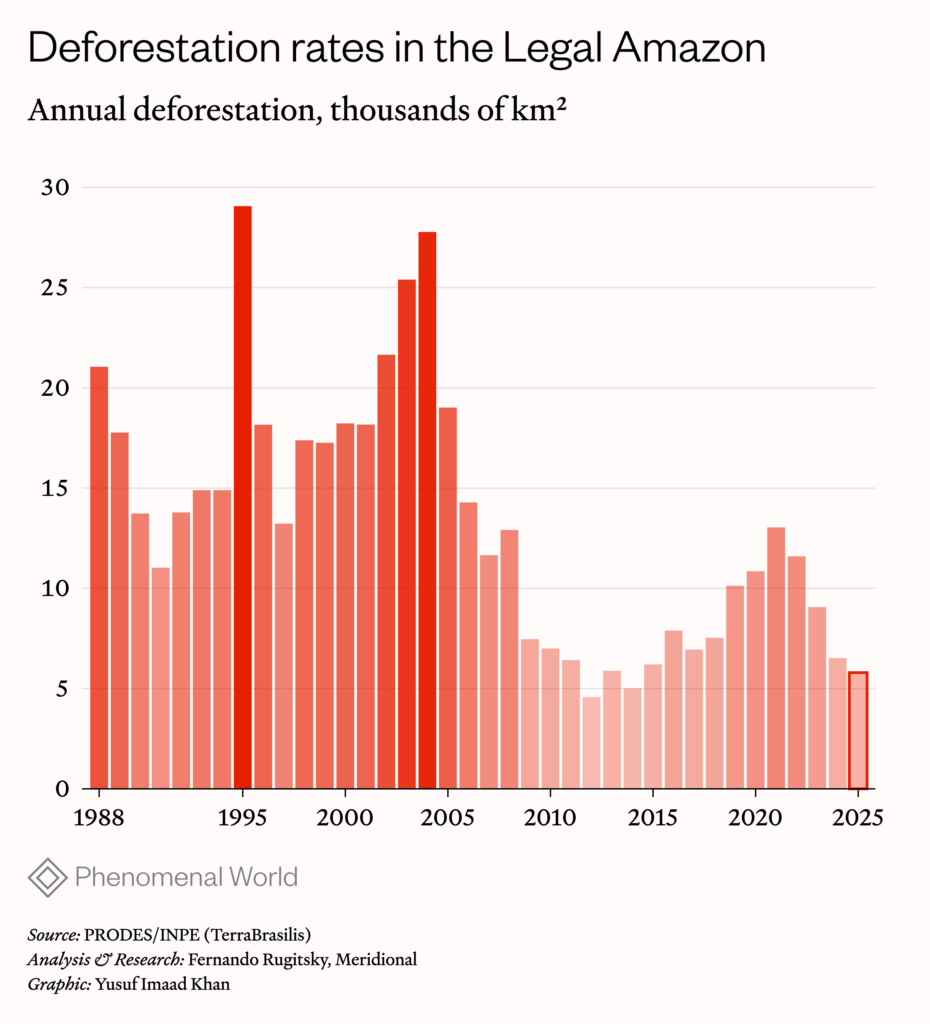
Struggling to adapt to this new context, and coming under intense pressure from environmental groups, the giant grain traders which had become dominant in the soy supply chain—ADM, Bunge, Cargill, Louis Dreyfus—agreed to a Soy moratorium in 2006. From then on, a ban was imposed on the purchase of soybeans from deforested land. Similar attempts at self-regulation were later adopted in the beef supply chain. Around the same time, the government began to test out additional tools to meet its environmental goals. In 2007 it began publishing an annual list of Amazon municipalities with worrying deforestation trends, giving the federal state enhanced power over them; and in 2008 a prohibition was introduced on extending credit to landowners who did not comply with environmental regulations. The results were impressive. From peak to trough, 2004 to 2012, deforestation in the Legal Amazon—meaning the Brazilian part of the rainforest and parts of the surrounding savanna—dropped from 27.8 to 4.6 thousand of km2 per year.
Backlash
As the 2000s rolled into the 2010s, through, an inflection in the trends slowly became visible. The number of infraction notices and seizures of equipment fell continuously between 2008 and 2012. Embargoes also declined between 2008 and 2009, before recovering from 2010 onwards. One might think that these tools were rendered less necessary as compliance with the regulations became more widespread—but that would only be true if deforestation rates were kept down, when in fact they began to increase in 2013, undoing more than a third of the PT’s gains by 2021 (see the figure below). Part of this was due to Congress yielding to agribusiness pressure and approving a new Forest Code in 2012, which among other regressive measures offered amnesty for a significant share of past illegal deforestation.
Yet these were only the first signs of a more thoroughgoing reversal. After the ousting of the PT from the presidency in 2016, in an impeachment pushed through with the crucial support of some agrarian interests, the new administration initiated a gradual process of dismantling the environmental institutions of the previous era. This then reached its apex under Bolsonaro’s far-right government. Enforcement agencies were weakened, protected areas were reduced, and advocates of deforestation were appointed to key government positions. In the middle of pandemic, Bolsonaro’s Minister for the Environment made the case, in a meeting that was later leaked to the press, that Covid offered a perfect distraction that would allow them to tear up environmental policies: a window of opportunity to passar a boiada.
The backlash did not abate after Lula’s return to power in 2023. The most significant recent example is Congress’s passing of legislation to eliminate mandatory environmental licensing and public consultation for a series of activities, including most agricultural, cattle-ranching, and mining undertakings. What critics have branded the “Devastation Law” is the most significant act of institutional dismantling to date, which will likely expedite a series of projects prone to increase deforestation, including oil drilling in the mouth of the Amazon River and the building of railways and highways to transport soybeans to ports in the North of Brazil and Peru. While Lula initially vetoed the most damaging measures, the agribusiness caucus has since managed to reinstate them, overturning 56 out of 63 vetoes.
Legislation at the subnational level has also been pushing in a similar direction. Since 2024, a series of Brazilian states passed laws preventing firms complying with the Soy moratorium from accessing tax incentives. Even though these state incentives are highly limited compared to the federal ones, the laws gave the giant traders a convenient excuse to finally bring the moratorium to an end last month.
It is difficult to find detailed explanations for the strength of this anti-environmental countermovement. This may in part be because of predominant orientation of the literature on environmental policies in Brazil, which, as Gregory Thaler points out, focuses mostly on different policy tools and their interaction yet fails to provide a “political account that looks beyond proximate factors to the actors and interests that generate the policy environment.” As he puts it, “the political-economic character of Brazil’s Amazon transition has not been effectively theorized.”
Kathryn Hochstetler’s work is one of the few exceptions. The PT’s emphasis on repressive measures, she argues, failed to create a political constituency that could guarantee the survival of its environmental project. Instead, it fostered violent opposition: “command-and-control tools were critical for reducing the rates of deforestation, but their very success at limiting private economic behavior also spurred political strategies that then helped to undermine those very tools and the institutions that supported them.” As an example she cites the increase in size of the agribusiness caucus, which went from 120 seats in the 2007–2010 legislature to 160 after 2011: from 23 to 31 percent of the total.
But while the march of pro-deforestation forces into the halls of power was a crucial part of the story, the full picture only emerges when one examines the dilemmas of the command-and-control crackdown at the local level. Studies of specific municipalities, like thoseundertaken by Thaler and his co-authors, reveal the fault lines created by the 2000s environmental push and the extent to which the political empowerment of agribusiness since the 2010s was based on widespread disaffection with the crackdown.
Land-sparing and its discontents
The environmental policy mix of the 2000s included a series of tools with different lineages, designed to meet the demands of different groups: support for agroecological practices, policies focusing on food sovereignty, and historical reparations for indigenous populations inter alia. The overarching logic of the crackdown, however, was that of land-sparing: containing deforestation by protecting some areas from any human use, while permitting the “sustainable intensification” of capital-intensive agriculture in other areas. The idea of sustainable intensification has been circulating for quite some time as a technical fix to make large-scale capitalist agriculture compatible with environmental policies. Its most recent incarnation is dubbed “climate-smart agriculture.”
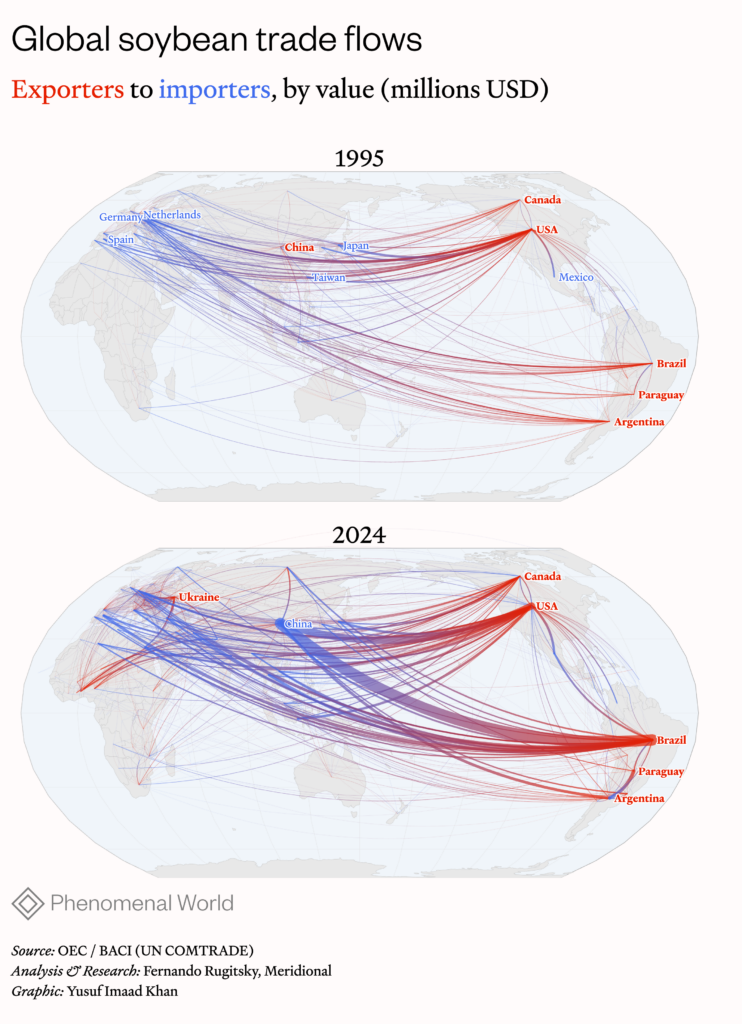
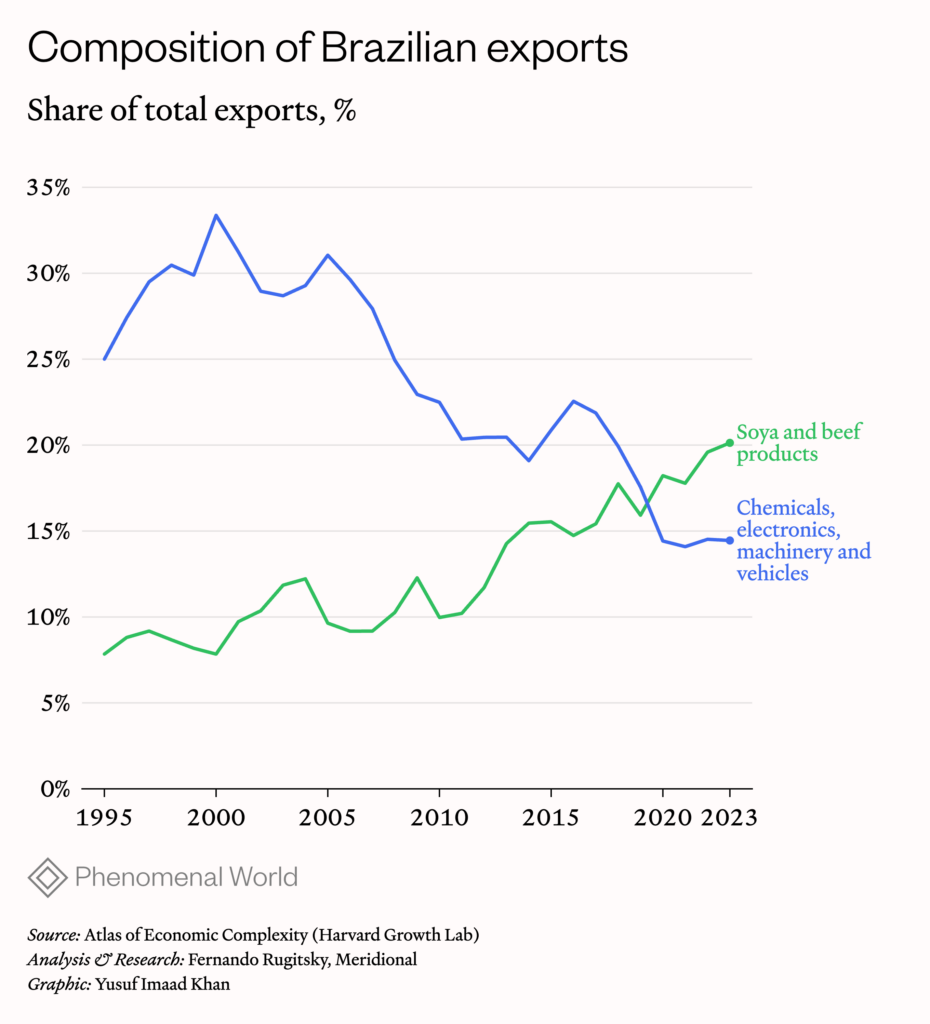
Land-sparing environmental policies came in handy for Lula’s governments in the 2000s, as it was engaged in the difficult task of meeting redistribution and environmental demands via a pattern of accumulation premised on agribusiness exports, dependent on a subordinated integration with the Chinese economy. The figures below show the scale of the shift for the case of soy, the most traded agricultural commodity globally in terms of value. The expansion of soy croplands and cattle ranches not only transformed the country’s geographical outlook but also provided access to foreign currency. Soy, beef, and related products accounted for about a fifth of Brazil’s exports in recent years, up from less than 10 percent two decades ago.
According to Thaler, the interests of agro-industrial corporations, government officials, and environmentalists thus converged in the Brazil of the 2000s to give rise to a “land-sparing complex.” Their project had no clear place for the massive population of small and medium landowners who populate the Brazilian agricultural heartlands. Given the costs involved in adapting to the new policies and the perceived difficulty of accessing government support, the land-sparing approach led to what Thaler describes as “smallholder dispossession:” “as smallholders struggle, large landowners consolidate their holdings.” Alongside this policy bias, so-called sustainable intensification had considerable health impacts for smallholders, causing what Fábio Zuker described as their expulsion by suffocation, via the chemical violence of glyphosate-intensive agriculture. (The land-sparing complex also had questionable effects on biodiversity, according to the vastliterature on the rebound effects and other consequences of soy intensification.)
Measuring the fallout of PPCDAm measures in two Amazon municipalities, Thaler argues that “punitive measures without corresponding incentives disadvantage smallholders, who have fewer resources to deal with fines or invest in intensification.” Hochstetler concurs: “To the extent that the new agricultural and deforestation policies reach small farmers, it will be the punitive side of them.” Land-sparing policies thereby advanced the aims of large landowners and big agrarian capital by encroaching on the properties of less powerful groups, in an indirect form of green grabbing.
In his detailed ethnographic study of agribusiness politics in Brazil, Caio Pompeia showed how these “political and economically subordinated groups of agricultural employers” formed the basis of what he calls agri-bolsonarism: the unholy union of agricultural interests and far-right politics. Pompeia describes how these radicalized groups, disaffected with the command-and-control crackdown, captured one rural political organization after another, from state-level associations of soy producers to the agribusiness caucus in Congress. Initially, the large agro-industrial corporations resisted this movement, since they had learned to live with and could profit from the government’s policies. Yet, gradually, they began to see it as an opportunity to remove environmental constraints and exercise greater political influence. They therefore began to collaborate, behind the scenes at first, with the bottom-up far-right mobilization.
In the Brazilian social structure, these “subordinated groups of agricultural employers” sit atop a wider demographic whose livelihoods are more directly threatened by the land-hungry agribusiness surge: indigenous groups, riverine and quilombola communities, and agricultural workers—popular classes who feed the ranks of the forest defenders. It would be a mistake to assume that the PT crackdown represented a victory for their interests against those of agricultural elites. Here the “battlefield Amazonia” framing breaks down. In fact, the land-sparing policy was initially accepted by agro-industrial corporations and many of the largest landowners, to varying degrees, because they realized they could exploit it to accumulate more land. Rather than empowering the forest defenders against agro-industrial capital, the program ended up pitting the former against relatively subordinated agricultural employers: creating a political cleavage with profound historical consequences.
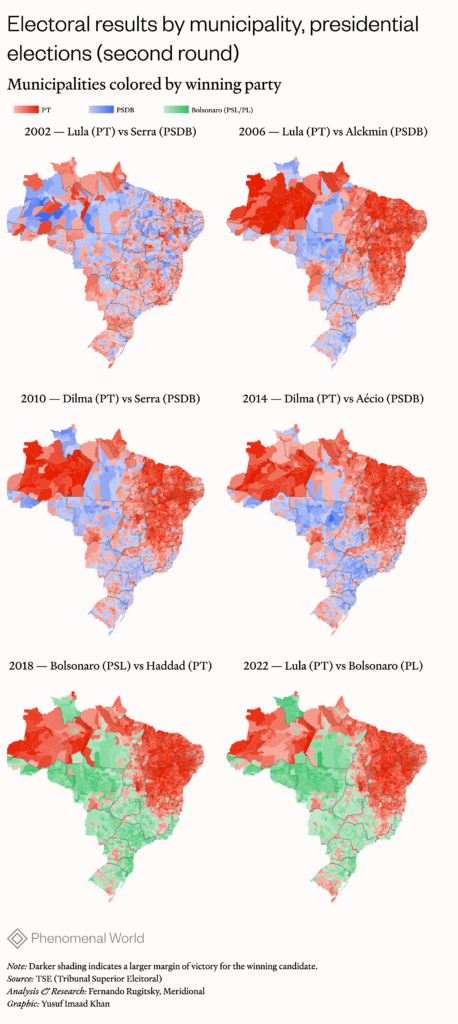
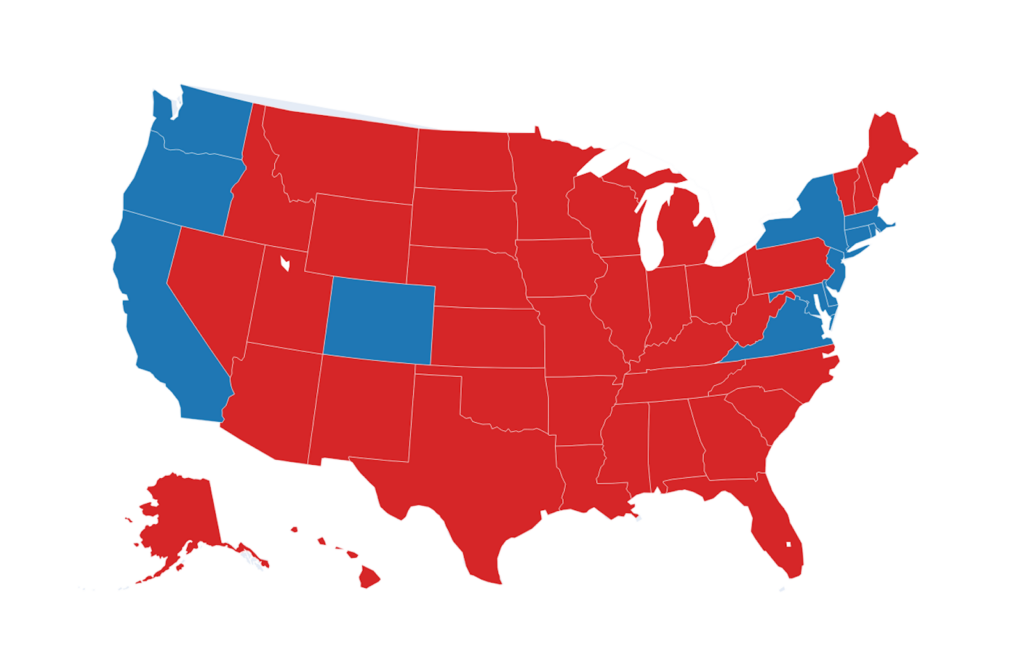
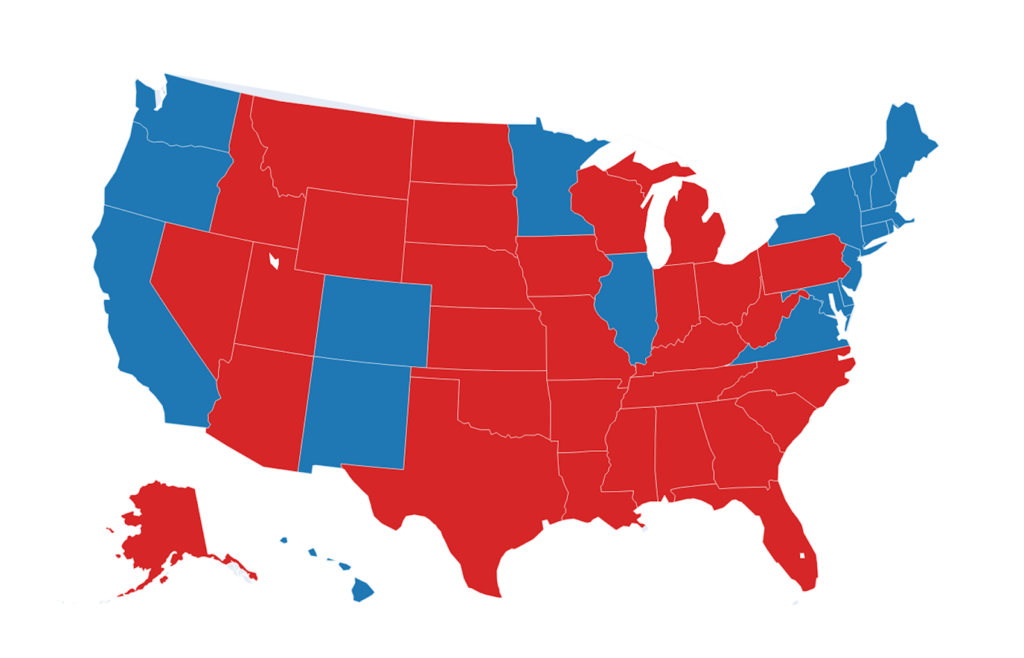
While agro-industrial corporations tightened their grip on the Brazilian state, capitalizing on increasing economic dependence on primary commodities, agri-bolsonarism provided a strong territorial base for a national anti-environmental politics. When the PT’s support declined in the mid-2010s, the far-right was able to seize the moment and mobilize the hinterlands, from the bosses to the smallholders. It achieved remarkable electoral success in the areas dominated by soy and cattle. Though many complex factors helped to shape the electoral dynamics, the geographical patterns in the maps below point to a striking conclusion: the rise of agri-bolsonarism led to the almost complete disappearance of municipalities leaning towards the PT in the agricultural belt that extends from the south of Brazil all the way to the Amazon rainforest.
Greenlash in the tropics
Today, a persistent paradox seems to be playing out in various realms of climate policy: the technological means of addressing climate challenges abound, yet the political conditions to deploy them are absent. This trend, which some have referred to as the greenlash, played out in the Amazon in the first decade of the century: sophisticated satellite identification and detailed legislation managed to curb deforestation, yet in it also unleashed political forces that have put the rainforest in an even more precarious position.
Needless to say, the alternative cannot be to throw the towel and abandon the goal of saving the rainforest. The aim must be to build a new alliance that will keep it standing. This should include subaltern groups ranging from the indigenous forest defenders to subordinated agricultural employers, united in their opposition to corporate agriculture. Concretely, this means engaging with alternatives to land-sparing which start from the multiple possibilities of harmonious human interaction with nature. Conservation biologists have coined the term “land-sharing” to describe this practice, involving “the difficult and messy process of agro-ecological harmonization through diversified working landscapes.”
Land-sharing is much more politically difficult than land-sparing, since it involves a direct challenge to agribusiness, but it is also much more promising. It opens up the prospect of reconciling the ecological and social dimensions of policymaking for the Amazon: not by starting from scratch, but by building on the existing social practices and traditions that have already been harnessed to resist the onslaught of big agrarian capital. “The agroecology implemented in settler projects,” writes Felipe Milanez, “as well as the collective management of Brazil-nut forests, the extractive reserves, and the demarcation of indigenous lands constitute spaces of common usage that materially confront the enclosures and the expansion of the latifúndios.” This would mean dropping the battlefield metaphor and reimagining a future for the Amazon that leaves room for both the rainforest and its peoples.
More than three decades ago, John Ruggie offered a definition of one of the most vexed terms in political science. Multilateralism, he wrote, was a group of “institutional forms which coordinate relations among three or more states on the basis of generalized principles of conduct” and operate “without regard to the particularistic interests of the parties or the strategic exigencies that may exist in any specific occurrence.” Today, amid rapidly resurgent economic nationalism and increasing geopolitical tension, it has become clear that the postwar system of multilateral institutions is under direct and sustained assault—often from its erstwhile sponsors.
In trade, the US’ obstruction of the WTO system has rendered the global regime dysfunctional, contributing to deepening protectionism and the multiplication of trade restrictions. In security, the UN notes that “paralysis in the Security Council and deliberations of disarmament bodies, as well as persistent geopolitical rivalries, are alarming signs of a multilateralism that has run out of steam.” The credibility of international law has foundered, as Israel and Russia have blatantly dismissed rulings and injunctions from the UN and the International Court of Justice. The UN Secretary General has affirmed that the institution faces “imminent financial collapse” as over 80 percent of states have not paid their membership fees to the organization.
NATO likewise faces existential threats from within its own ranks, while remilitarization has deepened fragmentation in security arrangements. In global health, the politicization of vaccine distribution during the Covid-19 pandemic exposed the empty promise of multilateralism in responding to major global crises. Climate governance is in peril, with UN environmental conferences captured by fossil fuel interests and the second Trump Administration engaging in prolific climate obstructionism.
In short, multilateral cooperation has been thrown into visible disarray across a number of issue areas, as leading states increasingly pursue unilateral actions, obstruct mechanisms, and bypass or disengage from traditional institutions. What explains this turn against multilateralism, and what might take shape in its place? Here we will trace the cause of the breakdown to the crisis of the neoliberal order, marked by US hegemonic decay, the rise of state capitalism, erosion of liberal internationalist norms, and the “Second Cold War.” This crisis has produced a non-hegemonic world order in which powerful actors are encouraged to reconfigure multilateralism or abandon it entirely. The emerging post-multilateral world, we argue, resembles Colin Crouch’s conception of “post-democracy”: institutions persist, but with their internal logics and functions hollowed out.
A Declining Order
Each cycle of capitalist development generates new hegemonic orders: new constellations of ideas, states, and social structures that legitimate its governing apparatus and coerce subordinated classes in the system. The post-WWII order was constructed by the US and sustained through such a combination of coercion and consent. On the one hand, it rested on domestic repression of communists and radical labour movements, and support for military coups and interventions in the newly decolonized world. On the other, the rules within Bretton Woods institutions were developed through multilateral means, negotiated between the leading states, and framed as promoting the collective good, rather than advancing narrow American interests.
The multilateral order was thus a historically-contingent phenomenon, one also shaped by the bipolar structure of the international system, as the US and leading social forces extended concessions to subordinate states and cross-class coalitions in the face of the Soviet alternative. While those concessions diminished significantly after the Cold War, the order retained some degree of consent, and continued to center on the US as architect and arbiter of international rules and norms.
But hegemonic orders periodically break down, as new forms of production and new social relations erode their institutional and ideological foundations. The present conjuncture represents such a period of organic crisis. Around the world, neoliberalism’s accumulation model is exhausted, its institutions are under assault, and its orthodoxies are being overturned. Yet, despite this, no single actor has articulated an encompassing alternative, resulting in an apolar, non-hegemonic condition characterized by multiple centres of power. None has the capacity to provide either the hegemonic leadership or the public goods necessary for stable regional, let alone global, order.
In this context, intensifying geopolitical rivalries alongside the resurgence of state capitalism have altered the incentive structure for states to support and engage with multilateral institutions. The result is the proliferation of post-multilateral orientations, wherein states increasingly attack or circumvent institutions they perceive to constrain their strategic action.
This situation is the result of two successive hegemonic crises. The first, taking place in the 1970s, challenged the postwar regime of Fordist accumulation centred on mechanized, standardised mass production and consumption of consumer goods. Out of the decline of this order emerged a new, neoliberal consensus that revived growth and profitability through offshoring, financial deregulation, privatization, commodification, and a new flexible labour regime.
Yet the very success of neoliberalism produced the conditions for its unravelling. New poles of accumulation emerged across the global economy, particularly in the Global South, where integration into global value chains and transnational networks of finance, trade, and ownership empowered new business classes. The growing international presence of transnational corporations, state-owned enterprises, and sovereign wealth funds from these regions reshaped global competition and generated geoeconomic tensions. Although these actors did not directly challenge US primacy, they demanded greater representation within global governance institutions. Despite some adaptation, such as the creation of the G20 after the 2008 Global Financial Crisis (GFC), multilateral institutions became increasingly gridlocked, unable to accommodate the widening array of interests.
The GFC also exposed the contradictions of debt-based accumulation and speculative finance, leading to stagnation in the productive economy. Subsequent policy responses deepened inequality, precarity, and political polarization, paving the way for ‘anti-globalist’ forces and populist leaders who, though still committed to neoliberal principles, rejected global governance itself.
Global governance, already paralysed by gridlock, fragmented further in the 2010s as informal institutions and multi-stakeholder partnerships proliferated, both as pragmatic responses to the failures of multilateralism and as mechanisms to manage dissent within a neoliberal framework. With the rise of right-wing populism, the US grew increasingly reluctant to bear the costs of global leadership, resisting IMF and World Bank reforms that would acknowledge rising powers, and instead using these institutions to externalize the costs of its own post-crisis recovery onto the Global South.
State-led Governance
The historical sequence that followed has deepened this organic crisis through two interrelated transformations. First, capitalism has entered a phase of waning dynamism, characterized by industrial overcapacity across multiple sectors, saturation in global product markets, sluggish labour productivity, and weak manufacturing growth. These trends have enhanced geoeconomic rivalry in trade, investment, and technological leadership, as firms compete over dwindling market opportunities within an environment shaped by two disruptions: the green transition, and proliferation of digital general-purpose technologies.
Second, states across North and South have responded to this tense environment—punctuated by crises such as Covid-19 and Russia’s war on Ukraine—by reinventing their roles as industrial policy actors, investor-shareholders, and direct owners of capital and assets, what some have called a new state capitalism. Under this regime, state-owned corporate entities that combine commercial and geopolitical mandates (such as investment funds, policy banks, state enterprises, and state-backed venture capital firms) have vastly expanded their assets across a wide range of sectors, including advanced technology, manufacturing, real estate, media, banking, clean energy, and infrastructure.
These statist entities have become key vectors of global capital accumulation. Governments have also reverted to muscular statism, deploying industrial policies, spatial development strategies, economic nationalism, and trade and investment restrictions to reshape the transnational economic networks underpinning globalisation. Consequently, the connective tissue of the world economy—its financial, trade, production, energy, and technological networks—has become the locus of intense contestation among established powers, non-Western challengers, and mid-range states.
Unlike its twentieth-century predecessor, this Second Cold War is not defined by bloc-based rivalry or territorial containment, but by state-led struggles to control the strategic networks of global capitalism. Securing key nodes within these networks enables the weaponization of interdependence and confers competitive advantage, market share, resource access, and financial returns, while allowing states to erect barriers to rivals. As governments increasingly mobilize state ownership and intervention to pursue such geopolitical objectives, this new state capitalism has become the defining feature of the contemporary global economy.
These shifts pose significant challenges for multilateral global governance. Because global economic institutions were not designed for a world in which states play active economic roles, they have struggled to adapt to this new state-capitalist reality while attempting to preserve market-centric regulation. Their adaptive capacity is further constrained by the diverse and often conflicting state interests now playing out within and through them. At the same time, emerging network-based forms of geoeconomic competition make it increasingly difficult to harmonize transnational capitalist interests, even in ostensibly technical areas such as standard-setting.
New coalitions of elites have formed, linking major capitalists in technology, energy, and advanced manufacturing with defence and national security institutions. These alliances fuse economic and security imperatives but show little evidence of constructing cross-class hegemonic projects through compromise with labour. This in turn intensifies the class contradictions of neoliberalism.
At the global level, the US has largely abandoned its hegemonic role. Now merely dominant, it is increasingly unwilling to bear the costs of providing the public goods that once sustained multilateralism, instead using its economic might to advance mercantilist interests at the expense of both allies and rivals, in a manner that accelerates the decay of the neoliberal order.
Yet with other states equally enmeshed in the crisis of neoliberalism, none is capable of filling this power vacuum. The result is an increasingly apolar geopolitical structure and non-hegemonic world order defined by competing and conflictual state capitalisms. A vestige of the old order, the multilateralism system is increasingly perceived as an obstacle to both national and capitalist interests, prompting states to sabotage, bypass, divert, or disengage from its rules.
Table 1. Strategies to undermine multilateralism
Strategy
Definition
Sabotage
Deliberate efforts to weaken, obstruct, or dismantle multilateral institutions, norms, or principles
Bypassing
Creation or use of alternative, non-multilateral institutions or frameworks to circumvent multilateral processes
Diversion
Co-option or capture of multilateral institutions, redirecting their resources and agendas towards narrow or parochial interests
Disengagement
Partial or full withdrawal of major powers from multilateral institutions, ranging from non-attendance to complete exit
Post-Multilateral Development
State responses to this structural crisis have had a profound impact on multilateralism across various arenas. Take development. International development institutions have been deliberately sabotaged through deep cuts to foreign aid budgets and agencies, alongside persistent efforts to hollow out multilateral rules on aid provision. The US has long been the largest provider of foreign aid, or Official Development Assistance (ODA); in 2024 it contributed $63 billion of the total $213 billion allocated to aid recipients and multilateral organizations. Last year, however, the Trump Administration—adopting the view of foreign aid as “a massive and open-ended global entitlement program captured by—and enriching—the progressive Left”—issued executive orders that froze funds, withdrew from several multilateral development bodies (including the WHO and multiple UN fora), and suspended contributions to the OECD Development Assistance Committee (DAC), the main multilateral forum for Western aid cooperation.
The US Agency for International Development (USAID) has likewise been hollowed out, with 86 percent of its projects terminated in 2025. This represents an existential threat to the multilateral development regime. Given US’s centrality in the system, the gutting of USAID and the broader ODA cuts have stripped funding from over 40 percent of the global humanitarian aid network, with UN agencies bearing the brunt. Beyond withdrawing funds, the Administration is repurposing aid as a “tool to dismantle global governance”, as USAID surveys now require recipients to confirm that their programs do not depend on international organizations—principally the UN—viewed as constraining US sovereignty and interests. Support for multilateral engagement has thus been replaced by a regime of “transactional sovereignty enforcement” in which alignment with US interests is a precondition for accessing what remains of US aid.
Beyond the US, major Western donors have also announced major aid cuts to channel resources towards rising defence spending. In February 2025, the UK announced it would reduce aid spending to 0.3 percent of gross national income in 2027 (the lowest level since 1999). Since then, further cuts have been rumoured, including cuts to the UK’s contribution to the Global Fund to Fight Aids, Tuberculosis and Malaria. In July 2025, France announced a “historic” €700 million in cuts to its aid budget (roughly 5 percent of the total), while Germany, Sweden, the Netherlands, and Belgium are also taking similar decisions. As Sam Huckstep and his co-authors note, “2025 will likely go down in history as the year donors set fire to their international development commitments.” Like in the US, these cuts reflect the “nationalisation of aid” which has risen over the past decade amid growing public antipathy towards such programs.
This fiscal retrenchment intersects with an increasing share of ODA now directed to items of nationalist concern, including support for private sector instruments and contributions to donors’ own Development Finance Institutions, which enable them to pursue commercial opportunities in middle-income countries. In-donor refugee management costs have meanwhile absorbed a growing portion of ODA budgets over the past decade. In 2024, the UK spent four times more on hosting refugees domestically than on global health or humanitarian assistance.
Such changes have undermined the credibility of the OECD DAC and eroded ODA’s status as a distinctly concessional and developmental resource. As Oxfam put it, “donors have turned their aid pledges into a farce. Not only have they underdelivered more than $193 billion, but they have also funnelled nearly $30 billion into their own pockets by mislabelling what counts as aid.” Through cuts and rule revisions, DAC donors have sought to deliberately sabotage the development regime in line with their parochial interests.
Alongside these strategies of sabotage there has been a persistent dynamic of disengagement. Over the past fifteen years, DAC donors have steadily withdrawn from the collective multilateral agendas of the post-Cold War era, most notably the Development Effectiveness agenda, whose principles used to be unanimously endorsed. Donor commitment to the UN’s Sustainable Development Goals (SDGs) is also in doubt. The Trump Administration has declared that “the US rejects and denounces the SDGs, and it will no longer reaffirm them as a matter of course.” Such declarations build on right-wing populist rhetoric that foreign aid must advance national interests over global needs.
Progress towards the SDGs themselves is stagnating: only 35 percent of targets are currently “on track or making moderate progress,” while “nearly half are moving too slowly and, alarmingly, 18 percent are in reverse.” The ambition of leveraging billions in aid to mobilise trillions in private finance has largely failed. For Adam Tooze, the SDGs “look less like a new dawn than the final gasp of a unipolar, end-of-history fantasy;” the “age of a politically neutral, universally endorsed development agenda is over.”
Yet such acts of sabotage and disengagement do not portend the end of aid provision altogether. Funds have rather been redirected into national or strategic channels, bypassing multilateral structures and recasting cooperation on explicitly geopolitical terms. What remains of the US aid budget has been channelled to national institutions such as the Development Finance Corporation (DFC), which does not provide concessional finance but instead offers loans at near-commercial rates and equity investments aligned with US geopolitical and state-capitalist interests. The DFC has, for example, supported US firms mining copper in the Democratic Republic of Congo, is exploring rare earth metal projects in Greenland, and has been tasked with financing data centres in the US and beyond.
The repurposing of DFC’s operations evidence rapid changes in the composition of the US state, with the growing presence and influence of hawkish Silicon Valley tech giants working in close collaboration with national security agencies, defence contractors, and energy and mining conglomerates in pursuit of geopolitical, economic and security objectives. The State Department’s FY2026 budget request, for instance, states that the “DFC provides a cost-effective approach to make a significant strategic impact and counter China and other strategic competitors’ influence around the world.”
While self-interest and geopolitical concerns were always part of development assistance, aid provision during the Cold War was at least premised on enabling the development of the Global South as a means of combating the spread of communism. In this sense, it was a hegemonic concession, and indeed the developmental dimension of Bretton Woods that at least partially emerged as a result of Southern demands.
By contrast in the emerging post-multilateral era, development assistance is increasingly subordinated to geopolitical or commercial priorities, abandoning any pretense of promoting development as a hegemonic concession. Calls for the “reform” of multilateral development institutions are driven by rationales of containment and competition. D.J. Nordquist—the World Bank’s former US executive director and a newly appointed Deputy Director-General at the WTO—has recently argued that “it is time for democratic and capitalist nations, led by the US, to stop believing the fiction that China can be a productive, responsible force in international organizations like the World Bank and IMF. Instead, [through these organisations] the US should seek to challenge and marginalise China.” Under Trump the US has sought to use the ostensibly multilateral World Bank to counter China and its Belt and Road Initiative (BRI), while also pressing it to scale back climate commitments and expand fossil fuel financing in line with US material interests.
Although the UN development system has been the primary multilateral target of USAID cuts, the IMF and World Bank have been assured continued US support “so long as both reformed;” that is, so long as they help the US “reduce the trade surplus of China.” Similarly, while the EU launched the Global Gateway with multiple of partners in 2023 to ostensibly promote global infrastructure investment based on “trust,” “equal partnership,” and “transparency,” the initiative is in fact designed to advance the bloc’s economic, geopolitical and security interests, in a context of strategic competition with China and other rivals. Indeed, the EU’s commissioner for international partnerships and Global Gateway overseer Jozef Síkela can declare in the same breath that he “deeply believe[s] in the value of the multilateral system” and that its purpose today is to compete with China’s BRI, defend the interests of the EU, secure “economic security and access to raw materials,” and “tackle the root causes of irregular migration.”
More broadly, diversion has intensified through the rise of “earmarked” lending to multilaterals over the past decade: the allocation of ODA on the condition that funds are spent on donors’ nationally determined projects and agendas. Although earmarking dates back to the Cold War, its rapid rise and current prevalence signals a shift “from collaborative approaches centred on aid effectiveness towards a paradigm driven by national interests and geopolitical strategies.” This trend undermines multilateral bureaucratic capacity by adding reporting and administrative burdens while core contributions stagnate or decline. It also accelerates the “bilateralization” of the multilateral system.
As core funding continues to fall alongside retrenched aid budgets, the normalization of earmarking further entrenches the instrumentalization of multilateral institutions for nationalist ends. That is to say, this shift both reflects and reinforces the post-multilateral condition, as multilateral bodies become tools for donor interests rather than collective problem-solving.
Towards a Southern Multilateralism
As we have argued, contemporary global governance is increasingly defined by a post-multilateral condition, characterized by the hollowing out of multilateral norms and principles. There are, however, simultaneous efforts to resist institutional decay and shore up existing structures by reforming and revising them. The most central protagonist in this respect is China. In the realm of global development, China has made explicit its ambition to lead through initiatives such as the Global Development Initiative (GDI, launched in 2021), the Global Security Initiative, Global Civilization Initiative, and the cross-cutting Global Governance Initiative. These initiatives are simultaneously embedded within current global governance arrangements (such as the SDGs) and reflect China’s broader vision of world order, framed as ‘true multilateralism:’ a UN-based governance system prioritizing pluralism and expanded state sovereignty.
As an attempt to operationalize China’s vision of world order through its “Community of Shared Future for Mankind,” the GDI can be interpreted as an effort to revise the multilateral development agenda away from liberal principles by—inter alia—prioritizing the “right to development” over civic-political norms. China’s vision therefore advances a “minimalist” multilateralism premised on pluralism, non-interference, and China’s role within the UN as primus inter pares. Yet the scale of Chinese and broader Southern multilateralism remains limited to filling the the gaps left by Western retrenchment. Overall, Global South countries face a qualitatively different development regime: less multilateral, more fragmented and apolar, and lacking the collective hegemonic project that once provided a minimal degree of cohesion and stability.
This piece is co-published with the New York City Policy Forum, a new project dedicated to enriching debates over policy and governance in New York City.
With the failure of Eric Adams’s last-ditch effort to stack the Rent Guidelines Board (RGB), Mayor Zohran Mamdani is now in a position to fulfill his promise to freeze the rent. The nine-member RGB sets maximum rent increases for New York’s million-plus rent-regulated apartments, determining rents for over half of the city’s renters.
The RGB is tasked with balancing the interests of tenants and building owners, considering a wide range of factors including the cost of operating rent-regulated buildings, the cost of living for tenants, and the overall state of the housing market. In practice, they have wide discretion. The RGB delivered a 0 percent increase in regulated rents three times during the De Blasio administration. Most discussion of rent regulation in New York City focuses on the legal intricacies of who, where, and when the RGB guidelines will bite. But this risks losing sight of the bigger-picture questions about the financial terms on which housing is bought, owned, and sold—terms which may have to fundamentally change to make affordability possible.
To understand the implications of Mamdani’s rent freeze, we must consider the broader economics of housing in New York. Any discussion of rent regulation has to grapple with the fact that owners of residential buildings pay most of their rent earnings not on maintenance or operations, but to service their debts to their creditors. With the kind of leverage typical for investor-owned residential buildings, any significant slowing of rent growth is likely to see many building owners unable to make their mortgage payments.
The great majority of residential buildings have rental income well above their operating costs, and they could be profitably operated even with rents much lower than today’s. So in principle, there is space for the RGB not just to freeze the rent, but to roll back regulated rents by some significant percent. The big obstacle to a mandated rent reduction is not the real costs of providing housing, but the financial commitments inherited from the past. A building underwater on its mortgage is unfortunate for the owner; it can be disastrous for tenants.
Waiting for a market solution to this dilemma through the bankruptcy courts would be misguided, since renters would bear the brunt of cost savings in the form of decaying living conditions while landlords wait for a better deal. Instead, the city’s plan to freeze or reduce rents must be combined with a quick resolution for apartment buildings in financial distress. This resolution must take account of the major dynamics that shape the rental market in the city—high rent burdens, inadequate investment in previous decades, and the distinct circumstances of landlords controlling old buildings versus developers looking to build new ones. After a rent freeze, true housing affordability will call for a model of alternative, including public, ownership.
The rent-stabilized market
It’s easy enough to predict the argument against freezing the rent—without rent increases, many building owners will encounter financial problems, leading to deferred maintenance or abandonment. A recent piece in The City describes how property owners have struggled to make mortgage payments and cover operating expenses:
Every month, Langsam Property Services collects dozens of rent checks from two buildings it manages in The Bronx. But that’s not enough to cover the mortgage and operating expenses. So every month, the buildings’ owner sends another check—for at least $30,000, just to meet the mortgage.
The kinds of buildings…where all or almost all of the apartments are rent regulated…face extreme financial distress. Rent increases failed to keep up with costs for most of the last decade, and changes to state law in 2019 made it virtually impossible to renovate vacant units and raise the rents, putting such landlords in a bind…A four-year rent freeze could result in the kind of abandonment that happened in the 1970s.
It’s important to take these concerns seriously. The landlords quoted here are honest when they describe their difficulties paying their mortgages. But we should distinguish between debt service and other costs. Operating and maintenance costs reflect the actual costs of operating a building in the city. Debt service, on the other hand, reflects how much the current owner paid for the building. Combining these two sets of costs is common in discussions of rent regulation. Another recent story, for instance, quotes the executive director of the Association for Neighborhood and Housing Development: “You can’t continue to run a building without paying the mortgage and without paying your insurance.” Insurance is indeed a cost of running a building, but the mortgage is not. At most, it is a cost of owning it.
As we think about the economics of rent regulation, we should keep this distinction clear. While operating and maintenance costs are necessary to provide housing, mortgage payments are not. Essentially none of the debt owed by owners of rent-regulated buildings is construction loans, and very little of it is financed capital improvements. The cost of servicing that debt is not part of the cost of providing housing. It rather reflects how much the owner has borrowed against it. The problems faced by owners of rent-regulated apartment buildings look very different in this light.
There is plenty of data on the incomes and expenses of residential buildings in the city, in particular the detailed (though not always complete) records of the New York City Department of Finance (DOF). Research and advocacy organizations like the Furman Center and the Community Service Society regularly put out useful reports based on this. For present purposes, the RGB’s annual Income and Expense Study, based on the DOF data, is enough to give the broad picture.
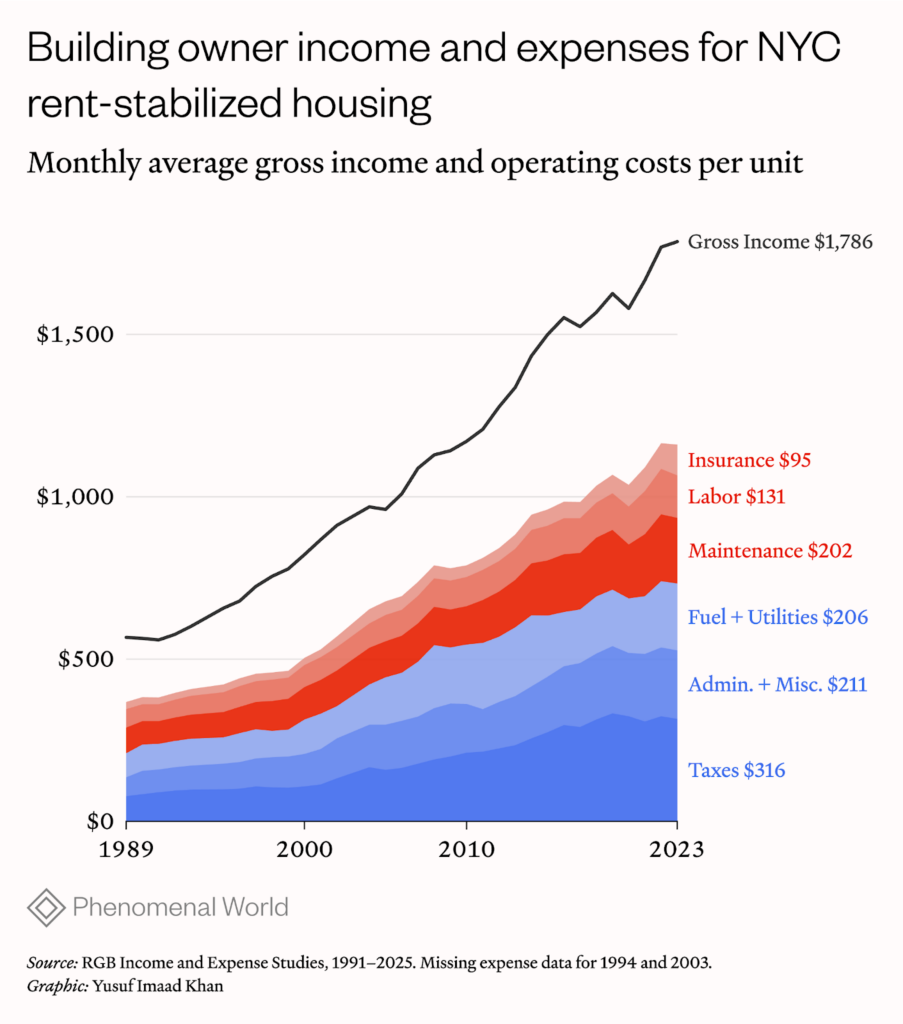
In buildings with rent stabilized apartments, reports the RGB, rent averaged $1,600 per unit; landlords on average collected another $200 per unit from other income sources—parking, retail space, cell-tower rent, and so on. Maintenance and operating costs, meanwhile, averaged a bit less than $1,200 per unit, including taxes (a bit over $300 per unit) and insurance (almost $100 per unit, and the component that has increased most rapidly in recent years). For the average rent-regulated building, net income is around $600 per unit, about 50 percent above operating costs.
This relationship between costs and income seems fairly stable over time, albeit with some short-term ups and downs. Over the past two years, landlord income has increased by 15 percent, while costs have increased by only 10 percent. But this was in large part making up for the pandemic period, when income increased more slowly than rents. Over the long run, the two have kept pace almost exactly—over the past twenty years, landlords’ incomes have increased at an average annual rate of 3.8 percent, while their costs have increased at 3.7 percent.
These averages mask a great deal of variation across individual buildings. Still, over 70 percent of buildings with rent stabilized units had operating and maintenance costs less than 80 percent of income, and fewer than 10 percent had operating and maintenance costs greater than income. This minority of buildings are a serious concern, and their numbers do seem to have increased somewhat in recent years, but they remain a fraction of rent-regulated buildings.
Yes, if rents on stabilized units were frozen forever, there would come a point when operating costs exceeded income for an increasing share of buildings. But why are building owners facing distress today? The answer in most cases is that they borrowed too much to buy buildings at inflated prices, based on an expectation that rents would rise faster than they actually did.
Landlord economics
The price that an investor will pay for a building, and the size of the mortgage that bank will give them to do so, is a function of the rent that the building is assumed to generate in the future. Lenders will typically accept a debt-service ratio of 1.25, and some will go as low as 1.1, meaning that they will lend as long as the expected rental income net of operating costs is 1.1 to 1.25 times as great as the payments the mortgage requires each month. To say that a building’s net rental income is 1.25 times its debt service costs is the same as saying that 80 percent of rental income after operating costs will go to mortgage payments, if the building performs as expected.
Furthermore, investors in multifamily buildings often refinance in order to extract equity when a building has increased in value. Say a building is valued at $1 million and is currently carrying a mortgage of $700,000, meaning that the owner’s equity is worth $300,000. If a lender would be willing to accept the building as collateral against $800,000 of debt, the owner can take out a new mortgage, reducing their equity to $200,000 and leaving them with $100,000 in cash—which they will presumably put toward acquiring another building.
This sort of “cash-out” refinancing was seen as a troubling aberration when it became popular among homeowners during the 2000s housing boom. But for real-estate investors, it is an established business practice—borrowing against one’s existing properties is the easiest way to finance the acquisition of new ones. From an investor’s point of view, a building carrying a smaller mortgage than what lenders would accept is money left on the table. Careful observers of the housing market believe that this kind of equity extraction may account for the bulk of the debt carried by rental properties in the city.
This means that even buildings that have not changed hands in many years often carry mortgages close to the maximum debt-service ratio that lenders will allow. Research by the University Neighborhood Housing Program based on data from the government-sponsored enterprise Freddie Mac (which purchases a large share of mortgages on New York apartment buildings) finds that residential buildings in the city, on average, pay out about 80 percent of their net operating income as interest payments. This suggests that building owners are normally operating close to maximum leverage. For most buildings in the Freddie Mac sample, interest payments are a larger cost than all operating expenses put together.
Whenever rents rise more slowly than expected when a building was purchased or refinanced, there is a good chance that the owner will be unable to meet their mortgage payments, even if rental income is still comfortably above operating costs—as is the case in the majority of buildings.
Rent growth below buyers’ (and lenders’) expectations is a particular problem with buildings that were bought or refinanced prior to the 2019 reform of the New York State rent laws. These investors hoped to win substantial increases in rents for regulated units or remove them from regulations entirely, using a number of loopholes that allowed landlords to kick out their current tenants and rent out the units at a higher rent. Since the 2019 reform, this is nearly impossible. As a result, many buildings purchased in the 2010s cannot generate income commensurate with what was paid for them.
To be clear, the rent reforms were a major positive step for housing affordability. The expected increases in rental income could only have been realized, in most cases, by evicting current tenants and attracting higher-income ones. But losing the possibility of replacing current tenants with higher-paying ones has left the owners of these buildings in a financial hole.
A future with lower rents?
This overhang of overvalued, overmortgaged buildings is presumably a major reason why there has been so little activity in the market for multifamily buildings in recent years, with the volume of sales less than a third of what it was a decade ago. How then should we think about landlord complaints—many of them genuine—that a rent freeze will leave them unable to service their debts?
First of all, it should be clear that if buildings’ rental income is inadequate given their debt payments, the reason is lower than expected rents—not rent regulation per se. If an Abundance-style program of supply-side reforms delivered enough new construction to substantially bring down rents, building owners like those quoted in The City would face the exact same difficulty. Any slowing of rent growth will create financial distress for building owners who borrowed on the expectation of rising rental income.
There might be steps the city can take to reduce costs for building owners—insurance being the most promising avenue—but the potential savings are limited. Major improvements in housing affordability will entail reducing rental income for existing buildings. At the end of the day, tenants’ housing costs are owners’ incomes; lower gross income for landlords is just the flip side of more affordable rental housing. The housing agenda must then explicitly include a strategy for property owners whose debts cannot be paid in an environment of lower rents.
One might ask, why does the public need to be involved? Perhaps this is an issue to be left to owners and lenders. Either the bank writes down the loan, or else it forecloses, and the building is sold to someone else at a more realistic price. The trouble is what happens during the transition: the foreclosure process can drag on for years, and financially distressed owners are likely to prioritize mortgage payments over maintenance and upkeep, allowing buildings to fall into disrepair at great cost to their tenants and to whomever ends up owning the building. Landlords will stop paying for gas before they give up control of their buildings.
The lower the rent increases allowed by the RGB, the more urgent code enforcement becomes as a complement to housing affordability measures. Otherwise, what landlords give up in rent increases, they will try to claw back in reduced maintenance. At the same time, a successful affordability policy means that many buildings will be worth less than what their owners paid for them. Someone is going to have to bear those losses. It’s important to proactively shape how that happens, rather than wait for the market to work itself out.
One approach would be for the city to work with landlords and creditors to negotiate mortgage write-downs in return for hard commitments to a higher standard of maintenance and improvements. The response to the failure of Signature Bank could be a model. Signature was a major lender for multifamily buildings in New York; a considerable part of its portfolio of loans to owners of rent-regulated apartments ended up in the hands of the Community Preservation Corporation (CPC). CPC agreed to loan modifications in return for clear commitments by landlords to address building and habitability code violations. The city could push other holders of mortgages on underwater buildings to make similar deals.
CPC had the big advantage of already owning the loans. As a third party, the city government might struggle to bring lenders and building owners to the table. Another option, promoted by the mayor’s new Director of the Office to Protect Tenants, Cea Weaver, would be for the city to move aggressively to take ownership of buildings that can’t make their mortgage payments.
There are also a nontrivial number of buildings where operating costs exceed rental income. These are especially common in the Bronx, where past underinvestment may have contributed to today’s costs, and many are already owned by nonprofit Community Development Corporations (CDC). CDCs have a fundamentally different business model than the investors who own most of the city’s rental buildings. They use far less leverage, and, while almost all are rent-regulated, they tend to charge rents below the legal maximum.
The economic challenge here is quite different from that of most buildings in the city. The problem is less financing, and more the very low incomes of families living in these buildings, combined in many cases with underinvestment and neglect by prior owners. The solution will involve operating subsidies. While the details of this are beyond the scope of this piece, subsidies to building operators are generally to be preferred to subsidies to tenants, which may be captured by landlords in the form of higher rents. (The city’s Multi-Family Water Assistance Program is a good example of a targeted subsidy to affordable housing operators.)
The situation of these genuinely distressed buildings should not be confused with that of the larger group of rental buildings where net income is positive, but insufficient to cover mortgage payments. In these cases, we must avoid two outcomes. The first is weakened rent regulations, which would make tenants pay for landlords’ speculative overborrowing. The second is allowing buildings to remain for an extended period in the hands of owners who will eventually lose them. If the current owner is going to give up the building, that needs to happen as quickly as possible. The threat of forced sale can be helpful to incentivize a quick settlement, even when it is not carried out.
Expanded public ownership is not just a long-term vision; it is an essential part of the solution to an immediate problem. The fundamental issue is that landlords are being squeezed by high debt costs from one side, while they aren’t able to charge higher rents, and they can’t cut costs without sacrificing habitability, which effective code enforcement will prevent. Under these conditions, some building owners will indeed face unsustainable losses. The role of public ownership, in this sense, is to provide an escape valve, a way for owners to exit their position without running the danger of an extended foreclosure process. The pressure on landlord incomes will be a source of great anger and scare stories in the press, but this is also precisely what gives the city leverage to force creditors to write down debt and move toward alternative models of ownership. It is worth pursuing genuine savings that the public can deliver, like pooling insurance.
It would be a big mistake to simply offer relief to stressed landlords by exempting buildings from the rent laws. That would only pass the costs off to tenants without resolving the structural problem that undergirds the rental housing market—the mismatch between debt loads and affordable rent growth. Even worse, allowing higher rents in response to financial distress would give other landlords hope that if they hold out longer, they will be able to avoid a resolution. Any hint of flexibility on the rent freeze could leave us in the worst of both worlds—a situation where building owners cannot pay their bills, but won’t give up ownership because they are hoping for higher rents in the future. An ironclad commitment to the rent freeze and to stringent code enforcement is essential to bring landlords and creditors to the bargaining table.
Landlords vs. Developers
The city’s leverage in negotiations with private landlords will implicate the broader politics of housing. Building more housing was a central plank of Zohran Mamdani’s platform. For the foreseeable future, that will require private developers and contractors, who control the specialized expertise, labor and resources required. NYCHA, for all its challenges, successfully operates buildings for over half a million New Yorkers. But it doesn’t put up new housing, nor is there yet any non-profit developer equivalent to the CDCs that manage so much of the city’s affordable housing. So if the city is going to gain more affordable housing, it has to offer sufficient returns to the businesses that will put it up.
The case of private landlords is different. The market rent for apartments in New York does not reflect the cost of construction; rather, it is determined by the balance between the demand for housing and an effectively fixed supply. Market rents in much of the city are significantly higher than the cost of maintaining and operating buildings. Unlike the payments to developers and contractors, most payments to landlords are rents in an economic sense.
In a recent post, the conservative journalist Josh Barro describes the emerging Mamdani-DSA housing policy mix as capitalism for developers, communism for landlords. He intends this provocative phrase to express skepticism about the coherence of the program. But it seems to me that, from an economic perspective, this is exactly the combination we want.
From the standpoint of private business, to lay out $10 million to build a new apartment building that you will operate or sell for a profit or to buy a similar existing building for $10 million may be roughly equivalent options. But from a social perspective, these options are completely different—one is creating something valuable for society, the other is trying to divert existing value in your direction.
Can we really split developers and landlords in this way? After all, even if very few buildings are owned by the same entity that developed them, the developer’s profit comes from selling the building. If old buildings generate lower net incomes and sell at lower prices, won’t this discourage new development?
Politically, the alliance between developers and landlords may be difficult to break. But economically, it is absolutely possible to reduce the rents on old buildings without meaningfully reducing the incentive to build new ones. The reason is discount rates.
Housing is distinct from other commodities in its lifespan: the median age of a New York apartment is about eighty years.1The other big difference is that so much of the value of housing comes from being located in a particular place. A building’s major costs—construction and land acquisition—were often incurred decades ago. This means the link between price and production costs is much weaker.
Economists conventionally count interest costs as part of the cost of production. This is reasonable for a business that issues debt to finance inventories or relatively short-lived capital goods. But it is emphatically not the case for housing in an older city like New York, where the vast majority of debt owed by landlords was incurred to finance ownership of a long-existing building rather than the construction of a new one.
Looking at it from the other direction, a typical investor in a new housing development might expect a return of 20 percent; lenders accept an interest rate that might be on the order of 8 to 10 percent.2Why these required returns are so high is beyond the scope of this piece; it’s enough to say that it reflects both the real risks of building ownership and the specific ways that it is financed. These returns are equivalent to discount rates; to say that a developer requires a return of 20 percent, is equivalent to saying that they put a value of about 80 cents on a dollar of income a year from now. At a discount rate of 8 percent, a dollar fifty years from now has a present value of about 2 cents; at a discount rate of 20 percent, it’s worth one-hundredth of a cent. This means that the rent a building will command decades from now plays essentially no role in the decision of whether it’s worth building today.
No rational investor would pay money to build an apartment that will come into existence decades from now. But the nature of real estate is that ownership today implies ownership into the indefinite future. If you put up a building in order to rent it out next year, the building ten, twenty, one hundred years from now comes along for the ride. Given the age of the city’s housing stock, this means that the rent paid in a typical New York apartment has no relationship to the building’s construction costs; those were paid long ago. To the extent that landlord income exceeds the operating and maintenance costs of the building—and, again, it does on average by a margin of 50 percent—then that rent is also a rent in an economic sense: a payment in excess of the cost of producing something. The fact that these economic rents are not necessarily captured by the current building owner does not change this.
In this sense, buildings are a bit like intellectual property, which also lasts longer than the economic horizon of the businesses that produce it. The economic argument for rent regulation is a bit like the argument for limiting patents and copyrights to a finite period.
For housing in a city like New York, there is no reason to think that the market price provides a useful signal about the balance between value to consumers and cost of production. What, then, is a reasonable rent for older residential buildings? Arguably, it should be limited to operating costs plus a moderate margin. Rent payments above this are simply a transfer from tenants to building owners (and their creditors).
Housing as a public utility
Real estate investors generally expect much of their returns to come from capital gains—an increase in the property’s market value rather than the rental income it generates.3I develop this point at length in a forthcoming paper from the Groundwork Collaborative, coauthored with Mike Fellman. Since buildings are normally valued at a multiple of their rental income, this means that owners expect not just high rents relative to operating costs, but steadily rising rents over time. If rent growth shifts onto a more affordable trajectory, owners will see lower returns, even if their buildings continue to generate a positive income for them. Under these conditions, the kinds of private investors who currently own much of New York’s housing stock might prefer to not.
This is not an argument against moving in that direction. But it is a reason for thinking carefully about how the losses will be shared out, and how to ensure that lower returns for investors and creditors do not hinder the ongoing payments that are needed to operate housing—utilities, maintenance, and so on. Public ownership is an essential tool here. So too is tenant organizing, including demands that landlords open their books as a condition of any kind of relief.
On January 1, after Mayor Mamdani was sworn in at the old City Hall subway station, the Washington Post crowed that his midnight inauguration was actually a tribute to private industry, since the city’s first subway system, the IRT, was built by a for-profit company. It is true that New York’s first subway system, the IRT, was privately owned. But one could read this history in a different way. City government did not take over the subways out of any ideological commitment to public ownership. Most city leaders in the early twentieth century (the IRT-hating John Hylan excepted) were happy to leave the subway in private hands. The problem was that a comprehensive system with affordable fares became incompatible with acceptable returns to private investors. The need to rescue the private system from financial crisis was why the city took over, and the state later established the MTA.
Perhaps decades from now, we will be able to tell a similar story about housing. Today, New York City’s rental market is defined by two colliding forces: tenants’ need for affordable rents, and landlords’ need to repay their creditors. Only public ownership offers an escape from the mounting pressure. If New York moves towards a model of social housing, it will be because public ownership is consistent with stable rents in a way that ownership by private investors fundamentally is not.
Thanks to Michael Kinnucan and Jacob Udell for helpful comments on this piece, and to Conor Smyth for research assistance.
One year into Donald Trump’s second term, the global economic order is being given a facelift that wouldn’t look out of place at his Mar-a-Lago beach club. The President has turned his famous penchant for tariffs—“the most beautiful word in the English language”—into an agenda for national rejuvenation, imposing them on allies and enemies alike. Stunned commentators have made various attempts to interpret the sweeping trade restrictions: as a break with the US role in superintending world capitalism, a tool to bully individual states into signing favorable deals, or a mindless assertion of raw power. Yet there is still no consensus about either the nature of this shift or its long-term implications.
Some have sought answers in the work of Trump’s former economic adviser Stephen Miran, now member of the Federal Reserve’s board of governors, whose policy document AUser’s Guide to Restructuring the Global Trading System was published in the runup to the 2024 election. The paper appears to explain the logic behind many of the decisions which have played out since, calling for a “generational change” to “put American industry on fairer grounds vis-à-vis the rest of the world,” with tariffs the primary vehicle. The dollar’s strength for the past half century, writes Miran, has made US exports too expensive for the rest of the world to buy, while making imports too cheap for American consumers to pass up. The result has been the degradation of American manufacturing and industrial output. “Persistent dollar overvaluation” is said to flow from the way in which “dollar assets function as the world’s reserve currency.” It is simply too burdensome for the US to “finance the provision of reserve assets and the defense umbrella, as the manufacturing and tradeable sectors bear the brunt of the costs.”
Miran is not alone in arguing for the dollar’s devaluation. The belief that the currency’s global role puts the US at a structural disadvantage has a long history which stretches back to the early decades of the postwar era. Yet the fact that this view has outlasted that world of fixed exchange rates and gold convertibility, and has more recently been adopted by many in Trump’s orbit, reveals a deep misconception about how the twenty-first-century international monetary system actually works. Whereas it was once assumed that trade dynamics formed the basis of exchange rates, the situation has since changed beyond recognition, as currency obligations have become tied to the ballooning world of finance.
Today, most dollar obligations extend beyond the traditional boundaries of the nation state. Offshore dollar creation is so prevalent that we can think of the dollar as a privatized and to some extent a “denationalized” currency. The vast network of dollar creation, trading, and lending outside the US amounts to an Offshore Dollar System that plays a crucial role in sustaining American power. An accurate understanding of this system puts paid to Miran’s notion that the US’s debtor status is somehow a symptom of decline, and that currency devaluation via tariffs is the path to restoration.
In what follows, we will first describe the development of the international monetary system from the era of Bretton Woods to the age of the offshore dollar. We will then explain how this system is likely to be reshaped over the coming years, as Trump’s misconceived tariff program provokes unprecedented trade wars and intensifies competition with China. What are the implications of this deepening disorder? It is possible to imagine four divergent scenarios, each of them favoured by different political coalitions: the rise of competing monetary blocs with their own distinct geopolitical alignments; the continuation of financial globalization, with the US assuming an even more coercive role; the collapse of the monetary order into a state of anarchy; and the establishment of a new transnational payments union.
Postwar Origins
The Bretton Woods System, designed towards the end of the Second World War, pegged the US dollar to gold, while all other units of account had exchange rates fixed but adjustable to the dollar. Figure 1 gives a schematic view of this system and its various “monetary areas,” characterized by national “units of account” or currencies. All monetary areas, including the US at the top of the apex, relied on central bank money (bank notes and reserves) and commercial bank money (deposits).1See Steffen Murau and Tobias Pforr, (<)a href='https://www.cambridge.org/core/journals/finance-and-society/article/what-is-money-in-a-critical-macrofinance-framework/CE9C7DEB74D0D402686C172839078CFC'(>)“What is Money in a Critical Macro-Finance Framework?”(<)/a(>), (<)em(>)Finance and Society. (<)/em(>)2020; 6(1): 55–66.
Figure 1—The design of the Bretton Woods System
CAD: Canadian dollar; DM: Deutsche Mark; FFR: French franc; GBP: British pound; ITL: Italian lira; USD: US dollar.
At the beginning of this period, New Deal banking reforms meant that American financial activity outside the regulated banking system was largely suppressed. Individual states played a dominant role in the monetary and financial system. Money creation, such as the creation of deposits against loans, took place predominantly onshore, within the legal space of the monetary jurisdiction. There was thus a “triple coincidence” of political, economic, and monetary areas. Despite the fact of gold convertibility, Bretton Woods was essentially a credit money system, with the balance sheets of the Fed and US banks functioning as its dynamic core.
The Nixon administration argued that the Bretton Woods System, with the dollar at its center, was rigged against the US. Under this arrangement, it pointed out, America had gone from having the world’s greatest trade surplus to having the largest deficit. So, as the fixed exchange-rate system came under pressure from gold outflows and market volatility, Washington refused to defend it, unilaterally putting an end to gold convertibility in 1973. This ushered in an era of floating exchange rates between national currencies.2Robert McCauley and Catherine Schenk (2020) (<)em(>)Central Bank Swaps Then and Now. Swaps and Dollar Liquidity in the 1960s(<)/em(>), (<)a href='https://www.bis.org/publ/work851.pdf'(>)https://www.bis.org/publ/work851.pdf(<)/a(>).
The dollar, however, remained the international unit of account. To preserve its role as currency peg, central banks outside the US had to keep dollar-denominated instruments—notes, deposits, and US Treasury securities—in their foreign exchange reserves. Private financial institutions likewise began to create their own USD-denominated instruments and use them to make cross-border payments, without the intermediary of other domestic currencies. Dollars were thus created offshore and placed in circulation beyond the formal jurisdiction of the Fed. The triple coincidence had come apart.
After Bretton Woods
Figure 2 provides an overview of how offshore dollar creation expanded. The Eurodollar market—i.e. dollars created privately and offshore—first began to emerge in the late 1950s, while Bretton Woods was still in place. At this time many central bankers saw it as a threat to their monetary sovereignty and attempted to fight its rise. Yet after the Nixon shock of 1973 they reversed course and actively endorsed offshore dollar creation by non-US banks, which rose sharply over the following decades. As financial markets were liberalized, new financial instruments were developed in the US to play the role of deposit substitutes or shadow money: money market fund (MMF) shares, repurchase agreements (repos), and asset-backed commercial papers.3Morgan Ricks (2011) (<)em(>)Regulating Money Creation after the Crisis(<)/em(>), (<)a href='https://journals.law.harvard.edu/hblr/wp-content/uploads/sites/87/2014/09/Regulating-Money-Creation.pdf'(>)https://journals.law.harvard.edu/hblr/wp-content/uploads/sites/87/2014/09/Regulating-Money-Creation.pdf(<)/a(>). From the 1980s onward, these same financial instruments increasingly appeared offshore.
The financial crisis of 2007–08 proved to be an inflection point: both an onshore run on the US-centered shadow banking system and an offshore run on the Eurodollar market. The Federal Reserve moved to save the Offshore Dollar System by reintroducing swap lines, agreeing to give emergency dollar liquidity to the rest of the world, sometimes in unlimited quantities. Since then, offshore dollar-denominated instruments have continued to expand, with the Fed acting as a global backstop—ready to step in and provide dollars on highly favorable terms whenever the system falters, as it did during the Eurocrisis and the Covid-19 pandemic.
In Figure 3 we can see the hierarchical relation between the different monetary areas of the post-Bretton Woods system. The dollar remains at the apex, with other currencies spread out beneath it according to their access to dollar liquidity. The Euro area, Japan, and the UK are immediately under the US given their unlimited access to swap lines from the Fed. The BRICS are a further tier down, since they do not have swap lines but can nonetheless access emergency USD liquidity by other means.4They can do this through the FIMA (<)a href='https://www.newyorkfed.org/medialibrary/media/research/epr/2022/epr_2022_fima-repo_choi.pdf'(>)repo facility(<)/a(>), thanks to their sizable volume of US Treasury securities to pledge as collateral. On the next level are the countries of the Global South whose best bet for emergency dollar liquidity is the Special Drawing Rights (XDR) system operated by the International Monetary Fund.
Figure 3—The structure of the Offshore US-Dollar System
AUD: Australian dollar; EUR: euro; GBP: British pound; INR: Indian rupee; PLN: Polish złoty; RMB: Chinese renminbi; RUB: Russian ruble; SFR: Swiss franc; USD: US dollar; ZAR: South African rand
Power of the dollar
Unlike Bretton Woods, then, the Offshore Dollar System was not created by design but through a series of contingent developments. Though politicians have often promoted the dollar’s role abroad, the main agents here were market actors who tried to circumvent the control of policymakers by producing offshore dollars and various dollar-denominated financial instruments. Their unregulated activities led to repeated crises, which technocrats tried to contain through a series of ad hoc measures such as swap lines—which, in turn, became part of the global monetary architecture.
Despite this lack of foreplanning, though, there is no doubt that the system has given the US immense privileges. Sitting at the top of the pyramid, American authorities are able to weaponize access to international finance for countries lower down: a crucial means of exerting influence over the global periphery. The Treasury can also sell its debt abroad to buyers who are forced to accept its terms. All this works to the benefit of US financial institutions and preserves the status of New York as the financial center of the world.
As we have seen, the Offshore Dollar System relies on the Fed to hold it together in moments of crisis. Shocks to the system typically cause market actors to shift their offshore dollars onshore, at which point the Fed becomes the overseas lender of last resort. Because the Fed has no formal mandate to play this role as the world’s central bank, however, it must always frame its offer of emergency liquidity to other countries in terms of domestic considerations. This is a political vulnerability which critics like Miran are now seeking to exploit: claiming that national interests are being subordinated to the stabilization of the international economic order. For Miran, the practice of supplying currency to the rest of the world has forced the US to accrue a massive trade deficit, which he describes as a “sacrifice” for global dollar supremacy.
This is a straightforward inversion of the real relation. It would be more accurate to say that the dollar’s dominance—as a partially denationalized currency—is what gives the US the freedom to import so much more than it exports. Although the country has become greatly indebted to the rest of the world, its debt is denominated in a currency whose ultimate means of settlement it controls. The US can also fund this deficit in part by selling its own sovereign debt, which Washington has successfully branded as a “global safe asset,” to international counterparties. This grants the American government and asset-owning classes various unique advantages, including the ability to keep taxes down—compensating for relatively low intake with sovereign debt issuance and an elaborate system to keep the market for US treasury securities deep and liquid. The effect of this complex configuration on the dollar’s external valuation remains highly speculative, as the exchange rate depends on many factors other than the current account position. The dollar’s under- or over-valuation does not have a single cause—which means that Miran’s ambition to restore its proper value by simply adjusting the balance of trade is misplaced.
Four futures
How will Miran’s ideas shape the future of the monetary system? Four outcomes are foreseeable. The first is that persistent tariffs lead to a reduction in global trade and value chains become increasingly regionalized. This would cause the process of financial globalization that has proceeded apace for the past four decades to slow. The US trade deficit would likely shrink, as its partners are pressured into trade agreements preferential to Washington, and the Offshore Dollar System may well cede its global reach. As it retrenches, increased regional payments would allow for the internationalization of other currencies, decreasing the dominance of the dollar.
We could then witness the rise of competing monetary blocs, with different monetary jurisdictions clustered around regional key currencies. The US would likely form a bloc with other Anglophone states like the UK and Australia, further decoupling from the EU and undermining transatlantic security cooperation (as with recent US sabre-rattling on Greenland). The result would be to encourage China to continue its internationalization of the renminbi, turning it into a major regional currency. Squeezed by mounting US-China competition, European policymakers may accelerate efforts to maintain ground both in geopolitics and international monetary affairs—for example, by pursuing new initiatives to promote offshore euro creation.
Scenario One—Competing Monetary Blocs
AUD: Australian dollar; EUR: euro; GBP: British pound; INR: Indian rupee; PLN: Polish złoty; RMB: Chinese renminbi; RUB: Russian ruble; SFR: Swiss franc; USD: US dollar; ZAR: South African rand
The second scenario is that the as yet unrealized Mar-a-Lago Accord, promoted by Miran, enables financial globalization to continue while at the same time making other currencies more competitive with the dollar. This is the preferred outcome for the Wall Street faction within the second Trump administration, who benefit most from the current setup. It would permit the dollar to maintain its hegemonic position while passing on some of its perceived disadvantages to trading partners. The Fed’s swap network could be further weaponized, with only those countries that submit to Washington’s demands granted access, while the global weight of offshore money and shadow bank money would continue to grow.
Scenario Two—Continued Financial Globalization
BRL: Brazilian real; EUR: euro; GBP: British pound; INR: Indian rupee; JPY: Japanese yen; RMB: Chinese renminbi; RUB: Russian rouble; USD: US dollar; ZAR: South African rand
Yet while scenarios one and two assume that the Trump administration will avoid a major monetary crisis, this cannot be taken for granted. Given that the Offshore Dollar System rests on the status of US Treasury securities as a safe asset, things would look drastically different if rating agencies were to downgrade the US Treasury as a sovereign debt issuer. Miran suggests in his User’s Guide that US Treasury securities could be forcibly converted into “special century bonds,” which would amount to a technical default on US sovereign debt. Were the Federal Reserve to decide that it would no longer act as the ultimate backstop for the dollar system—a plausible prospect considering the nomination of Trump acolyte Kevin Warsh as chair—this could cause a run on offshore USD instruments, unravelling the international monetary system as we know it.
In this scenario, the current order of currencies, institutions, and instruments would be radically destabilized. The Offshore Dollar System would come to an end—yet with no clear structure to replace it, we would quickly descend into an anarchic situation. This would be welcomed by the Big Tech faction of the Trump administration, who hope for a dramatic scaling back of the US state. The removal of the Federal Reserve swap network would be the ultimate “chainsaw” event, on a level that Musk’s DOGE never even came close to reaching.
The sketch below sets out the main features of this hypothetical future in which there is a plethora of different monetary arrangements: Country A maintains a system similar to the present one (albeit with fewer shadow money and offshore components); Country B reverts to a regulated onshore system resembling that of the 1950s, with only central and commercial bank money; Country C adopts a fully public system that exists exclusively onshore; Country D creates fully private banking system with a potentially strong offshore component. Another group of states experiments beyond established credit money systems: Country E could be one of Quinn Slobodian’s “libertarian zones,” introducing a pure cryptocurrency system; Country F returns to a gold-based currency; Country G plunges into a Hobbesian state of nature where the “trust” necessary for a monetary system has broken down entirely and a barter economy has risen in its place.
In this eventuality, new forms of cross-border payment solutions may well work to the benefit of Big Tech. In 2019, Facebook’s Libramade headlines for its attempt to monetize the social media company’s global network by connecting it with payment services. The plan was shot down by regulators, but in more anarchic circumstances it could have proven successful.
Scenario Three—International Monetary Anarchy
The final scenario, which could also take shape amid a monetary crisis, is a payments union involving transnational cooperation among monetary technocrats. Naturally, the question of what an alternative monetary system might look invites all kinds of speculation, but the figure below outlines one possibility that would not entail a break with existing institutions. The general idea is that, after the failing of the swap network and the large-scale winding down of offshore USD, central bankers would agree to redesign the commanding heights of the international monetary system. To this end, they would shift the clearing and settlement of international payments—no longer protected by a US lender of last resort—to an international institution. The clearest candidate would be the Bank for International Settlements (BIS) in Basel, which is also where the international central banking community meets on a regular basis to discuss international monetary affairs. The BIS was once the apex institution for the European Payment Union that existed from 1950 to 1958 and used its own unit of account to operate the clearing and settlement of cross-border payments.
If the BIS were to run an International Payment Union not denominated in USD, it would likely make use of special drawing rights (XDR)—a basket comprising the world’s major currencies—as a unit of account, since it already uses this internally. In this scenario, in which cross-border payments would have to be cleared via the BIS, it would no longer be necessary to have offshore money creation in national units of account. The scope of currencies would be restricted again to specific monetary jurisdictions. This would entail some return to monetary sovereignty in a “Westphalian” sense.Because a central-bank-centric system can hardly afford to relegate exchange-rate determination to market forces, it is likely that politically determined fixed but adjustable exchange rates—such as we saw during the Bretton Woods era—would also make a comeback.
The Trump administration would never agree to such a union, nor would it be supported by any part of the ruling political coalition. This outcome would only be conceivable if the MAGA regime was replaced by a government seeking to rebuild international institutions, backed by US monetary technocrats willing to engage in international monetary cooperation. At present, this looks a long way off.
Scenario Four—International Payment Union
BIS: Bank for International Settlements; EUR: euro; GBP: British pound; JPY: Japanese yen; RMB: Chinese renminbi; USD: US dollar; XDR: Special Drawing Rights; ZAR: South African rand
The Trump-Miran argument for the need to weaken the value of the dollar betrays a fundamental misunderstanding of the dynamics of the global monetary system. Those who want to translate their nativist politics into monetary precepts have failed to reckon with the credit-based, often offshore-created, nature of money today. What will emerge from this ideological forcefield remains unclear, but it is likely that a number of schisms will develop. Die-hard national-populists will strive for a less integrated global system in the hope of reshoring blue-collar jobs; Wall Street will cleave closer to the status quo, not wanting to kill the goose that lays the golden eggs; and the libertarians in Silicon Valley will see an opportunity to to promote alternative fintech solutions by wresting control of global payment networks. In each case, attempts to upend the existing framework will surely cause more problems than they solve. As the US erodes an international system that is structured in its favor, it risks deepening its condition of imperial decline. The future monetary order that it is now imposing upon all of us will come with some buyer’s remorse.
On November 27, 2024, a little more than a year after it declared a “unity of fronts” against the Israeli war on Gaza, Hezbollah signed a ceasefire deal with its regional rival. By that time Hezbollah had lost its secretary general Hassan Nasrallah and his successor Hashem Safieddine, along with most of its military top brass and around 2,000 regular fighters. The peace agreement was heavily slanted in Israel’s favor, thanks to a slew of secret clauses negotiated by Tel Aviv and Washington. It demanded that Hezbollah cease attacks and retreat to north of the Litani River. In return, Israel was supposed to withdraw from strategic positions inside Lebanon—but so far it has failed to honor this commitment. Nor has there been any letup in Israeli air strikes, which have been carried out almost daily over the past fourteen months, while targeted assassinations of Hezbollah leaders have also continued apace.
Washington’s ultimate ambitions for Lebanon extend beyond subduing Hezbollah. Its aim is to impose a broader settlement that would pacify the restive populations—in Beirut, the East and the South of the country—that Hezbollah represents. Its partner in this endeavour is the Lebanese state. Eager to meet the brief, Beirut has set a year-end deadline to bring the region under its control, dispatching security forces to dismantle militant infrastructure and quell potential unrest. If it succeeds, it has been promised recompense in the form of a Gulf-funded reconstruction program and a fresh funding package for the Lebanese Army. With the new Syrian regime aligned with the US, and Iran significantly weakened, Washington now finds itself in an even stronger position than when the November deal was signed. Its next steps could be to push Lebanon to normalize relations with Israel, to force Hezbollah’s complete disarmament, and to launch a major attack on the group’s backers in Tehran.
Yet guaranteeing the complete pacification of Lebanon is more difficult than it might appear. This is due to the distinctive political character of the country’s South: historically a site of underdevelopment, rural immiseration, and state neglect, at odds with both the central government on one side and the Israeli occupiers on the other. Its population has a long history of resistance that will not be easily forgotten, and may yet thwart the designs of its would-be rulers. This dynamic is vital for understanding not only the future prospects for Lebanon, but also the viability of US imperial ambitions in the Middle East, as Washington tries to deal a final blow to Iran-aligned forces and normalize relations between Israel and the Gulf. To measure the full significance of Southern Lebanon—domestic and international—we must describe how it developed as an incubator for anti-imperial politics, from the independence struggle of the twentieth century to the armed campaigns of the twenty-first.
National periphery, imperial faultline
The present situation in South Lebanon has its roots in the peculiarities of its modern formation. Its Jabal Amel region, historically connected to the collection of highlands that form the Galilee, was known for the distinctive culture of its people, one of the oldest Twelver Shi’i communities in the Muslim world. At the turn of the twentieth century, it was primarily populated by smallholding peasants and landless sharecroppers who grew wheat, tobacco, and silk for the consumption of Beirut, Damascus and, increasingly, the world market. Ruling over the peasantry was a class of landowning rural notables and merchant families centred around the port cities of Sidon and Tyre. Broad cross-class opposition to Ottoman rule crystallized with the outbreak of war in 1914, with the region actively participating in the Arab Revolt of 1916. Yet competing visions for the post-Ottoman order bred both resistance and accommodation to French rule, imposed through the Mandate in the war’s immediate aftermath.
In practical terms, nationalism in Jabal Amel meant union with Syria. There was never a real consensus over the exact nature and limits of the Arab nation, but by late 1918 the commander of the Arab revolt, Faisal (son of Hussein, Sharif of Mecca), had entered Damascus and consolidated his leadership over a promised Arab kingdom, stretching from the Mediterranean to the Euphrates. Faisal’s administration quickly sent missives to Jabal Amel, only fifty miles from Damascus, who appointed members of the traditional leadership as representatives of the new Arab government. The French had other ideas, however, wanting to see a Grand Liban that would tie Beirut to neighboring rural peripheries, turning them into zones of provision while diminishing the statelet’s dependence on agricultural imports from the Syrian interior.
The French ultimately prevailed, winning a decisive victory over Faisal’s forces at Maysalun in July 1920. But colonial rule was precarious, and particularly short-lived in Syria. As the French Mandate managed to secure Lebanese separation from Damascus, Jabal Amel became South Lebanon. This process could not have taken place without the mediation of the region’s leading families, who in the 1930s succeeded in pacifying popular aspirations by leveraging personal patronage and negotiating investment from Beirut, all the while maintaining their hold on the region’s social order.1The established authority and leadership of the Asa’ads, for instance, a family which had historically collected the region’s taxes for the Ottomans, survived well into the 1970s. This class of notables is often termed feudal, but their background was in fact heterogenous, some working as sub-contracted fiscal officers for the Ottoman state (posts that had, in the 17th and 18th centuries, become effectively hereditary), others merchant capitalists from the ports of Sidon and Tyre. The confusion is in large part due to attempts to understand elites in the South in terms of hereditary authority and bondage pertaining more strictly to adjacent social formations, especially Mount Lebanon. On a broader, regional scale, Samir Amin rejects feudalism as a general characterisation of late Ottoman class relations. Amin identifies instead a (<)em(>)bourgeoisie compradore (<)/em(>)and a (<)em(>)bourgeoisie agraire latifundiaire(<)/em(>), which align broadly with the two groups in question in the South. See Samir Amin, (<)em(>)La nation arabe: Nationalisme et lutte de classes, (<)/em(>)Dakar 1975, p. 8-9. By the end of the decade, however, French rule had become untenable even for such forces that had once defended it as a guarantor of their interests. Beirut and the political class of Mount Lebanon had outgrown the wide-ranging system of public ownership and concessionary monopolies on which the colonial economy was based. Their revolt against the colonists led to the emergence of an independent Lebanon in 1943. No alterations were made to the limits of the Mandate state; the annexation of Jabal Amel by Beirut was formalized.
Since at least the start of the century, the South and its port cities had been part of the territories Zionism claimed as the Jewish national home. Israel’s frontiers, set by the Jewish Organisation at the Paris Peace Conference of 1919, included land as far north as Sidon and the southern Syrian region of the Houran. Chaim Weizmann had visited Sidon’s Jewish community in 1907, returning with a plan to develop the city’s industry ahead of its inclusion in a future Jewish state.2 Y. Mizrahi-Arnaud, “The Israelite Community Council of Sidon, 1914-1948” (<)em(>)Israel/Palestine Review(<)/em(>), 1/2, p. 463. But Britain and France were to be the ultimate arbiters of Palestine’s northern border. French pressure ultimately resulted in the lines being drawn just north of the preliminary agreement reached by Sykes and Picot in 1916; six Shi’ite villages located on the western ridge of the Hula Valley—Abil al-Qamh, Hunin, Qadas, Nabi Yusha’, Malikiyya and Salha—initially included in Grand Liban, came under British administration in March 1923. These, along with Tarbikha to the west and numerous other Palestinian villages in the Galilee, were all depopulated as part of Operation Hiram, one of the most brutal campaigns of ethnic cleansing carried out by the IDF in the war of 1948–9. Some 120,000 Palestinians, mostly from Haifa, ‘Akka, and the Galilee, were displaced north into Lebanon during the Nakba. The most fortunate—a very small proportion—were able to resettle their lives and businesses in Beirut, which proved a welcoming refuge for fleeing Palestinian capital. Around 60,000 refugees were settled in camps on the outskirts of the South’s main cities: ‘Ain el-Hilweh, Lebanon’s largest, east of Sidon; Burj al-Shemali, outside of Tyre, and inland around Nabatieh (destroyed in 1974 by Israeli airstrikes). To these were added the two former Armenian refugee camps established in the late 1930s by the French in Tyre, al-Bass in the 1950s and Rashidieh in 1963.
The establishment of Israel in 1948 permanently blocked the South’s urban industries from accessing the Palestinian markets on which they relied.3Bint Jbeil, for instance, specialized in the production of shoes primarily marketed in the Galilee. Ahmad Beydoun, “The South Lebanon Border Zone: A Local Perspective” (<)em(>)Journal of Palestine Studies(<)/em(>), 21/3 (1992) p. 50. Jabal Amel produced refugees of its own; the Nakba initiated a wave of migration to the north towards the coastal plain that was rapidly transforming into Beirut’s southern suburbs. The South’s peripheralization had been underway for some decades, but 1948 marked the onset of a crisis structured by the combination of both Lebanese and Israeli states, which progressive political forces in the South came to see as separate yet interrelated vehicles for imperial governance.
Baghdad-Bandung
A distinct vision for Lebanon’s place in the world economy coalesced in the 1950s. It was shared by the Lebanese bourgeoisie, elites in neighboring Arab states, and the region’s new imperial hegemon, the United States. Camille Chamoun, a lawyer and deputy for Mount Lebanon who had served as Minister of Finance during the Mandate period, dominated the presidency for most of the decade. The late 1940s saw the abrogation of the customs and monetary union with Syria; Lebanon’s banking sector—already robust—grew vertiginously thanks to the wave of nationalizations underway across the Arab world in the early 1950s. Between 1949 and 1954 the value of deposits in Lebanese banks doubled. The distribution of this accrued wealth was, of course, highly uneven. Half of Lebanon’s labor force remained engaged in agriculture, whilst a commercial sector which accounted for around a third of national income employed just over 10 percent of the population.4 Fawwaz Traboulsi, “Social Classes and Political Power in Lebanon”, (<)em(>)Heinrich Böll Stiftung (<)/em(>)(Beirut, 2014) p. 80.
Keen to assert its dominance after the British and French withdrawal from the region, the United States moved quickly to bring Lebanon into its orbit. It was particularly interested in the South. In 1947, the construction of a pipeline began in Eastern Arabia, designed to carry Saudi oil west, via northern Jordan and the Golan Heights to the Lebanese coast. The Trans-Arabian Pipeline, or Tapline, met the sea at the Zahrani terminal south of Sidon, where it deposited up to 300,000 barrels of crude oil per day. At their height, Tapline and another terminal in Lebanon’s north supplied postwar Western Europe with over a third of its oil.5Tapline’s success was, in fact, an objective of the first ever coup in the CIA’s illustrious curriculum: the Syrian government under nationalist Shukri al-Quwwatli proved reluctant to grant the company transit rights for their project. Husni al-Za’im, the colonel that succeeded him, signed off on the company’s use of Syrian territory within days of taking power. Miles Copeland Jr., the Agency’s Damascus station chief who met with Za’im numerous times before the putsch would go on to be one of the principal architects of the Iranian coup of 1953. Revenues from transit fees, in turn, bolstered Lebanon’s burgeoning financial sector, helping to stabilize the currency and finance the state’s lenient tax regime.
Ties of dependence were also strengthened by identifying Lebanon as a privileged recipient of US development lending.6This was the case with the ultimately aborted Litani River hydroelectric dam, designed to service the capital’s demand for electricity at the expense of the local communities that lost access to their water supply for irrigation. See Owain Lawson, “Organised Abandonment in Lebanon’s Litani River Basin” in (<)em(>)Environment and Planning E: Nature and Space(<)/em(>), (2024) pp. 1-19. At the regional scale, Cold War alliances solidified in the second half of the 1950s. American attempts to recruit Gamal Abdel Nasser to the anti-Soviet cause ultimately failed, which put the Lebanese state—officially neutral, though increasingly entangled with the US—at odds with Arab nationalism, still favoured in the South. In February 1955, two months before the Bandung Conference, a defence agreement was signed in Baghdad by Pakistan, Iran, Iraq, Turkey, and the United Kingdom, in an effort to counter Soviet influence. Silent during the Tripartite Aggression of 1956, Chamoun ultimately welcomed the announcement early the following year of the Eisenhower Doctrine, which pledged American assistance to any Middle Eastern state under perceived threat by Soviet-aligned forces. The mood in South Lebanon was sufficiently wary of the central government that when, in February 1958, Nasser announced the formation of the United Arab Republic (Egypt’s political union with Syria), students and workers filled the streets in support of the move and in protest over Lebanon’s alignment, all but explicit, with the imperialist camp. The ensuing repression from the police, the army, and armed personal retinues of local notables allied to Chamoun led various groups comprising the nationalist movement in Tyre to take up arms. The city, like much of the South, soon came under the effective control of a coalition of Nasserist, Ba’athist and communist forces. By May of that year, Arab nationalists controlled two thirds of the country.
Simultaneous regional developments provided the final impetus for American intervention. On July 14, 1958, Free Officers led by Abdel Karim Qasim successfully overthrew the Hashemite monarchy in Iraq, a much despised instrument of colonial dependency and a pillar of postwar American imperialism. The next day, fearing the additional fall of Lebanon, the Eisenhower administration ordered the beginning of Operation Blue Bat. That afternoon, 1,800 Marines landed at Khalde, just south of Beirut—the first ever deployment of US armed forces in the Middle East. They faced little resistance. Their presence on the ground, supported by the Navy’s Sixth Fleet, encouraged Nasser and his Lebanese allies, Kamal Jumblatt and Rashid Karami, to enter into negotiations over a viable successor to Chamoun, by now considered a liability even by his allies. The experience the Americans gained in Lebanon, combined with their successful efforts in preventing the Iraqi coup from spreading to Jordan, would form the basis of a lasting shift in policy. Iraq was lost; Lebanon and Jordan so weak, from the American perspective, as to require active assistance to survive. Keeping them afloat had all but narrowly avoided a frontal collision with Nasser. The US had failed in its efforts to pacify and co-opt Arab nationalism through protection and funding. What it needed more than ever was a regional deputy that could wage counterrevolution on its behalf.
The crisis of 1958 is often remembered as a prelude to Lebanon’s later civil war; the origin, according to some, of rampant political violence between a Christian constituency wedded to an independent Lebanon, and a Muslim faction favouring Arab unionism. In certain parts of the country, the struggle did indeed take the form of intercommunal conflict, while in others it focused on the specific pacts regional elites had made with Beirut decades prior. But a far more meaningful faultline was the one between a sectarian bourgeoisie, at the helm of the state and client of American empire, and forces aligned with Nasser’s project to transform the regional order. In the southern city of Tyre, the fundamental struggle for nationalists was not against Christians, but against long-established Shi’i notables—the Khalil family, most prominently—which the Lebanese state relied on to govern the South. These families would survive the upheaval of the late 1950s, but by the end of the next decade their legitimacy and authority had finally faltered.
Southern anti-imperialisms
Founder and commander since independence of the Lebanese Armed Forces, Fouad Chehab emerged as Chamoun’s successor in 1958. His candidacy was the expression of a stalemate between the US and Egypt in the wake of the crisis; the US may have imposed its will through force, but Arab nationalism was far from a defeated cause in Lebanon. Neither an Arab nor a Christian nationalist, Chehab’s antidote to “factionalism” was to strengthen the state, both in terms of repression and provision; enlarging the army and secret services, as well as establishing new ministries with expanded portfolios.7 Important research on this period of state-led development has emerged in recent years. For a timely history of Lebanon’s central bank, founded in 1964, see Hisham Safieddine’s (<)em(>)Banking on the State: The Financial Foundations of Lebanon(<)/em(>) (Stanford, 2021). For an account of the Lebanese Ministry of Planning’s extensive activities in the 1960s, see Zeead Yaghi, (<)em(>)Planning National Disunity: Modernization and Development in Rural Lebanon, 1958-1970 (<)/em(>)(PhD thesis, UC San Diego, 2024). (<)br(>) In 1964 he was succeeded by an ally, Charles Helou, who remained in office until 1970. In the South, despite the moderate gains in political representation won by the anti-imperialist coalition in the aftermath of the crisis, rural immiseration and neglect persisted and a lasting regional policy failed to materialise.8 Salim Nasr, “Backdrop to Civil War: The Crisis of Lebanese Capitalism”, (<)em(>)MERIP Reports(<)/em(>), 73 (1978) pp. 3-13. This only deepened an already generalised mistrust of the state, felt now in the equal measure by the Christian right, excluded from government after Chamoun’s defeat. Chehabism sought to provide stability through technocracy, but in practice presided over a “cold civil peace” over the course of the 1960s, the most salient feature of which was the right’s militarisation outside of the state which it had previously dominated.9To borrow a turn of phrase from Waddah Charara, in his (<)em(>)al-Silm al-ahli al-barid: Lubnan al-mujtama’a wa-l-dawla 1964–1967(<)/em(>) (Beirut, 1980). In this growing Christian revanchism lie the roots of the subsequent civil war, which would come to a head by the mid-1970s.
It is estimated that Palestinians in South Lebanon accounted for up to a quarter of that region’s total population by the mid-1960s. Naturalisation (and with it access to most forms of regular employment) had always been considered a red line by Christian nationalists, ever watchful of their precarious demographic dominance around the country. Since their arrival, Palestinians had played a fundamental role in Arab nationalist agitation in Lebanon. Maarouf Saad, the long-standing Nasserist MP for Sidon who served as a volunteer in the 1936 revolt in Palestine, drew support from a social base composed of Lebanese workers and Palestinians from the nearby camp of Ain el-Hilweh. Of particular success in Tyre was the Arab Nationalist Movement (ANM), established in 1951 by a group of students at the American University of Beirut, including George Habash and Wadie Haddad, who would, a decade and a half later, lead the Popular Front for the Liberation of Palestine. (A young Ghassan Kanafani, recruited by Habash in the early 1950s, served on the editorial board of the ANM’s newspaper.) The politics of Palestinian return was, for the best part of the 1950s and 60s, still largely integrated into a broader program of Arab unity, liberation and socialism, whether Nasserist or Baathist.10ANM members could be found on all fronts of the nationalist struggle in the Arab world in the first decades of the postcolonial period, with active cells in Syria, Iraq, Jordan, Gaza (under Egyptian administration), Dhofar and South Yemen. For a useful introduction to the ANM, see Sayigh, “Reconstructing the Paradox: The Arab Nationalist Movement, Armed Struggle, and Palestine, 1951-1966” in (<)em(>)Middle East Journal(<)/em(>), 45, 4 (1991) pp. 608-629.
But despite widespread support for the nationalist cause, cracks in its regional coalition had begun to appear as early as 1961. The United Arab Republic had broken up. Egypt, Syria, and Iraq were pursuing increasingly divergent paths. The 1966 Syrian-Iraqi split within the Ba’ath, for instance, engendered a mutual suspicion and outright hostility between the two regimes that would never be resolved.11Anouar Abdel Malek’s early and influential assessment of the Arab nationalist experiment, which focuses on the social and class composition (petty bourgeois, military and bureaucratic) of the Egyptian regime, still holds significant explanatory power when probing Arabism’s failures, a line of argument extended and expanded onto the Syrian and Iraqi contexts by Hanna Batatu. See Anouar Abdel Malek, (<)em(>)Égypte, société militaire(<)/em(>) (Paris, 1964), and Hanna Batatu,(<)em(>)The Egyptian, Syrian and Iraqi Revolutions: Some Observations on their Underlying Causes and Social Character (<)/em(>)(Washington, 1983) and the individual monographs, (<)em(>)The Old Social Classes and the Revolutionary Movements of Iraq (<)/em(>)(London, 1978) and (<)em(>)Syria’s Peasantry, the Descendants of Its Lesser Rural Notables, and Their Politics (<)/em(>)(Princeton, 1999). Israel’s victory in the Six Day War of 1967 was as much a result as it was a cause of Arab nationalism’s disintegration. Three years prior, Nasser had helped establish the PLO, in many ways an acknowledgement of the changing nature of the movement for Arab national liberation, from state-led regional revolution to a much more localized guerrilla insurgency. The Lebanese Communist Party (LCP), with strong roots in the South, successfully presented itself as a conduit between Arab anti-imperialism, momentarily defeated, and worker, peasant and student struggles unfolding on the national plane. In this sense, the South not only represented the organic synthesis of the social and national struggles unfolding in Lebanon over the course of the 1960s, but also their most advanced front.
Labor and student militancy in the South persisted with intensity into the 1960s, apace with the rest of the country. Tyre continued to receive the sharp end of state repression; police and the army were routinely dispatched to pacify the student movement, which continued to agitate on a local and national level. Economic dependence on Beirut was further entrenched by rising rates of northward migration; by the end of the 1960s, half of Lebanon’s Shi’a population lived in Beirut, a city ill-fit to fully absorb it. Many of those who did remain in the Southern countryside continued to work in tobacco, the region’s dominant crop since the times of the French Mandate, regulated by a colonial era state-monopoly known as the Régie. After independence, the company had maintained its monopoly over licenses, for which a speculative market had emerged controlled by intermediary landowners. This was the object of successive struggles, mostly in and around Nabatieh, with farmers eventually unionising in the early 1970s. Informed by these struggles, successive Communist Party congresses in 1968 and 1974drew up a comprehensive program of agrarian reform aimed at the country’s rural peripheries (including, fundamentally, land reallocation, increased public control of the tobacco monopoly, and a minimum wage for agricultural workers). It also re-committed itself to resisting Zionism, a policy it had struggled to espouse publicly until the Six Day War due to the Soviet position towards Israel in the 1950s and early 60s.12Translated passages from the two programs can be found in Tarek Y. Tareq & Jacqueline S. Ismael, (<)em(>)The Communist Movement in Syria and Lebanon (<)/em(>)(Gainesville, 1998) pp. 81-136. The LCP’s military wing, the Haras ash-Sha’abi (Popular Guard), formed as a means to defend South Lebanon from increasing Israeli incursions. It worked side by side with Palestinian factions which, by late November 1969, were given exclusive control of the country’s refugee camps. A new, militant generation came of age: scores of young Southerners, if not already organized into cadres by local nationalist or leftist parties, joined the ranks of the feda’iyeen, where little distinction was made between Lebanese and Palestinian.13The memoirs of Soha Bechara, one of Lebanon’s most prominent political prisoners from the Southern border village of Deir Mimas are instructive in this respect, outlining the role of youth organisations—in this case the LCP-affiliated Union of Democratic Youth—in organising cadres that would go on to fight the Israeli occupation of South Lebanon in the 1980s. See: (<)em(>)Resistance: My Life for Lebanon (<)/em(>)(New York, 2003). Throughout the 1970s, the struggle against Zionist colonialism and the Lebanese state were effectively one, where both were understood as discrete manifestations of the same overarching imperial order.
Sectarian synthesis
Concurrent to these transformations, a very different political force was gathering in South Lebanon. Musa al-Sadr first arrived in Lebanon in 1959 upon an invitation to succeed his relative, Abdel Hussein Sharaf ad-Din, as imam of Tyre. Raised between Iran and Iraq in a family of prominent clerics, al-Sadr was trained at the major two Shi’i theological seminaries of Qom and Najaf, which, in response to the threat of secular anti-colonialism had begun developing responses to imperial domination from within Shi’i traditions of political theory and statecraft. Its two major currents tended to diverge on questions of sovereignty: Khomeinism, prevalent in Iran, crystallised around the ultimate authority of the jurist over the state and society; another strand of thought, derived from Muhammad Baqir al-Sadr in Iraq, was more committed to popular sovereignty. Musa al-Sadr’s activism, pursued from his position as the region’s leading cleric, would never explicitly espouse either. His great success lay in the more pragmatic task of exploiting the historic marginalisation of Lebanese Shi’is by using the already available sectarian scaffolding of Lebanon’s constitutional arrangement.
What was al-Sadr’s proposed solution to his community’s predicament? Despite the state’s more proactive development strategy over the course of the 1960s, rural poverty and deprivation persisted in Jabal Amel. The brilliance of al-Sadr’s program was to harness the Shi’i’s historical marginalisation, which had, until then, tended to manifest itself politically through channels which explicitly questioned the legitimacy of the Lebanese state (from Arab unionism to communism), and reoriented it to a political horizon which fundamentally respected—even strengthened—its sectarian character. Neither the constitution of 1926 nor the National Pact of 1943 had fully distinguished the Shi’is from the larger Muslim constituency in Lebanon. The Shi’is were formally indistinguishable from the more dominant Sunni community; what this meant practically was systemic Shi’i underrepresentation in the sectarian state, from public employment and government office quotas to regional investment. Immiseration in the South, according to al-Sadr, was less a structural outcome of Lebanese capitalism (per the analysis of the communists), than a malfunctioning of the sectarian system. The task was to strengthen patronage and redistribute more from the capital to the periphery. For al-Sadr, Israeli incursions against the PLO were primarily objectionable as violations of Lebanese sovereignty. The significance of this shift can hardly be overstated. Though he was opposed to Zionism, the basis for that opposition had become its threat to Lebanese sovereignty, a tacit naturalisation of what had hitherto been an object of Arab nationalist opposition The Americans, closely monitoring the cleric’s rise to prominence, were reportedly thrilled.14One of the most prominent scholars on the Amal movement and the more recent political history of South Lebanon was the late Dick Norton, a long-standing member of the political science faculty at West Point. On al-Sadr’s anti-communism see Augustus Richard Norton, (<)em(>)Amal and the Shi’a: Struggle for the Soul of Lebanon(<)/em(>) (Austin, 1988) pp. 42–46.
In 1967 Shi’ism was officially recognized as a distinct sect under Lebanese law. Two years later, al-Sadr sat at the head of the newly-created Supreme Islamic Shi’i Council. Southern notables and the Shi’i émigré bourgeoisie, whose capital was primarily concentrated in West Africa, were initially suspicious of the upstart cleric but soon came to accept his leadership; the landed classes less readily than the expatriate community, who through al-Sadr now had access to a domestic political scene which had previously been largely impervious to them. Nabih Berri, al-Sadr’s skilful lay successor, belonged to this class of newly-empowered entrepreneurs. Born in Sierra Leone to a successful diamond dealer, an emigrant from the Southern town of Tibnin, Berri’s entry into politics was through the national student movement, which he participated in whilst studying law at the Lebanese University. After unsuccessful attempts to join Kamel Asa’d’s electoral list, Berri spent time working in the United States, and joined Amal upon his return to Lebanon as the party’s spokesperson in 1975, soon after its founding.
By the early 1970s, the PLO and its allies within Lebanon had synthesized their visions for social transformation and anti-Zionism into a broad commitment to abolish the sectarian political order. The Lebanese National Movement (LNM) was established.15 On the revolutionary implications of the LNM’s program, see Nate George, “‘Our 1789’: The Transitional Program of the Lebanese National Movement and the Abolition of Sectarianism, 1975-77” in (<)em(>)Comparative Studies of South Asia, Africa and the Middle East(<)/em(>), 42, 2 (2022) 470-488. In truth, the LNM’s program of constitutional reform was an important departure from the Arab unionism of previous decades; by the 1970s any ambition for unity essentially amounted to an acceptance of suzerainty, especially with regards to the Assad regime, so much so that Syrian intelligence would eventually assassinate the leader of the LNM, Kamal Jumblatt, in March 1977. It was immediately at odds with al-Sadr, whose growing political movement was premised on an acceptance, not only of the Lebanese state’s integrity, but also of its sectarian character. In early 1974, al-Sadr announced the establishment of The Movement of the Deprived to a crowd of 75,000 in Ba’albek.16 Joe Stork suggests that Amal were never as rooted in the South as the LNM were, at least before 1982. See Joe Stork,(<)a href='https://merip.org/1985/06/the-war-of-the-camps-the-war-of-the-hostages/'(>)“The War of the Camps, the War of the Hostages”(<)/a(>) in (<)em(>)MERIP(<)/em(>), 133 (1985). By then the cleric had already began hosting a number of influential Iranian revolutionaries in Tyre, including Mostafa Chamran, future Minister of Defence of post-revolutionary Iran and associate of Ali Shariati, who helped establish and train the Lebanese Resistance Regiments (‘Amal’, per the Arabic acronym). This armed militia would soon be synonymous with the movement itself. al-Sadr may have presented his movement as insurgent, but in reality it did more to advance the hegemony of the Lebanese state in the South than any prior attempt by a central government or local representative. It could claim, through a commitment to social reform and anti-Zionist struggle, to be committed to the plight of the South, but its historic and enduring role was to decouple the fight against Zionism from any broader anti-imperialist project that called into question the legitimacy of the Lebanese sectarian state.
Seizing the South
Historical memory locates the start of the Lebanese Civil War in April, 1975, when a massacre in East Beirut, perpetrated by the armed wing of the Christian right, killed twenty seven Palestinians traveling by bus between the city’s refugee camps. Another early flashpoint occurred in Sidon a month or so prior, between local fishermen and a company owned by the Chamouns, which was pushing for exclusive control of the city’s fishing trade. At a demonstration against the company’s plans in late February, Ma’arouf Saad, the city’s historic Nasserist leader and a veteran of the Palestinian revolt of 1936, was shot and killed by the Lebanese Army. Given the nature of the coalitions that formed the two opposing sides, the war played out unevenly in different regions of the country. Initially, fighting was concentrated around control of Beirut and its environs. In the South, the equilibrium that had emerged between the PLO and Israel in the late 1960s remained broadly unchanged in the war’s opening stages. Even the week-long Israeli invasion in March 1978 arguably changed little, with the PLO quickly recapturing territory below the Litani soon after their withdrawal. The effects of the 1982 invasion were to be far more lasting and transformative. Anti-Zionism in South Lebanon would switch hands thereafter from the Palestinian-led coalition to one dominated increasingly by militant Islamists. In parallel, Amal’s now leader, Nabih Berri, would exploit the resulting vacuum after the Israeli invasion to gradually extend his control over the South’s economy.
Hezbollah emerged out of an internal rift within Amal. After a three month-long siege of Beirut in the summer of 1982, the PLO stood defeated and was expelled from Lebanon. Berri had participated in a national salvation government alongside Bashir Gemayel, leader of the Christian Phalanges—a noted collaborator and Israel’s favoured candidate for the Presidency of the Republic.17 In August 1978, Musa al-Sadr travelled to Libya on Gaddafi’s invitation. He was never seen again. The circumstances around his disappearance remain mysterious to this day. He was almost certainly executed at the Colonel’s orders, but a convincing motive for his killing—beyond vague references to his rivalry with Khomeini—has yet to emerge. Elements from the Shi’i clerical establishment, of Khomeinist leanings and centred in the Syrian-controlled Bekaa (Subhi al-Tufayli, ‘Abbas al-Musawi, Hassan Nasrallah) coalesced into a rejectionist wing within Amal, and soon began to coordinate with scores of young militants, mostly sons of the South, now under direct occupation and bereft of the organisational infrastructure of the PLO or LNM. (Imad Mughniyeh and his cousin, Mustafa Badreddine, two famed Hezbollah commanders of later years, were both Fatah recruits in their youth.) Though it would adopt its name in later years, Hezbollah first announced itself to the Israelis with two attacks against the IDF headquarters in Tyre in 1982 and 1983. American assets were also early targets, including, on April 18, 1983, the US embassy, which suffered enormous damage. Soon followed a coordinated attack against barracks housing a Marine Corps battalion that killed over 300 people.
Amal, with the support of Syria, reaped the largest rewards from the Israeli invasion, though it now faced competition from Hezbollah, which was proving increasingly effective at repelling the Israeli occupation of the South. On the front with an emergent Hezbollah were the reconstituted (and depleted) secular forces of the LNM, led primarily by the LCP and other communist factions, severed from the residual groups of Palestinian militants now limited to the urban camps. The effectiveness of these forces soon convinced the IDF of the cost of maintaining a presence in South Lebanon, which had been permanent since its invasion in the summer of 1982. In 1985, it finally withdrew to positions along the border, maintaining military rule through the South Lebanon Army, an outsourced counterinsurgency unit it had begun training in the mid-1970s, formed by men—many deserters from the Lebanese Army—from the South’s Christian villages.
If repelling the Israeli presence in the South served as a common goal, there was little else uniting the groups that strove for it. Arguably more significant than the operations against the Israelis carried out over the course of the 1980s were the clashes within the front itself—now composed of Amal, Hezbollah, and Palestinian and Lebanese left factions reconstituted after the siege of Beirut. At stake was control of the struggle against Israel, waged most aggressively by an alliance between the Syrian regime and Amal; a marriage of the former’s long-standing ambition to cleanse any front resisting Israel in Lebanon of potential threats to its own stability and the latter’s desire to expand its role as the leading sectarian party of the Lebanese Shi’a. The Palestinians in Lebanon were dealt with in a bloody three-year campaign, the infamous War of the Camps, from 1985 to 1988. Prominent figures of the secular left were also targeted.18 The assault on the LCP was particularly brutal. The most prominent figures killed between 1986-7 include the aforementioned Mahdi Amel (b. Hassan Hamdan, 1926-87), a renowned social theorist; Hussein Mroueh (1910-87), literary critic and editor of the LCP’s review, (<)em(>)al-Tariq(<)/em(>); Khalil N‘aous (1935-86) and Suheil Tawileh (1941-86), both writers, editors and members of the party’s Political Bureau. For the Syrian–Amal alliance, Hezbollah represented another liability. The fratricide between Amal and Hezbollah that raged for over two years should be understood both as an expression of Syrian priorities to curtail the fallout of an intensifying Iranian-US collision in a zone considered vital for its own security, and, simultaneously, an attempt by Berri to tame any insurrectionary force that may have challenged the future integrity of the Lebanese state, and the role he himself now occupied within it. Berri’s increasing dominance on the national plane was inseparable from the personal control he and his party were able to extend over the South during the latter half of the 1980s. In a sense, this was no different from other parts of the country; violent competition between militias for control of state assets and revenue streams largely dictated the war’s logic in its later stages, as well as laying the foundations of the emerging postwar order.19A useful summary of the war economy can be found in Fawwaz Traboulsi, (<)em(>)A History of Modern Lebanon (<)/em(>)(London, 2007) pp. 220-238. Berri’s stake in the state would be expanded and enshrined once elected as the first speaker of the Lebanese parliament after the war’s end, a position he has held, and wielded as an extremely powerful and lucrative national brokership, ever since. From the civil service to trade unions, real estate to banking, hardly a sphere of either politics or the economy exists where his influence is not felt. Musa al-Sadr’s counterrevolution was all but complete: the revolutionary anti-imperialism that had dominated the South in the 1950s and 60s had now been supplanted by a movement that could still claim to represent “the disinherited” and oppose Zionist expansionism, but in reality moved to only to leverage those sentiments to benefit as a partner of Lebanese nationalism and the broader imperial order.
(Neo-)liberation
By the end of the 1980s, the two broad blocs that had triggered the Lebanese Civil War were barely recognisable, transformed and reshaped by defeat, attrition and internal fighting. The right had fragmented, but the transformation on the left was more exacting and thorough. Hafez al-Assad, thanks to fears for his own regime in Syria, had for years sought to curtail the autonomy of the PLO and allied Lebanese leftist factions. With Amal and Hezbollah effectively replacing the secular left in the South, he stood as one of the war’s main beneficiaries.
Syrian-American rapprochement in the wake of the Gulf War seems to have been decisive in allowing Assad and his chief of security in Lebanon, Ghazi Kanaan, a free hand to shape a postwar settlement. The Ta’if Accords, signed in 1989, officially recognized Hezbollah as the sole force entitled to wage armed resistance against Israel in the South, and so it was shielded from the general disarmament stipulated by the peace. The group’s political program, in turn, was rendered far more accommodating to Lebanon’s constitutional arrangement, which, minor adjustments aside, survived the war unscathed. Islamic revolution remained a theoretical commitment, but receded markedly in the group’s political priorities. Over the course of the 1990s, resistance operations in the South against the Israelis increased not only in volume, but also in sophistication, and were accompanied by expanded communications capacities, radio and television broadcasts that projected the resistance’s advances directly to its constituency.20‘Aql Hashem was an SLA commander whose assassination in early 2000 was documented in detail by al-Manar, Hezbollah’s news channel and communications platform. In May, 2000, after years of sustained military pressure, the Israelis withdrew unilaterally. At a rally held in Bint Jbeil to celebrate the South’s liberation, Nasrallah cemented his position, domestically and internationally, as Israel’s most effective adversary since Nasser. His speech would haunt the Israeli imagination for the next quarter century: “This ‘Israel’ that possesses nuclear weapons and the strongest air power in the region,” he proclaimed, “by God, it is weaker than a spider’s web.”
After liberation the initial efforts at economic recovery undertaken by the political class that had emerged after Ta’if fed into a general sense of optimism, even jubilance. An altogether new subset of the Lebanese bourgeoisie had coalesced into a coherent political force during the 1990s: Rafiq Hariri, who would dominate Lebanese politics for a decade and a half, was perhaps the most successful of these contractors, many of whom had made their fortunes as émigrés in the Gulf. Their private empires in real estate, telecommunications and finance soon came to substitute the ailing state as the primary engine of postwar reconstruction. In practice, this heralded the absorption of much of Lebanese wealth (public and private) into their personal fiefdoms. Hariri’s own firm Solidere would oversee the rapacious development of downtown Beirut—once the commercial heart of the city and home to tens of thousands of residents—into a gilded luxury mall; only the most visible, and enduringly scandalous, measure of “accumulation at the urban scale” enabled by this new equilibrium of class and state power.21Hannes Baumann (2019) “The Causes, Nature, and Effect of the Current Crisis of Lebanese Capitalism” (<)em(>)Nationalism and Ethnic Politics(<)/em(>), 25:1, p. 65. For an account of the migrant labor on which much of this reconstruction depended (and on which Lebanon continues to rely), see John Chalcraft, “Labour in the Levant” (<)em(>)New Left Review(<)/em(>), 45, (May/June, 2007).
Having been one of its principal architects, Nabih Berri gained enormously from the new rentier logic that underpinned Lebanon’s postwar economy. Relations between Amal and Hezbollah were strong, despite their competitive struggle for control of the South. Soon, a division of labor emerged. Hezbollah, with its continued right to bear arms, had primary responsibility for conducting the insurgency against the Israeli occupation. Amal by contrast, enjoyed near-uncontested primacy over the levers of the South’s political economy. Berri was essential to this. In 1993, his close ally Nassif Saklaoui was appointed director of the Régie, and cancelled pre-existing licenses to cultivate tobacco held by the landowning class that had acted intermediary between company and cultivator in the preceding decades. Licenses were now issued directly to farmers that had remained in their villages throughout the war and occupation, helping to stall the depopulation of the countryside.22Munira Khayyat, (<)em(>)A Landscape of War: Ecologies of Resistance and Survival in South Lebanon(<)/em(>) (Oakland, 2022) pp. 99–100.
The Council of the South, which had been founded by Musa al-Sadr in the late 1960s and had remained under Amal control ever since, raised over $850 million for reconstruction and development projects around the region. The results of these policies were considerable. Concessions to cultivators did, in part, stave off intensifying emigration from the South, which posed an obvious threat to the continued viability of resistance. Sectarian redistribution also seems to have fostered a modicum of growth; between 1997 and 2004, the Southern district of Nabatiyeh witnessed the highest increase in per capita private consumption nationally (5.82 percent), though what this figure more reliably indicates is enrichment in and amongst Amal’s network of clients, an expression of Berri’s consolidation as the South’s dominant sectarian entrepreneur.23Nuance notwithstanding, the novelty this data indexes from a historical perspective should not be understated: ‘Akkar—not the South—has for the last decade and a half ranked as the poorest region in Lebanon in overall terms. See Nisreen Salti and Jad Chaaban, “The Role of Sectarianism in the Allocation of Public Expenditure in Postwar Lebanon” in (<)em(>)International Journal of Middle Eastern Studies(<)/em(>), 42, 4 (2010) pp. 637–655. During his ascent in the 1970s, Berri would often refer to his political program as a more just alternative to that of the notable families that had stunted the South’s development for decades. In practice, Berri merely replaced these families’ disparate interests and influence with his own, and elevated Shi’a representation to a far more central (and lucrative) position within Lebanon’s state apparatus. With respect to the class pact between Beirut and Southern families with the emergence of the Lebanese state, the South’s residents had gained little more than a more influential and affluent patron.24This cyclicality seems to align well with the writings of Mahdi Amel on the ‘colonial mode of production’, theorized as a structurally distinct, yet vital appendage of global capitalism. The concept was first used by ‘Amel to intervene in debates around underdevelopment in the colonized and formerly-colonized world. Not only does the colonial mode of production depend on an unusually “deep class solidarity between factions of merchants and landowners”, as seen in the South’s integration into (<)em(>)Grand Liban(<)/em(>), it also seems to account for the survival of the state and the defeat of national liberation through the 1970s and 80s, what ‘Amel terms “a halting of the movement of these countries’ development according to the logic of their inner becoming”. See Amel, “Colonialism and Underdevelopment” (<)em(>)Marxism and National Liberation (<)/em(>)p. 23–39.
Absorbing the resistance
Hezbollah’s liberation of the South had been remarkable, probably the greatest triumph to date achieved by an armed force against Israel (especially if one considers the difference in means between Nasser in 1956 and Sadat in 1973 compared to those of the guerrillas in the South). But victory inevitably posed more questions than answers to a group whose raison d’être had, for the best part of a decade, been national resistance. What was to be Hezbollah’s role after liberation? Israel’s continued occupation of the Shebaa Farms, a territory of around 20 km² along the Lebanese border with the Golan Heights, could hardly justify the group’s permanence to the array of political adversaries eager for its disarmament, from the Christian right and anti-authoritarian progressives domestically, to the international pressure of the Americans and Saudis. Hezbollah instead refocused its mission on the liberation of Palestine proper. The real dilemma for Hezbollah’s leadership was how to ensure the party’s survival and reproduction beyond the task of insurgency, especially in the face of competition from Berri. Hezbollah could, of course, count on continued Iranian support to fund its operations (estimates range from around $100–$200 million per year in the 2000s), but as long as the party abjured state power it would remain vulnerable to forces keen to erode both its arsenal and social base.
Hezbollah’s response was to take up the task of governance. The party had maintained a consistent presence in the legislature since the early 1990s, but had hitherto excluded itself from successive cabinets on ideological grounds. In 2002, Naim Qassem, Nasrallah’s long-serving deputy and eventual successor, published a book intended as an updated statement on the group’s political and strategic vision. Rather than excluding involvement outright, the group would now assess its options based on its best interest. The shift in tone was all but a definitive opening to participation.“Discussion of membership in the Council of Ministers”, Qassem writes, “would be posed on every round of its formation where a review of facts, advantages and drawbacks is undertaken. Such discussion would be considered worthier than a definitive a priori answer.”25 Naim Qassem,(<)em(>) Hizbullah: The Story from Within(<)/em(>) (London, 2002) pp. 250–265.
Three years later, on February 14, 2005, Rafiq Hariri was killed in a massive explosion targeting his convoy in downtown Beirut. The assassination came in the context of deteriorating relations between Lebanon and the Syrian regime over the proposed extension of Emile Lahoud’s term as President of the Republic (Lahoud was a staunch ally of Assad’s). Syria was almost certainly behind the attack, in all likelihood using Hezbollah operatives to conduct the operation. The fallout ultimately resulted in Syrian withdrawal from Lebanon that same year, but alignment or opposition to Damascus remained the primary faultline through which political conflict would be mediated for years to come. Either way, Hezbollah’s integration into the state hardly relented: that year, Trad Hamadeh and Muhammad Fneish would become the party’s first ministers as part of a short-lived national unity government, in charge of labor and energy respectively.
In July 2006, Hezbollah staged a cross-border raid with the aim of securing Israeli soldiers to negotiate a prisoner exchange. The operation killed eight Israeli soldiers and captured two. The Israelis were quick to retaliate with airstrikes on military and civilian targets around the country. In the ensuing war, which lasted little over a month, Israel enacted a strategy of maximum destruction of residential neighborhoods and public infrastructure through overwhelming airpower; a novelty then, the strategy has since become standard military practice for the IDF. The attempted ground invasion was less successful, failing to achieve any core objectives or control any major urban areas. (The defence of Bint Jbeil, where 100 Hezbollah fighters repelled three waves of attack from an Israeli force of 5,000 is remembered as one of the resistance’s greatest military achievements.) Israel’s inability to hold onto any meaningful territory in South Lebanon after 2006 gave real credence to the resistance’s main deterrents: the threat of an invasion of the Galilee and strikes on Tel Aviv. But the price exacted on civilians, especially in Beirut and in the South, was massive. (Nasrallah, scarred by the destruction Israel wrought on Beirut and the South, is said to have favoured relative restraint after October 7 so as to avoid repeating a similar scenario.)
Just as crucially, Hezbollah took on reconstruction projects for neighborhoods and villages damaged in the war through affiliated contractors. The net result of this was twofold. In the reconstruction of South Beirut large swathes of the city that had developed informally in the previous decades were privatized through the redistribution and regularisation of homeowners’ property rights, consolidating an upwardly mobile middle class loyal to the resistance.26“My best estimate,” Mona Fawaz writes, “is that at least one third of the private titles that were regarded as ‘given’ in Haret Hreik had been created between 1983 and 1994 as encroachments on various forms of public property, through multiple informal arrangements. At the time, land developers subdivided large agricultural tracts into smaller lots and transformed the orange orchards of this far suburb of Beirut into the dense residential neighborhood that it had become by 2006.” Mona Fawaz, “The Politics of Property and Planning: Hezbollah’s Reconstruction of Haret Hreik (Beirut, Lebanon) as Case Study” in (<)em(>)International Journal of Urban and Regional Research(<)/em(>), 38, 3 (2014) pp. 928. This, in turn, could not have taken place without an allied wing of the contractor bourgeoisie, which benefitted greatly from the party’s increasing integration into the machinery of state.27Joseph Daher lists four major affiliated companies, five if one includes Jihad al-Bina’, which had existed since the 1990s: Tajco, al-Inmaa, Meamar and Arch Consulting. See Daher, (<)em(>)Hezbollah(<)/em(>), pp. 83–88. All this had the consequence of fundamentally changing the organisation’s social function; Hezbollah now came to represent both the anti-Zionist resistance and a willingness to work within the framework of the national state. Though it still claimed the heritage of militant Islamist internationalism, it might be said that 2006 fully “Lebanized” Hezbollah; it was in the war’s aftermath that it proved, much like the other political forces that had shaped the postwar settlement, it could function not only as an effective vehicle for sectarian redistribution to its base, but also as guarantor of accumulation for rentier capitalists within its own community.
These financial entanglements would only intensify over the course of the following decade, in conjunction with an ever expanding stake in state governance. Then, in 2008 Fouad Siniora’s government attempted to seize Hezbollah’s independent telecommunications network, accusing the resistance of surveilling its domestic political adversaries. Within days, Hezbollah had mobilized its superior military infrastructure to place government leaders under effective siege and occupy loyalist areas around the country, including most of West Beirut. A Qatari-brokered resolution to the crisis enshrined an effective Hezbollah veto in the executive, which it would wield to its advantage in successive political crises in the years that followed. By the time widespread protests broke out in response to the economic collapse of late 2019, Hezbollah was no longer merely a military force with a parliamentary foothold; it stood at the center of a ruling coalition, kingmaker to the incumbent president Michel Aoun. But the crisis did represent, arguably for the first time, Hezbollah’s full and unequivocal identification with the interests vested in the preservation of Lebanese oligarchy.
American dreams, Southern questions
Aside from the occasional and brief exchange of fire, the 2010s were relatively quiet for South Lebanon. During that decade, Syria represented the most significant faultline in the regional balance of power: its forestalled revolution was seen by various actors as an opportunity to gain an upper hand in the brewing struggle between Iran and the Gulf states (and by extension the US). The Syrian war displaced 12 million people and killed over 600,000, up to half of which were civilians. Amid the tragedy, Hezbollah’s endgame was to secure its supply lines running from Iran, through Iraq and Syria, to South Lebanon. In pursuit of this aim, it managed to squander the broad support among anti-imperialists that it had earned during the July War. The group’s hand in the destruction of Qusayr, Zabadani, and Aleppo on behalf of the Assad regime permanently damaged its reputation. Necessary as the conflict may have been for Hezbollah’s survival, the Syrian Civil War set in motion a series of transformations that compromised the group strategically and militarily. Hezbollah had never fought a campaign of similar scale and duration. As its losses mounted, recruitment became less selective and training less rigorous. A military formation forged out of resistance to invasion and occupation from a far more powerful enemy now found itself leading ground assaults on Syrian cities with the aid of Russian airstrikes. For an entire generation of new cadres, this was the first experience of open war—hardly appropriate training for the rules of engagement on the Southern front. The expanded theatre of operations also heightened the possibility of security breaches in a force that had previously used stealth to its advantage. This may well have been decisive in giving Israel the upper hand in its confrontation with Hezbollah following October 728A report in the (<)em(>)Financial Times (<)/em(>)provides an account of how Israeli intelligence services were able to infiltrate Hezbollah’s operations as a result of their involvement in Syria. Mehul Srivastava, James Shotter, Charles Clover and Raya Jalabi, (<)a href='https://www.ft.com/content/6638813e-e246-4409-9a38-95bf60a220a8'(>)“How Israeli spies penetrated Hezbollah”(<)/a(>), (<)em(>)Financial Times, (<)/em(>)29 September, 2024.
This is not to say that the outcome of the recent Israeli war was a foregone conclusion. Nasrallah made considerable efforts to prevent the front from expanding during the first twelve months. In charting this patient course, he clashed with a number of top military chiefs, including Ibrahim Aqil, who argued that Hezbollah should capitalize on the Israeli entry into Gaza to establish a new equilibrium on the Southern front. Whether Hezbollah could have sustained an offensive beyond the border is an open question. Yet it is clear, in retrospect, that its decision not to escalate—especially after Israel’s assassination of high-ranking Hamas official Saleh al-Arouri in Beirut in early January 2024—was perceived as weakness. Over the next nine months, Israel appeared to maintain the illusion that it was unwilling to mount a major escalation. Then, in September, it struck, using its overwhelming airpower and superior intelligence to inflict a stunning defeat on Hezbollah that few could have predicted. Though its ground invasion made little headway, it succeeded in decapitating and demobilizing the organization.
As definitive as the outcome of the recent war may seem, the transformations that have taken place within Hezbollah over the last two decades will be just as important in determining its future. Its operations in Syria over the course of the 2010s mirror the structural role it came to play domestically, characterized by an increased exposure to a set of pressures largely alien to the group that led the successful insurgency against the Israeli occupation of the South in the 1990s. Such was the cost of governance and an increased stake in the state: survival and expansion, but also new responsibilities and constraints. Reconstruction efforts after 2006 helped consolidate a social base whilst providing avenues of accumulation to Hezbollah’s sectarian share of the Lebanese bourgeoisie. These interests will surely inform any future compromise. In its public pronouncements, the group continues to affirm the importance of its military arsenal, but behind the scenes it may well be willing to surrender, abandoning its military activities in order to continue its extra-military ones. Should Iran’s sphere of influence be curtailed as part of a forced settlement under the current massive weight of US pressure, Hezbollah could in theory justify surrendering its heavy weaponry in the interests of maintaining its role as political representative of its community.29How exactly current plans within the party around reconstruction after the latest war feature in these considerations is a question awaiting further clarification. Initial commitments have been made by the same set of companies and institutions that oversaw efforts after 2006. See Fouad Bazzi, (<)a href='https://en.al-akhbar.com/news/hezbollah-steps-in-with--3-billion-reconstruction-plan-as-st'(>)“Hezbollah Steps in With $3 Billion Reconstruction Plan”(<)/a(>), (<)em(>)al-Akhbar(<)/em(>), September 7, 2025. That recent American pronouncements on the South have begun to distinguish between Hezbollah’s military operations and its political wing is telling in this regard. The most inflexible party in negotiations has in fact been Israel, sufficiently confident in its mounting regional supremacy to consider disarmament a near inevitability.
Together, the US and Israel appear to have achieved a level of dominance in South Lebanon unmatched by any imperial power over the past century. Yet there is a difference between the disarmament of Hezbollah—the immediate priority of the US—and the long-term pacification of the South as the ultimate horizon. The latter is a more complex process, which relies on using the Lebanese state as a tool of American power. The many contradictions of that state, apparent for over a century, make it ill-suited to this task.
The country remains crippled by the same sectarian oligarchy that caused the massive economic collapse of 2019. Over the next decade, this class will try to use the process of postwar reconstruction to reproduce its power, while the state will have little to offer the population beyond feeble attempts at securitization. US special envoy Tom Barrack’s plan for the establishment of a “Trump special economic zone” in the South, which would fall under effective Zionist suzerainty, was rightly ridiculed when the details emerged in recent months. Yet the proposal nonetheless reveals Washington’s reservations about handing over control to the Lebanese state, deemed too dysfunctional to govern its own territory. The White House appears to have admitted that, under present conditions, Beirut cannot aspire to any enduring hegemony in the South. The best it can hope for is a fragile form of domination.
Of course, if South Lebanon’s anti-imperial tradition manages to survive, the latest iteration will be different to its forerunners. There is no regional equivalent to the Iranian internationalism of the 1980s, nor any group to replace Hezbollah as a heavily armed and highly coordinated actor. A new force of resistance would be more isolated than any of its predecessors, domestically and internationally, while confronting an emboldened Israeli expansionism. And yet, despite this unfavorable balance of power, it is almost inevitable that the current phase of the Zionist project will elicit fierce resistance. The case for peaceful co-existence has never been less plausible. The need for protection against the genocidal regime next door has never been so strong. An opposition will reemerge, whatever form it might take. The defeat of the South in 2024 cannot yet be claimed as a lasting victory for empire.
Capitalist society is structurally oriented towards the future. In Marx’s formulation, capital is the process of realizing the M-C-M’ circuit, wherein an initial investment (M) in commodity production (C) ultimately generates profit (M’). What it takes to realize some future M’ is naturally a question of intense speculation. Often, in the dogged pursuit of a particular future, we can get ahead of ourselves and inhabit that future as if it were already a reality. I suspect this is what’s behind the recent white-collar employee layoffs at Amazon and other tech companies: management is convinced that it can automate all manner of jobs, even if AI is not yet, and may never, be able to actually perform them. This naturally leaves the companies vulnerable to operational hiccups.
For most of the twenty-first century, it has been assumed that digital retail is the future, and that the brick-and-mortar retail experience is bound to steadily lose ground to the new portals of infinite choice and doorstep delivery. The prediction that such e-commerce companies will dominate the industry has shaped major investment decisions, and has far-reaching implications for worker organizing. But is this prediction correct?
Let’s start with the notion that e-commerce has a more profitable cost structure than traditional retail. The premier economic geographer of retail logistics systems Jean-Paul Rodrigue, of Texas A&M Galveston, has a chart on his site comparing the two that helpfully illustrates the differences.1As Rodrigue writes, the data are “adapted from the (<)em(>)Wall Street Journal(<)/em(>) and Onestop Internet Inc.” This is for a piece of apparel costing $150.
As this chart shows, traditional retailers have to pay for brick-and-mortar stores, ideally in desirable—more expensive—locations, and for the payroll of employees who work in those stores. Traditional retailers also necessarily keep more inventory on hand and have to have things like store signage, fixtures, etc. (these might be included in the “Other retail costs” category above). E-commerce companies, by contrast, can be lighter on inventory, and warehousing and transportation costs should be cheaper in more remote areas (which we often assume with e-commerce) than brick-and-mortar upkeep in town.
This is what we might call the “E-commerce Advantage” theory. From the consumer’s standpoint it’s a counter-intuitive one because, other things being equal, it should be cheaper to purchase something in a store than to pay for home delivery. The most expensive part of any package’s trip from manufacturer to final consumer is “last-mile” delivery, which traditional retail assumes the customer will cover. Yet proponents of the E-commerce Advantage counter that maintaining a brick-and-mortar store (rent, labor, inventory, upkeep, etc.) is costlier than warehousing and delivery.
Walmart v. Amazon
To test this proposition, we can assess those costs for the two most prominent examples of these abstractions: Walmart and Amazon. At first glance, comparing the two megaliths seems relatively simple. These are the two largest corporations in the United States by both revenue and workforce size. They are the two largest retailers by U.S. sales, with Walmart at $568.7 billion and Amazon at $273.66 billion (followed by Costco at $183.05 billion), according to the National Retail Federation. A few books have been written about the competition between them. Amazon pilfered many Walmart executives in its ascendant period, and Jeff Bezos himself often cites Sam Walton’s Made in America as a key influence.
But it’s nonetheless worth breaking down their segments to better understand what we are comparing. Walmart’s most recent 10-K announced revenue of $681 billion in the fiscal year ending January 31, 2025, and 82 percent of that revenue comes from its U.S. operations. Walmart doesn’t break out its international operations by segment (they do so by country), but here’s the U.S. breakdown:
Walmart US
Sam’s Club US
Total US Sales
Percentage of US Revenue
Grocery
$276,003
$59,976
$335,979
60.26%
General Merchandise
$113,921
$11,249
$125,170
22.45%
Health and wellness
$62,092
$6,089
$68,181
12.23%
Fuel and Other
$10,399
$12,924
$23,323
4.18%
Membership
$2,594
$2,323
$4,917
0.88%
US Revenue
$465,009
$92,561
$557,570
100%
From Walmart’s 10-K ending January 31, 2025, all numbers in millions
As is evident here, Walmart is now basically a grocer with some other segments attached. If one takes these percentages to hold for their entire global operation, Walmart would have done about $410 billion in grocery sales, $265 billion in other retail, and $6 billion in membership fees. They don’t break down e-commerce sales abroad, but e-commerce as a whole accounts for about 16 percent of total US sales (this is not represented in the table above, as it is a share of individual segments and not its own category).
Amazon is predictably a more complicated beast.
Amazon sales
Amount
Percentage
Online Stores
$247,029
38.72%
Physical Stores
$21,215
3.33%
Third-party Seller Services
$156,146
24.48%
Advertising Services
$56,214
8.81%
Subscription Services
$44,374
6.96%
AWS
$107,556
16.86%
Other
$5,425
0.85%
Total
$637,959
100%
From Amazon’s 10-K ending December 31, 2024, all numbers in millions
The National Retail Federation measures Amazon’s retail sales revenues by counting only the company’s revenues from its online and physical stores. To my mind, there is a good case to include Amazon’s third-party seller, advertising, and subscription services under retail revenue, as they are not simply separate segments of the business like AWS but completely dependent on the online retail platform. Amazon couldn’t spin off third-party selling as FedEx recently did to its Freight segment. Its “online store” is the source of its subscription revenues, its advertising revenues, and its third-party seller revenues. So a better comparison of Walmart to Amazon as competitors would be to use Amazon’s total revenue minus AWS, which was $530.4 billion in 2024. This represented 77.9 percent of Walmart’s total global revenue for the same year.
Three quick notes before continuing: 1) Amazon has not broken out its grocery sales in its 10-K’s yet, an indication that it is not yet a major player here. But with its recent announcement of same-day perishables delivery in 2,300 cities, it is trying to make a play. 2) Amazon Prime ($44 billion) is obviously huge compared to Walmart’s membership revenue (Walmart+ and Sam’s Club membership), but it’s a costly advantage (see below). 3) Walmart is also expanding into e-commerce, earning 16.4 percent of its sales (~$111 billion of their total revenue) from online sales. This is nothing to sneeze at, and there are some indications that they’ve finally figured out how to make their store-as-last-mile strategy work.
Physical footprints
According to CoStar, Walmart’s total square footage of commercial real estate is 958 million sq. ft., and Amazon’s (minus its data center real estate) about 735 million sq. ft. Given Amazon’s non-AWS revenue, $530 billion, and Walmart’s revenue of $681 billion, the two companies seem to be generating about the same amount of retail revenue with their US real estate: $710 (Walmart) and $720 (Amazon) per square foot per year.
If you break it down by state, some interesting disparities between the companies’ physical footprints appear. In The Retail Revolution, historian Nelson Lichtenstein noted the “symbiotic” expansion of Walmart and the GOP during the neoliberal period, and today, with a few exceptions, Walmart has more commercial real estate in red states than blue states. Amazon, by contrast, has more in blue states than red states. In many cases, the disparity is quite stark: in California, Amazon has almost twice the square footage of commercial real estate as Walmart (91.5 million square feet to Walmart’s 53.8 million), whereas in Alabama, Walmart (24.2 million) has more than eight times the square footage of Amazon (2.7 million). Having more square feet in Alabama than New York (18.1 million), as Walmart does, would make zero sense from the perspective of Amazon, which has until recently built methodically around population concentration.
Amazon v. Walmart Commercial Real Estate Footprint Comparison (Amazon has more commercial real estate square footage in states colored blue, Walmart more in states colored red)2024 Presidential Election Results
Let’s look at a state where the two companies have a pretty similar footprint: Arizona. Per CoStar, Walmart has 22.1 million square feet (146 total facilities) in Arizona, and Amazon uses 20.7 million square feet (59 total facilities), if you exclude its two data centers and One Medical facilities. It’s difficult to compare the real estate costs here directly, as Walmart mostly owns their facilities, and Amazon mostly rents them. But CoStar has useful “Market Asking Rent Per Area” data comparables for every property, listed as annual rent per square foot, which gives us a point of comparison. Using this data2Multiplying the square footage of any particular property by its market asking rent per square foot, and summing the results for each company., I came to the following: if Amazon were paying market rent on its properties, it would be paying a bit more than $219 million per year.3To be fair, let’s say that Amazon was actually using the same amount of commercial real estate as Walmart: a proportional rent cost would be about $234 million per year (53.5 percent of Walmart’s cost). That number for Walmart is a little more than $437 million per year, confirming the intuitive idea that paying for warehousing space is going to be cheaper than retail space.4Amazon bears the further advantage here of being more mobile than Walmart: it makes more economic sense for Walmart to buy more of its places than rent them, but that keeps Walmart more fixed in place. Amazon, by contrast, is closing and opening facilities all the time, evolving physically as new data comes in.
So far, so good for the E-commerce Advantage theory. But this is about as good as it is going to get. Right off the bat, the warehousing cost is more than we’re led to believe by the chart from Rodrigue above: there, warehousing costs for e-commerce should be 22.2 percent of rent costs for retail, but here it’s above 50 percent. Furthermore, Amazon tends to be more concentrated in states with more expensive commercial real estate (California as opposed to Alabama)—higher per-square foot real-estate costs for Amazon probably brings it closer to parity than the chart above from Rodrigue indicates.
Now there’s the labor question. It’s estimated that Amazon’s workforce in Arizona is about 40,000 people, and Walmart has a comparable 37,979 workers. According to Indeed.com, Walmart retail associates in Arizona start at somewhere between $16.25 and $17.58 an hour, while Amazon warehouse workers in the state start at somewhere between $18.42 and $19.18 an hour. This is a cursory analysis, but these numbers seem to indicate that Amazon’s labor costs are actually higher than Walmart’s in Arizona, despite having a similar physical footprint and workforce size there. Why would this be?
As a traditional retailer, Walmart has to pay for desirable locations. But while Amazon doesn’t need the same kind of location desirability for customers, it does need to build its warehouses close to the population centers it wishes to service. This means Walmart’s facilities are actually more remotely located on the whole than those of Amazon—think about the suburban highway loops around the smaller cities and towns where you tend to see Walmart stores. Of Walmart’s 146 facilities, 19 (13 percent) are in urban areas, 115 (79 percent) in suburban areas, and 12 (8 percent) in rural areas—according to Jed Kolko’s classification of zip code data. Of Amazon’s 59 facilities in Arizona, 26 (44 percent) are in urban areas, 32 (54 percent) in suburban areas, and 1 (2 percent) in a rural area. So while Amazon’s overall real estate costs are lower than those of Walmart, it’s drawing from a labor pool in more concentrated areas and paying (marginally) higher wages.
It is with rent and labor that the E-commerce Advantage theory is designed to shine. Amazon’s labor costs per employee, however, seem to be slightly higher than Walmart’s, and Amazon’s real-estate costs are much less cheap than what the chart above suggests. These labor costs don’t even include Amazon’s delivery workforce, which are entirely subcontracted out and so not included in the headcount comparisons here. Given all of this, the fundamentals of the E-commerce Advantage theory look pretty shaky.
The cost of free shipping
In Clash: Amazon vs. Walmart, Marketing professor Nirmalya Kumar of Singapore Management University argues the opposite thesis and claims that online retailing is actually a pretty substantial loser for Amazon. Kumar’s argument, relying on an analysis of Amazon’s 10-K, is as follows: Amazon’s delivery costs (fulfillment + shipping) are above 30 percent of total sales, and if you subtract AWS and other non-retail sales, they’re in fact above 40 percent of non-AWS sales. These costs together were $95.8 billion for shipping costs and $98.5 billion for fulfillment costs in 2024, or a total of $194.3 billion, on top of the costs of the goods themselves. Taking the retail industry norm of 25 percent gross margin (a number he gets from the example of Walmart), Kumar subtracts Amazon delivery cost percentage from the retail norm and arrives at the somewhat shocking conclusion that the gross margin for Amazon’s online retailing is substantially negative—by at least 15 percent and potentially much more as there may be other operating costs that the retail business relies on.
For all the helpful, detailed breakdown of some of the 10-K numbers, Kumar makes one questionable step in coming to this dramatic conclusion, which is simply to assume the industry-wide gross margin for retail as the standard of comparison. Walmart’s 2024 Cost of Sales was 75.9 percent of sales, so just less than that 25 percent gross margin that Kumar picks out. That same number for Amazon was 51.1 percent. On the surface, then, Amazon’s gross margin is much higher than that of Walmart, but digging a little deeper, it becomes apparent that Amazon breaks out its expenses in a way that makes a direct comparison with retail corporations impossible. Within typical retail “Cost of Sales” are included expenses like direct retail store labor, a marginal expense for Amazon. Meanwhile, counted outside of Amazon’s “Cost of Sales” are all “Fulfillment” expenses, including its payroll for Fulfillment Center workers. Clearly no direct porting of the typical retail gross margin to the case of Amazon is possible, and so Kumar’s strong conclusion that online retail is a substantial loser for the company does not hold up.
Amazon
Walmart
2024 Sales (in millions)
$637,959
$674,538
2024 Cost of Sales (in millions)
$326,288
$511,753
2024 Cost of Sales as a % of Sales
51.10%
75.90%
From the 10-Ks mentioned above
However, while Kumar seems to overstate his case, he is correct to doubt the profitability of Amazon’s retail business and helpfully picks out one very concerning trend in Amazon’s expenses. Since the introduction of Prime, Amazon’s cost of shipping has risen significantly as a share of overall revenues. He writes:
Between 2006 and 2022…, Amazon’s delivery costs as a percentage of its overall revenues have almost doubled from 17 per cent to 32.65 per cent, despite annual sales revenues increasing about fifty times…. What explains the dramatic change…? In a word: Prime. Before the introduction of Amazon Prime, which provides free unlimited deliveries for an annual subscription fee, shoppers had to pay a delivery fee with each order…. With Amazon Prime, subscriber behavior changed. Now, a shopper simply orders as the need arises, with no incentive to bundle the items.
Remember: delivery costs as a percentage of non-AWS sales is well above 40 percent. This is still true in 2024, despite the fact that Amazon has engaged in a broad regionalization plan to bring down shipping costs.
It’s therefore somewhat ironic that Bezos appears to have gotten the idea for Prime from Costco founder Jim Sinegal. Costco, with its tremendously low overhead and warehouse-as-store model, is in many ways an anti-Amazon in its retail structure. A Costco membership actually encourages bundling, as Costco shoppers take their membership to be proof that they’re getting the lowest prices on any particular item, and thus as reason to splurge. If you’re braving a trip to Costco (a personally harrowing but regular experience for me), you’re probably coming back with too much stuff. Amazon’s membership model, by contrast, encourages less spending per order, driving up Amazon’s back-end delivery costs and preventing economies of scale in shipping. Whereas Costco’s customers come into the warehouse, Amazon’s membership requires it to deliver goods out of the warehouse to its customers’ homes. The promise of Costco pertains to price; that of Amazon to speed and convenience. This locks in distribution expenses for Amazon that Costco always keeps way lower than that of its retail competitors.
On the other hand, thanks to that expenditure, Amazon now has its “competitive moat,” which it can use to be a uniquely positioned pharmacy, grocer, and parcel company. And it’s here that the comparison of e-commerce and traditional retail through the lens of Amazon and Walmart breaks down. In Amazon, clearly we are dealing with something much greater than an e-commerce company. Especially as it builds out its “Rural-Super Rural” distribution network, Amazon’s logistics infrastructure is looking much more like a public good in private hands—a common carrier of the 21st century.
Don’t write off brick and mortar
The most ready-to-hand examples of e-commerce and traditional retail—Amazon and Walmart—are difficult, it turns out, to take as representative of their respective markets. No other companies in the US come close to half of their workforce sizes. Walmart so dominates the American food system that if you add up the revenue of Kroger, Albertsons, and Ahold Delhaize (Stop & Shop, Food Lion, Giant, and Hannaford), you’re still not scratching that of Walmart. These are incomparable corporate behemoths. As ex-Whole Foods Vice President Errol Schweizer recently told me, “With those two, it’s King Kong vs. Godzilla, and either way Tokyo’s fucked.”
Company
2024 Total Revenue
Kroger
$147 billion
Albertsons
$79 billion
Ahold Delhaize
$92 billion (approx.)
TOTAL
$318 billion
Walmart’s 2024 revenue was $681 billion; its US grocery segment alone did $410 billion in sales
Perhaps a more representative comparison is in fast fashion, where you have one retailer, Primark, that has famously resisted e-commerce altogether, and another, Shein, that is purely an e-commerce business. After getting understandably pummelled during the pandemic, Primark’s revenue has rebounded to $12.4 billion in 2024, compared to Shein’s estimated $38 billion. However, Primark’s adjusted operating profit of $1.48 billion in 2024 represented significant growth from the previous year of $991 million, while Shein’s net profit in 2024 was only $1 billion, a 40 percent shrinkage from the year before and well below its projected $4.8 billion. Neither company files a 10-K, but even if a more direct comparison were possible, it would be difficult to universalize claims about Shein’s model, as one of their big advantages until this year was tariff-free imports thanks to the now-closed de minimis loophole. Regardless, as Primark thrives and Shein struggles, I’m guessing that a more in-depth analysis of that case comparison would also cast skepticism on the E-Commerce Advantage theory.
Simple intuition tells us that giving consumers a much expanded product inventory to choose from and then delivering their purchases right to their doorstep is going to be a costlier endeavor than traditional retail. E-commerce does have certain advantages (lower rent, no additional retail store costs), but it also bears the formidable last-mile expense and necessarily pulls from a labor force close to population centers. I’d need to do many more comparisons along these lines to say definitively that e-commerce has a less profitable cost structure than traditional retail, but at the very least, it’s possible to say here that the E-commerce Advantage theory doesn’t hold up.
In his 2023 book Winner Sells All, journalist Jason Del Rey tells the story of Amazon and Walmart’s battle largely as one of Walmart lagging behind its trendier and more innovative competitor. Walmart, however, has continued to do just fine, its revenue increasing by more than $30 billion every year for the past five years on average. Meanwhile, the e-commerce share of retail has hovered stubbornly around 16 percent after jumping significantly with the Covid-19 pandemic. Until that starts to grow significantly, Del Rey’s narrative about the inevitable triumph of digital retail looks premature. Most Americans still do the lion’s share of their shopping in person, and that doesn’t look like it’s going to change any time soon. Perhaps what the German social theorist Theodor Adorno said in 1956 of the brick and mortar experience still holds true today:
You just have to walk through one of the so-called American supermarkets, one of the huge stores that are especially characteristic of the new large cities and centers of the West, and you will have the—however deceptive and superficial—feeling: the time of privation is over, it is the boundless and complete satisfaction of material needs as such.
In August 2021, as the Covid pandemic raged, the IMF decided to offer a financial lifeline to developing countries. It distributed $650 billion worth of Special Drawing Rights (SDRs), a highly effective financial instrument that can easily be converted to hard currency. States throughout the Global South were able to use these internationally recognized assets to purchase essential imports—including vaccines and other public health goods—as well as to boost their economies and supplement their foreign reserves. Yet one Latin American country, in a situation of acute economic distress, was prevented from accessing this vital resource.
Flash forward to January 2026, and that same country has now suffered a criminal assault by the US military. Its president and first lady have been kidnapped, bundled onto a plane, and locked in a New York jail, where they await trial on vague and dubious charges including “narcoterrorism.” In the aftermath of this attack, the nation is looking down the barrel of a debilitating blockade, threats of further military intervention, and a possible US takeover of its oil industry.
However, in a strange but potentially hopeful twist, officials in the Trump administration have now begun to discuss the removal of sanctions targeting the oil sector and the unfreezing of the country’s SDRs, in spite of the fact that the chavista government—under the leadership of former vice president Delcy Rodríguez—is still intact. The implications could be significant. If oil revenue is allowed to flow back to banks in Caracas, this could lay the foundations for an economic recovery that would save many lives over the long term. And if billions of dollars worth of SDRs are released to Venezuela, this could provide immediate economic relief and help to ease the ongoing humanitarian crisis. What to make of this apparent reversal on Washington’s part?
Sanctions were initially imposed under the Obama administration, through an executive order which declared, with no elaboration, that Venezuela posed an “unusual and extraordinary threat” to national security. The Trump administration then used the Obama order to institute broad economic sanctions between 2017 and 2019 as part of a “maximum pressure” policy aimed at ousting President Nicolás Maduro. This involved sanctioning the central bank, seizing its overseas assets, prohibiting borrowing in US financial markets, and targeting the most crucial pillar of the economy: the oil sector.
Even before the sanctions began to bite, Venezuela’s economy had been experiencing serious difficulties due to a fall in oil prices and misguided government policies. The US’s economic war dramatically exacerbated the situation, leading to the deepest depression in history outside of wartime. The first year of Trump’s sanctions took tens of thousands of lives, and the following two claimed many more. There was a marked increase in undernourishment and mortality,particularly among infants. Living standards plummeted and millions migrated to neighboring countries.
Maduro, however, remained firmly in place. So in early 2019, hardline Venezuelan opposition leaders, in coordination with Marco Rubio and senior administration officials John Bolton and Mike Pompeo, got Trump’s approval for a new plan to topple the president. Juan Guaidó, who had recently assumed the role of rotating president of the national parliament, declared himself Venezuela’s rightful ruler despite having no national mandate. He was immediately recognized by the US, followed by Latin America’s right-wing governments and most European states.
Within days, diplomatic relations between the US and Venezuela were severed. Guaidó and his allies were granted access to billions of dollars of Venezuelan state assets held in the US. The Trump administration worked to cut off the Maduro government’s relations with a range of international organizations, such as the Inter-American Development Bank, and succeeded in getting the Organization of American States to impart member state status to the Guaido “government.” Tougher US sanctions were also issued against Venezuela’s oil sector, while Bolton and other officials made barely veiled threats of military intervention and called on Venezuelan troops to rebel.
Amid these dramatic developments, it mostly went unnoticed that the IMF had suspended relations with Venezuela due to “lack of clarity” about the country’s leadership. Because a majority voting share within the institution—consisting mainly of the US and European states—now no longer recognized the Venezuelan authorities, the Fund followed suit and withdrew its own recognition.
At first, Maduro showed scant interest in reengaging with the institution; Venezuela had minimal relations with the Fund since the early 2000s and no lending program since 1997. Yet this changed when the IMF Board of Governors decided to issue an unprecedented quantity of SDRs to its members. That allocation, as our colleagues Andrés Araúz and Kevin Cashman have shown, provided developing countries with much-needed liquidity to help cope with the economic fallout of Covid: 42 exchanged their SDRs for hard currency, others used them to pay off debt to the IMF, and at least 69 used them for fiscal purposes.
For Venezuela, the allocation amounted to 3.568 billion SDRs, the equivalent of $5.1 billion at the time. Few countries needed it more. During short-lived negotiations between the Venezuelan government and opposition that September, both sides agreed that accessing the SDR allocation was a top priority. But the resources remained embargoed, and the economy continued its downward spiral.
Today, under Trump II, the unfreezing of Venezuela’s SDRs is back on the table, as is the possibility of a major IMF loan. Why? Because US Treasury Secretary Scott Bessent said so. He has told reporters that the Trump administration is not only “de-sanctioning the oil that’s going to be sold,” and has met with the heads of the IMF and World Bank to push for restored relations. Needless to say, Washington’s motives are far from pure; Trump is fixated on reviving the country’s ailing oil sector so that it can be handed over to US companies. Yet this will require, among other things, a return to economic stability for the nation as a whole, hence the administration’s apparent willingness to break with the erstwhile maximal pressure strategy, at least for now.
Throughout the history of the IMF, the US Treasury has generally got its way, thanks to its veto power over key decisions and the tendency of Western allies to defer to Washington on questions of Fund policy. In this case, it looked for a moment like things might unfold differently. To allow Venezuela to reengage with the IMF, a majority within the Fund would need to support the recognition of Venezuela’s state authorities. European countries were reportedly hesitant to go along with this diktat on account of Trump’s threats to take over Greenland. But now that Trump is touting a Greenland deal with the Europeans, this prospect seems to have passed.
If the nearly $5 billion of SDRs is released, it could help Venezuela’s central bank to fight inflation, which has soared following the US attack and oil blockade, and avert more hyperinflation. They could also be used to purchase urgent necessities like food and medicine, setting the country on a path to reconstruction and creating more auspicious conditions for dialogue between its key political actors. In the midst of this unprecedented attack on its sovereignty, Venezuela might, paradoxically, be able to breathe for the first time in years.
Yet for this to happen, Venezuela must also be allowed to restructure and reschedule its crushing external debt, which ballooned following the country’s economic collapse. Here the danger is that Washington and international creditors pressure Caracas to use its SDRs to immediately begin paying off foreign debt. Trump may also try to channel the entirety of the oil revenue to billionaire buddies rather than allowing it to flow back into the country. It remains unclear which route the White House will take. But the rest of us must be clear in calling for an end to the sanctions regime and the freezing of Venezuela’s SDRs: policies which have brought nothing but misery to the Venezuelan people, and instability to both the country and the region.
The recent unrest in Iran marks the fourth major uprising since 2017.1The empirical foundations of this article are drawn from my book, (<)a href='https://manchesteruniversitypress.co.uk/9781526195579/'(>)(<)em(>)Capitalism in Contemporary Iran: Capital accumulation, state formation and geopolitics(<)/em(>)(<)/a(>)(<)em(>) (<)/em(>)(Manchester University Press, 2024; paperback edition January 2026). Sparked by merchants in Tehran who closed their stores in protest at a sharp drop in the currency, the ferment soon spread across the nation, drawing in a wide cross-section of people—from students to business owners to the urban poor—who clashed with the increasingly repressive state authorities. Over the next three weeks, the turmoil only seemed to escalate: an internet blackout, a mounting death toll, apparent penetration of the protests by Mossad, threats of bombing and regime change from Washington.
And then, in a matter of days, the momentum ebbed away. The government appeared to regain control, using what one analyst described as a “systematic strategy to encircle and fatigue the protest movement.” For now, it seems the clerical establishment will remain in place, since the domestic opposition is not strong enough to dislodge it and the US is unwilling to risk a major intervention.
Yet the crackdown has done nothing to address the origins of the upheaval, which lie in the country’s political economy and social structure. These have been reshaped, in recent decades, by two primary forces: the neoliberalization of the post-revolutionary state since the early 1990s, and the dramatic expansion of international sanctions since 2012. This has reconfigured Iran’s patterns of accumulation, allowing a narrow set of actors—primarily the Islamic Revolutionary Guard Corps (IRGC) and the religious-revolutionary foundations—to consolidate power.
For everyone else, conditions have deteriorated. Inequality and poverty are on the rise. Casualization and wage repression are ubiquitous. Welfare has been eroded, the middle class has been hollowed out, and a growing stratum of educated youth are unemployed or underemployed. The result is a simmering crisis of legitimacy, which now routinely erupts into the open. In what follows, I will show how deep political-economic transformations created the context for the events of this month, and interrogate their meaning for the future of the Iranian regime. Roiled from within and menaced from without, what are its chances of survival?
Welfare-warfare state
Following the overthrow of the Shah in 1979, Islamist forces, loyal to the charismatic Ayatollah Khomeini and supported by a broad segment of the population, moved to crush their revolutionary rivals—using violent methods to suppress the communists, the nationalist liberals, and national minorities. The newly established Islamic revolutionary state had three main offices: the Supreme Leader, the President, and the Prime Minister. While the President was directly elected by the people, real executive power rested largely with the Prime Minister, who led the government.
This ruling apparatus went on to develop an economic agenda with two main pillars: achieving independence from the United States, and redistributing wealth to promote social justice for the “downtrodden” (mostazafan). Viewing nationalization as essential to these aims, the Revolutionary Council launched a wave of state takeovers in which the assets of former elites were confiscated and redistributed. They were classified as either governmental property (dolati) to be managed directly by state ministries, or as public property (omumi) which was placed under the authority of the Supreme Leader.
The dolati assets—ranging from private banks and insurance companies to heavy industries—thus came under the control of newly created revolutionary ministries, all of which were part of the executive branch, with their leaders appointed by the Prime Minister. The omumi assets, on the other hand, were transferred to foundations known as bonyads: the Mostazafan Foundation, the Martyrs’ Foundation, the Imam Khomeini Relief Committee, the Fifteen Khordad Foundation, and Setad (Execution of Imam Khomeini’s Order). These were nominally public bodies that operated under the personal authority of the Supreme Leader and were therefore outside government oversight. Their purpose was to advance the cause of social justice by uplifting the mostazafan.
The bonyads’ access to resources and autonomy from government allowed them to grow quickly. During the Iran-Iraq War, their activities expanded to encompass large-scale relief and reconstruction efforts. Within a few years, they had evolved into sprawling, semi-private monopolies that wielded significant economic and social influence.
This gave rise to a factional division within the revolutionary power bloc. On one side, there were the bureaucrats who controlled the state enterprises under the authority of the government ministries. This state-bureaucratic faction advocated the subordination of individual property rights to perceived state interests. Politically, they were represented by the Islamist Left. On the other side, there was the group that coalesced around the bonyads, with their close institutional and social ties to the traditional merchant class of the bazaar. This bonyad-bazaar nexus favoured a conservative interpretation of Islamic law and charitable activity, and resisted greater government intervention in its economic affairs. This faction was represented by the Traditional Right.
Both factions competed for the support of the subaltern classes, promising to fulfil the promises of the revolution. Yet while the Shah had been ousted, little had been done to overturn his industrial policy of import-substitution industrialisation (ISI). Iran’s economy remained heavily dependent on domestic industries producing consumer goods, which in turn relied on imported technology and materials. It did not take long for this model to run into serious trouble. The conflict with Iraq forced Iran to divert a large amount of its oil income into the war effort, while also undertaking a massive redistribution of wealth to the poor, via food rations, cash stipends, and broader access to public services. This dynamic produced an expansive welfare-warfare state—but without a firm economic basis to maintain it.
As the country’s oil infrastructure was damaged by political upheaval and US sanctions, it became difficult to generate sufficient foreign exchange to finance imports. Agricultural output remained flat, industrial capacity was underutilized, and unemployment rose sharply. Between 1976 and 1989, real GDP per capita fell by 46 percent. Facing a crisis of accumulation, a powerful group within the state-bureaucratic faction, led by Hashemi Rafsanjani, advocated market liberalization and integration into the post-Cold War global economy as the only viable way forward. To sideline bureaucrats who were still committed to ISI, Rafsanjani and his allies formed an alliance with the bonyad-bazaar nexus. From the early 1990s onward, they succeeded in marginalizing the Islamist Left and setting an entirely new economic direction for Iran.
The neoliberal turn
Iran’s First Five-Year Development Plan, approved in June 1990, marked the beginning of this neoliberal era. Under President Rafsanjani, who ruled until 1997, and his successor Mohammad Khatami, whose tenure lasted until 2005, the state unleashed a series of pro-market policies. It abolished Iran’s multiple exchange rates—which had previously been maintained for different sectors and transactions—and created a single, market-based one. It moved to restructure the financial sector, rationalize prices, and phase out energy subsidies to reduce fiscal pressures. Efforts were made to replace non-tariff barriers with tariffs and to lower average tariff rates in line with emerging WTO norms. Legal and institutional reforms were introduced to attract foreign direct investment. The Tehran Stock Exchange was reopened. A suite of policies were designed to promote non-oil exports.
Although privatization was presented as the cornerstone of this new strategy, it only ever went so far. Efforts were made to partially open state-controlled industries to Western multinationals, with the aim of attracting capital, technology, and market access to support export-oriented industrialization. While Rafsanjani oversaw the sale of 391 government-owned companies, most of them were simply transferred to investment firms within the banking sector and pension funds which disguised themselves as non-governmental business groups. Such firms went on to become some of Iran’s largest diversified conglomerates, controlling dozens of holdings and hundreds of subsidiaries. Khatami accelerated the trend by privatizing another 339 enterprises and licensing new private firms in competitive sectors. More than a hundred spin-off companies from the National Iranian Oil Company were established as nominally private firms which continued to operate with state capital.
Rather than total privatization, then, Iran saw the proliferation of these “semi-private” enterprises: subsidiaries of ministries and government organizations, often tied to bureaucrats and their relatives, who were able to strike deals with powerful forces in the government. The result was not the dismantling of state control but rather its reconstitution through a web of semi-private conglomerates. This allowed political and bureaucratic elites to consolidate their power under the guise of market reform.
The outcome was the mutation of what was once the original revolutionary state-bureaucratic faction into new, Western-oriented faction of the ruling bloc. This group was primarily concerned with integrating Iran into the financial, trade, and institutional networks of OECD economies, mainly in Western Europe and North America. It found political representation in the New Right—most notably the Servants of Reconstruction Party, as well as reformist parties such as the Participation Front and the Mojahedin of the Islamic Revolution Organisation.
The military-bonyad complex
Yet the power of the Western-oriented faction would soon come up against a set of formidable rivals. Under this neoliberal regime, various institutions of the old order remained intact. The bonyad-bazaar nexus retained its influence and managed to carve out an exemption from the privatization agenda. The IRGC also enhanced its role in both the state and civil society, participating in reconstruction and other economic activities in the aftermath of the war with Iraq. Not even Khatami was capable of curbing the power of these autonomous actors—whose Eastern orientation was at odds with the state’s program of opening up to the West. Such forces became more deeply embedded after Mahmoud Ahmadinejad came to power in 2005, setting in motion a seismic shift in Iran’s political economy, which ultimately disempowered the Traditional Right and New Right alike.
A former IRGC commander, Ahmadinejad had close ties with both the Guards and the bonyads. Nearly two-thirds of his first cabinet were drawn from the military and security apparatus. He created the conditions for the bonyads to expand their economic role by transforming into large conglomerates—which were not simply expected to turn a profit, but also to contribute to national development, as part of an approach explicitly modelled on the large-scale corporate structures of East Asia. With that, a novel and more aggressive phase of privatization had begun.
This was enabled by the reform of Article 44 of the 1979 Constitution. The clause had originally stated that Iran’s economy was primarily state-controlled, confining the cooperative and private sectors to peripheral roles. Yet a reinterpretation of the article, ratified by the Supreme Leader in 2004, altered the government’s role: replacing direct ownership and management with policy-making, supervision, and oversight. Two years later, this was extended to authorize “public, non-governmental entities and organs, the cooperative and private sectors” to invest in, own, and manage up to 80 percent of shares in major state industries, including banking, insurance, energy, telecommunications, transport, and even defence. The Ahmadinejad administration thus had a legal framework to transfer substantial state assets from government ministries to firms affiliated with the IRGC and bonyads.
Though the law still required state assets to be tendered competitively on the stock exchange, the government argued that bidders had failed to appear and that it therefore had to carry out direct transfers, using a mechanism known as “liabilities clearance.” This effectively meant handing large enterprises over to their creditors, many of which were bonyads and IRGC-affiliated firms. What was presented as debt repayment actually functioned as a form of asset transfer.
Assets were also transferred through so-called “justice shares,” in which the government allocated 40 percent of shares in major enterprises to low-income households, war veterans, families of martyrs, and members of the Basij. They were doled out at steep discounts or sometimes free of charge, with repayment supposed to occur over ten years through company profits. Roughly 49 million people were deemed eligible for the scheme and 30 provincial justice-share investment companies were created to administer it. Once again, management of the shares was concentrated in bonyad-linked institutions, such as the Imam Khomeini Relief Committee and the Mostazafan Foundation. Welfare distribution thus became yet another means of selling off the state, further tightening the grip of bonyads and the military over the economy.
Between 2005 and 2013, the Ahmadinejad government transferred assets at nearly fifty times the pace of privatization under Khatami. This was framed as part of the same “liberalization” drive pursued by previous administrations. But its effects were wholly different. Rather than fulfilling the dreams of the Western-oriented faction, who wanted to remake Iran as a model neoliberal nation, Ahmadinejad’s reforms entrenched the power of traditionalist parastatal actors and increased their economic significance—allowing the conservative, Eastern-oriented elements within the Islamic Republic to gain the upper hand.
The IRGC moved swiftly to exploit this new phase of privatization through its network of affiliated financial firms. Groups like the Sepah Cooperative Foundation, the Ansar Financial and Credit Institution, and the Armed Forces Social Welfare Organisation captured major stakes on the Tehran Stock Exchange. Sepah came to control investment groups like Tose’eh E’temād Mobin; the AFSWO took over dozens of firms; and Ansar grew into a credit network of 600 branches serving six million customers. Even the Basij, once a paramilitary street force, reinvented itself as a stock market player. Revenues from all IRGC firms were shielded from tax and oversight on the pretext of funding anti-poverty initiatives.2The IRGC-affiliated construction conglomerate Ghorb embodied this rise. By 2017, Ghorb claimed to have completed over 2,500 projects, spanning highways, metro lines, dams, hospitals, and agricultural schemes. Rather than damaging Ghorb’s position, the sanctions regime helped to consolidate it. When Shell and Total withdrew from South Pars, Ghorb subsidiaries were awarded no-bid contracts. Hidden behind a dense network of subsidiaries, front companies, and charitable shells, it is difficult to measure the true scale of Ghorb’s operations, but by 2010 it reportedly controlled more than 800 registered firms.
The bonyads followed a similar trajectory. The Mostazafan Foundation pruned smaller firms and reinvested in strategic sectors, building Sina Bank and the Sina Financial and Investment Company. With ten major holdings and more than 200 subsidiaries, it established a strong footing in agriculture, energy, mining, construction, services, and finance. Pursuing similar diversification, the Imam Reza Shrine Foundation extended its control to over 150 companies and 400,000 hectares of land, while the Martyrs’ Foundation deepened its political ties under Ahmadinejad while expanding into finance and industry. Setad morphed into a vast holding company with an investment arm that spanned finance, pharmaceuticals, and agriculture. It defended its tax-free privileges by claiming to assist rural development.
Thus, what was presented as privatization, charity, and national development was, in reality, the consolidation of this vast parastatal empire. Through debt settlements, tax exemptions, and opaque networks, the IRGC and allied foundations turned state retreat into monopoly power, blurring the line between welfare and predation. In so doing, they marginalised their traditional allies, namely the bazaar merchant classes (the very same group that sparked the uprisings of 2026). Sanctions further contributed to these shifting power relations, as Iran was forced to develop a network of smuggling routes to circumvent the trade restrictions, allowing the IRGC to leverage the ports and airports under its control.
By the late 2000s, the rise of these interlocking conglomerates and subsidiaries had created an extremely powerful faction: the military-bonyad complex, whose political representatives are known as the Principlists. While the Traditional Right maintained its ties with the bazaar, this new group came to dominate both the ruling class and the state apparatus, forging close ties with the Supreme Leader himself.
Sanctions and geopolitics
There are several areas of overlap between the Western-oriented faction and the military-bonyad complex: both gained power by exploiting state institutions to channel public assets into “semi-private” conglomerates, effectively erasing the line between state and private capital. Yet the two have entirely different approaches to international capital and foreign relations. The Western-oriented faction supports an increased role for multinational corporations, particularly European ones, in strategic state-dominated industries—viewing this as Iran’s most viable source of funding, technology, and access to export markets.
This perspective naturally pushes foreign policy in a more Western-friendly direction, as demonstrated by the administrations of Rafsanjani, Khatami, and later Hassan Rouhani. It also aligns with a more “democratic” reading of Islam, emphasising “pluralism” and “good governance” as euphemisms for integration into the post-Cold War world order. Among this faction, support for free elections and institutional reform is mostly tactical rather than ideological: it is essentially an attempt to push back against the overbearing power of the military-bonyad complex. Because the latter benefits from the hybrid structure of the Islamic Republic, in which a range of unelected bodies—the judiciary, Guardian Council, bonyads, armed forces—are controlled by the Supreme Leader, calls for greater democratic opening are a means of challenging this factional hegemony.3It is worth noting that, unlike during the first decade of the revolution, the 1989 constitutional reforms abolished the prime ministership and concentrated executive authority in the presidency.
The military-bonyad complex meanwhile casts itself as the guardian of the 1979 revolution, arguing that greater entanglement with Western capital would pose a threat to the revolutionary ideal of “self-sufficiency.” It rejects the notion that foreign firms would bring technology or lower production costs, and portrays pro-FDI policies as instruments of Western domination. Unlike the Rafsanjani and Khatami administrations, which sought rapprochement with Europe and the US, Ahmadinejad pursued a security-driven foreign policy designed to limit further integration with the West. He brushed off Washington’s new sanctions as a “worthless piece of paper,” while the Supreme Leader touted them as an opportunity to cultivate economic independence.
The military-bonyad complex also sees China’s economic rise and Russia’s growing geopolitical assertiveness as a welcome departure from the period of unchecked American domination. This, it believes, could present Iran with new opportunities to leverage its strategic position. The Ahmadinejad administration tried to convince Beijing of the importance of Iran’s energy reserves, promoting itself as the region’s only “independent and secure” supplier, beyond the grip of the US. As the military-bonyad complex expanded its presence in the built environment—construction, contracting, development, telecommunications—and came to dominate major infrastructure projects, including railroads, highways, and dams, it styled itself as an ideal partner for Chinese capital, while the latter embarked on the Belt and Road Initiative. Principalists saw the rising East as a means to shore up their embattled revolutionary state.
Decline
Since Ahmadinejad left office, these two factions have continued to wrestle for control. In 2012, the unprecedented US and EU sanctions on Iran’s energy and banking sectors sharply reduced oil exports, plunging the country into a crisis that paved the way for the Western-oriented “reformist” Rouhani to win the presidency and embark on the Joint Comprehensive Plan of Action with the Obama White House. Following the election of Donald Trump, however, it became clear that there was little hope of appeasing Washington, which waged a relentless “maximal pressure” campaign against Tehran, hoping to destabilize and ultimately topple the regime.
This caused the political pendulum swing back against the reformists, tightening the grip of the military-bonyad complex and accelerating the “Look East” pivot. This reorientation culminated in Iran’s signing of a 25-year Cooperation Agreement with China in 2021, accession to the Shanghai Cooperation Organisation in 2023, entry into BRICS in 2024, and the conclusion of a 20-year Strategic Partnership Treaty with Russia in 2025. Even though the incumbent president, Masoud Pezeshkian, was supported by the Western-oriented camp, he has been unable and unwilling to reverse this trend. Both the balance of forces in Iran and the dynamics of US-Israeli escalation militate against any such decision.
Predictably, neither the Western- nor Eastern-oriented bloc has managed to deliver on their plans for economic regeneration. From the outset, there has been a contradiction between maintaining the privileges of these ruling elites and keeping the revolution’s original promise of supporting workers and the poor. This dilemma has been greatly intensified as the economy has come under siege. Embedded interest groups, linked to both the reformists and the conservatives, ensure that it cannot be resolved in favor of the general population.
Instead, they have stuck to a neoliberalization program which has redistributed wealth upward. Under the banner of market reform, state assets have been transferred to parastatal conglomerates. Under the pressure of sanctions, access to trade, finance, and infrastructure has been monopolized by institutions shielded from oversight. Under the banner of “self-sufficiency” and “economic resistance,” coercive power has fused with economic privilege. The effect has been to profoundly reshape the subaltern classes.
Labor-market deregulation has given rise to a precariat which is now the largest segment of the workforce: whereas only 6 percent of workers were employed on temporary contracts in 1990, this figure rose to 90 percent by the late 2000s. By 2021, an astonishing 97 percent of workers had contracts lasting less than six months. Economic restructuring has also sharply increased unemployment, particularly among university-educated young people aged 15 to 30. In a country with a median age of 32, this cohort constitutes the largest share of the population. The proportion of this emerging social group within the total unemployed population has risen steadily, from 10 percent in 2001 to 20 percent in 2005; from 42 percent in 2015 to over 50 percent by the end of the 2010s.
The deprivation of the traditional poor continues to deepen. Subsidy cuts for basic food and energy, persistent inflation, and the depreciation of the national currency have disproportionately affected households in rural areas, small towns, and among rural migrants in major cities. Although some remain partially covered by welfare organizations, the erosion of subsidies and purchasing power has still severely undermined their living standards. The result is a spike in inequality. Since 1994, the richest 10 percent of the population have earned, on average, around fifteen times more than the poorest 10 percent, while the top 20 percent captured nearly half of total income compared to just 5.5 per cent for the bottom 20 percent. By the end of the 2010s, official estimates showed that 25 per cent of the population lived below the extreme poverty line (the real figure is widely considered to be higher).
Throughout the neoliberal period Iranian workers have engaged in strikes and protests, fighting back against redundancies, short-term and temporary contracts, poor working conditions, and low wages. Riots have also broken out as a result of subsidy cuts, inflation, and declining living standards. After 2017, however, there was both qualitative and quantitative shift in the Iranian opposition, marked by a rise in labor unrest and the eruption of four nationwide uprisings.
The first wave, known as the Dey protests, began in Mashhad and lasted from December 2017 to January 2018, catalyzed by a sudden 40 percent increase in the prices of basic foodstuffs. Second, the Aban protests of November 2019 kicked off in Khuzestan province following the government’s abrupt announcement of fuel price increases. Third, the Women, Life, Freedom movement of September 2022 were initiated in Kurdistan after the death of Mahsa Amini while in custody of the Morality Police. And, finally, the most recent wave began on 28 December 2025 in Tehran’s historic bazaar, precipitated by the collapse of the currency.
From one uprising to the next, we have seen increases in both the geographical scope of the protests and the level of anti-state sentiment. While the 2017 protests took place in roughly 75 towns and cities, the most recent ones have spread to 200 locations across all 31 provinces. In parallel, the scale of state repression has risen, accompanied by near-total communications blackouts. Whereas there were around 20 deaths and 4,000 arrests in 2017, these figures have risen to an estimated 4,500 deaths and 26,000 arrests in 2026. The upward trend suggests a mounting structural crisis, caused by decades of neoliberalisation, economic mismanagement, and international sanctions. These processes have strengthened an unaccountable military-bonyad complex, dismantled the limited social protections of the post-revolutionary state, and produced a vast, precarious population of workers and youth who are vulnerable to economic shocks.
Each protest wave—whether triggered by food price hikes, fuel increases, the brutality of the morality police, or currency collapse—has expressed pent-up social frustration. Each has been broader, more geographically dispersed, and more socially diverse than the last. The Islamic Republic’s response has showcased its formidable coercive capacity, which appears to have succeeded in reclaiming the streets for now. Yet repression alone cannot restore stability or ensure the long-term viability of the regime.
After giving the order for Nicolás Maduro’s kidnapping, Donald Trump declared that the United States was now planning to ‘‘run’’ Venezuela. “It won’t cost us anything,” Trump said,
because the money coming out of the ground is very substantial . . . The oil companies are going to go in. They’re going to spend money. We’re going to take back the oil that, frankly, we should have taken back a long time ago. A lot of money is coming out of the ground.
In the past, when Washington claimed to act in the name of humanitarianism, democracy, or freedom, it was up to us—political economists—to reveal its ulterior motives, the material interests beneath the media spin. Now, as TJ Clark has written, political hypocrisy itself seems to be under threat. If imperial resource-grabbing is openly acknowledged, what is left for us to analyze?
Over the last week, much of the debate on the US attack has questioned whether oil is really the determinant factor. Some argue that Venezuela’s heavy crude is too expensive to extract, and that—given the current state of the market and the unlikelihood of price increases in the near future—this would be an irrational investment for US corporations. Others, meanwhile, note that about half of Venezuela’s oil reserves are not of the heavy kind found in the Orinoco Belt, and claim that in oil fields in the Maracaibo and Monagas basins there is still the potential for “quick wins” for big oil companies and oil-service firms.
Either way, there are many other plausible motives for the US aggression. It could be conceived as a resource grab not in a long-term strategic sense, but rather a one-off act of extortion to benefit specific actors in Trump’s elite coalition—plundering Venezuela to pay the spurious compensation claimed by ConocoPhillips and ExxonMobil, for example, or to benefit US refineries that specialize in heavy oil. One could also see it as a spectacle for a domestic audience: a demonstration of imperial strength to galvanize the MAGA base and the Latino right who have long pushed for US-sponsored regime change in Cuba and Venezuela.
All this may begin to clarify as the situation in Venezuela develops over the coming months. But for now, the question I want to raise is about the relationship between the military operation and the longstanding policy of containing China’s rise. Here we need to assess not only the immediate impact of the attack, but also the warning shot it sends across the entirety of Latin America. Alongside tariffs, foreign investment screening, and export controls, restoring the Monroe Doctrine could be interpreted as a new pillar of the anti-China strategy that has been pursued by Democrat and Republican administrations alike since the 2008 financial crisis. While Maduro’s abduction struck many as madness, we may nonetheless be able to glimpse the outlines of a method.
Before we turn to this hypothesis, though, a word on Venezuela itself. The goal of this column is not to assess the strengths and weaknesses of the Bolivarian governments. There are abundant reasons to argue that the hopes created by Hugo Chávez’s rise had long been dashed, and that the combined effects of Maduro’s choices and foreign sanctions were deeply tragic. But it goes without saying that the US assault will only worsen the crisis. The failed record of “regime change,” from Iraq to Afghanistan to Libya and beyond, is testament to this. The White House itself has spoken much more about extracting Venezuelan oil than about liberating Venezuelans, as if to concede that the fantasies of the Bush administration can no longer be sustained in 2026.
“Our Hemisphere”
Three days after the attack on Caracas, the US State Department tweeted a black-and-white photo of Trump with the caption “THIS IS OUR HEMISPHERE.” They are not in the business of nuance and subtlety. This was no surprise to those who had read the White House National Security Strategy released last November, with its mention of a “Trump Corollary” to the Monroe Doctrine. The latter was, of course, put forward in 1823 as decolonization took hold of Latin America, and asserted that the intervention of foreign powers anywhere in the hemisphere was a threat to US security. Though it lacked enforcement until the end of the nineteenth century, from then on it was used to justify all manner of violent interventions: in Panama, in Cuba, and in the countries that experienced CIA-backed military coups in the 1960s and 1970s. Venezuela itself was the target of botched attempts at regime change in 2002 and again in 2019.
Trump’s National Security Strategy claims that the Monroe Doctrine must now be revitalized “after years of neglect.” One of its stated aims is to discourage “mass migration to the United States.” Another is to kick China out of Latin America: “we want a Hemisphere that remains free of hostile foreign incursion or ownership of key assets, and that supports critical supply chains; and we want to ensure our continued access to key strategic locations.”
The Trump Corollary also stresses the need for collaboration between Washington and Latin American governments to combat so-called “narco-terrorists, cartels, and other transnational criminal organizations,” hence the trumped-up drug trafficking charges against Maduro. In recent years, right-wing governments in the region have increasingly placed criminal organizations on terrorist lists, making them legitimate targets for US intervention in line with the Barbados Convention. In Brazil, Bolsonaro’s eldest son has suggested that he would like to see the US bombing of boats in the Caribbean repeated off the coast of Rio de Janeiro. If future US military action is to retain a veneer of legality—even the very thinnest one—it will surely be justified on the basis of new narco-terrorism legislation.
China and Latin America
It is not a Trumpian fantasy to say that China, a “non-Hemispheric competitor,” has forged deep ties with Latin America over the last two decades. As China became the workshop of the world, dominating East Asia’s production networks, it came to rely on massive quantities of minerals, fuels and agricultural products. The result was an increase in the price of commodities—the so-called commodity super cycle—which reshaped the role of many global South countries in the international division of labor. South America, with its penchant for exporting primary goods, played a crucial part in this process.
During this period, even the countries that had gone furthest in increasing the share of manufacturing goods in their exports quickly descended into extractivism. In the 2000s, on average, manufacturing exports accounted for 50 percent of total exports in Brazil, 35 in Colombia, and 32 in Uruguay. If we look at the averages for the 2010s, we see that these numbers had dropped to 33, 20 and 22. This momentous shift can also be seen in the data on the destination of exports. For South America as a whole, the share of exports bound for China climbed from around 2 percent in the late 1990s to around a quarter since 2019, while the share going to the US dropped correspondingly. South America thus consolidated its role as a supplier of low value-added goods to Chinese production networks.
This dynamic comes into focus when we look at specific commodities. On average, 53 percent of the world’s exports of copper ore have come from South America since 2004. China imported just over 10 percent of the total in 2000, whereas in 2023 it accounted for 62 percent of all copper ore imports. The share of iron ore that South America exports has been declining in recent years but it remains the source of more than a fifth of the world’s total; since 2019, China imports more than two-thirds of all internationally traded iron ore. Minerals that are expected to play a major role in the development of renewable energy technologies—lithium, nickel, and rare earths—are also heavily concentrated in Latin America. As Helen Thompson has observed, “the attempted global energy revolution is starting to play out as a conflict between China and the US over metal resources in the Western Hemisphere.”
To return to oil, Latin America’s share is far from negligible. Its level of production in terms of barrels, when combined with that of Canada and the US, broadly matches that of the Middle East—and it may yet increase if Venezuelan oil infrastructure is reconstructed. At this point, one cannot guarantee the sidelining of oil by the energy transition; but even if that eventually happens, oil is likely to remain crucial for Washington’s military operations. As Javier Blas argues, by controlling the production in the Americas the US may be able to break the link between its wars abroad and its domestic fuel prices:
For decades, US military adventurism was constrained by the impact of any war on energy costs. Today the White House has primacy over oil-producing allies and adversaries alike—whether it’s Saudi Arabia or Iran, Nigeria or Russia. The past 18 months have already shown what these new hydrocarbon riches mean for US foreign policy. Trump’s administration has taken once unthinkable steps: from bombing Iranian nuclear facilities to helping Ukraine target Russian oil refineries. Grabbing Nicolas Maduro from his safehouse in the outskirts of Caracas was the most shocking example yet of what happens when oil doesn’t constrain the Pentagon anymore.
Amid the fallout of 2008, the China–Latin America connection moved beyondtrade to finance and infrastructure, with a significant growth of Chinese direct investment in the region and the participation of Chinese firms in various construction projects. A prominent example is the Chancay mega-port in Peru, which is likely to further boost trade flows. A series of Latin American countries also opted to take out Chinese loans to avoid the conditionalities typically imposed by the World Bank or the IMF. Then, in 2018, China invited Latin America to join the Belt and Road Initiative, further entangling the region in its networks of international diplomacy and finance. Beijing’s relationship with Brazil, consolidated through a series of BRICS institutions, is part of this larger picture.
Doux commerce
What motivates Chinese involvement in the region? China joined the WTO in 2001 and charted a development strategy that required it to integrate its economy into the circuitry of global capitalism: a decision that was welcomed by US foreign policy officials, who hoped it would set in motion an inexorable process of Chinese liberalization and subordination to the US-led global order. This assumption could be read as a remnant of the old doctrine of doux commerce, associated with Montesquieu, according to which commerce “polishes and softens barbarian ways.” US officials negotiating the WTO accession imposed extraordinarily stringent conditions, demanding that China “substantially open its markets in banking, insurance, securities, fund management and other financial services.”
The reordering of global capitalism that ensued was acceptable to the US largely because of the dynamics of debt-led consumerism. By 2001, the US economy had already gone through more than a decade of deindustrialization, with manufacturing production moving to Asia. Combined with the weakening of trade unions, the effect was to entrench stagnant wages. To make this compatible with what David Harvey called the “golden rule of never-ending consumerism,” finance had to be mobilized: with the exception of those at the very bottom of the income pyramid, most US households were able, for a time, to keep improving living standards with the aid of debt. The flow of cheap manufacturing goods from China helped by keeping inflation low.
This lasted until 2008, when the financial crisis exposed the unsustainability of workers’ indebtedness. From then on, those in precarious employment—living in impoverished towns across the US rustbelts and struggling to pay their debts—began to feel the cost of the restructuring of the global division of labor. The worsening economic situation was soon followed by epidemics of suicide and fatal overdoses, especially among non-college educated men: one of the main losers in the game of “globalization.” The stage was set for the rise of Trump. Empirical investigations by David Autor and his co-authors show that the localities most affected by the “China shock” played a decisive role in this political shift.
With Trump’s rise to the presidency in 2016, the cult of free trade was replaced by the trade and technology war with China. This was not an ephemeral change. The Biden administration intensified such trade measures and made them a cornerstone of what it called its “foreign policy for the middle class.” Two further events consolidated this transition. The first was Covid, which disorganized supply chains and pushed policy discussion towards the need for greater national resilience. The second was Russia’s invasion of Ukraine, particularly its effects on European energy markets. At this point, even the most committed defenders of laissez faire took heed. The Economistargued in 2022 that “Russia’s war shows that supply chains need redesigning to prevent autocratic countries from bullying liberal ones.” There was a tension, as they put it, between free trade and freedom. Disillusion with doux commerce was widespread.
A key part of Washington’s foreign policy over the past decade has been the export ban on US technology to China, prohibiting US firms from doing business with numerous Chinese counterparts and clamping down on the sale of particular high-tech goods. (Seans Starrs and Julian Germann offered a detailed description of these measures.) The recent negotiations on Nvidia chips are the latest iteration of this process that began with the Export Control Reform Act in 2018. Yet this approach is now running into a problem: once you compromise China’s production capacities in an attempt to stall its ascent, you need to find alternative sources of imported goods. This is where the redesign of supply chains, and all the talk about re-shoring and friendshoring, comes in. But among the many obstacles to this reorganization is the fact that most of the world’s natural resources are being sold to and refined by China. That, in turn, brings us back to Latin America and the US’s interest in controlling its resources.
Fragile hegemon?
Following the attack on Caracas it seems that the US is keen to carry out its next performance of hard power, turning its attention to Greenland and perhaps Iran. Whether or not Trump follows through on his plan to “run” the country, though, I think the broader geopolitical context indicates that the logic of imperial rivalry is critically important here. Hypocrisy is on its way out; naked resource imperialism seems to be back in. Venezuela was first in the crosshairs; Colombia and Cuba may be next. Upcoming presidential elections in the region—Peru, Colombia, Brazil—could present Trump with new opportunities to assert hemispheric dominance, perhaps via the same methods of financial interference that he used in the Argentinian elections last year.
Whether the return of the Monroe Doctrine will help to reorder global supply chains, however, is another matter. The US is aware of its economic weaknesses—both in resources and in certain key technologies—and seems inclined to compensate by flexing its military might. Yet in the quarter century since China joined the WTO, profound interdependencies have developed between West and the East, and efforts to dismantle them could easily backfire. The volatility of Trump’s tariffs is partly a sign of this difficulty.
Nor are other actors simply going to stand still. Under increasing pressure, China is strengthening its control over critical mineral exports. When Trump imposed tariffs on Brazil, in retribution for the imprisonment of Bolsonaro, Lula stood his ground and the US eventually backed down, probably because of the risk that tariffs would increase the domestic prices of coffee and meat while pushing Brazil even closer to China. In the case of Venezuela, US extortion at gunpoint makes resistance more challenging. But it seems that coercion, on its own, is not a surefire way of winning the conflict between Great Powers.
On September 30, hundreds of federal law enforcement officers raided a 130-unit apartment complex in Chicago’s South Shore neighborhood. After rappelling from a Black Hawk helicopter, rifle-wielding agents hurled stun grenades, kicked down doors and dragged residents out of their apartments, zip-tying and detaining some of them for hours. The operation, ostensibly targeting an alleged stronghold of Venezuela’s Tren de Aragua gang, resulted in thirty-seven arrests of mostly Venezuelan immigrants. Dramatic footage was posted by the Department of Homeland Security (DHS) on social media alongside the ominous caption: “To every criminal illegal alien: Darkness is no longer your alley. We will find you.” DHS later conceded that only two of those arrested actually belonged to any gang.
The South Shore raid is a microcosm of the new regime imposed by immigration hardliners at the DHS, the Justice Department, and the White House. Communities targeted by this enforcement blitz are familiar with its hallmarks, from indiscriminate force to the abandonment of due process, vacuous claims of criminality to theatrical violence. The fallout of such tactics is well-documented: a veteran attacked and dragged into a Portland ICE field office; Congressional Candidate Kat Abughazaleh thrown to the ground outside an immigration processing facility in Chicago; a Mexican national fatally shot while driving away from ICE agents; a 79-year-old man body-slammed by Border Patrol agents; NYC Comptroller Brad Lander and Newark Mayor Ras Baraka arrested by ICE agents under false pretenses. And now, the brutal killing of Renee Nicole Good in Minneapolis, followed by the Trump administration’s attempts to smear her as a “domestic terrorist.”
ICE’s crackdowns and shock-and-awe operations are being carried out alongside more routine sweeps, in which facial recognition algorithms and the whims of street-level agents—rather than legal status, identification documents, or judicial process—increasingly decide who is detained and deported. With public opposition to the agency reaching fever pitch in many cities, it is worth pausing to ask whether this terrifying spectacle represents something genuinely new. From one perspective, the current enforcement regime reflects longstanding methods of US statecraft, accentuated by the Global War on Terror, including the interiorization of the border into the US mainland, racialized policing, the use of deportation against ideological enemies, and the frequent invocations of ill-defined emergencies or states of exception.
Yet these same methods have been transformed in recent decades by far-right organizational cultures operating within the state. The second Trump administration has harnessed them to build a domestic policing omniforce, based within DHS and given enormous resources by the One Big Beautiful Bill Act. By reconfiguring lines of authority and warping agency functions, it is mounting an existential challenge to the existing terms of order that govern the rights of noncitizens, while turning citizenship itself into a more flexible category. How should we understand this latest mutation in the domestic security apparatus created by the Bush administration, augmented by Obama, and left in place by Biden? What institutional dynamics are driving the escalating war on migrants?
To answer, we must first examine Trump’s immigration program to date: the extent to which the existing framework has been remade by this recent surge in detentions and deportations. We can then look at how the agencies themselves laid the groundwork for this project over the previous decades, as they morphed into rogue actors with increasingly radicalized unions—aiding the advance of the far right at the national level.
Interior offensive
The administration’s opening salvo in the transformation of federal policing involved systematically removing legal and institutional barriers to immigration enforcement. Executive actions dismantled watchdog agencies, exposed sensitive data and spaces to immigration authorities, expanded “expedited” removal, and disregarded due process for legal residents and citizens. Millions have been made ineligible for bond and asylum hearings, while temporary protected status (TPS) has been revoked for one group after another. These moves came alongside a break with the fifteen-year-long trend away from interior enforcement. ICE has now shifted its attention away from the US-Mexico border and onto major cities, increasing the rate of interior arrests at an alarming clip, with government data showing ICE on track to deport upwards of 300,000 noncitizens this year.1Many commenters have noted that recent government data should be seen as untrustworthy and unverifiable. Aaron Reichlin-Melnick of the National Immigration Council notes that a December DHS press release boasting 605,000 “deportations” since January is artificially (<)a href='https://x.com/ReichlinMelnick/status/1983226102521712752'(>)inflated(<)/a(>) by administrative returns at the border and self-reported departures using the CBP Home app, neither of which constitute formal “removals.” A more realistic number reflected in an August report nonetheless suggests that removals in Trump’s first year have well exceeded the (<)a href='https://bipartisanpolicy.org/article/interior-enforcement-under-the-trump-administration-by-numbers-part-one-removals/'(>)218,000(<)/a(>) average annual interior removals under Obama’s first term.
These institutional attacks were complemented by massive new investments in the domestic enforcement apparatus. Last summer, Trump’s signature domestic bill poured a staggering $171 billion into immigration enforcement through 2029. A glimpse of the line items reveals the sheer scale of the investment: $46.6 billion to complete the border wall; $45 billion to expand immigration detention centers; $18.2 billion for border facilities and initiatives; and $30 billion on top of ICE’s $9.6 billion base budget to bolster deportation and removal operations. ICE’s annual budget increased threefold to around $28 billion through 2029, making it the largest federal law enforcement agency in the country.2This number will increase to $30 billion annually if the President’s FY2026 budget is approved.
The legislation solved ICE’s looming “cash crisis” while increasing its army of lawyers, deportation officers and other support personnel. It strengthened the material links connecting US immigration enforcement agencies as a constituency to the defense, technology, and private prison industries, and now promises to bring state and local police in cooperative districts deeper into the business of policing immigration.
DHS wasted no time making use of the new funds. A slew of generous hiring incentives, including student loan forgiveness and a $50,000 signing bonus, were announced to facilitate the recruitment of 10,000 new ICE agents.3Border Patrol applicants likewise see incentives up to $30,000 depending on their location assignment. By October ICE was struggling to vet more than 150,000 applicants in their hiring pipeline. Assuming federal hiring targets are met, the total number of ICE Deportation Officers will increase from 6,000 to 16,000, while Border Patrol Agents rise from roughly 20,000 to 23,000. These increases are largely in keeping with the agencies’ history of periodic funding spurts at times when border politics moves up the headlines; yet they mark a new era for ICE’s Enforcement and Removal (ERO) team, whose staffing levels had plateaued since the previous interior enforcement surge under Bush and Obama.
Federal spending records show that, as of October, ICE had also increased weapons spending by 600 percent compared to 2024, mostly on small weapons and armor. Another $25 million in contracts has gone to facial-recognition and monitoring software to find and detain the agency’s growing list of targets. These investments reflect not just an expanding force but also an increasingly militarized and technologized one, planning for sustained operations in US cities. It has become routine for immigration agents and allied federal law enforcement officers to use crowd-control tactics like tear gas, flash bang grenades, and rubber bullets alongside excessive physical force to “manage” protesters and apprehend noncitizen targets.
Quantity to quality
While the above figures are impressive by any standard, the shift here is not merely quantitative. The emerging enforcement regime melds federal law enforcement and other personnel into an interoperational whole, focused on mass deportations and ideological policing. The White House has detailed at least 33,000 additional federal employees for ICE and Customs and Border Protection (CPB) duties, taking them from the Justice Department, the Bureau of Prisons, Drug Enforcement Administration, FBI, US Marshal Service, and Alcohol, Tobacco, Firearms and Explosives. FEMA employees are now tasked with sorting through thousands of ICE job applications, while the agency’s emergency funds have been siphoned to fund detention camps. A December report released by Senate Democrats shows that $2 billion in Pentagon funds have been diverted for immigration enforcement. The number of deputized immigration agents is even higher when counting National Guard troops occupying US cities or local police who have been pulled into immigration task forces.
These moves have already compromised DHS’s other competing obligations, including those most closely aligned with the administration’s own moral justifications for mass deportations, like combatting drug or sex trafficking rings. Even US Citizenship and Immigration Services—the agency tasked with processing citizenship, asylum, and work authorization claims—has been transformed into an enforcement wing, with no compunction in detaining even immigrants when they arrive for naturalization ceremonies.
The crackdown also benefits from the longstanding flexibility in the remits of ICE and Border Patrol itself. In theory, ICE’s jurisdiction is the “interior”—jails, workplaces, and communities—while CBP’s is the “border.” In practice, though, their activities often overlap. Whereas Biden rushed interior resources to the border, Trump has diverted resources from there to boost interior removals. This not only allows for additional manpower; Border Patrol agents can also operate with little transparency or oversight, enjoying special authority to interrogate and detain individuals within an expansive 100-mile “border zone” occupied by over 200 million people. In other words, as long as things remain quiet at the border, this fluid interoperability allows both agencies to focus their efforts on the interior.
Detention data indicates the full extent of this interior surge. When the detainee numbers are broken down by the arresting agency, we see that the proportion of ICE arrests increased from 28 percent of total detained in January to 82 percent as of December 13. The same data shows that the total number of average detainees reached 50,000 in June, a figure not seen since 2019, and exceeded 65,000 by the end of last year—the highest in recorded history.
The new detainees have so far been crammed into what was already a sprawling system of poorly maintained and jerryrigged detention centers, far exceeding the maximum population capacity of 41,500 justified by ICE’s previous budget. While it is estimated that $45 billion in additional funding will expand detention capacity by “at least 116,000 beds,” these resources are unlikely to improve conditions for inmates. Egregious treatment is baked into the institutional design of the detention system. Because immigration proceedings can take months or even years, suspended bond hearings are now funneling more detainees into already overcrowded detention centers. This in turn puts more stress on ICE’s Custody Management and Health Services teams. Supposedly responsible for maintaining detention standards and administering medical aid, they have a long track record of neglect and abuse—which will surely be exacerbated as ICE’s for-profit partners scramble to staff up rapidly expanding private prisons.
New funding lines have also ushered in an era of immigration federalism. ICE heavily relies on cooperation from state, local, and local law enforcement offices to do its work (hence “Border Czar” Tom Homan’s vocal frustration with sanctuary city measures). Programs like 287(g) agreements create such federal-to-local links by subsidizing detention costs and empowering local authorities to make immigration arrests. In practical terms, these efforts multiply the possible locations—such as traffic stops, public spaces, and jails—in which an individual might encounter an immigration authority. Alongside $10 billion in reimbursements for “border states,” an additional $3.5 billion in state and local reimbursements through 2029 are empowering cooperative states to invest in immigration enforcement. The flood of resources could fund thousands of enforcement initiatives in cash-strapped red counties, with at least 730 new agreements inked since January 2025.4This makes for a total of 866 compared to 135 active agreements at the end of FY2024. Many localities have (<)a href='https://www.americanimmigrationcouncil.org/fact-sheet/287g-program-immigration/'(>)struggled(<)/a(>) in the past with inadequate federal reimbursement for the policing and detention costs created by these federal partnerships. To put this number in perspective, North Carolina’s Mecklenburg and Alamance Counties spent $5.3 and $4.8 million respectively in their first year operating the 287(g) program, while in Virginia’s Prince William County annual immigration enforcement costs of $6.4 million forced the city to raise property taxes and draw from a “rainy day” fund.
Redefining criminality
In April, Homan attempted to blackmail cities by promising more collateral arrests if local authorities did not cooperate with ICE: “sanctuary cities are going to get exactly what they don’t want—more agents in your community because . . . now we have to send a whole team to look for the bad guy.” This offer was clearly disingenuous. The notion that sanctuary cities could escape ICE by sacrificing “criminal” immigrants was contradicted both by the Trump administration’s staggering deportation quotas—statistically impossible without noncriminal arrests—and the high percentage of detainees without criminal records. Of those arrested and detained by ICE since the beginning of October, 72 percent have committed no criminal offences. Many more detainees have been caught in the crosshairs for minor infractions like parking tickets or nonviolent drug charges. The administration’s recent threats to “denaturalize” foreign-born citizens on ideological grounds suggest that acts of protest or civil disobedience could soon spell deportation for tens of millions of Americans.
This is part of a wider systematic attempt to redefine criminality so as to implicate larger numbers of immigrants and activists—for instance, by expanding the legal definition of “terrorism” to include various forms of political dissent, or by designating fentanyl a “weapon of mass destruction.” Along with these language games, the new enforcement regime has adopted a more expansive view of immigration police work. As an ICE Field Director boasted at a hiring event in Arlington last year, what makes the agency different from other law enforcement is that “[ICE] is an expert in stopping the creation of victims . . . we stop things . . . before they happen.”
“Criminality” has long been the conceptual hinge for the contradictions of the immigration system. For decades, pro-immigration legislators won partial reforms by separating “bad” immigrants from “good” ones, targeting the former for harsh criminal penalties or deportation, while increasing inflows of the latter. There were two benefits to this approach: first, legislative crackdowns on “criminal” immigrants allowed policymakers to pursue expansionary immigration policies by bargaining away the rights of non-citizens; second, it afforded executives greater administrative discretion to use deportations as a form of political currency: increasing or decreasing the rate depending on what happened to be expedient at a given moment. This arrangement suited migrant-dependent business owners, who retained access to a large reserve of non-citizen workers. Without recourse to law, the over nine million undocumented workers in the US are largely under the power of employers.
These dynamics deepened the legal division between citizens and noncitizens in the decades leading up to the War on Terror. Thereafter, new investments in border security allowed immigration agencies to flourish as unaccountable incubators of a hard-right agenda within DHS. This is the foundation on which the Trump administration has built. With organized capital no longer exerting a moderating influence on immigration policy—instead favoring tax cuts, deregulation, and backroom deals on immigration enforcement—the forces now operating the machinery of the state have abandoned the status quo of selective enforcement and pivoted to a scorched-earth strategy of mass deportations. To fully understand this transition, we must look more closely at the institutional politics of ICE and Border Patrol, as it developed from the Bush era onward.
Rogue agencies
Lax oversight and weak internal controls have plagued DHS since its foundation. Beyond carrying out publicly controversial policies such as family separation, Border Patrol agents have been implicated in numerous scandals, including abductions and sexual violence, unreasonable use of force, minor abuse, posting racist messages on private social media pages, and widespread corruption.
The crisis of discipline is an outgrowth of a domestic security state that was revamped to meet the demands of the War on Terror. As investigative journalist Garrett Graff has documented, the rapid expansion of ICE from 9,000 agents before 9/11 to 21,000 during Obama’s presidency led to a dramatic reduction in hiring standards, while the CBP lacked a coherent internal affairs process until 2014. A ProPublica report notes that misconduct investigations became contests between “local CBP supervisors; CBP’s nationwide internal affairs unit; the Homeland Security Department’s inspector general; the civil rights office at Homeland Security; and, in certain cases, the FBI and US Department of Justice.” CBP’s own understaffed internal affairs department was ill-equipped to handle the agency’s growing volume of disciplinary investigations.
The absence of accountability tallied with a crisis of authority in DHS. While both ICE and CBP have benefitted from DHS’s remaking of the security state, it would be wrong to view these agencies as passive beneficiaries of the reforms set in motion by the War on Terror. If anything, the relationship has often been the other way around: militant actors within ICE and Border Patrol have exploited the political contention over immigration to increase their resources, autonomy, and power within DHS—actively shaping the Department in their own image. This political mobilization took place primarily through their respective labor unions, the National ICE Council (NIC) and National Border Patrol Council (NBPC). As organizations mandated to advance the material interests of rank-and-file agents, both became incubators for far-right projects. Both also found an obvious ally in Trump, who in turn saw the unions as a potential power base in DHS.
Insurrectionary energies within NIC and NBPC became especially pronounced during Obama’s first term, as the precarious balance between protecting and punishing immigrants began to falter. Even as Obama ordered record interior removals in a futile attempt to build a coalition around comprehensive immigration reform, key figures within ICE and Border Patrol raged against what they saw as overly accommodationist “open border” policies. This rift set the stage for a protracted power struggle within immigration agencies between more pragmatic factions and radical ones who no longer saw a place for amnesty in the larger calculus of the US immigration system.
In 2010 ICE’s union chief, Chris Crane, filed a “no confidence” vote against then-ICE Director John Morton, citing his support for amnesty reforms as well as inadequate staffing. Crane would later go on to sue the Obama administration over the Deferred Action for Childhood Arrivals (DACA) executive order, and had to be forcibly escorted out of a 2013 Senate news conference where immigration compromise legislation was being announced. Border Patrol meanwhile came to feel increasingly hamstrung by institutional constraints as it was plagued by repeated corruption and abuse scandals, prompting it to escalate tensions with the Obama White House.
A turning point came in 2016, amid the growing politicization of rank-and-file agents, when the NIC and NBPC decided to cast their lot with Trump: their first ever political endorsements. “[A]ll the people responsible for the problems plaguing America today are opposing Mr. Trump,” claimed the NBPC, warning that “if we do not secure our borders, American communities will continue to suffer at the hands of gangs, cartels and violent criminals preying on the innocent.” The NIC likewise denounced Hillary Clinton as an “open-border radical” whose policies would force officers to “violate their oaths to uphold the law.”
The gambit paid off when Trump won the election and rewarded the agencies with greater enforcement powers, resources, and prestige. But although it saw the new administration as an ally, NIC did not shy away from criticizing Trump when he allegedly conceded to pro-immigration forces. Union representatives claimed the Trump administration had “betrayed” its promises by leaving Obama’s ICE team in place (this included Homan, then ICE’s Acting Director, who was accused of waste and mismanagement). Crane published an open letter claiming that Trump was continuing Obama-era policies of understaffing, political correctness, and deals with sanctuary cities. “I don’t believe you will find a group of law enforcement officers,” he wrote, “more hated by their own leadership and managers than the officers of ICE’s Enforcement and Removal Operations.”
In 2017, NBPC wielded its now considerable influence to oust Mark Morgan, a reform-minded director and the agency’s first outsider, after only seven months, resenting his alleged support for Comprehensive Immigration Reform’s pathway to citizenship provisions. At the time, the union’s president Brandon Judd remarked in an interview with Fox News that immigrants are “worse than animals, in my opinion . . . Animals do not treat other animals the way MS-13 treats other human beings.” Such dogged commitment to anti-migrant politics on the part of these powerful organizations arguably helped to push the first Trump administration further to the right.
Indeed, the crisis of authority at DHS had by this time begun to worry even the most zealous practitioners of the War on Terror. At the peak of the Black Lives Matter protests of June and July 2020, the Bush-era DHS chief, Michael Chertoff, warned of growing politicization within his former agency, cautioning that DHS personnel had begun “operating in camouflage uniforms with no clear identifying insignia.” Chertoff also claimed that immigration officials had been willfully overlooking DACA applications, in open defiance of a Supreme Court ruling.
This view was quietly endorsed by a bipartisan group of several former and acting Homeland Security secretaries who served as advisors on a 2020 Atlantic Council study on the “Future of DHS.” The report detailed a crisis of morale stemming from criticism of family separation, internal dissatisfaction with so-called catch-and-release policies, and ICE and CBP deployment at Black Lives Matter protests. It also considered whether “a change in Border Patrol culture would be beneficial,” citing Graff’s 2019 exposé on dissent among CBP’s rank and file:
Most Border Patrol agents serving today signed up for a tough job in a quasi-military agency protecting the country against terrorists and drug dealers. They’ve found themselves instead serving as a more mundane humanitarian agency—the nation’s front-line greeter for families of migrants all too happy to surrender themselves after crossing the border. CBP doesn’t have the culture to meet this challenge, nor does it have the manpower or support from the rest of government.
After the 2020 election, the Trump administration tried to use ICE and CBP unions as a lever to undermine the incoming Biden administration.5The ICE union praised Trump for promoting “core policies needed to restore immigration security – including… increased interior enforcement and border security, an end to Sanctuary Cities, an end to catch-and-release, mandatory detainers…and the canceling of executive amnesty and non-enforcement directives.” Acting Deputy of Homeland Security Ken Cuccinelli, a future architect of Project 2025, unilaterally declared that all DHS policy changes affecting agents would have to be approved by ICE’s union. When that gambit failed, ICE agents nonetheless continued to defy the new administration’s federal enforcement guidance. In 2022, NIC filed a Labor Department complaint seeking “autonomy” from the American Federation of Government Employees and requesting an audit of its parent organization, the AFL-CIO, which Crane argued were “far-left organizations” with “anti-law enforcement” biases.
Hypertrophy
How should we understand the endgame of the ICE and Border Patrol unions? What is striking about these organizations is the extent to which their material and ideological investments in immigration policing tend to reinforce one another. Opponents of immigration have long argued that restricting numbers will help protect the labor interests of native citizens. Often the connection between the two is highly uncertain. But for ICE and border agents—whose livelihoods literally depend on the level of immigration enforcement—it could not be clearer. For those on the frontlines of the war on immigrants, nativist politics combines with direct material incentives to support zero-tolerance policies which seek to eliminate all forms of amnesty. This is precisely the institutional culture that the Trump administration has sought to tap into by shutting down DHS’s civil rights division and the detention ombudsman’s office.
In late October 2025, a major purge of ICE leadership across the US—said to have been orchestrated by informal Trump advisor Corey Lewandowski—handed greater control of deportation operations to Border Patrol personnel. As a result, the man now leading the charge is Gregory Bovino, a Border Patrol veteran who exemplifies the agency’s cowboy culture and whose no-holds-barred immigration raids in rural California had impressed the administration. With the Supreme Court’s blessing, Bovino has brought his trademark style of indiscriminate arrests and aggressive racial profiling to “enemy” sanctuary cities.
The change came amid removal numbers that fell short of the administration’s stated goal. It suggests that even as ICE racks up formal arrest numbers in the US interior, it is Border Patrol that is set to become the dominant force within the expanded enforcement regime. ICE’s numerical expansion will serve as the vehicle for extending CBP’s paramilitary mentality across the interior. As a DHS spokesperson remarked to NBC News: “the administration thinks ICE isn’t getting the job done,” whereas CBP “does what they’re told.”
The close relationship between ICE/CBP and Trump has now, paradoxically, begun to limit Trump’s own room for maneuver. His instinct to insulate farmers and hotel operators from excessive enforcement was scuttled by Stephen Miller, who quickly retracted an order to “hold off on work site enforcement.” Shortly after, the White House made an about-face and emphasized the need to “massively expand” such worksite enforcement absent a congressional “deal.” The episode suggested that the lines of authority connecting Trump to immigration enforcement have undermined the president’s own directives. Now, as Bovino takes the reins, this dynamic is surely set to deepen.
While the reality of the immigration system has long been hidden from swaths of the US population, shifts in public opinion suggest that many are now seeing how radical the existing framework really is. Recent events in Minneapolis and elsewhere reflect its wild extrajudicial excesses, with tactics that exceed the demands of the mission and punishments meted out for their own sake. Trump’s immigration agenda—lawlessness achieved through the hypertrophy of law enforcement—has been laid bare. As ICE and CBP continue to grow in strength and autonomy, various groups (legal residents, federal workers, activists) have come to resemble the traditional targets of immigration clampdowns, unable to rely on rules that might constrain the hard power of the state.
The longstanding practices of these agencies are well-suited to our present moment of flexible citizenship and vanishing due process. Their dramatic expansion marks an unprecedented enhancement of the domestic security apparatus. But while this development is deeply troubling, it is not sudden or inexplicable, nor is it merely a top-down project of the Trump administration. The unconditional flow of money, equipment, and resources to DHS and its immigration sub-agencies—overseen by multiple previous administrations—had already allowed them to operate with minimal accountability for decades. This, in turn, nourished an increasingly assertive anti-migrant politics among the agency’s rank-and-file, whose militant unions fought to override resistance from employers and policymakers alike. Both Democrats and Republicans, following this bipartisan logic, spent years lurching rightward on immigration. Unconstrained resources have thus enabled the growth of the far-right enforcement regime; reckoning with its budgetary and institutional foundations will be necessary to stop it.
 World