Comments Off on The Gigantic Austerity Drive Underway
We are quietly witnessing the largest shift to austerity undertaken in this century. Debt-strained developing countries are making further cuts to already ragged budgets, in many cases as they battle to meet punishing new conditions demanded by the International Monetary Fund (IMF), which held its Spring Meetings last week in Washington DC.
Yet this trend was easily missed at the so-called Springs, where discussions of stalled talks on debt restructuring drew most headlines. That is partly because the Fund’s push towards “fiscal consolidation” comes despite, and not because of, the Fund’s stated ideological commitments.
In its World Economic Outlook, the IMF readily admits that austerity is—on average—unhelpful. Economic growth is a better engine for shrinking debt burdens. But given the grim growth outlook, the IMF has another prescription: do austerity again, just do it better this time. Despite acknowledging that fiscal consolidation—its main recommendation—“tends to slow GDP growth,” the IMF is encouraging countries to stick with it. Why? Because in the IMF’s view, stabilizing inflation should take precedence over growth. That is, fiscal policy must be tight and work in tandem with tight monetary policy.
Countries will go to great lengths to avoid going to the IMF, with its political and market stigma, and its imposition of structural adjustment. The last resort for distressed countries, the IMF charges a high price for its support; its policy prescriptions are onerous and politically challenging, a source of humiliation among domestic constituents and international relations alike.
To understand why, consider the IMF’s role and function. The institution is called in when countries have balance of payment crises and are unable to make debt repayments, or buy food and energy. In return for its last-resort liquidity, countries must adhere to a policy program that the IMF deems will put their accounts on a more secure footing.
Countries pay their external debt obligations out of export earnings. Therefore, the IMF has usually prescribed programs to support hard-currency earning industries that are sold on a global market—fossil fuels, minerals, and industrial agriculture—or policies to attract foreign direct investment to boost services like technology and tourism that earn governments precious dollars. Countries that avoid IMF programs have successfully internalized that same logic, with their finance ministries enforcing the prioritization of hard currency buffers and constraining other spending ministries by cutting budgets for public employees, such as teachers and healthcare workers.
In 2013, with Greece suffering from 25 percent unemployment and facing a decades-long struggle to regain its pre-crisis GDP, IMF staff acknowledged that they had underestimated the fiscal multiplier in devising Greece’s program. They had thus failed to anticipate how severely the economy would contract after implementing the harsh cutbacks required by the IMF-ECB-EU troika bailout.
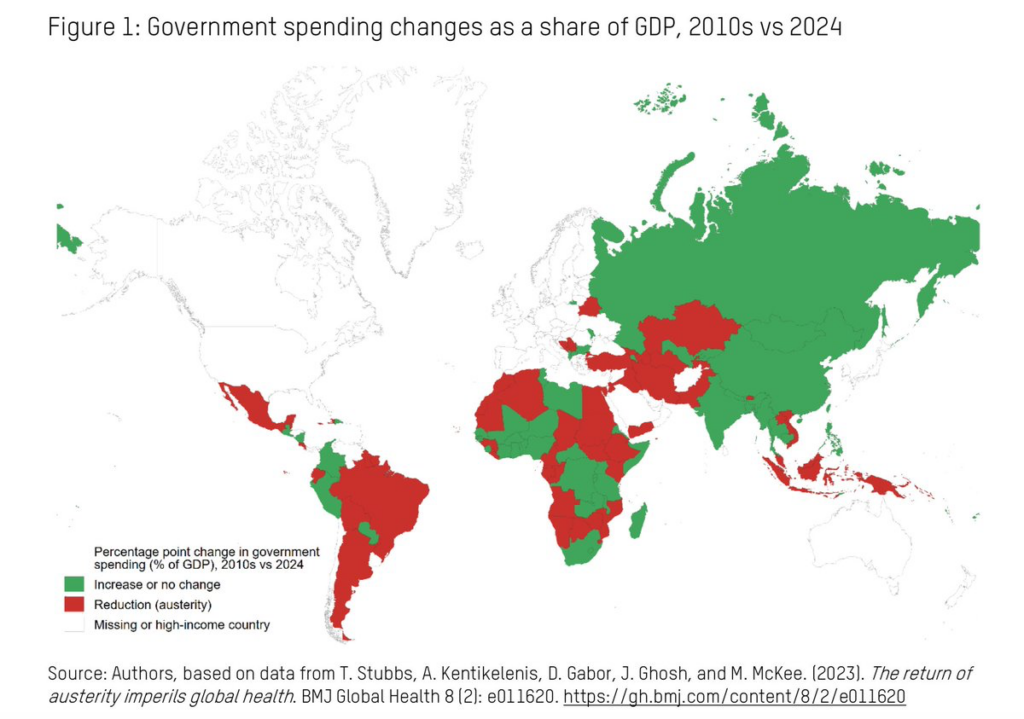
Since the pandemic began in 2020, the IMF has provided nearly $300 billion in financing to ninety-six countries, in many cases via rapid response facilities. By mid-2021, ninety-one of the 107 Covid-19 IMF loans either recommended or required countries to adopt austerity as a policy. By 2024, Oxfam researchers found that, “Fifty-nine out of 125 low- and middle-income countries (LMICs) are expected to spend less than during the 2010s, exposing a total of 2 billion people to the harmful consequences of budget cuts.”
Oxfam researchers also looked at the “unconditional” lending to the seventeen countries in traditional IMF programs in 2020 and 2021, and found that they were unsurprisingly, not unconditional. What was promised as emergency lending has now turned into a gigantic austerity drive.
The austerity that the IMF peddled in the 2010s devastated 600 million people in the North Atlantic. Over 6 billion people now live in the grip of austerity across all country income categories, according to an analysis by economists Isabel Ortiz and Matthew Cummins.
They identified government austerity policies such as targeting social protection (in 120 countries); cutting or capping the public-sector wage bill (in ninety-one countries); privatizing public services/reform of State-Owned Enterprises (SOEs) (in seventy-nine countries); pension reforms (in seventy-four countries); labor flexibilization reforms (in sixty countries); and cutting health expenditures (in sixteen countries). Many of those people live in countries outside of IMF lending programs or any program at all—but the Fund’s influence extends to those countries through signaling via its own pronouncements, precautionary programs and country monitoring.
Austerity does not cut debt-to-GDP ratios or help meet climate goals. It is costly and deadly. Slashing government spending reduces GDP which makes debt servicing yet more difficult. Crucially, austerity makes countries more fragile and less resilient to future shocks. When public health workers or firefighters lose their jobs now, who will put out the fires later?
Austerity can also trigger recessions that lay waste to lives. Recessions result in “sizable and highly significant increase in mortality,” found researchers at the Bank of International Settlements. That recession-mortality relationship is strongest in emerging and developing countries who suffer an extra 3.4 deaths per 1000 people during a recession. The devastating effects of 2010s austerity are now plain to see in the rich world, with falling life expectancy in the US and UK. The number of lives lost in developing countries from a world recession could be in the millions.
Last year’s IMF Fiscal Monitor, titled “Helping People Bounce Back,” aspired to a world in which governments are able “to ensure everyone has access to affordable food and to protect low-income households from rising inflation.” Of course, it added, this should not be accomplished through price controls, subsidies, or tax cuts, which would “be costly to the budget and ultimately ineffective.”
The Fund instead has prescribed, as standard since 2019, that the poorest should be protected during fiscal consolidation by implementing “social spending floors” that ringfence critical government spending areas like health and education.
Oxfam’s researchers analyzed all seventeen low- and middle-income countries that entered IMF programs in 2020-21, and found that social spending floors were nothing but a “fig leaf for austerity”. Most damningly, they find “for every dollar that the IMF provides to a poor country for social spending, it requires the country to cut four times more through austerity measures.”
Austerity holds back a big green investment push
The IMF has been clear that it sees climate as “macro critical” and hence can be included in its mandate to preserve financial stability. Again, though, its actions on the ground have remained stuck in the past.
Building emission-free generation and demand infrastructure will require capital, as much in developing countries as advanced economies. A report published in November by Vera Songwe of UNECA and Nick Stern of the LSE confirmed that roughly $2 trillion per year is needed for developing countries to meet climate goals. As recently as 2020, the IMF viewed decarbonization purely as a cost but an analysis it published in October that year found that net zero by 2050 would be positive for growth.
In its climate-related analysis and advice, the IMF still strongly pushes for carbon pricing as the central climate policy instrument. It does this even as western governments in high-income countries embrace “big push” investment approaches, and while research concludes that carbon pricing is insufficient (without accompanying regulation and investment) and politically unpopular.
As noted by an independent taskforce reviewing the IMF’s policies, convened at Boston University’s Global Development Policy Center, “the pursuit of net-zero pathways is expected to lead to high levels of public debt.”
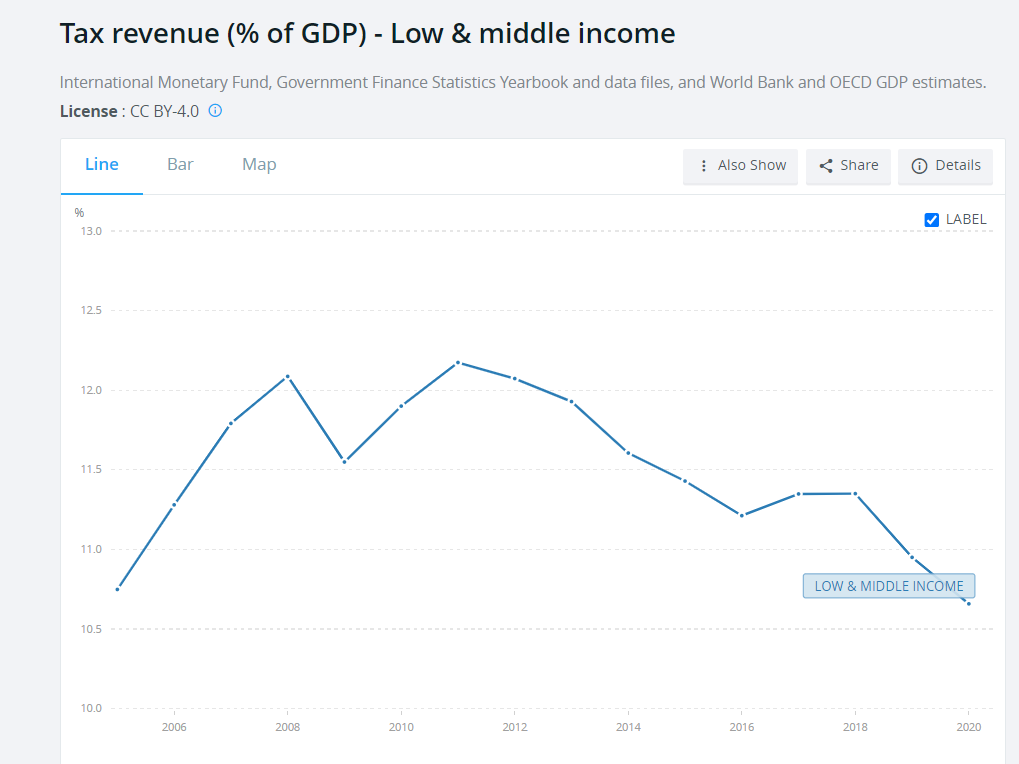
Taxes are an alternative to austerity
Source: World Bank
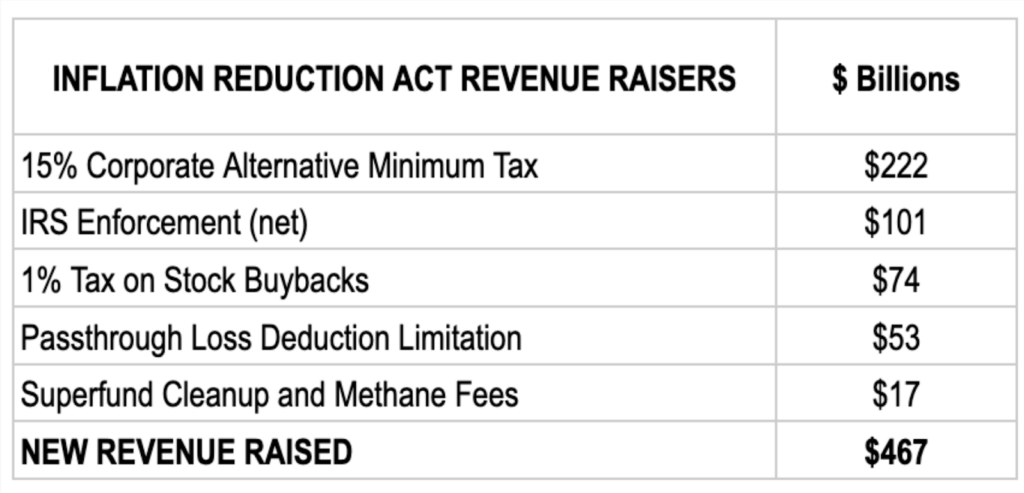
With tight public finances and corporate treasuries fattened on profits, governments should focus on raising revenues through taxation rather than cutting budgets. Though it has gone entirely unmentioned, the US Inflation Reduction Act is a tax bill: climate and healthcare spending is funded by taxing the rich. The IRA imposes a 15 percent corporate minimum tax and gives the IRS $80 billion in resources to go after tax dodgers. The US Treasury estimates that every dollar of tax-enforcement resources given to the IRS raises four dollars in revenue. The IRA also raises $74 billion in revenue by imposing a 1 percent financial transactions tax on stock buybacks.
Source: IRA Revenue estimates over 10 years. Americans for Tax Fairness analysis of Congressional Budget Office and Joint Committee on Taxation (link)
Similar policies are being raised in national parliaments around the world. In Argentina, a wealth tax on the wealthiest residents raises almost 0.5 percent of the country’s GDP ($2.4 billion), while Colombia’s left-wing government is undertaking a progressive taxation overhaul. Encouragingly, countries as varied as Italy, Mozambique, UK, and Bolivia have taxed windfall profits of energy companies to fund social services.
Richard Nephew, advisor to both the Obama and Biden administrations, candidly observed in his 2017 book that the outcome of sanctions depends on two factors: pain and resolve. The pain must be applied precisely and for maximum impact. Should the pressure point be missed or the injury blundered, sanctions may backfire, producing the perverse effect of merely steeling the target’s resolve.
The sanctions applied against Russia in response to its invasion of Ukraine signal a new era of economic coercion. Modern sanctions have typically been aimed at states on the periphery of the international order. By contrast, these have been issued against the world’s eleventh largest economy. In addition, Russia is a pivotal exporter of numerous vital commodities, a member of the Group of 20, and a permanent fixture on the UN Security Council. When the sanctions were issued, neither the aims nor the conditions for eventually revoking them were defined. Policymakers have spoken of requiring some Russian military retreat to end sanctions, but whether that means to positions as of February 2022 or January 2014 is unclear. In vaguer terms still, others have spoken of preventing Russia’s “destabilization of Ukraine” more broadly.
Pain
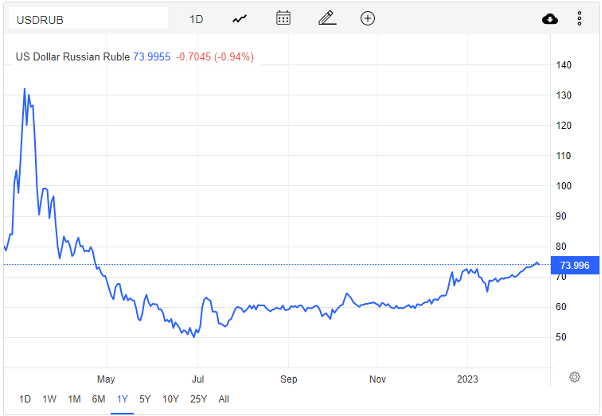
The pain administered thus far has been largely absorbed by its target. Contrary to the claims of the Biden administration, the sanctions against Russia are not “devastating their economy,” nor are they “crippling Putin’s ability to wage war,” as per the bombast of the UK government. The sanctions did not precipitate an immediate financial crisis, nor did the rouble collapse. Rather, the introduction of capital controls and restrictions on foreign exchange have stabilized the currency at its pre-invasion level.
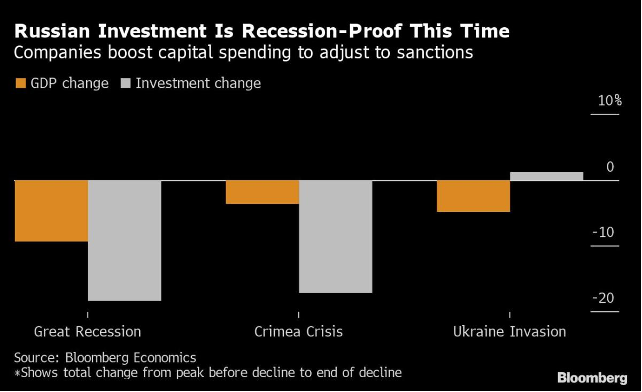
Despite the initial 2.2 percent hit to its GDP in 2022, the International Monetary Fund has now upgraded its outlook for Russia’s 2023 output, predicting an expansion of 0.3 percent this year and 2.1 percent in 2024, putting the country ahead of both Germany and the UK. Even the sanctions most likely to impact the Russian war machine, such as the restrictions on the semiconductors needed for the more advanced sections of Russia’s armory, have been alleviated by a mixture of purchases from the private sector, a transition away from western suppliers, and routing imports via intermediaries located within the Eurasian Economic Union.
Future historians will question the western coalition’s priorities. It took just four days from the invasion to freeze the Central Bank of Russia’s foreign exchange reserves, but more than eleven months to finalize two long-discussed price caps on Russian oil exports, with the G7 cap on oil-based products now beginning to have a further effect on the cap on Russian crude in December. Measures targeting the financial system had limited impact as Russia has been able to fall back on its vast trade surplus, the fourth largest in the world. The oil price caps are designed to cut into that surplus, but they have come late enough that Russia has been able to construct a “shadow fleet” of tankers and a sprawling network of intermediaries to help blunt the impact.
The sanctions will do long-term damage to the Russian economy’s ability to innovate, particularly through the disruption of technology transfer networks and the loss of western business expertise in complex energy projects such as the efforts to increase oil extraction in East Siberia. Going forward, the trade restrictions will also exacerbate the continued failure of the Russian armed forces to modernize. The war, however, is being fought in the present.
Resolve
Sanctions, Nephew notes, must hit a moving target. The larger that target the greater the resources it has to mitigate the effects. The basis of Russian resolve lay first in the astute reaction of its economic technocrats—Elvira Nabiullina’s decision to stay at the helm of the central bank brought much needed continuity and pragmatism to the stabilization effort, as ultra-hawkish monetary policy smothered the risk of runaway inflation. With the worst fears averted, Russian political economy shifted toward what political scientist Volodymyr Ishchenko has called “military Keynesianism.” This involved offering generous wages for conscripts and volunteer soldiers, building a vast public works program aimed at the reconstruction of newly annexed regions of southeastern Ukraine, and enlarging an already sprawling military-industrial complex. Expenditures are likely greater than 5 percent of GDP already.
As their western competitors recede in the domestic sphere, Russia’s national capitalists are consolidating, reflecting the nuanced and uneven real life consequences of sanctions often belied by the triumphant rhetoric that accompanies them. National business investment has been revitalized as companies reorient supply chains and substitute imports of foreign goods and technologies. Customers are still ordering burgers from the same staff in the same buildings that once housed McDonald’s, but the revenues now flow to Siberian billionaire Alexander Govor and his network of franchises, which operate under the name Vkusno i tochka (“Tasty and that’s it”).
Meanwhile, the Russian state has moved aggressively to circumvent sanctions. These are not merely short-term work-arounds, but rather lasting shifts in the economic geography of Eurasia. To take just one example, Russia and Iran are together spending up to $25 billion to create a 3,000 kilometer trade route stretching from Europe to the Indian Ocean, vastly shortcutting existing routes between the two countries. This project includes a $1 billion canal expansion project connecting the Volga River to the Sea of Azov, making inland waterways navigable year-round and easing congestion between the Black and Caspian Seas. The head of Russia’s Chamber of Commerce now talks of a “clear path” to Russia-Iran trade reaching $40 billion annually, up from $5 billion, and is pushing for a comprehensive free trade agreement to follow the recent $40 billion joint energy exploration deal between the National Iranian Oil Company and Russia’s Gazprom.
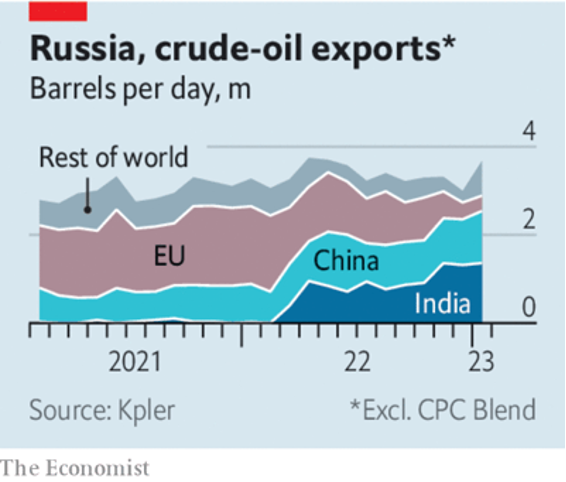
This rerouting of physical trade routes has been accompanied by wider shifts in the composition of global trade. India and China have stepped in to buy hydrocarbons at a discount that would once have been bound for Europe, ensuring that commodity revenues continue to flow to the Kremlin. While much has been made of the changing destinations of Urals crude, less has been said about other energy exports such as fuel oil. Commodity analysts estimate that China accepted a record 5.62 million barrels of Russian fuel oil in February, with India having purchased 4.5 million barrels the month before, three times its 2021 average purchase. The United Arab Emirates and Saudi Arabia have also drastically increased their purchases of Russian fuel oil to 3 million and nearly 2 million barrels per month, respectively, utilizing the cheap imports to power their energy system and preserve more domestically-produced crude for export.
Importantly, these new heavyweight purchases of Russian fossil fuels are increasingly being made in renminbi, rupees, and dirhams instead of the dollars that previously gave the US—through the Federal Reserve and the omnipresent Office of Foreign Assets Control—a lever to apply sanctions pressure. China now makes purchases from Gazprom half in roubles and half in renminbi, and President Xi Jinping used a speech in December to ask Gulf Cooperation Council (GCC) countries to use the Shanghai Petroleum and National Gas Exchange as a platform to carry out yuan settlement of oil and gas transactions.
Still, there will be no overnight de-dollarization of the international energy market. Bilateral trade flows between China, Russia and the GCC currently account for just 2 percent of global trade, but the essential components for what the recent meeting of the Shanghai Cooperation Organization called “the gradual increase in the share of national currencies in mutual settlements” are now in place.
Sanctions scholars have long posited the concept of a “black knight”: a “powerful or wealthy ally” of a target country whose “support can largely offset whatever deprivation results from sanctions themselves,” as Gary C. Hufbauer put it. Russia has not one black knight but several—a cavalry of the willing, driven less by chivalry than by a potent combination of mutual fear and material benefit.
In the face of Russian resolve, a growing consensus of experts have concluded that “peak” sanctions have probably passed. As Agathe Demarais put it, “American diplomats will be soon deprived of their favorite weapon to cajole, threaten, or punish US enemies.”
The hazard in this argument is that it underestimates the scale of the shift in the nature and purpose of sanctions that is currently underway. Western sanctions against Russia are not intended to “succeed” in the conventional sense, which is to persuade a target to reverse course on a contentious policy issue. They are better seen as a vehicle for demarcating economic territory, reorientating the map of western capitalism away from a regional hegemon now viewed as irredeemably unreliable. This is also the logic behind the US sanctions on China’s advanced technology sector, for which Washington is currently requesting support in European capitals, seeking to embed “strategic competition” for the long term. Such measures inevitably incur escalating responses from their targets, such as so-called “blocking statutes,” legislation increasingly favored in both Russia and China that makes complying with foreign sanctions illegal, thereby forcing multinational companies to choose sides.
Sanctions thus serve an important purpose for powerful factions within both capital and government, particularly national security establishments that have long fought internal battles against advocates of free trade and cosmopolitan economic integration. In this demarcation of the economic landscape, a highly volatile international order is emerging, characterized by slowly decoupling supply chains, weaponized interdependence, and perpetual low-grade financial conflict.
In 1970, Albert Hirschman described the options available to those witnessing a decaying status quo in the dichotomous terms of either “exit” or “voice.” The choice between them, he said, was dictated by loyalty. As international trade begins, in Olaf Scholz’s cautionary words, to “separate into competing blocs,” the global battle for that loyalty is heating up.
In an attempt to prevent the growing international voice against US economic dominance from escalating into a call for exit, Secretary of State Antony Blinken and Secretary of the Treasury Janet Yellen began 2023 by conducting a “listening tour” through Kenya, Nigeria, Senegal, Zambia, and South Africa. They urged compliance with US sanctions and emphasized both Russia’s blame for rising global food prices and China’s role as a barrier to debt relief for African countries. Meanwhile, Russian Foreign Minister Sergey Lavrov met with officials in Angola, Eswatini and Eritrea, pushing Russia’s trademark counter-offer of arms, advisors, and energy to an increasingly receptive audience.
But the world will not fold neatly into self-sufficient trade blocs led from Beijing, Washington, or Moscow. Although two-thirds of the global population live in countries that have not explicitly joined the sanctions regime against Russia, many financial institutions within those countries have attempted to strike a balancing act for fear of losing access to crucial dollar markets. This creates a quiet bifurcation, as leaders talk tough on US domination while their banks quietly submit to it. Turkey’s two largest lenders recently halted the use of Russia’s SWIFT alternative, Mir, following new guidance from the US Department of the Treasury, and even financial institutions in China and Hong Kong have mostly fallen into line. Elsewhere however, despite a tentative deal involving the Netherlands and Japan, the US appears to recognize it cannot bind the EU as a whole to its export controls against China. In wooing the undecided, Washington will continue to oscillate between promising constructive assistance and threatening to reimpose secondary sanctions.
Despite the deficiency in short-term pain inflicted against Russia and the resolve that has been precipitated, sanctions appear set to proliferate yet further—“dead but dominant” in the formulation of Jürgen Habermas. With all eyes on the US and China, less noticed is the increasing willingness with which the other power centers of the multipolar order—from Riyadh to Tokyo—have also weaponized trade in pursuit of political goals. This geoeconomic patchwork of state-led coercion, fragile alliances, and frequent countermeasures necessitates a more complex understanding of the role of sanctions, one that involves going beyond traditional determinants of success and instead asking of a given measure, like Cicero, “Cui bono?”
We live in a period of unparalleled financial complexity, and, as the history of recent decades has demonstrated, unparalleled financial risk. The recurring crises which plague the global economy have brought theorists of systemic instability to the fore. Key among them has been Hyman Minsky, whose framework for understanding financial market fragility takes a cyclical form. In his model, an excessive credit expansion (“displacement”) fuels a speculative bubble (“mania”) and causes “financial distress,” leading to credit contraction and the bursting of the bubble (“panic”).
The appeal of Minsky’s model lies, in part, in its structural perspective. In contrast to the general tendency to disregard financial market practices, Minsky leveraged institutional and legal structures of the financial markets to develop his views. A classic example is his interpretation of the 1980s debt crisis—unlike orthodox theories of profit determination based on productivity and market power, Minsky linked firms’ performance to the developments of the financial market. Specifically, he focused on the 1980s merger and acquisition mania and the structure of junk bonds. Whereas neoclassical theories priced cash flows based on profitability, Minsky analyzed them as claims on firms’ tangible assets, which were often used as collateral for junk bond loans. In the 1980s, financial distress thus enabled issuers to refrain from making payments, generating a liquidity crisis that neoclassical frameworks could not understand.
In Minsky’s vision, instability is an essential characteristic of market structure. Because credit expansion depends on the creation of private monetary instruments, and a panic involves a flight from such speculative assets towards safe, liquid monetary liabilities issued by a central bank, his framework opens the way for analyzing how the hierarchy of monetary liabilities influences the stability of the system as a whole.
By demonstrating how instability is generated, Minsky’s theory is a valuable guide to policymaking aimed at controlling systemic risk. However, most of the work inspired by Minsky uses it to understand instability after the fact. In examining the ex-ante formation of systemic risk, economists narrowly focus on the status of short-term funding and monitor a few liquidity or volatility indicators. Consequently, the structural and institutional aspects of derivative markets, payment systems, and the supply chain of collateral, remain a black box. I take the black box as my primary point of departure—examining the intricate workings of financial stability through market microstructures underlying financial flows.
The most established financial flow indicator is the flow of funds. Inspired by Walter Bagehot’s monetary world and Minsky’s market structure vision, macroeconomists began to examine sources and uses of short-term funding. Traditionally, the flow of funds was sufficient to capture the market structure’s resilience and financial stability. This is because the financial participants’ search for liquidity represented the real economy’s aggregate demand. However, the flow of funds alone cannot sufficiently reflect the institutional realities of the modern financial ecosystem.
For example, in a shadow banking system, the demands for short-term funding are not driven by transaction needs in the real economy. Instead, they reflect the state of the collateral supply chain, institutional aspects of the derivatives market, and the structure of payment systems. Therefore, to analyze financial stability, we should update the measure of financial flow and supplement the flow of funds with three new sets of flows: the flow of collateral, the flow of risk, and the flow of payments.
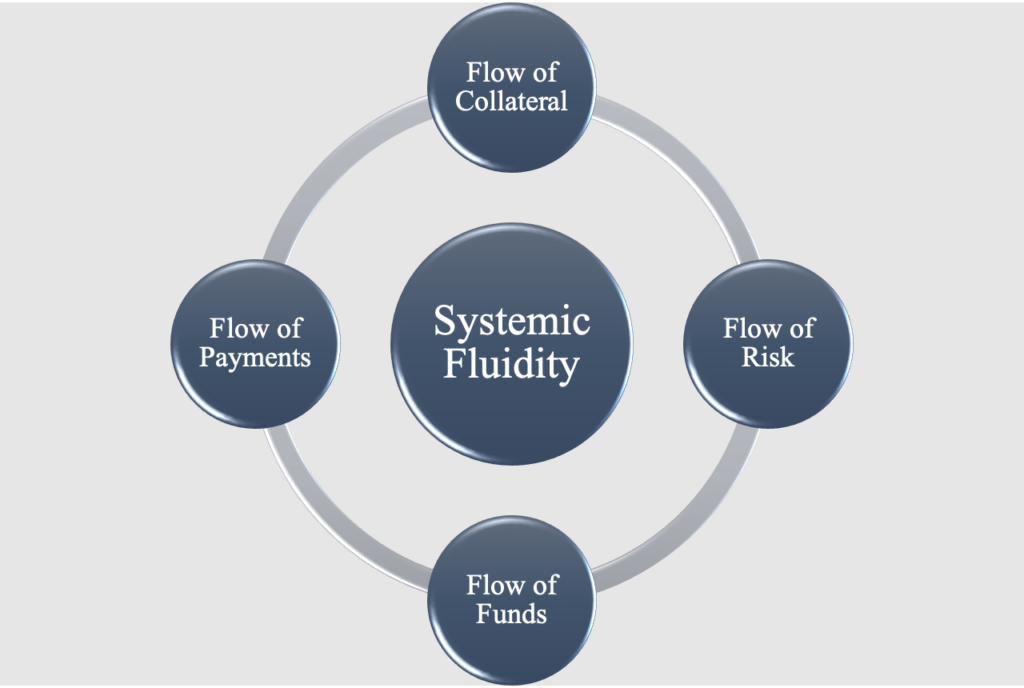
Together, these flows give insight into the microstructure of financial markets—the mechanisms which drive the willingness of financial participants to trade. The transactions resulting from this willingness contribute towards overall systemic fluidity.
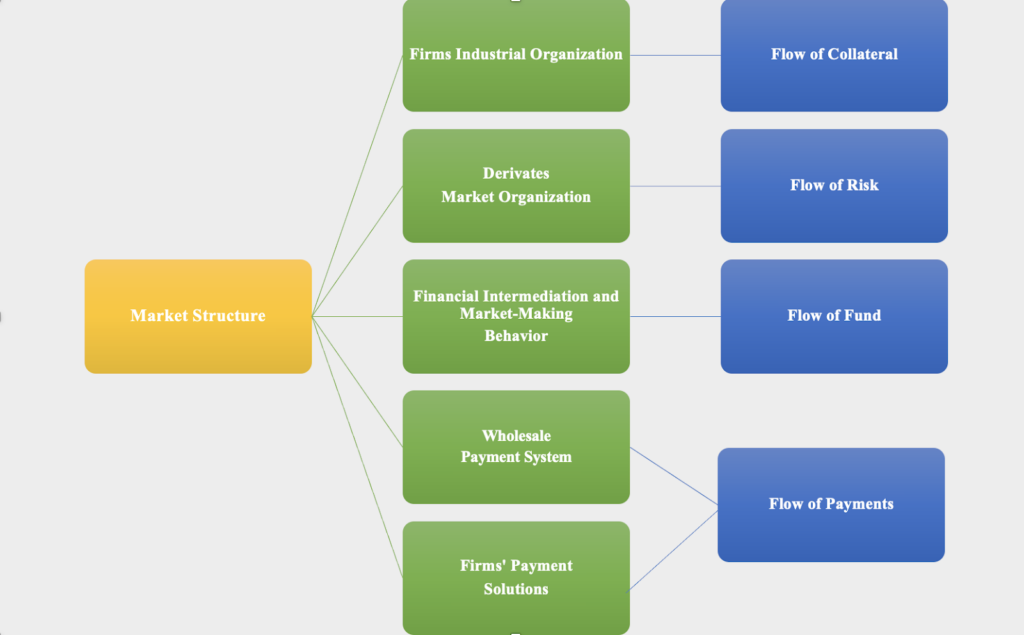
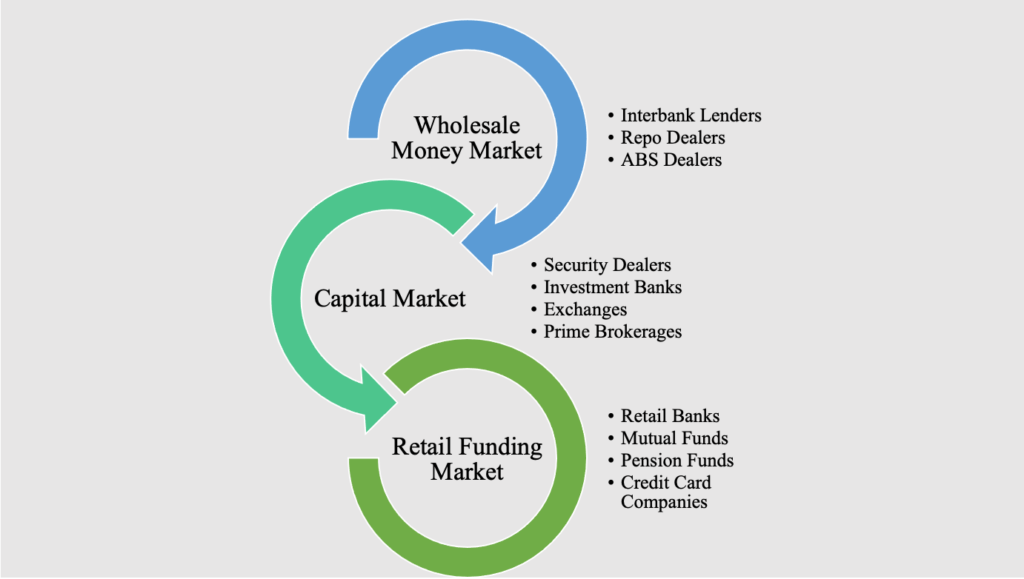
Crucially, this approach doesn’t take liquidity for granted. Instead, liquidity exists when the mechanisms underpinning transactions work seamlessly. While liquidity is necessary for systemic fluidity, it is not the only determinant. In the framework I present below, each element of systemic fluidity is linked to a particular market microstructure: collaterals move between different types of entities in accordance with firms’ industrial organization. The flow of risk depends on the institutional qualities of derivative markets, which, through derivative dealers, can distribute risk across the financial system. The flow of funds depends on the quality of liquidity in circulation, which in turn is shaped by the structure of the market for financial intermediation. Finally, the flow of payments depends on the tendency of two systemically important aspects of the payment infrastructure, the two-stage payment mechanism and firms’ payment solutions, that accumulate junk liquidity and siphon off high-quality claims.
Figure 1: Systemic Fluidity and Market Microstructures
Analyzing changes in market microstructure thus presents a constructive avenue through which to understand and predict the fluidity and stability of financial markets. By analyzing research outputs from key financial actors and reflecting on them with researchers from these institutions, this essay and accompanying posts aim to let the market speak in real time. It will leverage academic frameworks to cut through the many noises of market-generated narratives, differentiating structural, cyclical, and event-driven market shifts. In this first piece, I take a focused look at the relationship between financial flows and market microstructures in order to set the groundwork for analysis in subsequent articles.
Figure 2: The Four Elements of Systemic Fluidity
The flow of collateral
Transactions on wholesale capital markets are often secured by marketable collateral. Collaterals flow for different purposes, including secured funding, investment, short-selling, margin requirements, and lending by securities owners. The flow of these securities is a cornerstone of system-wide fluidity—if collaterals are not delivered on time or arranged cheaply, funding will evaporate.
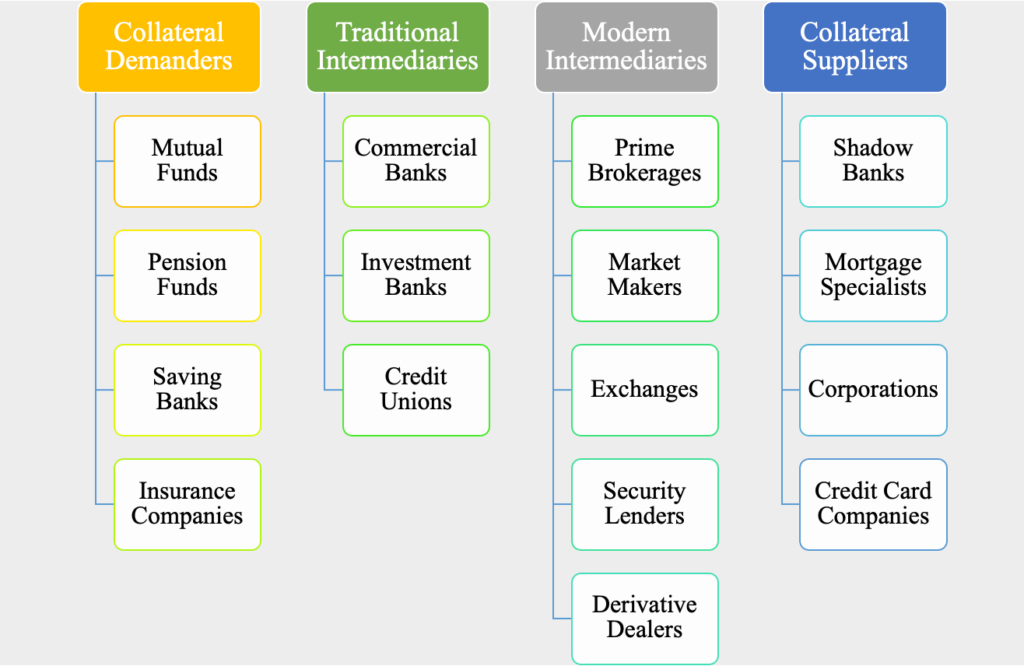
Classical financial stability models tend to focus on the role of financial intermediaries like broker-dealers in managing the securities market. But in reality, collaterals flow through a wide range of institutions with varying business models— including institutional investors, money market funds, asset managers, and securities firms. The economic structures and balance sheets of each of these institutions underpin the collateral supply chain.
Figure 3: Institutions and the Collateral Supply Chain
The collateral chain is essential for the functioning of the modern financial system, but it remains grossly understudied. Understanding the collateral supply chain requires outlining the particularities of each actor’s industrial organization, including its degree of market power, balance sheet positions, and interactions with market structure.
There has been a recent and burgeoning theoretical literature which argues that firms’ market power determines their willingness-to-pay for securities. This willingness-to-pay, in return, affects the resale value of securities used as collateral in the money market. In addition, it can change the market structure by influencing regulators’ behavior and other market practices. Our interest is in understanding the type of firm-level industrial organization strategies that affect the stability of overall market structures.
Financial firms may adjust their business strategies, as they do with Collateral Management and Assets and Liabilities Management (ALM), and actively shape collateral flows. Through collateral management processes, firms strategically match assets and liabilities or adjust the type of collaterals they accept from counterparties like banks, broker-dealers, insurance companies, hedge funds, and pension funds. These strategies can help maximize utility, achieve higher investment returns, and reduce counterparty risks at the firm level. At the market level, however, the adjustments can alter securities lending and investment activities by shaping the type of securities companies are willing to acquire and their willingness-to-pay.
In this way, firms’ business management practices can affect an entire industry. Indeed, the increase in securities lending post-2000, the secular decline in market-making post-2008 Great Financial Crisis, and the sell-off of the US Treasury securities in March 2020 are examples of the systemic impacts of such firm-level strategies. In viewing firm balance sheets as a pipeline of collateral flows, we can uncover hidden vulnerabilities underlying market operations. We can also understand how shocks are transmitted and amplified between different firms. Thus, combining the overlooked industrial organization of the non-intermediaries with that of the more well-known financial intermediaries helps pave the way to a new framework describing the financial system.
The flow of risk
Derivative markets are the key structure underlying risk distribution within the financial system, separating the flow of risks from the flow of collaterals. If firms were to lend their securities without proper hedging strategies, they would assume an unsecured and undiversified counterparty credit risk which may not obtain the risk manager’s approval. Institutional investors’ function as securities lenders partially stems from the existence of derivatives that transfer the risks to willing counterparties.
In turn, the availability of derivatives and hedging strategies depends on institutional aspects of the derivatives market, such as the market-making mechanisms, their legal structure, and financial engineering.
While derivative strategies are considered essential for firm-level risk management, they are often described as “financial weapons of mass destruction” and condemned as a “trigger” of the 2008-09 financial crisis. Derivatives are absent from balance sheets—having no initial value, they are not bought or sold, and consequently remain unrecorded by position takers.
But their absence from balance sheets is not the only attribute shaping derivatives’ net impact on systemic fluidity. Derivatives separate the flow of risks (foreign exchange, interest rate, and credit) from the flow of collateral. Thus, they strip risk from financial assets and become the parallel track required for shifting hedged collaterals across the financial industry. In this way, they transform collaterals into funding and enable market makers to provide liquidity. Derivative markets thus provide a market-based structure for risk management and collateral valuation.
Derivative positions also determine the fluidity of collaterals by reducing counterparty credit concerns and protecting against exposures. Financial instruments like US Treasury bonds can be traded as at least two separate instruments: they can be used as collateral to obtain short-term funding and make payments, or used as derivatives like interest rate swaps (IRS) and credit default swaps (CDS). The first shifts interest rate risks, and the second distributes the default risk from the issuer to the derivative holder.
In addition to enabling the flow of collateral and secure funding, derivatives also allow for the ongoing swap of IOUs in the form of cash. This parallel loan construction creates a web of hidden short-term debts which can pressure the traditional bank-based payment system both within and across borders.
For instance, interest rate swaps typically involve temporarily exchanging floating interest payments for fixed ones. Similarly, credit-default swaps require the derivatives issuer to make periodic payments to its counterparty as a kind of insurance premium. These payments parallel the debt issuers’ periodic interest payments, so that the time pattern of the derivatives holders’ payments mirror that of the issuers of debt securities.
The parallel loan structure of derivatives links them to system-wide liquidity and funding conditions. A mark-to-market financial engineering technique, in which investors pay for daily gains or losses according to changing asset value, makes derivatives’ actual cash flow commitments higher than their implied level. In doing so, it converts otherwise cash-rich institutions, such as pension funds, into vehicles of systemic liquidity risk.
Cash-pool investment vehicles like pension funds use derivative strategies to hedge significant pension plan liabilities against interest rate risks. Because they hold large cash pools, they simultaneously use derivative techniques such as Liability-Driven Investment (LDI) to earn higher yields. These institutional investors’ dual role in the derivative market exposes them to significant margin calls during large price swings. In this way, the cash-rich investors transform into vehicles of systemic liquidity vulnerabilities.
Finally, derivatives directly link financialized commodity markets with the broader financial system. Because derivative contracts in large part depend on commodities, fluctuation in their prices can generate excessive margin calls. Through a financialized business model, derivatives allow commodity traders to exploit their information advantage as the market makers. As non-financial corporations, however, they ultimately rely on bank funding. The mark-to-market nature of derivatives means that large swings in commodity prices can expose them to significant and frequent margin calls. In this way, commodity traders’ extensive usage of derivative strategies and over-reliance on bank funding can cause system-wide liquidity vulnerabilities.
Derivatives are thought to be toxic for overall financial stability, especially after 2008. However, derivatives mediate broader stability in far more nuanced ways. Their concealment of actual leverage in circulation, off-balance sheet calculation, and unpredictable margin calls can make these instruments dangerous. However, derivatives are also the backbone of secured funding. These instruments strip risks of long-term securities, convert them into collateral, and become the source of immediate liquidity. Furthermore, derivatives can be valuable for managing business risks and expanding operations with relative safety.
An institutional approach toward the derivatives market provides a robust framework for examining the risks and benefits of these instruments for financial stability. The goal is to design a type of derivatives market that becomes vital plumbing for the simultaneous flows of collateral and risk in the system. This aspect, which is relegated to the background in most financial stability frameworks, will be a critical parameter of our approach when assessing the systemic impacts of derivatives.
A narrative of the crisis that overstates the threat of derivatives can lead to policies that excessively limit and depress their use. The outcome will not be a more resilient financial system but one in which various business risks that have been hedged with derivatives will sprout up in their absence.
The flow of funds
Unlike collateral flows, which are delivered in the long-term capital market, funding is provided in the short-term money market. The seamlessness with which funding flows across the financial system depends in large part on the quality of monetary liabilities in circulation. The changing composition of players and activities all shape this quality.
In the financial ecosystem, short-term monetary liabilities are produced, traded, and priced in the market for financial intermediation. The microstructure of this funding market is determined by how traders on the sell- and buy-side share their responsibilities and roles. Liquidity providers (banks, dealers and brokers) and liquidity takers (asset managers) form the pipeline that moves funds across the system. Thus, the resilience of this pipeline depends on the dynamics in each of these spheres.
This financial intermediation process is performed by various players operating at different levels of the supply chain of funds. Nonetheless, regarding the degree of “cash equivalence,” not all players on the sell-side of funding instruments provide the same quality. The hierarchy of liquidity providers, ranked by their business model and the type of intermediation, is an essential characteristic of the financial intermediation industry. For instance, a traditional financial intermediary simply connects cash-rich to cash-deficit agents without making the market for funding. Similarly, the modern brokerage business only connects different counterparties and provides information about fair prices through financial analysis. These sell-side entities provide conditional liquidity by connecting traders with opposing needs.
By contrast, market makers, including dealers, are the source of continuous liquidity. This is because they are unbiased liquidity providers who trade with any interested trader. When a dealer absorbs monetary instruments onto its own balance sheets, it creates a position in those instruments. In doing so, it establishes long positions in certain assets and short ones in others—if a repo dealer borrows cash from an overnight market and lends it to the term (i.e., three-month) market, it has a long position in term repo loans and a short position in overnight cash loans.
This inventory position generates risks by preserving long term monetary liabilities. Dealers can shed this risk by trading out the claims if circumstances allow. By using their balance sheets to absorb unwanted inventories in order to acquire rewards, dealers make markets. Because they provide continuous liquidity, prices, and liquidity risk premia, they are at the top of the sell-side hierarchy.
Figure 4: The Vertical Integration of the Sell-Side of Financial Intermediation
The buy-side’s access to funding is equally hierarchical. Monetary liabilities in circulation have varying levels of quality, and high quality funding is unequally distributed. Financial firms at the top of the hierarchy have access to highly convertible and liquid monetary instruments, including central bank reserves. Others, however, have to pick from a menu of shadow funds, which are expensive and provided by low-rated and unstable liquidity providers.
In normal times, the elasticity of credit and frequency with which shadow funds are traded blurs the buy-side hierarchy. But during a crisis, the double hierarchies of the sell-side and buy-side bind simultaneously and to the fullest extent. Not only does the distinction between the sell-side and buy-side become unmistakable, but the different qualities of liquidities in circulation also become evident. When this happens, the pipeline and infrastructure that circulates funding, in dynamics between the sell-side and buy-side, become the vessel for moving liquidity risk across the system.
The linkage between the sell-side and buy-side, rather than the resilience of a few systemically important financial institutions, can aggravate an idiosyncratic funding problem into a system-wide liquidity crisis. Understanding the linkages between funding, collateral, and derivatives of the financial web is necessary for exploring the financial system as a dynamic process rather than a snapshot. Rather than focusing on cash and balance sheet items, our systemic fluidity framework shows these complex movements and shifts.
The flow of payment
The payment system is the real life stress test of the system-wide tendency to hoard junk liquidity and siphon off high-quality claims. The financial system continually transforms public claims into private claims through two different channels: the payment processing system and firms’ liquidity and payment solutions.
The former is composed of payment and settlement, where the quality of claims in the first stage is usually lower than that in the final stage. The latter continually transforms the liquidity and maturity of firm balance sheets. Both tend to hoard bogus liquidity and siphon off public liquidity, but the system’s overall quality depends on the trust that relatively safe and secured monetary liabilities exist at every layer. These claims are made by collateral-taking private entities or the government’s presence as a lender of last resort.
The liquidity transformation that occurs in the system has two separate roots. The first component is the intrinsic feature of the payment system. Every payment starts and ends with liquidity. However, the quality of funding instruments required to settle each stage differs. Payments are processed in two phases. The first stage, known as the payment stage, is when the promise to make the final payment is made. These promises to pay are usually funded by exchanging collateral (secured funding) or short-term monetary liabilities (unsecured financing). At this stage, at each layer of the hierarchy, payments happen as a conversion of the lower-quality liabilities into higher-quality ones (issued by entities at the higher layer of the sell-side hierarchy). In the first stage, the hierarchical structure of funding instruments remains invisible.
However, this hierarchy becomes binding in the final stage of payment. At this stage, all the net payments should be settled and cleared. The final clearance happens only if the payment system can convert the remaining payments into the highest-quality form of money, such as the central bank’s reserve or cash. A systemic problem will happen if this convertibility is not economical. In this case, the conversion, if it happens, will be at a penalty or negotiable at prices lower than par and cause system-wide missed payments. The continuity of liquidity transformation in the first and last stages of payments determines the resilience of payment flows. The payment flows seamlessly only if there is a systemic trust that relatively safe and secured monetary liabilities exist at every layer.
The second channel reflects the corporates’ cash management strategies. Various types of financial and non-financial participants are involved in the payments ecosystem. Importantly, all these large firms use somewhat similar liquidity and payment solutions to meet their daily cash flow constraints. For instance, the two core and standard liquidity management techniques are netting and cash pooling. Netting aims to reduce funds transfer between subsidiaries or separate companies by settling the funds to a net amount. Cash pooling allows enterprises to combine positive and negative positions from various bank accounts into one account. This aims to reduce short-term borrowing costs and maximize returns on short-term cash. Corporate treasurers’ payment solutions, an often overlooked aspect of systemic risk, link the business models of otherwise wildly divergent firms with each other. As a result, the liquidity transformation that happens at the firm level can leave industry-level footprints on the payments system.
Corporate treasurers manage liquidity and payment costs by not leaving liquid assets uninvested for at least two reasons. First, the monetary instruments earn very low-interest rates. Second, the wholesale cash is uninsured and exposes the corporates to credit risk. If and when funding is required to ensure the payment accounts remain in a positive balance position, they convert these investments back to more cash-like instruments. As a result, they change the level of liquidity transformation daily and expose the system to systemic forecasting errors.
Through channels such as “payment system” and “firms’ liquidity and payment solutions,” the financial ecosystem transforms public (high-quality) claims into private (lower-quality) ones. Many transformations are taking place in the complex payment system infrastructure. The two-stage payment mechanism is based on an inherent mismatch between the quality of the claims at the different layers. The type of acceptable claim in the first stage, dubbed the “payment” stage, is usually of a lower quality than in the second stage, called the “settlement” stage. In addition to the black box of the payment system, and at a firm level, treasurers’ liquidity and payment solutions enhance the liquidity mismatch between their balance sheets’ asset and liability sides. From a holistic perspective, the payment system is built on a tendency to hoard bogus liquidity and siphon off public liquidity. In this environment, the market structure’s quality depends on the “trust” that relatively safe and liquid claims exist at every stage. Such trust ultimately depends on the willingness of collateral-taking private entities or the central banks to extend high-quality liquidity.
In standard times, these strategies might not be consequential. Large corporates have access to short-term money market funding. In this system, money market dealers act as the ultimate corporate treasurers and correct their cash flow miscalculations. In doing so, money market dealers become the linkage between payment flows and short-term funding. In crisis times, however, this link might break. Under such circumstances, market makers usually exit the market. In this case, the full force of the liquidity mismatch embedded in the financial ecosystem becomes visible to everyone. Corporate treasuries’ liquidity and payment strategies can expand the current level of liquidity transformation in the ecosystem and make its management unsustainable. In such circumstances, the payment system that inherently depends on the system-wide ability to manage such transformation will break down.
Conclusion
Although invisible, market microstructure is the infrastructure underlying the financial system. In particular, its destabilizing dynamics can vividly disrupt the financial system’s fluidity captured by the shifting nature of collateral, the distribution of risk, the transmission of funding, and flow of payments. Although these four pillars of systemic fluidity can be examined individually, they are inseparable features of real world market structure. Forthcoming posts will delve into the industrial organization of firms, the dealing mechanisms and engineering of derivatives, the hierarchies of financial intermediation, and the structure of the payments system. Instead of monitoring liquidity and volatility indicators, we look inside the black box of the market structure, where the pressing concerns of market participants and regulators are found.
The founding myth of modern Germany can be traced back to June 20, 1948, when Ludwig Erhard, economic director of the Anglo-American occupation zone in Germany, created the Deutsche Mark. To stabilize the new currency, he paired the paper issue with the removal of price controls. By spring 1949, German production rose from 51 percent to 78 percent of its 1936 level. Over the next eleven years, GDP grew at an annual average of over seven percent.
In this account, Wirtschaftswunder, the German postwar economic miracle, emerged through a reduction in the quantity of paper money (the old Reichsmark was redeemed at a 10:1 ratio), the freeing of prices, and the unleashing of the power of markets. Erhard himself invoked this parable to describe the incipient business-led boom—words that remain etched in German and European law—the social market economy.
This neoliberal interpretation of postwar German history holds that economic stabilization lies with those who can guarantee market-determined prices. Germany’s ordoliberal tradition is claimed to have built a kinder, gentler neoliberalism, accepting within its boundaries what in America came to be known as the “welfare state.” In political speeches, in teaching materials and newspaper articles, in TV documentaries, and in an ever-growing pile of books, commemorative publications, and specialist essays, this economic constitution is invoked and celebrated. The market-hagiografic documentary Commanding Heights (2002), based on Daniel Yergin and Joseph Stanislaw’s history of the global political economy during the twentieth century, depicts Erhard’s currency reform as the only “gleam of light” in a dark era of planned economies and price controls.1With these words Hayek is cited in the PBS-series (<)em(>)Commanding Heights. The Battle for the World Economy. Episode One: The Battle of Ideas(<)/em(>). Documentary, Min. 49-50. Transcript at:(<)a href='https://www.pbs.org/wgbh/commandingheights/shared/minitext/tr_show01.html' target='_blank' rel='noreferrer noopener'(>) https://www.pbs.org/wgbh/commandingheights/shared/minitext/tr_show01.html(<)/a(>) , Chapter 8 (end). To this day, sound money and privately set prices are guiding principles of German economic policy. Where other nations celebrate their revolutions, their Independence Days, and their heroes, Germany celebrates the “social market economy” and the twentieth of June 1948.2Michel Foucault spoke of a new form of temporality in West-Germany after the second World War. Not history, but growth counts, Michel Foucault (2004): (<)em(>)Die Geburt der Biopolitik. Vorlesung am Collège de France (<)/em(>)1978–1979, Frankfurt/M., S. 112–299, S. 126. In a standard account of German Economic History by Werner Abelshauser the introduction reads “German history is above all economic history,” Werner Abelshauser (2005): Deutsche Wirtschaftsgeschichte seit 1945, Bonn, S. 11.
There’s only one problem: the narrative is a myth. Erhard’s price decontrol was a failure, quickly met by revolt from below, which forced the West German state to once again control core prices. It was this politicization of prices—not Erhard’s unleashing of the market—that helped form the institutional basis for the Wirtschaftwunder. If the German market economy was really made social, this wasn’t thanks to the benevolence of enlightened Christian Democrats (CDU). Rather, the so-called “social market economy” was a concession made by the CDU to the popular movements which had forcefully repudiated Erhard’s market fundamentalism and fought for a larger share of West German gains in the years after the war.
Currency reform
Ludwig Erhard came to office as the “Wirtschaftsdirektor” (later Secretary of Commerce and Federal Minister for Economic Affairs) on March 2, 1948. A champion of the free market, he promoted competition. In his own formulation, the “market as such is social,” meaning that it had no requirement to be further socialized by mechanisms like price controls.3This quote of Ludwig is brought to us by Friedrich von Hayek in an Interview, so take it with a grain of salt. “Friedrich Hayek on the Crisis,” see Encounter, Vol. 60-61, May 1983, page 55.
The introduction of the Deutsche Mark in June 1948 was not a West German invention, as is often contended. Rather, it was conceived and implemented by the Allies. To eliminate the money surplus from World War II, financial assets were devalued by 93.5 percent. Thus, ten Reichsmarks turned into 0.65 D-Mark. Overnight, savers were largely expropriated, while owners of assets such as real estate, companies, or stocks with semi-finished products hardly suffered any losses.
With the new currency in place, Erhard was in a position to pursue a “free market economy.” He exempted major commodities from management and removed important price controls over food and consumer goods. In doing so, he explicitly neglected advice from members of his own administration, Leonhard Miksch in particular. The latter intervened by telephone even on the day before the changes came to work. He urged to refrain from the releases of the “politically and socially sensitive prices” like textiles and shoes.4Aktenvermerk von Miksch vom 21. Juni 1948, BA Z8/220, page 140. It was in vain. However, even after June 20, the state continued to regulate rents, energy, and some basic foodstuffs.
With controls removed, prices on basic consumer goods unsurprisingly skyrocketed. They continued to rise in the following weeks. At the same time, the wage freeze from the Third Reich had remained in effect and wasn’t lifted until November 1948, further reducing workers’ purchasing power. On top of that, West Germans were deprived of accessing their cash savings. In response, Erhard rehearsed the usual neoliberal mantra that prices would “level off” or “balance” (“einpendeln”) over time, which did not happen.5Fuhrmann, Uwe. (<)a href='https://hcommons.org/deposits/objects/hc:28984/datastreams/CONTENT/content' target='_blank' rel='noreferrer noopener'(>)(<)em(>)Die Entstehung der ‘Sozialen Marktwirtschaft’ 1948/49 Entstehung(<)/em(>)(<)/a(>), (UVK Verlagsgesellschaft mbH: Constance and Munich, 2017) S. 166. In the first twenty days after the currency reform, the prices of shoes, housewares, and vegetables and fruits rose by fifty to two hundred percent, eggs even more. People feared for their basic supplies and denounced the blatant inequalities which came to light. Months went by, and the situation did not improve.6Fuhrmann, Entstehung, S. 167-169.
The result was a wave of social and political unrest in the autumn of 1948. Protests took place in almost every city. Market stalls were looted and large-scale consumer boycotts or “strikes” took place across the country. Housewives “socialized” eggs, which were in particularly high demand. The unions became involved, pushing the anti-inflation movement to a new level.
On October 28, 1948, a crowd of 80,000 people took to the streets in Stuttgart during working hours to protest the crisis. German and American police battalions used tear gas, bayonets, and armored vehicles to bring the angry crowd under control. The US-Constabulary, newly trained for riot control, was also deployed. A curfew was imposed. Events culminated on November 12, when a general strike was called—the last to date in Germany. More than nine million people—almost eighty percent of the wage-earning public—stopped work to protest Erhard’s free market.7For this large wave of social unrest see Fuhrmann, Entstehung, 172-230.
Political interventions
These events put great pressure on West-German politicians. Ultimately, Erhard and other CDU officials were forced to change policy course. In September, the Bizone government pulled the emergency brake in terms of economic policy. This was followed by a discursive shift some weeks later.
To counter the fatal dynamics of privately determined “free” prices, the government reintroduced controls through the backdoor. Tables of “reasonable” prices were published; fines were introduced for all those that contravened the new decrees.8Fuhrmann, Entstehung, 233-238. Moreover, decrees were issued to steer profit margins and target price gouging.
When government price schedules, voluntary exhortations, and even fines failed to stabilize consumer markets, production programs were implemented. The government rolled out a program to refurbish discarded military goods for civilian use. But as these new products flooded the markets, their prices only adjusted to those established by the decontrol fiasco. Only an executive order imposing fixed prices and fixed profit margins reestablished some order.
A proper production program, inspired by the British “Utility Goods” program—previously smeared in Germany as socialist—was implemented with particular success. The Jedermannprogramm (“Everyman Program”), delivered shoes and clothes of standardized quality to customers at predetermined low prices. Administrative distribution of resources—non-price rationing by the government of industrial materials favoring those companies participating—was the lever to enforce entrepreneurial participation.9Fuhrmann, Entstehung, 238-252. By the beginning of 1949, more than half of all consumer goods sold across the counter were once again at fixed prices—a victory of the broad social repudiation of Erhard’s free-market policies.10Gioia-Olivia Karnagel (1999): Jedermann-Programm, in: Wolfgang Benz (Hg.): Deutschland unter alliierter Besatzung 1945–1949/55, Berlin, 351–353, 351.
The “social market economy”
It was at this same time that the term “social market economy” first appeared in public discourse. Originally used by Erhard in 1949, the term was quickly taken up by his opponents in the Social Democratic Party (SPD) and the trade unions as a slogan to use against the different advocates of the free market economy. Transposed to the language of the left, the idea of a social-market economy came to encapsulate the demand for more socially-oriented economic policy, which in turn was backed by strikes and demonstrations.11Fuhrmann, Entstehung, 259-295.
The CDU’s Hermann Pünder then adopted the term. Completely unknown today, Pünder was Erhard’s superior and the highest German official in the Western zones at the time. Pressured by the forthcoming general strike, he claimed in Parliament on November 10, 1948, two days before the national work stoppage, that the government would “not create and operate a free market economy, but only a social market economy”—and had allegedly always done so. An impressing self-deception—or a blatant lie. Pünder afterwards compiled a corresponding brochure titled “Our Social Market Economy” and promoted this new political watchword within the CDU.12Fuhrmann, Entstehung, 287-289; 298.
In February 1949, as the CDU began preparations for the first election campaign in the coming Federal Republic, Erhard had little choice but to substitute the term “social market economy”for the free market. But though the language had changed, his convictions had not. Again, his speeches returned to the old mantras: “Only the market economy is social.”13Sitzung des Zonenausschusses der CDU der britischen Zone am 24. und 25. Februar 1949 in Königswinter, edited in: Helmuth Pütz (Bearb.), Konrad Adenauer und die CDU der britischen Besatzungszone 1946 – 1949; Dokumente zur Gründungsgeschichte der CDU Deutschlands, hgg. von der Konrad-Adenauer-Stiftung, 775-865, quote 846.
When CDU Chairman and later Chancellor Konrad Adenauer proposed “Planwirtschaft oder Marktwirtschaft” (“planned economy or market economy”) to describe the party’s program in the coming election campaign, Johannes Albers, a representative of the CDU’s workers’ wing, quickly intervened with a “Social!” shoutout. This is why Adenauer proclaimed “social market economy” as the guideline, rather than the adjective-less “market economy.” It was officially decided to focus the election campaign on the striking formula “social market economy or bureaucratic planned economy.”14Fuhrmann, Entstehung, 300-303; For quote see Pütz, 858.
The result was the “Düsseldorf Guidelines,” published on July 15, 1949, which served the CDU as a platform for the campaign for the first federal election in August 1949. The fact that the CDU made the “social market economy” its program cannot be understood, however, without the outcome of the trust in markets, social uprisings, the numerous strikes, and Albers’s heckling.
By June 1949, taking stock of the popular success that the “social market economy” was having across the electorate, Erhard wanted to stake ownership of the idea, claiming that he alone had “coined” the term.15“Mitschrift einer Rede Erhards zur gegenwärtigen Wirtschaftslage vor dem Wirtschaftspolitischen Ausschuss der CDU in Hagen-Haspe u. Detmold [sic!]” am 2. Juni 1949, Bundesarchiv N1278/163, page 5. It was this version of events that rapidly gained traction, ultimately becoming the authoritative with the 1957 publication of Erhard’s bestseller, Prosperity for All. This myth has now persisted for over six decades.
Today, the “social market economy” is enshrined in the Lisbon Treaty—and thus in the whole of Europe—as a guiding principle (“common provision”) of continental government. The history of its emergence, however, remains obscured, particularly the role of the labor struggles and social movements that repudiated Erhard’s market fundamentalism in a conscious effort to make the economy more social.
At the seventy-fifth anniversary of Erhard’s monetary reform, it is important to correct the narrative. Rejecting Erhard’s notion of a free market economy, Germany’s last general strike represented a fierce battle with the political order and achieved major concessions that define Germany’s economy today. That the reforms’ catastrophic consequences required the CDU to embark on a policy U-turn demonstrates both the centrality of price setting to economic and political stability and, crucially, the significance of popular protest in securing those measures in the first place.
Comments Off on Mercantilist Deals of the Great Powers
This is the twelfth edition of The Polycrisis newsletter, written by Kate Mackenzie and Tim Sahay. Subscribe here to get it in your inbox.
The maiden flight of a new cargo route between Shenzhen and São Paulo took off on Monday as European Commission President Ursula von der Leyen and France’s Emmanuel Macron prepared to travel to Beijing. US Vice President Kamala Harris has just been in Africa, attempting to avoid talking about China. Next week, Brazil’s President Lula and an entourage of hundreds of local business people will travel to the Chinese capital with plans to sign at least twenty bilateral agreements.
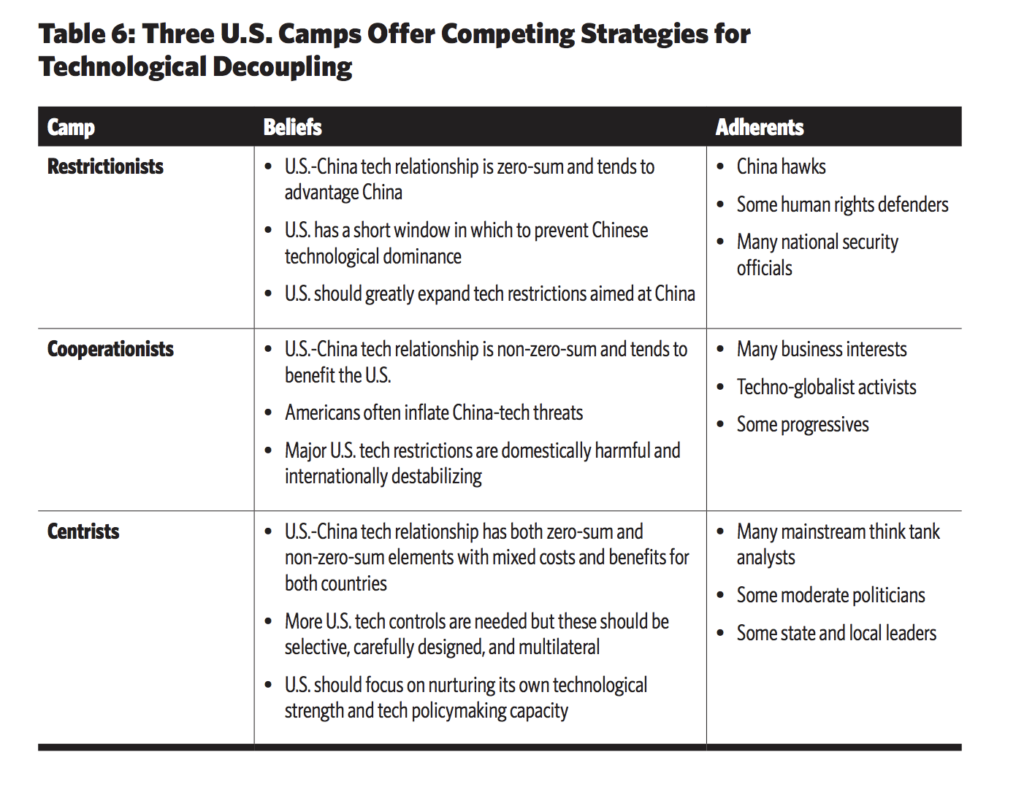
Each of these diplomatic journeys are the result of growing preoccupations with industrial policy, fragmentation, and the energy transition thanks to tensions around China and Russia. Trade flows, supply chains, and entire industries are rapidly being reorganized. Free trade led by “cooperative factions” in key countries has given way to “friend-shoring” led by “restrictionist” factions, largely on grounds of national security. New policies on export controls, visa bans, investment blocks, and sanctions are redirecting the flow of goods and people. US Allies, adversaries, and firms face hard questions: Who can invest in your country? Who can you sell to? What can and can’t you sell? Which countries do you risk arrest for trading with?
Table from US-China Technological “decoupling”: a strategy and policy framework by Jon Bateman (Carnegie Endowment for International Peace, 2022).
Europe, having dramatically cut its reliance on Russian gas within the space of months, still faces challenges around its own energy security and its place in this latest industrial revolution.
The EU was alarmed by the IRA’s strict Made in America requirements on the components, parts, and assembly required to qualify for the $7,500 consumer tax credit on each electric vehicle. Tense negotiations over the last six months resulted in the announcement of a far reaching EU-US agreement. The Biden administration has overruled a protectionist Congress and allowed the EU, Japan, and South Korea to source processed minerals from home, assemble them into batteries, and then get reduced consumer subsidies when selling them into the American market. Senator Joe Manchin, however, is not happy with the US Treasury battery rules. “American tax dollars should not be used to support manufacturing jobs overseas,” he said. “It is a pathetic excuse to spend more tax payer dollars as quickly as possible and further cedes control to the Chinese Communist Party in the process.”
Europe’s own stance towards China is more fragmented still. Cooperative factions in the bloc remain more powerful than restrictionist factions. “Our relationship with China is far too important to be put at risk by failing to clearly set the terms of a healthy engagement…I believe it is neither viable—nor in Europe’s interest—to decouple from China,” said European Commission President von der Leyen in her agenda-setting speech last week.
The European Commission’s attempts to align with restrictionist American interests are not supported by member states like Germany or France, whose leaders Olaf Scholz and Emmanuel Macron are opposed to national champion firms like Volkswagen, BASF, Alstom, and Airbus losing their China market. Von der Leyen wants member states to “derisk,” not decouple, from China, by controlling outbound investment for dual-use technologies like artificial intelligence or biotech that can be put to civilian and military purposes. On green technology, the EU has ambitious targets for local production (to substitute current sourcing from China) in its new Net Zero Industry Act. In contrast to the IRA, however, these targets remain unfunded.
Car manufacturing will have an outsize role in this pivotal juncture, perhaps even more so than the petrostates we covered in our last newsletter. In the US, the administration is walking a line between Congressional desires to promote US jobs and keeping big car manufacturing allies on board with its foreign policy goal of containing China.
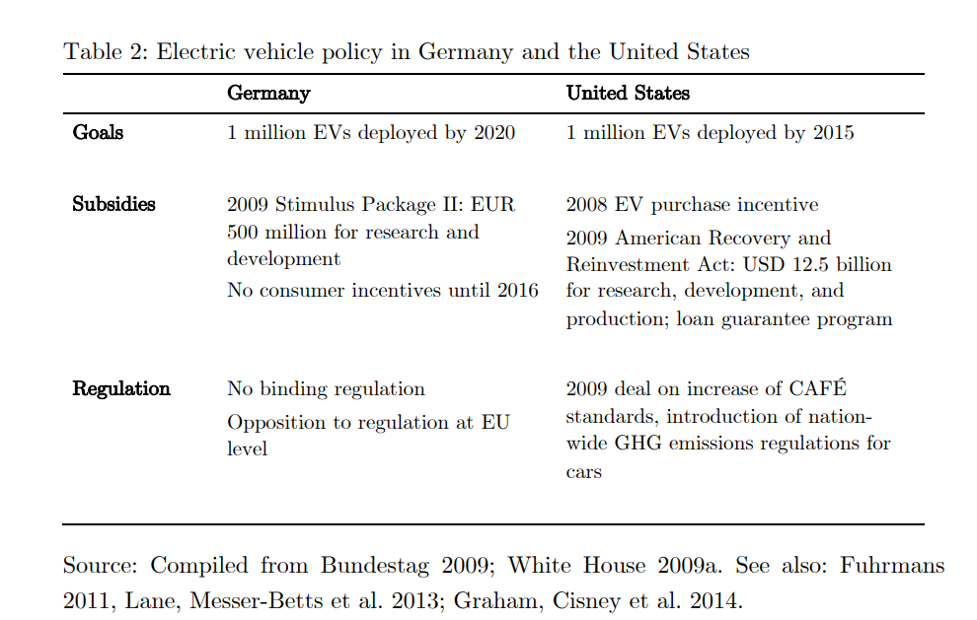
Fresh from forcing Germany’s coalition government to exempt synthetic e-fuels in the EU ban on internal combustion engines by 2035, the German car industry has strong views on relations with China. The powerful sector is enmeshed with China’s domestic automotive landscape through dozens of local plants and joint ventures. Besides, the country is the biggest source of profit for Mercedes, VW, and BMW. Can the restrictionists win against cooperationists? In 2022, Germany’s Ifo Institute surveyed roughly 4,000 national firms about their import relationships with China. Four out of five firms wanted to reduce their imports of Chinese inputs and buy more inputs from European countries.
German automakers might have other problems in China. EV sales there are growing rapidly, while foreign car brand sales are falling. Neither of these bode well for Germany, which has consistently dragged its feet on electrification.
Table from Jonas Meckling & Jonas Nahm (2018), “When do states disrupt industries?” Electric cars and the politics of innovation,” Review of International Political Economy, 25:4, 505-529.
Developing countries push back
For their part, countries in the global South are cautious about getting caught between bigger powers. They point to the escalating Cold War that is breaking down the free movement of goods, technology, and people. Shortages of food, energy, money, and technology have all intensified because of Covid-19 and Russia’s invasion of Ukraine. Can they risk a full blown war between the US and China? Can they risk losing export markets where they earn precious hard currency during a worsening global debt crisis? The IMF’s latest report on fragmentation estimates that 2 percent of world economic output could be knocked out, with losses rising to 7 percent for developing countries. The new Cold War is going to hurt trade, migration, capital flows, and technology diffusion. Losing 7 percent of a country’s GDP is devastating. As the proverb goes, when elephants fight, it is the grass that gets trampled.
New protectionist (“Buy American”/“Buy European”) industrial policy in the rich world is in tension with the agenda of developmentalist states in Asia. Developing countries are seizing the new policy space that has opened up to pass non-WTO compliant policies like local content requirements and export bans. Indonesia’s president Jokowi has banned export of the country’s raw nickel. His government is demanding that Indonesian minerals remain onshore for domestic processing and that foreign firms instead transfer technology like high pressure acid leach there to make battery-grade nickel. The policy has helped secure Chinese investment in Indonesian processing and even battery capability. The Chinese company CATL, South Korean LG, and American Ford and Tesla have all set up joint ventures in Indonesia with the state-owned mining and battery giants.
In Brazil, South–South cooperation has long featured in Lula’s foreign-policy program. He has signaled a policy of strategic non-alignment, rejecting any new Cold War between the US and China, pledging to “have relations with everyone.” Former president Dilma Rousseff has relocated to Shanghai to lead the New Development Bank (NDB), also known as the BRICS bank, which she was involved in setting up in 2014. Since Bolsonaro’s defeat, diplomatic and trade relations between Beijing and Brasilia have been recovering. China, which just one year ago purchased none of Brazil’s corn, is now its biggest customer, enabling Beijing to drop corn imports from the US. Brazilian beef, too, is now being exported to China, which has been the biggest market for Brazilian soy since 2018, after Trump’s tariff war.
Again, though, it is the energy transition and electrification that are creating entirely new paths in geopolitics. As EV demand soars, Brazil is involved in talks with Argentina, Chile, and Bolivia on a “lithium OPEC”—an attempt to replicate perhaps the most successful South-South solidarity exercise in modern history.
Western-China relations are at their lowest point in decades and spiraling further. US Secretary of State Blinken was forced to cancel his visit to Beijing by the spy balloon fiasco. Cooperationists are pushing back in the US too. Free traders, ex-Generals, ex-Intelligence analysts, civil society groups, scientists, and even Bernie Sanders have all argued for detente. Meanwhile, the G7 will be negotiating their economic security counter measures against China at Hiroshima in May. But what do national security driven “blocs” of globalization look like? If we are lucky, perhaps they look like an improvement on the patchwork that gave us vaccine apartheid. If we are unlucky, it looks like a mushroom cloud.
The headline “World trade war looms over microchip accord” seems like it could come from any news source today, but it in fact appeared in Nature back in February 1987, when the US had signed bilateral agreements with Japan to promote its own semiconductor exports and limit imports from the latter. European governments, in turn, were angry at what they saw as the cartelization of the global market. The then-European Economic Community (EEC) threatened to take the US and Japan to the then-General Agreement on Tariffs and Trade (GATT) for violating international trade procedures. Like today, concerns on all sides were linked to the crucial role of microchips in military and civilian industries.
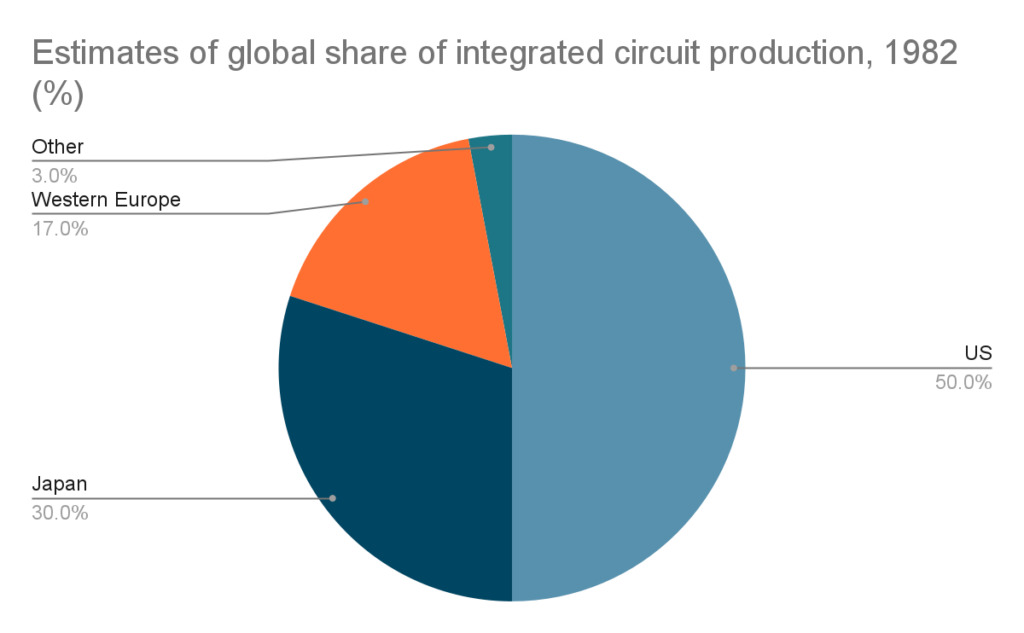
According to an OECD report, in 1982 Western Europe lagged behind both the US and Japan in terms of integrated circuit production and consumption. The US, by far the frontrunner, made up 50 percent of world production and 49 percent of world consumption. But Japan had also overtaken Europe, particularly in production. It made 30 percent of semiconductors, compared with 17 percent in Europe; and consumed 26 percent, in contrast to Europe’s 20 percent. Moreover, Western Europe had become dependent on semiconductor imports. In 1981, European firms only had 30 percent of their local market, while the United States dominated with a 62 percent share. While Japan had increased its share by 5 percent between 1977–82, Europe had lost 3 percent.
European countries responded to their relative weakness by developing their own microchip—what became known as the Eurochip. In the late ‘80s, this came alongside a program to promote a competitive microelectronic production known as ESPRIT. Neither of these initiatives were successful. While they did encourage the emergence of important technology firms—such as STMicroelectronics and Vodafone—these were engaged in developing components far from the technology frontier. Even when funding was sufficient, it was not adequately tied to deeper transformations in the electronics sector. Ultimately, the programs fell short of their ultimate goal: addressing European microchip dependence.
The experience of the 1980s should serve as a cautionary tale for contemporary European policymakers and industry leaders. As a result of the failure to catch up, and thanks to the evolution of an increasingly sophisticated semiconductor market globally, the EU has remained a dependent consumer. While Taiwan certainly dominates the market for <10 nm production, US and Japanese firms retain significant market shares across the rest of product lines and nodes in the value chain (10-22 nm, manufacturing equipment and inputs, and wafers). According to 2022 data, the US also leads research and development (R&D) investments by a high margin (amassing 60 percent compared to the EU’s 6 percent). The EU only has a significant presence (greater than 5 percent) within the manufacturing equipment market. External dependency concerns lie in the fact that the EU is today the third-largest global consumer, with 20 percent of the total end-market share, while firms and governments plan to expand connected industries.
An informative counter case is offered by Taiwan. Its current dominance in semiconductors began in the 1970s, with a state-directed effort to develop novel capabilities in microelectronics. Rather than catering to locally established firms, government agencies negotiated knowledge and investment transfers with foreign partners. This quid pro quo eventually led to the founding of key microelectronics firms, such as the Taiwan Semiconductor Manufacturing Company (TSMC) and the United Microchip Corporation (UMC).
Examining ESPRIT’s weaknesses and the alternatives posed by the Taiwanese example offers lessons for contemporary industrial policymaking. Key among them is that the success of industrial and technology plans depends on path-dependent political settlements, which describe firm capabilities to protect rents and resist necessary change. During the 1980s, the deference shown to a “neo-protectionist bloc” of technology firms contrasted sharply with the imposition of strong private firm conditionalities in Taiwan, Japan, and the US. Unlike in Europe, their industrial strategies managed to successfully develop semiconductor capabilities by leaving strategic decisions in the hands of public sector agencies.
After decades of complacency and austerity, the embrace of explicit industrial strategies in the EU marks a significant break. For decades, on both sides of the Atlantic, commentators have focused on high taxation, over-regulation, risk-aversion, conformity, and other “cultural” explanations for the lack of EU technological leadership. Now, the realities of Covid-19 and conflict have re-legitimized the coordinated steering of investment and production. At the national level, the European Union has loosened competition regulations to allow targeted stimulus. Supranationally, it is preparing to launch the European Chips Act. As it does so, looking to a previous era of industrial policy is instructive.
Euroesclerosis and the industrial policy “bloc” of the 1980s
At the end of the twentieth century, Western Europe was plagued by euroesclerosis and europessimism. Decades before the clichés about big tech conglomerates starting in suburban garages, anxieties regarding the perceived dynamism of US multinationals were rooted in ideas of cultural stagnation in Europe. In his 1968 reflection on the perceived technological gap between Europe and the US, OECD secretary general Thorkil Kristensen attributed North American inventiveness to “the wide open spaces which attracted men of courage.” It was ample natural resources, large domestic markets, and cowboy managerialism that had resulted in North American business achievements. Interestingly, Kristensen dismissed the impact of federal investments in military and aerospace procurement, which were then heavily involved in the race to the Moon.
More conscious of the innovative potential of The Apollo Project was American consultant John Diebold, who in the same year recommended the establishment of a permanent European technology and industrial policy that could compete with larger research and development budgets in North America. To this day, however, Europe has neglected the formation of a unified industrial policy, leaving technological development in members states’ hands. Industrial policy more broadly fell out of favor precisely when the European Union intensified its integration. As documented by Cherif, Engher and Hasanov, the 1980s saw the first decline in growth narratives about “economic structure”—a weakening of academic and policy interest in sectoral analysis for productive transformation. In its place came a nascent narrative of “structural reforms” (focused on institutional and regulatory elements), which became dominant alongside “Washington Consensus” principles. The Structural Reform and Consensus principles are based on the general idea that “private industry is managed more efficiently than state enterprise.” Therefore, liberalizing sectors is justified. A European example of the triumph of this narrative is the 1990 Commission communication, entitled “Industrial Policy in an open and competitive environment.” Here, it is argued that “sectoral approaches to industry policy can work during a period but they entail inevitably the risk of delaying structural adjustments.” By the end of the Eurochip decade, the EEC did not envision a permanent industrial policy agency. Rather, its industrial strategy focused on unleashing competition and accelerating the disappearance of unproductive firms.
In the midst of this overall shift towards the open markets and competition, which were embedded in the Maastricht treaty of 1992, ESPRIT represented an important instance of supranational and sectoral industrial policy in reaction to perceived loss of European strategic autonomy. At the commanding heights of European industry, no work was more influential than Servan-Schreiber’s The American Challenge, and its successor, The Global Challenge, focusing on Japan’s technological leadership. Servan-Schreiber suggested that European integration ought to generate an expanded market home to continental business giants, “supranational champions.”
But the world of business had its own dividing lines. In his analysis of the European Round Table (ERT—representing Europe’s top firms) Van Apeldoorn identified two distinctive blocs among European business groups leading up to the 1980s. Neoliberals in finance, energy, chemicals, and agri-food sectors, whose rents were protected through the Common Agricultural Policy, advocated for market openness and deregulation to compete as exporters. Neomercantilists, on the other hand, were represented by former national champions across diverse sectors who were concerned with cheaper imports from newly industrialized countries (NICs) and the loss of domestic markets. Manufacturers of electronics, small appliances, cars, and other components were sensitive to the rise of Japan and the Asian Tigers.
As Khan’s framework of political settlements reminds us, the ultimate shape of ESPRIT was shaped by the bargaining power and technical capabilities of these competing tendencies. Contrary to popular perceptions of neoliberal hegemony, it was the neomercantilists who, in alignment with policymakers, formed an industrial policy bloc with a particular interest in microelectronics. They were the ones enraged about US-Japan collusion and, in response, backed Eurochip 1.0.
Reacting to US and Japanese industrial policy
Western Europe’s anxieties in the mid-1980s went beyond microchip market shares. The technological rise of Japan mobilized European businesses and policymakers across the board. While Europeans had grown used to North American dominance through firms like IBM and their subsidiaries, Japan’s foothold in high tech sectors was unexpected. While semiconductor divisions for German firms in 1980 struggled to break even, Japan went from a USD 142 million deficit in 1976 to a surplus of USD 239 million in 1981 in the trade of integrated circuits. This transformation was spearheaded by Japan’s Ministry of International Trade and Industry (MITI).
The US Department of Defense, in addition to its permanent spending in high tech procurement, launched the very-high-speed integrated-circuit (VHSIC) program in 1980, and the Strategic Computing Initiative (SCI) in 1983. With sizable budgets for the ensuing decade, these targeted microelectronics and incentivized competitive innovation for grants between established firms and start-ups. Moreover, the Strategic Defense Initiative (Reagan’s “Star Wars”), albeit focused on adjacent technologies like lasers, had impacts on emerging computerized communication and artificial intelligence clusters of innovative small and medium enterprises (SMEs). SEMATECH would come in 1987, an even more ambitious effort to dynamize semiconductor production in the US. Crucially, this industrial policy persisted even as the Washington Consensus reigned; rather than dismantling industrial policy, Reaganism delegated it to “a decentralized system through which public agencies would, in fact, invest in potential winners.” Building on the experience of ARPA (Advanced Research Projects Agency) and the NIH (National Institutes of Health), the US was able to spread productive research and coordination across states, municipalities, universities, research centers and technology parks. This “hidden developmental state” responded to a distinctively North American political settlement around industrial policy, which bypassed the ideological veto of conservative groups against federal interventionism.
In Japan, the MITI continued in its role as prime mover of new industrial and technological capabilities, planning various projects at the technology frontier in the 1980s. These included optoelectronic components (vital for today’s quantum computing), New Function Elements (including radiation-proof circuits), then-supercomputers and the leading Fifth Generation Computer (5G). The 5G project aimed to combine advancements in chipmaking with other hardware and software development. All the Japanese projects had a timescale of a decade, with public laboratories hosting long-term, flexible collaborations between top computing companies. Conditionalities contributed to the spread of good practices, centered in management training and firm restructuring.
The political settlement underpinning these policies responded to the classic, developmental state approach to industrial policy. While formally not in charge of private firm activities, the government employed veto and agenda-setting mechanisms to dictate priorities. Almost half of the budget was apportioned by the state, and in any case private financing originated in large banks closely regulated by the Ministry of Finance. This leverage was crucial as, in some instances, banks even forced corporate clients to join MITI research cooperatives in exchange for credit lines. In addition to these initiatives, reforms in competition law and early privatization allowed US and Japanese telecommunication firms to integrate across industry functions and invest more aggressively in global markets.
These initiatives had an unsettling effect over European business and political elites. Within the European Council, the neomercantilist position was chiefly espoused by the French delegation in the early 1980s, who advocated for the creation of a Common Industrial and Research Area. This included building capabilities in new products by lowering internal barriers, mobilizing industrial policies, and guaranteeing preference in domestic markets. Nowhere were these measures expected more urgently than in information technology, particularly in its key component: semiconductors.
The French position was logical. Given the previous success of US and Japanese industrial policy efforts in other sectors, they had reasons to be worried. Furthermore, the efforts to take the US-Japan microchip agreement to the GATT had mostly stalled. The Europeans had based complaints on a predicted price rise for inputs in Europe because of the duopoly. However, several months after the agreement between the US and Japan came into force, microchip prices declined. Japanese chipmakers, responding to US pressure to limit their market share in North America, began to prioritize European sales. The European Electronic Components Manufacturers Association (EECMA) complained to the European Commission against this perceived “dumping” of semiconductors. Thus, ESPRIT was born.
ESPRIT emerged from the first Framework Programme, the key research and innovation mechanism of the EU today. Its formation came as a result of the ineffectiveness of national plans and Commissioner Davignon’s good relationship with firms. From the 1978 Forecasting and Assessment in the Field of Science and Technology (FAST) working group, to the Joint European Planning Exercise in IT in 1980, reports showed key weaknesses in private sector technological capabilities. The public-private working group identified five large areas of intervention: advanced microelectronics, advanced computing, software technologies, office automation, and integrated computer systems for industry. Despite its acronym, more than two years elapsed between the Commission’s first communications and Member State acceptance at the Council of the shared policy. This inaction allowed policy to be greatly shaped by incumbent firms in electronics, the neomercantilist bloc sensitive to external market pressures. From 1981 to 1982, companies like Siemens, Philips, and CGE (members of a “Big Twelve Roundtable”) lobbied Davignon and Member States to define the scope and mechanisms of shared technology policies. If they developed the plan, Davignon would find the funding.
How did plan development work in practice? Interviews conducted by Sandholtz suggest that senior executives from Big Twelve firms held one-day conferences at corporate offices, where companies set up shop in meeting rooms and circulated possible pilot projects for the Commission’s consideration. This privacy was preferred: at wider technical panels with universities and research laboratories, firm executives felt unease at the degree of information sharing.
The finalized ESPRIT pilots faced limitations. First, the European Community regulations set strict limits on direct state support of firm activities, favoring precompetitive research and limiting commercial considerations in project design. Second, given Member State mistrust, pilots were initially designed with one-year time limits, a significantly brief period for industrial and technology policy processes. Fifteen final projects were approved across the five areas of intervention, with budgets shared equally by the Commission and the firms.
Even though technical approval for ESPRIT was achieved in November 1983, it took almost half a year to actually disburse its budget. Its allocation reveals a consistent bias in favor of established firms. The Big Twelve firms designed the program and sat in the meetings with the IT task force that identified key sectors and technologies, including specific microchip product lines and components. In fact, according to Peterson’s post-hoc analysis, more than 80 percent of initial contracts were distributed among these twelve firms. These companies still garnered more than 50 percent of the ESPRIT budget in 1986. Their oversized ability to capture funds did not abate in ESPRIT’s second formulation, running from 1987 to 1992. Emulating the success of the Big Twelve Roundtable in electronics, another twenty firms from various industries created the “Gyllenhammer group,” including Volvo, Volkswagen, and British Aerospace, among others. They were national champions, but also key clients of the Big Twelve: they purchased semiconductors for product and process innovations. Together, the projects presented by Big Twelve and Gyllenhammer attracted between half and two-thirds of total Commission support between 1987 and 1992.
Naturally, smaller member states like Belgium rejected a project that seemed focused on subsidizing firms from the “Big Three” (France, Germany, UK), and sought support and reassurance for smaller firms. This resulted in an improvised, “B channel,” with even fewer conditions for the participation of SMEs. Overall, across big and small projects, there were limited supervisory powers on the Commission side once funds were disbursed. A complex mechanism was in charge of supervision, composed by the Commission’s Information Technologies Task Force, the Esprit Management Committee (EMC) representing member states, the ESPRIT Advisory Board representing participants on a consultative basis, and the ESPRIT Steering Committee, representing the Big Twelve. This plural design was conceived to allay the fears of smaller states and firms. However, as documented by a British executive at the time, key European firms retained actual control. For instance, the Big Twelve outlined the work plans that were only later amended by the other panels: barely any projects were rejected in the first phase of ESPRIT.
The 1980s European attempt to imitate Japan’s success thus led to quasi-cartel formations, forgetting the equal importance of selective competition alongside cooperation in the developmental state model. Equally, European policymakers failed to consider a key element of the US strategy: building local capabilities with multiple non-firm actors, to whom training, education, research and other activities can be eventually delegated.
An absence of public sector strategic insight, which could have guided cooperative, competitive, and institutional goals, was prevalent across subsequent Framework Programme agendas. Eureka, the EEC’s response to the US “Star Wars” initiative of the late 1980s, was hastily improvised a week after Reagan announced incentives for the relocation of European firms. As a result, its design also depended on Big Twelve firms. Eureka really began with a memorandum drafted by Siemens, Philips, GEC and Thomson, urging “market-oriented” criteria closer to “saleable products and systems.” Several projects had already been confirmed under Eureka even before Member States agreed on the program’s design six months later. In April 1985, France, the UK, and Germany agreed to disagree on which technologies would be covered by Eureka. Rather than defining clear criteria for potential technologies, national champions would define projects, from welding lasers to pollution trackers. The only basic requirement was that collaborating firms had to be based in at least two European countries.
The positive impact of these programs on European innovation is undeniable, particularly where supranational funding was successfully integrated with domestic industrial plans. STMicroelectronics, Infineon, and NXP, the few significant European chipmakers today, benefited from these 1980s plans. European initiatives also provided an umbrella for national projects. The British Alvey initiative, implemented in parallel with ESPRIT, generated advancements in object-oriented programming (further developed by Microsoft), and the basis for a “cellular radio service” that would later become Vodafone. Moreover, European programs helped overcome a common accusation levied at continental firms. EEC companies had tended to favor collaborations with US and Japanese companies, with local research networks operating as disconnected enclaves. Trans-European coordination increased through ESPRIT, Eureka, and subsequent plans.
At the same time, ESPRIT did not achieve its goal in microelectronics and was not always conducive to competitive innovations, despite ample national and supranational encouragement. Above all, integrated circuit firms had limited incentives to defy market tendencies and remain attached to the long-term targets defined by Commission and state-funded projects. As noted today, the German-Dutch Philips-Siemens 1985 Mega-Project prioritized the production of 1-megabit RAM chips, which were already a mass-produced global standard in 1986.
The obsession with national champions also precluded fruitful exchanges with Japanese and North American firms, since access to funding was earmarked for European firms. But the Big Twelve jumped the boat whenever it was convenient, with little ability for the Commission to adapt programs or impose penalties. For instance, when offered a potential external collaboration with IBM and Toshiba to develop 64Mbit microchips, which ran against funding rules, Siemens simply pulled out from the JESSI program altogether. The Dutch member of the chip Mega-Project, Philips, entered a severe crisis in the early 1990s, partly as a result of poor management, whereby product development groups lacked contact with commercialization areas. The Philips divisions that were responsible for static random access memory (SRAM) research were disconnected from commercially-minded product divisions.
In contrast with state-directed organizational change emphasized by Japanese industrial policy, European programs had little interest in internal firm affairs. Towards the 1990s, Commission and state funding began to focus on other technologies, such as renewables and biotechnology. Once public funding dried up, the firm lost interest in subsidizing loss-making long-term research activities and closed its microelectronics labs. This demonstrates the importance of organizational path-dependence and rent-accrual. While it does not fully explain the relative failure of 1980s semiconductor policy, the European Big Twelve had excessive influence over policy design and implementation.
In fact, European deference towards incumbent firms in shaping industrial policy was a key departure from the norm elsewhere. US and Japanese microelectronic strategies developed against the given political settlement, bypassing the vetoes of political and private sector incumbents. Crucially, independent agencies which can rely on long-term support from both executives and industry are a common feature of successful catching-up efforts—not least in Taiwan, the world’s key site for semiconductor manufacturing.
The classic work Governing the Market, by Robert Wade, details how Taiwanese officials set their sights on developing semiconductor production capabilities in the early 1970s. The state-owned Electronic Research and Service Organization (ERSO) was created in 1974, with the mandate of identifying foreign investors to kickstart a domestic electronics industry. ERSO’s accountability mechanism was directly linked to specialized cabinet members. In terms of decision-making, the prerogatives of local private firms were ignored. “Directional thrust” remained firmly in the hands of ERSO, which identified application-specific integrated circuits (ASICs) as useful outputs that could lead to further cross-industry specialization. UMC, ERSO’s subsidiary, achieved the partial relocation of Taiwanese Silicon Valley firms, bringing back domestic private equity with technical expertise acquired in North America. While mass-produced business areas were sold to better-positioned Korean and Japanese investors, ERSO’s patient and selective interest in application-specific chips remained at the forefront. Efforts eventually attracted the interest of none other than Philips, which enabled the investment and technology transfers that facilitated the creation of the TSMC in 1987. Today, UMC is a key semiconductor supplier for many fabless firms, vital for car manufacturers worldwide. TSMC is, of course, the key high-performance microchip producer in the world, “a linchpin of the global economy.”
Towards Eurochip 2.0
Industrial policies must be adapted to political settlements across borders, recognizing the importance of organizational capabilities of some large firms to capture rents and resist change. In the US, Japan, and Taiwan, long-term formulation of strategic goals and independent but accountable public agencies in the driving seat facilitated strong conditionalities on private investment. The US and Japan, either through Defense research networks or MITI-owned laboratories, retained leadership—and often equity—in the hands of agencies which were not subject to short-term market signals or political backlash against industrial policy. Conditionalities alongside external supervision incentivized private sector commitment to integrated circuit development even when projects stagnated, limiting short-term speculation and early exits. One of the benefits of this approach is that projects do not simply follow the latest market trends. Rather, whether in ASICs, lasers, or optoelectronics, working groups tried to identify technologies at the frontier.
The type of unquestioned industry leadership and cooperation promoted by the Commission, on the other hand, prioritized investments that would already take place in the absence of government support. As summarized by Martin in the mid-1990s:
To develop internationally competitive national or European firms would have required a “tough love” policy that combined financial support and brokering of alliances with an insistence on restructuring and vigorous product-market rivalry. European governments offered only love, and for a time diverted their home firms’ attentions inward rather than outward in a way that slowed down unavoidable structural change.
Today, Eurochip 2.0 seems to be repeating some of these mistakes. The announcements linked to the European Chips Act offer little details on quid pro quo mechanisms, with a focus on the figures and large-scale targets. This comes with a risk that the resulting projects will resemble the opaque structure of existing IPCEIs (Important Projects of Common European Interest). This will mean sectoral overspread, established firms capturing funds, and little to no encouragement for innovation. The “neomercantilist bloc” in the making risks imposing an inefficient outcome. While technological capabilities will necessarily be built from established productive networks, industrial policy plans should not simply allow existing political settlements to determine project pathways.
As in the 1980s, only some technologies will be helpful for European businesses, public services, and citizens. Specific, long-term, and measurable deliverables must be applied to whichever public funding fuels private initiative. A healthy combination of transparent and clear indicators, supervisory mechanisms (equity, conditional loans), and countervailing powers can shape a more productive coalition around Eurochip 2.0. For example, the Institute for Industrial Reconstruction’s role in Italy’s economic miracle can help inspire equivalent innovation “systems of state-owned enterprises” at the European level. Partially publicly-owned companies and projects can add competitive pressures in those sectors where rent captures are easier. Alternative perspectives around mission-oriented policies, community-wealth building, and others can contribute to the pluralization, diversification, and localization of project impacts. The goal should not just be to follow the market and leave existing firm leadership intact, but to ensure that innovation can solve the many challenges which will continue to appear on the European horizon.
Silicon Valley Bank’s (SVB) short lifespan—from October 17, 1983 to March 10, 2023—has been witness to crucial transformations in the world of modern banking. The bank’s collapse has sparked wide ranging reflections on the roots of the crisis, the utility of government bailouts, and appropriate responses. I identify two crucial shifts in the banking system exemplified by the Bank’s fall. On the liability side of SVB’s balance sheets, the shift from uninformed to informed depositors renders hedging against interest rate risk more critical. On the asset side, a strategy of “fixed income arbitrage” means that regional banks fell into similar difficulties as hedge funds—one in which low profits rendered betting on the shape of the yield curve too expensive to maintain.
From uninformed to informed investor
Among a number of channels, the crisis has been interpreted according to the classic Diamond-Dybvig Model. This model assumes that depositors in a particular bank are uninformed: as long as they do not reach the $250,000 threshold, they do not distinguish between depositing money in a bank and buying treasuries, given that both investments are backed by the government. As a result, they do not need to evaluate the financial health of their deposit-taking institutions. Driven by “animal spirit” rather than the details of financial statements, they are capable of generating a run on the bank based on “any” worries, imaginary or real. The surest way to stop a bank run, the model thus argues, is through deposit insurance, which stabilizes investor confidence.
However, recent events deviated significantly from these expectations. Rather than being motivated by a herd driven shift in “animal spirits,” the depositors who initiated the runs on SVB, Signature, Silvergate, and other regional banks were informed. Even prior to the run, they were known to extensively tweet about each detail and footnote in the financial statements of their bankers. In the case of SVB, for instance, they examined the bank’s balance sheet and “marked to market” its assets, revealing its exposure to interest rate risk. When the bank reported virtually no interest rate hedges on its massive bond portfolio, investors depositors instigated a bank run.
This distinction between traditional, uninformed depositors and modern, informed ones reflects a revolution in the structure of contemporary banking. In the first phase of this structural change, which took place during the 1950s, “retail” depositors were replaced by “institutional” ones such as pension funds. Though institutional investors injected far greater amounts of cash, they ultimately remained uninformed. They cared little about the financial condition and balance sheets of the banks that received their deposits, and instead prioritized the rate available on an FDIC-insured deposit. So long as they did not breach the $250,000 limit, putting money in a bank appeared as safe as buying Treasuries—particularly given that both investments had full government backing. Consequently, banks around the country, including the shaky and the sick, were flooded with money so long as they posted attractive rates.
With the strengthening of liquidity ratios in the aftermath of 2008, systemically important financial institutions like JPMorgan Chase, Credit Suisse, and Bank of America increasingly transformed into market makers in wholesale money markets, buying and selling securities for their own accounts and thereby minimizing their deposit-taking activity. Liquidity requirements like liquidity coverage ratio (LCR) required banks to have enough high-quality liquid assets to survive thirty days of deposit outflows in a stress scenario. In doing so, they rendered short-term deposits, and the illiquid assets they fund, less appealing.
Big banks coped with these liquidity requirements by reducing deposit-taking activities, leaving medium-sized and large regional banks to pick up the slack. These banks sought to compensate for greater deposit-taking through other financial pursuits. In particular, they were betting on higher returns and attracting new deposits from a piece of financial engineering known as “fund subscriptionlines.” These credit facilities were different from a traditional business loan on three main fronts. First, a subscription line is a loan to venture capitalists (VC) and private equity fund managers themselves rather than the actual businesses. Second, unlike traditional corporate loans that use the firms’ assets as collaterals, subscription lines are secured against unfounded capital commitments by private equity investors. Finally, banks anticipate returns not through interest accrual but capital gains once the investment is finalized. In other words, subscription lines transformed regional banks into private equity investors rather than creditors.
Subscription lines appealed to venture capital and private equity because they enabled them to manage their cash flows and increase the internal rate of returns on their investments without issuing a capital call to their investors. As such, they increasingly constituted the primary clientele for subscription lines. While big banks fundamentally altered the market-making business, large regional banks’ changed the banking and deposit-taking world. On the liability side, the current banking era started with the “death of the retail deposits.” On the asset side, the trend continued with the death of traditional loans. Instead, VCs and startup depositors obtained liquidity through liquidity events, such as IPOs, secondary offerings, SPAC fundraising, venture capital investments, acquisitions, and other fundraising activities. In this environment, regional banks, such as SVB, used Ponzi-like schemes, such as the fund subscription lines, to maintain the steady stream of deposits and become a stakeholder in the alternative investment world.
Marcy Stigum called this the “death of loans” in the late 1970s. This shift transformed banks’ asset management beyond their embrace of subscription lines. SVB and other specialized banks that served informed depositors practically eliminated their loan-giving activity. Lacking fixed assets or recurring cash flows, startups, and crypto investors were less reliable corporate borrowers. But more importantly, these customers did not need loans—equity investors provided them with a constant supply of cash. Consequently, banks shift their operations from issuing loans to purchasing fixed-income securities. In the case of SVB, government bonds became a large portion of the bank portfolio.
The shifts in the nature of depositors, from uninformed to informed, and the assets-liabilities management of banks contributed to the current banking mania. As a result of the large-scale addition of long-term bonds backed by the US government to banks’ portfolios, these specialized banks are unusually exposed to “interest-rate risk.” While most banks earn a higher interest on their loans during interest rate hikes, banks like SVB and Signature are stuck with long-duration bonds whose value goes down as rates go up. Every bank borrows short to lend long, but many banks ultimately strike a balance. Moreover, informed depositors continuously pay attention to the financial statements and footnotes of the banks in which they deposit. As a result, they constantly “mark to market” the banks’ financial assets and penalize them whenever the fair value of their assets is at a loss.
A brief example demonstrates the systemic importance of this point. Let us assume that a bank has $100 worth of deposits as its liabilities. On the asset side, the bank uses cash to purchase a government bond worth $100. In the meantime, the Fed announces a rate hike from 0 percent to 2 percent. A traditional depositor would account for the bank’s assets “at cost,” using the price the bank paid to purchase those bonds, in this case, $100. This is especially true if the bank has announced that these assets are intended to be “held to maturity.” An informed depositor, by contrast, continuously “marks to market” the value of the bank’s assets. In this case, they account for the value of the bonds at their fair market value. When interest rates go up, this value falls: if a bond is issued with a 5 percent coupon and the market rate rises to 8 percent, demand for the 5 percent bond declines. Consequently, its price must fall until its expected return matches the competitive return of 8 percent. Informed depositors know this—if the bank has a bond with a face value of $100, they will check the market price for that bond when the Fed announces its interest rate policy. If, for instance, it is $97, then the bank’s asset is only worth $97 on its balance sheet. The other $3 is gone, and the bank is considered insolvent. Informed depositors notice—they write long tweet threads, initiating a bank run. In doing so, they heighten the bank’s exposure to interest rate risks, particularly if the bank is invested in fixed-income securities, such as government bonds.
Fortunately, this shift also opens up new directions for bank run management: interest rate hedges. Often in the form of swaps, this financial instrument effectively turns an investor’s fixed-rate loans or bonds into floating rates by paying a third party. Once available for sale, the value of outstanding bonds can be protected if combined with interest rate hedges like swaps. Swaps transform the nature of an asset by converting a fixed-income investment into a floating-rate one and vice versa.
Consider SVB in our earlier example. A proper swap could transform SVB’s bonds earning a fixed interest rate into an asset earning a floating interest rate. Suppose SVB owned $100 million in bonds that will provide 3.2 percent for two years and wishes to switch to the floating rate. It contacts a swap dealer, such as Citigroup, and enters into a swap where it pays the fixed rate (3.2 percent) and receives floating plus 0.1 percent. Its position would then have three sets of cash flows: it receives 3.2 percent from the bonds, and the floating rate under the terms of the swap, and pays 3.2 percent under the terms of the swap. These three sets of cash flow net out to an interest rate payment of floating plus 0.1 percent percent (or floating plus 10 basis points). Thus, for SVB, the swap could transform assets earning a fixed rate of 3.2 percent into assets earning the floating rate plus 10 basis points.
The real question underpinning the current crisis then, is why SVB reported virtually no interest rate hedges on its massive bond portfolio at the end of 2022. On the contrary, its year-end financial report notes that it terminated or let expire rate hedges on more than $14 billion of securities throughout the year. The US government’s offer of unlimited deposit insurance has failed to calm markets, in part because it assumes the uninformed depositor behavior characteristic of the Diamond-Dybvig Model. But in reality, the banking world has changed: well-informed depositors treat their deposits as an investment vehicle. In this new financial reality, bank runs may be better dealt with using a proper hedging strategy. Strangely, the crisis teaches us that the current regional banking market structure may be better served by a private risk-management solution, available through the derivative markets.
Regional banks as the new hedge funds
The hedge fund crisis of 1998 offers a blueprint for understanding regional banks’ asset-liability management today. At the time, funds like Long Term Capital Management (LTCM) relied on a very popular, and very painful, strategy known as “fixed-income arbitrage.” This strategy uses the model of the term structure of interest rate (yield curve) to identify and exploit “mispricing” among fixed-income securities.
For instance, let us assume that the firm’s reading of the Fed is that the central bank pivots toward cutting rates sooner than the market expects. In this case, the firm’s models show a yield curve below the market yield curve. The difference between these two is the so-called “mispricing.” In this environment, when rates are expected to fall, the fixed-income securities gain in value, justifying the purchase of government-backed securities like Treasuries and mortgage-backed securities. Nonetheless, the fund hedges the position by entering the relevant swaps to turn such a strategy into “riskless” arbitrage trading. In this case, the fund enters an interest rate swap (IRS) and becomes a fixed-payer and floating-receiver. If the hedge fund’s prediction is correct, the IRS will generate slight cash outflows for the fund. In this case, the floating rate (determining the value of the fund’s cash inflow) would fall while the fixed rate (setting the cash outflow value) would remain unchanged. Most importantly, the fixed-income securities’ capital gain would compensate for the slight fall in the value of the IRS. Alternatively, if the hedge fund’s bet was wrong and rates increased instead, the IRS value would rise and neutralize the loss in the fixed-income securities’ fair value. Fixed-income arbitrage has its roots in the fixed-income trading desks of most brokerage houses and investment banks.
As LTCM’s failure showed, the strategy contains critical vulnerabilities. First, profits generated through fixed-income arbitrage transactions are often so small that managers have to use substantial leverage to generate significant levels of return for the fund. As a result, even a slight movement in the interest rate in the wrong direction could make hedging too expensive to be maintained. With small profit margins and greater exposure to interest rate movement, fixed-income arbitrage has been described as “picking up nickels in front of a steamroller.”
There are many reasons to think SVB’s business model has come to resemble that of hedge funds. Unlike the traditional model of deposit taking, SVB invested most deposits in fixed-income securities. Of its $190 billion in deposits, it had invested $120 billion into Treasury and agency mortgage-backed securities. Conscious of the limitations of fixed-income arbitrage, SVB’s managers suddenly dropped the interest rate hedges without providing reasonable economic justifications in mid-2022. But attributing this decision to poor risk management can be misleading. SVB’s decision to liquidate the swap positions coincided with a shift in the market consensus on the Fed—towards the perspective that the Fed would tolerate a slight recession and will not reduce rates without substantial evidence of inflation falling. The shift made it too expensive to bet on the fall in interest rates.
But this strategy becomes even more dangerous in the hands of a bank. Whereas a hedge fund can lock up liquidity and ensure investors do not run, banks can only pressure government insurance schemes or threaten the stability of the financial system. While hedge funds can impose momentary lock-up periods, bank restrictions on deposits access generate a broader banking crisis. Finally, hedge funds can employ redemption notices which require investors to give weeks or months of notice before redeeming funds, thereby enabling investment in illiquid, high-return assets.
The transformation of banks into hedge funds thus bears enormous implications for financial stability. Their investment strategies are yet to be identified by regulators—so long as deposits flow into the regional bank, it can maintain its hedges. But unlike hedge funds, which are expected to periodically disappear, banks are meant to serve a public function, have a government backstop, and occupy a vital role in the financial system. For the sake of financial stability, they should not be engaging in a short-term, high risk, and high profit business model.
Through the shift to informed investors, and the utilization of hedge fund investment practices, the SVB crisis holds significant consequences for the structure of contemporary banking, and the tools available to prevent future collapse.
The Federal Reserve is commonly depicted as an institution set up to fulfill domestic functions, only later taking on its significant international and geopolitical dimensions. In this view, the Fed’s origins are found in various domestic concerns, such as bankers’ desire to cartelize themselves, exporters’ bid to make the American financial system more stable and liquid so as not to rely on London for loans, farmers’ project to break up New York’s “money trust” and spread financial services more evenly throughout the country, and the collective desire to put an end to the apparently endemic panic in US money markets.1Robert L. Hetzel, (<)em(>)The Federal Reserve: A New History (<)/em(>)(Chicago, 2022) is the latest iteration of the functionalist domestic origins story. See Livingston, (<)em(>)Origins of the Federal Reserve System: Money, Class, and Corporate Capitalism, 1890–1913(<)/em(>) (Cornell, 1986) on corporate bankers; J. Lawrence Broz, (<)em(>)The International Origins of the Federal Reserve System(<)/em(>) (Cornell, 2009) on exporters; and Nadav Orian Peer, “Negotiating the Lender-of-Last-Resort: The 1913 Fed Act as a Debate Over Credit Distribution,” Tulane Public Law Research Paper, No. 18-8, 2018 on farmers.
Although there is an abundant literature on the financial projection of US power (“Dollar Diplomacy”) whose main characters overlap conspicuously with the cast of domestic, Progressive Era reformers (“corporate liberalism”), the two narratives have yet to be integrated.2Emily Rosenberg, (<)em(>)Financial Missionaries to the World: The Politics and Culture of Dollar Diplomacy, 1900–1930(<)/em(>) (Duke, 1999); Gabriel Kolko, Triumph of Conservatism: A Reinterpretation of American History, 1900-1916 (Free Press, 1977); Martin J. Sklar, (<)em(>)The Corporate Reconstruction of American Capitalism, 1890–1916: The Market, the Law, and Politics(<)/em(>) (Cambridge, 1988). Because the Fed’s opening was almost coincident with the first shots of the Great War, with the consequent enervation of European finance and the extension of American war loans, the story of the global rise of Wall Street typically includes geopolitics solely by reference to that conflict.3Melvyn P. Leffler, (<)em(>)Elusive Quest: America’s Pursuit of European Stability and French Security, 1919-1933(<)/em(>) (UNC, 2009), 89–90; John A. Thompson, (<)em(>)A Sense of Power: The Roots of America’s Global Role(<)/em(>) (Cornell, 2015), 122-3. But from their foundation, central banks have been embedded in the violence and hierarchy of the world-system. The history of America’s banking institutions demonstrates how global military and economic networks have shaped the development of nation states, as much as the reverse.
Global comparisons, interimperial competition, and the transnational flow of ideas were all present at the creation of America’s modern monetary apparatus. After an intensive study of European monetary history and colonial currencies, a cohort of corporate intellectuals decided the US needed a central bank to succeed in interimperial competition over currency blocs. Even though their initial reform efforts were blocked at home, the Spanish-American war opened up new opportunities to experiment in the periphery of America’s empire. Those experiments eventually came back home to inform the creation of the Fed.
The resulting dollar bloc was a hegemonic project. Its shape and trajectory had as much to do with Latin American resistance and terms of consent as it did with metropolitan blueprints for world order. To successfully court peripheral elites beyond those the US conquered, and to avoid detonating protests by the masses in those it did, US planners chose not to simply lay down terms of subordination. As a result, efforts to internationalize the dollar varied according to local conditions in Puerto Rico, the Philippines, Nicaragua, and other sites of the growing US colonial sphere. Puerto Rican riots and Mexican finance ministers are as much a part of this story as Princeton economics professors.4Christy Thornton, (<)em(>)Revolution in Development: Mexico and the Governance of the Global Economy(<)/em(>) (University of California Press, 2021) makes a powerful argument for the agency of the global south in creating the mechanisms of global economic governance following Eric Helleiner, (<)em(>)Forgotten Foundations of Bretton Woods: International Development and the Making of the Postwar Order(<)/em(>) (Cornell, 2016). See also Amy Offner, (<)em(>)Sorting Out the Mixed Economy: The Rise and Fall of Welfare and Developmental States in the Americas(<)/em(>) (Princeton, 2019) on the importance of holding domestic US history together with a larger hemispheric history of the Americas in a single analytic frame. These are the interimperial and Pan-American origins of the Federal Reserve and the world dollar.
The birth of an idea
In 1896, journalist Charles A. Conant published his magnum opus, A History of Modern Banks of Issue. A painstaking documentation of Europe’s advanced monetary authorities, the book consolidated over a decade of reporting in the Journal of Commerce. Conant argued that modernizing America’s financial arrangements was crucial to keeping up with advances elsewhere in the world. His activities, both theoretical and practical, created the framework within which the rest of the monetary reform process unfolded.
Conant’s cyclopean History covered over two thousand years of Europe’s monetary history in the major and minor powers, showing how state-backed banks of issue had a tendency to become banker’s banks—central banks. By its fourth edition in 1909, it included chapters on Canada, Mexico, Latin America, “Africa and Oceania,” “Japan and Korea,” “Banking and Exchange in the Orient,” and the US banking crisis of 1907. The US, Conant underscored, was the only major power to go without a central bank and as a consequence lagged behind its competitors.
Conant’s main aim was to prove to “thinking Americans” that “the currency of a commercial country should be regulated by commercial conditions, and not by the whims of politicians.” He began his narrative not with the Bank of England, founded in 1694, but with the infamous John Law episode of 1716-20 in France, in which a Scottish exile promised to modernize French political economy and, “carried away… by the grandeur of the new scheme,” wound up blowing massive financial bubbles instead, destroying the bank and the royal finances in the process.5Conant, (<)em(>)History, (<)/em(>)35. See also John Shovlin, “Jealousy of Credit: John Law’s ‘System’ and the Geopolitics of Financial Revolution,” (<)em(>)The Journal of Modern History(<)/em(>) 88/2 (2016), 275-305 and (<)em(>)Trading with the Enemy: Britain, France, and the 18th-Century Quest for a Peaceful World Order (<)/em(>)(Yale, 2021) which connect early 18th century French monetary governance more directly to great power conflict than Conant’s (<)em(>)History(<)/em(>). For a longer history of central banking in France, see Vincent Bignon & Marc Flandreau “The Other Way: A Narrative History of the Bank of France,” (<)em(>)CEPR Discussion Paper(<)/em(>) 13138 (2018). It was not hard to read between the lines here—his prime target was the Populists’ subtreasury plan, which aimed to revolutionize farm credit and took direct inspiration from French socialist Pierre-Joseph Proudhon’s proposals for a “people’s bank.”6Charles Postel,(<)em(>) The Populist Vision(<)/em(>) (Oxford, 2007), chapter 5. Sklansky,(<)em(>) Sovereign of the Market(<)/em(>), chapter 5.
The alternative model, the privately owned Bank of England, had been rejected by Americans in the 1830s under Jackson. It appeared to Americans at the time like the relic of a pre-liberal, mercantilist British past, built to fund inter-absolutist warfare.7The aristocratic and neo-classical aesthetics of Nicholas Biddle, the Second Bank’s brilliant helmsman, did not help. Jeffrey Sklansky (<)em(>)Sovereign of the Market(<)/em(>), chapter 4. P.G.M. Dickson, (<)em(>)The Financial Revolution in England: A Study in the Development of Public Credit(<)/em(>), 1688-1756 (Melbourne, 1967); John Brewer, (<)em(>)The Sinews of Power: War, Money and the English State, 1688–1783(<)/em(>) (Harvard, 1988); Carl Wennerlind, (<)em(>)Casualties of Credit: The English Financial Revolution, 1620–1720(<)/em(>) (Harvard, 2011). Bagehot, (<)em(>)Lombard Street: A Description of the Money Market(<)/em(>) (1873). Protected by two oceans with no great power rivals on its continent, republican America felt no need for such an institution.8Paul Post, “Central Banks at War,” (<)em(>)International Organization(<)/em(>) (Winter 2015): 63-95 shows that while central banks lower sovereign interest rates, before 1914 they did so (<)em(>)only(<)/em(>) in times of war. See also Niall Ferguson, Martin Kornejew, Paul Schmelzing, Moritz Schularick, “The Safety Net: Central Bank Balance Sheets and Financial Crises, 1587–2020,” Hoover Institution Economics Working Paper 23102. Why take the chance of emulating England when French political overreach was a more significant threat?
When the central banking debate reemerged at the turn of the twentieth century, the international context had changed entirely: the US was aspiring to great power status and state-backed banks of issue were universal. Conant noted that the inflection point in the arc of development for European central banking was the 1850s; with the exception of England and France, most of the modern banks of issue were products of the last half of the nineteenth century.9“The Evolution of Modern Banking,” (<)em(>)Political Science Quarterly(<)/em(>), 14/4 (1899), 569-93. Eric Helleiner, (<)em(>)The Making of National Money(<)/em(>) (Cornell, 2003). Charles Goodhart, (<)em(>)The Evolution of Central Banks(<)/em(>) (Penguin, 1988). Until then, coins had been fairly cosmopolitan, circulating far outside their country of origin, creating a patchwork of overlapping monetary circuits which did not neatly correspond to national boundaries. But innovations in minting technology that made counterfeiting more difficult, together with the new nationalist ideologies after 1848, spurred national monies. The move from cosmopolitan commodity money to national currencies and currency blocs meant that monetary management could no longer be left to mints and markets alone.10Henry Parker Willis, (<)em(>)A History of the Latin Monetary Union: A Study in International Monetary Action(<)/em(>), (University of Chicago Press, 1901). See also Marc Flandreau, (<)em(>)The Glitter of Gold: France, Bimetallism, and the Emergence of the International Gold Standard, 1848-1873(<)/em(>) (Oxford, 2004). Belgium led the way, pioneering the monetary management model in which the central bank was privately owned but the officers were chosen and overseen by the government.11Conant, (<)em(>)The National Bank of Belgium(<)/em(>) (National Monetary Commission, 1910). Linked to Paris through the Latin Monetary Union, Belgium’s central bank acquired a horde of French-franc-denominated assets that could be used to manage relative demand for the two francs. The value of French commercial paper was ultimately backed by the Bank of France, founded in 1800, making it as good as gold, but often cheaper. Unlike holding real gold, holding these assets paid interest. Increasingly, the gold supply that “backed” the Belgian franc was not held in the form of actual bullion in a Belgian vault, but rather took the form of paper claims on bullion held in a French vault.
The practice of stabilizing currencies by having a central bank accumulate foreign exchange became more widespread from the 1850s. Gold piled up in London and Paris, and for other countries it became normal for gold not to circulate within their borders. Claims on gold circulated across Eurasia in the form of national notes printed by banks of issue, and regulated according to the needs of foreign exchange markets. The Netherlands, Denmark, Sweden, Norway, Austria-Hungary, and Russia all managed the values of their currency by accumulating foreign exchange in Paris and London instead of acquiring gold directly.12Barry Eichengreen, Arnaud Mehl, and Livia Chiţu,(<)em(>) How Global Currencies Work(<)/em(>) (Princeton, 2018), which still prominently cites Kemmerer and Conant! As maintaining a proper gold standard was expensive, while buying up and maintaining contingent claims on future gold was not, this practice, which came to be known as the Gold Exchange Standard (GES), became a way for less wealthy nations to simulate the stability offered by a gold standard. Accepting a lower position within the global monetary hierarchy was the price they paid for sound money.
For latecomers to the central banking scene—Japan, Austro-Hungary, and by the third edition of the History, Russia—this was the model to emulate. Japan was the most impressive student. Like Germany in the 1870s it began by demanding a war indemnity in gold after defeating China in 1895, which it then deposited in London and used to finance a GES, overseen by a Belgian-style central bank.13Metzler, (<)em(>)Lever of Empire(<)/em(>). Harold James, “Monetary and Fiscal Unification in Nineteenth-Century Germany: What Can Kohl Learn from Bismarck?,” (<)em(>)Princeton Essays in International Economics(<)/em(>) 202 (1997). This was how modern states built modern monetary empires.
Conant connected his historical account to an analysis of his own conjuncture. Late nineteenth century America was wracked by crises. The Long Depression, kicked off by the Panic of 1873, had barely ended when the panic of 1893 threw the country into a severe downturn once again. In The United States in the Orient, Conant argued that the only solution to these cyclical downfalls was a militarist reorganization of the US political economy—including the establishment of a modern monetary authority and expansion abroad. Before either Hobson or Lenin, Conant argued in “The Economic Basis of Imperialism” that advanced capitalist nations were doomed to over-accumulate capital, leading to over-competition and declining profits and interest rates, hence to lower rates of investment and lower effective aggregate demand, ultimately causing large and permanent rates of unemployment.14First published in (<)em(>)The North American Review(<)/em(>), 167/502 (Sep., 1898), 326-40. Carl P. Parrini and Martin J. Sklar, “New Thinking about the Market, 1896-1904: Some American Economists on Investment and the Theory of Surplus Capital,” (<)em(>)The Journal of Economic History(<)/em(>), 43/3 (1983), 559-78. Conant could only see one way out of this “congestion”—new investment outlets for US capital. Since the rest of the capitalist core was just as congested, such outlets would have to be found in the periphery. He was conscious that “the narrower policy pursued by France and Russia, of endeavoring to shut up their colonies [exclusively for] their own commerce” would make inter-imperial rivalry, and perhaps warfare, inevitable. Only the unique genius of Anglophone nations for setting up free-trade empires, according to Conant (apparently forgetting about the US’s own massive tariffs), could maintain civilized peace.15Richard Bensel, (<)em(>)The political economy of American industrialization, 1877-1900 (<)/em(>)(Cambridge, 2000); Paul Bairoch, (<)em(>)Economics and World History: Myths and Paradoxes (<)/em(>)(UChicago Press, 1995) ch. 3.
Conant also marveled at the dynamism of the militarized Russian economy.16“Russia as World Power,” first published in (<)em(>)The North American Review(<)/em(>) (February 1899). He compared Russian absolutism and American democracy—and found the latter lacking. The recently installed finance minister, Sergei Witte, was connecting the continental empire with railroads, subsidizing the manufacturing sector, rejuvenating Russian finances with a new central bank. While America was fighting a bloody civil war to free its slaves, the czar had unbound Russia’s serfs with a single ukase. Similarly, while in the US the debate about returning to the gold standard continued in the late 1890s thanks to the Populists, the narodniki were never consulted and the deed was done. The obvious conclusion, according to Conant, was that America needed more militarism, hierarchy, command and control in its political economy, or it would lose to Russia in the coming “struggle for existence” in “the orient”—the inevitable upshot of global over-accumulation.
Conant completed The United States in the Orient just a month after the Spanish-American War put the US in nominal possession of Puerto Rico and the Philippines. The new colonies would need new currencies, and the War Department hired Conant as the only plausible candidate to carry out the necessary reforms.17Emily S. Rosenberg, “Foundations of United States International Financial Power: Gold Standard Diplomacy, 1900-1905,” (<)em(>)The Business History Review(<)/em(>) 59/2 (1985), 169-202.
The Gold Exchange Standard in the colonies
US imperial expansion made it imperative to understand colonial currency. Conant’s first two editions of the History only covered the central financial institutions of the core capitalist nations, so after the US victory over Spain, the Bureau of Insular Affairs (BIA) commissioned Cornell economist Jeremiah Jenks via the American Economic Association to fill this gap in the literature. The result was Essays in Colonial Finance.18The text included information on the colonies of France, Germany, Denmark, Holland, and Italy, as well as several chapters on the English dependencies, including the West Indies, South Africa, and “those of the Far East.” His graduate student Edwin Kemmerer covered the English system in Egypt.19Jenks (ed.), “Report of the Committee on the Colonies,””(<)em(>)AER(<)/em(>), 1/3 (1900), 2. BIA then hired Jenks to write the “Report on Certain Economic Questions in the English and Dutch Colonies in the Orient” on topics that ranged from labor relations to taxation to police, which served as a handbook for American colonial administrators in the opening decades of the twentieth century.
Jenks analyzed how the GES came to the periphery of the world system. Most poor nations (and every colony) in the last half of the nineteenth century were on either a silver or bimetallic standard. As silver mines enlarged the quantity of silver and gold production stalled, inflation and exchange-rate volatility led most core countries to flee to the gold standard, strengthening gold’s network effects and further inflating the quantity of silver. By the turn of the century, imperial powers were faced with the problem of what to do about their colonies’ increasingly inflationary and unstable silver currencies. Jenks canvased two options. France pioneered the less sophisticated solution, as its colonies were the least market oriented. With fewer pre-existing currencies to worry about, it could directly impose the gold franc. By contrast, England governed more advanced silver-standard colonies, which had long-standing monetary customs and traditions of their own. Given its size and relatively internationalized economy, India was the first to break on the rock of the turbulent and inflationary silver standard. Over the course of the 1890s, English administrators moved India onto a GES.20In addition to the Jenks volume, another contemporary view is Keynes’ first book, (<)em(>)Indian Currency and Finance(<)/em(>) (1913). India’s silver coins still circulated, but their value was no longer determined by their metallic content; instead, their value rose because the Raj stood ready to trade a fixed quantity of sterling for them in London. By the transitive properties of a functional monetary hierarchy, India’s silver coins became as good as English gold.
By the turn of the century, the largest GES reserves were held by the other side of Eurasia, first by Japan (in England) and second by Russia (in France).21Metzler, (<)em(>)Lever of Empire(<)/em(>) and Eichengreen et al., (<)em(>)Global Currencies(<)/em(>). The choice of reserve currency was constrained by the fact that only England, France, and Germany had the economic prerequisites: sufficient economic girth, robust asset markets, and oversight from a central bank. No one considered putting GES funds into the Moldovian stock market. Nor, for that matter, into Wall Street. If the point of the GES was that it simulated gold standard stability on the cheap, and paid interest on reserves, there was no question of trusting GES funds to minor or incompetent financial systems.
The choice of location for foreign reserve holdings was further overdetermined by military alliances. What better way for Russia to demonstrate to France that it was committed to containing an expansionist Germany than for it to hold a significant amount of government money in Paris? Similarly, Japanese imperial expansion onto the mainland brought it into direct confrontation with the other colonial powers, first with Russia, then with Germany—hence the logical choice of London for its own GES funds. Productive might, effective monetary authorities, and great power politics were the global monetary system’s principal determinants.
Further bolstering London’s command over global finance after the Indian GES was a Japanese innovation: layering GES’s. After conquering Taiwan in 1895, the imperial Japanese government imposed the Taiwanese yen on the island, the GES funds for which were held in Tokyo. Similar attempts to expand the yen zone were made in Korea and northern China at the same moment, but Sergei Witte’s Russia rallied Germany and France, and pushed Japan out of the Liaodong peninsula.22Conant, (<)em(>)US in the Orient(<)/em(>); Metzler, (<)em(>)Lever of Empire(<)/em(>), 41-2. Military rivalry went hand in hand with competition over one’s place in the international monetary hierarchy. Hence there were multiple “tiers” to the international payments system, and the same gold in one London vault served as backing multiple times over for currencies all across Eurasia. As gold exchange standards multiplied by the early twentieth century, even though economies were connected to each other via mutual commitments to gold, exchange was not seamless. Instead, a ramified patchwork of currency blocs was extended by and across empires.
Using their newly acquired knowledge of GES’s, Jenks and Kemmerer were hired by the Bureau of Insular Affairs and sent to the Philippines to aid in monetary reform, as some of the only experts in the country after Conant. Their task was to help modernize America’s new colonies in line with those of other great powers.
US imperial monetary expansion
In the first decade of the twentieth century, the US expanded its monetary sovereignty to encompass strategic areas in the Caribbean and Pacific. Whether through formal colonialism, dollar diplomacy, or branch banking in underdeveloped financial systems, Jenks and Kemmerer exported modern money management techniques throughout much of the Pacific and Caribbean—but not within the US itself, where Jackson’s defeat of the Second Bank still cast a long shadow.
The process of imperial monetary expansion in the Caribbean basin began with the Spanish-American War. Puerto Rico’s proximity tempted US policy makers to follow the French route of directly imposing the metropolitan currency.23Kemmerer,(<)em(>) Modern Currency Reforms: A History and Discussion(<)/em(>) (Macmillan, 1916). Dollarization was supported by local landlords and capitalists, who sought to gain from greater exchange-rate stability, and schemed to use the redenomination to trick workers into lower wages and higher prices.24Rosenberg, (<)em(>)Missionaries(<)/em(>), 13-14. Kemmerer noted the irrational attachments to the joys of symbolic domination, recalling one Congressmen’s conviction that the dollar would “teach [colonial subjects] the lessons of the flag and impress upon [them] the power and glory of the Republic.”25Kemmerer, (<)em(>)Modern Currency Reforms(<)/em(>), 33. The materialization of colonialism, in the form of hard coins, provoked a very different reaction, however. Popular protests and strikes led policy makers to reconsider their strategy, and contingency plans were drawn up to proceed without dollarization. Yet this was ultimately unnecessary, as after a few weeks, some of the strikes were settled with wage increases; the riots died down and the reform went through.
Although the Puerto Rican masses weren’t able to alter imperial plans for their own island, the experience made the dangers of the French strategy more vivid to colonial reformers, who changed tack in response. At the time, the monetary reform group in the Philippines was still in the process of winning a second guerrilla war against insurgents; fear of reprisals as in Puerto Rico convinced the money doctors that the more covert English GES alternative would be a safer route going forward. The next nation to be dollarized was specifically created for US interests. In 1903, Panama was carved out of Colombia to build the Canal, and promptly put on a GES with funds held in New York.26Commission on International Exchange, (<)em(>)Report on the Introduction of the Gold-Exchange Standard into China, the Philippines, Panama, and Other Silver Standard Countries, etc(<)/em(>). (1904).
The monetary modernization process was most straightforward in the Philippines. As Conant held meetings with local bankers, he was keenly aware of England’s pioneering transformations taking place around the Indian Ocean and East China Sea. Commenting a decade later, Keynes teased that Conant’s reforms in the Philippines “imitated, almost slavishly, India.”27Keynes, (<)em(>)Indian Currency(<)/em(>), 27. In 1903, Congress passed the Philippine Coinage Act, charging the colonial government with working out a plan for an official GES. Conant, together with Jenks, produced the text which that year became the Philippine Gold Standard Act. The GES architecture up and running, Conant left the island, and was immediately replaced by Kemmerer, who became Chief of the Division of the Currency. Kemmerer explicitly modeled his activities on foreign examples, describing his task as “the establishment of a gold standard with a theoretical gold peso,” very much “like the theoretical gold yen of Japan.”28Kemmerer, “The Establishment of the Gold Exchange Standard in the Philippines,” (<)em(>)The Quarterly Journal of Economics(<)/em(>), 19/4 (1905),585-609, this quote 586.
In effect, Kemmerer became America’s first central banker, managing reserves while buying and selling gold in New York to maintain the value of its colonial currency. While it did not resemble a “banker’s bank,” Kemmerer’s role was functionally equivalent to the national banks of Belgium, Japan, or Austria-Hungary, which dealt either principally or exclusively with managing foreign exchange markets and not with lender of last resort functions. The success of these experiments in the colonies began a process of expansion for the institutions of monetary management within America’s near abroad, which ultimately rippled all the way back to the homeland.
Dollar diplomacy blocked
Despite a few promising prospects for luring countries onto a dollar-based GES, it was not to be. While the US managed to implement GES in the new colonies of Puerto Rico and the Philippines, its growing military presence in the rest of the Americas struggled to translate into monetary power. The dollar’s reputation for instability still plagued the US’s ability to project power abroad.
The first failure occurred in Mexico, which had been looking to reform its currency. Although Mexico was a serial defaulter, their banker had been willing to offer a £3 million rescue loan to the Porfiriato when the price of silver—Mexico’s main export and a peg for its bimetallic currency—crashed in the early 1890s, pushing the dictatorship to the brink of default.29In the late nineteenth century, the principal underwriter for Mexico’s sovereign debt was Gerson von Bleichröder, personal banker to Bismark and the Prussian state as a satellite of the Rothschild network, who had his own complex diplomatic reasons for pursuing Mexican finance. Leonardo Weller, “Government versus Bankers: Sovereign Debt Negotiations in Porfirian Mexico, 1888–1910,” (<)em(>)The Journal of Economic History(<)/em(>) (2015) 75(4), 1030-1057 and “The Bankers’ Beloved Dictatorship: Mexico, 1890–1910,” in (<)em(>)Sovereign Debt Crises and Negotiations in Brazil and Mexico, 1888-1914(<)/em(>) (Palgrave Macmillan, 2018). Steven C. Topik, “Controversia crediticia: los “azulitos” del periodo de Maximiliano,” in Leonor Ludlow and Jorge S. Riquer (eds.) (<)em(>)Los negocios y las ganancias de la colonia al México moderno(<)/em(>), 445–70. (Instituto Mora, 1993) and “When Mexico Had the Blues: A Transatlantic Tale of Bonds, Bankers, and Nationalists, 1862–1910.” (<)em(>)The American Historical Review(<)/em(>) (2000) 105 (3):714–38. As part of a strategy to rebuild the nation’s fiscal capacity, Finance minister José Yves Limantour negotiated with several banking houses simultaneously, never adopting a single “patron bank” like other Latin American countries at the time. In 1899 he played Berlin, Paris, and London banks off against his best offer, that of J.P. Morgan, in a bid to refinance Mexican debt. Ultimately the campaign ended in a syndicated loan from all four cities, on terms better than contemporaries and later econometricians thought possible on the open market, but worse than Morgan’s original pitch. A nationalist concern about the growing power of North American companies in Mexican infrastructure was no doubt at work. But in a letter from President Díaz to Limantour, he adds an additional dimension: “Your Excellency has done very well in refusing the volatile [New York] banks.”30Weller, “The Bankers’ Beloved Dictatorship,” 135. New York money markets were simply too risky to depend on; better to distribute financial eggs across many baskets.
In 1904, Limantour lured Conant and friends to Mexico on the premise of setting up a GES fund in New York.31Rosenberg, (<)em(>)Financial Missionaries(<)/em(>). After again pressing for syndication with European houses, Limantour was surprised that the leading Parisian bank he was working with, Edward Noetzlin, balked at the idea.32Noetzlin was perhaps the most decorated international banker in the late nineteenth century not named Rothschild. Born in Switzerland, he joined the management of the (<)em(>)Banque de Paris(<)/em(>) before its merger in 1872; became Secretary General of the (<)em(>)Banque Franco-Égyptienne(<)/em(>) in 1875; cofounded the National Bank of Mexico in 1881 and served as its managing director; he was also involved as a managing director of the Russo-Chinese Bank. But in the 1904 Mexican debt negotiations, he was acting as a director of the (<)em(>)Banque de Paris et des Pays-Bas(<)/em(>) (later Paribas), which he would later become president of from 1911 to 1914. Hubert Bonin, (<)em(>)Le monde des banquiers français au vingtième siècle(<)/em(>) (Complex editions, 2000). Thomas Passananti, “Banking on Mexico: Edouard Noetzlin and the Role of Financial Networks in Porfirian Mexico,” conference paper for the 126th Annual Meeting of the (<)em(>)American Historical Association(<)/em(>). When asked about US inclusion on the loan to diversify risk, he replied that a “reduction in expenses would perhaps be possible,” but not the inclusion of New York, whose market was “not trustworthy” and “full of juvenile spirits.”33Weller, “Bankers’ Beloved Dictatorship,” 138. However, in the end, two loans—one European, the other American—were issued. Rather than set up a GES fund in New York, Mexico’s own Exchange and Currency Commission administered the funds, buying and selling claims on gold in London to manage the peso in the foreign exchange market.34Romero Sotelo and María Eugenia, “Patrón oro y estabilidad cambiaria en México, 1905–1910,” (<)em(>)América Latina en la historia económica: Revista de Investigación(<)/em(>) (2009) 32:81–109. While American banks could lend, they were not sufficiently stable to make a good GES peg.
Meanwhile, Roosevelt’s reaction to events in Venezuela pushed US monetary imperialism into a new phase. In the 1890s, Venezuela’s civil war meant forced loans and significant property damage for its European residents. When taken to the Hague, the Venezuelan state refused to pay. This prompted an Anglo-German naval blockade and threats of invasion, which in turn provoked Roosevelt’s “Corollary” to the Monroe doctrine: to prevent European intervention in Latin America, the US would enforce claims it deemed legitimate on the Old World’s behalf.35Nancy Mitchell, “The Height of the German Challenge: The Venezuela Blockade, 1902–3,” (<)em(>)Diplomatic History(<)/em(>) 20/2 (1996), 185-210, as well as her book, (<)em(>)The Danger of Dreams: German and American Imperialism in Latin America(<)/em(>) (North Carolina, 1999). As Conant put it, “the United States must interest herself in the maintenance of order and security for life and property, unless she wishes one or more of the leading powers of Europe to intervene.”36Charles A. Conant, “Our Mission in Nicaragua,” (<)em(>)The North American Review(<)/em(>), Vol. 196, No. 680 (Jul., 1912), pp. 63-71. To him that meant dollar diplomacy and a GES.
The first test of the Corollary arrived when the Dominican Republic defaulted on German debts in 1904. Roosevelt dispatched the army to take over the fiscal apparatus of the Dominican state. For over a decade thereafter, the State department sent delegates south to staff Dominican customs houses, collect revenue, and assure creditors of timely repayment. The State department hired Conant to organize a private loan from Wall Street to pay off the German creditors. The new US creditors promised to be more patient, since they were getting more than pecuniary reward out of the deal—they were obtaining control over the sovereignty of another nation, and security for the homeland. To facilitate loan repayment and to encourage future borrowing from America instead of Europe, the State department also pressured the government into a GES, with the new Dominican peso equal to one US dollar. The GES funds held in New York at the Morton Trust Company (which kept Conant on retainer) were intended to provide collateral for any new borrowing.37The GES funds for the Philippines and Panama were also placed at Morton. When Conant negotiated the Nicaraguan deal, discussed below, he was employed by Brown Brothers, another Wall Street firm. Ultimately no domestic currency was minted, and only the US dollar circulated for the next thirty years.38Robert Triffin, “Central Banking and Monetary Management in Latin America,” in Seymour Harris (ed.) (<)em(>)Economic Problems of Latin America(<)/em(>) (New York, 1944); Triffin, (<)em(>)Monetary and Banking Reform in Paraguay(<)/em(>) (1946), available on FRASER, the Fed’s digitized archive. Rosenberg, (<)em(>)Financial Missionaries(<)/em(>). The first test case was a failure.
A similar process took place in Honduras at the end of the decade. The government wanted a formal treaty with the US to establish its GES and a customs receivership. But by 1911, the US Congress was skeptical of the “money trust” and anything that smelt of Wall Street. Delays in US government support for the plan led the Wall Street bankers, whose loans were to finance the GES fund, to fall out. Without a trustworthy GES currency of their own, Hondurans resorted to using dollars, which became the circulating currency.39Curiously, it was not financial institutions which injected dollars into Honduras, but US banana companies, whose manorial economies dominated the north. Rosenberg, (<)em(>)Missionaries(<)/em(>), 65-9, 108-9. The same pattern of attempted GES, Wall Street impatience, and Congressional foot dragging led to a similar deal with Nicaragua falling through in the same year.40Ibid, 68-9. See also Michel Gobat, “La construcción de un estado neo-colonial: el encuentro nicaragüense con la diplomacia del dólar,” (<)em(>)Revista de Ciencias Sociales(<)/em(>), núm. 34, mayo, 2009, pp. 53-65 and (<)em(>)Confronting the American Dream: Nicaragua Under US Imperial Rule(<)/em(>) (Duke, 2005) for larger context. Conant’s old complaint that, unlike Russia, the US system was not streamlined for executive action to extend its monetary sovereignty, seemed more and more biting.
On the spectrum between full colonial apparatus (Philippines, Puerto Rico) and sovereign dollar-denominated GES funds (Panama, Honduras, Nicaragua), Cuba lay somewhere in the middle. After the Spanish-American War, Samuel Jarvis—a frontier businessman nearly sued out of existence in the West—rushed to Cuba to set up a branch of his North American Trust Company. He found no competitors as local “banks” were mostly money changers and pawn shops. Other American banks had stayed away because the legal status of branching abroad was unclear, while foreign branches were not legally recognized. Jarvis, comfortable in the juridical gray, had the island to himself.
When the US took possession of the country from Spain, North American Trust was designated the colonial government’s fiscal agent. As the only bank on the island dealing in dollars and hence capable of financing trade with the mainland, Jarvis’s profits were substantial. With the transition to self-rule, Jarvis set up the Banco Nacional de Cuba in 1900, which remained the fiscal agent of the neo-colonial regime. Legally, the BNC was no longer the branch of a US company, but a Cuban bank proper, its stocks largely held by North Americans and Europeans.41 Hudson, (<)em(>)Bankers and Empire(<)/em(>), 37. The BNC aroused controversy in 1905, when it suddenly attempted to issue one million Cuban pesos worth of notes. Cuba’s Congress objected that control of the national money supply was a fundamental aspect of sovereignty, which ought to be regulated by the Cuban people. The issue was still unresolved when a controversial election led to re-invasion by US marines. Within a few years, Jarvis sold the company, and its accounts eventually wound up in the hands of National City Bank, under the command of Frank Vanderlip. City continued to function as Cuba’s independent, Wall Street-controlled central bank for the next two decades.
Jarvis moved on to the Dominican Republic, where he set up a new bank after again finding no competition. Conant’s earlier GES scheme had already fallen through, and as the only dollar-dealing bank in the country, Jarvis was once again poised to become a central banker. But the State department intervened in 1912, encouraging City Bank’s bid to offer the Dominican government a second loan and to function as its fiscal agent, which succeeded.42Ibid., 47. American hegemony required at least some intra-class discipline, in this case imposed by NYC-DC actors on frontier bankers. Hence by the early 1910s, it was Vanderlip who was rapidly becoming the Caribbean’s private central banker. He received the State department’s blessing and the tacit agreement that legal gray zones would continue to be interpreted as white only on condition of good behavior. But his activities were not regulated or overseen in any official capacity. Neither the State department nor City Bank had any assurances that America’s monetary empire would remain stable.
These successive failures pointed to an institutional gap. The US was already in the process of losing client states to cranks like Jarvis. The Nicaraguan and Honduran deals were tanked by Congressional dithering on foreign loans. Even if the loan offers had gone through, there were prominent voices in Latin American governments who thought that the US was too risky to hold their funds. The absence of any monetary executive in the US meant instability and delay.
Homecoming
By the early 1910s, the situation had changed. New York money markets were more stable and more centralized. There was more institutionalized management and more expertise on international monetary matters than Conant could have hoped for when he first began to educate Americans on the subject in the 1890s. Indeed, by the second decade of the twentieth century, members of America’s international monetary community were beginning to write textbooks on the international monetary reform process.43 Conant, “The Correct Method of Monetary Reform in Latin America,” circulated to Kemmerer as early as 1909; box 243, folder 5, Edwin W. Kemmerer Papers (hereafter EWKP), MC146, Public Policy Papers, Department of Rare Books and Special Collections, Princeton University Library; published by a New York printing house in 1911.
Yet on returning to edit the third edition of his History in 1909, Conant noted a glaring omission: America’s periphery possessed rather advanced monetary management mechanisms, which the US itself lacked. The new chapter on the US, titled “The Panic of 1907,” was an embarrassing narrative of stock market crash, banking panic, and recession. The story only ended when J.P. Morgan took the reins and for a moment became America’s lender of last resort, organizing the healthy banking houses into a consortium to bailout their struggling peers. But Morgan would not be around forever. The US was desperately in need of a real central bank.
A decade of failed campaigning for banking reform as a part of the Indianapolis Monetary Convention established Conant as the foremost champion of central banking in America. With the recession of 1907, a tentative national consensus for reform finally emerged.44Kolko, (<)em(>)Triumph(<)/em(>), 147–8; Livingston, (<)em(>)Origins(<)/em(>), 104–5, 109–10. The next year, Congress passed the Aldrich-Vreeland Act, creating the National Monetary Commission (NMC) as a sop to growing calls for legislation.45Aldrich-Vreeland Act of 1908, May 30, 1908, section 18. In just under two years, the Commission produced an exhaustive comparative history of the major monetary systems of the world.46Available in full on FRASER. No less than 15,250 pages in twenty-three volumes, it was an encyclopedic accomplishment which still remains on the cutting edge of early central banking historiography. The NMC kept Conant on retainer, helping write that history and performing public relations work. In a fourteen-part series of front page editorials for The Wall Street Journal, Conant beat the drums for monetary reform week after week.47Conant, “A Central Bank of Issue,” Wall Street Journal, 22 September 1909, 9 October 1909, 16 October 1909, and 23 October 1909, 1. (Each article in the series begins on the front page.), cited in Sklansky, (<)em(>)Sovereign(<)/em(>), 232.
If the NMC tended to point to Europe as exemplars of their preferred institutional architecture, others pointed to America’s colonies. Irving Fisher, Yale economist and leading theorist of the quantity theory of money, proposed a global GES with only one country as the pivot for the whole system in his pamphlet The Purchasing Power of Money (a scheme later reincarnated as Bretton Woods). Answering objections to his system, Fisher insisted the technocratic fix would be hardly noticed at all. Pointing to the colonies, he wrote that “the average Philippino or the average inhabitant of India had no real conception” of the GES. Indeed, “No discontent has come from [it].”48“Objections to a Compensated Dollar Answered,” (<)em(>)American Economic Review(<)/em(>) 1914, 4/4, pp. 818-839. Fisher frequently invoked the colonial GES systems as inspiration, see also “The High Cost of Living” address before The Manufacturer’s Association at Brooklyn, 18 Nov 1912 and “A stable monetary yardstick: the remedy for the rising cost of living,” EWKP, box 12, folder 1.
The NMC proposal allowed banks with over $1 million in capital to apply to the new central bank for the privilege of branching abroad—or making any purchase of a bank operating abroad, such as City’s purchase of the BNC. Although the bill provoked fierce opposition, each subsequent counter-Aldrich bill included the same foreign branching clause.
Major opposition to the Aldrich bill came from Democrats. They worried that a state-backed bank of issue that was privately controlled would only serve the interests of Wall Street, harming indebted farmers in the south and west. Kemmerer—by 1912 at Princeton and living only a few minutes walk from one of the president-elect’s houses—launched into action. He pointed out to Wilson that farmers need not fear a central bank, using his research on agricultural banks in Egypt and the Philippines, and his proposals for the mainland as evidence.49See his (<)em(>)Report On the Agricultural Bank of Egypt To the Secretary of War and To the Philippine Commission(<)/em(>) (1906) and the report he produced for the NMC (<)em(>)Seasonal Variations In The Relative Demand For Money And Capital In The United States: A Statistical Study(<)/em(>) (1910). He argued that the large class of farming-oriented loans would benefit from the liquidity of a central banking discount facility, as the English had done in Egypt. Further, the private English model written into the Aldrich plan was not the only one available.
He argued that the large class of farming-oriented loans would benefit from the liquidity of a central banking discount facility, as the English had done in Egypt. Further, the private English model written into the Aldrich plan was not the only one available.50Kemmerer, “Banking Reform in the United States.” In the House of Representatives, Henry Parker Willis, an expert on the Latin Monetary Union discussed above, advised congressman Carter Glass. A bill emerged for debate.51Willis’ later career is also significant in this story. After serving as the first president of the Philippine National Bank, he became a professor at Columbia, where his most important student was Charles Kindleberger, on whom see the groundbreaking Perry Mehrling, (<)em(>)Money and Empire: Charles P. Kindleberger and the Dollar System(<)/em(>) (Cambridge, 2022). For more on literalizing the titular empire, see Herman Mark Schwartz, “(<)a href='https://www.phenomenalworld.org/reviews/money-as-empire/'(>)Money as Empire?(<)/a(>)” (<)em(>)Phenomenal World (<)/em(>)Feb 23, 2023. The Fed’s public-private mix ultimately descended from the Belgian model, which Conant considered the “ideal bank of issue.”52Conant, (<)em(>)The National Bank of Belgium(<)/em(>). While it wasn’t the banker-dominated, private central bank the NMC preferred, almost any central bank would do for Conant. As he had written for decades, there was a whole world of possible architectures for stabilizing the homeland.
The Act officially passed into law on December 23, 1913. Jumping the gun by a month, Vanderlip had already opened up the first branch of City Bank in Buenos Aires in November. Seven short years later, there would be 181 foreign branches of US banks, forty-eight belonging to City, blanketing Latin America with dollars.53Faramarz Damanpour, (<)em(>)The Evolution of Foreign Banking Institutions in the United States(<)/em(>) (New York: Quorum Books, 1990), 12–13; Clyde William Phelps, (<)em(>)The Foreign Expansion of American Banks: American Branch Banking Abroad(<)/em(>) (New York: Ronald Press, 1927), 85; Robert Mayer, “The Origins of the American Banking Empire in Latin America,” (<)em(>)Journal of Inter-American Studies and World Affairs(<)/em(>) 15 (February 1973): 61–2. Conant’s dollar system had arrived.
The dollar bloc today
Like all forgotten origin stories, this one has been written with an eye on the present. From its beginning, the US Fed was about more than domestic stabilization alone. With its roots in inter-imperial rivalry, central banking in the US always had its function within the world-system, where the dollar could act as a security perimeter for American hegemony and a substrate for economic weapons like sanctions.54 Nicholas Mulder, (<)em(>)The Economic Weapon: The Rise of Sanctions as a Tool of Modern War (<)/em(>)(Yale, 2022). Barry Eichengreen, Arnaud J. Mehl, and Livia Chitu, “Mars or Mercury? The Geopolitics of International Currency Choice,” NBER Working Paper No. 24145 (December 2017).
Today, countries like the Philippines and Honduras nominally hold political sovereignty, but US soldiers remain, and the history of their unequal integration into the dollar system still weighs heavily on their level of economic development. The US has never quite lived up to the responsibilities it assumed by force as central banker for its periphery. From the recession of 1920 that pulverized commodity prices and started the Great Depression a decade early in the agrarian American economies, to the Latin American debt crisis of the 1980s, to the ongoing Third World debt crisis today, the US has set monetary policy for the nation rather than the dollar system as a whole. These waves of financial catastrophe have consistently set back development in the American periphery.
The contradiction between US national policy and global economic governance has deep historical roots in early twentieth century great power politics. Any reform plan today that seeks to democratize finance or redress the imbalances and hierarchies of the dollar system will have to confront the longstanding interest of the American power elite in using the dollar to pursue US security interests.
Comments Off on Stranded Countries and Stranded Assets
This is the eleventh edition of The Polycrisis newsletter, written by Kate Mackenzie and Tim Sahay. Subscribe here to get it in your inbox.
The US routinely flouts its international climate financing commitments, rarely delivering on its promises. Last year, for example, Congress proposed just over $1 billion—or less than a tenth of its pledge in the annual budget. So it came as a surprise to some observers when, in November, the White House announced a $100 billion partnership with the United Arab Emirates to finance clean energy in developing countries.
It’s the latest in a series of high-profile green moves by the Gulf States. Two months earlier, German chancellor Olaf Scholz had traveled to Qatar to secure shipments of LNG. Later, the gas exporting country’s investment fund helped finance a German utility’s acquisition of solar and wind power plants in the US. At home, the Gulf states pursue an American-style “all-of-the-above” energy strategy, simultaneously expanding both hydrocarbon production and renewables.
But the UAE and other members of the Gulf Cooperation Council (GCC) are no longer just global gas stations. Flush with revenue, they are also becoming bankers to the world. And with many of their clients increasingly bent on the energy transition, their role as financiers is increasingly at odds with their role as drillers.
Sovereign wealth funds in the region are managing a pile of revenue equivalent to the UK’s GDP. According to the IMF, high energy prices mean governments are expected to reap $1.3 trillion over forecasts from before the Ukraine war. High prices also mean a massive transfer of wealth from oil importing countries to oil exporting countries, and from consumers to producers.
One of these beneficiaries, the UAE, is hosting this year’s UN climate conference. The twenty-eighth Conference of the Parties will be presided over by Sultan Al-Jaber, also chief executive of the country’s oil company, Adnoc. UAE’s role as climate conference host might be galling but it is the GCC country which has apparently moved most beyond fossil-fuel dependency. Today, its government revenue from hydrocarbons is equivalent to about a third of GDP—Saudi Arabia’s average is closer to half.
The UAE’s relatively less extreme oil-GDP ratio might reflect not so much conviction in the ecological imperative for a green transition, as success in a strategy that most of its peers are also pursuing. Within the petrostates themselves, the vast dollar-denominated revenues provide amply for the small population of citizens, but they also crowd out other domestic industries.
Saudi Arabia has been worrying about existential threats to oil sales for decades. The global recession caused by the Volcker Shock during the 1980s led to a reduction of oil demand by several million barrels a day, along with concerted efforts by OECD countries to reduce dependence on expensive oil. Since then, Saudi oil ministers have worried about “demand destruction” and used the country’s pivotal role in OPEC to ensure prices do not rise enough to drive customers to curb their use in ways that could become permanent. The threat has become existential as recent IEA forecasts bring the end of the oil era into sight. In 2016, the country’s leader, Mohammed bin Salman, declared a Vision 2030 strategy to go “beyond oil dependence” and expand sectors like financial services, tourism, and ports.
With footloose petrodollars, every story is an oil story. Take the Credit Suisse meltdown. Surely, one would be forgiven for thinking, it started with interest rate hikes in the West. But no: the proximate cause was the Saudi National Bank refusal to double down on its investment in the troubled Swiss bank. After the Russian invasion last year, with oil prices riding high, the Saudi government took a 10 percent stake in Credit Suisse, aiming to diversify its economy from oil into financial services. Last week, Saudi National bank’s refusal to come to Credit Suisse’s assistance spooked investors that something more rotten was going on, and the ensuing crisis over the weekend is still roiling financial markets.
Everyone wants to sell the last barrel of oil, but no one wants to pay much for the privilege of doing so. Western commercial capital is restricting investment in new oil fields, with investors preferring that the majors distribute earnings as dividends rather than reinvesting in long-term projects. Even the US shale oil producers have cut the amount of cash they invest in supplies by two-thirds. Saudi Aramco plans to increase production but despite its incredible cashflow, its capital expenditure on upstream oil and gas production is barely keeping pace with inflation.
A “green Opec”?
These new investment alliances between wealthy countries and Gulf fossil-fuel exporters are coinciding with a period of reckoning about the cost of climate change to countries that did little to contribute to it. A formal acknowledgement was made at last year’s UN climate conference of the need to pay “loss and damage” to countries that are ravaged by climate change. For poorer countries, sources of finance are limited. About three in five developing countries are in or approaching debt distress. Many have exhausted their 2021 SDR allocations for fiscal use and a new window to market finance that only opened in recent years slammed shut once Covid hit their economies.
Developed countries, meanwhile, still haven’t mobilized the $100 billion per year in “climate finance,” promised in 2009 for delivery by 2020. Covid provided some cover for missing the deadline, but whether or not the target will be met by this year remains to be seen. The amount is derisory next to the estimates of trillions required for developing clean energy systems and adapting to climate change impacts.
Could a “green Opec” fill the gap? The Arab oil producing countries have a long history of supporting other neighboring countries with less good fortune in oil reserves. Arab countries disbursed almost a trillion dollars to developing countries in financial assistance between 1971 and 1989. It went to Arab countries in the Middle East and Africa, and the majority was bilateral, concessional, and unconditional. Some of the most climate-vulnerable states such as Bangladesh and Pakistan are beneficiaries of their support. Around 2014 the Abu Dhabi Development Fund began providing modest concessional loans for solar projects to small island states such as Tuvalu and Samoa.
Unsurprisingly, however, most oil exporting countries provide very little climate-oriented aid for other countries. Gulf exporters are not counted as significant sources of climate funds in any of the analysis of such flows. Yet the UAE’s insistence that it can keep the extremely narrow window for limiting warming to 1.5C indicates that it remains interested as a responsible actor of the energy transition.
In 2007 Opec member Ecuador proposed leaving some of its reserves in the ground in exchange for international financial support. Five years later, then president Rafael Correa, picking up on an idea proposed earlier by economist Herman Daly, proposed that the oil cartel members should impose a tax on their oil exports which could be diverted to helping poorer countries adapt to climate change.
The Opec Fund’s latest three quarterly newsletters all focus on climate change and even mention renewable energy where previously most of the focus was simply on the catchall “access to energy.” The fund is a small disburser of aid in the scheme of things (about $1bn/year) but while its recent energy projects include gas-fired power plants in Mozambique and Uzbekistan, it now declares it wants to direct 40 percent of its funds to “climate finance,” including renewable energy.
The theory of fossil fuel “stranded assets” holds that hydrocarbon reserves won’t be actually sold, leading to financial losses. It usually uses a supply-cost analysis to see which company or country reserves are most likely to make it to market in a carbon-constrained world. If cost per barrel is the only metric that counts, then with cheap and easy-to-drill hydrocarbon reserves, the Gulf kingdoms should be in a good seat.
James Cust, David Manley, and Giorgia Cecchanito: “Unburnable Wealth of Nations.” Finance & Development, March 2017, Vol. 54, No. 1.
However oil has a different role in each country; Saudi Arabia has a break-even price which it needs to sustain its generous domestic spending, and its obstructive interventions in international climate fora over the years suggest consistent efforts against cutting emissions. (Just this weekend, it was reportedly pushing for more prominence for carbon dioxide removal in the IPCC Synthesis Report.)
In January, two months after the UAE–United States announcement, the US pledged an initial $20 billion towards clean energy investments, declaring it would “prioritize commercial projects in developing and low-income countries.” As the US deepens its reinforcements of its financial sector, and the Federal Reserve deploys emergency dollar liquidity measures with some of the richest countries, a handful of low-income states are still desperately negotiating debt relief; progress on expanding concessional lending from MDBs is happening slowly at best. Problems that could be easily—or at least plausibly—solved are left to go on.
In terms of its size, dynamism, and degree of global integration, China’s market economy is extraordinary. Though it’s known officially as a “socialist market with Chinese characteristics,” its market features far predate the 1978 decision on “reform and opening.” The reformist Chinese growth model has always been characterized by a distinct pragmatism. This involves integrating macro programming and regulations, a mix of public and private ownership and control, market allocation to various degrees of resources and distribution, bureaucratic cronyism in productive and business organizations, and international “free trade.”
This model is the outcome of decades of adaptation and innovation. While much has been written on pre-nineteenth century Chinese economic strategy, far less attention has been paid to the wartime fiscal and monetary experiments undertaken during the Communist Revolution. In an effort to rectify this oversight, I review revolutionary economic policy from the 1920s until the 1940s, reflecting on its theoretical and institutional implications.
The pacified empire
The unified Qin–Han state originated from an amalgam of the annals of Warring States around the same time as the rise of Rome in the Western Hemisphere. While the Roman Empire fell in the fifth century, imperial China outlived it and subsequent empires. This longevity was in part rooted in its socioeconomic arrangements. Trade had flourished early with extensive internal and external networks across continental and maritime expanses, encompassing numerous silk roads and transportation routes to reach many societies and cultures.
Prior to 1800, the Chinese, Indian, East Asian, Southeast Asian, and Arab economies were weightier producers than their counterparts elsewhere.1Frank, Andre Gunder, (<)em(>)ReOrient: Global Economy in the Asian Age(<)/em(>) (Berkeley: University of California Press, 2008), ch. 4. In The Wealth of Nations, Adam Smith recognized that “China is a much richer country than any part of Europe,” despite signs of stagnation.2Smith, Adam, (<)em(>)An Inquiry into the Nature and Causes of the Wealth of Nations(<)/em(>) (Chicago: University of Chicago Press, [1776]1976), 30, 70–71, 210. Instead of an industrial revolution, the Chinese accomplished an “industrious revolution,” argued Giovanni Arrighi, consistent with a Smithian path of “natural progress of opulence” rather than the “unnatural and retrograde” European path of interstate rivalries over power and colonial extraction.3Arrighi, Giovanni, (<)em(>)Adam Smith in Beijing: Lineages of the Twenty-First Century(<)/em(>) (London: Verso, 2007), 69. China at its splendor was so wealthy, thanks to regions like the Yangzi Delta, that while Europe was compelled to adopt machines to cut labor costs, “China didn’t ‘miss’ the industrial revolution—it didn’t need it.”4van Zanden, J.L., “(<)a href='https://cepr.org/voxeu/columns/great-divergence-modernity-china-onset-industrial-revolution' target='_blank' rel='noreferrer noopener'(>)Before the Great Divergence: The Modernity of China at the Onset of the Industrial Revolution,(<)/a(>)” Jan 26, 2011; Pomeranz, Kenneth,(<)em(>)The Great Divergence: Europe, China, and the Making of the Modern World Economy(<)/em(>) (Princeton, NJ: Princeton University Press, 2000).
By the fifteenth and sixteenth centuries, China had become the largest trader on the silver standard, contributing to the emergence of global capitalism but without transforming into a colonial empire. In a review of Chen Huan-chang’s 1911 The Economic Principles of Confucius and his School, John Maynard Keynes noted China’s trimetallic system dating back to “the remotest times,” observing that in the use of paper money, the Chinese “long anticipated other peoples.”5Keynes, J.M., “The Economic Principles of Confucius and his School,” by Chen Huan-chang, (<)em(>)The Economic Journal(<)/em(>) 22:88, December (1912) : 585.
Accordingly, “cooperative banks” were invented around 220 AD, and, in subsequent centuries, developed into government and shadow banking of coins, notes, bills, bonds, and “flying money”—money certificates to “control the price of all commodities.”6Keynes, 585-86. In place of the liberal legal institutions, credit systems, and public budgeting that characterized early modern Europe, the Chinese economy operated through informal arrangements of properties and contracts, claims and debts, rights and liabilities, which relied on personal and family ties, townsmen associations, and other private partnerships.7Rosenthal, Jean-Laurent and Bin Wong, “Another Look at Credit Markets and Investment in China and Europe before the Industrial Revolution,” (<)em(>)Yale University Economic History Workshop(<)/em(>) (2005), 14-18; Rosenthal, Jean-Laurent and Bin Wong, (<)em(>)Before and Beyond Divergence: The Politics of Economic Change in China and Europe (<)/em(>)(Cambridge: Harvard University Press, 2011), ch. 5; Rawski, Evelyn and Thomas Rawski, “Economic Change around the Indian Ocean in the Very Long Run,” paper presented at the Harvard-Hitotsubashi-Warwick Conference, Venice, July 2008. Ingenious transactions and lending in China’s commercial centers notwithstanding, underdeveloped financial infrastructure and stimuli of the economy came to be a competitive disadvantage. The “pacified empire,” Max Weber remarked, was a contrast to war-financed “varieties of booty capitalism” in Europe, where states enriched themselves “through war loans and commissions for war purposes.”8Weber, Max, (<)em(>)The Religion of China(<)/em(>) (1915), trans. by Hans Gerth (New York: Free Press, 1965), 26, 103–104, 61-62; Ertman, Thomas, (<)em(>)Birth of the Leviathan: Building States and Regimes in Medieval and Early Modern Europe(<)/em(>) (Cambridge: Cambridge University Press, 1997), 74–87; Tilly, Charles, (<)em(>)Coercion, Capital, and European States, AD 990–1992(<)/em(>) (Oxford: Blackwell, 1992), ch. 3.
Economic difficulties and political turmoil around the transition from Ming to Qing were an instance of the financial weakness of the Chinese imperial monetary system. Under Europe’s financial hegemony, major inflation in China was directly caused by the depletion of silver inflow in the seventeenth-century world crisis.9Wakeman, Frederic, (<)em(>)Telling Chinese History: A Selection of Essays(<)/em(>) (Berkeley: University of California Press, 2009), 27–35. En route, European ocean vessels linked American cotton and mining products derived from slave labor and trade from Africa with the Chinese-Indian-Arab markets. Gunder Frank recounts this gigantic trading triangle in which the Europeans took out American silver to “buy themselves tickets on the Asian train.”10Frank. Finding itself a “bottomless pit” for the influx of American silver and its monetization, China became dependent on foreign currency supplies and offshore exchange rates. This was not only economically but also politically costly, as the monetary arbitrage from the externally forged silver standard undermined the Chinese state. Foreign banks and other financial institutions had also come to China since the late-nineteenth century, hence the formation of a Chinese comprador class of financiers and financial brokers who locally facilitated imperialist super profits and rents.
Lacking the capitalist mechanisms of creative destruction and limitless accumulation, the premodern Chinese economy followed its own patterns of evolution—or involution, as some economic historians prefer to characterize it. Examples of its working methods are many: state depots of an “ever normal granary” (changpingcang) to balance seasonally fluctuated grain prices and regional price differentials; periodic government procurement of other essential goods in preparation for disaster relief and the easing of lean time market pressure; and recurrent reforms to unify taxation, regulate commerce, and calibrate competition. These ideas and institutions, refined over successive dynastic regimes, have been studied by economists, historians and sociologists in a growing scholarship of comparative economic history.
Among the most well known classics is the Guanzi (seventh century BC). Two millennia before the advent of classical and neoclassical economics, this economic-philosophical text, believed to be a reflective record of the economic principles discussed between the Duke of Qi and his prime minister Guan Zhong in the Chun-Qiu period, can be read contemporarily. The core argument is a “heavy-light” distinction in the hierarchy of importance attached to goods in their production and trade, which determines the need for, and techniques of, official pricing. To ensure adequate supply of the “heaviest” items, for example, the government must “stabilize the price of grain in order to stabilize the overall price level and the value of money.”11Weber, Isabella, (<)em(>)How China Escaped Shock Therapy: The Market Reform Debate(<)/em(>) (London and New York: Routledge, 2021), 24–5; Wu, Baosan, (<)em(>)A Study of(<)/em(>) (<)em(>)Guanzi Economic Thought (<)/em(>)(Beijing: Chinese Social Sciences Publisher, 1989). On Salt and Iron is another famous classic, a collection of documents on the salt and iron debate between the realist Guanzians and the moralistic Confucian literati. At a West Han conference (81 BC), the former group as policy advocates promoted state intervention as an obligation for economic prosperity and price stability. The latter group, on behalf of aggrieved producers and merchants suffering predatory officials, lamented a foregone age of pliable governments.12Nolan, Peter, (<)em(>)China at the Crossroads(<)/em(>) (Cambridge: Polity, 2005), ch. 3; Weber, Isabella
Following the Wu emperor (141-87 BC) who endorsed rounds of monetary reform, central monopolies of salt and iron developed, and became a staying policy. The state reined in fierce competition among the large landed and mercenary interests. These events were analytically narrated in such writings as “treatise on foodstuffs” and “usurers.”13Volumes 24 and 91 respectively, of the (<)em(>)Book of Han(<)/em(>), by Ban Gu (32-92 AD). Ban had incorporated what was earlier documented in the “biographies of usurers” (book 129) and “a treatise of leveling” (pingzhun shu, book 30) by Si Maqian in the Records of the Grand Historian. The pingzhun officials were assigned to the balancing act of market stabilization by organizing “selling [crops etc.] where and when they are scarce and dear, and buying them where and when they are bountiful and cheap.” This particular conception and measure of pingzhun, together with the heavy-light differentiation based priorities, are perhaps the most outstanding of the ancient economic wisdoms in laying the policy foundation of China’s future economic performance.14Sima, Qian, (<)em(>)Records of the Grand Historian: Qin Dynasty(<)/em(>), trans by Burton Watson (New York: Columbia University Press, 1995), 89–100; Ban, Gu, (<)em(>)Food and Money in Ancient China: The Earliest Economic History of China to A.D. 25,(<)/em(>) trans by N.L. Swann, Nancy Lee (Princeton, 1950) (New York: Octagon Books, 1974).
Power and adaption
In contrast to China’s pre-communist economic history and thought, wartime communist economic management has been largely neglected outside of China. The fusion of old wisdoms and novelties in this unique experience, however, deserves greater attention.
The story begins with the first tide of the labor movement in the early 1920s. The Chinese Communist Party (CCP) and its Trade Union Secretariat resolved to amalgamate political and economic class struggles. Its earliest experiment with shareholding cooperation was a self-managed cooperative for the coalminers and railway workers in Anyuan, Hunan, in 1923. This effort initiated the use of membership “red shares” and coupons. Mao Zemin, a younger brother of Mao Zedong’s, was twice its general manager. After the Guomindang (GMD) right wing slaughtered tens of thousands of communists and sympathizers in 1927, the CCP retreated from urban agitation and recruited at the rural margins. In these areas, cooperative farms, workshops, credit, trading and remittance networks developed widely, with voluntary participants as shareholders of specialized or multifunctioning cooperatives.15(<)em(>)Chinese Cooperation Times(<)/em(>), “The First ‘Red’ Stock of Anyuan Railroad and Mine Workers’ Consumer Cooperative,” March 25, 2021; Hu, Deping, “In Response to the Question Concerning Supply and Marketing Cooperatives,” (<)em(>)China Green Development Society(<)/em(>), November 10, 2022, (<)a href='https://mbd.baidu.com/newspage/data/landingsuper?sShare=1&context=%7B%22nid%22%3A%22news_8738844951950484093%22,%22sourceFrom%22%3A%22bjh%22%7D'(>)https://mbd.baidu.com/newspage/data/landingsuper?sShare=1&context=%7B%22nid%22%3A%22news_8738844951950484093%22,%22sourceFrom%22%3A%22bjh%22%7D(<)/a(>).
The cooperatives were also a vehicle of mutual aid and political education. Yu Shude, a party veteran since 1922, recognized that “creating collective power through cooperation” was a means for the vulnerable majority of the Chinese population to forge political ties. The ultimate aim was to replace private property, but “before the new social organization can be established, cooperation is the rescue for petty producers.”16Yu, Shude, “Lecture Notes on Cooperation at the First Training Class by the Chinese Disaster Relief and Charity Association,” 1925: (<)a href='http://www.coopunion.cn/news/zhuanjiaguandian/25bb209bcc4bc2160abc193f5a277db4.html'(>)http://www.coopunion.cn/news/zhuanjiaguandian/25bb209bcc4bc2160abc193f5a277db4.html(<)/a(>); Yu, Shude, (<)em(>)Lectures on Cooperation, (<)/em(>)(Nanjing: China Cooperation Study Society, 1934). This idea was popular, and it echoed in the non-communist reform movements for Rural Reconstruction and Popular Education.17Hayford, Charles,(<)em(>)To the People: James Yen and Village China(<)/em(>) (New York: Columbia University Press, 1990).; Lv, Xinyu, “Rural Reconstruction, the Nation-State. and China’s Modernity Problem: Reflections on Liang Shuming’s Rural Reconstruction Theory and Practice,” in Tian Yu Cao, et al. eds. (<)em(>)Culture and Social Transformations in Reform Era China(<)/em(>) (London: Brill, 2010), 235-56. It later accented the national rural cooperative campaign of the 1950s and was revived through the “Marxist theory of cooperation” to legitimize collectivization in the early 1980s.
The uneven nature of Chinese development and the temporal-spatial specificities of the Chinese revolution bore significant implications for the revolution’s economic orientation. State building in the People’s Republic thus began in the rural peripheries decades before the CCP came to national power, with the strategy of “encircling the cities from the countryside.” The revolutionary bases were created and expanded in discrete territories to break the weak links of counterrevolution. This was possible because imperialist powers and their local pillars in China were divided, and conflicts among the warlords were pervasive. In his analysis of how the small, separatist red regimes could survive privation and isolation, Mao highlighted semi-coloniality and the indirect nature of imperialist rule.
In the absence of an integrated national market, the red forces could carve out their own territories around the borders of several provinces away from the counterrevolutionary strongholds. However slim, the opportunity gave rise to the daring endeavor to build the “armed independent power of workers and peasants” as a “movable counter power.” Ultimately, the revolutionaries sought to aggregate a historical bloc out of this “state within the state.”18Mao, “Why Is It That Red Political Power Can Exist in China?” October 5, 1928, (<)em(>)Selected Works(<)/em(>) vol.1 (Beijing: People’s Publishing House, [1928] 1991); Mao, “A Single Spark Can Start a Prairie Fire,” 5 January 1930, (<)em(>)Selected Works, (<)/em(>)vol.1,(Beijing: People’s Publishing House, [1930]1991). During the next waves of revolution, they were vindicated, as a single spark did start a prairie fire.
Mao was writing in the mountainous provincial edges where the first Chinese red army regiments battled to win a primitive home as the cradle of an armed revolution. The Jinggang base was the first among communist local regimes to survive attacks by extreme adversaries. For the base, economic viability meant life or death.
Central to the party’s minimum program was land revolution. This revolution was of epochal significance in overturning China’s thousands of years old “feudal” (a borrowed term in the communist vocabulary) order, which entailed the polarity of land concentration and landlessness, the collusion of landlords and bureaucrats, widespread miseries and stalled modernization. The communists sought to alter the division between capital accumulation and productive investment which resulted from land purchases and usury. By the same token, as the landed, money-owning, and power-holding classes were jointly destroying the agricultural base of Chinese society, the country’s legendary but stifled productive forces were invigorated thanks to the redistribution of land.
In the following two decades, the CCP carried out this effort while remaining sensitive to changing political circumstances. Policies on land redistribution or rent reduction engaged the regional communist governments, the red army, the trade unions, peasant associations, women’s federations, and other mass organizations. Without the economic conventions directed by a landed and patriarchal gentry, the party prioritized productive self-sufficiency, popular livelihood and military provision.
Trade was a predominant priority for impoverished red regions. Tungsten mining in the Jinggang mountains, for instance, was an indispensable source of income, hence the trading of ore with non-local merchants in return for certain daily necessities and badly needed medicines for injured soldiers. Over a series of military victories, the Chinese Soviet Republic was declared in the town of Ruijin in Jiangxi from 1931 to 1934, which commanded dozens of border region soviets nationally. This was a turning point in communist state crafting.
But these enclaved regimes had to quickly develop commercial and financial ties. The joint-stock Zhicheng Bank in Shenyang is a good example of efforts to accomplish this. The bank was a vital asset of the party struggling to provide the isolated Northeastern Anti-Japanese Aggression Volunteers with medical and arms supplies.19Xiang, Guolan, “Red Finance,” Kunlunce Research Academy, October 3, 2021. Just as remarkably, the party ran a commercial station in Hong Kong as a mission facility in the lifeline of its base areas and guerrillas. Qin Bangli, a banker in training and brother of Bo Gu, politburo general secretary from 1931 to 1935, was a “capitalist in practice but communist by conviction” who “scrimped every Hong Kong dollar he could” from business for the revolution while his family lived in a bare rented apartment.20Kelly, Jason, (<)em(>)Market Maoists: The Communist Origins of China’s Capitalist Ascent(<)/em(>) (Cambridge MA: Harvard University Press, 2021), 26–29.
Despite a battle for self defense, the red regimes were repeatedly overrun, cut off from one another, and economically strained. The central soviet experienced dramatic shortages and inflation, and consequently its authority had to resort to barter borrowing in 1934. Losing Ruijin to the GMD military extermination campaigns in the same year, the communists embarked on the epic long march and relocated their counter-state headquarters in Yan’an in northern Shaanxi (Shanbei). A special troop of the long marchers shouldered the soviet treasury in gold, silver, banknotes, and minting machines trekked a perilous 6000-mile journey.
The relaunch of the soviet central bank in 1935 was based on these capital funds and the reserves of the existing local soviet bank. Soon after the three red field armies joined forces in Shanbei in 1936, they were restructured under the second CCP-GMD united front of the national resistance war and fought the Japanese and their puppet army in the most arduous conditions. By the end of 1945, the communists were in control of vastly enlarged “liberated areas” of ninety million people, or one fifth of the national population behind the enemy lines. Gathering momentum during the civil war, the now renamed People’s Liberation Army (PLA) took offensives to liberate north China and by the early summer of 1949 crossed the Yangzi river to seize the south. The US-backed GMD forces crumbled and fled to Taiwan.
The communist managers strove to foster subsistence and commercial agriculture as well as rudimentary industries with a facilitating ownership structure, schemes of subsidies, tax breaks, and other incentives. The red army depended mainly on resources from the battleground but also ran military clothing and munition factories. The “campaign for mass production” in the Shan-Gan-Ning border region from 1940 to 1946 engaged all the government and army units; party and army leaders were each assigned quotas of labor or products to fulfill. This movement ensured that the main communist regional powers would be economically viable. It also initiated a proud tradition of self-reliance and the army’s productive and constructive roles in peacetime.
The huge Huaihai campaign in the winter of 1948–49 also demonstrated how the sweeping land reform and related socioeconomic policies decisively changed the outcomes of the war. Thanks to the enrollment of recently landed peasants, the PLA was able to defeat the far better equipped GMD army. Division after division of the GMD army defected to the PLA on the spot, choosing to fight for their own land.
Undoubtedly, the fact that the communist local blocs had sustained themselves since the Yan’an era, with some even growing into economic strongholds, helps explain their success. They selectively reappropriated methods from a splendid civilizational tradition and invented their own. A most salient example was the purchasing of harvest in times of abundance and its distribution during lean times. Salt monopoly had also been adapted to manage the market and secure revenue. Though they lack a systematic economic ideology, these policies captured and nurtured market opportunities for common economic life, especially in trade within and beyond their borders.
Regional communist fiscal and monetary policies
The communists initially used portable mining machinery to strike coins as the circulating subsidiaries to silver dollars. These became the standard national currency. Although the images appeared crude (see the portraits meant to be of Lenin below), “what these coins may have lacked in appearance, they made up for in integrity.” That is, the communists were honest in their dealings with the peasants, and ensured that their coinage maintained good weight and fineness—in contrast to alternatives which had varied weights and qualities.21Kann, Eduard, “Paper Money in Modern China 1900-1956: Chinese Communists as Issuers of Notes,” (<)em(>)Far Eastern Economic Review(<)/em(>), Hong Kong (1957): part 25; O’Neill, E. F, (<)a href='http://www.thecurrencycollector.com/pdfs/The_Money_of_Communist_China_1927-1949_-Part_I.pdf' target='_blank' rel='noreferrer noopener'(>)“The Copper Cash and Silver Dollar Notes of the Hunan-Hubei-Jiangxi Workers’ and Peasants’ Bank,” (<)/a(>)in John Sandrock, (<)em(>)The Money of Communist China (1927-1949)(<)/em(>) (Hong Kong: Shing Lee Company, 1989) part I; Sandrock, John (?), (<)a href='http://www.thecurrencycollector.com/pdfs/The_Money_of_Communist_China_1927-1949_-Part_II.pdf'(>)(<)em(>)The Money of Communist China 1927-1949,(<)/em(>) part II: (<)em(>)Money of the Base Areas during the War of Resistance against Japan 1936-1945(<)/em(>).(<)/a(>)
One yuan silver coin minted in 1931 by the Xiang-E-Xi Soviet in central China
This applied to the earliest red paper notes as well, which, despite a ragged surface, were promised at full value. Mao Zemin, now the Governor of the Chinese Soviet State Bank founded in 1931, together with Lin Boqu and Deng Zihui, Ministers of Economy and of Finance respectively, devised an independent regional money called guobi in July 1932. With the aim of creating a unified financial system, the Guobi was declared the only acceptable currency for taxpaying and other formal payments.
The bank issued public bonds and opened a range of banking businesses of deposit, mortgage, loan, credit funds, bill discount, and remittance in support of the local economy. To strengthen the newly instituted central treasury and secure a source of revenue for fiscal and military expenditures, the financial authority directly operated a state mining company. Most impressively, it also pioneered special trade zones to bypass the anticommunist embargo half a century before China’s reform-era special economic zones. Encouraging the export of cheap local products like grain, timber, paper, and ore, while importing locally wanted goods, the “state bureau of foreign trade” set up multiple offices and warehouses alongside the borders between red and white jurisdictions.
The market logic and contradictions within the white regimes thus combined to generate a commercial boom in such places. The neighboring Min-Zhe-Gan soviet also used secret transportation routes with armed protection and invited outside merchants into its internal markets to boost trade. Its regional bank successfully made government offerings and was able to financially assist the central soviet.22Cao, Hong and Zhou Yan, “(<)a href='https://news.ifeng.com/history/1/200708/0808_335_180536.shtml' target='_blank' rel='noreferrer noopener'(>)Mao Zemin: From a Peasant in Shaoshan to the Governor of State Bank(<)/a(>),”(<)em(>)Party History Review(<)/em(>) 6 (in Chinese) (2007); Xu, Shuxin, (<)em(>)An Outline of the Development of Money in China’s Revolutionary Bases(<)/em(>), (Beinging: China Financial Publishing House, 2008); Xiang, Guolan.
Five Fen issued by the State Bank of the Chinese Soviet Republic 1932One Yuan “red army notes,” 1934
In January 1935, the long marchers entered the small city of Zunyi in Guizhou and were stationed there for merely two weeks. They injected guobi brought from Ruijin into the market right away, pegging it to salt, the scarcest local commodity. Backed by the salt reserve seized from the warlords, the “red army notes,” as they were then dubbed, were received as “salt notes.” The purchasing power of the notes for salt and other basic goods was instantly stronger than any other currencies in the local market. Meanwhile, the exchange of red army notes with silver dollars was guaranteed by the soviet bank.
The result was immediate and by any account a miracle. With its evident credibility, the new currency stimulated the market, aided the poor, and replenished supplies for an exhausted army. Before leaving the city, the bank opened a number of emergency stores for people to quickly use up their red army notes on materials or silver dollars, achieving almost complete withdrawal of the currency.23Wang, Zhongxin, “(<)a href='https://mp.weixin.qq.com/s/0P26HwAcnwBCtd-OlshE5A' target='_blank' rel='noreferrer noopener'(>)The Contemporary Relevance of ‘Salt Currency’ Created by Mao(<)/a(>),” Kunlunce Research Academy, November 16, 2022. Unsurprisingly, the red banks which already existed in Shanbei had also pegged their currencies to salt. The shared tactic of salt monopoly continued after the arrival of the central soviet.
In 1937, the communists formally launched their Shan-Gan-Ning Regional Bank under Cao Jvru’s governorship as the new soviet state bank replacing the Northwestern Branch under Lin Boqu since 1935. Confronted with critical economic and fiscal challenges in a poverty ridden region, and upon the issuing of the new border region banknotes or bianbi in various denominations on paper or cloth, Mao telegrammed the party’s policy leaders on August 17, 1938. He underscored monetary policy principles in the prolonged war against Japanese invasion: local base currency stability, avoidance of oversupply and hence depreciation; sufficient bank reserves in kind as well as in Japanese puppet notes or weibi and the GMD national fabi; efficient external trade; and sustained army supply. The key was to “keep the value of our regional notes equivalent to or above the exchange rate of Japanese money.” Minor and less dependable currencies were also to be cleared out.24Mao, “Fiscal Policy of the Border Region,”(<)em(>)Collected Works of Mao(<)/em(>), vol. 2, (Beijing: People’s Publishing House, [1938]1993).
1000 Yuan bianbi, circulated in the Shan-Gan-Ning border region in 1943.
The “foreign” currency of weibi was held as the secondary reserve because “foreign trade” with the Japanese occupied areas was unavoidable for both importing essential industrial and consumer goods and shielding the bianbi against too much fluctuation. As for the fabi, given its domination in the national market as a relatively strong currency backed by the dollar and the pound (after the silver standard belatedly elapsed in China in 1935), it was also a necessary reserve for trade across red-white boundaries.25Sandrock, part II. After the January 1941 Wannan Incident in which the communist New Fourth Army was unexpectedly attacked and nearly annihilated by the GMD, and with the Japanese occupiers pouring billions of weibi into the market to devalue the fabi, the communists had to alter their monetary policies.
Each border region administered its own banking and taxation systems to promote local businesses while countering hostile market manipulations. The regional banks and tax regimes were relatively autonomous in their relationship with Yan’an, due to sheerly uneven economic conditions across regions and individually specific situations in the midst of war and revolution. As the institutions of the state within the state, they constituted a system separate from the national economic and financial jurisdiction. These institutions served as the guardians and facilitators of local economic resilience and hence the viability of the revolutionary bases.
In the Shan-Gan-Ning region, government trading companies, such as the mainstay Guanghua Store26Cui, Qimin, (<)a href='//m.fx361.com/news/2019/1113/6008069.html' target='_blank' rel='noreferrer noopener'(>)“An Analysis of the Guanghua Store’s Cash Coupons,”(<)/a(>) (<)em(>)Modern Communication(<)/em(>) 17 (2019). and many cooperative traders, participated in the “financial warfare” waged to defend the bianbi. They furnished vouchers or cash coupons tied to the red money. To strike fair distribution between revenue and tax burdens, the Jin-Cha-Ji border region introduced and amended its cumulative tax rules in the early 1940s. Party leaders and dispatched offices worked painstakingly to design a system of enhancing state fiscal capacity without overburdening common taxpayers.27Li, Jinzheng, “Background: the Introduction and Revision of the Unified and Accumulated Tax Rules in the Shanxi-Chahar-Hebei Border Region During the Anti-Japanese War,” (<)em(>)Studies of the Soviet Areas(<)/em(>): 4 (2022). To uphold the value of jinanbi issued by the Jin-Ji-Lu-Yu region’s Jinan Bank, the regional government designated “foreign trade” denominated in it as the standard currency, and price control was instrumental for weibi holders to pay more for the same goods.28Liu, Haibo, (<)a href='http://www.xinfajia.net/12611.html' target='_blank' rel='noreferrer noopener'(>)“An Analysis of the Revelation of Monetary Work in China’s Revolutionary Bases,”(<)/a(>) (<)em(>)Global Finance(<)/em(>) no.6 (2013).
The odds, however, were enormous, and the bianbi did devalue on occasion. Shanbei had been hit by inflation from time to time due to a war racked economy and an adverse balance of payments. The export of salt, oil and other commodities was far from sufficient to offset importing locally unavailable manufactured goods.29Zhu, Lizhi, (<)em(>)Zhu Lizhi on Financial Governance(<)/em(>), (Beijing: The CCP History Publisher, 2017). The Jinan Bank was forced to inject extra notes and coins into the market to compete with the fabi and weibi which had been both banned but only ineffectively. They lingered as the bianbi was volatile. To contain the damage, the regional government kept the window of currency exchange legitimately open, while implementing ‘gradient’ rating differentials between the region’s central and peripheral areas. This move at least protected the value of the jinanbi in the core market of the red region and its assets and stocks.30Liu, Mohan,(<)a href='http://crchat.crc.com.cn/258C/2022-09-26/232678.html' target='_blank' rel='noreferrer noopener'(>) “Fiscal Wisdom of 土八路,”(<)/a(>) Huarun Magazine 7 (2022): 258. A more effective way developed only later in the Shandong revolutionary base where the established monetary standards were resolutely abandoned.
The Shandong regional Bank of Beihai, established in 1938, had since developed a cluster of divisions alongside the communist military advances in East China. The bank treated commerce as a weapon in the communist hands to integrate production, trade, and finance under a sustainable money and pricing regime.31Weber, Isabella. Xue Muqiao, chief financial advisor to the regional government in 1943–47, led an expert team to end the constant inflationary threats. The diagnosis was of a persistent inflow of weibi and a collapsing fabi. The Beihai Bank’s beihaibi or beipiao had already been declared the sole base currency in 1942, along with the financial authority’s stated mission of “issuing the kangbi, supplanting the fabi, and prohibiting the weibi.” (Kangbi or “money for resisting Japan” was another name for bianbi and here Beipiao.) This objective, however, did not materialize until nearly two years later, when the government achieved two preparatory objectives: possession of a sufficient stock of essential commodities to back beipiao, and parity of beipiao’s exchange rate for external trade. Steadily earning popular confidence and positive convertibility, this regional currency was consolidated to witness “good money driving out bad money.” As public and private traders and fabi holders either spent the money elsewhere or redeemed it for beipiao, the latter’s credibility accelerated. It became the most stable and favorable currency not only locally but also in the surrounding areas.
Shandong was a model of communist regional economic governance, where farms, factories, shops, and other market actors came to flourish. Enemy currencies were expelled and trade thrived. The Shandong liberated areas became a resourceful base for the communist victory in the impending civil war. Xue explained this success through a strict limit on the quantity of circulating currencies and the red money’s overpowering market capture. “The law of ‘bad money driving out good ones’ discovered by the bourgeois economists’ could be reversed.”32Xue, Muqiao, “The Battle of Currency in the Shandong Base Area,” in Selected Economic Essays, Ch.6, Beijing: Chinese Academy of Social Sciences, et al (1984): 64–71. The fabi must be locally delegitimized because its ongoing cocirculation would weaken beipiao’s self-defense and material reserves.
Ten Yuan and Five Yuan Beipiao issued by the Bank of Beihai in 1940 (below) and 1945 (above)
Xue’s theory focused on the “material standard” (wuzi benwei) for paper money as opposed to the “universal gold standard.”33Xue, Muqiao (1996), (<)em(>)Memoirs(<)/em(>). Tianjin: Tianjin People’s Publishing House. As mentioned, it was decided that the primary reserve for the bianbi was to be “goods, especially industrial goods.”34Mao “Fiscal Policy of the Border Region.” Only with such a material backing could the independently issued local currency hold on value and market confidence. Quoting Marx’s concept of money as commodities’ “general equivalent,” Xue argued that seeing the kangbi (bianbi) as “a castle in the air” without a metal foundation was mistaken. A currency could be pegged to precious metals or any hard currency as much as material goods. What mattered to the locals in the base areas was the worth of money materialized in physical rather than nominal forms. In Shandong, aside from producer goods, grain, peanuts, cooking oil, sea salt, cotton and other livelihood products were “the best guarantee” behind kangbi.
Responding to an American journalist who asked how beipiao had triumphed, Xue specified that “our material standard meant that we must monitor money supply according to the market demand. For every 10,000 yuan we issued . . . we would use at least 5,000 yuan to procure material goods.” With sufficient material reserves in place, the regional government could be a market regulator and price stabilizer by reflowing money from sales against inflation or increasing money to augment purchases and thereby neutralize deflation.35Xue, 65–67.
Towards the national planning and market
The protection and development of independent markets in communist territories required the designation of local base currencies supplied in the right amount at the right times. The red banks functioned as central banks while playing a range of microeconomic roles as commercial banks as well. The Northeast Bank followed this pattern to issue and solidify its dongbeibi after Japan surrendered. The revolution took the whole region in the next few years and turned the northeast into its own gigantic industrial and financial powerhouse. Both Dongbei and Beihai banks had thrived until the end of 1948 when the People’s Bank of China came into being in Shijiazhuang, Hebei, where the CCP leadership was getting ready to enter Beiping (Beijing). Formed through the merger of red Huabei, Beihai and Northwest Farmers’ banks, the communist national bank began to issue the first set of renminbi or “people’s dollars” on the eve of the founding of the PRC.
The new state was confronted with economic chaos—acute hyperinflation, urban food shortages, and violent sabotage were symptomatic of a long mismanaged, deeply corrupt, and failing old regime. The crisis intensified with the 1948 GMD reform that introduced Golden Yuan Notes (jinyuanquan) to replace the severely depreciated fabi. Without minimal assurance in fiscal preparation and quantum of issuance, the note depreciated much faster than its predecessor and soon became nearly worthless. Relentlessly and soaring inflation directly contributed to the downfall of the GMD regime.
A famous case of communist resolve was displayed in Shanghai upon the communist takeover. In early 1949, the municipal government transported a large quantity of cereals and other basic supplies into the city, bulk buying through government retailers to hasten price increases and then flooding the market with released stocks to bankrupt hoarding speculators. Differentiating between essential or heavy and non-essential or light commodities, the former were protected through a cost-plus formula for the latter. Skillfully utilizing market instruments to simultaneously depress both inflated prices and excess cashflow, the new authority swiftly restored the value of money and economic order.36Weber, Isabella, 84, 102–03. Stabilizing the price of grain followed by intermediate consumer goods, the communists seemed to pick up on a traditional practice of purchasing the plenty to be sold in scant times.
Winning economic battles nationally allowed coordinated state actions across regions. The wartime experiences proved handily valuable for the new state to manage economic recovery (while sustaining the war effort in Korea). In the process, the communist economic strategists also flouted the logic of a neoclassical postulate by stabilizing the price level before fixing the budget deficit.37Weber, Isabella, 80.
Overcoming hyperinflation, financial breakdown, and speedy price stabilization also granted the rural powerholders a firm foothold in urban China. The enraged international ruling class had predicted that the rustic reds would not be able to manage large cities and the national economy, but this was soon disproven.
A treasure trove
The demise of the old state and society paved the way for socialist industrialization without conventional market incentives or financial disciplines. Despite policy blunders and serious setbacks, the communist undertaking of “internal accumulation” was spectacularly developmental, both in physical infrastructure and in human development.
Today, the importance of fiscal and monetary sovereignty and market stability remain crucial points of contention for developing and transitional economies around the world. Government reserves of essential goods, a public system of regional development banks, and the maintenance of a stable money supply are just some of the communist wartime policy experiments which bear contemporary resonance.
In reflecting on how the legal tender of bianbi was locally requisite forty years down the line, Xue Muqiao stressed its status as the only circulating currency vigilantly guarded in size and value. “The basic policy of monetary struggle” was to defend and consolidate the autonomy and security of the beihaibi market.38Xue, 67. He contemplated that this understanding should be useful for those postcolonial nations still lacking the means to counteract imperialist money printing machinery, short-term bonds, and contagious inflation. Financial integration at the expense of autonomy in a speculative and crisis-ridden global market can be perilous.39Xue, 70–71.
Relatedly, the regulation of money supply continues to be debated. The provisional charter of the Chinese Soviet State Bank stipulated in 1932 that “money must be supplied in line with market demand” and “extremely cautiously” in an orderly manner, as again asserted at the second soviet national congress in 1934.40Yu and Zhang. In addition to capping the size of currency circulation as an intricate artwork adjusted to changing demands, the rates of currency exchange were also closely monitored. In the 1940s, Zhu Lizhi, one time governor of the Shan-Gan-Ning regional bank had recourse to fiscal flexibility. Reacting to a hazardous budget deficit, Zhu elevated the bar on bianbi supply and encouraged business lending and mortgage loans to both monetize the deficit and provide for entrepreneurial cashflow.41Zhu, 5, 44. The one-sided austere methods, as he saw it, could harm liquidity and in turn worsen inflation.42Yu, 9.
State reserves also functioned as a price control mechanism. The material reserves behind bianbi balanced abundance and scarcity in the market and stabilized the currency through enabling government intervention. The financial authority could thus use its discretion to increase goods supply to lower prices against inflation or increase money circulation and buy in goods to hold prices against deflation. This “material standard,” set to constrain money supply and preserve the worth of unit money, was a token of communist financial governance banked on the regional political-legal power. An implication of this novelty in an age of unbridled financial capitalism could be the advantage of a strong real economy, for which the optimal fiscal and monetary means are yet to be worked out.
 World