When Americans ran short on baby food last year, President Joe Biden made use of a Korean War-era authority—the Defense Production Act (DPA)—to airlift goat milk from Australia, despite protectionist howls from American formula companies. Operation Fly Formula funded the passage of 27 million powdered milk tins of Bubs Australia to American babies. If that makes you wonder whether the same authority could be used to get the critical minerals needed for the energy transition, then you might just be a Polycrisisreader.
At the G7 summit in Hiroshima last week, Biden met Australian Prime Minister Anthony Albanese. Together, they set out to answer a crucial question: is it possible for a country to have China as its largest trading partner, but the US as its security ally? The pair signed a wide-ranging compact that could see American taxpayers support—as buyers, matchmakers, and financiers—Australian mineral projects under the DPA. Details will be fleshed out by the US National Security Council and Australian Department for Industry. If approved by Congress, which looks likely, Australia will be counted as a “domestic” territory of the US under DPA’s key Title 3 on strategic industrial policy. Currently, only foreign companies with mines operating inside the US or Canada can obtain DPA investment.
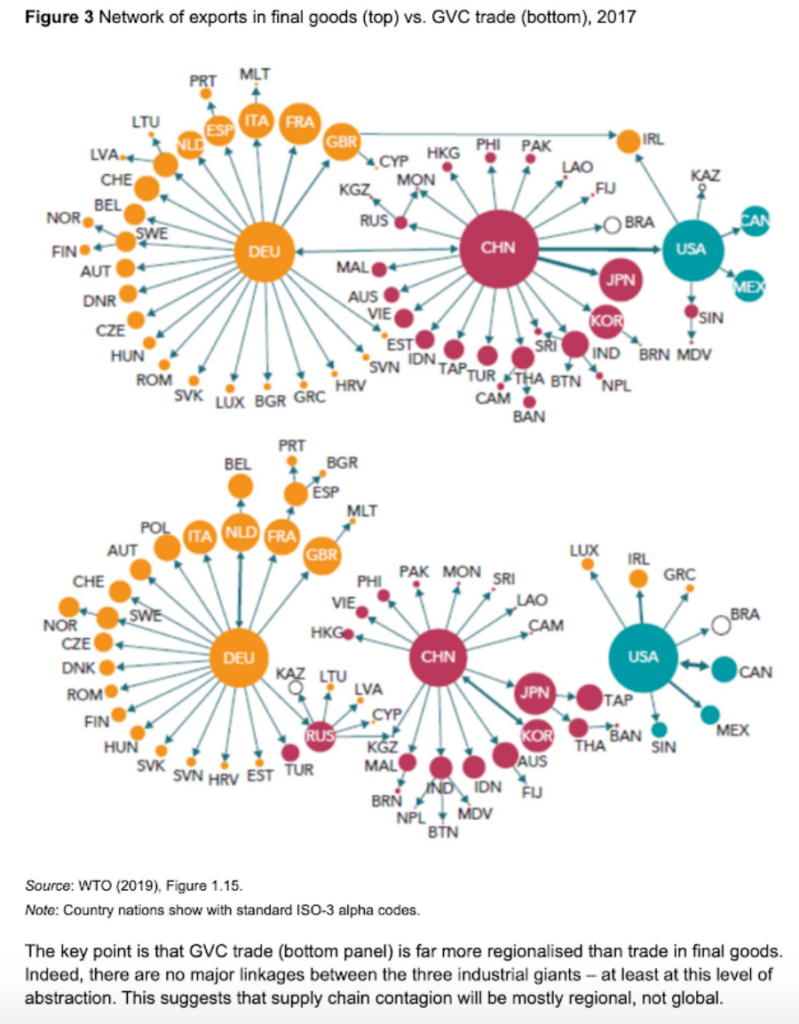
Approval of the compact would help solve a major problem facing the US and the G7. Clean energy components like electric vehicle (EV) batteries require minerals like lithium and nickel. But reserves in both the US and Europe are either scarce or extraction is held up by concerns over pollution and indigenous land rights. Australia mines more than half of the world’s lithium and virtually all of it goes to China for processing. The West wants that dependence to change. Australia and Canada, both US allies with significant reserves of most transition minerals, and with powerful local mining constituencies, are stepping up for G7 “friendshoring.”
In addition to lithium, Australia has substantial reserves of nickel and cobalt, also used for making EV batteries, as well as copper, used for making, well, everything electric. Days after the G7, Australian trade minister Don Farrell was euphoric, following a Detroit meeting with US secretary of commerce Gina Raimondo. He spoke of a “golden age” of mining to come.
Farrell was in Detroit for talks on the Indo-Pacific Economic Framework: a quasi-trade agreement that the US is developing with thirteen countries, to coordinate supply chains. Ministers from another transition minerals powerhouse, Indonesia, were also in attendance. But DPA deals were not forthcoming, even though economic affairs minister Airlangga Hartarto said his country was ready to supply the US with its domestically made EV batteries.
Both Australia and Indonesia have to balance their relationship with China, their biggest export customer, with the allure of US markets and the new subsidies on offer there. Mineral resources—iron, gas, lithium, copper—form the bulk of Australia’s $180-billion-a-year exports to China; more than half of Indonesia’s sales to China are ores and metals. A call for an investigation into the origins of Covid-19 led to China effectively banning Australian coal, timber, lobster, wine, and barley. The impact was muted as other markets filled some of the gap, but the lifting of restrictions this year was welcomed by smaller sectors.
Appeal to the base
Australia has long enjoyed a security treaty with the US, a relationship it is now making use of to advance its own interests. Last December, Australian foreign minister Penny Wong, a veteran of the center-left Labor Party, which returned to power in 2022, delivered a speech in Washington addressing the rising tensions between the US and China. Countries shouldn’t be required to pick a side in the great power rivalry, she argued. Respecting the agency of nations in the Asia Pacific region meant recognizing their close economic ties with China. For Pacific Island countries, it meant taking seriously the problems of debt, development finance, and “their most profound concern: climate change.”
Wong’s support for regional agency and non-alignment put Australian rhetoric at some distance from the New Washington Consensus espoused by the US administration, which has so far offered little to developing countries. Domestically, she hewed closer to Jake Sullivan and his colleagues’ “foreign policy for the middle class” framing: Australia would be “creating] domestic economic resilience, addressing climate change and energy security through more robust supply chains, making more things in Australia, and skilling our people.”
For a long time now, making things has not been the Australian way, however. It has been far too profitable to simply sell stuff dug up from under the ground—and sometimes from what’s grown on it. Manufacturing began its slow decline in the 1960s and was not helped by an enthusiastic adoption of liberalization policies in the 1980s.
Today the country has essentially no industrial policy, save for that focused on military development. Australia’s analogue of the IRA might be the nuclear submarine program of the joint Australia-UK-US pact (AUKUS), finalized in March. The goal is to boost their combined defense industrial base to deter China. Nuclear propulsion is the crown jewel of the US military industrial complex; the AUKUS agreement is only the second time it has shared the technology. The program, which includes eight Virginia-class submarines, is estimated to cost $AUD368 billion of public funds over thirty years—a substantial amount for an economy one-twentieth the size of the US.
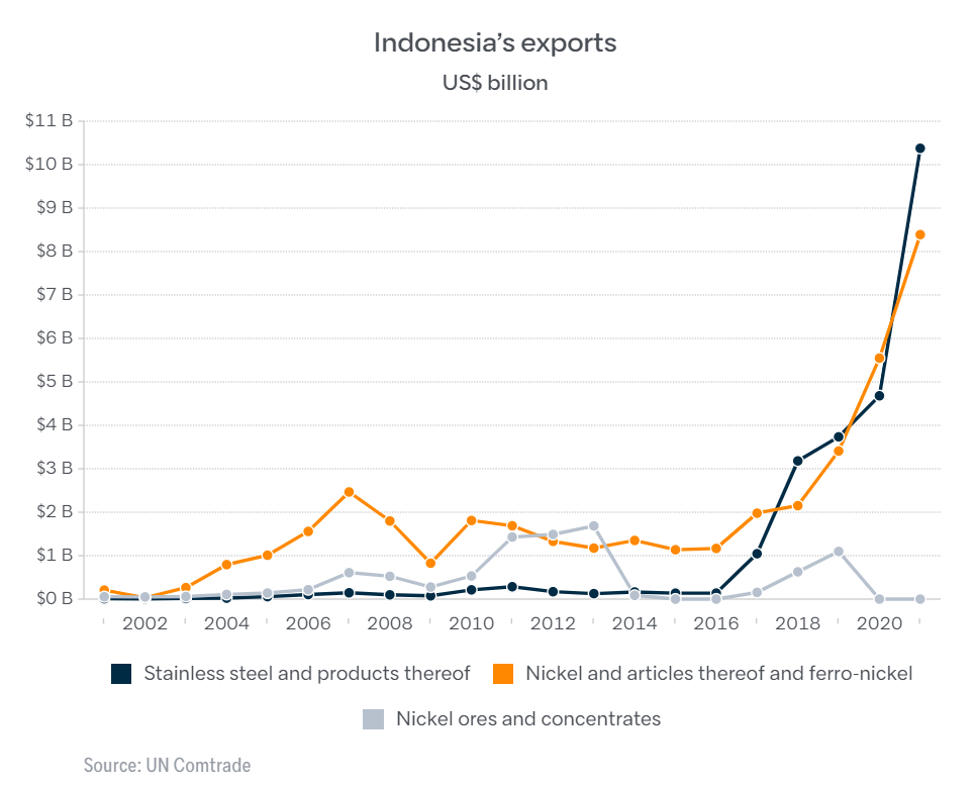
By contrast, Indonesia is strategically using its nickel reserves to move up the value chain of clean energy technologies. President Joko Widodo banned export of unprocessed nickel in 2020 and began offering incentives for production of EV batteries on domestic soil. In response, Korean companies Hyundai and LG onshored a battery facility, China’s Contemporary Amperex Technology Co., Limited (CATL) now has a processing plant, and Ford and Volkswagen also have plans. Jokowi now wants to go further and produce electric cars in Indonesia. His government is persuading Elon Musk to onshore Tesla, instead of their current $5 billion deal to import battery nickel.
Indonesia’s ban on unprocessed nickel exports was re-introduced in 2020. Source: Lowy Interpreter
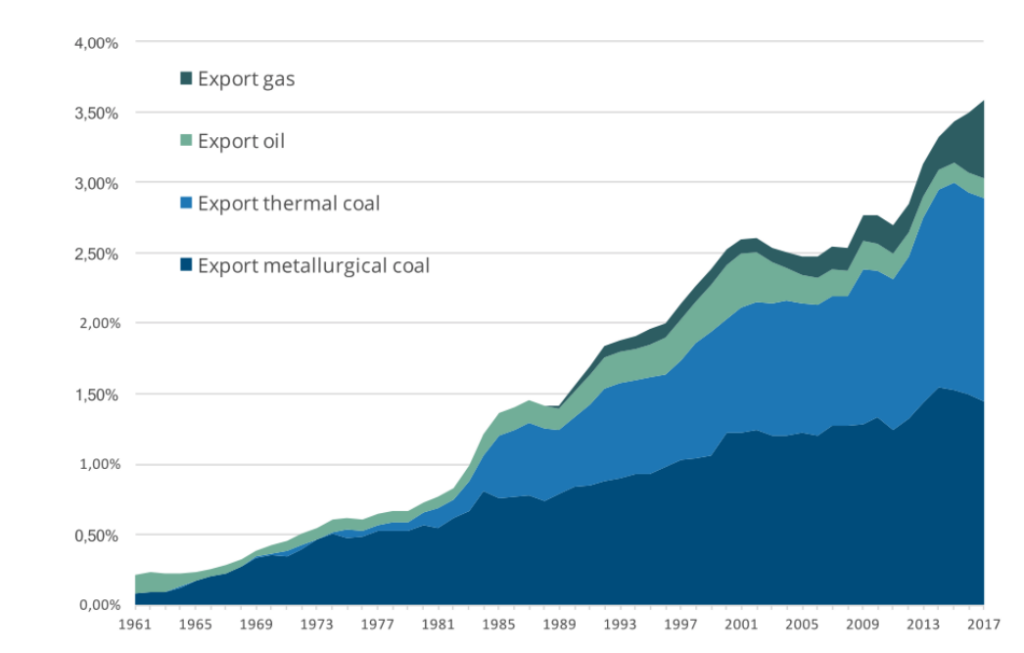
While weak on industrial policy, Australia is strong on pollution: it is one of the world’s most emissions intensive countries, on a per capita basis. Its coal and gas exports make a big contribution to this record. However, as the Grattan Institute has forecast, Australia faces the prospect of these earnings declining, because of the transition to cleaner and cheaper energy as well as China’s onshoring and near-shoring of coal from Mongolia. Australia’s liquefied natural gas (LNG) exports too are facing stiff competition from both the US and Qatar—and peak LNG demand looms.
Emissions from Australia’s exported commodities were approaching 4 percent of the world’s total by 2019. The country exports more emissions than all countries but China, US, Russia and Japan. Source: Climate Analytics
No man is an island
The terrible bushfires in Australia’s east during the “black summer”of 2020 were exacerbated by climate change, which amplifies the heating and drying effects of El Niño and the positive phase of the Indian Ocean Dipole. Both are predicted to return later this year, heightening the threat of bushfires in Australia and peat fires in Indonesia, as well as torrential floods in East Africa. The bushfires left millions of citizens choking, killed over a billion native animals, and prompted the Australian navy to undertake its largest ever civilian evacuation. The disaster was politically galvanizing for Australians too, who voted out the conservative government at the next election and support decarbonization. Ninety percent of Australians now want to see the climate recognized as a vital national security interest.
The Indian Ocean dipole is the coupled ocean-atmosphere phenomenon that leads to simultaneous extremes in the eastern and western part of the Indian ocean. The positive phase has amplified wildfires and coral bleaching in Australia; malaria and locusts in E Africa.
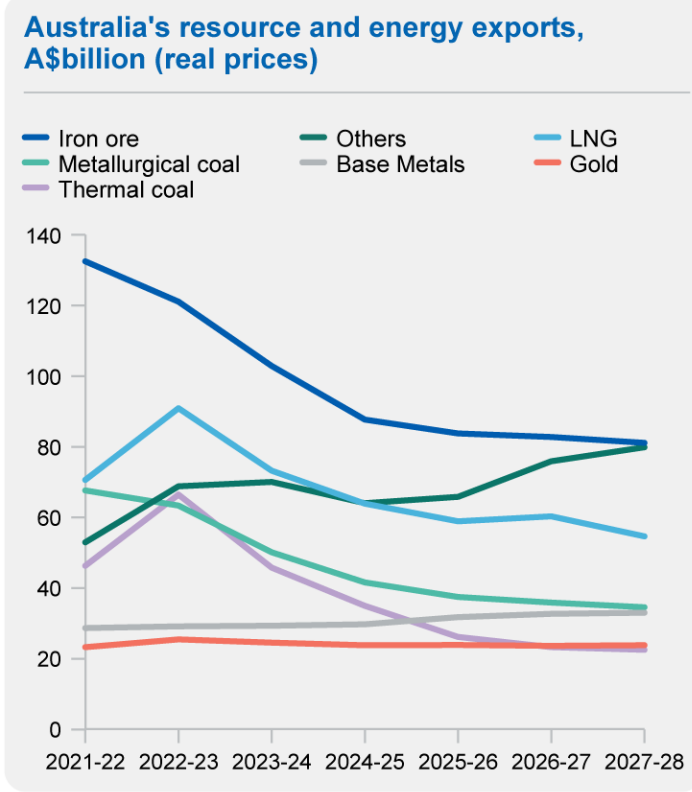
Australia’s single biggest export commodity is iron ore, the vast majority of which goes to China. Iron ore extraction is, in some respects, immune to the clean energy transition, as the stuff will be needed for wind turbines and buildings; the International Energy Agency projects that steel demand will grow by a third by 2050. It is not, however, immune to changes in China’s steel-intensive economic model. LNG and thermal coal export revenues are equivalent to about half of iron ore earnings.
Can Australia’s almost non-existent green exports ever match up to its booming gas, coal, and iron ore exports? Source: Australian Industry Department
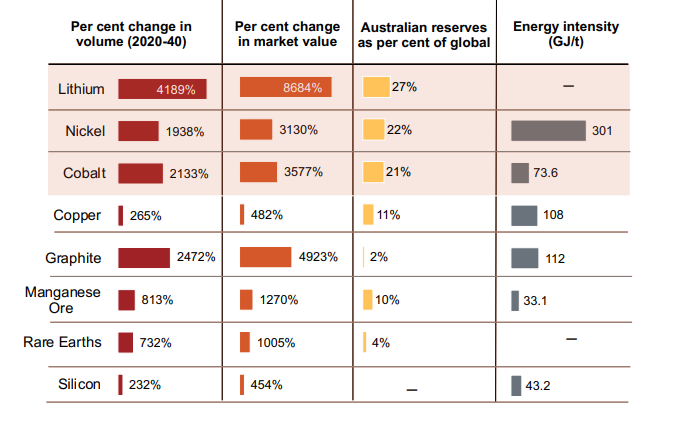
In theory, ample reserves of some transition minerals could take up a lot of slack. But will volumes and prices offset inevitable declines in other commodity exports? Long-term forecasts about the market for these substances—such as those below—very often derive from a small number of sources, and don’t explore a range of plausible demand-side measures, recycling, and material substitutions (such as sodium-ion batteries reducing demand for cobalt and lithium):
Estimated volume and value growth in the three transition minerals for which Australia has reserves, based on IEA and other sources. Chart source: Grattan Institute, 2022, see full notes here.
The country does not lack for capital to experiment with new industries. It has an AAA sovereign debt rating and an AUD2 trillion pension fund pool. Its more forward-looking billionaires want to export the country’s abundant sunshine and space, but distance from big markets makes that challenging. Green hydrogen, made with renewable electricity, favored by iron ore baron Andrew Forrest, is expensive to transport; the biggest users will be able to make their own closer to home. Atlassian co-founder Mike Cannon-Brookes has a big venture to send renewable electricity to Singapore, but transmitting electricity thousands of miles under the sea is, again, likely to prove too expensive.
Australia’s neighbors can perhaps see its predicament most clearly. In February, Indonesia’s chamber of commerce and industry, Kadin, signed a memorandum of understanding on critical minerals and batteries with the mining-heavy state of Western Australia. “We must use this opportunity to jointly develop a battery manufacturing factory in Indonesia taking advantage of Australia’s lithium and profitable investment to realize the potential of Indonesia’s nickel reserves and abundant workforce,” Kadin’s chairperson Arsjad Rasjid said, neatly acknowledging Australia’s comparative advantages in the twenty-first century: a large, although incomplete, complement of transition minerals and financing options that developing countries can only dream of.
The latest US experiment with industrial policy—comprised primarily by the Inflation Reduction Act (IRA), the CHIPS and Science Act, and the Infrastructure Investment and Jobs Act—has sparked outright opposition and pleas for restraint, but also calls for far more ambitious action.
The divergent responses are representative of the lack of consensus about the nature of the challenges that US industrial policy could or should address. In the broadest sense, industrial policy refers to the deployment of policy tools in order to influence how we create value—what goods (and services) we produce and how we produce them. In economist Ha-Joon Chang’s words, it is a set of “policies aimed at particular industries (and firms as their components) to achieve outcomes that are perceived by the state to be efficient for the economy as a whole.”1Chang, Ha-Joon. 2003. (<)em(>)Globalisation, Economic Development, and the Role of the State(<)/em(>). London: Zed Books. Mario Cimoli, Giovanni Dosi, and Joseph Stiglitz argue that industrial policies “come together with processes of ‘institutional engineering’ shaping the very nature of the economic actors, the market mechanisms and rules under which they operate, and the boundaries between what is governed by market interactions, and what is not.”2Cimoli, Mario, Giovanni Dosi, and Joseph E. Stiglitz, eds. 2009. (<)em(>)Industrial Policy and Development: The Political Economy of Capabilities Accumulation.(<)/em(>) Oxford: Oxford University Press. These different understandings of industrial policy all recognize the government as a key actor in shaping the world of production in line with a public purpose.
There is a growing awareness that all nations use industrial policy on an ongoing basis, whether or not they acknowledge it as such. Many conventional policy measures—from public investment allocations and trade measures to environmental regulations and public procurement rules—influence which industries and production methods thrive and decline, which economic (and social) actors win and lose power, who creates value, and who captures it. Therefore, whether or not policymakers frame such policy measures as industrial policy, that is precisely what they are.
However, the specific uses of industrial policy vary widely. States have historically deployed industrial policy for a range of purposes, from narrow objectives like temporarily ramping up production of a strategic good (e.g., masks during a pandemic), to broader and more ambitious missions, like winning wars or transforming poor countries into rich, industrialized ones.
Today, the existential threat of climate change and environmental degradation, rooted in a system of production that has been unambiguously diagnosed as terminally self-destructive from a range of scientific perspectives, necessitates a similarly ambitious transformation of the production systems that make up the American economy. The emerging US industrial strategy recognizes climate change as a central problem, but the full scope of existential threats we face (e.g. biodiversity loss, soil depletion, and water pollution) have yet to be integrated as priorities.
Industrial policy can have even greater implications. Broadening our outlook allows a host of societal challenges to come into view. It has long been evident that the burden of environmental degradation falls more heavily on poor Black, Brown, and Indigenous communities.3Zwickl, Klara, Michael Ash, and James K. Boyce. 2014. “(<)a href='https://www.researchgate.net/publication/266750137_Regional_variation_in_environmental_inequality_Industrial_air_toxics_exposure_in_US_cities' target='_blank' rel='noreferrer noopener'(>)Regional variation in environmental inequality: Industrial air toxics exposure in US cities(<)/a(>).” (<)em(>)Ecological Economics(<)/em(>) vol. 107 (November): 494-509. If we aspire to more equitable outcomes, environmental injustice has to be integrated as a priority in the redesign of production systems.
While these deep and intertwined problems cannot be solved exclusively through industrial policy, it can address issues ranging from pollution and access to safe drinking water, to poverty alleviation and housing provision. In pursuing this undertaking, we can gain timely lessons from an academic field devoted to the problem of productive transformation: development economics.
Dependent structures
Among the most profound insights of this scholarship is that productive structures—a country’s collection of technological-productive capabilities—are highly persistent across time. Studies of long-run trade dynamics have shown that countries specialized in exporting low value-added products are very unlikely to shift toward specializing in more sophisticated products.4Gala, Paulo, Jhean Steffan Martines de Camargo, and Elton Freitas. 2017. “The Economic Commission for Latin America (ECLA) Was Right: Scale-Free Complex Networks and Core-Periphery Patterns in World Trade.” Moreover, this global pattern of productive specialization has been largely persistent over two eras of globalization, with far-reaching consequences: the economic divergence between rich and poor countries that emerged during the first era of globalization resulted from unequal gains from trade between exporters of raw materials and manufactured goods.5Weber, Isabella, Gregor Semieniuk, Tom Westland, and Junshang Liang. 2021. “(<)a href='https://scholarworks.umass.edu/cgi/viewcontent.cgi?article=1301&context=econ_workingpaper' target='_blank' rel='noreferrer noopener'(>)What You Exported Matters: Persistence in Productive Capabilities across Two Eras of Globalization(<)/a(>).” (<)em(>)Economics Department Working Paper Series (<)/em(>)(No. 2021-02), University of Massachusetts Amherst.
Policymakers have recognized the difficulty in transforming a nation’s productive structure since well before the industrial revolution. The scale of the challenge motivated ambitious industrial policies. France’s Finance Minister Jean-Baptise Colbert (1619-83), for example, banned imports of Venetian glass to protect the state-owned glass manufacturer that today is the construction materials multinational St. Gobain. In the fourteenth century, King Edward III of England sought to develop local wool manufacturing capabilities by hiring Flemish weavers (the industry leaders at the time) and banning the import of woolen cloth; he even wore English cloth to set an example.6Chang, Ha-Joon, 2002. (<)em(>)Kicking Away the Ladder: Development Strategy in Historical Perspective. (<)/em(>)London: Anthem Press, 19.
The origin stories of today’s industrialized economies are variations on this theme of path-defying policies,7For detailed discussions on this, see Chang 2002; and Chang, Ha-Joon. 2007. (<)em(>)Bad samaritans. the guilty secrets of rich nations and the threat to global prosperity. (<)/em(>)Random House. including in the US, which began by promoting “infant industries” in textile and steel manufacturing when Alexander Hamilton 8Hamilton articulated his arguments for nurturing and protecting new industries in his Report on Manufactures (1791) and the thesis was later developed by Friedrich List (1885) (Chang 2002, 25-6) and complemented by the insights of the classical development economists in the twentieth century, such as Albert Hirschman, Arthur Lewis, and Raul Prebisch. defied British pressure—and advice straight from Adam Smith—to continue specializing in raw materials and leave manufacturing to Britain. US industrial policy has since been marked by several ambitious transformations of national infrastructure, periods of war-time economic planning, and the development of state-led innovation hubs in several key industries, most notably the military industry, which grew out of war-time mobilizations.9For a broader discussion, see Tucker, Todd. 2019. “Industrial Policy and Planning: What It Is and How to Do It Better.” Roosevelt Institute. Much like these early industrializers, the few countries that have managed to achieve path-defying change in the twentiethcentury—including South Korea, Taiwan, Japan, and China—have done so not by allowing pre-existing market dynamics to determine their productive structures but by reshaping those structures using a range of tools, from price management and public enterprises to trade management and workforce planning.10Weber, Isabella M. 2021. (<)em(>)How China Escaped Shock Therapy: The Market Reform Debate(<)/em(>). Routledge; Wade, Robert. 2004. (<)em(>)Governing the Market(<)/em(>): (<)em(>)Economic Theory and the Role of Government in East Asian Industrialization. (<)/em(>)Princeton University Press; Chang 2002; Amsden, Alice H. 1989. (<)em(>)Asia’s Next Giant: South Korea and Late Industrialization(<)/em(>). Oxford: Oxford University Press.
At this historical juncture, there are compelling reasons to think that the intertwined societal challenges the US faces call for similarly ambitious, transformative approach. Efforts at economic transformation have historically been curtailed by grave underestimation of the necessary scale and scope of the policy interventions. US policymakers risk this pitfall if they give in to pressure to deploy industrial policy narrowly, relying on a limited set of policy tools. US industrial strategy already features vigorous deployment of public investment and complementary “carrots,” but pathbreaking change will require more.11For a broader discussion of these tools, see Tucker, Todd. 2019. “Industrial Policy and Planning: What It Is and How to Do It Better.” (<)em(>)Roosevelt Institute(<)/em(>). “Sticks” like industry-wide rules to bring pollution levels in line with climate and human health targets may be less politically tractable, but they will likely be necessary for meaningful change. To manage future crises, we will need more potent tools and institutions from the industrial policy toolbox, like price management, public banks, public enterprises, and public equity stakes.
Measuring development
The field of development economics emerged as a response to what it deemed “the economic problems of poor countries.” Motivated by a concern of expanding consumption capacity, classical development economists focused on questions related to how states could achieve capital accumulation for technological change, economic diversification, industrialization and, as a result, per capita growth.12See for example, Hirschman, Albert O. 1958. (<)em(>)The Strategy of Economic Development(<)/em(>). Yale University Press; Lewis, William Arthur. 1954. “Economic Development With Unlimited Supplies of Labour.” (<)em(>)Manchester School of Economic and Social Studies(<)/em(>), (<)em(>)22(<)/em(>)(2), 139–191; Myrdal, Gunnar. 1957. (<)em(>)Economic Theory and Underdeveloped Regions(<)/em(>). London: G. Duckworth; Prebisch, Raúl. 1984. “Five Stages in My Thinking on Development.” In G.M. Meier & D. Seers (Eds.), (<)em(>)Pioneers in Development (<)/em(>)(pp.173-204)(<)em(>).(<)/em(>) However, the relationship between growth and living standards remained largely unexamined. Rising living standards, it was assumed, would be the natural byproduct of increasing per capita income through industrialization.
Mounting evidence that growth often did not improve human well-being gradually forced development economists to broaden their framework. Pakistan’s former financial minister, Mahbub ul-Haq, who would later champion the “human development” approach in the United Nations, noted: “When rapid economic growth during the 1960s failed to translate into improvements in the lives of Pakistan’s masses, I was forced to challenge many of the premises of my initial work.’’ Similarly reflecting on the early stages of his economic thinking, development economist Raul Prebisch wrote:
Up to this stage, I had not paid sufficient attention to the problem of income disparities [nor] to the fact that growth had not benefited large masses of the low-income population, while at the other extreme of the social structure high incomes flourished. Perhaps this attitude of mine was a remnant of my former neoclassicism, which assumed that growth in itself would eventually correct great income disparities through the play of market forces.
Prebisch and Haq’s accounts reflect the gradual expansion of development economics into issues like inequality, unemployment, and the fulfillment of basic human needs. Amartya Sen’s Development as Freedom (1999) cemented this humanist turn in development theory. The “human development and capabilities” scholarship examines how policies can expand human capabilities (or freedoms), and more recently has begun to explore how that expansion can be achieved within ecological boundaries.13Balogun, Kehinde, Kariuki Weru, and Xiaomeng Shen. 2023. “‘Freedom from Want’: A Critical Reflection in the Face of the Anthropocene.” (<)em(>)Journal of Human Development and Capabilities (<)/em(>)(January). The shift away from growth-centric models is also reflected in the proliferation of metrics that add to or altogether displace growth as a proxy for societal prosperity.14For a review, see: Costanza, Robert, Maureen Hart, John Talberth, Stephen Posner. 2009. “(<)a href='https://www.bu.edu/pardee/files/documents/PP-004-GDP.pdf'(>)Beyond GDP: The Need For New Measures of Progress(<)/a(>).” (<)em(>)The Pardee Papers No. 4 (January)(<)/em(>); Stiglitz, Joseph, Amartya Sen, and Jean-Paul Fitoussi. 2009. (<)em(>)Report by the Commission on the Measurement of Economic Performance and Social Progress(<)/em(>). European Union.
This evolution can be read as a record of a gradual realization that (i) an economic transformation that expands growth does not necessarily expand well-being; (ii) the expansion of well-being also involves policies that have little or nothing to do with growth; (iii) policies for economic transformation need to center the objective of improving human well-being; (iv) those policies need to be consistent with ecosystem boundaries to ensure species survival. Though these lessons are still often forgotten or marginalized in policy design, they can have profound implications when taken seriously.
First, they call on policymakers to articulate a vision for industrial policy that centers well-being as its ultimate objective. As Todd Tucker and Steph Sterling suggest, “Perhaps the most important question for policymakers when developing industrial policy is whether it is promoting the industries we need most to allow all members of our society and country to flourish.”15Tucker, Todd and Steph Sterling. 2021. (<)a href='https://rooseveltinstitute.org/wp-content/uploads/2021/07/RI_ANewOldApproachtoPolicymakingforaNewEra_IssueBrief_202108.pdf'(>)(<)em(>)Industrial Policy and Planning: A New (Old) Approach to Policymaking for a New Era(<)/em(>)(<)/a(>). New York: Roosevelt Institute.
In the absence of a holistic vision and missions for a “well-being-oriented” industrial policy (i.e., a national development strategy), basic principles can serve as heuristics to help clarify how policymakers can make “the perspective of freedom coherent and cogent”16Sen 1999, xi-xiii in policy design and execution. Foundational principles like equity, human rights, ecological sustainability, and democratic accountability can improve the quality of policy design if seriously considered and consistently applied.17See Tucker and Sterling (2021) and Tucker (2019) for a broader discussion on foundational industrial policy principles.
And much like development scholars use the principle of “exhaustiveness” to ensure that their analyses holistically examine the impacts of each policy intervention on the full range of critical human capabilities,18Ibrahim, Solvava. 2014. “Introduction: The Capability Approach: From Theory to Practice – Rationale, Review, and Reflections.” In Ibrahim, S., & Tiwari, M. (Eds.), (<)em(>)The Capability Approach(<)/em(>), (1-28). Springer, 16-18; Robeyns, Ingrid. 2017. (<)em(>)Wellbeing, Freedom and Social Justice: The Capability Approach Re-Examined(<)/em(>). Open Book Publishers; and Robeyns, Ingid. 2003. “Sen’s Capability Approach and Gender Inequality: Selecting Relevant Capabilities.” (<)em(>)Feminist economics(<)/em(>), vol. 9, issue 2-3, (January), 61-92. each stage of industrial policy design should be guided by a concern for well-being in all its dimensions.
Finally, reconceptualizing notions like efficiency, synergy, and systemic coherence can guide policymaking priorities by optimizing collective wellbeing over financial return, investing in multiple projects that amplify positive outcomes, and preventing indirect or systemic outcomes that may undermine public interest objectives.
The last of these can help craft an industrial strategy that accounts for the effects of policymaking and recognizes that every industrial policy is also an environmental policy, a distributional policy, a natural resources policy, a labor policy, a health policy, and so on. These policies influence power relations and distributional outcomes—who gets or loses access to clean air and water, who keeps or loses their homes, jobs, or livelihoods. This means that an industrial strategy designed around well-being needs to evaluate how different policy pathways—no matter their sectoral specificity or their core mission—affect a broad set of public interest challenges and well-being objectives.
For example, the IRA’s investments in decarbonization of highly polluting industries like steel, aluminum, and cement could target the broader environmental and health impacts of industrial production as well as the disproportionate harm of these effects, which are largely felt by Black, Brown, and Indigenous communities.19Zwickl, Ash, and Boyce 2014; Kassem, Hebah and Isabel Estevez. “Why ‘Buy Clean’ Policies Should Consider Toxic Emissions (And Much More).” (<)em(>)The Sierra Club(<)/em(>), September 8, 2022. The distribution of investments could involve equitable hiring standards and community benefit agreements, demonstrating the importance of process in tackling more than a single issue at once.
A democratic process
Since economic transformation is a political process as much as an economic one, the viability of transformative policies is contingent on buy-in from critical stakeholders. Failure to manage class politics to secure a supportive political coalition has historically been a common pitfall of industrial policy. Conversely, successful economic transformations have featured far-reaching political interventions, such as measures to neutralize hostile economic elites vested in the preservation of the status quo. South Korea’s land reform in the 1940s and 1950s, for example, weakened the political power of the landlords, clearing the way for the rise of a pro-industrial policy regime in the 1960s. In the Prussian “marriage of iron and rye,” Bismarck provided protections to the landlord class (the Junkers) in exchange for their acquiescence to industrial policy measures, including tariff protections for the emerging heavy and chemical industries.
In the US, the recent success of major renewable energy investments is partly a product of protracted coalition building between labor, certain sectors of the environmental movement, and sectors of the capitalist class that stand to gain from producing renewable energy technologies—coupled with political negotiation to neutralize hostile interest groups. However, the limited scope of the IRA relative to the Biden administration’s Build Back Better Agenda reflects the enduring power of those opposed to a far-reaching economic transformation. In this context, the implementation phase of the trifecta of US industrial policy legislation presents an opportunity to use democratic engagement as a tool to strengthen a coalition capable of propelling lasting and pathbreaking change.
As Sen reminds us, key actors are all too willing to accept sacrifices like “low welfare, high inequality, [and] intrusive authoritarianism” to achieve “development” in “the future.” In today’s context, some advocate privileging the speed of deployment of renewable energy and the construction of new infrastructure and manufacturing capabilities over other objectives. Critics of the CHIPS and Science Act’s labor, childcare, and community benefit conditionalities argued that higher costs could hamper the rapid buildout of chips manufacturing capabilities. Childcare provisions were entirely excluded from the final version of IRA, which had been proposed in the Biden administration’s original Build Back Better bill.
Notwithstanding the need for speed, Sen notes that the procedural aspects of policy can be just as important when it comes to delivering outcomes that effectively expand people’s freedoms. Procedures define the degrees of agency wielded by different groups in the design, execution, administration, and oversight of the institutional arrangements that structure their societies. Policymakers need to ensure access to decision-making in a way that compensates for existing power asymmetries. Failure to create institutional safeguards—from governance mechanisms to investment standards—that proactively push against those asymmetries risks delivering an industrial policy that exacerbates inequities and further concentrates benefits (and power) in a vicious cycle.
With emergent US policies still in flux and a growing awareness of the scale of the challenges to be met, policymakers have a unique opportunity to build a broad and powerful coalition for a transformative industrial strategy. Reflecting on experiences of industrialization throughout the nineteenth and twentieth centuries, and engaging with the development economics literature which has emerged from these experiences, is vital to this effort.
Monetary financing—the issuance of public money to support public expenditure—has in recent times become a policy taboo. The message from economists to politicians, policymakers, and society more broadly is often that any central bank support for public expenditure is likely to destroy an economy.
In 2009, the taboo stopped the European Central Bank (ECB) from buying sovereign debt in the open market, an activity that, as we will shortly see, European treaties had been explicitly drafted to allow. Newly issued public debt languished on the market. Eventually, pent up supply and panicked investors brought the very project of European integration to the brink of collapse. This was a very different scenario to what happened in the US and the UK, where, in 2008 and 2009 respectively, central banks launched enigmatic “quantitative easing” (QE) programs, which involved buying large volumes of government debt.
By 2020, the ECB had changed its tune. At the outset of the pandemic, it followed the Bank of England and the Fed, dutifully launching massive public debt purchase programs. Former ECB president Mario Draghi published an op-ed with the ominous title: “We face a war against coronavirus and must mobilize accordingly.” The model to follow was, he argued, was wartime monetary finance. When Christine Lagarde took over as president in 2019, she pointed to the role of government debt purchases in ensuring “supportive financing conditions […] for governments.”
In recent years, central bankers have taken a more conciliatory position. While conceding that central banking does at times involve outright purchases of debt, they maintain to the public that today’s quantitative easing should not be confused with monetary financing. The reason is that the objective of bond purchases is not to facilitate government spending. Indeed, orthodox central bankers and critical academics have alike sought to distinguish today’s interventions in sovereign debt markets from historical practices of monetary financing. Despite those efforts, there are few notable differences between the bond purchases of the Great Depression, the two World Wars, and the Cold War and the “unconventional” policies of 2008–2022. The main contrast lies in communications strategy.
In a recent article in the Review of International Political Economy, we propose a new macro-financial account of monetary financing to explain the historical continuity of central banking practices. As we show, central banks have almost always acted to buy debt issued by governments in a crisis. We make our case by pointing to how central banks supported treasuries in the jurisdictions that have issued the two global currencies of the post-industrial age: the United Kingdom and the United States. We show that monetary financing has always been important in helping states navigate large fluctuations in the demand for, and supply of, government debt. The ECB’s 2009 refusal to support struggling member states stands as an exception in twentieth-century central banking practice. Relying on newly disclosed archival documents, we also show that in the early ‘90s, central bankers drafted the ECB mandate to make sure the central bank could buy government debt when needed—an insight that got lost in the market-ideological enthusiasm of the late ‘90s and early 2000s.
Central banks have always acted—and always will act—as the lender of last resort to governments facing what we describe as “sovereign-financing gaps.” Wars, post-war reconstructions, financial crises, and other economic emergencies force the treasury to spend as fiscal receipts disappear, irrespective of private investor demand. The central bank, as the issuer of new public money, typically accommodates those spending programs, either by directly acquiring debt from governments or by bulk purchases in secondary markets from securities dealers. Its role is to monetize deficits until supply and demand dynamics stabilize. On this account, stabilization of sovereign financing conditions is a “feature” not a “defect” of central banking.
The most distinctive feature of sovereign finance is the demand for a continuous but irregular supply of funds which is exceptionally large relative to any other borrower, even in normal times. Sovereign financing gaps can easily exceed private creditors’ willingness to lend. In extreme circumstances, no credit is available in markets at affordable prices, for even the most solvent sovereign. When “debts are large and precarious creditors shy away,”1Dornbusch, R and Draghi, M, ‘Introduction’ (1990) In Dornbusch, R and Draghi, M (eds), (<)em(>)Public debt management: theory and practice(<)/em(>). Cambridge University Press, page 6. the volume of debt that treasuries can sell, even at high interest rates, is limited. Monetary finance becomes necessary “because debt cannot be sold.” Wherever sovereign financing gaps arise, governments must rely on central banks.
As we document in the article, the Bank of England and the Federal Reserve have always provided support to treasuries issuing large volumes of debt at critical moments of fiscal distress (see table 1). Since the early twentieth century, monetized credit has been provided through a variety of operations, including unsecured credit lines, direct purchases of newly-issued debt, and secondary market purchases intentionally designed to create scarcity of sovereign debt instruments. Large secondary-market purchases have become particularly important in recent years, given the dominance of quantitative easing programs.
Table 1: Exceptionally large purchases of government debt
Years
UK Bank of England
US Federal Reserve
Before 1933
WW1 War Finance
WW1; Great Depression
1933–1947
1944 WW2 War Finance; 1947 Reconstruction
1942-1945 WW2; 1945–47 Reconstruction
1947–1980
1949 Stabilization after currency devaluation; 1952–53 Coal industry nationalization
1958 and 1970 outright purchases to prevent the failure of treasury re-financing programs
1980–2008
Overnight finance; Ways and Means used until 1998
Fed guaranteed re-financing at primary auctions
After 2008
Finance Crisis Bank rescue Ways and Means financing and QE Pandemic QE
Policymakers at central banks acknowledge this macro-financial function. When launching QE in the US, all members of the Federal Open Market Committee (FOMC) emphasized that large sovereign debt purchases would be a form of debt monetization and acknowledged the political risks stemming from the taboo. However, even those who opposed purchases stressed the risk of non-clearance of auction in primary Treasury markets:
[T]here are serious questions being raised by market participants and market commentators about the government’s ability to fund new higher expected levels of Treasury issuance—that is, they may or may not, in the market’s view, be able to find buyers at market-clearing prices.2(<)a href='https://www.federalreserve.gov/monetarypolicy/files/FOMC20090318meeting.pdf' target='_blank' rel='noreferrer noopener'(>)FOMC(<)/a(>), 2009b, 80.
FOMC members in favor of Treasury debt purchases did not argue with the core point that secondary market purchases would be a form of debt monetization. In fact, they contended that such monetization would be both desirable and controllable. As one argued:
I think right now we need to make sure that fiscal policy is as effective as it can be. So monetizing the debt to me is not a negative under the current situation, because it’s helping fiscal policy be effective—provided we can do it in the context of not having rising inflation expectations and not having concerns about our independence. 3(<)a href='https://www.federalreserve.gov/monetarypolicy/files/FOMC20090318meeting.pdf' target='_blank' rel='noreferrer noopener'(>)FOMC(<)/a(>), 2009b, 95-96.
This is the background against which the dramatic history of the ECB’s monetary financing prohibition must be analyzed. It is a far more recent phenomenon than is typically thought, taking on its most radical form only in the mid-2000s.
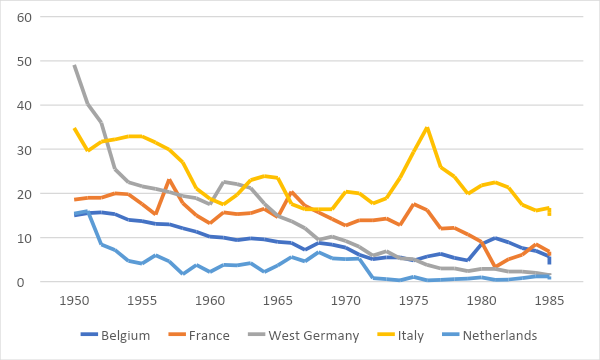
From the postwar establishment of the European Monetary Union, European central banks supported public debt markets through direct credit and open market operations (See Chart 1). This was even the case for the German Bundesbank. For example, in 1975, Germany’s central bank purchased DM7.5 billion in public securities to promote bank lending and “prevent an undesirable rise in interest rates.”4BuBa. (1996). (<)em(>)The Monetary Policy of the Bundesbank(<)/em(>). Frankfurt: Deutsche Bundesbank. Until well into the 1990s, it conceded that “the central bank affects the market situation, and the interest rate expectations of market players change, so that the Bundesbank may sometimes unavoidably be forced into the position of an “interest rate leader”’ to ‘smooth out erratic price movements’ and ‘ensure that the corresponding securities can trade on the stock exchange at any time, even in larger amounts.”5BuBa, 1996.
Chart 1: Percentage of the central government’s debt held by western European central banks at end of year
Source: Abbas, S. M. Ali, Laura Blattner, Mark H.J. De Broeck, Asmaa El-Ganainy, and Malin Hu. 2014. “Sovereign Debt Composition in Advanced Economies: A Historical Perspective.”
In the 1980s, central bankers were also concerned about rising public debt, but they knew the fragility of markets too well. As the 1988 Delors Report explained:
[M]arket views about the creditworthiness of official borrowers tend to change abruptly and result in the closure of access to market financing. The constraints imposed by market forces might either be too slow and weak or too sudden and disruptive.
For this reason, the EU treaties rely on fiscal rules rather than market discipline to constrain government spending. Behind the scenes, there was no genuine attempt to prohibit monetary financing.
Reflecting this history as well as other European central bank practices, the 1992 Maastricht Treaty did not prohibit the ECB from acting as a lender of last resort to governments via secondary market interventions. It did prohibit direct transactions between central banks and national treasuries. The distinction is important because secondary market transactions are a powerful conduit for monetary support to primary debt markets.
While discussing the historically unprecedented prohibition of direct credit to governments proposed in European law, former Bank of England governor Robin Leigh-Pemberton worried that “occasionally it would be useful to undertake such operations to influence the market.” That concern was dismissed by French governor Jacques de Larosière, who pointed out that the Treaty would ‘enable the System to buy and sell marketable instruments, such as Treasury bills and other securities, in the pursuit of monetary policy. Legal options to effectively prohibit debt monetization remained unused and no prohibition on secondary market interventions to support national treasuries was entrenched.
Today, the ECB’s refusal to act as a “lender of last resort” during the turmoil of 2008-2009 is widely recognized to have brought about the Eurozone Crisis. The initial driver of the crisis dynamics were large government deficits caused by the unprecedented circumstances of the global financial disruption. Between 2008 and 2014, European governments acquired bad assets from their domestic banking sector for a value of 5.3 percent of GDP and made direct fiscal transfers for another 2.1 percent of GDP. Expenditures differed considerably, with Ireland alone spending 25 percent of its GDP on bailouts. Compounding these direct costs, the indirect costs of financial market conditions and the economic downturn were much larger. The average Eurozone debt-to-GDP level rose from 65 percent of GDP in early 2008 to 92 percent at the end of 2014. In countries such as Ireland and Spain, the public debt doubled in a two-year period. Large issuance of debt called for, at least temporary, monetization.
By the time of the Eurozone Crisis, the ECB began to see financial markets as guardians of fiscal discipline. In this new market based approach to government debt, rating downgrades, higher funding costs, and maybe even a small debt crisis, were meant to force governments to cut spending. As a board member opined, “well-functioning financial markets should reward fiscal prudence and punish unsustainable fiscal policies.”
Driven by a zeal for sound public finances, the effect of central bank actions would be the exact opposite. The ECB’s refusal to address these acute sovereign-financing-gaps led to devastating market disruptions. In the absence of decisive central bank action, financing gaps set in motion a spiral, with the falling debt sustainability of the individual member state affecting the stability of their domestic banking sector, which in turn further harmed states. Crises of public and private finance were causally linked: banks held large volumes of bonds issued by their sovereign; governments were guarantors for banks; rising sovereign yields (hence, lower value of the bonds) led to losses on bank balance sheets; thus downgrades of banks and sovereigns were mutually-reinforcing A panic ensued. Notably, although the ECB disavowed its role as lender of last resort, in practice it could not avoid it entirely. By late 2009, the ECB announced its Securities Markets Programme (SMP), which would turn out to be comparable in size to the volume of fiscal support provided by the Federal Reserve at the same time (see the table below). The SMP absorbed a total of €220 billion government debt, which amounts to twenty-two percent of the total rise of debt levels between 2008 and 2012 for the five member states included. German central bankers, nonetheless resigned in protest over the purchases, possibly unaware that their central bank had executed similar operations (on a smaller scale) only a few years earlier.
Table 2: Delayed monetary financing in the Eurozone (General government deficits as percentage of GDP)
2008
2009
2010
2011
2012
Germany
-0.12
-3.15
-4.38
-0.88
0.01
Greece
-10.18
-15.15
-11.29 (*)
-10.47
-9.09
Ireland
-7.02
-13.85
-32.06 (*)
-13.01
-8.33
Italy
-2.56
-5.12
-4.24
-3.59 (*)
-2.95
Portugal
-3.7
-9.87
-11.4 (*)
-7.66
-6.18
Spain
-4.57
-11.28
-9.53
-9.74 (*)
-10.74
Euro area
-2.16
-6.24
-6.28
-4.24
-3.72
United Kingdom
-5.13
-10.04 (*)
-9.23
-7.48
-8.13
United States
-7.37 (*)
-13.13
-12.43
-11
-9.22
(*) denotes the year that central bank bond purchases start6OECD Data – General government deficit Total, % of GDP) (2008-2012).
Government debt purchases remain controversial today. In 2022 alone, the ECB’s Transmission Protection Mechanism and the Bank of England’s interventions in the face of the October mini-budget involve both government support and rhetorical assertions of monetary dominance. Ultimately, words are cheap. Deep functional constraints ensure the persistence of monetary financing.
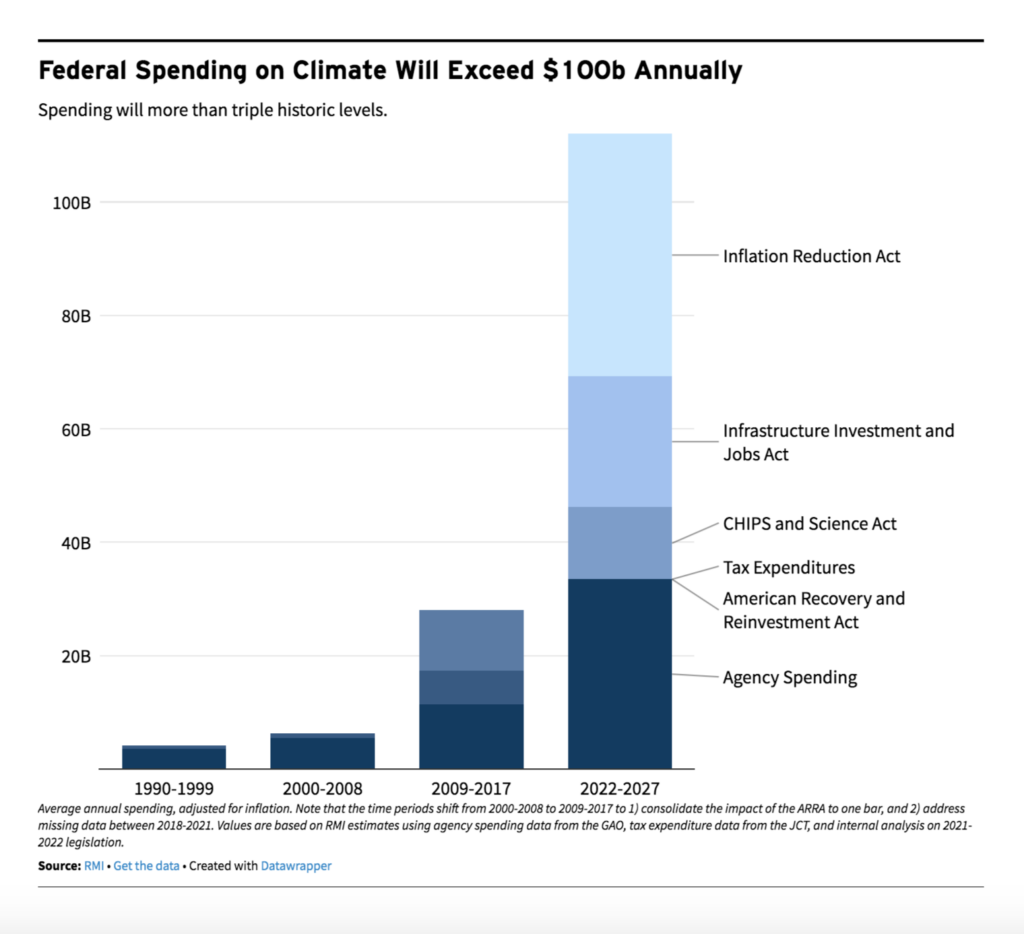
The Inflation Reduction Act is the most significant piece of climate legislation in US history. Alongside its three other major legislative achievements, the Biden administration has passed between $500 billion and $1.2 trillion worth of new climate spending, depending on projections of future demand. This translates to an average of at least $100 billion per year, which would not only be the largest climate spending package of any nation, but more than the total economic output of over 130 countries.
Together, the Inflation Reduction Act (IRA), Infrastructure Investment and Jobs Act, as well as limited sections of the CHIPS and Science Act, and American Rescue Planrepresent a green industrial strategy that puts the US in reach of its highly ambitious climate goals and marks a turning point in federal economic policy. Not only is this projected to help cut US emissions by about 40 percent by 2030, but this strategy will reconfigure technology trajectories, global capital flows, and the international rules and norms that shape them. In late April, National Security Advisor Jake Sullivan officially branded this as the “New Washington Consensus,” prompting commentators to proclaim the of “death of neoliberalism” and the victory of “Bidenomics.”
In this new paradigm, “Green Industrial Policy” is not only a climate strategy, but the centerpiece of a multi-faceted political economy project designed to boost growth, counter China’s dominance in clean energy sectors, and tackle domestic inequality. In many respects, it is the synthesis of economic, foreign policy, and political debates stretching back to the Great Recession. In economic policy, it reflects the pivot from market-liberal neoliberalism to state-interventionist “Hamiltonianism;” in foreign policy, a shift from globalist peace theory to realist multipolarity; and a direct response to the “Calamity Thesis” of deindustrialization and the rise of Trump-ism among the working class.
But nowhere is this shift more pronounced than in the climate debate itself. Ten years ago, we were “prisoners of the wrong dilemma,” stuck in a neoclassical view of climate change as a global externality to be fixed through collective action and international cooperation. Today, the success of Biden’s green industrial strategy emphasizes the power of rapidly improving technologies to drive positive feedback loops of economic growth and political coalition-building. As Kingsmill Bond at RMI has argued:
“[t]he energy transition is a shift from a concentrated, expensive, polluting commodity-based system with no learning curve, to an efficient, manufactured, technology-driven system that offers continuously falling costs and is available everywhere. It is moving from heavy, fiery molecules to light, obedient electrons; from hunting fossil fuels to farming the sun.”
This technological and economic shift has fundamentally altered the political horizon of what constitutes feasible climate action.
In a recent column, Paul Krugman identifies the core feature of green industrial policy as the attempt to “reshap[e] the economy to limit climate change,” rather than any particular policy or program. This conforms with the analysis of a group of scholars who in a 2021 paper characterize green industrial strategy as “the intent to restructure and transform the economy into a green economy” and contrast it with carbon pricing, a market-based approach which had long dominated climate policy and eschews the idea of a large role for the state. They point out that “[t]his new opportunistic frame for climate action has further effects on international institutions and geopolitics, heightening competition and presenting new challenges for cooperation.” As Todd Tucker at the Roosevelt Institute notes, what’s distinctive about the Biden administration’s approach is that it is no longer “kicking away the ladder” from countries trying to pursue their own industrial strategies according to their own political-economy needs, but instead places the goals of decarbonization, growth, geopolitical stability and income equality over first-best policy solutions.
This is important since few countries will be able to match the US’s fiscal weight or feel so compelled to address so many internal and external crises in a single administrative term. Green industrial strategy as implemented in the US is bigger than in Europe, more impactful than in Australia, Canada or India, and more reliant on private sector investment than in Japan, Korea, or China.
The politics of $1 trillion
Biden’s green industrial strategy is both impressive in scale and in its passage amidst highly complex political circumstances. After fractious negotiations, Congress authorized over $4 trillion in new investment between its four major pieces of economic legislation. Officially, around $500 billion of that spending goes towards climate-related spending, most of which is contained in the Inflation Reduction Act. According to our estimates, the US federal government will spend an average of over $100 billion each year on climate mitigation over the next ten years, about two and a half times the annual average from 2009-2017.
Even this figure is likely a significant underestimate. Since many of the tax credits contained in IRA are uncapped, total public expenditure is limited only by private demand for these incentives. If deployment of key clean energy technologies, such as solar or green hydrogen, were to be in line with a 2050 net-zero pathway, we estimate that total spending in the IRA alone could reach $1 trillion. A recent Brookings analysis reached a similar figure even without the net-zero constraint. This discrepancy is particularly large in renewable energy spending, which could see twice as much spending in a climate-aligned pathway—green hydrogen could see five times the spending, and the electric vehicle (EV) supply chain a staggering ten times the official Congressional Budget Office (CBO) estimates if consumers rush to buy cheaper EVs.
Official estimates also don’t include additional loan authorizations included in the administration’s green industrial strategy. In the IRA, there is a further $390 billion in public loan authorizations, which will crowd in significantly more private investment into the clean energy transition. Again, several of these programs, such as the Greenhouse Gas Reduction Fund, have no upper limit and could end up lending in excess of ten times their official budget allocation. Assuming these programs end up with the same leverage ratio as the Loan Program Offices’s (LPO) Clean Energy Loan Guarantee programs, they could collectively finance more than $800 billion worth of investments across a range of clean energy sectors.
Biden’s green industrial strategy is of course an innovation in the practical challenge of cutting carbon emissions, but just as importantly, it is an innovation in the political challenge of doing so through the US Congress. The public’s appetite for austerity was at an all-time low by mid-2022 following five separate Covid-19 welfare-expanding packages each exceeding $200 billion. At the same time, the use of tax credits and loan guarantees effectively hid the true impact of the bill, since the credits received a predictably conservative score from the CBO, while only the credit subsidy costs and administrative expenses of the loan programs are officially counted as budget expenditure. Finally, all of the spending had to be perceived as dis-inflationary given concerns around rising prices, prompting a rebrand from the“Build Back Better” moniker that had carried all the way through the election.
The IRA is therefore a masterclass in political pragmatism, effectively negotiating a 50-50 Senate, the rules of budget reconciliation, and a shifting macroeconomy. But as Jake Sullivan pointed out, the real political challenge goes much deeper. In particular, three profound shifts in the broader political economy environment have shaped the Biden laws: 1) post-crash stagnation and rediscovery of state role in directing private investment; 2) geopolitical concerns over China’s dominance manufacturing exports, particularly in clean energy technology supply chains 3) racial and regional inequality contributing to rising polarization and populism. These factors have deeply informed the design of key provisions and policies.
Economic stagnation and the (more) visible hand
The history of industrial policy in the US goes back as far as one of America’s founding fathers, Alexander Hamilton, who laid out the case and many of the mechanisms of industrial policy in his famous Report on the Subject of Manufactures. In his words, “the public purse must supply the deficiency of private resource.” The Biden administration has pointed to climate change, supply chain resiliency, productivity stagnancy, and economic inequality as the particular private “deficiencies” it sees in need of public redirection.
Hamilton’s ideas found renewed currency in the stagnant macroeconomic environment that followed the financial collapse of 2008. Referred to as “secular stagnation” by Larry Summers and others, the US and other major economies suffered from a persistent deficit in aggregate demand that, in many respects, they are still recovering from. With interest rates approaching zero, central banks could do little to address the deficit even as the grip of the “austerity mindset” held back fiscal stimulus creating a “lost decade” that left millions of Americans no better off in 2016 than they were in 2007. If the US had returned to its average growth rate from 1989-2007, the economy would have been roughly $1.5 trillion larger by the time of the Covid recession.
The US economy was deeply “scarred” by the Great Recession, with both labor and capital taking the better part of a decade to return to pre-crisis levels. Secular stagnation, however, appeared to be a phenomenon going back decades, with business investment falling in line with real interest rates since the mid-1980s. As the figure below shows, private investment as a share of GDP has fallen with each business cycle over that timeframe, reaching new lows in the 2010s. At its core, industrial policy focuses on renewing this rate of total public and private investment through a particular focus on industries seen to have an outsized role —or as Mariana Mazzucatto has described it, a “Supermultiplier” effect on economic output.
US productivity growth has been in decline in recent decades, which can be explained, in part, by falling private investment, itself a product of governments across the developed world taking their hands off the wheel. The turn in industrial policy—or what Treasury Secretary Janet Yellen calls “modern supply side economics”—is a clear and targeted attempt to reverse this phenomenon.
In its mission to stimulate productive investment, the Biden administration has been very careful to emphasize that its version of industrial policy is “about crowding in private investment—not replacing it.” Ultimately, very few of the key provisions within the administration’s strategy will have much impact without private sector uptake. The largest line items, such as the Clean Electricity Investment, Clean Vehicle, or manufacturing Tax Credits all work solely by incentivizing private investment. An important caveat to this is the “direct pay” option in several tax credits—state governments, NGOs, and other public entities without a tax liability can then invest directly in clean electricity capacity. Some have critiqued this approach as the “Wall Street Consensus,” arguing that it limits the state’s capacity to do more than “de-risk” private investment. But given the Congressional split and the need to secure every Democratic vote, this may have been the only politically palatable option.
China and the race for clean energy
The second structural trend that has shaped the political and economic context of Biden’s green industrial strategy is the extraordinary rise of China. In the post-Trump era, one of the few areas of bipartisan agreement is that China’s continued expansion is a direct threat to US geopolitical hegemony and economic supremacy. A direct line could be drawn from Obama’s Advanced Manufacturing initiative and tariffs on Chinese-made solar panels, through Marco Rubio’s “Made in China 2025” report and Donald Trump’s continued protectionism, to the manufacturing initiatives of Biden’s green industrial strategy.
China’s economic rise was an historic “shock” to the global economy, and particularly the manufacturing communities of the American heartland, where it had profound political and social implications. While technology also clearly played a role, the political blame has firmly been laid at China’s feet. In 2001, the year China entered the World Trade Organization, the US was responsible for producing 28 percent of global manufacturing value added—twenty years later that figure has fallen by 10 percentage points, and China now produces three in every ten dollars spent globally on manufactured goods.
Between 2001 and 2010, the US lost more than 5 million manufacturing jobs. Manufactured goods as a share of exports has also declined by about 20 percentage points since its late ‘90s peak, and the US now runs a trade deficit in advanced manufacturing. As the figure below illustrates, the US had the largest decline in manufacturing employment in the 2000s, while only Taiwan among high income countries has had faster manufacturing growth over the 2010s.
What is true broadly of manufacturing is especially true of clean energy technology supply chains. With the exception of wind turbines (where manufacturing is generally located near demand to reduce transportation costs), China dominates in almost all components of clean energy supply chain manufacturing. This creates significant vulnerabilities for the US’s decarbonization trajectory, but it also means that many of the economic benefits of the transition could accrue to China.
At the same time, China’s long standing investment in clean energy has helped speed up the global transition. Thanks to economies-of-scale afforded by China’s huge investments in clean energy manufacturing, the cost of wind, solar, and battery technologies have dropped precipitously over the last decade. All three are now cost-competitive with incumbent fossil fuel technologies, and as manufacturing advances, these costs are expected to continue to fall. Falling costs are key to understanding both the accelerating pace of the energy transition, but also the burgeoning race between manufacturing powers to capture global market share.
The Biden administration has therefore made manufacturing a central focus of its green industrial strategy. Within CHIPS, BIL, and IRA, there’s around $120 billion for clean industry and manufacturing initiatives alone, mostly in the form of production tax credits and additional loan guarantee authority. While economists remain divided over the benefits and the efficiency of such an approach, this manufacturing-centric strategy has a political upside —it enjoys bipartisan support. Of the fifteen states receiving the most incoming investment since passage of the IRA, only California is a solidly Democratic state. According to RMI analysis, the states positioned to see the largest federal spending on a per capita basis are all solidly Republican, including Wyoming, North Dakota, West Virginia, Iowa, Louisiana, and Nebraska.
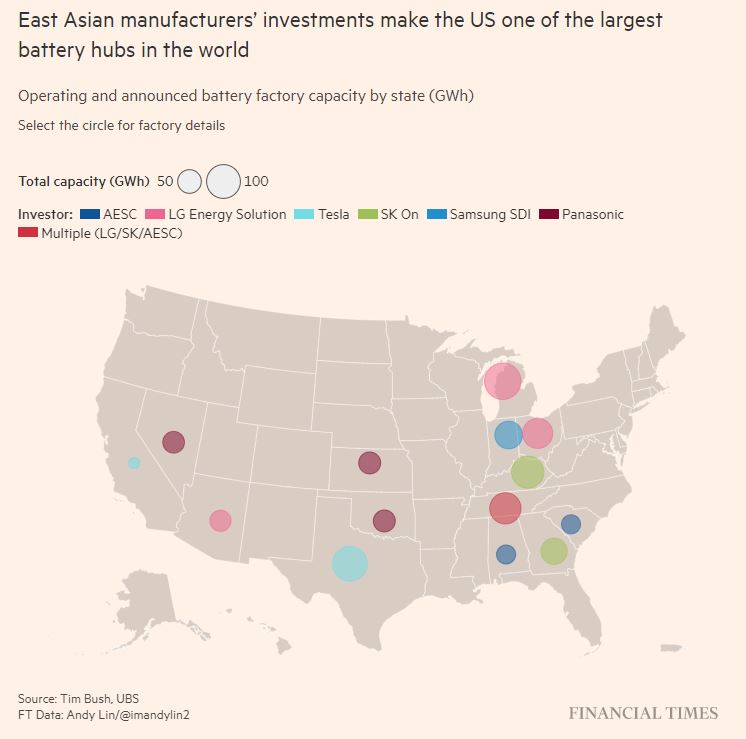
The automotive industry, in particular, has responded to these incentives with gusto. In just seven months there have been thirty-six major project announcements totaling more than $40 billion in new capital expenditures and over 30,000 new jobs. The bulk of EV supply chain projects are being developed in the so-called “battery belt” that runs from the gulf coast of Alabama to the shores of Lake Huron in Canada:
Many of the announced projects are pre-empting implementation of the largest of IRA’s clean energy manufacturing programs;, such as the Wind, Solar, and Battery Manufacturing Production Tax Credit, which the CBO expects to cost around $30 billion. Known as 45X, this Advanced Manufacturing Production Tax Credit is the clearest example of federal subsidies to directly compete with Chinese manufacturing and regain global market share. Overall, Credit Suisse estimates that the subsidized cost of a solar module represents about 20 to 40 percent of the unsubsidized costs, and wind turbines could fall by over 50 percent. Remarkably, they predict US solar modules will be 50 percent cheaper than China modules with these tax credits.
While the Advanced Manufacturing Credit tries to catch up with China in mature technologies, the Green Hydrogen Production Tax Credit tries to establish an early mover advantage in a relatively new industry. Offering $3 per kg of green hydrogen production, the tax credit will be more than double the value of the current market price of hydrogen in the US. Officially, the CBO estimates it will offer $13 billion in tax credits, while our estimate of how much hydrogen needs to be produced by 2030 in a climate-aligned pathway increases this figure five-fold to some $61 billion.
Controversially, the IRA also includes several provisions requiring that certain inputs are produced domestically or within countries with whom the US has a free trade agreement to promote both onshoring and so-called “friend-shoring” of manufacturing capacity. Most notably, the new EV tax credits require that 80 percent of critical minerals are extracted or processed in the US or its allies, that 100 percent of batteries are manufactured or assembled in North America, and that final vehicle assembly occurs in North America. There are also bonus “adders” in the electricity tax credits for using domestic content.
These subsidies have raised opposition among US allies and trade partners. Unsurprisingly, countries with existing automotive manufacturing expertise have expressed concerns that these provisions are protectionist. Biden administration officials, on the other hand, have described these initiatives as part of a “race to the top,” whereby expanded deployment lowers the cost of critical clean energy technologies, allowing more countries to get access and share in their climate and economic benefits.
The administration has been trying to carefully walk the line between placating its allies and angering political supporters who see any concessions to foreign counterparts as a betrayal of the legislation’s “intent.” In March, the US and Japan signed a fairly benign Critical Minerals Agreement to include mineral imports from the nation for purposes of the EV tax credit. Not long before, Biden put out a joint statement with European Commission President Ursula von der Leyen that announced the beginning of negotiations on an agreement that would allow European mineral extraction and processing to similarly count towards key IRA requirements. These are early indications of the types of “modern trade agreements” touted by Jake Sullivan, although it remains to be seen whether they can both meet legislative requirements for free trade agreement eligibility and represent the “foreign policy for the middle class” promised by this administration.
Every President since Bill Clinton has tried desperately to staunch the bleeding in the US manufacturing sector. Despite Biden’s early success in attracting clean energy technology manufacturing, it remains unlikely that manufacturing will return to its position as a fundamental driver of the US economy. The administration has tried hard to temper expectations, promising that it aims only to “de-risk” not decouple from China, and further diversify regional economies instead of returning to a nostalgic past of a bygone era. But this is at odds with a political agenda that hopes to return blue-collar workers to the Democratic tent.
Addressing inequalities
While Americans have grown more “concerned” about climate, the issue consistently falls among the bottom when listed alongside other priorities. Since climate policies inherently create winners and losers, they are intimately linked to inequities. A core feature of Biden’s industrial strategy has therefore been to directly link climate mitigation to deeply rooted political identities and existing political priorities, particularly the inequities of place, race, and class. Since climate policies inherently create winners and losers, they are intimately, indeed inextricably, linked to inequality. Roughly quarter of all spending in Biden’s green industrial strategy contains specific place, race, or class-based provisions. Not only does this approach improve the viability of climate policies, but attaches climate change to the Biden administration’s broader goal to “restore the soul of the nation” and steadily erode political polarization.
Inequities of place, or the “density divide,” increasingly defines the landscape of US politics. Where regions across the United States used to converge in income and well-being, since the early 1980s, the gulf between the richest and poorest parts of the country has widened. Changes in life expectancy vary starkly by where one lives in the US, with a remarkable 68 percent of counties seeing their life expectancy decline between 2014–2019.
The fastest wage growth has been concentrated in just the top 2 percent of metro areas nationwide. Since 2014, 96.4 percent of population growth and two-thirds of output growth in the US has been in just 53 metro areas, who account for just over half the total population. As digital technologies and innovation have become more important features of the US economy, the demand for labor has been concentrated in these big, coastal cities, leaving most smaller cities and inland regions behind. Significantly, these left-behind places overwhelmingly vote Republican. In 2020, Trump won 83 percent of US counties, but the counties Biden won represented 71 percent of economic activity.
As a result, Biden’s green industrial strategy is full of “place-based” economic policies, once considered anathema to efficient policymaking, designed both to address economic inequities and political vulnerabilities. In particular, the $8 billion hydrogen hub and $3.5 billion direct air capture hub programs in the infrastructure bill cleverly tied a technical need to demonstrate relatively immature clean technologies with a political desire to channel investments to the “people and places that have been forgotten and overlooked.” Other important place-based provisions include the designation of “energy communities” as eligibility criteria for bonus “adders” and LPO financing, and the $16.5 billion worth of “regional innovation strategies” contained in the CHIPS bill, of which about a fifth is likely to go towards climate-related technologies.
Racial inequities add another layer to this challenge. Inequalities of race have long plagued the US, and racial ideologies and identities are key factors in the rise of political populism and dysfunction. The Biden administration focus on race-based inequities is most clearly expressed in the Justice40 initiative, which commits to direct 40 percent of climate and clean energy investments to disadvantaged communities.1To avoid (<)a href='https://www.nytimes.com/2022/02/15/climate/biden-environment-race-pollution.html' target='_blank' rel='noreferrer noopener'(>)legal repercussions(<)/a(>), the administration’s official policy is to take into account a broad range of socio-economic data beyond race, but given how strongly many of these indicators correlate with race across the US, it is safe to say the initiative will have a disproportionate impact on communities of color. A number of provisions also have tax credit “adders” for tribes, provide direct pay options for tribal governments, or are explicitly targeted at Native American communities, such as the $20 billion Tribal Energy Loan Guarantee Program.
Finally, the new laws also attempt to address education inequities, mostly targeting lower-educated Americans by creating jobs in industries that require fewer college degrees, such as manufacturing and construction. There are also a number of adders and eligibility conditions to meet wage and apprenticeship requirements.
Among the many goals of Biden’s green industrial strategy, there are perhaps none loftier than this attempt to combat political populism and deeply ingrained inequalities, or as Joe Biden likes to put it, “restore the soul of America.” However, Biden is not exactly getting credit for early successes, which include channeling investments to middle America, creating historic levels of black employment, and overseeing a labor market that is disproportionately benefiting lower-income Americans. It could be too early for everyday Americans to see the impacts at the kitchen table, but solutions to core inequities likely require more than infrastructure projects and tax credits alone, and much will likely rest on whether Biden can win a second term with a mandate to move from the green economy to the “care economy.”
Conclusion
By situating Biden’s green industrial strategy within the broader political economy landscape, we can begin to understand the key tensions and tradeoffs required for the passage of this landmark legislation and its ongoing implementation. This strategy will continue to face the challenges rooted in America’s geopolitical positioning and domestic political structures. How can an effective industrial policy wielded by the strong hand of the state find success within a federal government long deprived of key resourcing and capacity-building? Can a revived American manufacturing sector “de-risk” rather than “de-couple” the relationship with China, such that gains of China’s investment into clean energies and cost-cutting effects remain unspoiled? Will the targeted provisions to reduce place-based, racial, and education gaps help confront today’s increasingly polarized political climate? The path forward not only depends on the details of the legislation’s implementation and the responses of the private investors, but, crucially, the results of November 2024.
The views expressed in this essay are those of the author and do not represent the views of RMI.
Leaders need followers. Last month, US National Security Advisor Jake Sullivan delivered a speech outlining the Biden administration’s international economic policy at the Brookings Institute in Washington. The “New Washington Consensus” was not directed at citizens but at capitals abroad. Sullivan’s speech took aim at the rise of global Trumpism. He addressed a question posed by social democrats the world over: Why can’t the center hold? An erosion of legitimacy, he argued, is at the core of the problem. In the face of compounding crises—economic stagnation, political polarization, and the climate emergency—a new reconstruction agenda is required.
Gone are the shibboleths of previous US administrations that extolled free trade, open capital flows and fiscal discipline. De-risking state interventionism is here. Treasury Secretary Janet Yellen laid out the logic of “modern supply-side economics,” while Biden’s former chief economic advisor Brian Deese said the administration won’t accept “that the individualized decisions of those looking only at their private bottom lines will put us behind in key sectors.” Since neither climate, inequality, nor the rise of China could be tackled by the market, he added, “the state had to step in.”
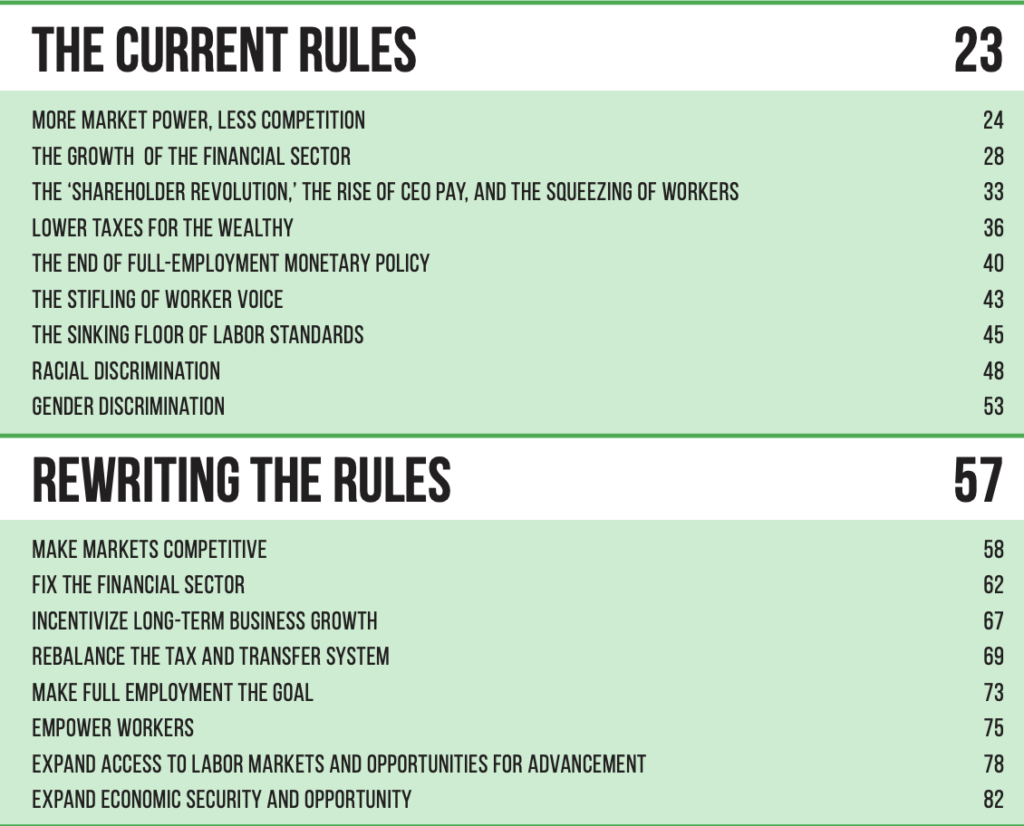
The 2015 Stiglitz “Rewriting the Rules” report formed the kernel of Democrats domestic policy agenda during 2021-2 (Source: Roosevelt)
On May 19, G7 leaders will meet in Hiroshima. A year since the Infrastructure Investment & Jobs Act, CHIPS & Science Act, and Inflation Reduction Act became law in the US, the rules about what qualifies for tax credits are being vigorously contested. But firms are gobbling up the carrots. The White House announced last month that vast investments had already been secured, including over $225 billion in clean energy and electric vehicles, $200 billion in chips, and about $15 billion in biomanufacturing. There are multiple reports of European and East Asian companies chasing those carrots and relocating planned facilities to the US. Having learned hard lessons about blowback and “leakage” with Russia sanctions, the US is coordinating with Japan and other allies to “derisk” its relationship with China by negotiatingexport controls on chips and diversifying sensitive supply chains, such as for transition minerals.
While the New Washington Consensus offers allies carte blanche on the interventionist economic tools they seek to apply domestically, it’s up to them to “crowd in” private investment and find fiscal space. Biden’s green industrial strategy prioritizes solving domestic inequalities rather than global ones. Its priority is using state power to actively steer markets that have proven incapable of providing public goods and broad-based growth.
Biden’s “foreign policy for the middle class” anchors the agenda. The basis of that framing originates in a 2020 report based on a two-year project by the Carnegie Endowment for International Peace that surveyed Americans in Colorado, Nebraska and Ohio. By the time the report was published, Sullivan and several of his coauthors—including Jennifer Harris, Salman Ahmad, and William Burns—were senior officials in the Biden White House.
The Carnegie report called into question a longstanding presumption of Beltway politics: that foreign and domestic policy should be neatly siloed. It suggested that the two realms could be mutually reinforcing. To “credibly assert global leadership,” it asserted, the country must “get its own house in order.”
The report set out a shift away from laissez-faire trade, liberalization, and globalization, yet was at pains to insist it was not pursuing a Trump-style America First retreat. Trade itself was not the problem, it argued, so much as the breakdown in the social contract between business, government, and labor to mitigate the effect of a world shaped by global corporations and labor-saving technology. The country’s own middle classes would be likely unmoved by “restoring US primacy in a unipolar world,” it stated, but might be more supportive of strengthening foreign alliances that address a spectrum of issues “from pandemics to cyber attacks to unsecure weapons of mass destruction and climate change—that could imperil middle-class security and prosperity.”
Is it too costly?
Leaders on the continent responded to the IRA with outcry, suggesting it would prompt a subsidies race to the bottom. For its part, the EU’s main preoccupation is European stability, as well as EU-US competitiveness. The possibility of transatlantic fracture is real. Loosening fiscal and state-aid rules could mean more subsidies for French and German firms. Re-industrialization in the core and further de-industrialization in southern EU countries would risk fragmenting the single market.
The US is in a unique position. As the main reserve currency issuer it, unlike many countries, runs an external deficit. As such—and notwithstanding GOP debt brinkmanship—it can afford to subsidize heavily. It also has a huge internal consumer market and is less intertwined with Chinese supply chains than some Asian countries. It has fared relatively well among G7 countries in the recent decades of globalization:
The US has maintained its share of global GDP since 1980, even as other G7 countries—Japan, Italy, UK, Germany, France, Canada—have declined. Developing countries (excluding China) too have stagnated as a share of global gdp. Source: Bert Hofman, World Bank data
Europe meanwhile was developing its own “green deal” agenda even before Covid. Over the past three years, exemptions have been made to allow common debt issuance and state support of national companies. These marked a shift in the bloc’s fundamental rules that ensure member states are on an “even playing field.” Emmanuel Macron last week announced a French green industrial strategy, declaring his government will seize the same tools used by both“partners and rivals”: tax credits to subsidize clean tech investment, local content rules for electric vehicles (EVs) and batteries (plus a EV consumer subsidy of €7000).
No Washington Consensus for developing economies
India and other big middle-income countries are in a very different position. Having declined to support western sanctions on Russia, many are wary of aligning with the US in ways that would threaten their economic relationship with China. Lula’s election in Brazil has sparked the re-emergence of South-South solidarity networks. The EV boom has spurred talk of a “lithium OPEC,” and Chile is now proposing nationalization of its lithium industry. Indonesia has been for years requiring foreign companies to refine its nickel domestically for EV batteries.
As to the question of what carrots the G7 might offer to countries in the global South, the details remain hazy. Last September, in our inaugural essay for The Polycrisis, we laid out what the countries flirting with a new non-alignment wanted:
1. Core technologies to power future growth;
2. Advanced military hardware for enhanced security;
3. The upper hand in trade negotiations with Europe, the US, and the new Russia-China bloc;
4. The ability to buy essential commodities like food, energy, metals and fertilizers from the new Russian-Chinese bloc;
5. Better terms to restructure their debt to Western and Chinese creditors during a punishing global dollar debt crisis that threatens their sovereignty.
Japan has made “global South outreach” a focus of its G7 presidency for 2023, and some potential, albeit patchy, efforts can be seen. The finance ministers’ meeting last week in Niigata produced a 26-point communique that included several references to emerging market and developing economies. It highlighted the importance of debt restructuring, of MDB reforms, and of better quality FDI.
The G7 finance ministers did, however, reference a new collaboration with the World Bank, to “help developing countries move up the supply chain” for EVs, solar panels, and storage. Timelines are vague, but policy guidance promotes joint R&D, and commits to unspecified support for low- and middle-income countries. It mentions using tools like “tax incentives, subsidies, guarantees and public loan and investment”—exactly the tools now being embraced at home by wealthy countries.
Without wide-ranging reforms to Bretton Woods institutions and other parts of the international monetary system, most developing countries remain reliant on costly and fickle sources of foreign investment capital, while remaining exposed to an IMF that imposes austerity measures and punitive surcharges whenever they stumble.
Sullivan’s speech assured its unambiguous commitment “to not leaving our friends behind.” While the US will “unapologetically pursue our industrial strategy at home,” he said, “we want them to join us.” But there is little sign of how deindustrializing developing countries might join the US or its G7 peers, whose leaders will be concerned with tightening Russian sanctions when they meet in Hiroshima. EU diplomat Josep Borrell told the Financial Times that Europe can’t take for granted that [developing countries] are on our side,” and must demonstrate support for their development needs, rather than forcing them to choose sides.
But there is no equivalent to the 2020 Carnegie report suggesting a path to reconcile tensions between security and domestic political economy in the global South, and paving the way for substantive change. The G7 has done nothing to address painful debt burdens in Africa. Its infrastructure initiative, PGII—viewed as an attempt to counter China’s BRI—is under-resourced. Bretton Woods quota reforms are idling, and SDRs are under-channeled.
After the G7, the next time the global South will be on the agenda will be the June Summit for a New Global Finance, to be hosted in Paris. The summit is inspired by the Bridgetown initiative, which was developed by Barbados and proposed concrete measures to improve developing countries’ access to finance for development and climate. After some confusion on the agenda, the Elysee promises the summit will “build a new contract with the North and the South.” It is also, notably, explicitly pledge-free.
In March 2023, the US Federal Reserve expanded its balance sheet by $300 billion. Following the run on Silicon Valley Bank, the Fed provided emergency lending through a brand-new bank lending facility that accepted US treasuries at face value (higher than market value) as collateral against dollars, for cash-strapped financial institutions. The US central bank assured that even the uninsured deposits exceeding $250,000 at Silicon Valley Bank would be made whole. As the banking turmoil spread across the North Atlantic, the Fed reactivated its international dollar swap lines. Meanwhile, in Europe, the Swiss National Bank arranged a public liquidity backstop for UBS Group AG, which had agreed to absorb Credit Suisse. Swiss authorities wrote new amendments into law that enabled them to structure the merger’s terms and conditions.
This elasticity in liquidity and legal constraints contrasts sharply with the rigidity and discipline enforced in IMF loan programs. While expedited financing was provided to institutions in the North Atlantic, low- and middle-income economies face major encumbrances—the average length of time between a staff-level agreement on an IMF loan and the IMF executive board’s approval has increased from fifty-five days to 187 days. The interest rate on the Fed’s short-term lending swap-facility is typically twenty-five basis points above the benchmark OIS rate. IMF lending via its extended fund facility for middle-income countries can include additional fees that are 200 to 300 basis points over the market-determined Special Drawing Rights (SDR) interest rate. According to the IMF, these surcharges are “designed to discourage large and prolonged use of IMF resources.” Comprising almost half of its annual income at roughly $1.76 billion, these penalty fees have become the single-largest source of revenue for the leading multilateral lender of last resort.
If countries fail to meet the structural reforms spelled out in the IMF’s program review, lending can come to a halt. The Fund’s new policy on lending in “situations of exceptionally high uncertainty,” which has underpinned its recent $15.6 billion lending package to Ukraine, presents an exception to the IMF’s general rule against lending to countries whose debt is deemed unsustainable. However, it seems doubtful that this new allowance will reorient IMF lending away from fiscal consolidation, or in simpler terms, austerity. For now, IMF lending to Ukraine, a lower-middle-income country, appears to be in keeping with its stringent conditionalities for borrowing countries.
The recent American and Swiss bank bailouts fulfill Mario Draghi’s imperative to do “whatever it takes.” They insulate a bank whose clientele are primarily the financial elite from failing on the grounds that it would present a “systemic risk”—even though Silicon Valley Bank wasn’t a “systemically important” institution like Credit Suisse. In a frank if unwitting admission, a recent IMF report clarifies that “systemic debt crises” are first and foremost ones that threaten the solvency of “large and possibly interconnected private creditors.” In this framework, distressed low-income sovereigns simply don’t matter much.1Unless several countries concentrated in one or more regions require a political resolution of their indebtedness to multiple creditors.
Surveying the contemporary landscape of sovereign debt and IMF lending programs reveals pervasive inequalities in the Bretton Woods system. Barring fundamental reforms, these threaten the IMF’s future as the preferred lender for countries in crisis.
Crisis landscapes
The North Atlantic bank turmoil may be understood as another aftershock of last year’s upheaval in the global economy. The energy-inflation triggered by the Ukraine war was followed by the Fed’s most aggressive interest rate hikes in recent memory. The upward march of the dollar, which topped a two-decade high, caused losses in balance sheets housing dollar loans and bonds across the globe. The counterpart of dollar appreciation is domestic currency depreciation—about ninety developing economies experienced exchange rate devaluations last year. In low-income economies, sharp currency depreciation leads to the exodus of finance capital. Faced with the threat of capital exit and double-digit inflation, central banks around the world have had to raise interest rates. Despite the efforts of monetary authorities to stanch the flow, there was an unprecedented exit from emerging market bond funds in 2022.
This liquidity shock is taking place in a context of rising debt burdens. The external public (and publicly guaranteed) debt of low- and middle-income (LMIC) nations stands at about $9 trillion.A third of this is owed by developing economies. Almost three quarters is issued by just eleven countries, including China. LMIC debt held by foreign residents has more than doubled in the last decade. Because they rely on short term loans, denominated in foreign currency, and issued largely from private creditors, indebted countries are vulnerable to interest rate shocks and subject to high debt servicing costs.
Dollar appreciation enlarged the value of dollar-denominated loans (in local currency terms) while high interest rates reduced the value of bond holdings and escalated debt servicing costs, requiring central bank portfolio managers to rebalance their dollar holdings. In some developing countries, central banks resorted to selling part of their dollar stockpiles to buy—and thereby bolster—their own currencies. Altogether, the foreign exchange reserves of developing economies fell by $379 billion.
Recently, IMF economists have criticized central banks that accumulate hard currency reserves to bypass interest rate hikes. But using foreign exchange reserves to purchase and thereby bolster the value of domestic currencies enables central banks to dampen some of the inflation. Given the inherent asymmetry in the international monetary system, hard currency war chests empower countries lower in the monetary hierarchy to cope with financial shocks. Over the course of the 2021–2022 dollar appreciation, countries that had larger ex ante reserves—especially in Latin America, the Middle East and North Africa, and sub-Saharan Africa—experienced lower ex postdepreciations against the dollar.
Existing IMF lending policies
For many developing countries, the problem is not over-indebtedness per se. Though many borrowed heavily when low interest rates increased the appeal of their higher yielding bonds, the idea that most sovereign governments tend to be serial defaulters is erroneous. Most governments pay back their external loans, often at the expense of imposing austerity on citizens. Emerging market public debt to GDP ratios have yet to return to 1994 levels, just prior to the Highly Indebted Poor Country initiative, which restructured some of the sovereign debt overhang from the 1980s.
In fact, the problem that most sovereigns face today is a liquidity constraint. In this, they are not dissimilar from Credit Suisse. Prohibitively high interest rates make it difficult to access new financing and roll over existing loans. More than a fourth of all emerging market economies have effectively been cut off from international bond markets, with their interest rate spreads nine percentage points or more above US Treasuries. While Africa’s debt burden has doubled, its debt servicing costs have quadrupled. Balance of payments crises dot the “frontier economies”—low-income countries with thin bond markets and constrained borrowing capacity.
These circumstances prompt countries to seek IMF financing. Article I of the Fund’s Articles of Agreement calls for the use of general resources in the case of balance-of -payments disequilibrium. To receive a new loan program, indebted economies must first undergo a debt sustainability analysis. IMF staff assess a country’s projected GDP growth and calculate what percentage of sovereign debt could be written off (say, a “haircut” of twenty percent on existing loans and/or interest payments) to set it on a path of “debt sustainability.” Next, the Fund assesses the country’s financing gap—net payments it owes to creditors. Countries typically need short-term financing for a few years after defaulting. IMF loan programs are designed to fulfill part of this short-term gap.
Concurrently, the IMF encourages countries to seek financing from other creditors, including the World Bank and other multilateral development banks (MDBs), and also bilateral lenders like China or Saudi Arabia. Nations must then negotiate with both bilateral lenders and private bondholders on how much of their existing loans will be repaid and what proportion forgiven . The parameters of these negotiations are based on IMF staff assessments of how much the net present value of sovereign debt needs to decline in accordance with the IMF’s debt sustainability assessment. Typically, the government engaged in a debt workout must reduce public spending in order to receive an IMF loan.2Correspondence, IMF economist, January 12, 2023.
Despite renewed calls for a multilateral sovereign debt workout mechanism, the IMF Board has opposed uniform debt restructuring, ostensibly because of the differentiated nature of debt sustainability across countries. The distinction between market-access countries and low-income economies in its debt sustainability analyses, which precede debt restructuring, have made for unequal treatment. The recent restructurings of Sri Lanka and Zambia reveal this pattern. While Sri Lanka’s IMF loan program is flawed in its emphasis on fiscal restructuring, unaccompanied by substantive debt restructuring, Zambia, which is more reliant on financing at concessional terms from MDBs, has been tied down in attempts to secure financial assurances with its external creditors.
According to a former IMF official, the Fund’s new primary balance targets are even more onerous than previous ones. Back in 2013, the former IMF chief economist Oliver Blanchard found that IMF assessments of fiscal multipliers were too low, suggesting that IMF-imposed austerity mandates incur more damage to economic growth than previously calculated. In its latest World Economic Outlook report, the Fund also finds that, on average, fiscal consolidation does not lower debt-to-GDP ratios. In short, austerity does not promote debt sustainability, let alone growth.
Currently, IMF lending is at a record high, but its remaining loanable funds remain far below its trillion dollar monetary firepower. Global environmental sustainability will demand an estimated $4 trillion annually in investment. If the IMF doesn’t act more boldly in stabilizing the finances of countries in crisis so that they can address the bigger financing challenges of the energy transition, it risks jeopardizing its own place within the global financial hierarchy.
Despite the claims of its leadership, the IMF is no longer at the center of the global financial safety net. Standing at about $14 trillion in 2021, foreign exchange reserves far outweigh other forms of protection. Emerging markets and developing economies hold three-fifth of the world’s foreign exchange reserves: more than $7 trillion. While bilateral swap-lines,3China has renminbi swap arrangements with thirty five countries. “Letter: Hesitant Fed Lets China Fill the Currency Swaps Void.” (<)em(>)Financial Times(<)/em(>). Accessed February 20, 2023. https://www.ft.com/content/7320e9b2-acca-46e4-ad58-12773912e5a6. regional financial arrangements,4Such as the European Stability Mechanism and the Chang Mai Initiative Multilateralization and IMF funding have expanded ten-fold over the last decade or so, they only amount to $4 trillion altogether.5“Global Financial Safety Net-A Lifeline for an Uncertain World.” IMF. Accessed February 20, 2023. https://www.imf.org/en/Blogs/Articles/2021/11/30/global-financial-safety-net-a-lifeline-for-an-uncertain-world. Also see: “The Global Financial Safety Net during the Covid-19 Crisis: An Interim Stock-Take,” IMF Strategy, (<)em(>)Policy and Review(<)/em(>) (Special Series on Covid-19). In that same period, bilateral lenders such as China have dwarfed the IMF. The rise of alternative multilateral lenders such as the BRICS established New Development Bank may further diminish demand for conditionality-laden IMF loan programs.
Special Drawing Rights reform
In light of these developments, substantial reforms to the post-Bretton Woods lending system are pressing. Key among these is an expanded use of the IMF’s reserve asset, Special Drawing Rights (SDRs). Although SDRs are not currencies, they may be considered as claims on currencies. Using them outside of central banks for fiscal expenditures requires treating them as potential claims on hard currency like dollars and euros. They can be exchanged, typically for dollars or euros, at IMF facilities.6The IMF has clarified that sovereign fiscal and monetary authorities have the (<)a href='https://www.imf.org/en/About/FAQ/special-drawing-right' target='_blank' rel='noreferrer noopener'(>)flexibility(<)/a(>) to interpret these balance of payments guidelines. As they did, following the last major SDR issuance, fiscal authorities should continue to use SDRs (converted into hard currencies) for public expenditures. Regularly issued as was originally intended under the 1944 Bretton Woods arrangement, SDRs can be an important source of financing the clean energy transition.
In 2021, the IMF issued an equivalent of $650 billion in new SDRs, its largest SDR issuance ever—yet only one percent went to low-income countries. Issuance is based on country quota shares at the IMF, which, in many cases, are grossly disproportionate to population.7More than $100 billion went to the US alone. As forms of central bank liquidity, SDRs can serve many functions. As international reserves, they can reduce sovereign financing costs and help stabilize currencies. As equity, they can leverage more lending by MDBs. If rechannelled through the proposed Loss and Damage facility, they can provide much needed liquidity for countries facing disasters.
Building out the SDR system, which is idiosyncratic and opaque, should not be impeded by“originalist” interpretations of its reserve asset characteristic. While expanding SDRs beyond payments between central banks and prescribed holders would require changes in the IMF’s Articles of Agreement, the instrument’s scope can be broadened, as “no strings attached,” even without such changes. Under the Bretton Woods Agreement Acts, SDRs may be issuedon a regular basis, aside from their special issuance in the face of exogenous global shocks. Given their current accounting designation as international reserve assets with matching liabilities, rechanneling SDRs from high-income countries (who have not used the bulk of their SDRs) to countries in need is a second-best solution compared to regular SDR issuance.8The (<)a href='https://www.imf.org/external/pubs/ft/bop/2007/pdf/bpm6.pdf' target='_blank' rel='noreferrer noopener'(>)sixth edition(<)/a(>) of the IMF balance of payments manual defines SDR as a “debt” instrument. Therefore, SDR allocation increases both the gross external reserves as well as the gross external long-term liabilities of a country’s external balance sheet. In the previous ((<)a href='https://www.imf.org/external/np/sta/bop/bopman.pdf' target='_blank' rel='noreferrer noopener'(>)fifth(<)/a(>)) edition of the manual, SDRs are likened to gold as reserve assets in country balance sheets “(<)a href='https://www.imf.org/en/Publications/Books/Issues/2016/12/30/Balance-of-Payments-Manual-157' target='_blank' rel='noreferrer noopener'(>)for which there is no outstanding liability.(<)/a(>)” As Andrés Arauz has pointed out, the latest IMF Balance of Payments manual (BPM) redefined the SDR from equity to a debt instrument—this has led to some confusion. If considered a perpetual liability as per the newer BPM guidelines, SDR allocation increases both the gross external reserves as well as the gross external liabilities of a nation. Holding SDRs earns countries interest payments while using SDRs involves paying an interest rate. Ideally, SDR issuance should be delinked from the IMF’s inegalitarian quota system. However, rechanneling SDRs from rich to developing countries via financial engineering in the form of SDR bonds are promising workarounds.
SDRs have already been pledged by donor governments to the IMF’s Resilience and Sustainability Trust (RST) as well as its interest-free Poverty Reduction and Growth Facility (PRGT). Both facilities are loans- not grants- based. They have yet to be fully financed and their current capacity is orders of magnitude short of what is required by developing economies. Only countries that have anIMF loan program in place can borrow via the RST. Given the large number of countries facing debt and climate shocks, there is no need for such a conditionality. Japan, France, and China (among others) have committed SDRs to the two facilities, but up to $200 billion in European-held and $150 billion plus in US-held SDRs could be rechanneled.9Rechanneling and/or issuing new SDRs has been stalled in the US because it requires bipartisan support in Congress. However, the US Treasury Secretary can sign off on new SDR issuance so long as it is $650 billion or less (<)a href='https://politicalquarterly.org.uk/blog/the-present-crisis-demands-a-new-international-monetary-system-for-the-public-good/' target='_blank' rel='noreferrer noopener'(>)without Congressional approval(<)/a(>). Across the Atlantic, (<)a href='https://www.imfconnect.org/content/dam/imf/Spring-Annual%20Meetings/AM21/IMFCStatePub/IMFC-S-44-21-28%20Statement%20by%20Ms.%20Lagarde%20-%20European%20Central%20Bank.pdf' target='_blank' rel='noreferrer noopener'(>)the European Central Bank (ECB) president(<)/a(>)’s claim that re-channeling SDRs doesn’t cohere to ECB (<)a href='https://www.lse.ac.uk/ideas/Assets/Documents/project-docs/ECB-SDR-Paduano-Maret-2023-v2-1.pdf' target='_blank' rel='noreferrer noopener'(>)restrictions on monetary financing(<)/a(>) has likewise paused the re-channeling process.
MDBs such as the African Development Bank have made plans to deploy rechanneled SDRs for climate mitigation and adaptation financing. The proposed Bridgetown Initiative includes a similar set up. Schemes to leverage SDRs into hybrid debt instruments to attract more public-private financing are gaining steam. It remains to be seen whether blended financing arrangements that seek to translate “billions into trillions” will provide funds at super-long maturity (fifty plus years) and on concessional terms. These factors will be key for the ability of low- and vulnerable middle-income countries to access, and equally importantly, manage new borrowing. Monetary authorities with limited fiscal capacity should not be coaxed into backstopping new green private investment; the IMF and other MDBs can take on that role. But that is only possible if the lending capacity of MDBs—which involves revising their capital adequacy frameworks while increasing their capital—is enhanced. While there seems to be growing consensus on the former front, efforts to increase capital appear stalled for now. At the Spring Meetings, the World Bank announced that it would boost its lending by about $5 billion a year for the next decade. Such modest efforts fall far short of rich countries’ pledges to re-channel $100 billion in SDRs to low-income economies for climate adaptation and balance-of-payments crises.
Modernizing the Bretton Woods institutions
A bolder IMF requires a bigger balance sheet. While the Fund, unlike the World Bank, does not have a credit rating to worry about, its resources have been stretched while its capital subscriptions, i.e. quotas, haven’t increased. Quotas aren’t just the capital-base of the IMF, they also determine member states’ voting shares, share of SDR issuance, maximum lending access and, crucially, the costs of borrowing. Both India and China punch way below their weight in terms of voting shares, with respect to population and GDP. The sixteenth review of quotas is underway and concludes in mid-December. Expanding quotas hangs in the balance. The last review in 2019 did not result in an increase in quotas because of a lack of adequate support for the measure. Those pushing for IMF reform in this review are advocating for rebalancing. Some of the key decisions on reforms, including quota increases, hinge on US support. The US holds 16.5 percent of the IMF’s voting shares, and changes in quotas, as well as the Articles of Agreement, require votes in favor by 85 percent of the body. Thus, the US structurally exerts veto power over major decisions at the IMF.
Much has changed since the initial drafting of the IMF Articles of Agreement in 1944. The Articles have been amended seven times, most recently in 2010. Shifts in the global financial system justify revisiting the Articles as a living document. The right to veto, which according to US policymakers has been weaponized in debt holdouts by bilateral creditors such as China, should be eliminated. The IMF Board could be replaced with a voting-based system that involves all member-states. This twenty-first-century global institution still clings to the anachronistic “gentleman’s agreement” that IMF and World Bank leadership must come from Europe and the United States.
The IMF’s singular focus on structural adjustment for countries facing balance of payments crises runs contrary to the beliefs of one the key founding fathers of the Bretton Woods institutions: John Maynard Keynes. In Keynes’ view, countries running balance-of-payment surpluses, like the US at the time, also bear responsibility for equilibrating imbalances in the international financial system. The original Keynes-White plan, which was cut from the final IMF Article of Agreement, explicitly called for capital controls both on countries capital was fleeing from and to where capital was fleeing to—the destination today is mostly dollar and euro assets in offshore tax havens. In 2022, the IMF endorsed pre-emptive capital controls on financial inflows. But despite evolving IMF policy on capital inflows, capital can still flow out of developing economies when the global financial cycle takes a turn for the worse. While tax reform in developing economies is necessary, the onus also falls on advanced economies. US firms have contributed to half of the $250 billion in lost corporate tax revenues across the globe—almost the size of the nearly $300 billion in new IMF loans since 2020.
An earlier version of this piece was published in Progressive International and can be read here.
The crisis affecting US and some European banks shows little sign of abatement. Following the collapse of Silicon Valley Bank earlier in the year, First Republic last week became the latest mid-size US bank to be bought up by a larger lender after investors withdrew more than $100 billion in deposits during the first quarter of the year. The Federal Reserve is now concerned about a “credit crunch” as mid-sized banks restrict their lending in the face of continued pressure on their balance sheets.
These developments have led to calls for rethinking the post-global financial crisis regulatory framework. Some have called for widening the “Too Big to Fail” regulations for larger banks to include smaller ones. Others have demanded a major expansion of deposit insurance. And still others have argued the opposite, citing fears of moral hazard and greater risk taking.
But these post-crisis reforms were based on dealing with the problem of credit risk. At the center of today’s crisis is interest rate risk. And that increased risk has been caused by central banks themselves. After a thirteen-year period of record low interest rates and plentiful liquidity in the aftermath of the global financial crisis, central banks’ suddenly reversed gear. To tackle persistent inflation, they have engaged in the fastest increase in interest rates in two decades, accompanied by “quantitative tightening” programs—the selling of government bonds and reversing of quantitative easing—that remove liquidity from the financial system. Last week the Federal Reserve raised interest rates for the tenth consecutive occasion to 5.25 percent, the highest rate since 2007, whilst the ECB ramped up rates to 3.25 percent.
This situation reflects a broader tension between monetary policy and financial stability. Current monetary policy involves destabilizing one set of prices—those of assets like government bonds—to try and stabilize another set: consumer prices. The collapse of confidence in the market value of the so-called safe assets of mid-sized US banks was largely caused by this trade-off. The failures reveal a fundamental feature of the modern monetary policy paradigm that financial regulators on their own can do little to address.
Capitalism is a two-price system
American economist Hyman Minsky described capitalism as a “two price” system. On one side are asset prices—both financial, like government or corporate bonds, and physical like residential or commercial property. On the other, there are consumer prices—goods and services that determine current output and consumer price inflation.
In the contemporary global economy, asset prices are much more sensitive to interest rate adjustments than consumer prices. The present value of assets is determined by expected flows of future returns, which are in turn estimated using today’s interest rates: a five-year bond that pays a fixed 2 percent rate of interest would sell at a lower price than it was purchased for following interest rate hikes. In this way, the prices of fixed income assets and market interest rates are inversely related: tighter monetary policy necessarily results in lower asset values.
This is exactly what happened to the government bonds and mortgage-backed securities held by Silicon Valley Bank and other mid-sized banks. The banks invested in these bonds thinking they were a safe and relatively liquid asset. Indeed, post-crisis regulation encouraged banks to hold more government debt for this reason. But the Federal Reserve’s rapid increases in interest rates led to drastic falls in their market value. This, in turn, caused investors to question the bank’s liquidity: its ability to raise sufficient funds by selling these assets to make good on deposit withdrawals. The result was a spectacular run on their—admittedly large and uninsured—deposit base that ultimately spelled doom.
Investments in long-lived physical capital goods like residential or commercial real estate similarly grow less attractive as rates rise. Would-be homeowners are put off by the higher debt-servicing costs on a mortgage and would-be landlords are put off by the lower yield on rents relative to debt costs. House prices are falling in two-thirds of OECD economies according to the IMF. From the perspective of financial stability, falling house prices are bad news as houses serve as banks’ main source of collateral for mortgages.
The commercial property market is even more vulnerable to interest rate rises as it is more highly leveraged than residential property. In part due to rising rates, commercial property prices have been falling rapidly in both the EU and the US, heightening concerns for regional banks that have large exposures to this asset class.
In contrast, the effect on output and consumer prices of interest rate rises is much more slow and indirect. It works through reducing demand in the economy. In theory, banks carry through the rise in their borrowing costs by charging higher rates to households and firms’, who then borrow less to consume and invest.
But central banks themselves admit that this process can take up to two years to fully transmit to the real economy. Evidence suggests firms’ investment is relatively insensitive to interest rate shifts in either direction and more influenced by expectations about future profits. The impact on consumer spending will be mainly determined by whether households have mortgages and, if so, when they are due for renewal. In countries like the US where most people have longer-term fixed rate deals, the impact takes considerable time to filter through.
Furthermore, many other factors may affect the price of key consumption commodities more significantly that interest rates—most obviously supply-side shocks like those resulting from the conflict in Ukraine (energy prices), the Covid-19 pandemic (supply chains for manufactured goods), and volatile weather due to climate change (food prices). Interest rate hikes cannot address the supply-side causes of current inflation. They can only work indirectly through the mechanism of demand destruction.
In sum, we have a monetary policy regime that creates rapid and large movements in asset prices—often resulting in financial instability—in order to slowly and weakly effect its actual target: consumer prices. This is a serious design flaw.
The systemic importance of asset prices
Central banks have tried to signal their intentions ahead of time in order to smooth the impact of interest rate shifts on market behavior. They have also tried to make small adjustments over longer periods. And since the global financial crisis, they have developed macroprudential policy to try and reduce systemic financial stability risks in certain sectors, including property.
However, these efforts have been countered by other developments that have increased the sensitivity of economies to even small shifts in interest rates.
Firstly, there has been an enormous growth in the size of financial and property assets, and corresponding debts, relative to the real economy. Financial asset values are now nearly 50 percent higher than the long-run average relative to income since 1977. House prices have doubled on average since 2000 in high-income economies as a combination of mortgage market deregulation and innovation, historically low rates, and quantitative easing have generated a huge expansion of investment in an inherently limited supply of residential real estate.
Secondly, the growth of market-based financing and repo-markets (“sale-and-repurchase” agreements) has meant that “safe assets” like government bonds have taken on much greater systemic importance in financial systems as forms of collateral. All kinds of financial institutions now deploy their holdings of government bonds as collateral to access to short-term funding.
The UK pension crisis in September 2022 was a classic case in point here. Pension funds engaging in liability driven investment invested in complex derivatives, using long-dated government bonds as collateral. The value of these bonds began to fall as the Bank of England began raising interest rates and engaging in quantitative tightening as inflation rose. In the market turmoil after former Prime Minister Liz Truss’s mini-budget, these bonds fell even more sharply, exposing pension funds to rolling margin calls from lenders as collateral values collapsed. The funds then moved to sell other long-dated bonds they held to cover the cash demands, which further exacerbated collapsing bond prices in a self-reinforcing downward spiral. The Bank of England was forced to take the extraordinary step of promising to buy up to £65 billion of government debt to calm the markets, despite otherwise having committed to shrinking its balance sheet as part of monetary tightening.
In effect, monetary policy was trumped by concerns over financial stability. Indeed, the economist Daniela Gabor has argued that recent instances of quantitative easing had more to do with controlling the yield on government debt to prevent systemic macro-financial risks emerging in repo markets than with creating fiscal space for governments or stimulating demand in the real economy.
Alternatives to a one-price monetary policy regime
What reforms to monetary and macroeconomic policy are required to resolve the tension between price stability and financial stability? We can identify two big shifts.
Firstly, fiscal policy should be given a much larger role in controlling consumer prices and asset prices. There is increasing evidence that the current inflationary dynamics are driven more by profit-driven inflation (or “greed-flation”) by larger firms than by more general increases in aggregate demand driven by rising wages. Price controls on strategic commodities like energy and food—or indeed public ownership of firms producing such commodities—will be more effective at controlling inflation than shifts in interest rates.
Meanwhile, taxation can be an effective tool to dampen asset price volatility. Taxes on capital gains, both in financial assets and physical property (for example, through a land value tax), would reduce speculation in both sectors. Indeed, these types of returns are essentially economic rents. Taxing them more highly could increase the efficiency of the economy, especially if it allowed taxes to be reduced on income or productive investment.
Secondly, central banks need to acknowledge the collateral damage of rapid shifts in interest rates for the wider economy and consider alternative tools to reduce demand in the economy in a less destructive manner. One option would be to revisit credit guidance policies, which target lending in particular sectors by limiting the quantity of credit. These were widely and successfully used in the 1950-60s period of high growth and productivity. They included quantitative restrictions on consumer credit and mortgage credit that were seen to be inherently inflationary—for both asset and consumer prices—and could take resources away from strategically important sectors of the economy. The return of macroprudential policy to reduce systemic risks in the aftermath of the global financial crisis is a step in the direction here, but such policies have been used infrequently and with little bite.
The need for a massive structural transition of the economy towards more sustainable forms of production and consumption further justifies the use of such an approach. Most obviously, central banks should work with other government agencies to limit credit and investment that supports unsustainable forms of activity (such as fossil fuel extraction and destruction of key ecosystems), while supporting lending for green energy, housing, and infrastructure. While the shocks caused by the war in Ukraine and the pandemic may be transient, climate change seems set to cause ongoing shocks to many sectors of the economy, and importantly food production. Achieving an effective and rapid green transition is the only way to hedge against such potential inflationary shocks. Perversely, raising interest rates across the board is likely to slow the green transition given the higher relative cost of capital for many green sectors like renewable energy.
The recent turmoil in financial markets has shown that the main tool central banks use to try to achieve price stability can destabilize the financial system. Monetary policy makers need to recognize that capitalist economies have two price systems which need different medicines. To marry modern-day price and financial stability requires greater coordination between fiscal, monetary, and wider industrial policy. Some examples of this could be seen in the response to the Covid-19 pandemic, where policies created fiscal space for massive investment in health care and the maintenance of jobs, and liquidity to support particular sectors. This more imaginative policymaking now needs to be scaled up to meet the multiple crises facing today’s world.
Watch the Korean Peninsula. It is in South Korea that the New Cold War has most visibly upset the delicate balance between industry, security, and domestic politics.
South Korea’s growth miracle has been based on deterrence and detente between China, its main trading partner; the United States, its ally and security guarantor; and North Korea, its neighbor with newly developed intercontinental ballistic missiles. The country has been on hair-trigger alert since last October, when North Korea stepped up its barrage of ballistic missile tests, including launching one over Japan. In a show of strength, South Korea launched its own ballistic missile, but the weapon malfunctioned, crashing in the coastal city of Gangneung, where the resulting fire raised panic of a North Korean attack.
Now that North Korea has demonstrated the ability to strike the US homeland, South Koreans worry that Washington might abandon them in a conflict to protect US cities instead. Today, 71 percent favor developing their own nuclear weapons. “New York for Berlin” was the central extended deterrence dilemma of the old cold war. The new question is: Would the Americans really trade “Seattle for Seoul?”
Last week, while the national security advisor Jake Sullivan was unrolling the “new Washington consensus” (the subject of our next dispatch), Presidents Biden and Yoon were holding security and trade negotiations in DC that resulted in a Washington Declaration. “Our mutual defense treaty is ironclad, and that includes our commitment to extended deterrence,” Biden said, referring to the treaty signed to end the Korean War seventy years ago. For his part, Yoon referred to the “unprecedented expansion and strengthening” of the US nuclear umbrella. The upshot was that South Korea agreed not to pursue its own nuclear weapons program in return for a greater decision-making role in US military planning should North Korea launch a nuclear attack.
The interwoven region
The new Cold War has upset forty-four years of peace in the world’s region of fastest economic growth and development. In 2000, the Asia Pacific was responsible for just over a quarter of global GDP; now that figure is well over a third, and projections abound for it to exceed half in the next two decades.
The region is also adversely affected by Washington’s bans on third parties selling to China technologies deemed relevant to national security. Jake Sullivan’s phrase “high fence, small yard” evokes surgical precision, but Asian supply chains and economies are so interconnected that bans and ensuing retaliations will be far messier than the view from Washington suggests.
East and South East Asian economies especially are tightly woven together by transborder just-in-time supply relationships. Firms have export markets not just in Europe and the Americas, but also within Asia’s large consumer market. This economic interdependence means that any disruption to critical industries—chips, cars, batteries, biotech—ripples across the region.
The regional connections are increasingly formalized, too. In 2020, the ASEAN countries, as well as China, Japan, South Korea, Australia, and New Zealand signed the Regional Comprehensive Economic Partnership. Although it didn’t include tariff reductions, some observers saw the new partnership as representing progress towards a China-Japan-Korea trade agreement, or even a regional trading zone. The divide between restrictionist national security hawks and cooperationist economic liberals that we wrote about last month holds in Asia. During a trilateral ministerial meeting last week, South Korea’s Finance Minister Choo Kyung-ho stated that “China, South Korea, Japan cooperation can be the new engine for global growth.”
In an effort to counter a more assertive China, Biden launched a new trade initiative with twelve countries. But the Indo-Pacific Economic Framework has been criticized by Asian countries for failing to provide greater access to US markets.
North Korean deterrence
This year, South Korea increased its military spending by 4.3 percent and upgraded its US-operated THAAD air defense system. Korean officials have held discussions with the Pentagon about Taiwan-related contingencies. Still, Seoul’s overwhelming focus remains on North Korea and not Taiwan. The worry that in the event of war in Taiwan, the US could pull some of its 30,000 armed forces out of Korea, leaving Seoul to deter Pyongyang on its own.
Since 2017, politicians in Japan, South Korea, Australia, and India have taken a harder line against Beijing. For the most part, they have the backing of public opinion in this. The heightened military posture and cycle of tit for tat responses threatens to kill the detente goose that laid the golden egg of the Asian growth miracle.
The US is now demanding that its allies cut off Chinese markets and reorganize their supply chains. Last October, Washington announced export controls on certain semiconductor sales to China, which cannot work without cooperation of the Dutch and Japanese, whose companies produce the lithography equipment used for making chips. That support was won, somehow. In another example, citing national security, Beijing has threatened a domestic ban on Micron, a US microchip firm that received big subsidies under the CHIPS Act. The White House reportedly wanted the South Korean government to urge Micron competitors Samsung and SK Hynix to not rush to increase their market share in China at Micron’s expense, should the ban take effect—which it ultimately did not.
Labor at home
Against this geopolitical backdrop, domestic conflicts continue to plague US politics. Not a single Republican voted for the Inflation Reduction Act. Rustbelt protectionists and progressives agree that free trade agreements have been bad for American workers. The new “buy American” and “made in America” provisions, which are intended to win back votes in the rustbelt, are policy instruments designed to create jobs at home, not abroad. It’s a policy that conflicts with the top national security priority to do whatever it takes to bring American allies into an anti-China coalition. Countries like Japan and Korea want to maintain non-discriminatory access to the vast US market, without too many strings attached. That market access is precisely what rustbelt senators, who favor domestic content requirements, wish to deny.
Meanwhile, East Asian (and EU) countries are opposed to “high road” labor standards that would make sure that companies receiving subsidies give workers high wages and continue to invest in non-union states in America. While South Korea’s Hyundai and Kia have dramatically expanded in the US, they won’t be eligible for IRA tax credits for another few years, until their plants start producing vehicles, because their EVs contain batteries made in China. The US administration is stitching a patchwork of bespoke bilateral agreements in a bid to satisfy competing domestic political economy and security interests. In March, it signed a critical minerals trade agreement with Japan to enable Japanese cars to qualify for IRA subsidies, which had “toothless provisions on labor and environment,” as Mireya Solis, at Brookings East Asia pointed out. For their part, Japanese firms are apparently worried about the trade-offs of relinquishing big Chinese markets.
These new White House agreements bypass Congress ratification. Asian countries worried that such deals will be reneged if the GOP comes into power will want to hedge against such risks and minimize trade-offs with Chinese markets. Indonesian industry groups have floated a “Chinese and a non-Chinese portfolio” for domestically-produced batteries that use local nickel. Such fragmented supply chains will likely become common features of global trade and industry.
South Korea remains on edge with threats of Chinese economic retaliation to the Washington Declaration. China could also resort to hard power coercion. The peace that knit together the growth miracle for over three billion people could end in a bang and not a whimper. G7 countries negotiating the new Washington consensus in mid-May go, fittingly enough, to Hiroshima.
Recent years have seen the rise of the meme stock frenzy—a wave of stock purchases driven by social media trends. This tendency culminated with the Gamestop bubble of 2021, in which the value of the company’s stocks increased more than a hundred times over in just a few months. Beyond demonstrating the added risk introduced by meme stocks, the occasion revealed crucial insights regarding the role of retail day traders in the structure of contemporary equity markets.
Typically, retail traders purchase low-value stocks in high volumes and then try to promote their stocks so that other investors buy in. In January 2021, GameStop share prices skyrocketed as retail traders filled chat forums on Reddit. Retail broker-dealers executed these orders, then sold or “routed” them to wholesale market-makers—large firms that buy and sell securities for a fee.
It is through these market-makers that retail traders were able to access stock options. The enormous increase in stock options trading among retail traders in turn increased the default risk within the financial system. Retail brokers, like Robinhood, were thus called for billions of dollars in additional margins. Because these margins constitute primarily high-quality liquid assets, the process led to a “liquidity squeeze” in the market.
With the aim of constraining these developments, the Securities and Exchange Committee (SEC) has recently proposed a series of rules to regulate market-making businesses in the equity supply chain. Regulators attributed much of the instability to the behavior of wholesale market-makers like Citadel Securities and Virtu Financial, who profit from charging wider bid-ask spreads, as well as to retail brokerage firms like Robinhood and Schwab who charge high access fees in exchange for forwarding retail orders to the wholesale market-makers (a practice known as payment for order flow (PFOF)).
Among these proposals, two have the potential to significantly change the approach of market-makers toward retail trading. The first has to do with market-makers’ pricing strategies. According to the new rules, market-makers will have to standardize their retail and wholesale trade reportings and disclose both quotes to the large market centers. Importantly, they must include a quote for odd lots—stock orders of less than 100 shares which are very popular with retail traders. The rules also influence pricing strategies by lowering “tick size”—the minimum amount that the price of a security can move. Smaller tick sizes are intended to narrow the spread, a measure of market-makers’ profit, for another category of asset favored by retail traders, highly liquid stocks.
Second, the proposed SEC regulations aim to influence market-makers’ cost structure. Through the tick size rule, they seek to simplify and increase the transparency of the retail fee structures. Currently, retail brokers and their customers know their transaction costs at the end of the month. With the proposed rule, market-makers are obligated to display the transaction costs immediately to their retail clients.
In addition, through Best Execution rules, regulators seek to reduce the market access fees for retail traders. Currently, retail investors trade securities through their brokers. The brokers route the orders to market-makers for a fee, and market-makers execute each order at a price they set themselves. In the new market structure, retail brokers are meant to bypass market-makers and execute orders on-exchange through public marketplaces like NASDAQ or NYSE. These new tools have myriad implications for markets. Crucially, by targeting the pricing strategies and cost structures of market-makers, regulators overlook their vital liquidity functions. Compared to public market places, market-makers provide higher speed, pricing, and size flexibility—all attributes of market liquidity.
In what follows, I look at how information flows, allocation techniques, price formation, and bidding patterns (known as auction mechanisms) shape the nature of market liquidity. The likely upshot is that the SEC proposals will effectively restrain retail trading by making the market-making business for retail investors riskier and less profitable. At the same time, there is a risk of increasing market concentration, and thus constraining the supply of liquidity. The standardization push also has the potential to distort accurate risk pricing, as the existing price variations, in part, reflect varying degrees of counterparty risk. Finally, by targeting liquid securities and odd lots, the SEC reforms may destabilize the flow of such securities in the system and create collateral crunch. While they do render the market more transparent, the rulings may also destabilize equity markets in the coming years.
An overview of equity market structure
The lifecycle of an equity trade begins when a trader places an order through an account with a retail brokerage firm. The broker-dealer then routes the order for execution to a wholesaler or market-maker through a PFOF—the payment charged by the retail broker to route the retail orders to wholesale market-makers. Under current rules, market-makers are exempt from reporting the trade to a securities information processor for retail investments and odd lots.
For other wholesale trades, which are reported, the securities information processor collects, consolidates, and publicizes the trade details (for example, the buyer and seller both report the same security, price, shares, and dollar amount). The trade details are also sent to the clearing broker for verification. Finally, the clearing broker “settles” the equity trade within two days of the trade date by officially moving the stock from the seller’s brokerage firm account to the buyer’s brokerage firm account, and moving money from the buyer’s brokerage firm to the seller’s brokerage firm. This process is facilitated by clearing agencies registered with the SEC under the Exchange Act.
Figure 1: The life cycle of a trade
The SEC’s new proposals primarily aim to standardize retail and wholesale prices and compel market-makers to accept lower profits when serving retail traders. By discouraging market-makers to execute retail trades, however, the reforms may reduce the flow of collateral, and weaken the resilience of the financial system by hampering its systemic fluidity.
One way in which the proposed regulations might inhibit collateral flows is through the market-makers’ business model. The behavior of market-makers can be understood through the auctions framework: as the primary bidders, market-makers set prices across the equity market. They have minimal profit margins and, as the insurers of market liquidity, they take on enormous risks. Their revenue thus depends on the volume of transactions they pursue. They charge buyers a higher price than they pay sellers, and the arithmetic mean of the bid-ask spread constitutes the market price. They provide market liquidity and guarantee continuous prices by adjusting their inventory for immediate trade execution instead of merely matching customers. In doing so, the dealers offer “immediacy” and generate the feeling of frictionless markets by trading with investors for whom time is essential. Without market-makers, investors would have to wait in order to execute their orders.
Market-makers make money by providing liquidity to clients, but to do this they face flow uncertainty and, therefore, price risk. When there is excess demand or supply for a particular security, a standard market feature, the market-makers absorb such inventories into their balance sheets. However, their willingness to do so depends on funding availability, business cost, and ability to price counterparty risks appropriately. With narrower spreads, market-makers have to increase their balance-sheet risks and cost exposures. When these become too high, and the spreads become too narrow, then it is very likely that market-makers will depart from the market. If they do so, equity markets may lose a pillar which guarantees smooth trading.
This is the danger of imposing highly prescriptive rules to deter retail trading. If the SEC amendments are not successful in stopping the rise of retail trading, they may simply encourage smaller market-makers to drop out, leaving the larger market-makers to absorb higher risks. Because of the reforms, these higher risks may not come at a higher profit margin. Consequently, by discouraging the purchasing of riskier securities, the reforms may adversely affect liquidity in the market. Given that liquid markets are what enable the seamless purchasing and selling of securities, a less liquid market is likely to distort the flow of securities across the system.
Since the SEC explicitly targets liquid stocks, riskier and less liquid trading could lead to a shortage of high quality collateral and secured funding in the system. Given that financial stability depends on the flow of collateral, risk, funds, and payments, the effective trade-off between the rise of retail trading and existence of small- to medium-sized market-makers may increase the fragility of the market structure.
Regulating the equity market
Post-2008 macroprudential rules have attempted to regulate the inherent interconnectedness in the financial system. Accordingly, they lean on “discrete-time” financial indicators—liquidity, capital, and leverage ratios—to analyze functions like equity trading in the banking system at a certain point in time. However, discrete-time financial indicators cannot capture the dynamics of institutions’ business models and market structure. Therefore, regulators are left in catch-up mode, relying on inevitable crises to reveal the hidden business models and structural changes in actions.
The SEC is adopting a similar blueprint for regulating the equity market. The proposed regulations seem to disregard the industrial organization of the different firms that execute trades and provide all the elements of market liquidity.1This includes immediacy (speed of trade), depth (trade volume), breadth (price smoothing behavior), and resiliency (how quickly new order flow corrects order imbalances). Instead, the SEC is focusing on a narrow concept—best prices—to measure best executions. But without considering the broader context, the SEC is overlooking business models and market structures, such as auctions, that allow firms to execute trades and move securities across the system.
Checking a snapshot of firms’ balance sheets or relying on narrow measures of market quality is inadequate. Financial stability demands a more dynamic understanding of the financial system. Regulators must ask: why do firms manage their balance sheets in a certain way, and under which structures do they perform? Viewing firm balance sheets as a pipeline of equity flows can uncover hidden market structure vulnerabilities and triggers for broader market failures. Effective regulation begins from an accurate understanding of the players involved—instead of supervising through a static evaluation of financial statements, we ought to monitor changes in statement balance sheets over time, combining the overlooked concept of firm industrial organization with a view of market structure.
Amid intensifying geopolitical and economic rivalries, policymakers around the world—including those in the United States and European Union—are increasingly turning to neomercantilist industrial policies to promote the wealth and power of their states. This trend has been reinforced by the pandemic’s disruptions to international supply chains, the growing weaponization of economic interdependence, and the broader backlash against free trade in many countries.
The sudden popularity of neomercantilist policies—typically characterized by forms of trade protectionism and activist economic policy—has been deeply disorienting to economic liberals whose preferences for free trade and free markets have dominated global politics in recent decades. But it appears less unusual when placed in historical context. Prior to 1945, neomercantilist perspectives on international economic relations were prominent and diverse. Though they were commonly overlooked in the Cold War struggle between Marxism and economic liberalism, earlier neomercantilists held innovative views on issues ranging far beyond trade. Contrary to popular perceptions which link neomercantilism only with heightened national tensions, this tradition even promoted compelling ideas in pursuit of international cooperation. Among the broader relevance of this school for contemporary global debates, this latter point is perhaps most important for coping with the challenges ahead.
Hamilton, List, and beyond
Neomercantilist thinkers in the pre-1945 era reacted against the liberal free trade advice of Adam Smith and his followers. Building on pre-Smithian mercantilist ideas, they called for strategic trade protectionism and other forms of government economic activism to promote the wealth and power of their state. Of these thinkers, the best-known today in Western scholarship are Alexander Hamilton and Friedrich List. As the first US Secretary of the Treasury, Hamilton developed an important case for activist policies to promote American industrialization in 1791. Half a century later in Germany, List built upon Hamilton’s critique to develop a more generalized case for state-led industrialization in his 1841 book The National System of Political Economy, soon cited by neomercantilist thinkers and policymakers around the world.
In contrast to economic liberals of the time—and like many policymakers drawn to neomercantilist ideas today—Hamilton and List emphasized the importance of the connections between state wealth and power, highlighting the particular significance of manufacturing for national independence and security.
The thinkers also deviated from the economic consensus in liberal circles by outlining many economic rationales for activist industrial policies, many of which are reappearing in contemporary discourse. Those rationales included the need to overcome private sector inertia as well as to counteract the advantages that powerful foreign firms derived from their established market positions and the support of their home states. As a broader economic rationale, List also emphasized the state’s role in cultivating the aggregate “productive powers” of a country over time, a task that he argued could only be successful “where the interest of individuals has been subordinated to those of the nation, and where successive generations have striven for one and the same object.”1Friedrich List, (<)em(>)The National System of Political Economy (<)/em(>)[1841], trans. Sampson Lloyd (London: Longmans Green, 1909), p.132.
Less noted, but equally important to today’s context, were Hamilton and List’s warnings on the dangers of excessive state economic activism. List insisted that trade restrictions ought to be moderate, carefully targeted, and temporary in order to prevent local firms from falling prey to “indolence.”2List, 93. Hamilton shared this concern and argued that trade restrictions should only be used if enough domestic competition existed to prevent a monopoly. Hamilton was also wary of how trade barriers would, in the short-term, increase import prices, smuggling, and scarcities. To avoid these kinds of problems, Hamilton preferred to promote local industry with targeted and temporary government subsidies. As he put it, “it is a species of encouragement more positive and direct than any other, and for that very reason, has a more immediate tendency to stimulate and uphold new enterprises, increasing the chances of profit, and diminishing the risks of loss, in the first attempts.”3Alexander Hamilton(<)em(>), Report on Manufactures [1791]. (<)/em(>)In(<)em(>) The Reports of Alexander(<)/em(>) (<)em(>)Hamilton, (<)/em(>)edited by Jacob Cooke, 115–205. New York: Harper and Row, 1964).
Other pre-1945 thinkers developed different versions of neomercantilism, including the American Henry Carey, whose mid-nineteenth century writings achieved similar levels of international acclaim as List’s. For Carey, strategic trade protectionism was needed not just to promote local industry but also to curtail rising inequality and poverty generated by free trade and international market forces. Although neither Hamilton nor List showed much interest in this kind of “social neomercantilism,” Carey foreshadowed the populist rhetoric of many contemporary advocates of industrial policies, who blame the free trade policy paradigm for rising domestic inequality.4For Carey and his contemporary relevance, see Helleiner, (<)em(>)The Neomercantilists(<)/em(>), 137-99, 353-5.
In another antecedent to contemporary debates, Carey combined neomercantilist goals with a concern for environmental protection. Drawing on the ideas of the German scientist Justus von Liebig, he blamed free trade for exhausting local soils through its promotion of unsustainable monocrop agriculture that served export markets. The fostering of local industry, he argued, would enable farmers to serve domestic markets instead, using more diverse kinds of agriculture to restore the health of local soils and draw useful fertilizer from the human waste of nearby industrial towns. Unlike most political economists of his day, Carey called for an environmental ethic to inform his discipline: “It is singular that modern political economy should so entirely have overlooked the fact that man is a mere borrower from the earth.”5Henry Carey, (<)em(>)Principles of Social Science(<)/em(>), vol.1 (Philadelphia: J. B. Lippincott, 1858), p.336. A parallel can be drawn to today, as the push for decarbonization has bolstered support for green industrial policy. In an era when environmental concerns have much higher political salience than in Carey’s time, this new “developmental environmentalism” is redrawing political coalitions across the world.6For “developmental environmentalism”, see Elizabeth Thurbon, Sung-Young Kim, John Mathews, and Hao Tan, (<)em(>)Developmental Environmentalism: State Ambition and Creative Destruction in East Asia’s Green Energy Transition(<)/em(>) (Oxford: Oxford University Press, 2023). For an example of the redrawing of coalitions, see also Thea Riofrancos, “The security-sustainability nexus: lithium onshoring in the Global North”, (<)em(>)Global Environmental Politics(<)/em(>) 23(1)(2023), 20-41.
Going beyond Hamilton and List, Carey stressed the universal utility of neomercantilist tools. Whereas the former two thinkers saw state interventionism as a means for late industrializing countries to catch up with Britain (the most powerful industrialized state in their era), Carey argued that Britain itself would also benefit from these policies. Some of Carey’s arguments about the social devastation caused by free trade in Britain were remarkably similar to contemporary criticisms of free trade in the United States. Carey was not the only pre-1945 thinker to see neomercantilist logics as relevant to a dominant power. Just as prescient were the arguments of British critics of free trade in the late nineteenth century, who warned that rising economic powers, especially Germany, used unfair trade practices such as subsidies and dumping.7Helleiner, (<)em(>)The Neomercantilists(<)/em(>), pp.103-7. Substitute China for Germany, and their arguments were almost identical to those of American neomercantilists today. Then as now, neomercantilism was not just an ideology for late industrializers.
Neomercantilist thought appeared across the political spectrum. List, for example, combined his neomercantilist ideas with a strong defense of the values of political liberalism. But some of his followers in the late nineteenth and early twentieth centuries were much more politically conservative, endorsing authoritarian values or, by the interwar years, fascist politics.8Helleiner, (<)em(>)The Neomercantilists(<)/em(>), ch. 3. Neomercantilists also existed on the political left, including the best-known Chinese advocate of this ideology in the early twentieth century, Sun Yat-sen, who was drawn to socialist thought.9Ibid, 245-59. The political malleability of neomercantilist thought has reemerged in the current era. As in the past, unusual political alliances are being forged amongst groups whose views are otherwise very divergent.
Like their contemporary counterparts, pre-1945 neomercantilists disagreed on the kinds of activist policies to promote local industries and firms. While Hamilton promoted the use of subsidies, List and Carey focused on the role of trade restrictions at the border. Later neomercantilists backed even more ambitious policies. Sun, for example, urged a state-led, export-oriented industrialization strategy that also employed state-owned enterprises, national economic planning, and public management of foreign capital. Although rarely cited in Western political economy scholarship, Sun’s ideas garnered renewed attention in China in the late 1970s when officials began to pursue a development strategy similar to the one he had recommended. Chinese officials—including President Xi Jinping—have continued to invoke these ideas.10Ibid, pp.350-53.
In the early 1920s, Sun also offered advice to future Chinese leaders who might be ruling a wealthier and more powerful China that resulted from the application of his neomercantilist advice. In that time ahead, he hoped those leaders would assume the “great responsibility” of assisting less powerful states to resist the imperialism of Western powers to which China had earlier been subjected. As he put it:
Let us to-day, before China’s development begins, pledge ourselves to lift up the fallen and to aid the weak; then when we become strong and look back upon our sufferings under the political and economic domination of the Powers and see weaker and smaller peoples undergoing similar treatment, we will rise and smite that imperialism.11Quotes from Sun Yat-sen. (<)em(>)San Min Chu I: The Three Principles of the People(<)/em(>), Translated by Frank Price, Edited by L. T. Chen (Shanghai: Commercial, 1928), pp. 147–48.
Sun was speaking in the context of reviving responsibilities that some Chinese authorities had felt towards their empire’s “tributary” states in East Asia before the Opium Wars. Sun’s mixing of neomercantilist ideas with a reference to China’s older tributary model of international economic relations represented a very distinctive approach within neomercantilist circles at the time. These views may be relevant for interpreting China’s foreign economic policies today, in an age when some analysts argue that Chinese initiatives such as the Belt and Road Initiative bear some resemblance to the tributary model.12For a recent analysis, see John Hobson and Shizhi Zhang, “The return of the Chinese tribute system? Re-viewing the Belt and Road Initiative” (<)em(>)Global Studies Quarterly(<)/em(>) (2)(4)(2022) (<)a href='https://doi.org/10.1093/isagsq/ksac074'(>)https://doi.org/10.1093/isagsq/ksac074(<)/a(>). Indeed, Xi Jinping himself has cited Sun’s idea, arguing that China needs to assume “great responsibilities for the world” as its wealth and status rise, albeit without mentioning the anti-imperialist conviction within Sun’s conception of that responsibility.13Helleiner, (<)em(>)The Neomercantilists(<)/em(>), p.352.
Neomercantilism and international cooperation
Given the revival of neomercantilism and concern over global rivalries today, it is important to consider how neomercantilist thinkers before 1945 differed over their views on international cooperation. Economic liberals today warn that this revival will generate growing international conflict and economic warfare; indeed, the views of many historical neomercantilists do give reason for concern. Focused on maximizing the wealth and power of their state, neomercantilists often gave little thought to the more cooperative goals of enhancing global peace and prosperity that animated their liberal counterparts in the nineteenth and early twentieth centuries. Instead, many saw world politics as a kind of high-stakes struggle for survival between states which required the aggressive projection of power abroad, including through imperial conquest and rule. In the economic realm, they were also often keen—like Donald Trump—to fight trade wars.14See Trump’s 2018 comment that “trade wars are good and easy to win.” (quoted in Eric Helleiner, “Varieties of American neomercantilism: From the first years of the Republic to Trumpian economic nationalism”, (<)em(>)European Journal of International Studies(<)/em(>), 6(3)(2019), p.22.
But disagreement between neomercantilists themselves suggests the possibility of a different future. Carey, for example, advised countries to cultivate state wealth and power only for the defensive purpose of protecting their sovereignty. He also suggested that neomercantilist policies would strengthen the prospects for international peace and cooperation by ushering in a world of more equal states, in contrast to free trade which, in his eyes, only reinforced the oppressive power of a dominant industrial country. If all states embraced his recommended policies, he envisioned a peaceful world where all countries had domestically-diversified economies and each respected the other’s sovereignty, while engaging in various kinds of mutually beneficial trade.15Helleiner, (<)em(>)The Neomercantilists(<)/em(>), ch.5.
List, too, saw his neomercantilist advice as serving not just the interests of individual states. Dedicating his 1841 book to “la patrie et l’humanité,” List, like Carey, argued that the embrace of neomercantilist policies by less industrialized states would enhance the prospects for international cooperation by ushering in a world of more equal states. But List’s s vision of equal, industrialized states applied only to countries in “temperate” regions of the world—he argued that “tropical” regions were destined to be in a subordinate, commodity-exporting roles, and often subject to imperial rule, of which List approved. Carey did not endorse this view and was a strong critic of imperialism.16(<)em(>)Ibid(<)/em(>), ch.2, 5. List’s vision of international cooperation was still in some ways more ambitious than Carey’s, involving the creation of a “universal confederation” of all states that resulted in a political “union of the whole human race.17List, (<)em(>)The National System(<)/em(>), 100, 101. List also suggested that free trade would ultimately prevail; neomercantilism was merely a temporary strategy to create greater equality among states—after which it would no longer be needed.
Before reaching that point, List was interested in how international institutions could foster economic cooperation. In 1837, he advanced what he called a “somewhat daring suggestion” to create a “world trade congress” that “should consider how the common interests of the various nations can best be served and how opposing interests could be reconciled.” For those concerned that rising neomercantilism today will undermine the multilateral trading system, it may be somewhat reassuring to learn that one of the first-ever proposals for a multilateral trade organization was, in fact, advanced by a neomercantilist thinker.
List’s pioneering ideas on the topic should not be surprising. In contrast to many economic liberals of his time, List did not assume that market processes had the potential to create a harmonious world that satisfied the economic interests of humanity as a whole. Instead, he believed that countries’ economic interests were often “opposing” and needed to be “reconciled” politically in an international body. To be sure, List hoped this forum could advance issues of common interest to all countries, such as “the freedom of the seas,” “universal free trade in raw materials and agricultural products,” and “common measures to secure universal peace, public order, and security of persons and property.” But he also insisted that the world trade congress “consider the varied interests of regions and societies at different stages of economic development—such as industrialized, agrarian, colonial, and primitive societies” and that any trade treaties negotiated in it give “equal advantages” to all its member countries and secure “guarantees for the future survival and prosperity of their industries.”18Quotes from Friedrich List, (<)em(>)The Natural System of Political Economy(<)/em(>), translated and edited by W. O. Henderson (London: Routledge, [1837]1983). 125-7.
List was not alone among neomercantilists in developing innovative ideas about multilateral economic cooperation. In 1920, Sun Yat-sen advanced one of the first proposals for a multilateral development institution—the “International Development Organization” (IDO), which was to be established through the newly created League of Nations with a mandate to channel foreign capital and expertise through its multilateral mechanism to support China’s state-led industrialization. Sun argued that the IDO would benefit not just China but also industrialized countries, which would find a new outlet in China for their exports and excess savings. More generally, the new multilateral institution would also “strengthen the Brotherhood of Man,” not just by generating mutual economic benefits but also by diminishing inter-imperialist rivalries.19Quotes from Sun Yat-sen, (<)em(>)The International Development of China(<)/em(>) (New York: G. P. Putnam’s Son, [1920]1922), p.9.
Nine years later, Mihail Manoilescu’s The Theory of Protectionism and International Trade, the most prominent neomercantilist book published during the interwar years, advanced yet another proposal for multilateral economic cooperation. Manoilescu’s 1929 book updated List’s case for strategic protectionism to support industrialization, but the Romanian was also interested in how List attempted to reconcile “national interests with the general interest of the Society of Nations.” To this end, Manoilescu suggested that the League of Nations abandon its promotion of free trade and instead support the principle that the use of protectionism was a “reasonable and legitimate” right of countries. In addition to supporting the efforts of agricultural countries to industrialize, he argued that this move would bolster international peace and cooperation through creating more equality between states and new markets for the exports of already-industrialized countries. Manoilescu challenged the idea that protectionism would undermine peace: “Nobody, up to the present, has shown any coincidence between protection and political aggressiveness. Nor does protection oppose the principle of universal solidarity. At most, protection opposes monopolies and exploitation.”20Quotes from Mihail Manoilescu, (<)em(>)The Theory of Protectionism and International(<)/em(>) (<)em(>)Trade(<)/em(>) (London: P. S. King and Son, [1929] 1931), p.250, 222, 218.
In 1931, two years later, the Indian neomercantilist thinker Benoy Kumar Sarkar—who had translated List’s writings into Bengali—offered an even more expansive proposal. After traveling through Europe at the height of the Great Depression, Sarkar proposed to officials in the League of Nations and the International Labour Organization that industrialized countries be encouraged to “export capital to those regions which are seeking to industrialize themselves” as a way of creating new markets for the former’s products. The proposal was reminiscent of Sun’s IDO but on a grander scale, involving the export of capital not just to China but to “the Balkan states, Russia, China, India, Latin-America, and the African Continent.” The industrialization of these regions, Sarkar argued, would accelerate a “Second Industrial Revolution” in the already-industrialized world, allowing both parts of the world to advance economically in a complementary and mutually-beneficial fashion that generated a massive economic transformation on a global scale.21Quotes from Benoy Sarkar, (<)em(>)Studies in Applied Economics, vol. 1(<)/em(>) (Calcutta: Chuckervertty Chatterjee, 1932), pp.290-2.
These proposals demonstrate how some pre-1945 thinkers saw neomercantilist thought as more compatible with international cooperation than conflict. A few of their innovative ideas later came to fruition. List’s 1837 proposal for a world trade congress was realized 110 years later with the 1947 creation of the General Agreement on Tariffs and Trade (GATT).22Earlier, the League of Nations hosted the world’s first large-scale multilateral trade negotiation that resulted in a 1927 treaty which was never ratified. The establishment of the International Bank of Reconstruction and Development at the 1944 Bretton Woods conference also finally gave life to Sun’s idea of a multilateral development institution. Manoilescu’s proposal for the League to endorse the use of protectionism was also subsequently implemented—in a very limited fashion—through the GATT’s Article XVIII which allowed trade restrictions for economic development purposes. Even Sarkar’s vision was echoed in broad-based global development cooperation that emerged gradually in the post-1945 years.
Back to the future
Neomercantilist thought preceding 1945 contains many ideas that resonate in the contemporary age. An examination of these ideas sheds light on the diversity of this intellectual tradition, with different views on many topics such as activist economic policy, social issues, and even core political ideology. From a global systemic standpoint, the different perspectives around international cooperation are the most significant. As contemporary policymakers return to parts of the neomercantilist tradition, they should also pursue new ways to strengthen international cooperation, instead of embracing a more narrow and exclusive focus on maximizing the wealth and power of their state.23 See also Nic Johnson and Robert Manduca, “After Free Trade” (<)em(>)Boston Review(<)/em(>), May 25, 2022 https://bostonreview.net/articles/after-free-trade/. The future of the world economy now rests on which of these paths prevails.
 World