Category Archive: Analysis

  1. Trading Order

    Comments Off on Trading Order

    Export Bans. Sanctions. Investment screens. The liberal trading order has been weaponized; security, not efficiency, is the new watchword. And yet, 2023 has seen an all-time high of goods traded across borders. Even bilateral trade between the warring great powers, China and the US, was at a record high of $400 billion in 2022. US imports from ninety countries are higher than ever before. In a series of articles at VoxEU, the trade economist Richard Baldwin debunked the “peak globalization” thesis, arguing that the narrative of “fragmentation” belies the fact that trade in goods and services has been expanding.

    There has indeed been a slowdown in the growth of global trade in goods, which is expected to be “subdued” at 1.7 percent this year, according to the WTO. But growth continues despite the rise in trade restrictions. Those restrictions can be largely attributed to the post-2008 crash and the associated loss in western countries of political majorities that sustained liberal integration of markets. It was Obama, not Trump, who started undermining the WTO’s mechanism of adjudicating trade disputes by not reappointing members to its Appellate Body. After that, Trump’s trade war took the form of tariffs—applied to allies and rivals alike—on countries in Europe and East Asia, all in the name of US national security. The pandemic, Russia’s invasion of Ukraine, and the US chips embargo against China have exacerbated fears of fragmentation. For over thirty years since the fall of the Berlin Wall, what the IMF’s Kristalina Georgieva called a “peace and cooperation dividend” prevailed; now the walls are coming back up.
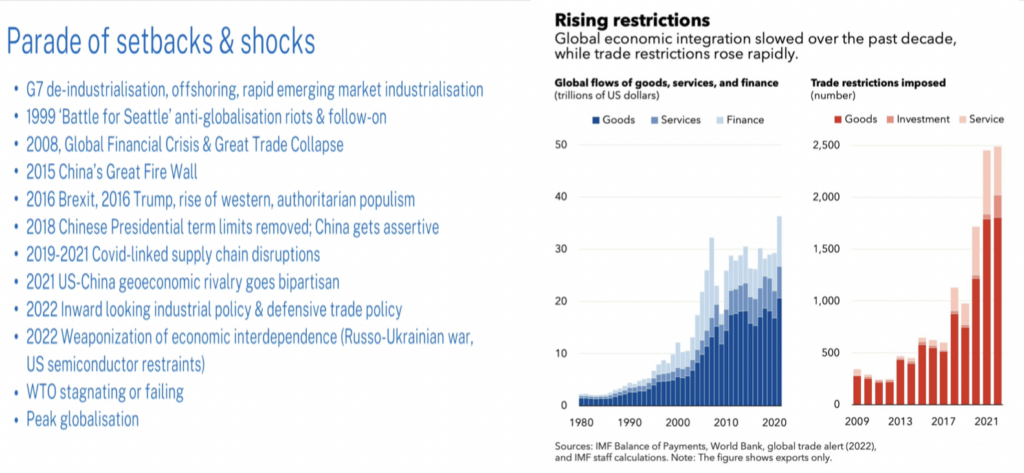
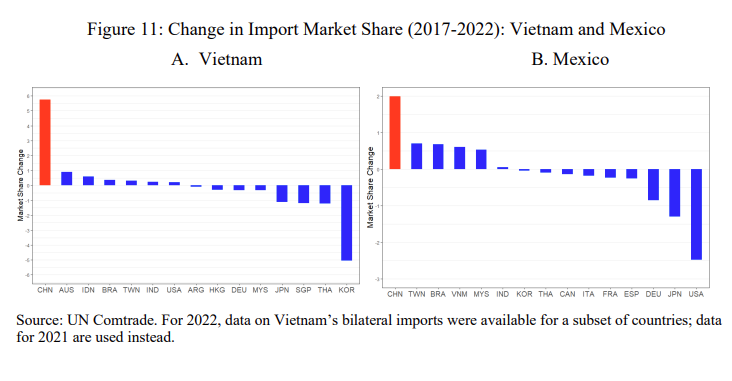
    Trade system in the eye of the storm (Source: left, Richard Baldwin; right, IMF)

    Continuities

    What is the source of resiliency in trade? The first line of defense is hub-and-spoke trading networks that provide alternative supply-chain routes when countries target each other on economic or security grounds. Trump launched a tariff war against China in 2017 but firms on both sides of the conflict were able to flexibly reroute supply chains to avoid those tariffs. A recent paper by Laura Alfaro and David Chor showed that US supply-chain links to China “remain intact,” albeit routed via other countries. Chinese firms ramped up exports and investments in Vietnam and Mexico, and the US in turn boosted Vietnamese and Mexican imports to replace those from China. In response to US tariffs on solar components, for example, Chinese firms established a solar manufacturing industry in Southeast Asia. As for those Chinese products that were spared tariffs—laptops, phones, toys—US imports were over 50 percent higher in August 2022 than four years earlier, before Trump’s trade measures were introduced.
    Similarly, Russia’s exports have remained resilient to Western sanctions; food and fuel exports—in terms of both volume and value—have stayed fairly constant since the invasion. The difference is that exports are now going to different buyers in the South and East. India and China are importing Russian crude oil in record volumes and re-selling refined petroleum and diesel to the West.
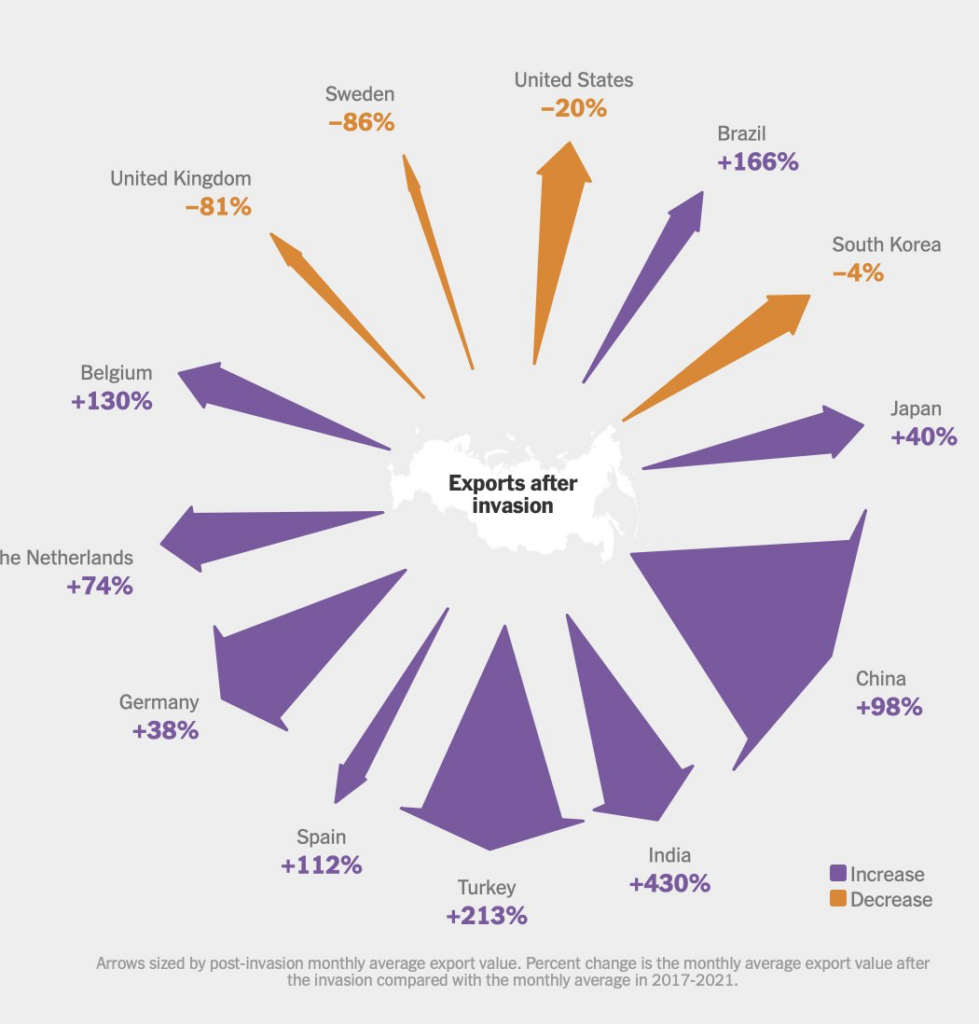
    Source:  New York Times

    Identifying drivers of aggregate trade is not straightforward. The notion that globalization has reached its end, according to Baldwin, largely stems from the drop in commodities prices after about 2010. The resilience of global trade may also have something to do with the fact that US firms are producing more than they used to, as production is expanded to keep pace with increasing aggregate global demand. A recent report from the Roosevelt Institute finds that for the US “73 percent of all core items, and 66 percent of services, see prices falling with quantities increasing—a sign of expanding supply.”

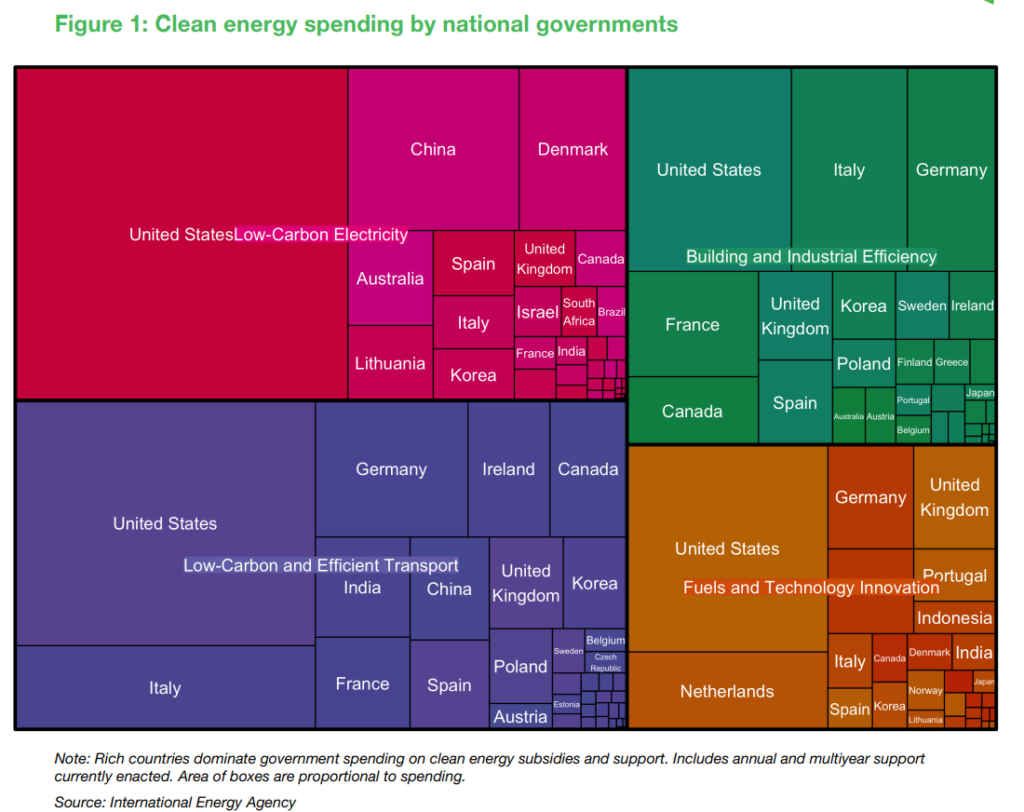
    Decarbonization inevitably requires manufacturing—“a billion machines” to replace the stock of polluting ones. UNCTAD estimates that seventeen frontier technologies could create a market of over $9.5 trillion by 2030. So far, rich countries are seizing most of that value. How and where the manufacturing and supply chains of these goods evolve will shape the political economies of virtually every country in the world. The return of industrial policy is necessarily a contest over profit-driven commercial competition, the global division of labor, and distribution of economic power.

    Green protectionism and its discontents
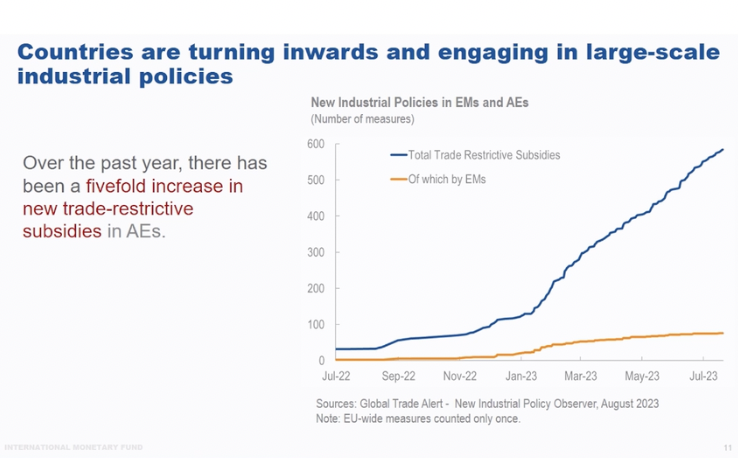
    After decades of being verboten, local content requirements (LCR) are rising in rich economies, leaving developing countries high and dry. Almost 3,000 restrictions were imposed just last year—nearly 3 times the number imposed in 2019. (Source: Gita Gopinath, IMF)

    For years, climate pledges by countries were expected to include a levy on greenhouse gas emissions, but there is growing recognition that carbon pricing is politically untenable, a development that has coincided with the abandonment of the logic supporting free trade in the global north. The US has left behind the view that free trade is an unabated good. “Market access is a privilege, not a right,” Jennifer Harris, formerly in the Biden administration, said in April.

    As a bipartisan consensus in the US pivots on free trade, and China persists with advanced manufacturing, Europe has been caught off balance. Germany’s car manufacturers, having for years successfully slowed EV-friendly policies, are now seeing their sales in China significantly eroded by local EVs. Moreover, Chinese vehicles—primarily electric—are quickly gaining share in the European market, rising from zero to eight percent between three years ago and now. The industry is so alarmed that the European Commission says it will probe Chinese EV subsidies and is threatening to impose tariffs. 

    In contrast to the US and China, Europe has done relatively little to nurture new climate-aligned manufacturing sectors. The EU has sought, however, to protect incumbent industries from the trade-related effects of its own carbon pricing. The EU Carbon Border Adjustment Mechanism begins operation next month; it paves the way for levies on imports such as steel from countries that don’t have carbon pricing. When the financial penalties are phased in, this could cost African exporting countries as much as $25 billion a year. 

    Enacting meaningful climate policies in democratic countries often means accommodating the demands of certain domestic industries. For instance, the EU has given over €100 bn in excess emissions permits to favored industries such as steel and cement. The challenge is to avoid driving actual fragmentation that would undermine collaboration and trade. Protecting domestic manufacturers of green goods can undermine decarbonization, either directly, by limiting availability of the lowest cost clean technology, or indirectly, by encouraging tit-for-tat, “race to the bottom” tactics feared by globalists and climate advocates alike.

    Technology transfers

    For decades, developing countries have relied on a strategy of importing machinery, production processes, and technology licenses from advanced countries. The understanding that climate mitigation and adaptation would require the transmission of technology from north to south was institutionalized in 1992 at the beginning of UN Climate negotiations. The Rio Declaration states that newly developed technologies must be “in the public domain” and made accessible to developing countries “at affordable prices.”

    China’s success in assimilating industrial knowhow and, especially since 2008, innovating and leading green technologies, has changed the picture of G7 countries holding the tech required by the rest of the world. Other examples include: South Africa’s synthetic fuels, Brazil’s agricultural technologies, and India’s pharmaceuticals. ​​The growth of BRICS will mean more technology transfers between countries in the global South, and indeed from countries in the South to the North.

    Donor → Recipient countryTechnology TransferredTerms of agreement
    US → IndiaGE fighter jet engines; thin film solar manufacturing GE-HAL co-manufacturing; DFC 
    China → IndonesiaHigh pressure acid leach to make battery grade nickelMetallurgical Corporation of China-Indonesian govt
    EU → Kenya
    EU → Chile
    Green Hydrogen; Sustainable miningEU global gateway; EU global gateway
    China → BrazilWind turbine manufacturingGoldwind-Bahia 
    China → US Iron Phosphate batteries (LFP) Ford- CATL licensing in Michigan
    South Africa → GermanySynthetic aviation fuelsSasol-HZB joint R&D
    EU → India, Brazil, South Africa , Bangladesh, IndonesiamRNA vaccines WHO Hub program funded by EU, Canada, France. African development bank coordinates transfer to 6 African countries
    Examples of recent technology transfer arrangements have been South-North, North-South, South-South

    Transferring technology is no easy task. It requires patient collaboration between firms and workers to transfer “process knowledge.” Behind every complex product is a community of skilled workers who have tacit knowledge in their minds and hands, which can only be transferred in a process of “learning-by-doing.” 

    Moreover, technology transfers have to be mandated at a state level and then imposed on firms that will be reluctant to comply in both originator and recipient countries. China has traditionally forced foreign firms to share their tech in return for market access. A key question for all participants is whether new technology will be manufactured in the recipient country or simply assembled there. The recipient country has an interest in maximizing the local value added with its domestic suppliers; the firm from the donor country has an interest in minimizing the value added in local supply chains, allowing it to keep a larger chunk of profit.

    A North-South pact?

    An increasingly broad interplay of industrial policy, development, climate, and geopolitics is now animating trade politics, well beyond the long-fought questions of which goods can be defined as “environmental.” A paper prepared by Shayak Sengupta and Sagatom Saha for the T20 think-tank program ahead of this year’s G20 proposed a pact of sorts between north and south, in which developing countries refrain from putting tariffs on imports or imposing expert controls, while developed countries agree to limit the use of subsidies that favor local companies.
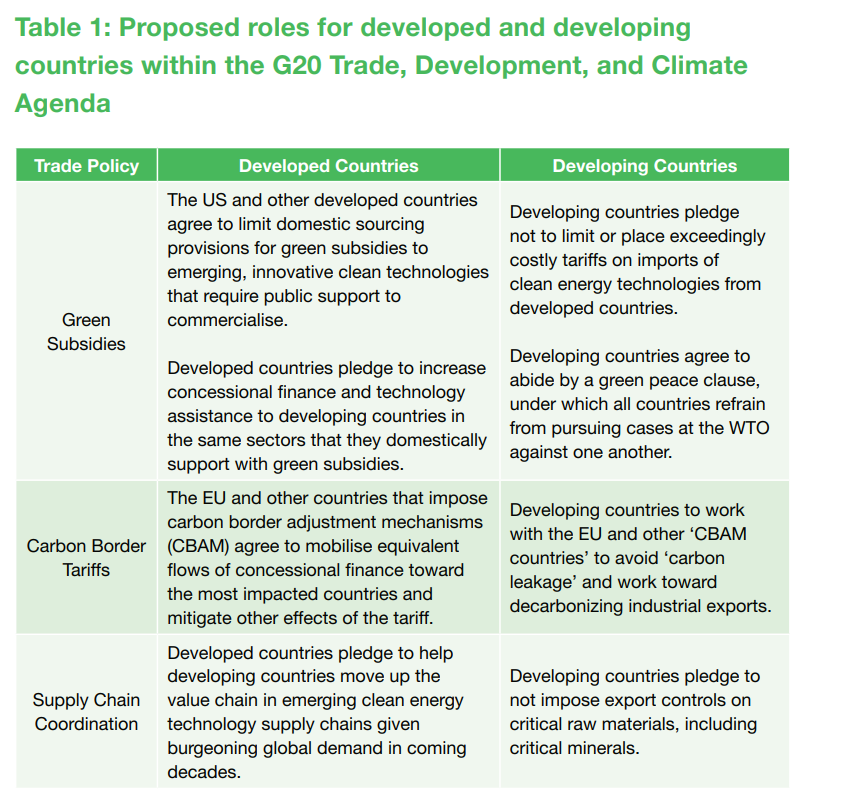
    At first glance, this proposal seems far-fetched. Europe is proceeding with schemes to impose a Carbon Border Adjustment Mechanism and has shelved plans to route the proceeds towards developing countries. The US has allocated subsidies for domestically-produced EVs and components. India is providing production-linked incentives to batteries, pharmaceuticals, and automobiles. Indonesia mandated on-shore nickel processing. China’s domestic manufacturing strategy is well known.

    Why would a pact work? If governments in the global north fear its supply of minerals being choked off by governments in the south (thanks to export bans or nationalized firms), the latter have fears, too—such as retaliations of capital flight, international arbitration, or sanctions. If one fears polluting industries being offshored or kept alive, the other demands clean technology transfers. 

    Relations between the US and India bear out some of this logic. Over the past two months, India has dropped all seven of its WTO cases against the US. In return, the US has offered more tech transfers, for example enabling Indian production of parts for GE fighter jets. This allows the US to maintain its local content requirements in clean tech, and preferential subsidies for domestic firms, while India receives transfer agreements in defense and green technology for local manufacturing. Market access wins were declared for exporters, including US agriculture and Indian steel and aluminum. 

    Mercantilist industrial policy stances can still facilitate the collaboration needed for decarbonization, albeit in a chaotic way. Today’s solar PV technology owes some of its prediction-defying cost declines to the combination of German and Spanish feed-in tariffs and Chinese state-supported manufacturing. In Europe, the cheap EV genie unleashed by Chinese automakers will be difficult to put back in the bottle, not least because of extensive integration between German and Chinese automotive companies. (A similarly intricate level of integration might account for why, more than a decade ago, Germany’s solar manufacturing industry did not mount a strong campaign against cheap Chinese solar.)
    The green transition is going to involve conflict. Industrial policy is often said to be about “governments picking winners” but often “losers pick governments,” with ailing incumbent industries vigorously contesting policies that might threaten them, even to their detriment. (For instance, part of why European car manufacturers are being bested by Chinese rivals is that the former has for years sought to hold back and water down EV rules in favor of diesel, e-fuels, or more efficient ICE vehicles.) Trade policy has always involved fierce political struggle between industries/workers/regions that prosper and coalitions who find political champions in legislatures. 

    In the view of liberal organizations like the IMF or WTO, all restrictive measures and subsidies are net negative. But just as they can help build domestic support for climate policies, these interventions can also be constructive in balancing interests for cooperation among nations.

  2. Labor’s Green Capital

    Comments Off on Labor’s Green Capital

    Global investment in solar energy has skyrocketed in recent decades: from 1 TWh of solar power in 2000 to 1,284 TWh in 2022. The trend is likely to be magnified in the United States by the Inflation Reduction Act (IRA), which includes a wide array of tax credits and new sources of investment for renewable energy. Much of the investment in solar remains tied to private asset managers with little obligation to operate in line with the public interest. Among these investors, however, lies one group with duties to a broad swath of the public—pension funds. 

    Pension fund investment in solar energy offers a lens through which to understand their involvement across the domestic economy. While they depend on the financial assets of workers, pension funds are managed by hired asset managers who may not have an interest in increasing innovative capacity and improving labor conditions. The ends towards which “labor’s capital”—in this case, workers’ pension funds—are directed ultimately depend on the economic policies that shape decision-making along the financial intermediation chain. The stakes are high. If pension funds do not proactively address the risks of climate change, it is those same workers—the current and future beneficiaries of pension funds—who will bear the burden.

    Union pension funds call themselves “investors” rather than shareholders. This gives the impression that the funds, which include workers’ retirement assets as well as other pooled funds and retail shareholders, provide resources for real-world productivity and innovation. The specific form of real-world investment directly and dramatically shapes the lives of working people globally. In practice, however, financial institutions like asset managers pressure companies to increase financial gains by squeezing labor. If invested towards publicly beneficial ends, pension funds have enormous transformative potential. But harnessing this potential requires regaining control over the financial assets of future retirees—and preventing managers from extracting value for their own benefit.

    Solar capital

    As of 2022, US state and local public pension funds—trusts that hold portfolios of financial assets meant to sustain retirees—comprised $4.5 trillion in assets and distributed $323 billion annually. Roughly 6,000 state and locally administered public pension funds provide retirement security for 11.2 million current retirees, in addition to 14.7 million future beneficiaries who are currently working—a combined total that is 14 percent of the US workforce. 

    These holdings have become a source of power for labor unions, leading to a widespread debate over the costs and benefits of what are commonly referred to as “capital strategies.” Economic historian Sanford Jacoby’s Labor in the Age of Finance demonstrates that while private sector union density fell, unions increasingly exercised power through shareholder activism—with labor leaders and public pension funds rallying institutional shareholders to pressure companies in which unions were campaigning. This strategy has won important gains but remains firmly entrenched in the framework of shareholder primacy and bound by fiduciary duties that can be narrowly interpreted towards maximizing the value of pension funds at the expense of other worker interests. It is notable that shareholder primacy has grown alongside shareholder activism.  

    When managers do not side with trade unions, the interests of labor’s capital diverge from the interests of labor. While scholars like David Webber have argued that capital strategies constitute labor’s “last, best weapon,” others like Benjamin Braun have convincingly demonstrated that pension fund pools and their search for yield have driven financialization and precarity. 

    The tension between these interpretations is highly visible in the solar industry. Solar is the most popular new renewable energy source and has been growing at an average of 30 percent over the past decade. The first commercial solar farm came online only in 1982, yet over the past forty years there has been a decline in costs by a factor of nearly 400, making solar the cheapest electricity source in history. However, to meet our net zero carbon goals, solar capacity needs to grow sevenfold in proportion to overall energy consumption. 

    Asset managers have demonstrated that their primary focus in solar infrastructure rests with the sale of the assets they buy, rather than their maintenance for collective use. Major real asset manager Brookfield has $58 billion of assets under management in renewable energy, including hydropower, solar, and wind energy. In Brookfield’s recent investment of nearly $2 billion in a large solar company, Scout Clean Energy and Standard Solar, the largest commitments came from the pensions of Canadian teachers and federal workers. According to OECD research, while only 25 percent of pension fund assets invested in infrastructure were in “green” infrastructure in 2020, three-quarters of the assets that are directed to solar and other renewables are channeled through private (or “unlisted”) asset managers. Though US public pensions do sometimes hold direct stakes in solar companies, as, for example, CALPERS, California’s public employees fund, does in a solar holding company, funds usually delegate choices regarding real investment to asset managers. This separates pension fund trustees from actual renewable projects, narrowing the scope of accountability for company use of funds. 

    Because solar is a new industry, it does not have the legacy of trade union density present in other segments of construction. Lee Harris has documented the difficult labor conditions for the solar workforce: “staffing agencies are notoriously unpredictable, known for nepotistic hiring and promotion, arbitrary firings, low pay, and zero transparency.” The public investments contained in the IRA will supercharge solar development in the Sun Belt, in states where unions are focused on making inroads into what is now the fastest-growing segment of the construction industry. The IRA’s centerpiece is tax credits for the manufacturing of clean energy technologies, which include incentives for employers to follow prevailing wage standards. But these requirements don’t apply to solar—Section 45X does not include the same prevailing wage standards as other provisions.  

    If asset managers are focused on selling the solar infrastructure that is currently being built, what incentive do they have to invest in the solar workforce? Given the nascent industry’s low unionization rates and ongoing efforts to organize, the unionized and public-sector workforce investing in the same solar projects have the opportunity to exert their financial power to hold companies to higher employment standards. 

    Capital gains

    Asset managers’ involvement in the solar industry demonstrates that there is a vast difference between managing wealth for purposes of asset appreciation and organizing financial resources to support the innovative capacity of the economy. In other terms, there is a difference between trading financial assets and real-world investment. Asset managers trading pension fund assets are focused on increasing their fees, rather than stewarding the investment capacities of the economy. 

    Asset managers have grown increasingly important amid two major shifts: financial institutions have moved from financing goods and services production to driving relentlessly for asset appreciation, and finance’s center of gravity has moved from banks to non-bank institutions. Though asset managers are intermediaries between corporations and households, they play a decisive role over portfolio holdings and through shareholder votes. Households, especially those whose only assets are in public sector pension funds, have an interest in reducing systemic risks like climate change, growing economic and social inequality, and macroeconomic instability. Yet private asset managers like BlackRock, Vanguard, and State Street have a clear record of voting against proposals to mitigate such systemic negative externalities. For decades, public and union pension funds could only hold safe assets. But in recent years, the widening appetite for risky assets has taken increasing proportions of funds out of publicly-traded equity and into private markets. Ultimately, asset managers most often trade for the sole purpose of maximizing capital gains. What do we lose by allowing asset managers to own, manage, and extract from systems needed for the energy transition?

    The idea that asset managers and pension fund trustees act for financial gain is shaped by law, fiduciary duties, and a limited public imagination, . In a recent report, Rick Alexander and I challenge this notion, setting forth two new kinds of standards so that asset managers act instead for the fundamental interests of households whose money they manage. First, we propose that portfolios be required to strictly comply with the Paris Agreement to achieve carbon neutrality. Second, we propose a reinterpretation of fiduciary duties which expects asset managers to consider the total impact of their decisions on the economic beneficiaries—working households. Instead of only comparing the potential financial returns from renewable energy investments, asset managers would be required to consider the economic impacts that households would suffer from the devastating effects of climate change.

    But reforming the responsibilities of private asset managers is not enough. The volatile nature of financial markets cannot form the basis for stable decarbonization. In another recent article, I make the case for a public asset manager with fiduciary duties in the public interest. Such an institution would manage public pension fund assets and serve as a public option for privately-held retirement assets. A public asset manager would evade the conflicts of interest that plague asset managers, who seek the business of corporations while voting in corporate governance decisions. A public asset manager’s fiduciary duties could be explicitly defined to recognize the systemic harms of climate change and mitigate its negative impacts on retirement security. This would implicate portfolio asset allocation decisions, redrawing the guardrails for voting on key pro-social shareholder proposals. Trillions of dollars of labor’s capital would be redirected from the financial system to working people and their families. 

    A public solar option

    While the IRA direct pay provisions will increase public and non-profit investment in renewable energy, the IRA does not directly take on the power of private asset managers. But increasing public control of pension funds is an important step towards achieving the legislation’s objectives. This could prove essential for a non-extractive energy transition—the $5.3 trillion in state and local public pension plans, along with the $735 billion in the federal employee plan, could provide a sufficient base for building out a public solar energy system. 

    Public Solar NYC is an example of the kind of project that could utilize public pension funds for community benefit. The plan, proposed by Comptroller Brad Lander, aims to leverage the roughly $250 billion in financial assets held by New York City’s five Public Pension Funds to place 25,000 publicly-owned solar arrays on New York City apartment building rooftops over eight years, adding 600 megawatts of energy while creating an estimated 13,000 quality jobs.

    The Comptroller, who has been a leader in recognizing climate change as a threat to retirement security, noted that “New York City pension funds have recognized a fiduciary duty to mitigate the systemic and company-specific risks that climate change poses to our portfolio,” and announced a “Net Zero by 2040” plan. The plan not only includes clear and straightforward disclosure about divestment (the City has divested $3.8 billion from fossil fuels) but it enumerates real investment in renewable energy systems, including the creation of a public option for solar in New York City. The IRA’s direct pay provisions offer federal funding to the city for solar development, which the plan proposes to channel into a City-capitalized and -controlled local development corporation. The City would establish a Solar Bond Issuer, with the proceeds going to Public Solar NYC, which would sign up rooftop owners, operate the process, install and maintain solar arrays, and require and enforce high labor standards. No private asset manager would be involved, and the financial benefits of solar would accrue to many residents, not only private homeowners who are disproportionately wealthy white households. While the program does not currently utilize public pension funds assets, New York City’s five retirement systems have $834 million invested across five Brookfield infrastructure funds, and $5.81 billion in infrastructure funds overall. It is worth considering how such funds could be utilized for direct public investment programs.

    Although New York’s public solar is still in the planning stages, it is the kind of project that should push us to envision how public pension funds can directly support the renewable energy transition, without a private asset manager as an intermediary. For truly public energy, this form of direct public investment and decision-making capacity must be paired with broad-scale reforms to asset manager fiduciary duties, and crucially, the establishment of a public asset manager to direct the power of labor’s capital. These changes would constrain the influence of private asset management institutions and ensure that the gains of the energy transition serve the public interest.

  3. The IRA and Public Schools

    Comments Off on The IRA and Public Schools

    Public school buildings in the United States are crumbling. National school infrastructure received a D+ rating from the American Society of Civil Engineers in 2021, and in more serious cases, learning environments have become toxic. Given the segregated and unequal nature of public schooling, building quality is closely tied to racial and class-based inequalities, with schools in lower-income communities confronting the most serious health and safety consequences. In addition to these unsafe working environments for teachers and students, a recent study by scholars at the Harvard School of Education found that schools are one of the largest consumers of energy within the US public sector, consuming energy equivalent to eighteen coal-fired power plants or fifteen million cars each year. This is both costly and necessitates involving schools within the broader project of decarbonization. 

    Indeed, schools are an essential arena for the Biden administration’s new green industrial policies. While a cottage industry has formed around assessing whether Biden’s industrial policies—specifically the Inflation Reduction Act (IRA)—are commensurate to the scale of the problems they set out to address, it’s imperative to survey how IRA programs might look on the ground if applied to their fullest strength. How would IRA programs affect public education finance—specifically school facilities and infrastructure? And how would these financial flows challenge the present state of educational inequality and segregation?

    Perhaps because the American Rescue Plan—the Biden administration’s pandemic relief package—included $122 billion in funding for schools, the IRA was not billed as a piece of education legislation, nor did schools take center stage in either the negotiating process or messaging around the policy. But the IRA holds major implications for public schools. While details on these policies are still forthcoming, I examine how two IRA flagship programs—the direct pay Investment Tax Credit (ITC) and the Greenhouse Gas Reduction Fund (GGRF)—could function within existing public-school infrastructure projects. A report from Aspen Institute’s education arm summarizes thirteen policies in the IRA that school districts could benefit from, of which the ITC and GGRF stand out for their novelty and impacts.

    The ITC has been likened to a mail-in rebate for green investment and production; it could provide public schools up to 60 percent reimbursement for qualifying projects. Due to its tax credit structure, the ITC could provide trillions in such reimbursements, while other IRA programs open to schools are more limited in amount. Likewise, the GGRF has been called the country’s first green bank, with the potential to restructure credit flows for infrastructure projects and open up new avenues for financing. Such programs have never before been available to school districts. 

    I study these programs’ hypothetical implications for two different case studies: a green bond sold by the School District of Philadelphia (SDP) in 2021 and a net zero elementary school renovation in Manchester, Connecticut. These two districts are instructive as they represent the disparities between school districts in the United States: the former is a large, poor city serving a diverse working class population in a state with constrained financing for schools. The latter is a smaller town serving a less diverse population, in a state which has historically been more generous in its school facilities financing and more progressive in its consideration of school buildings’ carbon emissions. The ITC and GGRF, along with a bevy of other programs, could contribute to the broader decarbonization effort of districts across a diverse set of public schools. But due to the fragmented nature of schools and districts, the financial mechanisms of the IRA threaten to reproduce underlying inequalities.

    Philadelphia’s green bond

    The School District of Philadelphia—which serves the diverse working class of one of America’s poorest big cities—needs to improve and modernize its facilities, with costs estimated conservatively in the range of $5 billion. The IRA could help facilitate this process, lowering costs for green projects in school buildings. Despite its infrastructural weaknesses, SDP has a track record of investing in energy-efficient facilities. In 2021, the district sold a bond worth $370 million, $60 million of which was set aside for green projects. Green bond revenues are dedicated to environmentally-friendly projects, widely understood. Their popularity has soared in recent years, with the Climate Bond Initiative reporting that more green bonds were sold in the first quarter of 2021 than all of 2015 combined. 

    School districts must bid for construction contracts, with strict laws regulating this process. In order to prevent corruption and inside-dealing, a district must take the lowest reasonable bid. But with green projects in Pennsylvania, the state-level Guaranteed Energy Savings Act (GESA) provides some flexibility in the contracting process. GESA resembles a green procurement law that allows institutions like school districts to insert clauses into their contract that make it easier to bid and complete projects that reduce energy usage, thus incentivizing what tend to be more expensive green infrastructures. Rather than the lowest bidder, a GESA project can go to the greenest, perhaps increasing costs but reducing emissions in the long run.

    SDP needs billions to modernize its large, aging, and decrepit plant. In 2020, the district infamously settled with Lea DiRusso, an elementary school teacher, for $850,000, after she was diagnosed with mesothelioma developed at Meredith Elementary school (which the district has since knocked down and is rebuilding, partly funded through GESA projects). Philly’s 2021 green bond statement reported that the city had been working on GESA projects since at least 2016. $60 million from the 2021 bonds are going towards the first group of these projects, called GESA-1. An addendum to the bond statement lists the kinds of projects the green bonds will finance and where, including HVAC modernization, recommissioned energy management systems, intelligent lighting systems, and building insulation at eight of the district’s 300 buildings. 

    Applied to the project of greening the district’s buildings, the IRA could cover more than half of all costs. Direct pay tax credits for both green infrastructure investment and green energy production could be channeled to geothermal heat pumps replacing gas boilers, dynamic glass for exterior windows, electric school buses, and potential savings on LED lighting. The law updates an existing tax deduction for private firms who contract with school districts to implement more efficient LED lighting. The new tax credit for private firms covers $5 per square foot of lighting if the project reduces energy usage by 50 percent; that number could increase if the district produces clean energy rather than only creating efficiencies. The savings, however, go to the contractors. 

    The 2021 bond statement reported that Johnson Controls International (JCI) would be the main contractor for its green projects. JCI is a buildings maintenance firm with whom the district did $8.6 million of work in 2020. In 2016, the company moved its base of operations from the United States to Ireland to take advantage of lower corporate tax rates, thereby avoiding $150 million of US taxes per year. Even Hillary Clinton called the move outrageous. If IRA programs were applied to the 2021 green bond, any district savings from tax credits would be in its contract with JCI or a similar company. To the extent that the IRA encourages more green infrastructure projects and incentivizes a school district to take on more than it normally might, the flows of resources would go to contractors, who likely employ non-unionized workforces.

    The ITC and GGRF do not stop at investment and production incentives, they also influence financing structures and revenue flows, which affect how districts like Philadelphia borrow from the municipal bond market. The IRA capitalizes green banks through the GGRF, and Philadelphia’s school district stands to save millions of dollars each year on debt service through this policy. Since 2005, the SDP has spent on average $3.1 million in bonding costs per year; in 2021 alone, it spent $17.8 million. On average, the district has paid 4.68 percent interest on its bonds, costing $11.15 million per year. The GGRF could offer significant resources to the Philadelphia Green Capital Corporation (PGCC), the city’s new green bank, a nonprofit entity operated by the city government that works with private and public institutions to structure credit flows for low emissions infrastructure projects. According to their advocates, green banks deploy public resources to galvanize green investment, ensuring that both private lenders and public borrowers get good deals on loans. One of the most significant limitations of green banks is their under-capitalization, leading to relatively low volume of project financing. The GGRF is supposed to address this shortcoming by capitalizing existing green bank programs. By going to the PGCC instead of the municipal bond market, the district stands to save $15 million a year on average on costs of issuance and interest payments.

    Two-thirds of school districts nationwide participate in these costly, traditional borrowing schemes; the others are located in states whose governments go to the municipal bond market to borrow for school infrastructure in the absence of any national program. In 2021, the district paid private financial counsel Eckhert Seamans $714,414.85 for legal services and Phoenix Capital Management LLC $656,207.38 for financial consulting for green bonds. In addition to the credit rating agencies, several banks were involved: Siebert Williams Shank & Co, LLC; AmeriVet Securities; Barclays; Bank of America Securities, LLC; PNC Capital Markets; Ramirez & CO; and RBC Capital. Siebert Williams Shank gained the most, taking an underwriter’s discount on the bond, for an amount still undisclosed due to hidden reporting practices. The high 5 percent interest rate on the 2021 bond contributed to its expense for the district. The GGRF has the chance to intervene in this dynamic. 

    With more muscular capitalization for Philadelphia’s green bank, the district could avoid contracting with Eckert, Phoenix, or Siebert, paying fees, and worrying about punitive interest rates or credit ratings. The green bank, newly capitalized, could negotiate a lower interest rate, and even no interest rate, halting the municipal bond market’s power over the public school district. The IRA has the ability to redirect these financial flows away from asset managers and private investors and towards the district, creating both savings and a paradigm shift in how the revenue and capital expenditure process works.

    Manchester’s zero emissions school

    Buckley Elementary, built in 1952, is now Connecticut’s first zero emissions school. A predominantly white and high-income suburb of New Haven, Manchester hired CMTA, a company that specializes in net zero renovations, for the project. They describe their work in the school: 

    A roof-mounted solar photovoltaic array to offset the building’s utility demand. The 360kW roof-mounted solar array will generate enough energy annually to meet all of the building’s energy demands… [the project] will utilize a whole building blower door pressure test to validate the tightness of construction, as well as thermal scanning/imaging. Enhanced roof and wall insulation, appropriate use of glazing, demand control ventilation, geothermal heating and cooling, and photovoltaic arrays are all components for this renovated facility. This high-performance building will exceed code minimum requirements and will supply outside air directly from the dedicated outside air unit to the individual spaces to maximize effectiveness. Demand control ventilation strategies will be implemented to regulate ventilation air throughout the building, based on occupancy and carbon dioxide levels.

    Manchester Schools’ director of communication Jim Farrell documented the details of the Buckley net-zero project as it happened, along with other facilities projects in the district. Farrell tells of Gene DeJoannis, a retired engineer and environmentalist who has been a central force advocating for net zero emissions in the district’s school buildings. DeJoannis states the case very clearly, “Schools last a long time, so the extra care we take now will pay dividends for many years.” Farrell reported that town officials have had to bump up costs by 5 percent, or $3.8 million, to reach net zero targets. Ultimately, “[t]he district and town are committed to this goal. Local taxpayers are expected to be responsible for $47 million of the total cost after state reimbursement and other factors.” Part of that reimbursement comes from the state’s energy utility “Eversource’s Energy Conscious Blueprint program,” which “offers incentives to offset costs for energy modeling and installing more efficient equipment.” Ultimately, the Connecticut Office of School Construction Grant and Review process will reimburse the town for two-thirds of the cost of the project. 

    The ITC and other IRA programs would support these reimbursements, offering financing for local and state programs so that other districts could follow suit. Many of these reimbursements would flow to CMTA, part of the Legence network of “sustainable builders”—private construction and maintenance companies branded more green than not. Legence is a company within BlackStone’s portfolio, and if Manchester’s Buckley project were an IRA project, CMTA-Legence-Blackstone could benefit from ITC reimbursements.

    Although Connecticut founded the county’s first Green Bank in 2015, the institution hasn’t been a decisive part of the Buckley project, most likely due to low capitalization. Farrell mentions that “in yet another sustainability initiative, the town is working with partners including Connecticut Green Bank to install photovoltaic panels atop nine buildings (including seven schools) at no cost to the community, but bringing an estimated $3 million in energy savings over 20 years.” With the IRA, Manchester recoups those extra expenses on the net-zero energy usage over that period. Such strategies could become more common and robust in districts across the country through IRA financing.

    In addition to the ITC, the GGRF could also play a role. In 2016, a city referendum, a result of the “School Modernization and Reinvestment Team Revisited” in 2012, led the city to sell $93 million in bonds. Manchester has decided to borrow each year in $15 million increments for these and related municipal projects. Each time they borrow from the municipal bond market they face similar fees, discounts, and interest to those described in Philadelphia. Manchester banks with FHN Financial Capital Markets, consults with Shipman & Goodwin as bond counsel, in addition to paying for credit ratings. Manchester and other municipalities would save millions if the GGRF capitalized the state’s historic green bank, which could secure lower fees and interest rates.

    Infrastructures and inequalities

    Manchester and Philadelphia are just two of over 10,000 school districts across the United States. The physical infrastructure of schools is determined by historic resource inequities as well as a complex mix of local, state, and federal policies, leaving certain districts better equipped than others to address the climate crisis. IRA programs must navigate this convoluted and uneven financing system. Manchester’s borrowing costs, for example, are much lower than Philadelphia’s, and the district faces less exposure to the bond market’s harms because of Connecticut’s more generous facilities programs. The IRA would not be able to equalize the costs faced by each district, and it would likely direct revenue to private conglomerates at the forefront of green infrastructure like BlackStone and JCI . Nevertheless, the IRA would reconstitute the means of financing these projects, capitalizing green banks, and thus challenging the municipal bond market’s monopoly on credit for school facilities. While the IRA is unlikely to eliminate inequalities between districts, it may lessen them by providing greater access to financing.

    In the debates around the 2021–2022 budget reconciliation process, two promising proposals—ultimately blocked—had the potential to unlock a greater transformation in public infrastructure: a Green New Deal for Schools (GNDS) and a National Investment Authority (NIA). The GNDS was a creative and generous policy for the moment, offering more than a trillion dollars in grants for the physical and social infrastructure of public schools. In addition to monies for ventilation and windows, the policy supported curriculum development and prioritized unionized labor. The policy’s Climate Capital Facilities Grants, for example, offered $446 billion over ten years for green retrofits in all K-12 schools, prioritizing the lowest-income schools in the first three years. These targeted measures would have led to a more even implementation and distribution of funds.

    The IRA programs could be considered vestiges of these more muscular dreams, and they are perhaps the best opportunity to clean and green public schools. But they are not nearly enough. The GNDS and NIA offer a more expansive vision of green industrial policy for economic and social justice, with the potential to directly confront the challenges of a fragmented and segregated schooling system. Public school buildings are a crucial part of the project. 

  4. Grievance and Reform

    Comments Off on Grievance and Reform

    The precursor of 2022’s energy crisis was 2020–2021’s vaccine apartheid. These shortages were in no way natural but reflected financial and geopolitical hierarchies: those with more power and resources bid up prices and developing countries lost out in the process. In the case of vaccines, millions of lives were lost. The energy crisis too is a question of life and death. Expensive gas-powered air conditioners in Europe subsidized with nearly a trillion euros of deficit-financing really did mean lights out for millions of Pakistanis and Bangladeshis.

    In both these cases, developing countries were reminded that the existing world order is rigged against them. Global inequality rose sharply. Their shortages of money (especially the right kind of money) and inability to borrow cheaply put them at the back of the queue. The grim fact that the West not only denied poor countries IP for technology to make their own mRNA vaccines in the hour of distress, but hoarded vaccines past their sell-by date, revealed the system’s bankruptcy. Ajay Banga, the new World Bank chief, described the growing mistrust “pulling the Global North and South apart at a time when we need to be uniting.”

    BRICS

    On August 24, more than sixty leaders of the largest developing countries met at the BRICS Summit in Johannesburg, chaired by South African President Ramaphosa. High on the meeting’s agenda were multilateralism, reform, and sustainable development. Brazil’s President Lula Inácio da Silva, who founded the BRICS group in 2009, bluntly summarized: “We cannot accept a green neocolonialism that imposes trade barriers and protectionist policies under the pretext of protecting the environment.” By the summit’s end the group had announced six new members: Ethiopia, Egypt, Argentina, Iran, and Saudi Arabia.

    China’s role as a security rival to the US—and that of Russia as a pariah state—dominated coverage of the summit. But efforts to depict these two BRICS states as orchestrating the rest of the developing world behind an anti-US, anti-G7, agenda are unconvincing. For one, they fail to account for the “demand side” of that equation: why are so many countries willing to join BRICS?

    Developing countries are not passive victims in the polycrisis; they are actively trying to wrestle some control over their destinies and direction of the world order. BRICS is one arena in which these countries can operate. The UN, where many of the same countries abstained from votes on sanctioning Russia for invading Ukraine, is another. In his speech at the summit, Lula affirmed that the BRICS agenda to reform the global economic order will continue at the G20 (which was led by Indonesia last year and by India this year, and will be led by Brazil in 2024). Where countries find they cannot achieve meaningful reform, they are threatening to exit the dominant multilaterals for China-dominated organizations like the Shanghai Cooperation Organization, or to BRICS, and resort to bilateral agreements ensuring access to investment, concessional lending, and commodities.

    Threats to exit, as any bargainer knows, confer power. A year on from our inaugural essay on the new nonalignment, countries are continuing to leverage ties with either the West or the new China-Russia bloc as a bargaining chip to achieve their interests and goals. These include:

    1. Core technologies to power future growth;

    2. Advanced military hardware for enhanced security;

    3. The upper hand in trade negotiations with Europe, the US, and the new Russia-China bloc;

    4. Essential commodities like food, energy, metals and fertilizers from the new Russian-Chinese bloc;

    5. Better terms to  restructure their debt to Western and Chinese creditors during a punishing global dollar debt crisis that threatens their sovereignty.

    Larger developing countries like India have shown themselves to be ruthlessly self-interested. Since the invasion of Ukraine, the BJP government has been buying Russian oil at a discount. In May, Prime Minister Narendra Modi was at the Hiroshima Quad firming up an informal coalition with the US, Australia, and Japan, against China. In June, he went to Washington and won technology transfers of everything from jet engines to chips; in July he was in France finalizing nuclear-reactor and defense deals with President Emmanuel Macron.

    Despite clear areas of tension between BRICS members and over what they want out of the organization itself, enough elements of the agenda had common support: lifting up Africa, local currency settlements, and G20-based reform of the Bretton Woods institutions and the WTO.

    Strategic differences

    Western media coverage had been dismissive of BRICS ahead of its August meeting. Few in the G7 commentariat expected BRICS to confirm new members. The commentary has characterized BRICS as an organization that has not achieved anything in years, is economically stagnant, and has little unity of purpose except to be performatively anti-US. 

    But a vast gulf separates the Western commentariat from Western policymakers. Biden’s national security advisor Jake Sullivan has lobbied Congress for more money to expand the World Bank and IMF as “strategically necessary.” His diplomatic calendar—with visits to India, China, Saudi Arabia, UAE, and Egypt in recent months—illustrates the frenzy of competitive deal-making with the nonaligned power players. The last three countries, together with Iran, Argentina, and Ethiopia, were just announced as new BRICS members.

    Strategic differences between BRICS member states over the organization’s purpose do exist. China wants to create alliances to supplant Western power and has some support from Brazil on this front. Meanwhile, India prefers to reform existing architectures—as Modi’s BRICS speech, with its emphasis on concrete governance changes at the IMF, World Bank, WTO, and UN Security Council, illustrated—and wants to persuade other global South nations to resist China’s geopolitical agenda.

    These differences ensure that BRICS will primarily remain a coordination forum, not a security bloc. Nor are India and China alone among BRICS members in having military and territorial disputes. Egypt and Ethiopia are fighting over the Grand Dam on the headwaters of the Nile. Iran and Saudi Arabia have only recently reached a truce on a forty-four-year Cold War. Egypt, the UAE, and Saudi Arabia are close US security partners; the latter two host American military bases and mercilessly bombarded Yemen with the firepower of European and US military aid.

    Not exposed to Chinese territorial aggression, Brazil under Lula is making much stronger moves towards Beijing. While India has blocked China’s main—and the world’s largest—EV producer, BYD, from setting up shop, Lula went to Beijing and convinced the firm to invest in a plant in Bahia. This will be its first EV production hub outside Asia, and is forecast to produce 150,000 vehicles per year. Neatly encapsulating the shift, BYD’s new plant will replace a GM facility.

    Lula’s aim is green industrialization and value-added agriculture after decades of exporting primary goods like soybeans, iron ore, and oil. He has won technology transfers from China for offshore wind and green hydrogen projects and has made Brazil the top developing country for attracting foreign-renewables investment, now with $115 billion in projects. Deforestation in the Amazon has already been reduced by 34 percent since Lula took office this year.

    Africa

    The Western-led system offers various economic, technological, and military resources to developing states, but has the drawback of coming with delays and many strings attached. Systems that offer resources quickly and with few conditions are seen as more attractive by developmentalist elites of non G7 countries.

    Chinese lending on the African continent surged in the 2010s with Belt & Road Infrastructure lending supplementing the World Bank’s loans for health and education projects. Now, African countries are leaning on BRICS. With Egypt and Ethiopia admitted last week, three out of eleven BRICS members are African.

    And they are delivering. Ethiopia wrangled a one year suspension of its debt repayments to China under the common G20 framework. Modi too is pressing for the African Union to become a full member when the G20 meets in Delhi next week.

    Take the question of South Africa’s energy transition. In late 2021, the first “JET-P” or Just Energy Transition Program was announced to great fanfare. In what could have been the clearest demonstration of energy-transition finance from North to South, richer countries promised to directly support South Africa to swap out its broken coal-intensive power system with renewables. $8.5 billion in cheap concessional loans were promised, but the entire arrangement is bogged down in domestic politics—the pressure on state-owned utility Eskom has reached a breaking point.

    China can’t waltz in and fix this mess. But with citizens suffering blackouts daily, demand for Chinese-made solar PV has soared, quadrupling on South Africa’s rooftops in a scant year. During Xi’s state visit, President Ramaphosa announced “deeper” Chinese investment in solar, power generation, and transmission. Protectionists inside the country insist on manufacturing; until recently the government forbade importing Chinese-made solar panels. Local industry is fearful that Chinese businesses will receive contracts for an expensive grid upgrade.

    Development finance is vital for many African countries in debt distress. After close to two years of reviews, expert panel reports, and lobbying, the US is at last supporting changes to free up more lending by the World Bank. It also proposed to increase its own contributions by $3.3 billion, which it estimates will enable about $50 billion in new lending, or a total of $200 billion leveraged if US allies kick in a proportionate share. But Biden’s supplemental funding request is held up in the US Congress, which ultimately holds the purse strings, where Republicans’ zero-sum view decides the fate of both Ukraine and the developing world.

    What counts as a political priority for the Biden administration is a stark reminder of the disparities in the global order. Australia and Canada have already benefited from billions in mining investment, courtesy of the US Defense Production Act. The DRC and Zambia, meanwhile, have a vague MOU with the US on transition minerals. Carrots from the EU too, the Global Gateway funds, are held up by a fragmented process. Meanwhile, African countries will have costs imposed upon them as EU’s Carbon Border Adjustment Mechanism (CBAM) penalties against imports of heavy industrial goods gradually come into effect over the coming decade.

    Financial bloc?

    BRICS is not serious about replacing multilateral structures like the IMF or the World Bank, as illustrated by the smaller scale of its own facilities. The BRICS bank, the New Development Bank, has lent $33 billion in eight years of operation, a fraction of the $78 billion from the World Bank in 2022 alone, not to mention a meager sum next to the nearly half a trillion dollars that China has lent through its own policy banks.

    BRICS also has its own IMF-style replacement to pool together their reserves and provide emergency liquidity—the Contingent Reserve Arrangement (CRA)—to countries in debt distress. It’s not free of the quota tensions that make the IMF and World Bank governance so unpalatable to developing countries. China, as the biggest contributor to the CRA, holds an almost 40 percent voting share in the facility. “From the outside, it might seem easy, or easier, when only five countries are around the table. But this was not the case at all,” Paulo Nogueira Batista Jr said of creating the NDB and CRA.

    The global financial architecture is one of the main sources of dissatisfaction for developing countries. Among other things, it creates a hard barrier to climate action. The outsized role of the dollar in trans-border transactions means monetary policy enacted within the US affects the whole globe; especially those who borrow in dollars. A new BRICS currency was not mentioned in the summit communique because the idea is a non-starter, as is the notion that China’s renminbi will supplant the dollar while it is still committed to capital controls. The real currency goal is to conduct more trade and investment in local currencies, facilitated by their central banks, and possibly shifting reserves into other currencies.

    Despite the US accounting for just 10 percent of global trade, the US dollar remains dominant as means of settlement, payment, reserves, and trade invoicing by third parties (Source: BIS)

    Productive competition

    BRICS can be seen as part of an agenda to reform an unjust multilateral order well past its sell-by date. “Today’s global governance structures reflect yesterday’s world,” the UN’s secretary general Antonio Gutteres said at the BRICS summit, adding that institutions “must reform to reflect today’s power and economic realities.”

    There is no pathway to peace, prosperity, or planetary stability that does not involve China. Martin Wolf recently argued that we are in a “competition of systems.” Countries are rationally wanting to hedge against further systemic breakdown in West–China relations. Recent US cabinet ministerial visits—Secretary of State Anthony Blinken, Secretary of the Treasury Janet Yellen, Secretary of Commerce Gina Raimondo—have assured Beijing that decoupling their intertwined economies would be “disastrous” to both (Yellen pointed out that it was not even possible).

    Yet relations could worsen as the US chips embargo remains in place amid new investment bans announced this month. The BRICS summit coincided with a historic US–South Korea–Japan trilateral agreement, strengthening a military alliance to contain China’s rising threat. New US bases to be built in the Philippines and Papua New Guinea are cementing Beijing’s view that the US plans to encircle it and prevent its future growth.

    The greatest impact of BRICS will likely not be in creating eye-catching new institutions or ballooning membership, but rather, if it can achieve it, in provoking more meaningful cooperation from the richest countries. What is less clear is its ability to strengthen South–South cooperation beyond deals timed to coincide with summit deliverables. Countries like India, Brazil, and South Africa must lead the way on cutting carbon, which will require finding their own self-interested reasons—green industrial growth, reducing their energy import bill, security/supply risks, and ecological vulnerability—in the way that China has.

  5. The Investment Climate

    Comments Off on The Investment Climate

    The world urgently needs financing for renewable energy, infrastructure, public transit, land restoration, and much more to face the storm of climate change. But these necessary capital investments in the green transition face real barriers, such as a high cost of capital or slow land acquisition. Policymakers, their critics, and investors alike are right to worry about these financial and regulatory obstacles.

    The pandemic, commodity price shocks, and US interest-rate hikes have left global South countries with limited fiscal room to invest in cutting emissions and building resilience against climate change. The upper crust of development policymakers believe that the best way to bridge this green finance gap is to incentivize deep-pocketed institutional investors:  a broad category that includes pension funds, investment banks, asset managers, insurers, and private equity funds. Assumed to collectively possess the capital that governments do not, they are meant to fund and operate the green infrastructure and services people need. In this view, the trillions of dollars per year needed this decade for climate adaptation and mitigation investments are trillions of dollars worth of new assets for investors.

    Policymakers promote “mobilizing private finance” as a solution that mutually benefits common people and investors. Achieving this requires the state to shoulder the costs as well as the investment risks; this is the logic of financial derisking, which operates chiefly through loan guarantees, blended finance funds, securitization structures, and project preparation services. Critics argue that these forms of financial derisking socialize investors’ risks while allowing them to reap profits, accelerate the privatization of public goods across emerging markets, and place the private sector in the drivers’ seat of the green transition. But it’s unclear if investors can actually finance all the world’s unmet financing needs. Is it technically possible?

    Examining the decision-making priorities of institutional investors reveals the limits of the rhetoric surrounding the mobilization of private investment: the institutional investors expected to drive global capital expenditure are ultimately concerned with how green projects like renewable energy fit into their overall portfolios. Their preferences and constraints are an important but rarely acknowledged obstacle to market-led decarbonization. These constraints—seen at the portfolio rather than at the project level—amount to a systemic barrier to mobilizing private finance for development. As a result, institutional investors are structurally unequipped to finance the world’s immense green infrastructure needs.

    “Bankable” projects

    The derisking paradigm focuses on eliminating the obstacles to investing in any individual infrastructure project. These are distinct from the preferences and constraints that institutional investors face when evaluating their wider portfolios. Some project-level obstacles are: 

    • Overall country risk, including the currency, political, and demand risks. Anything from electoral uncertainty to foreign exchange volatility to inadequate consumer uptake of the investment might deter foreign investors from financing public works.
    • Inadequate project data, particularly risk disclosures for investors. Institutional investors have pushed development banks to make their Global Emerging Markets database public, arguing that its data on the country-level default risks of infrastructure investments can help familiarize them with emerging markets.
    • Land acquisition issues. Securing land title and project permits from local authorities takes time, and construction is the highest-risk phase in most infrastructure projects.
    • Regulatory risks. Shifting or unclear tax burdens, price controls, tariffs, and labor protections can all impact returns. The Investor Leadership Network of pension funds identifies taxation in particular as a “hard-to-insure risk” to their members’ investments in emerging markets.

    An investment’s cost of capital—the cost of financing a particular project—effectively puts a price tag on these projects; where the cost of capital for a solar PV project in the US might be as low as 3 percent, a similar project in Brazil might carry a cost of capital around 12.5 percent. Deploying guarantees and blended finance arrangements to derisk these project-level obstacles helps lower a project’s cost of capital, thereby making that project more “bankable.” 

    Some large private institutional investors speak enthusiastically about investing in bankable projects in emerging markets, a topic of discussion at every major climate and development summit since 2015’s Paris Agreement. When Mark Carney, co-chair of the prominent Glasgow Financial Alliance for Net Zero and former governor of the Bank of England, stated at a development finance summit in June that “the scale of investment required in emerging and developing economies can’t be met with public money alone,” he spoke with the backing of the IMF, the World Bank, and the COP Presidency. But despite Carney’s confidence, the institutional investors he leads struggle to package these green infrastructure projects into financial assets they can hold. 

    False profits

    Even if governments stepped in to make green investments “bankable” by mitigating every significant project-level obstacle, a more expansive set of portfolio-level constraints would still hinder the mobilization of private capital.  

    First, fiduciary duty requirements and commitments to shareholders prevent fund managers from making investments unless they meet certain profitability or earnings quality thresholds that enable them to pay carried interest and adequate dividends. Investors set those thresholds―known as “hurdle rates”―on a whim, virtually independent of economic conditions or the cost of capital. As a result many projects with otherwise healthy returns and low costs of capital may never secure investment. The pressure to pay dividends to shareholders underlies the high-leverage, low-transparency financing strategies of infrastructure-focused private equity giants. Macquarie, for example, has been described as the “vampire kangaroo” corporation that has contributed to sewage, maintenance, and water bill crises across the UK. Peter Folkman, a former British Private Equity and Venture Capital Association council member, summarized it well: “If my financial incentive is that I will be paid if I satisfy my investors, then I will do things that will satisfy my investors … and that’s the problem.” 

    Second, many institutional investors refuse to hold assets with lower credit ratings. Because the three leading credit-rating agencies (Moody’s, S&P, and Fitch) unfairly downgrade emerging markets, they not only raise the cost of capital for all investments in those countries beyond what macroeconomic fundamentals might indicate, but also threaten institutional investor participation there. Research from the UN Department of Economic and Social Affairs finds that, “by losing investment grade status, an issuer may face a wave of forced selling as investment mandates of many asset managers and funds only allow for investment in investment grade” assets. Capital pours into and out of emerging markets at the whims of the credit rating agency oligopoly.

    Third, the liability management strategies of pension funds and other institutional investors transform necessary public services and infrastructures in emerging markets into vehicles for speculation. Most emerging market infrastructure assets are denominated in local currencies prone to lose value against a foreign investor’s home currency, often leading to their placement in investors’ higher-risk “growth portfolios.” However, this “growth” category is traditionally meant to yield quick returns rather than hold to maturity alongside assets like government debt. Bruno Bonizzi, a researcher of financialization in emerging markets, argues that institutional investors’ demand for these assets ends up being “volatile and independent of [economic] conditions in these countries” as a result. 

    Fourth, many institutional investors exhibit dangerous short-termism. Asset management scholar Brett Christophers explains that institutional investors manage infrastructure through short-term closed-end funds: they buy an asset, cut costs, delay maintenance, sell it within a decade, and make a profit. Moreover, many portfolio managers themselves have performance bonuses tied to the returns on their portfolios within months, rather than years. When it comes to emerging market infrastructure assets, institutional investors are hardly patient investors, despite their pleading to the contrary.

    Risk disclosure requirements, which should compel transparency from investors when a region has been identified as particularly vulnerable to climate disaster, might actually dissuade them from directing funds where adaptation spending is most needed. Even within the US, major insurance companies are exiting Florida and California over climate risk concerns. Where vulnerability drives divestment, divestment exacerbates vulnerability.

    Infrastructure as an asset class?

    These constraints on institutional investors are compounded by the fact that infrastructure rarely has the properties of a good financial asset. Infrastructure assets are heterogeneous; unlike mortgages or US Treasury bonds, they are not easily priced or traded on capital markets. Nor do they see consistent investor demand. In other words, infrastructure is illiquid, all but ensuring that its value tanks first and worst during a market crunch. Even in those situations where holding illiquid assets to maturity may be profitable, many institutional investors’ profits depend on trading fees. Greater liquidity leads to more trades, which in turn leads to more profits.

    In general, institutional investors remain biased against infrastructure investments in smaller economies. “Markets [in Africa] … are simply too small and immature to have materialized as an investment opportunity for us,” said Anders Schelde, the chief investment officer of a Danish public-sector pension fund. On the other hand, investing in larger deals, whether individual projects or an aggregated pipeline, allows institutional investors to spend less time vetting smaller, more localized projects, and ostensibly enables them to turn their infrastructure portfolios into standardized financial assets that can be traded on a secondary bond market. 

    Investors have asked emerging market governments to build “country platforms” that aggregate these projects for them, but this strategy is best suited for larger, middle-income markets in Asia and Latin America, where private investment already flows, not the lower-income countries most in need. In short, a preference for liquidity leads institutional investors to larger projects in larger economies with larger capital markets.

    The ultimate constraint on both institutional investors’ preferences and the value of infrastructure investments is the price of a US Treasury bond, which sets a floor on the global cost of capital. Higher dollar interest rates and other global liquidity tremors that raise this price can precipitate a flight to safety from emerging market assets toward more liquid and comparatively higher-return dollar assets.

    All these constraints will still exist even if governments derisk a project’s cost of capital or eliminate regulatory barriers to its construction. These portfolio-level constraints highlight the limits of institutional investors’ ability to finance infrastructure within the existing global financial system. Investors’ biases, incentives, and restraints produce a hierarchy of investability, with financial assets from the global North at the top. No matter how much project-level derisking an institutional investor can secure, they will always prioritize the perceived safety of their portfolio over the apparent necessity of any specific infrastructure or public service investment; adequate project preparation is no match for the Federal Reserve’s rate hikes. If inadequate investment in emerging markets is the collateral damage of decisions to preserve margins, so be it.

    Risk and responsibility

    In the face of these obstacles, governments can still take action to derisk some portfolio-level obstacles. They could provide liquidity backstops to cater to investors’ distaste for illiquid assets, for example, or use loan guarantees and credit enhancements to circumvent credit rating agencies’ judgments. Either instrument would see the state backstop the value of otherwise risky private assets. The European and Chinese central banks already provide a liquidity backstop to green bonds by treating them as a safer, more collateralizable asset than dirtier debt instruments. Still, many constraints lay outside the purview of a state or central bank, neither of which can change a fund manager’s pay structure. Nor can the World Bank pause the Federal Reserve’s rate hikes or calm liquidity tremors in US Treasury bond markets to prevent a flight to safety. 

    It’s also not clear if governments should attempt to derisk institutional investors’ portfolios, even when possible. For example, there’s no reason for governments to provide a liquidity backstop for private pension funds to incentivize them to hold emerging markets infrastructure assets, when they can alternatively  use their own greater risk tolerance and lower borrowing costs to invest in illiquid assets themselves. Loan guarantees to overcome sour sovereign credit ratings offer short-term promise, but when a downturn brings sharp, and unwarranted falls and the bill for those loan guarantees unexpectedly skyrockets, governments may wish that they had rather built a public-rating system with climate and development outcomes in mind. 

    Most worryingly, derisking these portfolio-level constraints threatens to deepen financial fragility without accelerating the global green transition. Institutional investors’ inability to weather a global liquidity shock contributed to $78 billion of outflows from emerging markets in March 2020, and another $69 billion of outflows from January to October 2022, as dollar interest rates spiked. Governments that choose to derisk future waves of volatility through liquidity or currency depreciation guarantees would be handing private investors a blank check to preserve their balance sheets. Not only would these measures fail to fix the financial system that perpetuates cyclical liquidity crises, they would also leave governments and multinational development banks on the hook for the consequences.

    In simpler terms, governments that engage in derisking are paying the private sector to build and provide services that, for whatever reason, governments won’t or can’t provide themselves. While derisking project-level obstacles may sidestep limited state administrative capacity for fixed investments, it runs headlong into the choices made by institutional investors.

    If derisking and blended finance fail to mobilize sufficient private finance, it’s likely due to the structural limitations of companies like those represented at the World Bank’s new Private Sector Investment Lab, not necessarily their level of moral commitment to the green transition. Even if policymakers agree that the green transition requires trillions of dollars per year, it’s clear they haven’t found an economically coherent program through which to mobilize it.

    At minimum, policymakers should be prepared to better regulate how investors manage their portfolios, forcing the private sector to fix its own deficiencies. But a lasting solution would see governments investing in global public financial institutions that could overcome portfolio-level obstacles to undertake long-term, illiquid investments of all sizes in climate adaptation and mitigation projects without thought to short-term profit. A global version of the National Investment Authority, backed by government guarantees and chartered to support public investment in specific green projects, could soak up institutional investor demand for liquid assets while accelerating the pace of decarbonization.

    Relying on derisking—to the exclusion of more coherent public investment programs and financial reforms—means abandoning the world’s most vulnerable to the escalating violence of the climate crisis. If institutional investors remain ill-suited to holding crucial investments on their own balance sheets, then governments must take it upon themselves to do the job.

  6. Coercion and Inequality

    Comments Off on Coercion and Inequality

    “Plumbing” is the metaphor of choice for describing how sanctions work. Sanctions are intended to stop the flow of money to the targeted government; reserves are frozen, trade is blocked, export revenues dry up, and government budgets are drained. Even the evasion of sanctions is discussed in hydraulic terms. When asked about the circumvention of sanctions against Russia earlier this year, Linda Thomas-Greenfield, the United States representative to the United Nations, replied that the Biden administration was “looking at that leakage.” “Every place we see leakage,” she said, “we’re stopping it up.” (On some occasions, the image becomes literal: EU export controls ban the export of “bidets, toilets, cisterns, and similar plumbing fixtures” to Russia.)

    The plumbing metaphor reflects a highly mechanical and often misleading understanding of economic coercion.  In a recent statement, Treasury Secretary Janet Yellen acknowledged that while US sanctions on Iran “have created a real economic crisis in the country,” the measures have not “forced a change in behavior.” Yellen’s admission speaks to a broader and growing concern over the efficacy of sanctions. Even measures that demonstrably hurt the targeted economy—by blocking flows and draining budgets—may not lead to a change in the behaviors that spurred their imposition. In sanctions policy, the targeted economy is treated as a static system—a machine. But to really understand sanctions, we must investigate how actors in a complex system relate to one another, and how changes in those relationships can change the system itself. The distributional effects of sanctions matter most.

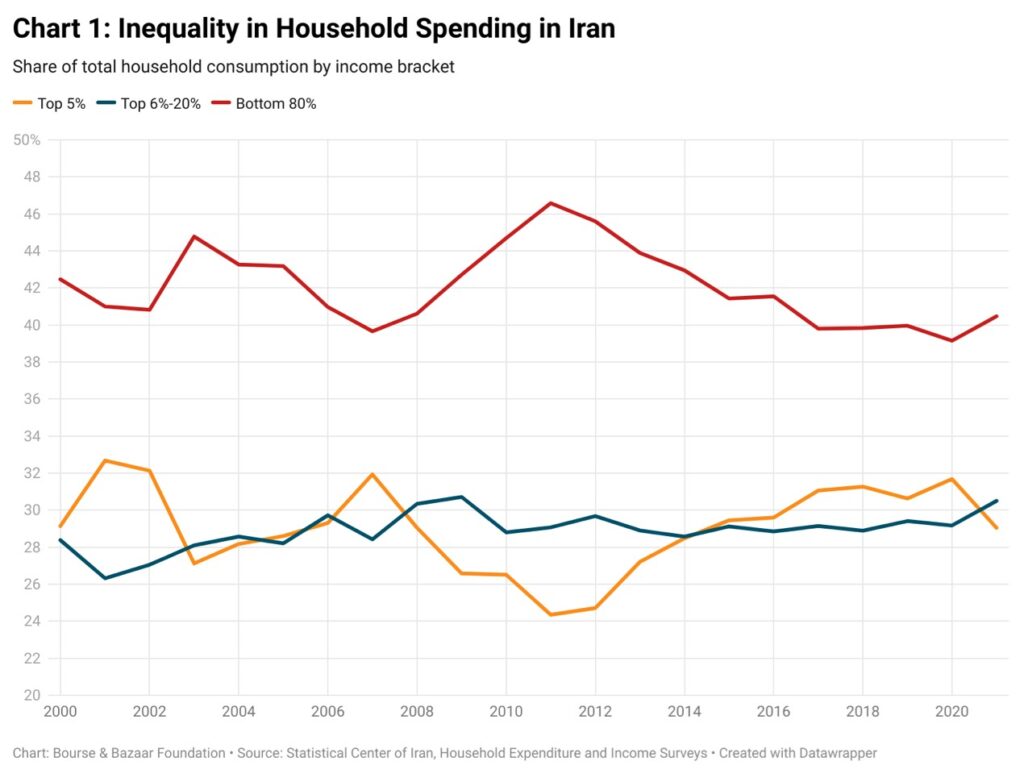
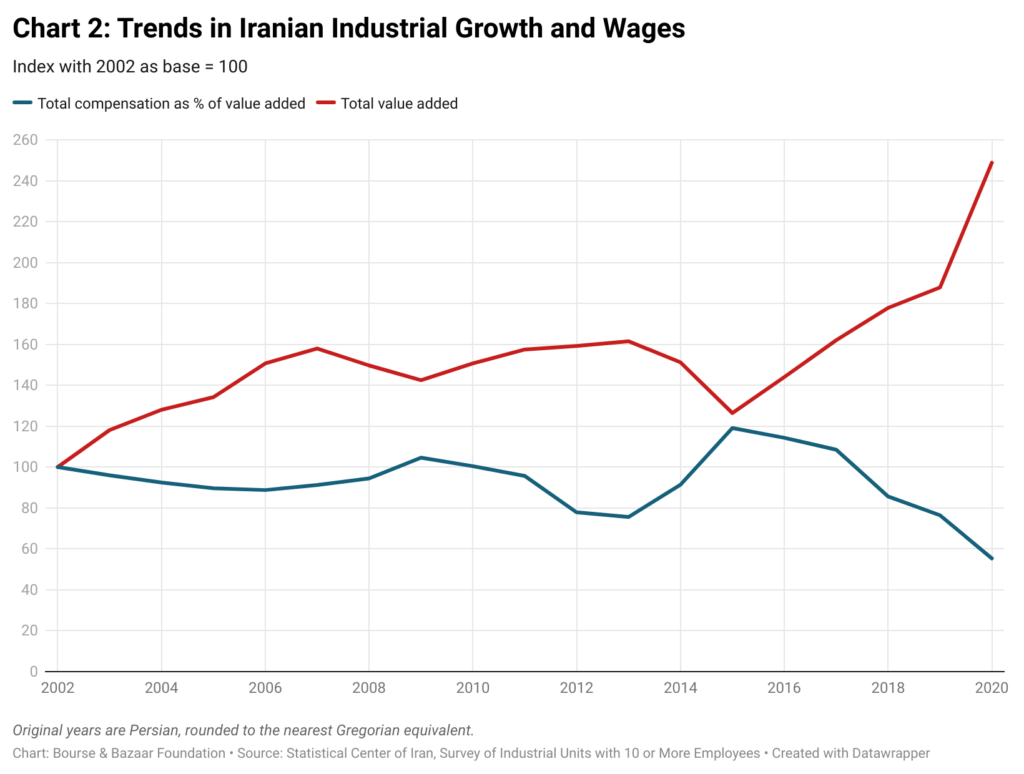
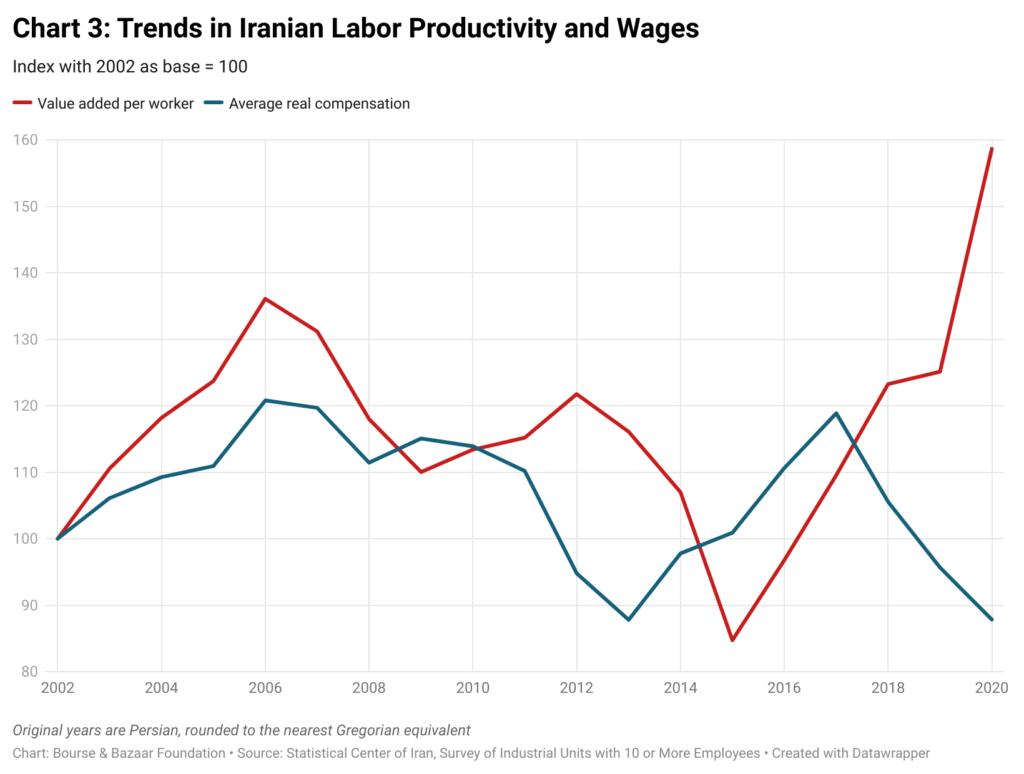
    Iran has been subjected to the world’s most extensive sanctions program for the better part of the last decade. Its experience is instructive: while sanctions were intended to target the country’s elite, the wealthiest households have fared far better than the poorest during the period. In fact, it appears that sanctions rigged the game, enabling a structural transformation of the economy that helped Iran’s richest households take a greater share of the nation’s wealth.

    Distributional effects

    Broad economic sanctions are intended to reduce the integration of the targeted economy (or key sectors in that economy) with Western economies (or the global economy more broadly). Targeted sanctions have the same goal but aim to impact specific firms or individuals. In the last two decades, over 9,000 entities have been designated by the Treasury Department’s Office of Foreign Assets Control (OFAC). Isolation is meant to lead to negative economic outcomes for the targeted state, sector, entity, or individual, in turn reducing the target’s power. But changes in relative power are often outside the scope of sanctions programs.

    In a recent paper, Reiner Eichenberger and David Stadelmann identify ten channels by which sanctions “shift the relative power between citizens and autocrats in favor of the latter.” For this reason, they argue, “autocratic leaders may quickly learn to love economic sanctions, especially if sanctions are used as a substitute for military action by the sender.” Even when cut out from the global economy, a powerful state can continue to dominate the regional economy, a powerful sector can still dominate the domestic economy, a powerful firm can still dominate a sector, and a powerful individual can still dominate a firm or government institution.

    The US first imposed sanctions on Iran in 1979 in response to the Islamic Revolution and the Iran hostage crisis. These sanctions were expanded by the Clinton administration in 1996 to block most US companies from the Iranian market. Despite the American embargo, Iran’s economy continued to benefit from foreign investment, largely European, until concerns grew over the possible proliferation risks posed by the country’s nuclear program.

    We use household expenditure to examine the circumstances of the top 5 percent of households in Iran since 2002, covering a two-decade period of shifting sanctions policy.1The Statistical Center of Iran publishes its own tables on household expenditure according to deciles, but these tables fail to reflect the true extent of inequality given how in a developing country such as Iran, even the top decile of the income distribution comprises much of what is generally understood as its “middle class,” namely households led by state employees and professionals living in big cities. In 2008, the United Nations Security Council passed Resolution 1803, which marked the beginning of a multilateral sanctions campaign targeting Iran’s economy. Still, between 2007 and 2012, thanks in part to redistributive government policies, the income share of Iran’s rich—those in the top 5 percent of households—decreased while those in lower income groups made substantial welfare gains; Iranian society was becoming more equal. In part, state elites had decided to redistribute in response to the 2009 Green Movement protests, which had put pressure on the conservative Ahmadinejad government to double-down on its populist agenda.

    In 2012, however, things changed. The Obama administration expanded its sanctions to disconnect Iranian banks from the global financial system and block Iranian oil exports. This threw Iran into its first recession in nearly two decades, leading to a period of fiscal austerity that coincided with an increase in the top 5 percent’s income share. At the same time, those at the lower end of the income scale saw their consumption decline. By 2020, the top 5 percent accounted for a staggering 35 percent of total household expenditures in Iran. This figure was on par with the early 2000s, suggesting that the major redistributive projects introduced in the interim period—monthly cash transfers, the workers’ Justice Shares program, the Mehr mass housing project, and the Rouhanicare healthcare program—failed to sustainably reduce and contain inequality as sanctions squeezed Iran’s economy.

    While the implementation of the Iran nuclear deal in January 2016 saw the lifting of EU and UN sanctions and the rollback of most US secondary sanctions, this relief was short lived. In May 2018, the Trump administration reimposed secondary sanctions on Iran as part of its unilateral withdrawal from the nuclear deal. Once again, Iran’s economy was thrust into a recession, soon made worse by the Covid-19 pandemic. By the end of 2022, economic data pointed to a painful, decade-long period of stagnation in Iran. But upon closer review, the adaptation of the Iranian economy to sanctions has been surprisingly dynamic. Amid the high-level impacts of contracting GDP, declining trade turnover, and a weakening currency, Iran’s wealthiest households have nonetheless won substantial economic gains under sanctions.

    As illustrated in Chart 1, the rise in inequality after 2013 can be mostly attributed to the sharp increase in wealth in the top 5 percentile, with those in the bottom 80 percentile of income distribution taking the hit. The expenditure share of the top 5 percent is likely an underestimate. Individuals tend to underreport their income and expenses on household budget surveys, especially at the top of the income distribution. As per the survey data, the median household in the top 1 percent spent $109,000 (PPP adjusted) in 2021. There are certainly Iranian households spending many times that figure who are not represented in the survey sample—the income distribution has a long tail. By comparison, the top 6–20 percent of households in the income distribution only managed to retain their spending share. All other households were worse off in 2021 than in 2011, before Obama’s sanctions changed Iran’s economic trajectory.

    Rising profits

    Iranian politicians, pundits, and the public often blame corruption for the growing gap between rich and poor. But not everyone who is getting richer is engaged in corruption—the top 5 percent of the income distribution comprises approximately 1 million households. Growing inequality is the result of a structural transformation in Iran’s economy, spurred by sanctions.

    Compelling evidence for this structural transformation can be seen in data from Iran’s industrial sector. After a few difficult years in the early to mid-2010s, manufacturers found ways to grow under sanctions, burnishing the fortunes of Iran’s shareholder class. Sanctions did lead to a drop in investment as the cost of capital surged and most manufacturers were constrained by their existing capital stock. But sanctions also fundamentally altered price structures associated with production and international trade. Manufacturers took advantage of import-substitution and renewed export competitiveness to expand production in certain fields. In real terms, total value added in large-scale industry has doubled since 2015.

    Firms seeking to boost output to capitalize on the new price structures could not simply invest in new technology. Instead, manufacturers prioritized efficiency and repressed wages, enabling them to take home a larger share of the revenues as profit. Chart 2 shows that the imposition of sanctions in 2011–13 and 2018–20 is associated with a sharp reduction in the wage share in total value added. Total labor compensation as a share of total value added dropped to a low of 14 percent in 2020, down from an average of 24 percent in the 2000s. Chart 3 depicts the dynamic in more detail: sanctions substantially reduced workers’ real pay. Average compensation in large industrial enterprises in 2020 stood 22 percent below its 2000s average. At the same time, sanctions raised average labor productivity—not primarily through mass lay-offs in the industrial sector, but rather by increasing output per retained worker. Industrial workers in Iran have become more productive, but most of their additional output is accruing to the owners and managers of capital.

    This insight is corroborated by financial disclosures showing Iran’s publicly traded firms have become more profitable, even as the economy has experienced high inflation. Since President Trump reimposed sanctions, the average profit margin of firms listed on the Tehran Stock Exchange (excluding the financial sector) has risen to 26 percent, up from an average of 11 percent in the four years leading up to March 2018, a period in which inflation was elevated but under control.

    Sparking increased profits and growing inequality, sanctions facilitated a structural transformation of the Iranian economy that favored those who control capital. Sanctions entrenched and empowered Iran’s elite by halting the economic redistribution that had been underway prior to 2012. These distributional effects may help explain why, as Yellen put it, “a real economic crisis” has failed to coerce Iran to change its behavior. The people most desperate for sanctions relief are those with the least influence in Iran’s political economy, and their influence continues to diminish because the pain of sanctions is distributed unequally.

  7. Hockey Sticks and Crosses

    Comments Off on Hockey Sticks and Crosses

    They say a picture is worth a thousand words. Two types of images are key to understanding current debates about economic globalization: the hockey stick chart, representing the stunning and inexorable growth of some phenomenon; and the cross chart, whose lines represent changes in relative power and prosperity.

    There are good and bad hockey sticks, and the job of policy makers the world over is to harness the former while curbing the latter. But the domestic and international politics of addressing these hockey sticks is complicated by their intersection with distributive conflicts—which can be seen in the form of crosses.

    In Six Faces of Globalization: Who Wins, Who Loses, and Why It Matters, we identify a series of narratives that dominate Western debates about the virtues and vices of economic globalization. These storylines are important because they offer different interpretations about what the problems are, how they came about, who is responsible, and what should be done. Here, we highlight some of the key hockey sticks and crosses on which these narratives rely.

    No single narrative or image can capture the multifaceted nature of complex issues like economic globalization and the climate crisis. Understanding different perspectives and how they interact is crucial.

    Prosperity

    Advocates of economic globalization invariably make some version of the following argument: Economic activity was stagnant for most of humanity’s existence until, sometime around the nineteenth century, a combination of technological innovation and international trade unleashed productivity, creating unprecedented riches. This is the hockey stick of global prosperity, as measured by GDP and shown in Figure 1. Whatever the costs and failings of globalization, proponents argue, we must be careful not to mess with this incredible success.

    Figure 1

    We call this the “establishment narrative.” It is the perspective you would typically hear from mainstream political parties in the West, scores of political and economic commentators, and international economic institutions like the World Bank, the International Monetary Fund, and the World Trade Organization. It is a story about win-win outcomes and trade’s potential to bring peace and prosperity to the world. 

    The caveats are that governments must design domestic policies to help workers adjust to the changing international division of labor and to redistribute wealth so that everyone gets a bigger piece of the expanding pie. But the bottom line of the establishment view is clear: we must have more technological innovation and economic integration to stay on the ever-rising hockey stick of global prosperity.

    Doom

    The hockey stick of doom, which charts skyrocketing carbon emissions in Figure 2 below, shows that the prosperity celebrated by the establishment narrative is built on unsustainable foundations. The storyline supported by this chart, which one could call the “Anthropocene narrative,” focuses on how globalization has facilitated the diffusion of carbon-fueled patterns of production and consumption, which are fast making large sections of the planet uninhabitable. This narrative is a pessimistic story about neglected environmental externalities in the quest for economic growth.

    Figure 2

    Proponents of this narrative argue that, instead of relentlessly maximizing economic growth, we must reorient our economies toward the goal of surviving and thriving within the limits of our planet’s resources. Unless we change course, we will find ourselves in a lose-lose situation of rising temperatures, extreme weather events, and collapsing biodiversity. We will also perpetuate serious injustices and inequities: even though everyone is at risk of losing, those who are most vulnerable and least responsible for the problem are losing first and worst. 

    As record drought, heat waves, fires, and floods batter the planet, the “Anthropocene narrative” is rapidly gaining mainstream acceptance. The hockey sticks of prosperity and doom mirror each other. The charts in Figure 3 capture the trajectory of the Anthropocene, with a series of blue hockey sticks showing rising economic activity followed by a series of red hockey sticks showing destructive earth systems trends.

    Figure 3

    Hope

    For some, the answer to this dilemma lies in “degrowth.” On this view, we need to recognize that never-ending economic growth is unsustainable and therefore commit to reducing our consumption to an ecologically sustainable level. The aim is to curb the hockey stick of prosperity, at least for rich people and rich countries, in order to bend the hockey stick of doom.

    Others maintain that trade and technology can point the way out of this mess. Proponents of the “green growth” approach marshal the hockey stick of hope, which represents the rapidly accelerating uptake of solar power and other green technologies. As Figure 4 shows, it took more than two decades for the world to install its first terawatt of solar power, but the second and third are set to follow within five years. At this rate, markets (with the support of states) can innovate us through our problems, argue proponents of this view, who often come from the pro-trade-and-technology establishment camp.

    Figure 4

    The hockey sticks are important, but they obscure distributive conflict. Not only will the impact of climate change be starkly uneven; the green transition is also beset by questions about the global division of labor and the distribution of economic power. China has led the world in the production of solar panels, helped by its unrivaled manufacturing capabilities, access to global markets, and generous state subsidies. The extraordinary growth of Chinese electric vehicle manufacturing and exports suggests that China will be the breakout star in this market, too. For Western politicians who worry about their manufacturing base and see their countries in competition with China over the technologies of the future, this hockey stick of hope comes with considerable anxiety.

    To understand this reaction, we need to explore the ways in which the hockey sticks of economic globalization intersect with the crosses of relative power and prosperity. Runaway growth, skyrocketing emissions, and technological tipping points are one side of the story; distributive conflict is the other.

    Global power

    Although the US and China have each gained from the economic globalization of the past decades in absolute economic terms, in relative terms China used the period to close the gap on its Western rival economically, technologically, and militarily. The new economic powerhouse fueled multiple decades of global economic growth by playing to its strength in cheap manufacturing, while gaining access to global markets and capital through its accession to the World Trade Organization. China’s domestic champions grew in size and strength, and moved up the ladder of technological innovation, and China’s military spending increased significantly. 

    The cross of global power captures this change, showing China’s relative rise against the US as measured by each country’s share of global gross domestic product in terms of purchasing power parity (Figure 5). This cross propels the “geoeconomic narrative,” which treats economic security as national security and frames China as both an economic competitor and a security threat to the US and other Western nations. Instead of focusing on win-win outcomes from economic integration, this narrative emphasizes the vulnerabilities created by economic interdependence with a strategic rival, such as lack of self-sufficiency and exposure to weaponized interdependence.

    Figure 5

    Those wary of China’s growing economic and technological prowess fear that their strategic rival will gain an advantage in key technologies and markets of the future, such as artificial intelligence, quantum computing, green technologies, and biotech. To avoid this, Western governments are pumping billions of dollars into the development of their own domestic industries while at the same time curtailing the export of key technologies like semiconductors, and attempting to secure continuous access to critical inputs, such as lithium and rare earth metals. But Western governments do not only strive to maintain an edge in the technologies of the future; they also hope that rebuilding their manufacturing base will help them mitigate the political and social fallout from deindustrialization and runaway inequality.

    Work

    Donald Trump did not win the US presidency in 2016 because the average American was concerned about falling behind China in quantum computing or artificial intelligence. Rather, his appeal rested in part on his repeated promise to bring back blue-collar industrial work that helped build the twentieth-century American middle class: car manufacturing, steel smelting, and coal mining. The steady decline of manufacturing jobs in the US and other high-income countries accelerated in the early 2000s after the “shock” of China’s entry into the WTO. The decline was mobilized in service of the “right-wing populist narrative” championed by Trump, the Brexit movement, and other right-wing parties all over the developed world. 

    This shift in labor markets is exemplified by Figure 6, which captures the changing shares of economic sectors in the US over the past two centuries. In the 1840s, almost 80 percent of employment was made up of agriculture and manufacturing, while just over 20 percent came from services, such as finance, business, education, information, legal and health services. By 2015, those positions had more than fully inverted, with services now making up more than 80 percent of jobs and agriculture and manufacturing constituting less than 20 percent. Technological innovation and trade transformed the US and other Western countries into knowledge economies. Why did this change give rise to such discontent, especially in the United States?

    Figure 6

    Deindustrialization had a highly asymmetric impact on different regions in the US. The regions hit particularly hard by the loss of well-paying factory jobs were ones that offered few alternatives; in these cities and towns, the closure of factories permanently depressed economic activity, bringing deaths of despair in its wake. Not all workers and their families were able or willing to move to the metropolitan areas where new service sector jobs were being created. Moreover, the decline of manufacturing disproportionately affected white men without a college degree, eroding the power of the traditional industrial male breadwinner in favor of what right-wing populists view as a “woke” urban elite.

    Income

    A major left-wing narrative of the twenty-first century has focused on a different image: the cross of income shares shown in Figure 7, which demonstrates the share of US income flowing to the top 1 percent rising inexorably as the income enjoyed by the bottom 50 percent declines steadily. According to the “left-wing populist narrative,” this cross captures the various ways in which national economies have been rigged to channel the gains from globalization to the privileged few, exacerbating inequality. From stagnating minimum wages to a predatory financial system, this narrative sees the economy as systematically skewed against the interests of the working and middle classes.

    Figure 7

    Taxes

    Not only have the rich been able to appropriate the lion’s share of the gains from globalization; corporations have also exploited the pressures of globalization to get governments to shift the burden of taxes from mobile factors of production, such as capital, to relatively immobile factors, in particular labor. While corporate profits have soared, corporate tax rates have collapsed, producing a cross in tax burdens borne by workers and companies in high-income countries over the past fifty years, as shown in Figure 8.

    Figure 8

    This dynamic is at the heart of what we call the “corporate power narrative.” For this narrative, the real winners from economic globalization are footloose multinational companies that have been able to take advantage of global markets to produce anywhere, sell everywhere, and pay back as little as possible through taxes. Proponents of this narrative accuse multinational companies of using their power to shape domestic and international rules in areas that advantage them, such as trade and investment, while lobbying against effective rules on subjects that might disadvantage them, especially taxation. In doing so, corporate power entrenches inequality.

    Complexity and connections

    Our debates about economic globalization tend to be siloed or polarized. Proponents of a given narrative will typically focus on one aspect of economic globalization, calling attention to the importance of a particular hockey stick or cross that epitomizes their cause, while largely ignoring the others. If we want to understand the complexity of the issues facing us—such that we can move toward useful interventions—we need to find ways of simultaneously keeping all these hockey sticks and crosses in our minds.

  8. Elusive Boundaries

    Comments Off on Elusive Boundaries

    In April 2021, investors gathered at B3, Brazil’s stock exchange, to bid for water concessions in Rio de Janeiro. The former capital city and its surrounding municipalities had been divided into four “concession blocks,” all of which were up for grabs. Among the bidders were firms owned by private equity and institutional investors, including state-led investment funds. In total, 22.7 billion reais were raised: the largest ever auction of water and wastewater services in the country.1Ministério da Economia, “Realizado o maior leilão de saneamento do Brasil, para a concessão dos serviços da Cedae, com outorga de R$ 22,7 bilhões e ágio médio de 133%,” 30 April 2021. Available at: https://www.gov.br/economia/pt-br/orgaos/seppi/noticias-1/realizado-o-maior-leilao-de-saneamento-do-brasil-para-a-concessao-dos-servicos-da-cedae-com-outorga-de-r-22-7-bilhoes-e-agio-medio-de-133

    Rio was not alone. In the last three years, nearly thirty such auctions were held across Brazil, totaling around 100 billion Reais in investment commitments.2ABCON, “Os últimos três anos,” Panorama da participação privada no saneamento 2023 (report), 2023. As in Rio, several of the contracts auctioned encompassed “blocks” of municipalities—pooled together so as to draw in investors. The wave of auctions has been much celebrated, with public officials and business actors promising that public-private collaboration would pave the way for better services, expanded access, and socioeconomic development. 

    The promise is familiar. It echoes the optimism about private initiative that marked the spread of neoliberal policy ideas in the late twentieth century, and the continued faith development institutions place in public-private partnerships for financing infrastructure projects and service provision—even when this faith is at odds with patchy and sometimes dire track records globally. (In the case of public-private water, the ongoing pollution debacle in England is just the latest example of the shortcomings of the approach.). 

    It would be easy to read the wave of auctions in Brazil simply as a renewed neoliberal offensive against public services. The auctions come, after all, on the heels of eagerly pursued market-oriented reforms under the administrations of Presidents Michel Temer (2016–2018) and Jair Bolsonaro (2019–2022). But such a reading would neglect the fact that both Temer and Bolsonaro faced setbacks in their efforts to reform water provision. And it would obscure rather than reveal the political processes and market transformations that led here. The recent influx of private investment differs from prior state efforts to encourage private participation during the heyday of neoliberalism in the 1990s. Private water provision at that time developed in relatively timid, small-scale, and scattered ways. What changed?

    The history of private water provision in Brazil exemplifies transformations in state-market relations over the past three decades. It features feeble market expansion efforts under pro-market governments, ambivalent state action under ostensibly more active ones, devastating political scandals, and shifting investor landscapes amid increasing financialization. This history shows that the fate of neoliberal or other policy frameworks is determined by power relations and concrete political struggle. More fundamentally, it reveals the practical challenges of demarcating where states end and where markets begin.3See Timothy Mitchell, “The limits of the state: Beyond statist approaches and their critics.” (<)em(>)American political science review(<)/em(>) 85, no. 1 (1991): 77-96. Policy debates around public-private collaboration or public versus private service provision assume too neat a separation between the two. From national policy to the inner workings of utilities, water provision in Brazil illustrates that these are not fixed entities; the boundaries that divide them are often blurry, drawn by the politics of contestation and compromise. 

    Ambitious privatization—almost

    In 1995, with the aim of remedying lackluster infrastructure investment and placing Brazil “back on the path of sustained economic development,”4Fernando Henrique Cardoso, 1995, “Foreward,” (<)em(>)Public Service Concessions in Brazil(<)/em(>). Brasília: Presidência da República, Secretaria de Assuntos Estratégicos, p. 5. President Fernando Henrique Cardoso (known by his initials, FHC) introduced the Concessions Law—a piece of legislation which allowed private actors to deliver public services like water. The moment appeared ripe for such a reform. Across Latin America and elsewhere, governments were experimenting with liberalization and privatization, due to a mix of economic and fiscal troubles, structural adjustment pressures, and loss of faith in state-led development. 

    FHC’s administration pursued what it claimed in a letter to the International Monetary Fund was “one of the most ambitious privatization programs in the world.”5International Monetary Fund (IMF), Letter of Intent from the Brazilian Government, 13 November 1998. But while the government succeeded in advancing such programs in sectors like energy and telecommunications, it faltered when it came to promoting large-scale private investment in water—and not for want of trying. The government mobilized the National Development Bank (BNDES) and federal banks like Caixa Econômica to make dedicated financing lines available for private water companies. It also sought to put in place a new legal framework for the sector to clarify property rights and introduce regulatory norms. 

    But there were various political roadblocks along the way. In Congress, the proposed framework failed to advance, encountering strong opposition from public providers and civil society groups such as the National Front for Environmental Sanitation (FNSA).6Ana Cristina Augusto de Sousa and Nilson do Rosário Costa, “Ação coletiva e veto em política pública: o caso do saneamento no Brasil (1998-2002).” (<)em(>)Ciência & Saúde Coletiva(<)/em(>) 16 (2011): 3541-3552. On the ground, there was the challenge of getting mayors and state governors on board. Since democratization in the late 1980s, municipal governments generally held responsibility for urban development policy, including the provision of water and wastewater services. But these services have long been provided primarily by state government-owned companies created during the military dictatorship (1964–1985). With the federal government as the main source of financing, the existing institutional architecture meant that water provision was necessarily a multi-scalar affair. Where the political and ideological stars aligned enough to push local governments to shift services into private hands, there was also the challenge of anti-privatization mobilization, which succeeded in thwarting a number of concession projects. 

    Political disputes and misalignments help to explain why early efforts to expand private water provision generally stumbled when the policy climate appeared set for them to advance. But even missteps can sow seeds. Some private investment—generally through small, sparse, and localized concessions—did occur, forming the contours of a private market. Unlike in the infamous water privatization experiences of Bolivia or Argentina, the private sector characters here were mainly domestic engineering and construction groups, rather than big multinationals like Suez. But, as we will see, it was construction groups who would later play key roles in the development of private water provision—this time in a context of bonanza, rather than fiscal austerity.  

    Two-headed monsters

    Where private investment occurred at a larger scale during the late 1990s and early 2000s, it was through the initiative of pro-market state governors with political clout, such as in Paraná. In 1998, Paraná’s governor, the famous architect and urban planner Jaime Lerner, auctioned off nearly 40 percent of Sanepar’s common stock, while retaining majority control over the company. The winning bidder was Dominó Holding, a private firm held by a combination of investors, including Brazilian construction group Andrade Gutierrez and the French multinational Vivendi (now Veolia). 

    Proponents of joint public-private ownership see these arrangements as pulling out the “best” of each half of the equation, while critics see the risk of “two-headed monsters,” whose contradictory interests —what agency theorists call “principal-principal problems” between state and private shareholders—may produce conflicts and inefficiencies. For that to occur, however, the public and private sides need to be distinct. 

    During Lerner’s administration, it was hard to tell public and private interests apart. Despite having majority control, the government largely adopted a laissez-faire approach, letting the private partner run the show and encouraging its search for profitability. Dominó had de facto veto power in the administration board, held strategic management positions, and maintained a close rein on operational decisions, fostering an “efficiency-at-all-costs” ethos that included what one manager described as “extreme things” like “turning equipment off to save energy.”7Isadora Araujo Cruxên, “The limits of insulation: The long-term political dynamics of public-private service delivery.” (<)em(>)International Development Planning Review(<)/em(>) 44, 3 (2022): 317-343.

    This “synergistic” relationship came to a halt following the election of Roberto Requião as state governor in 2002. Requião favored what might be called a more statist approach to service provision, vowing to challenge the existing shareholder agreement and curb Dominó’s influence. Relying on state appointed managers and other allies within the company, the government took on a more active role. It sought to steer service provision away from a focus on efficiencies towards other concerns such as affordability for low-income households and coverage expansion to rural areas—decisions that also catered to Requião’s constituents. While the company remained profitable, its relative profitability declined.

    From the perspective of other private investors and financial market analysts who followed the case, Requião’s term (2003–2010) was disastrous: a prime example of undue political “interference” in company activity. But what the Sanepar case in fact illustrates is that politics cannot be removed from the equation. As Bob Jessop once put it, to the extent that the state acts, it does so through “specific sets of politicians and state officials.”8Bob Jessop, (<)em(>)The state(<)/em(>). Cambridge, 2016, p. 247 Forms of electoral, bureaucratic, or contentious politics bring different planning rationalities into it. In some instances, these align with market interests, as in Lerner’s term, while in others they may help to advance socially minded aims, as in Requião’s term. Utilities, then, emerges not as something to be insulated but as a space of legitimate political struggle over the direction of service provision and of “public-private” relations.

    Ambivalence and compromise

    While Requião’s administration was clashing with Sanepar’s private shareholders in Paraná, at the national level President Luiz Inácio Lula da Silva (2003–2010) sought to appease investors while advancing a new vision of development. Much like the rest of the so-called pink tide in Latin America, the political program of the former metalworker and leader of the Workers’ Party (PT) promised greater social welfare and more active state engagement in directing, rather than simply enabling, economic activity. In practice, however, the “more state and less market” agenda often translated into vacillating commitments that tried to do a bit of everything. 

    With the shift from FHC to Lula, broad-scale water privatization was no longer on the horizon. Indeed, a favorable macroeconomic context invigorated public investment in infrastructure, providing relief to many public water providers. Riding the wave of the 2000s commodity boom, fiscal strangulation and scarce public investment—trademarks of the 1990s—were in Brazil’s rearview mirror. Lula’s Growth Acceleration Program (PAC) promised nearly 504 billion reais in physical and social infrastructure investments by 2010.9Gaspar, Malu. (<)em(>)A organização: A Odebrecht e o esquema de corrupção que chocou o mundo(<)/em(>). Companhia das Letras, 2020, p. 259. But the new flow of cheap public financing was also attractive to construction business groups with a long-standing and wide-ranging presence in domestic infrastructure development. Eyeing opportunities to cash in and to expand their portfolios, some of these groups began to look into water provision. 

    Legal and regulatory changes further stimulated private sector interest. In 2004, Lula’s administration introduced a law to govern public-private partnerships, which expanded the range of private investment modalities beyond concessions and signaled that “public-private collaboration” was not off the table. In 2007, the president signed the “Sanitation Law,” which put in place a new regulatory framework for the provision of water and wastewater services.10 Sanitation in Brazil refers to both water supply and wastewater services. It does not encompass water resources management, which is a separate policy domain.This new legislation was essentially mute on the question of ownership over service provision, an omission that reflected the need to negotiate among competing interests in the sector.

    One of the core disputes around the legislation concerned the allocation of ownership rights between municipalities and states. No longer needing to unite against privatization threats, municipal governments and state providers now fought for control.11Ana Cristina Augusto de Sousa and Nilson do Rosário Costa. “Incerteza e dissenso: os limites institucionais da política de saneamento brasileira.” (<)em(>)Revista de Administração Pública(<)/em(>) 47 (2013): 587–599. The federal government generally favored municipal interests. This largely owed to Lula’s appointment of leaders of the FNSA—the broad-based civil society coalition which had been instrumental in blocking FHC’s proposals—to coordinate policymaking around water and wastewater services within the newly created Ministry of Cities. The appointments reflected the Workers’ Party strong roots in social movements,12Rebecca Abers, Lizandra Serafim, and Luciana Tatagiba. “Repertórios de interação estado-sociedade em um estado heterogêneo: a experiência na Era Lula.” (<)em(>)Dados(<)/em(>) 57 (2014): 325–357. which turned many activists into bureaucrats, as well as FNSA’s support for Lula’s election bid. As a movement, FNSA had historically supported municipal autonomy.

    In 2005, the administration introduced a bill in Congress that, among other things, required the creation of regulatory agencies for water provision, encouraged public participation, and defined which local services were owned by municipal governments. But this proposal was undercut by a competing bill, favoring state companies, that was put together by state governments. At risk of losing its hand, the federal government sought a compromise. Sectoral actors, including a more organized group of private companies, came together and resolved to leave the issue of ownership vaguely specified and thus unresolved in the final legislation. The solution worked well for existing private companies, who argued that any policy framework would be better than an uncertain stalemate. Behind the scenes, they had sided with state companies—perhaps hoping to secure larger public-private partnerships down the line. 

    With the Sanitation Law in place, some of Brazil’s largest construction groups, like Odebrecht and Grupo Galvão, sought to expand and consolidate their activities in the water sector. They acquired existing contracts from other providers and used their local political ties and skill to win new ones. Gradually, the private share of water and wastewater services—albeit still comparatively small—not only grew but became concentrated around a handful of holding companies: Odebrecht Ambiental, CAB Ambiental, Equipav (later Aegea), and Águas do Brasil. These market changes would pave the way for the recent wave of private investment. All four of these companies—some under new names and owners—featured among the top winners of recent auctions in the sector, including in Rio.

    If water politics under FHC showed that private sector interests may falter under pro-market administrations, Lula’s term reveals how they may advance under ostensibly more statist ones. Along with a general ambivalence towards private investment and business interests, power struggles within the sector and political compromises combined to inadvertently contribute to the consolidation of a private market for water provision. 

    A “Bridge to the Future”?

    Judging from newspaper headlines or soundbites from policymakers or investors, one might also credit the recent wave of auctions to another reform: Law 14.026, commonly known as the “New Legal Framework for Sanitation,” which was approved in 2020. This law altered several provisions of the contested 2007 Sanitation Law and, from its conception under President Temer, was explicitly designed to expand private water investment. 

    When Temer became president following the impeachment (or coup) of President Dilma Rousseff in 2016, private water provision was undergoing a restructuring. The anti-corruption investigation known as “Lava Jato” (Operation Car Wash) implicated several Brazilian industrial groups in overpriced contractual schemes and unlawful political contributions. The scandal ravaged Brazilian politics and economy. It took a particular toll on construction groups, who subsequently sought to relinquish assets. As they stepped out of the water sector, finance stepped in. The boom years of Lula’s administrations and regulatory developments had stimulated Brazil’s private equity and investment fund industry. In 2017, the private equity groups Brookfield Business Partners (Canada) and IG4 Capital (Brazil) acquired Odebrecht Ambiental (renamed BRK Ambiental) and CAB Ambiental (now Iguá Saneamento), respectively.

    One implication of this shifting investor landscape was the growing demand to revisit the existing rules of the game. The 2007 compromise no longer sufficed. With money in stock from financial investors ready to be invested, the largest private water holdings wanted more room to grow, which required turning against state companies and challenging their market power. Regulatory fragmentation also caused anxiety around varying local norms and political demands. It is perhaps unsurprising, then, that private water companies joined forces and went all in on the possibility for institutional reform which opened with the transition to Temer’s administration.

    Shortly before Rousseff’s impeachment, Temer’s political party, the Brazilian Democratic Movement (MDB)—the same party as FHC—had put forth a new political program titled “A Bridge to the Future” (Uma Ponte para o Futuro). Ironically, in calling for “a development policy centered on private initiative,” the program read much like a return to the past.13Fundação Ulysses Guimarães and Partido do Movimento Democrático Brasileiro, 2015, “Uma Ponte para o Futuro.” Not long after taking over, Temer’s administration sought to use the National Development Bank (BNDES) to encourage state water companies to engage in ample public-private partnerships—a route that proved less fruitful than hoped for, even as several of these companies struggled in light of Brazil’s deepening economic crisis, fiscal woes across levels of government, and shortage of funds. Once again, multi-scalar political alignments proved to be a roadblock. 

    Seeking alternative routes, Temer’s administration introduced a provisional executive decree in 2018 aimed at changing the legal and regulatory framework for the sector, to allow for greater private engagement.14Provisional decrees are executive orders that act as law pending approval from Congress. Private water companies provided much input into the framework, but the decree faced strong opposition from civil society groups, municipal providers, and state companies, ultimately expiring before a vote in Congress. Bolsonaro’s government faced the same fate when it tried to get a new iteration of Temer’s decree approved by legislators in the first half of 2019.

    In light of these consecutive defeats, new state-business articulations and persistent political mobilization by private sector actors proved crucial for pushing a new legislation through. Whereas Lula’s government had sought to draw civil society groups and movements into the state, Bolsonaro’s shifted state boundaries towards finance. His chosen Minister for the Economy was the Chicago-trained economist and investment banker Paulo Guedes. Under his reins, financial interest increased in the water sector. Private water firms worked closely with policymakers in the Ministry to draft different iterations of the legislation. They also lobbied hard to build support for it in Congress and in the media. Rather than frame the reform around narrow interests, they promoted a public narrative that emphasized the shortcomings of state companies and placed public-private collaboration at the center of a broader quest to universalize service access. They suggested that, once approved, the new legal framework would pull Brazil out of the “Middle Ages” and bring the country into modernity. 

    Rescuing politics

    The moments recounted here show that there was nothing necessarily inevitable or certain about neoliberal projects under FHC, Temer, or Bolsonaro. Like Lula’s variety of state developmentalism, their fates were shaped by political processes.  

    What this history reveals is the need to put politics at the center of how we think about state and market, public and private. The idea of “public-private collaboration,” for instance, has not only underpinned recent water policy in Brazil but also featured prominently in contemporary debates about sustainable development. After returning to power following a difficult election against Bolsonaro last year, President Lula is announcing a green transition policy package grounded on a mix of public investment, public-private partnerships, and sustainable finance. 

    Mainstream development advice touts the potential for partnerships with global capital (via myriad investment instruments) to address infrastructure gaps, tackle poverty, or support climate action. Such prescriptions around public-private collaboration tend to focus on contracts or institutional design, rather than politics—indeed, in infrastructure sectors, the concern is often with insulating arrangements from political interference. What this perspective neglects is that public-private partnerships are not just instruments, they are political relations in themselves. Efforts to remove politics from the equation are often veiled attempts to constrain the political space to the interests of some, like investors, at the expense of the interests of many. 

    Equally, while we should envision a strong role for the state in steering the private sector towards clearly defined missions and goals, we should not overstate the state’s capacity to set clear boundaries and direct policy across different sectors over time. As water investment in Brazil shows, state action is neither coherent nor immune to messy democratic politics.

    This essay is adapted from “Disordering Capital: The Politics of Business in the Business of Water Provision.”

  9. The Agribusiness Pact

    Comments Off on The Agribusiness Pact

    Over the past two decades, Brazilian media and political discourse have exalted the success of a phenomenon known as “agribusiness.”1In Portuguese: agronegócio. Closely associated with the rise of commodity exports such as soy, sugarcane, and corn, “agribusiness” has come to define the nation’s dominant agrarian system. The term and its subject, however, require further clarification.2For a more in-depth discussion of the employment and meaning of the term “agribusiness,” see G. Delgado, (<)em(>)Do capital financeiro na agricultura à economia do agronegócio: mudanças cíclicas em meio século (1965-2012)(<)/em(>) [From Finance Capital in Agriculture to the Agribusiness Economy: Cyclical Changes in Half a Century (1965-2012)]. Porto Alegre: Ed. UFRGS, 2012; B. Heredia, M. Palmeira and S. P. Leite, “Sociedade e economia do agronegócio no Brasil [Society and economy of agribusiness in Brazil].” (<)em(>)Brazilian Journal of Social Sciences(<)/em(>), 25 (74), 2010, pp. 159-96.

    This article delves into the current agrarian economy of Brazil, drawing attention to a trend we refer to as “reprimarization” and its implications for the national economy. This trend, seen in Brazil’s foreign trade, describes the return to focused production of resource-intensive primary goods for export. It has led to a decline in the economic importance of industry, confining manufacturing to a supporting role within what can now be called an “agribusiness” economy.

    The emergence of the reprimarized economy can be traced to the early 2000s, when state policies promoted agricultural and mineral commodity exports as a prominent component of Brazilian foreign trade. This phenomenon has since transcended the conventional politics of economic policies, evolving into a consensus state policy program spanning two decades. This has borne significant socioeconomic and environmental repercussions, which have albeit largely been hidden from public discourse. Additionally, the swift financialization of agriculture has transformed tangible assets, such as commodities and land, into targets for speculative investment. 

    “Primary specialization” does not enhance Brazil’s autonomy in external economic relations or foreign trade. Rather, it intensifies an economy-wide dependence on primary goods exports, gradually displacing other sectors—in particular, manufacturing goods exports.

    This economic dependency is evidenced in Brazil’s trade balance by the considerable growth of deficit in “services and income paid abroad” alongside the significant decline of manufactured goods. Together, these phenomena amplify the prominence of a small number of agricultural and mineral commodities. The economy surrounding these commodities—which aim to achieve the value required for the elusive notion of “external equilibrium”—employ a combination of mechanisms that exploit the environment while concentrating income and wealth in land-based resources.

    The primary-export specialization process impedes alternative rural development strategies centered around agroecological sustainability and socioeconomic progress. This environmentally unfriendly and exploitative system fosters both domestic and global inequalities, marking a return to economic dependency after a sustained period of diversification.

    Primary-export specialization  

    The past two decades have seen significant transformations of the Brazilian agrarian landscape. Innovative agrarian policies were introduced after 2000, assisting the rapid reduction of social inequality and hunger (indicators of progress which were rapidly reversed after 2016). But processes that deepened the structural contradictions within Brazilian society were underway. This initiated a pronounced regression for rural regions, long characterized by stark inequalities in land access. Data from the 2017 Agricultural Census indicate that agricultural establishments smaller than ten hectares, despite constituting half of the total units, accounted for a mere 2.28 percent of the total area, whereas establishments with 1,000 hectares or more, constituting only 1 percent of the total number of units, held 47.52 percent of the land area.3See: Brazilian Institute of Geography and Statistics, 2017 Agricultural Census. Rio de Janeiro: IBGE, 2019.

    We focus on the expansion of commodity production and its consequences for foreign trade, as well as the degree of financialization occurring within rural areas. In particular, the rise of China in the twenty-first century reshaped Brazilian foreign trade dynamics. According to Flexor, Kato, and Leite:

    The global economic dynamics characterized by robust growth in developing nations, expanding trade, and low global inflation have significantly influenced the pattern of Brazilian trade . . . Over a span of two decades, China has become the primary market for Brazilian exports, with their value skyrocketing from just over US$ 1.08 billion to over US$ 67.68 billion between 2000 and 2020. In 2000, China accounted for a mere 1.97 percent of the total value of Brazilian exports, while in 2020, it represented almost a third (32.40 percent) of the total. The trajectory of Chinese product imports followed a similar trend, reaching US $34.77 billion in 2020, accounting for 21.9 percent of the total imported value and demonstrating a staggering increase of 2,752 percent over a span of twenty years.4G. Flexor, K. Kato and S. P. Leite, ““Transformações na agricultura brasileira e os desafios para a segurança alimentar e nutricional no século XXI [Transformations in Brazilian agriculture and the challenges for food and nutrition security in the 21st century].” (<)em(>)Texts for discussion(<)/em(>), 82. Rio de Janeiro: Fiocruz, 2022. Projeto Saúde Amanhã.

    Figure 1: The primary sectors of export and their corresponding values of Brazilian exports in 2020, in billions of US dollars.

    Source: ComexStat (2020). Flexor et al. (2022, p. 13).

    This concentration in the Chinese market was accompanied by a drastic shift in the structure of Brazilian exports. Until 2000, the foreign trade agenda still exhibited a relatively diverse range of products. But over the span of twenty years, there has been a shift towards primary goods. Figure 1 illustrates the increased significance of soy, iron ore, and oil—resource-intensive primary goods—along with a simultaneous rise in imports of manufactured goods. According to the Foreign Trade Secretariat (SECEX), starting from 2018, Brazil once again saw more than 50 percent of its exports comprising primary goods, signaling a return to a pattern seen up until the postwar period; thereafter, Brazil experienced a prolonged diversification of its foreign trade portfolio.

    The case of soy deserves special attention. In 2000, the value of exports from the oilseed chain accounted for 5 percent of Brazil’s total exports, but by 2020, it had surged to 16.8 percent. This substantial increase can be attributed to the significant rise in Chinese imports, which accounted for over 70 percent of the total value of soybeans exported by Brazil in the previous year. A similar trend can be observed with iron ore. It is worth noting that the rural sector, including the related industrial sectors, consistently maintained a surplus in trade flow from 2000 to 2020, as depicted in Figure 2. While the overall trade balance experienced alternating periods of deficit and modest surplus, the balance of the “agricultural macrosector” revealed a substantial gap between exports and imports, further evidencing the “reprimarization” of the export portfolio.5Ibid.

    Figure 2: The trade balance of the “agricultural macrosector” in terms of exports, imports, and the overall balance, from 2000 to 2020, values in billions of US dollars.

    Export, import, and trade balance of the Brazilian agricultural macro sector, 2000–2022. Source: SECEX (multiple years). Flexor et al. (2022, p. 15).

    The rise in commodity prices and their capacity to generate foreign exchange led Maristela Svampa to label the period as the “commodity consensus,”6M. Svampa, “Consenso de los commodities y lenguajes de valoración en America Latina [Consensus of Commodities and Valuation Languages in Latin America].” Nueva Sociedad, no. 244 (30:46), Mar/Apr, 2013. distinct from the “Washington Consensus” that characterized the structural adjustment of Latin American economies. This cycle had profound implications for the utilization of natural resources, particularly land. In addition to cost pressures, the “commodity consensus” led to encroachment upon areas designated for environmental preservation and inhabited by indigenous populations, notably in the Amazon and Cerrado biomes. Resultant territorial disputes have garnered significant media attention.

    This phenomenon has also led to a decline in the land area allocated for the cultivation of staple food crops, particularly those that form part of the basic food basket, primarily consumed locally or regionally. Rice and beans have experienced considerable losses over the past two decades, partly offset by periodic increases in productivity.7G. Flexor, K. Kato and S. P. Leite. Consequently, the outcome has been higher prices for essential food items, which, alongside the dismantling of agrifood policies, has contributed to an alarming resurgence of hunger in the country. Data compiled by the PENSSAN Network indicates that approximately 60 percent of the Brazilian population currently falls under the food insecurity category, with 33 million people classified as severely food insecure.8Brazilian Research Network on Food and Nutrition Sovereignty and Security (PENSSAN Network), (<)em(>)II Inquérito Nacional sobre Insegurança Alimentar no Contexto da Pandemia da Covid 19 no Brasil(<)/em(>) [Second National Survey on Food Insecurity in the Context of the Covid 19 Pandemic in Brazil] — II VIGISAN: Final Report. São Paulo, SP: Friedrich Ebert Foundation, PENSSAN Network, 2022.

    Financialization

    We examine the contemporary Brazilian rural landscape from the perspective of the agrarian question, taking into account the phenomenon of financialization in land and agriculture. Rural credit policies are key to supporting agribusiness production. They allocate subsidized public funds to specific activities; crops like soy, coffee, sugar cane, and corn receive around 80 percent of the resources from the National Rural Credit System. The emergence of a new financial framework can be traced back to 1994 with the introduction of the Rural Product Note, involving both physical and financial settlements, with the latter implemented in 2000. From 2004 onwards, the range of financial instruments gained momentum with the introduction of various types of agribusiness securities (such as Agribusiness Receivables Certificates, Agribusiness Letters of Credit, etc.), tapping into derivative markets and expanding the pool of investors beyond the rural sector.

    Since 2019, a series of legislative and financial innovations has fostered the expansion of private financing instruments for Brazilian agriculture, which had historically faced limitations in terms of funding capacity. These transformations positioned agriculture as an attractive financial opportunity. The new financial instruments became vital for mobilizing private capital, with land acting as a fundamental anchor for sectoral development. Recent legislation in Brazil further reinforces this trend, and significantly broadens the scope of possibilities, effectively linking the issue of food security with the newly financialized dimension of agriculture.9G. C. Delgado, “Condomínios imobiliários financeiros: senhas especulativas e graves ônus sociais [Financial real estate condominiums: speculative passwords and serious social burdens].” (<)em(>)ObservaBR(<)/em(>). São Paulo: Perseu Abramo Foundation, 2021.

    The Agro Laws,10Namely No. 13,986/2020 and No. 14,421/2022 along with the Law of Investment Funds in the Agribusiness Productive Chain (Fiagro), resulted in the establishment of the Solidarity Guarantee Fund, the Rural Heritage in Allocation Assets, the Rural Real Estate Note, and amendments to the Rural Product Note. The new business strategies prioritize the interests of investors and shareholders, shifting the agrarian economy from a productive logic to a financial one. Foreign land ownership has accompanied this transition, with a notable amount of land controlled by international capital, including investments facilitated by pension funds.

    A 2010 opinion from the Attorney General’s Office of Brazil established limits on the amount of land that could be directly acquired by individuals, companies, or governments, reviving a specific law on the subject from 1971 that had fallen into “disuse” during the 1990s and 2000s, when global demand for land reached unprecedented levels. This has prompted a variety of state attempts to regulate land acquisition. Currently, several bills awaiting Congressional approval consider the opening of the Brazilian land market to international investors. However, the Agro and Fiagro Laws, by permitting external investments, to some extent circumvent the existing restrictions within the legal framework for land acquisition. This situation has been further exacerbated by the land regularization instruments introduced during the Temer Government (2016-2018). 11This led to the enactment of a specific law (Law 13,465/2017) and three decrees (9309, 9310, 9311 of March 2018). The state has experienced a significant setback in its ability to regulate land, given the increased flexibility around defining the “social function” of rural properties.

    Implications of “reprimarization”   

    The late 1990s to the early 2000s saw the emergence of three interrelated economic processes: commodity predominance, the formation of political alliances to promote and protect the agribusiness system, and the implementation of specific economic strategies to generate surplus through private profit margins and the intrinsic value of natural resources. These processes continue to shape Brazil’s primary sector, with far-reaching implications for the broader political and economic system.

    First, the shift in Brazilian foreign trade is characterized by an extraordinary expansion in the export of agricultural and mineral commodities, accompanied by a relative decline in manufactured product exports. Additionally, there has been substantial growth in the deficit of “Services and Income Abroad.” Second, in the early 2000s, the state established a de-facto agreement with the self-proclaimed “Agribusiness System or Economy,” representing a primary-value cycle. This agreement entailed differential promotion and protection networks, encompassing agro-industrial complexes, large-scale land properties, and a recalibrated public finance system, all geared towards advancing this process of economic valorization.

    Lastly, there have been major changes in how economic surplus derived from the primary sector is generated and distributed, at the expense of the broader economy and society. Still, these changes have been largely obscured from the public through political diversions. These processes operate in conjunction—“at any cost”—to subordinate the entire economic system to the expansion of commodity exports. However, our analysis of this phenomenon cannot be limited to the primary-export system alone. The system has triumphed as a result of a political economy pact in which the dominant party or coalition in control of the government is bound by the exclusive objective of maximizing commodity exports. Indeed, commodity exports have transformed into a political achievement designed to garner popular support.  

    The political economy pact

    These three processes are not novel in the relationship between the Brazilian State and the oligarchic rural sector. In fact, they echo the primary valorization of coffee during the period of the Taubaté Agreement, from 1906 to 1930, a model which reemerged in the postwar period, until 1961. During this time, the state took on the arduous task of managing unsold public coffee stock that resulted from anticipated overproduction, and thus incurred substantial costs.

    This predictable overproduction led to the collapse of the coffee appreciation cycle. In response, the rural conservative classes initiated the “conservative modernization of agriculture” during the military government in the early 1960s. Between 1965 and the early 1980s, these classes forged strategic alliances to diversify exports, which were still heavily reliant on coffee, and cater to the growing demands of urban and industrial expansion during that period.

    This period also entailed close relationships with the Brazilian state, which sought modernization through the provision of generous tax and credit benefits to support the technical innovations of the “green revolution” in agriculture. Simultaneously, the state maintained a conservative approach by preserving the agrarian structure established by the Land Law of 1850, despite the military regime enacting the Land Statute in November 1964,12Law nº 4.504/1964 known as a dead letter law, which did little beyond serve political appearances. The “conservative modernization of agriculture” witnessed a decline from the mid-1980s to the late 1990s, paving the way for the emergence of the “agribusiness system” with an explicit strategy focused on generating high and continuously growing export surpluses of commodities.

    The agricultural modernization of the 2000s, however, differed in key respects13G. Delgado, op. cit., 2012. by abandoning the export diversification approach centered on manufactured goods. While the military dictatorship provided fiscal, credit, and exchange incentives for commodity exports, and it adopted the technological package from the earlier “green revolution” era, it still maintained import substitution objectives around essential inputs and capital goods for agriculture. Since the early 2000s, the state has weakened, if not entirely abandoned, regulations on production and supply for the domestic market, particularly for basic food items.

    Most notably, over the past two decades, agribusiness has managed to establish an ideological propaganda apparatus to construct a mythical narrative around the agribusiness pact. Continuous advertising and marketing strategies promoting the system accompany the Parliamentary Front for Agriculture in government, the PENSA Institute and its network of supporters in academia, and the Annual Crop Plans of Agriculture, the technical and financial structure of the state. Agribusiness has maintained a firm grip on the Federal Executive Power for six presidential terms, since the second term of President Fernando Henrique Cardoso. The agribusiness narrative benefits from a dedicated media outlet, the Canal Rural TV, which consistently aligns itself with its ideology.

    The construction of agribusiness as a myth serves to occupy a position akin to that of an idol in the public imagination.14This builds on a long tradition of idolatry and fetishism in Latin American political theory. See P. Richard (org.), (<)em(>)La lucha de los dioses: los ídolos de la opresión y la búsqueda del Dios Liberador.(<)/em(>) San José: Departamento de Investigación Ecuménica, 1980. They explore the theological underpinnings behind the utilization of economics and politics as means to attain consensus and ideological validation for contemporary capitalism. Within this context, the notions of idolatry and fetishism come to the fore as significant elements.The influence of religious elements in shaping economic policy is tied to the agribusiness economic cycle, distinguishing it from predecessors such as the coffee cycle. This influence extends beyond advertising messages—the Evangelical Parliamentary Group, for example, is fully integrated with the Parliamentary Front for Agriculture and aligns with the broader agendas of the agribusiness system.15See, for example, C. Pompeia, “O agrobolsonarismo [Agri-bolsonarismo].” Piauí Magazine, 184, 2022, pp. 24-8.

    Structural issues related to inequality, poverty, and the deepening climate crisis are largely absent from the system’s parliamentary agenda. Instead, the discourse is permeated with notions of economic utilitarianism, the promotion of wealth, and a theology of prosperity. The expansion of commodity production has led to increased inflationary pressures from the rising costs of basic food products, deindustrialization, foreign trade imbalances resulting from the surge in non-commodity imports, income and land inequality, and most notably, ecological crisis from a system responsible for the majority of greenhouse gas emissions in the Brazil. While these symptoms do receive media attention, they are rarely linked to the agribusiness system and its strategy for rural growth. The system is shielded from scrutiny in electoral debates, as major candidates bow to the pressure of the prevailing ideology centered on agribusiness’s national importance.

    Global markets and the state

    As new investment flows connect the rural and urban sectors through financial capital, the global land market indirectly links a retired professor from New York to land expropriation undertaken by new rural real estate firms in Piauí, Brazil. Such links, previously inconceivable, now characterize global land dynamics. Whether prompted by the food crisis in the mid-2000s, the growing demand for biomass, China’s significant presence in international trade, or energy and international financial crises, the Brazilian agricultural sector is currently witnessing a renewed expansion of areas allocated for commodity production. This reinforces large-scale agricultural productivism, with increasingly sophisticated and costly technological advancements. This model, however, engenders social and environmental conflicts in rural areas, straining existing conceptions of rurality that were previously centered around the promotion of family farming and territorial development.

    These conflicts require us to reflect on the role of the state and its regulatory capacity regarding land markets and commodity production. Thus far, the state has been incapable of effectively controlling land transactions, lacking the capacity to enhance transaction registration, monitor price fluctuations, prevent land concentration in conflict-prone regions, and reassess government agencies’ financial and technical support of sectoral expansion. 

    We now see a growing alignment between the productive strategies of firms and agri-food chains and the trend towards the financialization of agriculture and land. This convergence demonstrates the significance of new financing instruments, the increasing involvement of international investments in land acquisition and control, the dynamics of land prices in comparison to other financial assets and inflation, and the evolving roles of new social and governmental actors. The contemporary political economy pact is distinct from the twentieth-century booms in Brazilian agricultural exports, and it has become central in constructing and maintaining the hegemony of agribusiness.

    This essay was originally published in Portuguese in Revista Rosa in December 2022. It was translated for Phenomenal World by Isabella Barroso.

  10. Global Boiling

    Comments Off on Global Boiling

    This July has been the hottest in our recorded history and, most likely, over the last 120,000 years. Four “Heat Domes” across the northern hemisphere—over West Asia, North America, North Africa and Southern Europe—contributed to soaring temperatures, not just breaking but shattering records by several degrees. High up in the Andes, winter has turned to a blazing summer. The sun has been blotted out by Canada’s enormous fires.

    Together with deadly heat came unprecedented rains and flooding, most notably in Delhi and Beijing. It’s not just the carbon cycle but the water cycle that’s been supercharged by fossil-fueled modernity. We should never have called it Earth; ours is an oceanic planet, and most of the extra heat is being absorbed by oceans now hotter than ever before. Their warmed currents have meant that a Mexico-sized chunk of Antarctica failed to refreeze this year.

    Increased amounts of water vapor—itself a powerful greenhouse gas—caused by warming on Planet Ocean are in turn turbocharging the vast atmospheric heat engine, causing more extreme weather. Not for nothing has the UN Secretary General Antonio Gueterres declared a new era of “global boiling.” Look closely at the chart below: July is more than four standard deviations outside the 1979–2000 mean.

    The  first three weeks of July shattered temperature records. EU’s Copernicus satellite data shows the globally averaged surface air temperature for 1–23 July for each year from 1940 to 2023.

    Amid the weather crises, other records have been smashed too: the most air travel passengers in a single day in the US; the highest-ever profits for European carriers IAG and Air France-KLM; record oil consumption and record coal production. Between climate extremes and record fossil fuel profits, political backlash to climate action by right wing parties is gathering strength.

    Flow and stock

    When I (Tim) was a graduate student in the 2010s, I was miserable about mass denial of the climate emergency. Global warming remained a fringe cause and an afterthought in national politics. In 2012, climate wasn’t even mentioned in the final presidential debate between Mitt Romney and Barack Obama. How could it? Polls had Climate at the bottom of ranked concerns, with Economy at the top.

    This decade is different. We are being battered by extraordinary events at an accelerating clip, and today’s public is increasingly aware that we live in an omnicidal anthropocene. That awareness, however, does not necessarily lead to action. On the contrary, there is a threat that the positive but partial developments in climate mitigation could perpetuate the delusion that present action is sufficient.

    While we have begun to shift marginal activities—new car purchases, new efficient buildings—to greener technologies, there remains a risk of discounting the extraordinary threat of the already accumulated carbon in the atmosphere.

    This comes down to a distinction between the flow and stock of carbon. The planet does not care about the annual rate of emissions (the flow), what matters is the accumulated stock of carbon in the atmosphere—that’s what governs the degree of warming. The thousands of news articles during the pandemic wondering if a drop in emissions predicted a drop in temperatures exemplified the flow misconception. “Climate is a stock-not-a-flow problem” should be something that people are taught in schools. And it’s not just laypeople. A classic paper by John Sterman tested engineers and scientists at MIT and found that they too were clueless about stocks in their mental models of climate change: “​​Adults’ mental models of climate change violate conservation of matter.”

    The correct mental model is a bathtub. As long as more is flowing from the tap (our emissions) into the tub (atmospheric stock of carbon) than is being drained by the sink (rain forests, oceans, and so on), the water level in the tub will keep rising. The past five years have been the hottest ever on record—as have twenty of the past twenty-two. This consistent warming trend is a direct consequence of the rising water in the bathtub. It will only get worse as the stock of CO2 rises year on year.

    Gradualism and gradualists

    Ignorance about the stock problem has corresponded to climate mitigation frameworks long-dominated by gradualism. This sanguine orientation assumes that planetary instability is a problem that can be solved over the next few decades through making incremental changes to energy use. Powerful interests prefer deep cuts to carbon be completed far away in the discounted future, when we would, of course, all be richer.

    That motivated gradualism fed into policy tools—implemented or merely proposed—like carbon pricing and “energy transition pathways,” and popularized by concepts like the “McKinsey abatement cost curve.” The consultants asked: what are the cheapest emissions to abate? The low-hanging fruit? Gradualism is rooted in heavily-criticized cost-benefit models. Their logic sounds reasonable if we think that the problem is the rate of carbon emissions and cutting the flow of emissions will reduce global warming. This is not the case. The reason has to do with the stock logic of the greenhouse gas effect.

    An irresistible force—the international diffusion of fossil machines—has met an immovable object: planetary catastrophe if exponential accumulation of CO2 continues. Gt = Billion tons.

    In 2018, the gradualism started to lose its grip. That year, the IPCC Special Report on the impacts of a 1.5ºC change to global temperature—and the “hothouse earth” paper—were published, and a then 15-year-old Greta Thunberg began leading student strikes for climate awareness every Friday.

    Here and now

    In India, the Yamuna river broke its banks and flooded three water treatment plants; the Delhi state government warned that it would ration drinking water. Drought in Uruguay left more than half its population without safe tap water to drink. The government is providing people with bottled water as the situation is expected to last for months. 

    Whacking the climate stick causes cascading infrastructure breakdowns.

    Extremes put enormous stress on farms, power grids, ecosystems, and lives. Subway stations, sewers, roads, bridges, transmission cables, and foundations are all designed with a tolerance level. Supercharged with carbon, nature breaks our engineered world. Never forget: the economy is a “wholly owned subsidiary” of nature.

    Presentation by John Holdren, former science advisor to President Obama.

    All these disasters spark talk of a “new normal.” That, too, is a form of denial. What we face is planetary instability and disruption of everyday life as burning carbon loads the climate dice so that it throws six after six. Mark Blyth calls it “a giant non-linear outcome generator with wicked convexities. In plain English, there is no mean, there is no average, there is no return to normal. It’s one-way traffic into the unknown.” The earth system is an “angry beast” that we are poking with the carbon stock stick.

    Burning oil, gushing cash

    The oil and gas sector has seen record profits over the past two years, both in total and for individual companies. The IEA estimates a staggering $4000 billion in profits were made by the entire industry last year, compared to typical annual estimates of $1500 billion. The five biggest international oil companies alone reported a combined $199bn in net profits in 2022. National oil companies profited the most. Saudi Aramco earned $161bn.

    The use of these profits is revealing. In oil booms of the past, high prices consistently attracted financiers and producers to invest heavily in new capacity. Exploration continues despite the fact that no new resources can be exploited if we are to stay within the 1.5C limit. But in contrast to the last oil price boom, international companies have pledged smaller amounts of cash to drilling more polluting fuels, suggesting tacit acknowledgement by finance of the faltering prospects for oil and gas demand.

    Are they investing in green? No. Companies are responding defensively to a certain future of falling demand. The supermajors are returning cash to shareholders at a furious pace. Petrostates, however, from Saudi Arabia to the Brazilian municipality of Marica are diverting earnings towards diversifying away from a sunsetting industry.

    Distribution of cash spending by the oil and gas industry, 2008–2022. Source: IEA 2023; License: CC BY 4.0.

    A billion machines

    Today rebuilding the world to be cleaner and more resilient will take vast amounts of physical effort and skilled manual work. Whatever your beliefs about—or definition of—economic growth, deindustrialization is not an option.

    Social democrats the world over share a correct diagnosis of the climate crisis. The wealthiest create CO2 through: consumption; controlling production; and corralling democracy. The proposed solutions—expand the welfare state and build a “big green state”—create powerful enemies. That is the planetary impasse we find ourselves in.

    If the Inflation Reduction Act showering money on a new cohort of US green industrial interests offers the possibility (not without risks and troubling geopolitical escalations) of green capitalism bridging the impasse, some focus must be brought to bear on another stock. Billions of fossil-burning machines—engines, turbines, furnaces—produce CO2 each day. A “shock of the old” is that we still live in the machine age of Victorians.

    The climate crisis requires rapid electrification; new ways and machines to move, heat, cool, melt and make things. All those machines have to be made, financed, marketed, and installed.

    The twenty-first century is the Age of Consequences. Industrial machines that burn fossil fuels—engines, turbines, furnaces—and brought us prosperity are now unleashing planetary instability. Their early retirement and replacement rate dictates future warming. (Source: Saul Griffith)

    We are very early in this process. The IEA estimates that decarbonization will require the amount of power transmission and distribution lines to double and almost triple by 2050. Demand for grain-oriented electrical steel would have to double by 2030.

    Cars are one illustration of the stocks and flows problem. There are a billion plus cars on the planet. Sales of internal combustion engine vehicles peaked six years ago, but emissions from road transport won’t peak until 2029. The shift in the flows (sales) towards EVs is already upending political constituencies and threatening international allegiances.

    The future is now

    Even catastrophes—such as the blazing summer heat still ravaging Europe—don’t directly lead to action. A study found that heat waves in Europe last year killed over 61,000 people. Europe was supposed to be shocked into action after the infamous 2003 heatwave, which killed over 70,000 people, and was the subject of one of the first climate event attribution studies. Without social movements, inaction dominates. Wealthy societies aren’t protected, but they are complacent. The deranged idea—as Amitav Ghosh describes it—that we are safe, that things are under control, that bad things only happen to people who are far away, persists. Anticipating future ruin, we fail to act in the here and now.

    Community emergency services can help keep vulnerable elderly and infants cool. Governments can do more to cool people by opening air conditioned public facilities. China has gone further, opening underground bomb shelters to citizens seeking to escape the heat. In Arizona, thirty one days of above 43C/110F heat has led to a surge of deaths and, in a rerun of covid, the government has resorted to extra trailer morgues. 

    Creative adaptation is urgent. So is cutting the stocks of CO2 in the atmosphere. This is not the logic of costs and benefits, but of means and ends. Not of economics, but survival.