Category Archive: Analysis

  1. Rate Transformation

    Comments Off on Rate Transformation

    On September 28, 2023, the Bank of England opened permanent liquidity facilities to nonbanking financial entities—such as pension funds, insurers, and investment funds—many of whom are part of the interest rate swap (IRS) market. The move is unprecedented. Historically, the Bank of England and other Western central banks have assisted banks in managing their cash outflows by creating facilities catering to liquid assets’ usability. IRS are contracts to exchange cash flows based on interest rate differentials. When introduced in the 1980s, these were not considered a cash management tool, and swap market participants were excluded from liquidity programs. Why the sudden shift? 

    In what follows, I reevaluate the function of IRS in the global financial system. Swaps are widely conceptualized as hedging instruments, where a fixed-rate payer/floating-rate receiver can offset bond devaluation caused by interest rate fluctuation. They are also understood as a speculative tool which investors use to establish a leveraged position with regard to a bond without holding any positions in the underlying asset. 

    But the Bank of England’s actions suggest that alternative mechanisms are at work. Drawing on a forthcoming interview with one of the world’s largest IRS dealers, Ralph Axel, I make the case that IRS perform a far more significant function than hitherto realized—they are used to fill funding gaps and compensate for failures in the repurchase agreement (repo) market. 

    Considering IRS as synthetic repos opens up new possibilities for understanding funding liquidity and designing alternative funding solutions. The two main types of liquidity are market liquidity and funding liquidity. Traditionally, market liquidity is measured multidimensionally and by attributes such as immediacy, depth, and breadth. At the same time, when it comes to funding liquidity, economic theories only look at one measurement: the availability of funds. But given that investors heavily rely on swaps, funding liquidity needs to be comprehensively evaluated, considering the availability of cash, associated costs, duration of the loan agreement, and the nature of fixed versus floating rates.

    Looking at funding liquidity from multiple angles provides a more nuanced understanding of the state of the repo market. The repo market has traditionally been a reliable source for providing all elements of funding. However, investors are demonstrating a preference for swaps, in order to access some aspects of funding liquidity. This shift suggests that swaps have become a viable alternative to traditional wholesale money markets and that not all dimensions of liquidity can be obtained through the repo market alone. Examining the swap market structure can provide valuable insights into the overall funding landscape.

    This development has significant implications. In particular, the shift away from the repo market has led to a greater dependence on private credit and market-based finance for funding liquidity. In developed economies such as the US and the UK, most derivatives and swap activities are carried out by non-banking financial institutions such as pension funds, alternative investment funds, and hedge funds. These institutions offer elements of funding that cannot be obtained from the repo market, demanding the support of central banks as lenders-of-last-resort. This, then, is the shifting microstructure underpinning the Bank of England’s recent policies. 

    Swaps as modern repos

    A swap is a portfolio of multiple and sequential “Forward Rate Agreements” (FRAs). As shown in the figures below, an FRA is an agreement between two parties on a fixed interest rate to be paid/received at a future start date against a reference (floating) rate. 

    In practice, the FRA comprises two parallel loans: a fixed-rate loan, and a floating-rate loan. Let’s say bank A promises to pay Bank B a rate of 5 percent on a $200 million three-month deposit to be received in two months. When the time comes, Bank A will have to make that cash payment to Bank B should the three-month rate remain below 5 percent. However, should the three-month rate rise above 5 percent, Bank B will have to make a cash payment to Bank A. The amount of the cash payment thus equals the difference between 5 percent and the three-month rate on the day the FRA settled, multiplied by $200 million and a quarter of a year.

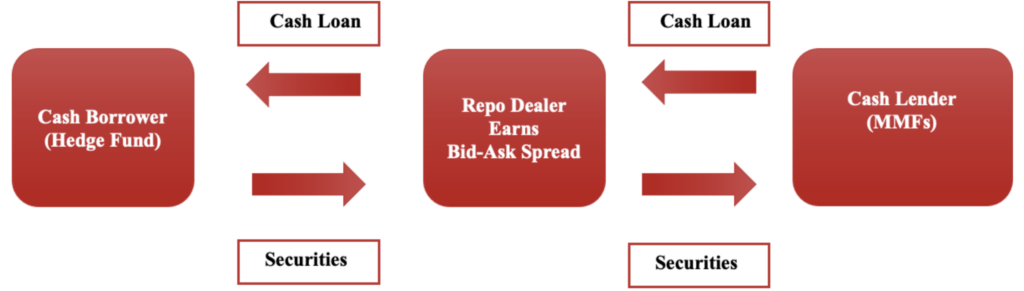
    Conversely, a repo is a loan secured by collateral in the form of securities. One side lends money, and the other side lends (or reverses out) securities. Perhaps counterintuitively, this loan effectively mirrors the structure of the IRS through the exchange between a floating and fixed-rate entity. The swap’s fixed-rate payer is comparable to the repo’s cash-rich lender (such as a money market fund or MMF), and its floating-rate payer replicates the cash-borrowing agent (such as a hedge fund). This parallel is exhibited in the two figures below:

    Figure 1: Financial Flows of a Swap
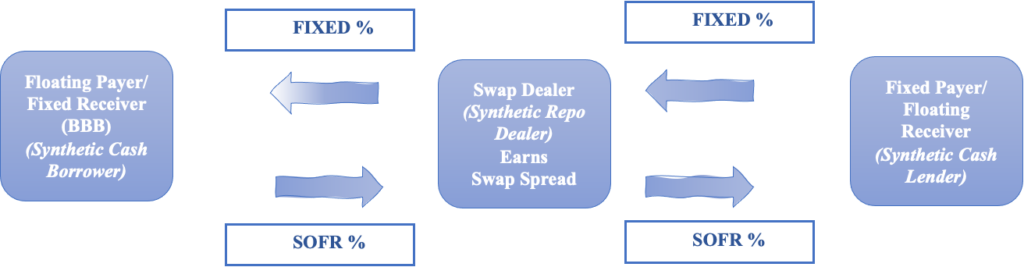
    Figure 2: Financial Flows of a Repo
    In this way swaps can enable the lending of excess fixed-income securities. If a triple-A-rated corporation enters into a swap contract with a triple-B-rated corporation, the former can trade its greater access to fixed-income securities for the latter’s better rates in the cash market. 

    Crucially, the swap’s replication portfolio (cash loans + coupon bonds) generates cash flows similar to those of a holding repo. Investors swap fixed-income securities for cash in an overnight or term (i.e., three-month) repo. Furthermore, like the sequential exchanges in a swap, repo contracts usually roll over for some time. Analytically, individual swap settlements can thus be interpreted and understood as synthetic repos. 

    The beauty of a synthetic repo analogy is that it clearly shows the funding utility of swaps. The two parties, intermediated by a swap dealer, may use swaps to lend their surplus balances. In the case of the fixed-payer, this means that the party, similar to a typical hedge fund in the repo market, has “too many” bonds in hand, and relatively speaking, fewer cash reserves.

    Why are swaps substituting repos?

    Repo markets are one of the largest sources of funding and risk transformation in the U.S. financial system. But despite their size, repo rates have proven to be increasingly unpredictable and subject to extreme intraday spikes. A notable example occurred on September 17, 2019, when the intraday repo rate rose thirty times the same spread the preceding week.

    This sudden spike was in part the result of short-term disruptions, including the settlement of Treasury debt issuances on September 16. But it also reflected structural changes that have decreased the flexibility of repo markets to offer attractive funding solutions. One of the major factors for this was the modification of the business models of large banks in the aftermath of 2008. Since they were obligated to hold higher levels of reserves and liquidity due to regulatory programs such as the Liquidity Coverage Ratio (LCR), banks have shifted their priorities from external to internal lending, in turn making them less flexible in their offerings of money market loans, including repo lending. 

    In the repo market, banks prefer to hold reserves instead of Treasuries to satisfy their High Quality Liquid Asset (HQLA) requirements. In response, repo market makers have shifted their priority from external to internal lending. These banks increase their flexibility in sourcing funds internally, becoming less flexible in repo lending as they stop obtaining cash from other parts of the firm.

    Internal frictions that curbed banks’ desire to offer attractive money market loans caused the spillovers from the repo market to the Foreign Exchange (FX) swaps market. Some spillover between these markets naturally resulted from foreign banks choosing to source U.S. dollars in FX swaps instead of repo. But the FX swaps market is heavily intermediated by the same banks active in repo. These banks increased lending in FX Swaps relative to repo despite a smaller rate increase, implying that frictions in banks’ ability to optimally reallocate funds in the wholesale money market led to these adjustments. Like the FX swap market, the interest rate swap market is another synthetic funding market that accommodates spillovers and investors from the repo market.

    Beyond mimicking repos, then, swaps also have several advantages over them. Most importantly, their engineering opens diverse opportunities to shift funds across the financial system. A company that has decided to borrow at short-term floating rates can either issue short-term debt, like commercial paper or issue long-term floating-rate debt. While both options offer the desired interest rate exposure, commercial paper comes with the risk of limited access and liquidity issues. Long-term floating-rate debt solves the liquidity issue, but the market is relatively small and illiquid. 

    A solution for these corporations is to issue fixed-rate debt and then receive fixed and pay floating in a swap. The net effect of the fixed debt and the swap is floating-rate funding. It’s far more appealing to issue fixed-rate debt and then receive fixed and pay floating in a swap—fixed debt combined with the swap effectively gives floating-rate funding. In addition, these transactions also avoid noting liability on company balance sheets, and give companies access to narrower bid-ask spreads, since the width of the dealers’ bid-ask spread in the swap is inherently constrained. Swaps offer a more flexible way to shift funds across the financial system.

    Regulatory challenges

    Swaps can be reconstructed indirectly (or synthetically) by holding two instruments: a floating-rate loan (such as a short-term bank loan) and a fixed-income security (such as a coupon bond). Importantly, these two instruments are explicitly involved in constructing the repo as well. In other words, individual swap settlements can be thought of as synthetic repos.

    This insight—that swaps’ cash flow replicates repos—provides a valuable shortcut to swap market structure and broader financial stability. Importantly, the market’s reliance on swaps for providing funding makes the Fed’s crisis-fighting task more complex. In a wholesale money market, the funding provision is relatively straightforward. In the repo, for instance, funds move from the cash-rich (such as MMFs) balance sheet to cash-deficit (such as hedge funds) institutions. The intermediation happens via the balance sheet of a repo dealer. In this setting, during financial distress, central banks inject cash into the system either by becoming the dealer of last resort (and trade directly with the dealers) or by becoming the lender of last resort (and lend to the so-called cash-rich players.)

    However, a swap-centric funding market structure is considerably more complex and less transparent. Notably, it is entirely off-balance sheets. The role of players and the direction of funding are also blurred within this marketplace—unlike in the money market, where access to cash determines who the lender is, in swap-centric financing, the lender is determined based on her “comparative advantage” in the capital and money markets. Synthetic lending happens by those with comparatively better access to the floating-rate market. The problem is that these institutions, by definition, are less credit-worthy and have lower credit ratings than their counterparts. In other words, the lenders of synthetic funding by construction are the low-quality firms with higher credit risks.

    Synthetic funding also adds additional layers to funding provision. Money markets are a direct source of funding, but they may not always offer reasonable rates. On the other hand, synthetic funding can provide more flexible solutions, such as better rates or the conversion of fixed to floating rates, and vice versa. This flexibility is crucial for investors, especially when borrowing against future income becomes difficult due to unattractive funding liquidity rates or other factors. In such cases, the money market can provide imperfect solutions. However, combining money market funding with swaps can make the rates and other attributes, such as fixed vs. floating of the fundings, more appealing and better aligned with the future cash inflow stream of borrowers. The repo-swap combo is an ideal funding solution for investors in such situations.

    The substitution of the IRS for repos represents a new market structure, which involves more complex funding and higher reliance on risky firms to provide affordable liquidity. It can, therefore, create important practical and political obstacles for the Fed during a period of funding squeeze—it is unclear whether the Fed’s established role as lender or/and dealer of last resort is enough to backstop such a complex and opaque funding system. The present gap in policymakers’ understanding of these developments can lead to binding regulatory consequences that impair funding conditions or make them unequipped to fight the next funding crisis.
  2. The Dollarization Threat

    Comments Off on The Dollarization Threat

    The results of Argentina’s first round elections on October 22 again defied expectations. Conservative former security minister and election favorite Patricia Bullrich came in third place, knocking her out of the running for the presidency, which will be decided on November 19 at a runoff election between the current Peronist finance minister Sergio Massa and the far-right economist Javier Milei. Having won 36.6 percent of the vote—compared to Milei’s 29.9 percent—Massa remains the frontrunner, but it remains unclear whether Bullrich’s supporters will side with the Peronist figurehead of the crisis-ridden economy or the far-right outsider next month. 

    To some extent, questions of democracy are at stake; Milei has said explicitly that Argentina’s problems can be traced back to 1916 when a new law allowing universal male suffrage led to the first popular government in the country’s history. Milei’s most publicized economic proposals—dollarization, the abolition of the central bank, and the end of trade with China—would deliver painful repercussions. But Argentina’s difficulties date far back, with the spectacular crisis of 2001-2 only as the most recent case. The question is whether the country can cope with another such crisis, after suffering from political instability and economic stagnation for more than fifty years.

    The backdrop of the current political crisis is Argentina’s dire economic situation—the country is on the verge of another external crisis. The central bank has run out of foreign reserves, and the only reason a default will be avoided, at least this year, is that there are no significant outstanding outlays other than to the International Monetary Fund (IMF). The lack of dollars means that the economy cannot import essential goods. A recession is very likely this year, compounding almost a decade of stagnation. The inability to manage the exchange rate—which has tumbled against the dollar—means that the price of imported goods continues increase. This in turn stimulates inflation, which is now at a rate of more than 120 percent. The scarcity of dollars has detrimental effects, too, even if a full-fledged hyperinflation crisis can be avoided before the end of the year, when a new government will be sworn in. 

    The fears now are of a complete collapse of the political institutions and the end of the democratic experiment that started forty years ago with the fall of the last dictatorship in 1983. A self-described “anticasta”—an outsider from what he sees as the nation’s “political caste”—Milei has crowned himself the leader of a rising authoritarian right. He promises to break the pattern of stagnation and inflation that has afflicted both the center-left and -right over the past two decades, but the proposed solutions threaten even greater turmoil.

    State of crisis

    It is important to note that the Argentine crisis has had a long gestation; responsibility for the problems lies beyond the current government of Alberto Fernández. The Argentine economy recovered swiftly after the 2002 default. Néstor Kirchner was elected in 2003, at the beginning of a period that was globally favorable to developing countries, with low interest rates in the United States following the dot-com bubble and high growth rates in China, which had just entered the World Trade Organization (WTO), leading to higher prices of commodities, including soybeans, Argentina’s main export. Kirchner renegotiated the external debt with foreign creditors and reduced debt in foreign currency by half while also increasing exports, helping to service the foreign debt.1 See De Lucchi, J. M. and Vernengo, M. (2023), “The new foreign debt trap and its long run consequences: the persistence of Monetarism as a social doctrine in Argentina,” in F. Ferrari Filho and L. F. de Paula (eds.), (<)em(>)Central Banks and Monetary Regimes in Emerging Countries: Theoretical and Empirical Analysis of Latin America(<)/em(>), Cheltenham: Edward Elgar.

    By 2010, when Kirchner passed away, Argentina had paid back its debt with the IMF. Economic prospects seemed relatively bright. Kirchner’s wife, Cristina Fernández de Kirchner, had been elected in 2007, and was easily reelected in 2011. The government had imposed higher taxes on exports, and though this had angered landowners and soybean producers, nothing indicated that a crisis was brewing, even in the context of the housing-bubble collapse in the US and the European debt crisis of 2010. It was at this time, however, that the external problems began to intensify; while many countries in the periphery accumulated significant amounts of dollars, the Argentine central bank maintained relatively low interest rates and failed to beef up its international reserves.

    The path taken was to maintain relatively low interest rates, seen by many within Kirchnerist progressive circles as essential for credit expansion and growth, while at the same time promoting the depreciation of the nominal exchange rate to stimulate exports. In reality, however, low interest rates drained current-account surpluses, which in turn meant reduced government spending in an effort to control imports, which ultimately cramped growth. At the same time, the depreciation of the currency and the resulting higher prices on imported goods, combined with the wage increases demanded by trade unions, led to higher inflation.2For some, the main flaws of Kirchnerism were the relative fiscal laxity, high inflation (resulting from expansionary macroeconomic policies,) and the absence of a more concrete industrial policy strategy. For example, Kulfas, M. (2016), (<)em(>)Los Tres Kirchnerismos: Una Historía de la Economía Argentina, 2003-2015(<)/em(>), Buenos Aires: Siglo XXI. For an alternative view that emphasizes the low rates of interest to accumulate reserves, and the absence of a more vigorous fiscal expansion to promote growth see Vernengo, M. (2019), “Una Salida Brasileña,” Página/12, 10 de octubre. With growth rates low and inflation surging, Mauricio Macri came to power in 2015, renewing the neoliberal project after twelve years of Peronist government.

    Macri promised to stabilize the economy. He appointed Federico Sturzenegger—an economist who had worked with Domingo Cavallo before the 2002 crisis—as president of the central bank and promoted the bank’s independence as an inflation-fighting institution that could bring down prices. Nonetheless, inflation accelerated and hit close to 50 percent by the end of his tenure in 2019. Elsewhere, Macri removed controls on the purchase of foreign currency, which had been introduced in 2011. The government paid the debt with the so-called Vulture Funds, which allowed it to borrow significant amounts of dollars abroad. However, domestic interest rates remained low, for the most part, and the central bank did not accumulate foreign reserves. By 2018, Argentina had more than doubled its foreign debt in dollars, and the central bank lacked the reserves required to face the short term needs of the country, forcing Macri to go to the IMF to obtain the largest loan in the history of the institution.

    Argentina’s particularly low interest rate means that the country’s main economic actors prefer to hold dollars rather than pesos.3For a discussion of the causes of informal dollarization in Argentina see Amico, F., Serrano, F. and Vernengo, M. (2022), “Cómo evitar el bimonetarismo y el monetarismo,” (<)em(>)Le Monde Diplomatique(<)/em(>) (Cono Sur), octubre. While the Kirchners wanted low interest rates to stimulate the economy, the Macri administration initially maintained low rates to allow some inflation acceleration to reduce real wages.4For an explanation that this should have been expected after Macri’s election see Vernengo, M. (2016), “Neoliberalism Resurgent in Argentina: What to Expect after Macri’s Victory in Argentina,” (<)em(>)Dollars & Sense(<)/em(>), January/February. In other words, the inability to accumulate dollars, for different reasons, has plagued both left and right of center governments, and has fueled the political pendulum in which Peronists and anti-Peronists alternate in power. 

    The run-off

    For the past four years, Kirchnerists in coalition with more centrist groups within Peronism have held power amid this economic instability. Given widespread discontent in the run up to the election, many expected that a center-right candidate, probably from the Macri coalition, would win. The surprise has been, first, Milei’s victory in the primaries, and then his passing to the second round last Sunday.

    Milei is often described as a representative of the region’s new authoritarian right, comparable to Jair Bolsonaro in Brazil or José Antonio Kast in Chile. It is clear that Milei’s primaries’ victory was the product of both popular anger and exhaustion with the inability of the traditional political parties to deal with the economic crisis. However, it is important to note that Milei is not a complete outsider, and neither is he a completely new phenomenon in Argentine politics.

    While Milei has almost no political experience, he has links to the most prominent economic corporations in the country and until recently worked for one of the main media groups. These connections opened many doors, providing him the media exposure that helped catapult his campaign. The team that he announced, should he be successful in the second-round election on November 19, includes experienced figures in previous neoliberal Argentinian projects, from the National Reorganization Process to the Menem and Macri administrations. In that sense, a Milei government would constitute the fourth coming of the neoliberal order in Argentina. The policies would likely be very similar to neoliberal predecessors, pushing austerity, liberalization, deregulation, and privatization—a difficult situation, given the destructive power of these policies, but hardly something new.

    Milei’s biggest threat has been his pledge to formally dollarize the Argentine economy. The consequences could be dire. There is overwhelming evidence that dollarization leads to slower growth, largely because it reduces the space for fiscal policy. In a dollarized economy, the interest rate is set by a foreign authority unconcerned with the domestic economy and its needs. Very often, developing countries are forced to drastically reduce spending, more often than not cutting social benefits, in order to reduce income and the imports associated with it. Low growth becomes instrumental in dealing with the external constraints. The case of Greece, which formally adopted the euro in 2002, is very illustrative. Greek incomes grew significantly after the entry in the euro, as capital inflows allowed an expansion that led to higher wages domestically. However, the European debt crisis led GDP to collapse; a decade later, it remains at 23 percent below its peak. The fall in GDP, high levels of unemployment, and lower real wages are instrumental in promoting external adjustment.

    It is true that dollarization tends to lead to lower inflation, but there are less drastic alternatives. An exchange rate anchor is often used to stabilize the economy and could be achieved if the central bank accumulates enough reserves while still propping up the peso, making it profitable for people to use the domestic currency. This option could be available to Massa, but the uncertainty hinges on whether the fear of a Milei presidency, with its grim prescriptions, outweighs the popular anger against the “political caste.”

  3. A Second Twenty Years’ Crisis?

    Comments Off on A Second Twenty Years’ Crisis?

    E.H. Carr’s The Twenty Years’ Crisis (1939), has a well-deserved reputation as a classic text that helped launch the academic discipline of International Relations (IR). Not only did Carr identify and dissect what would emerge as the two leading schools of thought in IR—utopianism and realism—he also applied a keen eye to the tumultuous decades after the Great War, when efforts to re-establish a functioning international political system foundered on a fundamental disruption to its most important operating principles. Carr framed these in terms of the relationship between power and morality, arguing that the latter had ultimately to accommodate itself to the changing dynamics of the former. Subsequent IR scholarship has mostly located Carr in the realist tradition of the discipline, concerned primarily with the balance of power and pursuit of national interest.1There are of course efforts to cast Carr’s contributions in a wider, more critical vein. See for example Michael Carr, ed., (<)em(>)E.H. Carr: a critical appraisal(<)/em(>) (Basingstoke: Palgrave, 2000) and Seán Molloy, “Dialectics and Transformation: Exploring the International Theory of E.H. Car,” (<)em(>)International Journal of Politics, Culture and Society(<)/em(>), Vol. 17, no. 2 (2003): 279–306.

    In what follows, however, I present him as part of a small group of mid-twentieth century intellectuals who tried to understand not so much the political irruptions of their time, but rather deeper disruptions within the world’s political economy. The Twenty Years’ Crisis certainly highlights how the balance of power within the international political system became dysfunctional during the 1920s and 1930s. But Carr did not confine his analysis to the diplomatic maneuvering of states, whether among themselves or at the League of Nations in Geneva. Instead, he drew on a broader tradition of political economy to place such maneuvering into the context of a fundamental disequilibrium in the international economy. It was not simply morality that had to accommodate itself to power during the interwar period; politics were also being recast to take account of new forms of international economic organization. Power, morality, politics, and economics were all in flux during the twenty years’ crisis. Carr reached for a political economy reading of this period across a number of publications before, during, and just after World War II.2For a fuller treatment of Carr’s relationship to political economy, see Randall Germain, “E.H. Carr and IPE: an essay in retrieval”, (<)em(>)International Studies Quarterly(<)/em(>), Vol. 63, no. 4 (2019): 952-962. I extend themes first set out by Robert Cox, “Social Forces, States and World Order: beyond international relations theory”, (<)em(>)MIllennium(<)/em(>), Vol. 10, no.2 (1981): 126-155.

    Carr had fellow travelers in his effort to provide a foundational analysis of the twenty years’ crisis. Key among them were Karl Polanyi and David Mitrany, who like him offer a broad explanation of the wholesale re-organization and re-scaling of the international political economy between about 1890 and World War II. Polanyi of course is best known for The Great Transformation (1944), which was published only a few short years after The Twenty Years’ Crisis (and which lauded its analysis of the balance of power). Mitrany, a pioneering scholar of what we now call global governance, published A Working Peace System (1943), and was like Carr a prolific contributor to debates on international politics throughout this period. 3 Karl Polanyi, (<)em(>)The Great Transformation: the political and economic origins of our (<)/em(>)time (Boston: Beacon Press, 1957/1944); David Mitrany, (<)em(>)A Working Peace System(<)/em(>) (London: Royal Institute of International Affairs, 1943). I have explored the connections between Carr, Polanyi and Mitrany in Randall Germain, “Nearly Modern IPE? Insights from IPE at mid-century,” (<)em(>)Review of International Studies(<)/em(>), Vol. 47, no. 4 (2021), pp. 528-548.

    Together, these scholars offer acute insights about the future prospects for world order in a period of tumultuous change, when established norms, social conventions, political relations, and economic dynamics were all facing upheaval. Using some of their ideas to reflect on the parallels between the first twenty years’ crisis and today can offer productive pointers about the future.

    The key insight we can take from the work of Carr and his compatriots is that the near term future of world order continues to rest primarily on how the rich world organizes its political economy. This means that solutions to the so-called crisis in world order need to come first and foremost from the global North rather than its purported “challengers” in the global South.4American scholars have been consumed by the question of American decline and world order for quite some time. Long-time contributors to this debate include John J. Mearsheimer, “Bound to Fail”, (<)em(>)International Security(<)/em(>), Vol. 43, no. 4 (2019): 7050; and John G. Ikenberry, “Why American Power Endures: the US-led international order isn’t in decline”, (<)em(>)Foreign Affairs(<)/em(>), Vol. 101, no.6 (2022): 56-73. It also suggests the future is perhaps a bit more open-ended than often portrayed. The past may be a foreign country, as the famous saying goes, but it is not yet entirely unrecognizable.

    To have and have not

    One of the central insights of The Twenty Years’ Crisis is that the distinction between “have” and “have not” states was a critical problem for the international system. Carr not only recognized how far the prevailing distribution of power had changed; he also called attention to the arbitrary ideational basis of world order, what he identified as the “harmony of interests” doctrine. The twenty years’ crisis, then, arose from the erosion of the dominant position of “have” states, who were unwilling to relinquish or renegotiate any aspect of their long-established privilege.

    The twenty years’ crisis reflected the untethering of long held assumptions about how economic production and exchange relations around the globe ought to work. In a part of his book that receives little attention, Carr addresses how the political economies of the Great Powers (which were in his view the principal belligerents of the Great War) had changed so extensively in their internal relations over the preceding half century that the operational principles of laissez-faire liberalism no longer applied. In other publications he expounded on the drivers of these changes, which included the political consolidation of an organized labor movement, the advent of mass democracy, and the extension of social security to a broader cross section of societies throughout the rich world. 

    Polanyi and Mitrany agreed entirely with Carr on these points, adding in their own work that these developments pushed capitalist societies towards a more functional organization. The critical point is precisely that developments within the Great Powers, arising from the remorseless logic of the terms of engagement between the needs of large business organizations, workers, and governments, had altered the operational dynamics of their economies. The form of the challenge may have appeared as a struggle between “have” and “have not” states, but the source of this challenge was the growing tensions in the internal organization of all Great Powers. 

    Today no one disputes that the redistribution of economic and political capabilities from the global North to the global South, and especially to China, has generated significant geopolitical tensions. Together with Russia’s invasion of Ukraine, the question of how to manage this redistribution between “have” and “have not” states now constitutes one of the most pressing problems for world politics. But a close reading of Carr and his contemporaries suggests that our geopolitical inflection point is not simply a matter of “have not” states challenging what is often described as the rules-based liberal international order. It is more than a moral play about the clash between liberal and illiberal values or the insatiable ambitions of autocrats. It is also a question of how inequality and poverty are playing out on a world-scale, where the “have” and “have not” division is as much a problem for the rich world as it is for the global South.

    Indeed, given the continuing disparity in the global distribution of economic and political capacity—where a mere handful of states still produce the bulk of the world’s economic output—it is the condition of the “have nots” within the global North that arguably poses more of a threat to world order than the “have not” states in the global South, including China.5In 2021, of the five largest economies in the world, four would be classified as global North (USA, Japan, Germany and the UK), and they generated over 37 percent of total global output. Even if we only consider manufacturing capacity, in 2015 four of five leading manufacturing economies (USA, Japan, Germany and Korea) generated almost 40 percent of the world’s manufacturing output, versus 20 percent from China (although it is the world’s top manufacturing economy). The twenty biggest economies in the world account for just over 80 percent of global GDP, but 52 percent of this comes from global North countries while only 29 percent is generated in the global South (and over half of this comes from China and India alone). More broadly, aside from a handful of global South economies, it is the economies of the global North that have high trade/GDP ratios. The main take-away here is that when considered in terms of cross-border (ie, international) economic activity, global North countries continue to generate a disproportionate share of the world’s economic activity. I am measuring GDP data in terms of nominal USD rather than PPP (purchasing power parity), because cross-border purchases are paid for in nominal currency units rather than PPP currency units. These data are taken from the Statista database, but are widely available. For global manufacturing data see Darrell West and Christian Lansang, “Global Manufacturing Scorecard: how the US compares to 18 other nations,” (<)em(>)Brookings Institution Research (<)/em(>)(accessed on September 8(<)sup(>)th(<)/sup(>) 2023 at: https://www.brookings.edu/articles/global-manufacturing-scorecard-how-the-us-compares-to-18-other-nations/). Taking a cue from Carr, it is more helpful to consider the “have” versus “have not” problem as a distributional issue that goes beyond the confines of inter-state relations, involving classes and people on a world scale. 

    Seen from this angle, the central argument made by Carr, Polanyi, and Mitrany is that the twenty years’ crisis was the culmination of a deep transformation in the industrial organization of the world that re-scaled its productive capacity; brought forth an organized labor movement which was able, through determined collective action, to extract a greater share of the economic product from capitalists; and witnessed a reinvigoration of democracy that pushed rich states to extend significant health, education, and welfare benefits to citizens. Polanyi tracked the social aspects of this transformation by pointing to the multifarious ways in which civil society worked to protect itself from the consequences of industrialization, a process he called the “double movement.”

    Mitrany tracked its political dimension through the growth of the administrative capacity of institutions, both national and global. By calling attention to the benefits of organizing institutions according to functional rather constitutive requirements (such as a strict respect for sovereign jurisdiction), he helped to advance an understanding of modern democratic accountability in terms of the delivery of services to citizens regardless of their jurisdictional residence. Mitrany was in this sense an early proponent for a global dimension to citizenship, although he did not use this language. 

    Carr tracked the intersection of social and political changes in relation to the inter-state system. All were aware of how these changes affected the global South, but they also recognized that these developments had their most significant causes (and impactful effects) in the rich world, which needed to adjust the most to meet the challenges of the great transformation. One hundred years on from the first twenty years’ crisis, our geopolitical inflection now points to the need for a further reorganization of domestic political economies: the “haves” need to give at home as well as abroad.

    The new economic whip

    All three mid-twentieth century scholars recognized the central importance of what Carr called, in a prescient set of lectures first delivered on the BBC in 1951, the “economic whip.”6E.H. Carr, (<)em(>)The New Society(<)/em(>) (Boston: Beacon Press, 1951/1957), pp 48-49. This term signified the incentivization to work, which since the advent of the Poor Laws in Elizabethan England had become a central pillar of the new capitalist economy. Balancing the need for an incentivized labor force against the social and moral consequences of abject poverty—a previously unknown condition—generated Polanyi’s “double movement.” This was a broad range of popular mobilizations whose actions ultimately blunted the economic whip. By the time Carr delivered his lectures, he believed the economic whip to have been discarded as a feature of modern life. And for much of the post-1945 period this was the consensus in the rich world: our three observers lived out the final years of their lives secure in the belief that living standards would improve, while poverty and inequality levels fell, however these were measured.

    But the threat of the economic whip has sharpened over the past several decades, although its return has not yet taken us back to the circumstances of the first twenty years’ crisis. Indeed, by one important measure, the world is significantly less unequal than that of the interwar period: economic growth in the global South over the past several decades, led by stunning growth rates across much of Asia, has reduced national income differentials between the global North and global South.7 Branko Milanović has tracked global inequality measurements for decades, and argues that global inequality when measured between nations is at its lowest ebb in over a century. Most recently see “The Great Convergence: global inequality and its discontents,” (<)em(>)Foreign Affairs(<)/em(>), Vol. 102, no. 4 (2023): 78-91.

    At the same time, this has been countered by the alarming rise of inequality within countries, across the board. With few exceptions, countries with the fastest economic growth rates around the world have also become more unequal.8 Inequality is typically measured in terms of the distribution of household income through what is known as the Gini-coefficient. Because it is measured slightly differently in most countries, global rankings must be taken with caution. However, most databases show a similar trend, namely that inequality within both global North and global South countries has increased in recent decades. In the UK, for example, there has been a step-change increase in inequality, while in many important global South countries such as China, India, and South Africa (but not Brazil), inequality has increased but not dramatically. I have used the World Bank’s Gini Index here, but there are many databases which confirm this trend. This is how the economic whip has returned, by widening the gulf in standards of living and generational life chances for growing swathes of populations within national economies, even as these economies and their societies grow richer.

    In the rich world, these developments have led to upsurges in populism and nativism along with governmental efforts to recalibrate the openness of cross border trade and investment, which have been the lifeblood of economic growth for much of the global South. Carr, Polanyi, and Mitrany would not be surprised at this development, for it reprises in certain respects the response to the first twenty years’ crisis from within the rich world. Fascism and Japanese militarism, after all, arose within the most “advanced” societies of their time: although they were “have not” states in relation to Britain, France, and the United States, they would be seen as part of the rich world of their day. It is important to recall that in the 1930s fascist movements were active in nearly every European and North American country. It was not a foreign implant. The principal challenge to world order during the first twenty years’ crisis came from within the rich world.

    Solutions?

    Looking at the rich world as the source of the twenty years’ crisis one hundred years on brings some crucial insights, although no easy solutions. First, the rich world needs to better attend to the return of the economic whip. While it may be true that the first twenty years’ crisis was not resolved until war hauled the rich world out of the Great Depression, it is equally true that high and sustained public investments in welfare, pensions, education, and healthcare after the war spurred decades of strong economic growth that removed the specter of the economic whip from these societies. These provisions have been hollowed out over the past three decades, resulting in today’s growing inequality, marginalized populations, and societies whose future prospects appear to have diminished in generational terms. 

    The good news is that we know how to reverse these trends, although it will cost money. Progressive taxation and redistribution will meet some of these costs, but economic growth will also have to make a contribution. This requires a growing labor force and higher wages, which in turn require productivity increases. The economic whip will only be retired once it pays to join the labor force; for that to happen, many of the expectations about what states provide to their citizens need to be upgraded. Higher immigration levels from the global South to the global North will need to be part of this solution as well.

    The second insight from our mid-twentieth century observers is that more attention needs to be paid to the state, especially to its broader role in securing economic growth. Historically, the economic whip has been reduced by supporting growth alongside efforts to enable the broadest participation of citizens in the economy. Both of these propositions require strong and purposeful state intervention.

    One of the iron laws of politics over the past century has been the rise of state responsibility for both economic growth and the health and well-being of its citizens. David Mitrany was concerned to trace the effects of this trend on international politics in the 1930s and 1940s; he concluded that the future of international cooperation was brightest where institutions could be fashioned on a functional basis. His ideas have lost some of their traction over the intervening decades, partly because of the Cold War but also because international cooperation has proven to be very difficult to depoliticize to the extent required by Mitrany’s vision of functionalism. But this does not erase his central insight (shared by Carr and Polanyi) that as people’s expectations about their standard of living rise (or come under threat), they look to states to secure the basic conditions of their prosperity.

    None of our protagonists believed in state action without democratic oversight; they were proponents of modernizing political institutions through democratic means, which for them meant paying attention to mass political participation. Their third insight, therefore, is to work harder to provide citizens, especially those who are mobilized, with better avenues of engagement with democratic institutions. This extends to understanding why populist movements now command a significant political allegiance across the rich world, and considering how to renovate existing political institutions to better channel this activity.

    During the first twenty years’ crisis, fascist political movements challenged democratic institutions across much of the rich world, but it was defeated politically where liberals took on board the key concerns of marginalized and vulnerable populations, and responded in ways to meet them. Fascism took root in the rich world but it could not compete with democratic practices when the state embraced the extension of what Carr, Mitrany, and others called the “service state.” Today the so-called “new right” is everywhere challenging how states engage with their citizens, and whatever the response, doing less for citizens (or worse, abandoning them) is neither a viable nor a responsible option.

    Finally, the first twenty years’ crisis was not resolved by the rich world walling itself off from the rest of the globe. This was not really possible anyway, given the extensive colonial possessions of leading European states along with America and Japan. But a critical element of the first twenty years’ crisis was an international economy in disarray after being torn apart during World War I. The failure to re-establish a functioning global economy in the 1920s and 1930s left an indelible mark on those tasked with winning the next peace. A world of national capitalisms was one option to pursue, of course, but as Fred Block and others have convincingly detailed, this pathway involved too many concessions from capitalists to workers to be attractive, and a world of global capital emerged instead.9 Fred Block, (<)em(>)The Origins of International Economic Disorder(<)/em(>) (Oakland: University of California Press, 1977). See also the magisterial account by Leo Panitch and Sam Gindin, (<)em(>)The Making of Global Capitalism: the Political Economy of American Empire(<)/em(>) (London: Verso, 2012). It is this world that has enabled the global South to grow economically over the past century, even as much of the global North has also prospered. Cutting off or severely reducing the flow of resources between the global North and global South, much less restricting cross-border trade and investment, is probably one of the worst ways that the rich world could respond to the current geopolitical inflection point.

    At the same time, Carr, Polanyi, and Mitrany all recognized that a functioning global economy could not rely on the principles of laissez faire for its organization. Political oversight and accountability were required, especially in a world of increasing state involvement in and responsibility for the health and well-being of citizens. This was a tough nut to crack for our observers, and their preferred solution to this problem—a combination of regional compacts together with select global institutions with clearly demarcated boundaries and remits—did not come to pass, not least because of the onset of the Cold War. Neither would their solutions work today. But one part of their insight bears repeating: if states in the rich world were to better redistribute their national incomes so as to strengthen welfare, health, and educational outcomes, which would in turn better support sustainable economic growth, they would ease the need for international organizations to manage or guide economic cooperation.

    The reason for this is that sustainable economic growth—based upon a more equal distribution of national incomes and life chances—would better accommodate itself to increased levels of international trade and investment, even if that were to generate imbalances between national economies for current account and investment payments. In this scenario, a rising tide could in fact lift all boats. But the initiative here has to come from the rich world, where state capacities are better positioned to address growing inequality. Reading the future starts with a cold hard look in the mirror, followed by the resolve to tackle problems at their source.

  4. Democratic Preconditions

    Comments Off on Democratic Preconditions

    Poland’s parliamentary elections last Sunday have led to a likely victory for Donald Tusk and his party, Koalicja Obywatelska (Civic Coalition). Although the ruling Prawo i Sprawiedliwość (Right and Justice, or PiS) Party received the largest share of the vote, 35.4 percent, granting them the first opportunity to try to form a government, they are likely unable to do so. An alliance with the far-right Confederation party, which won eighteen seats, would not be enough for a majority. Partnering with the centrist Trzecia Droga (Third Way), and the Nowa Lewica (New Left) alliance, Civic Coalition will be able to lay claim to 248 of the 460 seats in parliament, returning Tusk to the office of prime minister, a position he last held between 2007 and 2014. 

    Tusk’s victory isn’t the result of a decline in the Law and Justice vote; PiS supporters by and large remained loyal to Jarosław Kaczyński and his agenda. Rather, the decisive element was a surge in voter participation, which shot up to over 74 percent—an increase of more than 11 percent on Poland’s first free elections in 1989. The rise was especially marked among women and young people, many of whom voted for the Tusk’s Coalition. Despite having dominated the Polish government since 2015 and winning the largest share of the vote, PiS is, by many accounts, now expected to break into warring factions around potential heirs and claimants to Kaczyński’s legacy. Like its counterpart in Hungary, Viktor Orbán’s Fidesz party, it  has challenged the democratic norms that were accepted when Poland joined the European Union in 2003, suborning Polish media outlets and subjecting the judiciary to political pressure and appointment. 

    For the majority in Poland’s cities, the continued oppression of women, the seemingly endless reinforcing of legal restrictions on abortion, the picking of spurious arguments with partners in the European Union, and the incontinent clericalism that combine to remind Poland of social backwardness kept afloat by remittances from migrant workers, PiS has little to offer. “In a normal country,” as Poles like to say, such wells of youthful outrage would find natural expression in a party of the left. Not so in Poland, where Tusk’s Koalicja Obywatelska absorbed much of the vote under 35. While Nowa Lewica—a new alliance formed out of the old Left Democratic Alliance, or SLD)—dominated Polish governments in the 1990s, and then from 2001 to 2005, its fortunes quickly fell. In the 2011 election, it barely scraped in sufficient votes to get into parliament, and in 2017, it even lost its remaining members of the Lower House, the Sejm. Last week it received just 8.6 percent of the vote, 4 percent less than it scored in 2019.

    What accounts for this stunning decline of the Polish left, which has extended not only to the fortunes of party politics, but to the strength of its labor movement and its civil society institutions? The country’s experience under Communism is part of the story. After post-war reconstruction, Stalinist paranoia gripped the one-party state in the 1950s. A subsequent failure to raise living standards was followed by a foreign debt crisis, a brief period of military rule, food rationing, and austerity.

    The coming of free elections in 1989 was supposed to be a harbinger of change, but with the dissolution of the Polish United Workers’ Party (PZPR), its leaders coalesced into social- democratic parties. Fatally, those parties and later the SLD, embraced more than just democracy. In their desire to place themselves at the center of Poland’s new political consensus, the post-Communist left adopted the “shock therapy” that transformed Poland into a market economy.

    Shock therapy

    Poland’s transition to a market economy was master-minded by the minister of finance in the first post-Communist government, Leszek Balcerowicz. He was advised by the American economist Jeffrey Sachs who had been promoting abrupt market liberalization in Latin America on behalf of the International Monetary Fund, in programs known as the Washington Consensus. In Poland, Balcerowicz was persuaded that a shock of this kind would convince Poland’s foreign creditors that the government was serious about abandoning state control over the economy.1See Jerzy Osiatyński, “TINA and Alternative Economic Strategies for Polish Economic Transformation,” (<)em(>)Economic and Labour Relations Review(<)/em(>) 2020, Vol. 31 No. 2, pp. 249-261. But radical institutional change was not just a negotiating gambit over Poland’s foreign debt. Balcerowicz shared the conviction of most of the economic reformers of the time that markets and free enterprise are preconditions for democracy to function, preventing the emergence of a state with excessive power.

    Almost overnight he pushed through legislation to liberalize the economy, remove price controls, make the Polish currency convertible, and eliminate the fiscal deficit by substantially reducing government subsidies to state enterprises. To deal with inflation, the government introduced partial indexation of wages and incomes. Faced with the reduction in subsidies, state enterprises reduced production and raised their prices. Hyperinflation took hold and, along with it, mass unemployment. In the government, economists advised that even these high levels of inflation were necessary to bring down real wages, but also to eliminate the money balances built up during the last decade of Communist rule, as shortages of consumer goods left households with incomes but little on which to spend.

    The sharp fall in economic activity was more sustained than Balcerowicz and his advisers had planned. For the next two decades unemployment did not fall below 13 percent. The situation was especially bad during the 1990s, when public infrastructure rotted. The worst effects were felt in smaller towns and rural areas most dependent on state subsidies and state industrial policy. In the north and west of the country where state farms were concentrated, two generations of workers in rural isolation were socialized into idleness, with its symptoms of violence and alcoholism.

    In Gdynia, Szczecin and Gdańsk, home of the Solidarity trade union that had brought down Communist rule, the shipbuilding industry had been the pride of the Communist regime and the cornerstone of its industrial strategy. In the post-Communist era, the industry was so run down that it employed only a fraction of the mass labor force it once had. The automotive industries also fell into depression as consumers switched to buying foreign cars and trucks. The coal-mines of Silesia, heavily subsidized because they were the backbone of Poland’s export business, were gradually taken out of production. 

    Young people who left school during the transition were especially affected, as industrial enterprises stopped taking on new workers. For most of the decade after Balcerowicz’s reform, youth unemployment did not fall below 25 percent and in some smaller industrial towns and industrial centers, youth unemployment among school-leavers was as much as 50 percent. There was only one thing for those young people to do: emigrate. Over the course of the two decades following the deflationary shock, over two million Poles (one in ten of the workforce) emigrated. The demographic impact is still felt in the aging population that is now the core of PiS’ support.

    The economic depression was only effectively reversed with Poland’s entry into the European Union in 2004, at which point Poland became the largest recipient of EU assistance for economically depressed areas. Attracted by the subsidies, foreign companies started to take over Polish businesses to assemble products with cheap Polish labor. Cities were gussied up with EU regional aid, but the jobs in manufacturing never returned.

    One case in point is Poland’s Fabryka Samochodów Osobowych, Passenger Car Factory, which had produced the Polski Fiat so dear to middle-class Polish hearts from the 1970s onwards. In 1989, the company was taken over by Daewoo. After Daewoo went into liquidation in 2000, ownership passed to General Motors, and then to a Ukrainian company. The slimming effect of each transfer of ownership has reduced the factory to producing components for foreign assembly, again using a fraction of workers compared to its former days.

    During its years in government following the transition (1993–97, 2001–05), the SLD turned a blind eye to the depression of the Polish economy or, in its telling, took a long-term view of these economic difficulties. Fearful of scrutiny of its Communist origins, the party avoided any active government policy that might be seen to compromise adherence to the Stability and Growth Pact of the European Union. Even today the party considers its greatest achievements to be Poland’s membership of NATO and the EU. 

    By contrast, PiS emerged in the early years of this century with a strong narrative about the betrayal of Polish aspirations after Communism. In their first free elections in 1989, Polish people had voted for full employment and fair wages—not to lose their jobs and become impoverished. PiS identified the neoliberalism at the core of Balcerowicz’s policies and criticized the give-away of Polish jobs and enterprises that had come with privatization. The PiS economic program was simple: child benefits, higher pensions, and keeping ownership of Polish enterprises in Polish hands. If that meant holding onto state enterprises and extending the party’s control over Polish media to the point of excluding critical voices, then so much the better for embedding control of the state and society in the hands of patriots.

    The future of democracy

    It was not thanks to PiS that the decline of the Polish economy was reversed. That has been done by EU subsidies and foreign direct investment. Poland has in any case been excluded from the EU’s post-Covid green recovery facility thanks to the government’s flagrant violation of democratic norms. Nevertheless, in its embrace of social welfare and Big Government, PiS has made life very difficult for its opponents in the Sejm. The Koalicja Obywatelska, under Donald Tusk, has had to shelve its early criticism that raising pensions and paying mothers złoty 500 (US$114) per month for each child is fiscally imprudent. Welfare spending has poured money into the Polish regions depressed by the Balcerowicz reforms. The uplift that it has given to many poor households in the country is undeniable.

    The mainstream narrative that emerges about Poland is that democracy in that country has been subverted by PiS, a venal, authoritarian and intolerant conspiracy that is corrupting the institutions of the state, buying support from a docile electorate, and oppressing women, LGBTQ+ communities, and immigrants. This narrative, however, overlooks the consequences of Balcerowicz’s bungled dismantling of state controls over the economy, and the willingness of liberals and the left, when they held power, to satisfy their ambitions in Western capitals, rather than cleaning up the mess created in the transition from Communism. That created the social base from which nationalism grew into an oppressive celebration of social backwardness.

    This was not something new. Poland had experienced much the same in the inter-war period. In the 1930s, an earlier generation of political economists, including Oskar Lange and Michał Kalecki, recognized that, far from strengthening people’s resolve to create a better, more democratic world, the immiseration of the working class directs that resolve to intolerance, violence, xenophobia, and fascism.2 See Toporowski, J. (2023) “(<)em(>)Political Aspects of Full Employment(<)/em(>) in Retrospect,” (<)em(>)Contributions to Political Economy(<)/em(>) vol. 42, No. 1, July, pp. 226-241. This view is not confined to left-wing socialists. The Financial Times’ chief economic commentator Martin Wolf recently observed that “it is impossible to sustain a universal suffrage democracy with a market economy if the former does not appear open to the influence—and the latter does not serve the interests—of the people at large.” The corollary of such a necessity, he added, is “welfare for all citizens—that is, a commitment to economic opportunity and basic security for all.”3 Wolf, M. (2023) “In defence of democratic capitalism,” (<)em(>)Financial Times(<)/em(>) 20 January.

    Thirty years ago, the commitment to full employment, which had been agreed on in talks between the Solidarity trades union and the country’s Communist rulers in Gdańsk, was the first of the promises abandoned by post-Communist governments. In accepting mass unemployment, those governments removed the economic foundation for Poland’s democracy, for the precondition for democracy is not free markets, but full employment. 

  5. The Oil Revolution

    Comments Off on The Oil Revolution

    The abrupt quadrupling of the oil price in the final months of 1973 is widely held to have marshalled the end of “a golden age of world capitalism.” Eric Hobsbawm’s standard-setting interpretation defines 1973 as the turning point when the world “lost its bearings and slid into instability and crisis.”1Eric J. Hobsbawm, (<)em(>)Age of Extremes. The Short Twentieth Century(<)/em(>) (London: Abacus, 1994), 403. Though Hobsbawm’s assessment was overwhelmingly skewed towards the global North, the radical changes that occurred in the oil market that year were no doubt both of immediate and longer-term global significance.

    The events of 1973 precipitated the emergence of the “energy question,” never before positioned at the heart of public discourse. In 1974, most industrialized countries joined the Paris-based International Energy Agency (IEA) in order to coordinate their policies and react to excessive oil dependence. They created special national administrations to manage energy plans, such as the US Department of Energy, which was established in 1977. In 1981, the UN held a global Conference on New and Renewable Sources of Energy in Nairobi. The drive for greater “energy efficiency” led to improved standards for automobile engines and building insulation, while the scramble for “alternative energies” caused profound changes in the global energy mix, with the decline of oil and rise of coal, natural gas, and nuclear energy. Even “renewable” energies such as wind and solar entered the policy debate during this time.

    The origins of the shift, however, are still little understood. In the oil-importing West, the events of late 1973 are commonly referred to as the (first) “oil shock,” rooted in the pervasive myth that oil prices shot up because the Organization of the Petroleum Exporting Countries (OPEC) embargoed its oil shipments to the West in an attempt to support Egypt and Syria in their October war against Israel. In other versions, oil prices shot up because the Arab members of OPEC established an embargo on all countries that supported Israel. In these retellings, the quadrupling of oil prices is seen as an exogenous “shock” to industrialized countries, induced by an Arab-led act of sabotage. 

    Oil-exporting countries, Arab and non-Arab alike, refer to this moment as the “oil revolution.” Contrary to the popular understanding of this moment, public declarations by OPEC ministers at the time—in addition to the now-available minutes of their confidential meetings—suggest that member states sought to boost their economic development (and to some extent, their citizen’s welfare) in the context of the global anti-colonial movement.

    OPEC did in fact raise the price of oil, but not as a result of the Yom Kippur War. Rather, the price hike was prompted by ambitious developmental projects, the devaluation of the US dollar, and the end of the gold-dollar standard. Member states sought to halt the perceived “overconsumption” of oil that would deplete their reserves “too rapidly.” The events of 1973 were not the result of a purely exogenous supply shock, but rather a response to the crisis of the post-war global economic order.

    The oil weapon

    Most accounts of the abrupt quadrupling of oil prices conflate OPEC’s price hike with the use of the “oil weapon” by a group of Arab governments in the context of the Arab-Israeli War. In late 1973, there in fact was an Arab “embargo” on the US and other countries linked to the war, and it did have some effect on oil prices. However, this policy was unrelated to the dramatic price increases which shook the world.

    Arab countries used oil as a “weapon” to resist Israeli expansion on three occasions before 1973. The first was in 1948, when Iraqi authorities shut off the pipeline carrying Iraqi oil to Haifa. The Trans-Arabian pipeline, which was meant to connect the newly developed Saudi oil fields to the Mediterranean through Jordan, Syria, and Lebanon, was also delayed, and the Arab League created its permanent Petroleum bureau in 1953. Three years later, the Egyptian government’s closure of the Suez Canal the Egyptian government’s closure of the Suez Canal during the second Arab-Israeli War instilled the fear of an impending oil supply shortage in Western Europe. Jean Monnet half-jokingly claimed that Egyptian President Gamal Abdel Nasser was the real “federator of Europe,” speeding up the creation of the European Economic Community (EEC) in 1957.

    In response to the Six Day War, Egypt blocked the Suez Canal for from 1967 to 1975. On the second day of the conflict, Arab oil ministers met in Baghdad and engaged in a tirade against the US, Great Britain, Israel, and the international oil companies that monopolized production in the Gulf. Their embargo, however, proved to be ineffective due to the spare capacity of non-Arab producers like the US, as well as the deployment of new super-tankers which could circumnavigate Africa. In late August 1967, the Arab League announced a “three no” policy: no peace, no recognition, and no negotiation with Israel. Nonetheless, its public statement displayed a softer view on oil production:   

    The summit conference has come to the conclusion that the oil pumping can be used as a positive weapon, since oil is an Arab resource which can be used to strengthen the economy of the Arab States…The conference has, therefore, decided to resume the pumping of oil.2Arab League, Khartoum Resolution, 1 September 1967, available at Avalon Project, (<)a href='https://avalon.law.yale.edu/20th_century/khartoum.asp'(>)https://avalon.law.yale.edu/20th_century/khartoum.asp(<)/a(>), cited 11 October 2023.

    After 1967, Saudi Oil minister Zaki Yamani led the effort to create a new entity—intended to be autonomous from the “non Arab” OPEC and resistant to the pressures of Anglo-American companies in Syria, Iraq, and Algeria. On January 8, 1968, the Organization of the Arab Petroleum Exporting Countries (OAPEC) was founded by the monarchies of Saudi Arabia, Kuwait, and Libya. Abu Dhabi, Qatar, and Bahrain were quickly selected for admission. According to a British diplomat, this is how Yamani explained the rationale for OAPEC:

    It was something new in the oil world: an organization dedicated to the proposition that oil affairs should be separated from politics and that the consuming countries, as well as producers, had legitimate interests. These he [Yamani] would define as a reasonable price and—above all—security of supplies. The hand of OAPEC, he went on, was stretched out in cooperation; and he hoped that the consumer countries, as well as the oil companies, would grasp it.3British Embassy, Kuwait, October 1, 1968, in: A.L.P. Burdett (ed.), (<)em(>)OPEC: Origins & Strategy 1947–1973, Vol.4: 1967–197(<)/em(>)1 (Cambridge: Cambridge Archives Editions, 2004).

    Despite voicing a desire to separate oil and politics, OAPEC unsheathed the oil weapon in 1973. With the 1969 revolution in Libya that brought Muammar Gaddafi to power and the 1971 nationalization of the oil industry in Algeria, the Arab world had radicalized, and Britain lost its grip “East of Suez.” In December 1972, the International Union of Arab Workers asked Arab governments to place an economic boycott on the US. In Cairo, the economic committee of the Arab League examined ways to use petroleum to force the US to modify its stance on the Arab-Israeli conflict. In 1973, the Kuwaiti National assembly approved a resolution asking Arab states to freeze oil production in case of a war against Israel, and by May 15 of that year, Iraq, Kuwait, Algeria, and Libya turned off the oil tap in protest of Israel’s Independence Day. During a meeting in Geneva later that year, top executives of Aramco—the daughter company of Chevron, Exxon, Texaco and Mobil, which operated the Saudi oil fields—listened as King Faisal threatened to withdraw their concession if the US government did not change its pro-Israeli stance. By this point, the market had become “tight,” and Arab producers believed they stood a better chance to make political use of their threats.

    On October 6, 1973, war broke out again during the holy festivity of Yom Kippur in Israel. A coordinated surprise attack on Israeli defenses allowed the Egyptian and Syrian armies to momentarily recover some of the territories in the Sinai and Golan that Israel had occupied during the Six Day War. The Arab public was galvanized, but in the hectic days that followed, the US government set up a massive airlift to resupply Israel’s armed forces. The Israeli Defense Forces withstood Arab advances and put up successful counteroffensives in both the North and the South. By October 15, Israeli tanks threatened Cairo and encircled Egypt’s Third Army on the Eastern Bank of the Suez Canal.

    On October 17, OAPEC members convened in Kuwait to announce a 5 percent production cut for the following month, to be complemented with further cuts every passing month until “the evacuation of Israel from the territories occupied during the 1967 war and the restoration of Palestinian rights.”4A useful source for official documents on the 1973 embargo: SIPRI, (<)em(>)Oil and Security(<)/em(>), (New York: Humanities Press, 1974).

    That same day, Abu Dhabi’s minister of petroleum, Mana Al-Otaiba, announced that his government would also institute a total embargo on oil shipments to the United States, arguing that “oil is not more valuable than Arab blood.” Saudi Arabia, along with the rest of OAPEC would follow suit a few days later, singling out the US for the Nixon Administration’s decision to ship $2.2 billion in aid to Israel. The embargo was eventually extended to the Netherlands, Portugal, Rhodesia, and South Africa, with the hopes of garnering support from the broader Third World anti-imperialist coalition.

    By late October 1973, however, a ceasefire led OAPEC’s position to shift. At a meeting in Kuwait City on November 4, OAPEC opened the way to fully resume supplies to “friendly countries” such as France. In March 1974, after a series of contentious OAPEC meetings in Vienna and Cairo, both the production cuts and the embargo on the US and the Netherlands were officially lifted. While OAPEC’s measures placed Palestine at the center of international politics, the production cuts and selective boycott had much more limited effects on the oil market. US economist Morris Adelman argued that:

    over the three months October through December, total lost output […] was less than the inventory buildup earlier in the year. Considering as well some additional output from other parts of the world, there was never any shortfall in supply.5[1] Adelman, M., (1995), (<)em(>)The Genie Out of the Bottle: World Oil Since 1970(<)/em(>) (Cambridge: MIT Press, 1995).

    According to most calculations, the volume of oil traded in world markets declined between 5 and 13 percent for the five months when the production cuts were in place.6See Vitalis, (<)em(>)Oilcraft(<)/em(>), chap. 3. The oil price hike of late 1973 was thus disproportionate to the production cuts, especially given the countermeasures taken by several importers to “save energy.” Of course, “high prices” outlasted the end of the production cuts by several years. This is where OPEC’s role becomes pertinent, in many ways that bear very little relationship to the Arab-Israeli conflict.

    The price revolution

    On October 16, 1973, the day before the OAPEC meeting, the representatives of Saudi Arabia, Kuwait, Abu Dhabi, Qatar, Iraq, and Iran also met Kuwait City as an OPEC sub-committee to announce their historic decision to raise, for the first time unilaterally, the posted price of crude oil by 70 percent, from $3 to 5.11 per barrel. In December, OPEC delegates decided to redouble once again the reference price to $11.65 per barrel. This meeting was held in Tehran—Iran was not involved in the Arab-Israeli conflict, had raised its production levels in 1973, and was a supplier of Israel. The resolution bore only an indirect relationship to the regional turbulence.

    The Saudi minister Zaki Yamani and his Algerian colleague Belaid Abdessalam repeatedly claimed that the OPEC price hike was unrelated to the war in the Middle East during their diplomatic tours of Western capitals. The minutes of the available OPEC conferences from late 1973 and early 1974 show that there were few mentions of the Arab-Israeli conflict at the meetings. As Anthony Sampson notes in The Seven Sisters: “the price-hike and the embargo […] proved a deadly combination to the West. But the coincidence, surprisingly enough, was accidental.”7Sampson, (<)em(>)The Seven Sisters(<)/em(>), Bantam, 1976, p. 252.

    Market conditions facilitated OPEC’s decision. By the early 1970s, industrialized countries realized that an “energy crisis” was in the making: demand was up in both the US, Japan and Western Europe, Texas was pumping at full speed for the first time since the 1930s, and US consumers were experiencing natural gas and gasoline shortages. Between 1970 and 1973, the Nixon administration put further strain on the international market by phasing out the mandatory oil import controls which had protected US domestic producers since 1959.8These import controls were in fact a key reason for the creation of OPEC. Acknowledging an inconvenient truth, Secretary of State William P. Rogers wrote to Nixon:

    Unless present trends are reversed, the United States by 1980 will be producing little more oil than it produces today while consumption will rise from 15.8 million barrels per day in 1971 to 24 million barrels per day in 1980. At that time we will be forced to import half our petroleum needs, largely from the Arab States, which contain at least two-thirds of the non-Communist world’s oil reserves.9(<)em(>)FRUS 1969–1976, vol. XXXVI, Energy Crisis, 1969–1974(<)/em(>), Doc. 116, Memorandum From Secretary of State Rogers to President Nixon, Petroleum Developments and the Impending Energy Crisis, Washington, March 10, 1972.

    Given such changing market composition, an oil price increase was virtually unavoidable. But OPEC’s actions were a crucial component. The coordinated effort by oil exporting countries— the “petrostates”—to increase their income from petroleum had been at the origin of the very creation of OPEC. The organization’s precursor was a gentleman’s agreement reached at the margins of the first Arab Petroleum Congress in Cairo in 1959. OPEC formally came into existence in Baghdad in September 1960. Its founding members were Venezuela, Saudi Arabia, Iraq, Iran, and Kuwait, with Pérez Alfonzo of Venezuela elected as its first chairman. At OPEC’s first recorded Ministerial Conference in 1961, he argued:

    It is not possible to ignore the relatively low price at which this exhaustible product is sold to the richer nations. Our peoples cannot let flow, at an accelerated rate, their only possibility to pass without delay from poverty to well being, from ignorance to culture, from instability and fear to security and confidence.10NYUAD Library, Archives and Special Collections (ASC), Giuliano Garavini Collection (GGC), MC-038, (<)em(>)Minutes of the Second Meeting of OPEC(<)/em(>), Caracas, January 15–21, 1961.

    For the remainder of the 1960s, an oversupplied international oil market remained dominated by consumers and by the international oil companies. Yet crucially OPEC countries managed to increase their share of revenues per barrel of oil through minor increases in tax rates and by forcing oil companies to accept posted prices that were higher than the market price. In the late 1960s, as global criticism of Western imperialism grew with the Vietnam war, and Arab public opinion began to challenge the Arab leaderships after their defeat in the Six Days War, the petrostates renewed their activism.

    In December 1968, OPEC was revitalized with a Declaratory Statement of Petroleum Policy that demanded the control of posted prices, the “relinquishment” by the western multinationals of those areas that had not been productively exploited, and direct participation in oil concessions. In 1969, the revolution in Libya and the Algerian decision to join OPEC strengthened the front of those exporters who wanted more than “participation” in the concessions—they sought nationalization. In February 1971, Algeria became the first OPEC country to take this momentous step, announcing state control of 51 percent of the Algerian oil industry, which had remained under the control of French companies after independence.

    Other OPEC states soon followed through full nationalization or majority participation (this includes Venezuela, which nationalized oil in 1975, even though Hugo Chavez is frequently credited for the decision). With nationalizations of the old mining “concessions” inherited from colonialism, OPEC governments placed themselves among Third Worldist governments hoping to assert control of their commodities. Algerian President Houari Boumedienne, for instance, invoked the need for a New International Economic Order before the UN General Assembly in 1974 and the Solemn Declaration of the first Summit of OPEC Heads of State in 1975.

    At the same time, the oil market was shifting from a “consumer’s market” to a “producer’s market.” Demand for raw materials and energy was rising at impressive annual rates of more than 7 percent a year, particularly in Western Europe, due to wage increases and welfare spending. There were also difficulties on the supply side caused by the closure of the Suez Canal after the 1967 war, the bombing of the Trans-Arabian Pipeline, and the apparent (and momentary) “peak” in production capacity reached by the world’s largest oil producing country (United States) and the world’s leading exporter (Venezuela). This new balance was reflected in the 1971 Tehran and Tripoli negotiations on posted prices between OPEC and the international oil companies, and then in the “Geneva” agreements of 1972 and 1973 to adjust posted prices to dollar devaluation. By 1973, OPEC countries had already achieved significant increases in posted prices, resisted the sell-out of their oil to a weakening and no longer gold-backed US dollar, and begun to take full control of the oil industry. The October-December unilateral quadrupling of prices was only the completion of this process.

    Fifty years later

    At an OPEC ministerial conference in January 1974, the Iranian minister and oil heavyweight Jamshid Amouzegar summarized the four key considerations behind the oil price figure of $11.65 per barrel: first, the belief that oil exporters would one day have to import high-cost energy from other sources, as shale oil or liquified coal; second, the need to maintain the purchasing power of oil; third, the desire to protect the “intrinsic value” of oil, which was too precious to be burned; and fourth, the fact that oil had the advantage of not being merely an energy source but also a raw material for the petrochemical industry. Ahead of Amouzegar’s remarks, the Shah made it clear in December 1973 that the new OPEC consensus was that oil was a “noble product” that would “run out in thirty years time.”

    Thus, the price agreed upon in Tehran aimed at corresponding to “the minimum price that we will have to pay either to get the shale oil or liquefaction of coal or gasification of coal.” In a very favorable and unstable oil market, the OPEC price level served to promote internal industrial development, acknowledge the value of oil as the world’s most important energy source, and avoid the “overconsumption” or “economic waste” of a natural resource that was to vital not just to consumers, but possibly even more to citizens of petrostates.

    Whatever its political success, the embargo was economically a failure: other oil exporters (including from within OPEC) picked up the market share which OAPEC states voluntarily lost, and the selective embargo proved unworkable. Not surprisingly, 1973 would be the last time Arab exporters would coordinate an attempt to use oil politically. But by associating the quadrupling of oil prices with the embargo, the prevailing narrative positions the “oil revolution” as an exogenous shock and shifts emphasis away from the deep-rooted crises at the heart of the global economy. It perpetuates the notion that the inflationary wave of the 1970s was the result of a supply shortage, rather than a response to the 20 percent devaluation of the US dollar with the end of the gold standard.

    Conflating these two policies also obscures the deeper political meaning of OPEC’s “oil revolution”: a developmental vision which demanded a radical restructuring of North-South economic relations as the ultimate aim of decolonization. Over the next decade, this attempt was also doomed to fail. A successful neoliberal counteroffensive led by the US and the UK provided a decidedly different way out of the crisis of post-war capitalism; a debt crisis divided the Third World.

    Nonetheless, the oil shock must be understood through its socio-economic and anti-colonial origins, reminding us of the long history of efforts to reform Bretton Woods and the international monetary system. Today, the economic, geopolitical, and environmental costs of the fossil fuel economy—and its alternatives—have only gotten higher. Remembering the “oil revolution” of 1973 illuminates the central role of these petrostates in contemporary realignments of global economic governance.

  6. The Renters’ Constituency

    Comments Off on The Renters’ Constituency

    In developed economies around the world, housing has been transformed into a major asset. It is no coincidence that rates of homeownership have precipitously increased at the same time as governments in formerly social-democratic countries have reduced basic social safety nets. As state support has been withdrawn, one’s home—now cast as a fixed asset—has taken on responsibility for providing the capital needed for reproduction, illness, and retirement. At the same time, a widespread housing shortage has taken shape in these rich economies, and almost all countries in the OECD are facing a housing affordability crisis. Canada, New Zealand, and the UK all typify this new state of affairs, but the case of Australia provides a particularly stark example of the rapid acceleration of homeownership on a national scale—and the political recalibrations that are emerging from it. 

    It was never inevitable that a homeowning middle class would become the bedrock of Australian politics. Emerging from World War II, trade union density was among the highest in the world and the unions themselves were increasingly militant, in part influenced by the growth of the Communist Party, whose membership included the leaders of the mining, dockworkers, metalworkers, and sea workers unions. Post-war reconstruction was led by a Labor party who sought to use planning to sustain full employment. Responding to a housing shortage exacerbated by large-scale migration programs,, the Labor government invested in new public housing projects. The Minister for Postwar Reconstruction, John Dedman articulated the government’s concern in providing “adequate and good housing for the workers.” “It is not concerned,” he went on to say, “with making workers into little capitalists.”

    Robert Menzies, the Prime Minister from 1939 to 1941 and 1949 to 1966, sought to build a new center-right Liberal party as the Labor government attempted to ensure wartime controls would be maintained in the peacetime reconstruction. Terrified that economic planning would lead to the socialization of industry, he sought to build his party around the “nameless and unadvertised” middle classes, who provided “the foundation of sanity and sobriety.” “Responsibility for homes” would be the bedrock of this new political identity. 

    With his election in 1949, he undertook a mass house building program to increase the supply of homes. Policies like tax concessions, war service grants, home buyer grants, a sell-off of public housing, rent controls, and incentives to banks to prioritize mortgage lending at affordable rates ensured that when Menzies left office in 1966, homeownership was above 70 percent. His promotion of the “little piece of earth with a house and a garden which is ours” to national lore meant urban sprawl and suburbanization. As intended, this had dramatic effects on class formation throughout the country. By incorporating significant elements of the workforce into this property-owning middle class, Menzies created a political identity that was, as the biographer Judith Brett described, “not opposed to some other class but… to the very idea of class.” The property-owning middle class became the core constituency for the Liberal Party’s post-war dominance: it ruled from 1949 to 1983, with only a three-year interruption between 1972 and 1975.

    Real residential property prices in Australia, 1970-2022

    Source: BIS

    When the Labor Party finally returned to power off the back of a deep recession (1981–83), it maintained the Conservatives’ commitment to homeownership. Prior to the 1983 election, Labor negotiated an “Accord” with the trade union movement, where the unions would demobilize and agree to wage suppression in exchange for an expansion of the social wage. The Accord underpinned the Labor government’s policy approach (which later served as an inspiration for Tony Blair’s re-invention of the Labour Party in Britain), as it enabled the Hawke government to step up privatizations and the deregulation of financial services, among other reforms. This in turn restimulated the housing market as foreign competition led to increased business lending. After the Basel Capital Accord of 1988, which lowered the risk weighting of home loans, Australia’s domestic banks made a concerted shift towards home-lending. An easy credit environment and lower interest rates stimulated mortgage demand amongst lower-income Australians. Supply dropped and prices shot up as a consequence. 

    The dilemma of salient housing politics

    With the expansion of mortgage lending, mortgage holders have become the most politically consequential social group. A consistent finding from the Australian Election Study is that outright owner-occupiers are more likely to vote for the Liberal–National Coalition, while renters tend to vote Labor. That means that for Labor to win an election, it needs to simultaneously satisfy the interests of both renters and mortgage-holders. In practice, Labor has effectively taken renters for granted while prioritizing the preferences of homeowners. The party’s hallmark policy is a help-to-buy scheme, which enables the party to claim to help renters into homeownership, but only contributes to house price inflation and increases the value of asset values for existing homeowners.

    Proportion of households by housing tenure type, 1994–1995 to 2019–2020

    Source: AIWH/ABS

    By 2023, more than two-thirds of young Australians have given up the dream of home ownership. The household debt to income ratio has more than doubled since 1995, now sitting at 211 percent—the fourth highest in the OECD. In the mid-1990s the average Australian household would have to devote 20.8 percent of their income towards mortgage repayments; today that figure is 45.4 percent. At present, the national average deposit for a home is $119,550; for those still renting, saving such an amount is likely to take over 8 and a half years. A survey commissioned by the pressure group Everybody’s Home found that 67 percent of Australian renters are experiencing rental stress, a standard benchmark defined by a household paying over 30 percent of its income towards housing. In this market, help-to-buy schemes are grossly insufficient to prospective buyers. House prices are simply too expensive for the mythology of homeownership to be sustained.

    This is the context in which the newly elected Labor government has sought to pass the Housing Australia Future Fund (HAFF) through parliament. Australia would invest $10 billion AUD on the stock market and—should they exist—spend the proceeds (capped at $500 million per year) on building social housing—albeit an inadequate amount to the scale of the housing crisis, by all accounts. 

    The Greens, who hold the balance of power in the upper house, and held up the HAFF until more concessions were won, have, quite explicitly, sought to define and mobilize renters as a specific political constituency. Rather than prospective homeowners, the Greens frame renters as a group that is opposed to landlords in zero-sum terms: if rents go up, landlords win and renters lose. This better describes relations within the structure of Australia’s rental market, which is defined by a dearth of institutional investors and is dominated by landlords that typically own only one or two investment properties. As a result, close to a third of Australians, who are more likely to have lower incomes and less wealth, rent from a more affluent 20 percent that own investment properties. Yet perversely, the latter group receives greater government support. Under the existing tax structure, investors can negatively gear a rental property, which means that they receive an annual tax deduction on any losses that they incur from their investment and if they sell their property, capital gains are taxed at half the nominal rate, rather than the real rate. In making rent controls a condition of their support for HAFF, the Greens reframed the terms of debate around housing. Nevertheless, in September, the Greens ultimately passed the HAFF, after securing an additional $3 billion in direct funding for affordable housing though no meaningful support for renters.

    According to the Labor party, industry groups, and much of the media, a rent freeze would scare off landlords and reduce the supply of rents. Not only is this unfounded, it is out of step with public opinion as three-quarters of voters support some form of rent control. In reflecting on the decision to back down, the Greens’ spokesperson for housing, Max Chandler-Mather, described the HAFF as just a first step, adding, “I do not think we would have won $3 billion [in total] for public and community housing, if there weren’t hundreds of people across these country knocking on doors going to rallies and building this campaign.” The Greens have identified Labor’s help-to-buy scheme and tax reform as issues through which they will once again demand support for renters in order to secure passage through parliament, while Chandler-Mather speculates that it may take “Labor [to] lose a bunch of new seats to the Greens because they ignore the one-third of this country who rents” in order for reform to occur.

    Social democracy in an asset economy

    Australia’s housing market is far from unique. In Britain and the countries that were once known as the “white dominions,” the financialization of housing has been widespread and renters have not only suffered, but more or less been kept out of the political equation by the leading parties. Debate and policy has followed the interests of speculators and developers. Like their sister party in Australia, Labour Parties in the UK and New Zealand discuss the problems in housing in terms of supply and demand. The solution appears simple: build more houses. Though the specifics are often lacking, and it can only be presumed that the targets will be achieved by subsidizing and incentivizing private developers. 

    The mobilization of renters that is being attempted by the Australian Greens is indicative of the instability, and ultimately the exhaustion, of the prevailing Social Democratic approach to housing. In siding with property developers, these parties are attempting to maintain the basic structure and social relations that exist in housing markets, where homeownership is heavily incentivized as the ideal mode of living. While there are, of course, significant supply problems in contemporary housing policy, it is impossible to sustain an arrangement in which existing homeowners retain economic security through the value of their homes while retaining affordable access for prospective buyers. As Greens’ leader Adam Bandt has emphasized, the Greens are seeking to offer “a genuine social democratic alternative.” But what is a social democratic approach to housing in the contemporary political context?

    Ireland may offer some way forward. Sinn Fein’s housing spokesperson Eoin Ó Broin has endorsed a rent freeze, rejecting the standard argument that doing such would encourage private landlords to sell their properties. Party leader Mary Lou McDonald suggested that, if in power, the state would buy these properties and convert them to public housing with the intent that existing tenants would keep their lease. Alongside these changes, Sinn Fein would double the construction of housing but, significantly, mandate that more than half of these would be social housing. Ó Broin argues that investment in new housing technologies, like off-site manufacturing and assembly, would upscale housing targets.  

    Sinn Fein’s housing policy repositions the state as a housing provider. Rather than just subsidizing private developers, the state would play an active role in construction, by coordinating technological advancement, procurement and ending tax incentives for construction projects outside of social housing. Across high-income democracies, the costs of rents and mortgage repayments is largely unprecedented. These groups should form the basis for a new Social Democratic approach to housing, so long as parties can make tangible the purpose of a home. 

  7. Hot Labor

    Comments Off on Hot Labor

    The energy transition is underway and the global North is putting up the cash. In our series, we have investigated questions about the international hierarchy of money, the distribution of economic power, and trade wars. Today, we turn to labor, which will determine whether the energy transition can develop a mass constituency—or whether it flounders as workers are left behind and rebel.

    In this new political and economic context, a raft of questions are emerging. Can labor adapt to nascent green industries? Can new industrial policy investments reverse the erosion of wages for non-college-educated workers? Will unions be supported or further undercut as new sources of labor are developed? Will enough new skilled workers be trained to execute the transition, and in which countries will they work?

    With manufacturing investment just beginning to tick up, and mining prospectors starting to stake their claims in rocky Nevada soil, it’s too soon to see the whole picture. But a searing discrepancy between North and South is evident. In the US, unions are asserting their demands amidst an upsurge in strikes. Union reform campaigns have given workers more militant leadership, and a tight labor market has given them greater leverage in the new energy economy.

    In the global South, meanwhile, the energy transition is underway in a much slacker labor market, where precarity and informal contracts rule, and little in the way of a social safety net exists. Workforce shortages that constrain US producers positively cripple poorer countries’ efforts to move up the value chain. If both rich and developing countries have underinvested in industry that builds and trains needed human capital, the latter face tougher conditions for catching up in boom times.

    Source: Stephen Semler, The Lever

    Ecologists say that the planetary crisis has deep roots in the contradictions of capitalism—a crisis in reproduction and production, a crisis not just of carbon, but of care. If that sounds abstract, consider Joe Manchin, the conservative Democratic Senator from the gas-rich state of West Virginia, who authored the Inflation Reduction Act. He slashed all social welfare, eldercare, and childcare funds from the House-passed Build Back Better Act, while boosting critical mineral extraction, fast tracking the construction of new pipelines, and providing incentives to oil and gas.

    Strike weapon

    Last month, for the first time in US history, a sitting president walked a picket line in solidarity with striking United Auto Workers at a GM plant in Detroit. If Reaganomics was framed by the GOP’s crushing of striking airport workers, Obamanomics by pressuring autoworkers to swallow wage cuts, Biden’s support of the UAW carries a new symbolism. Bidenomics has from the beginning sought to increase the bargaining power of workers in their conflict with capital over the national income.

    Four out of five Americans support the UAW strike. As the union’s president Shawn Fain (yes, the US has its own IRA and Sinn Féin) has summarized, companies have raised prices on vehicles by 35 percent while raising wages by just 6 percent. CEO pay has gone up 40 percent. Biden has responded by appealing to workers: “You sacrificed a lot in 2008 when the auto companies went bankrupt; now that they are doing incredibly well, you should be doing well too.”

    “Living paycheck to paycheck, scraping to get by? That’s hell. Choosing between medicine and rent is hell. Working seven days a  week for twelve hours a day for months on end is hell. Having your plant close down and your family scattered across the country is hell. Being made to work during a pandemic and not not knowing whether you might get sick and die or spread the disease to your family is hell. Enough is enough. It’s time to decide what kind of world we want to live in and it’s time to decide what we are willing to do to get it.” – UAW President Shawn Fain

    Since coming to power in 2021, Biden has repeatedly emphasized his intention to bridge the growing divide in the Democrats’ traditional voter base. Throughout the twentieth century, center-left parties around the world relied on coalitions of non-college-educated workers with those from the professional-managerial classes. In recent decades, that cross-cutting social coalition has broken down, as Thomas Piketty and others have documented, and working-class voters have abandoned social-democratic parties.

    The Biden agenda seeks to bring working-class voters back into the fold. When Democrats retook Congress in 2021, they first focused on plugging some of the many holes in the welfare system. Expansions to social services were then paired with pro-labor provisions in bills in an effort to create jobs for those without college education and make it easier to unionize. The National Labor Relations Board was restaffed away from its anti-worker Trump membership. When anti-union Democrats tanked the Protecting the Right to Organize (PRO) Act in Congress, the administration resorted to executive action—federal contractor rules, NLRB penalizing anti-union employers—to lift wages.

    According to a new report by University of Massachusetts and the Blue Green Alliance, 70 percent of jobs created by CHIPS/IRA/IIJA over the next decade will be for non-college-educated workers. And beyond the administration’s policy support for unions, Biden has just launched a Climate Civilian Corps, which will train and employ young people in nature restoration and disaster relief.

    The macroeconomic policy has been to continue running a hot labor market with the Fed targeting full employment and risking inflation going above the 2 percent target. The result is that gaps between black and white unemployment rates, as well as for wage growth for those with and without college degrees, has narrowed. Low unemployment has in turn shifted power from employers to workers and boosted workplace militancy. This year, Teamsters, teachers, writers, and healthcare professionals have all fought successfully for better contracts.

    A full employment economy and striking unions are all good news for the American labor movement long on the backfoot. But will these higher wages and benefits be will o’ the wisps or turn into something more permanent? Last Friday, UAW secured a historic win that will shape the future of EV jobs in North America: General Motors agreed to put its new battery factories under a master union contract.

    Skill shortage

    Last month, at the foot of the Rocky Mountains, mining experts gathered at Colorado School of Mines to plot the resurfacing of an American industry once considered virtually extinct. At a symposium on critical minerals, national security officials and energy executives mingled with scientists to survey the investment landscape for copper, lithium, and metals seeing white-hot spikes in demand.

    While public discussion has agonized about the availability of minerals, investors have other concerns. The physical supply of minerals can be secured, they say, but ESG risks are a political minefield and there is a persistent shortage of skilled workers to extract and refine them. Long-term underinvestment has eroded mining workforce capacity, and much of the institutional knowledge in mining is held by an aging workforce, or has otherwise been lost entirely thanks to offshoring.

    Now Manchin has suddenly realized that throwing money at industry is not going to solve the spectacular shortage of skilled workers. At the Colorado symposium, he argued for the need to make fresh recruits to the mining industry, promoting his new bill on the topic in the process. “Legislative support such as grants for mining schools,” he said, were “vital” in the context of “hundreds of thousands of retiring workers.”

    Source: Payne Institute, Colorado School of Mines

    If there are shortages of skilled workers in the US, the situation is far more extreme in countries in the global South. Small scale mining—so-called artisanal mines—employ the vast majority of mining workers, more than 40 million people worldwide. How can they be supported in the energy transition?

    Skilled mining labor that supports large-scale and capital-intensive mines is transnational. Workers in one country are often attracted to other countries where wages and benefits are better. One is more likely to find South African mining engineers working in Australia or Canada than at home. Labor migration might be a solution to skilled worker shortages but it is in conflict with other objectives.

    Gone are the days when mining majors could open a few primary schools, drill a few wells, and bribe officials to retain mining rights. As Western-based multinationals return to African and Latin American countries to obtain more drilling rights, they are finding that some  countries no longer intend to be plundered for raw materials at basement prices. The DRC has negotiated a higher royalty rate on Western and Chinese companies, and last week a domestically-owned company won a smelter to process cobalt and copper dug up by millions of Congolese artisanal miners.

    To obtain a social license to operate extractive industries, both national and local leaders trumpet job-creation. But jobs for whom? A conflictual dynamic plays out over and over again in many countries. A shortage of skilled workers domestically leads to use of foreign workers which means resentment and often violent conflict with local workers. Management and companies often frame such local workers’ protests as xenophobic. Industrial policy proponents in both advanced and developing economies are more committed to training and recruiting local workers.

    Solidarity surge

    While the interests and conditions of workers in the North and South may not necessarily converge, recent months have shown remarkable displays of solidarity. In Brazil, for example, workers sent messages of solidarity to American autoworkers. Autoworkers in Mexico are going further, refusing voluntary overtime in support of the US strike.

    Solidarity campaigns from Brazil and Mexico to South Africa, Malaysia, and France are backing the UAW. “In Europe…our unions are facing the same problems of low wages and job insecurity,” the leader of a French teachers’ union said in a support video. On October 13, he added, European unions will call on the public to demonstrate to oppose austerity and for equal pay.

    In a week when saltwater is creeping up the Mississippi River and another shoddily designed Himalayan dam has left dozens dead, it is heartening—and surprising—to see the expression of so much cross-border worker cooperation.

    Not to say that coordination among a global green workforce will be easy. Earlier this year, Germany and India signed a memorandum of understanding, agreeing to increase green skilled migration, but such commitments remain fledgling. But those who write the “decisive events of our time,” as Pope Francis reminded us, are the “doctors, nurses, supermarket employees, cleaners, caregivers, providers of transport, law and order forces, volunteers, priests, religious men and women and so very many others who have understood that no one reaches salvation by themselves.”

  8. Downstream Industries

    Comments Off on Downstream Industries

    A pillar of Indonesia’s unprecedented economic growth over the last decade has been its ban on the export of raw nickel ore. This national experiment in downstream industrial policy began with the 2009 Mining Law signed by former president Susilo Bambang Yudhoyono, which mandated the domestic processing of all commodities mined in the country. The export ban on nickel was only partially implemented in 2014 amid widespread opposition from the mining sector, and it came into full effect in 2020. 

    Before the ban, Indonesia predominantly exported raw nickel ore, which is minimally processed into nickel matte. The country’s nickel-related exports were a modest US$6 billion in 2013. By 2022, this figure had risen to nearly US$30 billion, propelled by the exports of higher value-added products such as stainless steel and battery materials. 

    Chinese firms that were large players in the downstream nickel-based production had no choice but to expand their operations within Indonesia to secure access to its abundant nickel resources. The rapid growth of the nickel sector was facilitated by direct investments under the Belt and Road Initiative. Chinese state-owned banks financed the construction of coal power plants and basic infrastructure, integral components of the industrial areas that fostered economies of scale and agglomeration.

    The outcomes of these policies have been mixed. On the one hand, downstreaming has been relatively successful: tens of thousands of jobs have been created, higher-value skills have been transferred, and advanced technological and economic processes have been brought to Indonesia. No longer exporting raw nickel ore, Indonesian firms are now exporting nickel pig iron, ferronickel, and other nickel-based goods. Given that the value of Indonesia’s nickel exports has surged to five times the pre-ban rate, foreign firms are seeking partnerships with Chinese companies in order to establish more smelting facilities. Furthermore, inspired by the success of nickel, the government of President Joko Widodo, better known as Jokowi, is looking to ban the exports of copper and iron as well; in June this year, it passed a new ban on the export of raw bauxite.

    The ban’s effects elsewhere have been less positive. It has created a market with few large buyers—an oligopsony, to disproportionately benefit firms with smelting capacity. These are mainly ventures between Chinese and Indonesian companies based in major industrial parks. As Indonesian mining firms earn less and less per tonnes of ore that they extract, they cut corners and costs. The improper dumping of tail waste, for example, raises grave environmental and health concerns for the surrounding areas. Extraction contaminates fresh water and emits particulate matter, whether from mines, power facilities, or vehicular runoffs. These emissions, which result from a complex interaction of chemicals such as sulfur dioxide and nitrogen oxides, can severely impact respiratory functions. Such problems have become prominent in Sulawesi—home to the country’s largest nickel reserves. With further export bans and industrial processing now on the agenda, health concerns are likely to spread to other islands, too. 

    Competing development models

    Writing in the 1950s, political economist Albert Hirschman argued that balanced national economic development required the creation of complementary economies, a process that entailed generating demand for other goods, inducing investments with multiplier growth-effects, and protecting vital sectors from inward and outward shocks. In doing so, they create forward linkages with sectors that need further investment and backward linkages with founding industries. Hirschman’s strategy contrasts sharply with that of economist Arthur Lewis, who argued in the same decade that states should increase revenue and employment by attracting investment from foreign firms. Eventually, this is expected to move the domestic economies of the global South from subsistence into manufacturing or services. While Lewis’s dual economy long predates the policy prescriptions of the World Bank and the International Monetary Fund in the 1980s, the theory characterized policymaking across these and other international organizations. 

    Like many other global South countries, Indonesia has followed a development path that combines Hirschman’s leading sector strategy and Lewis’ dual economy model, with preferences shifting over time. Under Dutch colonial rule (1816-1941), Indonesia exported coffee, coconuts, sugar, and other crops. Much of the country was divided among Dutch firms that exported raw produce for manufacture elsewhere and sale on the global market. After independence, in the late 1950s, under President Koesno Sosrodihardjo, better known as Sukarno, the Partai Demokrasi Indonesia Perjuangan sought to move the country from exporting resources to pursuing higher-value activities on the world stage. Sukarno nationalized foreign companies, enhanced financial support to state-owned enterprises, and implemented foreign exchange control policies. But despite the political elite’s longstanding stress on industrial policy, dependence on resource exports for foreign reserves has constrained the Indonesian government’s will and ability to encourage industrial growth at home (see figure 1). 

    When Suharto’s authoritarian government gave way to the reformasi in the late 1990s, Indonesia changed tack. Under pressure from international institutions, the government liberalized markets and deregulated the economy, increasing both private-sector participation and state support in certain sectors like energy and infrastructure. When Susilo Bambang Yudhoyono (SBY) came to office in 2004 in the midst of political and economic crises, he accepted many of these market principles, along the lines of Lewis’ dual economy model. Embarking on his second term in 2009, however, he returned to the economy to a state-interventionist model, which has only been strengthened since Jokowi came to power in 2013. 

    A changing global arena

    This break with the dual-economy model was made possible by a changing global context, most saliently, with China’s emergence as a major global capital exporter. (In 2018, China’s foreign direct investment (FDI) stock totaled $3.8 trillion, and it spent around $843 billion in concessionary and non-concessionary financing between 2000 and 2019.) Since the 1990s, the PRC has increasingly oriented its development finance towards soft infrastructure and low value sectors to prevent recipient countries from rising up in the production chain. Politically, China has allied with global South countries in resisting the Western bloc, positioning itself as a model to emulate through the construction of large-scale physical infrastructures. In the face of Western pressure, China has become a major source of military aid; it is now the fourth largest arms exporter in the world, selling weapons to Myanmar, Cambodia, Indonesia, Laos, Malaysia, and Thailand. This growing strength bears enormous consequences for competition among regional political elites, exacerbating ethnic and racial fissures within recipient countries, as well as geopolitical tensions beyond the great power rivalries seen in headlines.

    Figure 1: Composition of Indonesian Exports, 1965-2015.

    The Indonesian government has long encouraged the onshore smelting of nickel, but the policy took years to come to fruition. In the late 1990s, smelting licenses were extended to domestic firms, but these proved costly. Besides, enormous amounts of capital were needed to purchase the technology needed to begin operations and then scale them up to profitability. The government only funded twenty-six small-scale smelters with loans. At the same time, foreign and domestic investments in exporting nickel ore continued to increase. This situation frustrated the political elites who wanted to bolster industrial policy and increase downstream activities. 

    In 2009, the Tsingshan Group from China’s Zhejiang Province showed interest in investing in Indonesian mining, as a way to secure access to mineral concessions in the longer term. Tsingshan was the world’s largest producer of ferro-nickel and the second-largest manufacturer of stainless steel. The SBY government pushed Tsingshan to instead invest and develop an industrial park, moving the smelting activities from China to Indonesia. To do this, Tsingshan worked with the Bintang Delapan Group, a long-term partner of the Chinese firm and one of the largest nickel mining companies in Sulawesi. The new park was to be located at Morowali Regency in Central Sulawesi Province, covering 5472 square kilometers, which is estimated to hold 370.59 million tons of nickel reserves. 

    Construction for the park began in 2014. While industrial parks and special economic zones exist throughout Indonesia, there has never been a park in the mining sector that links extraction-to-smelting so easily, and at such a large scale. Tsingshan group owns 66.25 percent of the park and Bintang Delapan holds a 33.75 percent share. Spanning 2,000 hectares of land, the park holds smelting facilities and a transportation network. It also boasts a five-star hotel for investors, barracks for thousands of workers, major roads, a port, and a small airport. By 2019, sixteen major firms—including from Australia, Japan, and Korea—were operating there in activities such as battery production and carbon steel development. Adjacent to Bintang Delapan’s mining concession, one of the largest in Sulawesi, the Morowali Industrial Park (IMIP) has succeeded by bringing together smelting and extraction in a single location. Together, Tsingshan and Bintang Delapan established Sulawesi Mineral Investments, which has bolstered extraction by pouring capital investments into new mining technologies. 

    Since the facilities at IMIP are offshoots of existing ones in China, Chinese workers were recruited to take up supervisory, technical, and managerial roles. With the Indonesian government’s encouragement, however, IMIP soon began investment in nearby vocational schools with the goal of upskilling Morowalians, in turn providing jobs to locals and supplying  IMIP a relatively cheaper supply of workers than what they would have contracted from China. In total, the company has thus far employed— directly and indirectly—80,000 Indonesians, the majority of whom come from Sulawesi or neighboring islands. In addition to schools, the IMIP constructed mosques and established health clinics.

    With the success of IMIP, more firms are looking to invest in Indonesian nickel. The Weda Industrial Park (IWIP), built on the same model as IMIP, has become the largest nickel smelter in Weda, North Maluku. The Brazilian firm Vale, one of the largest nickel mining companies in Indonesia, has signed partnerships with Chinese firms Taiyuan Iron & Steel Co. Ltd. (Tisco) and Shangdong Xinhai Technology Co. (Xinhai) to build new smelters. Tsingshan played a major investor role, inspiring both imitation and competition from other Chinese and foreign mining companies. Indonesian smelting firms are worried that the scale of mining-smelting activities will result in decreased supply. IMIP and other smelting firms have started importing ore from the Philippines, the second largest nickel ore exporter in the world. 

    The cost

    With the government’s export ban, Indonesia’s mining companies have been obliged to sell their nickel domestically, rather than to the highest bidden in international markets. National strategy on nickel smelting has led to a boom for industry, but it has also incurred important economic, political, and social costs. First, the export ban has created a nickel mining oligopsony, privileging the buyers of nickel minerals over sellers. Since Indonesian mining firms cannot sell extracted low- or high-value nickel to the overseas market, they are left with no choice but to sell on the far smaller domestic market, giving power to the select number of buyers. Among the buyers, two Chinese nickel smelting firms and their domestic Indonesian counterparts comprise 80 percent of the domestic market; only they have the productive capacity, thanks to Chinese financial support. IWIP will likely take a bigger share of the domestic nickel market in the future. Contained to this oligopsony, the price of nickel has been kept low, hovering between 15 and 30 percent of global market price. Mining firms, which need to sell their extracted nickel to pay their investors, firms, and service costs, have had no choice but to acquiesce to these extortionary prices. 

    Thanks to these market effects, mining firms have been prompted to cut corners, with often severe impacts to surrounding communities. The disposal of mineral tailing has become a major issue, with firms illicitly dumping their mineral waste in the sea or in open pits.1 In January 2020, two nickel mining companies sought to acquire a permit from Indonesia’s Coordinating Ministry for Maritime and Investment Affairs to use deep-sea tailings. The Widodo government has previously given gold and copper mining companies the right to use DSTD, but nickel firms have not been accorded such rights. As such, the request has simply been to level out what has been given to other (<)a href='https://news.mongabay.com/2020/05/indonesian-miners-eyeing-ev-nickel-boom-seek-to-dump-waste-into-the-sea/'(>)mining firms(<)/a(>). The Widodo government refused the request claiming that nickel is far more destructive than gold or copper to the sea. Mining firms generally prefer DSTD due to the cost effectiveness of the solution. Storing tailings on a dam, which has been the traditional way to deal with tailings, is the more costly option due to the need to negotiate land and space with communities. While mining firms claim that this process of deep-sea tailings disposal (DSTD) is safer than the alternatives, research has been scant. Another adverse effect is that nickel extraction has been significantly scaled up in an effort to compensate for dwindling prices—leading to deforestation to make way for open-pit and deep-pit mines (see figure 2). Mass deforestation means that Sulawesi’s periodic rains are more and more devastating. In 2022 alone, there were twenty-one floods and mudslides just on Sulawesi. This stands in contrast to the record before the implementation of the export ban; between 2005 and 2008, the island flooded  only two to three times a year. 

    Figure 2: Forest cover loss in Sulawesi, 2001-2022

    Beyond the environmental effects, the expansion in nickel production has meant more wage suppression throughout the country, and particularly in Sulawesi. This has taken the form of extending the working day as well as of relying on part-time workers who receive little-to-no protection from the national or local authorities. Fisher folk, who rely on the fishing stocks in the surrounding areas, have been affected by the illicit tailings deposit. Indonesians with alternative forms of livelihood in farming or tourism have no choice but to work with the mining sector. Many have migrated to the Morowali and Kendari area for jobs. 

    More export bans?

    Despite owners and investors of nickel mining firms lobbying against the ban, the Jokowi government has withstood the pressures because the Indonesian oligarchy has no major investments in the nickel mining sector. While externalities continue to pose problems, the government insists that these are the inevitable costs of pursuing higher-value industrial activities. 

    The Indonesian government has signaled that its future policy will focus on the forward linkages of nickel smelting. Minister of Investment Bahlil Lahadalia said that the government will likely prioritize firms who plan to put Indonesian nickel in the service of domestic electric vehicle battery production, as well as smelters that rely on green energy. Government officials recognize that the country’s high-grade nickel reserves will run out within the next two decades, further underscoring the need to develop industry beyond smelting. 

    Nonetheless, the government’s success in the nickel sector has inspired confidence in similar strategies for bauxite. Indonesia is the sixth-largest producer of bauxite in the world, and there are currently four domestic bauxite and aluminum smelters, which produce 14 million tonnes of refined bauxite annually. In June 2023, the Indonesian Bauxite and Iron Ore Companies Association, which represents twenty-eight bauxite mining companies, voiced their protest of the ban. But replicating nickel’s success will be challenging: a bauxite processing or smelting facility costs $1.3 billion, which is three times more than a nickel smelter. 

    While the government stayed its decision to implement an export ban for copper and iron, these are likely to be implemented further down the line. A strange coalition of often conflicting actors—opposition politicians, mining firms, labor groups, environmental non-governmental organizations, and villagers in kampungs—stands to lose out in this future wave of export bans. As Karl Polanyi argued in The Great Transformation (1944), the commodification of land, labor, and money displaces groups that do not typically align with one another. But a very specific set of beneficiaries—Chinese smelting firms and their Indonesian partners in Sulawesi—have been empowered at their expense. Export bans and their mineral investments are large-scale, technology-advancing, and capital-intensive, helping to burnish the government’s legitimacy. This has enshrined a near-consensus among Indonesian political elites around the importance of smelting and value-added upgrading, which has these sectors to determine the nation’s industrial policy.  

  9. The Politics of Fiscal Restraint

    Comments Off on The Politics of Fiscal Restraint

    The adoption of fiscal rules has emerged as a global trend over the past four decades. While institutional constraints to fiscal policy were uncommon before the 1990s, recent data indicates that they have since been put in force in more than forty economies. This proliferation reflects a consensus position against the so-called deficit bias—the alleged tendency of governments to run public deficits—which became a priority of fiscal policy management over this period.1According to the dominant literature, the growth of public deficits results from profligate governments leaving fiscal control to future policymakers, or from the capture of group interests pursuing electorally beneficial spending programs. See: Wyplosz, Charles. 2013. “Fiscal Rules: Theoretical Issues and Historical Experiences.” In: Alesina, Alberto., and Giavazzi, Francesco. (Eds.) (<)em(>)Fiscal Policy after the Financial Crisis(<)/em(>), University of Chicago Press, pp. 495-525 By regulating spending, debt, and fiscal results, rule-based fiscal policy intends to reduce political influence on public expenditure.

    In what follows, we take the evolution of fiscal rules in Brazil as a case study to analyze the deeper relationship between the rise of austerity and the spread of fiscal policy constraints. From Luiz Inácio Lula da Silva’s first tenure as President to the present, a significant shift in rule-based fiscal policy has taken place. In the early 2000s, under the government of Lula’s Workers Party (the Partido dos Trabalhadores, or PT), redistributive growth was achieved through a combination of increased government spending and a near-religious commitment to fiscal rules compliance. But when the financial situation deteriorated during the presidency of Dilma Rousseff, the opportunities for expanding the redistributive policies vanished, and proponents of fiscal responsibility turned furiously against her. After her impeachment in 2016, which put an end to almost fourteen years of PT governments, the new administration introduced a strict spending cap. Since then, Brazil has been through intense and constant austerity. The enduring strength of the discourse around fiscal responsibility is visible today, with a new Lula administration maintaining the legitimacy of fiscal rules in a bid to hold together a fragile Congressional coalition. In light of this history, we argue that fiscal rules ought to constitute a vital arena for political and economic debate in the coming years.

    Fiscal arrangements and crisis management

    Although there are four main types of fiscal rules—the expenditure rule, debt rule, primary result rule, and revenues rule—combinations of these have produced a significant diversity of fiscal arrangements. Fiscal rules vary not only according to the aims of a given fiscal policy but also their legal status: they can be either constitutional or ordinary laws, subject to domestic or external regulation, and representing a lasting or a medium-term political commitment.2Lledó, Victor, Yoon, Sungwook., Fang, Xiangming. Mbaye, Samba. and Kim, Young. (<)em(>)Fiscal Rules at a Glance(<)/em(>). International Monetary Fund, 2017.

    One reason for this diversity is that fiscal arrangements are spread unevenly across regions, arising from particular conjunctures. Whereas national fiscal rules in the Eurozone were mandated by the Stability and Growth Pact of the 1990s, rule-based fiscal policy in Latin America emerged during the 2000s, following the sovereign debt crises that marked the end of the previous decade. Different structural conditions in developing and developed economies (i.e., level of income, degree of industrial complexity, labor force characteristics, access to technology, and so on) also shape fiscal policy management, determine the enforceability of fiscal rules, and motivate varieties of institutional change.

    But in all its variations, the worldwide expansion of fiscal rules was driven by crisis management. In the aftermath of the 2008 Global Financial Crisis, policy makers were chiefly concerned with adjusting fiscal arrangements to fit cyclical market behavior and unexpected shocks. The resulting consensus revolved around promoting flexibility (like expanding escape clauses) and enforceability (increasing sanctions and correction mechanisms and introducing independent fiscal councils).3Eyraud, Luc., Debrun, Xavier., Hodge, Andrew., Lledó, Victor., and Patillo, Catherine. “Second-Generation Fiscal Rules: Balancing Simplicity, Flexibility and Enforceability.” IMF Staff Discussion Note, SDN 18/04, International Monetary Fund, 2018. More recently, several countries suspended their active fiscal rules in 2020 following the Covid-19 pandemic.4Davoodi, Hamid R., Elger, Paul., Fotiou, Alexandra., Garcia-Macia, Daniel., Han, Xuehui., Lagerborg, Andressa., Lam, W.Raphael., and Medas, Paulo. “Fiscal Rules and Fiscal Councils: Recent Trends and Performance during the COVID-19 Pandemic.” IMF Working Paper No. 2022/011, International Monetary Fund, 2022. When the emergency was controlled, national debt levels were considerably higher, but efforts to reduce them reflected a shift away from harsh austerity measures and towards “growth-supporting fiscal policies.” In developed economies especially, recent commentators have advocated for arrangements that allow long-term fiscal consolidation without compromising government spending in key areas, such as the green transition.

    These experiences demonstrate the incompatibility between the institutional arrangements in force and the economic challenges ahead. While the crisis of 2008 exposed the rigidity of fiscal rules, the pandemic-induced reforms favoring flexibility and enforceability were still not commensurate with needed state activity. The two crisis responses reveal an underlying institutional instability—the assumption that fiscal rules can permanently correspond to their stated goals no longer holds. Fiscal arrangements will change when economic cycles end, unanticipated shocks appear, mainstream discourse is reshaped, or political coalitions reorganize.

    But the public debate on rule-based fiscal policy almost exclusively focuses on the design of rules and technical solutions to increase compliance. Neglecting the politically contingent and potentially unstable nature of fiscal arrangements, it promotes a moralizing discourse about fiscal policy, according to which deviant trajectories are to be managed by austerity in both the short and the long term. By enforcing the reputational costs on governments, proponents of fiscal rules expect to reduce the partisan influence on fiscal policy and increase popular support for sound finance.5Debrun, Xavier. and Jonung, Lars. 2019. “Under threat: Rules-based fiscal policy and how to preserve it.”(<)em(>) European Journal of Political Economy, (<)/em(>)57 (2019), pp. 142-157.

    Three decades of rule-based fiscal policy in Brazil

    Brazil’s rule-based fiscal policy emerged with redemocratization in 1988. In that context, a new constitutional Golden Rule prohibited issuing debt to pay current expenses and reserved it for new investments, whose costs could be distributed over time as returns come in.6A consequence of the Golden Rule is the obligation that every new current expense created must have its own source of tax collection, linking the maintenance costs of the State with its tax revenue capacity. However, its application does not guarantee debt sustainability. See: Pires, Manoel. “Uma análise da regra de ouro no Brasil,” (<)em(>)Brazilian Journal of Political Economy, (<)/em(>)39(1), 2019, pp.39-50. However, the effective consolidation of modern fiscal management only occurred in 2000, when a supplementary measure called the Fiscal Responsibility Law (Lei de Responsabilidade Fiscal, LRF) established limitations on spending and debt trajectories.7The ratio of net public debt-to-net revenues cannot exceed 3.5 for the federal government, 2 for states and 1.2 for municipalities and there are maximum limits on personnel expenditure, as a proportion of net current revenues (federal: 50%, states: 60% and municipalities: 60%) and include both active and retired public servants. See: Berganza, Juan Carlos. 2012. “Fiscal rules in Latin America: a survey,” Banco de España occasional paper.

    The origins of the LFR lie in the 1994 Plano Real—an ingenious price stabilization program that ended years of inflationary pressures.8The Real Plan ((<)em(>)Plano Real)(<)/em(>) was a set of economic reforms that took place in 1994, with the aim to bring macroeconomic stability and end hyperinflation. The plan was divided into three phases, the Fiscal Adjustment, Deindexation and Nominal Anchor (which corresponds to the launch of the (<)em(>)real(<)/em(>) as the official currency in Brazil, anchored to the dollar). As the Plan relied on an exchange rate anchor that sustained parity with the US dollar, it led the Brazilian Central Bank to pursue high interest rates, and consequently to higher budget deficits: between 1995 and 2002, interest payments averaged 7.2 percent of GDP.9Giambiagi, Fabio., and Ronci, Marcio. “Fiscal policy and debt sustainability: Cardoso’s Brazil, 1995-2002,” IMF Working Paper, WP/04/156, 2004. However, liquidity shocks caused by the Mexican, Asian, and Russian crises of the 1990s ultimately rendered this currency anchor unsustainable.

    Like other Latin American economies, Brazil’s alternative measure for inflation control was based on the “macroeconomic tripod”: the floating exchange rate regime, inflation targeting,10Bogdansky, Joel. Tombini, Alexandre A., Werlang, Sergio R. da Costa. “Implementing inflation targeting in Brazil,” Working Paper Series no.1, Brasilia, Central Bank of Brazil, 2000. and establishment fiscal targets as part of a Fiscal Stabilization Program signed with the IMF.11Nassif, André., Feijó, Carmem., Araújo, Eliane. “Macroeconomic policies in Brazil before and after the 2008 global financial crisis: Brazilian policy-makers still trapped in the New Macroeconomic Consensus guidelines.”(<)em(>)Cambridge Journal of Economics(<)/em(>), 44(4), 2020, pp. 749-779. The arrangement made fiscal surpluses necessary to control public debt resulting from above-average real interest rates.12Barbosa, Nelson. “Inflation targeting in Brazil: 1999-2006,” (<)em(>)International Review of Applied Economics(<)/em(>), vol.22, no. 2, March 2008, 187-200. The tripod was expected to promote inflation control, balance of payment equilibrium, and public debt stability in the medium run. Price stabilization, therefore, is at the origins of the rule-based fiscal policy in Brazil.

    Given the dependence on export revenues and foreign capital inflows, Brazil (and other Latin American countries) have always been sensitive to boom and busts in the global economy. When the latter experiences exceptional growth, it is likely that the former will have additional room for fiscal intervention. By contrast, when global economic trends recede, developing economies are exposed to liquidity shocks, an increased risk of balance of payment crises, and weakened capacity for tax collection and revenue generation. These changes, in turn, can affect fiscal rules compliance.

    The early 2000s Latin American commodities boom opened space for a collective shift towards increased public spending and redistributive social policies. But as fiscal outcomes deteriorated after 2011, this Pink Tide receded along with the commodity boom. Governments across the region either abandoned or modified rules to assure compliance with their fiscal restraints, with many sidelining redistributional policies.

    In Brazil, the LRF was initiated a few years before the commodities boom and, from the early 2000s to the mid-2010s, it proved to be quite successful in meeting its objectives. The chart below shows that fiscal surpluses were maintained and the debt-GDP ratio dwindled. The inflation rate also remained stable despite a consistent fall in the policy interest rate. Finally, the Brazilian exchange rate appreciated considerably during the period and contributed to controlling inflation.13Summa, Ricardo. Serrano, Franklin. “Distribution and Conflict Inflation in Brazil under Inflation Targeting 1999-2014.” (<)em(>)Review of Radical Political Economics(<)/em(>), 50(2), 2018, pp.349-369. Perhaps the most interesting trend was the significant increase in primary government expenditures, from 15 percent to 19.5 percent of GDP in the 2003–2015 period, without compromising the LRF.

    Brazil’s debt-to-GDP ratio and Federal Government’s borrowing requirements.
    Source: Brazilian Central Bank Data. *The PSBR series is displayed on the secondary axis and shows the accumulated flux during the year.

    Following the election of the PT candidate in 2002, Lula da Silva’s government (2003–2009) promoted a large increase in social spending and public investment.14A significant part of it was due to increasing social benefits focused on low-income households, such as the emblematic (<)em(>)Bolsa Familia(<)/em(>). Public investment surged especially between 2005 and 2009, public investment surged (its average accumulated growth reached almost 25 percent). Besides the growing revenues associated with the booming phase of the cycle, another important factor allowing for increased expenditure was the ability of Lula’s governments to enact policy alternatives and institutional development that directly and indirectly affected public spending. Social policy, for example, was significantly boosted by the rising value of the real minimum wage—to which the former was anchored by a constitutional rule. In addition, the government actively encouraged the creation of formal jobs, which expanded access to social benefits.15For a debate on Latin American welfare regimes, see: Barrientos, Armando. 2009. “Labor markets and the (hyphenated) welfare regime in Latin America,” (<)em(>)Economy and Society(<)/em(>), 38(1), pp. 87-108. The government also managed to remove capital expenditures from the surplus requirements of the LRF, which enabled greater state-led investment, including for public companies.16Serrano, Franklin., and Summa, Ricardo. 2015. “Aggregate demand and the slowdown of Brazilian economic growth in 2011-2014,” (<)em(>)Nova Economia(<)/em(>), 25(s.n), pp. 803-833. Finally, fiscal space was used to increase social provisions with public health and education, which are, as recent studies have indicated, important drivers of inequality reduction in Brazil.17Silveira, Fernando G. and Palomo, Theo R. “The Brazilian State’s Redistributive Role: Changes and Persistence Throughout the 21st Century,” Discussion paper n.275. Ipea – Instituto de Pesquisa Econômica Aplicada, 2023. In Brazil, then, the commodities boom reduced external fragility concerning the balance of payments vulnerabilities and amplified fiscal space for the government to foster domestic demand.18Loureiro, Pedro M. “Reformism, Class Conciliation and the Pink Tide: Material Gains and Their Limits.” In Ystanes, M., & Strønen, I. Å. (Eds.). (<)em(>)The Social Life of Economic Inequalities in Contemporary Latin America(<)/em(>), 2018, Springer International Publishing.

    But by 2013 the situation had deteriorated. When Dilma Rousseff succeeded Lula in 2011, inflation showed signs of increase even with the appreciated exchange rate, leading the government to raise the primary surplus from 2 percent in 2010 to 2.14 percent in 2011. In 2012, with the slowdown in both domestic and external demand, the government decided to substitute expenditure-led fiscal expansion with tax exemption measures that did not generate the expected dynamism and simply contributed to a fall in public revenues.19Chernavsky, Emilio., Dweck, Esther., Teixeira, Rodrigo A. “Descontrole ou inflexão? Política Fiscal do governo Dilma e a crise econômica,” (<)em(>)Economia e Sociedade, (<)/em(>)29(3), 2020, pp.811-834. Moreover, it opted to employ poorly-communicated accounting practices that led the opposition and the media to question the real ability of the government to commit to fiscal responsibilities.20Orair, Rodrigo., and Gobetti, Sergio. “Brazilian Fiscal Policy in Perspective: From Expansion to Austerity.“ In Arestis, Philip., Baltar, Carolina., Prates, Daniela. (Eds.). (<)em(>)The Brazilian Economy since the Great Financial Crisis of 2007/2008(<)/em(>), 2021, Palgrave Macmillan, pp. 219–244.

    The combination of lower growth rates, increasing tax exemptions, and the larger share of GDP dedicated to public spending strained the utility of the LRF. Indeed, as the first primary deficit of the PT era occurred in 2014, the debt-to-GDP ratio increased. The coalition between finance, industry, and the party ruptured. The fast-spreading political opposition to the PT was expressed as fear of an uncontrollable debt-to-GDP spiral.

    This was a critical moment of distributive conflict in Brazil. After years of increase, the wage-income share reverted its trajectory in the 2014–2016 period, following a profit squeeze. Political realignment toward fiscal austerity coincided with the intensification of distributive tensions between capital and labor in the anticipated Kaleckian fashion—with economic elites reacting to the rising power of the working class.21Martins, Guilherme Klein., and Rugitsky, Fernando. “The Long Expansion and the Profit Squeeze: Output and Profit Cycles in Brazil (1996–2016),” (<)em(>)Review of Radical Political Economics(<)/em(>), 53(3), 2021, 373–397. See also: Marques, Pedro Romero, and Rugitsky, Fernando, “Rentiers and distributive conflict in Brazil (2000-2019),” (<)em(>)Cambridge Journal of Economics(<)/em(>), forthcoming. Facing political turbulence among her governing coalition and growing public dissatisfaction, Rousseff’s government drastically changed the orientation of fiscal policy towards austerity in line with the LRF. But the image of the government’s fiscal irresponsibility had been established. Dilma was impeached in 2016, ending the PT era.

    The most emblematic measure taken by the center-right government that came to power after Dilma’s impeachment was on fiscal policy management. In 2016, inaugurating an unprecedented fiscal arrangement, Brazil approved a constitutional measure (the so-called teto de gastos, or “expenditure ceiling”) that froze real spending growth for twenty years, limiting the adjustments of expenditure by the previous year’s inflation (measured according to the Extended National Consumer Price Index, IPCA). The strictness of the ceiling contrasted with the possibilities embedded in the LRF. First, fiscal surpluses were divorced from public spending, even in the case of a booming economy and growing revenues. Second, a no-real growth limit halted the institutional channels that fostered public spending expansion during the 2000s. Third, any GDP increase would mean a decrease in government expenditures as a share of GDP and per capita terms, indicating an opposite trajectory from that which characterized the previous period.

    The teto de gastos aimed to reduce state activity in Brazil. In order to preserve essential expenditures, future governments would be forced to reallocate resources and leave important areas uncovered. The most affected area of these cuts was public investment, which had been losing relative importance in total expenditures since the interruption of the PT government. The fiscal rules reform of 2016 can thus also be seen as a response to the intensification of the distributive conflict.

    From 2017 onwards, the Brazilian fiscal arrangement included the Golden Rule, the LRF, and the teto de gastos. In theory, these would complement each other to form a functional fiscal framework. But in practice, they were contradictory rules with different objectives—in which the last one clearly became dominant.22Previous work has explored the particularities of Brazilian fiscal rules: Marques, Pedro Romero., Rodrigues, Lucca Henrique., Serra, Gustavo., and Cardoso, Dante. “Regras fiscais no Brasil e no mundo: o que é preciso saber antes da nova proposta do governo?” Nota nº 035, 2023, Made/USP.

    The arrangement based on the teto de gastos eroded rapidly. Already in 2019, exceptions to increase expenditure above the limit were needed. In the following year, with the Covid-19 pandemic, the rule had to be bypassed again through an emergency budget that allowed the government to spend in order to minimize some of the pandemic impacts. Finally, prior to the 2022 elections, a growing consensus around a new fiscal arrangement emerged. Lula’s platform positioned a new fiscal arrangement as a key priority for 2023. Back in power, he presented an official proposal on March 30th.

    New moment, new rule

    The new fiscal arrangement proposed by the current Lula government and approved by Congress is called the “Sustainable Fiscal Regime” (SFR). In contrast with the teto de gastos, the SFR employs the design of standard fiscal rules used by other countries—a revenue rule, an expenditure rule, and a primary result target—but organizes them in a particular fashion. First, the primary result target is not a single value (as it was in the LRF) but limited to a range of +0.25 and -0.25 percentage points of a central target. Second, primary expenditures are now allowed to grow in real terms, up to 70 percent of the growth rate of the previous period’s revenues. Here, the primary result target is also important: if the result remains below the lower bound of the target range, the expenditures’ growth rate is limited to 50 percent of the revenues’ growth rate. In that case, other triggers that mainly restrict mandatory expenditures are put in place.23It prohibits the creation or readjustment above inflation of mandatory expenses, hiring and holding public tenders, the readjustment of public employee salaries, the expansion of subsidies or tax incentives, among others. Fiscal impacts arising from minimum wage increases, however, are shielded from these triggers.

    This mechanism is designed to maintain a primary surplus. An additional layer of spending control is offered by the expenditure rule, which introduces a countercyclical mechanism of an upper and lower bound to the expenditure growth, avoiding rapid drops or rises if revenues vary greatly. In this way, spending is also conditioned by an interval that defines its real growth rate: it cannot grow less than 0.6 percent or more than 2.5 percent. Finally, the SFR establishes new parameters to guarantee space for public investments in the budget. First, it determines an “investment minimum” of 0.6 percent of the previous year’s GDP (in real terms). Second, in the case of primary surpluses above the upper limit of the primary result target range, 70 percent of the “surplus excess” can be used as an investment in the following year without entering the primary result calculation. However, this allocation is limited to 0.25 percent of GDP.

    The SFR entails several improvements compared to the previous arrangement, the foremost being that it assures real growth in government spending. Also, it establishes a countercyclical mechanism that smooths spending following boom and busts, which was absent even in the LRF. Another highlight is the stipulation of  the “investment minimum” and the investment from “surplus excess,” which can not only help recover an expenditure category that has been sharply reduced but also assure a space for investment in the budget—even though its implementation may still be constrained if revenues are lower than expected, risking the achievement of the primary goal. Finally and significantly, the SFR is not included in Brazil’s constitution, which means it can be adapted to changes in the conjuncture.

    But the SFR continues to be restrictive for a country that needs the expansion of the public sector to guarantee basic rights and foster economic growth. The constitution states that at least 15 percent of current net revenue should be used for public health and 18 percent of revenues from taxes for education. Further, unemployment benefits and other transfers are linked to the minimum wage—and expenses related to the pension system are likely to increase with an aging population. However, the new fiscal rule operates with a logic of expenditure growing less than tax revenues and results in a reduction of the size of the state as a proportion of GDP.24In simulations, total expenditures as a share of GDP decrease in all scenarios considered, with the optimistic scenario (the one with higher GDP growth) being the one where the decrease is more pronounced. This occurs even considering the potential impact of public investment multipliers on GDP growth, revenues increase and subsequent increase in government spending. See: Marques, Pedro Romero. Brenck, Clara Zanon., Carvalho, Laura. Rodrigues, Lucca H., Gomes, João Pedro de Freitas. “Quais os efeitos do novo arcabouço fiscal sobre a trajetória de gastos públicos? Uma análise preliminar” Nota nº 036, 2023, Made/USP. See also: Brenck, Clara Zanon., Marques, Pedro Romero., Lima, Gilberto Tadeu; Rodrigues, Lucca Henrique G.; Sanches, Marina da Silva; Cardoso, Dante; Serra, Gustavo, “Considerações sobre o regime fiscal sustentável e a importância do investimento público para seu funcionamento,” Nota nº 042, 2023, Made/USP. The maintenance of social benefits and public services are likely to be in conflict for space in the budget, leaving doubts about the viability of the public investments.25 The fiscal rule establishes a minimum for investment when planning the budget. That does not mean, however, that the investment will be fully executed as planned. In other words, if the rule is maintained in the future, the government will likely have to choose between the value and size of existing social programs, the provision of public health and education, and the capacity to invest. In a developing country with enormous inequalities and aspirations to green development, the SFR should be subject to urgent debate.

    It is important to understand the political context in which the SFR was proposed. Lula is back in Brazil’s presidency after four years of Jair Bolsonaro’s far-right government, which still holds strong popular support. Victory in the 2022 election demanded that the PT form a large and politically diverse coalition, and turnover in the Congress was less dramatic than expected. With thin margins of support, Lula’s administration will face significant challenges in governance.

    Despite the failure of the teto de gastos, the fiscal policy debate remains dominated by  pro-austerity orthodoxy—something Lula himself complained about in the first months of 2023.26See: Marques, Pedro Romero, “O motivo da indignação fiscal de Lula (ou, por que se tornou mais difícil aumentar o salário mínimo no Brasil?).” Nota nº 032, 2023, Made-USP. In this context, the SFR limits should be seen as the price to pay for its approval. In any case, Lula’s government has won some battles, preserving minimum wage raises from SFR’s non-compliance triggers, and ensuring that external donations (such as the Amazon Fund) would not be subjected to the rule.

    Whether the new fiscal arrangement will show compliance without compromising the economic and social demands of a large developing economy such as Brazil remains to be seen. However, because of the aforementioned reasons, a large expansion of government spending of the kind that occurred during the 2000s appears impossible under the SFR. More than that, the government will have to readapt fiscal policy to fit into the new institutional framework. It implies removing legal mechanisms that have not only contributed to reducing Brazil’s poverty and inequality levels via public spending but also protected key areas from cuts under the expenditure ceiling (i.e., minimum commitments concerning public health and education). Once these legal assurances are lifted, it becomes difficult to backtrack, especially considering the neoliberal trends that define the contemporary relationship between states and markets. 

    That Lula and PT proposed the SFR reveals the political aspect of these technical debates. Political convergence against non-real spending growth was forged, but fell short of reinstating the previous conditions for expenditure growth. During the 2000s, Lula enjoyed favorable conditions that facilitated redistribution via public spending in line with the prior LRF. In the new consensus represented by the SFR, there is tighter restraint on expenditures, even in the case of bonanza periods, which limits the government ability to participate in the long-run growth plan—central to the PT’s old growth strategy—ceding ground to the private sector. The foundations of the rule-based fiscal policy lie in removing political control from national budget management.

    It is unfortunate, then, that the debate around the SFR has been focused on its technical aspects, not the type and size of the state provision necessary for Brazil social and economic development. In hurriedly adapting its rule-based fiscal policy to international technical standards, the PT government might have also increased the barriers to redistributive growth by reducing fiscal policy—and the public debates over its purpose—to the need to tame instabilities through automatic stabilizers.

    Fiscal policy can help resume economic activity and maintain social stability—a precondition and ultimate policy aim of a social democratic pact. But when rigid and ostensibly apolitical fiscal rules moralize the public spending debate in favor of sound finance, responding to changing economic conditions with blunt compliance mechanisms, such a path cannot be pursued. As the Brazilian case suggests, a careful analysis of the institutional changes in fiscal arrangements can bring light to the conflictual nature of the rule-based fiscal policy. Fiscal rules claim to insulate fiscal policy from political influence. But this is its own form of politics: constraints reduce the space for the working class, whenever in power, to influence fiscal policy decisions and pursue redistribution.

  10. Crisis in the Bread Basket

    Comments Off on Crisis in the Bread Basket

    In the run-up to the general elections of 2014, Narendra Modi was hailed across mainstream quarters of journalism and policy-making as the crusader of economic reform and growth in India, a spirit that was only bolstered by the resounding majority the Bharatiya Janata Party (BJP) received. Almost a decade on, the spell has worn off. Contrary to his initial image as the “strongman” who can “unleash” India, Modi’s economic interventions can only be described as policy misadventures. Overall, investment in the Indian economy has declined, while foreign capital inflows have increasingly come in the form of short-term private equity or venture capital. While industrial growth has been slow for decades, recent indicators suggest that the country may be actively deindustrializing. After two decades of “jobless growth,” a record high unemployment rate suggests that the economy may be actively shedding jobs. 

    At the same time, agriculture’s share in the country’s GDP has been steadily declining, exemplified by the state of Punjab, where, between 2020 and 2021, protests erupted around three new farm laws that threatened to unsettle the existing agrarian regime. The mobilizations evoked agricultural land as a lifeline of last resort, a source of protection and security when all other ventures failed. Today, Punjab’s political economy is at a crossroads: agriculture is not as stable or profitable as it used to be, and industry is incapable of providing employment and economic diversification. 

    The trajectory is symptomatic of what the development scholar Subir Sinha has termed a “sustained state of deferral” of “mature,” competitive capitalism in postcolonial India. Defying the conventional development narrative, increased investment in the agricultural sector has not automatically led to industrial development or increased employment. Looking back at the long history of land and agricultural change in Punjab, it seems clear that the further privatization pursued under the Modi government is unlikely to reverse course. The trajectory of regional development depends on many intermediating and contingent socio-economic and political factors, most significantly the links between corporations, farmers, and landless farm workers. With more than half of the Indian population dependent on agriculture as their main source of livelihood, the nature of land investments offers important lessons for capitalist development and political change.

    Complicating the bread basket

    Modern Indian Punjab was carved out of the larger colonial province of Punjab in the aftermath of independence and partition in 1947, with a large share going to Pakistan. The current political boundaries of the Indian Punjab state were fixed in 1966 through the linguistic reorganization of state boundaries.

    In the post-independence years, the state experienced rising land investments in response to a consolidation of land holdings and resulting tenant evictions. The colonial government had treated Punjab as an agricultural frontier, commercializing land and experimenting with innovations in agricultural production. This groundwork was cultivated by central government policies in the mid 1960s, which guaranteed procurement of wheat and paddy, implemented a remunerative Minimum Support Price (MSP), and drew on the existing market network to extend research and technology adoption by farmers. Punjab’s Green Revolution was arguably the most successful in the country, with astronomical growth in yield for wheat and rice following the 1970s. This was accompanied by a robust agricultural market infrastructure, good roads for connectivity, and a growing ancillary industry in agricultural inputs and machinery. 

    The triumph of the Green Revolution meant that Punjab’s countryside was, and still is, routinely stereotyped through the image of lush green fields worked by tractors, irrigated by tube wells and owned by prosperous farmers. But this picture is incomplete. Green Revolution technologies were input-intensive; they demanded enormous amounts of water and led to the introduction of fertilizers and pesticides. Given the time-sensitivity of the production cycle, the early years of the Green Revolution increased labor costs and in later years, led to growing mechanization. As a result, the cost of production increased significantly. By the 1980s, yields had begun to stagnate and scientists had begun to warn about the dangers of the depletion of groundwater levels by the continuous cropping of wheat and paddy, the latter being especially water-intensive and unsuitable to the semi-arid ecological conditions of Punjab. 

    These developments were accompanied by the nationalization of Indian banks in 1969, which, alongside cooperative societies, made formal credit for agriculture more readily available. This credit was unevenly distributed, however, and larger farmers gained more access to credit due to political connections and control over local cooperative institutions. Smaller farmers were increasingly pushed towards indebtedness and sometimes landlessness, leading to the present state of increased land concentration in the region.

    As per the 2011 Agricultural Census of India, the most recent available, Punjab has a much higher concentration of what the Indian government defines as semi-medium (2-4 hectares), medium (4-10 hectares) and large (over 10 hectares) farmers (cultivating their own or leased land) than elsewhere in the country. In Punjab, they make up 66 percent of all farmers, compared to the national figure of approximately 15 percent. In my research in Ludhiana district in 2014–15, I found that medium and large farmers were more likely than smaller farmers (operating on 0-4 hectares) to make capital investments—by purchasing tractors, tube-wells pumps and other agricultural machinery—and to employ attached labor.

    These tendencies worsened with time. As the scale of production grew, the intensity of capital accumulation increased, while labor conditions deteriorated. At the same time, land holdings have fragmented over successive generations. The MSP too has not kept pace with the rising costs of production, and scholars have pointed to methodological flaws in its estimation, although it remains somewhat remunerative. Public agencies procuring crops like wheat, paddy, and cotton have become more stringent in applying quality norms. Failure to meet these norms leads to price deductions. Together, these developments have led to a rise in informal land leasing or tenancy arrangements to increase profits. These strategies have had diverse outcomes—families who own land and have left farming charge high annual lease rates that significantly add to the costs and risks of tenant farmers. As a result, tenant farmers take on major debts as a result of drops in crop prices or damage due to unforeseen weather events or disease. The underestimation of land lease rates is one of the ways in which the MSP is deemed inadequate by farmer unions . 

    Land and caste

    Farmers and landowners in Punjab predominantly belong to the agrarian Jat caste, but the state also has a large Scheduled Caste or Dalit population—comprising 32 percent of the total, over a third of whom reside in rural areas, where they are largely landless farm workers. Even in the few areas they might have land, their holdings are quite small. Historically, rural Dalit men and women worked as agricultural wage workers, including under forms of attached labor, in Jat-owned farms. In the early years of the Green Revolution, the growth and the time-sensitive nature of labor demand led to higher agricultural wages. Since then, farmers have progressively mechanized their operations, reducing agricultural wage work. Harvesting of wheat and paddy is now entirely mechanized through the use of combine-harvesters, as is the sowing of crops like wheat and potato (but not paddy, yet). Manual weeding has been replaced by the application of weedicides using spraying machines. Some cropping operations such as paddy transplanting, cotton picking, and cauliflower harvesting are entirely manual while others such as potato harvesting involve a considerable amount of labor in picking, sorting, and packing. 

    While the Green Revolution firmly established agricultural land as a space for enterprise for dominant caste Jat farmers, it increasingly devalued it as a space for wage income for Dalit farm workers. This is not to say that land does not provide any sustenance to Dalit workers. My research indicates that Dalit women gather fuelwood for cooking and fodder for their animals from private farm land and common lands in the village. In a context where non-farm employment is also limited, many Dalit men and women continue to value any amount of agricultural wage work they might get. 

    The Green Revolution gave rise to the New Farmers’ Movements in Punjab (and elsewhere) in the 1970s and 1980s, represented in the various factions of the Bharatiya Kisan Union (BKU). Large Jat farmers, the prime beneficiaries of the deepened commercialization of agriculture brought about by the Green Revolution, were the leaders of this movement. The demands of the movement thus focused on input and output prices and the timely sale of crops from wholesale markets. These issues were, and still are, relevant for smaller farmers who are also drawn into the circuits of commercial agriculture, even if often on adverse terms. But other issues like land reforms and equitable access to institutional credit were absent from the agenda. Nevertheless, the common Jat identity was crucial to maintaining farmers’ unity. 

    The corporate turn

    Corporate agribusiness investments in Punjab have not typically been directed into land ownership for agricultural production, but they have instead taken alternate forms. Overall, these investments have failed to generate employment opportunities or ensure stability for farmers and farm workers; in some cases, they have led to more precarity. But examining the specific nature of corporate investments offers a sense of the region’s development trajectory. Given that land holdings are fragmented—for example, due to the division of landed inheritance among sons across generations or, less commonly, land titles being held in the name of women of the household to avoid the land ceiling or get tax concessions—any efforts to acquire a large area of land would require transactions with several landowners and potentially involve conflicts over dispossession and compensation.

    Ownership of land can be less attractive for corporations that do not intend to make fixed investments. For these reasons, it appears that agribusiness companies are not interested in land ownership. The Mukesh Ambani-led Reliance Industries Limited (RIL), for instance, entered into an agreement with the Punjab state government in 2006 to acquire over 1000 acres (404 hectares) for a “farm-to-fork” project. It was scrapped by the latter in 2009 as the company did not make any of the promised investments in the state. In 2021, it declared it had no intention of buying agricultural land in the state for contract or corporate farming. Although corporations less frequently employ direct control of land for production, there have been cases where they lease in and purchase agricultural land for value-addition activities upstream or downstream.

    In place of direct land ownership, Indian and multinational corporations have come to dominate the market for inputs for production such as seeds, fertilizers and pesticides. The share of the private sector in India’s seed market was reported to have increased to almost 65 percent in 2020-21. Punjab is no exception in this—farmers purchase seeds from private companies like Bayer, Syngenta, Mahyco, and Nuziveedu and engage in contract farming to produce seeds of vegetables like cauliflower, carrots, peas, and potatoes for private seed companies. The most obvious effect for farmers is in terms of the costs of cultivation. Seeds from private companies are, unsurprisingly, more expensive than those sold by public sector networks. Moreover, the companies push hybrid seeds which need to be replaced every year, or at least once every other year, in order to have good yields and often need to be supported with better irrigation and costly pesticides and fertilizers.

    Some exceptions exist. For instance, a private seed company and farmers I interviewed in Ludhiana district explained that farmers resisted the use of hybrid seeds for cauliflower in the winter as it would not grow well. However, in the summer, hybrids ruled. Critics are right in pointing to the adverse effects for farmers (and the ecology) of being locked into expensive, corporate-led technological packages. But in my research, some farmers—especially (but not exclusively) those who can afford the costs and associated risks—pointed to the higher, more stable yields from such seeds. 

    Contract farming—where farm goods are sold to a company at a predetermined price—has also been a much-discussed and trialed strategy of corporate agribusiness expansion in Punjab’s countryside. It began in the mid-1990s with PepsiCo contracting out tomato production for its processing plant in Hoshiarpur district. In subsequent years, a host of corporations, both Indian and multinational, followed suit and used contract farming to cultivate cereals, vegetables and oilseeds. Contract farming continues to be projected by the central and state governments as well as corporations as a promising strategy for agricultural development. The agrarian scholar Rithika Shrimali has argued that this should not be surprising as it allows companies to control land, exploit farmers and labor, and thereby accumulate surplus without making fixed investments in land, all without dispossession. 

    Yet many of these projects were abandoned, and contract farming remains a relatively marginal mode of crop production. Several studies have shown that companies prefer large farmers for contracted arrangements, as they are more able to invest in the expensive inputs and technologies required to meet the contracted standards, and this approach allows corporations to minimize their transaction costs in arranging for large volumes of produce. But this does not mean that companies would necessarily exclude small farmers. My research on potato contract farming in Ludhiana district showed how some large farmers were able to use contract farming to expand their surplus and invest in more land or other businesses like trading and cold storage. Still, the risks remain high, as companies could renege on contracts if prices in the open market fall lower than what they contracted for.

    Where in operation, contract farming strongly shapes the possibilities of subsistence and accumulation from agriculture. At the same time, it should not be considered as the sole determinant of agrarian change as contracted crops may be one of two or three crops being cultivated by a differentiated group of farmers who are also hedging their risks and seeking opportunities as best as their circumstances allow. In fact, my research suggests that one of the ways in which farmers often hedge risk while contract farming for crops like potato (for which there is no MSP or public procurement) is making sure they also cultivate wheat (also their food crop) and paddy—crops for which they can receive the MSP and thereby secure some stable income.

    Weakened industry

    Punjab’s relatively weak industrial development provides important context for the changing legal provisions around who can use, control, and acquire agricultural land. Some commentators have argued that Punjab’s land laws should be liberalized to facilitate long-term land leasing and enable the state to move towards industry. In line with the recommendations of the Niti Aayog, the Indian government’s policy think-tank, they have called for the removal of land ceilings and upper limits on land holdings, which are applied to facilitate equitable redistribution of land holdings. In 2019, the Punjab government introduced a new land leasing bill proposing a complete liberalization of land leasing and allowing corporations to lease land for fifteen years, but this has yet to become formal law. Two years prior, the government made provisions to allow non-agriculturalists to acquire agricultural land to develop industries or for infrastructural works as long as they notify the district “within a year from the date of acquisition”—in other words, after acquisition. 

    These efforts can be read as what the anthropologist Tania Li describes as “assembling a resource” for corporate investments. The expectation that capitalist agriculture would lead to industrial development and employment was not realized in Punjab. At the turn of the century, Punjab was performing worse industrially than all its neighboring states. While the state has historically had a strong presence in textiles, sports, liquor and malt beverages, and also steel, over the past few decades, factory closures and capital flight to other states with better incentives have hindered the industrial sectors. Subsequent state governments have held “Investor Summits” to attract business and investment from the corporate sector, but these have failed to achieve the desired results. The lack of dynamism across the economy in turn has led to growing unemployment, especially among the youth, who are thoroughly disenchanted and in search of immigration opportunities. 

    Scholars have pointed to various explanations for Punjab’s weak industrial development, including India’s quasi-federal structure and the power of the state’s mercantile castes in preventing agrarian castes from diversifying. In an earlier article, I discuss the electoral strength of the agrarian castes, which have forced the state government to make policies that favor agriculture at the expense of industry. These political factors have shaped the form of development in the region. Corporate investments in the post-Green Revolution era have magnified costs and risks for small farmers, as well as the precarity of landless workers. With agrarian capitalism defined by patterns of caste and land ownership, and political power held by dominant agrarian castes, much of the rural population is left dependent on a declining sector. 

    Building resistance

    The agrarian crisis in Punjab has intensified, with severe socio-economic and ecological consequences. Industry has seen a reversal, and corporate investments in agriculture have been unable to catalyze sustained development, alternative forms of employment, or economic diversification. The varying forms of these investments—namely corporate domination of input markets and the uneven emergence of contract farming—have only heightened costs for small farmers. At the same time, they have facilitated the accumulation of profits for large companies while the risks associated with fixed land investment are borne by farmers.

    In response to these trends, at the turn of the century, newer farmer-led BKU factions such as BKU (Ekta Ugrahan) and the Krantikari Kisan Union began raising issues specific to small farmers. Most of these unions are left-leaning, but they also draw on progressive Sikh values (sikhi). BKU (Ekta Ugrahan) in particular views redistributive land reforms as crucial to laying the foundations for a more equal society. Through alliances with farm labor unions like the Punjab Khet Mazdoor Union, BKU (Ekta Ugrahan) has attempted to build solidarities between small Jat farmers and landless Dalit laborers. While this unity is in fledgling form—and is certainly not pursued by all unions—it reflects a shared precarity. Both small farmers and landless workers struggle to earn a sustainable living through agriculture, experiencing chronic indebtedness, growing poverty, social stigma, and increased rates of suicides.

    The strains on agrarian accumulation and subsistence have led farmer unions to increasingly oppose land acquisitions for infrastructure projects that fail to award farmers fair compensation. In recent examples, unions have protested against acquisitions for a proposed economic corridor and a thermal plant. They argue that once dispossessed of their land, farmers are unlikely to gain alternative remunerative employment given the broader economic conditions. In these struggles, farmers also evoke land as the source of food for the nation, nurturing the nation’s soldiers and workers. Nonetheless, landless Dalit farm workers face a distinct and often more difficult reality, even confronting extreme violence from dominant caste Jat farmers in efforts to claim village common lands. 

    The farmers’ protests of 2020–21 reflected these caste and class dynamics, demonstrating that cross-sectional solidarity and joint mobilizations are necessary to confront the Modi government’s authoritarian moves. While many unions avoid electoral contests, their leaders still oppose the Modi government, which they see as a threat to the very survival of an oppositional civil society space. More significantly, growing solidarities have sought to reclaim the welfarist function of the state, demanding protection from the vagaries of the market through economic support and social security. The potential of these emerging joint efforts remains unclear, but they ultimately reflect a deep dissonance between India’s agrarian capitalism and its wider stagnating economy. With large swathes of the population facing diminished livelihoods and bleak futures, the current path can no longer be sustained.