Category Archive: Analysis

  1. Learning Curves

    Comments Off on Learning Curves

    Over the last ten years, the surface of the Earth warmed by another 0.5°C. At the same time, renewable energy grew its share of world electricity production from 5 to over 11 percent. These are the basic coordinates for the ongoing turn in global climate policy—from meting out taxes and penalties to promoting technologies that can substitute fossil fuels. Dealing with climate change feels more urgent than ever and also—for the first time since it emerged as an object of global politics in the 1990s—like a technical and economic possibility.

    As a result, the boundaries between climate policy and economic policy are more porous than ever. Countries around the world are recasting their strategies for claiming a greater share of global value-added in the language of the energy transition, and launching new subsidy and incentive programs to support domestic industries with green credentials—the USA’s Inflation Reduction Act is the paradigmatic example. It’s no surprise that organizations ranging from ExxonMobil and OPEC to Bloomberg New Energy Finance (BNEF) and the International Renewable Energy Agency (IRENA) produce so many forecasts, roadmaps, and scenarios predicting how much energy the world will consume in 2050, and where that energy will come from.

    The headline takeaways from these modeling exercises vary widely, with some predictable differences—ExxonMobil predicts that demand for oil and gas will grow 13 percent by mid-century, while BNEF predicts it will fall by 7 percent. However, they share a family resemblance. All of them rely on some kind of least-cost optimization framework, solving for the cheapest, most efficient global energy system possible, given whatever external constraints modelers choose to impose, like a maximum level of emissions. While modelers represent the global energy system at different levels of complexity, from one system planner with perfect foresight to multiple agents with distinct preferences, all of these approaches require some notion of costs to decide which technologies should be used to meet energy demand and which should be left on the shelf.

    The most pervasive way of representing how costs will change over time is through the concept of the experience curve—an idea that followed a strange, circuitous path through the twentieth century on its way to become a load-bearing element of thinking on climate policy. The “experience curve” (sometimes called the “learning curve” or “Wright’s Law”) concept was first codified by the aircraft engineer T.P. Wright in a 1936 paper titled, modestly, “Factors Affecting the Cost of Airplanes.”

    Wright drew the experience curve as a straight line on log-log paper, with axes representing the labor cost of producing a certain model of plane and the cumulative number of planes produced. In short, he was making the empirical observation that certain kinds of costs declined at the same rate each time production doubled, a ratio since dubbed the “learning rate” of a technology.

    Over the ensuing decades, other authors found that experience curves seemed to fit the cost trajectories of technologies as varied as DRAM, PVC, and magnesium. Auspiciously, the concept was also championed by the Boston Consulting Group (BCG), starting in the 1960s. BCG used the experience curve in a new setting, taking a tool originally designed for cost accounting within a single firm and making it a bigger-picture framework for competitive analysis. It also expanded the definition of costs to include “R&D, sales expense, advertising, overhead, and everything else.” Despite these changes in scope, the concept came with a seductive rule of thumb that dates back to Wright’s original paper—that learning rates cluster around 20 percent.

    Experience curves have long been controversial among economists, who tend to argue that they conflate learning-by-doing with factors as varied as economies of scale and a firm’s bargaining power with suppliers, and that they often represent a spurious correlation rather than a causal relationship. Nonetheless, they continue to be in wide use by industry and policymakers. By the late 1990s, the International Energy Agency (IEA) was promoting the use of the experience curve as a tool for policymakers sizing “learning investments” in new technology.

    Early examples of government policy to drive clean-energy adoption—solar heating for swimming pools in Germany, distributed solar panel installations in Japan, and wind turbines in Northern Europe—showed that cleverly designed subsidies could help new technologies realize self-reinforcing cost reductions, eventually finding “docking points” in niche markets and, from there, reaching full commercial scale. Twenty years on, the language of “learning investments” and “docking points” has transformed into calls for “catalytic capital” to drive “commercial lift-off” but the thinking behind it is largely the same.

    The experience curve concept really does map well onto reality for certain technologies. Over the last decade, the cost of utility-scale solar projects fell by 70 percent, and the cost of onshore wind farms by 39 percent. Lithium-ion batteries have fallen in cost by 82 percent. Solar, wind, and battery manufacturing are all likely to keep growing apace—BNEF estimates that these three technologies will see installed capacity grow by 4.6 TW by 2030, as compared to 2.1 TW of total capacity in-place today. At the same time, green industrial policy is increasingly directed at a range of earlier-stage technologies—“green” hydrogen, carbon capture and storage (CCS), long-duration energy storage (LDES), and advanced nuclear—where future learning rates are much less certain.

    Not all technologies “learn” much with scale. Construction costs for nuclear power plants rose alongside cumulative capacity in many countries from the 1970s to early 1990s, including the US, Japan, and West Germany, while more recent nuclear build-outs in India and South Korea have been only a little more successful, managing to hold costs flat or slightly down (by 1 to 2 percent per annum) in real terms. We need to be clear-eyed about whether support for a specific industry is a down payment on future cost reduction, or a carbon tax by other means.

    The ongoing crisis facing the offshore wind (OSW) is a case in point. Year-to-date, developers have canceled over 7 GW of planned OSW generation capacity, with more projects delayed or “under review.” For a sense of scale, only 8.4 GW of OSW was installed in all of 2022. Though projects in other countries are getting cancelled too, the OSW crisis centers on the US, where the Biden administration hopes to grow the industry from a standing start, adding 30 GW of capacity by 2030.

    The root cause of the industry’s problems is that OSW projects take a very long time to reach fruition. In the US, the Sunrise Wind project, a joint venture between Ørsted and Eversource Energy, initially leased an area fifteen miles off Rhode Island from the Department of Energy’s Bureau of Ocean Energy Management (BOEM) back in 2013, won a deal to sell renewable energy credits to New York State in the summer of 2019 (which it will potentially re-bid), and offshore construction is slated to begin in April 2025. That implies an over six-year journey from pricing the clean-energy credits sold by the project to the start of offshore construction work, let alone “first power.”

    Implicitly, this was a highly leveraged financial bet on the spread between inflation and the OSW industry’s learning rate. In 2019, when Sunrise Wind’s energy credits were priced, the unsubsidized cost of OSW power was about $150.1Author’s levelized cost calculation assuming construction costs of $4,640 per kW, a 70 percent debt-to-equity ratio with a 5 percent cost of debt, and $110 of fixed operating costs per kW per year. These assumptions are informed by construction cost data from BNEF and the National Renewable Energy Laboratory (NREL) (<)a href='https://atb.nrel.gov/electricity/2023/technologies'(>)Annual Technology Baseline(<)/a(>). If a project locked in revenue at that price point, with no recourse to inflation adjustments, and construction costs ended up just 10 percent higher than planned, it would cut the rate of return for equity investors in half. Developers do try to limit their exposure to unexpected cost increases by locking in prices with key suppliers, like turbine manufacturers and construction vessel owners, well in advance, and, in certain cases, hedging their exposure to changes in the cost of key raw materials like steel, neodymium and copper. But, in 2019, before the post-pandemic commodity squeeze, the cost of wind turbines had fallen by nearly 40 percent over the last six years. It would only be rational to retain some of the risk related to changing prices for turbines and other inputs if you extrapolated that trend into the future.

    As we now know, this was the wrong bet. Procurement processes for OSW off-take agreements are adjusting to this new reality—for example, the latest New York state OSW solicitation added a one-time inflation adjustment feature to the awarded contracts. OSW project developers like Ørsted have had to write off billions of dollars of assets after walking away from projects that no longer make financial sense. And the political opponents of OSW smell blood in the water.

    Whether that is a “crisis” has little to do with what has actually happened with the cost of OSW power, and more to do with the expectation that costs would rapidly fall. The reality is that if we look at the most mature market for OSW (Europe), construction costs for OSW installations have fallen by a little under ~$300 per kW a year, in real terms, since 2010, but there has not been a pronounced trend in either direction since about 2018, just a lot of ups and downs. Interest rates have gone up, and a number of key commodity prices, like steel, are well off their highs but still elevated versus pre-pandemic levels. Putting all this together implies an unsubsidized cost of offshore wind somewhere in the $120-150 range, still higher than typical peak power prices in the US or corporate power purchase agreement (PPA) prices.

    So this is a maturing industry, that may never be competitive with new-build gas-fired power plants on an apples-to-apples, unsubsidized basis. That doesn’t mean that it’s not deserving of government support. The Northeast US has few decent options for low-carbon power, with less sunshine than the Southwest and slower wind speeds than the Great Plains. New nuclear power plants face political opposition, and recent US experience with nuclear projects (i.e. the Vogtle project in Georgia) has been disastrous, with fully-loaded construction costs exceeding $10,000 per kW, over three times the cost of new-build nuclear reactors in Asia. Calculating the “social cost of carbon” is more art than science, and using the more aggressive estimates recently floated by the EPA would suggest that power from modern natural gas plants is underpriced by some $70 per MWh. Significantly, this implies cost parity with OSW, if CO2 emissions were to be fully taxed at this price.

    Nonetheless, this is not how OSW, and, indeed, green industrial policy as a whole have been sold to the public—as a strategy for incubating domestic low-carbon industries that will soon be able to stand on their own two feet. The key point is that we have to put the experience curve in its proper context, as just one intellectual tool, with its own particular history and baggage. Otherwise we risk getting sideswiped by cases where it doesn’t apply.

    Not every industry we need to scale to decarbonize our economy will have a high enough learning rate to reach cost competitiveness with incumbent, fossil-fuel-based technology. And in some cases, the experience curve concept may not apply at all, given it is better suited for thinking about routinized manufacturing processes than site-specific mega-projects. Green industrial policy is well suited to saving promising, but expensive technologies from being “locked out”—a real case of innovation market failure. Over the next decade, we are going to learn in real time which technologies it works well for, and which it doesn’t. Building a political coalition that can see this new, more aggressive kind of climate policy through to 2050 will require accepting that a risk-taking, market-shaping state is not going to win every bet.
  2. Anarcho-Capitalism

    Comments Off on Anarcho-Capitalism

    Lea o artigo em português / Lea este artículo en español.

    Since the early 2000s, Argentine development finance has undergone a profound transformation.1Jiang, S. (2015) China’s New Leadership and the New Development of China-Latin America Relations, (<)em(>)China Quarterly of International Strategic Studies(<)/em(>) 01, no. 01 (April 1, 2015): 133–53,(<)a href='https://doi.org/10.1142/S2377740015500074'(>) https://doi.org/10.1142/S2377740015500074(<)/a(>); Kevin P. Gallagher, (<)em(>)The China Triangle: Latin America’s China Boom and the Fate of the Washington Consensus(<)/em(>) (Oxford University Press, 2016); Kaplan, S. B. (2021). Globalizing Patient Capital: The Political Economy of Chinese Finance in the Americas. Cambridge University Press.(<)a href='https://doi.org/10.1017/9781316856369'(>) https://doi.org/10.1017/9781316856369(<)/a(>). Amid cyclical debt defaults and endless negotiations with Western investors and the IMF, Chinese overseas investment loans have slowly crept to the fore. Between 2007 and 2020, Argentina received $10.65 billion in investment from Chinese companies, concentrated in the energy, mining, and financial sectors.2American Enterprise Institute (AEI). (2018). China global investment tracker. Retrieved August 23, 2022, from(<)a href='https://goo.gl/e3vs3V'(>) https://goo.gl/e3vs3V(<)/a(>). Today, Argentina is the fourth-largest recipient of Chinese loans in the region, securing around $17 billion in total. These loans have primarily supported transportation infrastructure, energy projects, and the enhancement of Argentine exports. In 2022, President Alberto Fernández agreed to open financing lines with China totaling nearly $23 billion through the Strategic Dialogue for Economic Cooperation and Coordination (DECCE) and Belt and Road Initiative, though the latter is still pending activation.

    It’s within this changing borrowing landscape that Javier Milei, the self-defined “first true free-trade reformer and libertarian president in the history of the world,” has been elected. Milei won the ballot against the former Minister of Finance, Sergio Massa, in a country with 140 percent inflation rate and plummeting exports thanks to a drought that resulted in a $19 billion loss, nearly 3 percent of Argentina’s GDP. 

    Economically, Milei raises a sense of déjà vu reminiscent of neoliberal figures from the 1970s, 1990s, and the Macri era. His political party and cabinet are drawn from earlier administrations, with figures like Ricardo Bussi (son of the dictator and governor of the Tucuman Province), and members from Menem’s administration, including Menem’s nephew, Martín Menem, as president of the Chamber of Deputies. Notably, a significant number of former ministers from Macri’s government—Patricia Bullrich, Luis Caputo, Santiago Bausili, among others—have also joined Milei’s cabinet.

    Milei advocates for radical free trade reforms and a robust adjustment policy. Hoping to usher in a new era of substantial indebtedness from Western finance, he originally pledged to sever ties with “communist” governments like China and Brazil and notoriously promised to dollarize the economy and dismantle the Central Bank. 

    But less than a month since his election, Milei’s orientation towards China saw a dramatic shift: Argentina currently holds a net Central Bank reserve of negative $10 billion, with gross reserves amounting to $23 billion, 75 percent of which are tied up in a swap arrangement with China. When the Chinese Embassy suspended the arrangement, Milei was ironically forced to apologize to Xi Jinping in his first political move. But Milei’s letter was not enough—China suspended activating the 47 billion Renminbi (equivalent to $6.5 billion) of the swap.

    The trajectory of Milei’s orientation towards China raises questions regarding deeper developments in the global financial landscape. It suggests that there’s more at stake than ideology alone—that in certain contexts, the US and its affiliated financial institutions can no longer credibly claim to finance the development needs of the global South, and that Chinese investment is here to stay. Furthermore, it indicates that not all global South countries are equally empowered by rising geoeconomic competition. On the contrary, some find themselves doubly trapped between the global powers. 

    Debt Cycles

    In December 1982, Argentina’s central bank nationalized nearly $17 billion of private debt, concluding a period of Kissinger-backed dictatorship characterized by some of the earliest experiments with neoliberal restructuring. The decision paved the way for the debt crisis of the 1980s and subsequent deindustrialization and adjustment reforms policies in hand with social repression. 

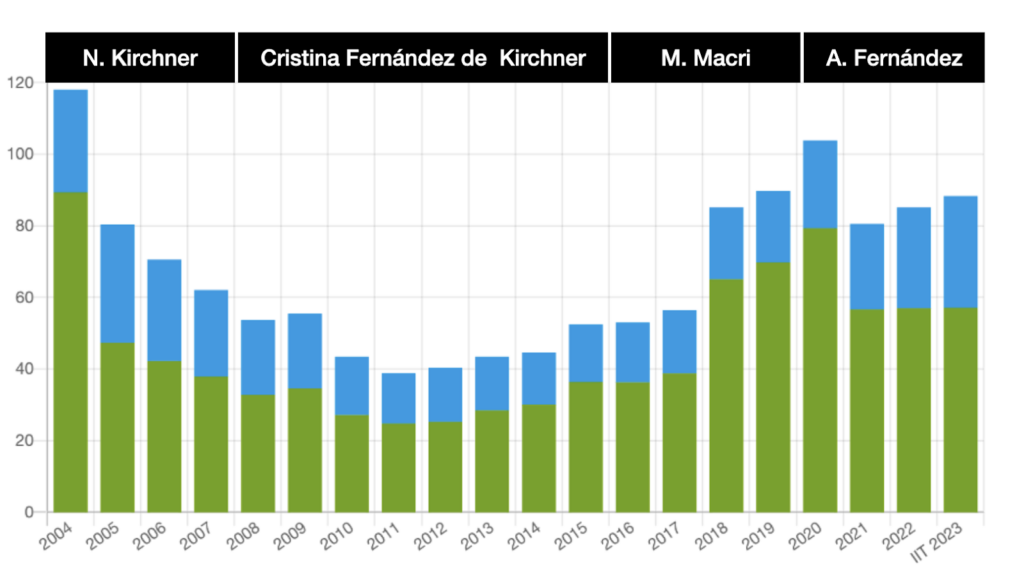
    The Argentine economy has remained on this cyclical trajectory since: significant borrowing triggers an economic crisis which is then used to justify austerity measures and privatization. Rather than stimulating economic growth, these measures often worsen the crisis and prompt a period of capital outflow.3Basualdo, E. (<)em(>)Endeudar y fugar: Un análisis de la historia económica argentina, desde Martínez de Hoz hasta Macri(<)/em(>) (Siglo XXI Editores, 2020). In subsequent elections, the ruling center-left coalition refrains from challenging the cycle, choosing instead to renegotiate and repay the debt. 

    It’s because of this pattern that former President Cristina Fernández de Kirchner designated Argentina as a “serial payer.” The strategy can have temporary gains in favorable exogenous circumstances, like a commodity boom. But during an international recession, the strategy couples with structural adjustment policies and sparks enormous dissatisfaction. The right-wing coalition eventually returns to power. 

    Figure 1: Argentina as a “Serial Payer”: Gross debt by currency as a percentage of GDP

    Source: Central Bank of Argentina. In blue, debt in pesos; in green debt in foreign currencies.

    Argentina’s debt cycle has been persistently stimulated by its toxic relationship with the IMF. In 2018, the disastrous effects of IMF lending reached new heights, surpassing Argentina’s debt-bearing capacity and sparking a capital outflow that contradicted IMF statutes.4The article VI IMF statute explicitly manifests that: “(a) A member may not use the Fund’s general resources to meet a large or sustained outflow of capital (…) and the Fund may request a member to exercise controls to prevent such use of the general resources of the Fund. If, after receiving such a request, a member fails to exercise appropriate controls, the Fund may declare the member ineligible to use the general resources of the Fund.”

    IMF policies have been guided by a distinct political agenda: Mauricio Claver, the executive director at the IMF and a crucial adviser to the Trump administration on Latin America, asserted, “Everything Trump did at the IMF was to assist Macri and prevent Peronism from returning to the ‘Casa Rosada’ (Argentine Presidential Palace).” By prioritizing the exclusion of the political left, these policies inadvertently opened the way for the right.

    Luis Caputo, now serving as Milei’s Minister of Economy, previously held the same position during Macri’s administration. Caputo, an economist with a background at JP Morgan and Deutsche Bank, implemented a currency flight mechanism via the Central Bank during Macri’s tenure. This involved dollar auctions below market rates, resulting in a substantial loss of 66 billion pesos. The connection of this loss to funds from Macri’s record IMF loan was later revealed, raising concerns about financial outflows. In a surprising revelation, Milei himself stated in a 2018 interview, “Caputo sold out, he smoked $15 billion from the IMF, and he’s responsible for the disaster in the Central Bank.”

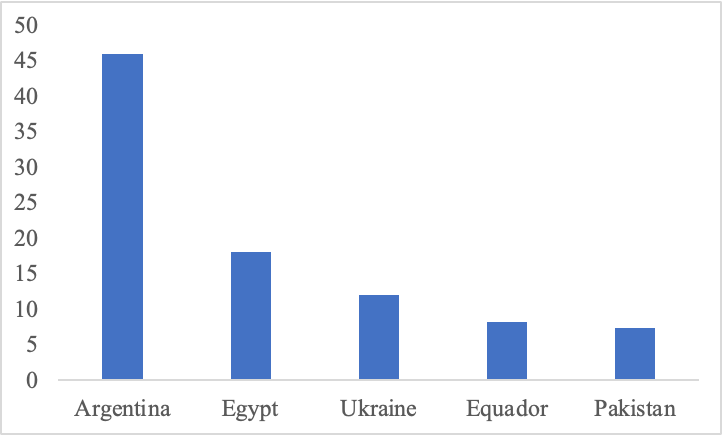
    Figure 2: Most Indebted Countries with the IMF, in USD Billions.

    Upon assuming power, former President Alberto Fernández government pledged to break away from neoliberalism and chart a path toward growth. However, the debt restructuring led by then Minister of Economy Martín Guzmán, involved requesting a new loan from the IMF within the framework of the Extended Facilities Program (EFP) and gaining approval in Congress. Historical evidence indicates that structural adjustment programs, be they “soft” or “strict,” have consistently fallen short of resolving issues in Latin America, often exacerbating them instead.5Basualdo, 2020; Monteagudo, G. (2022) IMF Holds Argentina Hostage Again, (<)em(>)NACLA Report on the Americas(<)/em(>) 54, no. 4 (October 2, 2022): 365–68,(<)a href='https://doi.org/10.1080/10714839.2022.2145108'(>) https://doi.org/10.1080/10714839.2022.2145108(<)/a(>).

    The agreement itself proved to be inflationary and significantly curtailed the government’s ability to implement assertive policies against inflation. Following the formalization of the agreement with the IMF, Guzmán resigned, and Sergio Massa, a seasoned politician, assumed the role of Minister of Economy. 

    An Opening for China

    It’s in the aftermath of decades of lending on the part of Western institutions that China has risen as an appealing alternative. Chinese loans hold significant advantages over their Western counterparts. While Western finance comes with domestic political and economic conditionalities, China offers non-conditionality loans for large infrastructure projects. After a five to ten-year grace period, recipient countries are expected to pay back the loans thanks to the economic growth they are expected to generate. 

    Chinese loans do require Chinese technology to constitute 30 to 40 percent of the recipient country’s imports, broadening China’s export markets. Overall, Western finance has been way more speculative and short-term than the Chinese “patient” capital.6Kaplan, S. B. (2021). Globalizing Patient Capital: The Political Economy of Chinese Finance in the Americas. Cambridge University Press.(<)a href='https://doi.org/10.1017/9781316856369'(>) https://doi.org/10.1017/9781316856369(<)/a(>). As Table 2 indicates, state-to-state loans from China to Argentina using sovereign guarantees amounted to nearly $7.8 billion, and most of the financing lines went to transport and energy projects.

    Table 1: Comparative table between Western and Chinese Finance in Argentina

    AspectWestern FinanceChinese Finance
    Conditionalities– Domestic political and economic conditionalities.
    – Mostly related to adjustment programs. 
    – Geopolitical conditionalities
    – Non-domestic policy conditionalities. 
    – Tech clause: Minimum 30-40% of Chinese technology imports to boost Chinese exports.7Hung, H. F. (2022). The Clash of Empires: From ‘Chimerica’ to the ‘New Cold War.’ Cambridge.(<)a href='https://www.cambridge.org/core/books/clash-of-empires/12211AC3B8957E8DE6C7F26998EB50C3'(>) https://www.cambridge.org/core/books/clash-of-empires/12211AC3B8957E8DE6C7F26998EB50C3(<)/a(>).
    – Cross-default clauses: If one project stops, all are affected.
    Cycle– Speculative and short-term 
    – Doesn’t generate repayment conditions
    – Usually outflows of the country
    – Linked to US financial expansion
    –Related to projects in the real economy (hydro-dams, solar plants, export lines, etc.) 
    – Expects to generate repayment conditions 
    – Swaps are long term, “patient” capital.8Kaplan 2021. They do not cost anything prior to activation. 
    – Linked to Chinese material expansion.
    Interest Rate– IMF: Around 10%– Chinese loans and swaps are lower than market interest rates. 
    – Loans around 3%, swaps around 6%.
    Adaptability– Low– High
    Source: Elaborated by the author.

    Table 2: Loans channeled by development banks from China to Argentina (2010-2019). By lending agency, project, amount, interest rate and maturity.

    YearLending AgencyProjectMillion USDInterest ratesMaturity (years)
    2010China Development Back (CDB) y CITICSupply of locomotives, passenger wagons, spare parts, tools, technical documents, technical service and technical training for the San Martín Railroad273Libor + 3.15%10
    2010Export-Import Bank of China (CHEXIM)Supply of passenger wagons, spare parts, tools, technical documents, technical service and technical training for the San Martín Railway114Not available8
    2014China Development Back (CDB) y ICBCRehabilitation of the Belgrano Cargas Railway21006-months Libor Libor + 2.9% interest rates, 0.125% commitment,
    and 0.20% management fee
    15.5 (with a grace period of 4.5 years)
    2014China Development Back (CDB); ICBC y Bank of China (BoC)Hydroelectric dams on the Santa Cruz River47146-months Libor Libor + 3.8% interest rates, 0.125% commitment,
    y 0.20% management fee
    15 (with a grace period of 5.5 years)
    2017Export-Import Bank of China (CHEXIM)Cauchari I, II and IIIA photovoltaic solar parks331Interest rates 3% (Preferential Buyer Loan – PBL) + 0.75% commitment fee and 0.75% management fee15 (with a grace period of 5 years)
    2019China Development Back (CDB)Acquisition of rolling stock for the Roca Electric Railway2366-months Libor Libor + 2.4% margin10 (with a grace period of 3 years)
    Total7768
     Source: Secretariat of Strategic Affairs of Argentina (2023)

    Chinese swap lines have played a crucial role in stabilizing Argentina’s macro-economy since 2009, strengthening the country’s reserves in the Central Bank without additional costs if used as a reserve mechanism. Since 2008, the People’s Bank of China has engaged in bilateral swap agreements (BSAs) with foreign central banks, utilizing these agreements to offer short-term liquidity support to partner countries beyond the Bretton Woods institutions. Argentina has been a significant beneficiary of these agreements. The initial currency swap, valued at 70 billion yuan ($9.98 billion), was inked in 2009 between the People’s Bank of China (PBoC) and the Central Bank of Argentina (BCRA) during Cristina Fernández de Kirchner’s presidency.

    In 2017, under Macri’s administration, the PBoC and BCRA renewed the bilateral currency swap agreement for 70 billion yuan. An additional currency swap deal for 60 billion yuan was signed in 2018, expanding the total to 130 billion yuan (US$20 billion). In 2022, Alberto Fernández renewed and extended the swap with China to 150 billion yuan (US$23.4 billion). During Sergio Massa’s tenure as Minister of Economy, two additional tranches were enabled: the first, equivalent to $5 million, and when depleted, a second tranche was activated for $6.5 billion. From this latter amount, funds were allocated to make three payments to the IMF in yuan: on June 30 for $1.08 billion, on November 1 for $796 million, and on the seventh of the same month for another $884 million.

    Table 3: Argentina Central Bank’s Reserves, disaggregated August 2023

    ConceptUSD Billion
    1. Gross International Reserves23.8
    Gross liabilities
    — Swap lines   
    — China         
    (Of which activated)   
    — BIS
    RR FX deposits
    Other (incl. deposit insurance) 
    — SEDESA 
    — Other
    34.1
    20.9 
    17.9
    6.5
    3.0
    10.3
    2.0
    1.8
    1.0
    2. Net International Reserves-10.3
    Gold
    SDR
    Liquid reserves
    3.8
    0.0
    -14.1
    Memorandum item 
    Nominal Interest Rates (program definition)
    Central Bank Non-deliverable forward position
    -6.3
    3.1
    Sources: Elaborated by the author based on FMI and BCRA.

    Chinese Trade and Industrial Transformation

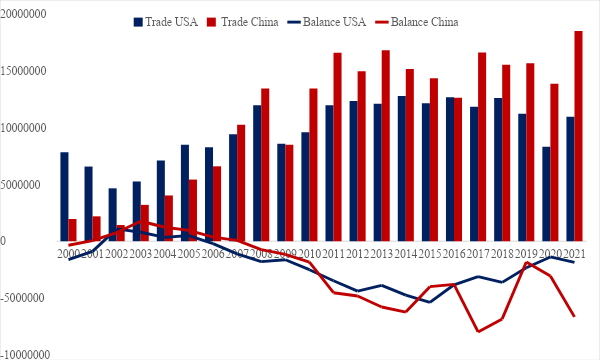
    Increased Chinese investment comes with a price. Since the early 2000s, China has overtaken Argentina’s traditional economic partners, including the United States and Europe. Currently, China ranks as Argentina’s second-largest trading partner, following Brazil. Typically, Chinese trade constitutes 8 to 10 percent of Argentine exports. However, Argentina’s trade balance has experienced growing deficits, particularly with China and the United States. 

    Figure 3: Argentina’s Trade Balance with the US and China

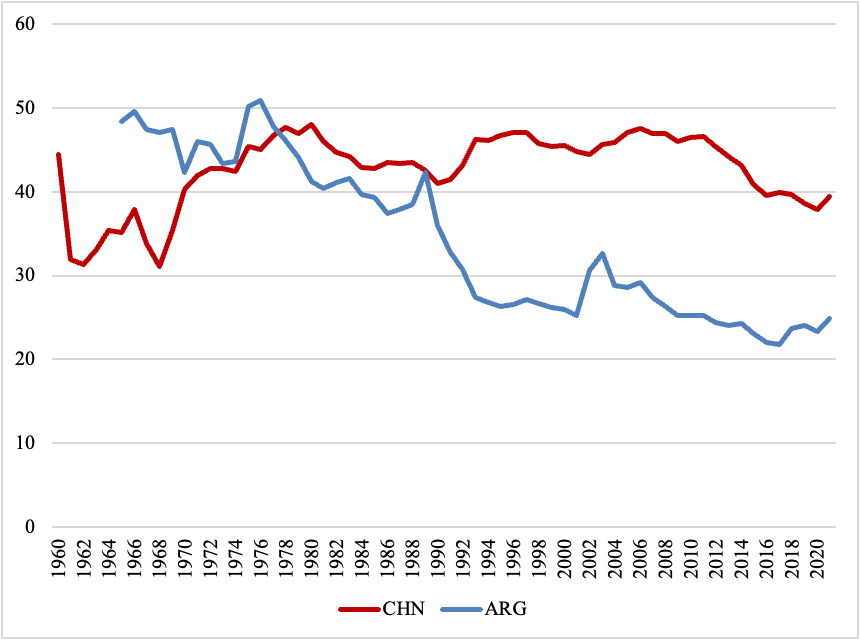
    While China escaped from “shock therapy” policies,9Weber, I. (<)em(>)How China Escaped Shock Therapy(<)/em(>) (Routledge, 2021). Argentina suffered the consequences of recurrent neoliberal waves, the industrial development in the countries experienced bifurcating paths.10Haro Sly, M.J.  y Hurtado, D. (2023) Hacia la convergencia de trayectorias en ciencia y tecnología que se bifurcan: desafíos de la cooperación de Argentina y China. En: Andrés, M.(Ed) Argentina-China. 50 años de Relaciones Diplomáticas. Cooperación, Desarrollo y Futuro. Mincyt y la Academia China de Ciencias Sociales.(<)a href='https://www.argentina.gob.ar/sites/default/files/c_2023-05-08-argentina-china.pdf'(>) https://www.argentina.gob.ar/sites/default/files/c_2023-05-08-argentina-china.pdf(<)/a(>). This led to a significant shift in the productive matrix, as Argentina underwent deindustrialization thanks to the increased demand for raw materials and natural resources.11Svampa, M. (2013) Consenso de los Commodities’ y lenguajes de valoración en América Latina. Nueva Sociedad No 244, 3-4/2013,(<)a href='http://www.nuso.org/upload/articulos/3926_1.pdf'(>) www.nuso.org/upload/articulos/3926_1.pdf(<)/a(>).

    Figure 4: Percentage of the Participation of the Industry in the GDP of Argentina and China.

    Source: Elaborated by the author based on the World Bank.

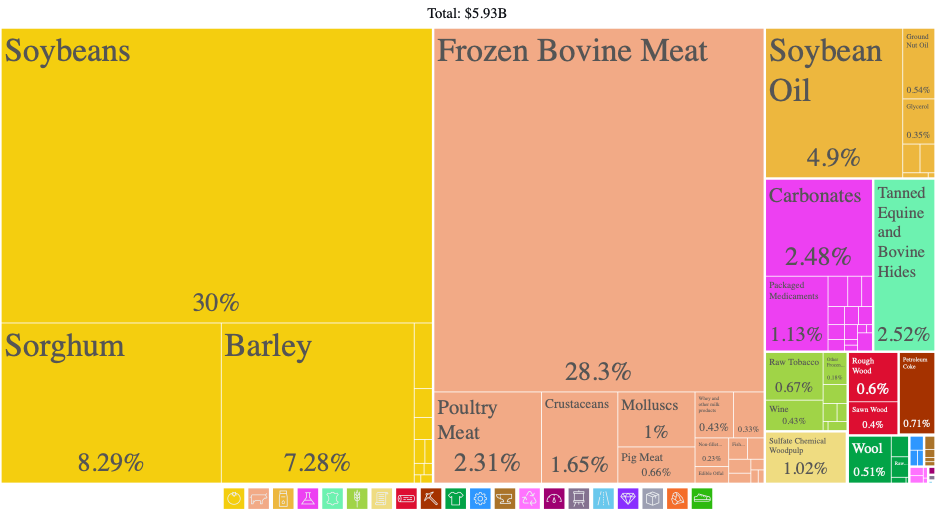
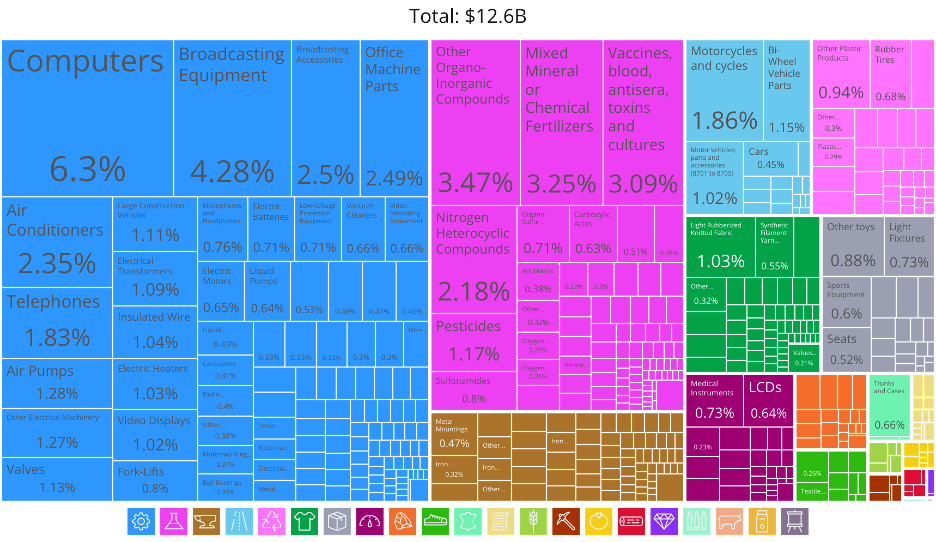
    Increased trade with China has only intensified the shift. Soybeans constitute the leading export from Argentina to China, equaling one third of the total. Fulfilling Chinese demand for soybeans has, in turn, entirely transformed the Argentine economic landscape.12Haro Sly, M. The Argentine portion of the soybean commodity chain. (<)em(>)Palgrave Commun(<)/em(>) 3, 17095 (2017). (<)a href='https://www.nature.com/articles/palcomms201795#citeas'(>)https://www.nature.com/articles/palcomms201795(<)/a(>). Figures 5 and 6 illustrate the profound imbalance in the diversity of exports and imports between the two countries. 

    Figure 5: Argentina Exports to China

    Source: OEC, MIT (2023)

    Figure 6: Argentina Imports from China

    Source: OEC, MIT (2023)

    Structural constraints

    Milei is not the first Argentine leader to resist growing economic ties to China. Since 2015, the Macri administration has aimed to curtail cooperation and emphasize a geopolitical alliance with the United States. But then, too, economic realities forced the government to reverse course. During the first seven months of Mauricio Macri’s government, China reduced soybean imports by 30 percent and soybean oil imports by 97 percent. During the 2016 G20 meeting in China, Macri managed to restore the soybean trade. Because Chinese-financed projects often include a “cross-default” clause that guarantees the cessation of all projects if one is halted, repercussions for pulling back are enormous. 

    Milei’s orientation towards China, then, is nothing new. Despite its solidifying economic reality, Argentina remains wedded to its alignment with the West. But like administrations before him, Milei will have to come to terms with the changing composition of the global economy: repaying Argentina’s debt to the IMF depends on continued exports to China. 

    Milei’s failure to find fresh financing from Western lenders may compel his administration to accept Chinese economic diplomacy, leading to a situation similar to Bolsonaro’s administration in Brazil.13Kotz, R. L., & Haro Sly, M. J. H. (2022). China’s Economic Diplomacy in the Context of the Far-Right Government’s Neoliberal Nationalism: The Case of Brazil’s Energy Sector. In J. Rajaoson & R. M. M. Edimo (Eds.), New Nationalisms and China’s Belt and Road Initiative (pp. 1-14). Palgrave Macmillan.(<)a href='https://doi.org/10.1007/978-3-031-08526-0_14'(>) https://doi.org/10.1007/978-3-031-08526-0_14(<)/a(>); Kotz and Haro Sly, 2022; Gonzalo, M., Harfuch, M. P., Haro Sly, M. J., Lavarello, P., & Gonzalo, M. (2023). 5G Kick-off in India and Brazil: InterState Competition, National Systems of Innovation, and Catch-Up Implications for the global South. (<)em(>)Seoul Journal of Economics(<)/em(>), 36(1).(<)a href='https://ssrn.com/abstract=4372457'(>) https://ssrn.com/abstract=4372457(<)/a(>). This may result in a strengthened economic reliance on Chinese hands. However, while Brazil is capitalizing on Chinese relations with an important trade surplus, innovation centers, and New Development Bank funds, Argentina will go to China as a “desperate debtor.” China is pressing Milei to confirm that his administration will maintain Chinese interest in Argentina.  

    Argentina’s case thus brings to light two harsh realities. The first is that Chinese financing and investment across the global South fulfills a structural need rather than a political choice. The second is that, while the emergence of competing superpowers typically opens up opportunities for global South countries, it can also trigger a downward spiral. As is often the case, Argentina stands as an exception, caught in pendular shifts without a clear international strategy.

  3. A Year in Crises

    Comments Off on A Year in Crises

    When we launched The Polycrisis a year ago, we set out to examine the intersecting crises in the economy, energy system, commodities markets, geopolitics, and climate. Our aim was to break intellectual and political silos to give a fuller picture of what’s going on: security and climate, political economy and commodities, domestic and foreign politics, macroeconomics and populism. In the meantime, our world crisis of ecology, economics, and empire, has continued to metastasize. It is, as Nancy Fraser put it, shaking confidence in established worldviews and ruling elites everywhere.

    In twenty-eight newsletters, ten articles by contributors, and four panels with experts so far, we have mapped four main shifts:

    Global South left high and dry

    A new Washington Consensus has arrived. Following the passage of the Inflation Reduction Act (IRA), Biden officials from Jake Sullivan to Janet Yellen have emphasized that the world can and should follow the US in its new passion for productivism. Food and energy import bills are not only a climate problem, they point out, but a security concern. Indeed, nearly every import is increasingly scrutinized through a security lens, down to Chinese garlic.

    The vision, then, is for localized, manufacturing-led green growth, erring on the side of redundancy rather than just-in-time production. All countries, the story goes, should be able to achieve prosperity through derisking, paired with local content restrictions, higher taxes, and subsidies for key sectors like clean energy, biotech and digital infrastructure.

    There is only one small problem. After overhauling its internal investment regime, the US has thwarted any meaningful structural changes to the global financial architecture. On IMF quotas, voting shares, taxation, and even on its measly contribution to the new Loss and Damage Fund, the US has been conservative and isolationist. There have been a few consolation prizes—Barbados’s PM Mia Mottley won debt payment pauses for natural disasters; the IMF will give slightly more interest-free loans to low-income countries—but, on the whole, the global financial safety net continues to ensnare, rather than rescue, the most vulnerable countries.

    For every $1 the IMF provides to poor countries for social spending, it demands $4 in cuts in public spending. Countries do everything they can to delay and avoid bailouts since, when they come, they reduce domestic policy space and autonomy, and force countries to choose between debt repayments, social spending and climate.

    The situation is not entirely hopeless. Norway, which has historically acted as a mediator between the North and South, has made $150 billion in oil and gas profits from the Ukraine war. Like the UAE, it may rechannel some of this windfall to underwrite the risk of green investments in developing countries. But we are far from seeing any coordination that could  rival even the New International Economic Order of the 1970s—let alone the kind of South–South solidarity needed to tackle the climate crisis.

    War

    The past two years have seen more violent conflict than at any time since the end of World War II, according to the Uppsala conflict data program. Conflicts have broken out in many continents. In Africa, there have been over half a dozen coups, with combat fighting in the Congo and Sudan, and now a teetering cease-fire in Ethiopia. In the Middle East, Israel’s assault on Gaza threatens to expand into a regional war. In Europe, Russia’s brutal war of attrition in Ukraine has strikingly altered the political scene. After months of European and US support for its ally, including aggressive sanctions, the US Congress is left in a deadlock on the question of funding Ukraine’s resistance. The result in a multipolar world? Russia’s economy has been decoupled from Europe’s but thanks to its trade with countries in the East and South, its treasury remains flush with cash. We wrote about how the EU is preparing for Ukraine’s accession, and the all important question of who will pay to reconstruct the country?

    On October 7 2022, the US launched an economic war against China. Biden issued a sweeping set of export controls aimed at restraining Chinese military modernization efforts by controlling advanced AI chips made with US inputs. The chips embargo was buttressed by the Pentagon’s largest ever military spending bill—$840 billion—with nary a murmur from inflation hawks. New US bases to be built in the Philippines and Papua New Guinea further cemented Beijing’s view that the US plans to encircle it and prevent its future growth. The panic about an impending war that set the tone during the first half of 2023 soon subsided with a series of crisis stabilization cabinet-level meetings and a constructive meeting between Biden and Xi in San Francisco in November.

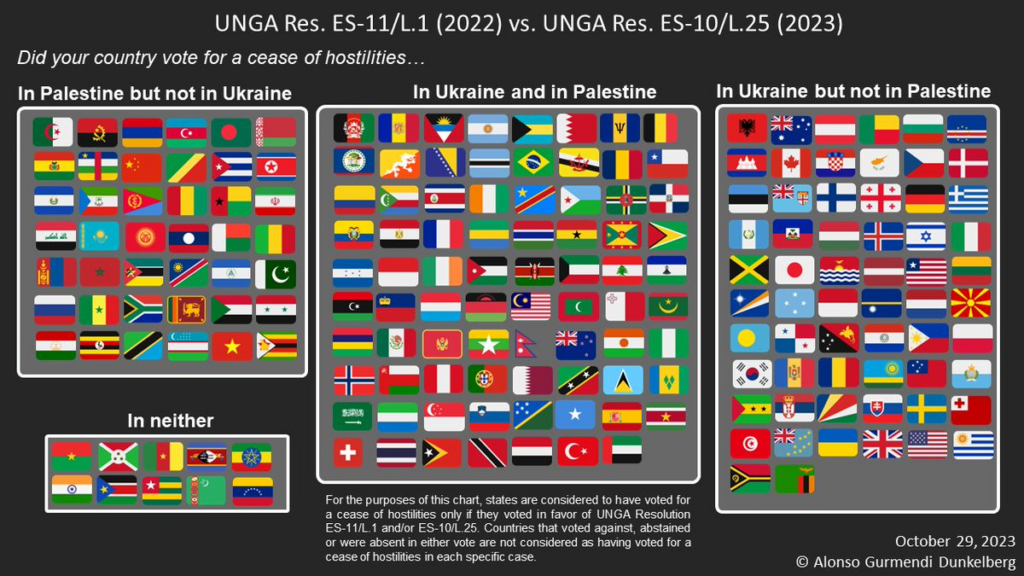
    Everyone is nonaligned: Venn Diagram representation of how countries votes in UN General Assembly votes in favor of ceasing hostilities in Ukraine and in Palestine (Source: Alonso Gurmendi)

    In the present context of a dangerous and differentiated world system, categories like “global South” and “global North” may no longer work. This is because, as Patrick Porter has argued, the global South isn’t simply comprised of “aggrieved cultures,” victims bearing wounds, but of ruthlessly self-interested nation states—much like those in the global North. Paying attention to regional actors and their rivalries and partnerships is key. Countries in the South are split on calling for a ceasefire in Ukraine and Palestine. For example, Brazil has called for a ceasefire in both cases, India in neither; Bangladesh and South Africa for a ceasefire in Palestine only; the Pacific Islands in Ukraine but not Palestine.

    Labor

    Around the world, workers are striking in a way not seen in decades. Betrayed by the US Congress in the IRA legislation, unions across America are taking it upon themselves to make the EV transition good for workers. A dispute between the US and the EU last year over the IRA meant that union-made cars did not get fatter subsidies. The United Auto Workers have fought back in an escalating series of strikes led by Shawn Fain in the US and Marie Nilsson—head of IF Metall, Sweden’s largest industrial union—has led a similar fight among Nordic unions fighting against Tesla.

    Trade defiance

    For most of 2023, it seemed that  free trade had given way to “friend-shoring,” largely on grounds of national security. Predictions of a crackup in global trade patterns abounded. New policies on export controls, visa bans, investment blocks, and sanctions are now redirecting the flow of goods and people. We dug into the narrative to find that 2023 has seen an all-time high of goods traded across borders. Even bilateral trade between China and the US was at a record high of $400 billion in 2022. Firms are responding to geopolitical crackup by diversifying their supply chains into new countries. Bloomberg analysts identified which countries benefited—Indonesia, Mexico, Morocco, Poland, Vietnam—to which we added India and Australia. 

    Assessing and Looking Forward

    What we got right and wrong

    • US policy elites underrated the seriousness of chips export controls—we expected these would provoke a furious response from Beijing and US allies in East Asia and Europe. By the year’s end, US policymakers’ decoupling rhetoric softened into “derisking.”   
    • We expected a wave of debt defaults with record high interest rates, but only saw a few. Why? Commodity exporting countries showed surprising resilience as they earned higher dollar revenues.  
    • We anticipated a geopolitical crisis in Asia with Chinese aggression. This didn’t happen. There were lots of military flashpoints but only a North Korean rocket scare in Seoul—part of North Korea’s record year of weapons testing—plus some skirmishes in the Himalayas and in the South China Seas.
    • We expected greater coordination among BRICS countries. We got this half-right. We’re seeing BRICS prioritizing local currency settlements and boosting African trade and investment. A troika of India, South Africa, and Brazil are leading reform of the Bretton Woods institutions during their G20 presidencies. Here, it remains to be seen whether the developing world will achieve the greater autonomy and coordination it aims for, or remain fragmented. Either way, one should have no illusions about the radicalism of a new non-aligned movement. The ruling elites of these countries are rarely concerned with carving out more policy space and autonomy for their publics. As William Shoki tartly put it, BRICS is only ever the anti-imperialism of the ruling class.

    The year ahead

    There are forty national elections slated for next year, the effects of which will cover 41 percent of the world’s population, in countries representing 42 percent of global GDP. These votes also represent approximately the same percentage of global emissions, with fossil-fuel industry interests well-represented. 

    We anticipate an anti-incumbency wave of world leaders over the next twelve months as voters elect heads of state in Mexico, South Africa, Russia, UK, US, India, Indonesia. Even a single election—Argentines have just elected libertarian dollarizer Javier Millei—has global consequences. Alongside nations, the European parliament and a host of other representative bodies are also going to the polls. Population movements may complicate polling predictions in several elections, given that the UNHCR anticipates that up to 130 million people will be displaced and in need of protection in 2024.

    “In the last 200 years, since the beginning of the industrial revolution, it has been the rich nations that ‘have polluted the world’ and not the African or Latin American peoples. They must pay the historical debt they have with the planet Earth. We cannot accept a green neocolonialism that imposes trade barriers and protectionist policies under the pretext of protecting the environment.” – President Lula, Paris Global Financing Summit, June 2023

    Lula will occupy center stage in 2024 as Brazil takes on the global reform agenda in its G20 presidency. Frustration with the US and Europe’s so-called green protectionism may frame the G20 and BRICS meetings. Lula may well amplify the anger expressed by many global South nations at this month’s climate summit, especially when Brazil hosts COP30 in 2025. Since China and India have already threatened to make formal complaints about EU’s carbon border adjustment mechanism, Lula’s intervention could be key at the WTO.

    Barbados PM Mia Mottley’ successful advocacy of climate resilient debt clauses has raised hopes for a more systematic rethink of the G20’s Common Framework on debt resolution. It is creaking and may soon be replaced given Zambia’s public creditors, including China, just “derailed” a deal brokered with private creditors under the Framework. 

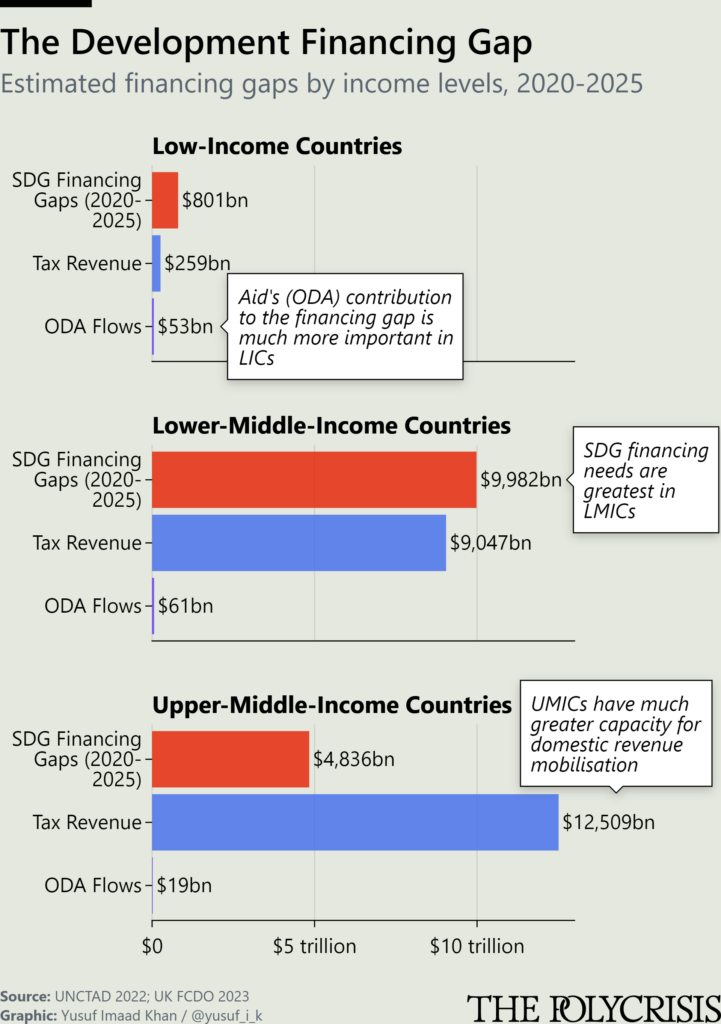
    These issues may transform 2024 from the year of elections into the year of finance. British Foreign Minister David Cameron has flagged a return to treating Aid as a mechanism to lever-in more private cash. This will rely on new mechanisms and private finance’s willingness and ability to meet the gaps. Recapitalisation of multilateral development banks, new SDR issuance, or a New Collective Quantified Goal (NCQG)—a major theme to-be for next year’s UN climate summit in Baku—will be the focus of discussions.

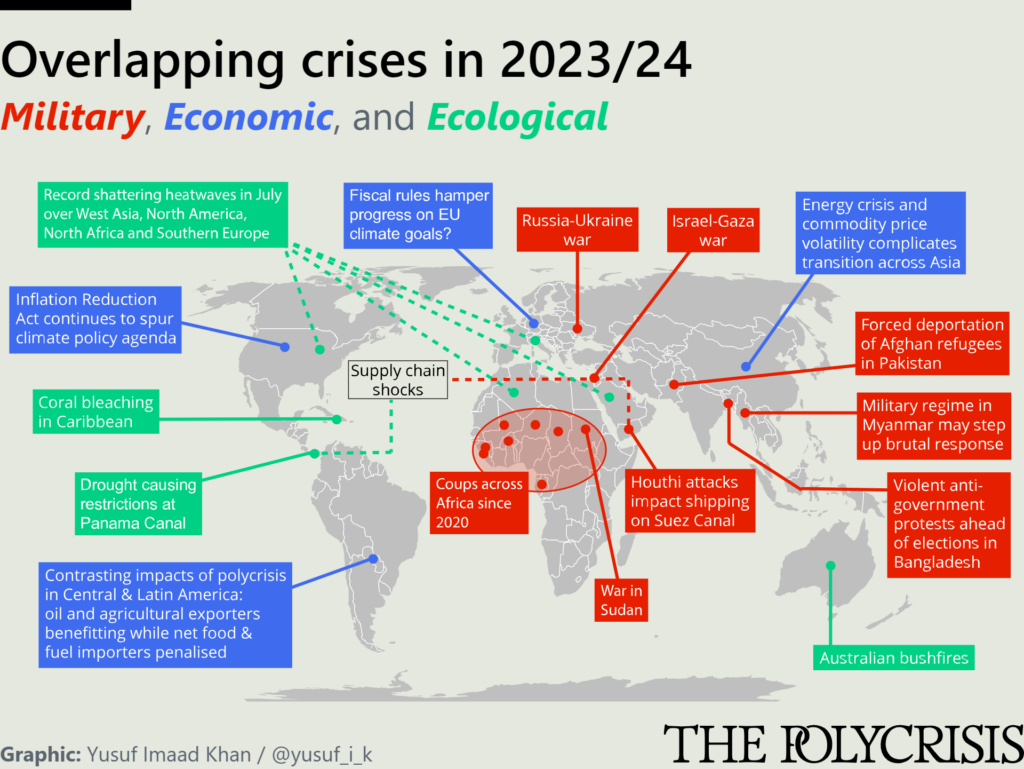
    We end at sea. Houthi rebels are poised to seriously disrupt the global economy with their actions in the Red Sea, in solidarity with Gaza’s besieged population, forcing ships to re-route around Africa. Meanwhile, thanks to drought, cargo ships in the Panama Canal are now stuck, holding up another major trade passage. Unlike the rather comical scenes of that large boat wedged in the Suez Canal in 2021, images from Panama fail to raise even a chuckle. We’re no longer dealing with the errors of a single human being, but with the tragic collective error of burning such vast amounts of fossil fuels, long after we should have stopped.

  4. Constitutional Odysseys

    Comments Off on Constitutional Odysseys

    On September 11, 1980—seven years after Augusto Pinochet seized power from democratically elected Salvador Allende in a brutal US-backed military coup—the dictatorship passed a constitution that laid the groundwork for one of the world’s earliest and most enduring neoliberal experiments. The results of this experiment have been well documented: with the privatization of education, pensions, health, public transportation, and essential natural resources like water, Chile became one the most economically unequal countries in the OECD. 

    The protests that erupted over rising transportation fares in October 2019 forced a national reckoning around this political and economic infrastructure. Weeks of mass strikes and public protests reinvigorated discussion about Chile’s future. A year later, nearly 80 percent of the country’s citizens voted in favor of a new constitution in a nationwide referendum. With the 2021 election of social democratic candidate Gabriel Boric—a former student activist who gained prominence through the campaign for a Constitutional Convention—it seemed that a political transformation was underway. 

    But the path forward has proved meandering and vague. In September 2022, the Convention’s proposed constitution, one of the most progressive in history, was rejected by 62 percent of the public. A far-right Constitutional Council, elected in June of this year, has since proposed a new, right-led charter. On December 17, the country will return to vote on this constitutional proposal, marking the culmination of a fierce battle over Chile’s identity. 

    The Boric government’s dramatic reversal of fortune is the result of conflict over the position of indigenous communities within the Chilean state, the patriarchal mobilization against feminist demands, and the role of the state in economy and society. On this final point, the ongoing debates on the Chilean constitution reflect deep-rooted divisions that have plagued the country throughout its recent history.

    Dictatorial inheritance

    Chile served as the experimental testing ground of the Chicago School, which pioneered the wholesale privatization of crucial services and resources, deregulated labor and financial markets, and constitutionally enshrined the independence of the Central Bank. The key innovation of this period was policy “neutrality”—abandoning focused sectoral promotion and allowing market rules to determine the fundamental questions of the economy. Financial liberalization and free trade were the core elements of this economic transformation.1Ffrench-Davis, R. (2003). Entre el neoliberalismo y el crecimiento con equidad: tres décadas de política económica en Chile. JC Sáez Editor.

    During the 1970s, regulations were lifted on interest rates, credit expansion, and bank reserves. The resulting proliferation of private banks and alternative financial entities were at the core of the 1982 banking crisis, after the indiscriminate increase in debt, which resulted in a 14 percent reduction in GDP and unemployment surpassing 20 percent.2Ibid. Equally, the gradual elimination of import tariffs fostered the exploitation of existing competitive advantages based on natural resources and eroded the competitiveness that certain domestic industries had maintained.

    Positioning the state as a subsidiary to the private sector, the dictatorship replaced the public pension system with one under private administration in 1981. New financial institutions called “Pension Fund Management Companies” were established to receive individual contributions from workers. These institutions then determined pensions based on the individual’s accumulated savings during the workers’ formal years of employment. 

    The dictatorship similarly privatized the healthcare system. Chile’s National Health Service was divided into a public (FONASA) and a private (ISAPRE) system. In line with the state’s reduced role in healthcare provision, primary care was delegated to local governments. After years of implementation, Chile’s public healthcare expenditure is among the lowest within the OECD, while private spending ranks fifth. As is reported by the OCDE, the private household spending on healthcare can exceed 30 percent of the family budget.

    In contrast to the radical shift from public to private participation in the pension system and health, the privatization of education occurred more gradually. In higher education, the government legalized the opening of private universities and technical training centers in 1981, while integrating private companies into the management of publicly funded elementary and middle schools. Across the education system, private provision rapidly expanded, forcing a significant part of the public sector to adhere to market rules in delivering educational services. A prime example is state universities, which, due to low state funding, now charge tuition fees and must compete on equal footing with private universities to attract students.

    This economic infrastructure far outlived the dictatorship. During successive center-left administrations from 1990 to 2010, economic growth was achieved while the constitution remained intact, following the slogan “continuity in change.” The first such period was between the end of the dictatorship and the financial crisis of the late 1990s: Chilean GDP grew more than 7 percent per year as a result of the non-tradable economic activity. Reforms of this period revolved around increasing investment, reducing external shocks, and raising social expenditure through higher taxation. The disastrous unemployment and poverty rates which followed the dictatorship were rapidly reduced during the ‘90s. 

    Despite these notable achievements, no structural economic reforms were made. This was evident in both the role of the state concerning the provision of social rights and in the scope of horizontal economic policies. A key obstacle to economic reform was the political structure outlined in the constitution, which included the participation of appointed senators among whom was the former dictator Augusto Pinochet. The constitution also established an electoral system (the Binomial System) that favored the election of two political blocs in the parliament, undermining a proportional representation system that would enable the participation of third-party forces. The majoritarian nature of the electoral system made it challenging to build coalitions for constitutional reforms.

    After lengthy negotiations (2000-2005) among the political forces of the period, fifty-eight constitutional reforms were successfully approved in 2005. While these were the most extensive to date, they all aimed at reforming the political system rather than the economic infrastructure: the protection of property rights and the role of the subsidiary state would continue to form central pillars of Chilean policymaking. Meanwhile, the Chilean economy maintained a clear path towards open trade, marked by the signing of several free trade agreements that further expanded the extraction of natural resources.3Saldaña, J. (2010). Reformas constitucionales en el Chile democrático: análisis de tendencias 1992-2008, in Fuentes, C. (Ed.),(<)em(>) Nombre del Debate sobre el cambio constitucional en Chile.(<)/em(>) Ediciones Böll Cono Sur.

    Subsequent years would see early signs of turmoil. In response to the election of a right-wing coalition led by Sebastián Piñera between 2010 and 2014, student protests gave way to a center-left government under Michelle Bachelet. This administration integrated political sectors previously excluded from government, like the Communist Party, in an effort to transform elements of Chile’s reigning economic model. During this period, and for the first time since 1980, new issues were publicly questioned. The country’s pension system was failing: the average pensions paid by the AFPs were $181,297 in 2013 (approximately $340 as of December 2013), and the state was spending heavily to subsidize the retirement of informal workers who couldn’t make contributions. Education saw a similar fate. The lack of state intervention and public spending (state universities only received 12 percent of basic fiscal funding) meant that by 2013, 77 percent of spending on higher education came from Chilean families.

    Among President Bachelet’s key proposals was a constitutional change. While her ambitions were thwarted by a right-controlled parliament, her government saw the emergence of new left-leaning political groupings like Frente Amplio, out of which Gabriel Boric emerged. 

    In March 2018, Sebastián Piñera assumed the presidency again, preserving the political model that had dominated the Chilean economy since Pinochet’s fall. But the model continued to wear thin, distancing political parties from their traditional electorate—while 53 percent of Chileans identified with a political party in 2006, only 19 percent did so in 2019.

    Social outbreak

    On the heels of these developments, in October 2019, Minister of Transportation Gloria Hutt raised Santiago’s metro fare. Under the slogan “It’s not thirty pesos, it’s thirty years,” students’ refusal to pay increased fare quickly catalyzed weeks of intense protests, where thousands expressed their dissatisfaction with the Chilean political and economic system.

    Amid criticism of the country’s education, health, and pensions systems, the call for a constitutional reform united different sectors of society behind a single demand. The successful popular referendum of October 2020 gave birth to the Constitutional Convention in July 2021, and Gabriel Boric was elected president shortly thereafter.

    Entering with what seemed like an enormous mandate, Boric’s proposed reforms sought to address the key complaints emerging from the social protests. The most prominent demands centered around privatized and unequal pensions, education, and healthcare systems; the selling off of natural resources; and the rampant political abuse and corruption limiting public participation in the political process. 

    With gender parity and representation for Chile’s indigenous peoples, the Constitutional Convention was one of the most progressive in history. The drafting process centered indigenous territorial rights and a commitment to feminism. Chile’s indigenous population, which constitutes 12.8 percent of the total, has historically suffered from high levels of poverty and racist discrimination. Their ancestral territories have been systematically violated by the Chilean state, particularly during Pinochet’s dictatorship. 

    During the social outbreak and the proposal for the new constitution, the clash between the Western territorial identity logic defended by the Chilean state and the communal indigenous identity logic became evident. The concept of plurinationality and interculturality was proposed as a new political project, wherein within the same state, the plurality of nations would be recognized, allowing self-determination. The coexistence of indigenous legal systems and the Chilean national system would be established, each responding to the oversight of the Supreme Court. 

    The constitutional convention also foregrounded feminist concerns, which had risen to prominence in Chile before 2020. Feminist university occupations in 2018 and the memorable protests of March 8, 2019 addressed femicides and the exploitation of feminized bodies.4Carrillo, F. I., & Alva, F. S. (2021). La emergencia del movimiento feminista en el estallido social chileno. (<)em(>)Revista Punto Género(<)/em(>), (16), 194-218. One of the most prominent constitutional reform proposals from this sphere was the defense of the freedom of choice for pregnant people regarding gestation, childbirth, and motherhood. This included, among other measures, the legalization of abortion. Additionally, the convention proposed a gender-equal democracy where all state bodies would be required to meet gender parity, and the state would guarantee the right to freedom of sexual and gender identity.5Estupiñán-Achury, L., & Gómez Isaza, M. C. (2023). La utopía constitucional descolonial y feminista chilena. Una lectura desde Colombia. (<)em(>)Constitucionalismo de la resistencia y la integración desde y para Abya Yala(<)/em(>), 147-170.

    The constitutional proposal also included significant changes regarding the role of the state in the economy. First, it expanded access to healthcare, education, and pensions, overturning the subsidiary state for the first time since the dictatorship. While the proposal maintained room for private sector involvement in these areas, it ensured the provision of services as a right guaranteed by the state. Second, it questioned the market’s role in strategic sectors. It upheld property rights at the same time as it made exceptions in areas such as environmental conservation and the defense of strategic resources, such as water. Water—currently managed by private entities through usage-rights purchases—was declared a “public-use good,” thus transferring its ownership to the nation.

    The rejection

    In September 2022, the constitutional proposal was rejected, with 61.8 percent against and 38.1 percent in favor. In one of the largest elections in Chilean history, thirteen million Chileans cast their votes, representing 86 percent of the electoral roll and almost double the turnout of the initial plebiscite in 2020. Roughly five million people who did not vote in the previous plebiscite did so in 2022, and the 7.8 million votes against the constitution exceeded the total number of votes in the initial plebiscite. Rather than representing the loss of supporters, the defeat of the constitutional proposal can be best explained by the attraction and mobilization of new voters.

    This mobilization is in large part tied to the media. Chile’s two major newspapers (El Mercurio and La Tercera), have achieved an elite-funded informational duopoly that significantly impacted the result of the election.6Spatola, I., Buffa, C., & Herrera, G. (2023). Opción Rechazo: el rol del duopolio informativo chileno en la votación del Plebiscito Constitucional (agosto-septiembre 2022). (<)em(>)Cuadernos del Centro de Estudios de Diseño y Comunicación(<)/em(>), (194). This had a direct impact on the fact that, in the months prior to the rejection, the Convention’s proposals on gender, indigenous rights, and the environment were deemed unsustainable. The media also presented the lack of incentives for growth and the inadequate protection of private property as major threats.

    Opponents argued that the new Constitution, aimed at guaranteeing social rights, would lead to an unsustainable increase in fiscal spending. The Center for Public Studies published an analysis by well-known center-left economists estimating an additional fiscal cost increase ranging between 8.9 percent and 14.2 percent of the GDP.7Bentancor, A., Larraín, G., Martínez, C., Ugarte, G., Valdés, R., & Vergara, R. (2022). Estimaciones del Costo Fiscal Directo de la Propuesta de Nueva Constitución.pWhile the study presented somewhat unrealistic assumptions, it also omitted the multiplier effect of public spending, thus reinforcing the false narrative that the constitutional proposal was impractical. 

    Debates surrounding the pension system were emblematic of this discourse, as one of the citizen initiatives supported by the right called “not with my money” started gaining space in the media. On March 30, 2022, a well-known national publication ran the headline: “Workers will no longer be owners of their pension savings” Shortly after, the “Reject” motion began to lead over “Approve” in opinion polls. Gradually, the demand for a present and rights-guaranteeing state for basic needs such as education, healthcare, and fair pensions shifted towards a fear that the state would infringe on private property and individual rights. The circulation of fake news and misinformation exacerbated these trends, associating the new constitution with the rejection of national symbols, Chilean traditions, and civic education; the expropriation of pensions and homes; and the rising levels of crime.

    In this context, the media campaign against the proposed constitution successfully represented the Boric government as extreme and the opposition as moderate. For instance, on September 3, 2022, columnist Luis Larraín asserted in La Tercera:

    “[If the Rejection wins] ultimately, the excessiveness, politically represented by the Broad Front and the Communist Party, will have lost. Instead, moderation and common sense will have won.”

    While the government and the constitutional convention were independent of the ruling government, the rejection of the latter was interpreted as a popular disapproval of Boric’s administration. Although the economy was experiencing the effects of imported inflation and post-pandemic economic slowdown, it was precisely after the rejection of the new constitution that Boric’s administration began to face heavy criticism, especially around economic matters. In March 2023, for instance, the Boric government’s proposed tax reform was rejected, and a widely-cited public opinion poll found that voter disapproval rose sharply following the referendum. 

    Another vote

    Elected by popular vote on May 7, 2023, the new Constitutional Council is primarily composed of members from far-right. While it has maintained gender parity, the body has not ensured indigenous representation. Beatriz Hevia, president of the new Council, presented the project as a statement “for the true Chileans (…) those peaceful, honest, hardworking individuals.” In the same speech, she asserted that both those who led the 2019 protests and those who politically supported them are responsible for the destruction and looting of the country. 

    Unsurprisingly, then, the newest constitutional proposal has taken a sharp turn to the right, allowing for immediate expulsion of foreigners who entered irregularly, rejecting the plurinational state, repealing the limited right to legal abortion established in 2017, and denying public rights over water and other natural resources. In many ways, the proposal signals a revival of the values espoused by the dictatorship, refusing to address the demands of the 2019 protests and upholding the economic model enshrined in the 1980 constitution. 

    On December 17, the people of Chile will decide whether this regressive proposal will become the nation’s constitution. Many questions remain: will the referendum manage to repeat the mass mobilization of voters seen in last year’s constitutional rejection? Or will the results display yet another shift in popular sentiment? In an increasingly polarized country where the far-right dominates the public agenda, Gabriel Boric’s government faces the challenging task of charting the progressive and inclusive economic course for which he was elected. 

  5. Climate Divergence

    Comments Off on Climate Divergence

    Ten years ago, the current predicament of central bankers would seem unthinkable: to what extent should they contribute to society’s response to climate change? As the impacts of climate change have escalated, most central banks have begun to appreciate the wide-ranging economic and financial consequences relevant to their work. These include the economic damages from heat waves, storms, floods, and droughts, as well as rising sea levels, species extinction, and other environmental shifts. These physical impacts also set the stage for a disruptive societal transformation, which will have consequences for central banks’ ability to maintain monetary and financial stability. How central banks should respond to these new challenges remains hotly contested. What is the appropriate role for institutions with unrivaled power to shift the financial conditions that are critical for a response to climate change, and a complex institutional structure that grants most political independence?

    On each side of the Atlantic, the European Central Bank (ECB) and the Federal Reserve (Fed) have come up with very different answers to this question, as we explore in a new working paper. In a recent speech Frank Elderson, ECB Executive Board member, delivered a call to action: “No transition, or a transition that comes too late, would be the greatest injustice of all. Delay is no solution. Delay is expensive. Delay is disastrous…We can’t allow ourselves to give up. We don’t want to give up. And we won’t give up.” Fed officials, on the other hand, were years later in considering climate change and have had a more conservative approach to their task. Speaking recently, Fed Chair Jerome Powell made the bank’s view clear: “We are not, and will not be, a climate policymaker.” On the international stage, several Eurosystem central banks were among the founding members of the new Network for Greening the Financial System (NGFS), a coalition for central banks and supervisors with an interest in climate and environmental issues that has been highly influential in building and disseminating technical expertise and resources for central banks looking to address these topics. The Fed, on the other hand, abstained from joining until the end of 2020, when there were already eighty-three other members.

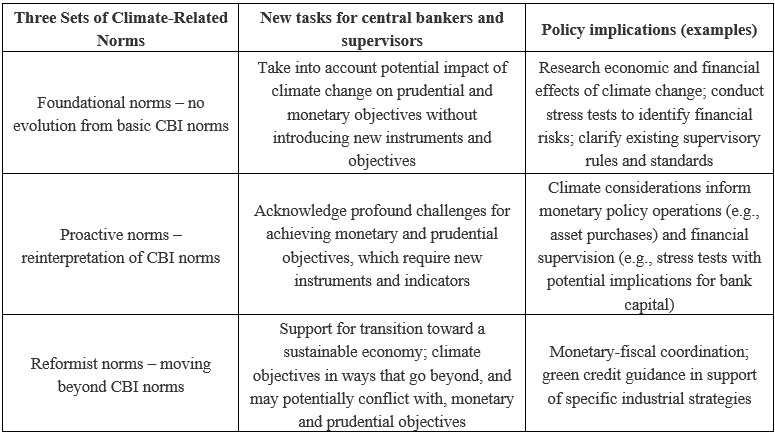
    This Fed–ECB divergence is particularly remarkable because of the otherwise dramatic convergence between central banks over the course of the past decades. Since the 1970s, central banks in the West have aligned around three key policy norms. First, that they should focus narrowly on price stability targets via managing interest rates. Second, that they should focus supervision on preventing excessive risk taking. And third, that central banks—independently from political influence—would avoid interfering in credit allocation or industrial policy. Both the ECB and the Fed have centered their climate strategies around risk management through tools like supervisory expectations and climate scenario analysis (or “stress tests”). However, while the Fed has adhered strictly to foundational climate policy norms, unwilling to step in any direction that might be perceived as actively influencing the relative cost or availability of credit, the ECB has instead pursued a proactive reinterpretation of what kinds of instruments and intermediate objectives are permissible to achieve its tasks (see Table 1). This has included the ambition to “gradually decarbonize” the ECB’s corporate bond portfolio, limit the share of high-carbon assets allowed to be pledged as collateral, and grading the quality of bank climate-risk management in determining Pillar 2 capital requirements. These policies are notable because they each have the potential to result in material shifts in the cost of credit for green and carbon-intensive activities.1These types of central bank actions are not a panacea, and still largely (<)a href='https://www.ucl.ac.uk/bartlett/public-purpose/sites/bartlett_public_purpose/files/kedward_gabor_ryan-collins_aligning_finance_with_the_green_transition_from_a_risk-based_to_allocative_green_credit_policy_regime.pdf'(>)leave the particulars(<)/a(>) of the pace and shape of a transition to private actors. Furthermore, they are (<)a href='https://www.greenpeace.de/publikationen/broken-promises-ecbs-widening-paris-gap'(>)limited(<)/a(>) in scope, i.e., the ECB is currently unwinding its corporate bond portfolio. In contrast, Fed chair Jermone Powell has said that he “would be very reluctant to see us move in that direction, picking one area as creditworthy and another not.” In our paper, we ask the question: what explains the new climate divergence?

    Table 1:  Three categories of climate-related norms

    Central banks, domestically and internationally

    To understand how central banks act in a given policy area, it’s important to understand their roles both as domestic and international actors. Within the above mentioned policy norms, central banks are insulated from direct political control, and are primarily directed by their legislated mandates. However, despite approaches in the central banking literature that have traditionally accepted these arrangements at face value, the reality is far more complex. Central bank mandates are often vague and include multiple objectives. They cannot speak explicitly to the vast array of circumstances modern central banks may find themselves dealing with, nor tell central banks which trade-offs to make in dealing with those circumstances. At the same time, central banks are subject to legislative oversight and their leaders are appointed by elected officials. As Joseph Stiglitz puts it, “There is no such thing as truly independent institutions. All public institutions are accountable, and the only question is to whom.” This was on full display in the wake of the 2008 Global Financial Crisis, when the Fed had its autonomy to conduct emergency lending programs reined in as part of the Dodd Frank reforms. It was an example of the ways in which domestic political context shapes how central banks undertake their mandated objectives and respond to new policy problems. 

    At the same time, central banks navigate uncertainty by developing norms collectively in transnational governance networks. Despite the fact that central banks operate like delegated agencies domestically, with a narrowly defined basis for legitimacy tied to their political authorities, they are also independently active in processes of global diplomacy, with substantial latitude to engage in agenda-setting in new areas of policy. Central banks regularly cooperate on economic policy, implement global financial legal frameworks, and routinely lend each other billions of dollars. Financial globalization has also created a practical need for international coordination and standardization. The main site for this is the Swiss Bank for International Settlements, in particular its Basel Committee on Banking Supervision, though more recently institutions like the NGFS can be counted among these. Through such networks, central banks develop a shared “logic of appropriateness”2March, James G., and Johan P. Olsen. 1998. “The Institutional Dynamics of International Political Orders.” (<)em(>)International Organization(<)/em(>) 52 (4): 943–69. about both the kinds of problems that they should address and technical knowledge about how to address them. 

    In our paper, we introduce a dynamic norm formation framework to describe the complex interactions over time between central banks’ domestic and international roles that shape central bank processes and narratives. We demonstrate that a favorable domestic political context around climate change set the stage for early action at the ECB, while domestic polarization initially prevented the Fed from addressing climate change. This changed as climate policy norms gained momentum among central banks through international forums like the NGFS.

    Channels of influence

    In Europe, action on climate change, both at the national central banks of the Eurosystem and at the ECB, has come in the context of broad domestic support for such measures. Crucially, central bankers were pushed forward both by legislative initiatives and by activist think tanks and NGOs that encouraged them to examine how climate change impacted their agendas. For example, the earliest articulation of foundational climate norms occurred outside the central banking community, with a 2011 report by NGO Carbon Tracker titled “Unburnable Carbon: Are the world’s financial markets carrying a carbon bubble?” European central banks also received pressure from government officials; the July 2015 Climate and Transition Law in France requested that the Banque de France produce a report on climate risk and climate stress tests. From 2016 onwards, the ECB came under pressure from these same actors to consider climate impact not only in supervision of risk, but also in monetary policy programs. While then-President Mario Draghi and other Governing Council members initially rejected these proposals, domestic politics rendered such a position difficult to maintain. In December 2019, the member states had agreed on the project of a European Green Deal and legally binding climate objectives set out in a European Climate Law. They had also appointed a new ECB president, Christine Lagarde, and several new board members, who initiated a review of the ECB’s monetary policy strategy that examined how to design instruments in light of climate change. These elements prompted the ECB, in turn, to increasingly move toward a more proactive approach. 

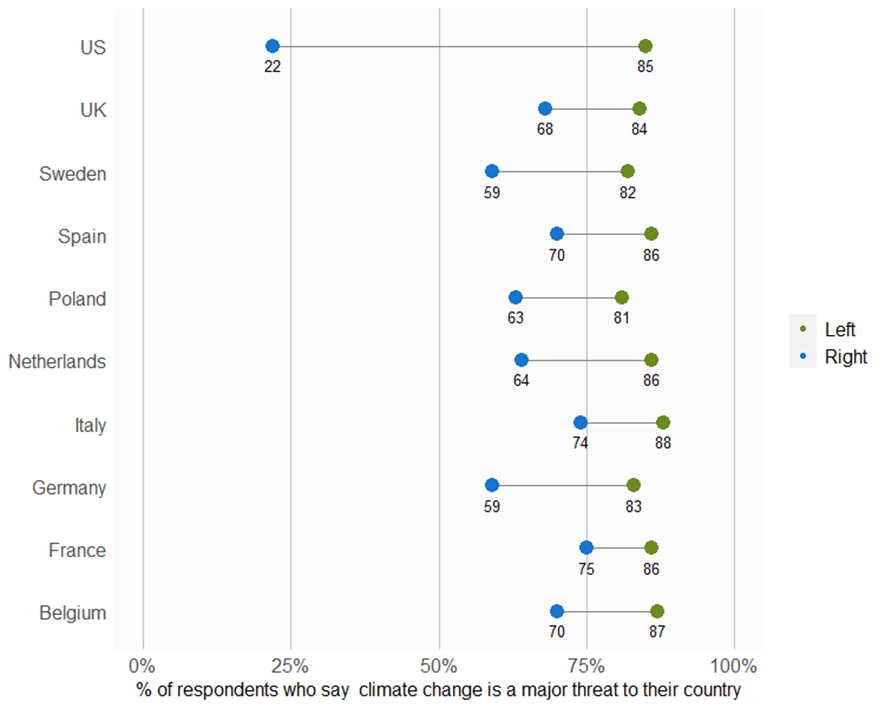
    In the US, on the other hand, there was near silence from the kind of domestic actors that turned out to be crucial in the European context. For example, the abovementioned Carbon Tracker report was widely read in the United States, but it did not translate into pressure on supervisors. Bill McKibben, a prominent American environmentalist, was key in amplifying this report in the US. However, he translated it into a campaign for college students to push their universities to divest from fossil fuels. The Fed also faced a highly polarized political environment on climate issues (Figure 2), even under the Obama administration.3 McCright, Aaron M., Riley E. Dunlap, and Chenyang Xiao. 2014. “Increasing Influence of Party Identification on Perceived Scientific Agreement and Support for Government Action on Climate Change in the United States, 2006–12.” (<)em(>)Weather, Climate, and Society(<)/em(>) 6 (2): 194–201. While these dynamics were already present ahead of Trump’s 2016 election, this development decisively froze the agenda. With the withdrawal of the US from the Paris Agreement in 2017, along with hostile domestic climate politics, there was little basis for the Fed to act. 

    Figure 1:  Public opinion on climate change from those who identify with the political left vs right, 2022

    Source: Authors’ graph, data from Pew Research Center 2022.

    However, growing attention to climate change on the international stage became difficult to ignore.  Though the election of President Biden at the end of 2020 substantially eased the domestic context, the Fed had, in fact, begun to devote attention to climate change at the beginning of 2019, while Trump was still in office. As Powell described in 2020, “…we are, you know, very actively, in the early stages of this, getting up to speed, working with our central bank colleagues and other colleagues around the world to try to think about how this can be part of our framework. And we’re watching what other—what other countries are doing.” Nonetheless, the Fed has remained conservative and continues to face a highly polarized domestic political context.

    This is clear when examining the influence of the fossil fuel lobby in Congress.4 Also see for example (<)a href='https://www.cruz.senate.gov/imo/media/doc/Letters/2020.04.07%20-%20Letter%20to%20Powell%20Mnuchin%20re%20CARES%20Act%20Implementation%20.pdf'(>)this(<)/a(>) and (<)a href='https://www.sec.gov/comments/s7-10-22/s71022-20131409-301574.pdf'(>)this(<)/a(>). In 2022, for example, Sarah Bloom Raskin withdrew her nomination to the Federal Reserve Board over Congressional climate objections, which drew on her earlier comment that regulators should “ask themselves how their existing instruments can be used to incentivize a rapid, orderly, and just transition away from high-emission and biodiversity-destroying investments.” Senator Joe Manchin (D-West Virginia), in opposing her nomination, stated that Raskin had “failed to satisfactorily address my concerns about the critical importance of financing an all-of-the-above energy policy to meet our nation’s critical energy needs.” His political opposition has been linked to the high level of influence of the fossil fuel industry in Congress: Manchin had at that time taken more money from fossil fuel interests than any other senator.5 Another explanation for the Fed’s divergence that has merit but is insufficient on its own is the Fed’s lack of secondary mandate to support government priorities, which the ECB possesses. However, the ECB only (<)a href='https://doi.org/10.1111/jcms.13406'(>)rediscovered(<)/a(>) its secondary mandate in 2021: in over 2,500 ECB speeches from 1997 until 2021, the secondary objective was mentioned in just 10. Furthermore, central bank mandates have historically been sufficiently elastic to accommodate new economic developments.

    It is unlikely this climate divergence will disappear entirely. Polarization on climate policy is deeply ingrained in US politics and the Fed will remain dependent on its government for ongoing autonomy and legitimacy. Now that the Fed is more actively participating in international climate initiatives, both at the NGFS and at the BCBS, a new question emerges: will the Fed act as a conservative force on other central banks’ climate actions? This question is not only relevant for a body like the NGFS, which produces knowledge and sets an agenda for central banks internationally, but will be especially salient for standard setting bodies like the BCBS, where central banks will need to come to a new climate consensus. 

  6. Sectoral Strategy

    Comments Off on Sectoral Strategy

    Industrial policy in Africa is back.1Behuria, P. (2021). The political economy of reviving industrial policy in Uganda. (<)em(>)Oxford Development Studies(<)/em(>), (<)em(>)49(<)/em(>)(4), 368-385.; Walter, M (2021) Industrial policy makes a comeback in Africa. (<)em(>)https://www.brookings.edu/articles/industrial-policy-makes-a-comeback-in-africa(<)/em(>) Beginning last January, Nigeria implemented the second phase of its “Sugar Master Plan,” a flagship industrial policy that, since 2013, has sought to stimulate domestic production—predominantly by offering various incentives to investors and by prohibiting refined sugar imports. Last month, Ghana extended a zero VAT policy on locally manufactured textiles, while Kenya announced plans to impose a 25 percent levy on imported clothes to revive its textile sector. This strategic investment is facilitating the country’s transition from merely producing cotton to becoming a significant exporter of textiles. These instances illustrate industrial policy—government strategies designed to promote industrial development or facilitate structural transformation—in action.

    Import substitution industrialization had once been popular in much of Africa, but from the 1980s state intervention models fell out of favor. Governments were advised by the World Bank and the International Monetary Fund to let market forces dictate development paths.2Mendes, A. P. F., Bertella, M. A., & Teixeira, R. F. (2014). Industrialization in Sub-Saharan Africa and import substitution policy. (<)em(>)Brazilian Journal of Political Economy(<)/em(>), (<)em(>)34(<)/em(>), 120-138. And so arrived neoliberalism in Africa, largely propelled by structural adjustment programs. Now, with the return of industrial policy on a grand scale, many are questioning whether, as in Europe and the US, neoliberalism may be coming to an end in Africa. 

    Several factors are driving the current resurgence. Key among them is the foreign exchange crisis that has intensified since 2015, leading central banks in many African countries to limit Forex availability for certain imports. This limitation inadvertently prompts domestic manufacture for substitute goods, which then receive support through instruments like credit facilities.3Oluikpe, P. I. (2020). Leveraging import substitution for economic expansion: the case of Nigeria. Bullion, 44(3), 1. Available at: https://dc.cbn.gov.ng/bullion/vol44/iss3/1. Elsewhere, China’s Belt and Road Initiative has sparked extensive infrastructure and investment projects. Many African countries have adapted their national strategies to capitalize on Chinese production investments, thereby crafting new industrial policies. The Covid-19 pandemic has further highlighted the importance of this strategic shift, emphasizing the need to cultivate local industries for critical sectors like pharmaceuticals and agro-processing.

    Finally, and perhaps most significantly, is the influence of newly prominent Diversified Business Groups like Nigeria’s Dangote Group. These conglomerates have been steering their national governments toward infant industry protection, import bans, subsidies, tax incentives, and the creation of Special Economic Zones and Industrial Parks. They also promote measures like public procurement and export promotion—quintessential industrial policy measures.

    ​​The revival of industrial policy in Africa coincides with transformative changes in intra-continental trade dynamics, notably the development of the African Continental Free Trade Area (AfCFTA). Although AfCFTA has for the most part been greeted as a positive development in Africa, I argue that it comes with substantial challenges as well. The AfCFTA seeks to encourage industrial policies by promoting the establishment of regional value chains, where different nations specialize in particular production stages.4Agreement Establishing the African Continental Free Trade Area (2018)(<)a href='https://au.int/sites/default/files/treaties/36437-treaty-consolidated_text_on_cfta_-_en.pdf'(>) https://au.int/sites/default/files/treaties/36437-treaty-consolidated_text_on_cfta_-_en.pdf(<)/a(>) see page 4 and page 36. But while the agreement is ambitious in many areas, it doesn’t necessarily align with domestic political ambition, which, it must be stressed, may hinder implementation. The coordination involved in organizing various phases of production across the region presents another challenge. I posit that strategic sectoral coordination—achieved through a negotiated division of labor among countries—can serve as an effective strategy to navigate these challenges, providing African nations with a clear pathway to leverage the AfCFTA for industrial development.

    Political realities

    The AfCFTA Agreement establishes a free-trade area uniting all fifty-five African Union member states, encompassing a market of over 1.3 billion people; in terms of the number of countries involved, it forms the largest free-trade area since the establishment of the WTO. The African Union has been pivotal in negotiating the agreement; its origins trace back to 2012 when the African Union Assembly of Heads of State and Government resolved to establish the AfCFTA to enhance intra-African trade. Negotiations commenced in 2015, and the agreement was signed in 2018. The primary aim of the AfCFTA is to forge a unified market for goods and services, underpinned by the free movement of persons to intensify the economic integration of the African continent. More precisely, the State Parties are committed to gradually removing tariffs and non-tariff barriers, liberalizing trade in services progressively, collaborating on investment, intellectual-property rights, and competition policy, engaging in all trade-related areas, cooperating on customs issues, and implementing trade facilitation measures. Furthermore, they agree to establish a dispute settlement mechanism to adjudicate their rights and obligations and to create and sustain an institutional framework for the AfCFTA’s implementation and administration.5 Agreement Establishing the African Continental Free Trade Area (2018) https://au.int/sites/default/files/treaties/36437-treaty-consolidated_text_on_cfta_-_en.pdf

    Though the AfCFTA Agreement officially commenced trading on January 1, 2021, actual trade has not yet occurred, pending the finalization of some protocols. Nevertheless, the AfCFTA has catalyzed the development of key mechanisms: it has established institutional structures that include an Assembly, a Council of Ministers, and a Secretariat headquartered in Accra, Ghana. It has introduced the AfCFTA e-Tariff Book, in line with digitalization and trade facilitation objectives; the Pan-African Payment and Settlement System, created in collaboration with the African Export-Import Bank to streamline intra-AfCFTA payments; an online platform to report non-tariff barriers, which assists in identifying and eliminating trade obstacles across the continent; and the AfCFTA Adjustment Fund, conceived to support countries with the adoption and implementation of the agreement’s stipulations.

    Research on the AfCFTA often overlooks the complex political dynamics within distinct African countries, assuming that complete implementation and compliance are possible when they may in fact not be. For instance, a 2022 World Bank study forecasts that the AfCFTA could boost Africa’s exports by $560 billion, mainly in manufacturing through regional value chains. It could also lift 30 million Africans from extreme poverty, improve the livelihoods of 68 million people earning less than $5.50 a day, and by 2035, increase wages for unskilled workers by 10.3 percent and for skilled workers by 9.8 percent.6 World Bank. (2020). The African Continental Free Trade Area: Economic and Distributional Effects (Washington DC: World Bank)

    Additionally, the agreement is projected to raise Africa’s income by $450 billion by 2035, a 7 percent gain, with a $76 billion income boost for the rest of the world. The agreement is expected to yield larger wage gains for women (10.5 percent) compared to men (9.9 percent). However, these projections are based on the assumption of absolute compliance with tariff liberalization and trade facilitation, including the complete removal of red tape and streamlining of customs procedures. Such assumptions fail to acknowledge that the inefficiencies targeted by the AfCFTA are entrenched in the local political landscapes, which often overshadow regional objectives. Consequently, previous regional efforts like the establishment of mechanisms for reporting, monitoring, and eliminating non-tariff barriers have not succeeded due to local political interests.

    For instance, the Republic of Benin depends significantly on an informal entrepôt trade system which thrives on importing goods and informally smuggling them into Nigeria, particularly when Nigeria enacts protectionist policies on products like poultry, used cars, and rice.7Golub, S. S. (2012). Entrepot trade and smuggling in West Africa: Benin, Togo and Nigeria. The World Economy, 35(9), 1139-1161. Benin capitalizes on these moments by importing these items in large quantities and smuggling them into Nigeria. Despite its illegality, this trade accounts for roughly 20 percent of Benin’s GDP and holds substantial economic importance for the West African nation’s political elites. For instance, the current president of Benin, Patrice Talon, has a vested interest in this system as his company he owns handles port logistics, which benefits from the entrepôt system and thus a significant revenue stream for the country. Similarly, his main political rival, Sébastien Ajavon, often referred to as the “king of chicken” (due to his dominance in the chicken import market) also benefits from the current system. It is unlikely that political elites would dismantle such a lucrative system essential to their political and economic influence. Similarly, in many African nations, certain non-tariff barriers and inefficiencies are maintained by ruling elites as mechanisms to generate resources critical for their political survival.

    Coordinating regional value chains

    In tandem with the new industrial policies, the AfCFTA is meant to expedite the formation of regional production chains within Africa.8Agreement Establishing the African Continental Free Trade Area (2018)(<)a href='https://au.int/sites/default/files/treaties/36437-treaty-consolidated_text_on_cfta_-_en.pdf'(>) https://au.int/sites/default/files/treaties/36437-treaty-consolidated_text_on_cfta_-_en.pdf(<)/a(>) see page 4 and page 36. Yet such production chains, be they global or regional value chains, rarely emerge through market forces alone. They are typically the result of strategic choices and deliberate actions by “lead firms.” These firms hold a central role, coordinating the production chain with authority, determining the particulars of production processes, including task assignments, cost parameters, adherence to standards, meeting specifications, and delivery timelines.9Ponte, S., Gereffi, G., & Raj-Reichert, G. (2019). Introduction to the handbook on global value chains. In Handbook on global value chains. Edward Elgar Publishing. The absence of lead firms complicates the organization of production; indeed, various coordination failures have surfaced among African nations attempting to foster regional value chains without a central entity to guide the process. To delve deeper into this issue, we must address the essential aspect of the value chain: the organization of production processes. 

    In Africa, the absence of regional lead firms in some sectors has led to coordination failures. For instance, in East Africa, the Kenyan government implemented protective measures against Ugandan raw milk due to Uganda’s cost advantage, despite the fact that Kenya’s dairy processing firms, including confectionery businesses, could benefit from such cost efficiencies.10​​EPA Monitoring (2020) “East African Dairy Sector Trade War Continues to Simmer”(<)a href='https://epamonitoring.net/east-african-dairy-sector-trade-war-continues-to-simmer/'(>) https://epamonitoring.net/east-african-dairy-sector-trade-war-continues-to-simmer/(<)/a(>) Moreover, Kenya has barred maize imports from Uganda and Tanzania, even though maize has a critical role in various production chains like milling, stockfeed production, ethanol, corn starch, and syrup manufacturing.11The Independent (2021) “Kenya’s ban on Uganda, Tanzania maize threatens EAC treaty”(<)a href='https://www.independent.co.ug/kenyas-ban-on-uganda-tanzania-maize-threatens-eac-treaty/'(>) https://www.independent.co.ug/kenyas-ban-on-uganda-tanzania-maize-threatens-eac-treaty/(<)/a(>) Despite the EAC’s commitment to free trade, inter-sectoral complementarity is scant, largely due to the absence of regional lead firms to oversee production organization.

    West Africa presents another example. Nigeria recently enacted a policy to encourage domestic tomato paste production by limiting canned tomato imports and promoting local canning investments. The expectation was that these facilities would utilize tomatoes from both local and regional growers to create a regional value chain. Nonetheless, as Nigeria pursued this policy, other West African countries also sought to develop their tomato processing industries, relying on both local and regional tomato supplies. This led to a notable dilemma: a surge in processing capacity across the region, juxtaposed with a shortage of tomatoes for processing. For instance, a Nigerian investor had to suspend operations of a new facility with a daily capacity of 1,200 tons due to a lack of raw tomatoes—a challenge echoed throughout the region.12Adamu, M. (2021) “Billionaire Dangote Can’t Get Enough Tomatoes to Run Plant Profitably” (<)a href='https://www.bloomberg.com/news/articles/2021-07-09/tycoon-dangote-can-t-get-enough-tomatoes-to-run-plant-profitably#:~:text=The%20Dangote%20plant%20sought%20to,of%20storage%20and%20processing%20facilities'(>) https://www.bloomberg.com/news/articles/2021-07-09/tycoon-dangote-can-t-get-enough-tomatoes-to-run-plant-profitably#:~:text=The%20Dangote%20plant%20sought%20to,of%20storage%20and%20processing%20facilities(<)/a(>) These cases highlight a critical point: the inherent complementarity in production, crucial to regional value chains, does not manifest without concerted coordination and the alignment of national industrial efforts.

    In sectors where African countries have established lead firms, we observe meticulously coordinated regional value chains under their guidance. Telecommunications, one of the most rapidly evolving sectors in Africa, characterized by extensive fintech innovation and significant capital investments, serves as a prime example. Prominent telecom companies possess the capacity to govern their respective chains. The MTN Group, Africa’s premier mobile network operator and the world’s eighth largest, spearheads a supply chain encompassing various facets such as infrastructure, network/IS operations, and commerce. This expansive chain covers over fifty contracted activities, from producing installation materials like network masts and microwave communication dishes to software testing programs and radio planning.13MTN SA (2016) “MTN Presentation ICT SMME Workshop” (<)a href='https://slideplayer.com/slide/10271047/'(>) https://slideplayer.com/slide/10271047/(<)/a(>) Given its presence in seventeen countries, each with distinct market dynamics, MTN has found it essential to establish a continental chain. Currently, MTN oversees more than 2,000 critical supply projects, collaborating with over 300 suppliers across Africa, and managing orders valued at billions solely within the continent. While some of these suppliers are opportunistic, others are targeted. Additionally, several regional suppliers also cater to other telecom giants like Safaricom in Kenya and Globalcom in Nigeria. 

    The cement industry offers another instance of lead firms coordinating regional production. Notable entities like Nigeria’s Dangote and Morocco’s CIMAF operate across multiple regions, with each firm overseeing a regional production chain in numerous African countries without any coordination failure. Pioneering lead firms akin to Dangote Cement and MTN emerges as the most pragmatic approach to constructing regional supply chains and actualizing the objectives of the AfCFTA, particularly for chains catering to regional markets.14Odijie, M. E. (2020). Is traditional industrial policy defunct? Evidence from the Nigerian cement industry. Review of International Political Economy, 27(3), 686-708 However, since African countries possess few lead firms capable of coordinating production, intentional coordination via sectoral negotiations is necessary.

    Sectoral coordination

    It’s unlikely that all African countries will fully implement every provision of the AfCFTA. There is, however, the potential for sector-specific policies within the framework that could support the development of regional value chains. These sector-focused strategies could align with the domestic political landscape, as not all industries are deeply intertwined with local politics in every country. Regional industrial policies should be based on coordination in chosen sectors, as opposed to a comprehensive liberalization that could conflict with various local political climates.

    Sectoral coordination between countries involves the deliberate negotiation of industrial and production policies to address local political challenges and coordination issues that stem from the absence of lead firms. For example, consider the industrial rice value chain. Subject to regional negotiations, it would involve segments like input supply—such as seeds, fertilizers, pesticides, irrigation, and machinery—paddy farming, logistics for collection, and processing activities like milling, grading, sorting, and packaging. Nations facing political challenges in this sector could choose to opt out, or they could leverage their political climate to negotiate a beneficial position, an option less feasible under a comprehensive free trade agreement that is not sector-specific. Such a deliberately negotiated division of labor would perform the role traditionally held by a lead firm by deciding who should produce what. 

    Countries can strategically determine and capitalize on specific niches within a sector based on their unique resource endowments and political landscapes. Consequently, sectoral industrial policies can be precisely tailored and coordinated with the choices of neighboring countries. Continuing with the industrial rice value chain example, a country opting to focus on paddy production must enact paddy-centric policies and cultivate trade networks for collection logistics, or with countries specializing in processing, which should, in turn, develop policies conducive to processing activities. Facilitating negotiations on production processes allows freer trade on the value chain to emerge organically, as opposed to free trade as a prescriptive goal without practical underpinnings. The benefit of a negotiated division of labor is its ability to minimize competitive overlap and foster synergy among nations. This approach can potentially mitigate trade disputes and encourage the development of industrial policies that align with each nation’s designated role in the value chain.

    The AfCFTA and industrial policy

    The weak implementation of free trade policies across the continent, despite stated commitments to the contrary, testifies to the flawed assumptions of the broad liberalization paradigm. While specialization has the potential to harmonize sectoral policies between nations, such coordination requires a reevaluation of the AfCFTA, and in particular, the notion that market forces alone will spur regional value chains. At certain points, two central objectives—implementing domestic industrial policies and expanding trade between African nations—may conflict. While the AfCFTA strives for comprehensive liberalization, sectoral coordination could lead to selective liberalization. Given that the AfCFTA vision of organic, market-led regional value chains may be stifled by the absence of lead firms, sectoral coordination involves a more collective and negotiated approach.

    The AfCFTA presents a unique opportunity for African states to tailor their industrial policies at the sectoral level, rather than implementing blanket liberalization. Opting for selective liberalization and establishing robust regional value chains through a negotiated division of labor could alleviate tensions within the elite networks and policy agendas of distinct counties.  A negotiated division of labor can foster an increase in intra-African trade and provide investment clarity. Achieving this economic transformation in several African nations would consolidate the return of state intervention, while promoting prospects for regional integration. 

  7. Industrial Experiments

    Comments Off on Industrial Experiments

    The turn of the twenty-first century brought a reassessment of development economics. The global commodity boom of the 2000s ushered in windfall profits for resource-rich countries in the global South, and with them came new agendas for growth. In 2002, economists like Dani Rodrik were hailing the decline of political support for the Washington Consensus and wondering what would come after neoliberalism.1Rodrik, Dani. “After Neoliberalism, What” In (<)em(>)New Rules for Global Finance Coalition(<)/em(>). 2002. https://drodrik.scholar.harvard.edu/files/dani-rodrik/files/after-neoliberalism-what.pdf; Rodrik, Dani, “Goodbye Washington Consensus, Hello Washington Confusion? A Review of the World Bank’s Economic Growth in the 1990s: Learning from a Decade of Reform.” (<)em(>)Journal of Economic Literature(<)/em(>) 44 (2006): 973–87.

    The 2008 financial crisis and the economic disruption of the Covid-19 pandemic underlined the question for governments of the global North. But the record of neoliberalism was always patchier in the South—successful, arguably, as a crisis mitigation strategy, it failed as a coherent program for long-term growth and economic stability. Along with the political rejection of neoliberal globalization, the demand for more interventionist state policy spread across the global South. Mineral-rich states pursued “resource nationalism.” Across Latin America, a “new developmentalism” was being pursued. Industrialization and structural transformation returned to the development policy agenda.2Aiginger, Karl, and Dani Rodrik. “Rebirth of Industrial Policy and an Agenda for the Twenty-First Century.” (<)em(>)Journal of Industry, Competition and Trade(<)/em(>) 20, no. 2 (2020): 189–207. https://doi.org/10.1007/s10842-019-00322-3; Bresser-Perreira, Luiz Carlos. “O Novo Desenvolvimentismo e a Ortodoxia Convencional.” (<)em(>)São Paulo Em Perspectiva(<)/em(>) 20, no. 3 (2006): 5–24; Nem Singh, Jewellord T. 2019. “Natural Resources.” In (<)em(>)Handbook of Contemporary International Political Economy(<)/em(>), edited by Timothy Shaw, Laura Mahrenbach, Craig Murphy, Renu Modi, and Xu Yi-Chong, 539–57. London: Palgrave Macmillan, 2019. The “advance of the state” in China3Eaton, Sarah. (<)em(>)The Advance of the State in Contemporary China: State-Market Relations in the Reform Era(<)/em(>). Cambridge, UK: Cambridge University Press, 2016. presented another decisive challenge to the Washington Consensus and an alternative growth strategy that emphasizes the centrality of export manufacturing to industrial upgrading, and, more critically, the importance of strategic state control to create a new productive basis for a national economy.

    For development economists, the proliferation of state-led industrial policy across the global South in recent decades holds a crucial lesson: there is not one path to economic transformation. Rather than prescribing a fixed developmental strategy, we ought to encourage experimentation and adaptation—with sensitivity to the inherited institutional, social, and economic infrastructure in a given policy-making environment.

    Moving away from “one size fits all”

    The aspiration towards structural transformation has been persistent among middle-income economies across Latin America and East Asia. The model for such an achievement has been largely borrowed from the newly industrializing countries (NICs) of the late twentieth century, who gained success through promoting domestic champions, capturing value addition in globalized supply chains of production, and developing indigenous technological innovation. South Korea and Taiwan built their globalized companies like Samsung and TSMC by promoting specific sectors and establishing tightly woven relationships with leading domestic firms. In South Korea, the state industrialized by shifting from labor-intensive textile and apparel in the 1960s towards heavy capital–notably ship-building—and “high tech” semiconductors—since the mid-1970s.4Hogan, William T. SJ. (<)em(>)The POSCO Strategy: A Blueprint for World Steel’s Future(<)/em(>). Lanham: Lexington Books, 2001; Kim, Hyung-Kook. (<)em(>)Between State and Market: Industrial Adjustment Strategy in Korea(<)/em(>). Seoul: Beebong Publishing, 1993. Similar to East Asia, Brazilian elites developed a distinctive state capacity to coordinate industrial sectors, create corporatist relationships with organized business and labor, and successfully align state-led finance with experimental policies for sectoral promotion.5Massi, Eliza. “The Political Economy of Development Finance: The BNDES and Brazilian Industrialisation.” PhD Dissertation, London: School for Oriental and African Studies, University of London, 2014; Massi, Eliza, and Jewellord T. Nem Singh. “Industrial Policy and State-Making: Brazil’s Attempt at Oil-Based Industrial Development.” (<)em(>)Third World Quarterly(<)/em(>) 39 no. 6 (2018): 1133–50. https://doi.org/10.1080/01436597.2018.1455144. Despite neoliberal reforms, for example, Brazil maintained its domestic content requirement laws in the oil and gas industry, generating substantive research and development (R&D) investments and development of domestic firm capabilities.6Massi and Nem Singh; Priest, Tyler. “Petrobras in the History of Offshore Oil.” In (<)em(>)New Order and Progress: Development and Democracy in Brazil(<)/em(>), edited by Ben Ross Schneider, 53–77. Oxford: Oxford University Press, 2016.

    Some of these reforms have been more successful than others. In response to the changing global political economy of automotive manufacturing, Thailand became an assembly hub for cars through an extensive growth strategy, while Korean chaebols became global automakers with world-class engineering and design capabilities.7Doner, Richard F., Gregory W. Noble, and John Ravenhill. (<)em(>)The Political Economy of Automotive Industrialization in East Asia(<)/em(>). New York: Oxford University Press, 2021. Korea, a typical example of an intensive growth strategy, combined its capacity for technological innovation with participating strategically in global supply chains. 

    Drawing on the Korean example, middle-income countries have increasingly begun to introduce intensive growth strategies in emerging key industries to overcome the middle income trap. In 2014, Indonesia introduced a ban on raw nickel exports to increase value in the mineral supply chain and induce an investment regime for domestic processing facilities. The policy aims to increase the participation share of Indonesian companies in mineral processing and to create more linkages with technology-intensive sectors, such as battery production and electric vehicles. While the mining policy by itself does not constitute an industrial strategy, building economic linkages among interrelated sectors signals the position of the mining industry as a pillar of structural transformation. With the export ban, Indonesia saw an increase in foreign direct investment (FDI) on nickel processing and export value (see Figure 1). Following on early successes in nickel, under the National Development Plan the government has extended the downstreaming policies to other minerals, such as copper, bauxite, tin, and agricultural commodities. This policy will be supported by the construction of smelters that focus on nickel (twenty-two smelters), bauxite (five smelters), iron (two smelters), lead (one smelter), and copper (one smelter).8Republic of Indonesia. “The National Medium-Term Development Plan for 2020-2024 (Appendix to Presidential Regulation No. 18 of 2020).” Republic of Indonesia, 2020. https://perpustakaan.bappenas.go.id/e-library/file_upload/koleksi/migrasi-data-publikasi/file/RP_RKP/Narasi-RPJMN-2020-2024-versi-Bahasa-Inggris.pdf.

    In a June 2023 Assessment Report by the IMF, FDI increased by 47 percent in 2022, mostly related to the downstream segment with China and Hong Kong accounting for almost half of the investments. Several foreign investors have built smelters in the remote provinces of Central Sulawesi and North Maluku, with some raising equity on the Jakarta stock exchange. Investment realization in nickel and bauxite smelters during 2021–22 has reached about US$5.5 and US$3 billion respectively, though broader reforms concerning labor market efficiency, infrastructure, and financial deepening remain recommended.

    Figure 1: Performance of Nickel Industry in Indonesia

    Source: International Monetary Fund

    China’s new industrial policy

    Despite the importance of the South Korean example, its various applications demonstrate that a template for industrial policy neither exists nor is desirable. China’s industrial policy development is emblematic of this view: built through experimentation, Chinese industrial policy drew from the experiences of both the Soviet-style public enterprise regime and the centralized, state-driven sectoral development observed in East Asian developmental states. China’s institutional configurations were products of a co-evolution between states and markets, whereby the establishment of complementary institutions in response to external changes was key.9Ang, Yuen Yuen. (<)em(>)How China Escaped the Poverty Trap(<)/em(>). Ithaca: Cornell University Press, 2016; Chen, Ling, and Buhe Chulu. “Complementary Institutions of Industrial Policy: A Quasi-Market Role of Government Inspired by the Evolutionary China Model.” (<)em(>)Third World Quarterly(<)/em(>) (November 2022): 1–16. https://doi.org/10.1080/01436597.2022.2142551.

    “Made in China 2025,” China’s industrial strategy, deploys multiple policy instruments: tax preferences to incentivize foreign companies to move their R&D programs to China; formal regulations and informal certification schemes requiring foreign companies to partner with Chinese firms into joint ventures; extensive use of state funding known as government guidance funds (GGFs) to support domestic R&D spending and overseas acquisition; funding of strategic acquisitions of assets to building Chinese firm capabilities; and foreign technology and equipment acquisition especially from US-led technology companies to fill in existing gaps in Chinese technological capabilities/10Levine, Derek Adam. “Made in China 2025.” (<)em(>)Journal of Strategic Security(<)/em(>) 13, no. 3 (2020): 1–16; Malkin, Anton. “The Made in China Challenge to US Structural Power: Industrial Policy, Intellectual Property and Multinational Corporations.” (<)em(>)Review of International Political Economy(<)/em(>) (October 2020): 1–33. https://doi.org/10.1080/09692290.2020.1824930; (Levine 2020; Malkin 2020; Wen, Huwei, and Zhao Zhao. “How Does China’s Industrial Policy Affect Firms’ R&D Investment? Evidence from ‘Made in China 2025’.” (<)em(>)Applied Economics(<)/em(>) 53, no. 55 (2021): 6333–47. https://doi.org/10.1080/00036846.2020.1717429; Yeung, Godfrey. “‘Made in China 2025’: The Development of a New Energy Vehicle Industry in China.” (<)em(>)Area Development and Policy(<)/em(>) 4 no. 1 (2019): 39–59.

    Figure 2: Domestic Content Goals under Made in China 2025 Plan

    Source: US-China Business Council, cited by the Congressional Research Service.
    Note: Target dates for domestic content goals range from 2020 to 2030.

    The policy reserves a central role for the state in increasing the participation share of national champions, whether domestic companies or state-owned enterprises, in manufacturing supply chains. It aims to strengthen the Chinese export manufacturing sector through continuous investment in research and development (R&D) and gradual technological advancement to move up the hierarchy of global value chains. Crucially, it seeks to combine sector-specific interventions—such as demand creation and risk-taking in high-tech, infrastructure, and capital-intensive industries—with incentives for businesses to expand markets overseas. During the 1990s and 2000s, Chinese policy experimentation was achieved through coordinated planning and a focus on creating economic competition among firms and political competition among regional elites to build FDI-conductive regimes within China.11Ang 2016; Qian, Yingyi. (<)em(>)How Reform Worked in China: The Transition from Plan to Market(<)/em(>). Cambridge, MA: MIT Press, 2017. After 2016, the deployment of subsidies to inject capital into joint ventures, promotion of state-sanctioned mergers and acquisitions in critical minerals sectors like rare earths elements (REEs), and active support for technological upgrading to concentrate processing and refining technologies in lithium, REEs, and other metals have also emerged as key strategic aims. In strengthening China’s hold on the critical minerals sector, the supply chains of energy transition metals have become concentrated in the hands of Chinese states and companies, fueling Western countries’ anxiety as they became heavily dependent on minerals extraction from China.12Nem Singh, Jewellord T. “Mining Our Way out of the Climate Change Conundrum? The Power of a Social Justice Perspective.” Latin America’s Environmental Policies in Global Perspective. Washington, D.C.: The Wilson Center, 2021; Nem Singh, Jewellord T. . “The New Geographies of Energy Transition: A Developmental Opportunity or Challenge for Latin America?” In (<)em(>)Beyond Extractivism: Scenarios and Lessons from Latin America(<)/em(>), edited by Henry Veltmeyer and Arturo Ezquero-Cañete, 142–58. London and New York: Routledge, 2022.

    Failures and successes

    Both China and South Korea demonstrate the importance of path-dependent circumstances in shaping industrial policy trajectories. Successful industrialization requires a comprehensive understanding of national political contexts, identifying how available policy instruments can support export promotion, and promoting state capacity to mobilize domestic resources for sectoral development. Apart from building institutional capacities such as a professional bureaucracy and centralized regulatory agencies for economic planning—what Vu calls a strong “developmental structure”—political leadership or “developmental will” is also significant in contexts where insulated bureaucracies are untenable. Although states choose intensive or extensive growth strategies depending on their political contexts, both strategies still require institutions capable of coordinating multiple agents who hold resources to be mobilized for specific policy objectives like technological learning. Similarly, in contemporary China, coordination policies for sectoral investment have been achieved through centralized regulatory agencies, for example through the State-Owned Assets Supervision and Administration Commission (SASAC) for public enterprises.13Chen, Zhiting, and Geoffrey C. Chen. “The Changing Political Economy of Central State-Owned Oil Companies in China.” (<)em(>)The Pacific Review(<)/em(>) (October 2019): 1–26. https://doi.org/10.1080/09512748.2019.1679229. Apart from creating relatively autonomous institutions, political leadership can demonstrate resolute commitment by ensuring expertise and technical capacity in these agencies can be sustained for continuity in policymaking. Without a knowledge base and ability for sectoral development, industrial policies not only encounter resistance from outside but can easily be hampered by the lack of sufficient knowledge on how to resolve coordination problems to induce domestic firms becoming more competitive.

    External factors also figure prominently among the conditions for successful industrialization. In the Korean electronics industry, Japanese firms’ decisions to move investments in Korea and then Southeast Asia have played a decisive role in creating opportunities for technological learning among Korean companies via joint ventures.14Castley, Robert J. “The Korean Electronics Industry: The Japanese Role in Its Growth.” In (<)em(>)Korean Businesses: Internal and External Industrialization(<)/em(>), edited by Chris Rowley and Johngseok Bae, 29–47. London and Portland: Frank Cass, 1999. By 1980, the degree of foreign domination in electronics declined as chaebols participated in the production of consumer electronics. Although leading Korean firms with sizable electronic affiliates kept their ties with larger Japanese companies, joint ventures and outsourcing enabled Samsung, Daewoo, and others to build a production network linking smaller domestic companies onto the supply chain. For developing countries, it is imperative that their trade and investment strategies are aligned with countries where lead firms are likely to shape the trajectory of the supply chain. Alternatively, as in the case of Indonesia, they can maintain strategic autonomy through an open globalization strategy to effectively engage with opportunities brought by geopolitical competition. 

    Geopolitical factors have hugely influenced state decisions to pursue industrial policy. For East Asia, systemic vulnerability took the form of realistic possibilities of a war or invasion, as in the case of Korea and Taiwan, and expulsion from the Malaysian Federation for Singapore. For others, elites constructed threats as a way of generating an internal logic of state coherence, or as a means to forge social cohesion especially in the context of strong opposition, as the case of communism in Brazil and the rest of Southeast Asia vividly demonstrate.15Hendley, David. (<)em(>)Asia-Africa Development Divergence: A Question of Intent(<)/em(>). London: Zed Books Ltd, 2015; Slater, Dan. (<)em(>)Ordering Power: Contentious Politics and Authoritarian Leviathans in Southeast Asia(<)/em(>). Cambridge Studies in Comparative Politics. Cambridge: Cambridge University Press, 2010. https://doi.org/10.1017/CBO9780511760891.

    In the 2000s, Latin American countries pursued resource-based industrial policy at the back of a resource commodity boom, justifying state intervention as necessary to maximize mineral revenues capture and to strengthen the role of public enterprises in the context of volatile and cyclical commodity prices.16Nem Singh 2019. These efforts have been encouraged by the growing demand for so-called “critical minerals.” Apart from the raw nickel ban in Indonesia, battery production for electric vehicle (EV) cars and green infrastructure require lithium and cobalt—both of which are concentrated in Latin America and Africa.

    Chile, the largest lithium producer, has set out a nationalization plan aimed at creating a public enterprise for joint ventures. In this policy, the state ambition is to increase mineral processing within Chile and enhance the possibility for Chilean companies to participate in the battery supply chain. Moving away from Chile’s traditional view of neoliberalism, economic linkages are seen as the answer to escape raw material dependence and participation in low value-added activities. Although Chile will fall short in designing a comprehensive industrial policy on lithium, state ownership—as it has happened in copper in the twentieth century—plays a vital role in enhancing its capacity as a mineral producer to maximize the benefits from the current scramble for resources. 

    Policy adaptation as a globalization strategy

    Countries across the global South face an uphill battle to industrialize effectively. Growing protectionism in advanced industrialized countries poses a key challenge for developing countries whose export earnings depend on their capacity to access lucrative markets abroad. For example, the Critical Raw Materials (CRM) Act passed in the European Union (EU) aims to increase the extraction and processing capabilities of European firms within the region. As part of its geopolitical strategy, the EU has used trade agreements to secure minerals from third countries while simultaneously investing heavily on manufacturing and processing capacities. Such policies might contravene efforts by mineral producers to increase value-added activities as they attempt to incorporate their exports into the supply chain of clean energy technologies. Through its regulatory powers for compliance, the EU has also been seeking to establish a “club of like-minded countries” to strengthen supply chain resilience, thereby using its single market as leverage to promote its own environmental standards.17Senior Official, European Commission Directorate for Environment, Roundtable, “The State of Play for Critical Mineral Policies”, Berlin Climate and Security Conference”, Berlin, October 6, 2023. However, what remains uncertain is the degree to which non-compliance can penalize mineral producers especially in the context where critical minerals are perceived to be in short supply given the trajectory of green infrastructure for the clean energy transition. In other words, the advance of industrial policy in the global North might have uneven effects in the developing world. 

     China’s shift from multi-billion infrastructure spending through the Belt and Road Initiative (BRI) towards “small but beautiful” projects is also likely to hamper resource flow towards the global South. Those African, Asian, and Latin American countries that have received substantial support from China through a combination of Chinese FDI and development cooperation programs may need to recalibrate their expectations, and therefore their industrial plans, given the shrinking financial support available in the post-2022 context. This, in turn, might also require ensuring their industrial policy is flexible and pragmatic to avoid the excesses of state-led growth often associated in the past failed attempts at structural transformation.  

    In both its successes and failures, the re-emergence of industrial policy initiatives demonstrates the need to do away with a one-size-fits-all approach to economic development. Instead, close attention to inherited domestic infrastructures and changing international circumstances must inform our understanding of economic transformation.

  8. The Doom Loop

    Comments Off on The Doom Loop

    Recent coverage of insurance markets has highlighted the industry’s involvement in the so-called “climate risk doom loop”: looming climate risks and worse disasters are raising the price of insurance for real estate and infrastructure assets, exacerbating their owners’ vulnerability to future disasters and feeding into higher insurance prices in the future―or the withdrawal of insurance coverage altogether.

    Rising insurance prices and the credible threat of insurer divestment from higher-risk areas will constrain investment in both homes and businesses across vulnerable communities. Yet more people are moving into higher-risk areas, and some politicians fear backlash if they let insurance companies deny these communities coverage. In response, state leaders in California and Florida have sought to prevent divestment by directing their insurance commissioners to adjust pricing regulations, invite competition in insurance markets, or derisk insurers by imposing disaster-risk fees on all insurance purchasers regardless of risk.

    Private investors, meanwhile, believe the insurance industry should follow price signals: if firms can identify the climate risks an assets could face, and investors price those risks into building and maintaining costs, then market actors will invest prudently. 

    I argue that insurance is a woefully inadequate financial tool for coping with the impacts of climate change. Improving insurance markets does little to address the fact that the core drivers of the “climate risk doom loop” rest in the design of capital markets, which are structured to direct investment away from vulnerable communities when they most need it.

    Coverage gaps

    Insurance companies profit from the difference between the amount customers pay for protection against loss and the amount they pay out in case of the few losses that occur.1A simple way to describe insurance goes something like this: lots of people face a common risk, like a car crash, with some small chance that this event actually happens to them. Importantly, a risk like a car crash will(<)em(>) (<)/em(>)impose a huge financial burden on most people. So everyone pays an insurance company a small amount monthly, and, in return, in the event that a payee gets in a car crash, the insurance company pays for the damages they faced. The insurance company makes money off the spread between (1) regular payments from everyone, most of whom do not get into car crashes, and (2) the cost of damages incurred by the few people who did get in a car crash.  Climate change closes this spread: everyone faces a similar set of possible disasters, the risks of which are rising every year.2The incentives are complicated. Some insurance companies fail to cover certain kinds of flood and storm damages and sometimes (<)a href='https://grist.org/economics/what-happens-when-americas-flood-insurance-market-goes-underwater/'(>)pretend(<)/a(>) that certain damages were caused by pre-existing issues and not by disasters. Still, there is only so much corner-cutting that can cut costs. Furthermore, by propping up fossil fuel assets, insurance companies are worsening this trend. As Lois Parshley at Grist puts it, insurers have started paying dearly for increasingly frequent disasters:

    Insured losses from natural disasters in the US now routinely approach $100 billion a year, compared to $4.6 billion in 2000. As a result, the average homeowner has seen their premiums spike 21 percent since 2015. Perhaps unsurprisingly, the states most likely to have disasters—like Texas and Florida—have some of the most expensive insurance rates. That means ever more people are forgoing coverage, leaving them vulnerable and driving prices even higher as the number of people paying premiums and sharing risk shrinks.

    Insurers usually buy insurance for themselves from multinational reinsurance companies, which can spread risk geographically. But, as Parshley notes, “this vicious cycle also increases reinsurers’ rates. Reinsurers globally raised prices for property insurers by 37 percent in 2023, contributing to insurance companies pulling back from risky states like California and Florida.” 

    The result is a massive “coverage gap” in disaster-prone areas. Climate risk analytics firm risQ judges that less than 10 percent of US single-family residential flood risk is insured by the National Flood Insurance Program, a federally backed flood insurance policy; except in census tracts with the absolute highest flood risk, a binary “in or out” flood risk designation system ends up excluding most lower-income households from access to this federal assistance. The nationwide coverage gap has seen uninsured losses from catastrophes consistently dwarfing insured losses:

    Figure 1: The coverage gap in 2022

    Insurance markets thus illustrate the correlated and compounding nature of climate risks. As carbon emissions continue to accumulate, more people are put at risk of climate disaster, while the damages from those disasters intensifies. Vulnerability will drive disinvestment, which in turn exacerbates vulnerability. Communities around the world that have been made vulnerable by racialized and exploitative processes of industrialization are impacted first and worst.3On how racial capitalism and imperialism (<)em(>)create(<)/em(>) financial and environmental vulnerability and produce insecurity, I recommend Olúfẹ́mi O. Táíwò’s (<)em(>)Reconsidering Reparations(<)/em(>) and Amitav Ghosh’s (<)em(>)Nutmeg’s Curse(<)/em(>). Tinkering with insurance markets will not solve their real issues—we must patch the gaping holes in the financial system itself.

    The climate risk doom loop

    In this stylized model of the climate risk doom loop (Figure 2), insurance markets reinforce communities’ vulnerability to climate shocks by raising the cost of investing in resilience. Rising emissions drive up the risk of climate disasters, to which communities are made more financially vulnerable. Less resilient, they face a more expensive insurance market, which drives capital investment away and further decreases resilience, which in turn makes climate disruptions more disastrous.

    Figure 2: The climate risk doom loop

    Insurance markets, however, are only a subordinate component of a deeply unequal economic structure.

    Figure 2: The climate risk doom loop without insurance

    The fulcrum of this feedback loop is the capital market, which, as it is presently constituted, allocates investment away from communities with decreasing resilience and toward fossil fuel assets that keep emissions climbing.

    This is true both locally and globally. American cities and emerging markets alike face fundamentally similar shortages of liquidity, due to private investors’ bond market discipline, US monetary policy cycles, and, downstream of both, political pressure to maintain balanced or otherwise “responsible” budgets. It does not help that American cities and emerging markets are on the front lines of the climate crisis.4Thanks to Tim Sahay for highlighting this connection. It’s also worth noting that climate disasters are highly (<)a href='https://www.bloomberg.com/news/articles/2023-10-04/climate-destruction-fuels-a-growing-sector-of-the-us-economy'(>)inflationary(<)/a(>) and, absent better coordination and distribution of resources, present a (<)a href='https://www.bloomberg.com/news/articles/2023-10-10/hotter-summers-mean-more-inflation-pressure-ecb-study-shows?cmpid=BBD101023_GREENDAILY&utm_medium=email&utm_source=newsletter&utm_term=231010&utm_campaign=greendaily&leadSource=uverify%20wall#xj4y7vzkg'(>)threat(<)/a(>) to peoples’ purchasing power. But these shocks are also (<)a href='https://www.bloomberg.com/news/articles/2023-10-04/climate-destruction-fuels-a-growing-sector-of-the-us-economy#xj4y7vzkg'(>)great(<)/a(>) at boosting the earnings of companies that support disaster relief. Absent more forgiving sources of liquidity than municipal and sovereign debt markets, their governments could functionally go bankrupt. At least in the United States—if the histories of New York City, Washington DC, and Puerto Rico are any indication—this could lead to governance by control board. 

    Given the present state of financial markets, climate disasters do not need to occur for communities to face liquidity shortages, while those that do will definitely be worse off during climate disasters. Insurance markets are embedded within the capital markets that provide liquidity to governments and investors alike. The deeper issue is the design of these capital markets, not of an individual flood insurance policy.

    The price signal

    Investors and businesspeople do not talk of reforming capital markets. Instead, many are focused on improving market participants’ information about climate risks, in the hopes that better price signals can drive decarbonization. For example, in September, at the Climate and Capital Conference, run by the New York Stock Exchange, I heard more than a few price-signal evangelists invoking the mystifying authority of artificial intelligence and machine learning to claim that they could transmute the most complex environmental datasets into quantifiable financial indicators.

    This faith has driven financial firms to invest heavily in climate risk modeling. On its own terms, risk modeling lets market participants judge vulnerability so that people can move themselves and their cash to less vulnerable places and into less risky assets. To some degree, these models do help insurers understand the risks they face; risQ’s research on flood coverage gaps, for example, is both necessary and useful. 

    But—as work from Madison Condon, Kate Mackenzie, Lee Harris, and Geoff Mann has shown—relying on this strategy promises only false precision. Put simply, the sheer complexity of our biosphere defies financiers’ efforts to turn fundamental uncertainty into probabilistic risk measurable at the level of individual assets. Total reliance on these measurements puts lives and communities at risk.5Condon’s research in particular highlights how privatized the infrastructure for climate risk data collection and computation is. The sheer computational power required to do climate risk modeling in the first place, beyond threatening false precision for certain kinds of risks, has driven oligopolistic consolidation of the climate risk modeling industry, and makes it prohibitively expensive for communities to access the data collected about them.  Instead, what is needed is an alternative vision for investing and protecting homes, businesses, infrastructure, and communities.6This argument is adapted from one of my favorite (<)a href='https://www.bostonreview.net/articles/trouble-carbon-pricing/'(>)criticisms(<)/a(>) of carbon pricing writ large: “As a policy, carbon pricing has the politics backward. It starts by changing the incentives to pollute. Theoretically these incentives will undermine carbon polluters’ economic and political power. But this puts the cart before the horse: we need to disrupt the political power of carbon polluters before we can meaningfully reshape economic incentives.” What could that look like?

    While state governments and policymakers are not wrong to encourage insurance companies to get smarter about risk management, or to mandate that services are provided equitably and affordably, insurance markets are, at their core, designed to spread risks―not attenuate them. The only way to stop insurance markets from collapsing in on themselves is to invest in risk reduction. 

    Alternative visions

    Private investors’ refusal to provide liquidity to assets and governments in riskier geographies will exacerbate their vulnerability to climate disaster. Their structural divestment―and their emphasis on achieving a level of precision in their investments that does not exist―is what keeps the doom loop spinning. We lack a global investment architecture that is safe for spending on social and environmental priorities. Change how capital markets allocate investment, and we can reverse the climate risk doom loop:

    Figure 4: The climate risk doom loop in reverse

    Investments in emissions reduction and community resilience reduce the growing risk of climate disasters, and the latter, at least, makes communities less vulnerable. Because the private sector is unable to allocate sufficient investment toward these priorities, we should look to a state-driven public investment and just transition program. Such a program must center both institutions and financial policies that loosen liquidity constraints on investment in communities made vulnerable by the financial system. This means discarding austerity measures, which, along with falling state investment, has empowered right-wing actors, who are firmly opposed to climate justice. The state must also prevent Wall Street from disciplining the public sector—institutions like a National Investment Authority could protect necessary investments, transforming public debt into safe assets where private capital might be parked. Successfully executing this economic transformation requires policymakers and organizers to politicize financial policy as one of the core distributional justice issues of our time.

    As major buyers of municipal and sovereign bonds, insurance companies have financed investments in the very communities they are insuring. This symbiosis implies that insurance markets and governments can support rather than undercut each other as they threaten to do today. It also reminds us to treat insurance as a secondary driver of communities’ financial stresses, given the havoc that climate disasters can wreak on bond markets writ large. Rising bankruptcy risks from increased potential relief spending and a declining tax base will force governments to pay higher bond coupon rates and save more for debt servicing, sharply constraining local fiscal space. Falsely precise climate risk measurements could arbitrarily worsen or ameliorate these dynamics, too. These problems are not created by insurance markets, but rather endemic to the financial system.

    While a massive public investment program in resilience could eliminate communities’ vulnerabilities in the face of climate disasters, the stock of global carbon emissions is already so high that investment in emissions reduction may not decrease the risk of climate disasters for quite some time. Our climate risk doom loop will continue even if policymakers allocate significant investment toward emissions reductions:

    Figure 5: The core of the climate risk doom loop

    The likely persistence of this feedback loop raises the question: what if some localities are just too disaster-prone to warrant expensive resilience investments? Even if large investments in emissions reduction and resilience infrastructure can meaningfully slow the rate of increase climate disasters, policymakers may have to seriously consider planning for managed retreats and migrations from higher-risk regions―and the political consequences of enforcing them.

    Not even the most transformative state-led green investment program can promise climate resilience for every geography. Still, ensuring that investment in decarbonization happens in the first place is important, especially for those in high-risk areas. Truly achieving resilience in this uncertain century starts with empowering communities with a financial system that no longer works against them. Breaking the climate risk doom loop is the best disaster insurance policy money can buy.

  9. Bearing Risk

    Comments Off on Bearing Risk

    For the past two centuries in Britain, the financial markets of US and many other high income countries have been venues in which the government provides a relatively safe investment opportunity—government bonds. At the same time, private investors seeking higher returns can invest in privately issued stocks and bonds, thereby bearing the risk of financing productive and innovative activities.

    Given this division, the recent debate over the “derisking” of investment opportunities is puzzling. The concept originally arose in the context of financing activities to address climate change in low- or middle-income countries (LMICs) that have limited capacity to issue safe debt. It has since been expanded to include the activities of high-income countries, which use subsidies to induce private sector investment in green technologies, often without accompanying taxes and disincentives for brown industries.1Daniela Gabor. “The (European) de-risking state.” (<)em(>)Stato e mercato (<)/em(>)1. (2023): pp. 53-84; Daniela Gabor and Benjamin Braun. “Green macro-financial regimes.” 2023. Available at (<)a href='https://benjaminbraun.org/research/green-macrofinance/green-regimes'(>)https://benjaminbraun.org/research/green-macrofinance/green-regimes(<)/a(>). Most recently, there have been calls for distinguishing between the derisking of financial investors and the provision of subsidies to industrial operations.2JW Mason. “Varieties of Industrial Policy.”(<)em(>) Slackwire blog(<)/em(>). 16 June 2023. Available at: (<)a href='https://jwmason.org/slackwire/varieties-of-industrial-policy/'(>)https://jwmason.org/slackwire/varieties-of-industrial-policy/(<)/a(>) This essay focuses on the derisking of financial investment. 

    The notion of derisking finance is oxymoronic—private sector investment in private sector assets is inherently intended to bear risk. In what follows, I examine the origins and evolution of derisking in the light of recent transformations in financial markets, and argue that better policy options are nearly always on the table. In LMICs, why should the government’s limited resources be transferred to a select group of private investors, rather than public debt creation or direct subsidies? In high income countries, governments can subsidize green energy investment at the level of the enterprise undertaking the activity rather than investment returns. Investors already have a “safe” option. It is not in the government’s interest to compete against itself by creating alternative “safe” assets for investors.

    The private sector and the state

    In the eighteenth century Britain became the most dynamic of the European imperial powers, backed by an exceptional capacity to raise funds through debt issuance.3Hamish Scott. The Seven Years War and Europe’s Ancien Régime. (<)em(>)War in History(<)/em(>) 18, volume 4 (2011): 419–455; Daniel Baugh. (<)em(>)The global Seven Years War, 1754-1763 : Britain and France in a great power contest. (<)/em(>)(Pearson, 2011). By 1800, Britain had an abundance of state capacity due to a strong administrative state that effectively collected taxes, actively promoted commerce to grow that tax base, and had a remarkably successful machinery for issuing debt and raising funds from a private sector that was operating in a robust domestic economy anchored by the Bank of England (see Figure 1).

    Source4Thomas, R and Dimsdale, N. “A Millennium of UK Data”, (<)em(>)Bank of England OBRA dataset(<)/em(>), 2017. https://www.bankofengland.co.uk/-/media/boe/files/statistics/research-datasets/a-millennium-of-macroeconomic-data-for-the-uk.xlsx

    Britain at the end of the eighteenth century presents us with an example of a state whose capacity to raise funds on debt markets rests on a delicate balance between the private and the public sectors. In this model, state capacity relies on the state’s ability to exploit private risk-bearing capacity. 

    The principal instrument used by Britain to borrow on a long-term basis in the second half of the eighteenth century was the consol. Consols were perpetual bonds on which the state had no obligation to repay the principal of the debt. For this reason, they were fully funded when the state dedicated a tax to paying the interest that the bond bore (which was a common practice at the time). However, consols were a form of callable debt, which gave the government the right to redeem them. Thus, Britain could issue relatively high interest rate debt during a war—say, 5 percent. Once the war ended and interest rates had fallen, Britain would offer a debt conversion to say, 3 percent to those who would accept, while paying off in full those who rejected the offer. In short, Britain’s long term debt burden was carefully designed to ensure that the private sector debt investor bore both the credit risk of the British state and interest rate or reinvestment risk.

    Britain also relied on private risk bearing capacity in short-term government debt markets. Short-term debt typically took the form of either Exchequer Bills or bills issued to fund the various arms of the military. In practice, these were not redeemed until the government chose to do so. As a result, bills that were nominally supposed to be paid within a year could remain outstanding for two years or more. Which is to say that the private sector bore both the credit risk of the sovereign and liquidity risk. This was one of the reasons that the private sector short-term debt comprising inland bills was considered, despite greater credit risk, to be a safer investment than short-term government debt—it was almost always paid off on time and there were clear legal remedies when it was not.5The Treasury Bill was first issued in 1877, and was modeled on commercial bills in order to improve its liquidity . See Richard Roberts, The Bank of England and the City in Richard Roberts & David Kynaston ed. (<)em(>)The Bank of England: Money, Power, and Influence 1694 – 1994.(<)/em(>) (1995): 155.

    The British case suggests that an important foundation of state capacity lies in transferring risks that the state is ill-suited to carry—such as the timing of when debt will be paid—to the private sector. In the modern era with well-established and deep markets for sovereign debt, this form of state capacity is managed by rolling over the issues of debt, but the effect is the same.

    In short, the British government did not bear risk for the private sector in the eighteenth century. As late as the 1890 Barings Crisis, the Chancellor of the Exchequer reacted very negatively to the Bank of England’s proposal that the government should bear any measure of private risk.6Sissoko, Carolyn. How to stabilize the banking system: Lessons from the pre-1914 London money market. (<)em(>)Financial History Review (<)/em(>)23, Volume 1(2016); Sissoko, Carolyn. “Transferability of financial claims” conference draft. “Law in Finance” workshop. Frankfurt 17 Feb 2023. Broader consideration, however, reveals there were two ways that the British government actively redistributed private sector risk. First, Parliamentary charters were granted to companies in order to allow them to raise funds on a limited liability basis. This was a way to ensure that private risk was transferred in the event of a bankruptcy because any losses would fall on the creditors of the firm and not on the owners of the company. Second, the Bank of England—which even in the eighteenth century is best described as a public-private hybrid institution—both guaranteed the convertibility of the paper currency into gold and provided liquidity on demand to those commercial bills that met the criteria it set forth for “safe assets” (or “prime” bills).

    In the heyday of British state capacity and economic growth, then, the private sector derisked the state and not vice versa. A somewhat more complicated relationship held, however, at the core of the money market, where the central bank anchored liquidity in the banking system by providing extremely limited derisking services to a narrowly defined set of very short-term private sector instruments.

    Over the course of the nineteenth century, stock and bond markets developed, opening many more options for private investors. By the twentieth century both the US and UK governments were issuing debt for a specified term of years, without a provision for calling the debt at an earlier date, as is the norm today. Thus, we no longer imagine investors as bearing liquidity or interest rate risk on behalf of the government when they invest in Treasuries issued by the US or Gilts issued by the UK. Instead, we think of them as investing in safe assets.7Of course, the investors still bear interest rate risk in the sense that the value of the bond will change along with market interest rates. Because the debt is typically not callable, the government cannot however take advantage of favorable interest rate changes in modern times.

    Emergence of the derisking state

    From its origins in the early nineteenth century through the first three-quarters of the twentieth century, the British government left the organization of stock and bond markets to the private sector, which from the start separated dealing activities from brokering activities and from commercial banking activities. By contrast, in the US brokering, dealing, and commercial banking activities were allowed to be combined until the 1930s, when Congress deemed this mixture to have played a role in the 1929 boom and bust on the stock market,8Senate Banking Act Report, Senate Report No. 73–77, 1933. and in the Glass-Steagall Act legally separated broker-dealers from commercial banks.

    This structure ensured that, in the 1940s through the 1960s, important firewalls were in place preventing central bank derisking from flowing into the support of private sector capital markets, even as money markets were supported in Britain by the Bank of England and the US starting in 1913 by the Federal Reserve. This isolation of capital markets from derisking began to change in the 1970s.

    With the collapse of Bretton Woods and the shift to floating exchange rates between high-income countries, the US began to support the dollar internationally by ensuring that no American banks active in international markets would be allowed to default on these obligations. This policy is now known as “too-big-to-fail.” The first bank rescued for this purpose was Franklin National Bank in 1974.9Sissoko, Carolyn. “‘Private’ equity is a misnomer: government support has been driving the restructuring of US corporate structure and the transfer of wealth to buyout firms over the past 40 years.” SSRN working paper (2023).

    This policy of government backstopping for all internationally active US banks ensured that they had abundant funding, which pushed them to find outlets for these funds. This dynamic played an important role in the growth of syndicated loans to low-income countries that culminated in the less-developed-country debt crisis in 1982. From 1983 syndicated loans were used by these banks to finance leveraged buyouts (LBOs), and indeed the buyout boom would not have been possible in the absence of this funding in the form of “leveraged loans” from too-big-to-fail banks.10Sissoko, Carolyn. “‘Private’ equity is a misnomer: government support has been driving the restructuring of US corporate structure and the transfer of wealth to buyout firms over the past 40 years.” SSRN working paper (2023).

    Not only did bank funding of capital market activities make a comeback in the 1980s, but the too-big-to-fail banks that were explicitly supported by a government backstop financed a massive increase in the debt carried by the US corporate sector. To understand this one must understand what a leveraged buyout is—the purchase of all of the shares of a company that is traded on the stock market and is paid for by borrowing about 90 percent of the purchase price with the buyer/owner putting up only about 10 percent of the price. The LBO is exceptional and controversial because the purchased company owes the debt, not the buyer. Effectively, banks were picking winners in the form of buyout firms who got to own and control some of the biggest US companies in exchange for granting to the banks a massive debt claim, typically secured by the company’s assets. 

    The LBOs of the 1980s were rationalized by the “free market” rhetoric of the Reagan administration. When Fed Chairman Paul Volcker sought to constrain the LBO market, the Reagan administration publicly denounced his “interference in the marketplace.”11Kilborn, Peter. “The New Clash with Volcker.” (<)em(>)New York Times.(<)/em(>) Dec. 26 1985; Johnston, Oswald. “Fed OKs Rule to Restrict Use of ‘Junk Bonds’ : 3-2 Vote Goes Against Administration’s Stand.” (<)em(>)Los Angeles Times(<)/em(>). Jan. 9 1986. Less than a year later, Volcker was replaced by Alan Greenspan.

    By the 1990s, uproar over the distortionary effect of leveraged buyouts on the US corporate environment had driven the buyout industry underground, focusing on privately traded companies.12Sissoko, Carolyn. “‘Private’ equity is a misnomer: government support has been driving the restructuring of US corporate structure and the transfer of wealth to buyout firms over the past 40 years.” SSRN working paper (2023); Kaplan & Stromberg. “Leveraged Buyouts and Private Equity.” (<)em(>)JEP(<)/em(>) 23 (2009): pp. 121-46. This uproar also drove the rebranding of “leveraged buyout firms” to “private equity.”13Economist. ”Barbarians at the gate 2.0.”(<)em(>) The Economist(<)/em(>). Oct 28 2008; Kaplan & Stromberg. “Leveraged Buyouts and Private Equity.” (<)em(>)JEP(<)/em(>) 23 (2009): pp. 121-46. The too-big-to-fail banks, however, found leveraged loans to be a great source of both fee and interest payments, which led them to continue to finance these transactions, thereby allowing the repeated resale of target companies from one buyout firm to another, or even from one fund to another fund managed by the same firm.

    By 2000, debt-financed buyouts had become normalized, as were the high yield debt and leveraged loans that financed them. Thus, the return of the buyout was uncontroversial in the boom years from 2005–07. Just as the mortgage boom was supported by an investment instrument, called a collateralized debt obligation (CDOs), the leveraged loan boom was supported by collateralized loan obligations (CLOs). Just prior to the 2008 crisis there was a massive increase in the debt load of US companies, which was moreover scheduled to mature, or in other words to require payment in full, between 2012 and 2014. In 2009 the financial press was full of articles about the “wall of debt” that was looming because of the buyout boom from 2005–07.

    By this time the buyout-firm-owned companies were worth between 5 and 10 percent of total US stock market capitalization. As a result, the buyout firms owned a significant—and the most heavily indebted—portion of the US corporate sector. After 2008, many of these companies were headed towards bankruptcy. 

    Buyout firms had successfully put the Federal Reserve in a box: if the Fed had normalized interest rates in 2011, a wave of corporate bankruptcies would have resulted. The interests of the buyout firms, then, were conflated with the interests of the real economy. As a result, the Fed kept interest rates low just long enough for the buyout firms to refinance their debt. While there is no question that the Federal Reserve’s goal was to support the real economy, the Fed’s post-2008 monetary policy was effectively a massive bailout of the buyout fund business model.14Neroli Austin & Ludovic Phalippou, “Decomposing value gains – The case of the best leveraged buy-out ever.” (<)em(>)Journal of Corporate Finance(<)/em(>) 81 (2023). https://doi.org/10.1016/j.jcorpfin.2022.102317.

    Since 2008, central bank protection of the value of leveraged loans and high-yield debt has become normalized. In 2020, the Fed accepted CLOs as collateral and purchased exchange-traded funds that held only high-yield debt. Both of these policies demonstrated explicit government support for the buyout firms.

    Finally, in 2023, Silicon Valley Bank’s (SVB) uninsured deposits, amounting to $165 billion, were paid in full, even as the Federal Deposit Insurance Corporation (FDIC) regularly imposes losses on uninsured depositors. What made SVB special? Its depositors weren’t just companies that had been funded by buyout firms, but firms whose failure could trigger broader disruptions in the US economy.

    “Private” equity

    When banks are framed as the drivers of “creative destruction” and growth,15Smith 1776, Schumpeter 1939 they are also understood as sources of economic distortion. In particular, those parts of the economy that receive bank funding grow. Any company that can reliably roll over bank funding from one year to the next is protected from failure, whether or not its underlying business model is sound.

    Thus, both “private” equity funds and private-equity-owned companies grew not because of market forces, but because the too-big-to-fail banks chose to direct their funding to them. From the start so-called “private” equity was an indirect beneficiary of the massive and distorting subsidies granted to too-big-to-fail banks.

    The continued growth of leveraged lending—which dropped by only 10 percent from 2008 to 2010 and increased thereafter—indicates that the so-called “private” equity industry has been protected from failure by ongoing bank lending, independent of whether or not the underlying business model is sound. 

    What does government subsidizing of “private” equity mean for the derisking debate? Expansive government guarantees of too-big-to-fail bank debt, from the 1970s onward, led to the growth of so-called “private” equity. They have now been extended to support the value of leveraged loans and high-yield debt. As a result, the US government effectively transforms a wide range of private sector assets into “safe” assets. In this environment, “private” equity funds do not expect to be asked to bear risk. Instead, they seek guaranteed returns like the ones already available to them. This use of the government balance sheet directs public wealth to select private individuals. Seen from this perspective, the demand for the derisking of private debt reflects financial markets that have been distorted by government subsidies, protecting select members of the private sector from losses for half a century. 

    The value that private investors can contribute to the economy is their capacity for bearing risk. If they don’t want to bear risk, they should be directed to invest in government-issued bonds. When the government instead chooses to give them a guarantee on their debt, it interferes with their provision of the only service that they can provide to the real economy—risk-bearing.

    Instead of using the government balance sheet to transform privately owned assets into “safe” debt, the government should be putting the funds to public use directly, by raising public debt and spending it in the public interest. Daniela Gabor points out that government subsidies at the operating level are insufficient in this environment. “Private” equity immediately organizes to oligopolize the relevant industries in order to capture the subsidies while at the same time interfering with the competitive forces that would drive prices down16Lee Harris. “Private Equity Intensifies Rollups of HVAC Installers.”(<)em(>) The American Prospect(<)/em(>). October 16, 2023.

    Refusing to derisk private investment is therefore just a preliminary step. The vast subsidies that are already being given to “private” equity also need to be withdrawn. The Stop Wall Street Looting Act proposed in 2019 would be a good follow up, imposing liability on the general partners of “private” equity funds for the debt they created. Separating too-big-to-fail banks entirely from the finance of so-called “private” equity transactions is also important, and normalization of Federal Reserve interest rate policy for a period of at least five years would do the rest of the work. The result would be a vast number of bankruptcies of highly indebted companies and huge losses for “private” equity investors. 

    Too-big-to-fail-banks will end up owning most of these companies, and they will be unable to engineer exits from their situation via new “private” equity purchases. This necessitates the creation of a new reconstruction finance corporation that deals with bank failures, alongside a government program supporting the purchase of each corporate carcass out of bankruptcy by a cooperative of workers with an interest in keeping it running. Support is also likely to be needed for pension funds that bear heavy losses from the fallout.

    Just as high income countries need to withdraw their subsidies to “private” equity, LMIC should avoid creating such subsidies by derisking investments. The limited resources of these countries need to be carefully directed to support the public good, not private investors. Though the path ahead is difficult, government guarantees already create a profound distortion in our modern financial structure. These distortions need to be eliminated, not extended through derisking. 

  10. October War

    Comments Off on October War

    It is now over a month since Hamas launched its attack on Israel, killing an estimated 1,400 Israelis and taking more than 200 people hostage. Israel’s response has, in Netanyahu’s words, sought to “crush and destroy” Hamas, but the main victims of his campaign are Gazan civilians. Daily air and artillery pounding has so far killed more than 10,000 Palestinians—including four thousand children—and destroyed large tracts of public infrastructure: schools, hospitals, universities. Food, electricity, and water have all been cut off by Israel’s siege, contributing to a gathering humanitarian crisis. Malnutrition, overcrowding and disease often take more lives than bombs.    

    To shed light on some on the cleavages in Israeli society that surround Netanyahu’s leadership, and the wider regional context of Israel’s assault on Gaza, we interviewed the Israeli historian Guy Laron in late October. Guy Laron is a senior lecturer of international relations at the Hebrew University of Jerusalem and the author of two books: Origins of the Suez Crisis and The Six-Day War. 

    An interview with Guy Laron

    Tim Sahay: Bibi Netanyahu is Israel’s longest serving prime minister, surviving many corruption scandals and public protests. In a tweet you said: “the Bibi doctrine has collapsed: it created a Hamas monster, Apartheid in the West Bank, and a hollow state. But he’s not letting go of his efforts to create a personalist dictatorship.” What is the Netanyahu doctrine? What are its bases of domestic support?

    Guy Laron: It started in 2009, when Netanyahu came back to power. Nobody then thought that he would be in power this long. The starting point of the Bibi doctrine is neoliberalism. From that you can derive all other aspects of his policy. The doctrine is upheld by his domestic coalition. That is where his foreign policy begins. What he cares about is getting the support of two demographically ascending sectors of Israel’s society: the ultra-Orthodox and the settlers in the West Bank. 

    The ultra-Orthodox are not that important for his foreign policy, but they are important for his domestic policy. While the rest of society suffers cuts in spending for public health, public education, and public transport, the ultra-Orthodox are exempt from cuts.

    Next is support for settlers in the West Bank. It’s an open secret that there is a welfare state in Israel, which exists only in the West Bank, and only for Jews. Each time Netanyahu wrote new legislation—to make the state smaller, the budget smaller, the taxes lighter—parties representing the ultra-Orthodox and the settlers supported him. In everything he does, then, Netanyahu needs to show settlers in the West Bank that he is meeting their needs. 

    This is where Hamas comes in. What is the greatest threat for the settlers in the West Bank? It is a scenario of a Palestinian unity government between Fatah (the faction which governs the West Bank) and Hamas in the Gaza strip. It hasn’t been the case for the last five years, but previously there have been opportunities for a Palestinian unity government to emerge across Gaza and the West Bank. In that scenario, with a unified political leadership for the Palestinians, Netanyahu could not postpone negotiations over a Palestinian state. 

    Each time such unity was possible, Netanyahu derailed it. His overall strategy has been to ensure that Hamas would remain strong in the Gaza Strip, and maintain a split in the Palestinian elite. One example of this strategy was his approval of an arrangement by which Qatar sent funds into Gaza, to Hamas. The resulting status quo was Netanyahu maintaining the division of parts of the Palestinian state, while costing Israel nothing. 

    “Anyone who wants to foil the establishment of a Palestinian state needs to support the strengthening of Hamas and the transfer of funds to Hamas.”— Prime Minister Benjamin Netanyahu at a Likud faction meeting in March 2019, as quoted in Haaretz

    Until October 7, even his critics understood his divide-and-conquer strategy as a stroke of genius. Hamas’s attack changed that. This is why, for example, the Haaretz Editorial Board was quick to lay all the blame for Israeli deaths on that day at Netanyahu’s feet. 

    Israel as “energy hub” turning into personalist autocracy

    TS: You have researched Netanyahu’s ambition to remake Israel’s economy into an “energy hub” and a “transit state” for oil and gas from the Eastern Mediterranean to Europe. What have you found?

    GL: Although Netanyahu is identified with the idea of “startup nation”—Israeli high tech—that’s not really his doing. He reaps rewards of policies of predecessor governments.  

    Netanyahu has long wanted to turn Israel into a resource economy and an energy hub. Ever since the 2010 discovery of enormous gas fields in the territorial waters of Israel—the Tamar gas field (200 billion cubic meters of reserves) and more famously the Leviathan gas field (600 billion cubic meters of reserves). The aim is to supply Europe from these two offshore fields.

    There was some existing infrastructure he could work with. For example, the secret Eilat-Ashkelon pipeline, that Israel has been working on since 1957, which connects the Red Sea to the Mediterranean. From 1957, Israel doubled the capacity of that pipeline. Recently—exactly when is classified—Israel made the pipeline bidirectional. Previously one could only stream liquid oil in one direction from the Red Sea to the Mediterranean. After he became PM in 2021, Netanyahu approved the much delayed development of the far smaller gas field in the territorial waters of Gaza, which has reserves of 30 billion cubic meters. 

    Becoming a player in the energy market and establishing itself as a transit state is useful for national security as well. That way, Israel could pitch itself to the West as a safety valve: “If something happens to the Suez Canal, we are here.”  

    TS: The Gaza Marine gas field is within Gaza’s territorial waters, but the Israeli government has barred Gaza from developing it. 

    GL: Yes. Until recently, Israel did not allow British Petroleum to develop the Gaza marine gas field. But the pressure to develop the Leviathan and Tamar has increased given European energy needs since the war in Ukraine, when the EU voluntarily cut off Russian oil and gas. In March, Netanyahu gave the final green light after meeting with Italian prime minister Georgia Meloni in Italy to discuss common interests. Italy wants to become the energy junction of Europe, the meeting point of various gas fields from Algeria up to Cyprus, Israel, and Egypt. Netanyahu discussed with Meloni how to connect the Leviathan gas field to Italy via Cyprus partnering with Eni, Italy’s national champion oil & gas firm. 

    TS: What is the relationship between this energy development agenda and the Bibi doctrine?

    GL: More and more, much like Putin, Netanyahu feels that the educated middle class that made Israel a powerhouse in high tech and arts is a burden. They were interfering with his quest to create a personalist dictatorship. These are the people he has been trying to drive off with his judicial coup in the last year—he no longer needs them. He’ll have revenue from transit fees, gas exports, and Israel’s military industrial complex. These are the only sectors of the economy he’s focused on. 

    ts: One viewpoint is that Netanyahu is trying to imitate an Arab oil Kingdom, where the ruler is relatively insulated from democracy, in that the fiscal revenues of the state are not dependent upon taxing people or firms, but on extraction, royalties and oil revenues. That gives the leader a lot of freedom with few checks and balances, and pushes the country in the direction of a personalist autocracy. Is Netanyahu consciously pursuing that goal, or is everything with Netanyahu just improvisation?

    GL: The educated middle class in Israel is important not just economically but for the functioning of the army. Netanyahu had this idea of investing in a “smart, agile, small” army. And while this too is a state secret, my educated guess is that he put a lot of money into Israel’s nuclear capabilities.

    What is better known is investment in the three technologically advanced arms of the military: the Navy, the Air Force, and the Intelligence Corps. But that investment gives the educated middle classes a veto position in Israel: once Netanyahu began his judicial coup, pilots in the Air Force said “we won’t volunteer for active service.” Those reservists are considered the most important for the functioning of Israel’s military because they have a lot of experience. Netanyahu refused to relent with his judicial coup saying, “Israel can live without one or two squadrons. But it can’t live without a functioning government.” That’s from a leader who has been beating the drum for war with Iran. Now, suddenly, he says Israel doesn’t need the air force that much!

    The Abraham Accords and the “axis of resistance”

    ts: For more than a decade, the foreign policy of the Netanyahu doctrine characterized Iran as the “axis of evil” and created a coalition with Arab autocrats—the Abraham accords—to contain it. How does Iran look upon Israel?

    GL: Netanyahu has long been Iran’s worst enemy in the region. Over the last decade, Mossad got a lot of money to run a series of operations that humiliated Iran by assassinating leading Iranian nuclear scientists and high officials in the Iranian Revolutionary Guards. There were also several cyber warfare operations. The Stuxnet virus that disabled Iranian uranium centrifuges is the most well known. But other incidents include jamming traffic lights in Tehran, or displaying anti-regime slogans on electronic billboards. 

    Until the October 7 Hamas attack, which I don’t believe was authorized by Tehran, the Iranians thought their best option was to sit this one out, to let Israel’s internal political strife play out, and hope that the opposition would succeed in toppling Netanyahu. In interviews over the past months, Hezbollah’s leader Nasarallah talked like an analyst working for the Israeli opposition, shrewdly describing how Netanyahu is trying to create a one man rule that was destroying Israel from the inside.

    Iran wants to see Netanyahu gone. The question is the method. Obviously, Iran is upset about the Abraham Accords between Israel and the Gulf kingdoms, which they view as an anti-Iran alliance. The Accords also had a military component with summits between Israeli and Gulf generals. The idea was to turn airfields in the UAE, Bahrain, and Saudi Arabia into further outposts of the Israeli Air Force.  

    ts: What has been the longer-term backdrop of changes within the Arab world that led them towards the Abraham Accords? Your books on the Six Day War in 1967 and the Suez crisis in 1956 pay enormous attention to the traditional powers of the Arab world: Egypt and Syria, which have since declined. How is it that the UAE and Saudi Arabia are now more powerful and leading the detente with Israel?

    GL: Most simply, the Gulf Kingdoms have a rivalry with Iran over hegemony in the Gulf. Even Iran under the Shah was always a strong player in the Gulf. The monarchist regimes fought but they didn’t have irreconcilable differences. Iran after 1979 is a different story. Iran that is using Shiite minorities throughout the region—and particularly around the oil fields in eastern Saudi Arabia—is a problem for the Kingdoms. There is a big Shiite population around the oil fields in eastern Saudi Arabia. Within that framework, for the Gulf Kingdoms to be allied with Israel against Iran seemed like a good idea. 

    It’s been a long time since Egypt and Syria have called the shots in the Arab world. After the oil shock of the 1970s, the center of power moved to the Persian Gulf. Egypt did have a leading position in the Arab world for many years, but ever since the Arab spring in 2011, the internal crisis within Egypt has precluded it from playing a regional role. The biggest issue for Egypt today is its external debt and the growing crisis for the Sisi regime around soaring energy, food, and debt servicing costs after the Ukraine war.  

    When Egypt was ruled by Nasser, it was a transit state and so earned high transit fees. Almost all the wars that Nasser got into were about controlling the Suez Canal. When King Faisal or the Shah looked at Nasser, they thought “he was out to extort us.” I think they were basically right. There was a deep rivalry between Nasser”s Egypt and the conservative Gulf Kingdoms. Sadat changed the rules of the game when he approached both King Faisal and the Shah, saying “why not work together?” That was the organizing idea behind the October War in 1973. Namely, that Egypt would launch a military maneuver, and Saudi Arabia would begin using the economic weapon, the oil weapon.

    It was from then that the center of power moved away from Egypt and toward Saudi Arabia. Egypt can serve as an intermediary between Hamas and Israel. But in terms of who decides the result of an Arab summit between Arab leaders, President’s Sisi’s Egypt would come as a beggar to the richer Gulf kingdoms. 

    US-Israel military and political engagement

    ts: US Secretary of State Blinken has made visits to every capital across the Middle East in the last month. He has gone to Egypt, Jordan, Israel, Bahrain, Qatar, Saudi Arabia, the UAE, Cyprus, Turkey, and Iraq. What is he trying to achieve? Secondly, Haaretz reported in October on a massive US-Israel air lift of arms and equipment that has been in continuous operation since October 7, which hasn’t received much attention in the US press. Does this airlift make it a joint US-Israel war?

    Source: Haaretz (left), Fox (right)

    GL: I’m speculating here, of course. Blinken’s visits played an important role in decision making in Washington. Their primary goal was to understand what capitals are thinking. In the lead up to Biden’s visit to Israel, Blinken underscored the understanding that an Israeli operation in Gaza would not be like any previous operation. That the rage in the Arab world is so intense among the public that governments like Jordan and Egypt feeling the political earthquake of October 7.

    On October 16, Blinken participated in a seven hour long Israeli cabinet meeting. Pentagon chief Lloyd Austin, speaks daily with Yoav Gallant, the Minister of Defense. The general message Blinken conveyed to Israel’s cabinet was to refrain from a ground operation until the US figures out a “day after” plan and to contain any general escalation in the region.

    Such deep American involvement also shows you how weak Israel is. The American understanding from Blinken’s visit to Israel and to leading Arab countries was that the government in Israel is crazy and unreliable, and that there was a high risk of a Middle east conflagration. Hence the Biden administration’s insistence to the Israeli war cabinet on planning. What will the political ends of an Israeli operation in Gaza be? The American plan is to get the Palestinian Authority to administer a post-Hamas Gaza with Saudi backing. 

    Other than that, we have two US aircraft carrier strike forces: the Gerald Ford, sitting next to Cyprus, and the Eisenhower stationed somewhere near the Persian Gulf. That creates an umbrella of anti-missile defense. My guess is that the Americans told the Israeli cabinet, “whether or not you invade Gaza or not, you need to give us the time to secure our assets in the Middle East.” 

    This unprecedented US naval maneuver is part of the effort to deter Iran, Hezbollah in Lebanon, Houthis in Yemen, and militias in Iraq and Syria. The reasoning seems to be to deter these players, in the most persuasive way possible, not to jump into the fray. Sending two aircraft carriers is the clearest signal to Iran: “this will be bad for us, the US, but it will be horrible for you.” 

    Going back to your question, I think the Blinken visit created a reassessment in Washington, and the most important conclusion was that the Americans need to be much more involved, both politically and militarily.

    ts: We are in the midst of a much broader New Cold War—a Hot war with Russia, a Cold war with China. Your books were about how Cold War dynamics shaped the modern Middle East and the global South. What do Arab-Israel, and US-Israel, relations look like within the context of an emerging de facto alliance between Iran, Russia, and China, each of whom have found themselves being contained by the US?

    GL: I think this broader Cold War won’t end, at least in the next few years. If it’s a new Cold War, then you would have look at the first Cold War solution to Europe’s energy problems. The first Cold War arrangement was to replace Polish coal, Romanian oil, and Soviet oil (that Europe was dependent on before 1947) with oil from the Persian Gulf. 

    You can see the same thing happening now. There are new centers of production, not just in the Persian Gulf, but also in North Africa. Algeria will be very important going forward, as will Libya. There are talks about connecting Nigeria with Algeria through a trans-Saharan pipeline. And in that jigsaw, Israel will be important as it was in the past as a transit area and an energy hub. Whether it can fulfill that role today is an open question. Israel is very much a divided society. 

    ts: Israel and America’s window of legitimacy appears to be shrinking each day. Everyone from the Pope to the Financial Times, UN agencies to 120 governments of all political stripes at the UN are calling for a ceasefire. Meanwhile, the US Congress and the President are staunchly opposed (despite decisive pro-ceasefire majorities in the polls) and Netanyahu is now talking of an “indefinite” re-occupation of Gaza. How does this end?

    GL: This Israeli operation in Gaza could continue for a few more weeks, but not much longer than that. Public opinion in the world and the Middle East, the deteriorating Israeli economy, and the fact that Israel is awash with the tens of thousands of internal refugees (people who fled the border regions both in the south and the north of the country due to fighting with Hamas and Hezbollah) would not allow the IDF enough time to achieve their stated goal of defeating Hamas. At the end of the operation, with a soaring civilian death count, the IDF will point out some tactical achievements: some ruined tunnels, some dead Hamas officers—but little more than that. 

    Then a bitter and protracted struggle would begin inside Israel over the question of whether Netanyahu exits public life. As long as he is around, he will not allow the Gaza crisis to be solved and it would continue to simmer. Only after his resignation—if it ever happens—will a window of opportunity be opened up to create a more stable settlement between Israel and the Palestinains living in Gaza and the West Bank.