Category Archive: Analysis

  1. Fiscal Democracy

    Comments Off on Fiscal Democracy

    There is less than one year left in Luiz Inácio Lula da Silva’s third term as president of Brazil. With elections scheduled for October, what is the balance sheet of his Workers’ Party (PT) administration to date? Economic indicators suggest that the period from 2023 to 2026 will see the lowest unemployment rates on record, the lowest average inflation rate in Brazilian history, and a reduction in the primary deficit of nearly 90 percent. Spending on social policies surpasses that of any previous government, while poverty and extreme poverty have also reached their lowest rates in the country’s history. 

    These statistical milestones were reached during a period of fierce debate about the country’s economic management, which has centered on the fiscal policies adopted by Lula and his Finance Minister Fernando Haddad. Critics on the left have charged the government with taking an excessively austerian approach, while those on the right have alleged financial irresponsibility. An objective assessment of the Lula–Haddad reform program, however, must reckon with a series of achievements that seemed exceedingly unlikely when the government took office in 2022. Today, the needs of poor Brazilians are directly represented in the budget; the super-rich are for the first time paying income tax; social spending has been expanded; and a new tax regime has become the law of the land. 

    Together, these changes amount to a major transformation of the institutional framework of Brazilian fiscal policy, loosening the strictures that have long been placed on the PT’s political program. Understanding the nature of this transformation is essential if future governments are to build on its legacy. To define its salient features, we can start by comparing the current iteration of lulismo to its predecessors in the 2000s and 2010s. 

    Inequality 

    Brazil is one of the most unequal nations on the planet. Reducing the enormous disparity between rich and poor after centuries of slavery and just sixty years of democracy is the country’s major structural challenge. Much discussion of the previous PT governments naturally focuses on this metric. Between 2003 and 2014, there was a significant improvement in the income of the poorest population, as well as greater dynamism in the formal labor market. The real appreciation of the minimum wage played a central role in reducing income disparities, while  the dramatic expansion of social benefits stimulated demand and accelerated the formalization of the economy. Household surveys show that income inequality in the country fell consistently over this period. 

    Yet Brazil’s overall national income is heavily concentrated at the top, where income consists mainly of dividends, profits, and financial income. Labor market statistics and traditional data collection rarely capture the economic reality of this upper stratum, where inequality is at its most extreme. Only recently have new methods, based on income tax returns, begun to bring this asymmetry among the elite into sharper focus. Whereas the bottom 80 percent of Brazilian society is relatively homogenous, inequality begins to intensify among the richest 20 percent, deepens in the top 10 percent, and reaches eye-watering levels in the top 1 percent. There is a greater disparity among the richest 10 percent of Brazilians than among the remaining 90 percent of the population.

    So, while inequality decreased under Lula (2003–2010) and Dilma (2011–2016), it did so to a lesser extent than the standard surveys suggest. Income concentration remained virtually stable in the top 1 percent. The chart below illustrates this dynamic by comparing the evolution of income for the poorest 50 percent with that of the richest 1 percent between 2002 and 2014. For each group, we have two indicators: market income, and income after taxes and cash transfers. The comparison makes it clear how fiscal policy affects each stratum: the pre- and post-transfer income of the top 1 percent grew slightly, while the share of national income of the poorest 50 increased significantly post-transfer. 

    This supports the standard left-wing critique of the first PT administrations: social progress was made, but the economic oligarchy as a whole was left unchallenged. Public spending directed to the poorest reduced inequality at the bottom of the distribution, reinforcing distributional gains and progress in combating poverty. But by preserving the regressive Brazilian tax system—marked by dividend exemptions and very low effective tax rates at the top of the distribution—the PT did little to alter inequality among the wealthiest strata.

    The graph also reflects the phenomenon of the “squeezed middle.” The increase in the post-transfer income share of the poorest 50 percent and the richest 1 percent necessarily implied a reduction in the share appropriated by the remaining 49 percent. As the Brazilian economy grew significantly over these years, each stratum saw an increase in its average incomes—yet the middle group grew less. Its share of national income decrease relative to both the bottom and the top. This distributional shift had important political consequences. The middle classes, benefitting neither from the social policies targeting the poor nor from the generous tax exemptions enjoyed by the rich, became increasingly dissatisfied with the first PT governments.

    The PT’s agenda in the 2000s reflected the fact that, ever since redemocratization, public spending—cash transfers, healthcare, education—had been the state’s main means of income redistribution: the primary counterweight to the regressive tax collection system. By consolidating these distributive instruments to the benefit of the poor, Lula and the PT secured the firm support of the country’s working classes. Yet the government also ran up against the inevitable limits to transforming income distribution through public expenditure alone. Ultimately, the extreme concentration of income at the top cannot be reversed without a profound change in the tax structure. And the expansion of redistributive capacity through public spending was always constrained by a tax system that placed a significant burden on the middle class while practically exempting the wealthiest. Historically, the average Brazilian paid 40 percent of their income in taxes (combining various direct and indirect taxes), while the wealthiest 0.01 percent paid less than half that figure. 

    The Poor in the Budget 

    One of Lula’s promises in his 2022 presidential campaign was therefore to “put the poor in the budget, and the rich in income tax” (o pobre no orçamento e o rico no Imposto de Renda). The first goal required the administration to repeal the fiscal rule adopted under the Michel Temer government in 2017 that froze real growth in spending, which imposed a hard limit on social policy and public investment. The second meant pursuing hugely ambitious tax reforms which had not been attempted even at the height of Lula’s popularity during his second term. Having returned to the presidency with a narrow margin, lacking a majority in Congress and facing a resurgent far right, the task seemed nearly impossible. 

    As a first step towards putting the poor in the budget in the aftermath of Bolsonaro’s disastrous handling of the Covid-19 pandemic, the incoming PT administration negotiated the Constitutional Amendment Proposal (or PEC), in which Congress agreed to raise the spending cap, allowing social spending to increase by R$145 billion. Without this increase, it would not have been possible to maintain state benefits. Yet this pushed primary spending to close to 20 percent of GDP and opened up a significant budgetary deficit. In return for the PEC, the new government pledged to draw up a new fiscal rule to replace the one from 2017. 

    Dubbed the Sustainable Fiscal Regime (RFS), the new framework stipulates that spending can continue to grow as long as tax revenue is also growing, with state expenditure limited to 70 percent of the gains in public revenue. Though this still creates fiscal constraints for the government, it represents an improvement on the previous spending cap for two main reasons. First, by repealing the spending freeze, it introduces a countercyclical component: now, even during economic slowdowns, public spending can continue to expand, through the disciplined expansion of public services and investments. Second, by linking expenditure growth to revenue performance, the new regime discourages the use of tax breaks as a political tool to win favor with certain constituencies. Under the RFS, revenue losses reduce fiscal space, while revenue increases allow for expanded spending. This, in turn, creates a clear incentive for the PT to carry out a structural overhaul of the tax system.

    The New Tax Paradigm

    The third Lula administration’s tax regime represents an unprecedented response to popular demands for a deeper transformation of the Brazilian economy. The reconfiguration currently underway has the potential to finally confront the country’s extreme concentration of wealth, which public spending alone cannot resolve. For the first time in the democratic era, we are seeing a comprehensive reorganization of indirect taxation, along with measures that call on the wealthiest to contribute more to financing the state.

    This regime has three main pillars: the reform of consumption taxation; revenue restructuring; and the reform of income and wealth taxes, particularly the Individual Income Tax. In the area of consumption, the new tax architecture is the culmination of at least two decades of intense debate. Constitutional Amendment No. 132/2023 brought about a comprehensive restructuring of the Brazilian tax system by replacing the fragmented logic of indirect taxes with a dual Value-Added Tax (VAT), consisting of the Contribution on Goods and Services (CBS), under federal jurisdiction, and the Goods and Services Tax (IBS), shared by states and municipalities. 

    This has resulted in a number of significant changes. By distributing broad tax credits throughout production chains and reducing cumulative taxation, the reform seeks to eliminate distortions that led companies to artificially integrate different stages of production, use less efficient inputs and technologies, or organize their supply chains for tax reasons rather than economic ones. Incentives for predatory competition among states through tax benefits have been reduced, diminishing the “tax war” between federal entities and reorganizing the country’s productive geography around real economic fundamentals, rather than tax advantages. 

    Though it is designed to be neutral in terms of tax rates, the reform may increase structural tax revenue by promoting greater economic efficiency and productivity gains. Its allocative effects are accompanied by distributive measures, such as tax exemptions for the basic food basket and the introduction of a cashback mechanism, which returns a portion of the indirect tax revenue to lower-income consumers. Thus, the reform helps correct a long-running historical distortion in Brazilian taxation: the proportionally greater burden of indirect taxes on the base of the social pyramid, stemming from the fact that lower-income families allocate a larger share of their income to consumption.

    The effort to restructure revenues followed the same logic of combining greater economic efficiency with the promotion of tax justice. This includes measures such as the reintroduction of fuel taxes and the reinstatement of the casting vote in the Administrative Council of Tax Appeals (CARF), which reestablishes the primacy of the public interest in cases of ties in tax litigation and reduces incentives to use administrative disputes as a means of deferring tax payments. The government has similarly sought to limit tax offsets by restricting automatic mechanisms and the excessive use of credits, particularly those arising from judicial decisions.

    This comes alongside the gradual reversal of payroll tax exemptions and the review of sectoral programs with high fiscal costs, such as the Emergency Program for the Recovery of the Events Sector (Perse), adopted in 2021 to mitigate the negative impacts of the pandemic. In addition, Complementary Law 224/2025 sought to address the rapid growth of tax expenditures by establishing a 10 percent across-the-board cut and creating guidelines for a new governance framework for these benefits, with requirements for targets, time limits, and monitoring mechanisms.

    Other measures have tried to combine the correction of economic distortions with increased tax intake. Decree No. 12,499, for example, adjusts the rates of the Tax on Financial Transactions (IOF) for various transactions, in an attempt to reduce tax asymmetries among institutions offering similar products while improving tax collection. By eliminating the IOF on the repatriation of capital associated with direct investment, the measure standardized the treatment of such returns relative to transactions in the financial and capital markets, strengthening incentives for foreign investment. In December 2025, a similar increase in taxation on fintech was approved, reinforcing competitive parity with other institutions offering similar financial services. The rules governing the taxation of gambling have also been revised, with the introduction of joint liability mechanisms aimed at curbing irregular operations in the sector and mitigating their social costs.

    Finally, under Lula 3.0, several measures aimed at expanding taxation on capital gains and large estates have been implemented. Among them are the taxation of offshore accounts and exclusive funds, the increase in the withholding tax rate on interest on equity, the establishment of a minimum tax on multinationals through an additional Social Contribution on Net Income, the setting of a minimum tax rate for dividend remittances to non-residents, and the fight against tax avoidance strategies in pension fund investments. As a result, the share of income tax in total primary revenues has increased by 1.4 percentage points over the course of the administration. Taken together, the effort to rebuild tax collection capacity is expected to generate more than R$480 billion in additional revenue for the public coffers by the end of 2026.

    These initiatives signal an effort to radically transform the country’s tax system, combating privileges and distortions while making it more efficient and fair. In November last year, they culminated in the passage of a landmark bill: the Individual Income Tax (IRPF) reform. As early as 2018, Lula and Haddad argued for a more equitable, solidarity-based tax reform, placing the issue at the center of its political agenda during its time in opposition. Now it has come to fruition. The revenue-neutral IRPF reform is notable for its simplicity. As of January 2026, those earning less than R$5,000 per month are exempt from income tax. For those above this threshold, taxation increases progressively until reaching the full level for monthly incomes of R$7,300 or more. 

    To offset these exemptions and deductions, individuals with taxable income exceeding R$ 600,000 per year now pay a minimum tax rate, which can reach 10 percent for those earning over R$1.2 million. In practice, a minimum tax levied on approximately 140,000 taxpayers will reduce the tax paid by more than 15 million people. For those earning up to R$5,000 per month, the cumulative annual benefit will be equivalent to nearly an extra month’s salary. The effect is not only to create a more rational system but also to rebuild the connection between the PT and the middle classes. By increasing the tax burden on the top of the pyramid and beginning to tackle the roots of Brazilian inequality, Haddad may have found a way to incorporate the squeezed middle into the PT’s project. 

    The passage of the proposal was eased by certain aspects of its design. First, by linking the expansion of the low-income exemption—a highly popular policy—to offsetting mechanisms within the income tax system itself, the reform preempted its opposition. Rather than increasing taxation on dividends or establishing differentiated rates for different types of income, the choice of a minimum rate simplified the implementation and made it easy to explain the measure to the public. Finally, the reform’s parametric logic—both regarding the minimum rate and the income brackets at which it applies—means the debate over greater tax justice will now continue within the framework established by the IRPF.

    This victory was also due in large part to the administration’s deft political maneuvering, particularly its ability to use congressional vetoes as an opportunity to start a public conversation about the anti-democratic nature of the legislature. Coordination between economists, political parties, and social movements succeeded in overturning the common assumption that the Brazilian people would oppose higher taxation. The slogan “Congress is the enemy of the people,” propagated by the PT’s base and the left more broadly, became a rallying cry on the streets and social media. Intensifying social pressure allowed the government to overcome its minority in Congress and pass an agenda that seemed impossible at the beginning of its term. 

    Can the strategy be extended? A PT-led campaign is now underway to reduce the working week while preserving wages. By placing this policy at the center of the public debate in an election year, the government is signalling its intention to continue on the course set by the tax reform, turning distributive conflict into a new site of political mobilization. 

    Democratization

    Opponents on both the right and left accused previous PT governments of failing to enact real structural reforms. The right argued that the PT had effected an artificial redistribution of income which, because it was not accompanied by productivity gains, relied entirely on the commodities boom, and could only be maintained after its exhaustion through a major fiscal imbalance. The left meanwhile claimed that the external boom allowed the government to distribute income to those at the bottom without confronting those at the top, in what amounted to a timid policy of class conciliation. Yet while some of the PT’s measures were less ambitious than others, many of its reforms did in fact have a structural character: by redirecting state policy to benefit historically neglected constituencies, it contributed to the democratization of the state.

    On the social front, the combination of cash transfer policies and a labor-market boom allowed Brazil to conquer the scourge of hunger. Programs such as Luz para Todos (Light for All), Mais Médicos (More Doctors), and Cisternas (Water Cisterns) expanded access to essential public services and helped reduce geographic and social inequalities. The expansion of access to higher education, notably through the university quota system—and its extension to the federal civil service—increased the presence of Afro-Brazilians in positions of power. Macroeconomically, the repayment of foreign debt and the accumulation of over $300 billion in foreign exchange reserves substantially reduced the country’s vulnerability to international shocks. While these gains were enabled by a favorable international context, economic policymaking was also decisive for developing a virtuous cycle of economic growth with income redistribution and increased public investment.

    To recognize the merits of the first PT administrations is not, however, to deny that, until recently, the oligarchic structure of Brazilian political economy—with its high concentration of income and power—was left largely intact. It is only Lula’s third administration that made a serious effort to challenge it. From this perspective, it is clearly the most radical of the PT administrations. 

    During the period of negotiations on the Sustainable Fiscal Regime, there was significant fear among the left that the new fiscal rule would not break with the logic of the previous spending cap. Yet the pre-inauguration approval of the PEC Proposal—which ensured that the new fiscal rule would start from an already high level of public spending—plus the guarantee of real expenditure growth and the linking of expenditure growth to revenue turned out to be fundamentally distinct features, which distinguish the current fiscal regime from what came before. In light of the economic results achieved by the current administration, it is obvious that the government has proven its ability to navigate the constraints of the new spending framework. 

    The results for the period show a simultaneous expansion of employment, social spending, and public investment, accompanied by a reduction in inequality as measured by household surveys. The Continuous Cash Benefit rose from R$84.6 billion in 2022 (in 2025 values) to R$127 billion. Bolsa Família, which served approximately 18 million families in July 2022, reached 21 million at the start of the current administration and has recently seen a decline due to improvements in the labor market. Overall, social spending saw its highest real growth in ten years, at 6.16 percent.

    Public investment has also resumed growth and is expected to end 2026 at the highest level of the decade: R$529 billion. A significant portion consisted of infrastructure investments, which in 2024 broke the record for the last three presidential terms, totaling R$261 billion. The average monthly number of homes financed through the FGTS was 47,000 units, the highest volume on record. At the same time, economic performance exceeded the expectations of many analysts, who had predicted a slowdown under the new fiscal framework: GDP advanced and, over the past three years, grew at an annual average of 3 percent, the highest rate in over fifteen years.

    Finally, even with the expansion of social spending and investment, the fiscal results showed a significant improvement. The primary deficit fell from 2.09 percent of GDP in 2023 to 0.48 percent in 2025, and the average for the term is expected to be the lowest since 2014. 

    This performance was made possible by an approach that reorganized fiscal policy based on a clear principle: reconciling social justice, growth, and political credibility. The RFS was necessary to address fiscal constraints that reflect the current political balance of distributive power, as well as the economy’s installed capacity, public debt management, and the dynamics of exchange rate policy, as well as the lower tolerance for inflation both in Brazil and on the international stage.

    This demonstrates that, while the scale of public spending is undeniably important, the question of who finances it and who benefits from it is equally consequential. Advocating for fiscal expansion is not the same as advocating for tax justice. The former ignores the intricacies of distributional conflict and shifts the debate to the absolute size of spending—which includes a significant portion of regressive expenditures that favor the wealthiest—rather than the sources of financing and its ultimate orientation. 

    As the data on income distribution in Brazil illustrate, the ability of public spending to influence income concentration at the top is practically nil unless it is accompanied by more profound tax reforms. The country’s history, from the coffee crisis to tax relief programs, is replete with episodes in which fiscal expansion proved little more than a way to socialize the elites’ losses during economic slowdowns, deepening the country’s inequalities in the name of sustaining economic activity. Now, in an unprecedented move, the Lula government has achieved a fiscal reorganization based on higher taxation of the wealthiest, a review of regressive tax expenditures, and an expansion of cash transfers to the poorest. 

    Progressive criticism of the PT’s early governance experiences, combined with political work to educate and mobilize the popular sectors, has contributed to the maturation of the party’s program, producing a more ambitious agenda. In contrast to the previous model, based solely on improving conditions at the bottom without challenging the privileges at the top, the wealthiest are now being forced to pay more while the poorest are reaping the benefits of an expanding social state. As the election approaches, any assessment of Lula–Haddad economic policy must take into account not only the improvements in employment, inflation, and inequality, but also the transformation of Brazilian fiscal policy framework. The ongoing restructuring represents an extension of democratic sovereignty: by reforming fiscal and tax rules, the government seeks to incorporate its working-class base into the state itself. 
  2. Pinto’s Lesson

    Comments Off on Pinto’s Lesson

    It is still too soon to fully understand the conditions that enabled the worldwide ascent of the far right over the past decade. But deepening material divisions within the working classes seem to have played a key role, unraveling historic solidarities that were once the basis of left politics. While capital’s relentless drive to accumulate “division and difference within the working class” is nothing new, neoliberalism seems to have intensified it. Dylan Riley recently suggested that, in the case of rich countries, the problem “is not so much that workers as a whole are turning to the right as that the class is fundamentally fractured by the material interests deriving from the market position of its component parts:” a fracture that has been seized upon by the MAGA movement.

    The tradition of critical political economy in Latin America has much to say about this dynamic of division among the working classes. In the 1970s, one of the high points of critical thought in the region, a central concern was to grasp how the sectoral characteristics of capital accumulation affected the class structure, and how shifts in the latter conditioned the politics of development in turn. The changing stratification of the labor force was at the heart of efforts to investigate the transformation of the economic structure and its political implications.

    Few took this line of inquiry further than the Chilean economist Aníbal Pinto. Bringing together structuralist thinking from CEPAL—the United Nations Economic Commission for Latin America and the Caribbean—and the analysis of class politics developed by dependency theorists, Pinto developed a means of investigating capitalist societies that was both remarkably insightful at the time and continues to shed light on present-day dilemmas. This year is the fiftieth anniversary of one of his most important articles, “Styles of Development in Latin America.” To mark the occasion, I will briefly contextualize Pinto’s work within the contemporary debates on development and show how he effected a creative synthesis of cepalino and dependentista theory. Born in Chile in 1919, Pinto joined CEPAL in 1957 and remained at the institution until his death in 1996. The story I want to tell starts in the early 1950s, a few years before he arrived on the scene, when development economics was still in its early days.

    High Hopes

    Development was, at this time, understood essentially as industrialization. The standard view was provided by Arthur Lewis, who, in his classic article from 1954, wove together various concepts taken from other economists to create a unified model, based on the assumption that peripheral economies were divided into two sectors: a capitalist one and a subsistence one. The capitalist sector was defined by the use of “reproducible capital,” whereas the subsistence sector referred to the vast pool of underemployed workers, from peasants to urban casual and domestic workers, which Lewis saw as an “unlimited” supply of labor. 

    In this framework, development meant reallocating labor from the subsistence to the capitalist sector; that is, cultivating a manufacturing industry and promoting a capitalist transformation of peasant agriculture. The main barrier to this reallocation was the accumulation of capital, since one would need to build factories and buy machinery to be able to employ labor in the capitalist sector. But once the process started it tended to gather pace. Given the unlimited supplies of labor, capitalists could hire workers paying little more than the average, very low, income of the subsistence sector, so that profits tended to be large. In Lewis’s view, the funds to increase the capital stock would come precisely from these profits. Hence the cumulative process: profits allowed for capital accumulation that, in turn, absorbed labor into the capitalist sector, increasing profits further and thereby accelerating accumulation. “Once a capitalist sector has emerged,” Lewis wrote, “it is only a matter of time before it becomes sizeable.”

    The available data suggests that, at least for a time, the “capitalist sector” did indeed grow in some parts of the global periphery. The share of manufacturing in GDP, for instance, increased between 1950 and 1960 from 19 to 30 percent in Brazil, from 15 to 19 percent in Taiwan, and from 16 to 20 percent in South Africa. Brazil caught up with the average share for the “advanced economies,” which inched up from 29 to 30 in the 1950s. For Latin America as a whole, the manufacturing share approached that level a decade later, in the early 1970s. Besides, the early movers (like Brazil, South Korea, Taiwan and Turkey) saw their GDP per capita and labor productivity levels climb towards those of the capitalist core, between the 1950s and the 1970s. But while some Asian countries managed to stay on this trajectory into the 1980s and beyond, Latin America had its gains reversed.

    Tensions

    The social and political implications of development had already begun to worry cepalinos in the 1960s, two decades before catching up morphed into falling behind. Despite the continuous advance of manufacturing production, its capacity to absorb surplus labor was rapidly reduced. In 1968, Albert Hirschman noted “considerable disenchantment” with industrialization as a “particular solution of the development problem,” noting, somewhat tongue in cheek, that “Industrialization was expected to change the social order and all it did was supply manufactures!” The fundamental prediction of Lewis’s basic model—even if Lewis himself was more cautious in some of his writings—was seemingly falsified by historical experience. Whereas he had thought that the dualism of the capitalist and subsistence sectors was only a transitory phase, and that the former would eventually absorb the latter, in fact this polarity persisted. In reality, the capitalist sector continued to grow, but drew in less and less labor from the subsistence sector. This turned the division of the peripheral working classes, split between waged workers and marginalized groups, into a permanent affliction. 

    In 1964, Pinto commented on the “acutely unbalanced character” of Latin American economic development, most clearly demonstrated by the “‘marginalization of rural populations and those of the urban peripheries.” A few years later, he referred to the growth of the “marginalized mass of the urban peripheries” as “the most significant phenomenon of the last decades.” Instead of the gradual absorption of the subsistence sector by the capitalist sector, the expansion of capitalist industries had led to the multiplication of slums.

    A 1961 report by the ILO suggested that one of the drivers of this “employment problem” was the “choice of techniques:” industrialization was excessively capital-intensive, inadequate to the factor endowment that prevailed in the periphery. (Aaron Benanav’s history of ILO efforts to deal with this topic is worth a read.) In simple terms, this meant that manufacturing relied too much on mechanization instead of taking advantage of the abundance of workers. While mechanization, or capital “deepening,” was expected in a model like Solow’s, which assumed labor scarcity, Lewis explicitly argued that unlimited supplies of labor would allow for unlimited capital “widening.” 

    In the conventional economists’ world that may have sounded logical, but it was entirely at odds with the actual course of development—and, of course, with the predictions of other economists like Nicholas Kaldor (see his “growth laws”). As smokestacks multiplied in the periphery, they brought with them higher capital/labor ratios. It was simply not realistic to assume that one would be able to produce steel, cars, or electric appliances with simple tools, replacing expensive machinery and modern installations with a larger number of workers. Technology was much less flexible than anticipated.

    In the mid-1960s, the Brazilian economist Celso Furtado, one of the most influential cepalinos, revised the Lewis model to account for the capital-intensive character of peripheral industrialization. For Furtado, it was important to consider the demand conditions faced by the “capitalist sector:” the unlimited supplies of labor implied stagnant incomes for the vast majority, which meant that a booming mass market for consumption goods would not develop. On the contrary, incomes appropriated by the rich and by the white-collar workers tended to grow significantly, creating a profitable market for luxury goods, whose capital-intensive production reduced the capacity of industrialization to transform the overall employment structure. In other words, Furtado forecast that the exhaustion of the unlimited supplies of labor would be postponed indefinitely. In his model, stagnant wages polarized the consumption market, biasing industrialization towards capital-intensive industries, decelerating employment creation and entrenching stagnant wages.

    Critical Reflection

    The cepalinos were not only concerned with the economic aspects of the Latin American experience. They were also reacting to the political turmoil that was then engulfing the region. The five years between the revolutionary forces seizing power in Cuba (1959) and the military coup in Brazil (1964) proved decisive to CEPAL, as Margarita Fajardo has shown. Under pressure from the most left-leaning members of the commission’s staff, Raúl Prebisch—the commission’s secretary-general at the time—agreed to establish a technical mission to assist Fidel Castro’s government. The plan followed in the footsteps of previous CEPAL missions to Argentina, Brazil, and Chile, providing training on planning techniques and helping to formulate economic policy. Yet the Cuban mission was much more controversial, placing CEPAL at the middle of the crossfire between the Caribbean island and the US. Concerned from the beginning with the political implications of the commission’s involvement, and reacting to pressure from the US State Department, Prebisch unilaterally put an end to it in 1960.

    The following year, the US government launched an aid program for Latin America called the Alliance for Progress, in response to the Cuban revolution. The goal was to contain the spread of revolutionary movements in the region. CEPAL was initially asked to contribute to its design and agreed to take on the assignment. Though it was quickly sidelined, the reputational damage was done. As Fajardo wrote, CEPAL’s “position had shifted from allies of the [Cuban] revolution to partners of counterrevolutionaries, especially as they aligned with the US foreign aid program.” The image of the commission was transformed “from an embodiment of a revolution against global inequality into a force against radical change and social justice.”

    Meanwhile in Brazil, Furtado, who had left CEPAL a few years before, was now heading up SUDENE, a government agency focusing on the development of the country’s poorest region. Constrained by lack of resources, he placed his hopes on getting funds from the Alliance for Progress. The US government, however, had other ideas, directing money to what Furtado branded “simple façade operations.” More significantly, as the Brazilian government began leaning left to navigate conditions of deepening class conflict, Alliance funds dwindled and the CIA stepped in to back a military coup. Soon after, Furtado was forced into exile, returning to CEPAL in Santiago.

    Discredited with the left and dismissed by the US government, cepalinos lost influence and became vulnerable to challenges from more radical quarters, opening the door for the dependency theorists. “The Alliance for Progress,” Pinto remarked in an interview in 1971, “was the swansong of the industrialization approach, of the moderate agrarian reform.” “The Cuban Revolution [and] the stagnation of Latin America precipitated the critical reflection.”

    Styles of Development

    Furtado’s account of industrialization’s bias towards luxuries, put forward in the aftermath of the military coup in Brazil, was his first attempt to adjust his theoretical outlook to the experience of political defeat. Pinto, who had been directing the office of CEPAL in Brazil in the first half of the 1960s, had observed this defeat up close. His first reaction, in an article published in 1964 under a pseudonym, was to focus on the political dynamics, as opposed to the economic conditions, that led to the power-grab. His starting point was Lenin’s argument that a pre-revolutionary situation requires both a deep crisis of the existing order and a revolutionary political instrument that can exploit it, supported by a significant part of the working classes. In Pinto’s view, the absence of such an instrument in Brazil was what allowed the military to step in and preserve the ruling order. This, he argued, was the result of the left parties’ failure to address the fractured character of the working classes. The Communist Party had not reached the new industrial proletariat and the urban peripheries, while “the political movement in the rural areas has been fragmentary and sporadic, failing to organically integrate with the fragile political machine of the left.”

    In 1970, back in Santiago to run CEPAL’s Development Division, Pinto turned his focus to the concept of “structural heterogeneity,” a result of the “great contradiction” of the Latin American development model about which Furtado had written. Latin America had attempted to reproduce the productive structure of the “opulent consumption society” of the capitalist core at much lower levels of income per capita. The result was that growth was forced to rely increasingly on the consumption demand of the very rich, in the absence of a mass consumption market that could afford the goods produced. Echoing Furtado, Pinto argued that this implied a reversal of the expected tendency towards economic homogeneity in terms of income and productivity levels: “the irradiate or pull capacity of the ‘modern sector’ turned out to be, to say the least, much weaker than expected. In this way, instead of a progress towards ‘homogenization’ of the whole structure, a deepening of its heterogeneity is identified.”

    From the mid-1960s to the mid-1970s, some Latin American economies demonstrated that this model could sustain itself, from the standpoint of capital at least, in spite of its “great contradiction.” While the cumulative process reproduced the fractures in the working classes, preventing the exhaustion of the unlimited supplies of labor, it did not lead to stagnation, as Furtado had assumed it would. In the early 1970s, under the guidance of Pinto, Maria da Conceição Tavares and José Serra examined the so-called Brazilian economic miracle—the sudden growth spurt unleashed by the military dictatorship—as a refutation of Furtado’s stagnationism. “Brazilian capitalism develops satisfactorily,” they wrote, while “the majority of the population remain in a condition of great economic deprivation, and this results mainly from the system’s dynamism or rather the kind of dynamism that characterizes it.”

    Furtado had not seriously considered the possibility that Latin America could continue to grow and become industrialized without addressing the persistent marginalization of most Latin Americans. It was down to Tavares, Serra, and especially Pinto, to delink the cumulative process he identified from the stagnation he predicted. It was not necessarily a vicious circle that led to low growth; it could rather be an unequalizing spiral generating high rates of capital accumulation. In his famous 1976 paper on “styles of development,” Pinto set out this argument systematically. Much as Lewis had codified his optimism in 1954, Pinto did the same for disenchantment and defeat two decades later.

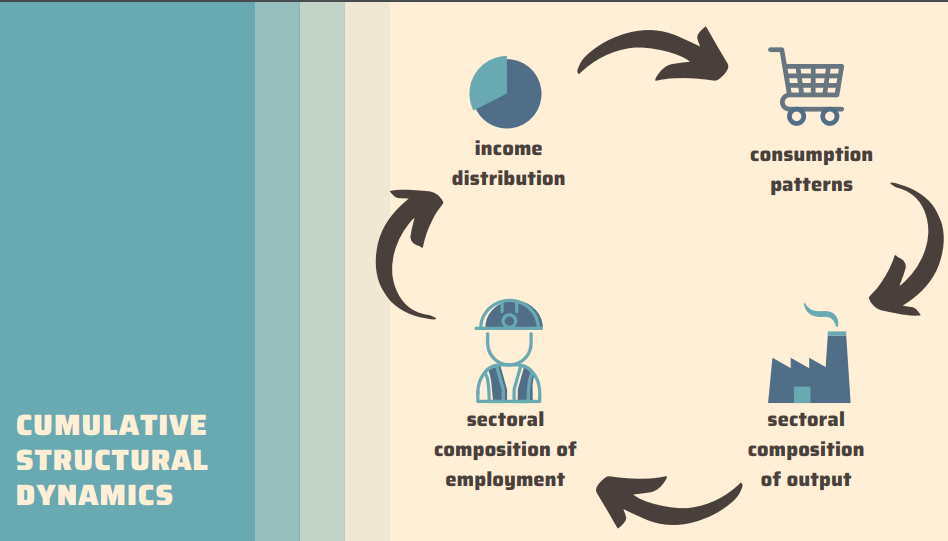
    Pinto defined a style of development as a cumulative process between the structures of demand (the consumption pattern and the income distribution) and supply (the sectoral composition of output and employment), as per the figure below. A significant increase in inequality—like the one promoted by the Brazilian dictatorship, squeezing the minimum wage and repressing unions—shifted the consumption pattern towards luxuries (which, at the time, included cars and electric appliances). Data presented by Pinto showed that, in 1970, 85 percent of the vehicles in Latin America were sold to the richest 10 percent of the population, along with 74 percent of the furniture and 50 percent of the electrical and mechanical appliances. The most important aspect of a style of development, he argued, was “for whom” it produced.

    Such a biased consumption pattern would be reflected in the sectoral composition of output and employment, creating few jobs—relative to the rate of growth—and expanding disproportionately managerial positions. As a result, the polarization of income distribution, separating the vast majority with stagnant wages from the minority of capitalists and integrated professionals, would widen, and the cycle would restart. This style of development was “a cumulative phenomenon which gradually strengthens the tendencies towards greater…inequality.” In a simulation offered toward the end of the paper, he indicated that the continuation of that style of development would reduce the share of the Latin American labor force that was underemployed from 53 to 45 percent between 1970 and 2000. At this pace, exhaustion of the unlimited supplies of labor would have to wait until the middle of the 22nd century.

    Marxist Keynesian

    Rejecting the catastrofismo he attributed to some dependency theorists, Pinto insisted on outlining possible alternatives. Yet as a careful political analyst as well as an economist, he did not assess such alternatives solely from a technical perspective but discussed at length the political conditions that could allow for their realization. (He was fond of invoking Marx’s line in the Eighteenth Brumaire that men make history but under conditions already given.)

    In 1968, for instance, he had offered a detailed class analysis of the Chilean case, mapping different fractions of the ruling and working classes, and carefully examining the obstacles to building a popular majority. When Salvador Allende was elected as president in 1970 and started building the “Chilean path to socialism,” Pinto remarked that “Allende captured with great clarity the fundamental tasks,” adding that he was “impressed by the seriousness of the Chilean process and of its leaders, by their rejection of populism and easy alternatives.” He interpreted Allende’s election as the rise to power of the organized fraction of the working classes and argued that the decisive question for the future of Chile was whether the left would be able to fulfil the “historical task” of the “real incorporation” of the marginalized masses into society. The answer, of course, was preempted by Pinochet’s coup in 1973.

    This kind of study, examining the dynamics of class structures of peripheral societies and their political implications, is today usually associated with the dependency theorists, yet Pinto had undertaken it as early as 1963, in parallel with his work on structural heterogeneity and the styles of development. The significance of conceptualizing styles of development was to offer a way to analyze, together, the sectoral characteristics of capital accumulation (with its macroeconomic consequences) and the transformation of class structure and class struggle—thus combining the best insights from cepalinos and dependentistas.

    Pinto’s approach, in other words, points toward a sophisticated political economy of development that takes both politics and economics seriously. This is something that is increasingly hard to find, as disciplinary specialization continues to sterilize critical thinking. Describing his theoretical background, Pinto said that he was “a kind of Marxist Keynesian” and that, for him and his generation, CEPAL’s thinking offered a “great perspective for the interpretation of the Latin American phenomenon.” His disciples saw the potential of this combination up close and took advantage of it. “All my heretical thinking,” Tavares remarked, “I inherited from him.”

    The power of Pinto’s legacy was manifest in some analyses of the Latin American Pink Tide of the 2000s and early 2010s, which drew on the styles of development thesis to examine the sectoral pattern of accumulation and its macroeconomic, distributional, and political implications. Works on the cases of Brazil and Argentina identified an equalizing spiral in which, paradoxically, falling wage inequality and structural regression interacted in a cumulative way. This style of development also squeezed profits and the income share of the middle classes, bringing class conflict to the fore, at the same time as it concentrated the working classes in weakly unionized sectors. Such an account of the political economy of this recent experience is arguably a key starting point to understand the crisis that followed and the rise of the far right in these countries. Meanwhile, in the capitalist core, research on duality and sectoral dynamics has so far been inspired mostly by Lewis’s writings—which, insightful as they are, tend to overlook the cumulative interaction between the structures of demand and supply and its dynamic implications for the class structure. Half a century on from his landmark essay, Pinto still has a lot to teach us. 

  3. War and Succession

    Comments Off on War and Succession

    Speculation about the rise of Sayyid Mojtaba Khamenei was once the preserve of eccentric Iranian exiles on obscure satellite channels, who drew tired analogies with courtly intrigue or with Game of Thrones. Now, the prospect that long fuelled this insider gossip and strained Kremlinology has finally come to pass. The assassination of Supreme Leader Sayyid Ali Khamenei by the United States and Israel on February 28 precipitated one of the most consequential moments in the elite politics of the Islamic Republic. The elevation of his second-eldest son to the position of Supreme Leader, under the unprecedented conditions of an ongoing war with two nuclear-armed states, demands explanation. This is not simply a story of dynastic succession, but of how this war of choice has violently reordered the terrain on which succession takes place. The circumstances of the elder Khamenei’s killing, the mobilizing power of martyrdom, and the political imperatives of an embattled Islamic Republic—determined to survive at any cost—have shaped the field of possible successors in ways that would have been unlikely in peacetime.

    For years, Mojtaba Khamenei was a shadowy yet significant presence in the Iranian political system. Born in 1969 in the northeastern shrine city of Mashhad, he joined the Iran–Iraq War at the age of seventeen. In 1986 he made several short deployments to the front and briefly served with the Habib ibn Mazaher Battalion of the 27th Mohammad Rasulullah Division, one of the most prominent formations of the Islamic Revolutionary Guard Corps during the war. Many veterans of that division went on to occupy influential positions within Iran’s security and political institutions. Mojtaba’s participation in these deployments, though brief, nonetheless placed him within the social and political networks of what is often described as the Islamic Republic’s “war generation,” a cohort that derived its authority and influence from the experience of conflict with Iraq.

    Thereafter he pursued religious studies in the seminaries of Qom, following in his father’s footsteps, and is said to have studied under a number of esteemed as well as state-aligned clerics, including Ayatollahs Vahid Khorasani, Mahmud Hashemi Shahrudi, Musa Shubayri-Zanjani, Muhammad-Taqi Misbah Yazdi, as well as his father. According to accounts circulated in IRGC-adjacent media, he has taught dars-e kharej, the highest level of Islamic jurisprudential instruction, for nearly two decades. Whether this narrative reflects his real level of erudition, given how highly politicized the Iranian seminaries have become, remains an open question.

    Within clerical circles, the reaction to Mojtaba’s appointment as Supreme Leader has been telling. While a small number of senior clerics, such as Ayatollah Naser Makarem Shirazi and Ayatollah Hossein Nuri Hamedani, have issued statements of support and calls for unity, the broader response has been far more muted. In many instances there has been a marked silence, or an offering of general prayers and well-wishes, which should not be mistaken for endorsement. Among the Iranian public, meanwhile, Mojtaba Khamenei remains largely unknown. Few have heard him speak, let alone formed any clear sense of how he might rule the country. This is in sharp contrast to his father, who, before becoming Supreme Leader, had already been a visible revolutionary activist, a member of the Revolutionary Council, a prominent figure within the Islamic Republic Party, a Friday prayer leader, and a two-term president.

    Yet despite his low public profile, Mojtaba has had repeated brushes with political controversy. Former parliamentary speaker Mehdi Karroubi wrote a blistering open letter to Ali Khamenei after the disputed 2005 presidential election, alleging that Mojtaba had intervened behind the scenes in support of one of his rival candidates. Karroubi expressed wider suspicions among reformists and centrists in the political class that Mojtaba was being groomed by his father, and that he had gained quiet but considerable influence within the system, particularly through networks linked to the Revolutionary Guards and the Supreme Leader’s office. The episode gave rise to a perception that he operated as a powerful intermediary within the opaque structures surrounding the leadership.

    These suspicions, in turn, fuelled anxieties that the Islamic Republic was drifting toward some form of hereditary rule. Ayatollah Khomeini himself had denounced monarchy in unequivocal terms in a famous 1971 speech: “The title of King of Kings,” he declared, “is the most hated of all titles in the sight of God . . . Islam is fundamentally opposed to the whole notion of monarchy . . . it came in order to destroy these palaces of tyranny.” He likewise baulked at the idea that his son Ahmad might assume his position after his death. In so doing he cut a rare figure in Iranian history for refusing to pass the baton of leadership to his progeny. Against this backdrop, critics have long viewed the prospect of Mojtaba’s succession as a profound violation of the revolution’s founding ethos.

    Yet the institutional terrain in Iran has been slowly shifting over the past few decades. The 1989 revision of the constitution removed the requirement that the Supreme Leader be a marjaʿ al-taqlid—or “source of emulation,” the highest rank of clerical authority—thereby facilitating Ali Khamenei’s accession. This did not resolve the question of clerical legitimacy so much as displace it. Tensions came to the fore most clearly in 1997, when Ayatollah Hossein Ali Montazeri publicly challenged Khamenei’s religious qualifications and, by implication, his fitness to lead. The episode, which led to Montazeri’s house arrest, underscored the contradictions at the heart of the post-1989 order. Those earlier disputes offer a clear preview of the debates Mojtaba’s appointment is likely to provoke within the seminaries of Qom, Najaf, and beyond. Even now, the decision of state-aligned media to address Mojtaba with the honorific “Ayatollah” has raised some eyebrows.

    The official line in Tehran has long been that Ali Khamenei never designated a successor and that the Assembly of Experts—eighty-eight clerics elected every eight years—would select the next leader in accordance with the constitutional provisions outlined in Articles 107 and 109. This is certainly still plausible. For years now it has been claimed that Khamenei had identified three potential successors, none of whom were his son. Recent reporting in the New York Times appears to support this claim, even suggesting that a written will was presented explicitly rejecting the possibility of hereditary succession. Given the depth of public distrust in the political system, however, this story will inevitably elicit scepticism.

    Candidates for the Assembly are vetted by the Guardian Council, whose clerical members are themselves appointed directly by the Supreme Leader. The institutional architecture therefore ensures that the leadership retains considerable scope to shape both the terrain and the composition of the very body tasked with selecting its successor. The presence of influential clerics such as Ayatollah Ali Reza Arafi—a member of the Guardian Council, a senior figure in the administration of the seminaries, a former chancellor of the powerful al-Mustafa International University, and a member of the short-lived transitional leadership council formed in the immediate aftermath of Khamenei’s assassination—raises further questions about how clerical opinion within the Assembly may have been steered during the succession process.

    The extraordinary conditions under which the Assembly convened only deepen these uncertainties. Israeli airstrikes destroyed the building where the Assembly of Experts would have ordinarily met on March 3, forcing them to make alternative arrangements. While participants claim that a quorum was achieved, it remains unclear who was present, what forms deliberation took, and which figures exercised decisive influence. Reports from the Times also suggest that Ali Larijani, who headed Iran’s Supreme National Security Council until his assassination on 16 March, sought to intervene in favor of a more broadly unifying candidate.

    Other potential successors who might once have been considered plausible became far less likely in the context of full-scale war. A figure such as Hassan Rouhani, president between 2013 and 2021 and generally associated with efforts to pursue détente and normalization with Western powers, was always an unlikely choice in the midst of a war of aggression waged by the Islamic Republic’s two principal adversaries. Rouhani has immense experience within the institutions of the Islamic Republic and has long been embedded in its national security establishment. Yet his political identity is closely tied to diplomacy and negotiation with the West, particularly the nuclear talks that culminated in the 2015 Joint Comprehensive Plan of Action. During his presidency, Rouhani also clashed repeatedly with the Revolutionary Guards and objected to their expanding role in Iran’s politics and economy, which did little to endear him to the principal power brokers within the system. It was therefore difficult to imagine that, in the midst of an existential confrontation with the US and Israel, the Assembly of Experts would coalesce around a figure associated with a strategy that might demobilize or unsettle the Islamic Republic’s core social base.

    Still, Mojtaba’s succession cannot simply be explained through backroom dealing and Machiavellian intrigue. The war appears to have decisively altered the political calculus. The assassination of Ali Khamenei, alongside reports that Mojtaba himself was injured in the same strike on February 28, turned his candidacy into a potent symbol of martyrdom. Official media have already begun referring to him as the janbaz-e ramazan, the “Ramadan war veteran,” linking his injury to a broader tradition of sacrifice in the Islamic Republic’s political culture since the revolution. This language of sacrifice was valorised during the eight-year war with Iraq, a conflict that more than any other shaped the Islamic Republic and the complex security architecture that continues to define it today. 

    The symbolism of martyrdom carries particular resonance within Shi‘i Islam, where the memory of Karbala and the martyrdom of Imam Husayn occupy a central place in both religious imagination and political rhetoric. The Iranian state has long invoked this symbolic repertoire in moments of crisis. The assassination of Ali Khamenei has therefore been framed not only as a geopolitical event of immense consequence but also as a sacred act of sacrifice, situated within a longer trajectory of resistance and suffering in the name of the Iranian nation. State-aligned elegists, or maddahs, have already cast Ali Khamenei’s death as part of a “final battle” that will resist the return of taghut—shorthand for the corrupt, Western-aligned Pahlavi order—at the hands of Iran’s foes. Billboards across Iranian cities now bear the slogan “The hand of God has revealed itself; Khamenei has become young again,” at once invoking divine providence and signalling generational renewal within the leadership.

    This symbolic politics has been accompanied by a visible and deliberately orchestrated mobilization of the regime’s core base of support. Despite ongoing bombardment and the risks associated with public assembly, supporters of the Islamic Republic have taken to the streets in multiple cities, staging demonstrations, mourning rituals, and commemorative gatherings. These are not spontaneous eruptions of grief so much as politically mediated performances of loyalty, activated through groups of veterans, Basij organisations, mosques, and local clerical networks. The leadership appears intent on converting the assassination of Khamenei into a moment of collective reaffirmation, directed not only against an external enemy but also at a fragmented and restive domestic landscape. This capacity to summon and stage support from below, even if uneven and far from universal, has long been a constitutive feature of the Islamic Republic’s durability. In moments of acute crisis, the state has repeatedly shown that it can still call parts of its social base into motion. The signal is calibrated in two directions. Domestically it seeks to stabilize a shaken political order and reassert a hierarchy of loyalty. Internationally it is meant to demonstrate that the decapitation of the leadership has not produced paralysis, fragmentation, or the prospect of imminent collapse.

    Mojtaba’s elevation therefore reflects both continuity within the Islamic Republic’s power structure and a significant generational shift, as the revolutionary generation recedes thanks to age, attrition, and targeted killings. If he consolidates power, leadership will pass to a cohort shaped less by the upheavals of 1979, or even the Iran–Iraq War, than by the formative experiences of the Islamic Republic’s interventions in Iraq and Syria in the late 2000s and 2010s, the pressures of prolonged sanctions, and the dilemmas of post-revolutionary entrenchment and resilience. Many of these figures are deeply embedded in the security institutions of the state, above all the Revolutionary Guards, whose influence has expanded steadily over decades of confrontation with the US and Israel. The fact that Mojtaba himself is widely understood to be closely tied to these networks helps explain why influential actors within the security establishment appear to view his rise as a means of preserving strategic continuity at a moment of profound uncertainty.

    This orientation was made explicit in Mojtaba’s first written declaration. Framing escalation as both necessary and popular, he declared that “the continuation of effective and punishing defence” was the demand of the masses, while insisting that “the lever of blocking the Strait of Hormuz must continue to be used.” At the same time, he reaffirmed the centrality of the so-called Axis of Resistance, describing it as “an inseparable part of the values of the Islamic Revolution,” and explicitly invoking its active components. “Brave and faithful Yemen,” he noted, “has not ceased defending the oppressed people of Gaza,” while Hezbollah, “despite all obstacles,” has come to the aid of the Islamic Republic, alongside Iraqi militias that have “courageously followed the same path.” The address also signalled the possibility of further escalation, indicating that plans had been developed to open additional fronts in arenas where the enemy is “highly vulnerable.”

    Supporters of Mojtaba have suggested that he could play a role in curbing corruption within the Iranian political system, but such claims have gained little traction. Over the past decade, persistent allegations have linked networks close to the Supreme Leader’s office to sanctions-evasion schemes and opaque financial structures that flourished under conditions of economic warfare. Figures such as Ali Ansari, associated with the now notorious Ayandeh Bank and repeatedly accused of large-scale corruption and money laundering, are often cited as emblematic of these shadow economies. These networks are widely believed to intersect with powerful political and security interests inside the state, where illicit financial flows and sanctions-busting operations have frequently operated with the tacit backing of elements within the security apparatus. In this context, claims of an anti-corruption agenda appear less as a program of reform than as part of an internal struggle over control of rents generated under sanctions. 

    The late Khamenei’s household, or bayt, also exercised control over vast financial and property holdings, most notably through the sprawling parastatal conglomerate known as the Execution of Imam Khomeini’s Order (Setad-e ejra’i-ye farman-e Emam). This organization controls dozens of companies and extensive real-estate assets across Iran. Control over Setad will now pass to his son, and there were clearly powerful interests invested in ensuring continuity in its management, given the considerable economic dividends and patronage networks tied to access to its resources.

    At the time of writing, there are real doubts as to whether Mojtaba Khamenei will survive the coming days and weeks, which naturally makes any assessment of his prospective rule provisional. His addresses to the Iranian public have only been made in written form. He has not made any public speech or video appearance: a silence that has fuelled speculation about his condition as well as signalling the extreme security precautions being taken to protect him. The Revolutionary Guards appear intent on shielding their preferred candidate from further attacks that could once again reopen the question of succession and potentially elevate a figure who is less aligned with their interests. This situation reflects a striking paradox. The man who now occupies the most powerful office in the country remains largely unknown to the society he is expected to lead. His elevation has been used by Iran’s ruling institutions to send a clear message. The decapitation of the leadership has not produced capitulation. If anything, it has arguably accelerated the consolidation of power in the hands of a younger and more militant generation within the political and security elite. This cadre has been formed by war, sanctions, and permanent confrontation. It may be committed to resisting the ongoing US–Israeli onslaught, yet it is otherwise increasingly distant from the aspirations of much of Iranian society.

  4. The Venezuela Illusion

    Comments Off on The Venezuela Illusion

    At first glance, the strategic rationale for the US-Israeli offensive in Iran seems elusive. While President Trump has described the campaign in the familiar idiom of democratic liberation, promising to topple the Islamic Republic, Secretary of State Marco Rubio has presented it as a pre-emptive strike. Pentagon chief Pete Hegseth joined Rubio in claiming that the core objectives are the destruction of Iran’s nuclear and missile programs and the degradation of its naval capabilities—not exactly regime change, but counter-capability coercion. 

    Yet the US war aims should not be sought in the Trump administration’s official briefings but in the long-term changes in American statecraft. Since the early 2010s, Washington has increasingly pivoted away from large-scale occupations towards the use of airpower, financial instruments, diplomatic pressure, and targeted removals of key adversaries. It has sought to impose its will on other states while limiting the domestic and geopolitical costs associated with prolonged military presence, in what amounts to a model of remote political engineering.

    The Venezuelan episode marked the culmination of this approach, demonstrating how a strike against an individual leader, combined with the application of intense external pressure, can create political change without the burdens of territorial control. This, it seems, is the same scenario that Washington would like to play out in Iran. When Trump followed up his assassination of Ali Khamenei with the avowal that the Ayatollah’s son, Mojtaba Khamenei, would be an “unacceptable” successor, he explicitly invoked the Venezuelan precedent: “I have to be involved in the appointment, like with Delcy.”

    But can Washington simply impose its favored leader on Iran, as it did after the capture of Maduro? The evidence suggests that it cannot. The Islamic Republic has a complex architecture of rule and a cohesive ruling-class coalition. Over three decades, Ali Khamenei transformed the office of the Supreme Leader into a sprawling bureaucratic and security apparatus embedded in a dense nexus of military, clerical, and economic institutions. This “military-bonyad complex,” as I have called it elsewhere, cannot be defeated through a strategy of mere decapitation. The most likely outcome of the US-Israeli campaign will be to reinforce securitized coordination across the state while risking wider conflict across the region.

    Regime Management

    The US’s current approach to Iran has a long prehistory. The financial instability caused by the 2008 crash, along with mounting domestic opposition to the occupations of Iraq and Afghanistan and growing competition with China, prompted a reorientation of imperial strategy. In lieu of costly attempts at regime change and state-building abroad, Washington now sought to gain leverage over existing institutions in target countries—from the state bureaucracy to the judiciary to the media—while preserving the bandwidth for longer-term Great Power conflict across Eurasia and the Indo-Pacific.

    The NATO bombing of Libya in 2011, which aimed to remove Muammar Gaddafi and resulted in the deaths of 50,000 Libyans, signalled this new approach. Even as American statesmen continued to use the discourse of democracy and humanitarianism, their dreams of wholesale political transformation gave way to a narrower foreign policy repertoire: stabilization, counterterrorism, alliance management, and the protection of energy corridors. Trump has continued in this vein while largely abandoning the language of democracy and the rules-based order that was once the moral grammar of American power.

    One pillar of this post-2008 turn was the expansion of financial and trade warfare as a substitute for ground interventions. Sanctions are no longer a marginal policy tool but a central instrument for reorganizing a target state. Their objective is systemic rather than tactical: restricting access to finance, procurement networks, insurance markets, shipping routes, and settlement systems, thereby forcing third parties to choose between participation in the US-centered order and commercial ties with the sanctioned country.

    Economic sanctions were one of the main weapons of the Obama administration, which Trump later supplemented with tariffs: a blunt instrument to generalize economic friction, raise transaction costs, and discipline supply chains, often operating alongside export controls, investment screening, and financial restrictions. This combination of sanctions and tariffs has strengthened the infrastructure of economic coercion, expanding the levers that Washington can use to punish, deter, or compel certain forms of political behavior.

    Another pillar is shifting responsibility for external coercion onto allied states: encouraging them to absorb greater frontline costs while the US provides the escalation umbrella, intelligence, logistics, and high-end capabilities. NATO offers the clearest illustration. America’s strategic turn has been accompanied by sustained pressure on European partners to raise defence spending as a share of GDP, which is less of a discrete demand and more of a structural sign that US commitments have become conditional on allies carrying a greater share of the burden. Here, too, there is more continuity than rupture from Obama to Trump, even if Trump tends to express the same logic in more abrasive terms.

    Yet this reorientation extends beyond Europe. Across the globe, Washington seeks to preserve strategic dominance while redistributing operational responsibilities outward and downward, allowing it to freely exercise coercion without getting entangled in open-ended campaigns to ensure stabilization. “Leading from behind” thus becomes an operational necessity. In the Middle East, the US has spent the past decade encouraging regional allies to police their own neighborhood in a way that advances American interests. This was especially apparent in the aftermath of the Arab Spring, when the Saudi-led Gulf bloc helped to suppress or neutralize popular upheavals and forge a regional order aligned with both Gulf and American priorities. The redistribution of responsibility also expanded Israel’s room for manoeuvre, as American backing for Israeli aggression, particularly since October 7th, has remained broadly consistent across the Biden and Trump administrations.

    “Regime management” thus presents itself as an attractive solution to a recurring strategic dilemma, in which Washington feels it can no longer secure its desired outcomes—the compliance, realignment, or neutralization of hostile regimes—through full-scale wars of regime change. This template has been used in Venezuela and elsewhere to engineer a more favorable political situation within a target state while preserving its existing administrative machinery. The standard protocol is to remove the apex, keep the bureaucracy intact, and then deploy sanctions relief, greater access to assets and markets, and diplomatic recognition to discipline the successor elite into a settlement.

    The State Within the State 

    The distinct features of Iran’s political economy pose a fundamental problem for this strategy. Since assuming the position in 1989, Ali Khamenei has systematically institutionalized the Office of the Supreme Leader. Khamenei always lacked the charisma of his predecessor, Ayatollah Khomeini, and his clerical standing was more contested from the outset. His response to this deficit of legitimacy was to transform the Office into the regime’s commanding height: a dense bureaucratic complex with parallel capacities across the spheres of administration, politics, finance, communications, security, culture, and the seminaries. What was previously a modest coordinating secretariat of roughly twenty staff evolved, under Khamenei, into something far more expansive: a state within the state, a shadow apparatus comprising thousands of personnel with extensive extra-legal reach and the ability to override or marginalize the elected branches. The aim of this institutionalization was to ensure that the system could function without relying on the personal authority of the Supreme Leader as a singular strongman.

    This institutional expansion took place alongside a deeper restructuring of the ruling bloc from the early 1990s onward, which culminated in the rise of the military-bonyad complex: Iran’s current ruling-class coalition. By appointing key figures to unelected institutions, and by overseeing the state’s coercive apparatus, key foundations, and strategic economic sectors, the Office of the Supreme Leader increasingly functions as the institutional expression of this coalition’s interests. In other words, the apex of the regime is not merely a person but a governing nexus that reproduces a particular configuration of power.

    This bloc began to take shape through intra-elite struggles that followed the turn toward neoliberalization in the early 1990s. Under the presidencies of Rafsanjani and Khatami (1989–2005), a Western-oriented technocratic current gained prominence in Iran, promoting privatization, deregulation, and reintegration into global markets as the route to postwar reconstruction. Such policies produced a landscape of semi-private enterprises; increasing power and wealth flowed to entities such as bank affiliates, pension funds, and quasi-governmental organizations that were officially private yet had strong ties to state ministries and political elites. In this context, a new stratum of commercially oriented bureaucrats and politically connected managers gained greater influence. They promoted a foreign policy based on détente with Europe and eventually the US, in the hope of securing capital inflows, technology transfers, and access to global markets.

    Yet this project was always deeply unstable. The election of Mahmoud Ahmadinejad as president in 2005 marked the ascent of a different mode of neoliberal state formation. Ahmadinejad effected a large-scale transfer of state assets to networks linked to the Islamic Revolutionary Guard Corps (IRGC) and major revolutionary foundations—among them the Mostazafan Foundation, the Execution of Imam Khomeini’s Order (Setad), and the Imam Reza Shrine Foundation. They were thus transformed into sprawling conglomerates that combined profit-seeking activity with the rhetoric of national development and charitable missions. While privatization continued apace, its beneficiaries were now increasingly embedded in the security state. 

    By the late 2000s, this process of elite restructuring had produced a new dominant fraction of the ruling class. Politically represented by the Principlist movement, the new military-bonyad complex was anchored in absolute loyalty to the Supreme Leader, a new strategic orientation toward China and Russia, and resistance to integration with Western capital.

    This coalition came to operate not merely as an economic bloc but as Iran’s entire governing architecture. Its component institutions—the Office of the Supreme Leader, the IRGC and associated security bodies, the major revolutionary foundations, the judiciary, and the Guardian Council—are all insulated from electoral accountability. Their leadership is reproduced through appointment chains under the ultimate authority of the Supreme Leader, while the Guardian Council’s supervisory authority covers both legislation and candidate eligibility for elected institutions such as the presidency and parliament. Power within this system rests on the fusion of coercive capacity with economic command, including preferential access to state resources, opaque transfer mechanisms, contracting monopolies and channels to circumvent sanctions. It is adept at converting conditions of crisis into political rents. Far from weakening this bloc, the West’s external pressure and sanctions have often reinforced its dominance.

    Parallel Armies

    Iran does not have a single army whose members could potentially defect. Its coercive architecture is much more complex: a layered system of parallel forces, overlapping intelligence organs, and differentiated command structures, designed to secure the regime against both external assaults and internal power-grabs. The American strategy of trying to remove the apex and reorient the bureaucracy is therefore inapplicable. Alongside the regular army (artesh), the IRGC is tasked not merely with territorial defence but with safeguarding the political order itself, via the regime’s core deterrent capabilities (missiles, drones, key elements of strategic airspace defence). The development of this dual-armed-forces arrangement was a deliberate attempt at coup-proofing the state. Institutional parallelism may create redundancy, but it also generates mutual constraint: no single command structure has the authority to switch the coercive apparatus from loyalty to defection. 

    Even the IRGC is not a unified actor, however, but a federation of semi-autonomous power centers, including the Aerospace Force, Ground Forces, Navy, Quds Force, Basij, and multiple intelligence and security units, each with its own operational mandate, internal hierarchy, and institutional interests. This fragmentation raises the transaction costs of coordinated defection. When intra-elite conflict occurs, it tends to take the form of high-level negotiation, bargaining, redistribution of institutional powers, and reordering of internal priorities, rather than any organizational rupture. The Guards have complex ties of vertical loyalty and mechanisms of horizontal coordination which make it extremely risky for any of its internal forces to challenge the power structure or act unilaterally.

    Iran’s security apparatus also operates through duplication and overlapping jurisdiction. The IRGC Intelligence Organization functions alongside the Ministry of Intelligence, while additional Guard-affiliated bodies oversee internal monitoring and counter-intelligence work. Crucially, the appointment and oversight of leadership figures runs through the Office of the Supreme Leader. What might appear as a cluttered bureaucracy is therefore a deliberate technique of governance. Institutional overlap helps to guarantee the surveillance of the surveillers: minimizing conspiratorial coordination, raising the probability of detection, and discouraging collective action outside of authorized channels.

    At the operational level, Iran’s command-and-control arrangements are similarly able to thwart Washington’s objectives. The methods of coordination across forces help to ensure continuity when the structure comes under attack, through dispersed command nodes and the preservation of retaliatory capacity. Even if the enemy manages to decapitate or degrade the apparatus, this does not by any means guarantee organizational collapse. The system is built so that none of its single nodes has the authority to surrender the whole, making it particularly shock-absorbant.

    These structural features, in turn, shape elite incentives under conditions of conflict. When external pressures intensify, Iranian political actors are naturally inclined to protect the governing coalition—and the system that guarantees their authority, wealth, and security—rather than defect from it. Internal disagreement tends to play out through succession bargaining and deal-making rather than the capitulation of any single bloc to US demands. The paradox, then, is that the more Trump administration tries to remake the Iranian power structure, the more cohesive it becomes. Survival becomes its organizing principle. Its coercive apparatus—not a conventional military hierarchy, but a regime-protective architecture built to prevent precisely to deflect this kind of threat—makes any repetition of the Venezuelan scenario exceedingly unlikely.

    Exporting Costs

    Iran differs from Venezuela in another decisive respect. The country’s deterrence doctrine has long rested on the premise that any major confrontation will not be confined to Iranian territory. This does not mean Tehran is powerful enough to dictate the course of escalation. Yet the the Islamic Republic’s strategic capabilities give it the ability to impose dispersed and persistent costs across the Gulf and the Levant.

    This capacity is the cumulative result of more than two decades of regional power projection, stretching back to 2003. The American invasion of Iraq ruptured the regional balance and created opportunities for Iran to expand its influence through aligned parties, militias, and armed networks. Over time, these relationships coalesced into what is commonly known as the Axis of Resistance: a loose but adaptable coalition of state and non-state actors capable of activating multiple fronts and complicating adversaries’ operational planning. 

    Since 2023, this network has come under sustained pressure. Israeli operations against Iranian-aligned forces across the region, combined with the collapse of Assad’s government in Syria, have degraded parts of the axis and diminished its logistical depth. Yet it has not been eliminated entirely. Its infrastructure of partnerships, armed groups, and political linkages remains partially in place, meaning that Iran’s prospects do not rely on a single decisive confrontation. Instead, it can apply pressure across multiple fronts.

    Missile and drone forces are the second pillar of this strategy. Iran’s deterrence posture has been built around stand-off strike capabilities: the ability to reach American bases across the Gulf and wider region, to threaten Israel and to place allied infrastructure at risk without matching Western airpower platform for platform. In Iranian doctrine, these systems are not auxiliary assets but compensatory instruments designed to offset conventional inferiority and impose costs on any adversary contemplating sustained air operations. This has direct implications for the Venezuela model, since it undermines the assumption that escalation can be neatly contained. A campaign intended to decapitate leadership and degrade the coercive apparatus from the air can instead activate the retaliatory logic it seeks to avoid: calibrated regional strikes, mobilisation of partner networks and an expanding theatre in which the coercer’s political steering capacity erodes more quickly than its ability to destroy targets.

    A third lever is geoeconomic, centred on Tehran’s long-standing capacity to threaten disruption of the global energy market through maritime chokepoints. The Strait of Hormuz occupies a pivotal position here. As the narrow passage connecting the Persian Gulf to the Gulf of Oman and the Indian Ocean, it serves as the principal maritime outlet for Gulf oil exporters and a conduit for a significant share of global energy flows. According to the US Energy Information Administration, roughly twenty million barrels of oil per day passed through the Strait in 2024, around one fifth of global petroleum liquids consumption. This makes Hormuz the world’s most consequential oil transit chokepoint. Even partial disruption can drive prices up, strain insurance and shipping markets, and transmit inflationary pressures into Asia and Europe. These wider economic externalities give Iran the kind of systemic leverage that Venezuela lacked.

    Protracted Contestation

    While these instruments do not guarantee strategic success for Tehran, they nonetheless give it multiple pathways to raise the cost of coercion and widen the circle of actors who are affected by its fallout. The Islamic Republic is not Venezuela. It is an institutionalised system built to absorb disruption, manage succession, and resist external pressure. Decapitation does not dissolve this architecture; it activates it.

    For Washington, the attraction of the “regime management” technique is obvious, in promising political transformation without the burdens of state-building. Yet the very conditions that make it appealing also make it flimsy. Iran’s governing coalition, security structure, and capacity to export costs ensure that the US will struggle to contain the escalation or determine its political consequences. Washington’s attempt to bring about a controlled transition may therefore turn into something else entirely: a protracted contest that generates increasing instability rather than quick compliance. The selection of Mojtaba Khamenei as the new Supreme Leader underscores the point: the system has not yet been ruptured; it has reproduced itself.

  5. Hezbollah’s Gamble

    Comments Off on Hezbollah’s Gamble

    As the United States and Israel launched their criminal assault on Iran, many in the region waited to see how Hezbollah would respond. In the aftermath of its devastating clash with Israel in 2024, the Lebanese party’s capacities were greatly diminished and much of its former leadership was dead. It had signed a heavily one-sided ceasefire deal, brokered by the US, in which it pledged to retreat north of the Litani river and give up its bases in the south, while Israel continued to occupy parts of Lebanon and carried out constant attacks. As the bombs began to fall on Tehran, some doubted whether Hezbollah would be able or willing to reengage the enemy. 

    Yet Hezbollah had also spent the past year rearming and reorganizing its command structures on the basis that a confrontation of this kind was likely inevitable, and that it needed to reposition itself in the changed landscape of the Middle East. On March 2nd, two days after the start of the war, it opened fire on Israel with a barrage of missiles. Israel responded by issuing evacuation notices to the entirety of south Lebanon as well the southern suburbs of Beirut. An unprecedented 600,000 residents flooded out of the area, while others remained trapped in the zone marked for destruction. The ensuing Israeli airstrikes laid waste to civilian infrastructure, killing almost 500 people and injuring more than 1,300. At this stage there is no telling when the war will end, amid mixed signals from Washington. But whatever the timeline, the return to hostilities in Lebanon could have long-term implications for both Hezbollah and Israel. What is each side hoping to gain? 

    There is reason to speculate that Hezbollah’s entry to the conflict was preemptive. Over the previous days Israel had mobilized an estimated 100,000 reservists with a heavy concentration at its northern border with Lebanon. According to a leaked US embassy cable dated to the eve of the war, Israel doubted that the Lebanese government would deliver on its promise to disarm Hezbollah—implying, perhaps, that Israel would need to take matters into its own hands. A report from Israel’s Channel 12 claimed that an attack on Lebanon had already been approved before Hezbollah made its move. 

    Yet whether or not Israel was always planning to expand the war to Lebanon, its calculus is fairly clear: it views the weakening of Iran as a means to eliminate its regional rivals—starting with Hezbollah and then almost certainly proceeding to the Yemeni Ansarullah—and thereby consolidate its position as the Middle East’s undisputed hegemon. In so doing, it may also be able to expand its territory into Lebanon, Syria, and Gaza, in order to offset its relative lack of strategic depth.1Israeli officials have long spoken of Greater Israel as a biblical right and a Zionist aspiration. Setting aside the theological mystification, one of Israel’s primary weaknesses is its lack of a strategic depth. Expanding its territory where possible while destabilizing and controlling the surrounding region are two ways it aims to mitigate this problem. Hezbollah, on the other hand, likely sees Iran’s forceful response to the aggression—fighting tooth-and-nail to preserve its sovereignty—as having created a possibility, however slim, for the party to reestablish its position in south Lebanon and push the Israelis out. If the ceasefire of 2024 risked turning Hezbollah into a marginal and domesticated force, it might now see an opening to reverse these fortunes. 

    Additionally, Hezbollah may be exploiting an opportunity to put pressure on Israel’s northern front, with Iranian ballistic missiles now straining air defenses across the region and most of the Israeli air force and intelligence agencies focusing their attention on Iran. Hezbollah missile attacks have reportedly caused some damage in the center of Israel and in the northern settlements. The party claimed to have destroyed a satellite communications center, and its coordinated attacks with Iran suggest close coordination between its military wing and the IRGC. The offensive also evinces a strategic shift, with Hezbollah reverting to the guerrilla warfare tactics it used in the 1990s: Israeli military officials report that Hezbollah has deployed small units which have attacked their forces before rapidly disappearing. 

    The Lebanese government of Nawaf Salam, brought into office on an American mandate to disarm Hezbollah, responded to the crossfire by banning the party’s military activities outright. It condemned Iran’s attacks on the Gulf countries and called for negotiations with the Israelis, affirming that it would discuss “any agenda” in “any format” and “any venue.” Naturally, Salam’s requests were refused and the Trump administration reportedly refused to take his calls. Yet while Hezbollah has so far thwarted the government’s attempts to rein it in, it must still deal with Lebanese public opinion, which is firmly against the decision to rejoin the war. Many feel that Hezbollah has plunged their already fragile country into another ill-fated conflict, either at the behest of the IRGC or to regain control over occupied land in the South, which some among Hezbollah’s political opponents may be increasingly willing to forsake if it means they can avoid further escalation.

    There are also risks that internal tensions could breed sectarian strife in Lebanon. With more than half a million Shias displaced across the country, reports of sectarian agitation are becoming ever more frequent. The country’s geographical divisions have widened, as southerners suffering constant Israeli bombardment feel that the government in Beirut has done nothing to protect them. Many of Hezbollah’s supporters, who have yet to recover from the previous round of fighting in which more than 4,000 were killed, are not in favor of this renewed conflict. But because the party remains the only force that could potentially deter Israel from annexing much of their territory, it retains an enduring legitimacy, whatever criticisms its social base might have. 

    Despite what Hezbollah’s opponents in both Lebanon and the West claim, the party does not view itself as an extension of the IRGC, nor as a pawn in Iranian foreign policy. It is a regional player with its own strategic view and political outlook. Yet it would be wrong to conclude from this that Hezbollah is not an essential element of Iran’s forward defense. The alliance between Iran and Hezbollah is inevitably asymmetrical because the relation between them is necessarily mediated by the logic of Tehran’s national security interests. This remains the case irrespective of the individual relationships between the two sides and their ideological dispositions. Hezbollah, acutely aware of this power imbalance, must carefully weigh its own interests against those of Iran. Its actions since March 2 reflect this complex relationship. They should be understood not only as an attempt to defend Iran, but also as a major, possibly even existential, gamble: a bid to reclaim the party’s legacy following the 2024 defeat, along with the territories occupied by Israel.

    Hezbollah is, moreover, trying to reposition itself in the region’s emerging geopolitical order, whose precise contours remain unclear. Having placed an extremely high-stakes bet on Iran successfully deterring the US and Israel, Hezbollah will prove its worth as security partner in the event that the Islamic Republic manages to preserve its sovereignty at the war’s end. If this strategy fails, though—either because the Iranian government falls or because it signs an unfavorable ceasefire deal, which seems to be the resolution that Trump now wants—Hezbollah could find itself newly isolated. It may then have to face the Israeli army as the latter pivots away from Iran and focuses its ire on Lebanon alone. There is no telling how disastrous this outcome might be. 

  6. Crisis of Plausibility

    Comments Off on Crisis of Plausibility

    Chile took a dark turn in the 2025 general election. The far-right candidate José Antonio Kast won the presidency with 58 percent of the vote, beating his Communist rival Jeannete Jara in a runoff by a significant margin, while his electoral alliance Cambio Por Chile increased its representation in the chamber of deputies. With one of the highest turnout rates in decades, thanks to a new mandatory voting system, more than 7 million people cast their ballots for Kast’s bullish “law-and-order” program, calling for a crackdown on crime, unions, and migration, a return to free market principles, and the repeal of progressive social policies. His inauguration marks the end of a brief political opening for the country’s left, which propelled Gabriel Boric to power in 2022 following a wave of widespread protests that challenged Chile’s constitutional order. Hopes of dismantling the neoliberal structures inherited from the Pinochet dictatorship now appear to have been buried for the foreseeable future. 

    Various explanations have been offered for this reversal of fortunes. The election result has been described as a reassertion of the Chilean people’s innate conservatism, an expression of anti-incumbency sentiment, a symptom of rising concern over crime, or a reflection of broader regional trends. These interpretations, however, often miss what is distinctive about the Chilean conjuncture. There has not been a sudden mass conversion to the right. Rather, the country’s existing economic model, founded in the wake of the dictatorship, has been beset by what might be termed a “crisis of plausibility.” 

    This model was based not only on the promise of growth but of greater national integration. Macroeconomic stability was supposed to translate into improved living conditions for a majority. Chile combined rapid expansion with a significant reduction in poverty and an increase in real wages. The model delivered enough, for long enough, to create a shared common sense about how progress would look.

    Yet even in its most successful phase, the post-1990 bargain of integration contained a displacement. The promise of mobility rested on a combination of targeted social spending, macroeconomic discipline, and expanding access to privately and semi-privately organized services. This access-based integration became a substitute for rights, financed through household balance sheets, credit markets, and a mixed public private provision system. Distributive conflict became a long horizon project. Governments can ask for patience, because the payoff is expected to arrive later.

    While this notion may have held water in the 1990s, it has come to seem increasingly far-fetched since the turn of the millennium. The education system, as a tool of social mobility, failed to live up to its promises. Constitutional processes to redraft the 1991 Constitution temporarily functioned to make gradual reforms intelligible as steps toward a larger settlement. But once that horizon closed through the plebiscite defeats of 2022 and 2023, slow reform began to look less like progress and more like drift. 

    The decisive shift is not that redistribution ceased to matter, but that politics appeared unable to produce a future. Against that background, the governing experience of Gabriel Boric becomes legible as a problem of timing under constraint. Amid stagnation, indebtedness, and institutional fatigue, a right-wing politics of “security” managed to gain ground. To understand how this process played out, and how the left might reorient itself under the incoming Kast government, we must look back at Chile’s post-Pinochet trajectory.

    The bargain

    Chile exited the dictatorship era in 1990 with a highly liberalized economy that owed much to the Chicago School. The country’s democratic transition combined continued macroeconomic discipline with expanded social spending. This gave rise to a peculiar developmental bargain. In lieu of a return to import substitution or state-led industrial strategy, elites sought “stability” through the preservation of key parts of Pinochet’s economic order, plus greater social inclusion through targeted redistribution and social programs. 

    As indicators began to improve over the next decade, this bargain was accepted by large sections of the population. Between 1990 and 1998, Chile’s real GDP growth averaged 7.3 percent annually, while real GDP per capita increased by an average of 5.6 percent per year, and real wages grew by close to 4 percent per year across the decade. Poverty declined sharply, from 38.6 percent to 21.7 percent, while extreme poverty fell from 12.9 percent to 5.6 percent. Though such gains did not eliminate inequality nor create a high-wage economy for most Chileans, they nonetheless made the goal of integration seem within reach. It appeared that growth, stability, and gradual redistribution could all happen simultaneously. The political implications were significant, as the country’s institutions began to command real authority, and ordinary households saw the hardship they were experiencing as a temporary state rather than a structural condition. 

    Yet the post-1990 bargain displaced the promise of mobility into a specific institutional channel. As increased productivity and wage convergence remained uneven, households increasingly came to see mobility not as a labor market certainty but as an educational project. Credentials were needed to realize the prospect of progress. The “massification” of higher education thus accelerated rapidly during this period. Official analyses show that net enrollment among people aged eighteen to twenty-four rose from 13 percent in 1990 to 27.5 percent in 2006, and then 30.8 percent in 2009. 

    This increase had a dual function. Symbolically, it represented inclusion, dignity, and the promise of a professional identity for the new generation of Chileans. Institutionally, it operated as a substitute integration mechanism, in a society where universal rights in health, pensions, housing, and care were still limited or segmented. There was a growing sense that educational effort could compensate for structural inequalities. The entire political settlement thus came to rest on educational returns. 

    This was a point of major vulnerability. When social mobility relies on educational credentials, the latter naturally becomes a source of intense scrutiny. If the quality of provision turns out to be unequal, if labor market absorption is segmented, or if paying for education means taking on excessive debt, then the situation can become politically combustible. Education, in other words, can only play a stabilizing role if its costs are not seen as punitive.

    It was Chile’s student credit regime that ignited this tinderbox. Created in 2005, the State Guaranteed Loan (Crédito con Aval del Estado, CAE) institutionalized debt-financed access as a major pillar of expansion. It integrated higher education expansion into financial circuits and redefined the social meaning of access, which was now no longer merely a matter of admission and tuition, but a long-term obligation. A direct link was established between macroeconomic conditions, household balance sheets, and political legitimacy. By the end of 2021, an official characterization of the CAE debtor population reported that over a million students had taken up the credit scheme, and that delinquency had risen persistently since 2015, reaching 48 percent at the close of 2021. The same report shows that delinquency was about 77 percent among those who did not complete their studies.

    The opening up of Chilean higher education, then, was not a simple story of expanded opportunity, but rather a complex web of marketized provision and financial architecture that shifted risk onto households. This created the conditions for a politics of disappointment, with unmet expectations giving rise to popular resentment. Though the latter was staved off as long as the economy continued to grow, it eventually came to the fore when the expansionary cycle slowed down, and the dream of integration began to unravel. 

    Students in revolt

    This slowdown produced a series of political upheavals, in 2006, 2011, and 2019, each of which expressed the same underlying tension: access to education was expanding faster than the capacity to guarantee decent quality and secure the desired outcomes. In a society still organized around privatized provision and credit, the system proved unable to deliver on its promises. With the lived experience of social mobility now mediated by the problems of tuition and student debt, distributive conflict came to center on the education sector.

    In 2006, secondary school students launched the so-called “Penguin Revolution.” What began as a series of concrete demands on issues such as the cost of transportation and examination fees soon escalated into a comprehensive critique of educational inequality. The movement pushed the education debate back onto the national agenda and exposed the disparities of the system. In 2011, the focus shifted onto higher education. Over the next two years, university federations and broader social actors engaged in mobilizations that directly targeted market interests in education, such as for-profit provision and debt financing. The movement succeeded in linking household balance sheets to wider questions of political legitimacy. 

    Those two waves changed the political baseline for the next decade, legitimizing a vocabulary of social rights and raising expectations about the pace at which institutional politics should translate into material improvements. This newly assertive outlook fed into the social uprising of 2019, which was initially triggered by a public transport fare increase and soon transformed into a mass struggle against inequality, debt, and the high cost of living. As protesters called for an overhaul of education, healthcare, and pensions, demanding that they serve the public as opposed to profiteers, the state was plunged into crisis. 

    The only way to defuse the situation was to open a constitutional process that had been negotiated in Congress. The political trigger was the Agreement for Social Peace and a New Constitution of November 15, 2019, in which parties committed to an institutional exit through a plebiscite with two questions. Voters would be asked whether they wanted a new constitution and which body should draft it. In December 2019, that roadmap was formalized through a constitutional amendment, Law 21.200. It set out operating rules for the constituent body and established the sequence of stages. The plebiscite, postponed because of the pandemic, was finally held on October 25, 2020. Turnout was high by the standards of the voluntary voting era, at 50.9 percent. That day, the Approve option won 78.27 percent. The Constitutional Convention mechanism also prevailed decisively, with 78.99 percent of the vote.

    Politically, the result functioned as a replacement mandate with overwhelming quantitative legitimacy. It was not simply about changing a text. It opened a channel to reorder the social contract under democratic conditions, with an explicit horizon of greater equality. That expectation was reinforced by the institutional design of the body itself. In the election of convention members on May 15 and 16, 2021, 155 representatives were chosen. Gender parity applied. Seventeen reserved seats were included for Indigenous peoples. There was also an unusually strong showing by independent lists. The message of the mechanism had two sides. On one hand, it aimed to broaden the sociopolitical base of the process. On the other hand, it signaled that the new pact would not be an elite arrangement, but an institutional production that could absorb pressures and demands from below.

    The Convention was installed on July 4, 2021, and it opened an intense phase of organization and drafting. A leadership board was chosen, committees were defined, procedural rules were approved, working methods were set, and a deliberation calendar was established. From the outset, its architecture combined participatory aspirations with demanding procedural constraints.1 Some of the notable features include Law 21.200, which established that Constitutional provisions and the voting rules had to be approved by a two thirds quorum of members in office. The Convention also could not alter those quorums or the procedures for adopting agreements. This high threshold was designed as a guarantee of cross partisan breadth. It also introduced a persistent tension between transformation and the practical capacity to close deals. At the same time, the process sought to sustain legitimacy through participation mechanisms intended to make citizen input consequential. The public participation rules, approved by the Plenary in October 2021, created an internal structure with a political commission and a technical secretariat. A digital platform and a public registry were also implemented to channel submissions. One of the most visible instruments was the Popular Initiative of Norm. Any person or group could propose constitutional level provisions. If a proposal reached 15,000 signatures from at least four regions, it acquired a status comparable to a proposal introduced by convention members and had to be discussed and voted on. Self convened meetings were also contemplated, which were deliberative spaces organized from within society. The idea of a diriment plebiscite was included as well, as a way to unlock provisions that did not reach two thirds but did reach three fifths on a second vote, although its feasibility depended on additional institutional adjustments.The promise was to combine electoral representation with effective participation, traceable inputs, and territorial reach. In that way, the final text could be presented as the synthesis of an expanded public deliberation.

    Chilean politics reorganized around the constituent moment and made room for a new generation of leadership. Gabriel Boric reached La Moneda after the 2021 presidential election, which recorded the highest voter turnout in national history. The wager was to channel unrest through institutions, reconnect democracy with social protection, and give political direction to the promised cycle of transformations. For much of Boric’s coalition and electorate, the government and the Convention looked like two pieces of the same wave. The hope was that protest could become institutional architecture to create sustainable material change.

    Boric and the binding nature of stabilization

    Boric faced difficult path from the start. His administration took office while the constitutional cycle was still open, and with the hope that the process could deliver a renewed floor of legitimacy. That expectation was quickly shattered. On September 4, 2022, in the mandatory exit plebiscite, the Constitutional Convention’s draft was rejected by a wide margin.2Rechazo won 61.86 percent against 38.14 percent for Apruebo. Turnout was also exceptional, above 85 percent of the electorate, which changed the profile of the effective electorate relative to the voluntary voting era.

    The 2022 defeat removed the institutional vehicle that could have expanded the space for reform. That closure deepened after the second attempt also failed. A new, more tightly controlled process was launched with pre-defined bases, an Expert Commission, and technical admissibility review, and it culminated in another plebiscite. On December 17, 2023, the second proposed text was again rejected. En contra won 55.76 percent against 44.24 percent for A favor. Two consecutive defeats consolidated a fatigue effect and reinforced a lesson that alternatives perceived as too far from the median voter were likely to be punished. The practical result was a stronger binding logic of sequence, caution, and governability. The space for ambitious redistribution narrowed further, not only because of macro constraints, but because the symbolic mandate for rapid refoundation had been denied twice at the ballot box.

    That political closure unfolded on top of macroeconomic constraints. The pandemic cycle had created an unusually high baseline of state capacity in the eyes of households, while also leaving macro conditions that required stabilization. In the government’s own fiscal planning, the strategy was organized around convergence toward tighter structural balances, with the aim of reducing a structural deficit that had widened during the emergency period. In 2022, fiscal consolidation was dramatic. Official budget accounts and summaries report that the year closed with an effective surplus around 1.1 percent of GDP and a real decline in public spending of roughly 23.1 percent relative to 2021, an exceptional contraction in recent decades.

    Reduced uncertainty and lower inflation expectations are valuable, but they do not show up as visible improvement in everyday life at the speed reformist coalitions need. Constraint also did not disappear after the initial adjustment. By 2024, official fiscal reports documented an effective deficit of about 2.9 percent of GDP and a structural deficit of about 3.2 percent of GDP, confirming that fiscal tension was reconfigured rather than solved.

    Inflation added a second, more corrosive channel. Annual inflation closed 2022 at 12.8 percent, and it reached a peak of 14.1 percent in August of that year. Monetary policy became contractionary. Chile’s policy rate peaked at 11.25 percent before gradually declining, reaching 5.0 percent by December 2024. Disinflation protects real wages in the medium term, but it does so through instruments that cool credit and investment, with uneven effects on employment and precariousness. That is especially damaging when households carry high levels of consumer and educational debt and compare current restraint to the memory of massive pandemic transfers.

    Social policy therefore operated within a paradox. The state was expected to act at scale because it had recently done so. The best single illustration is the Ingreso Familiar de Emergencia (IFE). The IFE was created as an extraordinary transfer during the pandemic and expanded over time, culminating in the IFE Universal phase. In July 2021, official government communication stated that the IFE Universal reached 15,805,563 people and 7,676,627 households. The official July 2021 summary report also noted that 95.8 percent of those registered in the social household registry were receiving IFE at that time. On the fiscal side, an official Dipres account reported that the IFE cost $24.6 billion between 2020 and 2021.

    Returning to targeted instruments thus represented a collapse of expectations. Boric’s government did deploy important measures. Copago Cero was activated in September 2022 for Fonasa users in the public network, eliminating copayments in institutional care. Official health ministry reporting stated that between September 2022 and May 2024, 1,510,227 people benefited and total savings were estimated at 202 billion pesos. By September 2025, the government reported 1,919,190 people as direct beneficiaries since implementation. Wage policy also changed, so that the monthly minimum wage rose to 539,000 pesos for workers aged over 18 and up to 65.

    These policies addressed out of pocket health costs, supported formal wages, and protected specific groups. But in the context of recent inflation, a fragile labor market, widespread indebtedness, and a post-constitutional closure environment, many households experienced these measures as containment rather than as a credible promise of sustained improvement. In other words, the policies could not rebuild integration for majorities fast enough under the constraints of stabilization, and under the political conditions created by two constitutional defeats.

    The failure of the administration’s tax reform effort in March 2023 further hindered its ability to finance a broader universal agenda. Without new permanent revenues, redistributive ambition is forced into narrow corridors. While the pension agenda did pass in January 2025, its effects were not always perceived as immediate. A policy that phases in over years can be fiscally responsible and socially meaningful while still failing to deliver immediate relief in the period that matters electorally.

    Why Kast won

    José Antonio Kast’s victory in December 2025 marked the crystallization of a long political sequence in which the promise of integration became implausible, while the everyday experience of insecurity and loss of control became the most legible political fact. In the presidential runoff, Kast obtained 58.16 percent of the vote against Jeanette Jara with 41.84 percent, with 11,367,113 ballots cast.  The magnitude of the margin matters, but the deeper point is what that margin condensed. Kast did not win because Chile suddenly became ideologically homogeneous. He won because a large part of the electorate came to treat order, discipline, and enforceability as the only promises that still looked executable within a constrained economy and a fatigued institutional landscape.

    Kast is not a newcomer who appeared at the end of the cycle. He is a longstanding figure of the Chilean right who professionalized his candidacy through repetition, party building, and agenda discipline. Trained as a lawyer, he built an early local career and later served as a deputy for multiple terms.  He first ran for the presidency in 2017 as an outsider relative to the mainstream right coalitions, then returned in 2021, and again in 2025.  That trajectory created a political brand that could survive defeats, absorb grievances, and normalize a tougher right wing vocabulary inside democratic competition. By 2021, Kast was already capable of leading the first round and forcing a runoff, where he obtained 44.13 percent of the vote. Even in defeat, that result established him as more than a protest candidate. It signaled that a hard right offer could become a stable pole of representation, especially when the center right appeared fragmented and when the governing left was forced into a politics of restraint.

    The organizational vehicle for that offer is the Partido Republicano de Chile (Republican Party of Chile). Kast founded and led the party after breaking with the older conservative right, building a party that positions itself as more uncompromising on public order, migration control, and cultural conservatism than the traditional right that emerged from the transition period. The mainstream right in Chile historically balanced business friendliness and macro orthodoxy with a pragmatic willingness to govern within the post 1990 consensus. Kast’s party was designed to exploit the perception that this pragmatism became indistinguishable from managerial inertia. Its comparative advantage was to promise clarity, hierarchy, and speed, and to treat the language of rights not as a horizon but as a source of disorder and fiscal indiscipline.

    Kast should also be read as a product of a transnational right-wing infrastructure that now functions as a geopolitical shorthand inside domestic competition. Long before the 2025 runoff, he had embedded himself in networks that connect CPAC-adjacent conservative organizing with European and Latin American actors. His appearance at CPAC Brazil alongside Javier Milei and Jair Bolsonaro, and his post-victory meeting with Milei, made that alignment publicly legible. His subsequent European tour as president-elect staged a shared agenda with Santiago Abascal in Brussels, a meeting with Viktor Orbán in Budapest, and a stop in Rome with Giorgia Meloni, all organized around a familiar repertoire of security, migration, and order.

    Kast’s victory relied on several mechanisms. The first is the exhaustion of the mobility promise. When educational expansion becomes a substitute for universal rights, it can stabilize a highly unequal society for a long time, but only if the returns remain credible. If improvements are slow, partial, or administratively complex, many voters interpret delay not as patience required by democracy but as evidence that the system cannot deliver.

    The second mechanism is institutional fatigue after the constitutional cycle. The constitutional opening that began after the 2019 uprising created a period in which gradualism could be narrated as movement toward a collective destination. The failure of that process eroded the belief that politics can translate conflict into binding settlements. The relevant consequence is psychological and strategic rather than simply a rejection of the left.3Chile’s state migration authority has documented that irregular entries reached a peak in 2021 with 56,585 cases, then declined in subsequent years, including 44,235 in 2023, with further reductions reported for 2024. Voters become more willing to trade ambitious horizons for immediate instruments of control, rewarding what looks enforceable. Kast’s discourse is built precisely for that environment.

    A third mechanism is the reordering of everyday fear around security and migration. It is not necessary for a country to have catastrophic homicide levels for insecurity to become dominant. Chile’s official homicide numbers are still low by regional standards, yet the public debate has been shaped by the perception of qualitative change, organized crime dynamics, and territorial control in specific neighborhoods, which amplifies fear even when national averages move slowly.  In that setting, a law and order politics can convert disparate anxieties into a unified demand. Migration became fused with that demand. In Kast’s narrative, the problem is a loss of control, the solution is the reassertion of control. 

    A fourth element is the way political experience becomes an asset under conditions of disappointment. Kast’s repeated presidential bids alongside his party’s intermediate electoral victories signaled momentum and normalized his presence. In the 2023 election for the Constitutional Council, the Partido Republicano de Chile obtained 35.41 percent of the vote and twenty-three seats, becoming the largest single list in that contest. That result functioned as proof that the party was not a temporary reaction but a durable organization capable of winning.

    Put together, these mechanisms help explain why Kast’s victory was simultaneously a rightward turn and a sanctioning event. It expressed a demand for order that grew out of stagnation, indebtedness, and institutional fatigue, and it rewarded an actor who had spent nearly a decade building a coherent organizational vehicle for that demand. Under an open economy with stabilization constraints, under a post-constitutional environment where collective horizons are weak, and under a social landscape where fear and control dominate everyday perception, the winning offer tends to be the one that converts diffuse frustration into a single executable promise. That is what Kast delivered, and it is why the victory should be understood as the culmination of a longer cycle rather than as a sudden conversion.

    Left strategy in an open economy

    What does a credible socialist economic program look like in a small open economy like Chile, where the exchange rate, external balance, and financial expectations constrain redistributive room, and where social reproduction has been organized for decades through privatized services, segmented rights, and cheap credit? A viable answer must be both macroeconomically compatible and materially legible.

    Two political lessons follow. The first is that stability must be claimed as part of a class strategy rather than ceded to conservative technocracy. Inflation and currency depreciation punish lower and middle income groups first because they raise the cost of essentials and erode wages faster than contracts adjust. The 2022 inflation peak of 14.1 percent and the policy rate peak of 11.25 percent are not just macro facts. They are distributive events with political consequences.4Instituto Nacional de Estadísticas, 2023; Banco Central de Chile, 2024.  A socialist strategy that treats macroeconomic stability as merely an external constraint will be perceived as resigned. A strategy that ignores stability will be punished through inflation and depreciation channels that quickly destroy popular legitimacy.

    The second is that, for the Chilean left, the model of “economic integration” has a structural limit that becomes fatal under volatility and crisis. When inclusion is mediated by household budgets, credit conditions, and market prices, any macro shock is immediately translated into everyday stress, and legitimacy erodes faster than reforms can repair it. The problem is compounded when the expansion of social policy functions primarily as an indirect financing channel for private provision, because rising public spending can be experienced less as universal relief than as a transfer to large private capital that captures rents in essential sectors. In that setting, the integration promise loses credibility not only because it is crisis-vulnerable, but also because its distributive meaning becomes ambiguous.

    Therefore, an agenda for the decommodification of social policy in Chile must be understood as a cost-of-living transformation rather than as doctrinal anti-market rhetoric. Citizens evaluate projects through concrete reductions in mandatory spending. Rent, transport, health copayments, energy, and care are the real battlegrounds. Copago Cero is analytically important because it signals the kind of universal platform that can reduce out-of-pocket costs directly at scale. The policy’s reported 202 billion pesos in savings for beneficiaries between September 2022 and May 2024 shows the magnitude of relief that universal design can generate when it is implemented through a dominant public network.5Ministerio de Salud, 2024. The same logic applies to housing and care. The state must expand universal platforms that function either as the default option or as a regulatory benchmark that disciplines private prices, so that public spending becomes verifiable relief rather than a mediated payment stream to providers with market power.

    A credible left program in Chile is unlikely to look like a total replacement of the private sector. It should look like a gradual but irreversible reconfiguration of the public role. It means development banking, public procurement, and investment steering to change the supply structure behind the cost of living. It means public platforms in health, care, transport, and energy that reduce price volatility and out of pocket exposure. It means tightening regulation in captive markets and improving labor rules that strengthen predistribution. And it requires a tax base that can finance permanence. The failure of the 2023 tax reform illustrates the fragility of redistribution without a stable revenue architecture.

    Finally, the left must rebuild an integration narrative beyond access, one which does not depend on exceptional moments. The pandemic transfers created a benchmark that cannot be replicated permanently. A sustainable project must therefore translate the memory of scale into a different kind of permanence. Not emergency checks, but permanent reductions in the cost of living and permanent improvements in security of provision.

    That is the real meaning of the Chilean crisis for the left after Kast’s victory. The electorate did not only vote for the right. It voted against implausibility. Rebuilding credibility requires a program that produces visible improvements in material security while staying compatible with stability in an open economy. Without that, reformism will be punished again, and the demand for order will continue to displace the demand for rights.


    .


  7. Drones Like Bicycles

    Comments Off on Drones Like Bicycles

    An Iranian-made Shahed-136 drone is a simple weapon. The delta wings, which span 2.5 meters, are made of fiberglass and end in two fixed vertical stabilizers. The rear control fins are operated by simple servos. The drone carries an autopilot system, a global positioning receiver, and a data module. Propulsion is provided by a basic air-cooled four piston motor, made of cast aluminum, producing 50 horsepower to drive a pusher propeller. While built to aviation specifications, the motor is not unlike that found on a small motorcycle. The drone can fly at a speed of 185 kilometers per hour while carrying a 40-kilogram warhead over a distance of 2,000 kilometers.

    This simple weapon has thrown the global economy into disarray. Since the US and Israel started an illegal war against Iran on February 28, Iranian forces have responded by launching thousands of Shahed-136 drones at targets across the region. These have struck not just military sites, but also civilian infrastructure, including refineries, power plants, airports, hotels, and ships; the drones have comprised a central element of Iran’s retaliatory strategy, and brought maritime and air traffic to a halt. Gulf Kingdoms, Israel, and the US have expended scarce and expensive interceptor missiles to repel drone attacks. Most interceptions have been successful, but the sheer volume of launches means Iran has hit many of its targets.

    To make sense of the long-range air weaponry that defines the widening devastation and the havoc produced by Iranian drones, reporters have fixated on the cost of the Shahed-136 platform. Dozens of articles cite the cost of the drones as somewhere in the $20,000 to $50,000 range—a mere fraction of the cost of interceptor missiles, whose price tag can reach up to $3 million. The price juxtaposition is getting a lot of attention, as an evocative illustration of fast-evolving contemporary warfare.

    But is the comparison accurate? An analysis by the think tank CSIS on the price of the Russia’s Shahed-136 variant explains the unscientific way these estimates are usually devised:

    It is difficult to precisely know the per-unit cost of Russia’s Shahed-type drones, which Russia manufactures domestically as the “Geran-2.” One Israeli missile expert, writing in January 2023, estimated as little as $20,000–$30,000 per drone. Later, a British analyst put the figure closer to $80,000, based on his personal inspection, in October 2022, of the components of a captured Shahed-136. Forbes Ukraine has used $50,000 per Shahed to calculate the cost of Russian attacks… Nevertheless, for our calculations, we used a conservatively high unit cost of $35,000—the midpoint between the lowest cost estimate and the more often cited $50,000.

    Most of the estimates of the cost of the Shahed-136 are based on analysis of the Russian variants and none of the public estimates appear to be derived from an actual breakdown of the components of an Iranian-made drone. The real costs of Iranian drones could be dramatically cheaper than assumed—the cost asymmetry more extreme. The US and Israel have installed an ever escalating sanctions regime and a still-escalating military assault with the ostensible aim of making the conduct of war too “expensive” for Iran. As the war of choice engulfs the region and sows chaos in the global economy, it is imperative to understand how “cheap” a war can now be.

    The cost of a Shahed

    If Iran were assembling the Shahed-136 at a unit cost of $35,000, it would represent a major failure of the country’s defense industry, which has prioritized developing inexpensive platforms that can be serially produced within limited dependence on imported components. Iranian media has not reported the production cost of the Shahed-136. Interestingly, when costs are cited in Persian-language reports, they use the same $20,000 to $50,000 range seen in media reports.

    The United States recently unveiled its version of the Shahed-136, called the Low-cost Uncrewed Combat Attack System, or LUCAS. CENTCOM has briefed reporters that the LUCAS has a production cost of $35,000. This is the clearest evidence that the widely reported cost estimates for the Shahed-136 are incorrect. While slightly smaller, the LUCAS is a more advanced drone, produced with composite materials, greater precision, and more features, including an integrated Starlink terminal. Even if the LUCAS were more rudimentary, and thereby more like a Shahed-136, the inherent differences in factor costs involved in defense production—equipment, materials, and labor, especially skilled labor—between the United States and Iran necessarily means that the two drones cannot have the same production cost.

    I found this perplexing. Producing a kamikaze drone in Iran cannot be the same cost as producing a similar drone with more expensive labor, more-advanced materials, and more-advanced technology in the US. So I asked an academic in Tehran with knowledge of Iran’s defense industry whether he had ever come across an estimate for the production cost of a Shahed-136. He asked around. The number he came back with was IRR 6 billion, or around $4,000 at the current main exchange rate. While verification of this figure is beyond the scope of this piece, it provides a clue that the Shahed-136 must be cheaper to produce than has been reported.

    A unit cost of $4,000 is obviously far lower than most of the widely circulated estimates for the cost of the Shahed-136. On one hand, the dollar price reflects the significant devaluation of the Iranian rial, which has been driven by the pressure of sanctions on Iran’s foreign exchange market. In this sense, the exchange rate may be making the drones seem cheaper than they really are. On the other hand, the low price could reflect the significant indigenization of Shahed-136 production. More than the actual currency requirements, it would represent the relative availability of the materials, equipment, and labor necessary to manufacture these drones. My contact insisted that the production of the Shahed-136 was now fully indigenized, meaning key components are domestically assembled.

    It has been widely reported that the MD-550 motor used in the Shahed-136 is fully produced in Iran. Electronic componentry could be assembled domestically using imported antennae, microcontrollers, voltage regulators, and oscillators. Domestic assembly of the electronic components not only reduces costs, but also aids in maintaining supply chains in the face of sanctions. Complete components such as autopilot systems can be flagged as “dual use” and may be difficult to source. Iranian experts advised on the establishment of the Russian Geran-2 drone production line at Alabuga industrial park, offering a view into the production practices likely being used in Iran. The director of the Russian factory has publicly described a highly efficient production process: “Aluminum bars come in, engines are made from them; microelectronics are made from electric chips; fuselages are made from carbon fiber and fiberglass — complete localization.” According to the Institute for Science and International Security, the Alabuga facility currently reports producing somewhere between 18,540 and 24,460 drones per year. 

    Given the dynamics around the exchange rate and likelihood that the Shahed-136 has limited imported parts content, the best way to understand the affordability of drones within the context of Iran’s defense industrial base is to compare the production cost with the cost of other manufactured products, especially products that are also manufactured in the United States. This analysis can help reveal the differences in the factor costs underlying defense production in the United States and Iran.

    Tractors

    The warring countries have large agricultural sectors and both produce tractors domestically. For example, the John Deere 5075M manufactured in Augusta, Georgia has similar capabilities and features to the Iran Tractor Company ITM 475 tractor made in Tabriz, Iran. Both use gasoline or diesel powered internal combustion engines, producing around 75 horsepower and driving four wheels. The John Deere tractor has better electronics and uses a turbocharged engine, but the two tractors are of similar size, produce similar power, and offer similar functionality. 

    At the beginning of last year, the manufacturer invoice price for the ITM 475 was IRR 8.5 billion. After stripping VAT and accounting for Iran Tractor Company’s gross margin, which is typically around 13 percent based on company filings, the production cost of the ITM 475 can be estimated at IRR 6.8 billion. Using the main exchange rate in early 2025, that means the production cost of the ITM 475 was around $7,000. By comparison, the list price of the John Deere 5075M was around $50,000 in that same period. Accounting for a gross margin of around 25 percent seen in John Deere’s filings and dealer margins of around 8 percent, the manufacturer invoice price is probably around $35,000. In other words, the factor costs for a serially produced tractor are about five times higher in the United States than in Iran.

    The tractor math and the drone math line up nicely. Applying the five-to-one ratio in manufacturing costs revealed by the tractor comparison to the $35,000 production cost of the LUCAS platform puts the price of an Iranian-made Shahed-136 at $7,000. Put another way, for the resources that the US expends to make one LUCAS, Iran can produce five Shahed-136s.

    Because of the exchange rate dynamics, citing a dollar price to explain the production cost of Iranian drones can be misleading. The Iranian price should be compared to that of a similar American system in order to reveal the difference in factor costs. Ultimately, the key finding here is that the production of a Shahed-136 drone is only as resource and labor intensive for Iran as the production of a basic agricultural tractor. As such, the pecuniary comparison understates the feasibility for Iran to continue its current drone campaign. The Iran Tractor Company produces 35,000 tractors a year, even under the significant restrictions of “maximum pressure” sanctions. But a drone is also not much more complex to produce than a small car and Iran’s automotive sector produces over 1,000,000 passenger vehicles annually, supported by a large steel and aluminum industry and ample domestic parts manufacturers. In short, Iran boasts prodigious industrial capacity and materials inventories that can be shifted from civilian to defense production under the urgencies of war.

    Economic sanctions and export controls failed to impinge on Iran’s ability to produce drones given the low cost of the platform and the move towards indigenization. Now, American and Israeli forces are left to use military force to hit back at Iran’s drone arsenal. Airstrikes have targeted facilities belonging to the maker of the Shahed-136, the Iran Aircraft Manufacturing Industrial Company, also known as HESA. But Iran will respond by dispersing drone production across numerous facilities, including underground locations. US authorities are also in discussions to procure Ukrainian interceptor drones as a more cost-effective means to defend against the Shahed-136. But these systems, while cheaper than using Patriot or THAAD batteries, will only offer a marginal improvement in interception rates, which are already near 100 percent.

    General Hossein Salami, who led the Islamic Revolutionary Guard Corps until his death in an Israeli airstrike last summer, once told an audience that advances in Iran’s defense industry had made manufacturing weapons systems “as easy as producing bicycles.” The real production cost of the Shahed-136 suggests Salami’s statement was closer to the truth than many would like.

  8. Conscious Uncoupling

    Comments Off on Conscious Uncoupling

    Eulogies for the rules-based international order have been piling up in 2026. Mark Carney’s speech at Davos in January was lauded for its open acknowledgment of the political “rupture” in the world order that has been long apparent, but which no world leader of the global North had as yet been willing to openly name. The US-led liberal order was as good as finished, Carney surmised, and it was incumbent on “middle powers” such as Canada and the Europeans to recognize that fact. In its place, “a system of intensifying great power rivalry where the most powerful pursue their interests using economic integration as a weapon of coercion” was emerging. He described a near-Hobbesian vision of geopolitical relations in which “the strong can do what they can and the weak must suffer what they must.” The task, he argued, was for middle powers to “act together” so as to increase their leverage. “If we’re not at the table,” he warned, “we’re on the menu.”

    Carney’s speech was received at the time as not only a clarion call for what Finnish president Alexander Stubbs has called “values-based realism,” but as a viable alternative to the bullying treatment many US allies have received at the hands of the second Trump administration. The joint Israeli and US airstrikes on Iran last week brought with them the first test of Carney’s stated commitment to “sovereignty and territorial integrity,” as he had put it in his speech at Davos, and Carney was quick to voiced his support for his allies’ bombing campaign in the name of “international peace and security”—all while insisting the assault was due to the “failure of the rules-based international order.” Whether or not Canada will be drawn into the expanding war in the Middle East remains to be seen. For now, Carney is plowing ahead with his plans for building strategic autonomy from Washington’s unpredictable trade policies. This week, he made visits to Japan, India, and Australia in an effort to boost trade around and without the US.

    Canadian pivot

    Mark Carney’s political career is in some ways a product of Trump’s second term. It was to large extent the popular revulsion among Canadians against the Trump administration that helped secure the Liberal Party’s surprising election win last April. Once in government, Carney set out to forge a domestic coalition that would commit to breaking the country’s dependence on the US, which currently accounts for three-quarters of its export revenue. In its first six months, it made twelve new trade deals. 

    It was in advance of the WEF summit at Davos that Carney made his five-day state visit to Beijing, seeking to reset relations with China and, in the process, diversify away from the US. He came away with a series of trade and investment deals, including a significant deal for the Canadian import of Chinese electric vehicles. Preliminary plans for joint ventures with Chinese EV companies were also floated. In exchange, China agreed to drop its punitive barriers on Canadian canola and other agricultural exports. Beijing dropped all visa requirements for Canadian tourists, and both countries made it easier for researchers to travel.

    The deal on EVs is significant. China now has a foothold on the North American continent. Chinese cars had suffered a 100 percent tariff since 2024, when Ontario was moving in lockstep with the Biden administration. The new deal will allow the import of just 49,000 tariff-free EVs a year, rising to 70,000 cars by 2030, which is a tiny fraction of Canada’s 1.8 million car sales annually. Nevertheless, Carney’s new strategy marks a significant shift, and the recognition that the Canadian auto industry can no longer remain shackled to an American regime of internal combustion engines. It’s for this reason that Carney is selling the new deal with China as an “opportunity” for Ontario car makers, allowing foreign automakers to set up factories and battery plants in Canada. 

    Last year, Carney thawed a decade-long chill between his federal Liberal government and the country’s politically-powerful oil industry by rolling back restrictions on a new oil pipeline. A recently built east-to-west pipeline has already increased oil sales to China dramatically since 2023. This in turn has helped to ameliorate the threat of the US swapping its own Canadian crude imports for Venezuelan. There is even talk of China investing in the hypothetical new pipeline to British Colombia. That seems highly unlikely, but in the meantime, Alberta takes comfort that Chinese refiners are importing more Canadian crude – and countries are now calling on Canada as energy disruptions surge from the middle eastern war.

    As is the case with much of the North Atlantic, Canada is dramatically increasing its military spending, which will hit 2 percent of GDP this year and as high as 5 percent of GDP by 2035. It’s also looking outwards. In December it became the first foreign partner to Europe’s SAFE fund, which provides €150bn of loans for member countries to boost their defense budgets by 2030, giving Canadian companies superior access to huge amounts of European military spending. It’s seeking similar collaborations in the Asia-Pacific, particularly with Australia, New Zealand, Japan, and South Korea.

    Courting Beijing

    Carney is not the only Western leader to seeking meetings in Beijing with Xi Jinping and laying the groundwork for new trade deals in a bid to defend against US tariffs. 

    In December, French President Emmanuel Macron travelled to Beijing seeking, among other things, to shore up a possible purchase of 500 Airbus planes. In January, a trip from Ireland’s president Micheál Martin won concessions on his country’s beef exports to China. On his heels, Keir Starmer’s visit signalled the end of frosty diplomatic relations between London and Beijing, and the start of something more reciprocal.

    Spanish prime minister Pedro Sanchez is scheduled to make his fourth visit to Beijing in April and is strengthening trade and economic ties with China, particularly in EVs and green investments, at the same time as he is reducing Spain’s dependency on US tech giants. He is the only European leader who has been able to unequivocally condemn the attacks on Iran. 

    Japan is perhaps an outlier. Its new prime minister Sanae Takaichi won a supermajority in February’s elections after Chinese efforts to discipline Japan over Taiwan backfired. Takachi has already shown herself a loyal ally to Trump and she has promised to revoke Japan’s pacifist Article 9 and ramp up military spending. Under Takachi’s new military plan, Japan is set to become the world’s third largest defense spender, after the US and China. 

    Warming relations with China hasn’t stopped the EU from going on an enormous remilitarization drive. NATO member states are complying  with Trump’s spending target of 5 percent of GDP, which for most of them means more than doubling their defense spending. Differences between member states and their respective companies are a barrier to full realization of the bloc’s potential. Dassault, a family-controlled French company that makes fighter jets, is reportedly dictating terms of a Franco-German collaboration on a new European fighter jet programme, the €100 billion Future Combat Air system.   European industries may benefit from industrial policy measures that the EU had previously foresworn, like local procurement rules. Its Industrial Accelerator Act proposes Made-in-Europe procurement for the bloc’s $2 trillion annual public spend, along with tech transfer requirements, and 51-49 joint ventures for inbound foreign direct investment. There are signs that this surge of domestic oriented fiscal outlay are beginning to work: European remilitarization is starting to drive industrial growth. Europe has entered its Metal Era.

    Buy European: European remilitarization is starting to drive industrial growth (source: Statistiches Bundesamt)

    Non-Hegemony

    Is a meaningful breakaway from the US-led order possible? US economic pressure is more effective against allies than adversaries, as the historian Nicholas Mulder has argued. Allies of Washington have deep trade, finance, and security linkages with the US that have made them more vulnerable to the Trumpian geo-economics. Adversaries, by contrast, have long worked to make themselves more resilient against American coercion.  

    For its part, the US is demanding extravagant financial commitments from large countries who want to avoid being locked out of the lucrative US consumer market by sky-high tariffs. Many of the US’s traditional allies reacted first with appeasement and delay, pledging massive foreign direct investment into US (Japan), to spend four times their typical annual outlay on gas imports (Europe), and to quadruple their existing US imports (India).

    Countries failing to deliver on their promises to the Mafiosa hegemon might be punished, but when and for how long? The TACO label (“Trump Always Chickens Out”) levelled at the president for his failure to execute some of his more absurd declarations probably also applies here. We call the international equivalent EMPANADA: “Everyone Makes Promises And No-one Actually Does Anything”  Countries that do this are trying to buy time reactively, rather than the more proactive strategic approach of Canada. 

    As dangerous as the current situation is to many traditional allies of the US, there are clear obstacles to walking away. Key among these is the singular power of the $20 trillion US consumer market for goods and services.

    Canada is extraordinarily dependent on this huge market to its south, but it is hardly alone in this condition. The situation is particularly acute for those countries that lack complex industries. In Lesotho, for example, 10  percent of GDP comes from garments exported to the US. Bigger, wealthier and more diversified countries can make deals among themselves, and are “speed dating” in their efforts to substitute for the US—as one sees with Carney’s latest tour. With East Asia and Europe running surpluses, the US consumer market remains the largest source of demand for goods and services, a buyer of last resort. 

    Current Account Imbalances have been persistent features of the global economy. The US acts as a massive source of consumer demand while German, East Asian and Chinese domestic demand cannot absorb their manufacturing exports. Source: Wall Street Journal; OMFIF 

    The African Growth and Opportunity Act 2000 reduced zero tariffs on thousands of items for 32 African countries and created an estimated 300,000 jobs directly and another 1.3 million indirectly. It was allowed to expire in September 2025, although in February the administration and Congress agreed to extend it to 2028. In the short term, though, the extension is of limited help; the think tank ODI says the uncertainty has already hurt investment in Lesotho and Madagascar. 

    Source: ODI

    The already-unfolding world of middle-power pragmatism has little to say about, let alone offer to, the smaller and poorer countries which stand to lose the “minimal degree of cohesion and stability” that was provided under the previous US-led order.  Many of the development aid budgets available to most of these countries have been cut in the past year, and finance for climate-vulnerable countries remains paltry. Those in Gaza, acutely aware of the failures of the rules-based international order long before the return of Trump, can expect diminishing global attention. 

    Questions of security, energy, trade and industrial strategy will roil political electorates in powerful countries. The degree to which those countries can find a domestic base will also determine their efforts to build any real post-US multilateral order that goes beyond safeguarding their own survival. The shape of the post-American world will be determined in part by the commitment and durability of Trump’s tariff war. 

    Carney’s logic is that Trumpism is a paper tiger. His judgment is that the US cannot actually withstand pain and punishment from the blowback from its economic war on the world because American society is polarized, has a threadbare safety net and its elites lack popular legitimacy. It is American consumers and importers who are absorbing 90 percent of the cost from tariffs not foreigners, according to Federal Reserve research. Trump will likely face a brutal reckoning in the November midterm elections. 

    For now, the new reordering of trade and diplomatic relations appears set to stumble onwards, as US allies reach out to Beijing and beyond in an attempt to insulate themselves against Trump. As American bombs continue to rain down on Iranian, and now Lebanese, cities and towns, the security alliance, however, appears to remain intact. 

  9. The Apotheosis of Point of Sale Data

    Comments Off on The Apotheosis of Point of Sale Data

    Many factors contributed to the so-called retail revolution of the late-twentieth century, when retailers like Walmart, Target, and Home Depot grew in size and power. But arguably the most important was the lowly barcode. Barcodes enabled retailers to compile point-of-sale data, which allows them to digitally track consumption behavior, and this in turn gave them more fine-grained control over what to stock their shelves with, when, and in what quantity. This new data-enabled inventory precision accompanied increasing sales volumes, as the retail giants remade the American commercial landscape. 

    Before the retail revolution, Christmas season came along and retailers put an array of Christmas items on their shelves. Much of the time, they’d guess incorrectly about how much of which items would be purchased—warehousing the excess, selling it on the cheap, or missing out on lost sales. Today, with decades of barcode system data, retailers can examine past Christmas seasons to predict by store and day the exact quantity of Christmas lights, wrapping paper, snow globes, and so on, they’ll need. Conversations with suppliers used to be real conversations; now the big retailers dictate the terms and can do so thanks to their size.

    Rather than making sales predictions and inventory decisions at the level of the store, point-of-sale data is used by e-commerce retailers to predict individual or household consumption in a particular geographical area. For the world’s largest e-commerce company, Amazon, this data has made possible a new kind of distribution node, which appeared a few years back and is rapidly growing: the Sub-Same Day (SSD) center. The SSD is not only at the frontier of speed in parcel delivery; it’s also a unique organizational and labor experiment that presents the key to Amazon’s growth strategy in e-commerce—an industry that expanded rapidly in the first year of the Covid-19 pandemic but whose market share has not grown significantly since.

    The Goldilocks proposition

    In a typical Amazon order, the product’s journey from the warehouse to the customer’s doorstep—its outbound arc—is a three-stage logistics process: fulfilled at a one million square foot-plus Fulfillment Center, it is then sent to a Sortation Center for routing by zip code, and then on to a Delivery Station, where it is picked up by a driver and headed for your home. Despite going through three separate buildings, Amazon very often completes this process in a single day, and it mostly does so easily in less than the two days it promises its 240 million Prime members.

    SSDs combine all of the typical Amazon outbound operations into one building (averaging about 220,000 square feet), effectively combining the functions of Fulfillment Centers, Sortation Centers, and Delivery Stations. Their product inventory is limited to the roughly 100,000-150,000 fastest moving items (SKUs) in a particular area—electronics accessories, household essentials, dry grocery. As an Amazon corporate worker, Taylor (like all interviewee names used here, a pseudonym), explained to me,

    They have a huge body of data, twenty years to draw on. And having a model trained on that makes them very good at figuring out something like, “Across all of the different fruit we sell, people in California are more likely to buy this fruit than any other fruit, and they tend to buy it more at a certain time of day.” 

    In stocking SSDs with those items that they know will be frequently purchased, Amazon can get you them in a couple of hours, rather than the day or two it would take from the Fulfillment Center. There is a kind of purity to point-of-sale data usage with SSDs: no concern with variety, product placement on shelves, signage, or store experience, just raw physical adaptation to demand prediction.

    The SSD is not Amazon’s first attempt at ultra-fast delivery: in 2014, the same year it really started to build out their outbound network of Sortation Centers and Delivery Stations, Amazon created Prime Now, a one-to-two hour delivery option for Prime members. This program started in New York City but soon spread to other large urban centers, and it was made possible by very small fulfillment/delivery operations for only the most high velocity SKUs (around 15,000). The Prime Now program was shuttered in 2021, and it was around this time that Amazon started building SSDs. 

    SSDs could be thought of as a kind of Goldilocks proposition: not as “slow” as normal Amazon outbound but not as fast as Prime Now, with a broader number of SKUs available than in Prime Now but narrower than in their sortable Fulfillment Centers. The appeal is intuitive: if you’re at work and remember you need dish soap, you don’t need it there in one-to-two hours because you’re not going to be home by then. But in two days, you’ll have dishes piled up. Having it on your doorstep when you get home? Just right.

    The SSD labor process

    Making this all work entails its own operational challenges. SSDs combine the typically distinct operations of fulfillment and sortation in one building. Darius, a sortation-side worker in a SSD who I spoke to, explained how the layout of the SSD keeps these operations physically divided:

    Although everything is under one roof, even internally, the sortation and fulfillment sides are kept separate. Digitally, they’re coded as two different buildings. But there’s also a chain-link fence that separates the two sides, with black mesh so it’s hard to see through. And access between the two parts of the building is controlled by your ID.

    One might wonder why two sides of the same building are separated so rigidly. As Darius understood it,

    The sortation side of the building is open to drivers to come in and get their routes. This is like at Delivery Stations, where there is light access control. You have to badge in, but there’s no metal detectors, sometimes no security. You can go in, you can go out. They’ll have huge bay doors open to let vans in and out. 

    But at Fulfillment Centers, there’s security guards at all the entrances, metal detectors. And that’s because at Fulfillment Centers you’re dealing with [unpackaged] merchandise. Theft is much more of a concern because you can tell how valuable a thing is when you’re handling it. But on the Delivery Station side everything’s inside of an envelope, so you don’t know whether you’ve got an iPhone or an iPhone case. So it’s similar at an SSD: the fulfillment side is heavily guarded, sortation is more open. 

    The fulfillment side of an SSD consists of two main areas where inventory is stored that take up most of the building (eighty percent-plus). The first is a floor of Amazon Robotics (AR) mobile units for sortable inventory, in other words, a floor of Kiva robots moving about with 1,000-pound inventory stacks on top for sortable inventory (items under twenty pounds each). The first generation of SSD were all manual—lots of human workers with scanners in hand moving inventory onto shelves, picking and packing it when ordered, and then sorting packages to stage for pick up. SSDs got AR floors in the 2.0 generation, and they’re currently up to 3.0.

    The second, smaller inventory area is known as VNA (standing for “Very Narrow Aisles”). This is where large, non-sortable items (oversized items, large boxes of food items, kitty litter, and so on) are kept on forty-foot high shelves. Bryn, who mostly works VNA, uses “OPs, or order pickers,” which they describe as “essentially forklifts that can go up in the air to the height of the highest bin. So we’re strapped into harnesses, and we wear helmets, and we go about forty feet in the air to pick packages.” Bryn also sometimes works on the inbound dock at their SSD and noticed a peculiar feature there:

    It’s pretty common that we’ll get an entire fifty-three foot trailer full of maybe two-to-three pallets, or a box truck with one cart of products. And that’s because it needs to get out immediately. It seems like such a huge waste of time and resources.

    On both the inventory and package sides of the operation, items are received and sent out according to customers’ same-day demand, and sometimes that means pretty empty vehicles.

    When an order is placed for same-day delivery, it’s picked from either the AR floor or VNA, packed up, and then sent over to the sortation side. There is a conveyor belt for sortable items to pass over from one side to the other, while oversized items must pass through a gate through which only supervisors can pass. At the newest generation of SSDs (3.0), sortable items will pass through the “Auto-SAL” tunnel, where they’re automatically affixed with a “Sort Assist Label” (SAL), which in turn lets the Auto-Divert-to-Aisle (ADTA) system know which packages to kick to which carts for drivers.

    In 2024, each SSD employed about 400 people on average. As reported by Luis Feliz Leon, the ADTA system reduced sortation staffing by about twenty percent at Delivery Stations where it is used. In Amazon Unbound, Brad Stone estimates that AR mobile unit technology increased stow/pick efficiency at least three-fold, meaning a reduction of the stow/pick workforce by about two-thirds for a given volume of sales. As human sorters comprise roughly fourteen percent of an SSD 3.0 workforce, and stowers and pickers about thirty percent (both according to anonymous reports provided to me), the transition from Gen 1.0 to 3.0 in SSDs could be estimated to have reduced the total SSD workforce by about 39 percent at any particular building, not counting displacement from the Auto-SAL. 

    In part because of this automation, but also in part due to the fact that SSDs only handle packages less than 40 pounds, Bryn told me that “the physical workload is not very strenuous. People don’t actually take issue with that part of the work. Compared to a lot of other warehouse jobs, the physical work at an SSD is pretty easy, and it’s also a competitive starting wage.” But there are plenty of other issues for workers at SSDs, including the pace of the work and management favoritism. Bryn estimated that about 40 percent of their co-workers quit in a roughly eight–month period last year.

    Flex delivery

    Unlike Delivery Stations, SSDs are exclusively serviced by Amazon Flex drivers, in other words, gig workers delivering packages from their own vehicles. Flex drivers typically sign up for shifts—typically between three to four hours, involving the delivery of about 35–40 packages on average—called “blocks” on the Amazon Flex app. But sometimes Amazon simply wants people on call, and so drivers will show up to an SSD and wait for routes to be assigned there. Flex drivers are paid according to the block, which are priced differently in the Flex app.

    Last-mile delivery is the most expensive leg of any package’s journey. To reduce these costs, Amazon has aggressively subcontracted the bulk of its traditional delivery from Delivery Stations in the form of third-party “Delivery Service Providers” (DSPs, the entities that run Amazon-branded fleets of vans for the company). But Amazon also has a wide range of other last-mile experiments, including its Flex program, drone delivery, and e-bikes. Flex is by far the most successful of these experiments, and I have heard anecdotally from one warehouse worker in a rural facility that some warehouse workers there are also signing up for blocks on the Flex app. Gigification does not make sense for most Amazon work, as it does not typically allow the company the precise labor control it desires. But on the fringes, Amazon is happy to experiment with it, and it provides a convenient duplication in the event of labor disruption at the DSPs (the Teamsters, for example, are particularly active at Delivery Stations and amongst DSP drivers).

    Flex drivers also make sense at facilities where orders are being processed in real time, rather than collected in larger batches. At Delivery Stations, a shift’s worth of packages are inducted, routes generated for the day based upon what’s inducted, and then inducted packages will be mass sorted into routes. At SSDs, by contrast, routes are being generated throughout the day, on the fly—and thus the need for a continuous stream of drivers for the smaller batches of packages that go out, rather than the larger batches carried by delivery vans. 

    This system leads to great frustration but occasional celebration for Flex drivers. Amazon has some idea of how packages should be assigned to routes ahead of time, but sometimes they’ll need to merge a few smaller routes together last minute. Sometimes they’ll shoehorn a random dropoff or two into an otherwise sensible route. And sometimes, they’ll only get a handful of packages for a route and have to send it off anyways. As the pay-per-block is fixed beforehand, this means the amount of work a driver has to do is, on occasion, significantly less—though these occasions are celebrated only as exceptions.

    While the SSDs themselves are open and running 23 out of every 24 hours, every day of the week, Flex drivers are typically scheduled for pickups only between 3am and 8pm, so as to meet desirable dropoff windows. Drivers arrive continuously throughout this time, but they tend to cluster in five waves just after what are called “critical pull times,” or CPTs. As Darius explained,

    On every package label for a package delivered from an SSD, there’s a delivery window printed on there, and the CPT is the deadline for inducting a package into the system to make that delivery window. When I was at Auto-SAL, which is where inducting happens, management would get up in a tiz as we approached CPT trying to push stuff through the scanners. Because if they missed the CPT, they missed delivery windows. 

    According to Fred, who works a variety of roles on both the fulfilment and sortation sides of an SSD, the busy arrival periods for Flex drivers are “all linked to CPT times. There’ll be waves of drivers around there. Our parking lot can probably hold about 100–120 cars, but cars are constantly coming and going. It’s never 100 percent full, but it can get close around CPTs.”

    Amazon’s retail strategy: SSD expansion

    In February, Amazon reported that it delivered 70 percent more items same day in 2025 than in 2024. SSDs are what made this possible. In 2023, Amazon had forty-six SSDs, and by my current count, there are seventy nine, with more coming online all the time. An anonymous source told me that Amazon plans to roughly double the current count by 2027, and that is because Amazon is betting on them as the key that will unlock new retail growth. 

    In December 2025, Amazon announced same-day grocery delivery in over 2,300 cities with no extra fees. Fulfilling the desire for same-day delivery is the main reason for the SSD expansion, but these buildings also make such experiments in new product lines possible. The grocery policy applies only for Prime members, only on orders of $25 or more. (The prior “Fresh” grocery offering was free delivery on orders of $100 or more.)

    In late January, Amazon announced that it will close all of its Fresh and Go stores, making Whole Foods and same day grocery delivery its key grocery plays. To my knowledge, SSDs are not yet doing perishables, but they are doing dry grocery on these orders. Fred has noticed a sizable uptick in groceries at his facility: “Since I first started work, there’s definitely a lot more grocery in our facility. Dry grocery. A lot of it is food, and I hate having to stow it. Twelve packs of soda, energy drinks, protein drinks. It’s all still sortable, but it’s a hassle to stow.” Perishables, meanwhile, still come from Amazon’s Grocery Fulfillment Center network, a separate cold chain fulfillment network for Amazon Fresh, that is also almost exclusively serviced by Flex drivers. 

    Given its razor thin margins, grocery might seem like an odd thing for Amazon to be prioritizing when it’s got cash cows in Amazon Web Services and its advertising business. Free same day delivery on orders of $25 or more probably eliminates whatever normal grocery margins there are. But Amazon understands grocery to be a key gateway category: if people are buying groceries on Amazon, as well as what they call “everyday essentials,” they’re probably buying much else besides. 

    In addition to groceries, SSDs are the key buildings out of which Amazon Pharmacy is operating. According to Darius, the pharmacy department in his SSD is housed in a “completely inscrutable gray cube,” a roughly twenty-by-twenty foot windowless box in the middle of the facility. Fred echoed the isolation of the pharmacy department: “Pharmacy is its own separate room, it’s all sealed. You have to have a proper badge to get in. The pharmacists will take their breaks in the break room, but there’s not any real socialization. But they’ll come out periodically and put stuff on the conveyor belt.”

    Taylor added that one problem for both grocery and pharmacy is that Amazon’s not actually that great at tracking expiration dates.

    In Amazon’s original system, they were designed for books. Occasionally you get a new volume, but you put it on a shelf, and it’s good forever. When Amazon moved into supporting food and other products that expired, they had to build new systems to track that. These systems were set up with different infrastructure, and they don’t always work together well.

    This could be why pharmacy and perishables are still isolated from the broader operations of SSDs.

    Finally, SSDs also allow Amazon to continue what it aimed originally to do with the now-defunct Prime Now hubs: ultra-fast, one- and three-hour delivery. As Bryn explained in February,

    In our building we do both express (one hour) and rapid (three hour) deliveries. We started doing that in the last four months, maybe. It changed the workflow in VNA pretty drastically. We have one person dedicated to just getting the rapids. They’re picking maybe two-to-ten packages every thirty minutes, whereas normal VNA picking is about 100 packages/hour.

    These orders are picked up by Flex drivers in shorter, one-to-two package routes. In the Flex app, they are typically advertised as hour-long blocks, paying somewhere between $27 and $30 each. As with the inbound side of the operation, the dispatch side entertains quite a waste in the name of ultra-fast delivery. With delivery expenses like that, one wonders how long this new program can last.

    SSDs have nonetheless become a cornerstone of Amazon’s distribution network, and they may be the key that unlocks what I believe is the most important problem for Amazon’s retail growth: the stubborn persistence of the American e-commerce share of retail around 16 percent. As Consumer Intelligence Research Partners has demonstrated, “shopping basket” is an inappropriate term in Amazon world, where customers go to the site typically to buy one or a few items. The existential question for Amazon retail is if it can get its customers to move away from thinking of it this way—as a convenience store—and toward thinking of it as a grocer or supercenter, where items are bought in larger quantities. Thus the importance Amazon accorded to the increase of sales in grocery and everyday essentials on its most recent quarterly earnings call, both low-margin categories but ones that indicate purchase bundling. SSDs are crucial for both, and should be understood as the most important physical infrastructure for Amazon’s growth outside of its data centers. 

  10. Finance in the Dark

    Comments Off on Finance in the Dark

    In October 2025, the Ohio-based auto parts manufacturer First Brands ran into trouble with its debt load. The financial press picked up on the story not because First Brands was particularly unique, or particularly important to the US economy, but because various financial institutions began to realize that their exposure to this company—through their private credit funds—was higher than they had previously thought. Because, unlike banks, private credit funds are unregulated, it was difficult to see the potential for intertwined risks, or to carry out due diligence, or to assess the reasonableness of the loans. As the UK’s financial regulator Simon Walls, the executive director of markets, pointed out: “There isn’t a very clean distinction between the banking sector and the non-banking sector”—yet regulators can only deal with one or the other. 

    The First Brands episode turned out to be the harbinger of a broader trend. Now, in early 2026, the financial press has begun to ring alarm bells about the “stress” in private equity and private credit. Private-equity firms hold $3.7 trillion in unsold companies, and sales are slowing down, prompting leading pension funds and other institutional shareholders to lower their private-equity portfolio allocations. These are symptoms of a structural change. Unregulated finance is becoming the center of gravity in financial markets, which are increasingly drawing non-wealthy households into their vortex.  Our entire financial system is moving not just into the shadows, but into the dark, with the activities of such firms highly opaque and largely protected from public scrutiny.

    High-risk, high-reward

    How did we get here? Ever since the reforms following the Great Crash of 1929, securities law has separated regulated banks and exchanges on the one hand from so-called “private” markets on the other. “Public” markets are those regulated under the Securities Act of 1933 and the Securities Exchange Act of 1934, the landmark legislation that established the Securities Exchange Commission (SEC), which oversees the issuance of financial securities and requires regular (quarterly) disclosure of the issuing corporations’ financials. 

    The 1933 and 1934 Acts established a highly regulated public realm, based on the premise that a lack of information about underlying financials had enabled speculators to fleece ordinary shareholders. Trustworthy information was thought to make markets more liquid, and therefore reliable. Since it had been swindling speculators with insider knowledge who lulled the public into positions prone to bank runs, credit crunches, and the drying up of liquidity, disclosure by those issuing investment products was thought to guard against such confidence games.  

    But the exclusion from those laws also established a lightly regulated private realm. Private markets were the domain of wealthy expert shareholders able to engage in dealmaking without public disclosure. This distinction initially limited who could participate—institutional shareholders, such as public pension funds, for example, could not purchase securities unless they were sold on public markets. New Deal financial regulation limited the kinds of deals pension funds could engage in; funds have to be managed by fund managers, “registered advisors” in the SEC’s parlance, who are required to disclose certain information about their activities. But the Investment Company Act of 1940, which defines an “investment company” in the US Code, laid out two exceptions—Section 3(c)(1) and Section 3(c)(7)—that allow fund managers to deal outside public markets if they have fewer than 100 participants or if they are determined to be a “qualified purchaser.”1250 clients for venture capital funds with less than $10 million in capital. Cf. Clayon 2020, Public Investors, Private Funds, and State Law. “Under the Securities Act of 1933, all of a fund’s investors typically must be “accredited investors” meeting certain net worth thresholds (generally $5 million for certain entities and $1 million for individuals)…. Under the Investment Company Act of 1940 (the “Investment Company Act”) all of the fund’s investors must be “qualified purchasers” who satisfy a different set of net worth thresholds (generally $25 million for certain entities and $5 million for individuals)….Alternatively, the Investment Company Act of 1940 allows a private fund to operate as long as it has fewer than 100 investors….Various other exemptions to the Investment Company Act exist, but these are the most commonly used. Furthermore, if managers want to charge incentive-based compensation, their investors must also meet the “qualified client” standard set forth in Rule 205-3 of the Investment Advisers Act, which currently requires entities and natural persons to have a net worth of at least $2.1 million or an investment with the manager of at least $1 million.”

    Funds have used these exceptions for a long time for their high-risk, high-reward profile. Because the market for these investments has been, by definition, much smaller and without disclosure requirements by the issuers or the fund managers, it is considerably less liquid—hence, high risk. Non-wealthy households did not have access to them. During the Nixon administration, large corporate employers had too often failed to meet their pension obligations, and Congress had passed the Employee Retirement Income Security Act (ERISA). After the long inflation of the Vietnam War era, however, that same law was interpreted to enable pension funds to invest in more speculative securities, including venture capital. Just two weeks before the White House announced Paul Volcker’s appointment as Chairman of the Federal Reserve Board of Governors, the Department of Labor revised its rules governing the standards for trustees of pension funds, enabling them to purchase illiquid assets for the first time.

    From $69 million in 1978, 15 percent of all funds raised, pension fund investments in “independent venture partnerships” increased to $1,808 million in 1983 (measured in constant 1997 dollars; $138 million and $3.6 billion in 2025 dollars). In the 1980s and 1990s, “pension funds provided anywhere from 31 percent to 59 percent of the funds raised by independent venture-capital partnerships, which in turn increased their share of all venture funds raised from 40 percent in 1980 to 80 percent a decade later.”2William Lazonick, “The Functions of the Stock Market and the Fallacies of Shareholder Value,” Institute for New Economic Thinking, Working Paper No. 58, June 20, 2017. This change enabled private markets, the purveyors of illiquid assets, to grow. For the first time, the largest pools of institutional financial assets—pensions—could be their customers. 

    The new conjuncture

    The Great Financial Crisis ushered in a new reality. As banks became more regulated to prevent future meltdowns, capital flowed increasingly to other financial institutions. Private equity thus increasingly took control of sectors like housing, daycare, and infrastructure. According to the SEC, private funds held $26.5 billion gross and $16.7 trillion net in the second quarter of 2025 (this most recent available). Of this $16.7 trillion, $7.3 trillion was held across twenty-five thousand private equity funds and another $5.7 trillion by nine thousand hedge funds. Management of these funds, however, is concentrated: the $16.6 trillion in net assets were ultimately managed by just four thousand registered advisors. Private credit funds have been growing especially rapidly. According to Moody’s, private credit funds held $217 billion in 2010, and grew to $1.2 trillion by 2023. Crypto is the hardest to pin down: CoinGecko, estimates global crypto market cap as $2.4 trillion today, down from $4.4 trillion in just October 2025.

    Yet as the big wins from private funds have been squeezed out by the “smart money” which has bid values high, private equity firms are having a harder and harder time selling their portfolio companies for a gain. This has made institutional investors wary of continuing to invest. One of the industry’s primary goals is thus to break down the bulwark separating private fund investments from the life savings of ordinary Americans. The estimated $12 trillion held in employer-sponsored defined contribution plans is a great prize for unregulated financial actors. Here the Trump Administration has been an ally, placing the growth of this unregulated finance at the center of its agenda.

    Last summer, the White House issued an Executive Order, “Democratizing Access to Alternative Assets for 401(k) Investors,” which frames access to “alternative” assets as a barrier that must be breached. While these assets are available to the wealthy and public pension fund beneficiaries, it states, 401(k) holders are deprived of “the opportunity to participate” in them—which it denounces as an unjust exclusion from the wealth-building opportunities in private markets.  The Order makes no mention of the reason this barrier has existed since the spread of defined-contribution plans during the 1940s. The Department of Labor, the regulator of employer-based retirement plans, followed the Order up in late September by rescinding a Biden-era statement that “discouraged fiduciaries from considering alternative assets in 401(k) plan investment menus.” The White House has given no word on whether the federal government’s own Thrift Savings Plan, which holds $1 trillion in assets, would invest in “alternative assets.” 

    These moves to deregulate middle-class savings came after the SEC, in May 2025, said that it will no longer require funds that propose to invest more than 15 percent of net assets in private funds to limit the sale of their shares to accredited investors with a minimum investment of $25,000 (Ropes & Gray 2025). This limit was based not on statute but rather on comments on disclosure filings. As a result, these funds can now market their investment products to households. In parallel, the SEC has reportedly been considering changes to the accredited investor rule itself. Already, BlackRock has been offering 401(k) plan members of retiree administrator Great Grey Trust access to private equity assets in target date funds. “Including private market assets in retirement accounts,” says Martin Small, BlackRock’s CFO, “could add 50 basis points of additional returns annually and generate 15 percent more retirement assets by the end of life.”

    It is the interaction of private markets and credit that poses the greatest systemic risk. In private markets, the borrowing companies themselves do not have to disclose their financials to the public. Private credit firms do their own loan valuations in lieu of the banks and asset managers who ultimately own the loans, and creditors have been extending loan times and terms to keep default rates low.

    One factor currently putting private credit’s value at risk is the future of software company securities, particularly subscription-based software. With the ascent of AI, billions of dollars of loans to these companies are falling precipitously, and about 20 percent of loans in private credit funds are to tech companies. The risk is not only to older software: Larry Ellison’s Oracle has borrowed at least $56 billion in construction loans from banks for its expansion of data centers to be leased by OpenAI; banks are now looking to sell these loans to private credit firms and insurance companies. UBS predicts that under “aggressive AI disruption scenarios,” defaults in private credit would rise by from 12 percent to 13 percent. Barclays analysts find it “nearly impossible” to know the total risk of such a downturn. But with the nation’s pension funds and 401(k)s invited to participate, the illiquid assets of unregulated finance can be traded off of fund managers’ books onto those of households—who will have to absorb the losses.

    The new Congress has also passed the Trump-approved GENIUS Act into law. Following up on the President’s promise to “make America the crypto capital of the world,” the law opened the door to tech platforms issuing their own money—despite the “crypto winter” of 2022-23, in which $2 trillion in value was wiped out fairly quickly. Before long, Morgan Stanley announced that any of their customer accounts, including retirement accounts, could now hold crypto. Within just three months of this announcement, bitcoin fell forty-five percent from its peak value—heralding the return of crypto winter.

    An alternative framework

    The growth of private markets threatens not only greater financial risk, but increasing economic power for some of the worst actors in the US political economy. The activities of private equity firm leaders are well-documented: they buy up companies, load them down with debt, and cut costs so aggressively that those companies fall apart. The campaign by workers at Toys R US for the severance they were promised, organized by United for Respect and documented by Megan Greenwell, brought this to many people’s attention. Innumerable communities from the Rustbelt in the Northeast and Midwest, to the oil and refinery towns of the South and Southwest, and the white-collar offices of the sunbelt, have seen the same obligations broken by outside finance taking control of major employers.

    Over the past two decades, private equity firms have steamrolled into healthcare, buying up hospitals, home health care companies, and even hospice providers because of their dedicated public revenue streams. Increasing the profitability of these assets requires aggressively cutting costs and reducing the quality of care; this has been well documented by Eileen Appelbaum and Rosemary Batt. And most recently, private equity has become the biggest landlord, worsening the housing affordability crisis. 

    The takeover of more and more of the real economy by unregulated finance threatens to supercharge this process. Businesses will mainly borrow from private credit funds or be held in private equity fund portfolios. Most household retirement portfolios will be allocated to unregulated financial assets. The behemoths of regulated finance see the threat to their business models and are trying their best to catch up and partner with unregulated financial institutions wherever they can. Jamie Dimon of JP Morgan Chase—“the most successful banker in generations”—has openly denigrated the risks of private credit funds and at the same time allocated $50 billion to private credit. Despite financial regulatory institutions from the IMF to the Federal Reserve to the Bank for International Settlements calling out the risks, little heed has been taken. Despite growing awareness of potential harms, unregulated finance will continue to grow until something stops it. 

    There is no shortage of proposals for financial regulatory reform. But the solutions offered, even by aggressive reformers like Senator Elizabeth Warren, mainly take an incentives-based approach. Practices are not outlawed; they are made less attractive through equalizing the capital gains and income tax rates, and adjusting the fees that can be charged. Extending the perimeter of public markets regulation to include crypto and private credit, or even private equity, however, will not on its own bring the financial sector into service of the real economy. If private equity firms were made to disclose quarterly reports alongside those of the SEC-regulated corporations, it would not prevent many of the kinds of abuses we hear about financial extraction. After all, public markets disclosure is what enables us to know where values are most clearly driven by stock buyback programs. Public markets are what allow us to see the absurd price-to-earnings ratio of many stocks, without guarding against them. Disclosure has not redressed the problems of predatory finance—its ability to manipulate securities markets, centralize economic control, cut wages, and raise prices.

    Protecting individual savings and promoting investment in productive enterprise requires prohibiting the kinds of legal market manipulation that characterize the industry and its increasingly political plays. This means seeing all of finance as one sector with a common set of problems. It requires revisiting the securities and investor protection laws that came out of the Great Depression. Many reformers have reasonable doubts about the risks of this approach; if we open up these laws to Congressional scrutiny today, it is unlikely that we have the political power for something better. But what the politics of private finance teaches is the inadequacy of considering only what we can achieve in the short term, given the political constraints. Unregulated finance has grown by promising the public a future far different from the present. Developing a general framework for regulating finance, holistically and structurally, which could be put to use when reformers have the necessary leverage, is no more utopian than what private markets themselves promise.