Category Archive: Analysis

  1. Capturing Production

    Comments Off on Capturing Production

    In 2017, uncertainty struck the US auto industry after President Trump demanded that US automakers start producing “at home” or face a 35 percent tariff. Automakers responded in rapid succession by suspending their expansion plans in Mexico. Ford cancelled the construction of an assembly plant in San Luis Potosí, while General Motors ceased production of the Chevy Cruze in Ramos Arizpe. Companies such as FCA, Toyota, and Volkswagen, among others, stopped talking about new investments in Mexico. But this wouldn’t be the case for long.

    In practice, each corporation made adjustments that allowed them to weather the Trump years without risking their medium and long-term portfolios for the North American region.1Ford, for example, by canceling San Luis P., redirected US$2.5 billion to expand its engine production in Chihuahua and open a transmission plant in Guanajuato. It also invested $700 million in its Flat Rock, Michigan plant to create 700 jobs. GM stopped manufacturing the Chevy Cruze, but not until 2018, when it had already decided to discontinue it worldwide. VW placed 1.1 billion dollars in Puebla to manufacture the Tiguan. Trump ended his term in January 2021 claiming to have met his goal of increasing domestic investment and employment. However, in the automotive industry the results were different. US auto production fell by 8 percent in 2017, 1 percent in 2018, 4 percent in 2019, and a massive 19 percent in 2020. Even prior to the pandemic, the Trump administration had accelerated the decline of US industry. The situation extended to employment, which declined from 957,100 auto jobs in January 2017 to 949,300 in January 2021.2Data from the US Bureau of Labor Statistics. During this period, the North American Free Trade Agreement (NAFTA) was renegotiated, following Trump’s campaign promise to end “the worst trade deal in history,” and replaced by the US, Mexico, and Canada Agreement (USMCA), described by Trump as the “best agreement ever signed.”

    Trump’s return to the presidency has triggered renewed uncertainty within the auto industry and beyond, with the recent threat of 25 percent tariffs on cars, steel, and aluminum. This new tariff-based trade policy is aimed at the rest of the world. “Liberation Day,” April 2, which marked the public announcement of new tariffs, targeted 185 countries. China faced a 54 percent tariff, and Europe, Mexico, and Canada faced 20 percent tariffs. (The so-called “reciprocal tariff policy,” alleged it was taxing products entering the US at the same rates that US exports face; numerous cases were immediately identified where the claim of reciprocity was false.) In the case of the auto industry, Trump and his administration have suggested that tariffs will rebalance the US trade deficit in the sector, bringing back domestic investment and jobs. But publicly, Trump has argued that the tariffs are in retaliation for the lack of sufficient cooperation from both countries to curb migration and fentanyl trafficking.

    The future of the USMCA—up for review in 2026—and the greater North American auto sector will be decided not only by the long-term structural trends of the industry and the immediate chaos of the start-and-stop tariff announcements, but also by the labor unions that represent workers in the industry. And in the context of the energy transition, a window of opportunity has opened for organized workers and affected communities to exercise a more forceful set of political demands.

    Transformations in the US automotive industry

    Through the auto sector, Trump is seeking to reestablish the “golden age of American capitalism.”3Michael Piore and Charles Sabel, (<)em(>)The Second Industrial Divide: Possibilities for Prosperity (<)/em(>)(New York: Basic Books, 1984). In 1950, the United States manufactured eight million vehicles, 80 percent of the world’s total. It was also the car consumption center of the globe, home to 76 percent of the 50 million cars registered.4Alex Covarrubias V. and Sigfrido M. Ramirez Perez, eds, (<)em(>)New Frontiers of the Automobile Industry: Exploring Geographies, Technology, and Institutional Challenges(<)/em(>) (Cham: Palgrave Macmillan, 2020). This leading position was maintained up until the new century, although output and employment declined in each decade.5In 1960, the United States assembled just under 50 percent of global car production; by 1970 it dropped to 28 percent of the total. In 1980, the drop was dramatic as production fell to 8 million (20.7 percent of the total) and Japan surpassed it, for the first time, generating 11 million (28.5 percent of the total). In 1990 Japan reached its maximum level of automotive manufacturing with 13.5 million vehicles (28 percent of the total). A cooling of Japanese domestic production would then begin, and a revitalization of the domestic industry in the US, encouraged among other things by Japanese transplants(<)em(>) (<)/em(>)to America. Thus, by 1994, the US once again took the lead, and maintained it for 11 years, with fluctuations. The stunning emergence of Japanese auto firms, compounded in 1973–74 by the oil crisis, precipitated the end of this golden age.6Simon Bromley, (<)em(>)American Hegemony and World Oil: The Industry, the State System and the World Economy(<)/em(>) (University Park: Pennsylvania State University Press, 1991). US dominance in auto manufacturing slipped as new competitors entered the stage, first from Central Europe (with Great Britain, Germany, France, and Italy at the forefront) and then from Japan, which emerged as an immense power of techno-organizational efficiency in the industry, innovating highly competitive management and globalized production methods.7In particular, Japan set the global standard for what needed to be done to be at the forefront of productivity and global competitiveness with its (<)em(>)lean production system (<)/em(>)and zero defect standards based on (<)em(>)Total Quality, Kaizen, Kanban, Just in Time, High Performance, & Teamwork (<)/em(>)methodologies and philosophies(<)em(>). (<)/em(>)It was a time when the focus of the specialized literature turned to deciphering the Japanese model. See Martin Kenney and Richard Florida, (<)em(>)Beyond Mass Production: The Japanese System and Its Transfer to the U.S.(<)/em(>) (Oxford University Press, 1993); James Womack, Daniel Jones, and Daniel Roos, (<)em(>)The Machine that Changed the World(<)/em(>) (Free Press, 1990).

    The Detroit Big Three (General Motors, Ford, and Chrysler) were soon listed alongside Volkswagen, Renault, Fiat, Nissan, Honda, and Toyota. In 2000, the United States was still the top producer of automobiles, manufacturing 12.8 million units. By 2017, however, US production decreased by 14 percent, while China’s production had increased by 1,350 percent. China soon commanded leadership of the industry by invoicing 29 million vehicles, 2.6 times more than the United States, representing 30 percent of the total global production and an equivalent amount of the consumer market.8The United States ultimately lost industry leadership in the midst of the 2007–08 financial crisis, the collapse and imminent bankruptcy of the Detroit-3 and its bailout by the Obama administration in 2008. In 2009, as US production fell by 34 percent (to 5.7 million), China took the industry’s number one position and has maintained it uninterrupted to date. In 2024, China’s sales market continued to grow for a record of 31.3 million cars sold.9Adding the Chinese (30 million) and U.S. (16 million) auto sales markets together, they accounted for (<)a href='https://english.www.gov.cn/archive/statistics/202501/13/content_WS6784c4a2c6d0868f4e8eec70.html'(>)half(<)/a(>) of the global total in 2024.

    China has also been at the forefront of the automotive energy transition, with a mastery of electric vehicle (EV) technologies and supply chains, including critical minerals. The global EV market in 2024 reached 17.1 million units or 21 percent of total vehicles. The Chinese market accounted for 11 million, or 64 percent, of total EVs produced, a growth rate of 40 percent. The European market appeared in second place in sales with 3 million, and the United States in third with 1.8 million.10The European market, however, declined by 3 points and the United States increased its market by 9 percent. See Lead Intelligent News, “Global EV: Record-Breaking Sales in 2024 & Outlook for 2025,” last modified January 28, 2025, https://www.leadintelligent.com/en/global-ev-record-breaking-sales-in-2024-and-outlook-for-2025/.

    Since 2023, China has become the world’s top vehicle exporter thanks to the placement of Chinese EVs in European markets. China dominates the processing of the five critical materials for battery manufacturing, including lithium, nickel, cobalt, manganese sulfate, and graphite. China has also mastered the production of battery cells, as well as lithium-free (sodium-ion) and lithium-iron-phosphate batteries.11China has 50 percent of the world’s battery recycling capacity. Such is China’s dominance of the battery supply chain that in the global North(<)em(>) (<)/em(>)it has triggered a set of policies and initiatives, articulated by governments and corporations, to extract lithium at home and promote its environmental credentials, creating a (<)a href='https://direct.mit.edu/glep/article/23/1/20/111308/The-Security-Sustainability-Nexus-Lithium'(>)(<)em(>)security-sustainability nexus(<)/em(>)(<)/a(>). With control of basic EV technologies and architecture, low labor costs, and government subsidies, China outperforms its competitors in the West.

    Meanwhile, the geography of automotive production and employment in North America has changed dramatically. Mexico has come to play an increasingly important role in the industry and became the region’s leading employer in the sector.

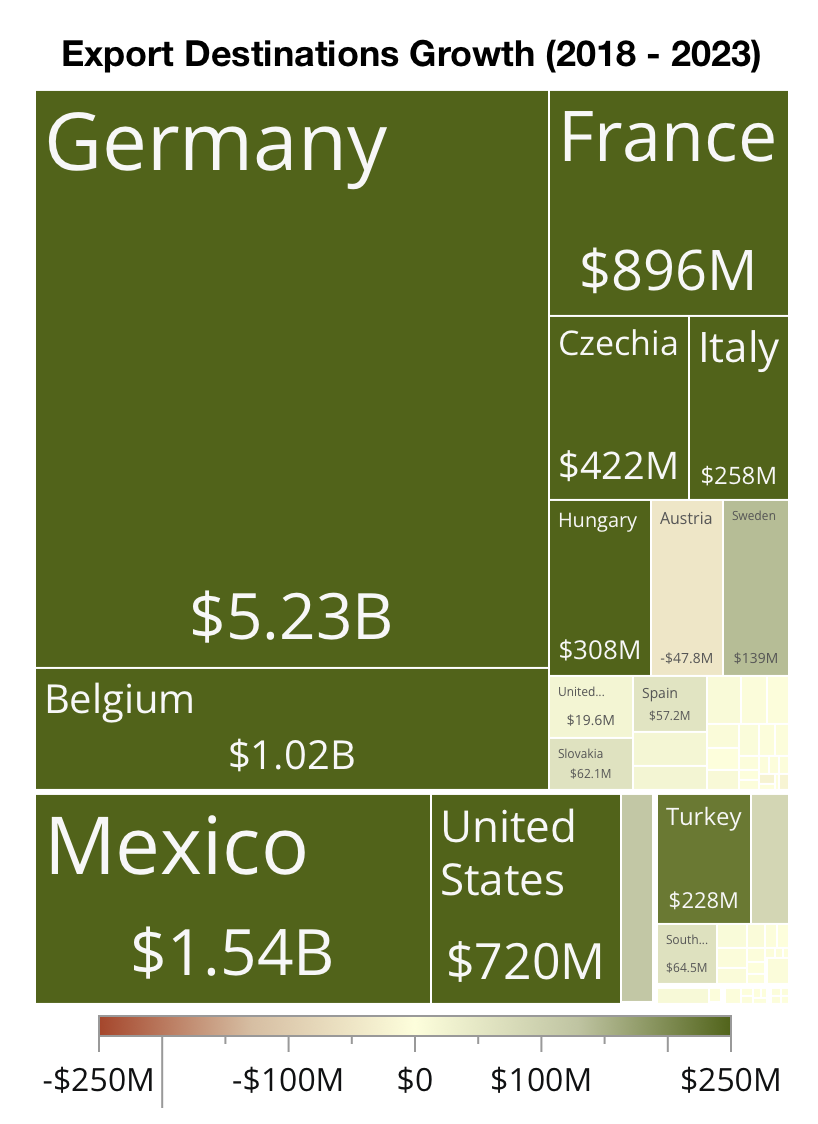
    In the twenty-four years of NAFTA (1994–2018), car production in the region increased by 12 percent. Car production in Mexico, in particular, increased 400 percent, from 800,000 vehicles per year in 1994 to 4 million vehicles per year in 2018. Automotive trade between the United States and Mexico quintupled during the same period, but the United States went from having a surplus of $1.6 billion to a deficit of $64.3 billion.12Two-thirds of the deficit originates in the automotive sector. Meanwhile, US-Canada automotive trade has balanced out, with a surplus in favor of the former of $900 million in 2024.

    Under NAFTA, auto jobs in the US fell from 1.2 million to 990,000, or by 20 percent, and in Canada they fell from 140,000 to 129,000. On the Mexican side, auto jobs in the sector were multiplied by 11, from 108,000 to 1.2 million by 2018. At the beginning of NAFTA, the United States generated 83 percent of autos in the region, Canada 10 percent, and Mexico 7 percent. By the close of the agreement, the United States was responsible for 43 percent, Canada 5.5 percent, and Mexico 51.5 percent.

    The USMCA era

    The implementation of the USMCA in July 2020 heralded major changes for the North American automotive industry. Rule of origin provisions were raised by 12.5 percentage points, meaning that 75 percent of parts and components, and 70 percent of steel and aluminum used in vehicles, needed to originate in North America, with the goal of raising the costs of entry into the regional market for European and Asian producers. The agreement also introduced a labor content rule which established that 40 percent of the value of a vehicle must be produced in plants where workers earn at least $16 per hour. As a condition of moving forward on the treaty, the United States and Canada encouraged the passage of a major reform to Mexico’s federal labor law, extending individual and collective rights in accordance with the International Labor Organization (ILO). The new agreement also obliged Mexico to modify its labor institutions to adopt a Rapid Response Labor Mechanism (RRM), empowering the United States and Canada to observe and enforce respect for the free organization and collective bargaining rights of Mexican workers.13The MLRR allows offices and representatives of “the parties” to denounce or intervene against violations of the rights of free association and collective bargaining at a specific facility (company) (Article 31-A.2 of Annex 32-A of the USMCA). However, since the MLRR is directed to take action against Mexico for such violations, the counterparties may summon the Mexican government and the company in question to resolve such complaints within peremptory time limits, under penalty of “freezing their customs accounts,” suspending their preferential access rights to their markets, as guaranteed by the USMCA, and eventually being sanctioned. Free access to the integrated North American market is now linked with adherence to fundamental labor rights, aiming to strengthen labor enforcement and promote wage growth—implicitly, however limited, counteracting the labor cost arbitrage represented in the severe wage gaps between Mexican auto workers and their Canadian and US counterparts.14Mexico maintained a policy of wage and working conditions containment during the previous four decades, generating labor relations and income standards of social dumping; practices facilitated by a so-called protective unionism. See Graciela Irma Bensusán, Alex Covarrubias Valdenebro, and Inés González Nicolás, “The USMCA and the Mexican Automobile Industry: Towards a New Labor Model?” (<)em(>)International Journal of Automotive Technology and Management(<)/em(>) 22, no. 1 (2022): 128–144.

    The adoption of the new labor rights and RRM required a lengthy negotiating process. Amid ongoing protests by the American Federation of Labor and Congress of Industrial Organizations (AFL-CIO) against free trade agreements (FTAs), in 2002 the US Congress directed the president to include mechanisms to promote fundamental labor rights in FTAs. The AFL-CIO and the United Auto Workers International Union (UAW) fought against a reiteration of NAFTA’s labor standards, in which labor compliance was confined to a side agreement. Each new FTA signed by the United States after 2002 introduced increasingly stringent requirements forcing the trade partners to promote labor conditions that strengthened labor institutions.

    Until the last moment, Congressional Democrats and labor rights supporters conditioned the signing of the USMCA on the inclusion of the most ambitious labor agenda in Latin America. Thus, the agreement was born as the first of a new generation of labor arrangements for international trade, presenting a model to follow. In addition, the USMCA Implementation Act (H.R. 5430) endorsed the labor position.15Title VII establishes the following labor rights monitoring and enforcement bodies: (i) the Intersecretarial Labor Committee to monitor and oversee compliance with the law; (ii) the Council of Independent Labor Experts for Mexico; and (iii) five labor attachés to operate in the US embassy and consulates in Mexico.

    This new framework of labor laws and institutions, in addition to the RRM, have granted organized workers more power, albeit with great limitations. Since implementation, thirty-three labor violation cases have been filed through the RRM, most of which have been resolved in favor of the unions claiming free organization and collective bargaining rights.

    Four years of the USMCA

    The first three years of the USMCA, from July 2020 to May 2023, coincided with Joe Biden’s administration. But effective implementation faced several obstacles. In 2020, the Covid-19 pandemic severely handicapped the industry,16In 2020, automotive production in the three countries plummeted sharply: 19, 21, and 28 percent in the United States, Mexico, and Canada, respectively. prompting a shock that overlapped with the end of the industry’s long expansionary cycle, which began after the 2007–2008 financial crisis and lasted until 2017–18.17The United States and Mexico achieved the highest growth rates for this cycle in 2018 (with 11.3 and 4.1 million cars produced, respectively). Canada in 2017 produced 2.2 million cars.

    In 2020, car production in the region plummeted by 30 percent compared to 2018. By 2024, there was a significant recovery with 16.1 million vehicles manufactured in the region, but still below the 17.4 million of 2018. US production was down 700,000 units from 2018, Canada produced 900,000 fewer cars than in 2017, while Mexico surpassed its 2018 level.

    In proportional terms, the United States failed to increase production capacity in the region under the USMCA, maintaining 66 percent of total regional production. Canada lost two points of that production capacity, the same that Mexico captured. Thus, the USMCA did not contain the “leakage” of productive capacity to Mexico.

    Mexico employed 53 percent of the region’s auto workers in 2024, three percentage points more than in 2018, the year of its highest production capacity. While Canada lost one percentage point of automotive employment during these years, the United States lost four points.

    Autoworker wages in Mexico have increased 1.65 percent per year (8.25 in a five-year aggregate) under the USMCA. Although the country’s new labor institutions and the utilization of the RRM have allowed for more intense union activity with better wage growth, these increases have barely surpassed inflation. Under the USMCA, wages in the Mexican auto industry have gone from $2.30 to $2.50 per hour.

    In this sense, the USMCA failed to achieve its wage objective for Mexico. In fact, the wage gap between Mexican automakers and their North American counterparts has widened since the implementation of the agreement. The UAW and Unifor strikes of 2023, undertaken as automakers earned record profits in thirty years (6.6 percent annual average), left average wages at $37 and $43.2 for UAW and Unifor workers, respectively.18Unifor is Canada’s most prominent union, created in 2013 through the merger of two major unions: the Canadian Communications, Energy and Paper Union (CEP), and the Canadian Auto Workers Union (CAW).

    YearReal IncreaseHourly wage ($)
    20192.3
    20202.012.35
    2021-.022.34
    2022.82.36
    20233.52.44
    202422.49

    Against history

    In his second term, President Trump has deployed a tariff policy that challenges the trends of a globally strategic industry. But the recent history of the auto industry does not bode well for the outcome of this shift. Trump was unable to implement the 35 percent tariffs he proposed in his first presidency. The USMCA signed into law by his administration did not stop the loss of productive capacity and employment in the US auto sector, nor did it stop the wage differential for Mexican workers, which continues to incentivize “social dumping” in the industry.

    Trump’s tariffs have been most severe on China, raised to 145 percent on April 9, under the belief that competitiveness can be created or ended by imposing tariffs of a magnitude directly proportional to the power of the enemy. Although it is too early to assess the impacts of these measures, recent developments indicate that Trump could fail again. China, we just learned, grew 5.4 percent during the first quarter of 2025. This figure warns that China’s economic health is robust.

    Already, Trump’s measures have promoted a trade war which could spur a global recession. China, Europe, and Canada have replicated each US protectionist measures, generating fears of a return to stagflation. Moreover, the dollar has depreciated against other leading currencies, reflecting investors’ expectations and distrust. Stellantis, faced with uncertainty, has cut 900 US jobs and temporarily suspended production at some plants in Mexico and Canada. Trump himself has said that his tariffs with China are not sustainable and recently agreed to lower the ceiling from 145 to 30 percent, as part of a ninety-day truce with China for further negotiations.

    The future of the USMCA hangs in the balance. Trump could cancel the agreement, producing grave economic consequences for the region. Or he could decide to promote the North American auto industry and the energy transition under a renewed USMCA. Cross-border coordination could accelerate the manufacturing and commercialization of EVs in the region, and the inclusion of agreements for critical battery minerals exploitation, battery recycling systems, and renewable energy production.19These initiatives and programs extend the resources and benefits for businesses and consumers established by the Inflation Reduction Act (IRA) and the Infrastructure Investment and Jobs Act (IIJA), among others.

    The latter path would require strengthening environmental rights and labor conditions, including enforcement of labor rights throughout the supply chain. This could also help level wages across North America through two “floors”: first, macro-sectoral agreements for the automotive, mining, and energy industries with minimum wages, benefits, and working conditions in place across three countries; second, a labor content rule that 40–45 percent of the value of a vehicle must be produced in facilities where workers earn no less than $16.20It should be recalled that, despite being included in the labor agreements, this labor-related rule has not entered into force. This is the only way to embark on a path toward a fair and competitive transition in the North American region.
  2. The Tariff Threat

    Comments Off on The Tariff Threat

    In a dramatic shift in US trade policy, the Trump administration has imposed and continues to threaten new rounds of tariffs against Mexico, sounding alarm bells across the Mexican manufacturing industry. If fully implemented, these measures could cause immediate disruption in key industrial zones, place hundreds of thousands of jobs at risk, and halt strategic investments.

    Whatever Trump’s motivations around migration, security, or a new model of trade integration, the threat reveals a deeper structural vulnerability in Mexico’s economy: an excessive dependence on a single trading partner, one which is now willing to use tariffs as a political tool. This instrumental use of economic power has direct consequences for the stability of the Mexican economy and the functioning of highly integrated value chains between the two countries.

    A clear example of this politicization of trade is the recent dispute over the 1944 Water Treaty. On April 10, less than a week after new tariffs announced during so-called “Liberation Day” came into effect, President Trump accused Mexico of “stealing water from Texas farmers” and threatened to immediately impose an additional 10 percent tariff on all Mexican imports, along with targeted economic sanctions. This episode illustrated how the arbitrary and political use of tariffs can generate profound uncertainty around bilateral trade secured by agreements signed decades ago.

    In 2024, Mexico exported a record $495 billion to the United States—equivalent to almost 30 percent of national GDP—mainly concentrated in complex manufactures such as vehicles, auto parts, and electronic products. This industrial success, however, implies a critical exposure: unilateral decisions in Washington are enough to cause, almost immediately, a partial paralysis of the national productive apparatus.

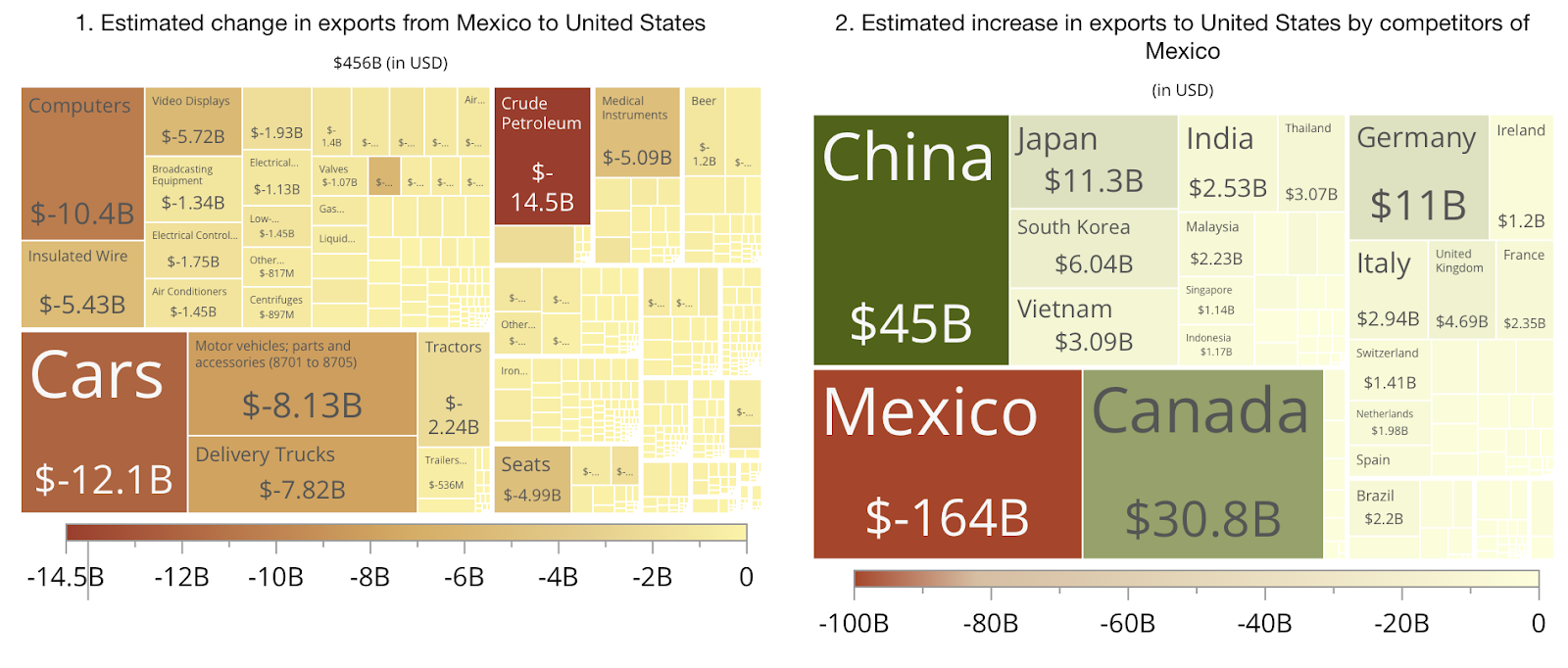
    Simulations by the Observatory of Economic Complexity (OEC) estimate that a 25 percent tariff could reduce Mexican exports by up to $164 billion annually over three years—a figure equivalent to Mexico’s total exports to countries outside the United States.1Viktor Stojkoski, Pablo Paladino, Jelmy Hermosilla, and César A. Hidalgo. The OEC Tariff Simulator (2025). https://oec.world/en/tariff-simulator?exporter=mex&tariff=25 The impact would be especially severe in industrial regions with a high concentration of exports, where employment is directly dependent on the stability of binational trade.

    Faced with this scenario, Mexico must avoid the false choice between deepening regional integration and seeking new markets. The only viable strategy is twofold: Mexico can intelligently strengthen economic ties with the United States in key sectors, while accelerating technological and geographic diversification to reduce vulnerabilities, scale its own capabilities, and expand the country’s strategic margin in the face of future disruptions. This is the only way to transform a critical exposure into a more autonomous, complex, and sustainable growth architecture—and avoid being trapped in a precarious integration model, vulnerable to unilateral decisions and increasingly incompatible with an unstable geopolitical environment.

    From growth to limits

    Productive integration with the United States has been the main driver of Mexico’s manufacturing growth over the past three decades. The automotive, electronics, and industrial machinery sectors have prospered thanks to geographical proximity to the US, trade agreements, and growing regional specialization. But the same process that allowed Mexico to climb up global value chains has also left it vulnerable. As competitive advantages were consolidated, risks were also concentrated. Today, a large part of the national productive apparatus depends on external rules, decisions, and conditions over which Mexico has less and less control. The paradox is clear: the more integrated the Mexican economy, the more exposed it is to disruptions originating outside Mexico’s borders.

    In 2024, Mexico exported more than 2.8 million light vehicles to the United States, reaching a 15 percent share of the US market.2Annalisa Villa, “European car makers’ body warns US tariffs threaten domestic production, exports,” (<)em(>)S&P Global(<)/em(>) (March 27, 2025) https://www.spglobal.com/commodity-insights/en/news-research/latest-news/metals/032725-european-car-makers-body-warns-us-tariffs-threaten-domestic-production-exports Behind this figure lies a complex network of assembly plants and suppliers distributed on both sides of the border, relying heavily on critical imported components, especially batteries, advanced sensors, and semiconductors from Asia and the US. This fragmented architecture, while efficient under normal conditions, multiplies logistical costs and exposes the industry to immediate disruption when tariffs or technological restrictions are introduced.

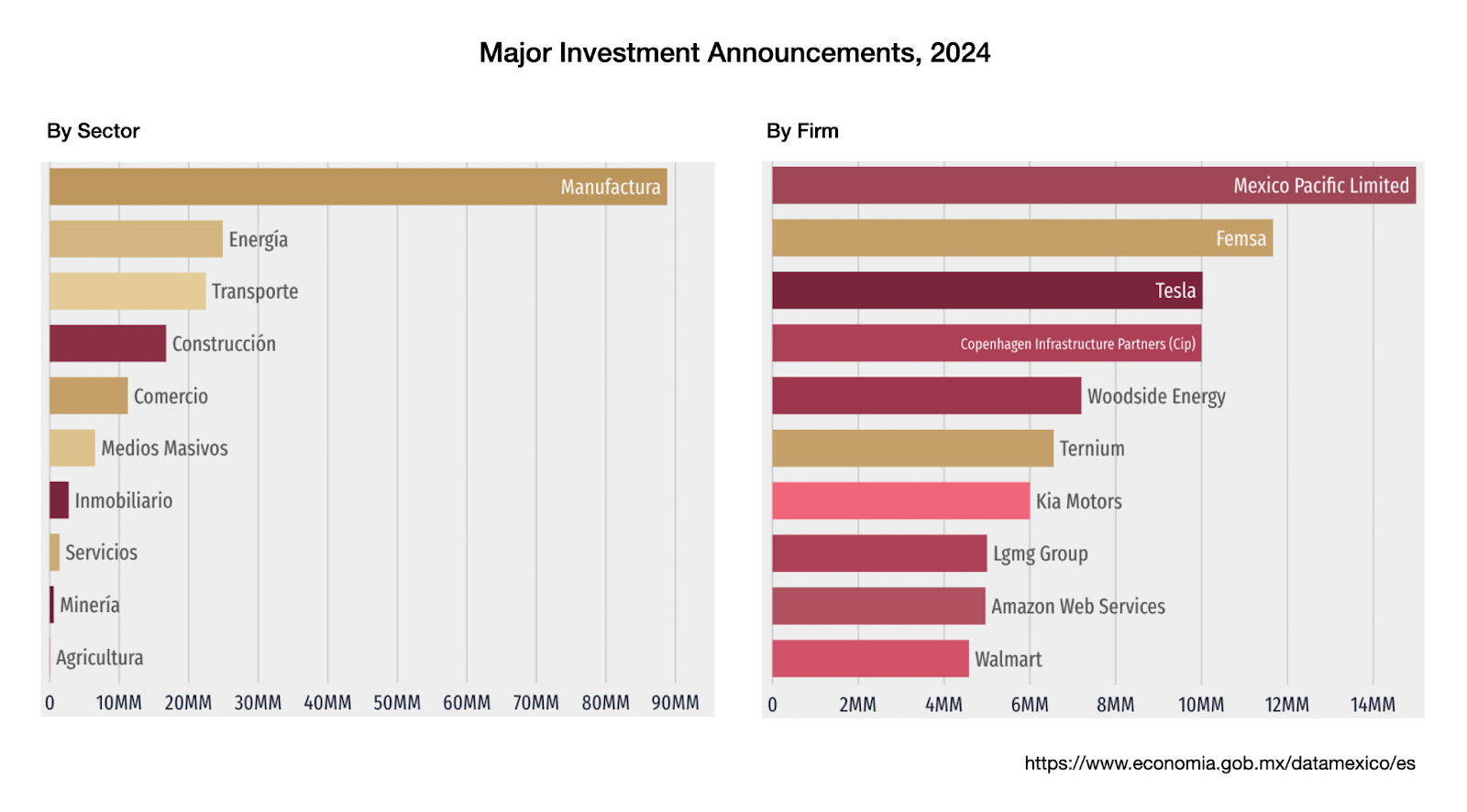
    An emblematic case is the Tesla gigafactory announced in Nuevo León in 2023. With an estimated investment of more than $10 billion and the projected creation of 12,000 direct jobs, this plant is emerging as a strategic node in the North American electric vehicle (EV) chain.3Forbes Staff, “Nuevo Leon approves $2.627 billion pesos in incentives for Tesla factory,” (<)em(>)Forbes(<)/em(>) (December 14, 2023). https://forbes.com.mx/nuevo-leon-aprueba-2627-mdp-en-incentivos-para-fabrica-de-tesla Under tariffs, however, its operation could become unviable, making the supply chain more expensive and inhibiting new investments of a similar scale.

    The case of Ciudad Juarez illustrates the scope of this vulnerability. The border city is home to more than 300 export-oriented manufacturing plants, many of them integrated into electronics, auto parts, and medical device value chains.4INDEX. Juarez, Consejo Nacional de la Industria Maquiladora y Manufacturera de Exportación, (<)em(>)Economic and Industrial Bulletin of the Maquiladora Industry(<)/em(>) (2023) An abrupt disruption of trade would have immediate effects on formal employment, local consumption, and state tax revenues. Other industrial regions—from Reynosa to Querétaro—face similar conditions of critical exposure, relying almost exclusively on fluid access to the US market.

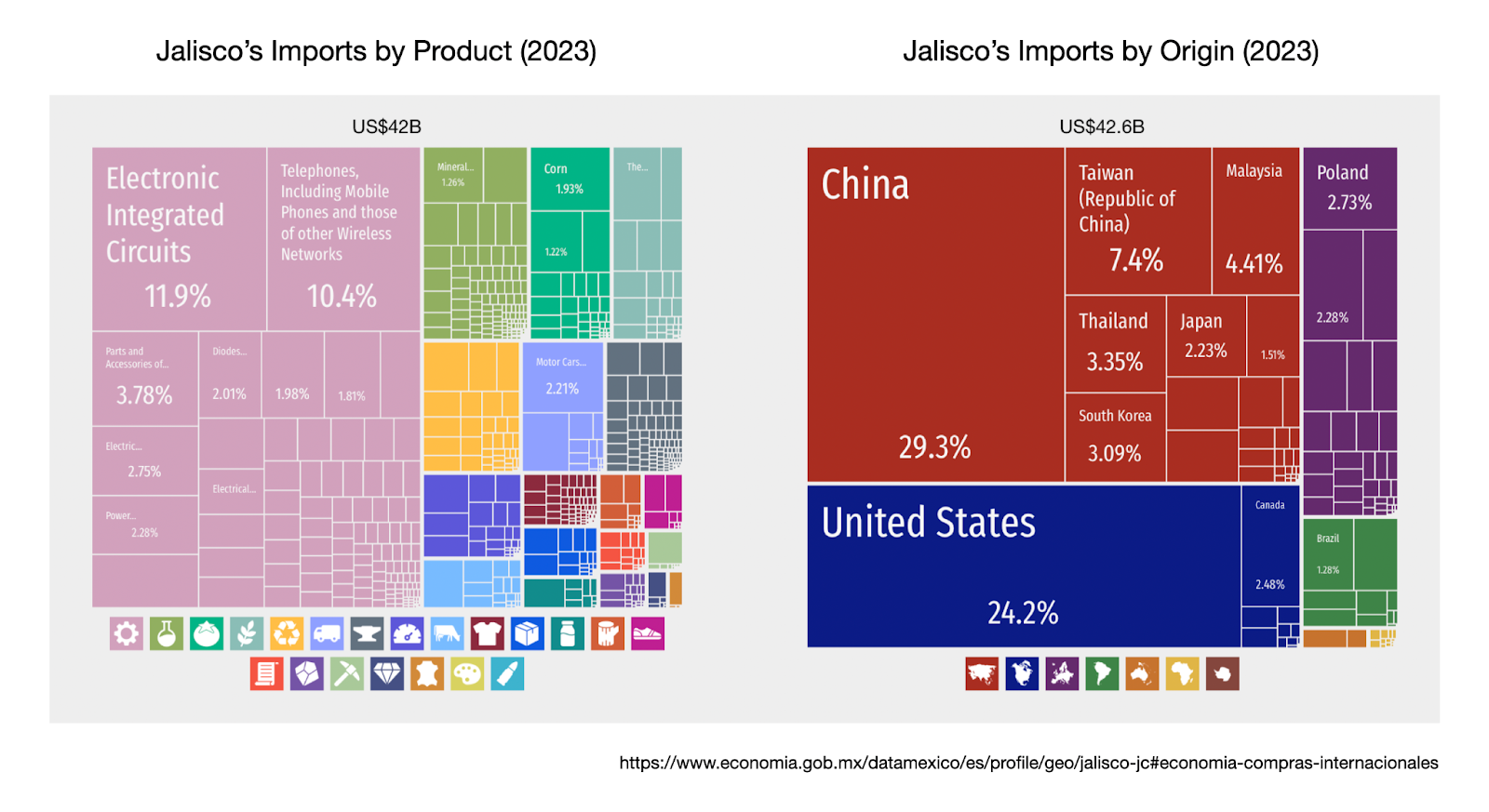
    The electronics industry in Jalisco represents another dimension of this dependence. With accumulated investments of over $4.5 billion in the last fifteen years and more than 100,000 specialized jobs, this region has consolidated itself as a key technological pole in Mexico.5Patricia Romo, “Jalisco is confirmed as Silicon Valley and chip capital in Latin America,” (<)em(>)El Economista(<)/em(>) (May 11, 2024) https://www.eleconomista.com.mx/estados/jalisco-confirma-silicon-valley-y-capital-chips-america-latina-20241105-733019.html However, more than 80 percent of the semiconductors it uses are imported from Asia. During the global chip crisis of 2021–2022, this dependence caused losses of more than $400 million in just six months, highlighting the limits of integration without local capabilities in high-tech components.

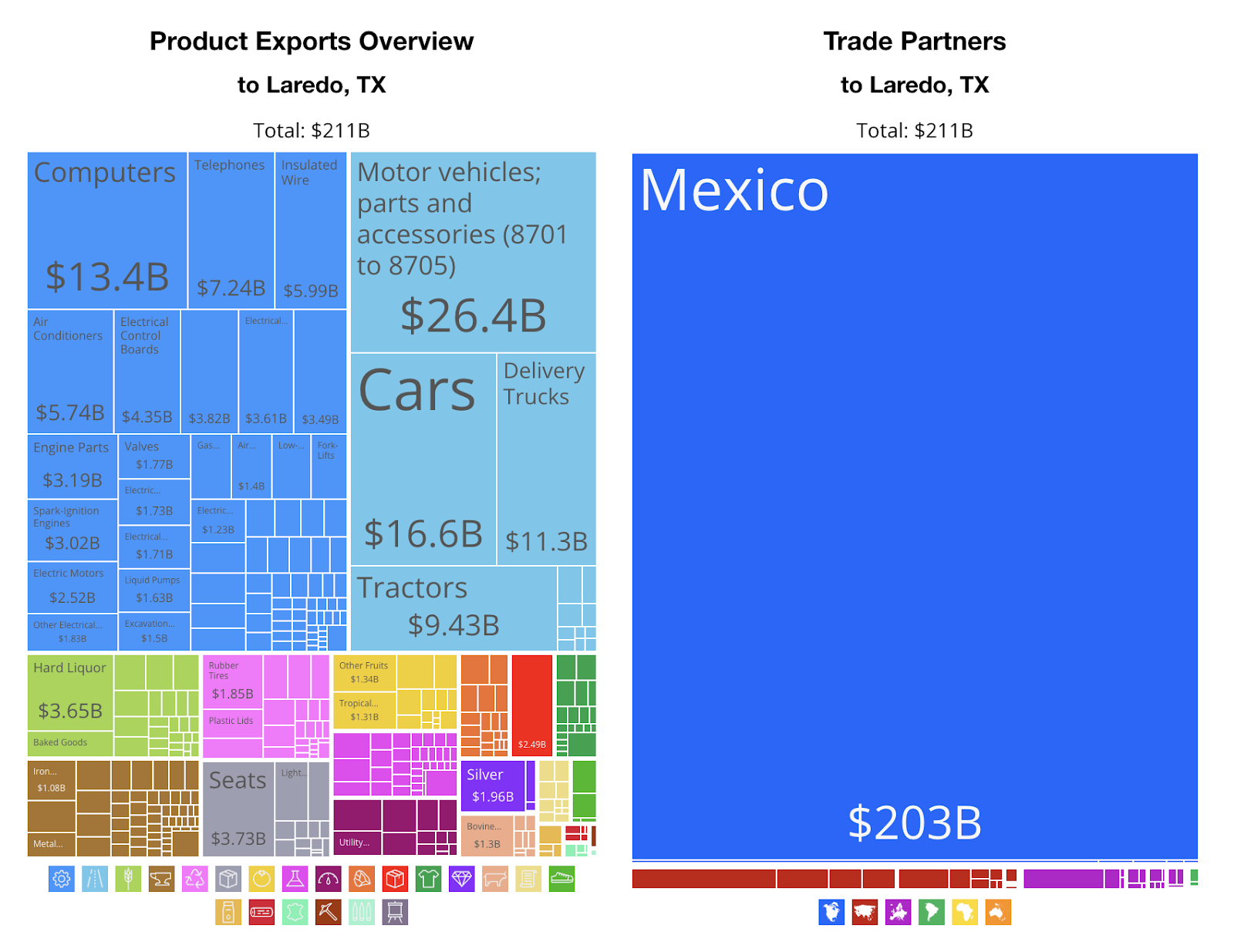
    This structural vulnerability is compounded by a logistical bottleneck that amplifies risks. The Laredo-Nuevo Laredo border crossing concentrates close to 40 percent of land trade between Mexico and the United States—more than $211 billion annually—but operates with overloaded infrastructure and slow customs processes. This saturation generates cost overruns estimated at more than $3.5 billion per year, affecting the operational efficiency of key sectors such as automotive, electronics, and medical devices.6Nuevo Laredo Institute for Competitiveness and Foreign Trade (ICCE). (2022). Binational Socioeconomic Forecast 2022. Nuevo Laredo, Tamaulipas, Mexico. Retrieved from https://anyflip.com/ivqr/ygor/

    The current model of integration, based on efficiency and scale, has been successful in terms of export growth, but its limits are becoming increasingly evident. Without greater technological autonomy, a more robust supplier base and modern infrastructure, this scheme is vulnerable to external shocks. In a geopolitical environment marked by uncertainty and unilateral decisions, persisting in this dependence without strategic adjustments compromises the Mexican state’s ability to protect its industrial base and guide its economic development with sovereignty.

    One strategy, two fronts

    Mexico’s growing exposure to unilateral trade decisions has made it clear that sustaining current integration is not enough: a strategic reconfiguration is needed that recognizes its limits and capitalizes on its strengths. The country’s most dynamic sectors—automotive, electronics, and the medical industry—show both the potential of deep integration and its latent risks. The question is no longer whether Mexico should integrate or diversify, but how it can do both in an intelligent and complementary way. Exploring this dual path requires understanding which sectors represent consolidated advantages, which face critical bottlenecks, and where real platforms exist to reduce vulnerabilities without weakening what works.

    This approach does not imply a break with the United States, but a qualitative transformation of the relationship. Mexico is not simply a low-cost supplier: it is a centerpiece of North American industrial competitiveness. What is at stake is not only maintaining access to the US market, but redefining the terms of integration through greater national technological content, internal innovation capabilities, and more resilient supply chains that can withstand external shocks without jeopardizing productive stability.

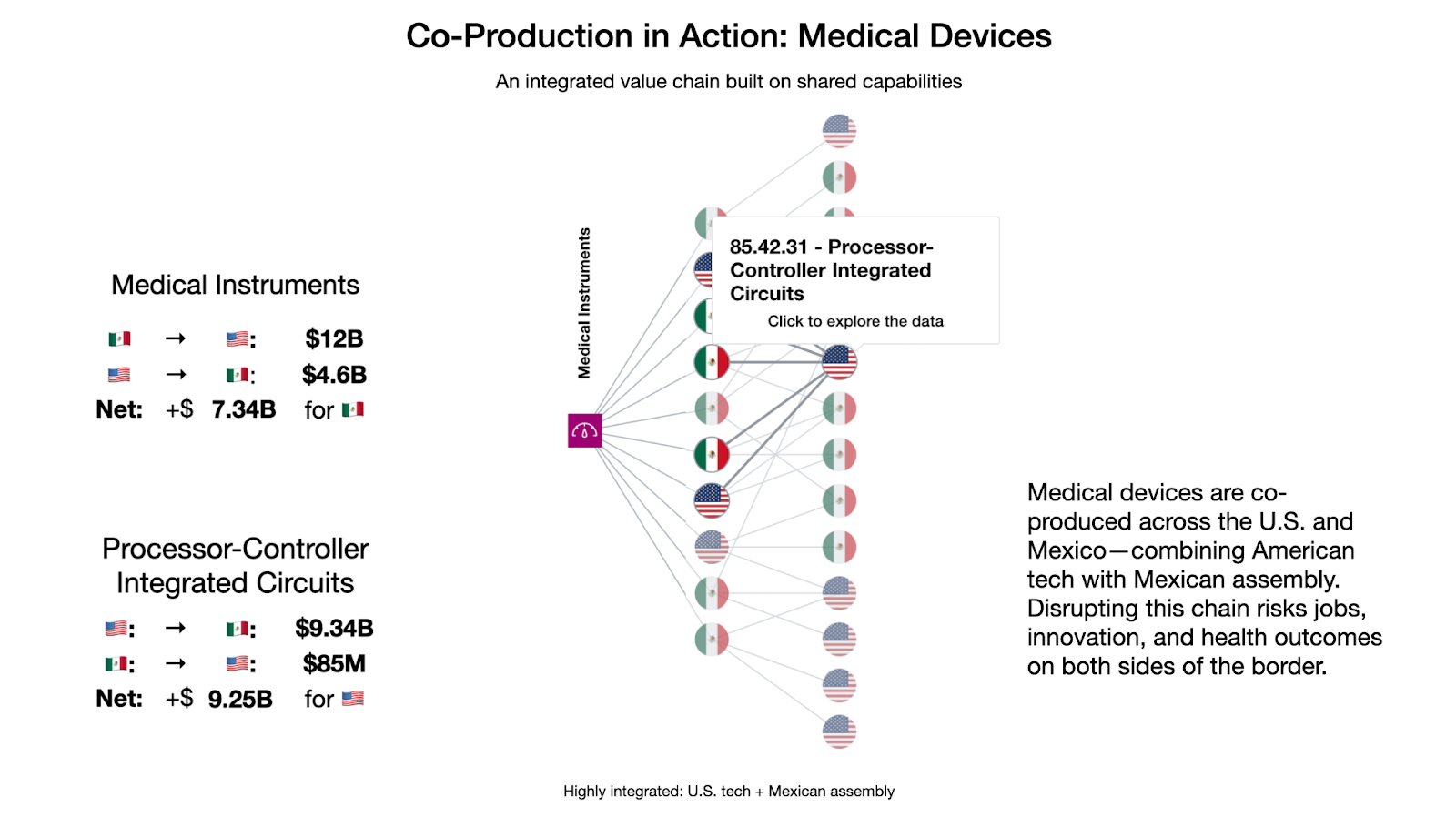
    The medical device industry offers a concrete example of new-generation productive integration. In 2024, Mexico consolidated its position as the main supplier of these products to the US market, with exports over $12 billion and growth rates exceeding 25 percent annually. Companies such as Medtronic, Johnson & Johnson, and Abbott have built binational operations that combine manufacturing efficiency in Mexico with US-based regulations, design, and research and development capabilities. According to recent data, Mexico contributes 2.8 percent of domestic value added to US exports, compared to 1.8 percent for China and just 0.4 percent for Vietnam.7Pedro Casas and Arturo Martínez, “‘America First’ does not mean ‘America alone’,” (<)em(>)21st Century Diplomacy(<)/em(>), Wilson Center  (February 3, 2025). https://diplomacy21-adelphi.wilsoncenter.org/article/america-first-does-not-mean-america-alone

    This model reduces operating costs by up to 20 percent compared to Asian suppliers, while improving the speed of logistical response in a highly regulated sector.8National Academies of Sciences, Engineering, and Medicine, Health and Medicine Division, Board on Health Sciences Policy, Committee on Security of America’s Medical Product Supply Chain, “Globalization of U.S. medical product supply chains,” Chapter 3 in (<)em(>)Building resilience into the nation’s medical product supply chains(<)/em(>). Carolyn Shore, Lisa Brown, and Wallace J. Hopp (Eds.)  National Academies Press (March 3, 2022). https://www.ncbi.nlm.nih.gov/books/NBK583730/ In addition, Mexican plants comply with demanding international standards (FDA, CE, ISO 13485), which allows them not only to supply the US, but also to compete in global markets. What is relevant is not only integration, but also their technological quality and their projection beyond North America.

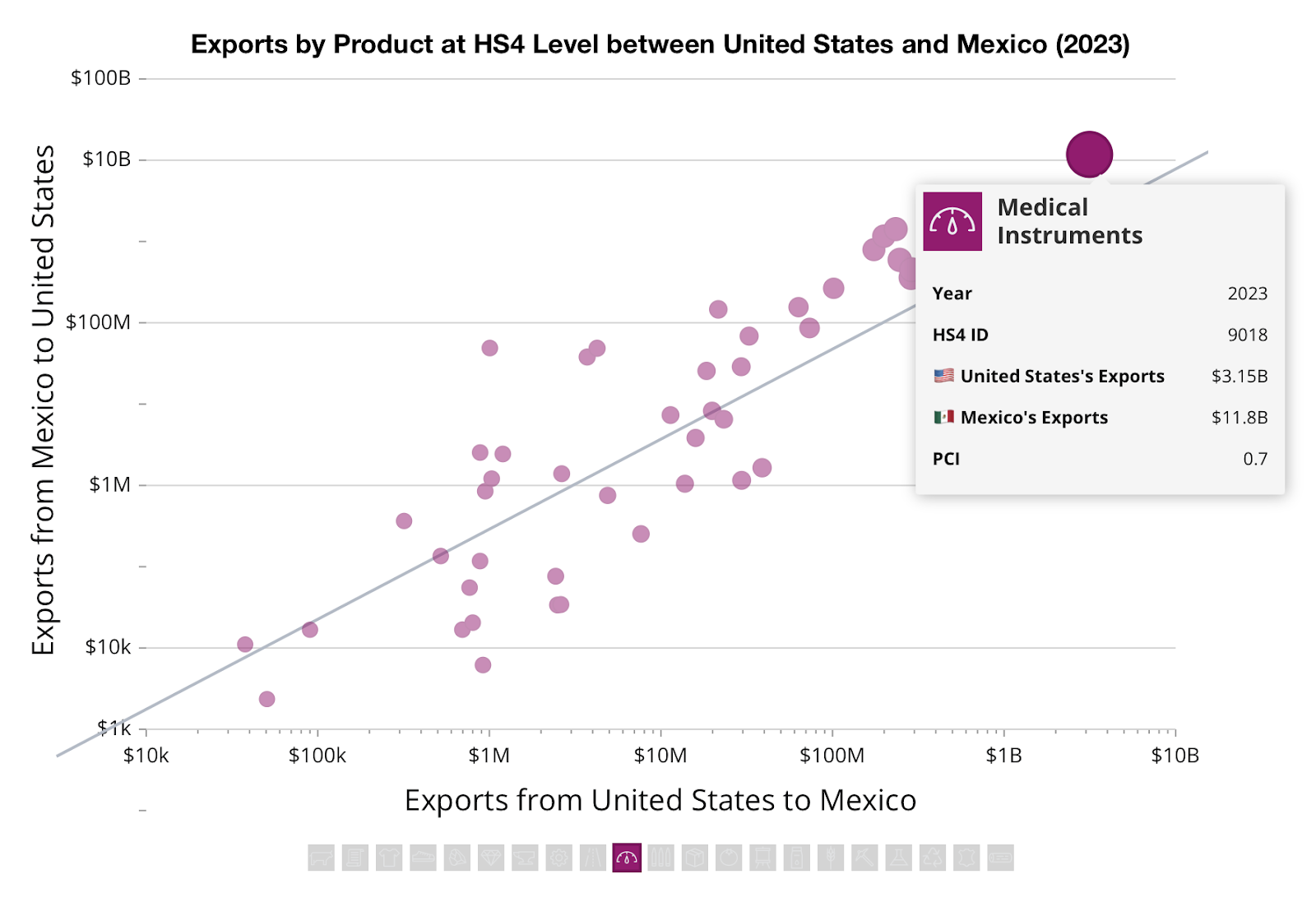
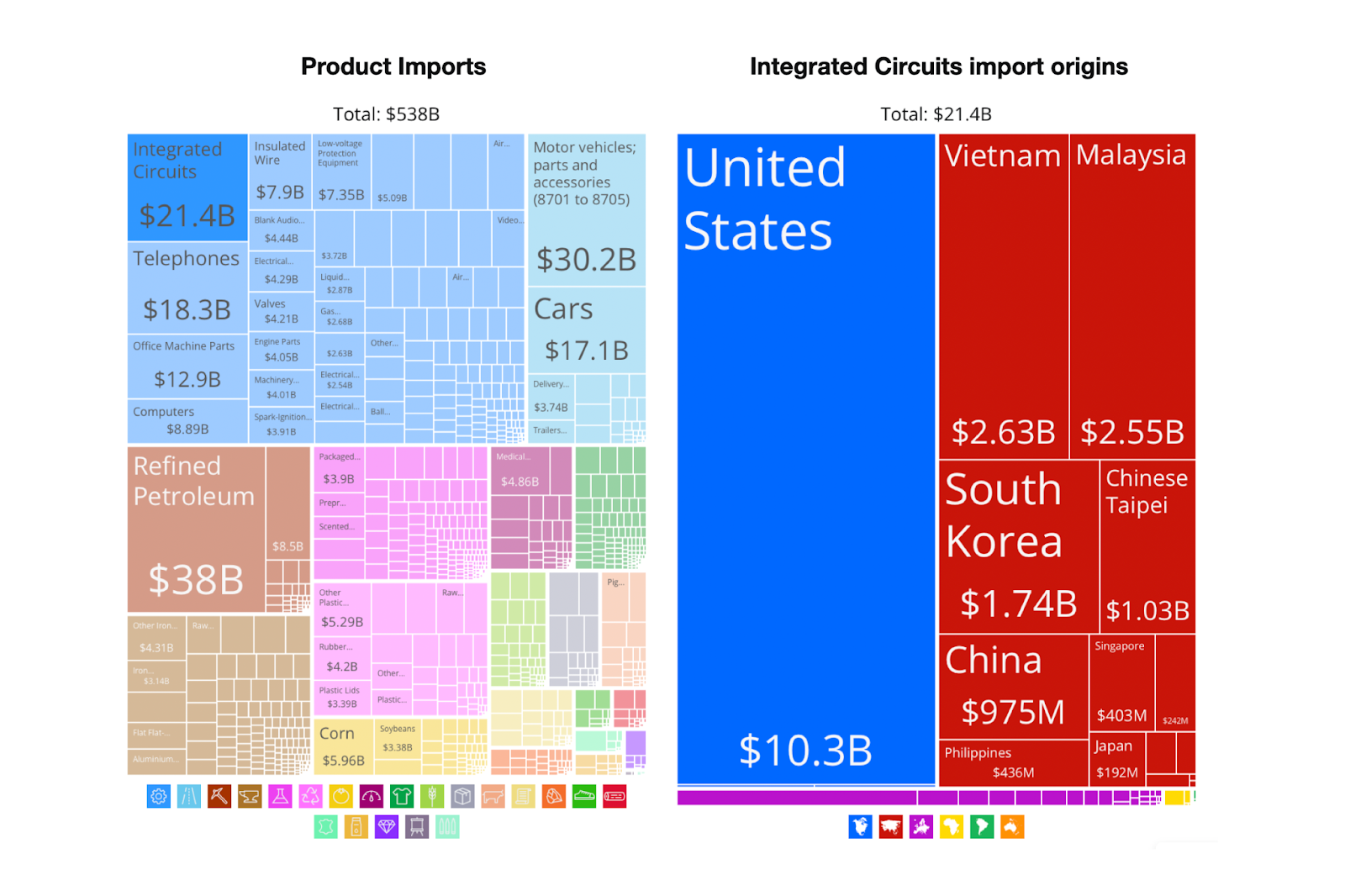
    A detailed visualization of bilateral trade clearly shows how this interdependence operates. Mexico leads exports of finished medical devices to the United States, while relying on key inputs such as controller-type integrated circuits (HS 8542.31) from the same US market. In 2024, Mexico exported more than $12 billion worth of medical devices to the United States, which in turn shipped more than $9.3 billion worth of these components to Mexico. The result is neither a deficit nor a loss: it is a shared value chain, where one country designs and supplies the “brains,” and the other assembles, certifies, and delivers quality products ready for clinical use.

    This model is not sustained by tariffs or nationalist speeches. It is sustained with clear rules, cross-border investment, and mutual trust. Fracturing this would not only jeopardize jobs and competitiveness, but would also weaken the health capacity of the entire region by disrupting a productive ecosystem that transcends borders and depends on deep coordination.

    In 2024, Mexico exported more than $30 billion in auto parts to the United States, which represented more than 40 percent of the total imported by that country. However, this apparent leadership hides a structural weakness: the average national technological content barely exceeds 55 percent.9Ministry of Economy (2023). Diagnosis and Prospects of the Automotive Industry. Government of Mexico. Available at: https://www.gob.mx/se/documentos/diagnostico-y-prospectiva-de-la-industria-automotriz Many of the most sophisticated components—sensors, semiconductors, electronic modules—continue to be imported.

    Sustaining this position in the supply chain requires more than volume: it requires a transition from assembly to value generation. This implies concrete instruments, such as tax incentives linked to a progressive increase in domestic content, technological co-investment schemes with anchor firms and technical training programs in key sectors. South Korea, in the 1980s and 1990s, adopted a similar strategy to move from intermediate supplier to industrial power. Mexico can adapt that experience to its own conditions.

    The other pillar of the dual strategy is productive and commercial diversification with strategic direction. Mexico has already begun to receive relevant investments in emerging sectors such as EVs. A prominent example is BMW’s plant in San Luis Potosí, which will produce 140,000 battery packs per year starting in 2027.10BMW Group, “BMW Group increases production of electric vehicles in the global production network: the ‘NEUE KLASSE’ platform will also be built at the San Luis Potosi Plant” (2023) However, the country does not yet have an integrated production chain: it does not have the scale capacity to refine lithium, manufacture cells, or assemble complete systems.

    Poland’s experience offers a useful roadmap. In less than a decade, the country created a competitive electric battery ecosystem, supported by three pillars: targeted tax incentives, specialized industrial parks in logistically advantageous locations, and accelerated technical training in partnership with global leaders such as LG and Northvolt.

    Vietnam’s experience in advanced electronics is also instructive. Although companies such as Intel have opened design centers in Guadalajara, and Foxconn has expanded its assembly capacity, Mexico still imports more than 75 percent of the semiconductors it consumes. Vietnam, on the other hand, took advantage of agreements with Samsung to develop capabilities in packaging, intermediate design, and specialized technical training, gradually moving up the value chain. Rather than spectacular leaps, Vietnam’s progress was based on structural agreements, progressive accumulation of capabilities, and clearly defined objectives.

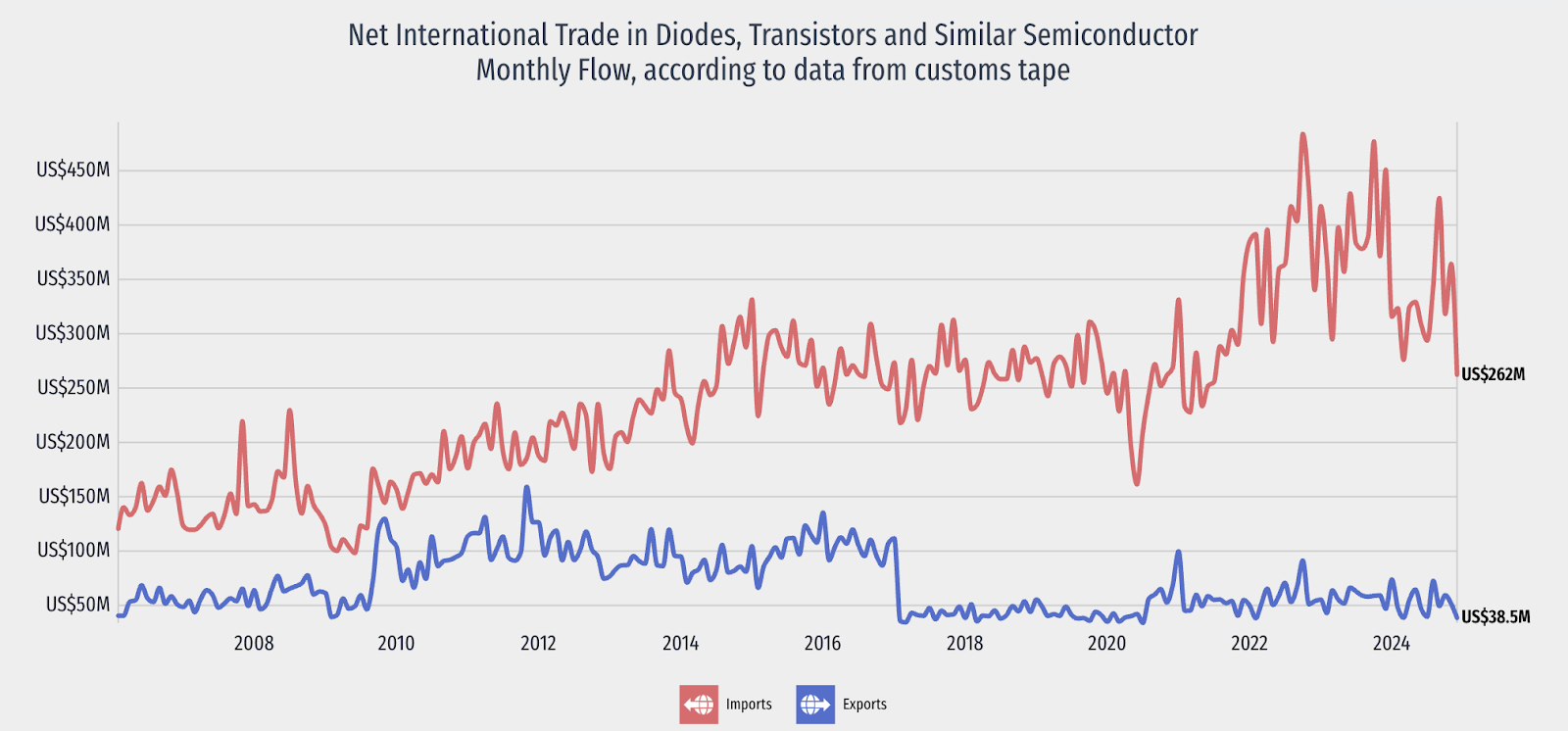
    https://www.economia.gob.mx/datamexico/es/profile/product/diodes-transistors-and-similar-semiconductor

    Mexico is home to more than 120,000 engineering graduates each year,11WorldAtlas, “Countries That Produce the Most Engineers,”  (July 18, 2018) Retrieved April 23, 2025, from https://www.worldatlas.com/articles/countries-with-the-most-engineering-graduates.html industrial zones connected to high-volume ports and border crossings, and a manufacturing base that represents more than 18 percent of national GDP.12Ministry of Economy and Labor, Manufacturing industry in Mexico (2023), based on data from INEGI. What is lacking is not advantages, but a determined and coordinated strategy to transform these latent advantages into solid platforms for advanced production. The key is not to distribute efforts, but to concentrate them in sectors where the country can rapidly scale, generate critical capabilities, and open new routes for international insertion.

    Investing and scaling

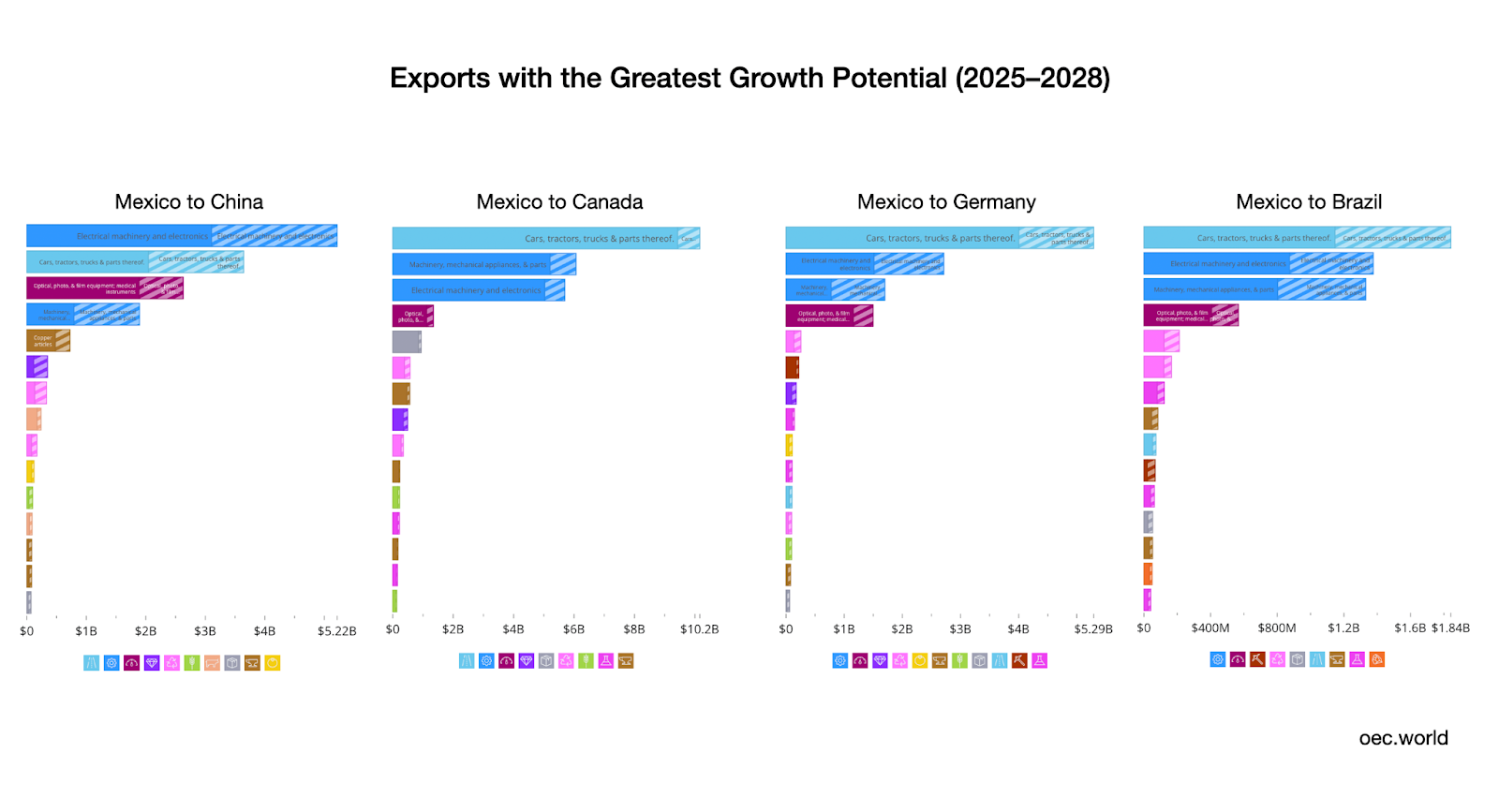
    The question is no longer just to which countries to export more, but in which sectors and markets Mexico can scale quickly, reduce critical vulnerabilities, and build a more robust technological base. The export potential model of the Observatory of Economic Complexity (OEC) offers a concrete guide: it identifies high-impact niches where the conditions to compete already exist and where focused investment can transform current gaps into platforms for expansion.13Gilberto García-Vazquez, “Uncovering Hidden Trade Gems: Rethinking Export Potential with the OEC,” (<)em(>)OEC(<)/em(>). https://oec.world/en/blog/export-potential

    Unlike traditional approaches, which project future trade based on past growth or geographic proximity, the OEC model incorporates productive capacities, technological linkages, and compatibility with destination country demand. By cross-referencing these factors, the model identifies products with high potential for expansion. The results are not generic: they point to concrete ways to diversify with strategic logic.

    • China: Auto parts, integrated circuits, and advanced medical devices.
      Estimated potential: more than US$3.2 billion in additional exports.
    • Germany: Automotive manufacturing, industrial electronics, and computers.
      Estimated potential: more than US$2 billion.
    • Canada: Auto parts, digital technologies, and medical devices.
      Estimated potential: more than $2.5 billion.
    • Brazil: Commercial vehicles, advanced auto parts, and industrial electronics.
      Estimated potential: more than $900 million.

    These opportunities are not simply new trade destinations: they represent concrete routes to reduce dependence on the United States, increase the technological content of Mexican exports, and expand the country’s geo-economic radius of action. It is not a matter of competing with low prices, but of scaling up in terms of quality, sophistication, and strategic relevance. Taking advantage of these niches not only diversifies trade, but also redefines Mexico’s role in global value chains. Identifying opportunities is just the first step; capitalizing on them depends on building the capabilities needed to compete in those markets. Scaling up exports of medical devices to Germany or Canada, for example, requires reinforcing international certifications (CE, ISO), adapting regulatory frameworks and having advanced testing laboratories. Accessing markets such as integrated circuits in China or Germany requires electronic design, encapsulation, and functional testing: capacities that are still limited in the national productive ecosystem.

    The same goes for infrastructure. Exporting complex manufactures to Asia or Europe will not be viable without reliable logistics routes, modern ports, and friction-reducing customs agreements. Opportunities may be well mapped, but without these enabling conditions, they will remain out of reach. Lack of seamless connectivity—by road, rail, port or regulation—not only makes operations more expensive, it also restricts the country’s ability to integrate into global chains with higher technological margins.

    Integration and diversification can be brought together as parts of the same productive architecture. The scale achieved in sectors integrated with the United States offers a concrete starting point for identifying the links of greatest external dependence and turning them into platforms for technological expansion and trade openness. Turning these weak points into platforms of sophistication requires an integrated approach, where technological capabilities, industrial scale, and commercial access are developed in a coordinated manner.

    From capabilities to policy

    The productive transformation that Mexico needs will not be achieved with scattered programs or disconnected incentives. It requires prioritizing critical capabilities, mobilizing public instruments, and coordinating the public and private sectors around new trajectories of specialization. The goal is not only to increase exports, but to build a more autonomous, sophisticated, and resilient economy. But this process cannot succeed through inertia: it requires political vision, implementation capacity, and an institutional architecture capable of sustaining the effort beyond six-year cycles.

    Mexico’s industrial base has grown in scale, but not in technological density or local integration. Today, less than 1 percent of Mexican companies participate directly in exports, reflecting a structural disconnect between foreign investment and the ecosystem of domestic suppliers.14OECD, SME and Entrepreneurship Policy Review: Mexico 2023, (<)em(>)OECD Publishing(<)/em(>) (2023) https://doi.org/10.1787/1cc9eaec-en Closing this gap does not require improvisation, but coordination. This implies linking tax incentives to increased domestic content in strategic sectors, promoting technological co-investment schemes between global firms and local suppliers, and launching accelerated training programs in mechatronics, encapsulation, advanced chemistry, and industrial automation. It is not a matter of replacing imports indiscriminately, but of developing technological autonomy in critical nodes—where the country is more vulnerable today, but also where the strategic return is greater.

    Moreover, infrastructure not only facilitates trade: it determines who can participate in it. Today, logistical and energy bottlenecks limit the expansion capacity of entire regions. While in the north, some key US-Mexico border points operate under chronic saturation, generating high cost overruns, in the southern part of the country, a lag in energy infrastructure impedes the arrival of advanced manufacturing to areas with great industrial potential. In these regions, the electricity grid remains insufficient, its load capacity irregular, and costs uncompetitive in comparison to the north. A useful contrast is the SIEPAC project, which electrically connects six Central American countries. Mexico has yet to take full advantage of the project to pursue regional integration. A strategic expansion of the national grid—combined with investment in renewable energy and distributed storage–would link the south and southeast with the main industrial corridors of the country and open new routes for territorial diversification. Overcoming these barriers requires more than isolated investments: it requires an integrated vision that combines logistics, modern energy, and digital connectivity, transforming infrastructure into economic cohesion and regional competitiveness.

    This scale of transformation requires an institutional center. Today, industrial policy is fragmented among ministries, trusts, programs, and levels of government, without a unified direction. The most successful experiences—from South Korea to Poland—were all characterized by political coordination. Without high-level coordination, it is impossible to align incentives, mobilize resources, and sustain priorities beyond a six-year term. Mexico needs a governing body that combines strategic vision with operational capacity: a National Industrial Policy Council that reports directly to the presidency, articulates measurable objectives in technological autonomy and export diversification, coordinates budgets and regulations between agencies, and ensures the participation of the private sector, state governments, and productive clusters. It is not a matter of creating yet another bureaucracy, but of providing the country with an institutional architecture capable of transforming capabilities into results.

    The tariff threat is not simply a compounded risk. It is the visible symptom of a deeper structural vulnerability: a model of economic integration that, although successful in terms of export volume, was built on fragile foundations—technological dependence, geographic concentration, and scarce local articulation. Mexico’s industrial future will not be defined only by what it exports, but by how it produces goods, with whom it integrates production, and under what rules it sustains manufacturing. The dual strategy of integration and diversification is not ideological, it is a structural necessity in a world where trade is no longer governed by efficiency, but by power. The water dispute, which became a trade ultimatum, made it clear: no agreement guarantees stability when the rules can be changed at a press conference.

    Still, Mexico has strategic sectors, emerging capabilities, and an industrial base that can scale. What is missing is not diagnosis, but sustained action, and a political will capable of transcending the enthusiasm of the first few months of a new presidency. The decisions Mexico makes in the coming years will define whether the country moves toward a more resilient, complex, and sovereign economy, or whether it perpetuates its own vulnerability.

  3. After Impeachment

    Comments Off on After Impeachment

    Korea remains engulfed in political turmoil following the declaration of martial law on December 3 and the subsequent presidential impeachment by the National Assembly. Former President Yoon Suk Yeol, arrested and detained on January 19, is now on trial in the Constitutional Court. His resistance to investigation incited public outrage and heightened fears about the impact of the political crisis on the economy. Meanwhile, conservative factions and the political right wing have rallied against his impeachment, leaving Korean society deeply polarized. On April 4, the Constitutional Court finalized Yoon’s removal after a lengthy impeachment trial, and on June 3, South Koreans are slated to elect a new president.

    The ongoing political instability has exacerbated longstanding structural challenges in South Korea’s economy. A poster child of late twentieth century democratic transitions, hailed for its export-oriented growth model, Korea now confronts democratic backsliding and economic stagnation. A robust program of public investment is needed to shift this course. 

    Crisis and impeachment

    By most accounts, President Yoon Suk Yeol’s declaration of martial law on December 3, 2024, represented a desperate attempt to deflect attention from the corruption allegations and plummeting approval ratings that plagued his government. Claiming that the elections were rigged by hackers linked to North Korea and China, he deployed soldiers to the National Election Commission and the National Assembly—a move that was overturned by the National Assembly within two hours. Thousands of citizens gathered to protest, confronting soldiers and demonstrating a collective resolve to safeguard democracy at the National Assembly on the night Yoon declared martial law. The Assembly formally impeached Yoon on December 14, with twelve members of his own party voting in favor. That day, a massive protest underscored resistance to Korean authoritarianism. 

    Despite the protests, Korea’s political condition is far from encouraging. For one, the investigation and arrest of Yoon took a long time due to his resistance, and the ruling elite stalled his impeachment. Han Duck-Soo, the acting president and former prime minister, was himself impeached by the opposition for refusing to appoint the constitutional judges needed to finalize the impeachment process. Furthermore, opposition leader Lee Jae-Myung has faced his own swath of legal scandals, including accusations of electoral and financial mishandling.  

    And since the impeachment, Yoon’s conservative party has only increased its popular appeal, by shifting further to the extreme right and opposing his impeachment. Although the ruling party’s approval ratings sank during the impeachment process in mid-December 2024, they have since surged, nearly surpassing those of the liberal opposition by late January 2025. Public support for Yoon’s impeachment has also declined, dropping from 75 percent to 59 percent, while opposition to his impeachment has risen from 21 percent to 36 percent over the same period, according to Gallup Korea. 

    The reality is that the impeachment process and coming elections are unlikely to resolve the structural challenges facing Korean democracy. Since its division from communist North Korea, South Korea has been governed by a right-wing governing coalition that repressed democratic mobilization and labor movements but maintained public support with rapid industrialization and economic growth. 

    With its first direct presidential elections held in 1987, the liberal opposition party only came to power in 1997. Since democratization, the conservative party has maintained its lead over the Liberals in general elections. Despite the Liberals’ landslide victory in the general election in 2024, the conservative tradition has remained powerful, bolstered by the support of large businesses, influential conservative media, intellectual elites, and entrenched bureaucratic networks.

    The recent rise of far-right rhetoric, fueled by fears of losing conservative control, has further polarized the political landscape. The violent unrest after Yoon’s impeachment could lead to a kind of political cold war in Korea. How this crisis unfolds will undoubtedly shape Korea’s trajectory, both as a democracy and an economic powerhouse.

    A fragile economy

    Though the Korean stock market has recovered after a successful impeachment vote in the National Assembly, the Korean won sharply declined from 1,406 won per dollar on December 2 to 1,478 by December 31. During a meeting with Acting President Choi Sang Mok in January, global credit rating agencies expressed heightened concerns about the prolonged uncertainty. A vice president at Moody’s Sovereign Risk Group remarked that “prolonged disruption to economic activity or weakening consumer and business sentiment would be credit negative.” In practice, foreign portfolio investment recorded a net outflow of $3.9 billion in December 2025—the largest amount since the Covid-19 pandemic.

    The negative economic impact of the political crisis is evident in stagnating domestic consumption. As the figure below demonstrates, Composite Consumer Sentiment Index has fallen rapidly since December 2024.


    The retail sales index has also fallen 2.1 percent since December 2023, according to Statistics Korea. This downward trend is unlikely to reverse until the impeachment process concludes. 

    The current turmoil has already dampened corporate investment, with corporate lending declining since December 2024. Business sentiment has also worsened, with the Composite Business Sentiment Index for all industries falling from 91.8 in November 2024 to 87.3 in December 2024 and 85.9 in January 2025, according to the Bank of Korea (BOK). The overall Economic Sentiment Index, which includes both businesses and consumers, also showed a decline in December. Finally, the Business Survey Index (BSI), which reflects the real situation of businesses, dropped in December. These trends paint an overall picture of stagnating investment.

    Labor markets are also feeling the impact. Employment numbers for December fell compared to the same month of the previous year, and the seasonally adjusted unemployment rate rose to 3.7 percent—the highest since December 2021. This marks a 1 percentage point increase from November and a 0.5 percentage point rise compared to December 2023.

    These rather momentary trends are part of a broader economic slowdown. The annual real GDP growth rate for 2023 stood at only 1.4 percent. And while the quarterly real GDP growth rate rebounded to 1.3 percent in the first quarter of 2024, it fell to -0.2 percent in the second quarter and remained weak at 0.1 percent in the third and fourth quarters, reflecting sluggish domestic demand and a recent decline in exports. Private consumption contracted by 0.2 percent in the second quarter compared to the previous quarter, primarily due to stagnant real wages. Meanwhile, construction investment and exports declined by 3.6 percent and 0.2 percent, respectively, in the third quarter. Notably, net exports contributed a negative 0.8 percentage points to economic growth in the third quarter. 

    The stagnation continued in the fourth quarter, with domestic consumption and construction investment growing by just 0.2 percent and contracting by -3.2 percent, respectively. As a result, the quarterly growth rate in the fourth quarter was a mere 0.2 percent, reflecting the worsening economy, partly due to the political crisis. The annual economic growth rate for 2024 is now expected to be 2 percent, lower than the earlier projections by the Korean government and the Bank of Korea (BOK). The performance of both the stock market and the currency in 2024 has also underperformed compared to major economies.

    The numbers suggest that the Korean economy faces challenges on two fronts: weak domestic demand, driven by stagnating real wage growth, and looming difficulties in the external sector, linked to changes in the global economy. Real wage growth has been negative in 2022, 2023, and the first quarter of 2024, exerting pressure on domestic consumption. The government’s fiscal austerity policies have only worsened the situation. Small business owners, particularly those in restaurants and retail, are bearing the brunt of the downturn in private domestic consumption, with a recent rise in bankruptcies.

    Annual and Quarterly Economic Growth in Korea (%)
    202320242024/Q12024/Q22024/Q32024/Q4
    GDP1.421.3-0.20.10.1 (1.2)
    Private Consumption1.81.10.7-0.20.50.2 (1.2)
    Government Consumption1.31.70.80.60.60.5 (2.7)
    Construction Investment1.5-2.73.3-1.7-3.6-3.2 (-5.3)
    Facilities Investment1.11.8-2-1.26.51.6 (4.9)
    Exports3.66.91.21.2-0.20.3 (3.1)
    Imports3.52.41.61.61.6-0.1 (2.7)
    Source: Bank of Korea. The numbers in parentheses represent the growth rate compared to the same period in the previous year.

    Another challenge stems from external shocks—particularly with the election of Donald Trump in the US. Trump’s tariff wars could significantly undermine an increasingly export-oriented economy. As a share of GDP, exports grew steadily after the 2000s, driven in part by a growing Chinese market for capital and intermediate goods. 

    Korea’s export-oriented growth model has suffered setbacks since mid-2022, when a protectionist global turn combined with China’s economic downturn and the development of its domestic industries to replace imports from Korea weakened demand for Korean products. While export growth recovered in late 2023, it has again stalled in recent months. Most notably, Trump’s election and his implementation of tariff hikes, including reciprocal tariffs, pose a significant shock to the Korean economy. Additionally, the announcement to reduce government subsidies for foreign companies under the Inflation Reduction Act (IRA) could negatively impact key Korean companies in the battery industry. 

    As a result, Korea’s growth prospects for 2025 appear dim. The BOK projected a growth rate of 1.9 percent for 2025 in November 2024, and lowered it to 1.5 percent in February 2025. International investment banks have presented even gloomier outlooks for 2025, with Goldman Sachs predicting a growth rate of 1.5 percent in March 2025. The BOK recently stated that the first-quarter growth rate might be negative, and the annual growth rate could fall below 1.5 percent. In April, the International Monetary Fund (IMF) lowered its 2025 growth rate forecast to 1 percent, down from 2 percent in January.

    These bleak economic prospects are compounded by structural trends, not least of which is the demographic shift. According to the Korean government, the share of the elderly aged 65 and older stood at 17.4 percent in 2022, and this figure is projected to rise to 25.3 percent in 2030, 34.3 percent in 2040, and 40.1 percent in 2050, making Korea one of the fastest-aging countries in the world. Furthermore, Korea’s birth rate is the lowest in the world, recorded at just 0.72 in 2023. This trend is attributed to economic insecurity among young people, difficulties in raising children, high real estate prices, and other factors. The relatively high level of inequality, stemming from the dual labor market, combined with limited government redistribution, further exacerbates the low birth rate. As a result, Korea’s working-age population will decline sharply, leading to slower economic growth in the future. Without significant improvements in productivity, the country’s potential GDP growth rate is expected to fall below 1 percent by the 2040s.

    A way forward

    The Yoon administration has done little to effectively address these challenges. Relying on the outdated approach of trickle-down economics, it has implemented tax cuts for businesses and the wealthy, arguing that economic growth should be driven by the private sector. 

    Alongside these tax cuts, the Yoon government has pursued fiscal austerity. Reducing the government debt ratio appears like an odd objective for a country whose public debt stands at about 53 percent of GDP in 2024—significantly lower than that of many other advanced economies. The administration limited government spending increases to 2.8 percent in 2024 and 3.2 percent in 2025, lower than the nominal growth rate. However, the administration’s tax cuts have led to a shortfall in tax revenue compared with that in the original budget, with a gap of 56 trillion won (about 2.5 percent of GDP) in 2023 and a shortfall of about 31 trillion won in 2024, ultimately increasing its fiscal deficit. The fiscal deficit recorded 1.5 percent and 1.7 percent of GDP in 2023 and 2024 respectively, running against the government’s goals. Even as Keynesian demand stimulus is back on the table in much of the West, Korean governing elites remain attached to an outdated Anglo-Saxon model. Commitment to the model dates back to the 1997 financial crisis and the subsequent neoliberal restructuring of the South Korean economy. 

    If Korea is to avoid the worst consequences of this failing economic strategy, it must undertake robust fiscal stimulus and public investment, not only to improve social welfare but also to promote emerging green industries. While there is rising support for a supplementary budget, the leading presidential candidate from the liberal opposition party has both advocated for tax cuts and voiced support for efforts to boost a corporate-led vision of economic growth, making his policy orientation somewhat unclear. What is certain is that Koreans have an opportunity to dramatically alter the course of the Korean economy in favor of sustainable and inclusive growth, based on higher taxation and more active government investment in industrial policy. They should not let this opportunity go to waste.

    This article is an updated version of the author’s previously published article.

  4. OPEC Plus

    Comments Off on OPEC Plus

    Over the last quarter century, oil-exporting countries, in particular OPEC members, have been exposed to extreme changes in the oil market and global geopolitics. With volatility stemming from booming shale oil production in the US, the intensification of international debate and policy to curb carbon emissions, a collapse in consumption during the Covid-19 shutdowns, and heightening geo-economic fragmentation, exporters looked to new avenues for cooperation.

    The process of realignment began in 2000, when the Second Summit of the Heads of State and Government of OPEC came together for the first time since 1975. Leaders relaunched the organization with the aim of consolidating its disparate factions. Since its inception OPEC has witnessed a tension between its identity as a “political” organization advancing the interests of developing countries and the global South, and an “economic” association for maximizing the revenues of member countries. This dual purpose would powerfully resurface in 2007, when the “economic bloc” led by the Gulf Monarchies grappled against a “political bloc” led by Venezuela and Iran that was outspokenly critical of US imperialism.

    The year 2016 brought a historic shift: a rapprochement between Saudi Arabia and the Russian Federation produced OPEC+, a larger and looser cooperation agreement focused on defending prices. Though it consolidated under OPEC’s “economic” umbrella, the rapprochement nevertheless signaled a potential shift in the global balance of power.

    The following is an outline of the origins of this new configuration and its prospects for coping with a new set of overlapping geopolitical and economic challenges. OPEC+ represents a unique model for global cooperation among resource exporters from the global South and it involves key members of BRICS. Whether such alliances can be forged around different natural resources and critical minerals or in different political circumstances remains to be seen.

    OPEC and Russia in the new century

    The early 2000s arguably represented a new “golden era” for OPEC. With the election of Hugo Chavez in 2000, Venezuela began to reverse the “oil opening” (apertura petrolera)—in which the national oil company Petróleos de Venezuela, S.A (PDVSA) jeopardized the nation’s fiscal regime and weakened control of the oil sector by courting foreign investment. By the end of the 1990s, Venezuela was “overproducing” by 800,000 barrels per day (bpd) and its oil technocrats wanted the country to leave the OPEC it had helped found. A young and charismatic leader, Chavez and his oil minister Rafael Ramírez (this article’s co-author) focused on strengthening the organization, reestablishing the oil fiscal regime, and allowing PDVSA to retake operative control over production under a policy dubbed “full oil sovereignty.”

    With new leadership in Venezuela and a favorable global market, OPEC began to act again. Member states introduced new price bands and committed to a renewed effort to respect quotas. Meanwhile, the tight oil market of the early 2000s gave the producers room to maneuver. One of its most notable interventions was an extraordinary cut of 4.2 million barrels per day (mbd) decided at the 2008 Oran Meeting in Algeria, the largest gathering in the history of the organization. The cut allowed the price to recover from its dizzying fall of more than 40 percent after the financial crisis in the US. That year, the price of oil reached a historic high of nearly $150 per barrel.

    The world’s second largest oil exporter would not join the party. This was partially a legacy of the Cold War, when political differences between the Soviet Union, Iran, and Saudi Arabia were pronounced. The Soviet Union saw itself as an industrial power having little in common with raw materials exporters. An active political actor in the Middle East and a close ally to some of the secular and socialist Arab powers, the USSR was viewed as a potential threat to the internal stability of the Gulf monarchies.

    There had been a short-lived cooperative effort, led by Mikhail Gorbachev, to dampen the effects of the oil counter-shock of 1985, but no agreement was achieved. And the prospect for working with OPEC seemed to permanently fade once the dissolution of the Soviet Union weakened state control over the Russian oil sector. At the time, the expectation of the EU governments and the US was that Russia would be fully integrated into a free Eurasian energy market—a kind of El Dorado of fossil capital, with capital flowing East and resources flowing West. The spirit of the time was visible in the signing of the Energy Charter Treaty (ECT) in 1994, followed by Russia’s inclusion in the G7 in 1998.

    Throughout the 1990s, Russia’s oil sector was regionalized and privatized. By 2002, 80 percent of Russian oil production ended up in private hands (compared to 10 percent in the mid-1990s), a policy with severe consequences for the country’s income and general wellbeing. Between 1991 and 1996, Russia’s GDP declined by 40 percent, poverty increased dramatically, and state institutions were starved for taxes. Capital flight was estimated at $17 billion annually.

    This was the context in which Vladimir Putin emerged as the dominant political figure in Russia. When Boris Yeltsin named Putin president in 1999, the latter already had a vision for the energy sector: mineral resources, he held, ought to ultimately support state power. The Russian state reasserted its role in the oil sector after the privatization spree of the 1990s, forcing oil companies to pay export taxes and royalties and recommencing direct state intervention in oil production. Government takeovers and forced sales of major private firms—including the infamous case of YUKOS—characterized the early 2000s.

    By the mid-2000s, ROSNEFT, Russia’s state-controlled oil company, was responsible for almost half of the country’s oil production. Importantly, private and international oil companies maintained a decisive footing in the oil sector (until 2022, for example, BP still owned one-fifth of ROSNEFT). There remained significant domestic and international pressures to treat oil as a commodity, unrestricted by international agreements that could limit Russian production.

    OPEC did try to coordinate with other oil exporting countries, especially outside the OECD. At successive conferences after 2003, producers such as Norway, Mexico, the Russian Federation, Syria, and Oman were invited as “observer” countries. But the organization was divided on how to deal with Russia. Saudi Minister Ali al-Naimi, one of the most influential ministers in the group and the first Saudi head of Saudi ARAMCO, insisted that Russia would not engage in credible production cut agreements, while Venezuela, Iran, and North African countries advocated closer ties to the enormous producer country.

    In 2005, an intermediate solution was reached to create a technical body for dialogue with the Russian Federation at the level of the OPEC Secretary General. At the 2007 OPEC Summit in Riyadh, Chavez vehemently advocated for strengthening the political role of the organization, citing its contribution to the fight against poverty in the developing nations, and questioned the persistent centrality of the dollar in international markets. The “political bloc” then proposed the establishment of a basket of currencies to replace the dollar for oil transactions, a measure that was hotly debated and ultimately set aside due to opposition from the economic bloc of the Gulf Monarchies led by Saudi Arabia (a similar proposal had already been unsuccessfully advanced in the 1970s). The need for OPEC to focus on maintaining market stability, however, was reasserted.

    The shale revolution reaches OPEC

    OPEC experienced a dramatic change in course during the early 2010s. The Arab Spring, NATO’s intervention in Libya, and the death of Hugo Chavez weakened countries in the political bloc, and indirectly strengthened the position of the monarchies. At the same time, a technological revolution rocked the oil industry, with profound geopolitical implications.

    In 2006, US net oil imports constituted 60 percent of total consumption or 13mbd; by 2019, this figure had fallen to just 3 percent. The change was due to the shale oil boom, a development as significant as the North Sea discoveries of the 1970s. With cheap financing available in the post-financial crisis low interest rate regime, the world’s most powerful military-economic power also became, once again, the world’s leading oil and gas producer. The strategic dependence on other nations’ oil, a feature of the US political economy since 1948, was significantly reduced (this year, the US net imports of crude ore are predicted to be the lowest since 1971).

    From the point of view of the OPEC General Secretariat, until 2012 shale oil production was not considered a structural factor directing medium-term change in the market. In fact, at its December 2011 meeting, OPEC had kept its production level fixed at 30 mbd. But soon the explosive growth of production from the US shale fields caught the interest not only of OPEC, but also of the Russian Federation.

    In October 2013, a high-level meeting between OPEC and Russia took place in Moscow, during which one of the two main topics was the assessment of the “development of tight oil and shale gas in the USA.” The following month, the 164th OPEC Ministerial Conference discussed the issue and asked the Secretary General for a mid-term market update, including the impact and prospects of shale oil production in the US. The resulting report showed an increase in US production by 1.14 mb/d in 2013, and a further increase of 0.95 mb/d in 2014. In a closed meeting with the ministers, a presentation shown by Secretary General Abdallah Salem El-Badri illustrated that US oil production from tight formations stood at 3.29 mb/d in 2013 and projected an increase—in both tight oil and shale oil—of 2.61 mb/d, reaching a total of 5.9 mb/d by 2019. OPEC thus acknowledged that shale oil would increase significantly, based on improved drilling efficiency and new wells, but also estimated wrongly that tight oil production would peak in 2019, at 5.9 mb/d, and then begin to decline.

    The ministers thought that these volumes could eventually be absorbed by rising global demand, which was expected to continue to rise until 2015, exceeding the 90 mb/d threshold.

    By the time OPEC began to react, it was too late. From mid-2014 onwards, oil prices began to fall against rising global supply and slowing Chinese demand. On the sidelines of the 165th Ministerial Conference in November 2014, Venezuela promoted a closed-doors meeting between representatives of Russia, Mexico, Venezuela, and Saudi Arabia. Mexico was represented by Energy Secretary Pedro J. Coldwell, Saudi Arabia by Naimi and the Saudi OPEC Governor Mohammed al-Madi, Venezuela by Oil Minister Ramírez, while Russia was represented by the Energy Minister Alexander Novak and Igor Sechin, the president of ROSNEFT. The presence of Sechin, who was close to Putin, was notable.

    After an introduction by Ramírez, the floor was left to the guests. Coldwell declared that Mexico could not make production cuts. Then Sechin, not Minister Novak, took the floor and stated that Russia would also not cut. Naimi’s response was swift: “It looks like nobody can cut, so I think the meeting is over.” Naimi was convinced that Saudi needed to maintain an export floor at 7 mb/d, and did not want to repeat the experience of the early 1980s when Saudi, acting as “swing producer,” saw its output drop to 2.5 million barrels in a failed effort to defend oil prices. To the Financial Times, Naimi said: “If I reduce, what happens to my market share? The price will go up and the Russians, the Brazilians, US shale oil producers will take my share.”

    With no commitments from non-OPEC producers, OPEC extended the previous production ceiling, unchanged since 2011, in the belief that market forces would eventually weaken high-cost producers. A December 2014 cover of The Economist depicted a vicious oil price contest—“Sheiks versus Shale”—that might tip the world into oil surplus. Market operators immediately sensed the disagreement among top exporters while US production increased without pause. From mid-2014 to early 2016, prices fell by 70 percent.

    The creation of OPEC+

    The end of 2014 delivered new political crises for OPEC members. The recently inaugurated Venezuelan president, Nicolás Maduro, shook up his Ministry and oversaw a collapse in oil production. Sanctions on Iran hobbled its oil output. Libya was engulfed in civil war, and Algeria entered a period of political instability. OPEC was weakened and internally unbalanced. The 2014–2016 fall in oil prices had an impact on all oil-exporting countries. In Russia and Saudi Arabia the economic damage was coupled with significant political changes.

    In 2014, Russian tax revenues from hydrocarbons fell by 40 percent. Russia’s foreign exchange reserves fell by more than 20 percent as the ruble depreciated. This was compounded by the enactment of the first sanctions against Russia over the annexation of Crimea and its support for separatists in Eastern Ukraine. In response to the annexation, G7 leaders cancelled the planned summit in Sochi, expelled Russia from the G8, and terminated Russia’s application to join the International Energy Agency (IEA).

    Meanwhile, Putin had begun to favor direct intervention in the Middle East: In September 2015, Moscow sent military forces to Syria to support the Assad government—the first time Russian troops were sent to a foreign country since Afghanistan.  With Western relations strained, Russia shifted focus toward greater self-sufficiency, also by promoting agricultural exports favored by a depreciated ruble. For a country that remained dependent on oil and gas for 36 percent of its budget revenues, asserting some degree of control over oil markets became an essential tool for strengthening economic resilience in the face of mounting external challenges.

    The year 2015 similarly saw major changes in the Saudi Kingdom. The death of King Abdullah brought to power Mohammad bin Salman (MBS), the sixth son of the twelfth son (Salman bin Abdulaziz) of Saudi Arabia’s founder. MBS’s father, Salman bin Abdulaziz, became king amid mounting external threats. With the Iranian-backed Houthis capturing Yemen’s capital in March, the lifting of sanctions against Iran following the signing of the US-backed nuclear deal (JCPOA) in July 2015, and oil prices continuing their fall, MBS was appointed Defense Minister and Head of the Royal Court. He inaugurated the Supreme Council for Economic Development, as an organ of the Council of Ministers to oversee economic policies.

    MBS pursued a muscular foreign policy, ordering a military intervention in Yemen—Saudi Arabia’s first direct military intervention abroad—and taking an increasingly anti-Iranian stance, culminating in the 2016 execution of Shia cleric Nimr al-Nimr, which triggered attacks on the Saudi embassy in Tehran and the subsequent severing of diplomatic ties

    Alongside this active foreign policy was an economic strategy aimed at diversifying the Saudi economy away from over-reliance on oil. Domestic energy prices were increased, new indirect taxes were introduced for the first time on non-essential goods, and a privatization plan was proposed that crucially included Saudi Aramco. Speaking to The Economist in 2016, MBS likened his own approach to “Thatcherism,” envisaging massive new investments in tourism, technology, and infrastructure. The Crown Prince was enthusiastic about privatizing Saudi ARAMCO, which would benefit both the company and Saudi citizens: “It’s in the interest of the Saudi market, and it’s in the interest of Aramco, and it’s in the interest of greater transparency,” he declared. In April 2015, Minister Naimi was removed from ARAMCO’s Board of Directors.

    MBS’s diversification strategy was rebranded Saudi Vision 2030 and announced to global audiences in June 2016, positioning a Public Investment Fund (PIF), enhanced with assets from the privatized Saudi ARAMCO, as “an essential mover on the Planet.”  Crucially, the entire diversification project ultimately relied on increasing oil prices to fund investments, attract foreign capital, and boost PIF’s capitalization. Saudi Arabia faced severe budget deficits as increased military spending came to constitute nearly 25 percent of its budget.

    With rising financial pressures, both powers were poised for negotiation. In June 2015, MBS made his first visit to Russia during the St. Petersburg Business Forum. In April 2016, Qatar, which held the rotating Presidency of OPEC, convened a meeting of selected OPEC and non-OPEC governments to discuss a production freeze. Russian delegates, as well as Saudi Arabia and others, supported the initiative, except for Iran, which was eager to regain its pre-sanctions production levels. Naimi first accepted the production freeze, but a phone call from Riyadh imposed a different position. A freeze would only be feasible if all producers agreed without exceptions.

    Days later, Minister Naimi, who had been consistently skeptical on a deal with Russia, was reassigned as “Minister without portfolio.” His successor, Khaled Al-Falih, quickly established a cooperative relationship with the Russian Energy Minister Novak. In September 2016, Putin and MBS instructed their ministers to develop a joint action plan at the G20 in Hangzhou. Novak announced the cooperation, calling it a “a new stage in relations between OPEC and non-OPEC countries.”

    The next step was taken at an OPEC Extraordinary Meeting in Algiers on 28 September, where a tough and lengthy debate centered on Iran. By then, the Saudi position had softened compared to the previous Doha meeting and the fourteen participants finally agreed to limit production, but allowed that Iran would not be constrained by the decision. The “Algiers agreement” marked the beginning of high-level consultations between OPEC and non-OPEC representatives, including Brazil, Mexico, and the Russian Federation.

    At the end of November, OPEC finally decided to cut production, and during the following Ministerial Meeting of OPEC and Non-OPEC countries in Vienna on December 10, the so-called Declaration of Cooperation (DoC) established a new partnership that would soon become known as OPEC+. A recent official history of OPEC considers the DoC “as significant in OPEC’s history as its founding on September 14, 1960.” Non-OPEC members participating in the DoC (Azerbaijan, the Kingdom of Bahrain, Brunei Darussalam, Equatorial Guinea, Kazakhstan, Malaysia, Mexico, Oman, the Russian Federation, the Republic of Sudan, and the Republic of South Sudan) agreed to cut 558 tb/d, while OPEC countries would cut 1.2 mb/d. A Joint Ministerial Monitoring Committee (JMMC) would assess compliance with the production adjustments. The move boosted oil prices, while global (US) shale oil production remained at around 5.3–5.8 mb/d, before rising again sharply from 2018 onwards. According to Kirill Dmitriev, the CEO of the Russian Direct Investment Fund, “the first OPEC+ agreement generated an additional 130 billion dollars for the Russian budget until 2019.”

    The new oil order

    Just a few years after the creation of OPEC+, the international oil market was impacted by two extraordinary events that severely tested its unity: Covid-19 and the Russian full-scale invasion of Ukraine. The economic shutdown in the early weeks of the Covid-19 pandemic crashed the oil market to an extent not seen since the Great Depression. In an unprecedented move, and after an internal rift between Russia and Saudi Arabia, the US openly called on OPEC+ to intervene in April 2020. The OPEC+ production cut, the largest in history, was a decisive step in stabilizing the oil market, reducing the oversupply by a volume equivalent to the 10 mb/d drop in demand and initiating the draining of excessively high oil inventories.

    The next shock was the war breaking out on Europe’s doorstep. Oil market alarms went off again, but now for geopolitical reasons. The US, the UK, and the EU, among others, imposed drastic economic sanctions on the Russian Federation. Agencies such as the IEA and experts at the Oxford Institute for Energy Studies projected an imminent 30–40 percent plunge in Russian oil production, putting it at 6–7 mb/d in the short term. In December 2022, the G7 countries imposed a “price cap” of $60 per barrel on Russian crude oil to limit its revenues and jeopardize the war effort.

    The geopolitical risk factor triggered a jump in oil prices. Brent and WTI went from 94 and 91.5 dollars a barrel in February 2022 to 139 and 131 dollars a barrel in March. When, at the beginning of the Russian invasion of Ukraine, the main consuming countries declared their intention to replace Russian oil and gas imports with volumes from other producing countries, the OPEC+ countries, especially the Gulf monarchies,  maintained their unity and even reduced production in solidarity with Russia. Given the tremendous pressure placed on Riyadh by the EU, UK, and US, this unity was surprising. As if to further underline the cohesiveness of OPEC nations, Saudi Arabia started to normalize its relations with Iran in March 2023 and, together with other members such as the UAE and Iran, was also invited to join BRICS in 2024.

    The Ukraine conflict triggered a reordering of the global oil market, with new customers and new suppliers. The oil market is a century old, with a well-developed and open infrastructure that can transport the resource over different routes to any destination. Unlike the natural gas market, there are hardly any physical constraints on oil’s transport. Therefore, when a supplier is displaced from a specific market these volumes can be directed to another market, satisfying demand until stability is reached.

    OPEC+’s astounding unity meant that the conflict at the “gates of Europe” and the economic sanctions and restrictions on the Russian economy did not lead to the collapse of Russian oil production (even though they have weakened Gazprom as a natural gas exporter). What happened instead was a process of re-orientation of flows, particularly towards China and India. The consolidation of a new East-East hydrocarbon axis, in place of the old East-West axis, is underway.

    The OPEC model?

    OPEC continues to face both contingent (see the recent effort to punish Kazakhstan for exceeding output quotas) and existential challenges. Most notable is the possibility of “peak oil demand” triggered by energy decarbonization, slower global growth, or a combination of the two. OPEC has tried to regulate the flow of oil, potentially a “conservationist policy” for natural resources, as advocated by OPEC founder Juan Pablo Pérez Alfonzo who thought of the organization as an “ecological force.” But, to this date, neither OPEC nor OPEC+ have ever engaged in international negotiations to plan a global reduction of oil and gas production. The same is true for the OECD countries, and for the world’s largest oil producer, whose President has declared an “energy emergency” that must be met with boosted production under the slogan of “drill, baby, drill.”

    Frenzied discussion of minerals crucial for electronics and green tech production have led to speculations about an “OPEC for Lithium,” or for copper exporters who have in the past tried (and failed) to coordinate production. Prospects for such projects will depend, as for OPEC+, upon their ability to navigate the tension between economic and political goals, their autonomy from liberal “resource governance,” as well as their willingness to exert sovereign control over their natural resources.

    Key OPEC+ members, such as Russia, Iran, and the UAE, are also members of BRICS (Saudi has been invited, but has not yet officially joined the club), an organization that stands for the reform of western-led global economic governance. But the weakening of those OPEC members (such as Algeria, Iran, and Venezuela) that in the past had endorsed efforts to marginalize the dollar or supported development and anti-poverty measures in the South indicate a resistance to engaging in global economic reform. Nominally, OPEC+ is mostly about “economics” (oil prices) and, to a lesser degree, about great power politics (Saudi/Russian diplomacy). But as a coalition of “sovereign landlords,” OPEC+ members may inevitably be driven to antagonize commercial capital, support global struggles to restrain finance, traders, and multinationals, and endorse efforts to preserve natural resources for the benefit of future generations. The fact that OPEC+ retains its solidity despite enormous internal differences and turbulent geopolitical conditions indicates the potential of international alliances of countries from the global South to endure in the changing world order.

    This is an adapted chapter from the forthcoming book, Energy Politics in a Turbulent Era, forthcoming from the University of Oslo.

  5. A Class Coup

    Comments Off on A Class Coup

    On September 1, 2013, O Globo, one of Brazil’s largest circulation newspapers, published a now-famous editorial declaring that its April 1964 support for the military coup that would control the country’s political life for twenty years had been “a mistake.” The apology came in reaction to large street demonstrations (now remembered as the “Jornadas de Junio,” or “June Days”), occurring two years into the investigations of the National Truth Commission, mandated by President Dilma Rousseff to uncover gross violations that took place under the Brazilian dictatorship. With the Commission’s findings reverberating through Brazilian political consciousness, demonstrations began to prominently feature the chant “a verdade e dura, a Globo apoiou a ditadura”—“the truth is hard, Globo supported the dictatorship.”

    In acknowledging the demonstrations’ slogan, the newspaper explained that its enthusiasm for the collapse of João Goulart’s government had been due to fear that a “labor republic” was being set up in the country. It had found the unprecedented political space conquered by union leaders—the growing organization of workers and large sectors of the population in the cities, along with the impressive mobilization of peasants in rural areas—disturbing and frightening. Explaining the era’s anti-communist rhetoric and middle- and upper-class-conservative hysteria, the editorial admitted that the 1964 coup had been, first and foremost, a seizure of power against workers and their organizations.

    The struggle for rights of Brazilian workers, and its fierce public presence since the end of the Second World War, reached its apogee early in the 1960s. While labor unions were the main driving force behind popular organizing in those years, mobilization also took place through community associations and informal spaces, such as local clubs and cultural institutions. In the countryside, the rise of the Peasant Leagues and their demands for a transformative agrarian reform took the country by surprise and put rural workers at the center of the political stage. Among other political forces, labor activists, Catholics, and communists fought and formed alliances within this movement. Strikes, protests, and a distinctly nationalist, reformist discourse carried demands for structural changes and achieved new rights, such as the 13th salary law, which compels employers to pay workers a month’s bonus, and unionization in rural communities, hitherto withheld.

    Operation CleanUp

    In a climate shaped by the Cold War, African and Asian countries’ decolonization, and the impact of the Cuban Revolution in Latin America, workers’ activism in the 1960s represented, for many, the antechamber to communism. It was no coincidence that the coup and its preparations were backed by the US government. Subject to particular execration was the intertwining of the nation’s labor federation—made up of peasant and labor leaders from Brazil’s national trade union confederation, Comando Geral dos Trabalhadores (General Labor Command)—with the government of Joao Goulart. The public display of this alliance at the Central Station in Rio de Janeiro during the famous rally of March 13, 1964, was the final straw for conservative proponents of military rule. Despite the intense offensive against the government, opinion polls carried out at the time but subsequently hidden demonstrated that the majority of the population supported Jango—as Goulart was popularly known—and his reforms.

    The coup put a sudden end to all of this, and it took many union leaders, radicalized and overconfident in their political influence and mobilizing power, by surprise. For the victors, it was essential to destroy the “hydra of communism and workerism.” The so-called “Operation Cleanup” unleashed by the new regime invaded and squandered the unions’ inherited domains. In the first few years after the coup, more than a thousand unions had their leadership removed by the government. The labor movement was a priority target of the first wave of repression immediately following the coup, and union leaders and worker activists across the country were hit particularly hard. Various labor leaders were imprisoned, stripped of their offices, or murdered. Contrary to many subsequent historical accounts, the dictatorship was brutal from day one.

    The worlds of labor were the young dictatorship’s central preoccupation. Although the Ministry of Labor was greatly weakened, the military and its allies did not intend to abolish unions, but rather to remove them from any political sphere of influence and make them partners in the construction of an authoritarian model of economic development. The aim was to turn the unions in the cities and in the countryside into workforce training agencies and institutions for health, leisure, and pension schemes.

    At first, the generals enjoyed grand support from Catholic conservatives. The North American unions also saw in the coup a unique opportunity to influence their Brazilian counterparts. Through organizations such as the Cultural Institute of Labor (ICT) and the American Institute for Free Labor Development (AIFLD), US labor offered a range of courses and exchange activities in Brazil. Soon, however, tensions with the military government and with many Brazilian trade unionists dampened American expectations. In any case, several figureheads forcibly appointed by the military coup over the Brazilian labor movement managed to gain some legitimacy and to form political groups that would control the unions for years to come. In trade union jargon, these groups were commonly dubbed “pelegos”—a term in Brazilian Portuguese referring to the blanket that sits between the horse and the saddle, comforting the animal to the masters’ rule.

    Employer associations such as the powerful Federation of Industries of the State of São Paulo (FIESP) celebrated the new era. Businessmen, managers, and supervisors were exasperated by the presence of workers in the public sphere, their increased organizing in the shops, and their growing labor demands. In the period immediately before 1964, they saw the coup as a chance for a “bosses’ restoration.” Beyond the direct repression of union officials and well-known labor leaders, thousands of worker activists, grassroots representatives, or even mere sympathizers of unions and left-wing groups were fired and, thanks to the infamous “blacklists,” experienced extreme difficulties in finding new jobs. The alliance between businessmen and the political police (the infamous Department of Political and Social Order, known by the acronym DOPS) already existed before the coup, but it strengthened and proliferated. An atmosphere of fear and persecution pervaded inside companies. In the countryside, a still-uncalculated number of rural workers were expelled from their communities and many were killed by private militias and henchmen at the service of large landowners.

    Burning through a miracle

    The new labor policy of the first dictator installed by the coup, General Castelo Branco (1964–1967), consolidated into the Government Economic Action Program . Devised by a coalition of military officials and civilian technocrats, specifically Planning Minister Roberto Campos and Finance Minister Octávio Bulhões, the program’s main objective was to contain the inflationary process and accelerate the rhythm of economic development through the free initiative of the so-called market.1Roberto Campos is the grandfather of Roberto Campos Neto, the president of the Central Bank of Brazil from February 2019 to December 20024. An essential feature of the plan was the control of wages and salaries. It is no coincidence that between 1964 and 1968 the real value of the minimum wage declined by an estimated 30 percent; workers were asked to “sacrifice” for the goal of economic stability.

    New laws aimed at wage control, suppressing strikes and protests, and the end of seniority rights provided an institutional framework for the regime’s widely unpopular labor-market policies. This created an economic environment that greatly facilitated layoffs and labor turnover. The phrase “wage squeeze” became common in workers’ conversations and the union leaders who supported the new regime found it difficult to reconcile the opinions of the membership with their support of the government’s labor measurers. Many began to criticize the government. Castello Branco was obliged to reiterate, in vain, that “the Revolution”—the term by which the military and their supporters called the coup—“was not against the workers.”

    This growing dissatisfaction, combined with radicalization of sectors of the left and the mass movements unleashed by students in 1968, created a propitious environment for the growth of protests by workers. Social pressure gave way to a smattering of strikes in the countryside and in the city. The strikes by metalworkers in Contagem, Minas Gerais, and sugarcane cutters in the city of Cabo, Pernambuco, surprised and frightened the government, which ended up partially accepting the workers’ demands. Meanwhile, the famous metalworkers’ strike in Osasco, São Paulo, was forcefully repressed as a lesson by example. With the enactment of Institutional Act No. 5, which consolidated the regime’s authoritarian grip over democratic institutions, fear and social control took over Brazilian society once and for all.2 AI-5, the most severe of the 17 institutional acts decreed by the military dictatorship, authorized the removal of elected politicians at all levels of the federation, authorized the president to intervene in state and municipal governments, and suspended citizens’ constitutional rights and guarantees, such as habeas corpus actions. The enactment of AI-5 inaugurated the dictatorship’s phase of greatest repression and made it possible to carry out widespread disappearances, murders, and torture as tools of state political control.

    While the year 1968 marked the deepening of the dictatorship and the beginning of its most repressive phase, it was also the moment when the Brazilian economy overcame the crisis of previous years and entered a period of rapid growth, improving the regime’s popularity. Benefiting from a global climate that was very favorable to the flow of international investments and loans, the economic policy—billed as the “Brazilian economic miracle”—brought the country annual growth rates of over 10 percent for four consecutive years.

    The country attracted direct investment from multinational companies, particularly in the manufacturing of consumer durables. In fact, in addition to tax incentives and the expansion of business credit, the very repressive climate of the wage squeeze and the containment of social demands was a decisive factor for both national and foreign industrialists, who could profit from the intense exploitation of an abundant, strongly curtailed, and cheap labor force. The “miracle” was also freighted with the dictatorship’s nationalism, which promised to “integrate” the country and thereby transform it into an international power: “Greater Brazil.” Therefore, ample investments in infrastructure, particularly in the areas of transportation, telecommunications and energy, characterized those years.

    The miracle didn’t endure for long: 1973 marked a turning point in the regime’s economic policy. The increase in oil prices influenced by the oil-producing countries provoked a crisis of global dimensions. Faced with international instability, the government of Ernesto Geisel, the dictator who took office in March 1974, decided to put its “foot on the gas” of the economy to guarantee growth, popularity, and political power. The Second National Development Plan sought to adjust the national economy to the new moment of the oil crisis, redoubling its wager on industrialization, particularly in the capital goods and energy infrastructure sectors. In a bid to complete the country’s industrialization process, the military dictatorship relied on various mechanisms employed by the state since the 1930s, such as planning, protectionism, and the extensive use of state-owned companies.

    This accelerated industrialization, however, was followed by two major afflictions that would mark the Brazilian economy for almost two decades: inflation and foreign debt. These problems came to light when two gigantic international crises reached the country in full: a new oil crisis in 1979 and the crisis of Latin American foreign debt during the early 1980s.3Eds.: The relationship between these crises should be noted: to stem the re-acceleration of world inflation following the Iranian revolution, the Carter administration appointed Paul Volcker chairman of the Federal Reserve, whose tight monetary policies dramatically increased the debt burdens of the global South. Ultimately sovereign default in Mexico, and the risk of such default spreading across Latin America, provoked Volcker to ease US monetary policy in late 1982. Occurring during the government of the last dictator, João Batista Figueiredo, these conjoined crises, together with the macroeconomic prescription proposed by the IMF, provoked a brutal economic recession, increasing unemployment, spreading hunger, and finally souring once and for all the popular mood toward the military regime.

    “Conservative modernization”

    The dictatorship also sought to redefine the agrarian question in Brazil—a fundamental issue over decades of political debate—without altering the structure of land ownership. The regime drove an enormous transformation in the Brazilian rural environment through stimulating the conversion of large estates into companies, the expropriation of small farmers, the migration of farmers, particularly from the south of the country (seen as entrepreneurial and ethnically superior to people of color) and opening new agricultural frontiers in the Central-West and Amazon regions—establishing a relationship between agrarian elites and conservative forces that persists to this day. The expression “conservative modernization” would be consecrated as a synthesis of the dictatorship’s economic policy as a whole.

    Despite the repressive environment, the censorship, and the government’s nationalist rhetoric, trade unionists, intellectuals, and sectors of civil society denounced the extreme concentration of income, the intensification of social problems, and inflation as the “miracle’s other side.” Nevertheless, the official propaganda promoted an image of Brazil under the “miracle” as a promising country in which rural migrants, now in the city, worked in construction, in factories, while their wives, as domestic servants in middle-class homes, could acquire “civilized” and “modern” habits. Volkswagen Beetles, refrigerators, and television sets were the hallmarks of that era.

    And despite economic growth and some social mobility, the country’s deep social inequalities were felt by millions of workers as a dominant feature of the military regime and a common denominator of identities and demands in the late 1970s and early 1980s. Economic growth augmented the concentration of income, favoring businessmen, an upper middle class of managers, self-employed professionals, and the upper echelons of the state bureaucracy. The policies of the wage squeeze and social control reduced the weight of the wage bill in the national GDP. The dictatorship left a country in which the rich were even richer and the poor even poorer. The growth of inflation after the mid-1970s amplified the feeling of loss and impoverishment.

    The dictatorship had both its political and social consequences, from the general’s coup to the tyranny of masters and foremans. Fear became quotidian in the workplace under managerial despotism and super-exploitation; intense rhythms with long working hours and mandatory overtime often posed risks to health and physical integrity. During the 1970s, Brazil became the “world champion of workplace accidents,” as the regime’s disregard for labor rights, naturalized by the managerial classes’ logic of human fungibility, prevailed.

    A twofold crisis marked the decade’s end: the deterioration of the military’s economic model—the economic exhaustion of the “miracle”—coincided with growing political frustration at the dictatorship’s tenuous hold on legitimacy. Proposing a slow and gradual loosening of the regime, the military in the second half of the 1970s confronted the mobilization of numerous sectors of society demanding the dissolution of its power and a return to democracy.

    The dictatorship and a “new” working class

    The 1970s also marked a profound metamorphosis in the composition and self-conception of workers. A broader and even more multilayered and diverse working class emerged in Brazil during those years. The economic and social transformations that had taken place over the previous decades and the diverse political and cultural traditions present in the workers’ movement reconfigured the processes of class and identity formation. The strikes at the end of the decade and their political mobilization as part of the struggle against the military dictatorship gave visibility and self-recognition to this “new” working class, a phenomenon that cut across the country’s geography and its various categories of employment.

    It was, above all, a working class characterized by an intense process of urbanization and internal migration. At some point in the 1960s, a majority of the country’s population had transitioned into city living; by 1980 this had grown to 68 percent of Brazilians. The peripheries of the capital cities and their surrounding towns, what we now call metropolitan regions, became the “typical” places of living for millions of workers. The favelas—an even older phenomenon and also stigmatized by precariousness, racialization, and the self-built character of its housing—were further impacted by these waves of internal migration.

    So-called “urban blight” was a central part of life for millions of workers. But these peripheries and favelas, in their sociability, represented a fundamental process of identity reformation through cultural exchange as housing and work experiences increasingly constituted a shared realm of struggles for rights and recognition. The repertoire of working-class collective action was developed in the urban peripheries and among the favelas, and as wellsprings of intense associative life they would have a profound impact on the country’s public sphere during the redemocratization and its subsequent decades.

    Internal migration shaped the working class forged in those years. Between 1950 and 1980, an estimate of nearly 40 million Brazilians had some kind of migratory experience. The states of the Northeast—Alagoas, Bahia, Ceará, Maranhão, Paraíba, Piauí, Pernambuco, Rio Grande do Norte, and Sergipe—and Minas Gerais are popularly known as the areas where most of these rural migrants left, arriving particularly in metropolitan areas around major cities of the Southeast.

    This was a young country with a young working class. Although birth rates were beginning to decline rapidly, the average age of Brazilians in 1980 was still around twenty. That year, around 70 percent of the population over the age of fifteen had not finished elementary school and had precociously entered into the workforce. It was also a work environment with a relatively greater female participation in formal employment. Women’s participation in the Economically Active Population (EAP) in Brazil jumped from 21 percent in 1970 to almost 28 percent in 1980. Pressured by family budget constraints and changes in a competitive labor market, these young women were working in low-paid jobs with little prospect of promotion, and they were often considered underqualified. Employers fired them more frequently, and used marriage and motherhood to hamper their ability to find and hold on to employment. In 1973, the average salary for women was 60 percent lower than for men.

    Despite women’s subordinate status, their presence in the labor market had an impact on gender relations and challenged traditional views of their place in society. Women’s growing economic emancipation played a central role in the transformation of family models and in public life more generally. It is not possible to understand either the women’s movements and the wave of feminism during the late 1970s or the general emergence of social movements during redemocratization without grasping the role of these workers.

    The decade of the 1970s consolidated a complex and diversified structure in the Brazilian labor market. The regime’s developmentalist policies propelled manufacturing, energy, and construction as leading industries in the national economy. Occupations and professions in these areas, as well as the expansion of the civil service in general, grew and came to play a particularly prominent role in the labor market—especially metalworkers, construction workers, energy workers, and transport workers. By the end of the 1970s, the quest for dignity, respect, and autonomy had spread across thousands of workplaces in Brazil, uniting millions of workers who felt humiliated, oppressed, and exploited. When the first factories and plants initiated strikes, many more perceived that it was possible and worthwhile to struggle, protest, and demand a different life.

    In the second half of the 1970s, though curtailed by dictatorial repression, a wave of organizing took hold of working-class neighborhoods in Brazil. Neighborhood Friends Societies, Residents’ Associations, mothers’ clubs, mutual aid collectives, groups calling for healthcare, education, and public transport, among many other organizations, made up a mosaic of popular associations that proliferated throughout the country. Fragmented, geographically dispersed, and carrying out everyday, small-scale resistance practices, these associations were, incrementally, creating mechanisms for self-recognition, collecting common experiences and constructing a collective identity. During redemocratization, this self-proclaimed “popular movement” began to operate more broadly, occupying public space with protests, demonstrations, and marches. The movement found expression through alliances with opposition leaders in the political world, while at the same time drawing the attention of the authorities at local level.

    The progressive wing of the Catholic Church played a key role in this process. Present in Brazilian political life since before the 1964 coup, the Catholic left became hegemonic within the Church between the late 1960s and early 1970s, proving to be a central actor both in opposition to the military regime and in reshaping the role of the working class in the public sphere throughout redemocratization. As an international phenomenon, particularly in Latin America, “Liberation Theology” brought together a set of practices and theories that would represent a leftward turn of the Church and a commitment to social emancipation. Grassroots ecclesial communities (CEBs), along with more specific pastoral work (workers’, land, indigenous, etc.) came to be the phenomena that best represented the action of the progressive Catholic Church in those years.

    However, this associative effervescence should not be exaggerated. Notwithstanding the informal nature of the public’s relationship with social movements and the lack of data on the various ways in which people organized into associations, it was a minority of the population that was actually organized. The old hierarchies of social domination were still very strong, and questions such as public safety tended to spark conservative and authoritarian reactions, including in the peripheries and favelas—such themes would be increasingly exploited by the political right in the coming years. Nevertheless, there was a clear qualitative leap in popular participation, in the politicization of the working class, and in the building of a collective vision “of the right to have rights”—a slogan during the heyday of democratization organizing.

    Unionism and redemocratization

    At the end of the 1970s, the social movement in Brazil that best catalyzed popular dissatisfaction, and demands against the government, while at the same time establishing a collective identity and a common language, was labor unionism. The widespread and massive strikes of the period were the repertoire of collective action that best brought visibility to the presence of workers in public life and in the political struggles for the country’s redemocratization.

    The metalworkers of Sao Paulo’s ABC region—named for the cities of Santo André, São Bernardo do Campo, and São Caetano do Sul to the south of Sao Paulo proper—were central protagonists in this movement. Since the late 1950s, a series of industrial parks had been established in this region around the manufacture of automobiles that, for many, was the symbol of Brazilian capitalist modernity. It was there that successive strikes in 1978, 1979, and 1980 had a major impact on social struggles and the process of redemocratization.

    Despite employer pressure and police repression, these strikes were massive. Under dictatorial rule, it was impressive to see thousands and thousands of workers, ordinary blue-collar workers, fighting for their rights to strike and for higher incomes in defiance of the military and the powerful multinational corporations that owned and managed the region’s factories. Images of the packed assemblies at the Vila Euclides Stadium, led by the union’s leader Lula da Silva, a charismatic and emerging popular union figure, were broadcast nationwide by newspapers and television channels that had just been freed from various government censorship constraints.

    Yet the workers’ protest movements were far from being limited to the ABC metalworkers. The ABC strike and the Vila Euclides images propelled one of the most impressive strike waves in Brazilian history. In addition to industries with older union traditions, such as manufacturing, transport, and oil workers, workers in agriculture, commercial banking (tellers), civil servants, teachers, among others, struck in millions to paralyze the country, despite pressure and attempts by the military government to control them. In 1979 alone, more than 3 million workers stopped their activities at some point as part of 246 strikes that swept the country from north to south, in the cities and in the countryside.

    Even with the economic recession and a reduction in strikes, the early 1980s were an intense time for trade unionism and social movements in general. It was a time of reorganization and institutionalization. The public upsurge in social struggles at the end of the 1970s had mobilized millions of people and thousands of new militants had sprung up. Opposition to the regime politicized many of those social movements in an unprecedented way while party reorganization and the end of the dictatorship opened up space for new political arrangements and alliances, which differed greatly both locally and regionally.

    In its twilight, the dictatorship was challenged by a wide and diverse range of social and political movements. The opposition to the regime was multi-class, but its most fierce and combative sectors identified themselves as members of the working class and called not just for a formal rule of law, but for a “true democracy” that recognized the dignity of work and human rights, that fought social inequalities and built a fair and democratic country.

    The different opposition strategies and voices converged into a broad movement between the end of 1983 and 1984. Twenty years after having imposed its rule by force, the military regime was facing gigantic political demonstrations in which millions of Brazilians across the country were demanding the return of democracy. Popular social movements and trade unions played an active and fundamental role in mobilizing the masses during the “Diretas Já” campaign—“Direct Elections Now”—that peaked in these years, demanding direct election of the presidency. But, just like the campaign, they were defeated in this goal. Split along different lines between the majority sectors of the opposition and those of the dictatorial regime, the movement for direct elections failed in 1984 and the Brazilian electoral college became the passageway to the transition from dictatorship to democracy, bringing the Tancredo Neves and José Sarney ticket to office.

    The impact of organized workers and social movements in the public arena, however, was still far from exhausted. Although many analysts, political scientists, and historians of redemocratization tend to neglect their role, reinforcing an elitist perspective that the political transition was fundamentally conducted inside military barracks and offices, it is impossible to understand the country’s history over the last forty years without acknowledging the place of the working class, its organizations, leaders, and struggles in those years.

    This article was translated from Portuguese to English by Marina Vello and Andrew Elrod.

  6. Unbankable Transitions

    Comments Off on Unbankable Transitions

    In a bucolic corner of Greater Manchester, England, an unusual financial experiment is underway. Not so long ago, the owners of Yate Fold Farm near Bolton primarily earned their income from dairy production. The eighty cows that grazed the land were herded each morning by a father-and-son duo who often found themselves working seventy-hour weeks; the pasture was low grade, and the market for organic goods was becoming increasingly unstable and unreliable.

    Today, Yate Fold Farm is home to one of the twenty-five “habitat banks” developed by the UK-based asset management firm Gresham House. The arrival of what the company’s managing director defines as a “new infrastructure asset class” came following the adoption of the Environment Act in 2021, which mandates developers to demonstrate that they have improved the biodiversity of the land they are building on by at least 10 percent—the technical term is Biodiversity Net Gain (BNG). Instead of doing this directly on the construction site, habitat banks allow developers to buy “Biodiversity Units” that enable them to meet their obligations off-site.

    As part of the scheme, Environment Bank, a portfolio company within Gresham House’s British Sustainable Infrastructure Fund, agrees to lease low yield, high effort farmland for a period of thirty years to create new biodiversity habitats, like woodland or wetland. Its ecologists are shipped out to the habitat bank sites to work with and advise the landowners on how to manage the restoration process. In the case of Yate Fold Farm, a new breed of cattle will arrive to graze the land sustainably, for conservation, and “also enabling premium prices for the beef,” as the farm’s owner describes the new business model.

    Meanwhile, companies like Aldi, Everton Football Club, and the National Grid are seeking planning permission from local authorities to turn to Environment Bank with the view to purchase Biodiversity Units, which will enable them to meet the new BNG requirements where it is not possible (or, perhaps, less cost-effective) to restore biodiversity on the new construction site. As the biodiversity of the habitat bank improves, so does the number of Biodiversity Units that the site is worth, meaning that Environment Bank can sell more of them, and the value of the “biodiversity asset” that Gresham House owns increases.

    What’s not to like? Everyone makes a buck—or saves a few, in the case of the developers—and flora and fauna, which the over-farmed land hasn’t seen for centuries, return. Unfortunately, things are not so simple. There is every reason to predict that such attempts to render nature initiatives “investable” will be even less successful than they have been at pursuing decarbonization in energy and transport, not just because of the relatively nominal scale of financing efforts in the former vis-a-vis the latter, but also because of the particular uncertainties embedded within them. It is only by looking at the whole picture of climate financing flows—and the other sectors and material demands of the green transition—that we can begin to reckon with the fundamental limitations of our existing climate governance regime, and what alternatives to it might look like. 

    Banking on investability

    Habitat banks are the latest in a series of policy tools and financial instruments that have been developed over the past decade. They are underpinned by an approach to pursuing green transitions that have taken governments and economic commentators by storm.

    The watchword of this new regime is “investability.” Under it, the choice to engage in a particular activity or implement a policy is guided by a simple question: Will this project succeed in attracting finance from the private sector? Wielding a plethora of instruments, governments and some multilateral and state development banks have sought to ease financial markets’ perception of risk when it comes to investing in infrastructure deemed critical to decarbonization, from wind farms and solar projects in renewable energy to electric battery systems in transport. These can include monetary and fiscal policy tools, such as the provision of public subsidies, loan guarantees, and tax credits, as well as regulatory policies that create more favorable or stable market conditions, such as guaranteed electricity grid access. The goal is invariably the same—in the words of the economist Daniela Gabor: “To ‘escort’ financial capital into de-risked asset classes.”

    The investability regime is, in many ways, a continuation of earlier market-based governance approaches premised on the idea that internalizing future environmental and ecological damage into cost calculations would drive market actors to buy, sell, and invest in ways that were less harmful to the planet. But it also reflects the transformation of finance capital and the distribution of ownership in global markets since the 2008 financial crisis, characterized by the ascendancy of “asset manager capitalism” and, concomitantly, a shift in the state’s role in the economy—from fixing markets to actively creating and securing their conditions. Understanding the likely costs of environmental and ecological externalities is no longer thought to be enough; investors want to know that an investment is not only cheaper but more profitable relative to other opportunities. 

    In the world of renewable energy, we can point to many instances where government efforts to de-risk infrastructure investments have yielded their desired effect of mobilizing private sector sources of financing. While it is not accurate to claim that this approach never works on these terms in practice, its realization more often entrenches existing power asymmetries between developers, utilities, and the public sector, exacerbating inequalities between the global North owners of infrastructure assets and the communities in which those assets are based.

    Still, the investability regime in the electricity and energy transition is not working at the scale and pace required to save the planet. For all the triumphant cases that governments and multilateral development banks point to in their industrial strategies and annual reports, there are many others that failed to attract any interest from investors. This is all the more common in cases where direct subsidies are absent, even if other regulatory conditions and financial terms reduce the risks—and increase the potential profits—that would otherwise exist without any state intervention.

    The whole picture

    The enduring “net zero financing gap”—and the rate at which it has grown each year—is perhaps the biggest indictment of this regime, which consolidated in the years after the Paris Agreement’s adoption in 2015. In 2022, the Intergovernmental Panel on Climate Change concluded that investment requirements to limit global warming to below 1.5°C by 2050 were a factor of three to six greater than current levels. The Climate Policy Institute estimates that USD $6.2 trillion is required annually between 2023 and 2030, and USD $7.3 trillion by 2050, to achieve “net zero” globally—a total of almost USD $200 trillion. Total investments in climate finance only passed USD $1 trillion for the first time in 2022. Paradoxically, the financing gap remains the most common justification for pursuing green transitions through de-risking.

    Beyond the scale of investments that are still needed is the stark unevenness of climate finance across sectors critical to not only decarbonization, but also climate change adaptation and biodiversity restoration, which is also inextricably linked to mitigation. 

    When we take a look at the totality of climate change mitigation finance across the economy, using data from the Climate Policy Initiative, we see that private sector resources have been overwhelmingly channeled toward just two sectors—energy and transport—at 44 percent and 29 percent of the global total in 2021/2022, respectively. In contrast, less than 4 percent of the total in this same period was directed toward the next-largest emitting sectors, agriculture and industry, even though, according to the Intergovernmental Panel on Climate Change, these two industries hold more potential to contribute to mitigation than energy and transport. Perhaps most damningly, where an estimated USD $1.15 trillion of climate finance was spent on mitigation in 2021/2022, just one tenth of this figure—USD $114 billion—was dedicated to activities for adaptation or that had “dual” benefits, which includes native forestry measures. The private sector contributed just 2 percent of the total tracked adaptation finance.

    In the realm of biodiversity, failure to achieve global targets has similarly been laid at the chasm between required financing and actual spending, with investment in nature purported to be five to seven times lower than required to reverse biodiversity loss. Increasingly, as the ecological economists Katie Kedward, Sophus zu Ermgassen, and colleagues highlight, the investability regime has also come to dominate governance approaches to conservation. But here, too, there is an inherent conflict between what conservation requires—small scale, patient stewardship, where returns (if they exist at all) have long horizons—and what finance capital prioritizes—certainty of short-term returns, ideally at scale. 

    If, as Brett Christophers argues in the case of wind and solar energy, it is the absence of attractive profits relative to other potential investments that have undermined the success of the renewables transition, these dynamics are only more redoubtable in other sectors, and in the pursuit of objectives beyond mitigation. Fundamentally, this explains why experiments like the habitat bank scheme in the UK will likely remain peripheral within private finance—and will not be the silver bullet in biodiversity that its proponents promise.

    Indeed, carbon capture initiatives in native forestry, agricultural transitions, and nature restoration projects are also beset by radical uncertainties, not least those associated with the breakdown of our ecosystems themselves. Even in countries like the United Kingdom, far from the most affected by planetary crisis, it is impossible to know how a patch of land will respond to ecologists’ attempts at rewilding, given its delicate relationship with changing weather, temperature, and species migration patterns. Perhaps most critically, unlike in renewable energy and transport, there is no real commodity at the end of a biodiversity asset investment. The value of the credit—or the number of Biodiversity Units, in the case of the habitat banks—depends entirely on the endurance of the governance system within which it is embedded. How this value is measured is, therefore, always at risk of total overhaul and social contestation. In a world where backsliding on climate commitments has become a feature of the global political landscape, regulators’ promises to stick to current frameworks are likely to ring hollow on Wall Street.

    Often, the expansion of initiatives in areas such as native forestry and agriculture requires the displacement of incumbent, ecologically harmful actors on a temporal and spatial horizon that is much shorter and wider than in, for example, energy and transport.1Among the justifications for this focus on energy is the one that Christophers lays out in the opening chapter of (<)em(>)The Price Is Wrong(<)/em(>): “The gas whose emission causes the most damage is carbon dioxide (CO2). In turn, the bulk of anthropogenic CO2 emissions derive from the burning of fossil fuels—coal, oil and natural gas. And the single activity responsible for the burning of most fossil fuels is electricity generation.” Energy and electricity are the biggest culprits of our warming planet, and, the argument goes, they are therefore most worthy of our attention. Occasionally, though perhaps less frequently in our new dawn of out-and-out climate denial and overshoot capitulation, we also hear the retort that focusing on climate change adaptation and carbon sequestration risks legitimizing inaction by corporate polluters, who can get away with more “drill, baby, drill” by pointing to their carbon credit-financed tree planting projects in the tropics. Beyond these specific rationale, the epistemic interests of those studying the political economy of the green transition lend themselves more leniently to research on energy and transport than, say, forestry and agriculture. We follow the money, and, as we’ve seen, energy and transport is where most of the action is currently happening. Forestry and agriculture are also critical sites of corporate power and contestation, but it is in the transition of energy and transport in particular that geopolitics, incumbent actor struggles, and clashes between the state and big finance are most visible and most forceful to those watching from the metropoles of Europe and North America. These are also the sectoral battles that—unsurprisingly, given their own interests—draw the attention of the media we consume: the rise and fall of a Swedish battery manufacturer is more likely to make the front page of the Financial Times than the struggles of indigenous communities over forestry plantations in Chile. It is an existential problem that fossil fuel production can continue and even expand as renewable energy capacity also increases. But where renewable energy infrastructure does not require the immediate displacement of fossil fuel assets—the construction of a new wind farm and a new fracking site can begin in two different areas of the same US state—finance capital does not view the former as an immediate threat to the latter. At least in theory, the decline of fossil fuel capacity can be “managed,” gradually and over time, and markets will have time to prepare. The same cannot be said for green transition initiatives that compete with existing uses of the same land and infrastructure. Many native forestry expansion projects, for example, require the cessation of plantation pulping and logging by powerful and often oligopolistic firms. Similar dynamics can exist in sectors like agriculture and mining, where the “transition risks” that repel potential investors include the upfront costs of retrofitting or replacing existing technologies and production processes that are spatially bound, the process of which also reduces output in the short term. 

    Investability is a scale where investors’ interests are contingent on a multitude of material uncertainties and risks, their ability to manage them, and governments’ ability to signal that they have been or can be reduced. 

    Learning from unbankable sectors

    Notwithstanding some important critical voices, researchers and policy analysts interested in the political economy of green transitions in the global North have overwhelmingly focused on energy and transport sectors. The same cannot be said for many countries in the global South, where the role of the natural world in planetary breakdown and resistance to it has long been at the heart of environmental scholarship.

    Analyzing differences in the level and nature of climate finance flows across different sectors is also critical for helping us to make sense of the limitations of the investability regime within specific sectors. My own research has attempted to do something like this, beginning from the premise that sectoral initiatives within the domestic, economy-wide green transition strategies that many governments have developed since the Paris Agreement are characterized by varying degrees of investability. In most cases, achieving carbon neutrality would require the implementation of every policy in these plans,  but regardless of how significant their contribution to decarbonization was projected to be, the extent of efforts to develop state capacity for their implementation differed widely. In some policy areas—notably green hydrogen—governments had invested huge sums in recruiting new specialist teams that were well equipped to manage and coordinate public investments and infrastructure projects. In other policy areas, like afforestation with native trees in Chile and alternative agriculture in Denmark, however, progress had been comparatively weaker and slower, even though domestically these were the most critical mitigation sectors. Governments were investing in and strategically developing state capacity where it could help to render initiatives and sectoral transitions investable insofar as it could provide assurance to potential financiers, underwriting a particular form of finance capital accumulation-based growth in the process.

    The uneven development of state capacity across planet-critical sectors is concerning not just in terms of what it implies for the pursuit of carbon neutrality today, but for how it helps to lock in contemporaneous transition pathways and growth models into the future. State capacity is of course not set in stone; the assemblage of organizations that make up contemporary governments are always evolving and adapting in various ways. But there is a degree of path dependence; what governments do or don’t do today matters for what they will be able to do tomorrow. An agriculture ministry that only develops the capacity to distribute EU farming subsidies effectively in the 2020s will struggle to drive sectoral transformation using both carrots and sticks—market incentives as well as discipline—in the 2030s. 

    Beyond deepening our understanding of how green transitions are unfolding, a political economy of these other planet-critical sectors may also enable us to see more clearly what alternative governance approaches and modes of statehood could and should look like—ways of organizing our economies that also benefit the transition of the more investable sectors. What resources do we need to restore the low-grade farmland of Greater Manchester, or Patagonia’s native forests? How can we do so, at scale, in the absence of finance capital’s contingent flirtations? Where the lure of investability doesn’t exist—and where our states’ pursuits of it only end in lament—finance capital can’t trap us.

  7. Green Indicative Planning

    Comments Off on Green Indicative Planning

    Energy transitions the world over are at an impasse. With the Trump administration’s scrapping of the Inflation Reduction Act and the mobilization of the European Far Right against existing climate legislation, the future of an effective market-based environmentalism that delivers real climate mitigation on time has been thrown into profound doubt. As the climate clock ticks, liberal democracies are being driven toward either a defensive and vague green liberalism or an aggressive and illiberal retrenchment of fossil capitalist growth.

    Amid worrying climate forecasts, and unresolved political struggle for the future of the advanced economies, it is now more important than ever to envision a feasible course for the green transition. While some economists on the left have begun to invoke ideas such as “democratic economic planning” or “ecosocialist planning” to describe institutions that might achieve this transition,  the planning imperative—determining national and international goals on the size and composition of gross output of various economic sectors, and achieving the levels of public and private spending necessary to induce the desired supply responses—does not demand a revolutionary restructuring of national economies as a prerequisite for emissions reductions.1 Cédric Durand, Elena Hofferberth, and Matthias Schmelzer, “Planning beyond growth: The case for economic democracy within ecological limits,” (<)em(>)Journal of Cleaner Production(<)/em(>) 437, 140351 (2024). (<)a href='https://doi.org/10.1016/j.jclepro.2023.140351'(>) https://doi.org/10.1016/j.jclepro.2023.140351(<)/a(>). On “democratic planning,” see Yousaf Nishat-Botero, “Planning’s ecologies: Democratic planning in the age of planetary crises,” (<)em(>)Organization(<)/em(>) 31, 7 (2024): 1035–1057.(<)a href='https://doi.org/10.1177/13505084231186749'(>) https://doi.org/10.1177/13505084231186749(<)/a(>). Christoph Sorg and Jan Groos, “Rethinking economic planning,” (<)em(>)Competition & Change(<)/em(>) 29, 1 (2025): 3-16. (<)a href='https://doi.org/10.1177/10245294241273954'(>)https://doi.org/10.1177/10245294241273954(<)/a(>). Rather, as we have argued recently, existing states can plan the coming energy transition despite the power of private capital—multinational corporations, credit rating agencies, sovereign bond investors, and global institutional investors—constraining them. In fact, planning may be the most direct route to states reclaiming power over private capital for public purposes.

    Our suggested approach is more indicative in nature. It is responsive and complementary to political institutions, rather than supplantive of them in the way so many twentieth-century programs for the transition to socialism attempted to be. It is a continuation of the longstanding tradition of indicative planning in post-war societies, largely forgotten during the era of neoliberalism. But the history of the mixed economies bequeathed by the Great Depression and World War II shows that economic planning and intersectoral coordination is possible in liberal-democratic societies managing broadly capitalist economies. When the hierarchical dimension of planning remains tightly integrated with the deliberative processes of existing political authorities, the evolution of the mixed economies as democratic polities has allowed them to achieve their most durable forms.

    Unapologetic commitment to economic planning by the state in a mixed economy is therefore the only clear-eyed path out of the current impasse of global climate politics. We define “green economic planning” as a system of coordination encompassing macro-financial architectures, industrial policy, and existing private-sector planning capabilities. It is a form of statecraft: repurposed for bold climate action, our existing mixed economies should be technically capable of achieving the hyper-growth of green sectors and the phase-out of high-carbon sectors in a short time span.

    Historically strong coordination between states and corporate elites in Denmark, France, the Netherlands, and Japan led to a range of successful planning economic arrangements. The world’s most rapidly growing (albeit undemocratic) economy, which is China, is another example of planning mixed with a wildly entrepreneurial privately-owned capitalist sector—many strategies can be taken from China that do not require the party-state to implement. Several of these planning styles have persisted into the present, meaning they can be more easily embraced across capitalist democracies today.

    History’s lessons: a playbook for the present

    During the twentieth century, planning was not confined to Soviet economics, and neither was it strictly a wartime measure. Throughout the postwar period, capitalist governments framed transformational economic goals, facilitated negotiation between economic actors, and actively influenced market calculation through state credit, monetary policies, subsidies, procurement, and regulation. By forecasting desired investment and production targets for the economy as a whole, these states “indicated” how private capital might earn returns in line with national goals. Countries employed these tools with varying degrees of encouragement and coercion: Dutch and Japanese forms of indicative planning were less coercive and directed than their French counterpart.

    In the Netherlands, indicative planning consisted of flexible geographic plans for ideal investment patterns, with corporatist institutions integrated into the decision-making process.2Hans Mastop and Rienk Postuma, “Key notions underlying Dutch strategic planning,” (<)em(>)Built Environment(<)/em(>) 17 (1991). Plans were coordinated by government institutions at the municipal, provincial, and national level, with each one cultivating its own planning expertise. Though it was receptive to organized stakeholders, Dutch planning ultimately generated a layer of specialized elite planners who were largely insulated from public scrutiny or political interference. While a step away from the market-led logic of contemporary approaches to decarbonization, by being focused on territorial rather than intersectoral development, this form of planning would be too weak for our purposes.

    French indicative planning, by contrast, was more extensive and more politicized—aiming not only at aligning spatial investment decisions with the interests of organized actors, but transforming the foundation of the French economy.3Charles P. Kindleberger, (<)em(>)Europe’s Postwar Growth: The Role of Labor Supply(<)/em(>) (Cambridge, MA: Harvard University Press, 1967). Its plans came in three parts: technocratic design, democratic vetting, and technocratic implementation. National growth rates were initially set by the Finance Ministry and Planning Commissariat (which consisted of economic and sectoral divisions). The Commissariat assembled issue-specific commissions responsible for designing a policy path to realizing the plan’s targets. This was then submitted for deliberation by a corporatist body with two hundred representatives of various interest groups, as well as to the High Planning Council, which included government ministers, employers’ federations, and trade union groups. Planning enrolled both private and state-owned corporations in finance, railroads, aviation, and electricity. Managed under rules of autonomy, they had to be persuaded by the planning bureaucracy to participate in implementation.

    Large state ownership was key. As the economist Eric Monnet has demonstrated, two-fifths of national income and half of gross investment during the postwar period came from the state.4Éric Monnet, (<)em(>)Monetary Policy without Interest Rates: Evidence from France’s Golden Age (1948–1973) Using a Narrative Approach(<)/em(>), EHES Working Paper No. 32 (European Historical Economics Society, 2012): 19–20. Leveraging control over credit, the state used the planning apparatus to pick the sectors that would benefit from cheap and patient financing. The Planning Commissariat, the Credit Council, the central bank, and state-owned banks acted in sync, enrolling private capitalists for the ride. For example, the French central bank, through tools such as credit allocation and selective credit policies, played a crucial role in directing economic growth, industrial modernization, and structural transformation, taking France to the top ranks of global industrial prestige by the 1970s.5Éric Monnet, (<)em(>)Controlling Credit: Central Banking and the Planned Economy in Postwar France, 1948–1973(<)/em(>) (Cambridge: Cambridge University Press, 2018). The systemic transformation of the French energy sector following the 1973 oil shock was nothing short of spectacular, with a wholesale shift from fossil fuels to nuclear achieved in a little over fifteen years, even with a planning apparatus already diminished by liberalization.6Gabrielle Hecht, (<)em(>)The radiance of France: nuclear power and national identity after World War II(<)/em(>). Cambridge, Mass: MIT Press (2009). This was a developmental state in which the government, acting as banker, planner, and owner of key industrial assets, was in the driving seat of systemic transformations from manufacturing to infrastructure. The state led on structural transformations, but the system it created also delivered substantial gains to private capital, ensuring its representatives had skin in the planning game: marginal returns on capital for each sector over the period 1954–1974 were positively correlated in every year of the sample.7Éric Monnet, (<)em(>)Monetary Policy without Interest Rates(<)/em(>), 6.

    On this spectrum, Japan’s successful post-war economy fell in the middle between Holland and France. Like France, Japan used indicative planning during its infant industry phase—but unlike France’s boldly dirigiste state, Japan’s planning apparatus had more modest indicative ambitions, limiting its interventions to cartel competition restrictions, patient public finance for industrial policy, and joining research teams at various firms.8Kazuo Sato, “Indicative planning in Japan,” (<)em(>)Journal of comparative economics(<)/em(>) 14, 4 (1990): 625–647. Of essence for green planning is Japan having the state plan the phase-out of declining industries like coal as early as the 1960s. Similar to France, Japanese planning initially developed in a context of militarism and catastrophe, with a planning agency established in anticipation of the war in 1937. As a consequence of the war, massive shortages of goods and widespread industrial destruction ensured the continuation of economic planning during the US occupation and, in subtler forms, after Japan regained its independence in 1952. Like France, Japan used five-year indicative plans well into the neoliberal era (with similar instruments based on expenditure, tax, public credit, and administrative guidance). These plans contributed to Japan’s diversified and complex industrial boom in new and high-value sectors while stabilizing growth and smoothing out the business cycle. Furthermore, unlike in France, the degree of centralized institutional dirigisme was more limited in the implementation phase.

    Indicative planning paved the foundations for post-war recovery and subsequent industrial upgrading from Western Europe to Japan, with macrofinancial and industrial policy coordination by central bureaucracies caught between the imperatives of accountability and technocratic autonomy. What brought this planning system into crisis during the late 1970s was the combined processes of stagflation, unanticipated by the prognosis devices of the planners, financialization of state debt, and the ideological ascent of neoliberalism. States taking decarbonization seriously can benefit from resuscitating these capabilities, building on selective sectoral planning experiences that survived in the interstices of neoliberalism with often remarkable outcomes.

    A new green statecraft

    The French model of intersectoral coordination finds its contemporary manifestation in the policies of China. Since China accounts for 90 percent of the growth in global emissions since 2015, the greening of Chinese monetary and financial resources is of planetary importance.9John Helveston and Jonas Nahm, “China’s key role in scaling low-carbon energy technologies,” (<)em(>)Science(<)/em(>) 366 (2019): 794–796. (<)a href='https://www.jstor.org/stable/26845194'(>)https://www.jstor.org/stable/26845194(<)/a(>). Fortunately, the Chinese government has embarked on a historic climate shift in its planning apparatus, yielding remarkable results—including the world’s most extensive decarbonization of transportation and the largest deployment of green energy capabilities. With Trump pulling the plug on US participation in the green transition, and likely pulling its allies in the same direction, China’s mighty investment machine remains geared overwhelmingly in favor of decarbonization.

    Indeed, China’s version of “developmental environmentalism” is structured by five-year plans and enforced by macroeconomic, administrative, and financial channels—a combination of administrative command and corporate incentives that harnesses the benefits of both centralization and decentralization.10Elizabeth Thurbon, Sung-Young Kim, Hao Tan, and John A Mathews, (<)em(>)Developmental environmentalism: State ambition and creative destruction in East Asia’s green energy transition(<)/em(>). Oxford University Press (2023). In this regard, China’s planning institutions rely on the mobilization of bottom-up stakeholders at the provincial and municipal level, with few centralized mandates regarding implementation.11Marina Zhang, Mark Dodgson, and David Gann, (<)em(>)Demystifying China’s innovation machine: chaotic order(<)/em(>). Oxford: Oxford University Press (2022). For example, provincial and city governments endowed with their own financial institutions that include innovation-oriented venture capital firms work with state-owned firms and private firms as part of a large tapestry of economic experiments12Xuan Li and Cornel Ban, “Financing technological innovation in China: Neo-developmental financial statecraft through Government Guidance Funds”, working paper for Global Development Policy Center, Boston: Mass, 2025, forthcoming. that, for all its inefficiencies, has put China in a leading position on cleantech innovation, cleantech deployment at home, and cleantech dominance abroad.13Helveston and Nahm, 794–796. Indeed, a system such as China’s, where homegrown technological innovations quickly advance to mass production and retail—frequently shaking Western stock markets—deserves careful scrutiny of its coordinative mechanisms in the search for the most effective planning practices. Rather than being treated as an exotic anomaly, it should be studied in depth.

    Perhaps most striking is the Chinese planning system’s reliance on a French-like macro-financial architecture: credit allocation on favourable terms to strategic sectors targeted by the plan and public ownership over systemically important financial institutions. Within this system, the People’s Bank of China pioneered green monetary policy by reducing the cost of capital for green activities and actors within the economy.14Camille Macaire and Allain Naef, “Greening monetary policy: Evidence from the People’s Bank of China,” (<)em(>)Climate Policy(<)/em(>) 23, 1  (2023): 138–149.(<)a href='https://doi.org/10.1080/14693062.2021.2013153'(>) https://doi.org/10.1080/14693062.2021.2013153(<)/a(>). Since 2015, the government’s indicative inter-sectoral planning—supported by resources and incentives (“carrots”) from state-owned banks and SOEs—has been directed toward recalibrating the economy, shifting investments toward cutting-edge cleantech industries in a manner that unexpectedly blends the ideas of Marx and Schumpeter.15Li and Ban, 2025. In this process, the state turned financialization into a state-led process for accelerated decarbonization16Kasper Ingeman Beck and Mathias Larsen, “Financialization and an emerging ‘green investor state’: Examining China’s use of state-backed funds for green transition,” (<)em(>)Regulation & Governance(<)/em(>) 19, 2 (2025) (<)a href='https://doi.org/10.1111/rego.12625'(>)https://doi.org/10.1111/rego.12625(<)/a(>) even as the process was severely shaped by US weaponization of global financial networks to constrain China’s rise.17Johannes Petry, “China’s rise, weaponised interdependence and the increasingly contested geographies of global finance,” (<)em(>)Finance and Space(<)/em(>) 1, 1 (2024): 49–57.(<)a href='https://doi.org/10.1080/2833115X.2023.2296439'(>) https://doi.org/10.1080/2833115X.2023.2296439(<)/a(>).

    Notably, government-owned venture capital firms, rather than private ones, dominate China’s innovation finance regime, challenging skeptical accounts that question the capacity of China’s authoritarian state to foster bottom-up green technological innovation. In achieving this, China relies heavily on the large-scale, top-down conversion of state assets into risk capital, integrated within central and provincial planning processes. Furthermore, it depends on the execution of geographically targeted investments in sector-specific innovation objectives, facilitated through the country’s multi-level administrative state.18Li and Ban, 2025.

    Democratic paths

    If you were a planning skeptic, you might  think that democracies are too fractious, too slow, too…democratic for strong forms of planning. China’s party-state is thus considered a poor guide for Western governments. Yet, as Thea Riofrancos has argued, democracies are well-suited to planning because democracies, by being more transparent and accountable systems, enable accurate information flows and reduce incentives for misreporting achievements in the planning mechanism.19Thea Riofrancos, “The Perils of Climate Alarmism,” (<)em(>)Journal of Democracy(<)/em(>) 36(<)em(>),(<)/em(>) 1 (2025): 169–174. (<)a href='https://dx.doi.org/10.1353/jod.2025.a947892'(>)https://dx.doi.org/10.1353/jod.2025.a947892(<)/a(>). Denmark’s praised energy-system transformation proves the point.20Karl Sperling, Frede Hvelplund, and Brian Vad Mathiesen, “Centralisation and decentralisation in strategic municipal energy planning in Denmark,” (<)em(>)Energy Policy (<)/em(>)39, 3 (2011): 1338–1351.(<)a href='https://doi.org/10.1016/j.enpol.2010.12.006'(>) https://doi.org/10.1016/j.enpol.2010.12.006(<)/a(>). By weaving centralization together with grassroots participation, it marries efficiency with legitimacy. Denmark boasts the most sustainable and secure energy system in OECD, the result of an energy planning process it has developed since the 1970s. The Danish Energy Agency (DEA) is at the center of the administrative part of the planning apparatus. It deploys multi-year plans for all sectors relevant to the production, transmission, and utilization of energy in the country. The actual plan, however, is designed by the energy ministry which issues the DEA with National Energy and Climate Plans after involving both democratic actors (political parties represented in the Danish legislature) and technocratic actors (Danish Utility Regulator, Agency for Data Supply and Efficiency, Danish Meteorology Institute). The DEA takes the plan, models it, generates scenarios and runs it through hearings and decentralized strategic planning with municipalities, companies, and independent suppliers who act as power producers. In the end, after regional consultations with the Nordic countries and the EU, the Danish Parliament debates the plan, adopts it and gives it the status of a democratically and technically sound strategic document.

    Following this procedure, the DEA then turns the plan into a framework for state subsidies, loans, grants, and tax exemptions (and, respectively, tax increases on fossil fuels), as well as regulations facilitating renewable energy investments and discouraging polluting sectors.21Louise Krog and Kyle Sperling, “A comprehensive framework for strategic energy planning based on Danish and international insights,” (<)em(>)Energy Strategy Reviews(<)/em(>) 24 (2019): 83–93.(<)a href='https://doi.org/10.1016/j.esr.2019.02.005'(>) https://doi.org/10.1016/j.esr.2019.02.005(<)/a(>). Furthermore, by turning local farmers and residents into renewable energy cooperatives at the municipal level using loan guarantees from the state-owned Energinet.dk, the planning process gained a stronger democratic facet in its implementation as well.22Benjamin K. Sovacool, “Energy policymaking in Denmark: Implications for global energy security and sustainability,” Energy Policy 61 (2013): 829–839. (<)a href='https://doi.org/10.1016/j.enpol.2013.06.106'(>)https://doi.org/10.1016/j.enpol.2013.06.106(<)/a(>). Danish green planning maximizes democratic input not just at the national level, but also at the municipal levels, where much green industrial policy takes place. As the capital intensity of this transformation increased, its economic basis was diminished, with a derisking state emerging alongside the planning state—yet overall the erosion of this democratic process was more of a choice than an inevitability.23Kirch Kirkegaard, Tom Cronin, Sophia Nyborg, and Peter Karnøe, “Paradigm shift in Danish wind power: the (un)sustainable transformation of a sector,” (<)em(>)Journal of Environmental Policy & Planning(<)/em(>) 23, 1(2023): 97–113. (<)a href='https://doi.org/10.1080/1523908X.2020.1799769'(>)https://doi.org/10.1080/1523908X.2020.1799769(<)/a(>). Energy decarbonization in Denmark shows that centralization did not lead to authoritarian drift. Indeed, the Danish lesson is that accelerated centralization was accompanied by heightened democratic input in terms of both planning procedures and collective ownership.

    Where do we go from here?

    Green planning is not just a theoretical promise; it has been a practical success under specific historical crises—war, post-war recovery, energy shocks, or the crisis of state socialism. However, as these cases illustrate, the legitimacy of intersectoral planning under capitalism often hinges on existential crises. Calls for urgency might risk elite capture and authoritarian tendencies, necessitating a research agenda for green economic planning that would seek to clarify how to balance democratic legitimacy and geopolitical realities.

    This agenda could unfold in three dimensions. First, we need more granular work on hierarchical coordination institutions that have historically characterized indicative planning in order to provide more than theoretical outlines of green planning institutions. For example, based on our case studies, we can suggest that such institutions can use control over credit conditions, guarantees for public-private liquidity (liquidity issued by financial institutions backed by central banks), capacity to socialize innovation functions, enhanced state ownership in finance and energy, or capacity to entice and coerce private finance to align state decarbonization targets and business incentives. As such, decarbonization might appear in part as a functionally hierarchical system with the coordination institutions of state planning on top, the macro-financial regime in the middle, and industrial policy or economic statecraft policies for firms at the bottom. Diminished since their post-war halcyon days, these capabilities are being bolstered by current geopolitical concerns in ways that remain poorly understood. This begs for reconciling the hierarchical nature of coordination institutions with the imperatives of geoeconomic competition and democratic legitimacy.

    Second, green economic planning suggests that large corporations with intricate multinational operations could serve as the perfect experimental laboratories for revisiting the old neoclassical objection that market interactions are simply too complex for the state to plan. Indeed, a micro-founded approach to planning within capitalist economies, armed with contemporary calculative tools, might elegantly sidestep liberal objections to socialist calculation (Morozov 2019). To be sure, extrapolating from firm-level planning to the intersectoral coordination we advocate is a herculean challenge. Technocracies, often constrained by their own institutional inertia, may instinctively recoil at the sheer scale of the task. Yet, in this era of technological revolution, such objections should not close the conversation but rather make us conscious of our historical turning point—when the very tools of this revolution, such as artificial intelligence, are conscripted into the service of decarbonization objectives. After all, if we are to take the promises of AI seriously, surely its finest achievement would be to master not just our chatbots, but the planners’ calculative devices as well.

    Keeping the hierarchical dimension of planning confined to the implementation phase is absolutely critical. The democratic facet of planning clashed with France’s fiercely competitive democracy. Despite its rise in the shadow of technocratic power, this political system rose to meet the challenge, particularly during the “Thirty Glorious Years” (1940–1970). Remarkably, technocrats, communists, liberals, capitalists, labour unions, and academics all found themselves at the same table. Before the hierarchical logic of implementation took over, the public deliberation phase was alive with vigorous—and often downright unpleasant—debates. Yet it was precisely this contentious process that lent the planning system its legitimacy, demonstrating that robust democratic engagement could coexist with, and indeed underpin, effective economic coordination.

    Third, if our analysis holds water, states with weak institutions and poor state-business coordination would do well to bolster institutions first and therefore initially steer clear of green planning—for failure in this domain risks not only operational setbacks but the broader delegitimization of planning itself. That said, such deficiencies are not immutable. Political mobilization has the potential to bridge these gaps, and further research could fruitfully explore how this might unfold under the pressures of geoeconomic competition and climate degradation co-occurring.

    Fourth, there is a pressing need to delve deeper into the scope for planning in global South countries, where structural constraints loom large. These include the straitjackets imposed by global and regional trade regimes, geopolitically-charged protectionism from core economies, and the relentless financialization of state debt. The challenge is formidable, but so too is the opportunity to uncover planning strategies that break free of these constraints and craft pathways toward sustainable and equitable development. The current historical moment may make such promises ring hollow but few studying Korea or Singapore in the 1950s would have expected to see high-performance developmental states flourish there from the 1960s onwards.

    Last but not least, green economic planning, for all its promise, carries the lurking specter of technocratic overreach and corporate capture—a dilemma familiar to anyone who’s studied the revolving door of finance and government. The challenge is clear: how can democratic states draw hard lines against corporate capture without triggering an investment strike that stalls the very sustainability transformations they seek? If private finance is co-authoring the macro-financial architecture of decarbonization, what tools can green planning institutions wield to keep financiers in check? And when high-emitting sectors face the inevitable reckoning, how do we ensure that their workers and communities are both democratically represented and adequately compensated, without turning the democratic process itself into collateral damage? Finally, how can planning institutions scale up green practices democratically developed in municipal and regional prefigurations, as suggested in emerging degrowth planning theory,24Cédric Durand, Elena Hofferberth, and Matthias Schmelzer, 2024. while ensuring the territorial homogeneity that effective decarbonisation entails?25Federico Savini, “Strategic planning for degrowth: What, who, how.” (<)em(>)Planning Theory(<)/em(>) 0, 0 (2024). (<)a href='https://doi.org/10.1177/14730952241258693'(>)https://doi.org/10.1177/14730952241258693(<)/a(>).

    These are not just idle questions; they cut to the heart of how political economy must evolve to tackle the climate crisis. The answers, if they emerge, will require breaking out of our research silos and grappling head-on with the messy, contested terrain of climate governance. The research agenda we propose builds on this tradition—not just to map the complexities of green planning, but to carve out a normative horizon where democratic aspirations are not only preserved but amplified in the face of existential environmental challenges.

    The green state must rise from the ashes of the derisking state and its climate risk-loading foe, not as an anachronism but as an instrument of survival. The choice will be stark: plan for a future of resilience or resign ourselves to chaos and the perils of climate adaptation under authoritarianism.

    This article is adapted from the authors’ latest in the April issue of New Political Economy.

  8. Nodes for Socialization

    Comments Off on Nodes for Socialization

    Decarbonization is a problem of investment and economic coordination: real asset by real asset, we must rapidly transform global infrastructure stocks through twin programs of investment and divestment, building out the new system in tandem with winding down the old. Often, we must do so in ways that defy conventional considerations of profitability. And importantly, we must coherently sequence and coordinate such programs so as to prevent breakdowns in the ongoing operation of critical infrastructure systems and production and consumption networks.

    This is all the more urgent in our increasingly turbulent global political context. In the face of rising economic, social, and political instability, populations around the world remain broadly in favor of decarbonization. Cascading climatic and political emergencies—as well as in the energy system—demand an ambitious and compelling alternative to climate breakdown. In order to move from slogans and proposals to action in the real economy, this alternative must present a concrete and far-sighted understanding of the investment hurdles and coordination problems involved in the green transition.

    Where decarbonization is occurring outside China’s densely state-owned enterprise system, it typically involves increasing state intervention to mobilize capital from the financial sector by creating asset classes with sufficiently attractive risk-return profiles. As these developments have taken place, a debate has unfolded over the appropriate division of labor between state and capital—and the extent to which the dominant “derisking” strategy can reliably substitute for direct public investment through public ownership. Critics of derisking decry its tendency toward upward redistribution and doubt private capital’s ability to set the pace and shape of the transition at the appropriate scales. Defenders take a pragmatic approach, and argue that the magnitude of capital needed would be simply too politically difficult to divert back through the apparatus of state dirigisme. Many of the investment hurdles and bottlenecks constraining derisked private projects, they add, are not easily sorted across the public-private binary. Beyond these two positions, others consider the question of ownership orthogonal to that of the coordinating power of the regulatory state—standing in for the more salient question of policy making.

    In what follows, we argue for what we term nodal socialization, outlining a framework for allocating public investment—and attendant ownership rights—under macrofinancial constraints. Given the practical unlikelihood of fully socializing the clean manufacturing and infrastructure apparatus, and the value of the functional critique of derisking’s efficacy vis-à-vis decarbonization, our framework identifies nodes whose socialization can tame the risk profiles of adjacent (private) projects in a manner that supports the larger program of decarbonization and macroeconomic stability without the regressive distributional politics implied by derisking.

    We use as our starting point a case study of the UK’s energy system, whose Contracts for Difference program has been celebrated and imitated across Europe as an elegant model to derisk financing for private-led renewables development. But the model has suffered severe disruption to its investment pipeline amid the financial and supply chain turbulence of the last few years. Vulnerability on these fronts stems, on our account, from a decision-making structure that is (a) dependent on ex ante assurances of value capture created by a (b) fragmented landscape of actors.

    To overcome these difficulties within the UK context, and more generally, we argue that key nodes within a given energy landscape—particularly the development of generation and transmission assets—can be socialized, reordering the structure of investment decision-making, rather than simply providing liquidity support at select hurdles.

    UK context

    The most significant buildout of the UK’s electricity sector took place during the postwar settlement, under the aegis of the nationalized Central Electricity Generating Board. But the presiding structural features of today’s regime date back to the 1989 Electricity Act, which laid the groundwork for the system’s privatization. The sectoral structure inherited from this legislation— vertically disintegrated, fully privatized, highly fragmented, and, consequently, reliant on atomized profit imperatives to coordinate the investment, divestment, and operation of assets across generation, transmission, and distribution—increasingly characterizes the power sector globally. Under this vertically disintegrated structure, generators compete in (overwhelmingly spot) wholesale markets to sell power to suppliers who in turn manage the consumer relationship. Separate actors own the transmission and distribution infrastructures that carry this electricity for a service fee.

    This is the electricity regime within which decarbonization programs must take place. Since 2014, the country’s flagship Contracts for Difference scheme (CfD) has served as its primary decarbonization mechanism. The scheme guarantees generators a fixed price for electricity through government-run reverse auctions, with any differences between the negotiated price and the prevailing wholesale price of electricity financed through a backward-looking levy on electricity retailers. It is an elegant derisking regime that maintains competitive tension between developers while encouraging private investments by shielding them from merchant price risk—a sharp concern due to the volatility of wholesale markets.

    Competitive tension is maintained through the auction’s notional “budget,” which limits the capacity that can be awarded contracts by capping the resulting amount that will land on consumer bills over the life of the contracts: effectively a multiple of capacity, load factors, and strike prices relative to forecast spot prices. The Government sets the “administrative strike price” (the reverse auction ceiling price) to target a given proportion of the supply curve as they imagine it to look, including based on their understanding of developers’ hurdle rates.

    The CfD regime constitutes a strong state intervention into the UK electricity system that will transform its institutional architecture over time. As analyst Dieter Helm has argued, the state will become the central purchaser of all new electricity generation, functionally bypassing the wholesale market through Power Purchase Agreements. With a state monopsony de facto in place, the role of regulator Ofgem and private retailers in price discovery may virtually disappear.

    Though the state is central, it is structurally circumscribed to backstopping private investment in renewable generation—abstaining from direct investment, divestment, and delivery itself. The regime relies on the state’s coordination, encoding, and enforcement capabilities in convening the auctions rather than its fiscal capacity.1See Daniela Gabor’s (<)a href='https://osf.io/preprints/socarxiv/hpbj2_v1'(>)taxonomy(<)/a(>) in “The (European) Derisking State,” (<)em(>)Stato e Mercato(<)/em(>) 1, no. 127 (2023). Price risk, meanwhile, is eliminated for both generator and consumer via price-fixing with no absorption by the derisking state. The price mechanism maintains a coordinating role through competitive tension in the auction. But rather than a carrot or a stick, the intervention into the price signal is better understood as a temporal response to the particularities of renewable assets’ cost profiles by treating the price of its electricity less as the price of a current good than as the repayment of the capital good. Researcher Adam Khan has described this method of price-fixing as a hybrid regime that shields against risk at the expense of system responsiveness, acknowledging the inability of intermittent energy sources to respond to real-time price signals.

    Contracts for Difference proved very successful at catalyzing investment in capital-intensive technologies like offshore wind until 2022. That year, the UK’s offshore wind capacity was second only to China in absolute terms, and only to Denmark on a per capita basis. Allocation Round 4 (AR4), as late as July 2022, secured as much as 7 GW of offshore capacity, up from 5.5 GW in 2019’s AR3. The pretax cost of capital is estimated to have been reduced 130 basis points (roughly equivalent to a 7 percent fall in the levelized cost of electricity) by the elimination of merchant risk alone, not to mention the technology’s maturation from its erstwhile frontier status.

    Headwinds

    In “de-risking” one set of investment risks—reducing exposure to wholesale market volatility through the creation of regulated auctions and contracts—for for-profit developers, however, the program leaves these same private investment decisions vulnerable to another set of risks: cost. Interest rates rose by 4–5 percentage points during 2022–23 (a 2ppt addition to the cost of capital adds 20 percent to the renewable levelized cost of energy, or LCOE, by IEA estimates. Turbine sale prices (roughly a third of LCOE when including capital costs) also spiked dramatically amid the wider inflationary episode—invariably 20–40 percent between 2021 and 2022 for onshore turbines—exacerbated by supply chain snarls. These cost hikes are impervious to the public-private distinction, and their impact on investment plans depends on the structure of the market.

    In the CfD framework, cost increases dramatically derailed the UK’s investment pipeline in offshore wind. 2023’s AR5 infamously failed to secure any bids to build offshore wind, while developers sought to renege on the terms of existing AR4 contracts. (Some of the latter spent months at risk of complete abandonment until revived by new buyers.) Both the price ceiling in the new allocation rounds and the strike price locked in place through existing AR4 contracts were deemed too low by private developers in the face of surging costs to warrant moving ahead with new projects. The government’s refusal of industry pleas to raise the AR5 price ceiling was motivated in part by suspicion—exacerbated by glaring informational asymmetries—that their cost complaints were a bluff.

    The latest round, after the government raised the ceiling by 67 percent and the notional “budget” by 50 percent, still secured less offshore wind capacity than AR3, with one third of it attributable to the deferral and renegotiation of some AR4 projects under the “permitted reduction” clause. This process leaves half the capacity of derailed AR4 projects unrecovered. Just recently Ørsted announced the cancellation of Hornsea 4, which counted for nearly half of the auction’s total secured offshore wind capacity, citing “supply chain costs, higher interest rates, and an increase in [delivery] risk.” Similar dynamics have led private developers to wage a capital strike in the context of the US’s nascent offshore wind sector. Such incidents suggest that an anatomy is needed to better understand the types of risk that these capital projects face, and how the larger system is able to metabolize them.

    Value capture within a fragmented landscape

    When for-profit developers halt investment in response to rising costs, they demonstrate that the profitability and certainty on which private investment depends is impacted by more variables than the CfD process can control. Not enough of the project is derisked. But the regime’s brittleness in the face of turbulence is a result of what we call its dependency structure: that is, which aspects of a project are conditional upon or informed by which others, on what terms. In the case of CfDs, the ex-ante criterion for securing investment is bundled with the ex post means of recouping the costs that materialize in the intervening years, in the form of the fixed strike price. This has implications both for the robustness of the project investment case, and for sustaining a healthy supply chain.

    Between the moment at which the strike price is agreed and when it begins to be paid out to developers sits a multi-year delivery phase during which the cost side of the profitability equation (not smoothed by any derisking policy) can experience turbulence.2The Renewable Energy Planning Database suggests that the average UK offshore wind farm becomes operational 23 months after construction begins, which is in turn three years after planning permission is granted. It is unclear how much of this latter period is devoted to the CfD auction itself. An emerging consensus expects volatility in project costs to become more the norm than the exception going forward. To quote the credit rating agency Fitch, (our emphasis): “In some markets, wind energy developers and turbine producers operate under fixed-price contracts for their output. However, there are often time lags before costs are locked in.” It is exposure to precisely that volatility that Ørsted emphasized when it listed “supply chain and cost inflation” as its number one business risk looking ahead to 2024.3For more on this dynamic, read Nolan Lindquist, whose memorable (<)a href='https://blog.activestewardship.org/p/fixed-vs-floating#footnote-anchor-2-139014058'(>)formulation(<)/a(>) describes such volatility as the balance sheet backing fixed assets against floating liabilities.

    Hence even the most sophisticated advocates for the CfD regime are careful to stipulate a “stable macroeconomic context” as a condition for its efficacy. Absent this, the inflexibility core to its success exposes it to circumstantial deteriorations in profitability. This circle can only be squared by incorporating a risk premium into a fifteen-year strike price that is not paid until after most of those cost risks (around 70 percent of the LCOE) have already been resolved. This would mean calcifying yesterday’s uncertainties into tomorrow’s prices for fifteen years at time.

    Within this decentralized decision nexus, the underfunding of CfD auctions periodically bemoaned by green advocates clearly appears as a feature rather than a bug: there to induce competitive tension and thus cost discipline by making workable strike prices—the derisking instrument—artificially scarce. Looking at the CfD program as a whole, we can see a quadrilemma between the certainty of investment, the quantity of capacity invested in, cost discipline in its delivery, and private ownership.

    Supply chain

    The implications of the dependency structure we’ve outlined extend beyond the power system itself and into the supply chain. In the context of distributional struggle between the power generators and their input manufacturers, there is a tension between maintaining profitability of generation and production while pushing for the lowest possible consumer costs of generation through contract auction models. This leaves the sector vulnerable to shocks. The fragmented allocation process increases the sensitivity of generator investment-decision making to costs and has thus foisted risk onto, for example, wind turbine manufacturers. As reverse auction rounds have been organized around lower and lower strike prices in recent years, for-profit developers have pushed their input producers, such as wind turbine manufacturers, to reduce their prices, in turn exacerbating their sensitivity to their input costs. Thus, the commodity price shocks wrought by Covid-19 and the Russia-Ukraine war did not hit a robust production network struggling to expand, but one simply struggling to maintain capacity.

    Since 2020 European and American manufacturers have seen margins fall despite rising turbine sale prices. (Chinese manufacturers have enjoyed the opposite on both counts.) The extent of price increases by turbine manufacturers were shaped by this exogenous shock, but achieving a productive base capable of meeting power sector decarbonization targets is clearly in tension with organizing the entire chain of production and generation around private profitability and minimal consumer prices.

    Furthermore, in the context of a long-cycle industry, ex ante price-fixing creates a chicken-and-egg problem between the investment decisions of the developers and the supply chain: developers calibrate their price-fixing to how cheaply they think they can source inputs from a supply chain whose own investments in manufacturing are premised on demand expectations. Ironically, it was precisely to the extent that CfDs provided the supply chain with a robust order flow, rather than merely foisting risk onto it, that the program also drove reductions in delivery cost (per MW) through “resource mobilization”: “ensur[ing] a strong pipeline of projects that enables the supply chain to prepare” by investing in both R&D and expanded capacity. A great deal of cost reductions were achieved through ever larger turbines, while greater vessel fleets have made installation and commissioning quicker and cheaper. Array cables and foundations got cheaper too. Now that costs have risen, manufacturers are also squeezed by strike prices. Vestas recently cites “developers cancelling or pausing offshore projects due to business cases uncertainty” as a key source of risk for the manufacturing industry, alongside “severe permitting delays [and] volatility in electricity market policy.”

    The unstable relationship between developers and the supply chain is an illustration of how derisking one node in the productive nexus can reorder and absorb risk for adjacent nodes.

    System coherence

    A fundamental feature of the CfD regime’s structure as we’ve characterized it is that the ex ante criterion for securing investment is assessed at the level of the isolated project, separated from the value it creates as part of a larger, real-time grid balanced power system. There ought to be a distinction between the project-level and system-level evaluation of the hurdle rate, in order to accurately assess what financial flows can be netted. In energy markets in particular, system fragmentation results when coordination through prices collapses into infra-system distributional conflict—among and between generators, retailers, and the grid.  These frictions are heightened not only as the intermittent-centric system becomes increasingly complex, but as we navigate the mid-transition challenge of simultaneously managing ongoing system operation with the buildout and operation of the new system.

    Distributional conflict also arises between generation and transmission, particularly when plant developments apply to the grid for transmission connections. The grid’s opaque process for apportioning the costs of the grid upgrades required for those connections leads many developers in the US and the UK to respond by “playing the table”—submitting speculative projects for transmission connections in the hope that one proves financially attractive, while the rest can be abandoned. As a result, in the UK the National Grid’s Transmission Entry Connection Register is bloated with ultimately spurious applications, creating administrative bottlenecks, and potentially impeding the buildout of network capacity relative to the generation that needs transmission.

    Far from being merely pecuniary, these distributional conflicts have the effect of stymying the investment pipeline and in some cases throwing sand into the gears of ongoing system operation. The growing pains of the emergent renewables-centric regime has given rise to a proliferation of new—often highly gameable—market mechanisms to manage its unreliability. Dispatchable gas plants sells ever less power into wholesale spot markets but remain a vital fallback for episodes of high demand, dunkelflaute, or grid congestion (whereby transmission capacity is insufficient to carry renewable power to demand centers from its remote sources); “capacity markets” have been created to reconcile this system-level need with the financial burden of their diminishing capacity utilization by paying them to remain on standby. Layered on top of this is a system of constraint payments during congestion events to induce, at one end, the frustrated renewable plants to curtail production and, on the other, standby gas plants nearer demand spots to boot up and replace them. The exigencies of real-time grid balancing conspire with privatized fragmentation during these moments to confer acute market power to gas plants, allowing them to extract rents far beyond the physical cost of booting up. Operating through this byzantine interlacing of price mechanisms, the “bribe to capital formation,” as Paul Samuelson termed the derisking move, degenerates into the bribe to simple capital operation.

    These dysfunctions reflect the enormous task of incrementally grafting together two incongruous systems, with distinct logics of investment and of operation, all the while coordinating fragmented profit-seeking agents via a cluster of (some fixed, some floating) price mechanisms. The evolving hybridity of this regime will continue to produce spasms that variously derail investments and burden consumers. The renationalization of the balancing authority (previously a subsidiary of National Grid plc) under the new name of National Energy System Operator signals the UK’s explicit albeit belated recognition that a physically coherent clean power system demands centralized coordination, but that insight is yet to extend to the relations of exchange that produce it.4“Alongside the Offshore Transmission Network Review (OTNR) publication, and the ESO’s Holistic Network Design (HND), ASTI should be seen as part of a departure from traditional incremental network build towards a more co-ordinated, topdown network planning approach. We consider that this new approach can better deliver the required network upgrades on a more programmatic basis.” Ofgem, “Decision on accelerating onshore electricity transmission investment,” (<)a href='https://www.ofgem.gov.uk/decision/decision-accelerating-onshore-electricity-transmission-investment'(>)https://www.ofgem.gov.uk/decision/decision-accelerating-onshore-electricity-transmission-investment(<)/a(>) Charged with drawing up the blueprint of the future system—the Strategic Spatial Energy Plan—the organization remains structurally powerless to enact its designs. Coordination in this sense is hypothetical. Eliminating transaction costs by subsuming the power system onto a larger balance sheet can rationalize the formation and operation of component assets under a single coherent logic.

    Derisking the supply chain by socializing energy assets

    Our analysis illustrates the advantages of the public development of renewable capacity in imposing rationality on the clean power transition—with spillover stabilization effects for the adjacent consumption and production networks feeding in and out of the electricity system.

    Core to this proposition is the unique ability of a public developer to reorder the dependency structure of the investment function, by pursuing investment projects on the basis of system-level need and setting prices ex post to recoup delivery costs after their attendant uncertainties have resolved—rather than proceeding by providing ex-ante assurances of project-level profitability. Meanwhile, cost discipline throughout the system can be preserved through competitive supply chain tendering. The terms on which this investment is ensured would prove easier to reconcile with the ongoing mid-transition operation of the system (e.g. curtailment events), while stability benefits also extend to an orderly managed fossil fuel phaseout.

    This is not a suspension of the profit imperative but its subordination to social need. It is also distinct from simply providing liquidity support to overcome particular hurdle rates for private investment.

    Its relationship to manufacturers is where nodal socialization becomes relevant, situating the power system as one node within the larger system of economic production and consumption. Providing a large, robust order flow would facilitate investment, as in greater vessel fleets or turbine manufacturing capacity. Just as importantly, rationalizing this order flow would help tame erratic cycles of investment and disinvestment, over- and under-capacity, fluctuating prices, and demand that characterize a heavy industry where demand and supply respond to each other at a significant lag. This is especially important given that the capitalization of these costs will persist into energy system prices for decades to come, undermining popular consent to decarbonization.

    Our analysis is concerned with what public development can do in the immediate term to ameliorate frictions in our energy system, especially in relation to private production and investment.

    In this proposed regime, it is through public investment that private investment is derisked, not in the sense of redistributing or assuming risk, but in the sense of reducing it absolutely—avoiding the canonical derisking pitfalls of privatizing reward while socializing risk. Symmetrically, the rationalization of real-time system operation redounds to the benefit of lower and more stable electricity prices for end users, delivering macroeconomic stabilization through the channel of a systemically significant price. This stability will in turn have the second-order effect of stabilizing the investment environment for clean energy.

  9. Coordination in Chaos

    Comments Off on Coordination in Chaos

    The first 100 days of the second Trump administration have indicated that the next months, and perhaps years, will be marked by more uncertainty and increasing political and economic fragmentation. Trump’s threats to use tariffs and trade sanctions to settle diplomatic disputes come amid ongoing strategic and technological competition between the United States and China—competition that Trump has vowed to intensify. Despite this uncertainty and the Administration’s aversion to climate action, “green” industrial policies are likely here to stay, and will sit under a broader umbrella of industrial support by national governments to build technological capability. 

    As green industrial policies become a mainstay of government agendas, the approaches undertaken range widely, especially with regard to the question of coordination. When it comes to national-level, unilateral action, there is the extraordinary example of China, whose industrial support for green sectors has in turn spurred a wave of industrial policy by Western governments. Researchers at the Center for Strategic and International Studies in Washington, DC, have estimated that, between 2009 and 2023, China provided over $230 billion in industrial support to its electric vehicle (EV) sector alone, now a world leader. Beyond EVs, Chinese industrial investment extends to many such green and non-green sectors.

    In recent years, other national efforts to support green sectors have shifted toward clean energy manufacturing and technological development, due to both the pressing need to combat climate change and growing anxiety around China’s dominance in such goods. Under geopolitical and domestic political pressures, advanced economies in the global North and emerging and developing economies in the global South all seek to ensure economic competitiveness by capturing shares of technology for the energy transition and their accompanying inputs. With subsidies, tariffs, export controls, and investment screenings, the sourcing of materials and finance for the transition has become even more important. 

    Fearing the loss of clean energy technological leadership, advanced economies have upped their green industrial policies to play catch up. A prime example is the Inflation Reduction Act in the United States, which despite Trump’s public distaste for it, will persist in some form, thanks in part to its heavy subsidies for Republican-controlled districts. Likewise, on a regional level, the European Green Deal represents a comprehensive framework to make Europe energy consumption neutral by 2050 to coordinate policies across European Union member states to promote green energy and invite subsidies for green technologies. Complimenting this is the continent’s Carbon Border Adjustment Mechanism, a tariff on emissions-intensive imports, which seeks to protect EU industries that pay a price on emissions, drawing ire from exporters to the EU, developed and developing alike. Developing countries are not far behind: India has instituted “Production-Linked Incentives” to grow domestic manufacturing of green sectors like solar manufacturing while erecting non-tariff barriers for imports of Chinese solar equipment. In an effort to grow local processing and manufacturing, mineral-rich countries in Latin America, Africa, and Southeast Asia have instituted or threatened to institute export bans of raw minerals critical for clean technologies.

    These national and regional efforts have varying levels of commitment, technological advancement, and policy frameworks. While a globally integrated energy transition governed exclusively by price and comparative advantage is unlikely, some degree of specialization and cooperation between countries will be necessary, and multilateral institutions and plurilateral agreements will certainly have a role to play given massive financing gaps. Consequently, coordinated or cross-border green industrial policies could be utilized to promote the development of clean energy technologies across geographies in the global North and South. Negotiating and implementing such coordinated strategies in a shapeshifting geopolitical landscape will be the central challenge for the years to come. 

    Why do we need green coordinated industrial policies?

    Coordinated green industrial policies are essential in a world characterized by uneven capacities and resources across nations. In the case of green technology manufacturing, and manufacturing in general, some countries have existing resources and expertise and some do not. Differentiation will always be the case even as the world steps back from a more liberalized global trading regime. For instance, reserves of lithium, a crucial component of current battery technologies, are concentrated in a handful of countries. A coordinated approach can help streamline supply chains, ensuring that countries benefit from each other’s strengths and resources. This fragmentation can lead to inefficiencies, such as technological duplication and missed opportunities for collaboration. 

    Coordination can help adapt technology and manufacturing to suit local contexts and priorities. While countries like China are leading the charge with ambitious policies and investments, others lag behind due to fiscal constraints or lack of political will. There is a growing understanding that an active state is needed to carry out a green transition, which could undertake massive state expenditure for green industrial policy.1Bentley Allan, Joanna I. Lewis, and Thomas Oatley, “Green Industrial Policy and the Global Transformation of Climate Politics,” (<)em(>)Global Environmental Politics(<)/em(>) 21, 4 (2021): 1–19. https://doi.org/10.1162/glep_a_00640 This, however, is challenging for some countries in the global South with limited fiscal capacities. Coordination could bridge some of this gap by building local capacity and economic opportunity through the trade of finance, resources, and expertise.

    Lastly, cross-border industrial policy offers an opportunity to foster innovation at multiple levels—the bedrock of clean energy technologies and broadly green industrial policy. Global collaboration on industrial policy can enable the diffusion of technology and knowledge between regions, helping less advanced economies transition to cleaner and more efficient technologies without having to reinvent the wheel. Collaboration can allow for economies of scale, which can reduce the costs of research and development, production, and deployment of clean technologies.

    While cross-border green industrial policies are crucial for global climate action, they face significant challenges due to divergent national interests, information asymmetries, economic disparities, regulatory inconsistencies, and geopolitical tensions. These acute challenges are underscored by the varying aspirations to promote national interests by countries, from “America First” to India’s ambitions of development by “Atmanirbharata,” or self-reliance. Protectionist measures can hinder collaboration, complicating coordinated industrial policies. 

    In addition to geopolitics, information asymmetries are a common challenge for any kind of industrial policy. With nations striving for technological supremacy, the intricacies involved in determining the right balance of subsidies, incentives, and regulatory and institutional barriers have never been more pronounced. In addition to the required “embeddedness,” or information and accountable feedback loops between governments and firms, an additional layer of feedback between governments is required. Existing institutional frameworks both domestic and international may not be equipped to handle the complexities of coordinating such policies. 

    Operationalizing cross-border, coordinated green industrial policy

    In this backdrop of fragmentation, expanding clean energy manufacturing and technologies could happen in three modes: unilateral, multilateral, or bilateral and plurilateral (see Figure 1). Each approach has its own advantages and disadvantages, influencing how effectively governments can promote their green industrial policy objectives. 

    Figure 1: Coordinated Green Industrial Policy: Various approaches


    The unilateral approach

    Unilateral industrial policy actions are undertaken by individual countries, focusing on domestic needs and priorities. This is more or less business as usual. This approach can be particularly appealing if domestic priorities and constituencies align. Governments can prioritize national interests by directly addressing important domestic economic issues, such as job creation and energy security. Unilateral policies can often be implemented relatively quickly compared to multilateral or bilateral agreements, reducing the bureaucratic hurdles that can delay action. The unilateral approach does not mean the absence of foreign participation. For example, China’s emergence in electric vehicle manufacturing was incumbent upon foreign auto firms partnering with local firms.

    There are, of course, disadvantages too. A unilateral approach can lead to competitive deregulation, where countries lower standards or incentives to attract investment, potentially undermining long-term sustainability goals and creating a race to the bottom. Moreover, another disadvantage is a regulatory patchwork. Differing policies can create a fragmented regulatory environment that complicates business operations for the multinational private sector companies, leading to inefficiencies and increased costs.

    The multilateral approach

    Multilateral efforts to promote industrial policy can be coordinated through multilateral development banks and funds like the World Bank, the Green Climate Fund, or the Global Environment Facility. These platforms allow for collaboration among multiple nations, in multilateral institutions with a larger balance sheet and therefore higher risk tolerance than some of their smaller, individual client nations. This is crucial when investing in emerging sectors like clean energy, where upfront costs and uncertain returns can deter private investment. Additionally, these institutions possess significant technical expertise and institutional buy-in for developing countries. Existing multilateral frameworks also provide a platform for wealthier nations to assist developing countries in navigating the complexities of industrial policy. 

    However, critics of these institutions point to their promotion of a Washington Consensus that eschews governments’ intervention in markets, along with their inability to quickly scale finance for climate change to developing countries. Consequently, these institutions may perpetuate traditional, paternalistic donor-recipient relationships, pressuring developing countries to conform to standards set by donor nations and limiting their agency in crafting policies tailored to their unique contexts. Likewise, multilaterals must manage the equities of various national governments subject to geopolitics, as well as bureaucratic inertia, making it difficult to reach consensus and implement policy measures through their lending instruments.

    Bilateral and plurilateral approaches

    Bilateral and plurilateral agreements involve collaboration between two or more nations, such as initiatives led by the Quad (comprising the US, Japan, India, and Australia), BRICS, trilateral partnerships like the US-India-Africa coalition, or the recent Just Energy Transition Partnerships (JET-P). These arrangements are often characterized by a more flexible and strategic focus.

    Bilateral and plurilateral agreements allow like-minded countries to band together, creating a coalition that can quickly respond to strategic and economic opportunities. This nimbleness is particularly advantageous in fast-evolving sectors like clean energy. Such collaborations can facilitate targeted investments in technology and infrastructure that align with the specific interests of the participating nations, enhancing overall economic resilience.

    Compared to multilateral organizations, however, bilateral and plurilateral coalitions may lack the same level of expertise and resources, as many do not have dedicated secretariats or budgets, hindering the effective implementation of industrial policies that require feedback between firms and governments. Moreover, these coalitions of the willing are vulnerable to changes in political leadership or shifts in national priorities. As governments change, so too can their commitment to collaboration.

    There is a growing consensus that an active state is needed to carry out a green transition. This entails massive state expenditure for green industrial policy, as seen in China.2In countries where states do not have the capacity to provide adequate financing, the literature argues that countries must rely on international financial flows to finance industrial policy: Seth Schindler, Ilias Alami, and Nicholas Jepson, “Goodbye Washington Confusion, hello Wall Street Consensus: Contemporary state capitalism and the spatialisation of industrial strategy,” (<)em(>)New Political Economy(<)/em(>) 28, 2 (2023): 223–240. https://doi.org/10.1080/13563467.2022.2091534 In coal dominant economies in the global South like South Africa, Indonesia, Vietnam, India, and others, stagnant green industrial development suggests that far greater fiscal spending or international financial flows are necessary. 

    Many of these countries were recent recipients of JET-Ps designed by countries in the global North to provide financial support for the green transition. While JET-Ps were dismissed by critics as quick fixes, in a fragmented world these could manifest as vital elements of a coordinated green industrial policy because they involve a strategic, collaborative effort between governments, industries, and international partners, which helps to build trade networks for green technologies and establishes cross-border mechanisms for sharing knowledge and best practices in green industrialization. Experts are hailing JET-Ps as climate oriented country platforms which aligns national and international climate objectives, helping unlock both public and potentially private international financing for green energy transitions. JET-Ps could well embody the essence of plurilateralism—as they allow for meaningful collaboration, targeted action, and flexible outlook, which many multilateral frameworks don’t. This makes them more practical for addressing the complex, diverse challenges of the global energy transition.

    Toward a sustainable future

    Given the strategic importance of clean energy technologies in combating climate change and fostering economic development, the need for coordinated industrial policy has never been more urgent than today, as countries around the world face the challenge of balancing domestic priorities with the necessity for international cooperation.

    A nuanced approach to coordinated action will be necessary. Among the different modes of action, plurilateral approaches are most promising. The International Solar Alliance, launched in 2015, is a plurilateral partnership that aims to promote solar energy in solar rich nations in the global South. So far, more than 120 countries have joined this initiative to develop solar energy infrastructure. Similarly, JETP-s, which have thus far been marred with financing and implementation challenges, could prove to be a key plurilateral instrument of coordinated green industrial policy for addressing the needs of countries with different levels of development and industrial capacity. While the Trump administration decided to withdraw US support from JET-Ps earlier this year, other nations—including Germany and Japan—stepped up to finance ongoing projects. Coordination in the current age, therefore, must be attentive and adaptive to rapidly changing geopolitical trends.  

    By fostering collaboration, investing in innovation, and prioritizing sustainable practices, governments can navigate the challenges of industrial policy while promoting economic growth and addressing strategic concerns. The future of clean energy manufacturing depends on our ability to coordinate efforts across borders, ensuring that the transition to a sustainable economy is not only achievable but equitable. 

  10. April is the Cruelest Month

    Comments Off on April is the Cruelest Month

    Investing in the US has been a good bet for well over a decade. America’s tech industry, its indefatigable consumers, highly profitable firms, and pro-growth fiscal policy has made the country a highly attractive option and contributed to the narrative that its economy is unassailable. This is what has been referred to as the “US exceptionalism” trade, a phenomenon that appears to have come to a sudden end.

    A country’s sovereign bond yields rising while its currency weakens is a pattern rarely seen outside emerging markets.

    April was the cruelest month. In the wake of Trump’s on-again-off-again tariff announcements, plus the general erosion of the rule of law domestically, investors are now properly spooked. In previous bouts of market turbulence, investors fled “risky” assets into the safe haven of US Treasuries. Now, investors have dumped  US company shares at a record pace and, in a dramatic turn, in mid April, Treasury yields rose (in other words, US sovereign bonds were being sold off) and the dollar weakened simultaneously. This combination of weakening currency and sovereign bonds implies a lack of confidence rarely seen in developed economies—Liz Truss’s disastrous mini-budget in her short-lived UK premiership is one exception—let alone in the reserve currency issuer.  Is your “safe” US bond even truly safe with a mad king?

    The Fed’s independence is crucial to market assumptions about American stability. When Trump threatened to “terminate” Federal Reserve Chair Jay Powell, then, markets reacted violently. That threat was walked back but Trump has since opined that interest rates should be cut, and with the President able to appoint a new chair when Powell’s term ends in May 2026, worries about the Fed’s independence will persist. As Larry Summers told the Wall Street Journal, bullying the Fed does nothing for rates, but makes markets “nervous, which means higher long-term rates.”

    With the Trump administration so far maintaining its soaring tariffs against Beijing, the entire world is facing the prospect of a US-China economic war and the disintegration of global supply chains. Decoupling is a trite misnomer. As Isabella Weber wrote, the term suggests something like “decoupling two railcars: clean and simple.” In fact, “it is more like tearing out organs from a living body.” Such an event, were it indeed to occur, would be catastrophic for the health of the global economy, hurting Americans, antagonizing allies, and slowing planetary climate stabilization.

    A multitude of factors, largely in the mercurial hands of White House policy, are increasing the chances of a US recession.
    Source: Apollo

    Hegemony

    Claims about the end of American hegemony are not new, but it is new for the White House itself to be declaring that it will no longer be a reliable security partner, trade partner, or reserve currency issuer.

    There is no replacement hegemon waiting in the wings to fill the US-sized hole in world affairs. And there definitely isn’t an obvious replacement for the dollar. As Dario Perkins of TS Lombard notes, diversification and dedollarization on the margins does not mean that this is the end of the dollar’s reserve status. The US dollar “has powerful network effects.” Trade is still going to be invoiced in dollars “mainly because it is supported by deep USD funding markets.”

    The system was built by the US to suit its own interests and beliefs. “The architect, the master planner, the developer of the rules-based multilateral system of economic integration,” as Singapore’s foreign minister Vivian Balakrishnan put it, “has decided that it now needs to engage in full-scale demolition of the same system that it created.”

    Countries and investors are not only responding to the dramatic and chaotic impulses of the Trump White House, but taking actions to reduce their dependence on the US over the coming years. These actions can build on the 2020s resurgence of industrial policy, economic interventionism, and a broader repudiation of the type of liberal globalization that’s prevailed since the Second World War. Neo-mercantilism—defined by Eric Helleiner as the “belief in the need for strategic trade protectionism and other forms of government economic activism to promote state wealth and power in a post-Smithian age”—is back, and states are reshaping the global order.

    Source: Bridgewater

    The G20 responds

    G7 and G20 countries alike are taking steps to capitalize on and hedge against a fundamental shift in American power. They are strengthening their domestic economies with deficit financing and directing investments into green, defense, and digital sectors.

    The monumental shift in German fiscal policy will now enable investments in climate, defense, and, if pledges are to be believed, social infrastructure. The provision has allowed more than €100bn at the EU level to support clean manufacturing, while the Commission has delivered a proposal to invest €800bn in common defense spending.

    In Canada, perhaps the most antagonized of American allies, Mark Carney is campaigning on a platform of strength and security, and has similarly pledged to ramp up defense and green manufacturing. He intends to collaborate with Europe on security and to stitch together a larger domestic market by loosening trading rules between Canadian provinces.

    As tensions between the US and China accelerated during the first Trump administration, emerging middle powers began to use nonalignment as a bargaining chip for industrial upgrading and better trade deals.

    Since 2020, large developing countries have unfurled industrial policies to strengthen, green, and modernize their economies. Brazilian President Luiz Inácio Lula da Silva launched Nova Indústria Brasil to leverage the country’s largely clean electricity matrix and natural resources into manufacturing opportunities. Along with other Latin American countries, Brazil makes the “powershoring” argument to attract foreign and domestic industry—positioning themselves as producers of energy intensive products in all sectors, such as metal refining and machine manufacturing for the wind and battery supply chains. Mexico’s president Claudia Sheinbaum, an energy systems expert, has announced and funded Plan Mexico for strategic investments with sustainable development and national content goals as a response to US tariffs.

    ​​President Claudia Sheinbaum: “Plan Mexico is the path that I am certain will lead us to a Mexico with more well-paid jobs, with less poverty and inequality, with greater investment and production, with more innovation, with a lower carbon footprint that respects the environment and increases our self-sufficiency and sovereignty.”

    Rest of world

    Elsewhere, governments are finding they have less room for manoeuver. In Southeast Asia, ministers are scrambling to placate the White House while also maintaining relations with their most important economic partner by far: China. Vietnam, which has benefited from the “cat and mouse” game of bypassing tariffs on Chinese exports to the US, is cracking down on transshipment while also stressing its close relationship with the US. Cambodia is attempting to walk a similar line. The delicate balance that China’s neighbors have been keeping to maintain the US security guarantees, already narrowed in the past decade, is now unbearably precarious.

    But for low-income and heavily indebted countries—those most subject to international financial subordination—options are even tougher. It wasn’t a surprise that countries immediately sought to placate the White House with pledges to import more US products and cut tariffs. A week after “liberation day,” the White House reported that more than fifty countries had requested talks on tariffs.

    Source: IMF

    Whether or not those countries will find an audience at the White House is another question. Lesotho’s largest employing industry is textiles, and it has its biggest export market in the US. When the ninety-day extension period announced by Trump will expire in mid-June, the tiny landlocked kingdom will be facing tariffs of 50 percent. Lesotho’s trade minister, Mokhethi Shelile, told South African broadcaster SABC News that he was unclear on what would happen. “I don’t have a good experience with trying to get meetings with,” he said. It’s possible that “after three months, we have not even been able to sit down with the American government to negotiate.”

    Cote d’Ivoire’s agriculture minister, Kobenan Kouassi Adjoumani, didn’t mention appeasement or retaliation, but pointed out that the cost of tariffs would have to be passed onto consumers. He also expressed hope that strengthening ties with Europe might help to offset the 21 percent tariffs on its cocoa exports.

    Beijing

    In China, Beijing has approved a 7.2 percent increase in defense spending to “firmly safeguard” national security. DeepSeek’s demonstration in January of a super (and IP-free) large language model already threatened America’s presumed predominance in the field; now the prospect of more Chinese tech and innovation fueling growth makes the US appear even more vulnerable.

    But China is not lining up to replace the US role on the world stage. China’s central government has its own ways of building strategic power. President Xi has outlined a eight-point agenda designed to support the developing economies of the global South, from scientific cooperation with Brazil and African nations to lowering trade barriers for least developed countries. But while China has been jumping in to fill some of the gaps left by the sudden US exit from USAID global health and development programs, it’s at a much smaller scale. The central government has shown no intention of ramping up the kind of overseas financing that the US and other G7 countries provide, nor of becoming a real reserve currency issuer.

    Diplomatic reorientation

    In response to recent events, various alliances and investments that bypass the US have been floated, including a proposal to green the world’s largest trade bloc, the Regional Comprehensive Economic Partnership, and the first economic dialogue in five years between key members China, Japan, and South Korea. The EU wants to strengthen and green its trade agreements with Mexico, Canada, and Brazil, and is reaching out to the UAE on a new free trade agreement. An alliance between ASEAN countries and the Gulf Cooperation Council will be discussed by heads of state of Singapore, Saudi Arabia, and Indonesia.

    In international relations, trade, security and capital markets, the themes are the same: in place of decades of reliance on the US and its assets, the rest of the world is now seeking to diversify, decarbonize, defend, and dedollarize.

    It’s far from clear how a unipolar US-led global order could possibly be repaired. Reforms to institutions like the World Bank and IMF have foundered on Congressional approval, but even with US cooperation any such change to the formal architecture would require new levels of trust and commitment between Europe and China in particular, and with other powerful countries and blocs including Japan, Brazil, and the GCC countries.

    Brazil and South Africa are leading diplomatic efforts through their 2025 presidencies of BRICS, COP30, and the G20. Discussion of a new trading and financial architecture, capable of providing policy space to pursue green structural transformation is now accelerating. Developing countries are not passive in the polycrisis but are actively trying to wrestle control over their destinies. With Trump blowing up the world order, there is suddenly more space for such countries to work with China, Europe and East Asia.

    Things have changed permanently—even if all the Trump tariffs are rolled back tomorrow, and even if the Republicans enter the political wilderness in 2028. The causal links between de-dollarization, diversification, and decarbonization remain unclear. But states are strategic actors that will not wait for certainty to emerge before they take action to balance against a hostile Washington, protect multilateral institutions that support their growth models, and invest countercyclically in the event of a global recession. The US is becoming poorer and weaker as it dismantles the very system it once built. Now, marooned on a fossil-drenched continent, the question is whether it will watch in sullen silence as others climb toward the solar uplands, or have the power to crush the spring.