Category Archive: Interviews

  1. A Progressive Tax Reform?

    Comments Off on A Progressive Tax Reform?

    In 2022, Gustavo Petro, Colombia’s first left-wing president of the twenty-first century, emerged victorious alongside a coalition of liberal ministers experienced in the public sector and academia. One key figure in this coalition was José Antonio Ocampo, an academic with several political appointments over the past three decades, who served as Colombia’s Minister of Finance during the first year of Petro’s term.

    Ocampo was a leading participant in Petro’s tax reform, the only ambitious bill supported by the president that managed to gain Congressional approval in November 2022, when the government had just began its term. The reform aimed at raising approximately 20 trillion pesos ($5 billion) on average between 2023 and 2026, the equivalent of 26 percent of the government’s public investment budget.  

    Today, Ocampo is a professor at Columbia University, where he is Co-Director of the Economic and Political Development Concentration in the School of International and Public Affairs. He served as director for the Center for Studies on Economic Development at the University of the Andes, a private university in Bogotá. He began his political career in 1992 as the Minister of Agriculture for the Liberal government of César Gavirio, and then served as the director of the National Planning Department under Liberal president Ernesto Samper in 1994. Two years later, Samper appointed him Minister of Finance (1996–1997), where, at the height of the drug trafficking boom, he placed stronger controls on foreign financial inflows, including a requirement for foreign capital to pass through the Bank of the Republic. Ocampo’s book The Economic History of Colombia (Historia económica de Colombia)—published in twenty editions—remains a crucial reference for Colombian economics. 

    During the 2022 presidential elections, Ocampo served as campaign coordinator and head of programming for the centrist candidate Sergio Fajardo. After Fajardo lost in the first round, then-candidate Gustavo Petro brought Ocampo to his team as Minister of Finance, a decision meant to signal seriousness around economic matters. However, the economist and sociologist lasted only nine months as the head of the ministry. His exit took place amid sudden shifts in Petro’s strategy for governance, in which Petro slammed the door to ministers of different political tendencies, favoring those with a vision of government more aligned to his own. 

    During his brief tenure, Ocampo pushed forward a reform to place a heavier tax burden on the upper classes and the corporate sector, especially oil and mining companies, which, as a result of the new policy, are now projected to contribute 57 percent of national tax revenues for 2023. This contribution is scheduled to come down to 35 percent in 2024 and 20 percent in 2025. The 2022 tax reform effort can be juxtaposed with Iván Duque’s 2021 tax reform, which inspired a national strike of over two months and served as a basis for Gustavo Petro’s presidency. 

    In the following interview, the former minister speaks to Camilo Andrés Garzón and María Camila González about his reading of the region’s economic growth, his tenure in Petro’s government, and the debates around progressive taxation.  

    An interview with José Antonio Ocampo

    Camilo garzón: Across Latin America, there has been discussion around the role of the state in reducing inequality and stimulating economic growth. In the case of Colombia, President Gustavo Petro has insisted that increased state intervention is necessary to address these challenges, while other governments in the region, like Javier Milei in Argentina, have chosen the opposite path. What are your thoughts on this debate?

    José Antonio Ocampo: Without a doubt, the question of reducing inequality presumes state intervention. In developed countries, for example, a mix of progressive taxation and dedicated social spending for middle and impoverished sectors is used to tackle inequality. 

    The data available for Latin America shows that the region makes use of public spending, though much less than developed countries. Taxes, meanwhile, are hardly utilized. In other words, the taxation system is not progressive. In Latin America, the value added tax (VAT), which is added to the payment for goods or professional services, reflects this system. VAT can even be called a regressive tax, as impoverished sectors spend a higher proportion of their income on consumption, and thus end up paying a higher proportion of value added tax. On the other hand, personal income tax, a form of progressive taxation, is not predominant in Latin America. 

    The other question is what determines economic growth. Here the debate has to do with the effectiveness of market liberalization reforms, which occurred in Colombia in the 1990s. I believe the evidence from Latin America suggests that such reforms have produced very little positive effect, and even a negative effect. 

    During the period of industrialization in Latin America, from 1950 to 1980, the regional economy experienced, on average, an annual growth rate of 5.5 percent. From the market liberalization reforms of 1990 until 2023, the region grew 2.5 percent. In fact, from 2014 to 2023, the average annual growth rate was barely above 0.9 percent. 

    In other words, economic growth has not taken place. There are many polemics regarding what happened, but I would say that today, in Latin America as in the rest of the world, there’s a consensus that the state has to intervene in what is generically known as “industrial policy.” But I prefer to call it “productive development policy,” because this intervention can also serve the primary and service sectors. 

    The experience of the last decades makes it clear that the state has to intervene, and it must use several instruments, from development banks to innovation efforts, and in some cases production boosts and support for the export sector. There’s more awareness today around the importance of these mechanisms of state support. It is clear that East Asia has been the most successful region in terms of development, and there’s no doubt that state intervention made this possible. China has also had a high economic performance, making it the world’s main exporter today.

    maria camila gonzález: As Minister of Finance in Petro’s government, you led a regional platform for tax cooperation with the goal of promoting a conversation around progressive taxation. How has this question advanced in both Colombia and around the world? 

    JAO: There are three levels to consider. At the national level, we have the tax reform that I negotiated, which was approved by Congress in 2022. The reform aimed to induce some kind of progressive effect on the tax structure, for example, by reducing tax benefits for individuals with a monthly income higher than $2,548. The reform also included a wealth tax, a complementary tax levied on the net value of taxpayers’ assets. The reform also proposed making oil and mining companies, the largest players in the export sector, pay more taxes. According to estimates from the Ministry of Finance, 57 percent of tax revenues in 2023 came from oil and mining companies. I’ll also mention that in Colombia, 23 percent of tax collection depends on companies and 6 percent on households. This is the opposite of the situation in developed countries, where the OECD average between individuals and businesses is 24 percent versus 9 percent. 

    Proposals for a global minimum tax have been developing over the last decade. In 2021, the OECD established what they call the Two-Pillar Approach to global tax reform. Since then, the agreements have been signed by over 137 countries, representing 90 percent of the world’s GDP. Easiest to understand is Pillar 2, which  proposes a global, minimum tax of 15 percent on all companies that serves to protect the tax bases of the countries involved. It doesn’t eliminate fiscal competition, but instead establishes multilaterally agreed upon limitations. Pillar 1 basically requires large multinationals to distribute the taxes they pay evenly across the countries in which they operate. The idea is for Pillar 1 to reallocate taxing rights on more than $125 billion each year to jurisdictions, and for Pillar 2 to generate new tax revenues of $150 billion per year worldwide. 

    The problem is that Pillar 1 only applies to very large companies, limiting its reach to approximately just 100 around the world. Developing countries don’t gain much. In response, African countries have promoted a process to generate the UN Framework Convention on International Tax Cooperation, with an even broader agenda in the works, which includes a wealth tax and regulations for tax havens. 

    My idea was to create, at the intermediate level, a mechanism of regional cooperation that would allow Latin America to do what this international agreement is trying to do—share data between tax authorities to increase the collection of taxes across the region. It would also prompt the important question of making information about suspicious contributors available to tax authorities. 

    Cg: If the need for more progressive taxation—like a personal income tax—is so urgent, why has it been so difficult to pursue in Latin America?

    JAo: The most complicated and important issue within the debate around progressive taxation is the question of VAT versus personal income tax. In general, the VAT is a regressive tax, and it disproportionately burdens median and low income taxpayers. In contrast, the income tax is progressive, but systematic evasion—including moving money to tax havens—means that places like Colombia and the region more generally have struggled to collect this revenue. 

    An additional consideration has to do with the key variable of the labor market. An improvement in labor market conditions—either through a reduction in unemployment, more job opportunities for women, or a decrease in labor informality (which is very high in Latin America, in Colombia around 60 percent of employment is informal)—tends to have a progressive effect on taxation and income distribution. The recent history of Latin America demonstrates this reality. The years with the greatest distribution of income across all countries in the region—2002 to 2003 and 2013 to 2014—correspond to the years with the greatest economic growth and the best labor market performance. In other words, good labor market conditions are at least as important as public welfare in improving the distribution of income. 

    mcg: What do you think of the social reforms proposed by Petro’s government, which aim to modify the role of the state in healthcare, pension redistribution, and the labor market?

    JAo: The proposed reforms have triggered various polemics. The first thing to highlight is that there are undoubtedly progressive impacts in some more than others. The pension reform will have the greatest impact, because it seeks to address a huge gap in coverage—today, only one out of four senior adults in Colombia has a pension. The reform also seeks to provide an end-of-life income to people who are not able to retire, which will help eliminate extreme poverty among older adults. 

    The progressive nature of other reforms is more debatable. The healthcare reform proposes to focus on disease prevention, giving private companies a secondary role in the administration and management of health resources. Overall, it aims for the healthcare system to remain in the hands of the state. 

    In Colombia, everyone has an equal right to healthcare, so in principle, everyone has access to the healthcare system. But as the Petro government correctly notes, the problem is that primary care varies widely across rural sectors or remote areas far from health centers. The reforms seek to address this situation, and if successful, they would help reduce inequality. But there’s also a question of the state’s role in managing the healthcare system. Should the state be in charge? Will this improve the system? I have my doubts. I don’t think the government has the capacity to manage our complex healthcare system.

    The labor reform is also controversial. Some aspects of it may be considered progressive, since it gives greater labor protection to certain sectors. But my first concern is that it makes labor more expensive, which will increase informality and have some negative effects. Salaries in the formal sector would have to remain low. My other concern is that the reform includes regulations to strengthen unions and make dismissals more difficult under certain conditions. These changes are not necessarily progressive, because unionized workers in Colombia do not make up the most impoverished sectors, who remain excluded from the reform. 

    Cg: These ambitious, progressive reforms have been difficult to pass through Congress, especially amid expected tensions with private actors such as healthcare companies and private pension funds. Is the battle worth the wear and tear in Congress?

    JAo: I managed to pass the tax reform. Reforms can pass if there’s interest in negotiations. My diagnosis is that there’s no real interest in negotiating the healthcare reform, and this is the reason for its failure. The Colombian system of Health Promoting Entities (Entidades Promotoras de Salud, EPS), in which private companies provide a basic health plan to their affiliates, has an 80 percent popular approval rating. The system is considered very poor in terms of access, but compared to the globe, Colombia is one of the few countries that effectively has universal access to healthcare. 

    The EPS has been in place since 1993. At that time, the liberal government of César Gaviria and his minister Gabriel Londoño proposed to imitate the Chilean health system, where you are required to buy health insurance, and the quality is dependent on how much you pay. Thus, higher-income sectors had better insurance than lower-income sectors. We fought for the benefit to be the same for everyone, contrary to the original proposal. Everyone contributes proportionally to their income, but the benefits are equal for all. Additionally, a subsidized system was created to cover health insurance costs for those lacking a formal job. 

    I do not agree with the Petro government’s former Minister of Health, Carolina Corcho, who says that there is no guaranteed right to health in Colombia. Of course, there is a lingering problem–—rural and impoverished sectors do not have equal access to health services. This needs to be improved, but, in my opinion, it could be achieved without healthcare reform. The 2015 statutory health law, which recognizes health as a fundamental right and lays the foundations for guaranteeing it, includes public policies aimed at reducing inequalities in the social determinants of health. 

    mcg: President Petro has recently spoken about reforming the 1991 Constitution, in order to form a popular mandate that would allow more people to retire and reduce national inequality. How could those changes be pursued? 

    JAo: In general, several policies sought by the government could be achieved through laws and public spending, and they don’t require amending the Constitution. Of course there are many gaps, and we continue to be a very unequal society with high poverty and a lack of universal access to social and public services. But several policies and the expansion of social spending, which have all occurred within the Constitutional framework, have generated progress. Multidimensional poverty has decreased from 60 percent of the population in 1997, when it was first measured, to 13 percent.  

    Some changes proposed by Petro do require a constitutional reform, like the question of decentralization. But even agrarian reform can be achieved without a constitutional amendment. As Minister of Agriculture, I promoted the current Law 160 of 1994, which allows for large-scale transformations in the countryside through the National Agrarian Reform System and establishes subsidies for land acquisitions.  

    The problem is the provision of resources to the National Land Agency, which allows it to buy land for redistribution. In fact, this is what the Petro government is trying to achieve now. When I was Minister of Agriculture, the National Land Agency’s budget for buying land for redistribution saw the largest increase. 

    While some policies require a constitutional reform, most of them instead need an effective social policy. I agree with political analyst Rodrigo Uprimny, who pointed out that the President’s proposal is “unnecessary, inopportune, contradictory, unfeasible, and therefore risky.” This is why I believe it is necessary to take care of our monetary policy as well, which according to the Constitution, must be coordinated with the general economic policy. To apply this principle, the Constitutional Court has already determined in a 1999 ruling that monetary policy must take into account its effects on employment and productive activity. 

    Cg: Petro came to power with the promise of pursuing the energy transition, but he has delayed some renewable energy projects. At the same time, the government has not decided if it will explore new hydrocarbon deposits. You have said many times that they will.

    JAo: I do believe that climate change has made the green transition a global question. I spent ten years between the United Nations and the Ministry of Agriculture working on the creation of the Ministry of the Environment. When I became Minister of Agriculture, environmental management was still under the jurisdiction of Inderena, an institute attached to the ministry, and we proposed to establish a new Ministry of Environment. All of this is to say that I’m very sensitive to this question, and recognize the urgency for a green transformation of the economy. 

    The problem is—who should be in charge of it, what can be done and what should Colombia do? The country produces 0.6 percent of the world’s oil, meaning that if it stops producing, its supply would be quickly replaced by another producer. Decreasing national oil production does not matter in terms of global climate change. And as I argued in intra-governmental debates, we must consider three transitions: the green transition, the export transition, and the fiscal transition. We depend on oil for all three. If we stop exporting oil, we have to export something else, but we are still lacking a similarly profitable equivalent. 

    When it comes to the national budget, individuals who sell oil are important for income tax revenue, as are Ecopetrol’s profits. As a result, oil management must be cautiously included in the energy transition. There were internal conversations around respecting the signed contracts—numbering over 200 at the time—for hydrocarbon exploration. 

    The main obstacle for clean energy projects has been the approval of transmission networks, mostly due to disagreements with the indigenous population of La Guajira. As a result of issues with the transmission network, many companies have abandoned solar projects in La Guajira. The lack of a guaranteed transmission grid slows down the entry of renewable energy projects into the country.

    mcg: You’ve stated before that your time in the Petro government was one of the toughest periods of your life. What legacy do you see from your time as Minister of Finance? 

    JAo: The Duque administration left us with monstrous economic imbalances, a large fiscal deficit, including a rising deficit in the Fuel Stabilization Fund, and a huge amount of public debt. There was also a balance of payments deficit, over 6 percent of GDP in 2022. The only other year during which we had a similar deficit was in 2015. But oil prices were at rock bottom then, while prices in 2022 were soaring. 

    The Petro government arrived to power under these difficult conditions, along with other structural factors, such as inflation derived from Russia’s invasion of Ukraine. In fiscal matters, the public debt of the national government that I entered in 2022 was around 60 percent of the GDP. When I was Minister between 1996–1997, public debt was at 20 percent.  

    Fiscal debt, inflation, and the balance of payments deficit were complex situations. We faced the task of reducing these economic imbalances. Achieving that goal, alongside passing the tax reform, were my main two accomplishments as minister. Fortunately, the management of these imbalances has continued after my departure.

    Cg: What is your general view on the cooling of the Latin American economy this year?

    JAo: I published an article in January where I refer to “Latin America’s second lost decade.” In the paper, I demonstrate that between 2014 and 2023, the average annual growth rate for the region was barely above 0.9 percent, worse than the average of 1.3 percent during the 1980s, a period which earned the regional title of the “lost decade.” This most recent moment has been a huge failure for Latin American economic growth. It is true that this diagnosis varies across regions, some Central American countries and Mexico had much higher growth rates than South America in 2023.

    Although foreign direct investment has remained robust, borrowing costs have increased. Consider the global context of low growth in trade volumes, which have been stagnant for the last two years, following the pandemic. The situation should prompt regional leaders to focus on productive development policies that promote dynamic sectors of the economy. This could help avoid continuous turmoil, especially given the continental predicament of frequent macroeconomic crises, with Argentina as the most dramatic example.
  2. Petrobras in Transition

    Comments Off on Petrobras in Transition

    Leia o entrevista em português / Lea esta entrevista en español.

    Luiz Inácio Lula da Silva’s campaign for his third term as Brazil’s president was defined by the idea of reconstruction. This encompassed a political recovery from the antidemocratic reign of Jair Bolsonaro, as well as the promise of reindustrialization and a green transition for Brazil’s economy. The role of state-owned petroleum giant Petrobras, key to such efforts, has been a focus of debate in the Brazilian development story. 

    Petrobras was created in 1953 as part of one of former president Getúlio Vargas’s popular developmentalist projects, known as the National Petroleum Policy, which secured a state monopoly over oil drilling, refinement, and transportation. The national monopoly lasted until 1997, when it was taken down by Fernando Henrique Cardoso’s administration, whose National Privatization Plan also promoted Petrobras’s massive initial public offering and allowed the firm to be traded on the international market. Currently, the Brazilian state is the majority owner of Petrobras, owning 50.3 percent of voting shares. 

    Through its seventy-year history, Petrobras never lost its centrality in Brazil’s development project. From the national-developmentalist nature of its foundation, to its entry on the global market, to the contemporary debate regarding its role in Lula’s third term—the firm reflects the evolution of debates around Brazil’s development path.

    Cibele Vieira is the general manager of the São Paulo Oil Workers’ Union (Sindipetro Unificado) and a director at the Oil Workers’ Federation (Federação Única dos Petroleiros, FUP), where she represents Petrobras workers nationwide. We spoke to Vieira about Petrobras’s role in the Lula administration, the history of Petrobras in the context of Brazilian development, and the country’s recent entry into OPEC+. 

    An interview with Cibele Vieira

    hugo fanton: Debates about oil exploration have been prominent since Lula entered office last year—how it relates to the goal of inclusive development, new industrial policy, and the administration’s environmental agenda. What has the historical relationship been between national development and the management of Petrobras?

    cibele Vieira: The discussion about oil exploration in Brazil arose in the postwar context. Oil was understood as a strategic asset central to securing national sovereignty. It was fundamental for the military and automotive industries, and for consumer goods production. Petrobras was founded in 1953, seven years after developmentalists started the O petroleo é nosso (“the petroleum is ours”) campaign—its inauguration as a state-owned enterprise with a monopoly on oil exploration in Brazil was a victory for this slogan and movement.

    There have been disputes ever since. Since the beginning, we invested in drilling and refining, so Petrobras became internationally prominent in deep sea drilling. And since 2006, with the discovery of the pre-salt oil reserve, Brazil has been one of the world’s largest holders of petroleum reserves. We understand that this was an important issue regarding the disputes that led to the coup of president Dilma Roussef in 2016 and Lula’s arrest in 2018.1This refers to the international influence over the Lava Jato Operation which consisted of a set of investigations made by the Brazilian Federal Police that aimed especially at Petrobras’s high-ranking management and Dilma Rousseff’s administration members. The Lava Jato Operation played a crucial role in destabilizing Brazil’s political scene, which led to president Dilma’s impeachment and Lula’s arrest—who was later found not guilty by the justice system. There’s a close connection between Brazil’s deep internal political crisis and its position among the world’s greatest oil producers.   

    Historically, the social movements and left parties in the country have understood that natural resources should be explored to support Brazil’s national development—in a sustainable way and in accordance with the population’s needs. In the case of oil, this means that exploration without concomitant investment in industrial development, new jobs, and economic growth just doesn’t make sense. But this perspective clashes with other approaches. The liberal administrations of Fernando Collor de Mello (1990–92) and Fernando Henrique Cardoso (FHC) (1995–2002) both had privatization plans for Petrobras. In 1995, a massive month-long oil workers strike erupted, halting the selloff while other key industries were privatized. When Lula came to power in 2003, it was with a completely different vision regarding the state and the role that the company should have in the economy of the country.

    Lula’s (2003–11) and Dilma’s (2011–16) administrations changed Petrobras’s structure and mission from a fossil fuel exploration company to an energy management company also dedicated to the energy transition. After Dilma’s coup, Petrobras went back to focusing solely on fossil fuels during Michel Temer’s (2016–18) and Jair Bolsonaro’s (2019–22) administrations. The firm’s role as a promoter of national development was abandoned. 

    Temer and Bolsonaro were way more successful than FHC in dismantling Petrobras. In the last few years, Petrobras’s own oil distributor, BR Distribuidora, was privatized along with many refineries and subsidiaries. The company’s strategy, once driven toward the supply of petroleum-based products for the domestic market, was transformed, with a new emphasis on financial markets that increased profit margins and dividend payments. The energy transition, incompatible with the new short-term profitability plan, was eliminated from the agenda. Indeed, it is impossible for a biofuel subsidiary to match the profitability of drilling in the pre-salt oil region. Additionally, the firm’s research center was completely dismantled. 

    So the debate that we have with oil workers now concerns certain parallels between Lula assuming office in 2003 and in 2023. The new administration wants to resume its previous project and mission, but there are obstacles left by the prior administrations.

    hF: What is the labor movement’s assessment of Petrobras’s management and the new Lula administration, just over a year since his inauguration? 

    cV: FUP was part of the government transition team’s working groups, and contributed considerably to the proposals for the oil industry. Nonetheless, given the narrow victory, the government must make concessions in order to maintain its coalition. 

    Besides these disputes on the overall national political scene, the unionist movement also faces additional challenges. This year, in the oil workers’ wage campaign, we are discussing internal governance issues. Despite changes in the presidency and in the internal board, there are other divergent perspectives clashing inside Petrobras—Bolsonaro supporters are still there, alongside pro-developmentalists that frown upon the unionist movement because they think that workers must conform and follow the rules, and there are those of us in the trade union movement. So there are political disputes about the company’s role in the national arena but also over the internal power relations inside Petrobras itself.

    The internal conflicts in Petrobras’s administrative council (Conselho de Administração, CA) mirror alliance disputes in the national congress. This means that there are divergences even among the advisors who were appointed by the government itself. Effectively, since the nominations reflect the government’s alliances in congress, Petrobras’s president doesn’t have the majority of seats in the CA. 

    Both President Lula and Petrobras’s president Jean Paul Prates have been emphasizing the company’s role in the energy transition, securing accessible fuel prices for the population, recovering economic growth, building naval fleets, and so on. There is a public defense of Petrobras. But the number of job openings announced for the new public tender is not enough—it doesn’t even cover this year’s workforce reduction by retirement. Petrobras used to be an enterprise with 86,000 workers, and now we have 40,000. The business plan that was released foresees a very small amount of investments, not nearly as much as what is actually needed. 

    hF: Is the vision of Petrobras as an explorer of fossil fuels still prevailing against the idea of an energy management company today?

    cV: That is still in dispute. Today Petrobras is able to approve investments in renewables, but not on the scale that is needed. It is clear that there has been a change in vision regarding the company’s role: Petrobras is back to positioning itself as a driver of national development and has adopted a plan to operate in refining throughout all Brazilian states—not just Rio de Janeiro and São Paulo. But despite political willingness, the numbers are very far from reaching the publicized intentions. 

    hF: What is the FUP’s outlook regarding Petrobras’s role in energy transition?

    cV: We at FUP understand the existential need to overcome the dependency on fossil fuel resources and that this is an ongoing process. At the same time, oil will not disappear tomorrow. Even while renewable production increases, oil exploration is still on the horizon.

    This means that some policies should go hand in hand: wealth generated by oil exploration must be invested in research and development of new energy sources. We have biomass and biofuel power stations in Minas Gerais and Bahia. We also have to discuss the production system, including the division between big and small producers and our relationship with regional development. 

    It is unacceptable to have great power plants surrounded by poverty. In biomass production, the resources should come from small farmers and not from agribusiness—that policy once existed but it was discontinued by Temer’s administration. This would be a concrete example of a just energy transition, which is what we stand for.

    Besides investing in new energy sources, it is also necessary to reduce the emissions impact of fossil fuels—for example, by reducing sulfur in petrol and diesel. Petrobras’s investments in refineries include planning to make fossil fuels less pollutant.

    We should continue oil exploration. Petrobras must explore new frontiers. We are in favor of exploring the Equatorial Margin region. It is a mistake to call it the Amazon River mouth, since the region is located more than 150 kilometers away from it. Since Petrobras has a long tradition of ensuring industrial safety in exploring oil, expanding this tradition would allow us to invest in new energy sources. This is our idea of a fair and popular energy transition.

    hF: Proposals for new oil exploration are controversial, particularly in the Equatorial Margin, where they have been criticized by Lula’s own environmental minister Marina Silva. Why does FUP argue in their favor?

    cV: Petrobras has been exploring oil in the Amazon for a long time. There is a refinery in Manaus. For years we have been operating in the forest. Other countries in the Amazon region also explore oil and have a history of dumping waste in the woods, which isn’t our case. 

    This is the difference that emerges from Petrobras being a state-owned enterprise—it is a more responsible company regarding the production process. The new frontier of exploration is the Equatorial Margin, which is not in the pre-salt field but is a very large offshore petroleum reservoir. This means that it isn’t about land exploration or exploration near the shore, as some have been saying. Also, Petrobras is the organization with the most adequate technology for this kind of drilling. Oil reserves don’t comply with our geographical borders. The recent Guyana-Venezuela dispute is related to exploration in the region that encompasses the Equatorial Margin. In today’s world, stopping the use of fossil fuels is not a feasible option. The Equatorial Margin will be explored, that’s for sure—by Brazil or other countries. 

    Our understanding is that new frontiers should be explored in a manner that ensures the proceeds are invested in energy transition. 

    If we look at the petroleum world map, most of the reservoirs are ancient and are going through a production decline. But Brazil is discovering new fields with huge reserves, enabling production to increase. We have an ever-more important role in producing oil while the production capacity of alternative energy sources continues to grow. If we don’t explore, as a pragmatic matter, we won’t have energy alternatives capable of meeting demand and we’ll have to pay a higher price for consuming oil nationally. 

    hF: What is Petrobras’s role in Brazil’s new industrial policy regarding foreign competition?

    cV: When we talk about global competition, it is not worth it to dispute in sectors where China has a much larger productive scale—it is not possible to compete with the prices they reach. But this doesn’t mean that we can’t have more complex industries, or that we should focus solely on providing commodities. There’s space for diversifying our market and overcoming economic dependency. Brazil isn’t in a bad economic position compared to other countries—we have agriculture, services, and industry. Continuing to invest in industrial expansion enables the generation of quality jobs, provides workers with a decent wage, and produces positive effects across the service chain. 

    Petrobras has a strategic role in this. Energy’s price and transportation are core issues for the industry. Building new natural gas pipelines is one of the main concerns both in Petrobras’s business plan and the new Growth Acceleration Program (Programa de Aceleração do Crescimento) infrastructure projects. I attended some of the meetings that the chemical industry had with Vice President Alckmin, and the main concern was gas supply. As Petrobras provides resources for the national industry, it is crucial for securing good prices and stability. There’s also Petrobras Diesel, which supplies fuel for a country that is highly dependent on road transportation. Besides the oil production chain, Petrobras also plays a major role in agribusiness by providing fertilizers. 

    The debate around local inputs for Brazilian production stems from this. When you build an oil rig, is the strategy to use imported projects, technologies, and components, or to invest in local resources?

    hF: Finally, what was the overall reaction in the oil workers unionist movement after the invitation for Brazil to join OPEC+?

    cV: FUP doesn’t have an official stance. I’ll share my personal point of view regarding this topic. Being a member of OPEC+ is different from being an OPEC member because it doesn’t necessarily imply compliance with OPEC’s provisions. If we look at our productive capacity and think about the petroleum reservoirs we have and how much oil we produce, it makes sense to join OPEC+. This organization directly influences oil’s international price, and following such decision-making processes is always positive. 

    Brazil’s pre-salt production costs are higher than Saudi Arabia’s and many OPEC members, but are still lower than others. Since many different countries have production costs above ours, the price determined by OPEC won’t hinder our production. From my point of view, taking part in the discussions about oil price formation doesn’t imply any risk of us having to comply with a lower production rate than what is feasible for Brazil. 

    Keeping up with this discussion makes Brazil safer. Unlike most of the biggest oil-producing countries, we don’t solely depend on oil as an energy source. This gives us a more comfortable position to discuss price formation. 

    Besides that, as Lula himself stated, there’s the energy transition issue. Our president was heavily questioned about the apparent contradiction in positioning Brazil as an environmental leader while joining OPEC+. The most salient question in the debate is whether it is best to leave these decisions in the hands of other countries or to actively take part. 

    Oil enterprises are central actors of the energy transition. They represent companies that already produce energy and that are expanding their activities to other sources. There is no possible way to create a responsible energy transition plan without engaging producers. Thus, the energy transition also depends on the discussions carried out by OPEC. If oil companies want to undermine any energy transition initiative, economically impairing alternative energy sources, all they have to do is lower oil prices. 

    Since Brazil is a large producer whose energy matrix isn’t completely oil dependent, we are in an even more comfortable place to promote the debate regarding energy transition within the organization.

    This interview was translated from Portuguese for Phenomenal World by Bruna Barro.

  3. Milei and the World

    Comments Off on Milei and the World

    Lea esta entrevista en español aquí.

    It didn’t take long for the new President of Argentina, Javier Milei, to don gloves in the international arena and showcase his libertarian approach to foreign policy. Some political gestures have already stirred conflicts with Brazil and China—the country’s two most significant trading partners. In December, Milei invited former Brazilian president Jair Bolsonaro to his presidential inauguration, and last month, his administration initiated relations with Taiwan by arranging meetings with representatives from the Taiwanese trade office and Taiwan’s representative in Buenos Aires.

    Identifying as an “anarcho-capitalist,” Milei aims to strengthen ties with what he calls the “free world.” However, this ideological rerouting of Argentina’s foreign policy clashes with very particular dependency relationships, mainly with the International Monetary Fund (IMF) and China. Milei’s early confrontations with other leaders in the South American region and his immediate distancing from forums like BRICS and Mercosur (the Southern Common Market) indicate his desire to swiftly choose his adversaries. These conflicts could prove costly. 

    To better understand the initial steps of the Milei government’s foreign policy, we spoke with Maia Colodenco, Head of the International Affairs Unit at the Ministry of Economy of Argentina in 2019 under Alberto Fernández’s government. She represented Argentina at the G20, worked as a consultant for the Inter-American Development Bank, and served as Principal Advisor to the Executive Director for Argentina at the World Bank in Washington.

    An interview with Maia Colodenco

    CAMILO GARZóN: Some members of Milei’s economic team have already been announced. They include economic advisors who previously worked with Macri, such as Luis Caputo, the Minister of Economy, and Santiago Bausili, head of the Central Bank of Argentina. How do you see this initial circle of economic advisors?

    Maia colodenco: Milei undeniably came to power by winning the runoff, but he needed coalition forces to help him achieve that victory. On the one hand, this points at a certain negotiation of continuity with those forces that aided him in gaining power. On the other hand, considering the country’s current economic situation, I think Milei now recognizes the need for a certain macroeconomic pragmatism in contrast to his campaign rhetoric. It is a lesson learned from when Macri came into office, introducing shock policies that did not turn out well in the end.

    There were certain macroeconomic imbalances at the end of Alberto Fernández’s administration that needed resolution—imbalances that persist and have not been addressed yet. The analysis of exchange rate issues is still valid, and it requires a revision of the foreign exchange clamp (a set of restrictions on access to foreign currencies in Argentina), which was implemented in 2011 and is still in effect. There is still no clear policy on how they will structure local currencies alongside the dollar. Faced with these challenges, instead of dismantling the Central Bank of Argentina, they appointed Santiago Bausili, well known in the market sector, as the Bank’s President. This reflects a certain pragmatism and, in a way, hints at a tendency or focus towards dollarizing the liabilities of the Central Bank and eventually dollarizing the whole economy.

    So, while I can see some shock policies in other political areas, at least in terms of the economy, the continuity of certain figures within the sector may indicate a pragmatic approach. The negotiation of external debt with the IMF is likely playing a role in how this macroeconomic decision aligns with continuity measures.

    CG: How do you this government will navigate renegotiating the external debt and the country’s relationship with the IMF?

    MC: Negotiations with the IMF are always complicated, but we need to consider the precedents. Back in 2018, the Macri government took on the largest debt in the history of the IMF, which was also the most significant credit assumed by the government in the entire history of Argentina, amounting to $45 billion. In that sense, I believe that it is also in the IMF’s best interest to resolve the matter and maintain good terms with Argentina.

    During Alberto Fernández’s government—which I was part of—Martín Guzmán, the first Minister of Economy, renegotiated the debt with the IMF in a way that served Argentina well, in my view.1Guzmán was Minister of Economy from December 2019 to July 2022. Subsequently, Sergio Massa assumed that position until the end of Alberto Fernández’s presidential term. The restructuring didn’t involve austerity measures; it allowed for debt refinancing without any labor reforms or privatization of state-owned companies. It curbed spending without being regressive. Unlike cases in other parts of the world, Guzmán initiated the negotiation by approaching private creditors with an analysis of restoration and sustainability based on maturities, and later negotiated with the IMF. This was a new strategy, and it proved successful. In contrast to some of the current policies being promoted, we believe that the program negotiated by Martín Guzmán aimed for a gradual adjustment, one which depended on how various factors had evolved in Argentina, while also including the issue of reducing IMF surcharges on the agenda.

    Now, the IMF clearly wants the numbers to add up and doesn’t care about what happens to the people in the country. For this government, Milei’s most recent mission objective—led by Luis Caputo and Chief of Staff Nicolás Posse—is to renegotiate the initial maturities of the debt that Argentina holds with the IMF, totaling $1.95 billion. Nevertheless, the impact of the new internal measures proposed by Javier Milei, currently being discussed in Congress, still need to be assessed, as they could also affect negotiations with the IMF.

    Among these measures are reforms to people’s pensions and the reduction of social plans, which together constitute a significant portion of public spending. There are also proposed reforms to healthcare systems, as well as everything related to reducing electricity and transportation subsidies. These reforms indirectly affect the relationship with the IMF insofar as they aim to reduce public spending with these adjustments, aspiring to achieve their fiscal deficit reduction goals. Depending on which variables they touch, whether these goals are achieved through increased employment or through less consumption and fewer economic stimuli, the impact may vary. In any case, the IMF will clearly commend Milei if fiscal deficit reduction is achieved. I don’t think they care how it’s done as long as the numbers show improvement.

    CG: On the other hand is Argentina’s presence in certain global economic forums. How do you interpret Milei’s recent speech at the World Economic Forum at Davos?

    MC: I think it stems from a misguided and outdated diagnosis of the current state of affairs—something from another era. For instance, there are aspects of his speech which I think no longer hold. He claims that the West has failed economically, but he doesn’t offer an alternative. If he is referring to the economic model of Southeast Asia, then that’s not a model he seems to admire. In that sense, we see a bit of a contradiction and a world of categories that harken back to the Cold War, as if there were still a sharp division between East and West. The world is currently multipolar, with actors much more atomized and a more conflicted globe, but the answer to our problems is definitely not a crusade against socialism, as he presents it. I also think the diagnosis is mistaken on Argentina’s self-awareness regarding its national and international role. In a Latin American context, a country like Argentina is far from insignificant, but it is not a systemic player in the broader context of the international economy. 

    An important trend in today’s international stage is the significant weight held by the private sector. Meetings like Davos have become very important, especially for influencing discussions on debt restructuring. The country needs to understand that it is not only engaged in relationships with state actors; there is a private sector that now holds as much influence as some states in various areas. However, this doesn’t mean Milei should solely focus on private entities as independent and self-sufficient units. Many developments, such as those occurring in the electric car sector, were driven by extensive state development agendas and investments. Someone like Elon Musk can praise entrepreneurial initiative all he wants, but his growth in various sectors has been considerably facilitated by the state. In that sense, when Milei’s discourse celebrates entrepreneurs unilaterally against the state, I cannot avoid perceiving contradictions. I believe he misunderstood the Davos audience, which consists of both types of actors—entrepreneurs and state representatives.

    CG: I find it interesting how Milei is already hinting at an alignment with the United States and Israel, while also distancing himself from Brazil and China. How do you think these changes affect Argentina’s presence in a group like BRICS?

    MC: The Argentine government has already formally announced that it has declined the invitation to join BRICS. Consequently, Argentina will no longer be part of a group that is key in parallel diplomacy to institutions of the global North. As I mentioned earlier, it would clearly benefit a country like Argentina to be involved in more international forums, especially economic ones. Participation in these forums can foster useful diplomatic and power dynamics, which can even influence support for various agreements. 

    In Alberto Fernández’s government, for example, we worked extensively in the G20. Many of the agreements we reached there were then extended to the IMF or the UN. All of that bespoke work contributes to building relationships with other states. In that sense, I believe it is a mistake not to participate, and I also think Milei is grounding this form of distance in a misguided diagnosis which leads to a diplomatic overreaction. Even the US State Department has affirmed that it would never ask countries not to join BRICS.

    Looking at Milei’s withdrawal from potential membership, I think his opposition was more strongly triggered by Iran’s recent inclusion in the BRICS forum than by a formal distancing from China. But even so, it is still an error—Argentina needs to improve trade relations with Brazil and China, its main partners. 

    We still need to wait and see what happens to Mercosur, since formal meetings have yet to take place. The Minister of Foreign Affairs, Diana Mondino, recently met with members of that forum to negotiate a free trade agreement with the European Union—this is despite Milei stating last year that Mercosur should be abolished because it was a defective customs union. Statements by Mondino are more nuanced; she speaks about “modernizing” Mercosur and says that the four member countries must reduce the number of customs barriers between them. On another front, regarding the Organization for Economic Co-operation and Development (OECD), Argentina will surely insist on joining—the question there is whether the OECD will accept its entry or not. 

    I believe Argentina should not have to choose between one forum or another. It could have a presence at both. However, it’s been Milei’s political decision to choose between the two. In my view, this decision seems to stem from an exaggerated line of action that had never been explicitly requested. Argentina has never before had to choose between China and the United States.

    In fact, we have historically had a very good financial relationship with the Chinese government through their swap agreement with the Central Bank of Argentina, which has been crucial for these countries’ economic relations. At the same time, the agreement with the IMF has also been very important. This shows that we can maintain very suitable agreements with the United States that are not incompatible with keeping good relations with China.

    CG: Can you elaborate on Argentina’s relations with China and Taiwan?

    mc: Argentina has always adhered to the One China principle. In our region, only Paraguay has expressly recognized Taiwan as an independent state. Since 2012, the relationship between Argentina and China has evolved, marked by increased investments in infrastructure. Just between 2007 and 2020, Argentina received $10 billion in investments from Chinese companies, primarily focused on energy, mining, and the financial sector.

    Historically, Argentina has maintained a strong and positive bond with China. The trade volume between the two countries has been a key element. As our second-largest trading partner, the possibility of having a credit line for commercial transactions has been crucial. This arrangement has allowed us to bypass the direct use of the dollar in currency exchanges—hence our growth in trade volume. Additionally, China has played a significant role in supplementing Argentina’s international reserves through the swap agreement. Additionally, there are major infrastructure projects in Argentina that are funded by China, including railways and dams in Santa Cruz. Many of these investments are related to logistics for exports and, in general, focus on infrastructure development.

    Sure, if one looks at the places where China has been directing its major interests over time, the role that Argentina plays in Chinese investments has somewhat diminished. However, Argentina still remains among the top three recipients of direct foreign investment in Latin America. In that sense, I believe that this shift in opinion regarding China has not worked well; it is evident that Argentina does not stand to gain from losing the Chinese market, or even simply from facing the risk of losing it.

    CG: Let’s talk about the case of Brazil, Argentina’s main trading partner. How do you see this relationship developing with both governments holding such divergent political positions?

    mc: Under Alberto Fernández, the national government made efforts to strengthen Mercosur. We believed that Mercosur needed to be modernized and made more efficient, while still safeguarding this crucial alliance between neighboring countries. I think that Lula will now be the guardian of that relationship, responsible for preserving Mercosur as a framework, though I suspect he doesn’t want to explore the possibility of creating alternate regional institutions at the moment.

    As to our direct relations with Brazil, the situation is now obviously different from the time when Bolsonaro was in power. Back then, even without a friendly relationship, many connections were well-kept. Since Brazil is a strategic and historical partner, we cannot afford to lose sight of our mutual identities. But Milei has already shown that he can take a more confrontational stance. He has already withdrawn Argentine ambassadors from Nicaragua, Cuba, and Venezuela, and he is currently in a dispute with Petro, though only on social media for now. 

    CG: Milei has arrived at a juncture where his ideological counterparts, such as Donald Trump or Jair Bolsonaro, are no longer in power. In Latin America, there was a period when left-leaning policies converged among governments in countries like Venezuela, Argentina, and Brazil, eventually leading to regional institutions like UNASUR (the Union of South American Nations) and BancoSur (the Bank of the South). Do you think something similar might happen if Milei finds regional counterparts that are consistent with his libertarian policies?

    mc: I haven’t seen any indications that Milei wants to create something similar to what existed during the so-called “pink tide.” It doesn’t mean it couldn’t happen eventually, but from what I see in the case of someone like Milei, who is a somewhat anti-institutional character, is that it would be more challenging for him to develop a similar regional institution. He is more skeptical of all these multilateral environments, not unlike Trump and Bolsonaro. The three share a diplomatic tendency to withdraw from various multilateral forums.

    Milei’s bilateral relations often lack pragmatism, although he has demonstrated some realism on certain macroeconomic issues. We will see how some aspects of international politics realign, but I believe that Argentina should neither remain in international conflicts nor overreact to them. 

    This interviewed was translated from Spanish for Phenomenal World by Eduardo Gutiérrez.

  4. Brand New India

    Comments Off on Brand New India

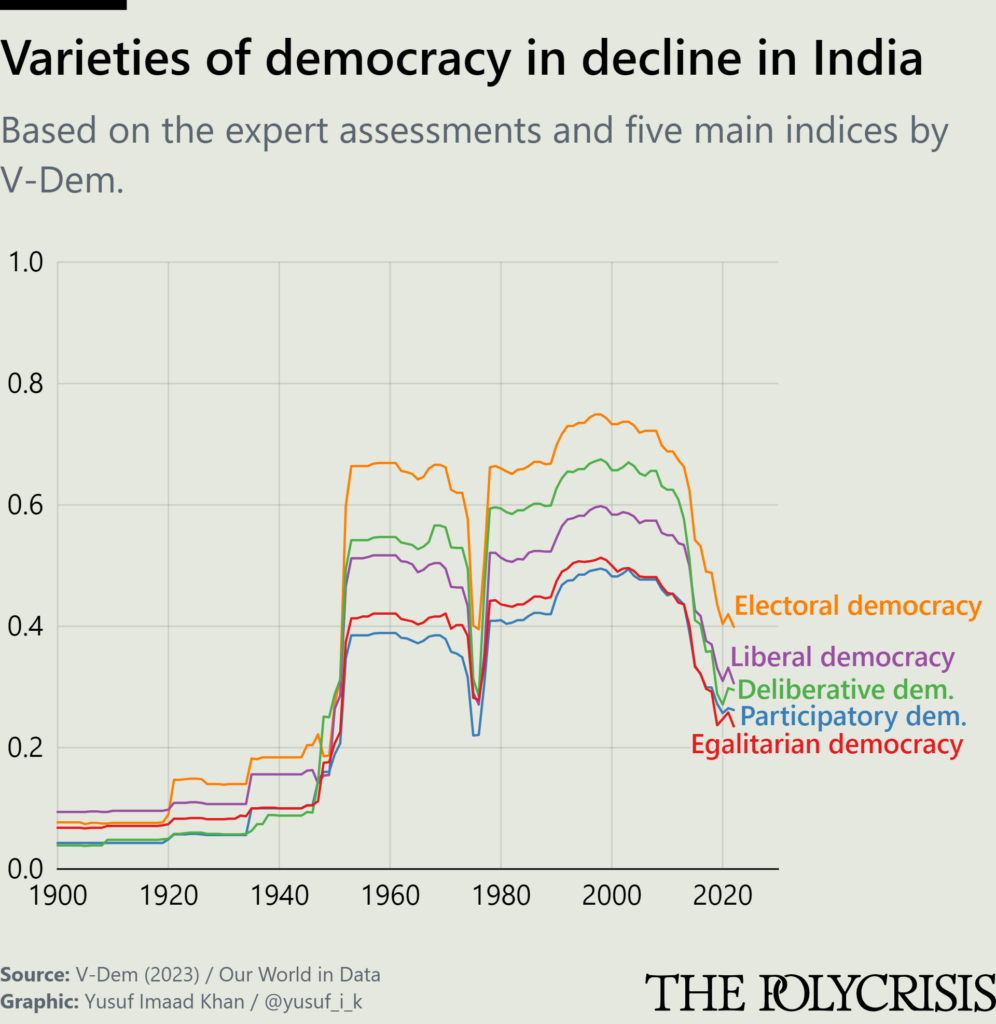
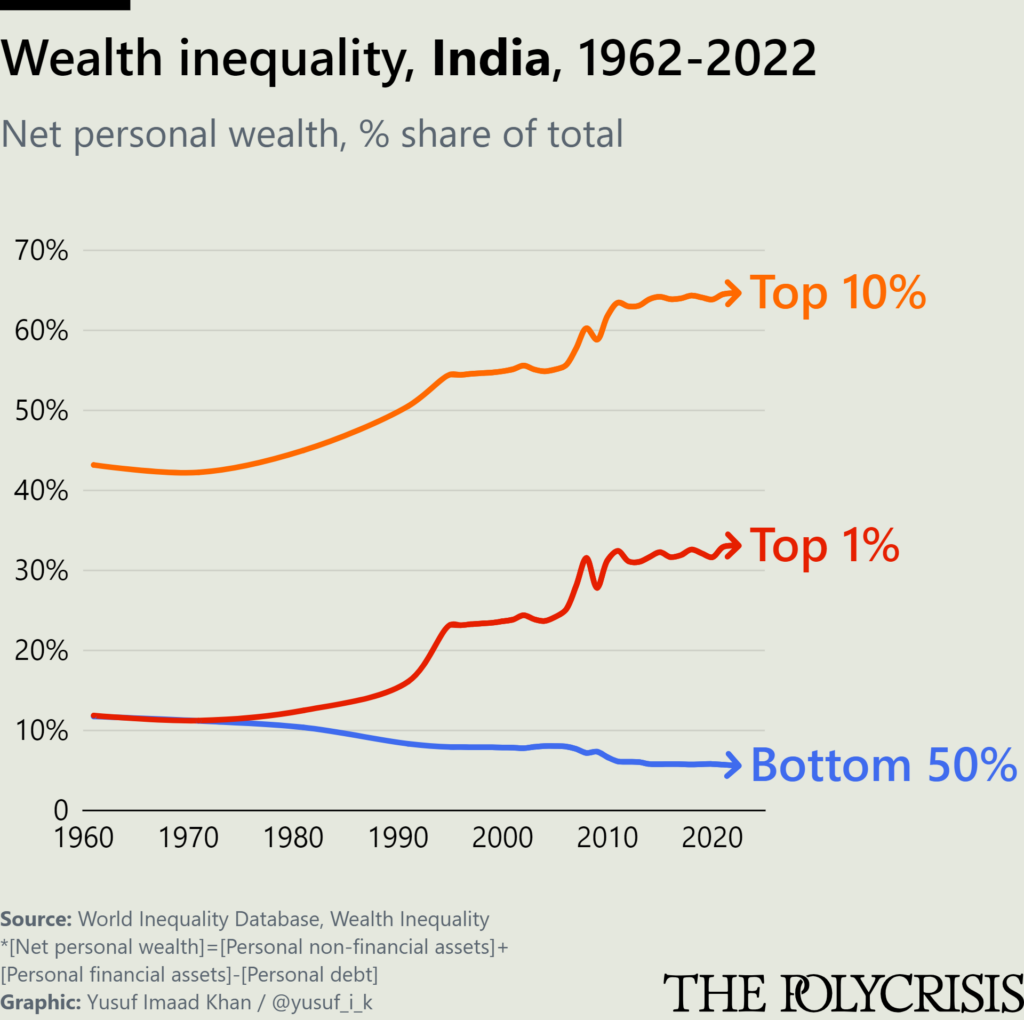
    With India headed to elections this April, the ruling BJP is rolling out enormous publicity campaigns to promote its record on economic growth and Hindu nationalism. Central to Prime Minister Narendra Modi’s third bid for reelection is the narrative that the Indian economy continues to grow and remains open for business. Amid the ample flows of international finance, and support from Western capitals, Modi’s India is an increasingly ethno-nationalist state. This week, tens of millions of Hindus mobilized across the country as Modi inaugurated a Ram temple in Ayodhya, in the state of Uttar Pradesh. Built at the site of a Muslim mosque destroyed by Hindu extremists in 1992, the temple’s unveiling represents a major step in Hindu nationalism—and the symbolic end of India’s secular republic. The question as to whether Modi’s Hindutva agenda lies in contradiction with the economic liberalism that has defined much of BJP’s policy is on many commentators’ lips.

    The BJP has long relied on a well-oiled marketing machine to win votes. The advertising blitz now underway recalls the party’s “India Shining” campaign of 2004, launched by the Ministry of Finance. Then, as now, images were plastered across the country, expressing optimism about the country’s economic performance and promoting liberal reforms. At the 2014 elections, Modi ran with the slogan of  “good times,” promising development, a “muscular Hindu nation,” and a bright and glorious future.

    To discuss these ad campaigns and the connections between the seemingly separate spheres of economic growth, national identity, and international politics, we talked to the Indian historian of nationalism, Ravinder Kaur. She is the associate professor of Modern South Asian studies at the University of Copenhagen, and the author of 4 books, including Brand New Nation: Capitalist Dreams and Nationalist Designs in 21st Century India, The People of India, Identity, Inequity and Inequality in India and China, and Since 1947: Partition Narratives among Punjabi Migrants of Delhi.

    An interview with Ravinder Kaur

    TIM SAHAY: Your book, Brand New Nation, looks at how countries were plugging into the liberal global economy of the 1990s to attract investment capital, and far from diminishing the importance of nation-states, rejuvenated ethno-nationalism. You’ve argued that in the Indian case, the “liberal” economy and “illiberal” hypernationalism of Modi’s BJP are not separate phenomena, but two strands of Hindutva’s vision. How would you characterize these connections?

    Ravinder kaur: I begin my book in the 1990s, arguing that the last three decades of economic reforms basically transformed the nation into a commodity. I traced the ways in which India, the post colony, turned itself into an “emerging market.” Contrary to the understanding of globalization as a process imposed from the outside and resisted by local groups, I argue that economic “LPG” reforms—liberalization, privatization, globalization—were embraced by the policy elite in India. Initially, there was some political pushback against it, both within the BJP and Congress, but by the turn of the century, any resistance to them had disappeared. 

    This great transformation activated a seemingly unlikely alliance between global capitalism and hypernationalism, a foundation on which twenty-first century Hindu nationalism would begin taking shape. 

    In the early 2000s, the government organized and funded mass publicity campaigns, such as “Incredible India” and “India Shining.” These were used to try to brand postcolonial India as a lucrative investment destination for global capital. These campaign ads showcased India as  Hindu, rather than the multiethnic society that it is. The Brand India publicity material mostly appeared as a repackaging of cultural symbols—from yoga to Ayurveda, colorful festivals to nature, and a virtual absence of Muslims. These campaigns dovetailed with a broader cultural politics that sought to define who was included and who was excluded in India. 

    The question I took up in the book was: “What is a nation in the twenty-first century?” It leads us to a different set of answers. I elaborate on the idea of an “identity economy,” in which a national identity is put to work in the domain of the economy, and harnessed to boost the self-image, self-identity, and prestige of the nation. I look at ways the economic and the non-economic work together to produce a particular kind of nation form.

    TS: What is unique about this project of national rejuvenation? China’s CCP has the story of a century of humiliation at the hands of Western powers, while the Indian BJP narrative has been a millennia of humiliation, of being conquered by foreigners, whether Muslim kings or British colonialists. These civilizationist-nationalist narratives violently flatten their history.

    RK: The infusion of capital promises progress and prosperity, and is a sign of the nation’s arrival on the world stage. Capital appears as a curative force that can efface the shame of colonial subjugation and violence, and redeem the nation’s lost glory via economic growth.

    Identity economy entails reimagining the nation as a commercial enclosure that can be put at the disposal of investors—its territory as a vast reservoir of untapped natural resources, its population as a “demographic dividend” that provides both labor and consumer markets to sustain growth, and its cultural essence to be turned into a corporate brand identity. Thus, the emergent nation form—the brand new nation—is erected not just upon the scaffolding of economic growth, but also the promise of civilizational glory and rejuvenation.

    Stalled liberalization

    TS: Could you specify the link between liberalizing policy changes to attract foreign capital and India’s domestic politics?

    RK: One goal of these ad campaigns is to signal to the world that we are open for business. They seek to invite investment, both domestic and foreign. In India, much of the liberalization of the economy has taken place in the service sector, and the country’s service exports have boomed. There has also been an attempt to boost and open the manufacturing sector—as with the flagship program called “Make In India”—and turn the entire territory into a zone of production, with mixed results. Meanwhile, the vast agricultural sector—India remains a country where 46 percent of working age adults are engaged in farming—has been the last area to remain protected. When in 2020 the BJP made attempts to liberalize and deregulate farming, large-scale farmers’ protests broke out and forced the government to shelve its reforms. 

    Liberalization has not happened suddenly, as shock therapy, but gradually. There are regulatory requirements for Indian partnerships or joint ventures, rather than 100 percent foreign ownership. These projects lead to a lot of conflicts, as making land—especially farmland—available to investors is often fraught, and Modi’s land liberalization agenda too has stalled. 

    Likewise, modes of federal governance have changed a lot. India competes for foreign  investments but, within India, different regions also compete with each other to lay claim to those investments. The current government has sought to create what’s known as the “one nation” model—one nation, one tax, one market. This entails greater centralization of economic and political power in Delhi and the weakening of the regional power structures. This has been attempted, for example, through a common Goods and Services tax system that centralizes revenue collection, thus giving greater power to the central government. That too is a project to unify the entire territory, both in an economic and cultural sense.

    TS: The BJP’s major support has come from the rising Hindu middle classes of North India. Is the success of Modi and the BJP a bottom-up expression of a newly prosperous Indian middle class?

    RK: These policy initiatives have always been led by the elite; to think that they have ever had a grassroots constituency is a mistake. Only after the policies are made by the elite does the question of selling it to the population come up. This is where mass campaigns or political spectacle have become a central component of Indian politics.

    What I analyze in the book is how these mass publicity campaigns emerged as a form of governance. In the run up to the 2004 election, BJP prime minister Atal Bihari Vajpeyi launched the “India Shining” campaign, which celebrated the high growth rates the country was reaping while encouraging higher consumption among newly affluent Indians. When the BJP then lost the 2004 election, many blamed the “India Shining” campaign. What people forget is that though the government lost the election, its liberal economic reform program had already become hegemonic. The Congress Party’s counter slogan to the BJP’s “India Shining” was “Aam Aadmi ko kya mila” (“What did the common person gain out of it?”). The Congress-led United Progressive Alliance government (2004–2014) also wanted to deliver “reforms with a human face.”

    TS: When Modi came to power in 2014 his election campaign promised acche din: India Shining 2.0. Despite the optimism from many corners, India’s economy has underperformed since then. Growth rates have fallen, underemployment remains high, investors have been burnt, and inequality is skyrocketing. How has Modi’s government responded to all this? Is it concerned about inequality or is it totally committed to an oligarchic project with the Adani and Ambani families at the core?

    Ravinder kaur: I think it’s a balancing act here. Firstly, inequality has certainly widened in India since Modi came to power, and Adani and Ambani’s wealth have skyrocketed.

    At the same time, the Modi government has kept in place many of the welfarist policies established by the UPA. For example, it maintained the Right to Work (National Rural Employment Guarantee) schemes, which guaranteed 100 days of work to 64 million rural workers, especially women. It also preserved the Right to Food program. Likewise, the BJP increased social welfare goods. The most prominent successes have been targeted poverty alleviation programs: the distribution of cooking gas cylinders, widening access to bank accounts, and direct cash transfers. So it’s not the case that Modi simply embraced a free-market model, which would have had its own major obstacles in a country the size of India.

    A key difference between the UPA and the current government is how welfare is administered. Rather than a basic provision from the state, welfare provisions are marketed and advertised as a benevolent gift from the BJP government, indeed as the beneficence of Modi himself. This is not welfare as a citizen’s right but as a gift one should be grateful for. These branding exercises have reaped electoral benefits for the BJP, especially among rural women in  Uttar Pradesh and Madhya Pradesh.

    TS: Why has the rise of Brand India gone hand in hand with the decline in liberal democracy?

    RK: India’s efforts to brand itself as the “world’s largest democracy” helped project it as an alternative to an authoritarian China—whence the paradox: under Modi, the very democratic advantage that shaped Brand India’s image on the world stage entailed its steady erosion at home. Hindutva politics recognises this contradiction: it cashes in on India’s democratic credentials to gain external recognition even as it weakens democratic institutions at home. Consider the unabashed implementation of the hardline Hindutva agenda in Modi’s second term—from the revocation of the special status of Kashmir in August 2019, the Citizenship Amendment Act (CAA) that excluded Muslims, to the inauguration of the Ram temple in Ayodhya this week. What characterizes this moment of majoritarian muscle flexing is the heavy-handed suppression of dissent (the crux of democracy), especially in university spaces, and how the act of protest itself has been criminalized by the State.

    Alignments

    TS: What do you make of Modi’s India positioning the country as a pro-West bulwark against China? This project seems like it would be a momentous shift away from India’s long-held foreign policy of nonalignment.

    RK: If India is positioned as a bulwark against China, this is largely thanks to efforts by foreign powers rather than Modi. With much of the world “derisking” its economies from China, India now finds itself in a happy position. It is the only country which rivals China in terms of scale of population. 

    The old Indian project of pan-Asian unity is long gone. Nehru was very much invested in that, but it came undone thanks to the Indo-China War in 1962. The ongoing border conflict between India and China has caused immense nationalist mobilization on both sides. So regardless of which party is in power, given the security threat China poses to India, any government would be pro-Western. 

    TS: India today relies upon extremely anti-Muslim, majoritarian, identity-based politics, but it’s not clear to me that the Hindu extremists in Modi’s party are entirely under his control. How unstable is this as a basis for rule in a country with over 200 million Muslims and other minorities?

    RK: Whether the growing strength of Hindutva will lead to some social breakdown that causes investment capital to flee, we don’t know. For now, India remains profitable to many, such that the world more or less wishes India well. The United States grants Modi’s violent project a carte blanche. This provides a high degree of security. But the impacts of a further deteriorating social fabric remain to be seen. Such projects can never truly be contained.

    TS: Modi has also positioned India as a champion of the Global South. He has argued that India faces massive challenges and wants reform of the unequal Westen-led international order—just like developing countries in Africa, Asia, and Latin America. At last year’s G20, India championed the goals of debt relief, poverty reduction, and sustainable development. What makes this project different from the non-aligned movement of the 1950s–60s?

    RK: On the face of it, it looks as if the 1950s have returned. But much is different this time. Countries across Asia, Africa, and Latin America are no longer impoverished in the way they were at the time of decolonization in the mid-twentieth century, and there is tremendous inequality within the global South. Meanwhile, in terms of foreign-policy influence, larger and more prosperous countries, like those in BRICS, now have substantial clout in the world, and are seeking to come together. 

    So this is very different from the Non-Aligned Movement, which many people did not take seriously, because it lacked economic or military power. But nevertheless, the old Non-Aligned Movement always had very strong currency, primarily because it came with very strong moral arguments about anti-racism, decolonization, and nuclear disarmament. The current mobilizations have nothing like that. There is no alternative vision of the world that they are trying to put forward, but instead new ways to plug into the capitalist world-system for their own advantage.

  5. Petro at COP28

    Comments Off on Petro at COP28

    Lea esta entrevista en español aquí.

    Upon entering office in July 2022, Colombia’s President Gustavo Petro voiced a strong stance against fossil fuels, marking a contrast with other left-wing leaders in Latin America who rose to power through resources gained from extractive economies. Petro’s emphatic critique of oil and gas was apparent at the United Nations Climate Change Conference (COP28) held this year in Dubai, United Arab Emirates, the world’s sixth-largest oil exporting country. 

    At COP28, Colombia announced its commitment to the Fossil Fuel Non-Proliferation Treaty, drawn up in 2019. Until now, the only countries to sign on were Pacific island nations, in response to their extreme vulnerability to the effects of climate change. Colombia has now became the first and only continental country to agree to the treaty. In addition to his environmental focus, Petro controversially linked climate change inequalities and the war on Gaza in his address to world leaders. 

    Petro’s rhetoric at COP28 has signaled a transformative climate agenda, but how does this translate to domestic environmental and energy policies in Colombia? And given the changing political dynamics in the region, what is the Colombian government’s role in influencing broader climate policy in Latin America?

    Manuel Rodríguez Becerra served as Colombia’s first Minister of Environment from 1993 to 1996 under President César Gaviria. He was part of the World Commission on Forests and Sustainable Development and co-founded the National Environmental Forum in 1988, a coalition of non-governmental organizations (NGOs) that promotes environmental protection and sustainable development in Colombia. He recently published The Present and Future of the Environment in Colombia (2023). In the following conversation, Rodríguez Becerra analyzes Petro’s address at COP28, Colombia’s shifting role in global climate discussions, and the differing—and often conflicting—climate policies of Latin American leaders. 

    An interview with Manuel Rodríguez Becerra

    Camilo Andrés garzón: One of the Colombian government’s major objectives in COP28 was a global agreement on the suspension of fossil fuel usage. Is this goal realistic?

    Manuel rodríguez becerra: Achieving a majority-supported commitment to suspend the exploitation of carbon, oil, and gas on a specific date is not something that was going to happen during this COP. President Petro, with very respectable political reasons, said that Colombia would adhere to the Fossil Fuel Non-Proliferation Treaty, promoted in 2019 by the islands that are most at risk in the Pacific. Colombia is the first continental country to join this treaty, but that does not guarantee that it will find great consensus, given the fact that developed countries have repeatedly refused to establish a specific date to cease fossil fuel exploitation. 

    We already have a significant precedent: at COP26 in 2021, seventy-seven countries promoted to gradually eliminate the use and production of coal. The plan envisaged that more developed countries would give up the use and production of coal by the 2030s, and that the poorest countries would do so in 2040. The proposal was not approved. China and India supported this idea, but it is not clear whether these objectives will be met, since available data shows that the world is heading in quite the opposite direction: since then, fossil fuel consumption has actually increased. 

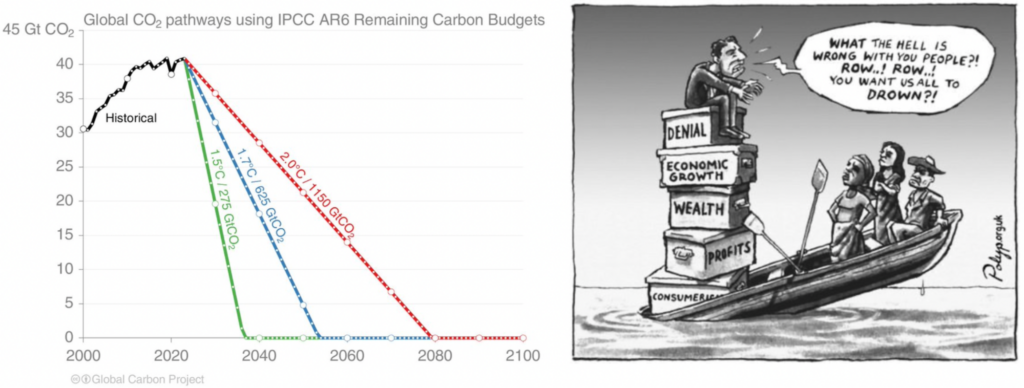
    A recent report published by the Stockholm Environment Institute found that the twenty governments responsible for more than 80 percent of global emissions are currently planning to produce by 2030 more than double the amount of fossil fuels that are necessary for the 1.5 degrees Celsius limit to be maintained. According to the study, the world is in fact on the path towards producing more hydrocarbons. Projections for 2030 estimate a 460 percent increase in coal production, an 83 percent in gas production, and a 29 percent increase in oil production. After twenty-eight COPs held between 1994 and 2023, there has yet to be a formal agreement to properly reduce the use of fossil fuels in the world.

    CAG: How do you interpret Petro’s speech before the presidents’ forum at COP28, in which he compared the war on Gaza and global climate displacement likely to occur in the future? In his speech, he stated, “Hitler is knocking on the doors of European and North American middle-class homes, and many have already let him in.”

    MRB: Petro is absolutely right when he points out that, in the future, there will be millions of migrants as a consequence of climate change. This is an issue we should all continue to insist on, since the displacement will affect the most vulnerable countries. However, it doesn’t seem so appropriate to compare this to the scenes of suffering in Gaza, since it is a very different problem with its own set of causes.

    Similarly, Petro’s comparison to the rise of the right in Europe and in the United States was not well received by the German Chancellery, which protested against the speech for “making crude comparisons with the Nazi era which ultimately relativize the Holocaust,” as was said in a statement. It is also interesting to note that when the Colombian government produced a written text based on Petro’s intervention, the President’s allusions to Hitler and Gaza were removed—a major lack of transparency. 

    In the same speech, President Petro stated that his administration was able to reduce deforestation in the Amazon by 70 percent with their own resources—but this is not entirely true. Colombia has received significant resources for deforestation through international cooperations with Norway, Great Britain, and Germany. On the other hand, it is good that donors know that their resources can successfully be translated into effective data on deforestation reduction.

    It’s still too early to see this as a definitive reduction, as it remains somewhat circumstantial. We need to know if the government’s plan will substantively reduce deforestation. I’ll remind you that there was also a significant one-year reduction in deforestation under President Iván Duque, Petro’s right-wing predecessor, but deforestation drastically rose in the following year. In that sense, we can’t celebrate a one-year reduction as definitive. I believe that donor countries monitor deforestation very carefully so that governments can meet these goals in the long term. 

    Cag: How do you view the Petro government’s emphasis on deforestation in the Amazon?

    MRB: The government has done well to focus its efforts on reducing deforestation in the Amazon basin and seeking active international cooperation around this initiative. This is true not only for broader climate change impacts, but also because the Amazon is the region with the greatest biodiversity in the world. Protecting Amazonian forests and surface water sources is of great importance.

    Colombia’s Minister of Environment and Sustainable Development, Susana Muhamad, also announced the National Restoration Strategy, with the goal of restoring more than 753,000 hectares of forest in the country by 2026. This is the most ambitious goal ever seen in a development plan; Colombia already had set a goal of restoring one million hectares of forest by 2030, but the Petro government is significantly speeding up this initiative. The real question is whether the Ministry and its environmental authorities will have the capacity to keep those promises. If met, these two environmental achievements—deforestation reduction and forest restoration—would be one of Petro’s greatest legacies. 

    In his COP28 speech, President Petro also spoke about the exploitation of gas and oil in the country, especially in the context of the Fossil Fuel Non-Proliferation Treaty. Many of us believe that suspending fossil fuel exploration in Colombia would be a major issue.

    Cag: Why do you say that?

    MRB: Different regions of the world vary greatly when it comes to greenhouse gas emissions. While agriculture, forestry, and other land uses account for 24 percent of the whole world’s total greenhouse gas emissions, in Latin America they account for more than 50 percent. In Colombia, deforestation, agriculture, and forestry represent 59 percent of the emissions of these polluting gasses. For these reasons, Colombia’s emission-reducing priorities should not necessarily be in decarbonizing the economy, but in stopping deforestation and transforming agricultural activity, even though advancing decarbonization is clearly an important objective.

    Furthermore, fossil fuels represent 3 percent of Colombian GDP, so suspending their exploration would threaten the country’s self-sufficiency regarding gas and oil—two fuels that the world will still consume to some degree for the next twenty or thirty years. The suspension would also sacrifice at least 40 percent of the country’s exports; this involves a considerable sacrifice of economic growth in areas that are vital for many social programs. Finally, the policy of suspending oil and gas exploration in Colombia may not have any substantial benefit for the planet as a whole: as long as an international demand is still at large, and without global agreements to meaningfully reduce the exploitation of fossil fuels, the resources that Colombia ceases to offer will simply be supplied by another country.

    Cag: Regarding climate policy, how does Petro’s influence compare to other Latin American leaders? Could he have developed a unified regional position on environmental issues at COP28?

    MRB: We are in a very diverse political context. In Argentina, Milei denies the reality of climate change, while in Brazil, Lula is striving for a difficult balance between extractivism and the defense of indigenous peoples. In Latin America, forming a regional position has been a historically arduous task. Regional positions are typically assembled and constructed ahead of the COPs; we clearly lack one at the present. The African Union is a very good example of a consensus regional position regarding climate change negotiations.

     There is a considerable lack of unity in Latin America; this is evident in discussions around the Amazon. During the Amazon Summit, Lula refused Petro’s proposal that Brazil should suspend oil exploration in the region, stating that Brazil would continue using coal and gas or gas and oil in the coming years. What is more, the exploration and exploitation of both has increased. We must recognize that Lula and Brazil hold the greatest weight in the negotiations around the Amazon region.

    Cag: Do you think COPs are useful in achieving a global consensus to battle climate change?

    MRB: The Convention has had little success, to say the least. In 1992, its goal was to reduce the amount of greenhouse gas emissions so that by the year 2000 they would not exceed the amounts emitted in 1990. Thirty years after the Convention was signed in 1992, emissions have increased by 60 percent since 1990.

    According to calculations based on current emission trends, as of June of this year, there are only eight years and ten months left to reach the temperature increase limit of 1.5 degrees Celsius established in the Paris Agreement, after which extreme climatic events are expected to intensify further.

    Some argue that if these measures had not been taken, the current situation would be worse, but that’s not the point. The point is that these agreements were designed to avoid a series of extreme climate events around the world which we have already been experiencing beyond any doubt. The heat waves in Europe in 2022 and the floods in Colombia in 2010 and 2011 are just a few examples. 

    Cag: Finally, what is your overall evaluation of the agreements reached during COP28?

    MRB: I’ve participated in about nine COPs, and I was also involved in the legislation of the Convention on Climate Change. The only treaty with reasonable vigor, an adequate design, and sufficient legal force was the Kyoto Protocol. However, it collapsed in 2009, largely because the United States—a great architect of this protocol—left it unratified during the government of George Bush. Once the Kyoto Protocol collapsed, work on the Paris Agreement began until the signature 2015 agreement. 

    Looking at everything that’s happened since 2015, we honestly don’t have reasons to be optimistic. Greenhouse gas emissions have clearly increased, and with the estimates of fossil exploitations currently underway, we’re very likely to surpass the 1.5 degrees Celsius threshold before the end of the century. It seems that developed countries don’t have the right attitude—they sign agreements, but they don’t keep their word.

    Of course, the major takeaway from this COP is the Loss and Damages Fund. This will be celebrated as a great achievement, but that fund was created during COP27. These types of announcements are meant to foster hope and testify to progress, but the problem of implementation remains. Back in 2009 in Copenhagen, developed countries committed to provide $100 billion a year starting in 2009 for mitigation and adaptation. Thirteen years have passed since then, and that goal has yet to be met. On top of that failure, it’s an insufficient sum. To illustrate the point: Africans estimate that they need around $700 billion in concessional resources for mitigation and adaptation—seven times the committed amount.

    The question is: if developed countries are not complying with the Mitigation and Adaptation Fund, why would they comply with the Loss and Damage Fund? Without resolving the compliance question, how can we claim the Fund as one of the great triumphs of this meeting?

    This essay was translated from Spanish for Phenomenal World by Eduardo Gutiérrez. 

  6. Governing the Climate

    Comments Off on Governing the Climate

    The twenty-eighth UN climate change conference, which took place in Dubai over the course of the last two weeks, has now come to an end. Like previous conferences, this COP took the form of a series of negotiations between countries to find an effective and legitimate approach to reducing dangerous warming. The entire architecture of the 1992 UN Framework Convention on Climate Change was built around differentiating between the rich industrialized OECD countries of the global North and the developing countries of the global South, attempting to account for the different needs and responsibilities of various nations. Conflict over money, machines, and how soon countries should phase out coal, oil, and gas have once again been at the forefront of negotiations. Remonstrations of the conference outcome’s gross insufficiency in the face of the climate crisis have come from many quarters, especially since the full phaseout of fossil fuels has not been enshrined as a requirement.

    The shared goal of negotiators at Dubai is to triple renewable energy globally by 2030. Such a commitment implies breaking through the financing barriers for developing countries, and creating political coalitions that can drive necessary national policy changes. At stake is something more fundamental: can the world historical process of “uneven and combined development” be decarbonized under the terrifying acceleration of anthropocenic crises?

    Navroz Dubash is a professor at the Centre for Policy Research in New Delhi and has been a key figure in international climate diplomacy for as long as there has been such a thing. Dubash was instrumental in setting up the Global Climate Action Network in 1990, and recently was coordinating lead author of the IPCC’s Sixth Assessment on Climate Change. He is the author of India in a Warming World: Integrating Climate Change and Development (2020) and Tubewell Capitalism: Groundwater Development and Agrarian Change in Gujarat (2002). Tim Sahay spoke with Dubash about the changing narrative of climate-oriented national development, and how past mistakes might inform a more resilient future.

    An interview with Navroz Dubash

    TIM SAHAY: You’ve been involved in international climate diplomacy since 1990, when the Cold War was nearing its end and the unipolar world was taking root. Now that we exist in a messier, multipolar world, how is climate diplomacy changing?

    Navroz Dubash: In the early years, there was a very strong cognitive lock regarding the design of the process. It was expected that we would simply follow the Montreal Protocol, which encouraged richer countries to produce substitutes for ozone-depleting chemicals, while transferring technology to poorer countries. 

    That somewhat simplistic protocol was later applied to the climate process, and I think it was damaging. In the case of the climate crisis, it’s of course not about finding substitutes for one chemical. It’s about ending the historical coevolution between fossil fuels and industrial development. 

    That line of thinking led to the top down approach of carbon rationing, set out in the Kyoto Protocol. When the US Senate unanimously refused to ratify Kyoto in 1998, arguing that it violated US sovereignty, it became clear that it could not work politically. That led to a period where climate negotiations were oriented around finding a way for the US to be brought back in. I think that was damaging because, as I like to say, other countries have politics, too. During that window—say from about 1998 to 2008—China was coming up in the rearview mirror. It was becoming the most important global determinant of whether we would be able to address climate change, and we weren’t thinking enough about how to structure the agreement so as to incorporate China.

    With little money or technology being transferred, much of the developing world saw the agreement as dysfunctional. The industrialized countries, for their part, wanted developing countries to prioritize cutting emissions. This resulting impasse led to the agonizing failure at Copenhagen’s COP in 2009. The negotiators still produced a statement because, as a former Indian negotiator once told me, the first rule of climate negotiations is that they never fail. But between Copenhagen and Paris, the only question that was possible to ask was: how do you get everybody on board? 

    What enabled the breakthrough at Paris in 2015 was a pre-deal between the US and China. The key phrase was “common but differentiated responsibility and respective capabilities.” They added a clause that basically said, as national circumstances change, this has to shift. And that language was carried verbatim into the Paris Agreement.

    TS: Since there is no planetary leviathan that can enforce decisions, the Paris Agreement was entirely bottom up and iterative. Countries submit a voluntary plan to cut emissions, they take stock every five years and ratchet up their ambitions. Much of this agreement was underpinned by a “G2” deal between the US and China. Is it the case that once the US and China stop agreeing on things, the Paris Agreement will blow up?

    ND: I agree that the guardrails of the Paris Agreement were set by the US and China. But it does not follow that their weakening relationship means blowing up the deal; we do still have the Paris Agreement. It has multilateral buy-in from a lot of actors—it survived the setback of Trump pulling the US out of it. That suggests Paris has a “political ratchet” mechanism in addition to the bottom-up ratchet. How smoothly those are implemented is, of course, affected by the US-China geopolitical confrontation.

    As it happens, I was in an India-US Track 2 meeting, when we got word of the pre-Paris China-US agreement. In the meeting we agreed on a bottom-up approach that would involve each country making Nationally Determined Contributions (NDCs). However, very soon the “High Ambition Coalition” of small island countries, which were very worried about the existential threat of climate change, intervened to alter the agreement. Thanks to their work, instead of limiting warming to 2 degrees Celsius, the Paris Agreement insisted on the need to limit warming to 1.5 degrees.

    Source: Global Carbon Project

    This had the effect of bringing the deadlines forward. This is because to limit warming to 1.5 degrees, everyone’s emissions would have to peak sooner and fall more steeply. The wager behind the Paris Agreement was that countries would come up with very generous NDC pledges and, upon implementing them at home, find that cutting emissions is in fact cheaper than they had initially thought. This would in turn contribute to a new green economy that would foster political coalitions domestically—going on to stimulate competition between countries, which would prompt some to go faster than they otherwise would have. At the next COP, their pledge would become even more ambitious.

    For some, this all relied on naming-and-shaming those that don’t meet their pledges. To me, the domestic implementation of NDCs—the national churn—was the more important part of the story. Once the target became 1.5 degrees, there wasn’t enough time left for that national churn. So, as soon as countries came up with their pledges, everybody was asked to up their pledges before anyone could get home to actually figure out their politics of implementation. 

    As for the current COP, I think there is a reckoning because we’ve now realized that the 1.5 degree target is really out of reach. We are in an overshoot scenario, and as soon as you get to an overshoot scenario you could overshoot by a little, you could overshoot by a lot. So that forcing mechanism of having a target—in a sense, it’s no longer there. To my mind, that means refocusing attention on the national story.

    Linking national development and climate action

    TS: How do different priorities of North and South play out? India often speaks in terms of climate justice, arguing that it has polluted very little over the course of its history and so deserves “carbon space” for development. Meanwhile, the lead US climate negotiator Todd Stern infamously once said “if equity is in, we are out.”

    ND: As you say, India has been the standard bearer, both at the governmental and the non-government level, for climate justice. Very early on, in 1991, Sunita Narain and Anil Agarwal wrote a pamphlet called “Global Warming in an Unequal World,” which had a huge impact. Even today, India continues to argue that there is a finite carbon budget that should be allocated to less developed countries. 

    For my part, I think the fact that the North has historically emitted much more than the South has consequences for how we should proceed. That said, I’m not sure that allocating a global carbon budget is the best way to operate. First of all, how do you allocate who gets to emit how much? The most important thing is to ensure that countries have access to the carbon required to meet their developmental needs while pivoting to a low-carbon future. 

    This is important because if a country gets locked into a high-carbon future, it will probably be an uncompetitive economy within ten or twenty years. Too much carbon now means shooting yourself in the foot with stranded costs, failure to develop new technologies, and so on. If there’s only so much fossil fuel we can burn and the rest we have to keep in the ground, then the principle should be maximizing global welfare, which means that if Nigeria needs to exploit some of its gas as a bridge measure, it should have first dibs on doing that, not Norway. 

    Where the rubber really hits the road is in figuring out ways to have capital infusions going from the North to the South. Climate action is going to be highly capital intensive. One of the implications of the climate equity story is how do you manage these massive transfers.

    Let me come back to a hobby horse of mine. So much of the climate conversation is dominated by Northern analysts—that’s where the research money is—so their interests end up dominating the discussion. For example, there is much more research on decarbonizing heating than on cooling, but given that the majority of buildings in tropical, developing countries are yet to be built, the future of cooling is the much bigger story. 

    To take another example, there’s a lot of conversation about pathways to net zero, which makes sense if you’ve already peaked. But for those who haven’t, they need to avoid locking-in at a high peak. Emissions trajectories should look like a hill, not a mountain. We should be thinking in terms of the idea of avoided emissions. What you do from a policy point of view to avoid emissions is quite different from what you do to reduce emissions. A carbon tax or a cap and trade system, for example, isn’t going to do much to help you avoid emissions because much of that is actually from infrastructure yet to be built like power, urban construction and transport. If 80 percent of future emissions are going to come from the developing world, we need to frame our questions accordingly.

    TS: Everybody’s talking about linking climate and development. You’ve written a book on the topic, but “co-benefits” like economic competitiveness or reducing air pollution are now broadly linked to national goals. Many countries are embarking upon a green project as one of national development. What do you make of these new varieties of governing climate?

    ND: I definitely see the shift in countries like India, Brazil, South Africa, and China thinking about climate as part of a larger project of remaking national economies. In a sense, I think that’s productive. The old framing of a “collective-action problem” that sought to distribute the “costs” of climate action was never going to work. Arguably, many of the developed countries have not delivered on climate finance or on phasing out fossil fuels first, so the North-South tensions have come roaring back. 

    I think co-benefits are a productive turn, but it’s yet to be seen how they will work. Broadly, we have two competing approaches. One is a European-led narrative that says the mitigation imperative is an existential one, and so should be first priority. We have, however, seen in the UK and Germany for example,  the extent to which climate goals by themselves are politically fragile. When something like the Ukraine war happens, or when energy prices spike, climate goals seem to take a back seat.

    The other approach is the idea that developing countries like India would pursue low-carbon development projects—public transport, for example— that would make for more liveable cities. This approach to climate is convergent with development; the choice between roads or railways are development choices but also climate choices. What’s really interesting to many of us is that the US Inflation Reduction Act implicitly adopts this approach; it wasn’t just for the developing world. This approach, what I call embedded—as opposed to standalone—climate framing, is an alternative to the European carbon-centric regulatory model, which is based very heavily on counting up and pricing carbon.

    TS: For decades the neoliberal project has gutted state capacity. A really interesting aspect in your work is the question of how states must be re-energized for green world-building. Bidenomics has called for a “whole-of-government” approach. A national developmental state is one thing, but one of the ways we’ve been thinking about the polycrisis is that the twenty-first century state needs to develop new eyes, ears, arms, and hands to intervene, listen, predict, and actually change the ways in which states are organized. What does that “climate-ready state” look like to you?

    ND: If a state wants to push a particular development agenda, it needs to have state capacities that can see the project out. A good example of such an institution is the Climate Change Committee in the UK, which is tasked with recommending five-yearly carbon budgets. It doesn’t have executive authority, but it has a kind of normative authority to set those budgets, which ministries are meant to align with; Parliament plus a few external actors drawing on the CCC’s analysis to hold those ministries to account. It charts a course not because it’s empowered to do so, but because it’s a place where a lot of ideas get digested and then injected into the public discourse with some credibility. Of course, that kind of vision isn’t enough. You need a strategy-setting body, but that has a much more complex analytical task.

    Another feature of such a state would be putting an end to what are currently siloed ministries, be they transport, or agriculture, or water usage or what have you. These departments need to work together. Take transport, for example: building transport infrastructure relies on a combination of urban planning and technology, plus, importantly, behavioral shifts. All this can’t just be dumped in the lap of a national transport ministry. In countries that are federated, it’s even more complex, and you have to also think about relationships between federal and provinces.

    Given all this, how do you develop mechanisms to coordinate? One way to do it is around existing epistemic communities. In the US, these take the shape of climate “task forces.”

    It is important to realize that there will be winners and losers as a result of these low-carbon transitions. Big shifts are on the horizon: phasing out the internal combustion engine, for example, means a whole new set of economic actors coming in around battery technologies and manufacturing. Land usage is bound to change, which is tied to powerful political interests. In the wake of Covid, there is also a shake-up of commercial real estate. How can these distributional conflicts be negotiated? 

    Some countries do a better job of this than others. South Africa has a deliberative tradition coming out of the post-apartheid era that can be used to work through thorny questions. In South Africa, the future of their electricity-mineral complex Eskom needs careful discussion. If it is to be dissolved, how is that going to happen in ways that bring labor unions along? South Africa’s Presidential Climate Commission has been a really interesting experiment.

    This returns us to earlier debates about varieties of capitalism. How does the nature of the capitalist enterprise in different countries make it easier or harder to make the green transition? In each case, one needs to start with the historical institutions that already exist, whether it’s corporate structures or forms of voting, first-past-the-post systems or proportional representation.

    TS: Developing countries at COP28 have pushed hard to get financing for a Global Goal on Adaptation. Adaptation to extreme climate, unlike energy transition, is not going to make anyone money. It requires a lot more grants, as everyone seems to agree. Has the political economy of adaptation gotten enough attention or is it just assumed that governments have an obligation to save citizens’ lives?

    ND: It is, I think, under-baked. Adaptation is distinct from loss and damage which received a political fillip at the last COP. Adaptation is, in many ways, conceptually much more complex than mitigation, which can be measured with an emissions trajectory. You can’t measure your progress towards adaptation using a single metric. You have to build a more resilient economy and society.

    The message coming  from the North is, we’re reasonably happy where we are, so we want to have systems that allow us to bounce back in the event of climate extremes. In the developing world, you already have massive loss and damage from floods, from weather events, and so on. It’s not about bouncing back, but about developing and building economic and social systems in ways that make it more resilient to both non-climate-triggered and climate-triggered shocks, understanding that one exacerbates the other. 

    To bring it back to the question of state capacity: it’s imperative to anticipate areas of vulnerability upfront. You might have to rethink your entire pattern of what, in India, we call minimum support prices for agriculture. Which crops are you supporting and therefore incentivizing? India’s Council of Agricultural Research has done good work on identifying climate-resilient crops. The government typically incentivizes rice and wheat, and there’s a big push towards incentivizing millets, which are more resistant to weather events.

    Similarly, water resources planning is going to be huge for South Asia going forward. There’s an existing debate about surface water versus groundwater, about so-called river interlinkage projects, whether large storage structures like dams make sense or not in the context of heavy rain runoff. All these developmental questions are inflected with a climate imperative, and part of that is the coordinating story I talked about earlier. 

    There are, to use the terminology of  my colleague Sharad Lele, multiple stressors and multiple objectives. The multiple stressors—in addition to climate change, you have land use, industrial usage, urban patterns, and so on— are currently dominating, though they will soon be surpassed by the climate tipping points. The multiple objectives carry over from mitigation, things like job creation, urban livability, and so on. This, and the question of adaptation, implicitly raises important questions: What kind of development do you want? What kind of economy and society do you want to build?

  7. Milei’s Argentina

    Comments Off on Milei’s Argentina

    Lea esta entrevista en español aquí.

    On December 10, the fortieth anniversary of Argentina’s redemocratization, Javier Milei was sworn in as the country’s new president. Milei—a far-right economist who calls himself an “anarcho-capitalist,” denies the existence of the military dictatorship, and claims to be a fan of both Donald Trump and Jair Bolsonaro—won the second round of the Argentine elections with almost 56 percent of the vote. Promising to dollarize the economy and cut public spending, he defeated Sergio Massa, current minister of finance and a representative of the Peronist party, Unión por La Patria. 

    Three political coalitions were at the core of the campaign trail. Javier Milei was the sole candidate for La Libertad Avanza, a far-right party. Juntos por El Cambio, the liberal right coalition led by former president Mauricio Macri (2015–2019), had two candidates in their primaries—Horacio Rodríguez Larreta, current chief of government of Buenos Aires, and Patricia Bullrich, deputy and former security minister under Macri. In the primaries of Unión por La Patria, headed by current president Alberto Fernández and vice president Cristina Kirchner, Massa defeated Juan Grabois, an activist and political leader representing the party’s left wing. 

    After losing in the first round in August, Bullrich, along with Macri, pledged support to Milei.1Argentina’s presidential elections consist of three phases: the primaries, the first round, and if necessary, the second round. The primaries determine who will be the candidates in the first round, and the two with the highest number of votes in the first round compete in the second round, unless a candidate wins 45 percent of the vote, or more than 40 percent of the total vote with a difference of 10 percent. Representing Unión por La Patria, Massa focused on consolidating the left and integrating the forces of Peronism and Kirchnerism.2Peronism is a historic political movement born in the forties in Argentina with the government of Juan Domingo Perón. It is characterized by unionism, anti-imperialism and the integration of Latin America; Peronism also revolves around Eva Perón, a bastion of the feminist struggle in the country. Kirchnerism is a movement linked to Peronism and founded around the figures of Néstor Kirchner and his wife, Cristina Kirchner, who led the country between 2003 and 2015, when Cristina was defeated by Mauricio Macri. Cristina returned to power in 2019 as the vice president of Alberto Fernández. Kirchnerism is characterized by the reinstatement of the Peronist ideals, through recovering the role of the state and defending human rights. Both currents have been a target of criticism from the Argentine left and right, but both have a solid political base, particularly among the working class. Milei’s victory and the defeat of the Peronist-Kirchnerist coalition has inaugurated a political transition. Milei appointed Luis Caputo as the minister of finance, a position he also held during Macri’s center-right administration. This perhaps surprising decision has made dollarization—Milei’s main proposal during the campaign trail—significantly less likely. Nonetheless, the economic and political fate of the country remains uncertain. 

    Mercedes D’Alessandro holds a PhD in Economics from the University of Buenos Aires and is a feminist activist in Latin America. As the first national director of finance, equality, and gender of the Ministry of Finance of Argentina (2020–2022), D’Alessandro led the implementation of the first national gender-based budget in the country.3In broad terms, this implied incorporating gender issues in the development of impact indicators for public policy, disaggregating data between men and women, and so on, to account for disparate impacts. She also helped implement unprecedented economic policies that worked to reduce the pandemic’s effects for the working classes.4D’Alessandro currently leads the Program of Economics at Universidad Metropolitana de la Educación y el Trabajo (UMET). She designed and teaches the PhD Seminar on Economics and Gender at the Universidad Nacional de Quilmes, and the subject Feminist Economics at Universidad Nacional de Avellaneda.

    In the following interview, D’Alessandro discusses the current economic and political crisis, possibilities for the forthcoming Milei administration, and the future of Peronism.

    An interview with Mercedes D’Alessandro

    maria fernanda sikorski: Javier Milei won by over 11 percent in the second round, while the voter turnout was the second lowest it had been in the last four decades, at 76 percent. The Peronist candidate, Sergio Massa, won in only three of the twenty-four jurisdictions of the country; even in Buenos Aires, the bastion of Peronism, Massa won by a very narrow margin: 50.73 percent against 49.26 percent. The results demonstrate a profound dissatisfaction with the current government, particularly in regards to the economy.

    How has the current situation led to such a deep level of disaffection? And how do you view the economic policies of Alberto Fernández’s government? 

    Mercedes D’Alessandro: It’s clear that Fernández’s policies did not have the expected outcomes. There was a series of external shocks during his administration—the pandemic, the war between the Ukraine and Russia (and its impact on international prices), and an unprecedented drought in Argentina which reduced the export balance and GDP to new levels. While we can’t analyze the economy without considering these events, justifying the response isn’t useful either: the government did not take the necessary measures to contain the effects of this situation. When there is a crisis and the state fails to engage in redistributive measures, inequality and social unrest will rise. I believe that the economic team did not meet the needs of Argentina, and its political handling of the situation was poor. These two aspects were closely linked. 

    There were many conflicts in the Fernández government. At least three groups form the Frente de Todos (Unión por la Patria): Kirchnerism and La Cámpora; Massa with the Frente Renovador and the support he gathered during the last campaign; and President Fernández and his supporters. These groups failed to reach an agreement during long periods of governance—arguments and stalled actions partially led to the current social unrest. 

    MFS: How do you assess the domestic policy of the Fernández-Cristina-Massa coalition?

    MDA: We are in a crisis of political leadership. Over the last few months, as Massa emerged as the party’s candidate, it seemed that he wanted to lead the process. In the previous period, Frente de Todos (Unión por la Patria) had an open domestic crisis. From the midterms two years ago until now, the party has seen considerable disagreement, including periods when the president and the vice president did not talk to one another, when ministers resigned in quick succession, and there was no clear political horizon.

    Under Fernández, the nation was coming out of four years of Macrism with a struggling economy and a record amount of debt owed to the IMF. For a long time, the Argentine people have been unable to make ends meet, plan for the future, and work towards a better quality of life. The youth in particular are frustrated. This is an economic problem, a political problem, and represents the absence of a political horizon.

    MFS: How has Milei’s candidacy responded to this moment of crisis?

    MDA: I think Milei was able to build that horizon and propose a solution—though that solution may not be ideal from our point of view. For instance, the promise to dollarize the economy indulges in the fantasy of solving day-to-day problems: we don’t have any money, we can’t make ends meet and inflation is really high—over 140 percent this year. Milei also represents the rejection of the elite—wealthy politicians who are isolated from the real world, throwing parties while people confined at home are suffering from the pandemic. It’s the president’s wife who, while your grandma was dying, had a VIP vaccine station for her friends. While you’re packed like sardines in a train on your way to work at 6 am, they have helicopters and chauffeurs. 

    I have said such an elite demeanor bothers me, not simply as a moral issue, but also because it shows the elite don’t consider the problems of the majority. Instead, the politicians are tangled in palace intrigue and unwise policies. Milei took advantage of two major issues: the fantasy of an economy that works, and the resentment towards politicians and the elite classes. 

    MFS: The Milei government is now in power. In the week prior to the elections, Argentines woke up to a 25 percent increase in food prices and a 30 percent increase in cleaning products in wholesale commerce. How will Argentines be affected by the proposals of dollarization, public spending cuts, and the role of the state in social welfare? 

    MDA: On November 22, Milei gave two interviews in which he said there is a high risk of hyperinflation, and preventing it would require deep and quick adjustments to the state. 

    These adjustments mean halting more than 2,000 public works in the country. Milei also stated that he would privatize certain companies with state participation, such as public media; enact spending cuts to high-ranking positions; and fire all chauffeurs and security employees for those who do not explicitly need them. But he has also said that if he is not allowed to implement these policies, the country will experience hyperinflation, and the majority will fall into poverty.

    In my view, even if Milei does accomplish each of these these proposals, we are nevertheless headed for a very deep crisis. With the measures he is proposing, there is no way that we don’t enter a deep recession, one which, for now, does not have foreseeable containment measures, particularly for the poorest sectors. A recession will only increase poverty.

    From all the measures Milei is proposing, not a single one explains how he’ll contain the effects of firing workers from public works, the government, or manage the prices which have already increased. So I ask: will Milei have the adequate governance to tackle these issues? Will he receive support from the provinces, the municipalities, and Congress? 

    MFS: In the House of Representatives, Massa’s party, Unión por La Patria, has 109 seats; Macri and Bullrich’s party, Juntos por El Cambio, has ninety-three seats; and Milei’s party, La Libertad Avanza, only has thirty-eight seats. This means that the liberals—Juntos por El Cambio and La Libertad Avanza—have the majority in the House. In the Senate, Unión por La Patria has thirty-four representatives, while Juntos por El Cambio has twenty-four and La Libertad Avana has eight. Peronists have a tight majority of seats, barely two more than the liberals. What does this power distribution entail? 

    MDA: Put like that, the liberals are currently the majority, but we don’t know how long they’ll remain so because Juntos por El Cambio is in crisis. The coalition had several groups, but currently just a portion of Propuesta Republicana (PRO) supported Milei, so I don’t know whether they will continue as a homogeneous bloc. Within Peronism, Florencio Randazzo, minister during Cristina Fernández de Kirchner’s government, now seems to support Milei. This is the yellow and blue composition we are currently seeing, and I would wait to see how it settles. This will depend on the government’s first moves and what progress is being made. Obviously, the most extreme Kirchnerists will oppose and defend their historic banner, and not give in as easily.

    MFS: Can any other political forces offer resistance?

    MDA: There’s also the streets. On the one hand, we have institutional issues, on the other, the people’s reactions. Many people simply voted because they could not stand inflation any longer, because of their life situation, because they are concerned about not making ends meet. The summer in Argentina will be very hot, and there will be power outages. The mood will change, and we’ll see more unemployment and poverty. 

    We’ll see if the streets resist. Benegas Lynch, who hopes to be included in Milei’s administration, said he would revoke the right to abortion.5After decades of feminist struggle and after fifteen years of protests of the National Campaign for the Right to Legal, Safe and Free Abortion, abortion was legalized in Argentina on December 30, 2020, through Act 27.610, submitted to the Senate of Alberto Fernández’s government. Is Milei ready to have 500,000 women protesting in the streets to defend abortion rights? Are they going to continue with the trial against Cristina? How many battles will he spark? It will probably benefit Milei to distract us and scatter us between different struggles, so that we’re not paying attention when he privatizes the YPF (Argentina’s majority state-owned energy company), for instance.

    I have doubts about Milei’s team. Macri wants his own people, but Milei and Macri don’t share the same ideas. Will Milei insist on his campaign promises, or will he become more moderate? The question is whether he’ll even have the ability to implement these promises. Halting public works is not an easy thing to do—such a policy would need to be passed by Congress. 

    Carrying out these policies may generate an unprecedented crisis. The prospects are dim in general. I realize that hearing this from me, an economist against Milei’s agenda, does not sound reliable. I don’t mean to be apocalyptic, but historical experiences in our country, and in Latin America in general, have proven that these economic models have not yielded any positive results. They have made us go backwards on so many levels, from the productive to the symbolic to the cultural.

    MFS: Peronism was tragically defeated in these elections. What does Milei’s victory suggest for social struggle and party politics in Argentina? What does this mean for the future of Peronism?

    MDA: Yes, Peronism suffered a great defeat, but so did Juntos por El Cambio, so I think the issue is broader than the fall of Peronism. Both parties failed to provide answers and were rejected at the polls. The only reason that they didn’t lose by an even greater margin is because many voters who otherwise would have submitted a blank vote, such as those in the more traditional left, went with Massa. Milei, and especially Villarruel, represented a risk to democracy for them.6Victoria Villarruel is the vice president elect. Like Javier Milei; she is an ultraconservative politician whose speeches during the campaign trail denied the military dictatorship. She opposes the right to abortion. 

    While the leadership problem already existed within Peronism, the polls ultimately demonstrated that there is a total leadership crisis. Cristina was unable to manage working with the President and with other factions of Frente de Todos, even when many of her political allies were appointed to important roles in the National Administration for Social Security (ANSES), the National Institute of Social Services for Pensioners and Retirees (PAMI), the YPF, the Ministry of the Interior. These were all pivotal places for decision-making, and she herself was in the Senate. But the attempted assassination against her last year transformed the political landscape, ultimately hurting her leadership.

    We’ll need to see how the new leadership is configured. Massa is a young man with a long and very intense political career, but the same can be said of Axel Kicillof.7Axel Kicillof was the Minister of Finance during Cristina Kirchner’s second term and the governor of the province of Buenos Aires. Juan Grabois waged an important fight during the primaries of Unión por la Patria, expressing the bloc that was dissatisfied with Massa. We also need to see the consolidation of leadership in the provinces. Hopefully we’ll process this moment in an intelligent and creative manner.

    MFS: Could you elaborate on the internal crisis of the government and its relation to the election results?

    MDA: The Fernández government had no epic narrative. Milei could establish a political horizon because Peronism lacked one. Peronists tried to maintain their classic bastions, but those bastions were void of content. When, for example, schools couldn’t open during the pandemic, they offered no narrative argument for that decision. Kids, mothers, and teachers alike suffered a lot, and we failed to explain the reasons for closing the schools. We lost the banner of education during that time.

    We talk a lot about democracy. This year, the tenth of December marks the fortieth anniversary of Argentina as a democracy. On this same day, Milei and Villaruel take office, a duo who deny that 30,000 of us disappeared during the military dictatorship. But in considering this, I think that democracy in Argentina has lost representation. It has become an elitist democracy where there are no women, there are no popular sectors. In the Fernández government, women had roles we achieved ourselves, such as gender parity to be eligible candidates, as well as to have more representation in Congress. But men dominate many positions of power, especially in the executive cabinet and in the Supreme Court. So this is not a democracy that welcomes all. There are very few young people in politics.

    MFS: Does Milei have a solid electoral base? Or is his victory a rather desperate alternative to the current government or “traditional politics”?

    MDA: There are of course right-wing radicals among Milei’s voters who hate the state, support more control and repression, deny the military dictatorship in Argentina, and oppose the rights of women and of minorities. But I don’t think they represent the majority of those who voted for him. I rather see his victory as an demonstration of the desire to reject the elite political class and the fantasy to improve quality of life.

    This is Milei’s second election, and his voter base almost doubled. Meanwhile, the two ruling parties of the last eight years lost. Milei does not have much support in the provinces, but he had a stronger strategy in social networks. Youth voted massively for Milei; they know him through Tik Tok. This man who does not have a political structure, or at least in the classic sense, now has the opportunity to establish a force to strengthen. But this will depend on the extent to which he’ll be able to govern. 

    MFS: How can the left organize from here onwards?

    MDA: Argentina is headed towards a very tough crisis. The state will weaken, society’s social fabric will become more and more frayed, and our ability to regroup will be dependent on what we can project for the future. If our project is to go back twenty years, I don’t know whether the past will appeal to people. The great challenge to Peronism today is making a proposal to understand the present and build the future. This does not mean starting from scratch—we certainly must learn from the past, undeniably—but we also need to consider that the great majority of Milei’s voters are young people, and we are not responding to young people because we are not even listening to them. We need to start establishing a conversation with them. 

    I don’t think Argentine society is shifting towards the right, but I do think the right is expressing itself more loudly. I think the hard core of Milei’s voters is formed by many things, not only by the right. Latin America is full of these right-wing expressions—we had a coup in Bolivia, Bolsonaro in Brazil, Kast in Chile, and Rodolfo Hernández in Colombia. I think the right is capitalizing on the frustration with governments that have been unable to satisfy people’s needs and generate a change towards the future. To me, it is not only the right or the left, because otherwise we couldn’t explain the existence of Petro, Lula and Boric, for example. We also must consider the pandemic, which discarded the majority of state norms, the need for change, and the pursuit of an outsider who represents something different.

    MFS: Although the result is still very fresh, what does Milei’s victory mean for regional integration? How will his offensive statements towards progressive leaders affect foreign and commercial relations with Argentina?

    MDA: One thing is what you say and another is what you do. We’ll need to wait and see what happens to international trade. Argentina had good diplomatic relations with Brazil under the Bolsonaro administration—there are some things in diplomacy which go beyond a gushing commentary. Now, I do think there is a realignment; Milei is much more empathetic to the United States than to any other country deemed progressive, so we’ll see how those relations evolve. But it’s not easy to break commercial relations with China or with Brazil, because these are very important commercial partners for Argentina.

    I am concerned about feminist struggles. Some colleagues in Peronism think we are losing the battle because we are far too progressive, but I think there is a more structural problem. These agendas are popular amongst the youth, and the youth bring lots of votes and supporters.

    Feminism has been pivotal for Peronism with Alberto Fernández and Cristina. Alberto had an openly feminist campaign; the women’s vote in the first round tilted the leadership of Sergio Massa. Both Milei and his vice president, Villarruel, espoused very antifeminist, misogynistic discourse. They oppose legal abortion and gay marriage, inciting more hate speech around these issues. I think we, feminists, are going to need a lot of support from the international networks we’ve worked with. 

    Argentina is the country of the Ni Una Menos (Not One Less) movement8Ni Una Menos was a mass feminist protest movement in Argentina that gained popularity in 2015, in condemnation of violence against women., it is the country of the green wave. These may be at risk, and women are going to be very exposed, even on a day-to-day basis. The gender institutions and the gender policies we have built are going to be halted, and any work we may have achieved at the national level will be reversed. They will close the national directorate for the economy and gender equality which I helped create. They will also close the Ministry for Women, as well as gender offices in every level of the national government.

    We know that economic crises affect women more, due to their poor position in the labor market. As a result, I believe that future projects need to involve women, climate activists, the youth, and the popular sectors. Right now, this whole axis is being displaced by a right-wing agenda that has begun to dominate the public debate. 

    This interview was translated from Spanish for Phenomenal World by Angela Forero.

  8. Rules of Restraint

    Comments Off on Rules of Restraint

    The majority of countries in the world have some sort of fiscal rule: an institutional constraint on fiscal policies to discourage government overspending and reduce political influence on state expenditure. But these rules have their own politics. As Clara Zanon Brenck and Pedro Romero Marques write in their recent Phenomenal World essay:

    Fiscal policy can help resume economic activity and maintain social stability—a precondition and ultimate policy aim of a social democratic pact. But when rigid and ostensibly apolitical fiscal rules moralize the public spending debate in favor of sound finance, responding to changing economic conditions with blunt compliance mechanisms, such a path cannot be pursued.

    In October, Zanon Brenck and Romero Marques were joined by Max Krahé for a Phenomenal World panel on the politics of fiscal rules in Brazil, Germany, and the European Union. Romero Marques is the research coordinator at MADE, the research center on macroeconomics of inequalities at the University of Sao Paolo. He has a PhD in Economics from the University of Sao Paulo, and his research focuses on the distributive aspects of contemporary Brazilian financialization, as well as the international monetary system. Zanon Brenck is an associate at MADE and holds a PhD in Economics from the New School. Her work focuses on inequality, debt dynamics, and taxation. Krahé is the Research Director of the Dezernat Zukunft, which he co-founded in 2018, and received his PhD in political economy from Yale University.

    The conversation, moderated by Alexandros Kentikelenis, analyzes the evolution of fiscal management over the past two decades, in the aftermath of the Eurozone debt crisis and the resurgence of the Workers’ Party ( the Partido dos Trabalhadores, or PT) in Brazil. The panelists discuss the increasingly legal nature of fiscal rules, their relationship to party politics, and prospects for reform, demonstrating how technical debates hold major consequences for the working classes. A recording of the event can be viewed here. This transcript has been edited for length and clarity.

    A discussion on fiscal rules

    Alexandros Kentikelenis: The fiscal rule is a long-lasting constraint on fiscal policies through limits on budgetary aggregates, like limits to the fiscal deficit. The IMF, the world’s guardian of fiscal orthodoxy, says that “fiscal rules typically aim to correct government incentives to overspend and to ensure fiscal responsibility and debt sustainability.” We can recall limits of 60 percent debt-to-GDP ratio or 3 percent deficit limits that many countries did not comply with in the EU. Fiscal rules are prevalent across the world.

    Fiscal rules are intended to provide incentives for governments not to overspend—especially during good times—but they also have key drawbacks. Strict fiscal rules may reduce the scope of governments to adjust policy in response to unexpected shocks like economic crises. Equally importantly, they may limit available spending necessary for making economies more resilient, not least, to the risks posed by climate change. In Latin America, evidence shows that public investment is the category of spending that is most adversely affected by fiscal rules. For these reasons, understanding the political economy of fiscal rules is more important than ever. Fiscal rules form part of the infrastructure of contemporary capitalism, both in the global North and in the global South. 

    Max, can you speak to the role of fiscal rules in Germany?

    Max Krahé: The history of Germany’s fiscal rules begins with debate in the late 1980s and early 1990s. Germany used to have a golden fiscal rule that said the state had to balance the budget. However, the state was allowed to enter into a deficit through the volume of investment spending. The Constitutional Court was frustrated with this, because nobody could delineate what precisely was an investment and what wasn’t. In 1989, the court ruled that the state had to provide a more precise definition. While this led to some reforms, there were no significant changes. The Maastricht Treaty process occurred in parallel to this domestic German contestation, linking notions of German reunification and European Monetary integration. The Maastricht process introduced quantitative fiscal rules—the famous 3 percent extent limit on annual deficit and the 60 percent on debt-to-GDP-ratio. As history moved forward, and frustration with the German fiscal rules bubbled up again, another ruling by the German Constitutional Court later expressed the court’s displeasure with government policy. In the early 2000s, both Germany and France broke the 3 percent limit or deficit. In response, European fiscal rules were reformed to allow a temporary breach of the 3 percent rule, quantified as a 0.5 percent limit on your structural deficit. 

    In 2006-2007, a commission was instituted to examine German federalism, in particular, how the fiscal relationship works within the federation. The European reform of 2005 had introduced the possibility of a structural deficit limit. In 2008, the Schuldenbremse (“debt brake”) federal constitutional reforms—instituted ahead of the 2009 elections—marked a decisive moment for Germany’s debt/deficit protocols. During the financial crisis of 2008, the conservatives agreed to a fiscal stimulus on the condition that the state harmonized them with the quantitatively precise European rules, as opposed to the loose golden rule of the Constitutional Court. 

    This moment resulted in the shortened versions of the debt brake, which are still in place in the Constitution, making them incredibly difficult to repeal. In Germany, you need a two-thirds majority, requiring the conservatives, namely the CDU and CSU. The German debt brake is a limit on the deficit that completely ignores debt levels. It has no interest in the debt stock, only in the annual deficit, and it limits the annual deficit to a structural deficit of 0.35 percent of GDP. There’s also a cyclical component: if you’re in a recession, you can spend a little bit more, and if the economy’s doing well, you have to tighten your ship a little bit. 

    The operationalization of that is a complicated story. Today, European rules have a preventive arm, to prevent countries from getting into trouble in the first place. The centerpiece of that is the so-called medium-term objective. This tells the state to run their fiscal policy so that they have a 0.5 percent of GDP structural deficit. If you’re kind of getting out of hand, this kicks in. This means you have to have a deficit of plain deficits, not cyclically adjusted, that is less than 3 percent, and your debt-to-GDP ratio should be lower than 60 percent. If you violate those rules, an excessive deficit procedure (EDF) will be initiated. Unlike the European rules, the German rules are immediately binding—the German government can immediately be brought in front of the Constitutional Court for breaking the rules. It’s a hard quantitative limit with a legally-binding nature. Breaking the European rules initiates a long and complicated procedure, which involves the political voting of states. 

    AK: Are reforms necessary? If so, what are their prospects? 

    MK: In the 2000s and 2010s, the Eurozone suffered from slack, high unemployment, very low interest rates, and very low inflation. All the macroeconomic indicators indicated that there was plenty of spare capacity that was not being used. Monetary policy was at the zero lower bounds, or the effective lower bound. Even quantitative easing couldn’t push the economy to full employment, and instead have side effects on asset prices such as housing. There was a clear case for more fiscal stimulus, but it kept running into the fiscal rules. 

    While the high-level structure of Germany’s fiscal rules is written in the Constitution, the cyclical component is government by decree—it’s easier to change than the Constitution. We at Dezernat Zukunft looked to see if there’s space for improvement. The way that it currently works is that you have a projection of potential output, and you have a projection of what you expect actual GDP to be. If your projected, actual GDP is significantly below your projected potential output, you have a so-called output gap—that generates additional spending space. Potential output, however, is unobservable, and the calculations involve a high degree of discretion. Depending on the macroeconomic situation, reform ideas can yield significant additional spending space. We’re currently in conversation with the government which has decided to look into research, and we’re also engaged in bureaucratic trench warfare with the relevant civil servants and the relevant ministries that do these calculations. We’re trying to convince them that there’s a better way of doing this.

    The European level also has a reform effort around the fiscal rules. The European Commission has tabled a proposal, which would put a new tool in the fiscal rules toolbox. This new tool, the debt sustainability analysis (DSA), originally came from the IMF. It’s worth highlighting the extended timeframe of the reform effort. DSAs are meant to work with spending plans ranging from four to seven years, put forward by member states. The DSA begins at the end of those spending plans. At the end of the timeframe, your debt-to-GDP ratios—projected from fourteen to seventeen years—must be lower. Those projections are going to be extremely assumption-driven. 

    How do we fix these reforms? The current rules are very strict, but killing this reform effort means that when they come back next year it might be so politically untenable, that this could be a reset button and space could be created for a better version of the reform. If that’s not possible, then at least prevent the worst—Germany’s currently pushing for quantitative benchmark, meaning if you’re not meeting the targets then automatic tightening takes place

    We also look at the interest rate assumptions inside the DSA given the long time horizon. Market-based interest rate assumptions bring a risk of doom loops. Let’s say Italy’s expected interest rates look bad, and there’s a DSA. The DSA based on bad interest rates gives even worse results, and the markets look at those results, and drive up spreads even more. To prevent this kind of doom loop, you should not use market interest rates in your assumptions for the DSA. 

    The framework for DSAs needs to evolve. The current European rules are determined by a so-called output gap working group, staffed by civil servants from various national ministries. Extremely important discussions happen there—they are very technical, but highly politically consequential. It is important to replace that body with something more political and more transparent. These discussions need to take place out in the open, not in the shadows. They must be held publicly and own up to their politics.

    AK: Pedro and Clara, can you speak about the debate around Brazil’s fiscal rules?

    pedro romero marques: Since 2016, Brazil’s fiscal rule prohibited the government’s spending to increase in real terms for twenty years, effectively freezing state spending. Of course, some economists and specialists argued that the state’s finances would not be able to keep up with the state activity with this rule, but the consensus around the difficulty regarding the spending cap only came in 2020 during the pandemic, when it was clear that the spending cap wouldn’t be able to accomodate emergency expenditures. It was already expected that the winner of the 2022 election would propose an alternative—now that responsibility is with Lula’s Workers’ Party.

    How did Brazil adopt this strict rule? The origins of the spending cap are around 2013–2014 when fiscal surpluses became fiscal deficits in Brazil. The fiscal responsibility law of 2000—not a constitutional rule—was established to complement the inflation-targeting regime in Brazil. It required the government to define fiscal results targets each year, leading to some predictability in fiscal policy. The PT came to power in 2003. It’s important to note that the fiscal responsibility rule was enforced during the whole period of PT rule, with no difficulty in complying until 2013. There were fiscal surpluses, and the debt-to-GDP ratio had fallen. But in 2013, fiscal deficits led to a sharp increase in the debt-to-GDP ratio in Brazil. This mobilized an austerity discourse, motivated by right-wing opposition and traditional media that accused the PT government of being irresponsible and fiscally negligent, despite the trajectory of the debt-GDP-ratio in the decade prior. This discourse was powerful in Brazil; it was a key factor in the changes to Brazil’s political system. It was also responsible for the spending cap approval.

    Brazil’s debt-to-GDP ratio and Federal Govt borrowing requirement (Dec 2001 to June 2023)

    Source: Brazilian Central Bank Data. *The PSBR series is displayed on the secondary axis. It shows the accumulated flux during the year.

    The economic dynamics that caused this pro-austerity surge are very interesting. Looking at the literature, we can see that distributive questions related to the PT’s growth model were important. In the 2000s, Brazil was part of the “Pink Tide” in Latin America, in which left-wing governments profited from international and domestic favorable conditions to increase government expansion in social policy to reduce poverty and inequality levels. During this period, it was common that social spending, both in real terms and share of GDP, increased. The problem began when the economy started to decelerate around 2011. Consequently, the falling revenues and the increasing trajectory of social spending compromised the Fiscal Responsibility Law around 2014–2015.

    The trajectory of social spending in Brazil is resilient. This is related to several redistributive mechanisms placed in the Brazilian constitution that allow government spending to increase with policies like the increase of the minimum wage value. The PT’s redistributive model was structurally placed in practice, making it difficult to stop only through politics or policy action. 

    The actions taken to remove the fiscal structure of the Workers’ Party came in two ways. First, the reaction came politically and President Dilma Rousseff, Lula’s successor, was removed from power in 2016, due to charges of committing fiscal crimes. Secondly, the spending cap ultimately stopped the process of increasing social spending. From 2016 to 2022, a constitutional rule of the spending cap was the fiscal rule in Brazil. In 2022, Lula was reelected over Bolsonaro with a very small margin. He won with a large coalition, but also with a Congress not politically aligned. Under these conditions, Lula is preparing the new fiscal rule. 

    CLARA ZANON BRENCk: Now, the PT needs to meet certain conditions in order to gain trust from their coalition that they won’t “break the country” again. This discourse around the PT almost “breaking the country” is why we have debt caps in the first place, and the new PT government is tasked with proposing an alternative.

    The PT’s new proposed rule is very restrictive. It’s very dependent on tax revenues and contradicts Lula’s promises for greater social spending. The need for social spending and investment will not fit into the new rule. The new rule makes the government dependent on the private sector to foster growth for greater revenues, which will then allow for social spending. 

    The proposed rule allows real growth that establishes a minimum of real primary expenditures growth of 0.6 percent. It connects the real growth of expenditures to the real growth of revenues, allowing expenditures to grow 70 percent of the growth rate of revenues of the previous year, if the government meets the target. Just like the fiscal responsibility law, the government needs to establish a target for the primary result. However, this target is a bit more flexible, because it has a range that can be + or – 0.25 percent. It’s already a surplus rule because you’re limiting 70 percent of expenditure, but there’s a counter-cyclical mechanism that requires the 70 percent to be within a range of 0.6 percent and 2.5 percent. So if the economy is growing too much, and if your revenues grew 5 percent in the previous year, 70 percent of that would be 3.5 percent, but then you have a cap of 2.5 percent. If the economy is growing rapidly, you cannot increase your expenditures rapidly. 

    During a crisis, in which revenues decrease, there’s a limit of 0.6 percent. You don’t need to cut expenditures, you can grow 0.6 percent in real terms. Consequently, it guarantees a minimum but it also has a limit that makes this counter-cyclical movement. If you don’t meet the primary target and you’re less than -0.5 percent of your target, then some things must change. Wages of public servants cannot increase. If the primary targets are not met, you also have to grow 50 percent of the revenue growth while also staying between 0.6 percent and 2.5 percent. This is a complicated rule, but it allows real growth, it has a counter-cyclical movement, and more importantly, it establishes a minimum for investment. In Latin America, investment is the first to be cut when we cut expenditures. 

    The expenditures of this rule are much lower than the expenditures of the previous PT governments. The government has much less space, and the rule reduces the size of the state related to GDP over time, because it restricts expenditure growth to 70 percent of revenue growth. Even in the more optimistic case of GDP growth, the government is shrinking. The counter-cyclical rule limits the growth of the state. 

    The size of the State under the Sustainable Fiscal Regime

    This is a complicated situation—we will not be able to sustain this rule in the long term, and if we do, we will have to change public spending. The rule needs to change to give a minimum for spending for health and education, or it will force us to cut government benefits such as Bolsa Familia. The minimum wage is linked to government expenditures, because many benefits are tied to the minimum wage. If you increase the minimum wage, public expenditures also increase. If you increase revenues, you also have a rule that connects health and education to those revenues. However, the cap doesn’t allow the overall spending to increase. In the end, investments will be left out, despite the budgetary minimum. You can cut investment if revenues are less than expected. 

    This new rule is still a very strong austerity rule, but the debate around it was limited. The functioning of the rule was barely discussed, because the consensus was that we needed a rule that restricts government spending in some way. The PT, a government that increases spending and thinks about the importance of government spending in the economy, is actually the one proposing this rule. This shows you the strength of the pro-austerity discourse. 

    Growth is left to the market, because public spending will not be enough for investment beyond social spending. To finish with a quote from our Phenomenal World essay, “The fiscal rules claimed to insulate fiscal policy from political influence, but this is its own form of politics. So it constrains and reduces the space for the working class whenever in power to influence fiscal policy and pursue distribution redistribution.” 

    AK: What is so concerning is how fiscal rules exit the state’s fiscal architecture and enter its legal architecture by being constitutionalized. They fundamentally transform the political economy and the ways in which different politicians as well as civil society can engage with these rules. As Max described, the part of the Schuldenbremse that relates to the structural deficit cannot be touched. We can only play with how we understand the cyclical component. The constitutional dynamic yields a set of pressures and politics of its own. 

    In principle, I agree with Max’s recommendations on transparency and high-level politics, but doesn’t transparency also yield unwanted politics? Of course, we remember the discourse around the lazy Southern Europeans and the hard-working Germans and Dutch people subsidizing them. If we have this high-level political approach, won’t this invite that sort of politics, on which political parties build their entire raison d’etre? 

    MK: The politics of discussing fiscal roles within Europe has been ugly in the past. Things got very, very ugly in the 2000s, and over the 2010s they improved a bit. It took a lot of time, longer than in the Anglosphere. But eventually, the European discussion has accepted that this form of austerity is destructive. By 2019, we had reached a place where the old fiscal rules were viewed quite skeptically, even in countries like Germany and the Netherlands. During Covid-19, both German rules and European rules were suspended very quickly. Moreover, significant stimulus packages, which, as in the US, led to a far faster exit macroeconomically from the crisis. Politics, especially in the early 2010s, were really ugly, but discussing them made it better over time. 

    The politics of not discussing the fiscal rules are arguably worse, especially since the rules as they are currently being proposed will not succeed, especially if they’re too tight. There are two outcomes. The first is a terrible rule that would wreck Southern European economies that attempt to stick to them, and in turn create huge resentment in the South. The second option is that these countries fail to abide by these rules, out of realism. In the German and Dutch political sphere, people will say that “no one is sticking to the rules,” this will cause political troubles in the North. 

    Going forward, I do think that the 2020s look much better for fiscal rules in Europe than the 2010s. I attribute this largely to a pivot in the French position. In terms of public debate, the French have been in favor of more reasonable fiscal rules. However, when push came to shove in the 2010s, they didn’t stick up for this position, because they didn’t really need it and it would have been politically costly. I think in the 2020s, the French are very keen on fundamentally refurbishing the nuclear fleet. That’s precisely the kind of thing that’s very effective, safe, and able to be quickly financed through debt. These are extremely long-lived assets that allow for higher leverage. If the French really pushed for allowing higher leverage, they should have that financial conversation publicly and build trust. Hopefully, we will get better fiscal rules through this process. 

    AK: Pedro and Clara, you ended by arguing that fiscal politics limit the ability of governments to spend on the working class, ultimately preventing them from living up to the fiscal promises they make during their electoral campaigns. If cuts need to happen, could they be made to disproportionately affect those with higher incomes, who are able to purchase health services or educational services on private markets, thus protecting those of lower socioeconomic status? If the pie of social spending has to remain the same in real terms, is there distributional space? 

    PRM: You make an interesting point on the changing nature from the economic to the legal character of fiscal rules. I want to make two observations. In Brazil, this legal side was diminishing. Dilma’s government was punished with regards to its budget management, and then the constitutional law in the spending cap that halted our capacity to conduct public policy.

    The new fiscal rule is not constitutional, and its punishment is not legal but economic. Both fiscal rules and social expenditure interact with the constitution and are at stake. This new rule is a policy option by the government to endorse social assistance programs, such as the Bolsa Familia, while entering a trade-off, which means that they will probably have to reduce provisions related to public health and education, as well as pensions and social security. This is related to the Brazilian state’s new form of social policy— opting for social assistance and income transfer policy, rather than public health and education in a way that would remind us of the welfare state. This would punish the poorest classes—social assistance can take people out of extreme poverty, they can remain poor. Importantly, Brazil needs free, universal, and well-funded public health and education. To me and Clara, adapting the size of social spending in the new rule will lead to a significant reduction in these provisions.

    AK: There’s an assumption around some degree of coordination between fiscal policy, administered by ministries of finance, and monetary policy, dictated independently by central banks. Can fiscal rules work in tandem with monetary orthodoxy, and if so, to what extent? Can we reform fiscal rules without reforming the central bank? 

    Also, why is Brazil so worried about deficit and debt? Brazilian debt is mostly denominated in Reals, and its domestic debt. Is the concern pure ideology or does it make economic sense? Is the government just terrified of having to go back to the IMF? 

    CZB: The answers are related. The origin of the fiscal rules in Brazil is the inflation-targeting regime. We had a period with very high inflation rates in the 1990s, and to control that, we had a change in our currency and system that ended with what we call the macroeconomic tripod. This is the inflation-targeting regime on the monetary side, and the fiscal responsibility law on the fiscal side. There’s the idea that you must control government spending to control inflation. 

    At the beginning of this year, we had nominal interest rates at 13.75 percent, in real terms around 8 percent. The central bank maintained that rate as they waited for the fiscal rule. We have a difficult situation where the inflation-targeting regime holds monetary dominance over the fiscal policy.

    If you reduce interest rates to control debt, you change the whole macroeconomic tripod. This would move the exchange rate and affect inflation—our biggest fear in Brazil given our past experiences. Consequently, all the discourse revolves around controlling inflation. The fear of growing debt was employed during Dilma’s presidency for her impeachment. As an ideological discourse, there was no actual evidence our debt was exploding and that we were going to careen off into high inflation. The Brazilian state is quite well positioned economically regarding rampant high inflation, but inflation is used ideologically. 

    AK: Max, I also wonder if you can speak to the coordination between monetary and fiscal policy. Given the current policy priorities around the green transition, what are the immediate next steps for strengthening the EU’s fiscal capacity? One option, of course, is reforming the fiscal rules. Another option could be to establish a permanent fiscal capacity through some kind of permanent investment fund that may be modeled after the Recovery and Resilience Fund (RRF). 

    MK: In a well-functioning macroeconomic regime, you would absolutely coordinate fiscal and monetary policies to achieve desired macroeconomic outcomes. In the European context, the European Central Bank (ECB) has actually been a fairly cooperative player. They’ve put in place the “transmission protection instrument”—a protective umbrella for states like Italy, whose interest rates might increase through spreads over Germany—which I’d argue is a key component for improving the European macrofinancial architecture. The ECB has said that as long as you meet certain criteria, including abiding by the fiscal rule, they will buy your bonds. The weight is then on sticking to the rules, which can put states in a difficult position—either you chop your leg off in order to abide by the rules and get the ECB protection, or be at the mercy of the bond markets without ECB protection. The operative issue that’s preventing reasonable cooperation between monetary and fiscal in Europe right now is the fiscal rules. It’s not the obstructive or excessive conservatism on the ground. 

    I don’t see the potential for a permanent RRF in Germany—both the conservatives and one of the three coalition parties aren’t willing to touch it before 2027. In Italy, a major beneficiary of the RRF, the spending is not fast enough—a result of lack of administrative capacity, which itself owes to a state of near-permanent austerity. I wouldn’t put too much weight on the RRF or RRF replacement. Fiscal rules reform is a much more promising space due to the highly technical nature of its structure. If you get the right players to support Green New Deal financing, you can make projections linked to Green New Deal spending, and so on. I am much more observant of the fiscal rules space. 

  9. Swap Structure

    Comments Off on Swap Structure

    Have interest rate swaps (IRS) become the modern repurchase agreements (repos)? In the latest essay in the ongoing series on Market Microstructures, I argue that shifts in the liquidity market have fundamentally altered the function of IRS in the global financial system. Today, IRS are used to fill funding gaps and compensate for failures in the repo market. 

    The following interview with Ralph Axel, an interest rate strategist at Bank of America (BofA), builds on this analysis, providing insights into the fixed-income market. Extensive experience in sales and trading desks has given Axel a thorough understanding of market structures, models, and risks. Below, we delve into the market structure of interest swaps, its connection with the wholesale money market, and regulator responses. 

    An interview with Ralph Axel

    ELHAM Saeidinezhad: Bank of America, which is a big player in the fixed-income market, is known for being one of the largest dealers in IRS—financial contracts in which parties exchange fixed interest payments with floating ones based on a notional amount. They create markets in IRS and sell them to participants such as asset managers and primary dealers, and they also make markets in fixed-income futures, and Treasury securities.

    Let’s examine the market structure for IRS. What is the dominant force that is fundamentally altering the market structure?

    Ralph axel:  In recent years, the Commodities Futures Trading Commission (CFTC) has discussed introducing new regulatory rules. These are aimed at examining the creation of new products for trading and defining capital requirements for swap dealers and major swap participants. The discussions are ongoing, with the CFTC working to ensure that new products benefit the market, while also considering the capital requirements of those involved in transactions. The CFTC aims to promote efficient markets while strengthening participant’s balance sheets.

    ES: These rules are separate from those introduced after the 2007-08 Great Financial Crisis (GFC), which were focused on increasing transparency in the market in the aftermath of GFC. Regulators have now shifted their attention.

    RA: Since the financial crisis of 2008, increasing transparency has been a crucial goal. In order to achieve this, regulators have implemented margin rules for high-quality collateral and clearing rules to push trades towards central counterparties (CCPs). These measures help create visibility, which was sorely lacking in 2008. It took a lot of work to know where IRS were located, who was facing whom, and what collateral types were used. Clearing and margin requirements have been at the forefront of regulators’ efforts to improve risk reporting, measurement, and tracking.

    Recently, regulatory focus has shifted towards strengthening swap participants’ balance sheets through higher capital requirements and closer examination of new products that may be considered swaps.

    ES: As someone who follows the markets closely, do you think these regulations are necessary?

    RA: These additional swap regulations aim to address issues in the repo market, albeit indirectly. I will later explain how the IRS and repo markets are connected. Going back to your question on regulation, in the repo market, current regulatory proposals that aim to push for repo clearing seem unnecessary.  In the swap market, the existing mandates introduced in Dodd-Frank and Basel III have already led to a smooth transition into swap clearing. Clearing swaps involves directly or indirectly submitting the swaps transactions to a Derivatives Clearing Organization (“DCO”) registered with the CFTC. In the government fixed-income market, for instance, the Government Securities Clearing Corporation (GSCC) has played a key role in this, handling government securities swaps with ease. In general, this process has been successful and has led to the development of relatively robust swap markets.

    ES: What is driving regulators to impose more restrictions on the IRS market? I am specifically thinking about capital requirements and new product rules that the industry has criticized.

    RA: The new regulatory interventions, although happening in the swap market, are not intended so much to fix the IRS structure but to stabilize the repo market. The repo market is a crucial wholesale funding market that helps to move cash around the financial system. The swap market plays a major role in enabling the flow of funds through the repo market. Therefore, regulators pay close attention to the happenings in this market.

    In the repo market, regulators, particularly the US Securities and Exchange Commission (SEC), advocate for the central clearing of the repo and US Treasuries to promote transparency. Similarly, the CFTC also pushes for increased swap clearing to enhance transparency in the IRS market. In addition to these mandates, the CFTC has implemented new capital requirements to improve the risk management and risk-absorbing capacity of the swap dealers and major swap participants. These regulatory developments positively impact both the repo and IRS markets.

    ES: You mentioned that swaps are crucial infrastructures supporting the repo market. The relationship between wholesale funding and swap markets is fundamental to the functioning of the financial system. Strangely, this connection is often disregarded in academic discussions. How do swaps make it easier to facilitate wholesale funding?

    RA: It is possible to observe a connection between the IRS market and the repo market by examining the business model of major swap participants. These entities, including asset managers and primary dealers, frequently use repos to raise funds and manage liquidity. In fact, asset managers constitute almost a quarter of the participating firms in the repo market, while primary dealers account for nearly 50 percent of the participation. These entities use interest rate-sensitive fixed-income securities, such as US Treasuries, as high-quality collateral to obtain cash in the repo market.

    Asset managers need to access funding through fixed-income securities. However, their funding depends on these securities’ price, which exposes them to price risks. To mitigate this risk, IRS can be used as a hedging solution. In the meantime, the repo market determines the funding costs for these firms, which are represented by the interest rates. At times, the repo market may offer unattractive or high rates, which interest rate swaps can mitigate. This process, known as interest rate management, enables asset managers to exchange these rates for more desirable and attractive rates. It is important to note that the conditions of the IRS market can impact the functioning of the repo market.

    But again, from an operational standpoint, it is striking how well the wholesale funding functions when you look at repo markets. 

    ES: The repo market is currently functioning well. However, as you previously mentioned, asset managers could use swaps to manage their funding costs if the repo market were to offer unattractive rates. This is a crucial function of swaps in the funding market.

    RA: An IRS is a financial instrument that helps entities manage their interest payments, including those related to activities in the repo market. Additionally, swaps help asset managers manage cash flow. For instance, asset managers can use IRS if they need to adjust their portfolio’s duration. Duration refers to the average time it takes to receive all of a bond’s cash flows, weighted by the present value of each cash flow. It is the payment-weighted point in time at which an investor can expect to regain their original investment. Liquid swap markets partially exist because swaps provide these essential funding-centric services.

    ES: Interestingly, IRS are often overlooked as a funding strategy. 

    RA: Yes, non-practitioners sometimes do not recognize the IRS market’s full potential. Typically, swaps are used either to hedge or speculate, which are their more classic functions. Hedging is an important because it can be used by both financial and non-financial corporate entities. For instance, if IBM plans to issue a bond within the next year and wants to avoid a situation where interest rates rise by 100 basis points, it can hedge today using the swaps market. This enables companies to plan more precisely for the future, leading to a smoother business cycle, even outside financial markets.

    ES: Should we expect spillover effects between the repo/US Treasuries and swaps markets due to regulatory developments such as clearing mandates?

    RA:  It is important to note that anything that limits the accessibility of high-quality collateral, including US Treasuries, for entities such as asset managers will increase the cost of repo funding. This increase in cost will also have implications in the IRS market. This is because the cost of managing the interest rate risks associated with these fundings will also increase. Similarly, any factor that increases the hedging costs will also cause an increase in the funding costs. Therefore, it is crucial to be meticulous when creating clearing/regulatory rules that affect the expenses of derivatives and repos. The functioning of the swaps and repo market are closely related.

    ES: The costs from the swap market, where interest rate management takes place, spill over to the repo market, where access to funding is provided, and vice versa. Regarding the new regulations on clearing mandates, are practitioners concerned about the costs that the restrictions may bring?

    RA: A more important question that needs to be addressed—who bears the costs? Specifically, when it comes to clearing, regulators must clarify who is responsible for bearing the costs. Are clearing house owners or capital owners on the hook? Additionally, how is the cost distributed among the participants? These are important questions.

    ES: Our focus has been on asset managers, but the Silicon Valley Bank (SVB) failure shows that banks also extensively use IRS. Can you explain banks’ applications for swaps?

    RA: The banking system holds approximately 17 trillion in deposits and frequently adjusts its fixed and floating rate exposures on both the asset and liability sides. Banks may opt for a fixed-to-floating rate swap through the IRS market to match their overall balance sheet interest rate exposure more effectively. The system is functioning well as these entities can trade swaps in a relatively liquid manner without encountering significant difficulties in determining market pricing, executing trades, determining trade size, and exiting positions without disrupting the markets.

    During the pandemic in 2020, swaps functioned properly while the cash market (i.e., the US Treasury market) needed the intervention of the Fed. Because people could not exit the market smoothly and functionally, the Fed had to buy many Treasuries. The current swap market is not in an emergency that requires fixing. However, it should be improved, simplified, and made fairer over time.

    ES: During the pandemic, you mentioned that investors faced difficulty in selling US Treasury holdings while they more smoothly unwound their swap positions. Although financial theories offer various ways for investors to exit swap contracts, what are the most commonly used methods in practice?

    RA: If a client has a swaps position initiated a few months or years ago, they usually approach a “swap dealer.” Like the BofA trading desk, these dealers could be large or smaller swaps dealers. These dealers have standardized pricing methods, crucial for clearing and enabling clients to exit their positions. The client would provide their swap’s payment schedule and maturity date, and the dealers would make a market in the swap. The client could enter or exit the swap, just like trading any other financial asset.

    ES: Earlier, you mentioned that the swap market was resilient during the pandemic because participants could smoothly enter or exit swap positions. Liquidity is a service offered by swap dealers such as BofA, vital in making the market for interest rate swaps. Can you tell us more about their business model and whether there will be any significant changes to their transactions or model due to regulatory changes in the near future?

    RA: We have trading desks for various financial instruments like IRS, repos, treasury securities, mortgages, corporate investments, high yield, commodities, and currencies. Each desk has a different business model. Generally, businesses require a certain amount of capital to operate, which can generate a certain return, making it attractive or unattractive. Sometimes, a business may not have a high return on equity, but it’s still important to keep it running as it provides a vital side service to other attractive businesses. Decision are made not only based on a business’s its return on equity but also on how it fits into the overall capital market operations. Swaps and cleared products are crucial to meet the demands of our client base. Interest rate risk and sensitivity are inherent in the fixed-income market, which makes swap dealers a fundamental part of the financial market infrastructure.

    ES: Standardization is a significant side effect of clearing mandates. Does standardization make the market-making more accessible, attractive, or challenging?

    RA: Standardization is very important. The value of any market lies in how usefully it facilitates trade. You can trade less standardized assets. But as you move away from the standardized products, the markets become less deep. And the pricing becomes more volatile, and liquidity deteriorates. We see that in many markets—Treasuries, mortgages, etc.—that started standardization before the swaps market. That is why important markets, such as mortgage-backed securities (MBS) and Treasury markets, are highly standardized.

    As you move away from standardized products, markets become less deep, and your pricing and liquidity are lower. This is why the IRS market is also growing highly standardized. We only have a financial system because the market can fulfill a need. We have a swaps market because so many entities have financial risk and the need to manage interest rates. They need to exchange fixed payments for floating payments. Everyone benefits if you have a IRS market that exchanges fixed for floating rate payments. But as it becomes more specialized, the number of people open to using the market declines—it becomes less valuable.

    ES: I want us to focus on the hedging momentarily. Some practitioners differentiate between hedging and risk management. In academic and policy discussions, they are often used interchangeably. Are there any differences between these two terms?

     RA: Risk management is a broader concept than hedging. Usually, when hedging, there are very specific instruments whose risk profile is changed. Let’s say a bank has a mortgage-backed security sensitive to interest rates. That’s a specific interest rate exposure, so they might trade a swap specifically geared towards reducing the interest rate exposure on that mortgage-backed security. Risk management more broadly incorporates more generic ideas. 

    Borrowing costs are a function of the overall interest rate level and its specific credit profile. As a corporation borrowing money in capital markets doesn’t know precisely what its borrowing costs will be next year, it can’t perfectly hedge. Likewise, as its credit profile can change in a year, it can’t really hedge—it can only hedge the approximate overall level of interest rates. Risk management tends to be performed by corporations that wants to manage overall exposure to borrowing costs by locking in their costs through a fixed tenure swap. That’s different from hedging the interest rate risk on a specific security.

    ES: I am also curious about the role of CPPs in all of this, including hedging. A CCP becomes a counterparty to trades with clients that are different market participants. Recent reports from the CFTC display concern for the behavioral diversity among CCP clients—hedge funds, asset managers, insurance companies, pension funds, and so on. Should we be concerned about this?

     RA: I think the more, the merrier. If you only had banks in the swap market, they would likely all go the same way—if they are generally making thirty-year fixed-rate loans, they all have similar risk exposure. They will all want to go in the same direction in the swap market to offset it. That would create a lopsided demand; you wouldn’t have many players or entities wanting to take the other side of that trade. When banks, hedge funds, insurance companies, asset managers, and corporations take different risks in different directions, the chances of a balanced market is much greater. Diverse entities spread risks, which is extremely important.

    ES: We started our conversation by discussing regulations and collateral (margin) rules. I want us to go return to that point. One of the things that the CFTC is trying to understand is whether there is a causal relationship between margin requirements and the liquidity of the IRS market—whether margin requirements create funding issues in the market. What do you think about this relationship between margin requirement and liquidity?

     RA: We have seen some problems with margin requirements. In the UK, pension funds struggled to meet margin requirements because the market had huge moves. The prices of assets declined significantly, and they were asked to put more margin in to protect against default. Suddenly, these funds were not able to make their margins. It’s thus important to have somewhat predictable margin requirements. If volatility picks up suddenly, you have margin requirements that were not projected or planned. That can be disruptive; if you can’t meet your margin requirements, you must unwind your position in the clearing house.

    That forced liquidation, sometimes called fire sales, is a risk. You can have caused liquidation problems for other reasons, like suddenly needing to meet liabilities. We want to minimize fire sales because they significantly impact the prices and liquidated assets and carry chain effects. We must figure out ways to reduce the risk of fire sales and forced liquidation by making margining more transparent and predictable. It’s very tough to do that because margin requirements move with volatility, but it is important to make margining less disruptive.

    ES: Finally, I want to discuss the hierarchy of financial instruments, where cash is at the top. CFTC reports mention that market practitioners prefer to hold cash as collateral and seem pretty puzzled about it. Is this the case, and if so, why?

     RA: Cash doesn’t have price risk, and everything else does. If you post treasuries and their price decreases, you might need to post more. That’s the main problem with non-cash—it has this exposure that can make it less valuable. The problem is that to get cash, you often have to borrow it; entities rarely have lots of cash sitting around because it’s an expensive thing to do. So, practitioners face a tough choice on the right collateral to use.

    Treasury bills have minimal price risk, while thirty-year bonds have a lot of price risk. Then you might have other types of securities, like government bonds issued by Germany or Canada, and so on. These might have the same property of moneyness as T bills or cash. It is undoubtedly essential to have some flexibility in the collateral types used. 

    One of the great things about insurance companies in the United States is that they naturally hold a lot of corporate bonds of various types. It’s beneficial that many insurance companies have collateral arrangements that allow them to post those corporate bonds. If something happens with a margin call for an insurance company, they typically will be able to adjust the margin to, let’s say, an increased margin requirement because they’ll post more of the assets that they already own, they don’t have to go out and find these assets to post.

  10. Oil and Politics in the Mid-Transition

    Comments Off on Oil and Politics in the Mid-Transition

    A world with terminally declining oil demand has never been experienced before, but the growth era for fossil fuels is ending, as many producers, investors and forecasters are acknowledging. This does not put climate goals in close reach, as CO2 flows need to fall far more dramatically to reduce the stock that is already too high. But pathways to both energy independence and strategic export industries no longer have to involve fossil fuels. Instead, they center on new manufacturing capabilities and technologies, mineral resources, and increasingly delicate trade relationships and security alliances.

    Countries highly dependent on fossil fuel exports are seeking to diversify. Among the wealthiest countries in this category, Norway has been doing this most decisively via its sovereign wealth fund. Meanwhile, Gulf Coordination Council countries are deploying footloose petrodollars via private acquisitions targeting new industries and an increasing focus on development finance, especially vast forest carbon offset deals. Several low-income countries with fossil resources are hoping to develop them in time to exploit a declining market; while others such as Colombia and Ecuador are exploring ways to transition to new industries before the price decline.

    Today fossil fuel markets still involve great power plays between producers and consumers. Russia’s invasion of Ukraine was funded and buoyed by its export earnings and its apparently captive market for gas; the response by western countries also sought to weaponize fossil fuel markets through price caps and prohibitions on shipping insurance. Fossil fuel demand can change much more quickly than production, which—for oil in particular—expands slowly and capital intensively, and retrenches painfully for both sovereign and commercial producers especially those that rely upon higher prices. This lends itself to lumpy, chaotic pricing shifts, captured by the phrase “the mid-transition” developed by Emily Grubert and Sara Hastings-Simon. A recent IMF working paper, co-authored by one of our panelists, William Oman, applies this concept to cross-border relations to produce a framework that suggests both winners (China, India, Japan) and losers (Saudi Arabia, the US, Russia).

    Every country, whether a net supplier or importer of energy and transition minerals, is grappling with the new world.

    To discuss these issues, we convened a panel with Amy Myers Jaffe, Morgan Bazilian, William Oman,1The views expressed by William Oman do not necessarily represent those of the IMF, its Executive Board, or IMF management Alex Turnbull, and Adam Tooze. You can watch the full discussion here. The following transcript was edited for clarity.

    A discussion on the geopolitics of a transitioning global energy system

    ADAM TOOZE: The theme of the panel could hardly be more topical. We are facing something completely new, a world which is now embarking on an energy transition in various messy, incomplete, but nevertheless highly dynamic ways. Our task for today is to begin digging into the geopolitical questions that arise from this.  

    Some of the questions that immediately arise: How do we think about who the winners and the losers are going to be? What are the prospects for various types of mineral-exporting countries? How does a world with terminally declining oil demand look? Getting into the weeds, we have to speak of an electric vehicle (EV) shock. This is happening as fast as anyone anticipated it could possibly happen, and in very dramatic ways—driven, of course, by China. How do we imagine a new generation of EV-centered subsidies playing out? What does the future of a more distributed energy system look like—one which doesn’t rely on the hunter gatherer model of discovering fossil fuel reserves, but instead is centered on farming wind and solar power?

    AMY JAFFE: I’m a big fan of Emily Grubert’s concept that we’re starting to build out the new energy system, but we haven’t integrated it or figured out how to get it to work well with the old energy system. I would say that oil demand itself is not going to fall evenly—there’s still a lot of places where oil demand is rising. The bottom line is, as we move forward, oil has become less inelastic. In the past oil served certain functions—especially in vehicles, but also in certain petrochemical sectors and other sectors—for which there was no substitute. Therefore prices could go way up and stay there until somebody drilled for more oil. But today with the digital world, I am able to own an EV. And even if I don’t own an EV, there is a strong possibility that I know someone who can give me a ride with an EV or that I can access a ride-sharing service with an EV. Individuals and communities can now actually move away from oil. 

    But we have a problem, which has arisen from the invasion of Ukraine. We’re now at the fiftieth anniversary of the OAPEC oil embargo, but we’re still not out of the woods: if OPEC+ pick a price that’s too high and we fail to damp down the inflationary pressures, high interest rates are going to crash the housing market in different locations. We could see a return of a pretty dire picture if we don’t get this right.

    I want to make one more point as we’re going to delve into metals. When you put a metal in my vehicle or in my virtual power plant setup, I’ve got to have it there probably for a decade. And then—because we’re talking ten years from now—I’m going to be able to recycle it. The US Inflation Reduction Act (IRA) is giving out billions of dollars for recycling of metals, and Vitol and some of the other big commodity traders are investing in recycling of metals as well. People want to argue that Chinese government controls these metal assets for processing, or that there’s a lot of these metal resources in this country or that country, but it’s not the same as oil and gas because you don’t burn it in one minute and then it’s gone forever.

    We need to move away from that storyline—which I do believe is a very oil industry-oriented storyline—that somehow these metals are just as bad. I’m not saying metals don’t have environmental impacts that need serious consideration, but it’s really a very different kind of thing. People said we’re going to run out of lithium—now there’s been a world historic find of lithium in India, so much that they’re not going to need to import lithium from anyplace else. Like oil, I think metals will suddenly appear in ways we didn’t imagine they would. It’s a commodities market, and commodities have a way of showing up when somebody needs them.

    TOOZE: Thank you so much for taking us into metals, oil, and finance all in one fell swoop. Morgan, which bit of this subject do you want to pick up for us?

    MORGAN BAZILIAN: I’ll say five things. The first is that, in 2008, I co-wrote one of the only textbooks that’s been written on energy security. It has the catchy title of The Analytical Methods for Energy, Diversity, and Security. In the second paragraph of the introduction, we warned about the dependence of Europe on Russian natural gas. It was obvious then. There were meetings of ministers happening all over 2008 to 2009 about transit through Ukraine. 

    The second is, I co-authored wrote a paper that was published in Nature, resulting from a scenario exercise we did for the German government—not the German Department of Energy or Economics, but the Ministry of Security, similar to the US State Department. In the paper, we came up with four different scenarios, wildly different outcomes, of things like oil versus renewable energy; we also included other fossil fuels and different kinds of energy. The most important outcome was that there would be—will be—winners and losers. It’s very easy to make goals. We see that all the time. Many of the world’s powers—maybe most—now have net-zero climate goals. In fact, Russia brought their net-zero goal to the climate talks six weeks before the invasion of Ukraine. And so one can be rather cynical about the value of making high-level political statements. The planning is extraordinarily difficult—not just politics, but engagement with communities and funding. 

    The third is, I co-authored a piece that tried to look at security in a different way. I believe we coined the term “actorless threat,” which was a way to look at how you move, at least in the US, from a military Carter Doctrine perspective on security toward a situation where there’s no place to put military force, per se—there’s nowhere to target a missile. The examples we gave were the COVID pandemic and climate change. 

    The fourth has to do with critical minerals. The straw man argument that we have to make an analogy between oil security and mineral criticality is long debunked. But a few things in the critical mineral space are important to keep in mind. One, it is true that China dominates, and the US is not going to catch up in the very short term—not just because China has planned for this over the last three decades, but also because they’re not waiting for us. They’re presently making enormous investments in those sectors. Two is that you have to think across supply chains and critical minerals. No one needs the raw minerals themselves; the value for the economy goes up as you move along the value chain to advanced manufacturing. The markets for these different things are minute, in most cases. They have very poor price signals, and they’re not liquid. Those are significant threats. There’s plenty of the stuff in and on the Earth, but there are challenges to using it. 

    The final thing I’ll say is that, at the Payne Institute, through satellite data, we see light and we impute heat. In other words, we calculate heat through basic equations of physics, and through that we have really a very different way to look at how energy security, national security, and human security are being reshaped. That has long been the purview of the intelligence community and the military; now those functions are, as an example, at a public university in Colorado.

    TOOZE: Thank you so much Morgan. That was fascinating. So, William, I’ll call on you, then Alex, and we’ll start going back and forth.

    WILLIAM OMAN: There’s been a lot of focus on the ways in which geoeconomic fragmentation and geopolitical rivalry matter for the prospects of global decarbonization; however, as my coauthors and I argued in our “Mid-Transition” paper, that there’s been much less focus on the potential impact of global decarbonization on geoeconomic fragmentation and geopolitical rivalry—the other way around. We build on the concept developed by Grubert and Hastings-Simon of the mid-transition, which we interpret as a volatile, unstable, and potentially chaotic period where we have the fossil-based energy system persists even as low-carbon technologies rise. We have some modeling results that show very large changes in energy exports, trade balances, and GDP among G20 countries at the 2030, 2040, and 2050 horizons. 

    A main conclusions of our paper is qualitative: the world economy may be entering this mid-transition, unstable phase. This is happening even as climate impacts and other impacts of the polycrisis worsen. In this context, there’s a real risk of the world economy being increasingly exposed to cross-border risks of an economic and financial nature, which would deepen fragmentation. This could ultimately disrupt national economies, global trade, and potentially even the international monetary and financial system. That would, in turn, interfere with countries’ ability to decarbonize. 

    In my view, the focus on winners and losers is missing a very big blind spot, which is that we’re facing a huge collective action trap related to political economy. Neither the middle classes in high-income economies nor the majority of developing economies have the means in the current international institutional configuration to achieve the transition. We are seeing the simultaneous occurrence of significant costs related to climate policies and rules of the game that prevent many countries from achieving a rapid transition. The risk is that this could give rise to a significant political backlash, with the rise of populist and extremist parties. We’ve already seen this recently in Germany, where regional elections over the summer were won by AfD, the far-right party; also the U-turn of Rishi Sunak.

    IMF WP/23/184, Cross-Border Risks of a Global Economy in Mid-Transition

    TOOZE: Thank you. This whole mid-transition issue is one that we’ve got to come back to. Alex, can I ask you to wrap up this first round of comments?

    ALEX TURNBULL: With the Australian National University (ANU), I’ve been modeling the details of these mid-transition dynamics, particularly with respect to China. China is in some respects far more advanced in activities like stockpiling, though they are loath to disclose these things, which leads to some interesting forensic econometric work. We have been modeling how China has been reconfiguring its internal logistics to essentially exit coal markets, and how their changes in grid investments could immensely accelerate the process. We are also trying to pick apart what exactly China does with its strategic petroleum reserve. China has really deep capacity, though its disclosure is not excellent, which makes it very hard for other countries to coordinate their behavior in response or anticipation.

    There’s also the issue with China—much like a lot of other countries and particularly the US—where it is a large domestic producer of a lot of fossil commodities, but also newer energy products. The issue is that you can have this very turbulent dynamic where a country can previously be a large importer of things and then make a very rapid phase shift to self-sufficiency, both policy-led and in response to changes in demand dynamics. This, of course, has very big macro implications for anyone who trades with China in commodities. 

    This mid-transition is almost, in physics terms, a phase shift. Unpredictable and nonlinear, it leads to very peculiar dynamics, where Europe can be absolutely hurting for gas one year and then swimming in it the next. It’s a volatile period.

    In the stockpiling work, I’ve taken a cue from China’s State Reserve Board behaviors, which offers a model for how other countries can achieve a smoother supply growth of these critical transition minerals. Having worked on, I think, seven lithium bankruptcies over the past twelve to fifteen years, it seems quite clear to me that the way we are not managing this challenge optimally this in the West.

    TOOZE: Thank you so much, Alex, for that perspective from the market. Sitting here with my historian’s hat on, I’m tempted to paraphrase Keynes. In the long run, are we always going to be in the mid-transition? I can understand why we need transition thinking; what I’m really puzzled by is the idea of the “mid.” That seems like a teleological construction that implies that we know that we get there, but you all are saying that the transition we’re embarking on is turbulent and there are many obvious points of resistance.

    JAFFE: I love how you framed it because I think you’ve really clarified down to the nub. I wanted to throw out an example from the state of California, which I think is further along in the so-called mid-transition than many other locations—even more than China. Because even though, as Morgan correctly points out, China has been plotting this line for themselves for decades, they are still highly dependent on coal—are in fact one of the world’s largest importers of oil. They’re buying LNG from the US as well. Despite our complicated relationship, they have ponied up even more for the new LNG terminals than the Europeans. 

    California seems to me a microcosm of what can go right and what can go wrong. One of the things that comes about in the mid-transition is that companies take different strategies—they have to decide what to do, and that’s influenced by what they’re forced to do by policy. California has this policy, which seems to be quite effective in terms of implementation—the low-carbon fuel standard, as per which fuel providers have to show increasing decarbonization or purchase carbon credits, which will get more expensive over time. 

    California is a weird gasoline market. Theoretically, you could ship in gasoline from Singapore or some other location, but there’s a limited number of ways you can bring it in by pipeline, which is the way most fuel moves around. They’re a little bit of an island nation in the sense that if a refinery breaks or something goes wrong, it has an instant price impact. 

    In California, a few of the refinery players have realized that as people move away from oil, a race emerges between those left with market power and governmental efforts to get people into electric cars and other kinds of transport solutions. The whole thing has blown up into a political scandal about this premium for gasoline prices in California, which is not really a direct result of carbon pricing or anything like that but more a symptom of the mid-transition. Because you have had refinery closures, there is market power. 

    A question arises: Are we going to say that the refineries are utilities now, keeping them open until there’s enough people to move? As Morgan also correctly points out, there’s also a justice issue. Are we going to accept a situation where people who are wealthy and have EVs or other means of transportation do fine, but those with an old vehicle that needs gasoline get socked with very high gasoline prices? Even though they’re further ahead on electric car deployment, boast a higher percentage of renewable energy, and are doing really well with batteries, a mismatch may still be brewing—a power struggle between the state government and refining industry over the path forward.

    TOOZE: William, when you talk about your mid-transition trap, how deep is that trap? The mid-transition concept has this incredibly strong teleological implication that we can define the middle. To me, it’s a little bit like the interregnum idea which floats around critical political economy that we’re between hegemonic structures. I’m always tempted to ask, what convinces you that there’s another one coming? In your modeling, how destabilizing is it to the overall narrative of transition?

    OMAN: We argue the transition is actually more of a transitory phase—not in the traditional sense of decarbonization policy discussions, where its basically presented as a controlled trajectory on a certain timeline with a certain shape of the curve. We interpret it in a slightly different way, as this volatile, unstable, and potentially even chaotic phase characterized by the persistence of fossil-based energy systems and the rise of certain low-carbon technologies. 

    We see the risk of a trap because of numerous cross-border feedback loops. To give you one example, the materialization of physical climate risks hit hydropower in Latin America, directly leading to a buildup of fossil infrastructure to offset that. Multiple countries face sovereign debt crises arising from different sources, which have led to an inflow of foreign direct investment into extractive sectors to address these countries’ foreign currency needs. There are also huge gas projects in Argentina. The climate crisis will continue to be fueled by all this.

    We also have in the background these biophysical dynamics going on that are, in principle, irreversible—contrary to the crises that we’re all used to thinking about such as the Great Depression, which can ultimately be reversed. That’s why I think there’s a blind spot on this discussion about winners and losers—because we will all be losers, in an absolute sense, if the current configuration persists. That is because we are likely to see these very significant binding constraints materialize both on resources and supply chains. 

    Regarding the policy implications, I want to speak about international coordination and cooperation, which has become a bit of a cliche. Regarding critical minerals, do we need an international agency? The International Energy Agency (IEA), World Bank, and International Renewable Energy Agency (IRENA) are all jockeying for leadership on supply and prices; however, I see this goal as a very concrete policy agenda for international cooperation. In the context of geopolitical rivalry, China and the US in particular make cooperation extremely difficult, but I think this has to be a kind of working hypothesis for a policy agenda. Because at the moment, I don’t see this being at the center of policy discussions.

    TOOZE: Alex, in the markets do you see solid conviction around the 2050, 2060, 2070 horizon for decarbonization? Or do you see the markets pricing for some sort of mixed and very unstable environment?

    TURNBULL: No-one cares about 2050, not really even in bond markets.

    JAFFE: Well, I think the question is: Are people today making capital investments with their eye out in a distance or only on the next couple of years?

    TURNBULL: I’ll give you an example. It is very hard to fund pumped hydro assets right now because they are five- to seven-year capital works projects, which are predicated upon diurnal price cycling spreads. The good news is that batteries have gotten a lot cheaper, and there’s a number of other, more modular long-term energy storage options. In Australia, we’re seeing this mid-transition get to a good place. During the Ukraine shock, electricity prices moved in sympathy with fuel costs, namely coal and gas. But now enough people have installed solar—utility but primarily residential—and the battery supply is large enough that gas burns on the Australian grid are probably going to drop by 50 to 60 percent. 

    From an industrial organization point of view, Australia is a little bit like Canada. Not as big and competitive a country as the US, it’s a little bit clubby. People tend to extract rents and engage in portfolio bidding. That’s going to completely break down because you suddenly have more players with peaking capacity, and that’s probably going to destroy pricing power on the market. Prices are going to be essentially pinned by a marginal cost of solar, plus or minus whatever spread a battery needs to make on a diurnal basis. 

    In oil and energy markets, the media coverage sometimes makes me want to scream. The reason is, it’s very hard to observe China’s petroleum stocks because they don’t like to report them. You can get it from satellite services for the above-ground stuff, and then for the below-ground there is the strategic petroleum reserve. The first rule about the strategic petroleum reserve in China is you don’t talk about strategic petroleum reserve—a lot of consultants who used to provide that data have been harassed and left China. But you can back it out by looking at stock flows.

    The funny thing is everyone talks about oil and ventures being super low right now globally; however, if you zoom out of the accounting anomaly in China, we’re probably at record stocks. China has been building up its petroleum reserves like crazy during COVID. As soon as they stopped, the market kind of fell out of bed. In a weird way, China’s been acting like a covert central bank of oil, a fact which is not very well appreciated.

    JAFFE: Are they trying to help the Russians? I mean, they’re taking oil from the Russians.

    TURNBULL: They have a really interesting problem. They had structurally declining diesel demand because they moved a lot of coal transport from trucks to rail. As a result, diesel cost per kilometer went down about 75 percent. Consequently, diesel demand fell, but it’s gone to the moon more recently because they’ve been buying all this heavier Russian crude and running it. Their real estate sector is so sick, though, they’re not able to use it. 

    My estimate is they’re sitting on about 200 million barrels of diesel stocks right now, which is quite a lot. But then just a couple of weeks ago, they decided not to bump their quota for exports. They’re either planning to blockade someone in the not too distant future, or this is just really incoherent policy.

    JAFFE: A lot of people say that they need diesel for reasons other than their economy.

    TURNBULL: Yes, and one thing I’ve been mulling over as we model things like coal and the grid build-out is, when you have a lot of pumped hydro and a lot of distributed solar, you don’t need as much gas for peaking, so maybe their LNG demand falls quite sharply. It hard to draw conclusions about Chinese governmental policy, as the data is not easily available. It is occasionally profitable, but not exactly easy work.

    JAFFE: One of their motivations for going green, quite honestly, was that the US now has its own oil. The US had this big boom with shale, and still has a thriving refining industry. The strategy of China going green was to be much more self-sufficient. That’s part of why it’s hard for them to commit to closing coal. And then the question is, if I’m building up all this oil, and the US has its own oil, why did I feel I needed all that oil?

    TURNBULL: They stockpile everything, and they are honestly great traders—maybe not as good as Glencore, but close.

    JAFFE: They’re stockpiling oil at a high price, no? They think it’s going higher?

    TURNBULL: They built most of their SPR over 2020 when transport demand imploded. More recently, over the pas three, four weeks, they have completely stopped importing. It’s like the Bank of Singapore managing a trade-weighted band for their currency—China’s effectively got a band for oil that they are quietly enforcing, which I think is kind of a good thing from an inflation stability point of view.

    TOOZE: Standing back from this, are we basically saying that the importing side drives this industry over the medium- to long run? In these transition stories, it’s the demand side that’s really king, right? It’s all very well to have your own oil, but in a sense it could just be a kind of a giant pile of stranded assets, especially if they’re expensive.

    TURNBULL: It’s good to have stocks so you can manage price volatility. China has been significantly growing its oil production and gas production in the last couple of years. Both are good things to have in order to manage price. A lot of transition assets are quite long-dated investments; wind and solar are about twenty-five years of cashflows. So if you can manage the cost of capital, that’s desirable for allowing the transition to occur. It’s an interesting tension, though—if China’s trying to enforce a price band of $70 to $90 per barrel, and Saudi Arabia requires, to break even fiscally, $85 to $90 to $95. It is also a question of, if you are an oil exporter, how do you fund your transition to the next thing? Whatever Saudi Arabia may want to export in fifteen years, it will be affected by buyers managing reserves in a different way. There’s lots of funny national interactions that are occurring, which are perhaps not as well publicized as they should be.

    TOOZE: I want to spin around and ask about copper. In the news coverage of minerals and metals, lithium is the heartbreaker—everyone expects it to make money, and then you go bankrupt because somebody discovered another lithium thing. If you look at the world through the lens of the Financial Times or The Wall Street Journal, however, the vision you get is a looming issue in copper because the expansion of capacity has not been there. Existing mines in Latin America are unpromising for political reasons, and the investment lags on these things are gigantic. If there’s one thing we feel reasonably confident about, it’s that we’re going to need a lot of copper, only a part of which can be acquired through recycling. Allowing for the fact that, in general, we buy the market dynamics in innovation and recycling and everything else, is copper the exception to that story? Or is that another kind of fallacy of commodity journalism? 

    BAZILIAN: I think about all these discussions in terms of priorities. There’s almost no country in the world where climate change is an actual political and social priority. And if you don’t have something prioritized then you’re not going to get very much done about it. 

    From both a public policy perspective and an investment perspective, we can do the right thing for the wrong reasons. When we think about critical minerals, the only reason that they are being talked about it—at least in the US, and to a large degree in other OECD countries—is because of the angst with China. It’s not because of some mid-transitions struggle or climate change imperative. In the US, of course, that means it’s one of the only things that’s remotely bipartisan. You could see that in the Congress if it were actually functioning. 

    Down to copper: Copper is very important for energy transitions; it’s very important for electrification, especially. It also happens to be incredibly important for munitions. Is there some sort of dearth in copper? No, there’s no dearth of resources of copper. But there are issues in countries that have copper—including political conflict the Democratic Republic of the Congo (DRC). Everyone talks about the DRC in the context of cobalt. But cobalt is a secondary mineral—you mine for copper, not cobalt. There are political challenges in Peru, Chile, the US, and on and on. 

    Interestingly, copper is not on the US Geological Survey critical minerals list. It is on the newer list that came out of the Department of Energy. That doesn’t mean it’s more or less critical. Of course it’s critical, and you’ve had some famous energy people like Dan Yergin write reports with S&P about it recently. Will it halt the energy transition? No, it will not. But people need to keep in mind that some people are more concerned about using copper for munitions than they are for transmission lines. I come back to my point about priorities—if you don’t understand where the priorities are, then you’re very unlikely to come to a reasonable answer or solution.

    TOOZE: I take that point. It is sobering to scan the world’s governments and ask who, in fact, is taking this seriously. Is there an energy expansion happening? Or is it the same old process, with new and added sources being thrown into the mix, pell mell? William, you had something you wanted to add?

    OMAN: I wanted to pick up on what you just said about energy symbiosis, the additive dynamics between energies and energy sources—which, I think, is another big blind spot in discussions. Independent of any trade and geopolitical tensions between the US and China, Europe faces a really steep challenge in terms of acquiring critical mineral. Europe’s supply of critical minerals contains only 3 percent local production; the target is to get to 10 percent by 2030, and to 40 percent of refining of metals by 2030. This is a huge challenge. There is also the fact that the EU taxonomy for sustainable activities does not include mining activities, and the related Sustainable Finance Disclosure Regulation requires that investors explain how their investments take sustainability into account, with the implication being that investment is not being steered toward the decarbonization-relevant mining sector. This is despite the fact that technical experts cited aluminum, copper, nickel, cobalt, lithium, lead, zinc, and precious metals as being essential for the transition. There’s a real contradiction there, with pretty big ramifications. 

    It’s important to realize that copper is not just important for the energy transition, it’s part of the vitamins of the economy. If we continue on the current trajectory of expanding consumption at the global level and gradually increasing income levels, this implies massive needs for copper for reasons independent of the energy transition. And speaking of EVs, there’s some big challenges that are being sidelined in discussions. The CEO of Stellantis recently said that if EVs are not affordable, you can’t leave a big chunk of the US middle class without freedom to move around. There are rumors that European Commissioner Thierry Breton reassured the auto industry in Europe that they would be able to export internal combustion engine vehicles to developing economies. The pushback on EVs comes from those saying the grid may not be stable enough in many developing countries, putting aside the question of affordability. 

    One last point on energy symbiosis. Vaclav Smil pointed out in Energy and Civilization: A History (2017) that a fundamental fact of energetics is that every transition has to be powered by the intensive deployment of existing energies and prime movers. It’s important not to underestimate the extent to which coal is needed to produce steel, which is currently needed to produce EVs, and so on. We may be able to decarbonize steel at some point, but we are not there yet.

    JAFFE: Morgan raises an important point: What is your priority for different materials? And how might that manifest itself in a war situation, as opposed to during peacetime?

    Part of the storyline of the Industrial Revolution, then followed by the World Wars, was that there were a large number of electric cars in the US in the 1910s. There was a lot of metal that was needed for munitions, as was mentioned above about copper. The US president deployed Ford Motor Company and other organizations to provide gasoline trucks and chassis and change their assembly line from electric to fuel-based vehicles to facilitate sending those vehicles to help Europe in the war. A war could actually be a definitive feature in shuffling away from a technology if it requires taking up materials.

    TOOZE: I’m trying to pull together the strands of this fascinating exchange. We started out with a kind of script, which was energy transition—we are mid-transition in regards to falling oil demand. And what I’m hearing is something different and more complicated. 

    Picking up Morgan’s point, maybe the energy transition is really no one’s priority. The real priority is great power competition logic, which energy technologies may play into. There’s every reason to think the Chinese government would, from their position in the world, have a substantial interest in diversifying their energy sources and stockpiling oil and minimizing their dependence on seaborne routes. But the way Alex described it, it’s not really a one-way street. It’s not an unwinding. It’s actually a kind of strategic play between the Saudi and Chinese governments. 

    And then we have a kind of general skepticism about California, a warning about the fragility of Europe, and Morgan’s point about how, really, when the chips were down, everyone clustered around fossil again. And then from William, a series of questions about the fragile states in-between. Because as complicated as the status quo is, the world that comes next for many of them looks even more complicated. 

    TURNBULL: You’re the historian, but I’m not sure state behavior and priorities really change much, ever. When you throw a new technology in the mix, whether that’s nuclear weapons or cheap renewables and storage, all that changes is the lay of the land in terms of priorities and edges countries can get. 

    Given the current trade contention over EVs—if EVS exist at a reasonable price point and people are willing to purchase them—companies, particularly like Geely, really cannot compete with the Volkswagens. So they just said, alright, if we’re going to be relevant, we have to go all in EVs. There was definitely a good amount of state support, but there was also a calculus that we’re not going to have an export sector in this space otherwise. And of course, they’ve succeeded wildly there. 

    I’m not sure priorities really changed that much; I think Morgan’s absolutely correct on that. But once these technologies get to certain price points and availability, people have to deal with them. They have to integrate them into their calculus one way or the other.

    TOOZE: How bad does the climate crisis have to get before it has impact on these systems? William reminded us that we’re all losers unless something acts. Implicitly, what we’re saying is that, for all relevant purposes, over the next ten to fifteen years, the climate crisis is actually bracketed for the big actors in the system.

    TURNBULL: I would say that the bad thing about the climate crisis is that hydrological cycle intensification tends to destroy infrastructure. The good thing about renewable technologies is that they tend to be sort of anti-infrastructure. 

    The Panama Canal water levels are quite low right now. Shipping is starting to be constrained, and most global shipping is just moving around joules. That means we’re getting to a point where there’s a real confluence between bookish security people and people that care about climate.

    JAFFE: Europe installed a giant amount of renewable energy. They put in solar, and Germany added batteries. They made announcements that they’re going to triple their targets for renewable. So I think the war actually hastened the transition, not the other way around. It just set back last year’s emissions for some temporary fixes.

    TOOZE: Morgan’s hypothesis becomes more relevant when you ask the question: Can the most progressive government in Europe get serious about heat pumps? In fact, that is very difficult. But Morgan, you wanted to come in?

    BAZILIAN: I liked what Alex said about this convergence of interests. That’s why you see the military in the US talking about climate and security. And what Amy said—of course, it’s exactly right that you asked, what will it take to take climate seriously? War is one thing. But to go back to my point, we can use things people really care about—like security, like air and water pollution, and like economic development—as prime motivators that will help the climate as well. You can get some of these happy coalitions. But if you insist on transacting everything through a climate lens, it is, in my view, not the most powerful nor the most effective way to make those transitions.

    TOOZE: There are some constituencies where you may be able to sell climate head on, but in the vast majority of places, it’s got to be in combination with, exactly as you put it, either pollution, or cheap energy, or development, or national security. It’s got to be coupled.