Category Archive: Interviews

  1. Recycled Liberalism

    Comments Off on Recycled Liberalism

    Since 1999, the European Union (EU) and Mercosur have been negotiating a bi-regional partnership agreement comprising three pillars: trade, cooperation, and political dialogue. A quarter century later, in December 2024, the parties announced the conclusion of negotiations during the Mercosur Summit in Montevideo, attended by European Commission President Ursula von der Leyen. Before implementation, the agreement will undergo legal scrubbing for national ratification processes. The European Union has opted for a split approval: the trade dimension of the agreement requires only European Parliament approval, while political and cooperation aspects must be submitted to national parliaments. Within Mercosur, though each country’s parliament must ratify the text, the agreement can take effect bilaterally between the EU and individually approving Mercosur nations.

    A previous version of the deal was announced in 2019, under the Mercosur leadership of Jair Bolsonaro. Latin America abandoned those negotiations after the EU introduced new environmental regulations. While Bolsonaro opposed these measures, they were also widely viewed throughout Mercosur, including by progressive factions, as protectionist on the part of the Europeans. Negotiations resumed in 2023 with Lula’s new term. Although more moderate, the new text still faces criticism from organizations and governments on both sides of the Atlantic.

    In the European Union, resistance comes primarily from agricultural sectors in France, the Netherlands, and Poland, which fear competition with Mercosur’s producers. In South America, concerns arise mainly from civil society and academia, centered on the agreement’s potential to undermine current reindustrialization efforts within Mercosur countries, reinforcing their export profiles focused on primary goods. Compared to 2019, the current version maintains greater freedom for the national implementation of public policies and public procurement requirements, enhanced environmental commitments, new review and “rebalancing mechanisms” in the case of disputes, and extended deadlines for trade liberalization or tariff removal in certain sectors.

    Phenomenal World’s senior editor Maria Fernanda Sikorski spoke with Marta Castilho, professor of economics at the Federal University of Rio de Janeiro and coordinator of the Research Group on Industry and Competitiveness (GIC-UFRJ), about the agreement’s perspectives for Mercosur—and Brazil, in particular—and the risks of trade liberalization for South America’s national and regional development. The conversation has been edited for length and clarity.

    An interview with Marta Castilho

    Maria Sikorski: Could you describe how the political and economic environment evolved during the partnership’s negotiation period, from 1999 until its conclusion in 2024? Why did the agreement remain relevant, and how did EU-Mercosur trade relationships change during this time?

    Marta Castilho: When negotiations began, the European Union was a bloc of fifteen member states. Mercosur had aimed to gain preferential access to the European Union over Eastern Europe, which then had industrial structures relatively similar to ours. Eastern Europe, however, eventually became closely integrated with Western European industry. This might have been the most significant change since negotiations began, at which time the horizon was a little more encouraging to our industry.

    Since the beginning, Mercosur saw an opportunity to increase exports of agricultural products. Domestically, the agreement was supported by interests linked to agribusiness, while industrial sectors took a more cautious approach, advocating for a gradual trade opening as they feared increased competition from European manufacturing.

    Additionally, it was important to consider that European companies maintained a strong presence in the region through multinational subsidiaries, and their positions had, let’s say, “mood swings” throughout negotiations. For example, one of the world’s largest poultry producers, a French company with operations here in Brazil, initially supported trade liberalization because their aim was to raise chickens in Mercosur and export the meat to Europe. This is in contrast with current objections coming from France. Similar shifts occurred across various sectors. The automotive sector is another significant example, as is the chemical sector and its various subsectors, due to the strong presence of European companies in our region. In general, Europe showed great interest in opening Mercosur’s industrial products market and facilitating service flows. In contrast, there was stronger resistance to agricultural product imports.

    MS: An earlier version of the agreement announced in 2019 never received European Parliament ratification. What are the main changes in the current text?

    MC: One relevant factor is that in the five years between 2019 and 2024 the Covid-19 pandemic happened. By 2019, European countries were already signaling a return to industrial policies, with new strategies focused on “Industry 4.0,” digitalization, and related areas. The pandemic exposed some of these countries’ vulnerabilities, leading them to explicitly adopt policies targeting localized production and reducing foreign dependency in specific sectors and segments. This shifted the EU’s trade interests in the agreement and the overall negotiating conditions between the blocs.

    The shift particularly affected the interest in minerals, especially critical minerals. Mercosur is extremely rich in mineral sources—in this regard it is a paradise. One of the most recent shifts is Europe’s increasing attraction to the region’s minerals. The EU has taken a dim view of any initiative inside Mercosur countries to protect or tax these mineral exports, but Mercosur has been strategic about the critical minerals sector, ensuring the possibility of imposing conditionalities.

    In Brazil, there is an ongoing debate about this matter. The discussion is not closed, and perspectives vary, for example, between the government of the State of Minas Gerais and parts of the Federal government. The discussion centers on developing a strategy for critical minerals beyond its exploitation and export as raw material, to focus on increasing processing capacity and, ultimately, manufacturing batteries and other goods domestically.

    Another change between the 2019 and 2024 texts concerns public procurement. Mercosur secured the right to use this mechanism as a productive development policy. While Europe has long employed public procurement, the 2019 agreement eliminated the possibility of Mercosur using certain mechanisms. Mercosur managed to renegotiate this, bringing the agreement’s terms much closer to the bloc’s existing rules. This was one of the most positive aspects of the renegotiation.

    MS: What are the implications of separating the agreement’s trade, political, and cooperation pillars, given that trade provisions take effect after the approval of European Parliament and Mercosur national parliaments, while political and cooperation clauses require approval from each EU national parliament?

    MC: The partnership agreement follows a European tradition of handling non-trade aspects in negotiations of this nature, unlike the Anglo-Saxon tradition, for example. This is the reason why the EU-Mercosur agreement has a trade component, a cooperation component, and one for political dialogue. This is a positive aspect of the agreement because, for example, cooperation provisions could compensate for certain trade-related losses. Trade opening can be compensated by prospects for cooperation in technical development in areas in which Europeans are more advanced, such as technology, and in fields where we can exchange, like bioeconomy and tropical medicine.

    Now, for pragmatic and strategic reasons, the agreement has been split up. This is because a trade agreement is easier to negotiate and approve. The procedure, even within the EU, is faster: if it’s just the trade portion, it doesn’t require approval from all member-state parliaments but only the European Parliament. A comprehensive partnership agreement would need to go through all national bodies—a process that could be delayed by the disagreements we’ve seen in France, Poland, and the Netherlands, for example. For the Europeans, it’s a pragmatic matter. But for Mercosur, in my view, it’s short-sighted, as the bloc misses the opportunity to benefit from potential gains that would be made possible by other aspects of the agreement, especially cooperation.

    MS: Because it is possible that only the trade agreement obtains approval while other pillars remain indefinitely postponed.

    MC: Precisely, because there is no incentive to approve. You won’t put to a vote something you know won’t be approved. European interests are already covered by the trade agreement. For example, some environmental rules added to the current text—such as the Carbon Border Adjustment Mechanism (CBAM) for disputes and the reforestation mechanism—do not affect the main European legislation: they are exempt from the trade agreement.

    MS: Let’s discuss the trade agreement’s key aspects and their impact on different Mercosur sectors. Can we start with the part about tariffs and tariff rate quotas?

    MC: The trade agreement covers various regulatory domains. One of them is tariffs and tariff-rate quotas—quotas are technically non-tariff barriers, but they are typically addressed together. The quotas are largely used for agricultural products: a lower tariff is applied for a certain amount of exports within the agreement, and anything exceeding this quota is charged with standard partner-country rates. Mercosur countries adopt a common tariff for agricultural products. The current agreement maintains an array of tariff-rate quotas from the 2019 text. Certain products see increased quotas and reduced in-quota tariffs. In other situations, the in-quota tariffs were reduced, but the established quota is lower than the amount we were already exporting in 2019 and 2020. Moreover, there are mechanisms which allow Europeans to review these quantities—another preserved aspect of the 2019 text. While Mercosur may gain improved access to the EU agricultural market, trade liberalization is not as impactful as some sectors hope or proclaim.

    MS: Considering the volume of our current exports?

    MC: Exactly. But some segments will benefit. Take beef producers, for example—it’s no surprise that French farmers are highly reluctant, as beef is one of the products receiving expanded quotas and reduced tariffs. Rice was one of the products for which both quotas and tariffs on imports into Europe were reduced. There are various situations among agricultural products.

    MS: What about Mercosur’s industrial goods?

    MC: That’s our biggest problem, for several reasons. European tariffs on industrial goods are already quite low: in general, they average around 5 percent, while ours will settle near 13 percent. Potential tariff reductions by the Europeans on our exports there are modest and Europe’s existing trade agreements with other countries further limit our preferential margin. On top of that, there’s a significant asymmetry, both in terms of competitiveness and scale of our industrial sectors. While we lack the competitive advantage to significantly penetrate European markets, their potential gains from trade liberalization are much greater.

    MS: The general perception in critical assessments of the agreement suggests that Mercosur’s agribusiness would benefit significantly while industry would struggle. But from what you are saying, the agricultural sector doesn’t necessarily gain that much, except in specific products.

    Given this scenario, what implementation conditions would help South American industry benefit, or at least mitigate negative impacts of competition with European industry?

    MC: The trade and tariff liberalization is already set and will likely be implemented. What this means is that, in trade terms, there’s little to be done. On the one hand, we need to enhance domestic industry productivity and competitiveness—and that’s our own responsibility, which involves conceiving industrial and productive development policies, making strategic use of public procurement, and implementing technological policies. On the other hand, we can also make use of certain adjustment mechanisms within the agreement, such as the rebalancing mechanism. The revised text added certain safeguard mechanisms against occasional surges of products and abrupt inflows in specific sectors. While specific instruments await definition, at least the deal preserves adaptation possibilities.

    Nevertheless, competition between our industrial production and Europe’s remains inevitable. What we can do is leverage available domestic tools to enhance our industrial competitiveness, while utilizing both national and agreement-based trade mechanisms.

    MS: Tariffs represent a crucial tool for protecting and strengthening domestic industry in order to become competitive, especially for countries like those in South America. Doesn’t an EU trade agreement of this nature undermine efforts toward reindustrialization in the region?

    European companies enjoy technological and productive superiority, better credit access, and stronger state support. Brazilian companies, conversely, face extremely high interest rates, scarce credit, currency instability, and logistical and infrastructure challenges. Aren’t we giving up a crucial industrial policy tool? Could this agreement reinforce Brazil’s trend of returning to a primary-export-based economy as has taken shape in recent decades?

    MC: Absolutely. The agreement impacts it in both short and long-term. Short-term effects stem from tariff reductions. Even though the timeline for vehicle tariff reductions was extended, particularly for those with new technologies— the tariff reduction schedule for electric vehicles, for example, could extend up to 30 years—the current version doesn’t seek to revise the tariff reduction promised in 2019. We gave up on an instrument that could strengthen domestic industry in relation to a stronger trade partner, further complicating reindustrialization efforts.

    Beyond tariffs, other crucial domains include public procurement, questions related to intellectual property, and so on. Securing public procurement mechanisms represents a significant achievement for Mercosur, and it’s worth noting that this is a hallmark of the current Brazilian government in the text. They insisted on this point, and now we will explicitly use it—just as developed countries do. This mechanism is particularly interesting, because it not only enables state support for specific sectors through preference margins and conditionalities but also helps to prompt certain practices—for example, requiring public procurement to be sustainable encourages suppliers to adopt sustainable practices. This applies both to domestic and foreign companies: if an international company wants to become a government supplier, it could, for example, face technology-transfer requirements.1 N.E: Public procurement compensation mechanisms from foreign companies are called  (<)a href='https://www.gov.br/gestao/pt-br/assuntos/noticias/2024/dezembro/capitulo-sobre-compras-governamentais-no-acordo-mercosul-e-uniao-europeia-garante-politica-que-vem-sendo-desenvolvida-no-mgi'(>)offsets(<)/a(>).

    As for the intellectual property section, I get the impression that there haven’t been significant progress or reversals compared to 2019, which established slightly stronger commitments than those already made by WTO countries, but not much more than that.

    Compared to previous versions, it seems that until around 2013 or 2014, the Brazilian government approached negotiations with a clear strategic vision centered on productive development and autonomy. That continuously shifted until 2019. While we might see some improvements now, the text retains several elements negotiated under a strongly liberal framework. The trade chapter, for example, has remained largely untouched.

    MS: How might the agreement impact Brazil’s reindustrialization efforts?

    MC: The trade part of the agreement undermines reindustrialization efforts targeting a more technologically dynamic and autonomous productive development. While some domains—such as public procurement and certain safeguards and rebalancing mechanisms—represent progress compared to 2019, they are insufficient.

    Brazil’s large consumer market and position as South America’s export platform demand special consideration. So, it’s the Brazilian government’s role to try to impose conditionalities to compensate agreement-related losses. The mining sector offers a prime example. The government can potentially intervene in the conditions of mineral exploitation within national territory. There’s some room for negotiation with investors—for instance, by stipulating that certain advantages can only be accessed if more production stages occur domestically. However, this will depend on the domestic management of industrial, technological, fiscal, and tax policy instruments. It will also hinge on macroeconomic conditions, including growth potential and interest rate dynamics.

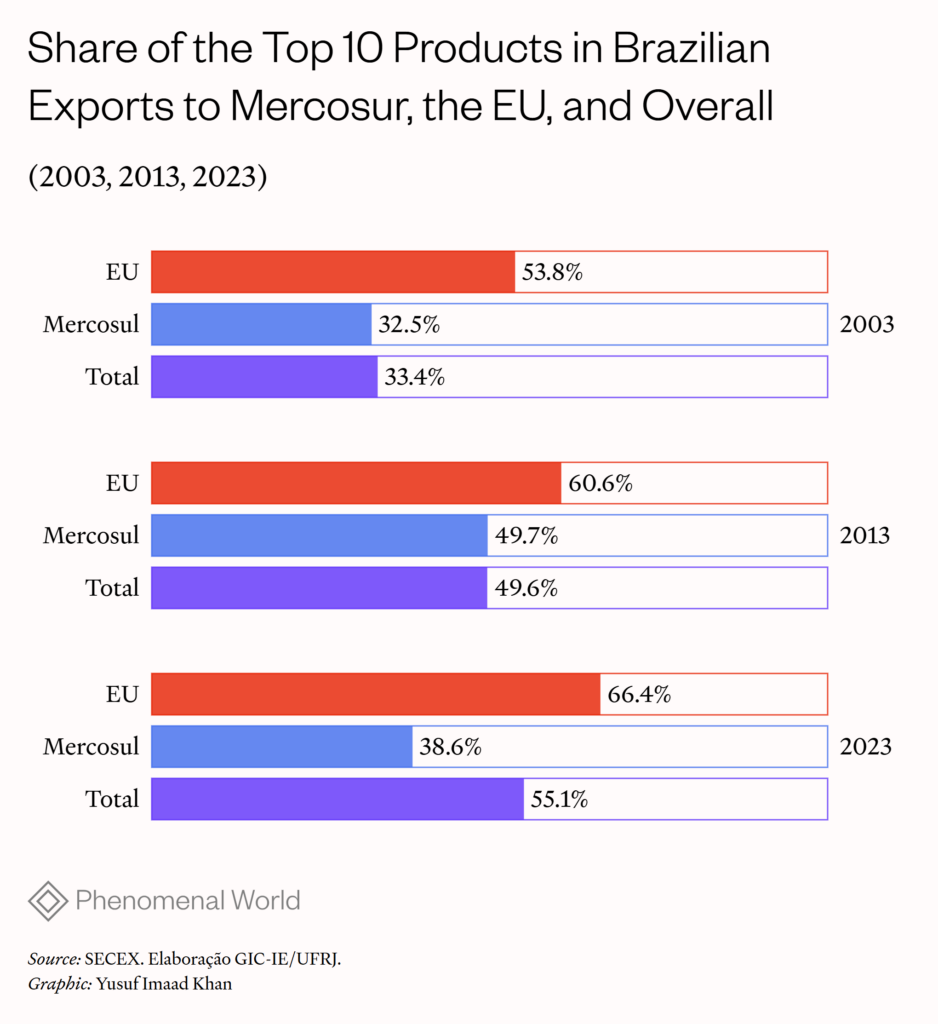
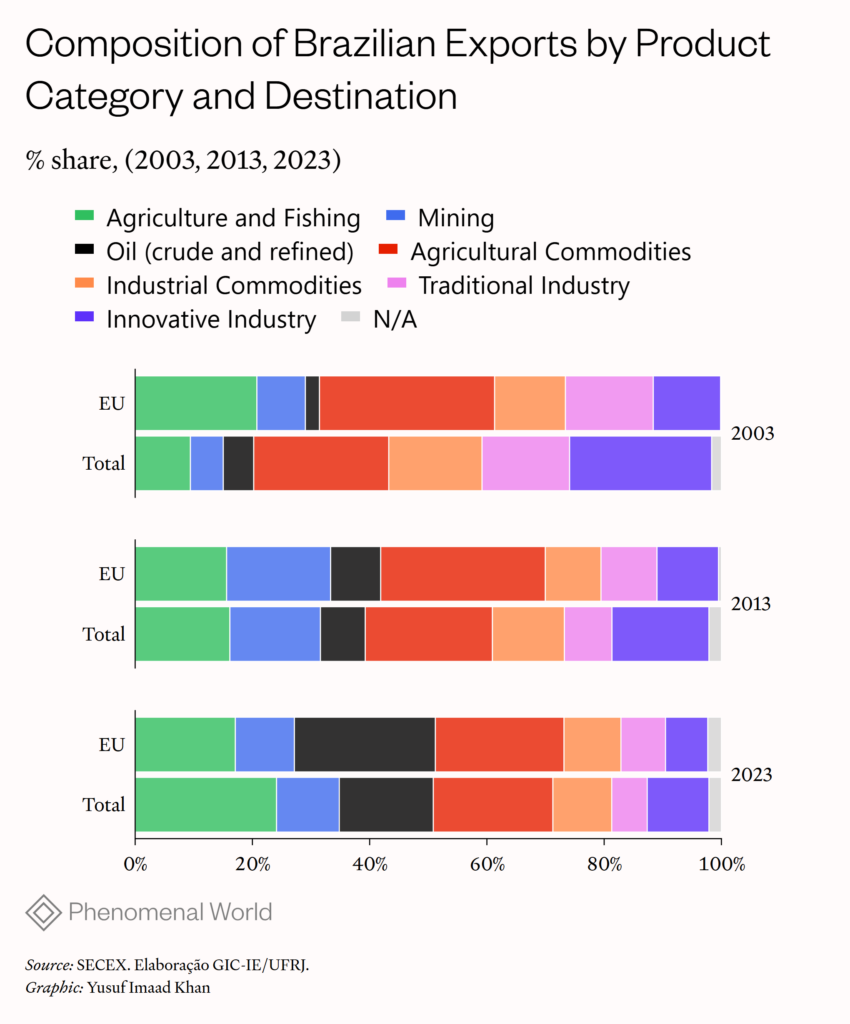
    Moreover, it is important that the Brazilian government shares its advantages with other Mercosur countries. The problem with this agreement is that it tends to reinforce a pattern of growing regressive specialization, which has intensified since the 2000s across Brazil and the region. Comparing Brazilian exports to the EU in 2003, 2013, and 2023 reveals the increasingly primary nature of our exports profile. And the agreement tends to reinforce our specialization in agricultural and mineral products.

    Order200320132023
    1Soybeans, whether or not groundIron ores and concentrates, including roasted iron pyritesPetroleum oils and oils obtained from bituminous minerals, crude
    2Soybean oilcake and other solid residues from soybean oil extractionSoybean oilcake and other solid residues from soybean oil extractionSoybean oilcake and other solid residues from soybean oil extraction
    3Iron ores and concentrates, including roasted iron pyritesSoybeans, whether or not groundCoffee, whether or not roasted or decaffeinated; coffee husks and skins; coffee substitutes containing coffee in any proportion
    4Fruit juices (including grape must) and vegetable juices, unfermented, not containing added spirit, whether or not containing added sugar or other sweetening matterCoffee, whether or not roasted or decaffeinated; coffee husks and skins; coffee substitutes containing coffee in any proportionSoybeans, whether or not ground
    5Coffee, whether or not roasted or decaffeinated; coffee husks and skins; coffee substitutes containing coffee in any proportionChemical wood pulp, soda or sulfate, other than dissolving gradesCopper ores and concentrates
    6Chemical wood pulp, soda or sulfate, other than dissolving gradesPetroleum oils and oils obtained from bituminous minerals, other than crude; preparations not elsewhere specified or included, containing by weight 70 percent or more of petroleum oils or of oils obtained from bituminous minerals, these oils being the basic constituents of the preparations; waste oilsIron ores and concentrates, including roasted iron pyrites
    7Meat and edible offal, of the poultry of heading 0105, fresh, chilled or frozenPetroleum oils and oils obtained from bituminous minerals, crudeChemical wood pulp, soda or sulfate, other than dissolving grades
    8Unwrought aluminumFruit juices (including grape must) and vegetable juices, unfermented, not containing added spirit, whether or not containing added sugar or other sweetening matterFruit juices (including grape must) and vegetable juices, unfermented, not containing added spirit, whether or not containing added sugar or other sweetening matter
    9Petroleum oils and oils obtained from bituminous minerals, crudeUnmanufactured tobacco; tobacco refusePetroleum oils and oils obtained from bituminous minerals, other than crude; preparations not elsewhere specified or included, containing by weight 70 percent or more of petroleum oils or of oils obtained from bituminous minerals, these oils being the basic constituents of the preparations; waste oils
    10Unmanufactured tobacco; tobacco refuseCopper ores and concentratesFerro-alloys

    Thus, strengthening regional industrial coordination within Mercosur becomes crucial. Despite obvious political challenges, the existing coordination in certain sectors should not only be preserved but further reinforced—including through public procurement mechanisms or regional funds, enabling the bloc to enter more cohesively in this EU “partnership.” The Uruguayan government, for example, is delighted with the agreement—particularly because the liberal government that took part in the negotiations was fond of the specialization.2 N.E: Uruguayan President Lacalle Pou’s neoliberal-oriented term ends in March, when progressive candidate Yamandú Orsi, allied with former president Pepe Mujica, takes office. Their beef exports do not face the same environmental problems as Brazilian production in the Amazon and Cerrado regions. For Brazil to maximize agreement benefits, coordinating with its neighbors and creating strategies to transfer part of the gains is desirable, as it could facilitate alliances with these countries and boost bloc-wide industrial production.

    MS: The Brazilian government’s official position claims the agreement offers several advantages to Mercosur. The Ministry of Development, Industry, Trade and Services, for example, highlights greater access to the European market—which could attract additional foreign direct investment—and reduced domestic costs for industrial inputs and capital goods—since we could import them duty-free. Improved international competitiveness of our products is the ostensible result. They argue this would strengthen trade partnership diversification, industrial modernization, integration with EU production chains, and spark interest from other actors in negotiating new agreements with Mercosur to access this market. How do you view this argument?

    MC: This is a very old argument on trade liberalization. It is the same one used in the 1990s, claiming that we can import to export, that liberalizing imports might provide productivity gains through the import of cheaper inputs and capital goods. This would allegedly lead to competitiveness gains for the domestic industry, turning the country into an exporter of manufactured goods. However, since then, Brazil and the region have increasingly exported less sophisticated goods. In short, our major liberalization attempt implemented in the 1990s provided no evidence of the positive effects of trade opening on exports.

    I doubt that this time the Brazilian economy will achieve a great virtuous cycle of economic growth driven by direct investment or increased export competitiveness through greater access to European inputs, particularly in the current context. Will we integrate into European value chains? No, we won’t. Europe has already established its chains and is attempting to shield itself from Chinese and other Asian countries’ entry, trying to consolidate these chains as much as possible within European borders. Our role will likely be further specializing in raw materials supply for these chains. The foreign investment we might attract relates to companies looking to take advantage of specific domestic factors, such as natural resources and a broad regional consumer market. But this does not necessarily translate to industrial modernization.
    This article was translated from Portuguese to English by Glenda Vicenzi.

  2. Decolonizing Jamaica

    Comments Off on Decolonizing Jamaica

    The ideas of the Jamaican political leader Michael Manley had a global impact that continues to be felt today. As the leader of the People’s National Party (PNP) from 1969 to 1992, and particularly in his first period as prime minister of Jamaica from 1972 to 1980, Manley promoted a wide range of ambitious reforms that were guided by strongly articulated ideas of democratic socialism and economic decolonization. He recognized that Jamaica, like many other countries, had gained constitutional independence, yet remained wedded to a world economy structured by colonialism. 

    Manley therefore sought to pursue these ideas on an international level. Along with other leaders such as Tanzania’s Julius Nyerere, as one of the leading spokespeople in the 1970s for a New International Economic Order (NIEO) based on more egalitarian principles through cooperation among countries in the global South. Despite the successful implementation of many reforms, Manley’s policies faced strong opposition both from groups within Jamaica and from international actors, most notably the United States. His government struggled with the difficult economic circumstances of the 1970s, and lost elections in 1980 after several years of austerity that came as a condition for loans by the International Monetary Fund (IMF).   

    Anthony Bogues is the Asa Messer Professor of Humanities and Africana Studies at Brown University. He has written extensively on Caribbean and African intellectual, cultural and literary history and political thought, including the life and political ideas of Michael Manley. In the late 1980’s he was also an advisor to Manley. More recently, he has supported efforts to rethink the political vision of the People’s National Party.

    In this interview, Bogues reflects on the life and legacy of Michael Manley, whose hundredth year birth anniversary was celebrated last month. Considering Manley’s influence in both Jamaican and internationalist politics, the conversation explores Manley’s political formation in the Jamaican labour movement, his ambitious efforts to decolonize the Jamaican economy, as well his efforts on the global stage, on issues ranging from the US embargo of Cuba to the IMF. Bogues discusses inheriting a generational burden to rethink the philosophical vision of democratic socialism in Jamaica, expressing hope for a united Caribbean.

    An interview with Professor Anthony Bogues

    will kendall: Can you tell us about your relationship with Michael Manley? How did you first meet him, and how did your relationship develop?

    anthony bogues: I met him formally after the 1980 election, which was a critical moment in Jamaican history. The year of the election was a period of political crisis and immense violence—over 800 people died between the beginning of the year and the election in October. From the late 1970s onwards I was a left-leaning journalist working at the Jamaican Broadcasting Corporation. The election was in October, and with the conservative Jamaica Labour Party in power I was fired in December. During the election campaign, myself and other journalists were threatened by the conservatives that we would never work in Jamaica again. Myself and a colleague, Brian Meeks, took the government to court and won a case for unfair dismissal.

    So after my dismissal the question was: what was I going to do with my life? I considered doing a PhD. But I was approached by two leading members of the PNP, the party’s then general secretary, DK Duncan and the now former wife of Michael Manley, Beverley Manley, asking me to come and work for the Party as a researcher. I said yes, and that decision led me to work for the Party secretariat. I became the secretary of the Political Education Commission of the Party, and that is the role in which I met Michael Manley. We became very close over the years. When he became Prime Minister in ‘89, he asked me to come to Jamaica House—the country’s 10 Downing Street if you will. I still wanted to do a PhD, but I ultimately agreed. We had our political disagreements, but our relationship deepened. I worked with him as his special assistant and what is today called a chief of staff. 

    In this capacity we travelled to many meetings. On one occasion, he had to visit the White House. Typically, on those occasions the Prime Minister would be joined by the Minister of Foreign Affairs, but Manley wanted me there in the private meeting in the Oval Office with President Bush Sr. When the meeting began, I understood why Manley wanted me there. There were three main items on the agenda. The first was the drug problem which was beginning to create real problems for many Caribbean states. The second was about the multilateral debt of Jamaica and the region. The third was to ask the US to lift its embargo on Cuba. The plan was that Prime Minister Manley would go speak to Fidel Castro. Former President Carter would then visit Cuba to advance the negotiations. And the White House would stay out of it until it was clear that the conversations and negotiations had arrived at a certain point. The one US condition was that Cuba would release a number of political prisoners.

    After that meeting, we went to Cuba and spoke to Fidel who said, “We don’t have any political prisoners.” When we conveyed that to Brent Scowcroft, the US National Security Advisor, the deal fell flat. Those are the sort of things Michael and I were involved in and the foundation for our relationship. We remained close long after he left office. When he passed away, I was doing my postdoc in the United States at Howard University, and I flew back immediately to help organize his funeral. 

    WK: Can you paint a picture of the social and political environment that Michael Manley came of age in? On the one hand, there’s the the class and racial contexts in Jamaica, such as the “color-classism” of the planter class, and on the other hand, there’s the “political unionism” of the labor movement and its relationship to the two mass parties.

    AB: Michael was born in 1924, when Jamaica was still firmly in the grip of British colonialism. He was born to an upper middle-class family and his father was one of the most important lawyers in the entire Caribbean. His mother, who was born in the United Kingdom, became a widely revered artist and very important in Jamaica’s artistic community. Both of his parents lived their lives according to a powerful ethic of public service. She was known for challenging the racial colonial representation of Black people in the colonies. One of her most important works was called Negro Aroused. His father Norman Manley actively served working people alongside his list of very important clients. Living in London as a Rhodes Scholar, Norman Manley also developed Fabian Socialist ideological views. 

    In 1938, major workers’ riots broke out across the country as well as across the Caribbean. The strikes prompted Britain’s colonial office to reflect on how it would manage this emerging trade union movement. Prior to ‘38, we had the Universal Negro Improvement Association in the Caribbean, which was founded by Marcus Garvey. That is important because many Garveyites later joined the People’s National Party (PNP). After the labor riots in the 1930s we had the Bustamante Industrial Trade Union (BITU) and the PNP led by Norman Manley—an organized labor movement, and a nationalist anti-colonial movement. That was the political configuration of the time. 

    I have argued that the PNP was a mass anti-colonial movement that transformed itself into a political party in 1944 with the advent of universal adult suffrage. The BITU was a mass trade union movement linked to Bustamante, who was originally a member of the PNP. He was imprisoned for his union activities and left the party upon his release, forming the Jamaica Labour Party (JLP) in 1943. So the union movement is attached to that party, and so when Bustamante leaves the PNP, Norman Manley and others in the PNP leadership form the Trade Union Congress as a counter to the BITU. So both parties in the 1940s were rooted in organized working-class activities. You can say following conventional labels that the JLP is center-right and the PNP is center-left, but it’s important to note that both parties engaged in a relationship with mass movements that no longer exists today. 

    The PNP also had immediate connections to the British Labour Party and Fabian Socialism. Stafford Cripps, the left leaning former Chancellor of the Exchequer, was present at the PNP’s inaugural conference. So while at its birth the PNP’s primary objective was political independence, it also had a socialist foundation. 

    Michael grew up in this environment, he would come home and hear his father’s political arguments. Both his mother and father were both actively involved in public life. He attended the same elite colonial school that his father had gone to, Jamaica College, after which he briefly studied at McGill in Canada before moving to London. At the LSE, his greatest influence was the English Socialist and later chairman of the Labour Party Harold Laski. Initially, under the influence of his mother, he had wanted to study Art criticism, but by the time he finished the Latin requirements he ended up opting for a degree in Government/ political science. 

    Laski’s left-wing socialism, which was to the left of the Labour Party at the time, enormously shaped his thinking. As did the cohort in the West Indian Students Union—which included figures like Errol Barrow, later Prime Minister of Barbados, and G. Arthur Brown, later governor of the Bank of Jamaica. Elsa Goveia, the extraordinary Guyanese historian who became the first chair of West Indian History at University of West Indies, was also there. This was not the generation of the ‘20s and early ‘30s who had come to London, people like CLR James, George Padmore, Amy Ashwood Garvey as well as the cricketer Learie Constantine. It was an explicitly anti-colonial generation who came together in the ‘40s and ‘50s in London, primarily as students. It was also a Federalist generation. They thought of themselves as not only participating in the separate political life of Guyana, Barbados, and Jamaica, but advancing a Federation of the Anglophone Caribbean.

    By the time Michael returned to Jamaica in the late 1940s, he had abandoned his dream of being an art critic and he decided to pursue a career as a political journalist. He started working for a newspaper called Public Opinion, publishing a remarkable column called “Root of the Matter.” Politically, he became an ordinary group member of the party and when the party split in 1952, he began to play a more active role. This split was brought on by the increased pressures of the Cold War. In Jamaica, during the period of anti-colonial twentieth century agitation Soviet-aligned Marxists led by Richard Hart and others along with the radical leftist Ken Hill had become incredibly influential both within the PNP and within the labor movement . The Right of the Party became increasingly concerned with getting the Marxists and left-wingers out, and they did so during the party conference of 1952.

    After the split, Michael became part of an internal campaign which sought to articulate the difference between communism and democratic socialism. In this process, his political ideas were sharpened by attending hundreds of Party groups and listening and participating in the debates between Party members. At this point, he’s a journalist and a minor figure within the Party. But I would argue that his subsequent participation in the labor movement was perhaps most formative. He was brought into the labor movement through an invitation to observe negotiations by a PNP member and trade union leader. The story goes that at the negotiation meeting, the leader unexpectedly exited and left Michael in charge of the discussion. Hearing the list of worker grievances at this meeting is what turned him into a trade unionist. It’s his work in the sugar and bauxite belt that brought him in contact with the organized working class and shaped him into the politician he was. 

    Neil Warner: After Manley became prime minister, his government pursued a large number of ambitious reforms. Manley described his economic and political approach as an attempt to pursue a “third path,” contrasting it to the Puerto Rican Model—which Jamaica had initially pursued and which focused on seeking to attract overseas investment—and the Cuban Model—which was based on Marxism-Leninism and central planning. How would you describe this approach? What would you say were the most important and successful of these reforms?

    AB: As I mentioned, Michael Manley’s upbringing is enormously shaped by the anti-colonial struggle. But after Jamaican independence was granted in 1962, Jamaican society did not decolonize in any substantive form. The plantations were still powerful and racial and class hierarchies remained intact. The dominant social order was constructed around black oppression drawn from the various structural legacies of the colonial order.  

    As a result, decolonization remained one of Manley’s core aims into the 1970s. But you couldn’t pursue decolonization without raising fundamental questions about equality, justice, and the structure of the national economy. In his first book, The Politics of Change, Manley elaborates ideas on changing the actual colonial structure of Jamaican society. That involved overturning colonial laws like the Master Servant law, putting forward public programs like free education, and bringing ordinary Black people to the centre of Jamaican society. In his political practice, he attempted to dismantle the legacies of the old colonial order. 

    So it’s a period of, on the one hand, what Rex Nettleford calls “somebody-tization”: how the Black person becomes somebody. On the other hand, it was a period of reorganizing the Jamaican economy. Sugar was one of the most important industries in Jamaican society. In the decolonization process, a question emerged: Could those workers, whose ancestors had been slaves, participate in redesigning how the industry would operate? This was both a historical and political question given the island’s history as a slave sugar-producing colony. In the late 1970s, myself and others went to Westmoreland, a sugar-producing area, to help turn that land over to workers so it could function as a cooperative. That was just one of the programs Michael had put forward. Another was on literacy. Nearly 80 percent of the Jamaican population was illiterate as a result of British colonialism. Young people like me at the time were deeply involved in these programs that the Manley government had created. 

    In his negotiations with bauxite companies, Michael Manley opted for bargaining higher rates of compensation over nationalization. Bauxite is an extractive industry and as a result it is finite, so it made sense to get the best conditions we could during that period of extraction. How do I summarize the 1970s reforms? What I’ll say is that Michael Manley pursued a program of full decolonization. 

    All of these reforms made many members of the Jamaican national elite very uncomfortable. When low wage workers are given a minimum wage and domestic workers are granted rights, things just can’t continue to operate in the way they had before. In other words, when the power balance begins to shift, the elites become jittery. By the 1980s, elite opposition and opposition from multinationals had crystallized. As recent documents from the US National Security Agency demonstrate, the US also became concerned, and it is now clear that it acted on these concerns. Remember now this was the middle of the Cold War. Moreover, Michael supported Cuba and its intervention in Angola on behalf of the radical People’s Movement for the Liberation of Angola (MPLA). The MPLA at the time was struggling against South African expansion, which would not only spread apartheid but also weaken the anti-apartheid struggle within South Africa. All of these things came together in the 1980s. 

    Nw: This year is the fiftieth anniversary of the declaration of the New International Economic Order (NIEO), a program led by countries in the global South for a restructuring of the rules of the international economic system to end economic colonialism and dependency. Manley was known as one of the most influential advocates of the NIEO. Can you talk about Manley’s role in the NIEO? 

    ab: Manley realized that even though countries like Jamaica had gained constitutional independence, they remained wedded to a world economy structured by colonialism—what people like Kwame Nkrumah would call “neo-colonialism.” Transforming the world economy depended on altering price setting mechanisms and developing technological and energy independence. We grow the commodities, but we don’t set the prices and we rely on importing machinery and oil to process them. Because he was deeply invested in political and economic democracy, Manley was also very concerned with the rise of multinational corporations. 

    These problems could only really be dealt with through what Julius Nyerere of Tanzania and others called the Trade Union of the Poor. At the core of the NIEO was a new economic world order. It was based on the idea, as elaborated in 1979 in Arusha, Tanzania, that there was the need “to complete the liberation of the Third World countries from external domination.” Third World countries therefore had to band together to gain a say in the structure and operations of the world economy. Julius Nyerere and Michael Manley were a tag team in the NIEO. Both grew up in former British colonies. One had studied at Edinburgh University, the other in London. And importantly, they shared the sense that a real threat to postcolonial societies was the rise of a domestic elite that would mimic the old colonial rulers. Nyerere developed the Arusha Declaration, which was really about cauterizing the power of the new elite and their capacity to corrupt the state. Michael didn’t get that far, he was operating in a different political culture. But his ideas on socialism and decolonization were about constraining the power of the elite to leverage the state for their own purposes. 

    The NIEO ends up gaining the support of Willy Brandt and others in the Socialist International. James Callaghan, who was then Prime Minister, ultimately came on board. This became an international campaign to get the world to think about the structure of the global economy and alter it in a way that will benefit newly independent countries. This was not entirely the same as the Non-Aligned Movement, which was a political movement more than an economic one. The Non-Aligned Movement was transformed by Nyerere and Manley into a robust movement that challenged both the economic and political structures of the world at that time.  

    WK: You have spoken about the trauma of two defeats in the Caribbean—Michael Manley’s 1980 election loss, and the defeat of the 1983 Grenadian revolution. These were political, ideological and military defeats. Manley was prime minister of Jamaica for a final time from 1989 to 1992. This time, his government seemed to have been more reconciled to capitalism. How did he think about that change?

    ab: The problems Jamaica faced with the IMF were global problems. There was a sophisticated analysis of these problems coming out of the journal Development Dialogue in a special issue edited by Tanzanians and Jamaicans. Within the PNP, you also had a huge debate about the IMF. The IMF was one of the core entities ensuring that Manley would lose the election. The structural adjustment programs were very harsh, and they explicitly called for the reversal of the reform program that he had initiated. This, combined with oil prices, political destabilization, and rising violence, all contributed to his defeat. 

    Let’s think about the 1980s. There are three key figures in the world during this decade: Margaret Thatcher, Helmut Kohl, and Ronald Reagan. They were united in their intention to shut down every progressive movement, domestically and internationally—whether it was the miner’s strike, the NIEO, or the anti-apartheid movement. These three individuals had an ideological view about what society should be. To quote Maggie Thatcher, “there is no society, there are only individuals.” Stuart Hall called this moment a revolution in ideas and social practices.

    After Manley’s defeat in 1980, there was a meeting in Cancún in 1981 chaired by Reagan. Julius Nyerere attended to represent the NIEO arguments. When they got to that part of the agenda, Ronald Reagan said: “next item.” No one protested. That is what was reported back to Manley and he started to realize that the world had dramatically shifted. But he was still a politician, he had to lead his party to victory. 

    We had numerous conversations during this period. The way he put it to me was, in the words of Hamlet, “time is out of joint” for people like him. In his view we couldn’t, as an island of 2.5 million people, go against the tide on our own. So the new question was not abandoning all hopes of transformation, but rather how do we ameliorate the worst effects of the market? I want to emphasize that this was not a trajectory that he embraced with enthusiasm. But it was the only realistic path he saw.

    There are many unpublished stories from this period. I’ll just recount one. When the PNP entered into office in 1989, one of the first things we did was go around to all the Socialist International countries. Michael met Felipe González in Spain and he told him that we’ve got a serious problem with foreign exchange, and we didn’t want to go to the IMF: “Can you help us out?” Gonzalez said: “talk to our finance minister.” That’s what they all did, they left it to the finance minister because they could not say yes. Every finance minister then asked if we had a standing agreement with the IMF. 

    Manley then sent me to the multilateral Inter-American Development Bank to negotiate a less onerous deal. There were some Latin American figures there, and we also had a Jamaican who was high up in the bank. I went to Washington to have breakfast with them. The first thing they said to me is that we had to privatize the Jamaica State Trading Corporation. That agency was scouring the world to purchase cheap pharmaceuticals and deliver them to public hospitals. In searching for arguments against this, I told them that if we put this before parliament, the public would turn against their intervention into our national sovereignty. And you know what they told me? They said, “as a debtor country, you have no sovereignty.” I put my knife and fork down, left the meeting, and told the Prime Minister that this was not going to work. 

    Manley became ill and retired, I finished my PhD, and we continued our regular discussions. As he got older he grew more and more convinced that the democratic left (and this is his phrase) had to assert a counter narrative to the neoliberal dogma. We even started working on a book together about the need for a distinctive kind of democracy and what would be the ideological and philosophical basis of a modern democratic left. But as his illness worsened the project fell to the sidelines. To be very frank, I felt I shouldn’t do it without him. 

    WK: More recently you led a commission that came up with a rethinking and restatement of the philosophical vision of the PNP. What was behind that rethinking and how did you find that experience? How are you thinking about sovereignty now?

    ab: Once Michael Manley formally retired, people like myself began to feel that the party lost its vision and ambition to transform Jamaican society. We began to walk away. But a couple of years ago I was asked by members of the new leadership to help them revive the Party’s philosophical identity. I said yes for two reasons: One, which I said publicly, was because Michael had made it clear in our many discussions that it was my generation’s burden to put progressive and deep democratic ideas back on the agenda. Second, I felt that those of us on the left really did need to begin to do some of the work that Manley and I had begun to discuss before his death. It was an opportunity to work with a group of comrades and articulate where we stand. 

    To do this, I followed a democratic model of politics. I spent a lot of time in constituencies. I was back and forth between the US and Jamaica, doing surveys, interviewing people, doing deep listening. After that process was completed last year, we wrote up our impressions and submitted a document titled “ Where we Stand,” which was approved by the Party. We then set about translating these principles into economic policies. We received 602 recommendations from the party delegates at the last September annual conference about how to restructure the Jamaican economy. I can’t share that with you yet, but I think it is safe to say that there is a foundation for the process of transforming Jamaican society. However the jury is out on whether we will succeed.

    The question of sovereignty remains important. I go back to the Caribbean writer and novelist George Lamming, who argued that the question of sovereignty is central for us in the Caribbean. And if you ask me, I would say to you that the only real sovereignty that we can have in the Caribbean is a Caribbean that is united. I mean the entire Caribbean, Anglophone, Francophone, Hispanic, Dutch and so on. It must first emerge in the imagination, through a belief that we are not overwhelmed by external economic and political forces. We have to imagine things beyond that which is given. And we must be united in doing so, because the structure of the global economy does not allow for individual sovereignty in the economic sense. The matter of sovereignty begins then with a political horizon. It will demand of us in the Caribbean a series of joint economic ventures as well as building the capacity to intervene in the world at the level of global politics. This means configuring new global relations and alliances outside of big power politics. There are still superpowers which dominate the globe but given the current multiple crises, new forms are called for. I think that is one of the contemporary legacies of Michael Manley.

  3. Normalization and the Future of the Middle East

    Comments Off on Normalization and the Future of the Middle East

    Before October 7, 2023, the pursuit of diplomatic and economic normalization between Israel and Arab states appeared to be the central trajectory for regional politics in the Middle East. With the prospect of an Iran deal buried, this path represented American designs for the region—in a bipartisan consensus launched by Donald Trump’s Abraham Accords and carried forward by the Biden administration. For Saudi Arabia, a pivot toward relaxing tensions with Iran while pursuing normalization with Israel was also the order of the day. All signs seemed to give National Security Advisor Jake Sullivan permission to blithely declare, a week before Hamas launched its incursion into southern Israel, “The Middle East region is quieter today than it has been in two decades.”

    When October 7 happened, then, it’s no wonder that speculators immediately wondered if Hamas was seeking to smash the trajectory and prevent Saudi Arabia from joining its Gulf neighbors UAE and Bahrain on the short list of Arab states who have normalized relations with Israel. At this, they have certainly been successful: while the Biden administration has pursued Saudi-Israeli rapprochement throughout the genocide in Gaza, recent months have seen Saudi Crown Prince Mohammed bin Salman clarify to the Shura Council, and Foreign Minister Faisal bin Farhan to the readers of the Financial Times, that normalization would be conditional on the establishment of an independent Palestinian state. 

    In recent months, however, a countermovement by the US and Israel seems to sabotage alternatives to normalization by way of a widespread military assault on Iran’s sphere of influence. With Assad’s regime fallen, the diplomatic path taken by a new government—allying with the Gulf powers, or greater confrontation with Israel as it invades Syrian territory—may be an indicator of the strength of the normalization program. Much will depend on the approach of a new Trump administration, which may include the return of the architects of the Abraham Accords to the circles of American power, toward Israel and the region.

    In order to understand the particular role of the Gulf states in the Middle East, their relationship to the Palestinian question, and the history of normalization, we spoke to Elham Fakhro, a researcher at the Harvard Kennedy School’s Middle East Initiative and the author of the new book The Abraham Accords.

    An interview with Elham Fakhro

    Jack gross: Let’s start with the Abraham Accords, signed in September 2020. Who were the players that were involved?

     Elham fakhro: Trump’s immediate circle is very pro-Israel. For example, David Friedman, who became his ambassador to Israel, first started out as Trump’s lawyer before he was a presidential candidate. After Trump announced his candidacy, David Friedman pushed to become his advisor and got that role. Friedman shaped Trump’s platform on Israel and Palestine early on. He reversed the Republican Party’s endorsement of a two-state solution and insisted UNRWA was compromised by anti-Semitism. He himself was the head of an organization that fundraised for settlements.

    Then of course there’s Jared Kushner, whose family is friends with Prime Minister Netanyahu. (There’s the frequently repeated story about Kushner being expelled from his bedroom as a teenager because Netanyahu was coming to stay.) During the Trump administration, Mike Pompeo became the first acting Secretary of State to visit a settlement. Friedman and Pompeo both speak of this conflict in religious terms. Friedman has openly stated that he believes that Trump was sent by God to save the state of Israel.

    Trump was initially advised that bringing Palestinians to the table for peace talks was futile, and then pushed to adopt a series of very pro-Israel policies: moving the embassy to Jerusalem and walking back the 1978 Hansell memorandum, which states the US government position on the illegality of Israeli settlements. If you read Friedman’s biography, it’s very clear that he worked with Netanyahu to influence US policy rather than the other way around. He convinced the president to cut aid to UNRWA, another wishlist item for Netanyahu.

    This all led to a boycott from Palestinian leaders, with Palestinian Authority Prime Minister Mohammad Shtayyeh stating that “the rights of the Palestinian people are not for sale.” Afterwards, Kushner still wanted to put together a plan for resolving the occupation, but this was delayed by Netanyahu running for reelection. During the summer of 2019, Trump launched the economic component of a new prosperity and peace plan in Manama. It was significant because the Palestinians weren’t in attendance. Eventually the Trump administration decided to also not invite the Israelis, and instead drew the Gulf states in as intermediaries into this diplomatic process for the first time.

    The move represented a new strategy of geopolitical alignment. For example, the economic component of the peace plan was released in Manama, and at the event there was a lot of talk about Iranian extremism being the real threat in the region. It was an opportunity, especially for Bahraini leaders, to express how much they thought in accordance with the Trump administration. The White House also tried to draw the Gulf states in as financial investors in the proposed plan.

    jg: What were the steps and issues that led up to this final plan being presented and signed in Washington? What did the plan say on the question of Palestinian statehood?

    ef: Shortly after the Manama meeting, Netanyahu and Benny Gantz came to Washington for the launch of the political component of the plan: land swaps for the Palestinians and, in exchange, permission for Israel to effectively annex one third of the West Bank. Palestinians were offered land in Sinai to be linked to other Palestinian territories by a future high speed rail, which would rely on investments, presumably funded by Gulf capital, in exchange for these land swaps. But there was no guarantee of Palestinian statehood. 

    In lieu of a state, the Palestinians were offered a freeze on settlement construction for a few years, during which time they could decide whether they wanted to continue the talks or not. There was nothing on the right of return. The plan was, of course, rejected by Palestinian leaders. On the day that this rejection was announced, Netanyahu openly declared his intentions to annex the West Bank. This actually caused surprise and frustration among Trump officials who weren’t in support of unilateral annexation.

    Trump’s officials were divided between supporters of Friedman who were on board with Netanyahu’s stance, and figures like Kushner who wanted a less extreme version of annexation. Trump was also unhappy—his team wanted to see Netanyahu engaged in the process that they had laid out. 

    This is when the UAE stepped in. UAE Ambassador Yusuf al Otaiba met with Kushner in DC and wrote an editorial in June 2020, originally published in Hebrew in one of Israel’s main newspapers. He argued on behalf of the UAE that annexation was not acceptable, and that plans for annexation and talks of normalization were contradictory. For the Israeli readership, he dangled the possibility of peace and emphasized commonalities over differences. This was the seed for what would become the Abraham Accords.

    During the pandemic, Kushner and his advisor Avi Berkowitz traveled to Israel in an attempt to persuade Netanyahu not to annex the West Bank. It was plausible that Netanyahu’s threats were an electoral ploy directed at extremist settlers and Israel’s most right-wing factions who wanted annexation. The UAE had already indicated to Kushner its willingness to normalize, and this normalization could be offered to Netanyahu in exchange for halting the annexation. This effectively formed the basis for the Abraham Accords announced in August 2020 through Trump’s tweets. A month later, Bahrain’s Minister of Finance called Trump’s people to let them know that Bahrain wanted to join too. 

    jg: What was the immediate impact of the announcement of the Abraham Accords in 2020?

    ef: Initially, the announcements triggered a flurry of petitions across the Gulf states from all kinds of civil society groups criticizing the UAE and Bahrain for their decisions. The response largely took place online, due to the pandemic. Religious scholars condemned it, and civil society groups led the oppositional response—I think we would have seen more protests than we did if it weren’t during the pandemic.

    Nonetheless, the new relationship began to take hold and develop. 

    In the first two years after the agreement, bilateral trade between the UAE and Israel, the two most significant economies involved in the Abraham Accords, reached $2 billion. It’s now projected to reach $4 billion in the first five years, driven by significant investments by UAE sovereign wealth funds in Israeli startups and tech companies, as well as Israeli tourists coming to Dubai. Tourism doesn’t go both ways: In December 2020, about 70,000 Israeli tourists visited Dubai, while roughly 3,000 Emirates visited Israel. The Emirati state and popular media are very interested in pursuing this narrative that normalization is about tolerance and cultural acceptance, which also offers Emiratis the chance to go pray at Al Aqsa Mosque now. Yet there is a reluctance to embrace normalization at the popular level, not to mention a continued commitment to the rights of Palestinians.

    On the military side, the US moved Israel from the European zone of command (EUCOM) to the United States Central Command (CENTCOM), which covers the Gulf and Arab states. This was meant to deepen engagement not only between Israel and the normalizing Arab states but also the broader community of Arab states that hadn’t normalized.

    There was also significant economic coordination. The diamond industry, a huge source of convergence between Dubai and Israel, has become one of the major areas of trade. There are agreements between universities for enhanced cooperation, think tank agreements, and so on. I think particularly in the first year after the signing of the agreement, there was this huge state drive to involve Israel in everything, in both the UAE and Bahrain.

    The Gulf States and Israel in the twentieth century

    jg: I wonder if we could place the Abraham Accords into a longer history: How have the Gulf states seen the Palestinian question over the last century? From the Arab Revolt in 1936 and the Partition Plan of 1947 to the creation of Israel and the Nakba, the Six-Day War and the Yom Kippur War—what do those key moments indicate about the development of political power in the Persian Gulf?

    ef: Each of these junctures has elicited unambiguous grassroots support across the Arab world for the Palestinians. In 1936, when news of labor strikes and armed revolt against Zionist settlers reached the Gulf through radio and newspapers, efforts to fundraise for them took place in several places, including Bahrain. The Emir of Sharjah, one of the seven emirates of what is today the United Arab Emirates (UAE), himself even donated to the cause. This emerged mostly out of the growing popular sense of Arab nationalism, and solidarity against the British—a colonial enemy intent on dividing the Arab world. Solidarity with the Palestinians in that context made sense.

    The announcement of the partition plan in 1947 triggered some unrest in the nascent Gulf states. In Bahrain, workers and high school students went on three days of strike. In 1967, there were similar acts of solidarity, and rulers began to get involved. Sheikh Zayed of Abu Dhabi at the time sent aid to frontline troops in the conflict.There was direct involvement of a Kuwaiti contingent under Egyptian command in 1967—a change from before World War II, when the ruler warned citizens not to send money (presumably because the British, who were in control of Kuwait at the time, didn’t want to see the rise anti-imperialist solidarity across the Arab world).

    dylan saba: The Yom Kippur War in 1973 saw the Arab states of OPEC launch dramatic production cuts and sales bans that dramatically impacted the global political economy. How did these events shape the future of the Gulf states’ political unity, and the geopolitical and diplomatic area in which they operated? 

    ef: The oil production cuts and export embargo that began with that war was one of the most successful examples of coordinated action between the Gulf states. Oil prices quadrupled in two months. High oil prices lasted for many years beyond the embargo, and generated windfall profits for the Gulf states. It also triggered several changes within the United States. The Nixon administration began what would be a decades-long project to diversify energy supplies beyond Middle Eastern oil. It also intensely pursued a diplomatic settlement to the Arab-Israeli conflict. Nixon and Kissinger began to recognize the real connection in the minds of Arab leaders between the peace talks to end the war and the politics of global energy markets.

    The first Egyptian-Israeli disengagement agreements in 1974 paved the way for the subsequent Camp David Accords in 1978 and the peace deal between Egypt and Israel in 1979. The upshot to the oil embargo in the US was long-term diplomacy—both political parties realized they needed to do more to resolve the Arab-Israeli conflict. It taught the Gulf States how successful they could be through coordination. Greater political and economic unity arrived soon after with the Gulf Cooperation Council, which the Gulf states formed in response to the outbreak of the Iran-Iraq war in 1980.

    jg: How did the Gulf Cooperation Council (GCC) come into existence in these pivotal years? Were there different visions of cooperation among the founders?

    ef: The six countries that form the GCC—Bahrain, Kuwait, Oman, Qatar, Saudi Arabia, and the United Arab Emirates—experienced relatively intense vulnerability during the Iran-Iraq War. The UAE did not want to take a side in the war. It publicly staked a nonaligned position and eventually leaders in all of those states agreed that creating formal alliances would be useful for their long-term security concerns. The other event is of course the Iranian revolution of 1979, which had enormous regional implications. For the Gulf nations, it marked the beginning of a deepening security relationship with the United States. These three events—the OPEC embargo of 1973, the Iranian revolution in 1979, and the Iran-Iraq War, particularly the Iranian offensive in 1982—were all decisive for moving the Gulf countries into closer collaboration with one another.

    jg: You narrate the period of formation of the GCC during the Iran-Iraq War as the moment that the Gulf States began increasing military spending with new oil revenues and became major defense procurers. How have the Gulf States been shaped by this weapons outlet for their newfound wealth?

    ef: The years immediately following the Iranian revolution were a real entry point for US expansion in the region, and Gulf leaders welcomed that expansion with enthusiasm. The rhetoric from Iran was about exporting its revolution. The region was on high alert, especially countries like Saudi Arabia and Bahrain with sizable Shia populations but Sunni rulers. The response among GCC members was to do whatever they could to bring the Americans more closely into the region as a deterrent. As a result, their defense spending grew dramatically. In Bahrain, defense spending became 8.5 percent of its GDP in 1982—two years into the Iranian revolution. The US Navy’s Fifth Fleet moved its headquarters to the country. That’s the moment when they began to see the US as the necessary protector. 

    From Oslo to the Iran nuclear deal

    ds: How did the Gulf States relate to the Oslo Accords? Did they see a potential resolution to the Palestinian question—and thereby the question of normalization—or were they more trepidatious?

    ef: At the start of the Oslo process, there was much optimism in the Gulf states that this issue could finally be resolved. Contingent on the idea that the peace talks would end with the creation of a Palestinian state, Oman and Qatar both began to open their doors to Israel by setting up preliminary trade offices in their capitals. Continued normalization of the Omani and Qatari relationship with Israel seemed possible. Both these trade offices were shuttered when a two-state solution did not materialize. In Qatar’s case, this happened partly as a result of both Saudi and Iranian pressure. In 2000, both Saudi Arabia and Iran threatened to withhold their attendance from an Islamic summit being planned in Doha. Qatar shut the trade office, and one year later the Second Intifada broke out. 

    Through this period, the Gulf states were broadly committed to the idea of “land for peace”—the international legal interpretation of UN Security Council Resolution 242—that had governed all Arab-Israeli peace discussions since 1967. Even during this first wave of post-Oslo dialogue, the broad balance of power in the region meant that normalization was contingent on Palestinian statehood. So when the prospects for that pathway fell apart with the breakdown of the so-called peace negotiations during George W. Bush’s presidency, the Gulf states, in turn, rolled back normalization.

    jg: You mark 2006 as the next signal year for two major events that marked Iran’s growing influence in the region and the Gulf States’ fear of that influence. This fear was exacerbated during Obama’s tenure with the US-Iran nuclear deal. What is this next piece in the narrative that leads us to the Abraham Accords project under Trump?

    ef: In 2001, Saudi Arabia had launched the Arab Peace Initiative, which was a roadmap for normalization designed on the land-for-peace formula. Endorsed by the Arab League, it also included the condition that Israel withdraw from the occupied territories—at that time including the West Bank and Golan Heights, and also Lebanon—and recognize an established Palestinian state. 

    Two events in 2006 would begin to bring several of the Gulf states into closer strategic alignment with Israel. First, Iran announced it had enriched uranium for the first time and begun a nuclear program. Second, Hezbollah pushed Israel out of Lebanon. Both of these events signaled to Gulf leaders the rise of Iran, along with its proxies and allies, as a serious force in the region. As in 1979, the region was again confronted with the idea of a rival force that could threaten their standing in the long-term.

    This is when we begin to see visible outreach to Israel outside the parameters of the Palestinian question. Normalization of economic relations and progress on Palestine statehood began to decouple. In 2007, the UAE began to procure Israeli technology for a traffic management system and Israeli satellite data to surveil Iran’s nuclear program. Behind the scenes, the Israelis, the US, and officials from several Gulf states—Bahrain, Saudi Arabia, and the UAE—enter into discussion, later revealed by WikiLeaks, about the shared threat emanating from Iran. 

    From the Gulf perspective, these conversations in the Obama years centered on how to convince the US to take a stronger stance against Iran, invoking greater sanctions and isolation. Israel appeared useful to them in gaining leverage in Washington. 

    ds: How do you understand the tension or continuity between the Gulf States’ movement against the Iran nuclear deal, Joint Comprehensive Plan of Action (JCPOA), and the Trump administration’s execution of the Abraham Accords?

    ef: The Gulf’s relationship to Iran has had two phases: the first, from 2006–2019 was more confrontational; the second, which I believe we’re still in, is characterized by de-escalation, with the overwhelming message being one of building positive ties and avoiding conflict.

    Between 2006 and 2019 the Gulf states wanted sanctions, and some even quietly supported direct military action against Iran. They and Netanyahu shared the view of the JCPOA as a deal that paved Iran’s pathway to a bomb instead of hindering it. The Gulf states wanted the JCPOA to target Iranian missile production—a threat, they argued, on par with a nuclear program. 

    Two events brought a shift in this approach. The first was the tanker attacks that took place off the coast of the UAE in the summer of 2019, targeting four tankers from three different nationalities. The next was the strike on Aramco in Saudi Arabia, for which the Houthi forces claimed responsibility. Both of these events triggered a real change of thinking for Saudi Arabia and the UAE, particularly because they occurred during a Trump administration. With the US not coming to their aid, and Iran indirectly suggesting that the attacks were in retaliation for Trump’s withdrawal from the JCPOA, the Gulf states began to move toward diplomacy with Iran. Following those 2019 attacks, the UAE and Iran hosted multiple diplomatic exchanges. And significantly, Saudi Arabia and Iran restored relations after seven years, in a deal brokered by China. In the last couple of months there have been other visits, very interestingly, between Saudi and Iranian ministers in Doha, which would have been unthinkable a few years ago. So Gulf leaders are putting their efforts towards de-escalation with Iran. They are sending a clear message that they do not want to get caught in the middle. 

    jg: The Arab Spring was another source of instability for the Gulf powers. Could you talk a little bit about how 2011 impacted these governments, and by extension how they view popular dissent regarding normalization? 

    ef: Several factors led to this rapprochement between the Gulf states and Israel. The first were the 2006 events that we talked about. The second was the rise of this new generation of Gulf leaders less interested in the Israeli-Palestinian question, and way more focused on the alleged threat from Iran. These leaders tend to be more Western-educated and pro-US, and they don’t really have the commitment to Arab nationalism their fathers used to have.

    The third was the Arab Spring, where there was again convergence between Gulf leaders and Netanyahu on diplomatic alliances. At the time, Netanyahu described the Arab Spring as another 1979—another threat to Israel’s security. Meanwhile, the Gulf states were concerned that pro-democracy movements would empower Islamist elements in the region and threaten their long-term survival. Both Netanyahu and Gulf leaders agreed that the Arab Spring was a threat to the regional status quo. 

    The repression of civil society is effectively part of what makes normalization possible. For example, Bahrain actually had an uprising similar to the bigger mass movements that we saw across other parts of the region and GCC forces mobilized to bring an end to the movement. The agreements with Israel are deeply unpopular. They are only made possible because popular representation is absent. Even pre-normalization, there were polls carried out regularly across the Arab world asking whether the public would support relations with Israel. And in the Gulf, between 85 to 95 percent of the population consistently oppose. Normalization could not have happened except through repression, and this has only continued post October 7. 

    October 7 and the Abraham Accords today

    ds: How has October 7 influenced the question of normalization? 

    ef: The Gulf States do not want to see escalation between Israel and Iran. They know that they’re caught in the middle, and would suffer at minimum indirect impacts on their economies from further escalation. The genocide in Gaza has put limits on a more aggressive timeline of normalization with Israel—not necessarily because the regimes are moved by the Palestinian deaths, but because popular outrage within their countries has made it clearer than ever that the Abraham Accords and the legitimation they afford Israel are deeply unpopular.

    But to me, October 7 and the year since has been the ultimate test of normalization. Even after what Israel has done in Gaza and Lebanon—the extreme civilian toll and suffering, the dramatic destabilization of the region—the goal of normalization has survived among the Gulf states. They haven’t expelled ambassadors or done anything substantive to disrupt their relationships with Israel.

    ds: Military technology and intelligence have been a lure for Gulf states, particularly the UAE, to pursue normalization with Israel. But October 7 in many respects represented a failure of both of these supposed assets. Does that factor into the Gulf states’ evaluation of their relationship with the US and Israel, especially given that Iran in some way may view them as partial proxies for the United States?

    ef: One of the drivers of normalization is certainly the ability to acquire technology from Israel. While October 7 was a security failure for Israel, that doesn’t diminish how useful the Gulf States see its technology, particularly its antimissile technology. 

    When the Abraham Accords were first signed, not a single word was said about security or tensions with Iran—it was all about economic cooperation, people-to-people ties, trade, commerce. This is a very striking omission, because these states are now engaged in the kind of second phase diplomacy toward Iran, no longer actively antagonistic. They still want to acquire weapons and intelligence from Israel to protect against future attacks from Iran, but at the same time they don’t want to provoke future attacks from groups close to Iran by engaging in this confrontational military language. If you look at the first year of the Accords, there isn’t much said on technology or military transfers. 

    This evolves in the second year of the Accords. In January 2022, the UAE was hit by three missile attacks. In response, UAE for the first time publicly requested antimissile tech and anti-drone tech from Israel. Israel gave them technology very similar to what they asked for—the Barak system, which the UAE deployed shortly afterwards. Emirati leaders think Israel, rather than the US, came to their protection. Several days afterwards, Israel sent a team over to the UAE to investigate how the attacks had happened. Bahrain, in contrast to Saudi Arabia and the UAE, very early on made approving statements that the Mossad is present in Bahrain. This, I believe, showcases a slightly different, and somewhat more confrontational approach with Iran.

    On the domestic governance front, Israeli spyware, such as Pegasus, helps the Gulf states manage internal dissent. Pre-October 7, there was the sense that Israel had effectively managed a permanent occupation, relying on very advanced technology in order to do so. Some knowledge transfer regarding both the technology and the organizational approach of policing a subject population was valuable to the Gulf states. 

    The use of spyware has been documented in the UAE against some of its most high-profile dissidents. In the book I mentioned the case of Ahmed Mansour, who was targeted multiple times. While the kind of surveillance software used to track him has confusing origins—its being sold through Cyprus or other places—some of it was certainly Israeli. Bahrain has been less tech savvy on this front. Dissent in Bahrain has been much more visible than in the UAE, and it incorporates a much bigger section of society. During its Arab Spring, Bahrain relied on more typical forms of suppression, like arrests and interrogations. But I wouldn’t be surprised if Bahrain was also acquiring more sophisticated spyware.

    ds: You spoke about how the Gulf States, in pushing a particular narrative around normalization, have sidelined the issue of Palestine and portray the Arab-Israeli conflict as something older or in the past that can now be essentially managed rather than negotiated. October 7 was both a reaction to that move and a disruption of that narrative.

    ef: This is exactly the rationale behind normalization: The Palestinian question is unsolvable; therefore, not much energy should be expended in trying to resolve it—but at the same time, why let it get in the way of building closer ties with a useful partner? The generational leadership change in the Gulf can be characterized by this sentiment. 

    This view was shared by US officials in the Trump administration. But October 7 showed that actually the Palestine question cannot be contained. Even if you aren’t really concerned with the occupation, its eruption into a very devastating conflict has implications for regional and economic stability. Take the Houthi attacks in the Red Sea or the occasional missile launched from Yemen—this becomes an immediate issue for Saudi Arabia, which is developing Neom right on the Red Sea. October 7 dispelled the narrative of normalization and showed that you couldn’t just put the issue of Palestinian statehood in a box and forget about it.

    Another consequence of October 7, of course, is this real outpouring of Arab support for the Palestinians. It has dispelled the myth behind the Abraham Accords that the Gulf populations don’t really care about the Palestinians anymore and are happy to normalize. For states more vulnerable to civic unrest, like Saudi Arabia, it’s increased the cost of normalization. 

    ds: It seems that, despite the fact that the war has made normalization much harder to achieve, the Biden administration has tried to resolve the war with normalization itself. Is this a desperate position from the Biden administration? Or is there really the possibility of a deal in which normalization plays a central role, and Gulf states buy into the external administration of Gaza

    ef: The approach held by Brett McGurk, Tony Blinken, Jake Sullivan, and so on is exactly that: a grand bargain whereby Saudi Arabia can be brought in and offered normalization and a Palestinian state—or at least some pathway toward a Palestinian state—in exchange for a defense deal. Saudi Arabian officials have clarified several times that they won’t settle for anything less than Palestinian statehood. And what they’re looking for from the US is pretty significant—not just a binding security agreement, but something akin to an Article 5 NATO agreement, whereby if the Saudis are attacked, the US is compelled to respond. In addition to that, they want advanced antimissile tech and access to a civilian nuclear program.

    Normalization with Saudi Arabia is far from a done deal, and I think US officials have been overly-optimistic. The US long-term strategy is to delegate its regional policies to an alliance of Sunni Gulf monarchies and Israel. But there are several sticking points to this. The first is whether Congress would ever give Saudi Arabia what it is asking for. Second, there’s the requirement of a Palestinian state, which the current administration in Israel—the most right wing in its history—wouldn’t agree to. No Israeli leader supports this, and the US presidential election, from the point of view of the Arab world, was a contest between bad and worse—carte blanche has already been given to Netanyahu, and there is no reason to expect Trump’s second term will be different from his first. 

    So the question then becomes, would the Saudis agree to normalization without a Palestinian state? It’s not clear. Some say the Crown Prince clearly doesn’t consider a Palestinian state to be a priority, and any token gesture would suffice. The other view is that it would be too much of a risk to antagonize their domestic population. The Saudis led the Arab Peace Initiative, and they don’t want to lose their clout—let alone alienate millions of Muslims beyond the Gulf who are dedicatedly pro-Palestinian.


  4. Displacement and Development

    Comments Off on Displacement and Development

    Brazil’s low-carbon energy sector is often spotlighted in international forums debating solutions to the global climate emergency. While agribusiness and the extractive industry are the main contributors to the country’s polluting emissions, renewable sources, especially hydroelectric power, prevail in the generation of electricity that supplies public facilities, homes, and industries. But even though the Brazilian electricity sector is widely considered to be “clean,” its history and politics cannot be ignored in a genuinely just project for transitioning away from fossil fuels.

    This is due to the way the sector has been privatized in recent decades. The electrification of Brazil does not neatly follow the country’s political history. Following the high-modernist pattern of the twentieth century, demand for electricity grew exponentially with urban population and basic industry during the 1920s and 1930s. This was only possible due to state regulation. The 1934 Water Code was the first major instrument that allowed the Brazilian state to establish the criteria for expanding hydroelectric power. By the mid-1940s, regulatory law ensured that state and national governments held the majority of ownership and control over the generation and distribution of hydroelectric power. The development projects of Getúlio Vargas (1951–54) and Juscelino Kubitschek (1956–1961) included a series of public investments in infrastructure that significantly expanded the country’s electric capacity. These culminated in the 1962 establishment, under João Goulart (1961–64), of a state-owned electric company, Electrobras, designed to coordinate, oversee, and execute projects related to hydroelectric production.

    This trend toward public ownership and planning was not discontinued under the 1964 military coup. What changed with the Brazilian dictatorship, however, was the nature of investment. Dependence on international private capital for productive expansion significantly increased. During the dictatorship, sixty-one large dams were built. Hydroelectric generation was crucial to the so-called “economic miracle” of the authoritarian regime: during the 1973 oil crisis, 90 percent of the electricity generated in Brazil came from hydroelectric sources. However, the deterioration of the international economic environment during the 1980s exposed the fragility of the miracle: the exponential growth bequeathed by the dictatorship was actually one of social inequality and foreign debt.

    Retracing the history of Brazil’s clean electricity sources is essential to understand the terms of the country’s climate transition. The construction of power plants, especially during the military dictatorship, entailed social and environmental damage as significant as the structural advances achieved. In the regions where they were built, the dams displaced thousands of people, flooded entire towns, and eliminated biodiversity in ecosystems. Public investment in infrastructure guaranteed Brazil’s energy sovereignty. But the military’s political repression concealed the increase in international dependence, and developmental constraints, this entailed.  The widespread lack of social and environmental compensation that marked the years of expansion of the country’s system hydroelectric generation exposed the flaws of an unjust economic development model.

    Redemocratization promoted a perverse shift away from the continuous energy developmentalism of the Vargas era, the Fourth Republic, and the military dictatorship. While the Movement of People Affected by Dams (MAB)—an organization aimed at defending the interests of the populations affected by the generation, distribution and sale of electricity—emerged among the social movements of the 1980s, from the 1990s onwards the electricity sector was largely privatized. Since then, the electric grid has been characterized by private control, with a strong presence of interest-bearing capital, company indebtedness, and the internationalization of prices and rates. Privatization, however, did not end the exploitation and violation of the rights of populations affected by the hydroelectric system.  The climate crisis, in light of this history,has brought new urgency to the claims of environmental justice made for years by organized sectors of Brazilian society. Hugo Fanton, editor of Phenomenal World, spoke to Gilberto Cervinski, leader of the MAB—a movement that has recently begun to include families affected by mining following the construction of dams and climate change-related events, such as the floods that hit southern Brazil this year.

    Cervinski holds a master’s degree in Energy from the Federal University of ABC (UFABC) and is a collaborating professor on the Energy and Society in Contemporary Capitalism graduate program at the Urban and Regional Research and Planning Institute of the Federal University of Rio de Janeiro (IPPUR/UFRJ). 

    An interview with Gilberto Cervinski

    hugo fanton: How is the electricity sector in Brazil organized and why does the energy transition issue depend on its transformation?

    GILBERTO CERVINSKI: The electricity sector in Brazil, which represents one part of the energy issue, was traditionally structured by the state and public companies—such as Eletrobras and state companies—that built the power plants, transmission lines, and organized the process of distributing electricity to the cities. This model lasted until the 1990s, when a process to privatize the sector began. The most efficient and largest load-bearing power plants and transmission lines in this industrial complex were privatized. As a result, wholesale rates and final prices for the population increased. Now we have a privatized electricity sector. Those who control the power plants, transmission lines, and distributors are the big banks and speculative investment funds: nowadays, the owner of all the power plants is interest-bearing capital, which we call parasitic capital. A related feature of the current model is the composition of energy prices: we currently have one of the lowest energy production costs and one of the highest prices in the world for the population. It’s a great contradiction. This is the model that has been in place since the 1990s. 

    When we at MAB talk about the need to create a popular energy project, we are saying that Brazil must fundamentally change the pricing policy, recover sovereignty, and guarantee rights and adequate reparations for the people affected by the construction of the grid. This cannot be reduced to hydroelectric plants. The fight for a popular political project organized around energy is therefore a movement for changing the nation’s energy policy on all these bases, from the dams themselves to the larger question of environmental policy. This year we are experiencing the longest drought in the history of the Amazon, which is being burned to the ground. And why is that? Because major landowners are setting fires to raise cattle. These are the issues that must be fundamentally changed.

    hF: Why are retail energy prices so distorted from generation and distribution costs?

    GC: With privatization, rates were reformulated based on international energy prices—which are determined by the costs of coal-based thermal energy. But here energy is produced by hydroelectric plants. We have river basins with twenty plants, one right below the other. The same water produces electricity twenty times over the course of a basin—this water is renewed at no cost. But these very low costs do not translate into benefits for the people. On the contrary, it is a mechanism for accumulating wealth based on the difference between low production costs and high tariffs. This is because the regulatory agencies that oversee energy policy are captured by private finance, by the banks. In addition, there are violations of the rights of both workers in the sector and the populations affected by the projects. Power plants are built and the people affected are expelled from their territories without compensation or reparations. 

    More than 80 percent of the electricity produced in Brazil comes from renewable sources, mostly hydroelectric, which accounts for 70 percent of actual electricity production. The remaining 10 percent comes from wind and solar sources. There is no cost for water like there is for coal, oil, and natural gas. In Europe, for example, producers need to buy fuel and burn it in a thermoelectric plant to produce electricity. Here in Brazil, we have many large self-replenishing lakes. It’s the lowest production cost when compared to other renewable sources or to thermoelectric or nuclear energy. But since the sector has been privatized, the price is not based on the cost of the hydroelectric plant. The international price is adopted. And the price that prevails in the world is based on what the world produces, coal-based thermoelectric power, which is precisely what costs the most. That is the reference for what they call the “ceiling price” of energy. Here, the ceiling price is adopted, the highest in the world, with the lowest production cost, so the profitability rate is extremely high.

    hF: Who benefits from the present model?

    GC: The banks and financial funds made a huge move during the Cardoso administration to control the Brazilian electricity sector and extract extraordinary profits. There has been a strategy of indebting the energy companies—today, they are over-indebted, paying extremely high interest rates. This cost is dumped on the consumer’s electricity bill. So there are two mechanisms that guarantee extremely high profit rates: the companies’ indebtedness and the electricity bill itself. It is parasitic capital that extracts income from all workers in Brazil. Energy prices and rates are central to the control and distribution of national wealth: they work as mechanisms for extracting income from the masses through the payment of electricity bills. In Brazil, there are 80 million residential consumer units: families that pay electricity bills. If we adopted a real price policy, consistent with the Brazilian system of low-cost generation, people would pay a lot less. There wouldn’t be this extraction of wealth from their hands. With an energy policy that guarantees high prices, a portion of workers’ wages is expropriated and concentrated in the hands of the banks and financial funds that control the sector.

    hF: In 2012, Dilma Rousseff issued Provisional Measure 579 to change the way prices were set in the energy sector. Can you explain the context in which this happened and why the initiative failed?

    GC: Brazil’s large hydroelectric plants were built in the 1970s. The government concession contracts for 60 percent of them were due to expire around 2012. The thirty-year concession paid off the debt incurred in building the plants: as of that year, these plants would no longer have any remaining debts from the initial investment. The proposal was to offer the country energy under new terms: at cost plus an average profit rate. This was Dilma’s policy: offer the country energy at the real cost of production, since the Brazilian people had already paid for hydroelectric plants over thirty years of concessions.

    This created a political problem. Under the proposal,  generation plants would no longer carry interest costs, which triggered a strong reaction from Brazilian bankers. The Rousseff administration was calling into question two components of the extractive model: the price of electricity bills and the payment of interest on companies’ debts. The president picked a huge fight with financial capital over this. No wonder financial capital was one of the leading sectors favoring the impeachment process. The result was the coup of 2016. 

     What happened after the coup? Instead of Dilma Rousseff’s proposal of reducing electric company debts and retail prices, the companies incurred new debts—as if the old hydroelectric plants were being built again.1(<)a href='See: Maggi, L. B. (2013). Itaipu’s contributions to the regional electrical integration process. Dissertation (master’s degree) - Universidade Estadual Paulista, Faculdade de Ciências e Tecnologia. Presidente Prudente: [s.n.]; Cervinski, G (2019). High voltage: actors and conflicts within the context of the renewal of the Brazilian electricity sector through Provisional Measure 579/2012. Dissertation (Master’s in Postgraduate Studies in Energy) - Federal University of ABC. Recent news shows how this debt strategy has affected Eletrobras after privatization: https://valor.globo.com/empresas/noticia/2023/11/08/divida-da-eletrobras-aumenta-com-captacoes-e-consolidacao-de-passivo-de-hidreletricas.ghtml'(>)See: Maggi, L. B. (2013). Itaipu’s contributions to the regional electrical integration process. Dissertation (master’s degree) – Universidade Estadual Paulista, Faculdade de Ciências e Tecnologia. Presidente Prudente: [s.n.]; Cervinski, G (2019). High voltage: actors and conflicts within the context of the renewal of the Brazilian electricity sector through Provisional Measure 579/2012. Dissertation (Master’s in Postgraduate Studies in Energy) – Federal University of ABC. Recent news shows how this debt strategy has affected Eletrobras after privatization: (<)/a(>)(<)a href='https://valor.globo.com/empresas/noticia/2023/11/08/divida-da-eletrobras-aumenta-com-captacoes-e-consolidacao-de-passivo-de-hidreletricas.ghtml'(>)https://valor.globo.com/empresas/noticia/2023/11/08/divida-da-eletrobras-aumenta-com-captacoes-e-consolidacao-de-passivo-de-hidreletricas.ghtml(<)/a(>)(<)br(>) Each of them now has a new debt and is paying interest on it, once again paying for the investment in their production. And who owns the debts? Private finance.

    hF: The privatization of Eletrobras was also part of this backlash from financial capital. What were its implications?

    GC: After the 2016 coup, there was a move to privatize Brazil’s last major state-owned company, Eletrobras, which owns forty-eight hydroelectric plants in the country—the ones with the highest quality from a financial perspective, with debts that have been amortized. Capital didn’t want to pay what these hydroelectric plants were worth. So the privatization was carried out by the Temer administration transferring control of the company for a price far below what it would cost to sell the hydroelectric plants. This privatization was outrageous. Currently, the government controls only 10 percent of Eletrobras. Everything else is in the hands of finance capital. It was a process of plundering national wealth: 48 hydroelectric plants transferred overnight to the control of private capital, unnecessarily. And we can already see the consequences: further price increases and higher electricity bills.

    hF: What would a change in the energy system to address the climate crisis mean in a country with such characteristics?

    GC: The environmental debate has been going on around the world since at least the 1970s. Eco 92—the United Nations Conference on Environment and Development of 1992, or “Earth Summit,” which took place in Rio de Janeiro—was also an important milestone. Yet throughout this period there has been a linear increase in fossil fuel usage—oil, coal, and gas consumption— and a parallel upward trajectory of greenhouse gas emissions. 

    It’s not only fossil fuels that cause gas emissions: here in Brazil the main cause is agricultural activity. They call it agribusiness, we call it the agrarian bourgeoisie. They produce and want to expand areas for soy, beef, cellulose, and sugar cane. In order to do so they want to deforest both the Amazon and the Cerrado, areas of the country that still have standing forests. This is a second front, therefore, of the climate transition. In the case of Brazil, we must combine changing the energy matrix with curbing the agrarian bourgeoisie’s drive to destroy forests. We need to contain deforestation, which implies a profound change in agricultural production. And when we talk about changing the energy matrix, it’s not about changing the source of electricity, but about energy policy. That’s what needs to change: the pricing policy and the control of generation, as well as the fuel sources.

    hF: Specifically regarding electricity production, what would be the necessary changes?  

    GC: Brazil perhaps has the best conditions in the world for generating renewable energy, with 230,000 horsepower installed in power stations built over the last hundred years. And it has the same amount of potential for offshore wind energy production. We also have regions of extremely high solar radiation, equivalent to deserts, as well as biomass and hydroelectric potential. In other words, Brazil has one of the best production conditions in the world. It has great hydroelectric potential. 

    Despite having several options, big businessmen in the energy sector want to resume the construction of huge hydroelectric dams with large lakes in the Amazon. This means flooding thousands of hectares of forest. Why is this so interesting? The answer lies in energy policy, for what and for whom this electricity is destined, and in a speculative logic of the industry’s new owners. Now they’re proposing to privatize the forests here. And what is forest privatization? It’s handing over the exploitation of forests to big farmers and banks. It’s not preservation. It’s increasing private ownership of reserve areas. The initiatives to monetize and commodify the climate prevent a real solution. Who benefits from carbon credits here? It’s precisely the farmers and power plant controllers. In other words, it’s a financial mechanism that, under the guise of protecting nature and reversing climate change, benefits exactly those who are actually causing the problem.

    This is what we need to tackle. Even though renewable energy is available, the Brazilian people are punished. We have to change national energy policy, pricing policy, and control over production and distribution. The environmental problem is serious, but the solution presented by financial capital is financialization and privatization. What we have been doing is exposing the fact that the privatization and commodification of the environment will not reverse the climate problem. Quite the opposite

    hF: How does MAB operate in this scenario?

    GC: MAB has a history linked to the impacts of hydroelectric dams, going back many decades. The movement comprises people who have been forced out by the construction of hydroelectric plants, without compensation or reparations, in various corners of Brazil. Over time we have become a national organization. The name is Movimento dos Atingidos por Barragens (Movement of People Affected by Dams), but there has been a change in recent years, because it’s not just those affected by hydroelectric power plants, but also those affected by two new situations that are very similar. The first is the collapse of tailings dams—dams created by mining waste—in Mariana and Brumadinho, in the state of Minas Gerais. There are several others that have broken in different parts of Brazil. These affected people are also organized in MAB. 

    We have come to also include, over the past few years, those affected by climate change, such as the people impacted by the rains on the coast of São Paulo and, now, the more emblematic case of the major floods that swamped Porto Alegre and other cities in Rio Grande do Sul. Our struggle is both for the rights to compensation and reparation  of those affected, and for a popular energy project to transform the prevailing business model of electricity generation. Our history is intertwined with the energy issue, which is why we analyze the sector, publicly discuss these aspects, and fight to transform national energy policy.

    hF: What is the current situation of those affected by dam collapses in Mariana and Brumadinho?

    GC: Over nine years have passed since the dam collapse in Mariana. To date, families have not been compensated. The dam broke in the state of Minas Gerais, near Belo Horizonte. The toxic mud fell into a watershed formed by the Doce River, which runs for 670 kilometers to the coast of Espírito Santo. The entire river was destroyed by the mud, which then invaded the ocean and reached Abrolhos, in Bahia. We are currently organizing people throughout this region. Due to making greater demands and the Lula administration’s sensible approach, there is now a major compensation agreement for the families being discussed with the companies. Just to give you an idea, 700,000 people are suing the companies in London, because the Brazilian courts have, in a way, sided with the owners of the companies. The families have filed a lawsuit abroad to seek redress, and this is helping to speed up the settlement now. 

    As for Brumadinho, the mud reached another river basin, the São Francisco. Thousands of people were affected. An agreement was reached recently, but the families still haven’t received their compensation, so the fight now is for the agreement to be fulfilled and for the basin to be rehabilitated. And these people are organized within the movement, fighting for their rights. There are several fronts of action, because the problem has affected people, communities, the river itself, the flora, and even the sea. It’s a very complex process, and MAB is prioritizing the issue of those affected.

    hF: And what’s the situation in Rio Grande do Sul?  

    GC: There are six basins in the Porto Alegre metropolitan area. They all flow down towards the capital of Rio Grande do Sul. In May 2024, it rained 900 millimeters in five days. The average in the region is 170 millimeters a month. All this water overflowed the river, which rose from 13 to 33 meters deep. The water carried everything away, bringing down houses and entire neighborhoods. More than 200 people drowned because the water rose so quickly. In all, more than 2 million people were affected in the state. Porto Alegre had a wall protection system to prevent flooding, because it is a city on a level with the Guaíba River. The municipality is responsible for maintaining this system, but in recent years, fascist and neoliberal mayors have neglected the system’s maintenance and it hasn’t worked when needed. Porto Alegre and the metropolitan region were flooded for 21 days because of this. People lost everything they had, their homes, their furniture, everything. So, in some places, the fight is about rebuilding homes and getting families back to where they used to live. We are organizing all these families. People have identified with the movement: we’ve brought together those who have lost their homes to flooding, mudslides, or dam construction. These families have legitimate claims and, of course, that places pressure on government at the center of our campaign.


  5. Political Investments

    Comments Off on Political Investments

    As the nation prepares for a second Trump administration, the mood among many Democratic Party officials has been one of bafflement and astonishment. How could voters have failed to rise to the defense of the democracy and “institutions” that Democrats spent eight years lionizing as bulwarks against an incipient Republican Party fascism?

    Among the electorate, however, disappointment is just as likely to be at the choices on offer as at the outcome itself. The Pew Research Center in exit polling found 64 percent of respondents thought the campaign “was not focused on important policy debates.” In pre-election polling, it found 63 percent of Trump supporters and 62 percent of Harris supporters sharing such sentiments.1A total of 9,609 panelists responded out of 10,604 who were sampled from November 12 to November 17, 2024. (<)a href='https://www.pewresearch.org/wp-content/uploads/sites/20/2024/12/PP_2024.12.3_election-2024_REPORT.pdf'(>)https://www.pewresearch.org/wp-content/uploads/sites/20/2024/12/PP_2024.12.3_election-2024_REPORT.pdf(<)/a(>) Given how diminished the scope for change appeared to most voters, it is perhaps unsurprising that turnout fell by 2.6 million voters below the level of 2020—while the voting-eligible population increased by 3.5 million—with those staying home concentrated among large cities in swing states: traditionally Democratic-voting precincts.

    What explains the American party system’s continued rightward drift? On this question few analysts have offered insights as trenchant and consistently significant as Thomas Ferguson, currently Director of Research at the Institute for New Economic Thinking. For the past four decades, he has argued that American politics is best explained by an “investment theory of politics.” According to that theory, electoral outcomes are shaped by competition between the parties not over the preferences of voters—as argued by the “median voter theorem” popularized by postwar social science—but rather by a different set of preferences altogether: that of donors.

    Countless surveys show that voters preoccupied with life and work are uninformed when it comes to the finer points of foreign trade; the federal budget; or the determinants of investment, unemployment, and inflation. If they must select among candidates and platforms decided elsewhere, how are those choices defined? To either the chagrin or inspiration of many historians, economists, and political scientists, Ferguson has spent decades in campaign-finance records and the historical archives of key twentieth century business and party leaders.2 Thomas Ferguson, (<)em(>)Golden Rule: The Investment Theory of Party Compeition and the Logic of Money-Driven Political Systems (<)/em(>)(University of Chicago: 1995). The evidence he’s found demonstrates that the complex of business corporations and their financiers—whose growth plans would be made or broken by changes to tax law, regulation, foreign policy, and exchange rates—significantly shape candidate nominations, electoral campaigns, and the careers of politicians. In a money-driven campaign and media system, these are the contributions that matter most.

    Despite the revelatory nature of his archival findings to the theory of how electoral realignments happen, Ferguson’s prescient warnings of the deep decay of American party politics appeared to go unheaded by partisans ostensibly alarmed by the state of American democracy. As readers search for answers about how to interpret the 2024 US elections, Phenomenal World editors Tim Barker and Andrew Elrod reached out to Ferguson for a conversation about his thoughts on the recent campaigns. It has been edited for length and clarity.3Thomas Ferguson is Professor Emeritus at the University of Massachusetts, Boston; and Senior Fellow at Better Markets. Dr. Ferguson notes that he is not speaking on behalf of any organization with which he is affiliated.

    An interview with Thomas Ferguson

    Andrew elrod: One thing that struck me about the 2024 election, and really about Democratic strategy since the 2022 midterms, was the degree to which the party seemed to be engineering a demobilizing operation.

    Thomas ferguson: Let’s put it in very simple English. Joe Biden was the consensus candidate of the Democratic Party establishment in 2020 because he was the only one who was broadly acceptable within the Party, looked viable against Trump, and could hold off Sanders. His candidacy was strongly reminiscent of Paul von Hindenburg’s second run for president in the last days of the Weimar Republic, when everyone from liberal elements of big business to the Social Democrats united around the doddering octogenarian as the only candidate capable of defeating Hitler.

    I like to start the discussion of recent American politics with the 2014 midterm elections, which I analyzed in a piece with Walter Dean Burnham. The big story in 2014 was the stupendous decline in voting turnout compared to the presidential election in 2012. The turnout drop off was the second largest ever in percentage terms. Only the 1942 decline was greater, because millions of voters were shipping out across the globe to serve in World War II. But in many states turnout in 2014 collapsed to astonishingly low levels, akin to those of the Federalist era (when property suffrage laws limited voting). Regional differences in turnout between the North and the South also pretty much closed up for the first time since perhaps 1872, when much of the former Confederacy was still under occupation by Union armies. But this wasn’t because Southern turnout arced upward. Of course voter turnout in the South had been slowly rising since the civil rights revolution of the 1960s, but what finally brought the regions to parity in 2014 was plunging northern and western turnout. California probably witnessed the lowest rates of voting since it came into the Republic, while Nevada, Utah, and other states hit true lows. Burnham and I concluded that this signaled voters were sick of the establishments of both parties—that real upheaval impended.

    What we got were challenges from outside the normal political spectrum. Trump challenged from the right, Sanders from the left. The dramatic entrance of candidates who did not stand for business as usual started a process in which turnouts rose sharply with these outsiders pulling in lots of people on both sides.

    In 2016, Hillary Clinton and the Democratic Party leadership would not deal with Sanders. They famously cut the Sanders movement out of everything. In 2020, with Trump in the White House, Sanders ran again and lost, but he did quite well and the rest of the party consolidated around Biden. Sanders was undeniably a major force in the party and his movement could not be ignored. Elizabeth Warren represented a somewhat similar force.

    In contrast to 2016, Biden let Sanders and his movement into the campaign and then into a kind of power-sharing arrangement. Underneath all the discussion of investment approaches to politics that I’ve done is a basic model of American electoral politics in which elite conflict driven by industrial structure interacts with broader social conflicts. What was happening after 2014 was the political expression of people who were definitely not super rich in any way, shape, or form. You can see that very graphically in the paper that Paul Jorgensen, Jie Chen, and I did, where we show the percentages of cash coming from various size levels of contributors. There’s basically one guy who’s not getting any money from the super rich: Sanders. All the other candidates are. Trump has that peculiar barbell shape: he gets a lot of small money, but he gets enormous amounts of big money, too.

    Biden thus came to power in 2021 in coalition with a serious, articulate progressive agenda. The bulk of the Democratic party didn’t like that: Pelosi and, for that matter, most of the Biden people were not wild about the Green New Deal.

    But Democrats knew they had made a big mistake in 2009, when they came in and did the small stimulus. Everybody agreed they could not repeat that disaster. Even the financial community took the point—emblematic of this is a January 2021 paper by Robert Rubin, Peter Orszag, and Joseph Stiglitz. Basically, it says you need to go big on fiscal policy. But the understanding of the financial wing of the party was that this would be a temporary stimulus. I’m not saying this worked out because three guys agreed. The agreement reflected a current of thinking that was very strong—Rubin’s signature in particular is representative of that. The guiding idea was “let’s go big early and then taper it back.”

    The result was a consensus to try to put a big package through. And that happened: the American Rescue Plan, which the Wall Street Journal just the other week was denouncing quite mistakenly as the cause of inflation. At that point, Biden’s popularity was very high. But the program was rapidly cut back. To caricature this for clarity: for about two years, you had almost a European social welfare state briefly in the United States. You got all kinds of things that you should have—the stimulus allowed people to pay for doctor visits, cover essentials, and there was meaningful childcare assistance—and then suddenly you didn’t again. Nearly all of that was rolled back before the 2022 election. Not quite all of it, but most of it. And the administration pretty much gave up on Covid-19 and declared victory prematurely, as Phillip Alvelda, who led the DARPA project that helped develop the mRNA vaccine, has spelled out in damning detail.

    Ae: Let’s talk about the Inflation Reduction Act—the culmination of these struggles in Washington that opened with the American Rescue Plan and intensified as inflation accelerated.

    Tf: The killer problem for the climate politics part of the Biden agenda, in my opinion, occurred after the war had started in the Ukraine. The Russian invasion drove oil and liquefied natural gas prices to the moon. Suddenly liquefied natural gas (LNG) exports from the US looked really crucial to supplying the rest of the world. Large fossil fuel interests saw their opportunity and went on the offensive. You could see this as it was happening. The new view in the US foreign policy establishment was, “you know what? Domestic fossil fuel production is a great weapon in foreign policy. We can supply Europe with the energy they’re losing as we finance the war with Russia; in fact we can supply many parts of the world. Let’s not push out the natural gas or oil guys too fast.” And the Biden administration discovered you can garner campaign contributions from those folks. As we know, US drilling increased, not decreased under Biden.

    Ae: You’re arguing that the rescue of the various green energy tax credits from the whole Build Back Better agenda in the spring of 2022—the green capital push—was also a way to give fossil fuel producers a stake in the Bidenomics coalition?

    Tf: That’s exactly what happened, though the Democrats were never going to be as hospitable to oil and gas as the GOP, since they also represent the possibility of action on climate change. The key point is that oil and LNG forces were no longer being treated as pariahs anymore, but as a potentially important international economic resource for the United States, a view that was shared widely within big businesses and the foreign policy establishment. I’m only repeating judgements that are obvious in, for example, Jamie Dimon’s “Letter to Shareholders” in the J.P. Morgan Chase annual report.

    Ae: How does the problem of inflation enter the political calculus here?

    Tf: The inflation was principally a supply-side story. Covid-19 happens. You can’t get anything or go anywhere. There’s nobody able to work in many places. You’ve got hundreds of ships sitting off ports that can’t land. Almost everything grinds to a halt. It has nothing whatsoever to do with any government spending. When Servaas Storm and I worked through the spending statistics very carefully in the first of three papers we wrote on this, we showed that, in fact, the federal spending had trickled off to almost nothing by October 2021, while inflation went higher and higher, surging principally in response to the Ukraine war, but also to problems related to climate: droughts, wildfires, and intense storms hitting crop patterns and infrastructure. These interact with oil prices which also drive up food prices. That last point is shown beautifully in a separate paper by Carlotta Bremen and Servaas Storm.

    In my opinion, the Biden people should have moved to quickly choke off general financial speculation in commodities. Not everyone agrees with me, but I think they could have done it. A former Commodities Future Trading Commissioner actually told me he thinks US regulators probably could have acted, though we agreed that coordination with the Europeans would have been much better. The administration could have at least made the point and asked Congress for the authority to do something.

    If the authorities had gone back to the older, pre-deregulation rules where end users and producers of the product were the folks mostly allowed into these markets, you would have contained those big price spikes, and the stabilization would have spilled over onto food prices.

    Ae: Can you say more about how the regulation of commodity futures contributed to inflation?

    Tf: In the old, pre-deregulation days, you couldn’t get into those markets on the financial side, except with very severe limits. You had to be somebody who actually used the commodities in their products, or you had to be a primary producer trying to hedge. The Bush-era regulatory changes made a huge difference. You may remember when AIG went bust in September 2008 and Tim Geithner, Hank Paulson, and Ben Bernanke got the federal government to rescue it. The team administering AIG had to get rid of a huge pile of commodities. They sold it all off one afternoon. It was shocking. AIG had all kinds of things in there: crops, metals, you name it. World commodities took a hit. But what that showed is how much financial firms just go in and speculate in this stuff. This is a US, a European, and, indeed, a world problem.

    But Biden’s top economic policymakers, in the National Economic Council and elsewhere, drew heavily from hedge funds, private equity, and other financial types—despite talk about all the labor people in the administration. They should have done something. They should also have moved much more vigorously on antitrust. This is partly the responsibility of the FTC, where Lina Khan was certainly willing, but she was just getting into the job and met with huge internal resistance. They could have put a lot more emphasis on antitrust earlier. They didn’t. The antitrust section of the Justice Department could also have moved much faster than it did. Now, the Biden antitrust record overall is pretty good, but they were slow when it really mattered, at the start of the inflation, with the reopening of the freight system. They should have jumped in with something like a World War II-type coordination system—to open those ports much faster.

    Tim barker: Why was it that Biden was so relatively good on antitrust? How do we explain Lina Kahn?  

    Tf: That pick reflected, first of all, the Warren and Sanders wings of the party. That was the appointment that signaled to everybody instantly that they were going to be serious about this. There is also, though, a strong minority view even in Silicon Valley itself that the smaller startups are bled by the platform companies. You can see that today in the Vance wing of the Republican Party.

    But unfortunately, the Biden people dragged their feet. They should have controlled “greedflation” and paid more attention earlier to algorithmic pricing. It’s crazy to me how many economists even from the left kept denying “greedflation.” It’s clear in the data.

    The administration’s slow response to inflation turned into an ostrich policy. In 2024, this was politically disastrous. They just kept proclaiming themselves as the most labor friendly administration. Sometimes they said in history or sometimes since FDR. There were all these folks, David Autor, Paul Krugman, and Arindrajit Dube saying that real wages were rising. Servaas Storm and I have written three very detailed papers on this, and we have walked through the evidence, and we conclude that no, in general, wages were not rising. The very lowest wages rose a tiny amount, pretty plainly a response to much greater workplace hazards, and everybody else’s wages lagged behind inflation.

    Even within the wage data, there’s something of an optical illusion: Hourly wages rise, but working hours are dropping a lot. Average weekly real earnings are falling. No matter how you do it, most people are not keeping pace. As of our most recent paper, the overall loss is about 3 percent. Now the numbers in real wages were getting better over the course of 2024, and so that number might change slightly, though not by much. The fact is as we said, inflation’s decline without a recession came mainly from restored supply chains, some delayed expansion on the supply side, and a loss of widely distributed purchasing power—a fall in American real wages.

    What was happening to people’s wages and incomes would have been much clearer if analysts would have stopped confusing people with statistics about hourly wages and simply focused on household median real income, where the numbers have been obviously disastrous if very slow in coming.

    Almost everybody knew this, intuitively, when they went into a food store to buy anything at all. For the Democrats to keep parroting their “we’re the most pro-worker administration ever” line in 2024 was suicidal, even if their appointments to the National Labor Relations Board were truly labor friendly and had key impacts on specific campaigns. All the numbers for 2024 are not yet in, but the net change in the percentage of the workforce unionized during the entire Biden presidency is going to be either zero or very close to that.

    In the election debates, it did not help that Democratic economists kept ignoring the actual record of the first Trump administration. Trump sharply criticized the Fed for prematurely hiking interest rates. Wages barely rose during his first term—leading to increasing doubts about the Phillips curve—but working hours went way up. Accordingly, the median household income figures rose a lot. Democratic economists were not wrong to note that the tax code and deregulation measures tilted heavily in favor of the rich, but many just ignored the short-run income rises that benefitted everyone, including minority groups, substantially. The number of pages in the media over the last two years pushing weird theories about why people didn’t appreciate that they’d never had it so good was a vast diversion.

    Tb: Some people recognized the “greedflation” problem. Lael Brainard was one of the most outspoken about this, and the administration even tried to do a little jawboning.

    Tf: When Brainard was still on the Fed board, she was often the most reasonable person in the published meeting minutes. Voters had a much better understanding of these issues than the media discussion. The truth is that while you have many Democrats saying people are stupid, it was the elites that were stupid. It’s really a case of that saying: You can fool all the people some of the time, and some of the people all of the time, but you can’t fool all the people all of the time. The Democratic campaign found that out. Telling everyone that American democracy itself will end if you don’t vote them back into power after you’ve steadily lost purchasing power on their watch was just not going to cut it.

    ae: Was there any contingency at all in 2024? Some argue that no matter what campaign the Democrats ran, they would have lost. The outcome was overdetermined—not because of the administration’s conservatism, but because inflation was global and so was the anti-incumbent wave of elections.

    Others say that the Harris-Walz people actively ran a conservative campaign that failed to differentiate from the incumbent, and repudiated key parts of their base, very openly, intransigently, and as a result they were punished at the polls. Do you side with one or the other of those explanations?

    tf: People knew their real earnings were declining. That was, in my opinion, fatal in the absence of a more dramatic break with Biden. The inflation situation defined the “Macroeconomics of the Second Coming” of Trump. What was crazy is the resistance in the media, the New York Times, the Washington Post, and elsewhere to this rather obvious point. I spoke with various economics writers in some of those publications, who had some idea of what was happening, but they were afraid to touch it. People talk about the fragmented media context—what we really have is media balkanization with overarching partisan divisions, and almost everybody, including bloggers, takes their cues either from some party or party-related apparatus. Critical assessments of the wage data just did not get published. Ditto for the closely related issue that we kept documenting: that wealth effects from the Fed’s quantitative easing were also a major factor in driving inflation on, too. Only now are the Fed and the IMF publishing studies that recognize this.

    But Harris and Walz did not break with Biden, not even respectfully, not even implicitly. Instead, they told everyone to be joyful. They were extrapolating from the outpouring of joy when Biden finally pulled out, which was real, but then they failed to articulate anything different, except an empty emphasis on “opportunity.” Let’s forget the campaign’s ridiculous appeal to crypto as an opportunity for black males—the whole package was fairly vacuous and it went over like a lead balloon with real people almost regardless of race or ethnicity.

    I do think there were ways the Democrats could have won the election. Their situation was rather like Truman’s in 1948, when he had presided over high inflation and was down in the polls. He solved that problem with an assist from a major oil company that came up with money for the famous “whistle stop” train campaign that took him around the country to meet with Americans. Now, he didn’t repudiate himself—he ran against the “do nothing” Republicans in Congress and narrowly won. Biden’s Hindenburg strategy, of course, made that kind of strategy difficult, since it was premised on pulling in as much of big business as possible against Trump and attracting as many big donors as possible—including Republicans. Harris and Walz persisted in that path, and even more aggressively courted elusive moderate Republicans, but they could have drawn much clearer lines on Social Security, which they barely mentioned, medical care and public health, or even—imagine this—strongly defended Lina Khan and her impact on Americans instead of parading around with her critics. The campaign could have simply said it would fix the problems already identified in Congressional hearings with health care companies denying medical coverage to policyholders. People are desperate and very angry, as the murder case in Manhattan illustrates, but healthcare all but vanished from the front-page political agenda since the epoch-defining pandemic.

    Instead, they talked up ideas for controlling “greedflation” in grocery prices—one sector from which they knew they could hardly hope to attract campaign contributions. I’m convinced most voters saw right through the thin proposed remedies—if they were even aware of them—but we can wait for serious post-election survey data to make sure. The campaign’s concentration on Republicans and donors who mostly wanted nothing to do with such subjects is obvious.

    Political science struggles to account for the overwhelming influence of big donors on our elections. In 2016, the mainstream social scientific consensus ascribed Trump’s victory to racism and sexism, brushing aside very sharp evidence that voters did not see significant differences between the parties on other issues, and in particular the economy. Or they told us fables about how “professionals” ran the party—a theme that has reemerged this month in claims of a supposed NGO “groups”-driven leftward drift in the party—instead of major donors.

    tb: In that connection, I have to ask about crypto, which is by some accounts the largest corporate sector intervening in this election, and one that seems to have a big influence operation in the media.

    tf: My colleagues and I are writing a piece on crypto. When we started, we were focusing on its inroads in the Democratic Party because only one Republican in the House voted against a major piece of proposed legislation to regulate the sector. There’s no variation on that side, which gives little space to model anything, so we were very interested in which Democrats were and were not voting against the industry. But crypto is probably not the biggest sector in campaign contributions. Oil, gas, finance, and technology—the high-tech firms, too—are the much bigger story. The big numbers you see rest on amalgamating all of tech with crypto.

    There are serious problems with existing coverage of political money. My colleagues and I “roll our own” data, as it were, pulling it straight in from the Federal Election Commission (FEC) ourselves and sometimes the IRS. What we find in our accounting usually differs from what journalists and many scholars claim, sometimes dramatically. In the piece we wrote on Sam Bankman-Fried and FTX, for example, we immediately found tens of millions of dollars more than other journalists were reporting at the time.

    Yes, the crypto people are big. But I doubt very much that their campaign spending is unique. The real story you want to concentrate on with crypto, I think, is financial stability and transparency. Financial stability and “know your customer” rules are actually organically connected; when you don’t know what claimed assets really represent and you can’t ascertain that, you are asking for trouble. Comparisons of the huge rise in crypto recently with Tulip Mania are a bit unfair; the flowers at least had real decorative uses. No heavy hand of any government caused the crypto collapse during Covid. It is intrinsic to the phenomenon. Tech fixes that are supposed to guarantee stability in stablecoins failed; those things stay stable to the extent they have an outside guarantor. The big question is how much the banking system will become an appendage of crypto.

    A lot of political money data is also still unexplored. There are vast inflows into state political machines that are not in the FEC, and can only be found in the IRS numbers. Meanwhile, the IRS has been retiring many of the reports and been very slow publishing recent ones, so it’s mostly terra incognita in need of serious research. And news outlets—the New York Times, Bloomberg, and other folks—pour lots of money into polling, but devote little attention to analyzing political contributions, beyond making lists of billionaires.

    The sad fact is that even right after the reforms that came out of the 2008 financial crisis, Congress had real trouble standing up to finance interests. We know now that US Congressional elections are linear functions of money and careful tests show that that is not principally because money is following votes, but rather the reverse. You can actually watch gambling odds on the new prediction markets change as money pours in sometimes. It does not help that the leaders of neither political party want to regulate political money or their own stock transactions in any serious fashion. Or that so many of them, their aides, and their children and spouses shamelessly turn into lobbyists at the first opportunity.

    ae: What does the evolving industrial structure and the investment theory of parties explain about the current political landscape? As a theory of historical explanation, your work has shown how business polarization in moments of changing industrial structure has in the past led to moments of realignment. Yet over the past four decades or so, there seems to have been a prolonged decay and failure of realignment to occur. What kind of period are we living through? Where is the industrial structure headed? Is business polarized? Why is a realignment failing every four years?

    tf: I’m cautious about this, especially now because my colleagues and I are still doing the data for 2024 and I’m a believer that if you don’t have access to archival data, you can study public statements, but they’re imperfect evidence.

    In the old paper that Jie Chen and I published back in 2005 in the Journal of the Historical Society on realignments we found the last New Deal election was probably 1968. At that point, we enter a new political era. We are planning to redo that paper, because time series statistics have developed a lot and there’s a lot more data. But I think it is safe to say that the period after 1968 wasn’t as Republican-dominated as is often said, since the Democrats held the Congress through into the 1990s. But I would say this: that period was pretty plainly one in which organized labor declined steadily. If you want a simple index, just take the percentage of the workforce that’s unionized and watch it, and it goes down, down, down, down. Particularly in the private sector now, it’s microscopic at about 6 percent. That’s a real realignment, I think, from the perspective of investment theory.

    Today, we see that the wealth effect that resulted from the Fed’s quantitative easing policies, especially after 2020, had a major political implication. The enormous boom in financial and housing wealth accrues principally to the top income brackets. What this means is that even discounting inflation, the weight of the billionaire and near-billionaire groups has greatly increased. You just see this simply by counting billionaires who can’t qualify to make the Forbes 400. It’s remarkable: there are now almost as many billionaires who don’t qualify for the Forbes list as there are on it.

    Large chunks of the economy are restructuring around this redivision of income. Politics is an integral part of that. I find reporters are increasingly comfortable writing up whatever billionaires have to say without including criticisms. For example, Kamala Harris brought a large number of billionaires into the campaign. Reid Hoffman actually said something to the effect that “I’m going to take her around and support her, but we have to get Lina Khan out of there.” What counts as acceptable behavior is changing a lot, because the safeguards that used to be in the system are gone.

    Now that brings me to one of my favorite points. In my book on the investment theory of parties, Golden Rule, I had an Appendix on what I called the “black hole theorem” of the press. If you’ve got a for-profit press dominant, there’s all kinds of things they will not print, because it will hurt their owners’ interests if they do. Daniel Chomsky has published several excellent papers using the archival collections of publishers and editors of major papers that show how this works. But this year you could see the devastating impact of what you might call the “loss function” of excluded information from the for-profit news coming right up front. At the Washington Post and the Los Angeles Times, the owners just intervened and said “we’re not going to endorse anybody.” This is not an autocratic aberration, it stems from the development and consolidation of profit-oriented markets for information.

    The consequences in the blogosphere are not edifying either. Various tabulations are around of how many so-called influencers are active that don’t fit into mainstream media, but the crucial point is that this influencer culture is permeated by a money-driven, product-selling logic. The apparent multiplication of media that’s supposed to be small and uninfluenced by money is an illusion. There’s a kind of Jacksonian-press efflorescence of outlets, but not real qualitative variety. When printing underwent technical innovations in the early nineteenth century, what you actually saw were all kinds of folks subsidizing small papers, either directly or indirectly. Larry Goodwyn made the point crystal clear in his memorable study of Populism, too. Then as now, the parties, the White House, and media elites collaborate on standard narratives which are retailed around. I use the term carefully—this is done over email and through teleconferences of influencers. They believe they’re getting inside information when in fact they are just getting the party line. As Goodwyn said, a big reason for the Populists’ relative success was that they had a press of their own.

    tb: There’s almost a sort of neo-Sunbelt shift, right? Elon Musk has moved to Texas. Texas and Florida seem poised to expand even further their share of the population and the Electoral College.

    tf: Fair enough, but the biggest state for data centers is Virginia. And the Northeast is not full of people clamoring to increase unionization in biotech or other high-tech enterprises.

    The advent of private equity makes a big difference. They are not simply hedge funds or passive asset managers. They actively manage companies. They’re usually harshly anti-union. The spread of private equity into the rest of the industrial structure has been very marked. But that whole area of financial control of non-financial companies needs more analysis.

    tb: In 2020, there was private equity money on both sides.

    tf: But the big players were for Trump as my colleagues and I showed in detail. It was the same thing in 2016, and I am sure that’s going to come out in 2024 too. The really big private equity firms are mostly heavily Republican.

    Look, when you don’t have the data, you don’t have the data. People who are reporting on the 2024 election now are using stuff that came out in October. End of the election stuff with the FEC has yet to appear.

    What my colleagues and I find repeatedly is all kinds of people using different forms of their name and their employers. I started doing this by hand in the ‘80s and ‘90s on data that would be printed out for me and alphabetized by friendly FEC folks, all of whom have left that agency. Name variations and affiliations cause lots of problems. My favorite, one I remember clear as a bell, is a guy who claimed he had no business attachment whatsoever. He was actually the chairman of the largest health insurer in the United States. But he just listed himself as retired.

    Jorgenson, Chen, and I wrote a paper on the 2012 election in which we spelled out a lot of these data problems. They have not been fixed by the FEC or others. The industry assignments are not super reliable. An antitrust lawyer told me the blunt truth, which was that the firms often don’t put the correct classification numbers down because they want to do mergers or stay out of an antitrust suit. Also lower-level folks sometimes just fill out these forms with what they reported last year.

    I’ve always thought the heart of realignment was the reconfiguration of the industrial base—in other words, the people paying. When those figures change, the system changes. And they will then help reconstruct the system from the top down, just like the Texas oil guys I wrote about in the New Deal.

    For realignment to occur, you need a government that really wants to restructure the system, solidify new configurations, and bring forward more radical demands. We may see that come January. You know you’re not in Kansas anymore when Dr. Oz is nominated to be in charge of Medicare.

  6. Weaponizing Aid

    Comments Off on Weaponizing Aid

    On October 28, the Israeli Knesset voted to shut down the operations of the United Nations Relief and Works Agency for Palestine Refugees in the Near East (UNRWA) and to designate it as a terrorist organization. While this drastic attack on the UN was met with widespread condemnation from the international community, it was not wholly unexpected. For decades, Israel has regarded the number one provider of education and humanitarian services to the Palestinians of Gaza with contempt and suspicion. Just earlier this year, in response to still-unsubstantiated Israeli allegations that UNRWA employees took part in the October 7 attacks, the United States led a series of countries in terminating funding to the UN organization. 

    The month of October marked a sustained escalation of the Israeli genocide in Gaza, with particular brutality inflicted on Palestinians in the northern Strip. Amid scenes of devastation, bound and blindfolded men, and expulsion marches, the sustained deprivation of aid has caused yet more widespread suffering. A letter from the United States issued on October 13 warned of consequences should the Israeli government not increase aid flows into Gaza in the following thirty days. The deadline has passed, with aid at its lowest level in eleven months, and no consequence has been forthcoming. 

    To understand the relationship of Israel and the US to UNRWA, its place within the broader ecosystem of aid organizations across Palestine, and the weaponization and politicization of aid delivery, we spoke with Lisa Bhungalia, author of the recent book Elastic Empire: Refashioning War Through Aid in Palestine. The interview, conducted before the Israeli Knesset vote, has been condensed and edited for clarity.

    An interview with Lisa Bhungalia

    Jack gross: In January, the United States terminated funding to UNRWA. What should we understand about this decision, and its impact on aid provision in occupied Palestine?

    lisa bhungalia: Yes, in January the US paused its donations to UNRWA following allegations made by Israel that twelve (this was later increased to nineteen) UNRWA employees, out of roughly 30,000 UNRWA staff, had links to October 7. Even as Israel failed to provide credible evidence to substantiate its allegations, the United States, alongside fifteen other countries, suspended their donations to the refugee agency. Nearly all countries have since restored funding following independent investigations into Israel’s accusations. but notably, in some cases, some of those restored funds have been earmarked for “risk management” (that is, an emboldening of a counterterrorism paradigm and attendant policing and surveillance mechanisms into civilian aid flows). 

    Meanwhile, in the United States, Biden signed into law HB 2882 (or the Consolidated Appropriations Act, 2024) in late March, which includes a provision that prohibits funds from being used for UNRWA—so now there is a legally sanctioned, wholesale cutoff of US funds to UNRWA—the US was UNRWA’s largest donor, providing over a quarter of the agency’s budget. Moreover, the Knesset recently passed legislation designating UNRWA as a “terrorist organization” and banned the UN agency from operating on Israeli-controlled territory. The consequences of this designation are significant due to the fact that the designation mobilizes a “no contact policy” thereby prohibiting any direct interaction between Israel and UNRWA, a prohibition with especially insidious implications as UNRWA must structurally interact with Israel to carry out its humanitarian operations in the West Bank and the Gaza Strip. The legislation is expected to lead to the closure of UNRWA’s East Jerusalem headquarters and will effectively block the delivery of humanitarian aid into Gaza via Rafah. Israeli lawmakers directly cited the January allegations when drafting this legislation.

    Notably, Israel’s original allegations came directly on the heels of the International Court of Justice ruling in January, which determined that Israel is plausibly in violation of the Genocide Convention. I won’t rehearse the political motivations behind Israel’s timely maneuver here, though these are likely clear; rather the story of UNRWA indexes a different kind of war, one enacted through laws and lists which mobilize a politics of ban, sanction, and punishment on targeted entities. 

    Just to lay bare the mechanics of what has happened in the case of UNRWA, here we have an agency consisting of nearly 30,000 employees of which nineteen are alleged to be linked to a crime. This allegation, in turn, constitutes grounds for the termination of all funding to the said organization—this is the fungibility argument written into US (and Israeli) counterterrorism law, which holds that any support to a designated terrorist entity could potentially free up other resources to carry out prohibited acts; therefore any support to the said organization is banned. 

    The salient point here is that this current moment and developments therein animates the surfacing of a different kind of war, one that has developed largely in the shadows over the course of the last three decades. This war has a history which really takes shape with the Oslo Accords, Bill Clinton and Executive Order 12947, Oklahoma City and the passage of the “material support ban” in 1996, and the subsequent birth of the “list-based approach to terrorism.” The body of law surfacing here, which criminalizes the “financial foundation of the global terror network” (these are George Bush’s words) effectively imposes a relation of ban on the designated entity by prohibiting relations with and financial flows to the blacklisted entity enacting what I have called elsewhere, “asphyxiatory violence,” a modality of violence that realizes its destructive effects through less spectacular means than a bomb or tank, and instead through a quieter, temporally stretched process of constriction, one that progressively erodes conditions of livability through forced disconnection and isolation. 

    Now that Israel has designated UNRWA to be a “terrorist organization,” it is hard to see how UNRWA will be able to continue operating in the West Bank, East Jerusalem and Gaza given its forced structural entanglement with Israel, as Israel controls the entirety of the Palestinian occupied territories including the internal and external borders. While Israel’s campaign to undermine UNRWA is decades-long, it appears that the “terrorist” designation might be the act that ultimately collapses the agency, the consequences of which are dire especially, but not exclusively, for Palestinians in the Gaza Strip at this very moment.

    Jg: Palestinians are “aid dependent” as the term goes, and the politicization of that fact is not a new phenomenon. What is UNRWA, and what is the broader aid landscape throughout occupied Palestine?

    lb: Palestinians are heavily aid dependent due to ongoing processes of dispossession and a decades-long occupation, which have, among other things, undermined their ability to develop a self-sustaining economy. This feature was structurally built into the Oslo Accords. Following the Oslo Accords in the 1990s, there was a very sharp uptick in foreign aid—intended, the argument went, to build the institutions for a future Palestinian state. As the occupation never ended, the latter has yet to become a political possibility.

    We can start with UNRWA. Established in 1949 by the UN General Assembly in the aftermath of Israel’s founding and the concomitant displacement of over 700,000 Palestinians, UNRWA was tasked with a mandate to provide assistance and protection to Palestinians who lost “both home and means of livelihood” and their descendants. The only UN agency concerned with the plight of Palestinians specifically, UNRWA remains the principal aid agency providing critical humanitarian assistance, food aid, relief, and other services to Palestinian refugees in the Gaza Strip, West Bank, and in the surrounding Arab states of Syria, Jordan, and Lebanon. 

    UNRWA’s mandate is distinct from that of the UN High Commissioner for Refugees (UNHCR) the latter of which, as legal scholar Hanin Abou Salem points out, seeks to eliminate refugee status through the “medium of local integration in the host country, resettlement in a third country or repatriation when possible.” UNRWA, on the other hand, has a mandate to administer assistance and protection to Palestinian refugees until a just settlement to their plight is achieved, which includes the option to return to the homes from which they were displaced as enshrined in UN Resolution 194. Accordingly, UNRWA’s mandate does not seek to eliminate refugee status barring this political outcome. As such, UNRWA is unique in that it maintains a longstanding commitment to one group of refugees, the Palestinians—a group that today constitutes about 5.9 million people eligible for UNRWA services. UNRWA today manages what was supposed to be a short-term humanitarian crisis, one that continues apace seven decades later. 

    Beyond UNRWA, there are many different aid actors at play, including bilateral and multilateral agencies, international NGOs, Palestinian NGOs, private contractors, and grassroots organizations all of which operate within and are beholden to specific national, institutional, and legal pressures, contexts, and  frameworks. I will focus primarily on USAID in our discussion today—particularly since Washington has indicated its intent to repurpose aid away from UNRWA and towards USAID and its partners on the ground, who manage aid projects on the ground. From 2021–2024, USAID, it is estimated, will distribute about $500 million in Gaza and the West Bank. 

    One more scene-setting point here is that everything we are talking about today needs to be seen in a broader context in which the US provides Israel with $3.8 billion of military aid annually. The US has distributed over $228 billion in military aid to the country since its establishment. Israel is the largest cumulative recipient of US aid since World War Two, and just since October, it has received over $17.9 billion in aid. Everything must be seen in light of the magnitude of these figures and the relationship it illuminates.

    dylan saba: Your book studies how counterterrorism measures in the United States have come to shape every part of the aid complex in Palestine, turning all kinds of aid-dependent activity—from education, to civic engagement, to food and survival—into another arena of surveillance and control by the occupation. How did the securitization of aid developed since the early years of the War on Terror?

    lb: There is much to say on this, and the United States is not alone in its weaponization of aid to the Palestinians. It is, however, an especially influential player that has set into motion processes of intensified aid securitization that have been emulated—to different degrees—by nearly all western aid agencies operating in the West Bank and Gaza Strip. US counterterrorism law is a particularly significant part of the story here. US counterterrorism laws, sanctions and blacklists are infused into US civilian aid flows administered to Palestinians, and the impact of this is what I’ve studied and written about in my book. While the counterterrorism paradigm has been emboldened since September 11, it  is by no means new. In fact, as I argue in my book, the 1990s and the Oslo Accords in particular constitutes a critical period in which the groundwork for everything that happens post-9/11 is established. But it goes back even further. 

    The US Foreign Assistance Act of 1969 effectively stipulates that UNRWA must ensure that no US aid goes to “any refugee that is receiving military training from a member of the so called Palestinian Liberation Army, or who was engaged in any act of terrorism.” As Darryl Li points out in a report published jointly by Palestine Legal and the Center for Constitutional Rights, this is the first time that the term “terrorism” appeared in a US federal statute.

    The 1990s, as noted earlier, was a critical period in which the legal foundation for this counterterrorism infrastructure was established. In 1996, Congress passed into law, as part of the Antiterrorism and Effective Death Penalty Act (AEDPA), an exceedingly broad ban on providing “material support” to US-designated terrorist entities. And just before that Bill Clinton signed into force EO 12947 in 1995 which blocked assets in the United States of “terrorists who threaten to disrupt the Middle East peace process.” EO 12947 imposed US sanctions on designated entities and prohibited transactions with them. Clinton’s order identified twelve organizations it deemed to pose a threat to the Oslo Accords, including Hamas, Palestinian Islamic Jihad, and Hezbollah, as well as eighteen individuals associated with them, as “Specially Designated Terrorists” (SDTs). This marks the beginning of the shift to a “list-based” approach to criminalizing support for terrorism, wherein any support to or contact with a blacklisted entity is rendered criminal under US law.

    Later on, in the post-9/11 moment, the language of “association” was added to the prohibition on material support, which greatly expanded the activities and relations that could be considered criminal under US law. The “association” framework has been particularly damaging in the case of Palestine as many NGOs and contractors receiving US funds police far and wide to ensure they do not run afoul of US terrorism laws and sanctions policies. 

    A number of oversight and compliance mechanisms have been integrated into US aid flows in Palestine to ensure compliance with US laws and sanctions policies. For example, in 2003 USAID integrated anti-terrorism certification (ATC) into its grants and cooperative agreements in Palestine, which served as the entrypoint for my study of aid politics and the security state in Palestine. The ATC is connected to an Executive Order signed by George Bush in September 2001, marking the onset, at least officially, of the “financial war on terrorism.” Executive Order 13224 significantly expanded the power of the US Treasury to target the “financial infrastructure of terrorism” casting an ever-expansive net on who and what could be sanctioned by the US government. The Order, among other things, created the Specially Designated Global Terrorist (SDGT) blacklist, consisting originally of twenty-seven organizations and individuals, which has since grown to tens of thousands of entries. It also broadened the scope of those targeted from individuals directly belonging to “foreign terrorist organizations” to those deemed “otherwise associated” with an FTO and nullified the humanitarian exception in the 1977 International Emergency Economic Powers Act (IEEPA). So basically now humanitarian actors, NGOs, etc could potentially be prosecuted if they provided aid to designated “terrorist entities” or operate in “terrorist-controlled” territories. 

    On the ground in Palestine, what this has meant for NGOs and contractors receiving US funds  is that they must monitor the recipients of US-administered aid to ensure they aren’t working with or associated with anyone designated by the United States as a “terrorist entity”—a classification assigned to a number of Palestinian parties, factions, and political groups.

    ds:  Can you tell us more about the crucial role that USAID plays here? How does it operate in Palestine, and what is its role in implementing the antiterrorism legal regime you describe?

    lb: USAID operates almost exclusively through what I call the intermediary sphere—that is the broad nexus of international NGOs and private contractors awarded USAID grants and contracts that then, in turn, implement aid projects in Palestine whether through partnership with local organizations or through direct implementation on the ground. These bodies constitute a critical infrastructure or set of nodes through which US counterterrorism law is transmitted and projected onto landscapes and bodies afar. Referred to by one aid worker in Palestine as USAID’s “many arms,” these intermediary bodies are responsible for undertaking a number of policing and surveillance functions to ensure compliance with US legal mandates and sanctions regimes.

    The contractual relationship to which these bodies are enlisted is best distilled in a document integrated into the USAID WB/G Mission in 2003, Mission Order 21. Mission Order 21 functions, in essence, as a technology of risk transference as responsibility for upholding the US counterterrorism regime is offloaded onto the international bodies that handle US aid monies resulting, as I have traced in my book, in a diffusion of securitized managerial power. Among the functions these contracting agents are required to carry out some include: collection of the personal information of key individuals and organizations receiving US funds under an award to be screened or vetted against US intelligence and counterterrorism databases; obtaining of anti-terrorism certification from prospective aid grantees, in which the prospective recipient must denounce terrorism and pledge not to work or associate with blacklisted individuals or groups; and upholding restrictive clauses in funding agreements.

    Concern over potential violation of US counterterrorism law has meant that many NGOs and contracting agencies receiving any kind of US funding have built expansive surveillance and policing mechanisms into their aid programming, such as screenings, certificates, and restrictive contractual terms, and in some cases have cleaved off entire regions, spaces, and municipalities (coded as “derog”) from aid flows to protect themselves against legal violation and related punitive measures. As the director of one international NGO handling US funds in Palestine remarked to me when I was conducting research for my book, “money does not go to anything that is considered risky by law.” Meanwhile, the director of an organization receiving US funds for a Palestinian youth democracy project shared with me that entire municipalities were simply preemptively eliminated from project inclusion. Routinely, US-funded contractors talked about how they had incorporated expansive policing mechanisms and preemptive strategies to ensure they were viewed as low risk bodies by those administering US aid contracts, in turn, lending a power to the US security state that it might not otherwise have. In the case of one US-funded NGO operating in Gaza, the organization’s activities, in toto, were cast in the ambit of suspicion. The NGO’s Gaza program director revealed that they had to be excessively cautious about initiating contact with any individual or organizational body “outlawed by the US government.” As he told me, a colleague in their Jerusalem office spends the majority of his time checking the names they submit against the US Treasury “Specially Designated Nationals and Blocked Persons” list. 

    One distinction to underscore here is that between US funds channeled through a multilateral organization, such as UNRWA or another UN agency, and those administered bilaterally through  USAID. UNRWA is not exempt from US security and counterterrorism mandates, though aid securitization in the UN context plays out somewhat differently. Frictions resulting from incongruencies and contradictions between UN counterterrorism regimes and those of individual donor states have long been discussed in legal and policy circles. UNRWA has been mandated to uphold US counterterrorism policies and conditionalities from the late 1960s onwards. The Framework for Cooperation between the United States and UNRWA, for instance, stipulates that UNRWA undertake “all possible measures” to ensure that no part of US money is used “directly or indirectly, to provide support to individuals or entities associated with terrorism.” There is, nonetheless, some level of protection afforded to UN agencies to ensure that the counterterrorism-related policies of foreign states do not entirely usurp other humanitarian and ethical considerations, including those enshrined in international humanitarian law.

    This would not necessarily be the case for US bilateral aid flows, as NGOs, contractors, and other intermediary aid agents receiving US grants and contracts would necessarily interface principally with, and are accountable primarily to, Washington. As noted in a study published by the Counterterrorism and Humanitarian Law Project, the United Nations and other multilateral and international humanitarian organizations “do not typically treat counterterrorism measures as a standalone set of concerns” but rather see them as one element among a broader field of considerations that must be weighed when implementing humanitarian programs and practices. Counterterrorism legislation, on the other hand, begins with the premise that one party of a conflict is (or may be) criminal and on this basis can exclude aid. Moreover, even if one is deemed a combatant and thus excluded from receiving aid under international humanitarian law, the relation of exclusion would not extend to the combatant’s family or dependents. This is not necessarily the case with US counterterrorism laws and policies, and the broad associational logic that underwrite them. Thus, the repurposing of US funding from UNRWA to USAID and other agencies could, very conceivably, create new forms of exclusion within the Palestinian refugee pool. The implications of such a possibility are indeed grave both in terms of meeting immediate humanitarian needs in Gaza, as well as for future prospects of rehabilitation and reconstruction.

    Jg: Your book describes a number of cases where that compliance role creates incredibly demobilizing divisions among Palestinian groups trying to organize politically and develop various programs for their communities. Could you tell us about how the securitization of aid plays out for civil society groups in Palestine, how people navigate the fear of sanction and the divisions that fear stokes?

    lb: Palestinians have adopted numerous strategies to negotiate deepening processes of aid securitization. Some have opted to refuse US funding all together. In 2003, for instance, the Palestinian Nongovernmental Network (PNGO) announced a boycott of USAID in response to the integration of “Certification Regarding Terrorist Financing” (this is connected to EO 13224 which I spoke about earlier) into grants and cooperative agreements which had to be signed by Palestinian NGOs prior to entering into a funding agreement. PNGO expressed concern that Palestinian NGOs were being required to sign a document stipulating that they would sever relations with entities and individuals designated by Washington as “terrorist” – a classification, as mentioned earlier, that includes many figures, movements, and parties long considered part and parcel of the Palestinian liberation struggle. 

    And of course it is not lost on Palestinians how almost any activity, behavior, or act of speech that challenges their subjugated position within the current political order in Palestine is scripted as a security threat and is almost reflexively equated to terrorism. To sign the ATC was seen as a direct sanctioning of the conjoined Washington-Tel Aviv position that criminalizes in toto all but Palestinian complacency under conditions of ongoing dispossession. As one interlocutor told me, “No group actually wants to use the funds to support terrorism. Rather, this is a battle over principle. Who has the power to define?” The ATC, in other words, was understood by many in Palestine as a technology of counterinsurgency and proxy warfare.

    Other Palestinian groups and organizations opted to accept US funding and to negotiate, to the best of their ability, the security relationship into which they were enrolled. In one instance, a Palestinian youth organization had developed a youth shadow council project in an attempt to imbue a sense of local politics and empowerment among Palestinian youth, especially as the national sphere had been deeply compromised by the deep enmeshment of the Palestinian Authority with Israel. They had completed the first phase of the project with European funding. However, when their funding ran out, they were approached by an international organization that wanted to work with them to complete the second phase of the project with USAID money. This prospect triggered a long series of intense conversations within the Palestinian organization about whether to refuse US funding altogether or operate under the compliance constraints though to do so without compromising their principles. Part of the debate centered on the acknowledgment that foreign aid is so compromised regardless, whether it comes from the US, the EU, or other bilateral and multilateral donors, and thus much of their discussion focused on which restrictions they felt that could work within. The organization eventually decided to take USAID funding.

    What is interesting about this case is that the organization could not, with US funding, establish youth shadow councils in any municipality that had elected members on the municipal council belonging to groups designated on US terrorism lists. Accordingly, the organization had to preemptively eliminate any municipality fitting this criteria in the pursuit of its youth democracy project. As predicted, this posed a number of ethical dilemmas for the organization and their longstanding relationships on the ground with “banned municipalities.” In addition, the US counterterrorism requirements profoundly shaped project implementation as the organization was forced to circumscribe their work primarily with smaller municipalities void of city council members belonging to prohibited groups. Moreover, the irony of upholding a foreign prohibition on the inclusion of political parties in a democracy project for Palestinian youth was not lost on this organization, its youth base, and beneficiaries alike resulting in the erosion of this organization’s credibility on the ground. 

    In many cases, intensified aid securitization produces very real kinds of fragmentation and division on the ground, including a void of services and critical aid where it’s needed because you have a municipality with a municipal council seat belonging to a proscribed group, whether the PFLP (Popular Front for the Liberation of Palestine), Islamic Jihad, DFLP (Democratic Front for the Liberation of Palestine), or any number of groups. It’s not just Hamas. That’s the one we most often cite. This fragmentation, these geographies of division and isolation, are produced across multiple scales and sites in Palestine. Obviously we have seen it in the case of Gaza and we’ll see it in much more pronounced fashion if these aid intermediaries—including the private contractors being touted by Washington right now in its latest scheme—are tasked with reconstruction in Gaza, a place where Hamas will invariably have a presence. 

    ds: The negative obligations of the aid system are so extreme that they undercut the positive mission of the overall project—to provide humanitarian assistance to a population that needs it. Do you see that as the result of mission drift? Or, to put it another way: given how crucial the ability to cut off aid has been for the genocide in Gaza—and the longstanding tactic of fomenting splits and divisions within the Palestinian national movement, not dissimilar from the story you just described—should we understand control over aid as part of a strategy for achieving particular political objectives? 

    lb: It’s a great question, and a difficult one to answer. I hesitate to ascribe too much coherency to this moment. I can offer some speculation regarding how we might make sense of recent shifts and reconfigurations in aid flows (and their arrest) especially in regards to UNRWA.

    The pivotal role UNRWA plays in maintaining the political category of the Palestinian refugee is not lost on Israel. Israeli officials have long campaigned, and now more vociferously than ever, that UNRWA be dissolved. As Netanyahu stated bluntly in 2017 following a meeting with then US ambassador to the UN Nikki Haley, “It is time the UNRWA be dismantled and merged with the United Nations High Commissioner for Refugees.” Situating the recent uptick in attacks on UNRWA in a longer history, Hassan Barari, professor of international affairs at Qatar University argues that these attacks are a continuation of Israel’s longstanding attempt “to defund UNRWA in order to kill the refugee file from any future negotiations.”

    It is thus necessary to situate the escalation of attacks on UNRWA within this broader context. Relatedly, the concomitant reshuffling of US aid flows in recent months, including the termination of US contributions to UNRWA and a reshuffling of some aid through the State Department, USAID and “its partners on the ground,” and other UN agencies can read as a clear signaling that Washington has opted to more directly facilitate the goal of UNRWA’s unraveling through a form of “managed collapse” enacted through a gradual devolution of critical aid functions UNRWA has long carried out to other UN and bilateral agencies. This is not a new strategy, as one former UNRWA employee disclosed in a discussion we had this past summer, but rather one that has been discussed in top governmental circles for years. Such a strategy seeks to dissolve UNRWA as an institution while rolling out its functions to other agencies that notably do not serve the specific political category of the Palestinian refugee. Moreover, with respect to the repurposing of aid to “US partners on the ground,” this would serve a hyper-securitized function in direct service of Israel’s broader political aims.

    ds: The current war has ushered in untold devastation, both of human life and infrastructure, which I think generally is viewed through the lens of wanton destruction and genocide. There is another dimension developing through these aid flows: the dire need for reconstruction itself creates a political void for the regime of counterinsurgency to fill. What are you looking at when you think about the reconstruction of Gaza? How is targeting UNRWA part of Israel’s broader strategy? 

    lb:  Israel’s strategy, it seems, finds coherence on a few different levels. The first seems to be about eliminating the category of the civilian from Gaza—discursively and quite literally. Part of this strategy is about collapsing and subsuming everything and everyone  in Gaza, and now indeed Lebanon, into being “terrorist affiliated”—all infrastructure: hospitals, entire neighborhoods, cities, anyone in a particular WhatsApp group etc. The goal geopolitically and materially, it appears, is to steadily depopulate the Gaza Strip. We are seeing this most aggressively right now in the North with the partitioning of the strip, consistent bombing, and nearly full blockage of all aid. The attacks on UNRWA are part of this strategy: here we are seeing an attempt to eviscerate the political category of the Palestinian refugee through a collapsing of the agency that materially sustains refugee life. UNRWA’s collapse would of course not change international law but it would eliminate the institutional infrastructure that sustains refugee life. UNRWA indeed has to be at the center of any discussion about what’s happening right now—in no small part because of the integral role that UNRWA plays in enshrining and protecting the Palestinian right of return. There’s a clear intent to undermine UNRWA, potentially to the point of collapse, while repurposing those aid flows to other UN agencies without the specificity of UNRWA’s mandate regarding the Palestinian people.

  7. Where Americans Work

    Comments Off on Where Americans Work

    Healthcare and education are two of the most important sectors of the US economy. Together they comprise over $8.44 trillion in annual expenditure. When including the $1 trillion-plus health insurance industry, these three industries of private education and healthcare, public education, and insurance carriers altogether comprise some 32 to 33 percent of GDP —larger than manufacturing (25 percent) and nearly four times as large as all construction (8.6 percent).1Percentages are gross output as a share of GDP. U.S. Bureau of Economic Analysis, “Gross Output by Industry” and “Value Added by Industry.” The education share of state and local government for 2023 Q2 estimated by dividing BEA Table 3.16 “Government current expenditures: state and local: education” by Line 96, State and local: General government of the “Gross Output by Industry” table. This ratio was 36.14 percent for 2022. According to (<)a href='https://apps.bea.gov/scb/pdf/2008/03%20March/0308_primer.pdf?_gl=1*pfowhb*_ga*MTU3MjcyNjUyOS4xNzI5MjA2MTE1*_ga_J4698JNNFT*MTczMDMxMzM2Ni41LjEuMTczMDMxMzg0OC41MS4wLjA.'(>)past BEA estimates(<)/a(>), education accounted for 43.6 percent of all state and local government spending in the year 2000. Table 3.16 shows the education share of state and local spending has fallen from 33.3 percent in 2008 to 30.7 percent today. However, the historical BLS data on “local government education” show education employment as a share of all state and local employment has fallen less dramatically, rising from around 40.7 percent in 2000 to 40.9 percent in 2008 before falling to 40.1 percent today. Because state and local expenditures also include healthcare facilities in county hospitals, the education share of total state and local expenditures (derived from BEA Table 3.16) understates annual expenditure for public care services. The Kaiser Family Foundation (<)a href='https://www.healthsystemtracker.org/health-spending-explorer/?outputType=%24billions&serviceType%5B0%5D=allTypes&sourceOfFunds%5B0%5D=allSources&sourceOfFunds%5B1%5D=privateHealthInsurance&sourceOfFunds%5B2%5D=healthInsurance&tab=1&yearCompare%5B0%5D=%2A&yearCompare%5B1%5D=%2A&yearRange%5B0%5D=%2A&yearRange%5B1%5D=%2A&yearSingle=%2A&yearType=range'(>)estimates(<)/a(>) total private insurance expenditures on healthcare in 2022 of $1.29 billion. For nearly every national election in living memory, at least one campaign issue has centered on this socially necessary complex of schools, hospitals, pension funds and health insurance. 

    And yet in the 2024 US presidential elections, the economic future of these crucially important sectors of the American economy are far from the center of campaign rhetoric. While Tea Party concerns about government “death panels” have grown into Ron Johnson-Marco Rubio bans on “critical race theory” and “gender insanity,” neither the basic structure of payments or employment in the sprawling network of “care industries” on which the quality of American life rests is up for debate in the November 2024 contest. 

    To ask about the greater meaning of the “care economy” and its absence from US party politics, PW spoke with Gabriel Winant, an economic and social historian of the US healthcare industry at the University of Chicago. Winant has argued that the growth of care employment has been a decisive characteristic of capitalist development over the past century, one driven by political systems of both the right and the left—not always intentionally, but persistently nonetheless—as patterns of family care organized around the family wage dissolved. Necessitating new forms of socialized care for an aging population and insecure workforce, these transformations leave both business and the state searching for solutions neither seem able to propose.

    An interview with Gabriel Winant

    Andrew elrod: The health insurance issue seems conspicuously absent from the election. What do you make of that? 

    gabriel winant: In some ways, both parties would find it convenient for the issue to be absent. But despite their efforts—partly to suppress it and partly to express subsections of the issue opportunistically—the social service industries nonetheless have a way of working themselves back toward the surface. 

    Just a few examples: JD Vance has talked about repealing Obamacare, without acknowledging that’s what he’s talking about. He’s floated the idea of separating more acute, sicker healthcare subscribers into their own insurance pools—which would basically repeal Obamacare’s pre-existing conditions regulation. But when pressed, he denies it, which is symptomatic of the general way that Republicans can’t generate a coherent popular line on healthcare. That arises from the pathologies of the sector itself. Republicans learned their lesson on Obamacare. It was politically remunerative to them for years to campaign against Obamacare when it was unpopular. The turning point was the struggle over “repeal and replace” in 2017—public opinion had changed. Enough people had become enrolled in Medicaid through its higher income eligibility and in other plans through the subsidies for the exchanges that Republicans can no longer actually campaign against it openly. They may translate it into questions about gender-affirming care or reproductive care—which is also a way of talking about it without talking about it. But unlike before, they’re not campaigning on private “health savings plans.”

    The Democrats have a different problem: they’re accountable to conflicting constituencies, one of whom is the master, one of whom is not. If there were a primary process, the politically weaker left wing of the party would have had a chance to assert itself and extract some symbolic concessions, given the popularity of lowering healthcare premiums, rolling back hospital prices, and expanding Medicare and Medicaid coverage as voting issues. Harris would now be trying to back away from certain political concessions to the left. That was how she came to endorse “Medicare for All” five years ago. 

    Since there was no competitive primary, Harris has the opportunity to outline a healthcare policy program with a somewhat freer hand. So far, she has largely avoided it. But there are a few notable policy proposals. One is to extend Medicare to cover in-home care, which is quite consequential and significant. She’s also made some noise around medical debt. Democrats are potentially flirting with the federal government funding states more generously in return for cancellation of medical debt. 

    But there is no proposal to structurally re-engineer the industry. Healthcare has been an issue that Democrats owned for a long time. But they’ve always tried to serve conflicting constituencies: the hospital industry, the insurance industry, organized labor, the medical lobby, the different forms of patient organization, of which AARP is probably the most significant. The Democrats’ general strategy is to play these constituencies off against each other, to give with one hand and take with the other, to try to keep the most powerful sectors of the industry relatively pleased. Today, those most powerful in healthcare are the hospitals and the insurers. Doctors have lost a significant amount of power. In the 1940s, the AMA was the most important factor in the defeat of Harry Truman’s national health insurance plan. That’s changed as doctors have been subordinated to hospitals, private finance, and, to some extent, insurance companies. So the Democrats hash out this unstable working compromise among these groups, hemming them in a little bit on the antitrust side but then subsidizing them on the welfare state side. That’s why they don’t want to talk about it too much.

    ae: This pattern also seems to lay beneath the secular cost increases in the industry. Before the pandemic, policy agendas within the Democratic Party seemed open to some kind of structural reform to arrest this creeping inflation. In 2018, for example, the Center for American Progress published a report on hospital price controls. In 2020 and 2021, some structural reform seemed possible—whether through expanding Medicare over hearing, vision, and dental; or direct government-owned pharmaceutical production. There was an agenda, at least. 

    gw: I think there is a logic which has restricted the social democratic-reformist impulses within the Democratic Party. Defeating Trump and Trumpism was initially understood to involve some amount of significant reform to labor policy and social policy. Gradually, this devolved into a kind of Cold War-liberal view of intensifying geopolitical confrontation with China, requiring internal political repression within the Democratic Party coalition. Under the continuous banner of defeating Trump, there was a move from a cautious detente with the left to a rejection of the left. That same political logic is probably at work with the care economy too. 

    The care coalition is big, but fragile. So you can’t contemplate a big divisive structural change to anything. Everyone remembers how Obamacare consumed the entirety of Obama’s first term. Although it succeeded legislatively, it spawned the Tea Party and prevented any other major legislative initiative for the rest of his presidency. And Obamacare was engineered to balance the coalition—it was a huge giveaway to insurance companies. So the lesson looms large. As a consequence of this internally repressive political orientation to stopping Trump, and thereby also maintaining US primacy globally, the appetite among Democratic elites for structural reform in healthcare has disappeared. 

    Defining the “care economy”

    ae: Industries usually lumped into the “care economy” along with hospitals include nursing homes, childcare, and K-12 education. These four sectors share certain economic characteristics: they are labor-intensive, facing growing labor costs; they have some access to government subsidies, whether municipal, state, or federal. What else do they have in common? 

    gw: The care economy is basically healthcare, childcare, education. In the US, the fundamental division in healthcare structurally is the division between payer and payee. The payer is the insurance company, although obviously behind the insurance company—or next to it, or in the absence of an insurance plan—is the actual patient. Providers are hospitals, doctors offices, and other kinds of health-service institutions, such as home health agencies and nursing home companies. We’ve organized the healthcare system structurally around an antagonism between payer and payee, insurer and provider, and there’s been many decades of efforts to manage its consequences. There exist now many merged payer-payee entities: that’s an HMO (health management organization), where either an insurance company started owning hospitals or a hospital wanted an insurance plan. There are public payers—Medicare and Medicaid—that account for about a third of the whole market. 

    Medicare is a federal entitlement that you qualify for at age sixty-five. The prices that it pays to hospitals and doctors and drug companies—its reimbursement rates—are set by the federal government. Now, Medicare has been burrowed through by private interests—pharmacy benefit managers, “Medicare Advantage” plans, etc.—which represent partial privatizations of different aspects of the Medicare insurance process. But it still remains, nominally, a universal federal program. 

    Medicaid, by contrast, is a state-federal cooperation, as many “welfare” programs are. It was conceived of as a program for the poor, akin to what was then called Aid for Families with Dependent Children (AFDC), which is the thing that we call “welfare,” which is today Temporary Assistance for Needy Families (TANF). (In fact, it was common in the early days of Medicaid that the way you got enrolled was at the “welfare office.”) As a means-tested poverty program at the state level, Medicaid has parameters in place. The states receive federal funds, they contribute their own funds in different amounts, they set various rules about eligibility for the resulting program, and about reimbursement rates and any kind of regulatory strings attached to reimbursement. If a hospital or a nursing home wants to be paid by Medicaid—as the vast majority do—they are complying with federal and state rules. 

    Because it was a poverty program, and because it has a budget-constrained state administration, Medicaid reimburses at lower rates. A hospital would rather have a Medicare patient than a Medicaid patient, if it has the option. (Eds: a nursing home doesn’t have the choice, as Medicare pays only limited long-term care benefits.) This division also drives reorganization among owners, both public and private, as services are divided across the provider into Medicaid and private insurance-serving establishments—the services become partially segregated. States are more budget constrained than the federal government, and for both political and fiscal reasons they’re likely to try to restrain the program. Nonetheless, Medicaid has grown enormously over the last generation. It has shed its character as welfare healthcare and is now the biggest insurer in America (Medicaid covers approximately 72 million people, compared to Medicare’s 67 million).

    It’s important to remember the state-level struggles following Obamacare—the Supreme Court gave the states the right to opt out from Medicaid expansion; many conservative states did. They wouldn’t have had to pay for the expanded coverage, they just didn’t want expansion of the welfare state in their jurisdiction.2Eight states remain without the Affordable Care Act-expanded Medicaid today. These are Alabama, Florida, Georgia, Mississippi, South Carolina, Tennessee, Texas, Kansas, and Wyoming. A ninth state expanded its Medicaid funding only to remove it in 2023: Wisconsin. Then in many states like Idaho, Kentucky, Maine, and Virginia, you saw campaigns, sometimes very-grassroots struggles, which built state politics around opposition to regional Republican Party opposition and surfaced Democratic Party leaders. 

    Payers and payees

    ae: You mentioned the shotgun marriage, so to speak, the dueling interests over the growth and regulation of the care economy within the Democrats’ political coalition. 

    gw: With the public programs, the government—whether federal or state—sets the prices. With the private insurers, which account for about 40 percent of the hospital market, the rates are negotiated. That negotiation has led to a generational struggle for market power between hospitals and insurers. This has sometimes appeared as a form of vertical integration, but I think more recently it’s led to horizontal integration, where hospital chains have grown as the wealthier among them buy up the more financially vulnerable to try to dominate market share, which gives them leverage on insurers. The insurers have merged and consolidated for the same reason.

    This particular set of coalitions between providers and payers, of gradually expanding coverage delayed by continuously rising prices, begins in the 1980s. From its passage in 1965 until 1983, Medicare reimbursed on a “cost-plus” basis. A hospital admitted a patient, the hospital’s accounting and billing departments sent the estimated cost of all the procedures to the federal government, and the federal government basically paid them 102 percent of the costs. This created an enormous incentive for hospitals to expand. The federal government underwrote demand, but without real planning, leading to prices basically dictated by the providers. The fiscal structure thus helped enable a massive hospital capital expansion from the late 1960s to the early 1980s.

    In 1982, Congress and the President pursued a Medicare reimbursement reform, which passed in 1983. This remains the most significant change to Medicare since its passage: the reimbursement structure shifted from a retroactive cost-plus formula to what’s called “prospective payment,” under which the federal administration, the Center for Medicare and Medicaid Services, breaks down all hospital procedures into hundreds of “diagnostic related groups,” and fixes a price to them, with regional adjustments and so on. From then on, hospitals know what they’ll be paid for any given Medicare patient, and they must manage their costs and operations as they see fit.

    Private insurers, which are still, to a significant degree, dominated by nonprofits up to this period, followed Medicare’s lead and also switched over to a negotiated prospective-payment system following the 1983 reform. But private insurers can’t force their prices on hospitals. Unlike the federal government, they have to negotiate their prices. This begins to cause a shakeout in the industry. The hospitals have part of their income controlled; the other part they negotiate and for that they need power. 

    Western Pennsylvania is a case I know best: Blue Cross and Blue Shield merge to form Highmark, allowing them to negotiate hospital prices more forcefully. At the same time, the academic hospitals affiliated with Pitt consolidate and form the University of Pittsburgh Medical Center (UPMC) to buy up hospitals in the surrounding region. Now, UPMC can negotiate more favorable rates with insurers. You see how this arms race takes place. The UPMC-Highmark example is a relatively notorious case: it reached a point in the last decade that one of the biggest hospital chains in the country refused to accept payment from its region’s biggest insurer. Each was trying to squeeze the other out of the market. 

    ae: It’s also important to remember the reason premiums had grown so persistently: the spread of collective bargaining before the Reagan years meant that workers could re-negotiate the large group policies employers took out on their behalf. Union contracts covering millions of workers meant that employer contributions could be renegotiated upward, particularly as the hospital sector took on debt to grow in the 1970s and 1980s. The shift to prospective payment in the early eighties showed a political limit to this process, at least from the insurers and the federal Treasury. 

    gw: One putative solution to this problem of healthcare inflation is what’s called “managed care,” which is to say HMOs where you have vertical integration, the hospital and the insurer are the same corporation. The idea is that whatever rationing has to happen can happen internally on a kind of sound medical rationale rather than happening through an external market process. That’s the nice version of the story. The less nice version is that HMOs are incentivized to deny you care because they’re going to pay for the care by providing it themselves. The 1993–1994 Hillary program was very complicated, but managed care was central to it. HMOs explode across the 1990s.

    By the end of the century, there were also about 40 million uninsured people. The linking of insurance to employment, which has its origins in collectively bargained health benefits, meant that the destabilization of the American labor market—de-industrialization and de-unionization—caused greater uninsurance by the early twentieth century. Obamacare was in part addressing that problem. In a system where healthcare is linked to employment, how do you provide health security in the absence of employment security? And the answer is, it can’t be done. And that’s why it continually arises as a kind of contradiction.

    One consequence of this payer-provider conflict was that hospitals began trying to offload less acute cases, which didn’t reimburse at high rates. Those had been profitable in earlier decades under retrospective cost-plus plans, but this changed beginning in the 1980s. And thus is born the long-term care industry, to absorb forms of care that basically once happened in hospitals. Nursing homes grew very rapidly in the ‘80s and ‘90s, and by the end of the century, home health was introduced. For many years, home health aide has been the fastest growing job in America. It will continue to be for the foreseeable future. 

    ae: In terms of payment structures, the public education example departs here in a useful way. In public education, uniquely for middle-class and lower-income working people across most of the country, payment for the service was collectivized a century ago or more. Its survival was underwritten at various points by the federal government, though in the 1990s and 2000s politics in many states revolved around questions of state takeover to enforce budget and staffing reductions. The extent of the tax districts and their subsidies from general taxation vary. But there’s a longer history of socialized payment and government ownership. 

    The politics of cost are different in K-12 for that historical reason. There are still elitist and racist campaigns to limit school district revenues, but they proceed indirectly as campaigns to protect services from immigrants or as attacks on the particular service provider—rather than on the idea of it being a government-provided service.3Eds: It’s important to note that even here the larger pattern of confusion has encroached, in recent decades, with the bipartisan project to convert public school-district revenues into funding for charter schools, and in the evangelical Christian political campaign for private-school vouchers. There’s a kind of tractable politics there that accepts as terms of debate total costs and distribution of the tax burden. But in the broader conversation around the “care economy,” even getting to the question of how much we should pay for things like mass-market health insurance, childcare, or home health services is obstructed by the prior questions about existing payment structures—the role of insurance, what existing organizations can be folded in, or whether these things should be provided by right at all. 

    gw: Typically the way payment manifests as a political issue is in terms of whether a political coalition can find a way to attach a subsidy to demand somewhere. On the left, we often think what we would like to do would be to take more direct control over supply, like in the public education example—and directly politicize the conditions of supply. In the absence of the political power to accomplish that, the kind of partial measure that winds up coming on the table is a subsidy—a subsidization of demand for a service supplied by some market or quasi-market institution. That’s a very politically convenient mechanism because it brings some suppliers, service providers, and clients onto the same side. 

    For example, home health agencies love the Harris proposal of a Medicare benefit for in-home health care. The private equity firms that have entered into the home health care space also are very happy about that idea, because Medicare reimburses at a higher rate than Medicaid. This solves the political problem in the near term by expanding the patient market, raising the reimbursement rate, and thereby presumably flushing more money into home health care—which will in fact enable more people to get the care they need and presumably raise the quality because it will raise wages, and thus draw labor into the sector where there is a systematic shortage, all while further enriching a set of for-profit actors. This is that logic of the structurally divided Democratic Party coalition that I was alluding to earlier. It’s true across lots of these industries. This is how the Democrats work—they try to strike deals to subsidize demand and thereby bridge the two class parts of their coalition. 

    Labor intensity

    ae: In addition to “low margin” services such as long-term care, aren’t there also “high margin” services that can be performed outside a hospital setting? This would be the incentive for the growth of low-cost “urgent care” centers, which seems like primarily a way to get around union labor.  

    gw: Urgent care isn’t so much about getting around union labor—hospitals themselves are a largely non-union sector, still. But the basic insight is right that it’s about absorbing payment in a lower-cost setting, where deskilled labor serves a higher volume of patients with lower fixed costs. 

    As for long-term care: it can be paid out of pocket, which is very expensive, but many wealthy people do that. Alternatively, Medicaid pays for it. Medicare will only pay for a sort of small amount of long-term care, so for middle class people, it’s more common to pauperize yourself to qualify for Medicaid. That’s a real serious social policy dysfunction on the eligibility side. The Medicaid programs don’t currently pay that well to the providers—to the home health company or the nursing home company. The firms that operate in this layer of the market are often quite predatory and provide a lower quality of care, because they make a profit by absorbing Medicaid payments, which are not enormous, and then limiting their main cost—staff. Adding long-term care to Medicare is a good idea. 

    This gets to a pervasive feature of the care economy—its labor intensity. This idea is often attributed to the economist William Baumol: in “Baumolian” industries, there’s no real way of increasing productivity, at least not consistently. This is even true to a significant extent in hospitals, but it’s especially true in less capital-intensive sectors: home health care, long-term care, childcare, even education. These are sectors characterized by huge labor costs, low wages, and poor working conditions. This manifests in unreliable and low-quality service, despite the enormous costs generating massive unhappiness, obviously, on all sides.

    ae: There seem to be two different economic logics in tension here. The way we usually think about the relationship of cost to quality is competition: an excess of competition drives down prices and so costs and lowers industry standards. Increasing productivity, replacing labor with capital, was a way around this—driven by the profit motive. But in these labor-intensive care industries, competition is limited (in the case of hospitals) or where it does exist prices still appear to be prohibitively expensive for households—even though the labor is cheap (long-term care, childcare). Given the structure of demand, the profit motive hasn’t seemed to bring down prices but rather the opposite. 

    gw: The high costs come from their labor intensive, non-productivity-increasing quality. The economies of scale that allow you to reconcile low prices with high labor costs don’t seem to exist in these industries. There’s periodically noise made that automation, or now AI or whatever, will finally crack this. I guess we’ll see. It seems implausible to me, for the time being. 

    What unites long-term care, childcare, even hospital care, and public education is this inability to increase productivity per person-hour—their Baumolian character. This is also part of the source of their kind of intense connection to the household. The sense that they absorb functions out of the household, because the care economy, like family economies, is attention intensive. That makes them ill-suited to so-called ordinary market institutions. The absence of ordinary market processes—like the increase of productivity, the achievement of economies of scale, the lowering of price simultaneous to the increase of volume or quality or both—makes the family and these kinds of enterprises have something in common. This is also the reason that both supply and demand flow back and forth between households and these sectors. Neither the family economy nor the care economy as it is currently organized have adequate income to provide what people continue to need, and so labor moves back and forth between them continuously looking for a better deal. 

    There aren’t good structures for paying for these services. Either it’s devolved onto households to pay exorbitant costs—that’s largely the story in childcare. Or Medicaid has to do it—which is the story in long-term care. Hospitals, we could tell a related, but distinct story. The pressures of economization that all three of these kinds of firms are subject to mean that they can’t pay high enough wages or hire enough staff, and because they can’t pay high enough wages to hire enough staff in their mass market versions—there are high end versions of all these things, but in their mass market versions— they deliver a poor service, or an inadequately staffed service. That’s not the fault of the people who work there. It’s because of the structure of these industries and the ways that they’re paid for.

    Look at childcare. The economics of childcare are linked to the emergence of dual-earner households, especially though not only at higher points of the income distribution. There is obviously a general increase of women’s labor-force participation in the US over the whole twentieth century, but for working-class women in the post-war period, participation is significantly suppressed by the wages and benefits of collectively bargained industrial jobs for their husbands. There are many criticisms of this arrangement, but for a period of a few decades, autoworkers, steelworkers, people in the building trades, etc., earned something near family wages. This was a longstanding labor movement demand going back to the nineteenth century. So the emergence of the dual-earner household coincides exactly with the last quarter of the twentieth century, when the family wage eroded under the pressures of deindustrialization and deunionization and so on, accelerating in the 1970s. 

    Women were compelled to bring in some money. On the one hand, there was an enormous increase in demand for childcare as women entered the workforce under declining family wages. On the other hand, childcare was also a form of employment for women entering the labor market. When the 1996 welfare reform bill began to force women off the welfare rolls and into the labor market, child care, low-wage health care, and other personal services were the most significant destinations. It’s a very skilled job in a certain way, but the barriers to entry are relatively low. So the growth of the care economy in recent decades has been part of the turn towards the market. As women had to generate more cash for their households, they became more likely to need to pay someone to watch their kids. There’s an enormous amount of social science about how families calculate the dozens of complex trade offs—who should work and who should stay home, on what cycle, and so on. It’s a complicated development that has a kind of unequal side and a kind of progressive side also at the same time. But the jobs into which working-class women could enter were at the bottom end of the service sector. 

    ae: And those low-wage jobs are still apparently too expensive for companies to provide service for all the families that need it. Let’s talk about the politics of a solution here. SEIU seems to play a big part in the politics of organizing the business end of these markets. Because of this political role, I was interested to see no mention of the union in Rachel Cohen’s great debrief of the childcare campaign in congress in 2021.

    The rise of the issue in many ways coincides with SEIU’s rise to political power. California Governor Gavin Newsom appointed Laphonza Butler, president of the SEIU local 2015, to Senator Diane Feinstein’s seat after her death. President Biden appointed two top SEIU attorneys to the National Labor Relations Board. But while they can win victories like gubernatorial and presidential appointments, those alliances also seem limiting to some: Butler’s appointment, for example, was a compromise to a conflict that eventually saw Adam Schiff win the Democratic primary for California’s Senate seat—over Barabara Lee and Katie Porter. How does that advance labor’s cause? 

    gw: It’s notable that the main union in a lot of the care economy is SEIU, which Kamala has been close to since she was a Senator, if not attorney general. To its credit, SEIU has done enormous work to put the idea of the “care infrastructure” on the table and raise the demand for new subsidies. Federal expenditure on the care economy was the Built Back Better idea. This discourse comes from SEIU and its affiliate institutions. SEIU has wrapped up the unionization of hundreds of thousands of childcare and home health care workers over the last few decades.

    On the other hand, the SEIU has an organizational structure that uses workers more or less as votes in November. Of course, there are certainly many individual home health care and childcare workers who are working-class leaders, and they deserve every bit of credit. But the union seeks to leverage relationships with Democratic policymakers in state capitals and ultimately in Washington to achieve unionization through governors and state legislatures. A few weeks ago, Michigan unionized—and you can really almost call it the state unionizing the workers—its in-home health industry. The workers had to sign off in a nominal ballot. While the majority had to vote yes, the participation levels are typically very low. The workers aren’t congregated anywhere and it’s difficult to establish a real collective experience. 

    I don’t want to gainsay the actual economic and material improvements that are accomplished that way. But SEIU is an organization very adapted to the idea of being the mediator within this Democratic Party cross-class coalition, where it delivers for workers and with their limited participation, but not exactly through bottom-up pressure. That cross-class coalition puts limits on labor’s political program. Its internal power structure—an international convention held every four years of elected delegates who themselves elect international officers— is also quite undemocratic. Participation in its local unions is often limited, more or less depending on the region and industry, to votes in November, and open-ended strikes are rarely part of the power strategy. 

    In blue states, SEIU will go with the Hospital Association or the Nursing Homes Association to the state capital and lobby together for higher reimbursement rates from the Medicaid program. While there is a significant history of not-for-profit and even public nursing homes, about 70 percent are for-profit. They are increasingly amalgamated into larger chains, often owned by private equity or Real Estate Investment Trusts. The basic way nursing homes generate cashflow—two out of every three dollars it earns—is through Medicaid. That subsidy to demand can attract what are actually parasitic financial elements into the industry through the providers. 

    The company Manor Care, for example, had 25,000 beds and was the second-largest nursing home chain in the country by 2017. In 2011, it was bought by the private equity firm the Carlyle Group, which sold the land on which the nursing homes sat to a company that specializes in being a landlord to healthcare providers. Previously to this, the nursing homes typically owned land. Carlyle could basically pocket the proceeds from that land sale, paying off the debt that it had incurred to acquire Manor Care in the first place. This has become relatively more common in this sector. Manor Care now has to pay rent using its Medicaid revenues, and Carlyle extracts profit. 

    With a new rent burden, Manor Care’s margins contracted. To protect them, the Carlyle-owned operator found cost savings elsewhere in its business, which for a nursing home without real estate is basically labor. The quality of care in the homes went into a downward spiral. Carlyle claimed that this was the fault of a reimbursement change policy in Medicare, which is basically not true. Past a certain point with management, there is a pattern of death spiral for nursing homes. You can really measure this: regional lawsuit clusters over neglect and abuse. Manor Care is one of them and it eventually goes bankrupt by 2018.

    In this case, the private finance attracted by this subsidy of demand actually is parasitic. Because the core issue in long-term care is staffing, the quality of the service depends on whether the operator can profit at existing wages and staff-patient ratios, or whether it has to reduce these costs to protect its margins. A badly run nursing home might have dozens of patients to one Certified Nursing Assistant—a state license that can be earned in four to twelve weeks or less. 

    The low wages and poor conditions have led to a staff shortage, and state intervention has thus far been regulations on staffing ratios. It’s hard for nursing homes to comply with regulatory standards of patient-staff ratios without increasing their wages to the point that they’re not yielding the profits that are demanded. Now, the federal government has tried to enforce a regulation with more fines and penalties if facilities don’t comply. Several lawsuits have emerged to get this regulation thrown out under the new post Chevron-deference rule.

    ae: The same coalition that labor and employer associations form to win the subsidy to demand breaks apart over regulatory issues, and then labor and the employer associations end up on conflicting sides of the very thing that they’ve helped to grow together.

    gw: There’s another version of this with hospital market regulation, which has been a kind of intense site of antitrust activity at both state and federal levels since the post-Obamacare wave of mergers. As California attorney general, Harris had a relatively active record of antitrust regulation of hospitals’ merger and acquisition activity. As governor, Tim Walz stuck his neck out against a hospital merger and got slapped on the wrist for it by the Mayo Clinic, which threatened to pull out of Minnesota. He retreated—you do get capital strike in this industry, potentially.

    Care and the national economy

    ae: Commercial interests shape the fiscal policy that subsidizes demand in these care services. But while the issue seems to be often reported about flatly in newsmedia as the politics of “social policy” or “social spending,” this can, I think, obscure what’s happening. We’ve talked about how commercial interests work inside the care economy, but what about the wider world of employer interests in the American economy—the owner associations in retail, leisure, hospitality, “business services,” real estate, finance, and even manufacturing. How do these shape the care economy in the United States? 

    gw: Historically, the rest of the economy had an interest in a functional care economy without an inbuilt inflationary dynamic. Employers in other sectors often historically have wound up footing the bill for at least a significant part of the cost of the care economy through health insurance and wage demands related to childcare, etc. In theory, there’s supposed to be a mechanism by which the labor market transfers the costs of the care economy back across the rest of the economy. 

    That seems not to happen anymore. On the one hand, workers and unions aren’t strong enough to enforce this mechanism. On the other hand, historically, industrial employers sometimes played a somewhat constructive role in relation to health policy, because they were interested in lower costs. I don’t think there’s a clear version of that anymore. You might think that the bosses of America would support Medicare for All to offload this cost from them, but the truth is that they’ve already transferred more and more of the cost of care to their employees, by increasing employee contributions in group plans. Or they have grown to rely on low-wage labor markets where employer-sponsored group insurance is not the norm, such as was true in the retail industry before the Affordable Care Act, or in many small businesses.    

    ae: Much of the workforce can’t afford those costs. So while there used to be a politics of cost shifting, it seems that as demand for care has grown the question has become not who should pay but whether it should be provided at all on any but individual terms. 

    Could we think about the emergence of the care economy in the twentieth century—the invention of social insurance schemes, these subsidies to demand that later came to grow, these various phases of social reproduction that demand different services—how can we think about these in relation to the way that national governments conceive of economic development? 

    The discourse around growth strategies, “varieties of capitalism” or the “product cycle” concept, give some vocabulary to talk about this. The idea is that, to be a prestigious nation in the world of nations, you need to foster your high-technology industries, your entrepreneurs, your research and development capabilities, and your high value-added businesses, to stay ahead in the global race. Otherwise, developing countries will catch up. The focus of economic growth is in these high-tech sectors, which in the North Atlantic and in parts of East Asia have a strong identity as “private sector” industries: this is the CHIPS and Science Act and the energy stuff in the Bipartisan Infrastructure Law and the Inflation Reduction Act—the political campaign of “green capital.” 

    Though it seems to be almost completely absent from the international politics of growth and development, the fact of the tremendous and unceasing growth of the care economy arguably contradicts a lot of the economic-development logic we read about guiding our national political systems.

    gw: The care sector is not as relevant to things like balance of payments or geopolitics. The geopolitical, the geoeconomic—these are the factors that endow the high-value-add sectors with the prestige that you alluded to.

    There’s a historic connection in the mid-twentieth century between productivity growth and manufacturing and the possibility of a more egalitarian labor market and social structure. Bidenomics was meant to revive that linkage, in combination with these geoeconomic-geopolitical questions.

    In practice, however, manufacturing doesn’t employ enough people to link productivity to a more egalitarian social structure. It is not scalable. Its productivity development has outpaced the possibility of making good on the link between productivity and employment. The result is that manufacturing has these geoeconomic and geopolitical valances, but it can’t do the domestic social work that’s wanted from it. In its place instead stands the care economy, which rather than promoting productivity would in fact demand a cross subsidy from the more economically dynamic parts of the economy. Now, the overwhelming majority of the domestic labor market—which is outside of the shrinking manufacturing sector—must figure out how to pay for and organize its own reproduction.

    Now developing payment structures that, in effect, subsidize low-productivity public care from the high-productivity sectors’ profits is a perfectly fine thing, and that’s what we should try to achieve. But we need to rationalize the care economy so that it’s not a site of all these dysfunctions and pathologies we’ve been talking about, and actually a site of human well-being and good employment. The success of this project depends on the degree of redistribution. And that would be socialism, there’s just that there’s no other way to describe it. 

    ae: Meaning public ownership in addition to public subsidy, as with public school districts, rather than the public subsidies to private providers that characterizes how our care sector has grown over the last generation?

    gw: Yes. Not just ownership but democratic control of providers.

    ae: You could say that ensuring the expiration of the Trump Tax Cuts and Jobs Act and the accompanying increase in corporate taxes would fund a downpayment on expanding public ownership and increasing reimbursement rates to private providers in care industries. That could have been a way for Kamala Harris to campaign on the care economy issue—although she’s not saying that and hardly seems to want to engage on questions about K-12 education and healthcare economics.

    gw: What Kamala Harris wants to do is not socialism, obviously. It’s a gesture in this direction of recognizing the increasing social and economic importance of care mediated by the subsidy of demand. But I think it’s likely to encounter a new set of limits, which arise ultimately from the fact that the supply is still private and predominantly, effectively for-profit. 

    Demand then becomes a kind of bottomless pit, because we have no means of collectivizing supply as we would need to do to plan to meet people’s needs. Supply needs to be coordinated publicly and democratically. But instead, we rely on public subsidy of demand and coordination of supply through market mechanisms. And that’s in a positive case, with Democratic Party policy victories; in other words, we wind up kicking the can down the road. In this event, the problem will continue to reappear in the form of classic questions of taxation, immigration, and labor, as the dissatisfactions and inadequacies of market coordination get politicized. Public control of supply might not solve it all, but it becomes at least a site of a more constructive politics.

  8. Petro-Politics

    Comments Off on Petro-Politics

    In his bid to transform Colombia into a global leader of the green transition, President Gustavo Petro announced in 2023 that the country would stop signing new contracts for oil and gas exploration. Though celebrated by environmental advocates, the announcement was met with skepticism from various political actors, who have pointed to Colombia’s dependence on oil for its domestic energy needs and government revenues, as well as voiced concerns on behalf of those employed at Ecopetrol, the nation’s largest oil company.

    While the Unión Sindical Obrera (USO, or Worker’s Trade Union), which represents Ecopetrol employees, strongly supported Petro’s presidential campaign, the union now confronts new tensions with the government. Ecopetrol—whose majority stake is owned by the state—is a key asset for the Colombian economy,  and USO is one of the oldest and most persecuted unions in the country: nearly 900 of its members have been victims of homicide, threats, and exile over the past several years.

    USO today finds itself at a critical juncture, as the union pushes for decarbonization within a company that has been at the forefront of Colombia’s fossil fuel production. Petro seeks to turn Ecopetrol into a leader of clean technologies. In the first two years of Petro’s government,  the central debate between the national government and the 25,000 workers employed in the oil and gas industry has hinged on how this transition will be carried out.

    A recent decision by Ecopetrol’s Board of Directors to halt approximately $3.6 billion of investments in the Permian Basin—a field that straddles Texas and New Mexico—has put the relationship between the government and industry workers to the test. Ecopetrol had studied the fracking site for more than a year and a half, and the deal aimed to generate more profits for the company, stimulating an estimated 9 percent increase in its barrel production. But the Board, which is aligned with Petro, rejected the project, citing environmental and economic concerns. The decision has sparked controversy among fossil fuel workers, who believe that decarbonization should not require halting new projects that would increase crude oil production.

    Phenomenal World interviewed César Loza, president of USO, to discuss the history of unionism in the fossil fuel industry, the Petro government’s plans to promote Ecopetrol’s decarbonization, and the vision for a just green transition.

    An interview with César Loza, President of USO

    camilo garzón: What has Petro’s rise to power meant for Ecopetrol?

    césar loza: We agree with the government on the need for an energy transition, one that provides a mix of clean energy sources and gradually weakens our dependence on fossil fuels. But we also have strong disagreements. For a sustainable energy transition, we believe three fundamental elements are necessary. The first is political will. Various actors need to have the political will for an energy transition to take place. Today, workers, local communities, unions, businesses, local governments, and the national government all seem to share this desire, so there are few disagreements here. The second element has to do with our energy sources: wind, solar, and geothermal. We are also aligned on this point, as Colombia has strong potential to develop these sectors. However, there is a third element without which an energy transition cannot happen, and that is economic resources. We’ve stated this before: the financing required for the energy transition must come from the oil and gas industry itself. Unfortunately, the government has not understood this. President Petro constantly talks about an energy transition, but where will the money come from? Any left or right government that proposes a tax reform —as Gustavo Petro’s government has already done in its first year—to increase tax revenues to obtain resources for an energy transition risks popular discontent. It won’t happen.1The Constitutional Court overturned a provision in the 2022 tax reform to increase taxes on mining and oil companies.

    We told the President, the Finance Minister, the head of the National Hydrocarbons Agency (Agencia Nacional de Hidrocarburos), and the president of Ecopetrol that we support a basic curve with technical rigor for a production cap on barrels—for example, a cap of 750,000 or 800,000 barrels per day. Everything produced beyond that cap should be invested into the energy transition. This compromise clearly requires a strong and robust industry. But instead, we’ve noticed disinvestment in different oil fields—this is obviously a profound disagreement we have with the government. An example of this disinvestment is Ecopetrol’s decision to cut the investment budget this year from $4.5 billion to $2.5 billion. The decision will impact both the exploration and production of oil and gas. It also goes against the medium-term fiscal framework projected for 2026, since it was expected that the company would increase its production to 850,000 barrels of crude oil per day. At the current pace, however, it is unlikely that this target will be met.

    In an interview on March 4, Andrés Camacho, the Minister of Mines and Energy, stated that a major challenge for the country was reaching one million barrels of oil production per day. The Finance Minister later echoed the sentiment. Recently, the National Hydrocarbons Agency formed an inter-institutional committee with the aim of reactivating the oil and gas industry. USO requested to be included in that committee, since it benefits us to help shape the surrounding policy to develop the industry. But there are conflicting interests. A key example: the Ministry of the Environment and Sustainable Development opposes strengthening the industry’s production capacity.

    cg: To provide some context—what has been the historical role of USO in Ecopetrol?

    cl: USO was founded clandestinely in Barrancabermeja on February 10, 1923—the organization celebrated one hundred years last year. The union served to defend the rights of workers employed by the Tropical Oil Company, a North American multinational responsible for exploiting the “Infantas 2” well, discovered in El Centro, Santander. The well had been in operation since 1918 and marks the birthplace of the Colombian oil industry.  

    Initially, USO was known for defending workers’ rights and dignifying their conditions with the slogan of the “three eights” (eight hours of work, eight hours of study, and eight hours of rest), which took inspiration from the Haymarket riot in Chicago. The union embarked on a broader political agenda when it led what was known as the “patriotic strike” in Barrancabermeja in 1948, demanding improved labor conditions, the nationalization of oil, and that the conservative government in power withhold the Mares concession—an initiative that dated back to 1909, when president Rafael Reyes granted Roberto de Mares the rights to exploit oil in the Carare Opón jungles in the valley region of the Magdalena Medio.

    As a result of that strike, the conservative government limited the Tropical Oil Company’s exploitation of oil in the region until August 25, 1951; it also agreed that the Mares concession would return to the state after that date. This led to the establishment of the Colombian Oil Company (Ecopetrol, or Empresa Colombiana de Petróleos), which came into being in August 1951. This is why we say that, in a sense, USO was responsible for creating Ecopetrol. Since then, USO has defended oil as public property for Colombians. Although the union was initially a grassroots union—tied to a specific company—about twenty-five years ago we transitioned to an industrial union. Today, we represent workers across the entire fossil fuel industry in Colombia, not just Ecopetrol.

    We are a left-wing union that defends ideals like public ownership, public assets, and workers’ rights. However, we are also pragmatic: our workers want a union that defends their rights, their company, their source of employment, and their collective bargaining agreement. The union, of course, aligns more easily with the left and progressive governments, but political circumstances change. Despite the fact that Santos was a right-wing candidate, for example, we supported his re-election because of his government’s peacebuilding process with FARC.

    Today, the organizational structure of the union consists of a National Board of Directors with twenty members and the president. There are twenty-eight regional boards across the country, and the union’s highest deliberative body is a National Delegates Assembly. In the fossil fuel industry, we are about 25,000 workers, with approximately 16,000 employed by Ecopetrol, although this depends on work cycles. The number of USO members within the Ecopetrol group is around 9,000 workers, and the rest are service workers employed by contractors and other operators. There are other smaller unions, but we are the more militant union that leads most mobilizations and engages in political action.2Most other unions emerged after 2003. Due to a court decision, it was not possible to negotiate with Ecopetrol and workers lost the job security provided by the Collective Agreement. As a result, they began founding new unions to gain union protections.

    cg: What is Ecopetrol’s role in the Colombian economy?

    cl: After tax collection, Ecopetrol is the country’s main source of revenue. In 2023, it contributed 58 trillion pesos to the nation; this is equivalent to 4 percent of the country’s GDP and corresponds to the sum of the last three tax reforms over the past five years. In the most recent tax reform, approved by Congress in 2022, the government tried to make mining and oil companies pay more taxes, but the Constitutional Court overturned that provision this year, which would have brought the government nearly 7 trillion pesos in 2023. Now, the government must refund this collection.

    Ecopetrol’s contributions have always been significant for Colombian public finances. If Ecopetrol were privatized, the company would pay royalties and taxes, but it would not generate anything for the government in terms of profits, and this difference could only be covered through tax reforms that tax private earnings. That is why it is important to defend contributions that depend significantly on Ecopetrol’s income and profits.

    Another important factor to take into account is the international price of crude oil: if it is high, the nation’s income will tend to be better. For example, prices have remained above $80 dollars per barrel for the past three or four years. This is after the Covid-19 crisis, during which prices plummeted to negative levels. Some companies even lost profits by having to pay $20 per barrel to store crude in ships because there was no transport or distribution. The most recent price drop occurred in 2014, when there was a global crisis in international prices. The crisis had a negative impact on industry workers worldwide, but especially in Colombia, where prices fell dramatically from $118 dollars per barrel of Brent to $37 dollars in 2015.

    cg: Can you tell us about USO’s relationships with previous governments?

    cl: Although the labor movement is constantly struggling, certain governments have been more harmful to unions. The two right-wing governments of Álvaro Uribe (2002–2010) were particularly counterproductive for the union movement in Colombia and especially for USO. In 2003, while Uribe was in power, we went on strike. At the time, the president of Ecopetrol was Isaac Yanovich, an anti-worker reactionary who hated the union. USO was against the privatization of Ecopetrol. There had been a trend of privatizing public Colombian companies like Telecom, the former state-owned communication company, and the union had reason to believe that they were planning to do the same with Ecopetrol. In the end, the strike came at a high cost for the union, resulting in the dismissal of 253 employees.

    Alongside the strikes, Ecopetrol suffered two major blows under Uribe’s presidency. The first was Decree 1760 in 2003, which stripped Ecopetrol of its prominent role in oil contracting, partnerships, and the management of royalties. These responsibilities were transferred to the National Hydrocarbons Agency. The other major blow came with Law 1118 in 2006, which transformed Ecopetrol into a corporation and authorized it to sell up to 20 percent of its shares. This decree transformed Ecopetrol’s economic nature, turning it into a mixed-economy company. It was now majority-owned by the state (88 percent), but it also had private shareholders. Additionally, there were labor and pension reforms that were detrimental to the labor movement. All of this made Uribe’s administration one of the most conflict-ridden for the union movement. Aside from those tensions, the history of the union has been marked by violence and repression.

    cg: Could you speak more to this violence and repression?

    cl: Our union has been a victim of the dirty war in Colombia. Between the late 1980s and early 2000s, over one hundred USO leaders and activists were assassinated. Violence against USO is part of a broader trend of violence against trade unions within the armed conflict. Trade unions were associated with leftist guerrillas and perceived as threats to business interests, making them targets of paramilitary persecution. There were 1,858 homicides of trade unionists recorded between 1986 and 2010, according to data from the Human Rights Observatory of the Presidency. The Truth Commission documented 865 victimizing acts against members of USO in particular between these years. Individuals have admitted to physical violence against union leaders, and even within Ecopetrol, some used violence against the union.

    In one infamous case, Aury Sará Marrugo, the USO president in Cartagena, was assassinated on December 5, 2001. Salvatore Mancuso, one of the top ex-commanders of Colombia’s paramilitary groups, later admitted that union leaders like Marrugo were kidnapped and tortured. Testimonies given under the Justice and Peace Law (a legal framework established to support the demobilization of paramilitary groups during Álvaro Uribe’s administration) also revealed that a security official from Ecopetrol had connections with paramilitaries. As a results, many union leaders avoided speaking out publicly.

    cg: Besides the disagreements that USO has had with the government, how is the union’s relationship with Ecopetrol’s Board of Directors and its President Ricardo Roa?

    cl: We have a good relationship with the Ecopetrol Board. They’ve allowed us to participate in meetings they’ve held in Barrancabermeja and Bogotá with the vice presidency of organizational talent, but there are also decisions that don’t depend on the board but on the national government. I want to make this clear because while the relationship between USO and Ecopetrol is good, some decisions are made at the national government level.

    A specific disagreement with them is that we believe in a green transition that doesn’t halt oil and gas production. We need to keep producing oil and gas. Not only is it Ecopetrol’s traditional business, but it also ensures national energy supply. Halting the exploration of new reserves will risk putting Ecopetrol and the national economy in peril, since our fossil fuel reserves will only last another seven years. Today, we produce 758,000 barrels per day, which includes the production from fracking in the Permian Basin in the United States. That contract extends until 2025. We have 580,000 barrels of crude oil, not including gas. If we subtract the 64,000 barrels contributed by the Permian Basin, then by the end of next year we will have a production of 516,000 barrels of crude oil. If a 10 percent decline factor is applied, in two years, we will have 374,000 barrels. In other words, we will have to import crude oil to supply our own refineries, with the additional problem that we will have nothing to export. This is an issue that concerns us as a union, and it should concern the entire country. We need further oil and gas exploration, no matter what.

    If no new discoveries are made within the next two years, we will not have the crude oil needed to supply the two largest refineries in the country, in Cartagena and Barrancabermeja. Today, some barrels of crude oil are imported to meet the demands of the Cartagena refinery, purely for technical reasons, but we also export more than 300,000 barrels of crude oil.

    Undoubtedly, Ecopetrol plays the most important role in Colombia’s fossil fuel sector. The company guarantees energy self-sufficiency and refines 440,000 barrels a day, transports over 1,100,000 barrels of crude oil and derivatives, produces seven out of every ten barrels, and generates 80 percent of the country’s gas. In that sense, investments in the traditional business cannot be halted, not only for energy supply reasons but also because of the revenue it provides to the nation.

    cg: USO has also been concerned with job creation. What proposals has USO made to Ecopetrol to ensure that the company’s energy transition does not lead to job losses?

    cl: At Ecopetrol’s recent assembly, the national government and Board of Directors approved a statutory modification allowing the company to be considered an energy company and not just an oil and gas company. It’s important to note that major oil companies around the world are adopting the same approach, and we think this is a good idea. Equinor—Norway’s state-owned company—underwent an internal administrative transformation in 2018, becoming an energy-generating company.

    Although a similar strategy could allow Ecopetrol to lead Colombia’s energy transition, significant resources and regulatory changes are needed. Currently, the oil company cannot sell clean energy; it can only generate it for its own consumption. In general terms, we believe that the energy transition in Colombia should be led by Ecopetrol, so that it remains under state control. Otherwise, the business will go to private or multinational companies, which, of course, will contribute to higher energy prices.

    There’s also the labor situation. The jobs generated by the oil and gas industry in Colombia are high quality jobs, thanks to the efforts of USO and its workers. By contrast, jobs generated by alternative energy sources, like solar energy, tend to offer low wages and don’t require as much labor as is needed in the major electricity generation centers. In that sense, the quality of the employment is different, and we need to ensure that jobs in clean energy are also dignified and well-protected. This could be done within Ecopetrol, as it is a company with a track record of providing labor guarantees for its workers.

    cg: How do you see yourselves alongside the broader international oil worker movement, such as the unions in companies like Petrobras and Pemex?

    cl: Although Lula’s government is left-wing, he hasn’t advocated for stopping oil and gas production in Brazil; on the contrary, Brazil is increasingly encouraging offshore exploitation, with a goal of reaching 6 million barrels. This doesn’t mean they aren’t aligned with the green transition, but that they are simultaneously working on both fronts. Even though the government is committed to the green transition, there is no risk to jobs in the oil industry because they continue to exploit resources.

    Here, on the other hand, there is the notion that we must stop depending on fossil fuels as soon as possible. That won’t happen for technical and socio-economic reasons. What will happen in a region like the valley region of the Magdalena Medio, which has historically depended on the oil industry and is a hub for production, exploitation, refining, and transportation? We need a social transformation that allows people not to rely on oil but on other economic opportunities in the region. But that can’t be achieved overnight.

    cg: In Colombia, there is an ongoing debate around subsidies for gasoline and diesel. The Petro government, in line with its policy of discouraging fossil fuels, has decided to remove a part of these subsidies, leading to an increase in gasoline prices and now diesel. Transport unions were very upset with this decision. What is USO’s view on the subsidies?

    cl: Since August 2022, President Petro has sought to dismantle the so-called Fuel Price Stabilization Fund, created in 2007 with the purpose of avoiding price fluctuations. Its objective was to replenish the fund by charging higher prices when international oil prices were low, and turning that surplus into a gasoline subsidy when oil prices were high. But since its creation, the fund has been in deficit, and the state had to subsidize it. Petro decided to gradually phase out this incentive, starting with gasoline, and now he has announced that this will also apply to diesel. Since July 2022, the price of a gallon of gasoline has increased from 9.046 pesos to 14.564 pesos, a 61 percent increase in nominal terms and about 40 percent in constant prices (adjusting for inflation).

    In Colombia, there is a fossil fuel price structure in which 35 percent of the price is made up of taxes. Another factor contributing to our high fuel price is fuel purchased from the Gulf of Mexico—an international benchmark price that we apply here. That’s why it is said that the government subsidizes each gallon of gasoline with a certain amount of money, because in the Gulf of Mexico, a gallon of gasoline is more expensive. The Petro government has now applied a price liberalization policy to align our prices with those in the Gulf of Mexico. They did this with gasoline, and they will do the same with diesel.

    Recently, the Minister of Finance said that the diesel price increase would be 6,000 pesos: 2,000 this year and 4,000 next year, in two increments. This will certainly generate social unrest: transporters have made threats to stop production, and they have already began taking action.

    At USO, we wish there was more academic and technical rigor around proposing a new price structure in which fewer taxes would be paid, and fuels would be cheaper. Another option is for Ecopetrol to maintain a profit margin for refining crude oil, after it’s processed and delivered to supply points. However, that hasn’t been possible for one very simple reason: if the price structure changes, and taxes are reduced, then revenues for the regions will be lower. There’s a structural issue here, rooted in how fuel prices are determined.

    All of this should be a public debate. People are already asking: if 20 percent of the gasoline consumed in the country is imported, but all diesel is produced domestically using our own crude oil, why should gasoline and diesel prices be tied to those of the Gulf of Mexico when much of it is produced locally? This has been a long-standing debate in the country. From the union’s perspective, the price structure in the country should change without causing losses to Ecopetrol or reducing tax revenues as a result.

    cg: Finally, how do you see the future of oil and gas exploration?

    cl: We can look to the example of the Komodo 1 project, which involves drilling an offshore well 40 kilometers from Santa Marta. This project’s aim is to identify a gas-producing region that could contain the reserves Colombia needs for the coming years. However, the Ministry of Environment and Sustainable Development temporarily suspended the project, after asking the environmental authority to await more information about its impacts. This situation is counterproductive for Ecopetrol, and the energy supply we need to guarantee. There is a request in the Ministry’s office to convert more than eighty stratigraphic wells into production wells, but there has been no progress on that request.

    We are calling for government bodies to coordinate and strengthen exploration in Colombia, even among the 300 contracts the country currently has in the works. We’ve mentioned Ecopetrol’s withdrawal from the Permian Basin deal in the United States, which involved purchasing a stake worth $3.6 billion in CrownRock’s assets from Oxy. The deal was projected to increase the company’s production by 9 percent, but Ecopetrol’s Board of Directors rejected it, citing a fiscal concern as well as the government’s opposition to fracking. We’re not saying the decision should have been different, but we’ve suggested to the company’s Board that the $3.6 billion that wasn’t spent should be brought back and invested in the country.

    It’s unreasonable to keep all production expansion projects at a standstill, especially in the absence of a defined strategy for the company’s economic growth. And despite repeated requests, we have not been able to secure a meeting about this concern with President Petro.

  9. In the West Bank

    Comments Off on In the West Bank

    On August 28, Israel launched its largest military assault on the West Bank since the Second Intifada more than two decades ago. Targeting Jenin, Tulkarem, and Tubas—three cities in the north of the territory—“Operation Summer Camps” has killed thirty-nine Palestinians. The military also injured 150 people, arrested dozens more, and demolished critical infrastructure. Stretches of roads were torn up, storefronts were bulldozed, and water and electricity lines were destroyed.

    Statements from Israeli security officials indicating that the raids might be the beginning of a protracted military operation have given way to their withdrawal from some of the northern cities. Meanwhile, troops remain active, with raids and arrests reported over the weekend in Nablus and Hebron. (The Israeli military also killed an American-Turkish activist at a demonstration in a village south of Nablus last Friday by shooting her in the head.)

    The latest dramatic ground operation and aerial bombardments are less an opening of a new front alongside Gaza and the Lebanese border, and more of an escalation of Israel’s military activity in the territory. Israeli forces enter the occupied West Bank at will, often with the stated objective of targeting Palestinian resistance fighters. Since October 7, over 650 Palestinians have been killed in the West Bank and East Jerusalem, over 150 of whom were children. Just days before Operation Summer Camps was launched, settler-soldiers attacked Wadi Rahal, a village near Bethlehem, and killed a Palestinian man; two weeks before his murder, settlers waged a pogrom in the village of Jit—burning homes and murdering another man. Before October, 2023 was already the deadliest year on record for Palestinians in the West Bank.

    These developments have taken place in the context of the ongoing Israeli genocide in Gaza, and in the context of a military occupation by Israel in effect since 1967. The latter, widely considered illegal by the entire international community, grows more entrenched and violent each year.

    The morning after these recent incursions into the territory began, we spoke with Fathi Nimer about the raids, conditions in the West Bank since October, and the history of annexation and occupation. Nimer has worked at the Arab World for Research and Development, Birzeit University, and the Ramallah Center for Human Rights Studies. He is currently Palestine policy fellow at Al-Shabaka.

    An interview with Fathi Nimer

    JACK GROSS: Last night, the IDF launched an attack on several locations in the West Bank, with reported air strikes in Nur Shams, bombing in Faraa, raids in Beit Fajjar, and a siege on Jenin. What do we know about what’s happened so far? Is this a limited operation or a more sustained escalation?

    FATHI NIMER: Rumors of a more intensive operation in the West Bank have been circulating for the past few months, and really the last two to three years. One reason for this is the rise of different resistance groups, particularly in the refugee camps, which are among the only areas where Palestinians are able to organize themselves with relatively less interference from either the Palestinian Authority (PA) in its role as security coordinator or Israel’s intelligence apparatus.

    These areas have become centers of the new armed resistance groups—which Israel thought it had wiped out. Since the genocide began, groups in the West Bank have sought to divert IDF resources from Gaza. We can have some sense of the threat these groups pose because for the first time in almost twenty years, Israel is resorting to bombing these camps from the air. They cannot costlessly pursue ground incursions; the typical strategy is to bluntly arrest, assassinate, and bomb. They’ve been doing this for ten months now in the West Bank, but it hasn’t achieved the desired results. By means of a big attack, the IDF thinks they can inflict enough damage to deter further resistance.

    There is significance to where the IDF is attacking. Jenin has been known as a site of resistance since at least the Second Intifada, and it has in the past been subject to extended curfews and more targeted killings than other West Bank cities. But some of the places under IDF assault right now—Jericho, for example— are not typically associated with armed resistance. The situation in the West Bank has deteriorated so rapidly over the past years, and accelerated still more since October, that even areas that haven’t previously participated in armed attacks are becoming embroiled.

    While the current focus of the IDF is in the northern West Bank, it’s also not the end of the story. Concurrently, there is a big so-called security campaign being carried out by the PA in Nablus. It’s not always clear in these kinds of operations in the West Bank what the difference is between the Palestinian National Security Forces and the Israeli Defense Forces, as they work in tandem with the shared goal of neutralizing armed resistance and anything that challenges the monopoly of power held by the PA.

    It’s important to keep in mind that events have been leading up to this for years. I think October 7 put it on a faster track, but we were always headed toward this level of escalation because Israel’s policy is, as always, to hit as hard as possible without addressing underlying pressures. When the root causes remain unchanged, there’s definitely going to be perennial resistance.

    Another thing to note is that, evidently, Israel can blockade and genocide Gaza without any local repercussions, but there are hundreds of thousands of settlers in the West Bank. The West Bank is a small territory, with settlers criss-crossed throughout it—by design and by necessity, the settlements are constructed to prevent contiguous Palestinian territory that could become a state. Palestinians are surrounded by Israeli settlers, and Israeli settlers are surrounded by Palestinians. This means, for all intents and purposes, a total lockdown is impossible.

    Israel’s strategy may be to “live by the sword,” but the sword is extended to three active fronts—Gaza, Lebanon, and now the West Bank—and with periodic engagement from other groups in the region. In this situation, can Israel deploy groups of soldiers to each settlement, putting a tank on each corner? This would affect their battle readiness on these other fronts.

    You won’t see this analysis from the political leadership, who exclusively peddle bravado. But among the military leadership, there is an understanding that if the West Bank actually does cut loose and a rebellion breaks out, it will be a bigger problem for them than any other front that they’re worried about, because we are just too intertwined as populations at this point.

    DYLAN SABA: In the West Bank, as you mentioned, there has been increased resistance activity over the past several years—most notably in what was being called the Unity Intifada in 2021. Something characteristic of that moment and the years since is the emergence of Palestinian resistance groups that aren’t affiliated with the historic factions of Palestinian politics. Is that still the case, or is there a return to factional resistance politics in the West Bank?

    FN: My impression is that this is still the case. Young people especially are disillusioned, generally speaking, with formal party apparatuses. If we’re being honest, most of the Palestine Liberation Organization (PLO) factions have been in large part demobilized. Fatah remains aligned with the PA, and is therefore not interested in escalation—this isn’t true of all currents within Fatah, but the pro-resistance factions have been heavily marginalized since the end of the Second Intifada.

    In the 2000s, we even had an American, General Keith Dayton, come and preside over what was called a security sector reform. The details of this episode are complex—involving tensions within the US and Israeli governments, and cooperation with Jordanian intelligence and Egyptian military—but what it basically did was create a new cadre of American-trained soldiers loyal to the leadership of the PA, but not to Fatah as a political party per se. The old security force was dismantled, and this new, US-trained force took its place. These are the same forces repressing protests, including with lethal means, throughout the West Bank.

    And it makes sense—most any protest inevitably turns into an anti-PA protest, because this is the quasi-government participating in direct repression of Palestinians. The stifling political atmosphere in the West Bank gives rise to a lot of fear of the mukhabarat, the intelligence state, in a now-typical Arab fashion—but here in the West Bank we just have the repressive capabilities of the state, without the actual state.

    Back to your question about the resistance groups today. It’s important to understand that they cut across factions; the youth claim affiliations with different party groups without the official sanction of those groups. I think this is a major reason they’ve been difficult to repress and co-opt. They aren’t easily taken in through frontal repression, or through bribery. This was very obvious with the Lion’s Den, a group from the Old Town of Nablus that gained some prominence in 2021. The PA failed to bribe them with jobs in the security apparatus, and Israel conducted a year-long campaign to assassinate every leader in that group—but it failed to completely dismantle the group. It’s possible this is part of why the Israeli attack is so harsh, and so devastating. The intended message is that their power is utterly overwhelming, and that resistance is ridiculous. And I believe that intended message explains much of the Israeli “security” policy in the West Bank.

    DS: You’ve pointed to a number of different threats that Palestinians in the West Bank are facing and have faced since before October 7—threats from Israeli military incursions, from settler violence, and from the PA. How do you understand the relationship between these different repressive forces in the West Bank?

    FN: The colonization aim of the Israeli state is maximum Palestinian land, with minimum Palestinians.

    Even when it goes unsaid, that imperative still animates the mainstream of Israeli politics. Each of the oppressive forces you named are oriented toward that aim. In the case of the settlers, they are essentially outsourced troops carrying out the colonization of the West Bank. It is a mistake to look at settlers and the state as separable.

    When settlers go and harass Palestinians, they are protected by the Israeli army, which, being a conscript army, also includes enlisted settlers. In fact, there are entire units that only include settlers. (One such unit, as you may remember from a few months back, was supposed to have sanctions placed on it by the US, but the US then backtracked, because even that symbolic gesture of applying the Leahy Law was too far for the Biden administration.)

    So these forces kind of work hand in hand. Settlers are more direct in their land theft, and they see the army as being too slow and cautious in their method of annexation. The army looks at the settlers as perhaps an embarrassment internationally, but at the end of the day, they both have the same goal, which is to maximize possession over Palestinian land.

    There are many methods of expropriation, and expansion by settlements is only one form of annexation in the West Bank. Nature reserves were used to annex a lot of Palestinian land, and in the South Hebron Hills, they designated an entire swathe of land as a “closed-military firing zone”—annexed ostensibly for military purposes, but which encouraged illegal settlement.

    Notwithstanding Israeli rhetoric to the contrary, an assessment of the post-Oslo period suggests the Palestinian Authority was one of the best investments Israel ever made: they get to maintain control of the borders and the airspace while the PA gets to take care of all the “dirty work,” such as education, trash pick-up, healthcare, Israel’s security concerns, and all the nasty, basic administrative stuff that comes with occupation that, under international law, the occupier should provide. And they must do so under extremely restrictive conditions.

    The PA was created in theory as an interim body to establish a Palestinian state within five years. It resulted from the Oslo process and more specifically Oslo II. But the parameters of the PA’s power were very limited, then as now. The PA lacks any actual autonomy or sovereignty. It’s a glorified administrative body at this point. One of the aspects of Oslo II is that there was something called the Paris Protocol, which is the economic system of the PA and how it would run its economy and what relation it would have to the Israeli economy, because for all intents and purposes, the Israeli economy swallows the Palestinian economy. And that was also by design, through a process of de-development that started from the very beginning of the occupation, where they instated all these laws to prevent Palestinians from competing in any way with Israelis and to flood the Palestinian markets with Israeli goods. Palestinians are in this way a captive consumer base, and also a captive workforce—within Israel’s borders and on settlements in the West Bank.

    JG: Can you elaborate on how the West Bank is carved up in legal, military, and infrastructural terms? What are Areas A, B, and C, why do these distinctions exist, and what do they mean for Palestinians living under occupation? To what degree have restrictions on movement and economic activity on Palestinians in the West Bank intensified since October 7?

    FN: As part of the Oslo framework, the West Bank is divided into Areas A, B, and C. Area A is the smallest. It’s completely under Palestinian control, theoretically—there’s nothing under actual Palestinian control. In Area B there is shared control, supposedly, between the PA on the civil affairs side and the IDF on “security.” Area C, which comprises most of the land area of the region, is completely under Israeli control, and forms the bulk of what was supposed to be the “Palestinian state,” following the peace process. It is in this context that the Palestinian Authority maintains their two-state solution driven political program.

    Palestinians are not allowed to have their own currency or collect their own taxes. Israel collects taxes for everything, particularly VAT and import taxes, which means that if Israel wants to freeze or appropriate those revenues, then they can do that. They do it often when they want to put any kind of pressure on the Palestinian Authority. It means that we’re not even allowed to change our tariffs, our taxes, or anything else. We have a tax union but we’re also not allowed to change any of that. There are also projects like the Joint Water Committee, which determines how water is distributed—a nominal reformulation of what it was before the PA—which provides veto power to the Israeli army concerning anything related to water. It is Israel at the end of the day that determines which Palestinians get water, because they grant the permits.

    For example, we’re not allowed to dig for water beyond a specific depth, and if they do catch you doing that, they’ll come and pour cement into the well. If you want to dig for water, you have to apply for a permit. Of course, permits have over a 98 percent rejection rate. This takes place even in Area A, which is supposedly under full PA control.

    We can draw a parallel between the water system and many other restrictions on resources in the majority of the West Bank because this system of control affects everything. Even if you want to build a house, you need a permit. You don’t apply to your government, the PA, for a permit. No, you apply to the Israeli army’s Coordination of Government Activities in the Territories (COGAT). And good luck ever getting one. This is why we hear so much about house demolitions, which aren’t only exercised punitively against people convicted of “terrorism,” but against families subject to Israel’s permit regime. Terrorist convictions, by the way, also occasion a very interesting insight into Israel’s military courts, in that 99.7 percent of cases end in conviction. They could basically accuse you of, who knows, growing a tree on your head, and you could still get convicted because the system just works that way. There’s no way to actually appeal anything, if you get a trial to begin with at all. In the case of administrative detention, you don’t even get a trial or due process. Over 3,600 Palestinians are currently held in this way. You just get put in prison for six months, it could be repeated indefinitely, and in many cases the lawyer isn’t even aware of what the charge is. A lot of people have spent ten or twenty years in administrative detention without knowing why.

    So all of these different systems make living in the West Bank very difficult, and especially in Area C, which is under complete Israeli control. Area C is predominantly rural, and the goal is for as many Palestinians as possible to move from these rural areas, where their habitation obstructs access to various resources, and into the urban centers, which are contained in Area A—the major cities such as Ramallah, Nablus, and most of Al Khalil.

    What is happening now, since October 7? Life, as I’ve described, is already difficult in these areas. But since October, things have been much more difficult, and much more unpredictable.

    You may have seen images of Ben-Gvir handing out rifles to settlers. Over 100,000 guns have been distributed since the beginning of the war, and settlers use these guns to harass, attack, and shoot Palestinians in the West Bank without much rhyme or reason. The army, of course, escorts them.

    Over 150,000 Palestinians work on the other side of the Green Line, and all of them were banned from crossing to earn their income after October. Just as an example of a change, my family has a small farm in a village called Kufr Ein, which is thirty minutes away from Ramallah. Ever since October 7, with the settlers going all over the place and the closure of the checkpoints, it takes us over an hour to get there now, because we have to take a very circuitous route on small roads and through Palestinian villages that don’t have the infrastructure for this kind of traffic. Even before October, it was estimated that 60 million work hours are wasted every single year by movement restrictions on Palestinians. Movement restrictions include checkpoints, bypass roads, the separation wall, the permit regime, and other various difficulties.

    All of these difficulties prevent us from even adapting to the system of occupation that we live under, because they don’t want an actual Palestinian economy or self-sufficiency for Palestinians. A stark example of this is the case agricultural cooperatives, once the backbone of the economy of Palestinians in the 1980s, were targeted by Yitzhak Rabin, who was serving as Minister of Defense at the time. Rabin instructed the army to impose curfews on Palestinian villages during harvest times so that their crops would rot in the field.

    In the 1960s, Moshe Dayan said that if Israel can pull the plug on Hebron’s electricity, that’s a much more efficient means of control than a thousand riot dispersals. And he was right. The choice on offer—for example, to move away from your family’s village to earn a wage across the Green Line, meaning fewer Palestinians in areas where Israeli settlers are looking to set up outposts—is between deprivation or becoming a more obedient part of the system.

    JG: Beyond direct military control over Palestinians and their livelihoods in the West Bank, there have been efforts to transfer some of that military control to Israeli civil control. In Spring 2023—following a 2017 Likud party vote to pursue the formal and complete annexation of the West Bank—an agreement between Smotrich and Defense Minister Yoav Gallant began transferring a number of powers from military control to civilian control, a clear step towards de jure and not just de facto annexation. This transfer of authorities has accelerated over the past year. Can you tell us about these moves, what they represent both as a matter of Israel’s colonization policy and on the ground for Palestinians in the West Bank?

    FN: Whenever Israel does something de jure, it’s typically already been established de facto.

    We saw this with East Jerusalem, which was treated as a part of Israel for decades, in clear violation of international law. And then in the 1980s, it was like, “you know what, let’s just do it de jure,” and they passed the Jerusalem Law, which declared a unified Jerusalem as the capital of Israel. The backlash from that move has died down, nobody cares anymore. That’s also how they’re going to shift the status quo with regards to the Noble Sanctuary. They’ve denied any intention of changing its status for a long time but they are doing it right now.

    The annexation of the West Bank has been an open objective of the pro-settlement bloc for a long time. It’s also just a typical right-wing position in Israel in general.

    However interesting, discussing statehood scenarios is an academic exercise at this point, because facts on the ground are determining everything. Some powers to issue permits, as you brought up, have been transferred to a civil authority, which is a huge violation of the Fourth Geneva Convention and the law of occupation. For an occupation to be legal, it needs to be temporary, that’s a fundamental concept of international human rights law, and one frequently repeated by Israeli courts. But given the transfer of hundreds of thousands of settlers into the occupied territory, it’s clearly a delusional pretense to call the occupation temporary. You just do not invest billions of dollars into an area or build permanent infrastructure to exercise permanent control if it’s temporary. And you do not transfer control to a civil authority if you are carrying out a temporary military occupation. There is very clear evidence for decades now that they intend to annex the West Bank.

    So what will these new moves mean for Palestinians? I think the biggest effect it’s going to have on Palestinians is that instead of there being a 98 percent permit rejection rate, we’re going to see a 100 percent rejection rate—a different of degree, or of speed. But the question remains, what does de jure annexation look like? I don’t think that they want to take control of Area A completely. I think they’d rather have an even further diminished Palestinian Authority, maybe ruled by somebody like Mohammed Dahlan, in Area A, while they take complete control of Area B and Area C.

    They’re already starting to weave settlements into Area B, which was a big news item when it happened for the first time a decade ago, but is now normalized. The Oslo Accord parameters have been slowly collapsing for a while, but I think it is safe to say they’ve ruptured completely.

    Even if a ceasefire is accomplished, we’re not going back to how it was before. Not even the West Bank or Gaza, or even within ’48, where Palestinian citizens of Israel are basically living under the rule of a military state at this point. Some colleagues who live inside Israel describe a level of censorship akin to how it was before 1967, when they lived under military rule.

    After the withdrawal from Gaza in the 2000s, nobody wanted to entertain the possibility of reoccupation. Israelis were glad to be free of the burden. But now you have people actually calling for the ethnic cleansing of Gaza, to empty it and reestablish settlements there—this is a radical departure from the last decade or so. If a return to direct colonization is feasible again in an area like Gaza, that is a significant threat to the West Bank. The status quo here will not hold. Just this week, Israeli Foreign Minister Israel Katz suggested evacuating Palestinians from the West Bank to deal with the armed resistance. So despite the extensive continuity and precedent I am describing, I also think we are not prepared for what’s coming.

    A thousand red lines have been crossed. The only way that Israel would stop any of this is if there were a price—politically, economically—for its policies.

    DS: You’ve described the intertwined populations of settlers and Palestinians in the West Bank. The number of Jewish Israeli settlers in the occupied territories after 1967 has gone from a couple of thousand to nearly 500,000 (with 230,000 in East Jerusalem, and 25,000 in the Golan Heights). How has that settlement been encouraged, ideologically and economically?

    FN: It is very strongly encouraged to move to settlements because settlers have a lot of subsidies directed toward them, and they have a lot of security. There are six government ministries providing benefits for education, housing, investment, social work, and tax breaks for individuals and companies.

    Settlements are declared as national priority areas, which means that they receive subsidies for rent, for education, even improvements on their credit ratings. What this means is that even the nonideological would-be settlers can be motivated to move to the illegal settlements, where you can enjoy the privileges of Israeli citizenship, and where everything is just as available as it would be inside the Green Line, but cheaper.

    Settlements are not just remote outposts; their erection requires a network of infrastructure. We’re talking about water, we’re talking about electricity, we’re talking about fences, we’re talking about an army presence. The army needs roads, roads require annexing and cutting up more territory, which requires building security cordons, which requires more annexation.

    JG: One origin point that is frequently discussed for the annexation of the West Bank is the Allon Plan. Given that mainstream accounts of the settlement project tend to associate it—especially now with figures like Smotrich—with the far-right wing of Israeli politics, could you speak a little about this history?

    FN: The original Allon Plan was drafted by Yigal Allon after the 1967 war and Israel’s seizure of the Sinai Peninsula, the Golan Heights, Gaza, and the West Bank. Its purpose was to outline the next steps for Israel’s expansion. It underwent many revisions—Gaza was originally supposed to be annexed completely, for example—but its designs for the West Bank have remained remarkably consistent, identifying the Jordan Valley, the areas around Jerusalem, and the areas to the south of that.

    If you look at the map of Area C and the map of settlement construction today, it looks remarkably similar to what Israel was hoping to do after 1967. The Allon plan’s agency was to create this little small autonomy zone between Nablus and Jenin for the Arabs to “rule themselves.”

    The mainstream interpretations of the Allon Plan weren’t actually fulfilled, but the maps, the logic behind them, the areas that were annexed, and the proposals for settlement construction, are all the same. This puts into question the association of the settlement enterprise with the right-wing, or the extremist Hilltop Youth organization, or really any specific government or political current in Israel. The foundational logic remains the same, and the association of annexation and colonization with the right is a very recent phenomenon, out of step with the historical record of ethnic cleansing of Palestinians.

    DS: I’d like to turn to international law and the strategy of pursuing a rights-based approach through appeals to international institutions. There’s a broad international consensus that the Israeli settlement project in Palestine is illegal, but, as you’ve alluded to, that recognition is almost never accompanied by action or by any consequences.

    Last month, the International Court of Justice (ICJ) issued an advisory opinion declaring the settlements in all of occupied Palestine to be illegal in the occupation itself, stating that Israel has a legal obligation to evacuate the settlements, pay restitution to Palestinians, and honor the right of return. How is this opinion received by Palestinians in the West Bank? How has the Abbas strategy in general been received in the West Bank both before and after October 7? And do you think that this opinion, or this approach, opens up any new pathways for advocacy or otherwise shapes the Palestinian demand for self-determination?

    FN: There is some utility, especially with public relations. There’s utility for advocacy because, for a lot of people around the world, the idea of international law still holds some kind of weight. If a country is violating international law, then you have something to stake your moral claim in. There’s no disagreement, let’s say among Palestinians on the street, that our rights are being violated, that the Geneva Convention is being violated—the question is rather: what does that bring us?

    And when it comes to realpolitik, I don’t think, so far, it actually influences how states think. Just a couple of months ago, the US declared that a Security Council resolution is nonbinding. So it’s like, what is left? That is the whole international order you just upended.

    The question of how the ICJ ruling can impact the situation needs to be asked in the context of the failure of post-Oslo negotiations, which simply cut international law out of the equation. In each step, Palestinians are pressured to give up their rights so that negotiations can move forward, and if the Palestinians say no to a bad deal, then all Palestinians are instantly regarded as rejectionists who don’t want peace, and that characterization justifies more occupation and annexation, because we supposedly can’t be reasoned with.

    This has been the modus operandi for thirty years, with catastrophic results. The Palestinian Authority, we learned through the Palestine Papers a few years back, has basically given up on the right of return enshrined in the UN Universal Declaration of Human Rights. No one consulted the refugees about it, but that was sacrificed to move negotiations forward. When you look at the negotiation positions, the compromise for Israel is merely a promise to comply with international law.

    JG: Another striking element of the ICJ opinion was the idea that the settlements need to be depopulated, given their illegality, which is clearly a logically necessary step towards a two-state solution, but also clearly in contradiction with the facts on the ground and the immense political significance of settlers in Israeli politics and society.

    FN: When Israel removed its settlers in Gaza, it triggered enormous public outcry—including Netanyahu’s resignation from Sharon’s government. There’s still a huge movement, the Orange Movement, that protests disengagement from Gaza.

    Then, only about 8,000 people were relocated. How would Israel politically survive relocating over half a million settlers away from their illegal posts? The Palestinian Authority even offered land swaps—trading Israeli territory for settlements. It was a bit ridiculous, the product of desperation for the two-state solution, but it was useless because there was no will on the Israeli side to allow for a Palestinian state. We see that complete opposition to a Palestinian state daily in the comments of Israeli rulers. And so in my opinion the two-state solution—whether spoken about as the position of the US government, or among analysts and activists—is a completely abstract discussion, a blinder distracting from the facts on the ground.

    For Palestinians, the number of states isn’t the issue—it’s the sovereignty. Through Camp David, we were offered a sham of a state with no control over our borders, our airspace, our water. In our supposedly sovereign state, we have no military nor control over the majority of East Jerusalem, designated as our capital. That’s what’s been offered to Palestinians, and it appears as complete nonsense. But what Palestinians need or want is not part of the equation, and the United States—with daily weapons shipments and immense dominance in international fora, without which Israel cannot sustain itself—is not a neutral third party acting towards meaningful resolution.

    The progression of the ceasefire negotiations can be read as a rough and brutal analogy for how previous administrations talked about moving towards a two-state solution: constant reassurance that diplomacy is hard at work behind the scenes, on the verge of a breakthrough, while the annexation and killing continues with unbroken support.

  10. The Nakba and the Law

    Comments Off on The Nakba and the Law

    In the international legal system, the Palestinian cause has made significant headway since the start of the war in Gaza. In addition to legal processes that have arisen from Israel’s conduct in the war itself—it stands formally accused of genocide at the International Court of Justice (ICJ), and Israeli leaders including prime minister Benjamin Netanyahu face the prospect of arrest warrants for war crimes and crimes against humanity committed—the so called rights-based approach to Palestinian self-determination has picked up steam. In under a year, nine new nations have announced formal recognition of Palestine, and last month the ICJ issued an advisory opinion declaring Israel’s occupation and settlement of Gaza, East Jerusalem, and the West Bank illegal.1Read the opinion (<)a href='https://www.icj-cij.org/node/204176'(>)here(<)/a(>), and read Dylan Saba on the opinion in Foreign Policy (<)a href='https://foreignpolicy.com/2024/08/12/icj-israel-palestine-gaza-occupation-settlers/'(>)here(<)/a(>). These developments advance the notion that a Palestinian state exists de jure, albeit under belligerent occupation by Israel.

    From the perspective of Palestinian liberation, the rights-based approach has significant advantages over the paradigm it is overtaking: the Oslo framework whereby Israeli and Palestinian representatives negotiate under American oversight toward the establishment of a future Palestinian state. These bilateral negotiations have consistently failed because of the profound power asymmetry between the parties and the partial role of the US as broker. By turning to international legal frameworks and institutions to make claims towards a resolution, the rights-based approach avoids such roadblocks.

    But the legal approach has its own shortcomings. By assuming the logic of partition, ongoing efforts within existing legal frameworks overlook the foundational violence of Palestinian dispossession and displacement dating back before the onset of Israel’s occupation in 1967. Responding to these limitations, in a recent law review article, Palestinian legal scholar Rabea Eghbariah has introduced Nakba as a new legal concept to capture the precise harms inflicted upon the Palestinian people. (The article, “Toward Nakba as a Legal Concept,” drew the ire and censorship of legal academics and administrators from Columbia Law School, as an earlier version had at Harvard; it was eventually published by Columbia Law Review in Spring 2024.) As an attorney and as a researcher, Eghbariah works on restrictions on the civil and political rights of Palestinians, and is completing his doctoral studies at Harvard Law School. Phenomenal World editor Jack Gross and attorney and writer Dylan Saba spoke to Eghbariah about Nakba and Palestine in international law.

    An interview with Rabea Eghbariah

    Jack gross: Let’s start with a foundational question. What is unique about the Palestinian experience vis a vis international law?

    rabea eghbariah: There are two ways to think about this. One is a point of uniqueness, and one is a point of salience—what might not be unique, but becomes particularly vivid in the case of Palestine. There is of course a lot that is unique about Palestine historically, but my work is also about demonstrating that the international legal structures implemented in Palestine are part of the broader international legal system and the colonial hierarchies that it produces more generally. It’s a place to see them in their starkest form. 

    There is a century-old history now of the Palestine question. It can be traced to different origin points, but one key point of reference is the 1917 Balfour Declaration, when the British administration officially committed to advance a “national home for the Jewish people” in Palestine. From there, international law became the framework that incubated Zionism in Palestine through the mandate system. A unique aspect of Palestine under this system is in it being the only place, out of all that were classified and incorporated by the Mandate commission, to be endorsed and developed as a settler colony. 

    The mandate system was a League of Nations system.2Antony Anghie, (<)em(>)Imperialism Sovereignty and the Making of International Law(<)/em(>) (Cambridge University Press, 2005), 115-195. Within it, different nations were classified as Class A, B, or C Mandates. Palestine was a Class A Mandate—which meant that it was, quote unquote, the closest to civilization and self-administration, from the point of view of the classifiers. The Balfour Declaration was issued in 1917, five years of military rule followed, and the British Mandate of Palestine was formed in 1922. 

    Zionism and British colonialism worked in tandem under the mandate system. Anyone can find this embedded and codified throughout the entire text of the British Mandate for Palestine. Article 7, for example, contains the only mention of the word “Palestinian,” referring to provisions for the acquisition of Palestinian citizenship by Jews. The resulting system follows this logic, erasing 94 percent of the population by negatively defining them simply as the non-Jewish communities of Palestine, and grants supremacy to Jewish national claims to the land. The Mandate is meant to facilitate both the immigration of Jews to Palestine and the development of  Zionist self-governing institutions, while suppressing or denying the same for Palestinians. 

    This all of course predates 1948. It is the precondition of the Nakba, the establishment of a system that denied self-determination and made it impossible for Palestinian people to establish self-governing institutions. And it was clearly stated as such. Balfour would explicitly write in a letter to Prime Minister David Lloyd George, “in the case of Palestine we will deliberately and rightly decline to accept the principle of self-determination.”3Letter from Arthur Balfour, British Foreign Sec’y, to Lloyd George, British Prime Minister (Feb. 19, 1919) 

    The Mandate established the international legal infrastructure that sets the scene really for what is happening here in Palestine. 

    We’re talking about a settler colonial project advanced through international legal institutions that culminates in the 1948 Nakba. Leading to that point, international law reasserted itself with the partition plan. After the 1936 Arab revolution against the Mandate, the British were essentially looking for a way out, and following World War II, the British decided to delegate the Palestine question to the newly assembled United Nations (UN). The UN dispatched a committee to report on Palestine, and it set forth two competing visions: a minority vision for a single state, and a majority in favor of partition.4 Ardi Imseis, “The United Nations Plan of Partition for Palestine Revisited: On the Origins of Palestine’s International Legal Subalternity,” 57 Stanford Journal of International Law 1 (2021). The majority, which of course won the day, contains a lot of explicitly racist language, arguing Palestinians are too backward to be granted the right to self-determination, and so on. This colonialist language was still very influential in 1947 and informed the ways in which the international community dealt with Palestine. 

    dylan saba: How do you understand the fact that partition—both a kind of colonial strategy and a legal technology—won the day?

    re: Partition is a mechanism developed in the course of colonization. The British used it first in Ireland, then in the Indian subcontinent. It was understood as a kind of solution and a form of decolonization—answering, through these measures, questions of nationhood—but of course, in each instance, it violently entrenched the legacies of colonialism. In the case of the Indian subcontinent, this meant a large, violent population transfer—tearing up the territorial integrity of the land, transforming the range of political identities imaginable, and suppressing Kashmiri self-determination.

    In Palestine, partition cast the Zionist settler colonial project as a “conflict” between two competing nations rather than one of between a settler society and a colonized people. The concept of partition has also entrenched the Zionist logic of an exclusivist Jewish identity that must be bifurcated and separated from Arab and Palestinian political identities. The two state mantra goes back to this premise of partition.

    Once the logic of partition was adopted in Palestine, it necessitated denying Palestinian self-determination and fragmenting the territorial integrity of the land to install the Jewish state on top of it. The recommendation of the UN Special Committee on Palestine (UNSCOP) in 1947 was to give 56 percent of Palestine to the future Jewish state, at a time when Zionists in Palestine held only 7 percent of the Mandate’s total land area. The report’s authors acknowledged that the recommended 56 percent included the most fertile lands while the other unit, namely the future Palestinian state, would perhaps be economically unviable or require continuous international aid to sustain it. Of course the Palestinians rejected it, and it is important to recall that Palestinians continued to articulate political visions that defied partition and offered alternative political horizons even after 1948.

    Partition, however, was never implemented in Palestine in its original form but rather birthed the 1948 Nakba and entrenched a brutal system of domination, fragmentation, and denial of self-determination ever since. The UN Partition Plan, adopted in November 1947, paved the way for the conquest of 80 percent of Palestine by Zionist militias and the displacement of over 750,000 Palestinians from their homes between 1947–1949, never to be allowed to return. Zionists used partition as a pretext to carry out this Nakba. As Ben-Gurion himself put it: “We presume that this is only a temporary situation. We will settle first in this place, become a major power, and then find a way to revoke the partition… I do not see partition as a final solution to the Palestine question.”

    The term Nakba emerged to describe this radically violent transformation of Palestine from an Arab-majority territory for over a millennium to a self-proclaimed Jewish-state that is built on top of Palestinian destruction. In the aftermath of 1948, the Nakba also reflected an Arab problem unfolding in Palestine, rather than a Palestinian problem projecting itself onto the Arab world. The making of Israel in Palestine meant the rupture of the territorial continuity of the Arab world, and therefore reflected the crisis of the Arab nationalisms. Seventy years later, Palestine is exceptionalized, the Arab world has been further fragmented, the project of Arab nationalism has declined, and Arab governments in the region perceive Palestine as something they need to manage. 

    jg: In your paper, you describe a historical episode that is illustrative of how international law has attempted to grapple with the specificity of the Palestinian experience—attempted to use concepts to understand and act in the wake of atrocities. In a report following the Sabra and Shatila massacre in 1980, chaired by Sean MacBride, a group of international lawyers debated the utility of the genocide concept and whether it was appropriate to account for that violence. 

    re: The MacBride report is very valuable just in how it exhibits a process of thought. The authors are writing a report concerning the Israeli invasion of Lebanon, and are confronted with the question: Why are the Palestinian people in Lebanon to begin with? In trying to understand the massacre at Sabra and Shatila of 1982, they come to the conclusion that what is happening in Lebanon is tied to what’s happening concurrently in the rest of Palestine—and the forms of governance and domination are connected. So they look for a framework that will allow them to capture these two locations. 

    In need of a framework to capture this totality, to link these different coordinates, they expand the concept of genocide. That is, they experiment with what the term genocide is and what it can include. They cite Lemkin and take notice of how Lemkin talked about cultural genocide. They consider how “cultural genocide” could be incorporated into the legal concept of genocide. They try to expand the doctrine, but ultimately reach an impasse. There is a majority opinion that says this is genocide, and a minority opinion dissenting with this view based on the notion that genocide requires special intent. Now, the massacres of Sabra and Shatila undeniably are genocidal—and there is the UN resolution declaring them as acts of genocide in 1982. But the MacBride report authors can’t agree on what genocide is, so they end up recommending to establish an international committee that will look into the concept of genocide as applied to the Palestinians. That’s the only path to a unanimous recommendation. 

    Another illuminating parallel in comparing then to now is the rhetoric. The motto to “eliminate Hamas” is today’s pretext for genocide, whereas the slogan for the genocidal massacres back in 1982 was to “eliminate the PLO.” The report on Sabra and Shatila illuminates both how the Palestinian experience has intersected with genocidal violence over seventy-six years, and at the same time, the limits of existing concepts to capture the totality of the Palestinian experience.

    In the article, I argue that we need to use Nakba to name the crimes against the Palestinian people. Just as the Holocaust introduced the crime of genocide and the South African experience introduced the crime of apartheid into the international legal vocabulary, the Palestinian experience has the potential to introduce the crime of Nakba to international law. 

    It’s understood that international legal crimes pertaining to groups have always overlapped—the Holocaust, for example, included practices that we can easily identify as apartheid. Still, we distinguish between these concepts because we understand that, despite this overlap, the foundational violence that defined the Holocaust is extermination, whereas the foundational violence that defined Apartheid is segregation. So if we look at the Palestinian experience and ask what is the foundational violence that defines the Nakba, we will realize it is displacement. 

    But the Nakba never ended, and its foundational violence of displacement has birthed a structure of fragmentation that serves to deny Palestinian self-determination. The Nakba concept aims to be attentive to this ongoing displacement, fragmentation, and denial of self-determination—the distinctive nature of what Palestinians have undergone for the past century.

    ds: You write about fragmentation in your article. It’s clear from your argument that the legal regime in Palestine—the territorial fragmentation, the various legal statuses conferred onto Palestinians from different areas on the map—are downstream from partition’s initial intervention. Even Jewish nationalism, now codified in Israel’s 2018 Nation-State Law, is part of that fragmentation from partition. When we look at the Mandate system, we see how the international legal system served the interest of colonial powers and the nascent Zionist state. But it’s less clear, today, given the extraordinary power imbalance between Jewish Israelis and Palestinians, what the purpose of fragmentation is. To put it bluntly: why not just dominate? Why create all these intricate systems? 

    re: It is plainly domination by fragmentation. The more fragmented the group is, the less it has the ability to govern itself or resist as a group. Fragmentation creates a coordination problem. There exists an extremely sophisticated system of domination that classifies Palestinians into different legal statuses and ID systems, so that each sub-group becomes defined by its own struggle. As an initial mapping, there are five main legal statuses for Palestinians: Palestinian citizens of Israel, residents of East Jerusalem, residents of the West Bank, residents of Gaza, and refugees or diasporic communities. Each status has an internal dynamic of control, domination, and relative legal privilege. It’s divide and conquer reversed, first was the conquering and after was the dividing. This mode of governance creates Palestinians with greater legal privileges than others, subsets from whom the occupation can extract different functions, tiered labor pools, and so on. On a very basic level, this is the same logic and aim at work when Benjamin Netanyahu promotes political divisions between Gaza and the West Bank. 

    On the question of domination by fragmentation, it’s helpful to think of this system as having been constructed over a period of over seventy years, whose origin point is partition, namely, a supposedly binary case of fragmentation. But over time this origin point leads to a more layered system of fragmentation, given that in 1967 Israel also conquered the remaining Palestinian lands. What do you do with all these people that you’ve conquered? They’re now, properly speaking, subjects of your regime, but you can’t make all of them citizens, because that will sabotage the project of maintaining a Jewish majority. Palestinians index a problem for the Zionist project, which is that the mere existence of Palestinians challenges and disrupts the system, and so it evolves with each step aiming to further fragment, control, and govern that existence. This system of control is structured by legal classifications that determine the socio-legal status of each Palestinian in the system.

    ds: What you’ve identified as fragmentation is a principal political barrier for Palestinian liberation, and elaborating this problem is important. I’m curious how you see the role of developing this legal concept of Nakba. Is it to name the political horizon and to reaffirm a struggle against fragmentation? Is it about external pressure, galvanizing international advocates so that they may correctly name the form of domination? What is the function of legal scholarship in addressing problems that are unsolved during historical circumstances that are unfolding?

    re: To address your first question, I would say you’re absolutely right: unity and fragmentation are forces that co-produce what Palestinians are today. Different junctures in time make manifestations of unity or fragmentation more salient. In 2021, for example, the protests against the ethnic cleansing of Sheikh Jarrah expanded swiftly to manifest in a unity of Palestinians between the Jordan River and the Mediterranean Sea. This popular uprising was therefore dubbed the “Unity Intifada.” The genocide in Gaza, in contrast, has uncovered the forces of fragmentation more clearly. Each sub-group of Palestinians has faced an entirely different material reality that reflects the depth of fragmentation. Still, it would be a grave mistake to think of this fragmentation/unity in binary terms. The forces that drove the Unity Intifada are really always at play. At the same time, Zionism’s driving mechanism is the ever-expanding fragmentation of Palestinians. The Nakba concept articulates this dialectic, and how Palestinian existence is defined by the interplay between imagined unity and material and legal fragmentation.

    Now, as to your next question, why should we even try to make this concept? Is it just purely an intellectual exercise? What I can say is that we are observing a moment where there is urgency in the language we use. I think what I’m trying to do is to offer a diagnosis that addresses the root cause of the problem. There is a risk that, if confined to a certain subset of the Palestine question, the question of genocide may exceptionalize Gaza. The Palestine question becomes the Gaza question, and the Gaza question becomes the genocide question—as if this were unrelated to what’s happening in the West Bank, to what’s happening in ‘48, to what’s happening in Jerusalem, or to what’s happening in refugee camps. There is a fundamental injustice that has been unfolding for the last seventy-six years. Developing a distinctive concept of Nakba—as was done in the past, iteratively, for genocide and apartheid—grants us the language to talk about this fragmentation and domination in all its totality.