
Category Archive: Interviews

  1. Experiments in American Unions

    Comments Off on Experiments in American Unions

    What has become of the “hot labor summers” of the Biden years? Since Workers United publicly launched its organizing drive at Starbucks in August 2021, the union has won in 618 of the 727 stores where representation elections occurred. Since the Amazon Labor Union (ALU) won its election in April 2022, it has affiliated with the International Brotherhood of Teamsters, which claims 10,000 members at ten Amazon facilities across the US. In February 2024, United Auto Workers President Shawn Fain announced a $40 million, two-year organizing drive to expand the union’s presence among the predominately unorganized US auto assembly and parts makers clustered in the South, which led to the UAW winning elections at Volkswagen and GM-Ultium, both in Tennessee.

    However, despite the apparent upsurge in labor militancy in recent years, the share of the US workforce represented by labor unions declined during the Biden administration—from 10.3 percent in 2021 to 9.9 percent in 2024. Starbucks has fired workers for their union sympathies at 120 stores, according to government filings by Workers United, and has repeatedly refused to bargain with the union. Amazon has fired leaders of the ALU and countless others across the country, and regularly threatened to do so where workers have sought legal recognition. Both Mercedes-Benz and Ford-BlueOval, the Kentucky battery factory joint venture, have responded to workers’ petitions for union representation by firing the leaders organizing the effort. Having mustered the conviction to engage in collective bargaining, American workers today habitually confront corporate offices committed to discriminatory retaliation in the form of firing, disciplinary action, threats, and refusals.

    Correcting such “inequality of bargaining power” between workers and employers was the original purpose of the National Labor Relations Act (NLRA), sponsored by New York Senator Robert Wagner and passed by Congress in 1935. The language of that statute made it national policy to “encourag[e] the practice and procedure of collective bargaining.” Workers lacking “full freedom of association or actual liberty of contract,” the law’s preamble explained, impeded the public interest in economic progress “by depressing wage rates and the purchasing power of wage earners.” The entire history of labor’s decline from the 1950s through the period of neoliberalism—from the age of McCarthyism to Trump—can be understood through the fate of this statute.1The NLRA has been amended twice. The 1947 Taft-Hartley amendments restricted bargaining tactics such as secondary boycotts, expanded employer rights to fight against unions, and legalized state-level bans on union-shop contract language (so-called “right-to-work” laws.) The 1959 Landrum-Griffin amendments required unions to submit accounting statements to the Department of Labor and further regulated their internal governance. During the 1960s and 1970s, repealing Taft-Hartley and strengthening penalties against employers’ violations repeatedly produced high-profile legislative showdowns. During the 1990s and 2000s, attempts to revive the NLRA continued to be a central partisan issue, most recently with Obama’s campaign support for the Employee Free Choice Act (EFCA) and Biden’s campaign support for the Protecting the Right to Organize (PRO) Act.

    For decades since, it has been pro forma, a “best practice” of the corporate HR Department, to violate the Act on the assumption that delaying any hearings and appealing any decisions that result will maintain the status quo of unilateral managerial control. In the second Trump administration, this trend has reached its local terminus in the five-month hiatus at the National Labor Relations Board (NLRB) without quorum. In March, the White House nominated for the position of NLRB General Counsel, the agency’s staff director, Crystal Carey, a partner at the management-side labor law firm Morgan Lewis whose clients include Amazon, Apple, SpaceX, and Trader Joes. In July, the US Chamber of Commerce prematurely announced, before the White House itself, the administration’s nominations for the empty NLRB seats—one a career agency official and the other chief counsel for labor relations at Boeing, a company whose nonunion growth has had infamous consequences for airline safety.

    At a moment when all national political rhetoric is uttered in reference to “the working class,” the actual institutions that embody workers’ organized power have become incongruously absent from the journalistic scene. As the old New Deal system affords workers a narrowing sliver of opportunity for collective bargaining, many of the big fights today are taking place outside the NLRB process, in labor-led legislative struggles, among worker centers in alliance with unions, or in state-level public sectors. To discuss this situation, and what workers have been doing in the new age of working-class politics, Phenomenal World spoke with Benjamin Fong, the Associate Director for the Center for Work and Democracy at Arizona State University, which earlier this year published a comprehensive report on alternative organizing strategies beyond the NLRB.

    An interview with Ben Fong

    ANDREW ELROD: The National Labor Relations Board was created by the National Labor Relations Act to enforce labor law in the private sector—receive and investigate charges of alleged violations, issue complaints, and certify unions. What is the status of the NLRB today and its role as a regulator in capital-labor conflict? How did it transform under the Biden administration?

    BEN FONG: Though it is still formally available to most workers, the NLRB has been hugely skewed by the anti-union practices of corporate America. Employers campaign aggressively against the union, illegally fire or threaten to fire workers, and litigate who is eligible to participate in the election, thereby manipulating the size and scope of the bargaining unit. The chances of successfully seeking an election and bargaining a contract without a strike are in reality really slim.

    Take the example of Amazon: a highly publicized election took place at one of its fulfillment centers in 2022 in Staten Island. It was a remarkable campaign, but the company has still not recognized the union and is nowhere near bargaining. Instead, Amazon’s legal team actively delays the process until momentum dies and the workers fragment. Though originally intended to protect workers’ ability to undertake collective action, today’s NLRA primarily benefits employers.

    Another obstacle for unions is the sheer cost required for Board certification, which is how workers can use the law to obligate an employer to recognize their union. Some estimate that the cost of organizing a single worker through the NLRB election process is something like $3,000. If a union’s got a strong organizing department, it might be closer to $1,000 per worker—that’s the per-worker cost of a union recognition campaign: organizers’ salaries, printed and digital materials, office rent, etc. With a labor force of 145 million workers in the US, increasing union density by just 1 percent would require organizing roughly a million and a half new workers, not accounting for labor market growth. Even taking the lower estimate, that puts the cost of a 1 percent union density increase at a billion and a half dollars.

    Biden’s NLRB made a number of changes that were great for labor. It processed elections far quicker and therefore benefited trade unions. It passed the Cemex decision and the various joint employer decisions.2Issued in August 2023, the Board’s decision in (<)em(>)Cemex Construction Materials Pacific, LLC(<)/em(>) obligates employers to either commence bargaining immediately or promptly petition for an election when a union demonstrates majority support for representation. If the employer commits an unfair labor practice during the resulting election, the Board will dispense with the election and order the employer to recognize and bargain with the union. The Board’s joint-employer rules extend NLRA obligations over companies that control subcontractors to the employees of those subcontractors. The NLRB issued a notice of proposed rulemaking on joint employer status in September 2022, issued the final rule in October 2023, only for the Eastern District of Texas to strike it down in March 2024. The NLRB issued two joint-employer complaints against Amazon in August and September 2024, with hearings and subsequent complaints scheduled for March and August. In September 2024, Amazon, represented by the law firm Hunton Andrews Kurth, sued the NLRB in the Eastern District of Texas alleging it to be an unconstitutional agency. But even under Biden, numbers from the Bureau of Labor Statistics reflect union density decline. This means that labor’s problems are not only partisan—the existing system harms labor even under a friendly administration and will do so especially under a hostile Republican one.

    The impracticality of organizing through the NLRB should lead us to consider two things. First, the scale of existing organizing commitments is nowhere near what it would take to actually address labor’s issues. For example, after a remarkable strike in 2023 the new UAW administration announced a commitment of $40 million for organizing over two years. This is a real transformation of the UAW, but it is hardly enough to keep up with labor market growth—remember, a conservative estimate is $1 billion annually. In 2022, AFL-CIO President Liz Shuler set an organizing target of one million members over ten years. That’s a goal that, if met, simply assures labor’s continued decline.

    In addition to putting existing commitments in a different light, I think what the resource question also shows is that labor needs to find new avenues of possibility in organizing, because it does take a tremendous commitment of resources—much more than is being committed right now. That money also needs to be used in smarter ways that render greater gains given the financial outlay.

    AE: How have workers begun to organize around the constraints of the NLRB?

    BF: In our report we review five strategies, each with a representative case study or two. There’s an additional section on what we call “promising innovations”—fairly unique experiments in worker empowerment that don’t fit neatly into any existing strategy. The first strategy we review is sectoral bargaining backed by legislation, which has been pioneered most prominently in recent years by the Service Employees International Union (SEIU). This refers to instances where an existing union has enough political power, or builds enough political power, to successfully lobby for a legal framework that allows the union to represent some new category of workers. A more recent example of this is California’s Fast Food Wage Board, which is an extension of SEIU’s decade-old Fight for $15 campaign.

    Fight for $15 grew out of a broader SEIU initiative called the Fight for a Fair Economy, which was part of a renewed attempt within SEIU to devise new organizing efforts in the aftermath of the financial crisis. As the name implies, the Fight for $15 campaign was an effort to get local $15 minimum wage ordinances widely passed. Fast food was a key target of the campaign from the beginning. In 2021 and 2022, SEIU led a push in the California legislature for AB 257, which was successful in creating a Fast Food Council. The powers of the board, as enacted in AB 257, were pretty sweeping: to issue, amend, or repeal any rules and regulations necessary to establish minimum fast food working standards. In the entire state of California it affected more than half a million workers. The industry mobilized against this while SEIU was pushing for further legislation to hold corporate and franchise owners jointly liable for workplace abuses (at the moment, the parent company is often not responsible for what happens in franchise cases). This would have been a huge blow to the power of major corporations in the fast food industry. But in 2023 SEIU drew back that bill in exchange for an immediate wage bump.

    In the political back and forth, the replacement legislation kept the Fast Food Council. This is an agency that exists in California. There are two fast-food worker representatives on it and two SEIU staff members, as well as business representatives and government officials. This is a classic corporatist arrangement, wherein representatives of government, business, and labor all sit on a common board and try to negotiate industry standards. Certain left labor elements have raised concerns around similar kinds of sectoral arrangements in other industries. While SEIU is very good at novel campaigns, they have been criticized for failing to involve their rank and file at a decision-making level. Political deals at that level almost by necessity cannot not involve the 500,000 people who are not already organized into a union.

    But the vociferous reaction against AB 257 by the restaurant industry suggests that the union had identified a real point of leverage within the industry. The resulting board is not necessarily aimed at winning a union on the front end, but leveraging the Fast Food Council to create something like a really large, semi-public sector unit on the back end. So this campaign wasn’t just successful at raising the minimum wage for fast food workers in California to $20 an hour—it also opened the way for leveraging that Council to create some kind of actual union apparatus. Because under the current NLRA, and without a joint-employer law, there’s no legal framework wherein you could create something like a large fast food workers union within the entire state of California.

    AE: In the report, you suggest that the Fast Food Council was partially inspired by a very different industry—long-term home care, which is largely Medicaid-financed home health aides, often family members, reimbursed by the state. How did that earlier experience in representing long-term healthcare workers inform the union’s strategies?

    BF: Home care work is an interesting case, because it’s a non-congregate workplace, and oftentimes people’s direct employers are individual patients. It is also semi-public in nature, given the predominance of Medicaid reimbursements for home care workers. SEIU looked at this in the late-90s and early 2000s, when it was reconsidering national organizing strategies. From a traditional union organizing perspective, it doesn’t make much sense to target individuals as employers. But given the predominance of public funds that goes to this workforce, SEIU concluded that the state could bargain directly with the entire sector of workers to improve their working conditions.

    The first place they successfully executed this was on the West Coast, with legislation in California, Oregon, and then Washington. It was a slow process. When the home care union in Washington, SEIU 775, first formed, it was a couple thousand people. But it eventually grew to represent something like 95 percent plus of the home care sector in the state. That was a huge win. Through these laws granting bargaining rights to these quasi public-sector unions, lots and lots of home care workers have unionized with SEIU. Home care union membership today is 75,000 in California, 50,000 in Oregon, and 50,000 in Washington.

    During the Andy Stern years of SEIU, home care worker organizing accounted for most of the gains in the union. The key point of leverage lay in creating some kind of state infrastructure whereby you might imagine the possible formation of a union through means other than an NLRB election. Here they expanded the public sector bargaining framework as it stands for existing unions to a new class of workers. And I think the hope with the Fast Food Council is that it can create a similar kind of state infrastructure also leveraged for the creation of a large quasi-public sector union.

    AE: What about areas where these legislative approaches to sectoral bargaining are not possible? What if the employers are already organized on paper but not bargaining centrally?

    BF: Legislation to create sectoral bargaining arrangements is only practicable in blue states and municipalities like New York and California. There’s certainly less experimentation on behalf of workers who don’t live in those areas, but you do see some unique and powerful examples. One that we spotlight in the report is Arizona Educators United, AEU—the driving force behind the 2018 teacher strike in that state, which was the last teachers strike to occur during that wave of momentum in 2018, before the Red for Ed movement shifted to blue cities. The sequence was West Virginia, Oklahoma, and then Arizona that year.

    The actual teachers union in Arizona is the Arizona Education Association, the AEA, which traditionally holds the lobbying relationship with the State of Arizona. The AEU was a parallel teachers group that started on Facebook and went on to create an external grassroots structure which undertook a remarkable organizing drive. In the space of eight weeks, AEU won a strike authorization vote from 57,000 educators. This was at a time when a majority of Arizona teachers weren’t members of the union—just 20,000 out of 60,000 total teachers in the state. But basically everyone in the industry voted in the strike authorization. The strike itself lasted six work days. Before the strike, the state wasn’t willing to consider anything more than a 1 percent pay increase, and afterwards, they won a 20 percent pay increase.

    What we found interesting about AEU is that it was, on the one hand, a clear example of what happens when you have very smart, dedicated rank-and-file leaders interested in organizing people around very immediate fights. On the other hand, it didn’t really fit the classic model of the rank-and file-strategy as it’s been articulated by many different left labor commentators. The classic articulations of the rank-and-file strategy are about fixing representation gaps within unions, with a dedicated core of rank-and-file organizers leading their union to be more militant. While the AEA was supportive of the drive from the beginning, that support was a very secondary consideration in the action.

    So we think the AEU mobilization presents a kind of interesting test case for rank and file theorists: it brought a whole bunch of people that weren’t in the union into the process of strike preparation, rather than attempt new organizing on the back of a successful contract campaign or an internal election win. How does that happen? We argue it speaks to the power of rank-and-file mobilization in the kind of unconstrained spaces where organized labor is traditionally very weak.

    It was interesting to look at membership bumps in years after the 2018 teachers strike wave. In Arizona, you saw a 10 percent membership bump the next year. I don’t think that’s lasted, but a lot has happened in the meantime that can’t be pinned on the effects of the 2018 strike. So as inspiring as the Arizona teacher strike was, it also presents something of a cautionary tale. After the settlement, the energy of the teacher’s strike sort of went in two ways. The first was that AEU started a national organization, National Educators United, which was an attempt to maintain that external grassroots structure outside of formal union governance. This didn’t really grow beyond its original Arizona members. The other, more successful way was toward a ballot initiative, Prop 208, which was an initiative to tax the rich to fund public education. This was the union’s preferred path. I remember Joe Thomas, who was the president of the union at the time, saying “Okay, we did this now let’s go get some signatures for this ballot initiative.” They had that in their back pocket from the beginning. It was successful in 2020, and the teachers won a tax increase of 3.5 percent on income above $250,000.

    But the Arizona Supreme Court struck down the initiative and reversed the victory. The ballot campaign was successful, but demonstrations of rank-and-file power and legislative maneuvering through ballot initiatives are two different processes. At the end of the day, Arizona teachers didn’t control the latter, and so, thanks to the legislature and the courts, the practical gains that were won through those means have essentially been reversed.

    AE: The construction industry seems to sit interestingly between these two poles—the completely open-shop fast food industry on one end and on the other, K–12 public education, where collective bargaining has been legally protected in many places. Construction is one of the oldest unionized industries but, unlike many traditional labor strongholds, it’s an industry that today has more employment than ever. There has been no job loss due to “de-industrialization” in construction.

    At the same time, most of the growth of construction employment has been outside of the unions. The building trades today are islands of collective bargaining, centered on large commercial and government projects, surrounded by an ocean of individual bargaining in private residential projects. That nonunion market is characterized by often-fraudulent employment arrangements and a real race to the bottom in terms of wages and standards. And it’s begun to flood into commercial projects where unions survive.

    BF: Construction is an industry that highlights yet another important development in national labor strategy: the cooperative relationship between trade unions and workers’ centers. Take the example of Minneapolis. As in many cities, Minneapolis’s construction workforce is bifurcated: the downtown urban development projects are largely unionized while the suburban and exurban smaller projects are a lot of fly-by-night contractors employing a predominantly immigrant workforce. The industry is divided and the building trades understandably don’t really know how to organize in the latter context. Many of these construction contractors are deeply unreliable.

    This is where worker centers can potentially play a role. The particular construction industry case study we looked at was Centro de Trabajadores Unidos en La Lucha (CTUL), a worker center founded in 2007 in Minneapolis. Traditionally, worker centers are thought to engage the vulnerable workers that unions either don’t or can’t organize.

    What’s interesting about CTUL is the relationship they’ve built with the area’s labor unions and the organizing niche they’ve filled to bridge the different labor markets dividing union from nonunion employers. To do this, they borrowed from a campaign by the Coalition of Immokalee Workers to organize tomato pickers in Florida. This is the strategy of “worker-driven social responsibility,” which consists of developing industry codes of conduct. The name “worker-driven social responsibility” has become common to distinguish these projects from “corporate social responsibility” campaigns where the employers develop the codes without workers’ independent participation.

    In Minneapolis, CTUL has developed industry codes for the area’s construction industry through a separate organization, the Building Dignity and Respect Standards Council, which is a membership organization for developers in the Twin Cities. The BDR Standards Council drafts priorities for the construction industry, working with both nonunion workers and with the unions. They get developers to agree to certain standards that are then enforced through monitoring and compliance organizations. Many of the standards are simply the law, but the monitoring and compliance allows the BDR Standards Council to bring violations to the city, which can then enforce the law where previously these parts of the industry were invisible to the authorities.

    AE: How do they get the agreement? I could envision a worker center in a very different place, Houston for example, where there’s no desire on the part of an employer to acquiesce to any standard, much less voluntary monitoring by a potential whistle blower. 

    BF: Looking back to the classic iterations of these social responsibility campaigns, such as the tomato pickers in Immokalee, Florida, it’s primarily a brand image problem. For the tomato pickers, the brands were some of the biggest grocery and food service companies—Kroger, Walmart, Taco Bell, et cetera. The campaign was successful through attempting to tarnish the brand images of these big corporations and getting them to agree to industry standards that are pennies for these big corporations. In the case of Immokalee, it was literally a penny a pound extra that the companies agreed to pay. Dairy farm workers who supply Ben and Jerry’s had a similar tactic: they got Ben and Jerry’s to agree to sourcing standards. You attack the brand until they recognize their ethical responsibilities.

    But as your question implies, this is also the essential problem with worker-driven social responsibility. You can only get so much from tarnishing a company’s brand at the end of the day. In Florida’s tomato fields, it did absolutely raise working conditions. But it didn’t give the workers a union. The gains were pretty minimal and limited. A similar thing is happening with the BDR Standards Council in Minneapolis. In construction, people don’t relate to real-estate developers in the same way that they do to Taco Bell, right? The leverage of the “corporate campaign” is pretty minimal and the amount of possible change even more limited.

    The interesting innovation here is not the standards themselves, but how those standards help consolidate an industry to make it organizable. The level of competition is so low in some of these exurban and suburban construction developments that the trade-off for getting in trouble with the city for workplace abuses is enough that the construction companies are willing to sign these agreements. It effectively edges out the worst low-road contractors and brings standards up in the unorganized parts of the construction market. But importantly for our study, the marginal improvements under the codes also make it more possible for unions to consider organizing in that part of the market.

    To understand how this works, it helps to know a little bit of Minneapolis’s recent labor history. One of CTUL’s early campaigns was a corporate campaign against large retailers for their janitorial subcontracting standards. They had a campaign on Target, which was contracting with something like twenty-six different janitorial services. This was a nightmare from a union organizer’s perspective—this is why large corporations pursue such workplace fissuring in the first place, to keep out unions and drive down labor costs. As a worker center, CTUL could go after parent companies in the way that unions can’t, given the ban on secondary boycotts and all the constrictions of the NLRA. You see these kinds of things in a lot of cities: NGO-driven worker centers organizing corporate campaigns to raise the floor for certain sets of workers or industries. That’s nothing new. This is what CTUL did in getting Target, among other companies, to sign certain contracts around working standards for their janitorial staff.

    The codes themselves aren’t anything revolutionary. But what CTUL saw after they got Target to agree to contracting standards for their janitorial companies was that the set of twenty-six subcontractors had whittled down to just four companies. The codes drove out the worst fly-by-night janitorial contractors, and at this point, SEIU Local 26, with whom CTUL has a solid relationship, decided to go in and try to unionize the janitors. They did, and they were successful in organizing those janitors into the local.

    Creating the same dynamic is one goal of the BDR Standards Council. Industry codes of conduct aren’t providing much leverage at the end of the day. What they do provide enough leverage to do, however, is to get out some of the worst low road contractors so as to provide a situation where a workforce is potentially more organizable. You could say it’s an attempt to use local state capacity around enforcement to create better conditions for unionization. And in that sense, it’s similar to SEIU’s sectoral bargaining efforts in California.

    CTUL is pretty unique among worker centers for having developed really good relationships with unions. They’re constantly talking to the building trades, as they have with SEIU Local 26. There’s a partnership there that allows a kind of leverage for unions. And it speaks to the kind of possibilities that a diverse organizational ecosystem in certain municipalities can produce.

    AE: Thinking across all of these examples, those that resulted in the growth of durable workers’ power are ultimately those where workers were able to organize themselves and conduct strikes. But reminding us of this truth doesn’t quite help us understand how to make mass collective action happen. And in suggesting other approaches—worker-driven social responsibility or corporatist political deals or minority unionism—we lose sight of the kind of power that can actually arrest our drift into the kind of anarchy that defines much of the American economy these days.

    BF: One important thing to emphasize is that this is a survey of existing practices, of what unions or worker organizations are attempting to do to empower workers outside of just running more NLRB recognition campaigns. None of the strategies currently being employed by unions or workers offer the single key to labor revitalization, and none of them is wholly promising on its own. There are always conditions. The home care worker organizing that the SEIU did in the nineties and early aughts was remarkably successful in one sense, but it was limited to the West Coast—it was rebuffed in Ohio, Wisconsin, and Michigan.

    Nevertheless, it is important to understand the sort of strategies being developed on the ground and the creative ways in which the floor on labor organizing is being raised for certain groups of workers who were until recently unorganized. If you look at the case of the CWA’s tech worker organizing project, which we do, you could say that they were successful in organizing Zenimax (a Microsoft contractor) workers because they were adequately prepared for a strike. That’s true. But that project, through the Alphabet Workers Union, also had 1 percent of the salaries of Google employees to help fund the Zenimax organizing. That’s an interesting set of conditions made possible by tweaking the minority union form a bit. Something new was possible where it wasn’t before.

    The hope in pointing to these things is to start a larger strategic conversation about labor’s impasse. So much of the discussion about organized labor’s problems concerns traditional tactics: how to organize better or worse, given existing constraints of employer retaliation and repression. That’s one very important part of the conversation, but it’s not the only part of the conversation. Labor’s been playing a losing game, arguably for forty years now. And the hope is to entertain strategic reconsiderations that aren’t so much highlighted in academic and popular labor discussions. What we hope to do in each case is not to hold them up as a shining example that we ought to follow. It is to say that under certain conditions this works and to understand those conditions. What are the conditions under which it might be possible to scale and what are the conditions under which it might become something sustainable over time so that it can endure during fallow periods?
  2. Common Characteristics

    Comments Off on Common Characteristics

    For the United States and its allies, China’s rise from a low-cost manufacturing center to the world’s leading industrial and frontier tech power poses a fundamental challenge to the post-war international order. Intensifying competition over supply chains for critical technologies and strategic sectors reflects a broader struggle to shape the global landscape. For many countries in the global South, China is both an economy-shaping importer and a potential model for sovereign development.

    To explore these questions, Phenomenal World editor Maria Sikorski spoke with Xiaoyang Tang, Chair and Professor of the Department of International Relations at Tsinghua University in Beijing and an expert at the China Forum. Their conversation covered China’s development trajectory, the complexities of its state-business relations and their influence on foreign economic engagement, its role in global governance, and its responses to recent geopolitical and geoeconomic shifts.

    An interview with Xiaoyang Tang

    Maria Sikorski: Outside observers have characterized the Chinese development by contrasting it to the “Washington Consensus.” However, in your writing—including your 2021 book—you challenge the notion of a singular “Beijing consensus” by introducing the idea of coevolutionary pragmatism. What does this concept tell us about China’s own history of development, and its approach to other developing nations?

    xiaoyang tang: The Washington Consensus adopted a strict logic of causal mechanisms and attempted to generalize them—it stipulates static variables that should lead to specific results. It identifies a cause-and-effect relationship between factors such as the free market and economic growth.

    The Chinese experience suggests that viewing economic development through this analysis is overly simplistic—and that culture, existing economic institutions, historical economic institutions, style of educational system, form of government, and so on, all must move together in a country’s modernization process.

    I find that the concept of coevolutionary pragmatism best explains this multidimensional and interactive relationship. The form of government is not a determinant factor in economic growth; it is correlated to it. For the economy to grow, the form of government must fit its current economic conditions, and it must adapt as the economy grows. In this type of multidimensional relationship, there is no fixed model for either the government or the economic structure that leads to development. Instead, you have a pragmatic view on how to adjust different factors operating inside a broader system to seek a better functioning relationship between all of them at each stage of development. In contrast to the prescriptions of the Washington Consensus, the search for the right combination of variables will be dynamic across national contexts and across time.

    That is what China has been doing for the last forty or fifty years. Experimentalism and gradual change allowed China to find its fitting combination at each historical period.

    MS: How does China’s history shape its approach to international development and finance? What guides Chinese infrastructure projects abroad and economic cooperation through trade and foreign direct investment?

    XT: When you talk about international development and finance, infrastructure building, trade, and investment all come down to the question of modernization. All non-Western countries were and are forced to follow the Western path because Western modernization had enormous impacts on productive power, and no country could resist it. China learned this over a century-long period. With the 1978 market reforms, China understood that to modernize itself, it needed to foster economic productivity by operating in the global market and placing a new emphasis on infrastructure and technology. China’s approaches to trade, investment, and infrastructure building are all related to this modernization process—to increase productivity through the world market, there must be enough infrastructure to support commodity, labor, and information flows. This exchange of labor, commodities, and information allows production and the economy to scale up, fostering industrialization, which further stimulates the market to expand. This is what drives the Chinese approach to foreign economic engagement.

    MS: Your work has focused on Chinese affairs in Africa. Can you explain how this broad view of Chinese economic development has impacted its activities on the African continent? To what extent has Chinese engagement succeeded in fostering industrial development and structural transformation in Africa, as opposed to merely finding sinks for overcapacity or securing raw materials?

    XT: My research on Sino-African relations began with observing economic partnerships on the ground. At the beginning of the twenty-first century, Sino-African economic cooperation grew so much that it attracted worldwide attention from policymakers, economic actors, and researchers, and I was among the first that had a chance to do field research in the region. I went to Africa for the first time in 2007, and have been working on this for almost twenty years.

    As the most underdeveloped continent in the world, Africa has considerable potential but faces numerous challenges. Many colonial powers and former superpowers, such as the US and the Soviet Union, worked in Africa with various approaches to their bilateral relationships, but they did little to facilitate African development.

    China is now Africa’s number one trade partner; India is number two. This is a story about South-South cooperation broadly, which has to do with the emerging global economic structure. In the twenty-first century, developed economies like Europe and the US share little, if any, common interests with Africa. Their engagement there is limited to providing some aid in exchange for oil and other natural resources.

    When China started working with African nations, though natural resources were an important aspect of cooperation, they were not the only factor. China’s very significant investment in the mining sector, for example, is still less than half that of its Western counterparts. Historic diplomatic ties from the period of decolonization have critically informed these partnerships, and Africa’s incipient industrialization can help Chinese growth. Increasing moves from Western governments to decouple from Chinese trade and saturation in domestic markets force China to seek new growth opportunities. If African countries industrialize, they can become powerful economic partners.

    China invests in infrastructure, assists local factories to establish processing industries for agriculture and the extractive sectors, invests in capacity building and education, and shares the lessons it has learned from its own experience. In Zambia and Malawi, for instance, China-Africa Cotton Co. not only cultivates cotton but has established textile mills and oilseed extraction plants.1Xiaoyang Tang, “Adaptation, innovation, and industrialization: the impact of Chinese investments on skill development in the Zambian and Malawian cotton sectors,” (<)em(>)Journal of Chinese Economic and Business Studies(<)/em(>) 19:4 (2021): 295–313. DOI: 10.1080/14765284.2021.1943734 A decade ago, China Nonferrous Metals Corporation was already developing a mineral processing industrial zone in Zambia’s Chambishi region to enhance the value of raw copper exports.2Deborah Bräutigam, Xiaoyang Tang, “‘Going Global in Groups’: Structural Transformation and China’s Special Economic Zones Overseas,” (<)em(>)World Development(<)/em(>) 63 (2014): 78–91.

    MS: How does the African experience compare to that of other regions in the world where China is conducting economic and diplomatic activities? In the case of Latin America, China is a significant trade partner, but its rapid economic development has also been associated with the “reprimarization” of domestic economies to supply primary products like soya, beef, and raw minerals, and so on.

    XT: Latin America is quite different from Africa. The region used to have much more advanced industrial levels than China, but has experienced deindustrialization over the past decades—a process that was underway even before China’s rise. Latin America’s deindustrialization was driven by the adoption of neoliberal policies in the 1980s and 1990s, when countries abandoned the old structuralist approaches to development. These patterns are extremely different from African countries, many of whom have never had advanced levels of industrial activity. Sociopolitical structures also differ dramatically, as does productivity mechanization, and labor relations in the primary sectors like mining and agriculture. The Latin American puzzle is nothing like the industrialization from scratch underway in many African countries—Latin American nations in many cases already have a modern structure, and now, due to policy changes, they want to revive their industrialization.

    I would say that China’s engagement with Latin America has accelerated in the past decade because Chinese industrialization has reached a level that matches that of Latin America, surpassing the region in some sectors but not in others—Brazil’s airplane manufacturing sector, for instance, is ahead of China’s. That means both partners can find more opportunities to work together. The electric vehicle sector offers a clear example: China has large productive capacities, and Latin America has huge markets. Chinese investment in the region, such as building EV plants, can help revive Latin America’s industry. Ten years ago, this was simply not possible—China’s auto industry was still at a very low level. Now, having reached a high level, it can afford to invest in projects like the railway connecting Brazil to Peru and the Chancay port, investments that enable Latin America to export even more to Asia, thereby reducing its reliance on the Panama Canal and the US market. I think these are the new trends for China and Latin America. At a more similar industrial level, both regions can now find new complementarities.

    MS: When talking about Sino-African and Sino-Latin American relations, you emphasized economic cooperation as the core aspect. How do Chinese state institutions and businesses coordinate or diverge in their foreign engagement approaches? How do Chinese businesspeople and Party officials understand and interpret China’s role in global affairs?

    XT: Chinese stakeholders or players cannot be simply divided between public and private ones. In China, there is a lot of competition, even within the so-called public sector. State-owned enterprises like Sinopec and ChinaOil compete with each other; entire provinces compete with each other. Meanwhile, the so-called private sector is not so private. Huawei is one obvious example. It’s a privately-owned company that even tries to distance itself from the Chinese government because of reputational and legal issues abroad. However, the US and other Western governments still see its critical technology as a relevant factor of the Chinese economy, and that shapes how the company operates worldwide. Not only Huawei but Alibaba, Tencent, even BYD—all of them are privately-owned companies, but critical components of the Chinese economic system. Therefore, when these companies invest overseas, for example, they are certainly representing China’s image and contributing to China’s policy.

    Take the Belt and Road Initiative (BRI), which has quite a loose and broad strategy. When Chinese companies invest in places like Brazil and Colombia, that can be counted as part of the BRI. This is how complex and diverse the Chinese system is. At the same time, to the outsider observer, Chinese activity is understood as completely unified because all these actors have similar views of development. When the government wants to promote international cooperation, it relies on state- and privately-owned companies to implement its projects, and when they take part in such projects, it means they’re part of Chinese foreign policy. China is a unity with many complexities and diversities; it’s not simply divided by public and private sectors.

    MS: In what ways is China simultaneously working within and attempting to reform the existing international order? Both in terms of global governance and its institutions and in terms of trade practices and investment.

    XT: China works with a wide range of international institutions, whether they are part of the post-war international order or organizations aimed at reforming global governance. It keeps participating in the UN system to strengthen multilateralism, peace, and security. It is a major shareholder in the IMF and the World Bank—although China is not satisfied with these institutions, as they are obviously promoting Washington-dominated views. It remains a member of the WTO despite trade conflicts and the US’s campaign over recent years to weaken its authority. Still, China is exploring ways to work with Europe and other countries to (hopefully) reinstall the trade order—but with the current US president, there are reasons to be pessimistic about outcomes for the next four years.

    China’s goal is to make the whole international environment more favorable to economic development—not only for a small number of advanced countries, but for all of them. Consistent with this coevolutionary pragmatist approach, China engages in efforts to expand the global governance horizon, by joining BRICS, establishing Asian Infrastructure Investment Bank and supporting the Shanghai Cooperation Organization. To reach the goal of economic development, you need different variables working together, which is why China doesn’t have a single, straightforward plan to preserve or reform the existing global order. Instead, pragmatism leads to working within existing institutions while experimenting with new ones. Experimentalism and gradualism also guide this approach to global governance.

    MS: How would you characterize China’s evolving foreign policy, particularly toward the global South, in light of dramatic geopolitical and trade conflict? What are the inflection points or lessons learned that will shape China’s next phase of foreign engagement?

    XT: For the past twenty years, China has attached a lot of importance to working with the countries of the global South. In 2024, around 34 percent of China’s exports went to BRICS+, Africa, ASEAN, and Central Asian nations—surpassing its exports to the US, Europe, and Japan, which accounted for a combined 32 percent. To a significant degree, the “rest of world” export markets—fostering South-South engagement—can now meet China’s major interests.

    Global South countries have common visions, shared histories, and a more equitable and friendly attitude when partnering up, so China finds that it is much easier to keep working with them. South-South relations also have much more potential than North-South ones. The US and Europe today have problems of their own—their economies face challenges, and their political stability is in question. While the global South still has many high-risk regions, several countries have demonstrated stability and a willingness to embrace Chinese foreign investment for common development. Given this scenario, Chinese foreign policy will continue to engage with the global South not only in economic terms but also by fostering mutual trust and encouraging cultural exchanges.

    MS: How do you understand China’s responses to US trade restrictions in light of its development strategy?

    XT: In Trump’s first term, China’s response to new US tariffs focused on diversifying trade partners. But in his second term, the situation is now different. Trump is no longer targeting just China—at least not yet. He is instead pursuing a full-scale tariff war against all varieties of US economic partners, in order to instrumentalize the chaos and make new bilateral trade deals.

    Trump’s strategy assumes the existing order can be disrupted and individual countries can be directly threatened and forced to accept new terms because of the size of the US market. Meanwhile, China wants to use its own case to show the world that it should not be coerced by Trump. China does not fear the trade war, but it is also not close to turning its back on the US. If the US wants to fight, China will take measures in turn. But if they want to negotiate, China is open—as long as it’s an equal negotiation with mutual respect.

    The message China wants to send to all other countries, from the Europeans to the global South, is this: Most of us benefit from the global market and depend on it for further growth. The international trade order is what allows us to promote economic productivity and welfare. We will therefore stick to international cooperation. We understand the global order needs adjustments, but they must be done with mutual respect—not a condescending, unilateral attitude.

    China wants its actions to illustrate this to the world. And that’s what has been seen in the Geneva negotiations between the Chinese vice-premier and the US Treasury secretary.

  3. Energy and the One Big Beautiful Bill

    Comments Off on Energy and the One Big Beautiful Bill

    As US policymaking has ground against fiscal rules with increasing frequency since 2008, the “budget fight” has become an existential trial of each successive presidential administration. This spring, the second Trump administration found its coalition fractured by a set of competing demands on fiscal policy: extending the 2017 tax cuts, which expire this year; exempting income from tips, overtime, and social security benefits; raising expenditures on the Departments of Defense and Homeland Security; and increasing the deduction on state and local taxes—all while somehow reducing the deficit to satisfy a small number of genuine fiscal hawks in the Republican Party, without touching either Social Security or Medicare, defense of which has been central to Trump’s appeal. 

    Within this complex negotiation sits the centerpiece of the last government: the Inflation Reduction Act and its array of tax credits intended to accelerate the US transition to clean electricity generation and greater electricity usage. While cutting the annual cost of these credits is small in comparison to extending the 2017 tax cuts—about $50 billion raised against $350-$400 billion lost in annual revenues—the scale and scope of corporate investment in clean electricity generation and manufacturing of clean energy equipment has shaped a group of Republicans large enough to influence the negotiations. While the House’s version of the FY2026 budget all but eliminated the energy credits, on June 17 the Senate partially restored a portion of them. At the same time, the House offered tax breaks for affluent tax-payers in high-tax (i.e. coastal) states that the Senate has not. To meet congressional budget rules set in April, both chambers have sharply reduced spending on SNAP, Medicaid, and the IRA clean energy credits themselves—results that would stall progress on the US energy transition and intensify economic distress for millions of Americans. 

    “The budget,” Austrian sociologist Rudolf Goldscheid wrote in 1917, “is the skeleton of the state stripped of all misleading ideologies.” In the short term, the House bill represents about $500 billion in annual borrowing between 2026 and 2028. This is more than double the $150 billion in near-term annual borrowing proposed in 2021 under the Build Back Better Act, and six times the total increase to the national debt the CBO projected for that bill over ten years—reflecting the asymmetrical politics of US deficit debates. This budget will fund lower taxes, increased military expenditures, and increased immigration policing, while eliminating access to medical care for millions. 

    To walk us through how we got here, and detail the struggle inside the GOP over Trump’s One Big Beautiful Bill, Phenomenal World spoke with Ted Fertik, Vice President for Manufacturing and Industrial Policy at the Bluegreen Alliance, a coalition of labor unions and environmental groups focused on policies to foster a high-road clean economy.

    An interview with Ted Fertik

    JACK GROSS: Can you tell us about how the Inflation Reduction Act works? What channels did it establish to implement its goals, what have its impacts been so far, and what has changed since January?

    TED FERTIK: The IRA’s provisions that affect green industry are delivered through two channels: grants and loans, and tax credits. Together with the climate-related grant programs passed in the earlier Bipartisan Infrastructure Law (BIL), like the publicly-funded EV charger program, the Biden administration created altogether—somewhere on the order of—$100 billion worth of grant programs. By comparison, the IRA’s tax credits are expected to reach over $500 billion by 2032.

    There were dozens of grant and loan programs, including higher-profile initiatives like the Environmental Protection Agency’s Greenhouse Gas Reduction Fund (GGRF), the Department of Energy’s Industrial Demonstrations Program, and the expanded Loans Program Office (LPO). The GGRF was designed to give $27 billion in grants to nonprofit lending institutions—it essentially provided capital for nonprofit green banks, creating a large multiplier effect. The Industrial Demonstrations Program was about $6 billion in grants for first or near-first of a kind commercial deployments of emissions-reducing technologies in industries like steel, cement, aluminum and other energy-intensive processes. The LPO was given four different credit authorities, totaling $400 billion, to do things like credit guarantees as well as outright loans to companies.

    This money was nearly all committed. While the House version of the “One Big Beautiful Bill”  includes provisions rescinding unobligated funds for IRA grant programs, the Biden administration obligated—that is, entered into contracts for—somewhere around 90 percent of the IRA and BIL grant program funds.Those contracts are with for-profit corporations, nonprofit organizations, or in some cases subsidiary government entities. The Congressional Budget Office (CBO) score on how much the House version of the reconciliation bill will reduce expenditures by rescinding the unobligated funds is not very much: for all of those programs it’s around six billion. Of that, about $2.5 billion is the LPO’s remaining lending authority. That is all that remains from the $100 billion the Congress authorized and appropriated in 2021 and 2022.  It’s still too soon to draw up the balance sheet on the grants. Some of these projects are undoubtedly going to continue. But we face a real problem in the agencies; empty Washington offices can make life very difficult for the grantees. On the loans, it does not seem like the administration is intending to interfere with deals that have closed—like the multi-billion dollar loan agreements with StarPlus, the Stellantis-Samsung joint venture in Indiana. And while the House bill was designed to prevent new loans, the Senate version—at the instigation of Energy Secretary Chris Wright—preserves some of the LPO’s loan authority, which Wright believes can help spur a new build-out of nuclear power.

    JG: A lot of what we’re seeing at the agencies is targeting lower-profile, business-friendly programs. Does it tell us anything that they are putting entrepreneurs in the crosshairs?

    TF: EPA Administrator Lee Zeldin, the former congressman from Long Island, seems determined to make his name on dismantling the Greenhouse Gas Reduction Fund. The Trump administration is claiming malfeasance and the right to recoup the money—basically $20 billion of the $27 billion. They are fighting to do this in court and through administrative means. Secretary of Energy Chris Wright is pursuing his vision of “energy dominance.” He comes out of the fracking industry, and aggressively propagandizes against solar and wind as intrinsically bad for the grid, because of the intermittency of their generating capacity. So he is dismantling DOE’s Office of Clean Energy Demonstrations and cancelling dozens of contracts, those with major multinational companies included. This approach is a combination of DOGE-inspired cost-cutting and ideological opposition to anything that has decarbonization as a goal. But at the same time he sees a role for nuclear, geothermal—so-called “clean firm” power—and the energy section of the Senate Finance draft very much reflects his views.

    Andrew elrod: What has the geography of business investment in the energy transition looked like since 2022? Where are we seeing the commitments that have been made, in terms of states and districts?

    TF: When we talk about geography, the tax credits are a bigger source of business investment than the grants and loans. For the most part, the tax credits are “as of right” as opposed to the grants, which are competitively won—meaning if you meet the requirements you are able to claim the credit, either against your tax liability or as income. They are intrinsically scalable: just like the Earned Income Tax Credit, Congress has not established a cap on the number of recipients that can claim the IRA tax credits. That applies for corporations claiming investment credits, like the 45X Advanced Manufacturing Production Credit, and individuals claiming consumer credits on residential solar panels or electric vehicles. If you’re eligible, you can claim it. 

    The full suite of IRA credits was initially scored by the Congressional Budget office at $270 billion over ten years. They have subsequently proven to be much, much bigger than that: the CBO and Joint Committee on Taxation scores are now much larger, around $825 billion over ten years. That reflects a ton of uptake, from new electric vehicles being purchased, to battery, solar, and wind installation, to the development of supply chain facilities for all these where production and assembly is scaling accordingly. The deployment of zero carbon generation technologies has been much more rapid than expected in 2022. So there absolutely is a boom in clean energy taking place right now in the US. 

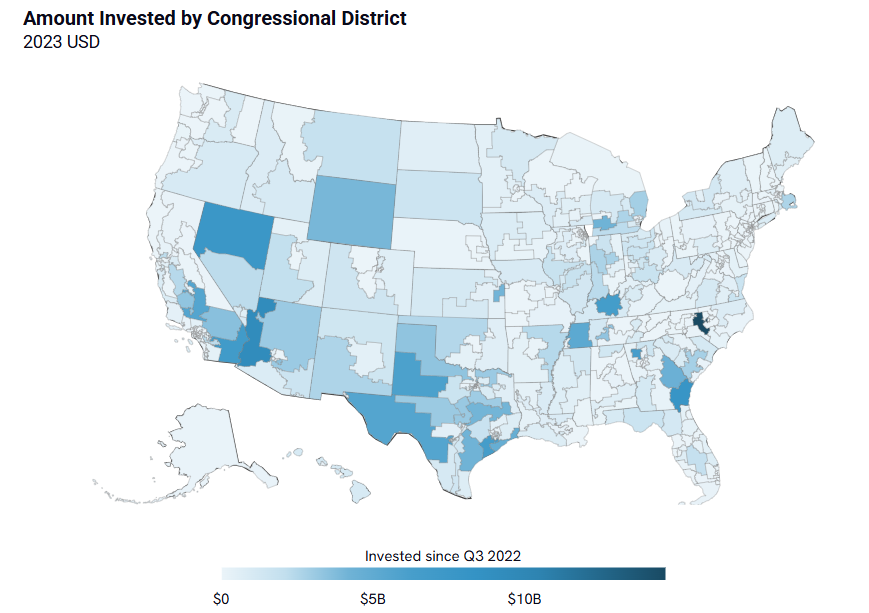
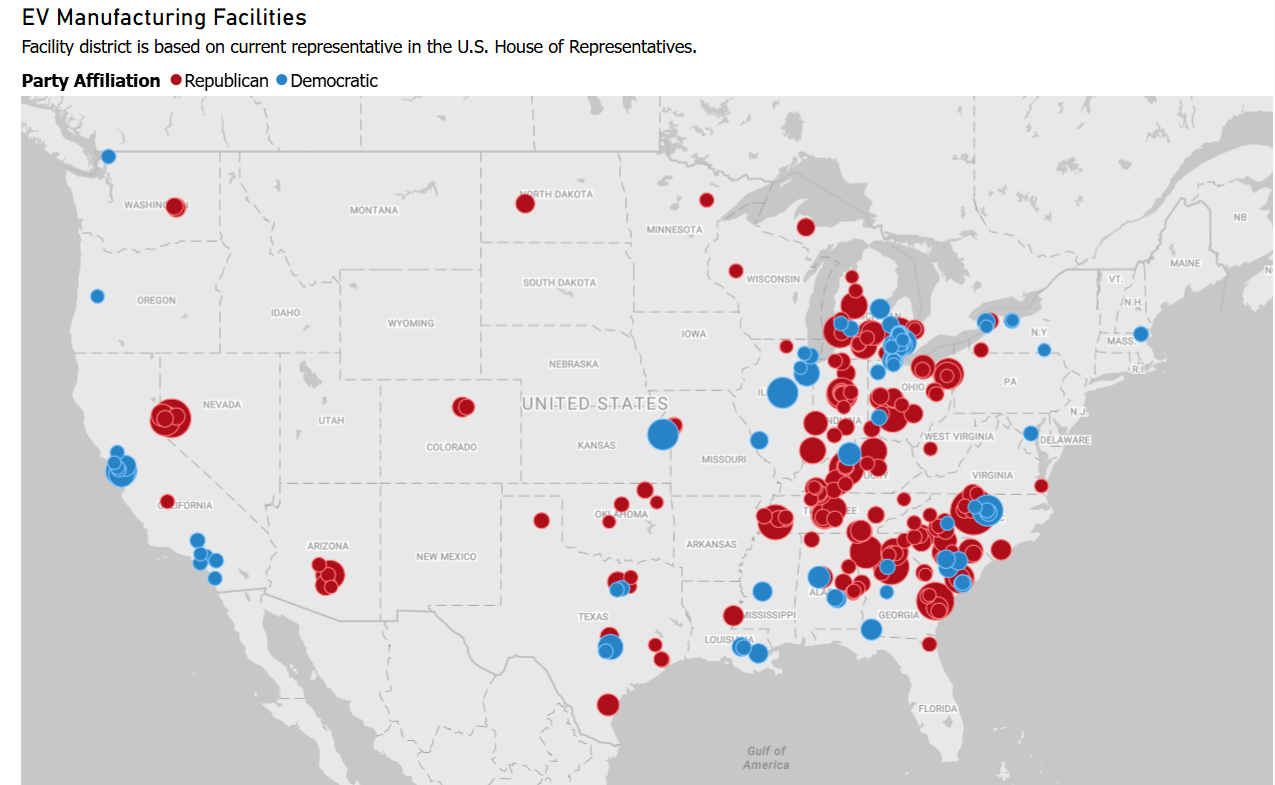
    There’s no question that in terms of the political geography, the vast majority of the investment has flowed to predominantly Republican areas of the country. And it’s not close—credible estimates put it at about 70 or 80 percent. There are different estimates of these investments in terms of scale, but without a doubt it represents several hundred billion dollars in business spending and several hundred thousand direct jobs downstream of the IRA. 

    Solar and wind tend to be rolled out in rural areas that are often more Republican—that’s where the land is. But the geography also reflects the fact that US manufacturing has become quite concentrated in the Southeast, in large part because these Republican states have “right to work” laws that outlaw union-shop contracts and weaken collective-bargaining rights. Several of the tax credits, including the key credits for deploying clean electricity, integrate labor standards into the credits themselves—especially in the form of the prevailing wage and apprenticeship bonus credit—creating a huge incentive to utilize union labor or meet union standards on the construction side. On the manufacturing side, there is no such bonus credit for hiring union labor to operate these facilities. That said, traditional manufacturing powerhouses like Michigan, Ohio, and Indiana have also seen huge investments linked to IRA tax credits, especially in connection with batteries and electric vehicles.

    Source: Clean Investment Monitor, https://www.cleaninvestmentmonitor.org/database

    If you listen to what the Republican opponents of the IRA like Chip Roy are saying, they do not deny that there are jobs connected to the programs of the IRA. In May, for example, thirty-nine right-wing House Republicans—essentially the Freedom Caucus, plus some extras— signed a letter of protest that said during 2024, “solar represented 61 percent of all new electricity generation in our nation, with more expected this year,” and that wind generation “is expected to increase 11 percent” above 2023 by the end of the year. They say these shifts in the fuel mix are “because of these subsidies,” and then claim those jobs are “distortions in the US energy sector”—that the government has put its thumb on the scale in favor of otherwise noncompetitive technologies. They know that killing the credits will kill jobs, they just imagine that those jobs can be recouped in other industries. The 2023 Congress even used this rhetoric in legislation: “Repeal Market Distorting Green Tax Credits” was Title III of one of their bills. They would like to see a return to a “natural” state of market allocation.

    AE: As if oil and natural gas do not benefit from dozens of industry-specific deductions—the 15 percent “depletion allowance” for “independent producers” being the most famous, but cheaper oil and gas leasing on public lands is another obvious one.1The bill passed by the House on May 22 expands IRA credits for producers of renewable diesel, ethanol, natural gas, and hydrogen.

    Just this week we saw the Senate Finance draft exempt oil and gas from the minimum corporation tax, a benefit no other kinds of tax-paying corporations get.

    TF: Obviously it’s a deluded view, but the point is that not even the opponents of the “Green New Scam” dispute that there is a boom in these industries going on, with a lot of investment and a lot of jobs tied to it. 

    If you look at electric vehicles and batteries, nearly every player in the industry has secured very large loans from LPO. This is the same program through which Tesla once received its famous loan. More recent prominent loans include the $2.2 billion loan to the Ultium joint venture between GM and LG, focused on battery cells. GM interestingly just repaid that loan by refinancing it internally, and that was connected to three facilities, two of which are UAW-organized—in Lordstown, Ohio, and in Spring Hill, Tennessee. 

    When you think of a place like Lordstown, Ohio, it’s a pretty classic case of a town with once-concentrated unionized manufacturing jobs being severely hit by decades of deindustrialization. Today, Lordstown is represented in Congress by Republicans: David Joyce in the House of Representatives, and in the Senate by newcomers Bernie Moreno and John Husted, who took JD Vance’s seat. The IRA credits provide some meaningful hope of contributing to the revitalization of a place like Lordstown. It was a big fight by the UAW to get those workers incorporated into the broader contracts the UAW has with the Big Three.

    Source: BlueGreen Alliance Foundation, https://evjobs.bgafoundation.org/

    The batteries assembled at Ultium facilities like the one in Lordstown are benefiting from the 45X Advanced Manufacturing credit. Furthermore, the vehicles GM manufactures that utilize the Ultium platform are themselves currently eligible for the 30D Clean Vehicle tax credit, which has strict sourcing requirements attached to it. So the consumer-facing tax credit is providing a demand pull to these investments in domestically-made batteries by way of its sourcing requirements, and where the manufacturers respond to that demand they can claim a producer-facing credit.

    This is also an instructive example because David Joyce, who does not necessarily have a history of being a vocal supporter of clean energy, and who is in a district that votes for Republicans by over 60 percent, has nevertheless publicly called for a softer touch on IRA repeal, as in a March letter by Republicans to Ways and Means Chair Jason Smith. That reflects a very straightforward political-economic impact of the IRA, where substantial investments in a member of Congress’s backyard has made them cautious about ideologically motivated policymaking that would harm those investments and jobs. 

    AE: How are industries responding to the new tax and subsidy environment? Can we call it a new political economy?

    TF: Basically every electric utility in the country is taking advantage of the IRA. As a result, the utility industry has been one of the very prominent voices defending the tax credits. There is a fear that repealing the Clean Electricity credits could lead to surging electricity prices in much of the country. Renewables developers are making use of technology-neutral clean energy tax credits, both the production credit and the investment credit.2Inside the Washington Beltway, the term “tech-neutral clean energy” is used for the 48E Clean Electricity Investment credit and the 45Y Clean Electricity Production credit. This is to distinguish them within the larger group of clean energy credits. In this interview, the terms “Clean Electricity credits” and “technology-neutral credits” are synonymous. And the expectation is that if these are weakened significantly, these producers will make up the difference in higher prices to ratepayers. Solar, in particular, is the cheapest form of power to put onto the grid right now, while natural gas prices are increasing and order books for natural gas turbines are filled for multiple years into the future. We are already deploying natural gas as fast as we know how; it is simply not a realistic option to substitute accelerated gas deployment for solar and wind deployment and continue to meet demand. So the utility companies are quite concerned about the prospect of surging electricity prices, which could happen more or less instantaneously.3As the Senate has taken up the House proposal, a group of Texas electricity-generating companies calling themselves the Texas Advanced Energy Business Alliance sent (<)a href='https://advancedenergyunited.org/hubfs/2025%20Folder/TX%20Tax%20Policy%20Sign-on%20Ltr%20June%2025.pdf'(>)a letter(<)/a(>) to John Cornyn asking the Senator to “preserve these key tax credits,” referring to 45Y, 48E, 25D, and 45X. “We believe it is possible to advance deficit reduction without sacrificing the cutting-edge power solutions that advanced energy businesses in Texas provide,” the association wrote, alluding presumably to deeper cuts to social insurance.

    There’s a whole suite of existing and new manufacturers in both solar and EV components.  Batteries and their supply chains have accounted for the biggest share of manufacturing investment tied to the IRA. And of course, there are dozens of massive developers and energy businesses utilizing the credits. Consider a company like Entergy—a massive player in the energy space that is by no means a pure-play clean-energy developer. Entergy operates across the range of electricity generation technologies. They have been aggressive utilizers of the credits and have been defending them politically. 

    Then there’s a broader set of players connected to all of this by way of procurement who have been less vocal, but who do not want the Clean Electricity tax credits or the Commercial Clean Vehicle Credits to go away. Big tech companies’ net-zero commitments, for example, are very much tied to procurement of clean energy. At a time when data centers are straining grids everywhere, making electricity more expensive is not something that they see as being in their interest. Amazon’s corporate climate commitments include hundreds of thousands of electric vehicle delivery vans. The House bill had carved out special treatment for corporate customers that signed contracts for commercial vehicles, ordered but not yet delivered before the end of this year. The Senate bill does not include any such provision, which will raise costs for corporate clean vehicles delivered in 2026 and beyond.

    All of these interests have lobbied for the preservation of most or all of the tax credits. As a result, their repeal has been anything but a given, and their fate has been one of the biggest and thorniest questions the Republicans have been grappling with as they try to assemble a bill that can pass both Houses.

    JG: There was some debate in the last year of the Biden administration over the degree to which renewables growth followed preexisting trends or was directly stimulated by the IRA. You’ve already demonstrated the significance of investment figures downstream of the IRA, but I wonder if you could comment on this non-IRA counterfactual, and its relationship to the political economy question.

    TF: Companies are reluctant to say publicly that their business model depends on a regime of tax credits, and that their investment decisions are tied to them. So we are forced to speculate on this question. But clearly they criticize the prospect of repeal, which is all about certainty in business. You frequently hear the expression “pulling the rug out from under businesses”—meaning businesses were told that these credits were going to be in place for ten years, and so made investment decisions based on those expectations. 

    More investment capital and jobs are connected to these provisions of the tax code than there were in 2022. If you look at any chart, you will see the rate of change notches significantly upward after 2022 in all of the targeted technologies. What does that mean politically? It means there are more actors in the system that want to see these measures preserved—companies with capital invested, labor unions with members in these industries, mayors, local chambers of commerce in towns and counties where capital is flowing, who don’t want to see that economic revitalization reversed. 

    Source: Rhodium Group-MIT/CEEPR Clean Investment Monitor

    JG: On May 22, the House passed the One Big Beautiful Bill Act by a margin of one. How did that bill compare to some of the earlier committee text that had been released, what does it mean for the IRA, and what does it tell us about the governing coalition?

    TF: What the Ways and Means Committee voted out on May 20 was a considerably more draconian set of changes to the IRA tax credits than many were anticipating—probably tantamount to full repeal. Between the Ways and Means Committee markup and the final bill passage on the House floor, the text actually got worse. 

    Earlier expiration is the simplest way of reducing the credits. The House terminated the 30D Clean Vehicles credit for consumers, with a tiny carve out for OEMs that have not yet sold 200,000 qualified vehicles—they got one more year of eligibility. The Senate has since closed this, which will affect OEMs like Honda and Rivian. The 45W Commercial Clean Vehicle credit is gone. The 30C Alternative Fuel Vehicle Refueling Property credit, which is most prominently charging stations, is gone at the end of this year. The tax credit for homeowners who install clean energy technologies in their home, the 25D Residential Clean Energy credit, and the 45V Hydrogen Production credit will be fully repealed at the end of this year. Along with earlier expiration is the abruptness of the phaseout: the House bill used a “placed in service” rather than a “commence construction” standard, so projects would have to be finished before expiration to receive the credit.

    Another way is increasing restrictions on “Foreign Entities of Concern” (FEOC)—provisions primarily designed to exclude Chinese companies from US clean energy subsidies. The IRA included these provisions on the 30D New Vehicle credit, but the House extended them, in ways that appear far more stringent, to the 48E and 45Y Clean Electricity and the 45X Advanced Manufacturing credits. The Senate has proposed something very similar. These will require far more extensive supply chain due diligence, and will likely reduce usage.

    AE: What are the other relevant committees and players that have held sway over the budget making process? How do they relate to each other, in terms of rules and procedures, but also power politics?

    TF: Let’s talk about the big picture of what the Republican Party is trying to do, because I think that’s the way to answer this question. In order to lower the headline cost of their 2017 tax bill, Republicans had a number of provisions sunset in 2025, especially the reduction in individual income tax rates. So if Congress were to do nothing, next year there would be a tax increase—1 to 3 percent across the different brackets, and around $7,000 in the standard deductions resetting. 

    So first of all they want to extend the expiring Tax Cuts and Jobs Act (TCJA) provisions. They also want to reinstate several provisions of the TCJA that have already expired. They want to accomplish a whole bunch of Trump’s campaign commitments, which include eliminating taxes on tips, on overtime, and on social security. They want to satisfy a new Trump demand, which came in the wake of the auto tariffs, for being able to deduct interest payments on auto loans. They want to, in their way, expand the Child Tax Credit. They also want to meet one more of Trump’s promises, which is to at least partly reverse the $10,000 cap that they placed on the State and Local Tax (SALT) deduction, which raises a couple of hundred billion dollars a year and is part of how they paid for the TCJA in 2017. The Trump specific provisions are being designed to sunset when Trump leaves office—they are reducing their notional price tag the same way they did in 2017. They want a massive increase in funding for immigration enforcement and defense. And they want to enact all of these tax cuts and spending increases while also reducing overall deficits, which means they’re eyeing gigantic spending cuts elsewhere.

    What we saw between the Ways and Means Committee bill and final passage in the House was two open threats to tanking the thing, which came from two different parts of the Republican coalition. The SALT caucus—five Republicans from affluent districts in New York, New Jersey, and California, and several more quietly backing them—threatened to tank it because the deductions on state and local taxes were too low. Meanwhile, the hardliners threatened to tank it because it didn’t cut Medicaid severely enough and left some of the IRA standing, sort of. The hardliners’ unofficial leader in the fiscal fight is Chip Roy, who is on the Budget and Rules Committees. As we saw in the last Congress, the Rules Committee killed several bills that Johnson was trying to bring to the floor.

    Party leadership in the House Rules Committee ended up accommodating both of those revolts in significant measure. That is where the SALT deduction allowance expanded from what had been in the Ways and Means Committee bill. That is where they sped up when the Medicaid work requirements were to kick in, from 2029 to 2026. If Republicans had a forty seat majority, the SALT members would have been out of luck. The reason the SALT cap is there in the first place is their 2017 majority was larger. In 2025, the party could lose only three votes. That was the leverage the SALT caucus needed to get an outcome favorable to them.

    As a result, the final product was even worse on IRA tax credits than what the Ways and Means reported. That’s how leadership quelled their rebellion from the hardliners.

    AE: Just to put these parts in perspective: the revenue gain from repealing the energy credits is about equal to the revenue lost from the higher SALT deduction, and both are about one-tenth the revenue lost to tax cuts old and new.4According to the JCT’s estimates of the House bill, the changes to tax rates, exemptions, and deductions amount approximately to $600 billion a year in less revenue. The SALT deduction reduces revenue by about $30–$40 billion a year. Revenue raised by repealing the energy credits is about $40–$50 billion each year in 2027 and 2028.

    TF: By far the biggest chunk of the House bill’s projected deficits is the cost of simply extending the 2017 tax cuts that are set to expire. $350 billion a year in lost revenue from extending the TCJA is where the majority of the One Big Beautiful Bill’s deficits are coming from. The Republicans essentially decided that since extending the existing tax cuts doesn’t increase the deficit from its present level, they can ignore that cost when evaluating whether their bill is reducing the deficit. So they only tried to find savings to match the new tax cuts and spending, at roughly $1.5 trillion over 10 years. The big question throughout this saga has been, where are they going to find $1.5 trillion in budget savings?

    The GOP debates about where to find savings to offset this massive fiscal cost is revealing a very interesting set of developments in American political history. Cutting federally funded and federally subsidized healthcare—once one of the most unifying ideas within the Republican party—has now become meaningfully contentious. It’s really novel that the Republican Party nationally can no longer frame Medicaid cuts as red meat. They are contrite about it, and they are trying to hide it. Nevertheless, they’re doing it. Where the House arrived involves cutting the following over ten years: $560 billion from IRA clean energy credits, $860 billion from shrinking Medicaid, another $300 billion from SNAP, and another $100 billion and change from curtailing subsidies for the Affordable Care Act. The upshot, as the CBO estimated, is upwards of 12 million people losing their health insurance (plus another 4 million from the GOP’s refusal to extend additional ACA subsidies); and about 3 million people expected to lose food stamps eligibility. Medicaid cuts are the biggest source of savings, and repealing clean energy tax credits is in second place.

    In a sign that the politics around the clean energy tax credits are in fact contentious, almost immediately after the House bill passed, we saw an unusual development. Thirteen House Republicans—all of whom voted for the bill—wrote to their Senate colleagues asking them to fix the House’s work. They focused on three specific things relating to the energy credits: transferability, FEOC, and the abruptness of phaseouts. These correspond to the most urgent demands of clean energy developers and companies connected to clean energy supply chains, including in manufacturing. At the same time, these companies also undertook a very significant lobbying effort, focused on the Senate Finance Committee in particular. 

    The Finance Committee’s draft reflects this. For zero-emissions technologies other than solar and wind—battery storage, geothermal, nuclear—the clean electricity credits remain in place and transferable, not only for the full period the IRA had given but with an additional two year phaseout. The Senate removed the House’s sixty-day “begin construction” requirement. 

    But in other ways the Senate bill is actually even more draconian than the House bill was: the extension of the clean energy credits specifically excludes wind and solar, which are rapidly phased out during 2026 and 2027; consumer credits for any clean vehicles are completely gone. To offset the cost of some of the restored IRA credits, Senate Finance left the lower SALT allowance in place and took an even more aggressive approach to Medicaid.

    Our assessment is that the net effect of the Senate changes would be not only a significant slowdown in the rollout of clean energy technologies across the US economy, but a loss of jobs in construction, a loss of jobs in manufacturing, a pull back of investments and a significantly degraded economic picture relative to what we were looking at in 2024.

    JG: What has this reconciliation struggle revealed about the GOP coalition and leadership?

    TF: The bill that passed the House shows that some number of Republican members of Congress were willing to court the ire of their leadership and of Trump by publicly threatening to derail the bill in the closing stages—whether on SALT or spending cuts. But the members who had spoken out publicly about preserving the clean energy tax credits did not mount a similar revolt. Twenty House Republicans, a mix of members from swing districts and solidly partisan districts but with major investments in IRA-related industries, had publicly signed on to a couple of different letters. Some of these people were among the more outspoken on Medicaid, including Don Bacon from Nebraska and David Valadao from California. But as a group these politicians did not threaten to vote no and they did not vote no in the House. 

    On the Senate side, the counterpart to House Ways and Means is the Senate Finance Committee. The chair of that committee is Mike Crapo from Idaho. Majority Leader Thune of South Dakota is an important player. And Josh Hawley has emerged in a very interesting position as someone who has become extremely vocal in opposition to cuts to Medicaid, making the argument that “these are our voters.” Lisa Murkowski, playing her traditional role of the all-purpose Senate moderate in the GOP, has pushed back on both Medicaid and the energy credits.5With respect to fiscal policy, Murkowski sits on the Energy and Natural Resources Committee and the Health, Education, Labor and Pensions (HELP) Committee, as well as the Appropriations Committee. Hawely also sits on the HELP Committee, as well as on the Homeland Security and Governmental Affairs Committee and the Small Business and Entrepreneurship Committee. On the other end you have Rand Paul, who the Republicans consider a definite no vote, because he’s a genuine libertarian fiscal hawk who doesn’t consider the House bill remotely serious from a fiscal reform point of view. So functionally, Senate Republicans have fifty-two votes, not fifty-three.

    What the fight in the Senate reflects is that we’re not at the end point of them threading that needle. One popular framing that GOP leadership prefers is Hawley’s: “I don’t know why we would defund rural hospitals in order to pay for Chinese solar panels.” They want to pit the energy transition and healthcare for low-income people against each other. (Domestic manufacturing incentives in the IRA are the biggest factor in what onshoring we have seen in industries like solar manufacturing. In contrast to Hawley, the Solar Energy Manufacturers for America calls the Senate cuts “a massive gift to Chinese manufacturers” that will “end any hope of onshoring domestic manufacturing.”) 

    Whatever the Senate votes on, however, will have to go back to the House. There Chip Roy is already saying the Senate’s changes are too big of a concession to clean energy producers. And while the Senate bill specifically excludes solar and wind from its extension of the clean electricity credits, it hasn’t restored any Medicaid funding. And because no Republican senator is in favor of a higher SALT deduction—because there are no Republican senators from places where SALT matters—the SALT Republicans in the House immediately rejected what Senate Finance produced. 

    Numerically, there were enough Republican IRA members in the House to play a similar role as the SALT caucus. But they were not willing, individually or collectively, to exercise that leverage. This has been one of the challenges for the clean energy industries and advocates throughout the tax fight. Public red lines on SALT forced a direct negotiation with House leadership and significant concessions, but there have been no public red lines on clean energy credits and no negotiations resulting in concessions. This is in part because the clean energy Republicans are part of a larger group in the House that also includes all of the SALT caucus Republicans. For these Republicans from affluent districts in coastal states, it was SALT or IRA, and they chose SALT. But if any of the larger group of IRA Republicans are willing to trade SALT deductions for keeping the IRA credits, they haven’t come out publicly calling for that. For them to do so would threaten to cleave SALT out of their coalition. 

    It would be wrong to say the political economy coalition for clean energy development isn’t there. We have witnessed the emergence and partial maturation of a clean energy coalition that does have power. What we’re seeing is how powerful it is relative to other political economic coalitions, as well as the ability of certain groups within the Republic conference to build majorities. Under these conditions, it is not an all-powerful actor in the decision-making of the key players in Washington.

    AE: Even with all the other spending cuts—on agriculture, K-12, and higher education, federal employee pensions—federal borrowing under H.R.1 would be $2.4 billion over ten years according to the CBO. At the risk of sounding naive, has this level of borrowing been the plan all along, or aren’t there any chamber rules about deficit spending in play?

    TF: What they can’t do is increase the deficit by more than they said they were going to increase the deficit in the initial budget resolutions. 

    It becomes very challenging for them if the CBO scores on the proposed changes don’t fall within the instructions that the budget resolutions gave to the respective committees of jurisdiction. If the CBO scores don’t match up, then when it comes to the Senate there can be a point of order. And the Senate parliamentarian will say that this does not comply with the rules for budget reconciliation. To move forward in that situation, in the face of such a ruling from the parliamentarian, the Senate will have to overrule its parliamentarian. That’s generally considered to be equivalent to eliminating the filibuster altogether. This is a step that the GOP is very reluctant to take. 

    So they have been quite serious about writing legislation that will meet the instructions that they set for themselves. The cuts to IRA, Medicaid, and food stamps are absolutely real cuts. Because, as it stands, they don’t have fifty senators at yes, they are giving themselves a little bit of flexibility on the timeline. Previously they planned to pass the bill and have it on the President’s desk by July 4, but now that’s been pushed—the Senate needs to pass the bill by July 4 and the House and Senate need to agree to have it on the president’s desk by August recess. But if any of the fractures within the Republican Party persist, or can’t resolve, then they do risk hitting the debt ceiling clock, which strikes midnight some time in August. Then they have to negotiate with the Democrats—over the debt ceiling increase or over the TCJA extension. They might dare the Democrats to cause a default, but they probably don’t want to. Thune hopes to get a bill to the floor by the last week of June. We have no idea if they’ll actually resolve all their issues by then, or if they’ll get snagged by the parliamentarian. And if they do find consensus we don’t know what it will look like on those core questions of Medicaid, IRA, and SALT.

    AE: Let’s end with an extremely broad and speculative question: how do you see this fight over fiscal policy in its longer sweep? We’ve seen versions of this three times: Reagan came in and exploded the deficit by cutting taxes on top incomes and corporations. It was very controversial at the time, and the Democrats responded by becoming a party of fiscal hawks. George W. Bush came in and did his tax cuts on capital gains and top individual incomes, again exploding the deficit, and introduced this forecasting fiction of the cuts expiring in the future. And then Donald Trump in his first administration in 2017 did the same thing, for corporations mostly. One could argue “oh, this is just the pattern, and all of the drama that we’re witnessing right now is myopic and forgetful of the fact that we’ve done this before.”

    But at the same time, the American economy and America’s place in the world have changed since the 1980s. The strategy back then of funding huge fiscal deficits with sky-high interest rates, of using a strong dollar to preserve American power, seems to be in direct conflict with the administration’s professed trade policy and its relationship to the Federal Reserve. The brief, six-hour run on the dollar on Liberation Day and the increase in US bond yields seem to indicate a real resistance from the banks, hedge funds, and other large-scale holders of US debt to Trump’s planned budget deficits—whether they lead to $2.4 or $4.5 trillion in new debt. Is the ability of the United States to borrow becoming constrained by the other elements of the coalition?

    TF: From my current perch, I’m not positioned to offer a verdict on the credit worthiness of the US government. But here is one thing I can say. The bulk of this fight inside the GOP is because of the commitment to preserving the 2017 changes to tax rates, whose benefits overwhelmingly flowed to the richest Americans. Any departure from this has proved to be a complete non-starter. It was an absolute priority of the GOP to not only extend, but also expand, the estate tax exemption: for the holders of very large fortunes to not have to pay any tax. This legislation enshrines the GOP’s commitment to tax breaks for billionaires as a core part of their approach to governing. The world has changed in many ways, but that remains, unalterably, a truth about how the world works.

  4. Closing the Extractive Frontier

    Comments Off on Closing the Extractive Frontier

    Today, more than half of Colombia’s export revenues come from coal and fossil fuels. The industry employs roughly 100,000 people, a quarter of which are unionized through the Unión Sindical Obrera (USO). In this context, Colombian President Gustavo Petro’s plan to end domestic fossil fuel production is profoundly ambitious. It will require not only replacing the revenues generated by the industry, but securing financing for green energy infrastructure and production. The latter is especially difficult for a country strapped by strict fiscal rules mandating the preservation of balanced budgets. The transition also presents an enormous political challenge: beyond the mobilization by the country’s largest business associations, Petro’s plans have already faced pushback from allies in the USO who have expressed concern for preserving worker livelihoods.

    Managing this complex effort is the Ministry of Mines and Energy. On March 19, we met with the former Minister of Mines and Energy, Omar Andrés Camacho Morales. Camacho is a lifelong activist—from the student movement for public education in the early 2000s, to the Movement for Peace of the following decades. From July 2023 to February 2025, Camacho contributed to the development of the Petro government’s energy transition agenda.

    In the following, Minister Camacho reflects on Colombia’s decarbonization plans, the progress made thus far, and the core obstacles these efforts have faced. We discuss the ban on new contracts for oil and gas exploration, alternative sectors to promote future growth, and the ongoing (but to date, unsuccessful) effort to create a “green fiscal rule” that would allow more flexibility concerning the financing of renewable energy. And we consider the social foundations required to successfully manage the transition and give communities a stake in the production, commercialization, and decision-making processes surrounding renewable energy. These movements, Camacho notes, are crucial to facilitating regional unity that extends beyond the boundaries of nation-states.

    An interview with Andrés Camacho

    Gabriel Hetland: What was your vision for the energy transition in Colombia as Minister of Mines and Energy?

    andrés camacho: We work close to the extractive frontier. We are not prohibiting the exploitation or exploration of hydrocarbons in Colombia. But we’re not increasing it. So we decided against signing additional, new contracts in hydrocarbon exploitation and exploration. 

    At this moment, there are about 308 exploration and exploitation contracts, and 300 of these contracts are in force, with 16 million hectares dedicated toward exploitation and exploration. The current scale should be enough to fulfill the tasks of the energy transition and decarbonization. Critics in Colombia say that we don’t want to continue oil exploitation. But this isn’t true—we’re committed to exploiting what currently exists.

    Our starting point was that Colombia is not an oil country like Venezuela. We are a country that depends on oil, but we do not have the large deposits that other countries have, and that makes our economy very dependent on fossil fuels. We can’t increase our dependence without large deposits. Our country has a lot of heavy crude oil, but the market conditions for this type of oil are more difficult. This puts us in a difficult spot. 

    When we came to the ministry, we utilized data, science, and engineering to develop a road map, which measured how to achieve a green transition in Colombia without putting the country’s energy security and sovereignty at risk. Usually, governments hire consultants to conduct these studies, but we wanted a sovereign exercise to recover state capacity. We organized an energy transition team within the ministry made up of Colombian professionals and those with technical expertise. This road map includes the analysis of many components: hydrocarbons, oil, gas, coal, electric energy, as well as an analysis of both supply and demand. It defines the medium and long term measures that we would have to adopt to reach the goal of decarbonization. 

    The Ministry published the findings in a document titled, “Energy transition scenarios for Colombia,” which considers the environmental and social dimensions needed to guarantee a just energy transition. 

    An energy transition has to be, in a country like Colombia, a just transition. This implies several elements: climate, environment, energy, and social justice. In a country with enormous inequalities, the transition should not only help to overcome dependence on hydrocarbons and reduce greenhouse gases, but it should also help us to overcome energy poverty. This is the basis on which we built the policies and programs that are currently being pursued by our government.

    GH: What have been the achievements of developing this road map? 

    ac: One of the main achievements is to develop the country’s greatest renewable potential. Colombia is a privileged country because it is in the equatorial zone and has abundant access to water, sun, and wind. One of the plan’s goals, still in progress, is to install 6 gigawatts of renewable energy in the country. Today we have 2 gigawatts installed that are delivering energy, especially solar, to the grid.

    When we arrived there were only 0.2 gigawatts of renewable energy. In other words, in these two and a half years we have multiplied by ten Colombia’s solar energy capacity. This was achieved with projects that were behind schedule, which we took on the task of putting into operation. This year, the plan is to incorporate another gigawatt. Next year, the big bet is getting the first wind projects into operation. If the projected six gigawatts come on line, the country’s energy matrix will be 85 percent clean.1 Currently, the country’s energy matrix is considered mostly clean. By 2023, the installed generation capacity was 17,771 MW of energy, about 70 percent of which is produced from hydro technology (11,942 MW).

    The other great achievement, especially when it comes to environmental justice, has been our Energy Communities program. These are consumer groups that manage, administer, and efficiently use energy from renewable sources, such as solar and wind. When we arrived in the government, many sectors said that implementing this program would be impossible. But this program allows us to bring the most economical energy we have—solar—to vulnerable communities. With solar solutions we solve problems of access and energy poverty in many areas of the country.

    When we registered the communities that wanted to receive government support to build their own solar generation, we received more than 14,000 applications. We already have the communities identified, and 300 energy communities have been built and are operating. A thousand more are under construction. The Energy Communities program is unprecedented in Latin America—it is the most successful transition initiative in the continent. 

    Most of these energy communities are in territories that have been victims of the armed conflict. The program has demonstrated several things. The energy transition can be used to overcome poverty, but it can also help develop a rural electrification plan. Electrification is still centralized and 16 percent of Colombia remains with little to no electricity access. 

    We’ve also made progress with new energy sources. We’re developing three geothermal energy projects with Ecopetrol, the state oil company. There’s also an auction to take advantage of offshore wind energy. In addition, we’re building the ecosystem and the legal framework for Colombia to start developing hydrogen. Ecopetrol will soon build the largest green hydrogen production plant on the continent, producing some 800 tons per year.

    There is also what we call hydrocarbon management, which is to guarantee stability in the sector. We have not had a single second of gas shortage, even in the difficult conditions of declining gas production in Colombia. Today we face the challenge of rising gas costs. We have managed, even through Ecopetrol, to maintain the country’s reserves, demonstrating that with the same contracts we can achieve efficiency in hydrocarbons.

    GH: Colombia is a peripheral country that lacks access to credit at sufficient levels, and it’s also limited by a narrow fiscal rule that restricts financing possibilities. There are also other constraints, such as the fact that Ecopetrol cannot generate renewable energy on a large scale. Can you speak to these financial challenges? 

    ac: We are economically dependent on hydrocarbons. Around 50 percent of the country’s income from exports comes from coal and oil. This means that we must pursue an economic transition at the same time as the energy transition. How do we replace those foreign currencies? How do we replace those revenues from oil and coal? 

    One achievement is that tourism now exceeds coal revenues in the country. This is very important, as it shows that the country can indeed move towards decarbonization, emphasizing that Colombia is a country of biodiversity rather than oil or coal. We are also building a green fiscal framework, which aims to answer the question of how to decarbonize the economy by overcoming this resource dependence. 

    But the fiscal space we have to pursue these measures is severely restricted. That is why President Petro has entered a global discussion about the tools that countries like ours can deploy to make the transition. Colombia has quite an ambitious goal, and we need international support, which can come from exchanging debt for climate action. That would open a fiscal space for countries like ours to have different loan conditions. But this is a discussion with international capital that is not so simple—green loan options involve global interests that are out of our hands. For the time being, we continue to pursue a decarbonization agenda with the resources we have available. 

    GH: And what are main challenges when it comes to Ecopetrol and legal prohibitions on renewable energy generation?

    ac: Ecopetrol, due to past laws and the way the country was conceived economically, has been part of the neoliberal model in Colombia. During its inception, the energy sector was divided into different branches, such that Ecopetrol is still currently prohibited from generating electricity. 

    It is a restriction that exists by law, and we have led a discussion in Congress to change it. If a new law is approved, Ecopetrol can begin with electricity generation this year. We have been able to issue a self-generation decree, where Ecopetrol can generate its own energy. Thus far, we have inaugurated about five Ecopetrol solar parks as an initial start. 

    Ultimately, Ecopetrol has to be the first company to make the transition. It is the largest company in the country and the company that provides the most resources (11 percent of the national budget). So, if we manage to make the transition of Ecopetrol, this will have a positive impact across the country. 

    Solar energy is already being produced in many of the refineries—in the Cartagena refinery, in Barrancabermeja, and in production fields. If we resolve this restriction on Ecopetrol, we can first accomplish an energy transition within Ecopetrol, and then we can take the possibility of Ecopetrol’s energy generation to the rest of the country. 

    GH: You are trying to pursue an energy transition under the framework of a representative democracy, with enormous difficulties due to the sectors that oppose it. What would you say about the possibilities and limits of being a leftist government in a democracy like Colombia?

    ac: Our approach to the energy transition is unprecedented, even among the Latin American left. Brazil, Venezuela, and Ecuador have different positions. The other countries, even those with progressive governments, maintained fossil fuel production and furthering exploitation, refusing to restrict the extractive frontier. 

    This puts us in an even more challenging situation, because not only are we going against the world, but even within the Latin American left, there is a major debate on how to address the energy transition. For us, the only way to prove that our plan is possible is to show that the country has not gone bankrupt, that Ecopetrol continues to be the most important company in the country. Ecopetrol continues to give dividends, and our transition proposal is possible, sustainable, and could even be more ambitious. 

    lala peñaranda: Many neoliberal countries have pursued the energy transition through a market, with private actors, favoring some elites. The Ministry, on the other hand, repositioned the role of the working class and put the unions and social movements at the center of the transition. 

    ac: When we entered the Ministry we asked ourselves that question: How can we create a movement capable of defending against these conquests of the just energy transition? That is why we set ourselves the task of identifying the social subjects of the energy transition. We are pursuing broad change in Colombia. The subject of the agrarian reform, for example, is the peasantry. But we ask ourselves: who is defending the energy transition? First, there is the consumer movement, the citizens who are affected by poor quality public services, or by the non-existence of public services. We took on the task of helping to organize a movement of energy consumers. This culminated in MODEN, which is the national constituent movement for energy democracy. This movement is beginning to center public participation in issues of just transition.

    There are instances of other groups that are already organized, such as the unions, though they have not always worked on these issues. We are helping to create a tool—which is the movement for energy democracy, but that movement has already been growing at the national level through energy communities, where communities that directly manage their energy can participate, give their opinion, and be subjects of this change. 

    Another issue that cannot be left aside is mining. In Colombia, there is a mining model that privileged multinationals and large economic groups and has left out small traditional miners. We also took on the task of helping organize mining workers, including female mining workers, and this has led to the emergence of efforts to organize small miners. These social forces within the mining and energy sector are for us what we could call the movement of democratic transformation for the green transition. At the Ministry, we helped develop these movements and guarantee popular participation. 

    Julian Gómez Delgado: What did you learn about the state from your experience at the Ministry? Has it changed your understanding of the state?

    Ac: Yes, the first thing was to come up against the reality of a phrase that one is taught in one’s political militancy, which is that governing is one thing and power is another. The reality is that we are exercising the powers of the government, but the economic power in many of these sectors is held by financial conglomerates, unions, and companies—products of neoliberalism that transferred state capacity to the private sector. We came to assume a government of change within a state that has been reduced, where state capacity has been reduced, which has made it more difficult to deliver on our proposals. 

    We have also managed to take a step toward recovering state capacity. For example, the roadmap I mentioned on energy transition was drafted directly by the government itself instead of consulting firms. So what is the lesson I have learned? That there is still a lot that needs to be changed. Being in government is still not enough to make the transformations we need. This process requires greater continuity. In four years, we cannot transform what has been in place for decades, what is behind the apparatus of those who really hold power across economic sectors. This is a long term process. 

    From here on, I believe that we’re beginning a new agenda which was not in the orbit of the left and other progressive forces. In general, the left in our country has focused on health, labor, and pensions. But now, the climate and green transition agenda has become central. Now that I am out of the government, I will work on growing this agenda from within social movements.

    gh: Can you explain to us how consumers, citizens, and workers participate in energy decisions? Some say that in these matters, the technical criteria should have the last word.

    ac: That was a prejudice that we constantly faced in Colombia. They have tried to judge us by calling us activists, saying that we don’t have technical expertise. But I believe that it is precisely more activism that is needed. People must become politically active and have an opinion, otherwise the energy transition becomes a transition written from the desk in the ministry. For us, participation is fundamental. Last year, we held fifty energy and mining assemblies where we asked people from the different regions how they were seeing the transition, what their needs were, and explained our proposals. There cannot be a just transition if we restrict democracy.

    For example, in the process of creating an energy community, there is an energy training school. But we are not going to impose an engineering design from the center of the country onto Indigenous peoples, when there are uses and customs in the way things are built. We need to incorporate knowledge from the territories themselves. 

    gh: How should the left approach the challenges of the energy transition at this time? Should it focus on gaining representation in Congress, strengthening the trade union movement, or action at the international level? 

    ac: It is most important that we strengthen the social organization around the energy transition. Only if we maintain that network will we be able to defend what has been achieved so far, and also promote the transition in the terms we have set. Then we can take this agenda to Congress, but it must be from the basis of a movement for energy democracy. 

    We are organizing energy democracy committees throughout the country, and anyone can participate in these committees, but we especially want to reach unorganized people, those who live in areas where there is no union and who need access to energy. The idea is to tell them what the transition is about and why it is important to them. 

    Our priorities are as follows: (1) growing the energy communities in the remaining years of Petro’s term; (2) developing transmission lines, especially when energy generation capacity is already there—the transmission line in Guajira, the Colectora line, will enable large generation projects using renewable energy; and (3) managing gas to guarantee efficient prices and prevent shortages.

    Lp: What steps should be taken towards international cooperation? Who are our allies in the just transition?

    ac: We need cooperation between peoples rather than between countries. Governments will always be in the sway of a political debate, but we have to push forward a Latin American movement. For example, we are already coordinating with energy communities in Brazil, with communities interested in public services in Argentina, and we must begin to organize a continental movement. 

    We want the Colombian experience to be instructive across the continent, showing how social movements can shape the government agenda. There’s also the  challenge of Latin American energy integration, which would require transmission lines between our countries to share energy. 

    gh: Many are wondering about President Petro’s strategy given all the changes in the cabinet. Being one of the ministers who have left office, what is your reading of the direction of the Petro government?

    ac: I have a very personal opinion of what the changes mean. The President is giving the opportunity to new leaders to be part of the government. 

    I am part of a new progressive generation in Colombia. If the President had not given us the opportunity to participate, to govern, we would not have been there. I believe that part of the rotation has to do with the possibility that more people can try the exercise of governing. 

    On the other hand, the President is developing a strategy to reconfigure the government to face the 2026 election. We are already nearing the end of his term, and he has to guarantee that our political project can continue in 2026. This means restructuring the cabinet and bringing in other political forces that were not present earlier. 

    This also requires some people leaving in order to work on other tasks. One of those people is me. I spoke to the President, and he asked me what I wanted to do. I told him I wanted to go out to work on this cause of the energy transition and consolidate the social movement. The same thing always befalls our governments: if we all enter the government, the social movements are sometimes left without leadership, or with restricted leadership. We also need to leave the government to work from the outside.


  5. Jungles in Dispute

    Comments Off on Jungles in Dispute

    The Amazon rainforest is one of the most sensitive ecosystems in the world, as its deforestation could trigger a chain reaction leading to a warmer and more unstable global climate. Preserving the Amazon has become a top priority for both climate finance and the countries that share this ecosystem, including Colombia. This year’s Climate Summit will be held in the Amazon itself, in Belém, Pará.

    Upon winning the Colombian presidency, Gustavo Petro promised to reduce deforestation. The Colombian Amazon—which represents 35 percent of Colombia’s territory—is the region of the country in which deforestation is most prevalent. This phenomenon is driven by cattle ranching, illegal logging, and drug trafficking, the latter led by armed guerrilla groups that did not sign the 2016 Peace Agreement and now control illegal cross-border trade in the rainforest.

    Under Petro, the task of controlling deforestation in the Amazon fell to Susana Muhamad, Minister of Environment from 2022 until February 2025. Muhamad, the daughter of Palestinian immigrants, had been an ally of Petro since his tenure as the mayor of Bogotá. As head of the environment ministry, she sought to move forward Colombia’s green transition project and weaken the country’s dependence on fossil fuels.

    At the end of last year, Muhamad left her post amid disagreement with the Petro administration over the entry of more centrist politicians, including those accused of corruption, in the presidential cabinet. Nonetheless, she has continued to defend her links to the Colombian president’s program and was considered for the position of head of the government’s National Planning Department this month, although she ultimately failed to secure an appointment. Her leadership in the Biodiversity Summit held in Cali (2024) and the results in the fight she led against Amazon deforestation made her a key player in Petro’s environmental program.

    For Phenomenal World, Muhamad spoke with Camilo Andrés Garzón about her strategy to fight deforestation, negotiating with armed groups, and financing Amazonian protection at a time when resources coming through USAID and the United States have been severely restricted.

    An interview with Susana Muhamad

    Camilo Andrés Garzón: Colombia—which accounts for 6 percent of the Amazonian ecosystem—receives a X in aid for preservation. The Ministry of Environment was tasked with the objective of reducing deforestation. How did the national government measure up to this goal?

    Susana Muhamad: The reduction figures are historic. We achieved the lowest deforestation figures thus far in the twenty-first century. The highest point of deforestation was in 2017, when 219,000 hectares of forest land were removed. This was right after the signing of the government’s peace agreement with the Revolutionary Armed Forces of Colombia (FARC) guerrillas. As FARC lost control over land and thus a role as a de facto environmental authority, they left territory open for uncontrolled deforestation.

    Under the right-wing government of Iván Duque, deforestation was at 174,000 hectares in 2021. Petro managed to reduce it to 125,000 in 2022. By 2023, it was the lowest in the century, at 79,000 hectares. In 2024, deforestation rose again to 107,000. This shows that deforestation requires the persistent efforts of the state. It is an unstable political goal, and deforestation cannot be easily reversed.

    We put an end to Operation Artemisa, the militaristic approach to deforestation led by the right-wing Uribist government of Iván Duque. Without the threat of military persecution, we were able to regain the confidence of farmers in these departments, who used to view the state with suspicion because of its repressive role. The arrival of Petro’s government created the opportunity to change the relationship between the state and the communities.

    We engaged in dialogue with farmers in the Amazonian departments (where most of the deforestation occurs) to understand where they were and how they organized themselves socially and politically. This helped us create a program with them that would respond to the realities in those territories. They had criticisms of previous conservation programs, including those led by NGOs and international cooperation initiatives.

    On this basis, we built a political pact with farmers. The government committed substantial economic resources to meet its responsibilities to this pact, and thus the state became the main financier of conservation efforts. Through the Conservar Paga program, the government grants the farmers in the Amazon rainforest 900,000 pesos per month ($216) as an incentive for reforestation activities. International initiatives used to be the main financiers and defined how the programs that were in place operated. Now, these organizations and initiatives are following the lead of the Colombian government.

    We’ve bet on a productive model that demonstrates the possibility of a different kind of economy that regenerates the forest, instead of one based on cattle ranching. This agreement is aligned with the peace processes of the Petro government, so the state also held talks with the armed actors of the territory, such as FARC dissidents, to include them in the conversation about containing deforestation.

    In addition to negotiating with communities and FARC dissidents, the government’s plan replaces Operation Artemisa with criminal investigation to directly capture large deforesters, who are often linked to local politicians and ranchers, instead of small farmers who deforest for subsistence. We also altered land legislation, so that farmers can use the land for reforestation with legal security, and aren’t prohibited from intervening in environmentally sensitive areas. This whole package of measures has together led to the reduction of deforestation. If we can maintain this progress for the next ten or fifteen years, we can show that there is a regional economic model in the Amazon that can regenerate the forest.

    CG: You believe that this model of reforestation with government support can be an alternative to the livestock economy, which has encouraged Amazon deforestation in Colombia.

    SM: I think we are beginning to show how this economic model would work, but we need to consolidate these markets for Amazonian products and demonstrate production. This is very difficult because it is estimated that extensive cattle ranching and land grabbing invested 5 trillion pesos (more than $1 billion) in the Amazonian economy in five years. The Petro government has invested 1 trillion pesos ($250 million) in the region in two and a half years, and the money has already run out. There are guaranteed resources until 2026, but with the national budget crisis it is difficult to guarantee the objective of investing 600 billion pesos annually, as the president had wanted.

    CG: You said that the government engaged in talks with the armed FARC dissidents as part of the effort to contain deforestation. But since the peace negotiation with these groups failed to materialize, FARC dissidents have begun to relax measures and allow deforestation in the Amazon as a way of pressuring the government. How do you reflect on the decision to include armed groups in the negotiation?

    SM: Without the support of the local population, an armed group cannot control the territory, so they rely on threats and extortion. The Ministry of Environment and the other environmental institutions are not intimidated by the armed actors, and we persist in being present and engaged with farming communities. We’ve had officials threatened by armed groups, and the environmental institutions have been the government’s political resistance to the armed actors.

    I believe that if peasants regain confidence in the state as an ally that helps them and includes them in a productive model, these armed actors will be isolated from the political will of the people. There is a very serious public-popular alliance that delegitimizes armed groups. I am concerned that negotiating with FARC dissidents gave some oxygen to these groups—which are dedicated mainly to drug trafficking and taxing farmers—and facilitated their expansion. Sadly, we know that the areas where there is now a ceasefire and partial agreements with these groups is where the most deforestation is taking place. In other words, the agreements with the guerrillas have not been useful for the fulfillment of environmental achievements.

    I am not saying no to the peace tables. What I believe is that the action of the State in the Amazonian departments cannot be subordinated only to what happens in those tables, because the State has a constitutional function to work with the communities that cannot be stopped because the peace table does not advance. We cannot run the risk of allowing the armed actors to use the negotiating tables to advance their political-economic ends.

    CG: Brazil controls 60 percent of the Amazon rainforest. Lula Da Silva’s government reduced deforestation by nearly 50 percent between 2022 and 2024. What does the Brazilian case suggest for the fight against deforestation? What makes the Colombian case different from Brazil’s?

    SM: The deforestation factors in the countries are different. In Colombia, the Amazon is the most conserved area of the country, while in Brazil, a region like Pará, which is part of the Amazon biome, is a massive industrial area.

    The Brazilian government did tell us about the importance of satellite monitoring systems in tracking deforestation. Here in Colombia, the last three governments have been developing a forest and carbon monitoring system with the help of international cooperation. This is key for following up on deforestation efforts. As minister, I sat down once a week to look at the images produced by this tool. Almost immediately we could see where deforestation was taking place, allowing us to come to the negotiating table with evidence against the claims of dissidents who claimed they were protecting the forest. We can also see if farming communities are complying, property by property, with the forest protection goals, in order to pay them the economic incentive.

    We want to improve the monitoring system to help us prosecute large deforesters. We’ve created the National Council Against Deforestation and Environmental Crimes for that purpose, financed by the United Nations Office on Drugs and Crime. Thanks to this program, we were able to identify the Corponariño case, where eleven officials of an environmental protection institution were linked to deforestation and other illegal activities.

    Brazil’s military and judicial operations are gigantic. In Colombia, we have not reached that capacity. The Colombian case is also more complex for the reasons of the armed conflict. Still, we should remember that the mafias operating in the Amazon are transnational and require binational operations. We are cooperating with the Brazilian government on this front. The Amazon Cooperation Treaty Organization (ACTO) must work more rigorously to carry out criminal investigations at the scale of the Amazon biome, precisely because the pressures and drivers of deforestation are not restricted to a single nation.

    CG: Another of the Ministry’s commitments was to ensure resources for Amazon protection. In 2024, Petro created the Fund for Life, the largest fund for environmental policies in Colombia’s history. This at a time when the Trump administration has cut funding intended for Amazon protection. 

    SM: The US provided resources through their own agencies, such as USAID, to implement their projects. The Fund for Life collects from different sources, including the national budget, a carbon tax, and an illicit crop substitution program. These are funds from the state itself. While the Fund still allows money to come directly from international aid, we can depend less on it. There is already an agreement with the World Bank to fund the program. This strengthens the public sector and not only the NGOs.

    Cooperation for Amazon protection traditionally works through agreements made at climate summits for large funds, but these funds are implemented almost exclusively by global certified agencies. These agencies define the programs that are then presented to different environmental ministries in need of resources. But where is sovereignty and territorial governance? No wonder local communities say: what I see is vests of all colors and flags here, but without any unity.

    Previously, the law mandated that environmental funding be distributed annually and only to international institutions such as regional corporations. But these were very small projects without long-term impacts. Given its scale, the Fund for Life can invest in larger programs that can work with more actors. For example, we are giving money to the Community Action Boards, which are citizens’ organizations in the Amazon. This is a financial revolution in terms of who receives the resources. Today, with the Fund for Life, we have the largest Amazon program of any cooperation institution or NGO.

    CG: This is happening at a time when carbon credits have become more relevant in climate COPs as an option for companies and states to reduce their emissions, and at the same time finance the care of the forest. What is your reading of the carbon credit market for conservation purposes in the Amazon?

    SM: The carbon market has two scenarios: the regulated market and the unregulated market. The regulated market is between states, and to me, it’s a mechanism that could work. For example, I make an agreement with Japan and tell them: locate your industry in Colombia, my energy matrix has fewer emissions, and you can collect those certificates. It is a good investment for Colombia because it will generate employment and technology transfers. It is good for Japan because its products will have lower emissions. This is what we finally regulated at the COP29 in Azerbaijan last year, where Colombia was very active in promoting environmental safeguards.

    On the other hand, the unregulated market, which is between private parties, has serious problems due to scandals around projects with indigenous communities where financial speculators have profited.

    There are still no regulations to prevent this, and I was unable to propose a regulation during my time as minister. But I hope it can see the light of day under this government. The unregulated market has been benefitting some certifying and intermediary companies, but it does not seem to me that this is of public benefit. For example, a global airline company that wants to reduce its emissions can through intermediary carbon credits that it formulated in Colombia with some projects. But that intermediary which is earning has no social responsibility within the territory. As the market currently stands, the state only registers the projects in progress or those that are planned, and it functions as a notary. The idea for a regulation would be to control projects and guarantee that they meet environmental and social safeguards. It is not really a mechanism to reduce emissions, nor is it a mechanism that will solve the problem of climate change. It is a form of financing and that is how it should be seen.

    A more attractive alternative is a domestic carbon market in Colombia that already exists, where domestic companies can reduce a portion of their carbon tax by investing in forest restoration projects. The Fund for Life can be used by companies to invest in projects that have national relevance.

    CG: This is a challenging moment for the Latin American left. Part of the progressive electorate is very environmentally sensitive and connects with the decarbonization agenda. Another part is rooted in the historical struggles of trade union movements in the oil and gas sectors. How can we mediate these seemingly competing interests?

    SM: This is a global debate, and this is why we speak of a just energy transition. “Just” has many connotations. One is the question of who is responsible for climate injustice. It is excellent that oil workers have guaranteed labor rights, but what are the impacts on the people most vulnerable to climate change as the result of an unsustainable industry.

    It’s not true that the oil industry generates more jobs. It is a truly capital-intensive industry, but it is not labor-intensive. The renewable energy industry generates seven times more jobs per energy unit produced, as compared to the oil industry, because it requires a process of industrialization. The solar panel production chain, for example, goes from the process of extracting materials to commissioning and includes the panel maintenance industry.

    The important question is how to transition these jobs. An example of this is in the department of Cesar, where the closure of Prodeco, a coal mining company, caused a major unemployment problem. But now they are migrating to become owners of solar energy.

    The same is taking place with the Wayuu indigenous communities in La Guajira: the alternative is between whether it is going to be another territory of extractivism, even with renewable energies such as wind energy, or whether indigenous communities, in their ancestral territory, will be partners in these new energies.

    Obviously, if there is no just transition, there will be no transition. What there will be is a popular movement that will attack environmentalism, and that is a deadly trap for the left. It is precisely progressivism in its understanding of the social and environmental dimension that must propose the policies for the green transition to provide better opportunities. This is a slow process, but this government is hoping that the extractive industries weigh less in the national GDP compared to the income that can be generated by tourism, for example, which produces more jobs, or agriculture, which also needs to move toward agro-industry. Without reindustrialization, we’ll just replace the current extractivism.

    The current energy transition could also end up embracing extractivism under another name. We can easily play the role of mineral exporters for the transition, and then buy state-of-the-art technology and remain in debt, which is the economic model of oil and mining extractivism over the last thirty years. The alternative must be decarbonized economic activities that generate employment and industry.

    This contradiction you mention seems to me to be less a problem for the left and more so a problem for the liberals. The liberals think that the energy transition is a technological one, not one of production power, and that those are two very different tasks. The liberals in France can remove the gasoline subsidy for environmental reasons and spark the yellow jackets movement, which now has right-wing implications. The European Union places environmental measures on agricultural production and leads to a movement of farmers against it. All of this is because the liberals are not consulting the social reality from where they craft neoliberal green policy. The green policies of the European Union have encouraged right-wing populism.

    The left should lead the proposal for a just transition. The alternative is leaving the field open to a radical extractivist right wing, reflected in Trump’s announcement to enable the timber industry to use 100 million hectares of public lands where there are native forests for timber extraction and export. That’s about the same size in Colombia.

    CG: The recently televised Council of Ministers meeting reflected a division in the government cabinet, as you objected to the president’s proximity to politicians accused of corruption like Armando Benedetti, who is Minister of the Interior. Looking ahead to the 2026 elections, this raises the question of whether or not Petro will form alliances with the center.

    SM: The reality today is that it is impossible to govern and win without alliances. If you look at the voting trends, there is no majority force anywhere, so we have to form a coalition. The question is the terms of the coalition. When Petro came to power in 2022, the heart of the coalition was his progressivism. In hundreds of public squares across the country, he delivered speeches on his principles, values, and political programs that would fight against corruption and mafias in the state.

    Of course, gaining power required alliances, but these alliances were dominated by a progressive faction. Other agendas were included and there was some power sharing across the coalition, especially if allies’ support would help ease the way in Congress to pass the reforms, but this did not happen that often. For me and some other ministers in the Council of Ministers, we questioned what values were dominating the governing coalition, and we insisted on remembering why we came to power.

    Now, looking towards 2026, who will be the center of the coalition without Petro? Those of the political center know that they need progressivism, and progressivism needs the center. We could see a scenario like 2014, in which progressive factions supported Juan Manuel Santos because he defended the peace process.

    At that time, despite the thousand differences we had on economic policy, we decided to vote for Santos to support the agreement, but we were in the margins of the coalition. Now, in 2026, the progressive faction must maintain significant weight in any coalition, even if we do not dominate or if the candidate does not come from the progressive movement.

    Still, we need to fight for results that will grant momentum to next year’s campaign, advocating for specific progressive policies like agrarian reforms and those supporting the energy transition. These policies must increase employment and reduce poverty. That must be the progressive agenda for next year.

  6. Who Will the Green Transition Save?

    Comments Off on Who Will the Green Transition Save?

    The Camaçari Industrial Complex in Bahia attracted worldwide attention following BYD’s announcement in 2023 that it would be home to the electric vehicle company’s largest factory outside China. Inaugurated in 1978, the industrial hub was Brazil’s first planned petrochemical complex, forming the centerpiece of a national industrial development project that ran until the end of the 1980s. The complex has historically contributed to economic development in the region by generating employment and providing job training opportunities. From the 1990s onwards, however, amid the liberalization of trade and rise of foreign competition, the complex underwent significant structural changes. 

    Camaçari has always hosted industries that complement the petrochemical chain, but its twenty-first century expansion was sparked by the arrival of the automobile industry. American automaker Ford set up shop in the 2000s, but after two decades of operation, Ford closed its doors in 2021 and halted production of the low-margin light vehicles EcoSport, T4, and the Ford Ka. Today, the complex is undergoing yet another process of sectoral expansion, attracting investments from electric vehicle manufacturers and renewable energy companies, mostly of Chinese origin. Emblematically, the new BYD factory is being built on the former Ford site, with its address on Avenida Henry Ford.

    Over the years, the petrochemical center first emerged as an industrial center, and it is yet again poised to transform into a green industrial center. Alfredo Santos is the General Secretary of CUT-Bahia and press coordinator for the Chemical, Petrochemical, Plastics, Fertilizers and Chemical Terminals Workers’ Union (Sindiquímica). In the following interview, Santos speaks with Phenomenal World editor Maria Sikorski about Camaçari’s role in Brazil’s project of green reindustrialization from the perspective of the working class. The transcript has been edited for length and clarity.

    An interview with Alfredo Santos

    Maria Sikorski: Can you tell us about the history of the Camaçari complex and its relationship to Brazilian industrial policy?

    Alfredo santos: The Camaçari complex was built between the mid-1970s and the early 1980s. It emerged as a tripartite ownership model: the shareholder composition included national private capital, multinationals, and Brazilian state capital. A raw materials plant controlled by a public company, Copene, which was later privatized, promoted second-generation industries. The petrochemical plant supplied the basis of the production chain for naphtha, ethylene, propylene, etc. The tripartite ownership model is an example of how industrialization in Brazil has only occurred with strong state participation, either directly, as was the case with the Camaçari complex, or indirectly, through Brazilian Development Bank (BNDES) financing. Both when the complex was first set up and today, private companies—including Chinese companies that have recently set up shop—have received funding from the Bank. It is the Brazilian state that finances industrialization.

    Camaçari continued to grow throughout the 1980s and 1990s. However, since the opening up of trade under the Collor government (1990–1992) and more markedly during the government of Fernando Henrique Cardoso (1995–2002), the complex has faced a crisis of productivity and international competitiveness and as a result has suffered from reductions in investment and factory closures. At the beginning of the 1990s, the complex accounted for more than 30,000 direct jobs. By the end of the decade, the number had fallen to just over 10,000.

    From 2003 onwards, with the first Lula government (2003–2010), the Brazilian state once again invested in industrialization, but indirectly: Petrobras became an important investor in Brazil’s so-called “big players.” One outcome of this process is Braskem—Petrobras now holds 47 percent of the company’s shares. Some international competitiveness has been regained, but the production of central raw materials and the thermoplastic resin chain has been increasingly monopolized, resulting in the closure of several companies that were unable to compete with the big players.

    The Brazilian petrochemical sector today faces a massive crisis. The Camaçari complex is unable to compete internationally. The fertilizer sector is a case in point: 85 percent of the fertilizers used by Brazilian agribusiness are imported. The thermoplastic chain imports around half of the inputs it uses. This influx of imported products into the petrochemical chains happens for two reasons. The domestic cost of the chains has become very high compared to more modern chains that are gas-based instead of naphtha-based. The US, Arab, and Indian industries export a product at a lower price than our domestic production cost, both because of the lack of technological advancements in our plants and because of environmental factors: the US, for example, uses gas from fracking, which has a much lower production cost, but is extremely damaging to the environment. Brazil does not produce gas from fracking and even has environmental restrictions on its use. What’s more, the price of Brazilian natural gas is up to five times higher than the US price. This undermines the international competitiveness of our petrochemical industry. If the country doesn’t have an industrial policy aimed at preserving the domestic market, the tendency is for all these industries to go under.

    MS: Bahia has been identified nationally and internationally as an essential part of Brazil’s green reindustrialization project and the global energy transition. It is the state that produces the most renewable energy from solar and wind sources in the country and has attracted a lot of foreign investment, especially Chinese, in these production chains.

    With the promise of BYD’s electric car manufacturing and the installation of other Chinese companies in the renewable energy sector, some say that Camaçari could become a catalyst for the green reindustrialization of Brazil. When announcing the installation of the factory on the former Ford site, for example, BYD promised to bring high value-added stages of the electric vehicle production chain to the complex, including those related to research and development, as well as generating thousands of jobs. BYD’s CEO for the Americas, Stella Li, stated that the aim was to turn Camaçari into a “Brazilian Silicon Valley.”

    Amid a crisis in the petrochemical sector, does the entry of other supply chains represent a resumption of Camaçari’s role in national development?

    as: The Ford plant, inaugurated in 2001, represented the start of the automotive chain in the Camaçari complex. In 2021, after twenty years, Ford closed its operations and more recently Chinese companies such as BYD have started to invest in the auto supply chain. Other Chinese companies in the renewable energy sector, such as Sinoma and Goldwind, have also set up shop in the complex. The process of attracting BYD to Bahia involved a significant amount of state subsidies. The government of Bahia made electric cars exempt from the motor vehicle ownership tax (IPVA) from 2024, for example. BYD also received public incentives for utilizing the land that belonged to Ford, and the company also received funding from the BNDES. 

    Although the BYD plant is promised to actually function as a factory, right now, these companies are only operating as assemblers, practically maquiladoras. The higher value-added stages of the supply chain are not yet in Bahia. The petrochemical complex has great potential for battery production, but the batteries for these vehicles have yet to be produced here. There’s also a potential for lithium processing, as well as in the plastics industry for the production of parts. It is possible to produce the cars here, but so far BYD’s promise has not materialized.

    What can we demand from these companies to accompany the state subsidies? This is the role of the Brazilian state in the project of reindustrialization. If BYD only sets up mere assembly plants, what do we get out of it? Now, if the state demanded that, within a certain period of time, BYD process lithium in Brazil and manufacture batteries here, that it use local industries to manufacture parts, that it actually have parts of the production chain operating here, things would change.

    In the past, there was a similar debate in the petrochemical industry. The national content policy for the oil product stream—abandoned after the 2016 coup—required every industry that provided services to Petrobras to have a percentage of its machinery produced in Brazil. The country’s shipbuilding industry was reborn during that period and, when local content was no longer required, it broke down again.

    Brazilian industry can’t compete without some form of state incentive. There is no industrialization without state participation. If the industrialization project doesn’t require counterparts to foreign investment, be it American, Chinese or from anywhere else, Brazil will simply play a role in another country’s industrial policy. No company decides to expand its operations to another country altruistically. If it invests, it’s because it serves its own interests. And investment, from whatever source, is always good. The question is what we demand of investors in order to satisfy national interests as well.

    For many years, Brazilian industrialization was very dependent on the United States. If we simply replace US imperialism with Chinese imperialism, we’ll end up with the same result. We can’t simply cater to the interests of those who want to invest. Foreign investors want to make a profit. What does the country gain when it subsidizes their profit-making?

    MS: How does the Bahia trade union movement view the role of the New Industry Brazil (NIB) program in promoting the national interest in the country’s green reindustrialization project?

    as: So far, NIB is just a plan on paper. It’s difficult to analyze without observing the real impact through data, and the program hasn’t yet shown what it will become. But one thing that’s important to keep in mind when talking about green industrialization is: who pays the price?

    In the trade union movement, we jokingly say, “Well, alcohol is a cleaner fuel than gasoline, but I’d rather work at Petrobras than in the alcohol industry.” The green industry cannot be made economically viable by reducing the cost of the workforce. What we have seen is that the supposedly most sustainable sectors of the industry today are the ones with the most precarious jobs. If biodiesel has a higher production cost than diesel, how do you ensure that the green alternative reaches the pump at the same price? By making the workforce in the biodiesel production chain more precarious. That’s impossible!

    This contradiction exists not only in Brazil, but all over the world: the dirty industries, the oldest ones, are the ones that offer the best working conditions, including from the point of view of workers’ health. You only have to look at the working conditions in a sugar cane mill or in the aluminum recycling industry with can collectors. Someone might say that waste pickers aren’t part of the recycling industry, but the fact is that the recycling industry only exists in Brazil because of waste pickers. Brazil is the record holder in aluminum recycling, not because it has a great logistics project, but because there are a lot of impoverished people who need to collect cans to survive and who, in doing so, foster a production chain that is extremely profitable.

    Electric cars are another example: due to the technology used, the sector generates far fewer jobs than the combustion car industry. It’s much simpler engineering: the electric vehicle has a body, battery and engine, while the combustion car has oil, a belt, filter, head, piston, connecting rod. In short: several other factories are needed to supply products and parts for this industry.

    The trade union movement’s criticism of renewable energy chains follows the same line. Today, Bahia is the state that produces the most clean energy in Brazil and basically “exports wind” to the South and Southeast of the country without any compensation for the communities where the wind farms—which have a huge social and environmental impact—or the solar panels are installed. At the same time, the parts of the production chain that generate the most jobs, such as the manufacture of turbines, photovoltaic panels and maintenance parts, are not here. We are left with the worst part of the whole supply chain: the one with the greatest impact and lowest return. This is a localized reproduction of the same dynamic that can be observed between countries at the center and periphery. Will the role of the Northeast in Brazilian industrialization be reduced to generating energy and carbon credits to be consumed in the South and Southeast? The Northeast is the region in Brazil that produces the most solar energy, but it doesn’t have a photovoltaic panel factory.

    In the same vein, I believe that the NIB needs to include a geopolitical discussion about Brazil’s green industrialization objectives. Are we going to pay for the energy transition of the countries that have historically polluted the most? Will our role be to generate clean energy and carbon credits for the countries of the global North to consume? Once again, it’s the weaker that end paying for the energy transition. So far, it seems that the lowest value-added, least complex and least job-generating parts of the green production chains are those in Brazil or other peripheral countries. This is the persistent international division of labor. The most precarious jobs stay in the periphery and the most technologically-advanced and well-paid jobs stay in the center of capitalism. The NIB needs to engage in dialogue with the Chinese interest entering Brazil, for example, to demand counterparts to the state subsidy that would reverse our subordinate role in the international division of labor.

    Obviously, we are in favor of promoting green industry, but we argue that it should come with state funding. The state, not the worker, should pay for the transition. When the economic viability of biodiesel comes from the precariousness of the workforce, the state is making the worker pay for the energy transition. On the contrary, we advocate for a truly just energy transition.

    MS: So how would you summarize the trade union movement’s demand for Brazil’s green reindustrialization?

    as: The trade union movement’s demand is that green industrialization should not lose sight of the fact that workers are a fundamental part of this process. The quantity, quality, wage, and other conditions of these jobs generated through green industrialization must be equal to or better than what was observed in previous industrialization processes. Under no circumstances can we continue to use job insecurity as a mechanism to make green industry economically viable. The energy transition needs to happen, the planet can’t wait, but it needs to happen bearing in mind that workers are also part of the environment. If we sacrifice workers, who will the transition save?

  7. The Runaway Shop

    Comments Off on The Runaway Shop

    In North America, few places have come to symbolize the transformation of economic development in the neoliberal era more intensely than at the border between the United States of America and Mexico. As international economic integration remade the national developmentalist projects of the postwar era, Mexico followed much of the developing world in increasingly turning to export markets rather than domestic consumption spending as the engine of economic growth. With global demand limited to a small number of high-consumption countries, manufacturing became a hyper-competitive industry. Governments that once promoted collective bargaining and internal redistribution turned to repressing wages and lowering taxes to earn diminishing shares of the value of final products.

    The maquiladora has become the symbol of this transformation. But alongside these changes in modern production and cross-border trade, the growth of manufacturing in Mexico has produced some of the most militant labor organizing on the continent. Since 2019, when the Mexican government strengthened its collective-bargaining laws, organization has spread across the continent’s workshop.

    Jeffrey Hermanson, a labor organizer who began his career with the International Ladies Garment Workers Union (ILGWU) during the late 1970s, witnessed these events first hand. Following the migration of the textile industry after the passage of NAFTA, Hermanson worked in Mexico as a representative of the AFL-CIO Solidarity Center from 2000 to 2003 and later served as the director of global strategies at Workers United-SEIU. He has lived primarily in Mexico since 2019, when the Solidarity Center appointed him Director of Organizing in Mexico, a position from which he retired in 2022.1Hermanson worked for the ILGWU between 1977 and 1997, serving as Director of Organization after 1990 through its merger with the Amalgamated Clothing and Textile Workers Union (ACTWU) in 1995. Between 1997 and 2000, he worked with the United Brotherhood of Carpenters, and in 2006 became director of organizing and assistant executive director at the Writers Guild of America, West, where he coordinated the 2007–8 writers strike. In 2003, he founded and directed the Global Trade Union Strengthening department of the Solidarity Center, working with unions around the world. Phenomenal World spoke with Hermanson about the evolution of North American manufacturing and its creation of a new working class in the export industries of Latin America. The following interview has been edited for length and clarity.

    An interview with Jeff Hermanson

    Andrew elrod: What is a maquiladora today, after NAFTA?

    Jeff hermanson: The word maquila means mill—it refers to a subcontracted labor-intensive process. From the 1980s, unfinished goods were shipped across the border from the US and shipped back, but they initially couldn’t be sold in Mexico. Today, a maquiladora is basically a separate tax regime. There are industrial parks all over Mexico, but you don’t have to be in an industrial park to be a maquiladora. The maquiladora incentivizes foreign direct investment by lighter taxation and allows for negotiation with the local authorities for land and other utilities, water being one of the most crucial.

    The maquiladora largely established itself in large factories on the US-Mexico border in the early years of NAFTA. The factories were well capitalized, and workers came for the jobs from all over the country to settle in poor communities they built themselves. I visited a free trade zone, or industrial park area, a few years after NAFTA was passed and saw really poor conditions, with low wages that were insufficient for supporting human life. The houses were built out of pallets. There was a song, “Techos de Carton,” about people living in cardboard shacks in Mexico. Electricity was brought in with homemade attachments to electricity lines overhead, and with wires all over the ground to run into these houses. The dirt streets turned to mud when it rained. This was a barrio obrera in the late 1990s.

    Prior to 2018 and the Morena government, it was widely known that these companies were given land for free as well as tax concessions. For ten years, they wouldn’t have to pay any tax on the land or the buildings. They also received special deals on energy and water.  With Morena, concessions for maquiladoras have been revised to equalize the tax rate with other companies, rather than giving an unfair advantage to a foreign invested firm. Maquiladoras have been required, more and more, to meet the same regulatory requirements as any company. There’s still favorable treatment of big investments. Nestlé, for example, just announced a $400 million investment in Chiapas, and they will receive favorable terms on the use of water. Here in my local community, there is a maquiladora making sweatshirts and hoodies for Fanatics and Columbia Sportswear, which has a special contract for the use of water. In an area where water’s at a premium, they get a relatively good price, and they use a lot of it to dye and launder garments.

    AE: The phrase “runaway shop” was commonly used during the fifties and sixties, much earlier than “deindustrialization” entered the conversation. How has that concept changed over time with the rise of the maquiladora, NAFTA, and what we call neoliberalism?

    JH: During the fifties and sixties employers were running away from the Northeast and Midwest to the US South and Puerto Rico, which was much less unionized and had much lower wages. In garment manufacturing, where I began organizing for the International Ladies’ Garment Workers Union (ILGWU, or ILG), the core of the US industry had been New York City, Philadelphia, Chicago, and a little bit in Canada. But in the fifties it all started moving south.

    In 1965, the Congress passed Item 807, which is part of the US Tariff Schedule.2In 1989, the Congress passed legislation replacing the US Tariff Schedule with the Harmonized Tariff Schedule of the World Customs Organization. This permitted garment manufacturers to cut goods in the United States, send the pieces to the Dominican Republic and other Caribbean sites to be sewn together and then export it back to the US duty free. By the late 1980s the Dominican Republic became the site of free trade zones employing a couple hundred thousand workers sewing apparel for the US market.

    Hosiery and other intimate apparel had been in the upper US South, already on a runaway from the northeast. In the seventies and eighties, these companies set up their factories in Puerto Rico. From there it was a short jump to Central America. This was the next phase, which was pioneered by the intimate apparel industry: Maidenform, Fruit of the Loom, and Hanes are the big three. Underwear manufacturers moved primarily to Honduras and El Salvador. Those companies were more capital intensive— knitting, cutting, and sewing were all integrated in big factories owned by the manufacturers—and they moved their whole shops, with Honduras being the industry’s geographic core.

    Other parts of the garment industry did the same thing on the southern border with Mexico. Prior to NAFTA, there was a twin-plant system, a cutting factory on one side of the border and a sewing factory on the other. Calvin Klein jeans, for example, were cut in a union shop in El Paso, Texas, then sent to Durango and Coahuila in Mexico to be sewed together and imported back under Item 807. With NAFTA, the need to cut garments in the United States was eliminated.

    AE: When did you begin working with the ILG?

    JH: I started with the ILG in 1977, at the beginning of the offshoring process. We organized a strike in 1979 against a sportswear firm in New York City, and one of the workers, a Dominican cutter, told me that the cut goods were being shipped to the Dominican Republic. That was new for him, and he was shocked. That was the beginning of offshoring, and it grew by leaps and bounds during the eighties.

    The union had a slogan, “follow the work.” We followed the work, out of New York City into Pennsylvania and beyond. But when we went to the South, it became much more difficult because of the racial divisions in the workforce and employers’ use of those divisions to defeat unionization efforts. We organized Kellwood in Mississippi, a big firm owned by Sears that employed thousands of workers. We followed Calvin Klein to El Paso, Texas, and organized the factory there. We had several other successes in the South, but it was more difficult than in the Northeast.

    In 1990, the Dominican Republic passed a new labor code under pressure from the AFL-CIO. The Dominican unions came to the US and asked for assistance in organizing workers in the free trade zones, which their government had set up specifically for this work. At that time, there were already over 100,000 Dominican workers in those free trade zones producing apparel for the US market. We went to the Dominican Republic, trained about twenty organizers, helped the Dominican union organize ten or eleven factories—over 10,000 workers—and built a strong garment workers union in the Dominican Republic, which still exists. All these factories were producing for US brands. But with NAFTA, we basically lost control of the industry. The whole process, rather than just the sewing, was now done in a maquiladora. We were not able to follow the work into Mexico at that time.

    AE: You mentioned a change in the US tariff code to enable this kind of business. What were the changes in the laws of the other countries?

    JH: From the forties through the seventies, Mexico followed an import substitution model, which emphasized local production and national producers. Quite a few of them were state-owned. Even in the auto industry—trucks, buses, and agricultural equipment were produced in state-owned enterprises. That model began to exhaust itself in the late seventies and early eighties. There was an external debt crisis, and neoliberalism became the ideology of international trade and investment—the Washington Consensus, Thatcher, and Reagan. This required changes in law in Honduras and  Central America—where the intimate apparel industry had already relocated production—and in the US. The Caribbean Basin Initiative, for example, enabled these industries to invest internationally in response to the competitive pressures that existed in the US.

    In Mexico, this meant the sale of the state-owned enterprises, the privatization of production generally, and the end to as many trade barriers as possible. The maquiladora was the first step in that process. A very strict trade regime initially prevented maquiladoras from competing with local firms. But when those restrictions were lifted, many were pushed out of business.

    The story differs from industry to industry. The auto industry, for example, has a long history in Mexico. Ford has been in Mexico for a hundred years and has developed an internal market for their product. In textile and apparel, there are still domestic firms that produce entirely for the Mexican market. Even in steel and heavy industry, there’s part of the market that is truly producing for domestic consumption. Because of Mexico’s historic national economic model, many did not agree with this loosening of the regulation of import and export. But they were a minority, and the political forces were such that regulations became looser and looser.

    AE: When was the first time that you went to Mexico?

    JH: The first time I went to Mexico was in 1994, when NAFTA was passed. Prior to NAFTA, the national textile and apparel industry was quite strong in Mexico. They produced the textiles in fairly large modern plants and had an industry-wide labor agreement for the textile sector. It was unionized and prosperous, and the union contracts were fairly good.

    That has been totally undermined by the competition with garments made in maquiladoras. But even more today, the Mexican garment industry has been undermined by import competition from Chinese-produced garments. That national industry has been decimated, and the conditions are in grave decline.

    AE: What is the labor law in Mexico as it relates to labor organizing? In the United States, for example, unions in the private sector must be certified by a federal agency, the National Labor Relations Board (NLRB), to enjoy legal protections. Workers have organizing rights without a certified union, but these are also enforced by the NLRB. In Brazil, there was a long tradition of union jurisdictions being written into law, and the representatives being funded through a special labor tax, a kind of “dues checkoff” through the state. What is the Mexican labor regime?

    JH: From the mid-1930s up through the 1990s, Mexico’s was a “corporatist” labor relations regime: the government supported the organization of workers into big national industrial unions and a confederation of those unions, which became a pillar of support for the political party, the Partido Revolucionario Institucional (Institutional Revolutionary Party, PRI). The Confederación de Trabajadores de México (Confederation of Mexican Workers, CTM) was formed during that period in the late thirties—like in the United States, at the time of the Wagner Act and the growth of the Congress of Industrial Organizations—when millions of workers organized under a fairly favorable labor law.3The CIO half of the AFL-CIO, before the two federations merged in 1955.

    The CTM unions mainly covered workers in those sectors that were either state enterprises or quasi-state enterprises, like the electrical energy industry, the petroleum industry (which was nationalized in 1935), telephones, steel, mining—all these big national basic industries. Those unions in turn supported the political party, providing privileges to the organized segment of the industrial workforce. This approach, incorporating labor unions into the political structure of the state so they become “official unions,” is called corporatism.

    AE: That sounds very similar to the US and other labor-aligned political parties of the mid-century—the government supporting large industrial unions with an implicit or explicit political agreement that those unionized workers would then support the government. To an important extent, that’s the story of Franklin Roosevelt and the CIO. What is the importance of understanding this as “corporatist,” as a regime of a different type to the US?

    JH: The biggest distinction is that in the US the CIO was organizing private enterprise, privately owned industries. In Mexico, a lot of the industries were state-controlled, either state-owned or operated—petroleum, electricity and telephones—and their workers were public-sector workers. Teachers, for example, still make up the largest union in Mexico.

    I’ll also point out that the union activists who led the formation of these unions were communists and anarchists and socialists. But the government was not a socialist government, although they did nationalize industries. There was, consequently, a very tight political control over the organizing of the industries and the unions. Legal certification was determined, and disputes were settled, by a federal board and the Local Boards of Conciliation and Arbitration, which were tripartite in structure: the government, the employer, and the unions appointed these boards. It was a condition of membership in the union to be a member of the PRI. When there was an election, the union would organize buses to take the workers to the polls, or to demonstrations in favor of the candidates. It was a very tightly controlled corporatist labor movement (incorporated into the political structure), and in the US there’s nothing like that.

    AE: Except during the 1930s—“Franklin Roosevelt wants you to join a union” was a big part of the 1936 election. That relationship intensified during World War II, in the 1940 and 1944 elections.

    JH: Wartime capitalism in the US approached the corporatist structure. There was the War Labor Board and its sectoral wage-setting boards. That’s quite true. There are similarities between the approach of the Cardenas government in Mexico and the Roosevelt government in the United States. The Democratic Party did want to control the labor movement. They weren’t as able to at first. They were able to get David Dubinsky and John L. Lewis to come to the White House, but John L. Lewis could not be controlled. “You can’t dig coal with bayonets,” as he said. But with the beginning of the Cold War, the US government and employers used anti-communism to pass the Taft-Hartley Act, which weakened the labor movement and halted its growth. Rather than control labor by bringing it into the political structure, in the US the choice was made to control labor by weakening it and subjecting it to regulation.

    In Mexico, the period of the “Mexican Miracle” (1940–1970) saw the growth of a narrow, privileged organized sector of the working class in the corporatist unions. They were becoming middle-class workers. But they never amounted to more than a small percentage of the overall labor force, which included millions of rural poor. The privileged position of unionized workers began to break down for a couple of reasons. In the sixties, there were several rebellions by workers against the tight control of the unions, most of which were repressed by the union leaders with the help of the PRI government. In October 1968 the Mexican military, acting at the direction of the president Gustavo Diaz Ordaz, massacred hundreds of protesting students in Mexico City. There were uprisings in the countryside in southern Mexico and in certain urban areas in the north of Mexico, where people began forming guerilla groups. There was an uprising by dissident workers in the Ford plant in Cuautitlan, in the industrial belt around Mexico City, that the incumbent CTM union, colluding with Ford management, put down violently with 300 golpeadores (thugs). The international situation—France in 1968, the US Civil Rights and Anti-war Movements—contributed to the government’s paranoia. There was a sense that revolution was in the air. The government of Mexico treated this as a real threat.

    Another factor was the increasing corruption at all levels of the government, the PRI political party, and the trade union leadership. Carlos Hank Gonzalez, one of the most famous politicians in Mexico, had a saying: “a politician who’s poor is a poor politician.” It’s just open corruption. “Quien respira, aspira,” (literally translating to: He who breathes, aspires) is also a saying from the legislator Saúl Monreal, who after jumping from party to party has joined the ascendant Morena.4“The Monreal family business,” Hermanson adds, is “opportunistic politics.” It became shameless, really.

    This combination of the growing, open corruption and repression coincided with the waning of the Mexican miracle in the late 1960s. The union leadership didn’t take action against it, they joined in the corruption. They began to survive on their relationships with the employer and the government, not on their relationship with the workers. Of course, there were also some leftist independent unions formed in the 1970s that organized in the industrial belt around Mexico City.

    AE: NAFTA was signed in 1993. What was the motivation for this, given how much integration already existed?

    JH: My feeling has always been that, in the US, employer support for NAFTA was a union avoidance strategy. Since the PATCO strike was crushed by Reagan in 1980, the employers continued their attack on the labor movement, and by the mid-1990s they decided they could use Mexico as a low-wage preserve.  In the summer of 1996, my union, UNITE, launched a big strike against Guess Jeans in Los Angeles, where there were 3,000 workers in several dozen small sweatshops.5In 1995, the delegate conventions of both the International Ladies Garment Workers Union and the Amalgamated Clothing and Textile Workers Union voted to merge, forming the Union of Needletrades, Industrial and Textile Employees, or UNITE. At the merger, the new union had 250,000 members. The strike shut down their production in the Los Angeles area, so Guess picked up and moved their production to Mexico.

    We filed unfair labor practice charges with the NLRB, which initially agreed with us that the move was illegal and indicated they would issue a complaint.6In January 1997, Maurice Marciano, chairman and chief executive of Guess, told the (<)a href='https://www.wsj.com/articles/SB85320163935160000'(>)(<)em(>)Wall Street Journal(<)/em(>)(<)/a(>) that the union and the NLRB investigations in response to its charges were “a factor” in the company’s decision to move sewing work from the US to Mexico. In April 1997, the NLRB’s Office of the General Counsel issued a favorable advice memorandum to Region 21, which includes Los Angeles. Cf. Justin McBride, “Guess Again: Revisiting the Last Major US Apparel Union Campaign at 25,” (<)em(>)Journal of Labor and Society(<)/em(>), May 2021. But they didn’t, and ultimately found that Guess had been planning this move all along, and therefore it was not a response to the strike.7In November 1998, the NLRB’s Office of the General Counsel permanently dismissed UNITE’s charge on the grounds that the 1996 decision to move sewing to Mexico was based on economic reasons and not related to union organizing. The ruling came as a surprise to the industry: (<)em(>)Women’s Wear Daily(<)/em(>) mistakenly headlined its story “Guess: NLRB Rules Mexico Shift Unlawful” before issuing a correction three days later. Guess counsel Dan Petrocelli, who had earlier alleged Los Angeles sweatshops were staged by the union, told (<)em(>)Women’s Wear Daily(<)/em(>) the ruling “confirms that companies have the right to take full advantage of the policies and laws effectuated in NAFTA. Just because labor unions don’t like it doesn’t mean it’s unlawful.” While it might have been true that Guess had investigated such a move, I truly believe that the Board’s finding was a political decision by the Clinton administration. NAFTA was three years old: they could not penalize a company for moving to Mexico to escape the union, because that would have restricted NAFTA’s implementation. Guess Jeans was a major campaign contributor to the Clinton campaign. We lost that strike: the jobs went to Mexican sweatshops and Guess Jeans prospered.

    The complexity of the pre-NAFTA supply chain, at least in the apparel industry, was also a motivating factor for companies to support NAFTA. The nature of the industry was changing. “Full package producers” were beginning to take charge of the total production process. Even some parts of the design process were being done by big contractors in Asia and in Latin America. This was a development in Mexico primarily in the 1990s. A company like Calvin Klein became a design and marketing firm, employing no production workers at all.

    That process has continued until the present, facilitated by NAFTA. Calvin Klein, Tommy Hilfiger—these companies are now just names. They have zero production employees. The labels are owned by PVH, which is a company that owns brands and contracts out production throughout the world. This way, they can take advantage of the cheapest labor they can find and avoid any threat of unionization.

    AE: How has labor organizing in Mexico shifted with this regional integration before and after NAFTA?

    JH: In the West, in Tijuana and Mexicali, there were sweetheart unions, corrupt mafia-controlled unions that made deals with the employer before they even set up business. In Juarez, which is across from El Paso, there were no unions whatsoever and workers organized at the risk of their lives. During the maquiladora boom of the 1990s and 2000s, hundreds of young women workers were murdered and disappeared by criminal gangs—a climate of violence and insecurity in which maquiladora employers’ union avoidance strategy was very successful.

    On the east end of the border—Matamoros, in the state of Tamaulipas—there was a union that grew out of the workplace. It was a traditional CTM union, the Sindicato de Jornaleros y Obreros Industriales y de la Industria Maquiladora (SJOIIM), representing around 150 to 200 factories in Matamoros. But its leader, a man named Agapito Gonzalez, was determined to get a good deal from the employers. During the 1980s, he negotiated contracts that won wages significantly higher than other maquiladora regions. They also contained clauses that said wages would be in reference to the minimum wage, so that minimum wage raises would raise all wages under the contract. It was unique in the maquila sector.

    Gonzalez has passed away, and his successor Juan Villafuerte has faced some rebellion from workers who feel he is less committed to fighting for their interests. In January 2019, the federal minimum wage on the border was doubled by the new Morena government. Under the Gonzalez contract language, this would have meant doubling the wages of the workers already earning above the new minimum wage, but the union leadership refused to enforce this language. This led to a wildcat strike of 45,000 workers in forty-eight maquiladoras in Matamoros—a huge event after Morena had just come into power.

    The employers immediately got the governor to request a federal intervention to stop the strike, as they would have ordinarily expected. But the Deputy Secretary of Labor, Alfredo Dominguez Maruffo, told the employers the government would not intervene. He advised the employers to negotiate. The workers put forward demands for a 20 percent immediate across-the-board increase in wages and a $1,600 (MX$32,000) one-time bonus, calling themselves the “20/32 Movement,” and pressured the SJOIIM to negotiate those terms. After weeks of individual factory negotiations, the workers’ demands were met, and a victory was achieved. Out of that struggle, a new independent union, the Sindicato Independiente de Trabajadores de Industrias y Servicios, Movimiento 20/32 (SNITIS) was formed; and SNITIS has gone on to organize several big factories, including Panasonic Automotive in Reynosa, and Tridonex in Matamoros.

    AE: What does it mean to be an independent union in Mexico? In the United States, a union can be not affiliated to the AFL-CIO, but it can still have a board election, it can still have rights in court.

    JH: In Mexico, an independent union is a union organized outside the corporatist relationship of the “official unions” (CTM, CROC, CROM, SNTE, et al.8The Confederación Regional Obrera Mexicana(<)em(>) (<)/em(>)(CROM) is the older confederation from which the CTM split during the 1930s, but it continues to exist. The (<)em(>)Confederación Revolucionaria de Obreros y Campesinos(<)/em(>) (CROC) was founded in the 1950s. The Sindicato Nacional de Trabajadores de la Educación(<)em(>) (<)/em(>)(SNTE), formed in 1949, represents teachers and was allied with the PRI until 2005 when it created its own political party, the (<)em(>)Partido Nueva Alianza(<)/em(>).) with the PRI political structure. In the 1960s and 1970s, as we were saying, political radicals began the formation of independent unions through direct action, and they were minimally successful. But unions affiliated with the existing confederations and political parties, first the PRI and then the PAN, used their position on the labor boards to refuse registering unions not affiliated with the CTM or other corporatist unions. Sixty years of corporatism have left their mark on workers and would-be independent trade unionists. Many instinctively look to the Mexican state as the principal determining factor in the success or failure of a trade union initiative, which leads them to try and align as closely as possible with the state and the party in power.

    Most successful independent unions are in the private sector. Two of the earliest successful independent unions were the Volkswagen Union in Puebla and the Nissan Union in Morelos. Both of them are unions that bargain at the level of the company. To win recognition, they had to throw out an industrial auto workers union that was an affiliate of the CTM and part of the corporatist political structure. How did they succeed? Through direct action, through those wildcat strikes—illegal activities that the state tried but failed to repress.

    AE: Did they go for contracts?

    JH: Yes. Once Volkswagen saw that they couldn’t operate without recognizing the independent union, they agreed to make a deal. This happened in a number of sectors, including with some of the state-owned companies. Workers at Dina, a truck manufacturer in Hidalgo, also formed an independent union through direct action. This was the only way, because you couldn’t use the legal process to get recognition, and you had to force the employer into enough desperation to ask the government to allow the recognition of the union.

    This situation continued through the nineties. When I came here in 2000 to represent the AFL-CIO Solidarity Center, we started supporting a group of about a thousand Mexican workers at a Nike contract factory here in Puebla. The Korean owner who produced sweatshirts for Nike had recognized one of these corporatist unions before the plant even opened. The workers were angry at being forced to pay dues to a corporatist union, the state CROC affiliate, that they had no contact with, and which never did anything for them. The workers formed an independent union and conducted a nine-month strike at this maquiladora. Because it was a Nike factory producing under license from the University of Wisconsin and other universities, there was pressure from the US—from the student activist groups such as United Students Against Sweatshops—to get their universities to cancel their licenses with Nike.9The Worker Rights Consortium [WRC] was set up as a result of USAS campaigning, and United Students Against Sweatshops appointed half of the WRC board. Nike called me and asked me to help resolve the conflict.

    AE: How many months into the strike did that happen?

    JH: Almost at the beginning of the strike. The CROC state affiliate had got the state government to send in the riot cops to beat up the workers that had camped out in the factory yard, and so the workers all went to their homes and didn’t go to work. People stayed home, that was how the strike unfolded. Both Nike and the maquiladora were desperate.

    The company—both Nike and the local contractor—saw me as an ally in their struggle for existence, and I helped them work out a resolution. But first the company had to pay off the incumbent union to the tune of $50,000, and then the contractor had to pay off the government. And of course, the union and government were related: when the Korean contractor wanted to make an investment in the state of Puebla, it was the governor of Puebla who introduced him to the CROC union.

    “Mafia of power” is what López Obrador called it, and he was right. This issue of corruption got worse and worse from the late 1960s until Peña Nieto, the last president before Lopez Obrador, who was a pure object of popular contempt. He was blatantly corrupt, and the mass media sold this guy as a president. From 2012 to 2018, people were just so disgusted that they elected a radical, a rebel: López Obrador, whose main political platform was ending corruption and using the funds that were freed up to assist the poor. His slogan was “for the good of all, first the poor”—just the total opposite of the ideology that had preceded him. He has been tremendously successful, so much so that his successor, Claudia Sheinbaum, now has 85 percent popular support.

    AE: Have there been efforts to federate, or to form a rival federation, to bring the militant parts of the labor movement to a broader level of organization?

    JH: There have been attempts, but the independent union movement in Mexico is ideologically committed to enterprise unions, bargaining at the company level. Independent union leaders and members are extremely suspicious of larger organizations because of their experience with the corporatist federations and confederations. There is a federation of auto parts, aerospace, and tire workers that has ten affiliated unions, FESIIAAAN. But they have not registered as a federation legally. They have no staff, and no dues or affiliation fees. They rotate the president among the leaders of the independent unions every year.

    AE: Have independent unions experienced setbacks because of that suspicion of federations? The impetus for broader organization, historically, is that the firms can be put against each other. The militant shop can be punished if it stands alone.

    JH: This enterprise union mentality is a serious weakness. The Nissan Union is one of the original independent auto unions, formed in the 1970s at the Nissan plant in Cuernavaca, Morelos. The union negotiated excellent contracts; but in 1982, Nissan set up a plant in Aguascalientes, and since then has opened three more plants, all with a corporatist union, the CTM. That union basically discredited itself by not representing the workers, but the union that eventually challenged and took over the contract, Confederación Autónoma de Trabajadores y Empleados de México (CATEM), is led by Pedro Haces Barba, a former PRI and CTM leader. His patron, Ricardo Monreal, the former governor of Zacatecas, is also a former PRI man, who now sits in the Chamber of Deputies. Barba is trying to replicate that niche for himself within the new political regime of Morena, so the workers are no better off. But Morena has not shown significant support for this—both men have come under significant criticism from Morena’s more progressive figures. Meanwhile, Nissan has been downsizing the Morelos plant, where the independent union is organized, and increasing their production in Aguascalientes instead. The same happened with the VW independent union: VW built an engines plant in Silao and signed a CTM contract before the doors opened, which the independent VW union has not been able to overcome.

    AE: How has the USMCA changed labor organizing?

    JH: Unlike NAFTA, the USMCA has a labor chapter.10NAFTA had a labor side agreement that Mexico would have to respect its own labor laws, and the US or Canadian government could call for consultations. “I tried to use those provisions against corporations that were violating the rights of workers, and it turned out to be totally useless,” Hermanson adds. One of its provisions required Mexico to reform its labor law and to ratify ILO Conventions 87 and 98, which the US has still not even ratified.11ILO Convention CO(<)a href='https://normlex.ilo.org/dyn/nrmlx_en/f?p=NORMLEXPUB:12100:0::NO::P12100_INSTRUMENT_ID:312232'(>)87(<)/a(>) concerns the freedom of association and protects the rights of workers and employers to establish or join organizations of their choosing, while ILO Convention CO(<)a href='https://normlex.ilo.org/dyn/nrmlx_en/f?p=NORMLEXPUB:12100:0::NO::P12100_INSTRUMENT_ID:312243'(>)98(<)/a(>) concerns the rights of workers to organize and bargain collectively.

    In 2019, Mexico reformed its labor law to require direct, private secret ballot votes on union representation elections, union leadership elections, and ratification of contracts—a much more democratic system than exists in the US. The independent union movement and its allies—academics, labor lawyers, activists of all kinds—have been supporting this type of reform since the 1970s. Secret ballot was the key consideration, but the elimination of tripartite labor boards is also crucial. There is a new labor justice system under the judiciary, and now, because of a recent constitutional change, the judiciary is going to be democratically elected.

    The USMCA labor chapter also has a Rapid Response Mechanism that permits workers or unions to raise complaints with the US Department of Labor if their rights are violated. The Mexican government currently has been responsive to this. Under Biden, the US had good labor secretaries and the US Trade Representative (USTR) was fairly progressive. The US pushed hard for the success of the labor terms of the USMCA, and there were twenty-four cases during the Biden administration that were favorably settled for Mexican workers and independent unions. This really is a huge transformation.

    One of the first cases under the USMCA Rapid Response Mechanism was at General Motors in Silao, Guanajuato, an assembly plant of 6,500 workers that produces US$40,000 Silverado pickups for export to the US. Part of Mexico’s USMCA implementation stipulated that existing contracts had to be voted on by workers. When the incumbent CTM union at GM Silao was caught destroying ballots in the first vote, the Rapid Response Mechanism ensured a fair vote. After the contract was voted down, a new independent union, SINTTIA (Sindicato Independiente Nacional de Trabajadores y Trabajadoras de la Industria Automotriz), won a representation vote against two other unions. They’ve been negotiating good contracts ever since. SINTTIA, which has an industrial union outlook, has since won a couple of campaigns in auto parts plants, and they just organized a Bose speaker plant in Tijuana.

    AE: Now that USMCA is being renegotiated, what do you think is the best way of improving on this record?

    JH: First of all, the USMCA is asymmetric. Mexico is governed by these terms, not the US or Canada. That would be the first thing I would want to see changed. The USMCA is about trade, and the sanctions involve the elimination of the tariff exemption for violators’ products. How would you sanction a US firm? There would have to be a new sanctions regime.

    AE: But doesn’t the US auto supply chain involve exports from US plants to Mexican assembly?

    JH: Yes, but the provisions don’t currently apply to US firms. They’re meant to “hold Mexico accountable,” which was the position of the US labor movement in the negotiations. In the current process, private parties file complaints with the USTR and the International Labor Affairs Bureau at the US Department of Labor (DOL). These offices conduct a preliminary investigation using their labor attachés in Mexico, of which there are five, to see whether they find a prima facie case of an employer violating labor rights. The rights are under the Mexican labor law and the ILO conventions—which US workers do not have. Why shouldn’t the US reform our labor laws? Why shouldn’t the US ratify the ILO conventions?

    If the USTR and DOL find a prima facie case, they ask the Mexican government to investigate. The Mexican government then has a very short period of time in which to see whether they agree with the findings of the US government. If they agree, then there’s a negotiation between the US government and the Mexican government for a remediation plan or for an action plan. This process has been successful in most cases.

    But I think it will find diminishing success. The Mexican government is becoming less and less responsive, and they’re beginning to look for ways out of aggressive enforcement. Recently, they have been reaching agreements with the company that’s been charged before the remediation plan is fully worked out, trying to preempt an aggressive plan.

    This is the Mexican strategy in the revision of the USMCA. They want symmetry. My suggestion would be a board composed of all three governments, with citizen participation, that hears complaints and applies the same basic ILO conventions to all three countries.

    In Mexico, with or without the USMCA, there should be an independent labor movement that is aggressive, that organizes, that takes direct action, that uses the Mexican labor law—which is truly good—to increase the legitimate representation of workers in Mexico. For that to happen, there needs to be an investment in resources, and the Mexicans don’t have the resources needed. There’s no Congress of Industrial Organizations in Mexico, so I’ve been trying to convince US unions that they should provide support for the Mexican independent labor movement.

    AE: How much money would be a good, initial investment on the growth of the Mexican labor movement. What unions could undertake this?

    JH: The US Congress appropriated $180 million for the implementation of the USMCA, of which $150 million was for contractors of various sorts to assist the Mexican Department of Labor in training and developing the labor inspectors, the labor justice system—“capacity building.”

    The last $30 million was supposed to go to the AFL-CIO Solidarity Center, which I worked for at the time. The money was appropriated and I developed a program that I had hoped would be successful in building a militant labor movement in Mexico. The US and Mexican economies have been increasingly integrated since the 1980s, and in this period the Mexican PRI and PAN governments encouraged a low-wage strategy to attract foreign investment. The wage gap with the US grew significantly. Improved labor rights and increasing wages in Mexico are one of the means of leveling the playing field and promoting fair trade, but for Mexican wages to rise the country needs the growth of an independent and democratic labor movement. It was approved by the Department of Labor, but with the suspension of foreign aid that money has been frozen.

    But US union support for Mexican worker organizing and collective bargaining need not depend on US government funding, nor cost $30 million. In the 1930s in the USA, the CIO hired 100 organizers, and in the five years from 1935–1940 the labor movement gained 5 million members, doubling in size. In Mexico, where an organizer’s salary and expenses at current levels would cost around USD $30,000, a national industrial organizing campaign could be carried out for a few million dollars. With the relatively favorable labor laws and labor authorities, some financial support for organizers, shared industrial research, and strategic coordination of campaigns would have the potential to organize many thousands of workers and change the balance of power in the auto and other basic industries.

    AE: Do you think that many workers could be organized? 

    JH: Definitely. In Puebla there’s a Volkswagen plant with 7,000 workers with an independent union. Within 20 miles of that plant alone there are 70,000 parts workers supplying its components. There’s an Audi plant there with another 30,000 parts workers. General Motors has a plant in Coahuila with 7,000 workers, surrounded by glass, tire, brake, clutch, and axle factories. They can all be organized with a little investment, good industry research, and use of existing US union relationships with the corporations. I believe that the mood is there. There is great discontent in the ranks of the Mexican working class, especially in the auto parts, tire, glass, and other basic industry sectors. We’ve had independent union victories in all those sectors, which indicates that with a little bit of investment and international union solidarity you can stimulate campaigns in other plants.

  8. Never Again?

    Comments Off on Never Again?

    This week marks the sixty-first anniversary of the military coup in Brazil, coinciding with a time of great instability in the country’s liberal democracy. A few days ago, the Federal Supreme Court ordered Jair Bolsonaro to stand trial for attempting a coup during the 2022 elections, an event that for Brazilian progressive forces evoked memories of the terror under the dictatorship and renewed debates about the threat of authoritarianism today. To explore the meaning of these experiences in light of current events, Phenomenal World editor Hugo Fanton spoke to Frei Betto, an organizer whose social and political work helped facilitate the resistance to the Brazilian military dictatorship, and caused him to be twice imprisoned by that regime.

    A Dominican friar and writer, Frei Betto took part in the creation of the ecclesial base communities (Communidades Ecclesial do Base, or base communities), a form of organization encouraged by the parts of the Catholic Church practicing liberation theology in Brazil during the Cold War. These groups met regularly in a specific area—slums, schools, factories, etc.—to combine biblical reading with a debate on the political and social reality they were experiencing. They became one of the main mechanisms of resistance to the dictatorship and the fight for democracy in Brazil.

    Frei Betto is the author of a number of books based on the experience of community organizing during the dictatorship, including Letters from Prison and Baptism of Blood, a work exposing the military regime for its crimes against humanity.

    At a time when authoritarian forces are advancing in Brazil and around the world, and with the number of arrests and deportations rapidly increasing in the US under Donald Trump, the processes of regime transition toward increasingly authoritarian methods are more relevant than they’ve been in decades—as are the struggles to ensure that the horrors experienced in Brazil are never repeated.

    An interview with Frei Betto

  9. Inflation in the World-System

    Comments Off on Inflation in the World-System

    Across the world, parties governing amid the post-pandemic rise in prices have found themselves punished at the ballot box. The seeming ubiquity of this voter reflex, which has transcended the left-right divide, translates to a political cry for help: just do something. The question, though, is what to do. The answer to this question today is unusually constrained in historical terms: interest rate increases and public-sector austerity. The example of Javier Milei is a case in point: the Argentine president took office in December of 2023 amid triple digit inflation and slashed public spending. While inflation in the country has dropped in response, the country’s poverty rate has climbed to 50 percent.

    But persistent and accelerating rising prices were not unusual during the decades after World War II, and how governments should understand their cause was a central problem of politics and economic theory. The newly created United Nations understood the stakes of inflation, and in 1948 established a commission to study the roots of rising prices in Latin America and the Caribbean. Amid the birth of a Latin American school of critical economics in the years after World War II, “structuralist” economists associated with the UN’s Economic Commission for Latin America and the Caribbean (Comisión Económica para América Latina or CEPAL), argued that inflation accompanied development occurring within an imbalanced system of global trade. “Monetarist” economists, associated with the International Monetary Fund (IMF), instead blamed inflation in developing South American countries on excessive monetary expansion and fiscal mismanagement. The diverging political implications of these two interpretations were stark, lending themselves to distinct policy programs which would shape the trajectory of the region.

    Margarita Fajardo, professor of history at Sarah Lawrence College, examines CEPAL and its contributions to the knowledge and theory of inflation in her 2022 book The World That Latin America Created. Her current follow-up book project considers the history of inflation (alongside commodity regulations) and its importance to the transition to a neoliberal order in Latin America. For Phenomenal World, geographer Sammy Feldblum spoke with Fajardo to understand the hemispheric history of how inflation might be mobilized for a different sort of political-economic project. The following conversation has been edited for length and clarity.

    An interview with Margarita Fajardo

    sammy feldblum: One of the major themes of your book is institutional personalities: how institutions of knowledge production like CEPAL came to shape Latin American economics, including the interpretation of inflation. 

    What is CEPAL? How did the economists employed by CEPAL come to collect and analyze data in a different way from those working on macroeconomic theory in the US in the 1950s? And what historical circumstances gave rise to CEPAL’s critiques of the global economy and the economic science developed to explain it?

    margarita fajardo: Although CEPAL became eventually known as a Latin Americanized institution, we must remember that it is a UN-affiliated body. That global aspect is often forgotten, but it’s important because it gives a sense of CEPAL’s potential resources, leverage, and ideological diffusion. 

    Intellectually, CEPAL is best known for a few key notions that are often packed together under the umbrella term of “dependency theory.” The main contribution of the cepalino understanding of development was to place development in the context of a global political economy of countries divided between center and periphery: the industrialized centers producing manufactured goods and the periphery producing raw materials for the world markets. That international division of labor gives rise to specific political economies, specific labor struggles, and specific monetary policies. These specificities are what cepalinos identify as the source of a long-term decline in the terms of trade, impeding Latin America’s development in the long run. Given that diagnosis, cepalinos proposed two different strategies: first, industrialization that substitutes those goods previously imported from the world’s economic centers, and second, international cooperation between those centers and peripheries to make trade fairer and more conducive to the economic development of the periphery.

    The book tries to unpack the notion of “dependency” and give each of the ideas within that framework its time, place, and trajectory. It’s important to really understand the differences between these concepts—and the politics behind each of them—because they emerged during distinct periods. CEPAL is known for the center-periphery framework, the structuralist approach to inflation, and then dependency theory. The center-periphery framework was rooted in the post-World War II context. The structuralist approach to inflation, which I will explain in a moment, rose in the 1950s in relation to the politics of inflation in Chile and Brazil. Full-fledged dependency theory emerged in the mid 1960s and 1970s in response to the early theory of the center-periphery structure of world production and trade, and also in response to the changing political economy in Latin America, which was considering the role of international capital and of the political forces of development at the local, national, and global levels.

    Institutions, individuals, and ideas—that is the tripod in which I conceptualize CEPAL and its role. In the book, I focus on individuals that shaped the trajectory of the institution, and also how the institution and the individuals clashed and altered each other’s trajectories. Those particular individuals include Argentinian Raúl Prebisch, long-time head of CEPAL and prime mover of the center-periphery framework. Then the “structuralist approach to inflation” connected many different cepalinos, including Mexican Juan Noyola, Brazilian Celso Furtado, and Chileans Anibal Pinto and Oswaldo Sunkel. Dependency theory brought in German-American Andre Gunder Frank and Brazilian Fernando Henrique Cardoso, just to name a few. 

    There are also those who participate in the dependency framework and are not linked to CEPAL. The confluence of these institutions, ideas, and individuals is what led to the rise and transformation of what I call the cepalino project.

    sF: You note that the structuralist approach to inflation arose in the 1950s, but earlier, in the case of Chile for example, there was a policy of tolerance to inflation. Why and when does inflation come to be seen as a threat to economic development and social peace, and how does that figure into the initial period of cepalino thinking?

    MF: The structuralist approach to inflation rescued and redeployed that foundational framework of CEPAL. Chile, the headquarters of CEPAL, greatly influenced the institution. The country had experienced long-term double-digit inflation, though not hyperinflation, for decades. In that context, inflation came to be assumed as the cost of development, or the accompaniment to growth. But there was a point in the 1950s when that consensus started to break. Why? Perhaps it has to do in part with the stagnation of development. When development and inflation coexisted, the latter was tolerated. But once development started faltering while inflation persisted, the search for new explanations for inflation began.  

    Cepalinos, like everyone else, initially thought of inflation as driven by costs: wages that increase above price levels that then are translated into prices. This creates a wage-price spiral that is transmitted to the rest of the economy. As development faltered and labor struggles over real wages intensified, some cepalinos worried that the wage-price spiral was not only unable to explain the rise in prices, but that it also fueled the fire of conservatives, who did not want to concede on those labor struggles by lowering profits or engaging in some form of redistribution. As cepalinos debated the sources of inflation in Chile among themselves, they were also thinking in relation to another big institutional actor in Latin America, the IMF. There, we can see the growing split between the structuralist and monetarist approach to inflation. 

    Cepalinos considered not only the amount of money in circulation, but also the structural factors affecting inflation, including the international economic structure, land tenure regimes, and balance between the different sectors of the domestic economy, among others. They argued that the international division of labor between raw-material producing peripheries and the industrial center—and the falling terms of trade for the former—made imported goods costlier, both hindering development and promoting rising prices. Similarly, the land tenure system, with its large, idle landholdings, made foodstuffs and agricultural products expensive or unavailable, turning countries towards imports amid a shortage of foreign exchange. As cepalinos debated the causes of inflation, they gave rise to the structuralist approach to inflation in the 1950s, which was eventually recast as the antithesis of the monetarist approach to inflation ascribed to the IMF.

    sF: Can you elaborate more on these distinct approaches to inflation? What kind of policy program does each approach put forward?

    MF: The structuralist approach tries to understand inflation as a product of development, meaning that the economic development in this postwar context was driven by demand for imported capital goods required for industrialization. This meant that development, the industrialization process, required imported capital goods which—given the shortage of foreign exchange and falling prices of exportable commodities—created inflationary pressures. This approach differentiates between the structural causes of inflation and inflationary pressures like wages. 

    The response required sustainable and accelerated development to break the bottlenecks that lead to inflation. If there’s not enough food, and food needs to be imported, then prices can rise. If we need to import capital goods, then we can either develop the capacities to manufacture goods ourselves, or we can create stable foreign exchange flows by stabilizing the prices of commodities to lower those inflationary pressures. The toolkit of the cepalinos, or the structuralists, sought to foment development through international cooperation in order to manage inflationary cycles. This would prevent the rapid adjustments in income required to control inflation, instead using international cooperation to soften those effects and have a less detrimental impact on the population. 

    The monetarist explanation of inflation has to do with the quantity of money available in the market, the source of which is private banks, the central bank, and the government treasury. The solution has to do with controlling that money supply: central bank regulations and cutting fiscal expenditure.

    The structuralists think of inflation as a cost of development. The monetarists think inflation impedes development. Monetarists think that if the problem of inflation can be solved, then development will follow.

    sF: How important is this split in driving the dependency theorists’ criticism of CEPAL more generally? I’m thinking specifically of the structuralist criticism of Raúl Prebisch’s stabilization plan in Argentina in the 1950s. 

    MF: Initially, the structuralist and monetarist approaches were not exclusionary paradigms. They could concede points to the other side. But over the course of stabilization plans in both Chile and Brazil, the political debates became heated. The paradigms of CEPAL and the IMF became more polarized. CEPAL was the “International Monetary Fund of the left,” a toolkit and institutional fulcrum to challenge the policies of the IMF. Certain cepalinos like Prebisch would say that such an oppositional approach would actually undermine an understanding of the true social costs of inflation.

    The confrontation between structuralists and monetarists positioned cepalinos on the left of the polarized political contests in Latin America, especially as a result of the Cuban revolution. But also, while some cepalinos sided with the Cuban revolution, others trusted the Alliance for Progress, the US counterrevolutionary response to Cuba, as a solution for accelerating development. The alignment of CEPAL vis-a-vis the Cuban Revolution and the Alliance for Progress led to criticism from dependency theorists, who, in response, sought a different model. For some dependentistas, CEPAL’s institutional rupture with Cuba signaled that the organization was complicit with imperialist forces and thus an agent of underdevelopment.

    sF: In 1970, Salvador Allende gave dependency theory-adjacent Pedro Vuskovic wide leeway to implement a program of economic planning in Chile. How does Vuskovic approach inflation while in power? How does the resulting high inflation under Allende spark backlash to the regime?

    MF: I don’t know if Vuskovic would call himself a dependentista, but I do think he was very much influenced by dependista ideas, and he was a member of the Socialist Party. He implemented a plan to accelerate development through granting subsidies, raising wages, and promoting industrial growth. That push towards development initially worked.

    There were many different factors at play, so it’s hard to tell in the Chilean case why exactly that approach failed. Did it have to do with sanctions, or domestic and international sabotage, or the failure of these policies in and of themselves? In any case, production didn’t increase at the pace of demand. That resulted in a shortage of goods which eventually translated into rising prices and the emergence of a black market. It was hyperinflation that marked the failure of the Allende project. 

    sF: In thinking about the struggle between the contrasting interpretations of inflation, Fernando Henrique Cardoso presents an interesting case. He was straightforwardly a dependency theorist and to the left of CEPAL in the 1970s. By the time he came into power in Brazil the ‘80s and ‘90s, he implemented stabilization plans that were part of a broader neoliberalization of the Brazilian economy. What does this say about the trajectory of dependency theory more broadly?

    MF: The case of Fernando Henrique Cardoso, one of the pioneers of dependency theory, allows us to see how we move from state-led development to the neoliberal state and the neoliberal order. I think there’s some consistency in his transition despite the drastic change. His critique of dependency theory emerges from his critique of the developmental state, which he saw as a populist alliance between workers, industrialists, and the state. That critique persists as Brazil turns from a developmental state under authoritarianism to a developmental state under democracy. Throughout his career, Cardoso tries to understand and unravel the state as an economic actor—the role it should and shouldn’t play. These are the main questions of his intellectual and political project. 

    sF: Because dependency theory has an anti-imperialist ethos, it remains popular among Marxist intellectual historians and much of the left. Yet the world economy it describes has evolved considerably in terms of industrial structure and the international division of labor. What do you think about the accomplishments, limitations, and legacy of Latin American structuralism and dependency theory today? 

    MF: One of the meanings of dependency theory that has perpetuated over time is its ability to point to the insertion of Latin America in the global economy as the reason for many of the economic, social, and political difficulties that the region faced in the mid-twentieth century. That critique was embedded in cepalino thinking from the start. The contribution of dependency theory is interrogating the relationship between the global economy and the internal structures of power, and the balance between those different social actors. I think that dependency theory could be used again to identify those local forces, the internal political structures of power that work with external global forces to perpetuate or challenge a specific model of development.


  10. Party Bus

    Comments Off on Party Bus

    While the world’s attention was focused on the United States presidential election that would deliver Donald Trump a decisive victory and a second Presidency, Brazil’s municipal elections in October were signalling the political balance for the coming years within the second largest country in the hemisphere. Elections for city council and mayoralties take place all on the same date, and—much like the Congressional midterms in the US context—are often read as an indication of the health of the ruling government’s support, and weigh heavily on intraparty disputes over strategy for incumbents and opposition alike. In São Paulo, Latin America’s largest city and Brazil’s largest single electorate, some trends asserted themselves: namely,  the concerted success of centrist forces to defeat the favored candidate of the left, and the surprising rise of a non-Bolsonarista far-right candidate in Pablo Marçal.

    To discuss the election results and Brazil’s current position on the global stage, PW editor Hugo Fanton spoke with political scientist André Singer. The wide-ranging interview addresses Singer’s recent writing on Brazilian party politics, class structure and political behavior, varieties of autocracy, and striking similarities between the United States and Brazil. Singer is Professor of Political Science at the University of São Paulo (USP), former spokesman for President Lula Inacio da Silva (2003–2007), and the author and editor of numerous books, including O segundo círculo: Centro e periferia em tempos de guerra, released in Brazil last September.

    An interview with André Singer

    Hugo Fanton: Pablo Marçal’s performance in São Paulo’s mayoral election drew nationwide attention. Who is Marçal, and what does his candidacy tell us about the Brazilian political scene, and the prospects for the 2026 presidential election?

    André Singer: Pablo Marçal, an internet influencer, was completely unforeseen by the major political players. He came out of nowhere, backed by a political party that has no representative in the National Congress, and yet secured 1,700,000 votes. It was an extraordinary result in the most important electoral contest of the year: the city of São Paulo. By a difference of just 50,000 votes—a very small margin—he didn’t make it to the second round. In addition to the general shock, Marçal’s success exposed unforeseen issues on the right of the political spectrum: a young man, thirty-seven years old, with no support other than his own communication skills, was able to mobilize São Paulo’s far-right electorate away from former President Jair Bolsonaro. Marçal became a far-right figure, independent of Bolsonaro and his chosen candidate, the Brazilian Democratic Movement (MDB) candidate, as well as the city’s incumbent mayor, Ricardo Nunes.

    In order to get re-elected, Nunes nominated a Bolsonaro appointee as deputy mayor, confirming that there was a formal alliance not only with Bolsonaro’s Liberal Party (Partido Liberal, or PL), but with Bolsonaro himself. Once Marçal began to climb in the polls, Bolsonaro found himself in a difficult situation. At first, he tried to disqualify Marçal in order to boost Nunes’s campaign. But this backfired, and Bolsonaro’s own supporters forced him to retreat and reconcile with Marçal. This shocking grassroots defection seriously threatened Nunes’s prospects.

    In that moment, I believe, it became clear that the main winner of the entire 2024 electoral process was São Paulo state governor Tarcísio de Freitas. Tarcísio supported Nunes’ candidacy and was in debt to Bolsonaro, who made him his gubernatorial candidate in 2022 and delivered him a victory on the back of his strong base in the countryside. Now, two years later, in the middle of this situation, Tarcísio found himself faced with a decision: to stand with Nunes, or with Marçal and Bolsonaro. Tarcísio opted for the former, saving Nunes’s bid for re-election, which eventually caused Bolsonaro himself to retreat from supporting Marçal and take a more or less neutral stance. Tarcísio, despite opposing Bolsonaro and Marçal, asserted throughout that the former president needed to come back to Nunes—understanding that if the right unified, it would be competitive.

    Tarcísio represents what I called “Shrek-like Bolsonarism” in a recent article for piaui: a right-wing politician that seems friendly in contrast with extreme figures like Bolsonaro and Marçal. He is a hybrid figure who is originally from the monstrous extreme right but presents himself in a more palatable way for the non-extreme right. Mayor Ricardo Nunes has the same profile. He does not appear as an extreme right-wing figure, but embraces several of their slogans and pursues unity across the right.

    São Paulo’s municipal election was widely covered in the national media and can be viewed, relatively speaking, as a preview of elements that may return in the 2026 presidential elections. Of course, Brazil is different from São Paulo and there should be no automatic transposition. But some of what happened here may prove useful in understanding certain elements of 2026. The 2024 election demonstrated the power of the far right after its defeat in 2022. It was the first time that the far right returned to the polls, after Lula’s victory and Bolsonaro’s exile from the electoral system, and it proved to be powerful—not enough to win, but enough to compete. Crucially, it proved that if there is unity, the right can win the election.

    HF: The parties that performed best in these municipal elections are called the partido do interior—parties of the interior, or rural areas in Brazil. These are parties like PMDB, PSD, and so on, which perform well in the local governments of the countryside and are closely associated with regional elites. What does their success reveal about the traditional right wing and the Bolsonaro coalition? Is there a realignment taking place?

    AS: In 2006, I described an electoral realignment that had taken place through the election and government of the Workers’ Party (PT).1On electoral realignment in Brazil in the first decade of the 2000s, see: Andre Singer, (<)em(>)Os sentidos do Lulismo(<)/em(>): reforma gradual e pacto conservador (The meanings of Lulism: gradual reform and conservative pact), São Paulo: Companhia das Letras, 2012. That realignment was characterized by the decisive shift of the bottom of the social pyramid—households earning zero-to-two times the minimum monthly income—from the array of Brazilian parties and toward a strong alignment with Lula and the PT. This fundamental alignment is still intact. Datafolha’s assessment of Lula’s government at the beginning of October is an indicator of this: 36 percent of the electorate as a whole rate his government as “good and excellent.” But at the bottom of the pyramid, this proportion rises to 46 percent. For everyone else who isn’t at the bottom of the pyramid, it’s around 27 percent. That’s a big difference. It’s as if the country were divided into two blocs, two great social halves, with the bottom half supporting the government and the top half tending not to support it. Numbers like this lead me to believe that Lulism is still standing. Another element that points in this direction: the only major victory for the PT in the municipal elections was in Fortaleza, one of the main Northeastern capitals, which is the center of the subproletariat, that fraction of the class that is technically at the bottom of the pyramid. So, in that sense, the alignment from the early-2000s remains. What is new, however, is that there is a shift within the middle class from the point of view of party identification, which began with the depletion of the Brazilian Social Democratic Party (PSDB) and the migration of these sectors to the extreme right from 2016 onwards.2 The PSDB was founded in 1988, after the end of the Brazilian dictatorship. In 1994, the party entreated the PMDB, the PFL, and the PTB to endorse the presidential candidacy of its cofounder Fernando Henrique Cardoso. Cardoso would go on to become the first Brazilian president reelected for a second four-year term. Since 2016, the center-right PSDB has lost importance in the national scene.

    One of the ongoing factors—which was also very apparent in the 2024 municipal election—is Bolsonaro’s attempt to build up a party to organize and replace the PSDB, and that is the PL. Bolsonaro first joined the Social Liberal Party (Partido Social Liberal), which he left while in office. Then he launched his own party, which was abandoned along the way and dissolved. Finally, he joined the Liberal Party which had been around for a long time, and whose top leader was willing to become the main organizer of Bolsonarism. Therefore, Bolsonarism now has a party vehicle that did well in the elections. It’s the party with the most state resources for campaigning, because it holds the largest caucus in the Chamber of Deputies, and it did very well in October.

    However, this comes at a price: like any force that joins the institutional game for real, there is a normalization effect. Somehow, it is drawn into the implicit or explicit rules of the electoral game. The implicit rule in the Brazilian case is that these parties need to behave like what former President Fernando Henrique Cardoso, when he was just a political scientist forty years ago, called a partido ônibus, or “bus party”—meaning you can join and leave at any time, and the parties don’t necessarily have a homogenizing influence on their members, such that regional and local sections can bear very different characteristics. This “bus party” form leads to some very odd cases, like local alliances between the PL and the PT. It’s rare, but it has happened—just to give foreign readers an idea of the complexities of Brazilian party politics.

    The PSDB was partly replaced by the PL, but also partly by the Social Democratic Party (PSD), which is led by a very traditional politician, Gilberto Kassab. In São Paulo state, especially in the countryside, the PSD has absorbed the old PSDB machine, a very strong structure in a very powerful state. As a result, we’re witnessing a reshuffling of the right of center. On the one hand, the extreme right has acquired a party apparatus with some robustness; while, on the other, there is the strengthening of a party from the so-called centrão—the large, ideologically thin, and highly transactional group of parties that make up the center of Brazilian politics. The PSD, a partido do interior, is a more moderate force that has grown in size with the potential to dominate the centrão. The right’s problem is whether it will be able to produce an alliance between the PSD and the PL. In the elections in São Paulo, the right and the far right were separated in the first round but combined in the second. The question is whether they can do this on the national stage in 2026.

    So what uncertainties hang over the election next year? Firstly, whether Bolsonaro will insist on being a candidate, even though he is legally barred from running. There are several signs that he will run, and in this he would mirror what President Lula did in 2018 while facing a prison sentence for now-annulled corruption charges: he waited until the very last moment to acknowledge that he could not be an eligible candidate and nominated Fernando Haddad to run in his place. If Bolsonaro does this, it will create problems for alternative candidates. For example, if Tarcísio wants to run, he will need to build his name nationally, which requires mobilizing earlier rather than later. But to do so would mean stepping into the open and confronting Bolsonaro, thereby contradicting one of his premises: the right will lose if it is not unified. Tarcísio’s problem is this equation. The second major uncertainty is whether Marçal or a candidate like him would have a chance of reproducing, on a national level, what happened in the city of São Paulo. It’s a very difficult question, because Brazil is not São Paulo. Brazil is a giant, heterogenous country, with a wide range of different characteristics across region, religion, age, gender, and so on. But it’s not impossible, as demonstrated by the previous phenomena of Jânio Quadros, Fernando Collor, and Bolsonaro himself.

    HF: Can you say more about the relationship between these shifting political forces and the country’s class structure?

    AS: I’m going to start from the bottom up and talk about four population segments. First, there’s the base of the pyramid. As I said before, looking at this section shows that Lulism still stands. For example, one of the most significant victories in Brazil was that of João Campos (Brazilian Socialist Party, or PSB) in Recife, who was leading the coalition that supported Lula in 2022 and who was supported by Lula now in 2024. Recife is one of the largest cities in the poor region of the Northeast, and historically the home of many national political leaders. We’ve already talked about the PT’s victory in Fortaleza, also in the Northeast, and then there’s Eduardo Paes’s (PSD) triumph in Rio de Janeiro, where, with Lula’s support, the winning coalition inflicted a defeat against Bolsonaro in his political stronghold. This is no small feat, as Bolsonarism remains very strong in the South of the country, where it won in all three capitals, and obtained expressive victory in the Central-West, in addition to its performance in some capitals in the Northeast. Nevertheless, the election and the polls show that the base of the pyramid still remains with Lulism.

    The second tier is what social scientists refer to as those with a monthly family income ranging from two to five times the minimum wage. Here, a sharp divide begins. Marçal’s candidacy in São Paulo had a significant advantage in this group, although it was not his core support, which was among higher-income voters. Support for the far right increases up the income ladder. It was the same with Bolsonaro: the higher the income in these middle sectors, the more they oppose the base of the pyramid. In this respect, it is a class opposition to Lulism. From a social point of view, this is the fundamental clash at play. Those earning from two to five minimum wages are very important from a numerical point of view, representing more than 30 percent of the Brazilian electorate, while over 40 percent of the electorate remains at the bottom at two times the monthly minimum or lower. These two segments decide the election, as rich Brazilians don’t have the numbers to be decisive. But the two to five wage sector is divided. The extreme right does hold sway there, but it remains under dispute, and I would even say that this is the sector that will decide the election in 2026.

    Next, we have the third tier, made up of those with a monthly family income above five minimum wages. Here, too, there is a threefold split: the far right, the right, and a small middle-class progressive fringe. The left-wing candidate in São Paulo, PSOL’s Guilherme Boulos, who was backed by Lula, faced difficulties at the base of the pyramid, but his support grew in the third tier—somewhat similar to the distribution that the PT could achieve until its breakthrough in 2002.

    Finally, the fourth tier would be the dominant classes, who don’t even feature in opinion polls. They are not important from a numerical standpoint, but from a class structure perspective. It’s clear that part of the ruling class supports the extreme right, particularly in the agribusiness sector. The PL, for example, did very well in the cities with the highest agribusiness revenues—where that sector determines employment and is politically integrated in local government. This is also true among those in business and construction, which are economically important sectors. The major question is what the cosmopolitan bourgeoisie will do, given that it was difficult to get them to side with Lula in 2022. The bankers, financiers, and cosmopolitan business elites backed Lula’s candidacy in an environment of considerable tension, and the subsequent two years in office have been marked by a central governmental dispute: the problem of austerity. This sector of the bourgeoisie wants public spending to be cut, ostensibly to create a fiscal balance that will generate peace of mind for investors. Their support for Lula is accordingly very fragile, so a right-wing candidate seemingly without extreme right-wing characteristics could emerge and appeal to this cosmopolitan bourgeoisie.

    HF: You’ve written about the idea of “autocracy with a fascist bias” to understand the phenomena of Trump in the US and Bolsonaro in Brazil. Could you explain this idea, and how it helps us understand the election of a more radicalized Trumpist movement in the US, the Marçal phenomenon, and the impacts of Bolsonaro’s ineligibility?

    AS: From an empirical perspective, what we saw during the Bolsonaro administration was a tendency toward an autocratic regime—in a specific sense, it aimed at consolidating governance around Bolsonaro himself. This is unlike, for example, what became known as the techno-bureaucratic military regime of 1964, which had no prominent leadership and instead organized around an apparatus. By “autocratic” I mean something very particular because, by contrast, we don’t have any empirical evidence to say that he was moving towards a fascist-type regime. The fascist bias lies in having activated, or perhaps having sought to activate, the unconscious of the masses. Following the Frankfurt School’s analysis of historical fascism, communication that can activate this unconscious across class divisions are part of the “delusional system” of right-wing nationalist and fascist politics.  There are many episodes of this kind of irrational, mass, communications-driven far-right movement in recent history. To give one example, in 2021 Bolsonaro’s networks started spreading the word that most of the Supreme Court (STF) ministers were receiving Chinese money to enable the legal rehabilitation of former president Lula and thereby enslave the Brazilian people to China. This was spread not as a metaphor, but as a fact. And this fact is completely delusional, outside of the realm of logical dialogue. This didn’t exist in Brazilian politics until Bolsonaro came along. It’s a novelty that typifies what I call the fascist bias.

    My analysis is for Brazil, but since the question has been posed, I’m risking an opinion on the United States. From a distance it seems to me that Trump’s victory last November took place amid an intensification of this fascist bias. The promise to deport millions of people and fables about Haitian migrants eating pets in the middle of the country take part in this delusional system. This newfound phenomena presents us with challenges we aren’t accustomed to in political analysis, so it’s difficult to predict what will happen when Trump takes office, but I would expect a further deepening of both authoritarianism and this fascist bias.

    Back to Brazil, it’s my view that the fascist bias was fully at play in Marçal’s campaign in the São Paulo election. It was an extremely aggressive candidacy, characterized by vicious attacks on other candidates, and viral falsehoods. He was so offensive and provocative that, in a televised debate during the campaign, another candidate hit Marçal with a chair. The scandal became known as cadeirada, roughly meaning “chairing.” In a subsequent debate, one of Marçal’s advisors punched another candidate’s publicist. Generally perceived as random explosive moments, these events were rather, in my opinion, part of a communication strategy: acts of expressive violence that activate the unconscious of the masses. That’s why the Marçal phenomenon is very significant—it represents the existence of a social environment for this type of politics.

    HF: You launched a book last September, The Second Circle (O segundo circulo), which seeks to place Brazil in the world. Where does the country stand today compared to the early 2000s? How do you view Brazil in the context of increasing competition between China and the US?

    AS: As a peripheral country, Brazil is subject to determinations coming from the center of the global system, but at the same time it processes these determinations through its domestic dynamics and class structure. As Professor Fernando Rugitsky has argued, Brazil’s position in the global trade system is primarily as a supplier of roughly processed raw materials for industrial use in Asia. Brazil is once again the breadbasket of the world—or a part of the world, at least. Meanwhile, the third corner of this triangle, the United States and Europe, dominate the financial and currency system in which Brazil is a subordinate party. What we don’t know is whether or not the polarization between the US and China will lead to Chinese and US-European industrial investment in Brazil. So far, there have been some Chinese industrial investments in the country, such as the BYD and Goldwind plants in Camaçari (both of which used to house American industrial giants, Ford and GE). These investments do not seem to be on a scale that would suggest structural change or a reversal of the trend towards deindustrialization. Nor, so far, have I heard about the transfer of advanced technology, which is essential if we are to think about the possibility of reversing this trend. The same question applies to the bloc led by the US in opposition to China, because Brazil, as an important country on the international stage—diplomatically and economically—could benefit from this division by negotiating concessions from both sides that point in the direction of what is a historical project for part of Brazilian society, which is to seek a definitive exit from so-called economic backwardness.

    Compared to the early 2000s, when Lula won the first presidential election, Brazil is significantly more deindustrialized and reprimarized. This partly explains the reason why the Bolsonaro coalition was defeated in 2022 by a margin of less than 1 percent of the vote, despite the humanitarian catastrophe that was Bolsonaro’s management of Covid-19. There is also the further transformation of a country toward services rather than industry, something that has everything to do with Bolsonarism, which brings together ruling class groups linked to agribusiness and services. So today, from the standpoint of a development project, the situation is far more difficult than it was twenty years ago. Precarious work, superexploitation of the workforce, the progressive growth of organized crime—these are the trends from the point of view of income redistribution and the lower classes. The problem of how to organize a new program in this situation is, I would say, one of the most distressing questions of the moment.

    HF: You write in this book about parallels between Brazil and the United States, about a “mimicry” across the politics of the two countries. Can you outline the main aspects of this parallelism and its implications for understanding Brazil in the world?

    AS: We started with the observation that, since 2016, Brazilian politics has begun to resemble American politics. At the first level, former president Jair Bolsonaro began to literally copy all of Trump’s actions, culminating in the uprising of January 8, 2023, in which a Brazilian crowd invaded and vandalized the headquarters of all three branches of government in Brasilia—mimicking January 6, 2021 in Washington DC. This was a kind of mimetic performance, with extraordinary consequences, because many of these people are in prison to this day, paying a very high price for the delusional rallying cry that led them there.

    The philosopher Roberto Mangabeira Unger says that there is no country in the world more like the United States than Brazil: the extent of the isolation of the two countries, both continental in size, both inward-looking and insolated. It is worth remembering that Brazil also has a historical tradition of turning its back on the rest of Latin America, and looking first to Europe and then to the United States. It is also the case that Brazil has historically copied other US formulas, notably the adoption of presidentialism (although this is true for several other countries in the region as well). But finally, and perhaps most essentially for our discussion, both countries have been deindustrializing in parallel.

    Of course, the United States is the center of the system and Brazil is a peripheral country—the starting points are different, and the place of the two countries in productive and financial chains are different. But, curiously, both countries have been experiencing parallel consequences for neglecting domestic industry. Deindustrialization is the starting point for thinking about the strange underlying resonances in the political realm, despite immense differences in social composition, political system, and so on.

    HF: What are the prospects for Lulism and left-wing politics in Brazil?

    AS: Contextually speaking, I see three major challenges. The first is the fact that budget cuts in programs that provide income and benefits to the base of the pyramid could have a fatal effect on Lulism, which is built entirely on the provision of this support. Possible cuts in the minimum wage, in the Continuous Benefit Program, in salary bonuses, which affect the base of the pyramid directly, need to be carefully observed from a political standpoint. Secondly, there is a perception, common to both the United States and Brazil, that the increase in the cost of living is impacting the base of the pyramid and also the next tier up (the two to five minimum wage monthly family income group), meaning that aggregate economic figures seem to be of little importance on the scale of elections. We may observe economic growth, a drop in unemployment, and an increase in wages, but when surveys are carried out, pessimism about the economy even increases, which seems to suggest that, for ordinary people, life is still very difficult. And this may have something to do with the surge in inflation in the cost of living worldwide, due to the disruption of production chains during the Covid-19 pandemic and perhaps later the wars, as oil and energy prices have a huge impact on the entire price chain and, in particular, on the cost of living. So the second challenge is to design policies to protect the popular economy, to prevent the effects of the global economy from reaching the lower income strata. The third, and most difficult, is to draw up a program that makes it possible to attract this group of voters who receive between two and five minimum wages monthly, who are not at the bottom of the pyramid, but who are workers dealing with precarious incomes and all that come along with them. For example, an app delivery driver who works on a motorcycle in the city of São Paulo is not at the bottom of the pyramid—in the Brazilian case, he is in the middle sector and not among the poorest. What project can fight for this electorate, which has proven quite inclined to support Marçal in São Paulo? It can’t be anything other than a national development plan. But how can we think of a development plan in the adverse global conditions I described earlier? To end on an ironic note, I would say that we need to do this now. But how? I don’t know.

    HF: In the first chapter of the book, you defend the use of the word “interregnum” to think about the global crisis. Could you comment on the analytical value of thinking in these terms?

    AS: The purpose of the article is to reflect on the notion that interregnum, for Gramsci, means a period of struggle between forces that don’t have hegemony, but seek it. It’s not just the idea that chaotic periods lead to a new settlement. We take a very political angle of looking at the interregnum as a period of dispute between these forces. From our vantage point, we sought to interpret the Biden phenomenon as an attempt to create a new, organizing vision of Americanism. It’s not clear to me that all of these attempts have been lost with the electoral defeat, but it will now be replaced by Trumpism, seeking to put forward a counter-direction to resolve the same set of problems. For example, there are a number of analyses that point to the very difficult living conditions of the average American citizen, not to mention citizens at the very bottom of the US’s own class pyramid. How will Trump deal with this? In global terms, the competition over the new hegemony is taking place in two directions—inwardly and outwardly. For Biden, this was attempting new domestic economic policy while pursuing belligerent foreign policy. When it comes to China, the focus must be on what it is proposing for the global South, and at the same time, for its own domestic economy. Thinking about the “interregnum” is about focusing on the direction of these forces, in a moment when there is no defined hegemony.

    This interview was translated from Portuguese to English by Marina Vello.