This week, an Australian college student noticed how data from Strava, a fitness-tracking app, can be used to discover the locations of military bases. Many outlets covered the news and its implications, including Wired and the Guardian. In the New York Times, Zeynep Tufekci’s editorial was characteristically insightful:
“Data privacy is not like a consumer good, where you click ‘I accept’ and all is well. Data privacy is more like air quality or safe drinking water, a public good that cannot be effectively regulated by trusting in the wisdom of millions of individual choices. A more collective response is needed.”
Samson Esayas considers the collective nature of data privacy from a legal perspective:
“This article applies lessons from the concept of ‘emergent properties’ in systems thinking to data privacy law. This concept, rooted in the Aristotelian dictum ‘the whole is more than the sum of its parts’, where the ‘whole’ represents the ‘emergent property’, allows systems engineers to look beyond the properties of individual components of a system and understand the system as a single complex… Informed by the discussion about emergent property, the article calls for a holistic approach with enhanced responsibility for certain actors based on the totality of the processing activities and data aggregation practices.”
A Twitter note on Strava from Sean Brooks: “So who at Strava was supposed to foresee this? Whose job was it to prevent this? Answer is almost certainly no one…I’ve always hated the ‘data is the new oil’ metaphor, but here it seems disturbingly accurate. And ironically, organizations with something to hide (military, IC, corporate R&D) have the resource curse. They want to benefit from the extraction, but they also have the most to lose.” Link.
We mentioned Glen Weyl last week as a noteworthy economist engaging with ethical issues (see Beatrice Cherrier’s Twitter thread). A speculative paper he co-wrote on “data as labor” imagines a world in which companies paid users for their data. (We find the framing “data as labor” slightly misleading—Weyl’s larger point seems to be about data as assets—the product of labor.) Link. ht Chris Kanich for bringing the two threads together on Twitter.
This Economist article also covers Weyl’s paper: “Still, the paper contains essential insights which should frame discussion of data’s role in the economy. One concerns the imbalance of power in the market for data. That stems partly from concentration among big internet firms. But it is also because, though data may be extremely valuable in aggregate, an individual’s personal data typically are not.” Link.
A potentially exciting aspect of the GDPR is the right to data portability: “A free portability of personal data from one controller to another can be a strong tool for data subjects in order to foster competition of digital services and interoperability of platforms and in order to enhance controllership of individuals on their own data.” Link.
“Up until now, there’s been no shortage of discussion about individual rights around data: privacy, the ‘right to be forgotten,’ and ownership. But Esayas, Brooks, and Tufekci are latching onto an aspect of data ethics that’s only beginning to be explored. Individual-level data—collected and processed by governments, interest groups, and companies like Strava—enables the discovery of information that goes far beyond the contents of any individual’s personal data; in many machine-learning contexts, that’s the whole point. Information that’s inconsequential at the individual level may be momentous when aggregated. As a result, individual-level consent (and rights-based constraints more broadly) may be an inadequate safeguard for the use of data at scale.
“Interestingly, this problem would in fact be exacerbated by suggestions (a la Weyl) to treat individual data as an individual asset. If individuals have a financial incentive to release data, this sets up a classic collective-action problem: the rational choice for each individual (release data they don’t care about in exchange for money) may lead to a socially suboptimal result.”
“Corruption was characteristic of everything that was in place until the end of the nineteenth century.… There was a lot of misuse of state money and it worked as a way to make political alliances, although it was seen as illegal and morally wrong.”
From a thread (in Portuguese) by THIAGO KRAUSE, bemoaning “platitudes” about corruption hampering development.
Cosigning Krause’s thread, Pseudoerasmusnotes the persistence of this default position and suggests that the inconsistent relationship between rent-seeking and productivity is undertheorized.
Krause cites several general interest histories to support his position: a study on anti-corruption efforts from antiquity to the modern era; on America during Reconstruction and the Gilded Age; and on state formation in 18th century Britain. (Link, link, link.) From the latter: “Corrupt payments advanced the public service, and thus… ‘corruption’ was as much a dispute over ends as means.”
Extending this argument to present international development context, in a post from 2012, Chris Blattman calls the focus on corruption an “Anglo-American fetish… far out of proportion to its impact on poverty alleviation and economic growth.” Link. (Acemoglu and Robinson offer accompanying thoughts on this angle.)
Relatedly, two papers on the connection between the Perceived Corruption Index and international investment. Link, link. ht Sidhya
A 2010 paper examines the relationship between economic development and institution building, looking at “state capability traps” and the “techniques of failure” in global development schema. Link. Along similar lines, a 2015 study on corruption and democracy makes the claim: “Income is key.” Link.
Branko Milanovic, in a post on the FIFA corruption scandal, offers a two-item menu: “dirty devolution of power or (seemingly) clean oligarchy.” Link.
A review of studies on corruption finds neither grease nor sand. Link. Ricardo Hausmann does a similar overview, finding that “if the control of corruption does not deliver a more effective government, it is likely to be bad for growth.” Link.
A book that takes up Douglas North’s work favors a long theory of change and the coevolution of institutions and development. Link. (An interview with one of its authors here.) And a new book, referenced in the above Twitter conversation, applies a coevolutionary approach to the history of development in China. Link.
State legistlative power may not impact well-being at all
“…Do political coalitions actually have the power to influence the performance metrics used for retrospection on the timeline introduced by elections? In this paper, we use difference-in-difference and regression discontinuity techniques to explore whether states governed by Democrats or those governed by Republicans offer better returns on economic, education, crime, family, social, environmental, and health outcomes on the timeline introduced by elections. We find that states controlled by Democrats perform equally to states controlled by Republicans. Our results suggest that voters may struggle to truly hold government coalitions accountable, as objective performance metrics appear to be largely out of the immediate control of political parties.”
Working paper by JOHN HOLBEIN and ADAM DYNES here.
Holbein explains key findings on Twitter here, and writes: “If one is troubled by citizens’ voting decisions seemingly being influenced by sporting outcomes, the weather, shark attacks, or other ‘irrelevant’ factors, then they should probably also be concerned about citizens voting on the economy.”
“There is really only one meaningful conclusion: we have no idea how many jobs will actually be lost to the march of technological progress.” Link. ht Lauren
In a follow-up to a post we linked to last week, an exchange between Dani Rodrik and Peter Hall on the distinction between ideas and interests. Link.
A new paper on the declining large firm wage premium, written up at the Institute for New Economic Thinking. Link. ht Anki
In synchronicity with Sean Brook’s tweets above, Nicolas Berggruen also uses an oil analogy in his editorial about using the blockchain for universal basic capital: “Digital wealth can be thought of as the oil of the 21stcentury — except now it is possible to generate this wealth everywhere, not just where the minerals happen to be underground.” Link. ht Bobby
A related 2017 longread from Nick Szabo: “Without institutional and technological innovations of the past, participation in shared human endeavors would usually be limited to at most about 150 people – the famous “Dunbar number”. In the Internet era, new innovations continue to scale our social capabilities. In this article I will discuss how blockchains, and in particular public blockchains that implement cryptocurrencies, increase social scalability, even at a dreadful reduction in computational efficiency and scalability.” Link. ht Lauren
“This study provides the first experimental evidence of a positive effect of online civility on social trust. While exposure to civil online interaction induced a significant increase in people’s trust, the opposite condition, i.e. online incivility, seemed to be considered ‘business as usual’ and thus did not produce any effect on trust, with respect to the control treatment.” Link.
Using artificial intelligence to decipher one of the world’s most mysterious manuscripts. Link.
Just for fun: A 53-second video of Milton Friedman predicting cryptocurrency. Link.
A flurry of articles in December and January assess the state of artificial intelligence
From Erik Brynjolfsson et al, optimism about productivity growth:
“Economic value lags technological advances.
“To be clear, we are optimistic about the ultimate productivity growth fueled by AI and complementary technologies. The real issue is that it takes time to implement changes in processes, skills and organizational structure to fully harness AI’s potential as a general-purpose technology (GPT). Previous GPTs include the steam engine, electricity, the internal combustion engine and computers.
“In other words, as important as specific applications of AI may be, the broader economic effects of AI, machine learning and associated new technologies stem from their characteristics as GPTs: They are pervasive, improved over time and able to spawn complementary innovations.”
On her blog, Sarah Constantin writes about the pace of advances in five areas: games, image recognition, speech recognition, machine translation, and natural language processing. She concludes:
“General AI systems, as far as I know, do not exist today, and the million-dollar question is whether they can be built with algorithms similar to those used today, or if there are further fundamental algorithmic advances that have yet to be discovered. So far, I think there is no empirical evidence from the world of deep learning to indicate that today’s deep learning algorithms are headed for general AI in the near future. Discontinuous performance jumps in image recognition and speech recognition with the advent of deep learning are the most suggestive evidence, but it’s not clear whether those are above and beyond returns to processing power. And so far I couldn’t find any estimates of trends in cross-domain generalization ability.”
Link to the full post, where many commenters provide further reading.
Denny Britz has a more technical year-in-review at WildML, including a list of favorite courses/lectures on deep learning and reinforcement learning, and a list of favorite datasets for supervised learning. Link.
Wired emphasizes how AI-generated content is becoming indistinguishable from the real thing. “‘If you were to see a picture of me on the moon, you would think it’s probably some image editing software,’ Sotelo says. ‘But if you hear convincing audio of your best friend saying bad things about you, you might get worried. It’s a really new technology and a really challenging problem.’” Link.
Historian of economics Beatrice Cherrier questions contemporary economists’ reluctance to consider ethical questions
“As [Al] Roth’s presentation moved from mundane to life-saving achievements, his slides became loaded with ethical statements. Moneyless kidney exchange is ‘fair,’ he argued. Global kidney markets shouldn’t be considered ‘exploitative.’ Yet he never saw fit to discuss the ethical underpinnings of the designs he advances. Is it because, as explained in his introduction, his address focuses on ‘practical’ marketplace design rather than on the identification of the theoretical properties of mechanisms? Or because the underlying ethics is obvious – isn’t raising the number of kidney transplants a universally accepted policy end? Or because he believes that the opposition to his international kidney market scheme betrays an unwarranted sensitivity on repugnance? Elsewhere, he has argued that economists should not take for granted citizens’ repugnance to engage in some kind of transactions (money landing [sic] or prostitution are other historical examples). That society has banned markets for such transactions has sometimes harmed their welfare, and Roth believes it is possible to carefully design such markets in a way that commodification and coercion won’t happen.
“My puzzlement is twofold. As a historian, I find economists’ contemporary reluctance to get their hands dirty with ethics (Roth is not alone in this) highly unusual. For, contra the popular received view, those economists usually considered the founders of contemporary economics like Paul Samuelson or Kenneth Arrow were constantly arguing about the ethical foundations of their discipline, in particular welfarism. And as an observer of a changing discipline, I fear that this ethical shyness may at best prevent them from communicating with their public, at worst backfire. Let me elaborate.”
In a follow-up tweet, Cherrier mentions a few economists who are seriously grappling with these issues, Matt Weinzierl and Glen Weyl. See the abstracts of their recent work here. Weinzierl on welfare: “I propose and formalize an argument for why economists working in the welfarist normative tradition should include nonwelfarist principles in how they judge economic policy.” Weinzierl’s paper is available free here. Weyl on voting: “We propose a simple design that offers a chance: individuals pay for as many votes as they wish using a number of ‘voice credits’ quadratic in the votes they buy.” A technical examination of this idea is here.
Free-riding, Right To Work, and the feedback effects of hampered union power
“Free-rider problems were nearly fatal to the Union under the Articles of Confederation, as Alexander Hamilton observed. The notion ‘that a sense of common interest would preside over the conduct of the respective members, and would beget a full compliance with all the constitutional requisitions of the Union,’ was disproven by ‘that best oracle of wisdom, experience,’ as contrary to ‘the true springs by which human conduct is actuated.’ […] Despite their common interests, each member ‘yielding to the persuasive voice of immediate interest or convenience has successively withdrawn its support, till the frail and tottering edifice seems ready to fall upon our heads and to crush us beneath its ruins.’
What was true of the Union is also true of unions.”
From an amicus brief filed to the Supreme Court in the case Janus v. American Federation of State, County, and Municipal Employees, Council 31. The case seeks to overturn the court’s 1977 decision in Abood v. Detroit Board of Education.
The brief skewers the “forced rider” argument—that workers are required to pay union dues against their will—which underpins both this lawsuit and Right To Work legislation more broadly. In its place, they offer an overview of free-rider problems—with citations ranging from Hume to Mill to Friedman to Mancur Olson—and evidence of the negative effect of RTW laws on public-sector union membership. Disaggregating the connection between sentiment regarding unions and participation in them, the brief holds that it is the presence of free-riders, rather than any underlying anti-union sentiment, that explains the reduction of union membership in RTW jurisdictions.
A new working paper from economists at NBER, SIPA, and Brookings examines the immediate and downstream political effects of Right To Work laws: decreased turnout, decreased Democratic vote share, fewer working-class candidates in down-ballot races, decreased liberalism in state policy. Link.
This research joins a wide field of studies on the effects of Right To Work laws, the majority of which focus on economic effects. A 2015 briefing paper from the Economic Policy Institute examines wage differences between comparable RTW and non-RTW jurisdictions. Link. A 2011 paper in the American Sociological Review finds “the decline of organized labor explains a fifth to a third of the growth in inequality—an effect comparable to the growing stratification of wages by education.” Link. A 2007 paper finds more business in RTW states but lower wages, employment and personal income in non-RTW states. Link. Another EPI paper found negative effects for business in Oklahoma following RTW legislation. Link.
The new NBER paper was written up in The Nation by Demos’s Sean McElwee, who reads its results as a wake-up call for Democratic leadership. Link.
Hyperlinked therein, related research on the use of policy feedback loops as a political weapon. Link.
On a distinction between interest- and idea-based outcomes. Link. ht Sidhya
AI, jobs, and the role of demand in employment amidst mass technological change. Link.
Related to last week’s spotlight on social wealth funds, a new post by People’s Policy Project with a radical proposal for collectively owned real estate. Link.
Using machine learning to resettle refugees: “the algorithmic assignment yielded higher employment rates in almost every location, including locations that had higher and lower baseline employment rates.” Link.
“Record corporate profits and share prices, coupled with low corporate investment and wage growth.” On financialization in the non-financial corporate sector and declining worker prosperity. Link.
We previously sent this paper on monopsony from Azar/Marinescu/Steinbaum. Pro Market’s recent post situates the paper with other research. Link.
From FiveThirtyEight, an interactive set of gerrymandered maps. “We went back to the drawing board and drew a set of alternative congressional maps for the entire country. Each map has a different goal: One is designed to encourage competitive elections, for example, and another to maximize the number of majority-minority districts.” Link.
“Davis is a Ph.D. candidate at MIT, and his group’s image processing algorithm can turn everyday objects into visual microphones—deciphering the tiny vibrations they undergo as captured on video.” Link. ht Will
Accidental geoengineering: “Studies have found that ships have a net cooling effect on the planet, despite belching out nearly a billion tons of carbon dioxide each year. That’s almost entirely because they also emit sulfur, which can scatter sunlight in the atmosphere and form or thicken clouds that reflect it away.” Link.
The New York Times Magazine’s cover story on the blockchain catches up, four years behind, on the social potential of blockchain technology: “For all their brilliance, the inventors of the open protocols that shaped the internet failed to include some key elements that would later prove critical to the future of online culture.” Link. From Steve Randy Waldman in 2014: “When you hear “cryptocurrency”, don’t think of Bitcoin or money at all. Think of Paul Krugman’s babysitting co-op. Cryptocurrency applications deal with the problem of organizing people and their resources into a collaborative enterprise.” Steve Randy Waldman continues the idea in 2016.
Does banning the box increase hiring discrimination?
“Our results support the concern that BTB [Ban the Box] policies encourage racial discrimination: the black-white gap in callbacks grew dramatically at companies that removed the box after the policy went into effect. Before BTB, white applicants to employers with the box received 7% more callbacks than similar black applicants, but BTB increased this gap to 43%. We believe that the best interpretation of these results is that employers are relying on exaggerated impressions of real-world racial differences in felony conviction rates.”
Newly published by AMANDA AGAN and SONJA STARR, in line with their previous work on the same topic, available here.
These results bolster longstanding concerns about perverse consequences arising from ban the box legislation. (Similar studies include this one from 2006, and this one from 2016.) A 2008 paper provides a theoretical accompaniment to these worries, arguing that a privacy tradeoff is required to ensure race is not being used as a proxy for criminal history: “By increasing the availability of information about individuals, we can reduce decisionmakers’ reliance on information about groups.… reducing privacy protections will reduce the prevalence of statistical discrimination.” Link.
In a threepartseries from 2016, Noah Zatz at On Labor took on the perverse consequences argument and its policy implications, levelling three broad criticisms: “it places blame in the wrong place, it relies upon the wrong definition of racial equality, and it ignores cumulative effects.” Link to part one.
A 2017 study of ban the box that focussed on the public sector—where anti-discrimination enforcement is more robust—found an increase in the probability of hiring for individuals with convictions and “no evidence of statistical discrimination against young low-skilled minority males.” Link.
California’s Fair Chance Act went into effect January 1, 2018, joining a growing list of fair hiring regulations in many other states and counties by extending ban the box reforms to the private sector. The law provides that employers can only conduct criminal background checks after a conditional offer of employment has been made. More on the bill can be found here.
Two posts on the California case, again by Zatz at On Labor, discuss several rich policy design questions raised by the “bright line” standards included in this legislation, and how they may interact with the prima facie standard of disparate impact discrimination: “Advocates fear, however, that bright lines would validate the exclusion of people on the wrong side of the line, despite individualized circumstances that vindicate them. But of course, the opposite could also be the case.” Link.
Tangentially related, Ben Casselman reports in the New York Times that a tightening labor market may be encouraging some employers to hire beyond the box—without legislative guidance. Link.
An excerpt from Virginia Eubanks’s Automating Inequality: How High-Tech Tools Profile, Police, and Punish the Poor
“Geographical isolation might be an important factor in child maltreatment, for example, but it won’t be represented in the data set because most families accessing public services in Allegheny County live in dense urban neighborhoods. A family living in relative isolation in a well-off suburb is much less likely to be reported to a child abuse or neglect hotline than one living in crowded housing conditions. Wealthier caregivers use private insurance or pay out of pocket for mental health or addiction treatment, so they are not included in the county’s database.
“Imagine the furor if Allegheny County proposed including monthly reports from nannies, babysitters, private therapists, Alcoholics Anonymous, and luxury rehabilitation centers to predict child abuse among middle-class families. ‘We really hope to get private insurance data. We’d love to have it,’ says Erin Dalton, director of Allegheny County’s Office of Data Analysis, Research and Evaluation. But, as she herself admits, getting private data is likely impossible. The professional middle class would not stand for such intrusive data gathering.”
Link to the excerpt. See the end of this newsletter for an extended comment from Jay, who notes some of the shortcomings of these pieces.
Danah Boyd of Data & Society writes about the book here: “Eubanks eschews the term ‘ethnography’ because she argues that this book is immersive journalism, not ethnography. Yet, from my perspective as a scholar and a reader, this is the best ethnography I’ve read in years. ‘Automating Inequality’ does exactly what a good ethnography should do — it offers a compelling account of the cultural logics surrounding a particular dynamic, and invites the reader to truly grok what’s at stake through the eyes of a diverse array of relevant people.” ht Will
A few weeks ago, the New York Times Magazine published a long story also about Allegheny County’s predictive analytics in child protective services. Link. Virginia Eubanks tweeted a critical response to that story from the National Coalition for Child Protection Reform, which explicitly compares the two stories: “Everything the Times Magazine story got wrong, this story, from Wired, got right. The author looked at the same predictive analytics model in the same county that was the subject of the Times story.” Link.
In New York, City Council member James Vacca has been leading the establishment of a task force for algorithmic transparency. “The task force will be the first city-led initiative of its kind in the country, and it is likely to have a significant impact, nationally and internationally, when it reports its findings, in late 2019. There is no doubt, however, that the final law represents a scaling back of Vacca’s early ambitions.” Link. ht Michael
“With the current consumption-based approach to social and economic policy, there will always be a disconnect between the macroeconomic health of the U.S. economy and the economic fortunes of the typical American family. That’s because technology-induced productivity growth often results in a windfall for the few at the top and little or no increased income rewards for those at the bottom. By contrast, if everyone were an investor, national productivity gains could instead be distributed in the form of dividends. When productivity went up, we could actually work less and take more time off when our kids were born or our parents were ailing, for instance. Such a work-deemphasizing approach would represent nothing short of a whole new economic policy–one better fit to a post-industrial knowledge economy and a fragile global ecosystem threatened by our consumerist culture.”
In a 2009 piece, DALTON CONLEY sketches out what a fund would look like. Full piece here.
A brief tour through the rest of the recent history of the idea:
A 2013 piece from Miles Kimball: “Markets today are so hungry for assets as safe as US Treasurys, and so frightened of risk (pdf), that a US sovereign wealth fund would be paid handsomely to provide safe assets and shoulder some of the risk. But those financial returns are a bonus over and above the primary aim: fostering full economic recovery.” Link. Kimball and Roger Farmer round up more of their ideas in a 2014 blog post here.
Norway’s sovereign wealth fund, the largest state-owned investment fund, hit $1 trillion in 2017. Link. In accordance with the fund’s ethical guidelines, it has made news in recent months over increased activity in corporate governance: voting no on CEO compensation proposals, banning investment from companies involved in nuclear arms production, and proposing to divest from oil and gas companies. (Link, link, link.) Relatedly, BlackRock CEO Larry Fink’s letter to CEOs encourages/threatens companies to work with a view to sustainability and responsiveness to all their stakeholders, “including shareholders, employees, customers, and the communities in which they operate.” Link.
David Bollier on system change and managing shared wealth in the post-capitalist commons. Link. ht Michael
Carbon Brief has posted an excellent in-depth series on how climate modeling actually works, which addresses many of the complexities of earth science and answers questions like “How do scientists validate climate models?” and “What is the process for improving models?” Link.
Relatedly: “‘Our study indicates that if emissions follow a commonly used business-as-usual scenario, there is a 93 per cent chance that global warming will exceed 4C by the end of this century,’ said Dr Ken Caldeira, an atmospheric scientist at the Carnegie Institution for Science, who co-authored the new study.” Link.
A take down of a widely discussed paper from last fall that claimed neural networks could predict sexual orientation based on physiognomy: “Much of the ensuing scrutiny has focused on ethics, implicitly assuming that the science is valid. We will focus on the science.” Link. Jack Clark summarizes: “Rather than developing a neural network that can infer your fundamental sexual proclivity by looking at you, the researchers have instead built a snazzy classifier that conditions the chance on whether you are gay or straight based on whether you’re wearing makeup or glasses or not.” Link. ht Margarita
On quantitative vs. qualitative approaches in sociology: “For example, many publications on social movements tend to be case based and involve discourse analysis. Similarly, questions of identity tend to be studied using qualitative, ethnographic methods. On the other hand, topics related to employment, income and education (presumably dealing with inequality) employ more frequently a quantitative methodology. It might be interesting to see these topics studied from the other method: identity from a quantitative perspective and employment, income and education from a qualitative perspective.” Link. ht Bobby
Scrutinizing improvements to Google Maps you may not have noticed. Link.
Wired’s February issue has a Free Speech theme. Two of interest: Zeynep Tufekci’s article: “Here’s how this golden age of speech actually works: In the 21st century, the capacity to spread ideas and reach an audience is no longer limited by access to expensive, centralized broadcasting infrastructure. It’s limited instead by one’s ability to garner and distribute attention.” Link. And Doug Bock Clark on Megan Squire, a North Carolina computer scientist who created a database of alt-right members. Link.
A report from Brookings: “The looming student loan default crisis is worse than we thought.” Link. ht Sihya
From the St. Louis Fed: The Political Economy of Education. “Much of the framing around wealth disparity, including the use of alternative financial service products, focuses on the poor financial choices and decisionmaking on the part of largely Black, Latino, and poor borrowers, which is often tied to a culture of poverty thesis regarding an undervaluing and low acquisition of education. This framing is wrong—the directional emphasis is wrong. It is more likely that meager economic circumstance—not poor decisionmaking or deficient knowledge—constrains choice itself and leaves borrowers with little to no other option but to use predatory and abusive alternative financial services.” Link. ht Will
A tech ethnographer describes the workings of Uber/Lyft driver forums: “With many app screenshots of their work proliferating across forums, driver-to-driver comparisons spread across a disaggregated workforce from diverse cities, fueling a pervasive sense of disparity and suspicions of unfairness. At an individual level, some of the Uber and Lyft drivers I interview shrug off pay discrepancies; others are disturbed by them. But the group dynamics of online forums build off of a common sense of the inequities that affect all drivers.” Link.
+” “
Jay comments on Automating Inequality:
The NCCPR piece is good as criticism of the NYT’s editorial decisions. It rightly points out myriad problems with their reporting. It doesn’t do as well, though, on critiquing the actual program. The Wired piece is better, but still seems misdirected.
Many of the criticisms seem to be comparing the algorithmic system with an ideal system. An ideal system wouldn’t be biased; the algorithm is biased. An ideal system would have a better false positive/false negative tradeoff; the algorithm has a mediocre one. An ideal system would understand that there’s a substantial difference between a child living in poverty and a child living in neglect; the algorithm assimilates these. These are entirely fair worries: they establish that there’s room for improvement in the algorithm, and suggest some places this could happen.
They don’t however, constitute arguments for ditching the algorithm. What’s relevant for that decision is whether the algorithm does better than the relevant alternative – the previously-existing screening system (or a modification thereof). And there seems to be very little in the way of argumentation for the claim that it doesn’t. The blog post rightly points out that there are systematic prejudices and injustices in the way foster care and childhood services are administered. The Wired piece points out that most of the racial disproportionality “actually arises from referral bias, not screening bias.” That’s true of the previous system. It’s true of the new system. This isn’t a problem with the algorithm per se, it’s a problem with the way experts think about these decisions. Better ways of thinking would likely lead to better systems, human or algorithmic.
Algorithmic analyses aren’t a silver bullet against systematic bias. People who think they are, are wrong, plain and simple. But automatic decision systems do have an advantage for those fighting such bias: when they’re open (as in the Allegheny County system), they allow for examination of where bias enters the system.
The analytics failures the blog post worries about are false positives: the algorithm wrongly decides that a child is at high risk. But this worry is incomplete. Any classification algorithm has to deal with a tradeoff between false positives (a child that isn’t at risk is labeled at-risk) and false negatives (a child that is at risk is labeled safe). The characteristics of this tradeoff vary from algorithm to algorithm (this is usually described by the ROC curve; see this video for a brief explanation). A good classifier will require fewer false positives for a given false negative rate, but for any real-world classifier, there is some trade-off.
So there are really two big decisions any classifier designer has to make. First, she’s got to choose the algorithm (and hence the tradeoff curve). Second, she’s got to choose a target level: how many false negatives are we willing to accept? Once she does these things, the number of false positives is determined – she doesn’t have any more choice in the matter. It doesn’t make a lot of sense to criticize getting lots of false positives without taking these facts into account. If you’re going to criticize the accuracy of the algorithm, you need to either criticize the choice of algorithm, or the target cutoff.
A) First, we might worry that the designer chose a bad classifier: that better choices exist, which would result in fewer false positives at the target level of false negatives. One question you could ask is whether the new algorithm has a worse trade-off than the previous classification method (since humans sitting in offices using whatever process they use is a decision method, too!). We should hope that the algorithm at least improves on that; I didn’t notice any contrary claims in the articles.
Could the designers of this system have built an algorithm that improved even more on the status quo? Certainly so – with caveats. What the team did, briefly, was to first choose a class of models (probit/boosted probit), do preliminary tests to see which input features mattered for classification, and then select from that class the best model given the training data they had access to. The team reported their methods here (pdf); the actual mean AUC for the classifier is around 0.7604, which for most problems would be considered a decent-but-not-spectacular tradeoff profile.
They could have improved on this if they had better data; but they didn’t. Among the class of models, given the selection of input features (which I’ll not get into, because none of the critics focus on it), the classifier they chose was the best they could have chosen. If they had chosen a different model with these features, they would have gotten worse results: there would be more mistakes.
The Wired article notes that “by relying on data that is only collected on families using public resources, the AFST unfairly targets low-income families for child welfare scrutiny.” This is, in a way, misleading. The input data certainly overrepresents the poor. But if the input data accurately represents the differences between poor children who are abused and poor children who are not, that doesn’t entail that the classifier will be biased against the poor. Rather, it means that the classifier will perform better when trying to decide whether a poor child is at risk than it will when trying to decide whether a middle- or upper-class child is at risk. On the other hand, if the input data fails to accurately represent the facts, by wrongly labeling past cases, this is, as above, an issue that has very little to do with the algorithm design. The data used were past decisions by case workers about whether to remove a child from his or her home. If the agency has been making those decisions badly (remember, these are the actual placement decisions, not the pre-screening decisions the algorithm is used for), then the problem is with the agency’s standards. I don’t think anyone would suggest that algorithm developers should be making that call.
They could also have improved it by using a different class of models. Interestingly, a different class of models could alleviate some of the differential accuracy worries noted above. If, for example, the predictors of neglect are markedly different for poor children and well-off children, the conditional dependencies can be much more easily captured with a decision tree or neural net than with a straightforward probit, especially given the effects of strong regularization. Interestingly, they chose not to use such methods because “they have the weakness that they tend to be ‘black box’ in the sense that it is more difficult to understand why a family received a high score” (p. 14). This seems to me like a valid place for criticism; rather than weighing the value of interpretability against the importance of various outcomes, they simply took it as a hard constraint. But the critics haven’t touched this point.
B) Second, we might worry that the algorithm designer has chosen the wrong target value for false-negatives. Where to set this target is a value judgment (ahem). In most scientific investigations, it’s considered worse to believe a false claim than to miss out on a true claim: the tradeoff is weighted so that we get few false positives, at the expense of many false negatives. In medical trials, the situation is often more relaxed: we’re willing to countenance a moderate number of treatments that don’t work if doing so means we only very rarely miss out on cures. In cases like child welfare, ex ante we would probably think that the tradeoff should be strongly weighted toward avoiding false negatives: we want to save as many at-risk children as we can, even if that means we mistakenly intervene occasionally.
There are reasons to think this ex ante intuition is wrong-headed, and some are brought up in the linked articles. If, as a matter of fact, mistakenly intervening is very harmful, then maybe we should be willing to let some at-risk children slip through the net in order to reduce the number of mistaken interventions. If we can quantify the harms, then we can solve for the optimal cutoff using straightforward expected-utility optimization procedures. But doing this quantification is, unavoidably, a question of values: just how much worse is it to allow a child to remain in an abusive home than it is to take a child out of a perfectly fine home? This is a decision of ethics and public policy. The algorithm designers clearly shouldn’t be making this decision without the input of the child welfare advocates, but there’s no indication that they did (and the Pittsburgh algorithm was explicitly developed with input from community leaders).
Higher minimum wages and the EITC may reduce recidivism
“Using administrative prison release records from nearly six million offenders released between 2000 and 2014, we use a difference-in-differences strategy to identify the effect of over two hundred state and federal minimum wage increases, as well as 21 state EITC programs, on recidivism. We find that the average minimum wage increase of 8% reduces the probability that men and women return to prison within 1 year by 2%. This implies that on average the wage effect, drawing at least some ex-offenders into the legal labor market, dominates any reduced employment in this population due to the minimum wage.”
Full paper by AMANDA Y. AGAN and MICHAEL D. MAKOWSKY here.
Jennifer Doleac responds, “The results in this new paper…definitely surprised me—my prior was that raising the min wage would increase recidivism.” She explains: “Those coming out of prison are very likely to be on the margin of employment (last hired, first fired). Given some disemployment effects, marginal workers are the ones who are going to be hurt. Amanda and Mike find that the positive effects of pulling some (higher-skilled?) offenders into the legal labor market outweigh those negative effects.” Link to Doleac’s Twitter thread.
One of the co-authors, Makowsky, adds, “The EITC, dollar for household dollar, generates larger effects [than minimum wage increases], but is hampered by its contingency on dependent children. This is one more reason to remove the contingency, extending it to everyone.” Link to Makowsky’s Twitter thread.
Another piece sourced from Makowsky’s thread: “The Impact of Living-Wage Ordinances on Urban Crime.” “Using data on annual crime rates for large cities in the United States, we find that living-wage ordinances are associated with notable reductions in property-related crime and no discernable impact on nonproperty crimes.” Link.
Noah Smith rounds up recent studies on increasing the minimum wage, many of which come to contradictory conclusions. “At this point, anyone following the research debate will be tempted to throw up their hands. What can we learn from a bunch of contradictory studies, each with its own potential weaknesses and flaws?” Link.
“In Washington, especially on Capitol Hill, there’s not much talk about this shift in the labor market, much less movement toward solutions. Lawmakers attend conference after conference on the ‘Future of Work’ at which Republicans praise new companies like Uber and TaskRabbit for giving workers more flexibility in their jobs, and Democrats argue that those companies are simply finding new ways to skirt federal labor law. They all warn about automation and worry that robots could replace humans in the workplace. But there’s actually not much evidence that the future of work is going to be jobless. Instead, it’s likely to look like a new labor market in which millions of Americans have lost their job security and most of the benefits that accompanied work in the 20th century, with nothing to replace them.
“The scale of the change, for many economists, clearly suggests that it’s time for Congress to rethink the social contract around work, updating it for the new relationship between employers and workers in the 21st century. Letting it slide further risks hamstringing the country with an outdated system that hurts both middle-class workers and, experts fear, the economy that depends on them. The shift is already well underway. What’s far less clear is whether Washington is paying any attention.”
Ideas for regulating Facebook, from an early investor
ROGER MCNAMEE’S longread describes his concern about election interference and filter bubbles, and his work with Tristan Harris in Washington. One insight is on the relative price of ads:
“Meanwhile, the Remain campaign was making an appeal to reason. Leave’s crude, emotional message would have been turbocharged by sharing far more than Remain’s. I did not see it at the time, but the users most likely to respond to Leave’s messages were probably less wealthy and therefore cheaper for the advertiser to target: the price of Facebook (and Google) ads is determined by auction, and the cost of targeting more upscale consumers gets bid up higher by actual businesses trying to sell them things. As a consequence, Facebook was a much cheaper and more effective platform for Leave in terms of cost per user reached. And filter bubbles would ensure that people on the Leave side would rarely have their questionable beliefs challenged. Facebook’s model may have had the power to reshape an entire continent.”
This week, the internet filled with responses to Mark Zuckerberg’s personal challenge. Zuckerberg writes: “The world feels anxious and divided, and Facebook has a lot of work to do—whether it’s protecting our community from abuse and hate, defending against interference by nation states, or making sure that time spent on Facebook is time well spent.” Nitasha Tiku posted a skeptical reading at Wired: “Real progress on abuse and propaganda will depend on whether Facebook empowers qualified third-party experts, faces real competition to do better, listens to its most vulnerable users, or has to face some form of regulatory oversight. But reclassifying ‘fixing Facebook’ as a personal challenge doesn’t indicate a willingness to cede control.” Link.
One trend in responses is a critique of the ad-based business model, and several commentators have suggested moving on to a subscription model. On Medium, John Battelle writes, “You cannot fix Facebook without completely gutting its advertising-driven business model.” Link. In the Week, Jeff Spross cites a 2015 Zeynep Tufekci editorial, and writes, “Even the dangers of fake news, and bots spreading misinformation, is a natural outgrowth of the very way social media companies make money.” Link.
Mark Zuckerberg’s Thursday announcement: “We’re making a major change to how we build Facebook. I’m changing the goal I give our product teams from focusing on helping you find relevant content to helping you have more meaningful social interactions.” Link to his statement. NYTimes coverage of the change. The editor in chief of the San Francisco Chronicle responds: “The San Francisco Chronicle won’t go out of business because of this decision. But smaller publications very likely could, and virtually all news organizations will lose money that pays for reportage.” Link.
Marshall Steinbaum in the Boston Review: “This human capital–oriented approach to the labor market gradually morphed into a normative claim: to increase wages and economic growth, we should increase human capital by expanding higher education. The federal student loan program, in conjunction with increased enrollment, became the policy mechanism for accomplishing this. The normative implication was even extended to individual workers: if you want higher wages, increase your educational attainment and take on debt to do so. The debt would ‘pay for itself’ with the increased earnings available to those with more education. But this theory was premised on the idea that the value of higher education credentials remains constant or increases, even as more people obtain them, because wages are set by worker productivity and productivity is increased by more education. That assumption proved false.” Link.
Maciej Cegłowski has been teaching political campaigns the basics of tech security: “‘What’s the equivalent of wash your hands and boil water, like we do for public health?’ Cegłowski said. ‘What is that in terms of computer security? Things that people can act on that don’t require expert understanding.’” Link.
Lawfare analyzes the Secure Elections Act: “The bill itself hits three central themes: Promote better information sharing about cybersecurity threats; Fund improvements to state election systems and processes through federal grants; Establish a bug bounty program to uncover new vulnerabilities in election systems.” Link.
Two more attempts to automate the detection of illegitimate news. Looking for real eyewitnesses on Twitter: “We look for inferences that the tweeter was at the event they are posting about, and then test that by seeking evidence they were not actually there at all.” Link. Seeking the informativeness of news stories: “So, the first task was to take a whole bunch of NYT articles—just over 50,000—and compare their lead paragraphs to the aforementioned short summaries. The difference between these two things can be viewed as an indicator of information richness.” Link. ht Margarita
A special congratulations to Candy Marshall and TheDream.US. Today, Jeff and MacKenzie Bezos announced a $33 million donation to fund 1,000 full college scholarships for DREAMer students. Link the the announcement.
On single-blind vs. double-blind peer review. Link. ht Margarita
“An explorable explanation of relativistic spacetime, inspired by Albert Einstein’s thought experiments.” Link. Philip Cheang’s comment on Twitter is a typical response: “Super cool stuff! E-Textbooks should really adopt this format for abstract/theoretical stuff.”
A moment of levity remembering astronaut John Young: “Certain members of Congress, though, were incensed at the thought that Young had ignored all of his very expensive space food in favor of deli take-out, and ended up setting an appropriations committee meeting to question NASA administrator George Mueller about the event. Thus, the immortal congressional line: ‘We have taken steps…to prevent recurrence of corned beef sandwiches in future flights.’” Link.
Main finding: Living standards may be growing faster than GDP growth. Nominating economist: Diane Coyle, University of Manchester Specialization: Economic statistics and the digital economy Why?: “This paper tries to formalize the intuition that there is a growing gap between the standard measure of GDP, capturing economic activity, and true economic welfare and to draw out some of the implications.”
Main finding: The average worker does not value an Uber-like ability to set their own schedule. Nominating economist: Emily Oster, Brown University Specialization: Health economics and research methodology Why? “This paper looks at a question increasingly important in the current labor market: How do people value flexible work arrangements? The authors have an incredibly neat approach, using actual worker hiring to generate causal estimates of how workers value various employment setups.”
Interesting that seven of the 13 aren’t particularly about economics: they’re sociology/social psychology/public policy done by economists.
The Chetty/Hendren/Katz paper (one of those seven) is particularly interesting in what it suggests for public policy evaluation – the Clinton program was widely seen as an utter failure, because evaluators looked for effects in the wrong places and at the wrong times (overall performance rather than later performance of children). This highlights a severe limitation of means-testing as ordinarily conceived: politically convenient, “instant feedback” metrics won’t detect effects that are long-term and subtle, even when those effects are exceptionally strong.
Furceci/Loungani/Ostry is absolutely astonishing coming from within the IMF – it seems to be a vindication of the 1990s anti-globalization movement’s critiques targeting the World Bank’s and IMF’s neoliberal approaches.
Glover/Pallais/Pariente is an example of looping. See Ian Hacking’s “Making Up People.”
From the Washington Post, on a number of ISA programs that emerged in 2017:
“‘It sends a message to the student that we’re in this with you,’ said George Latter, vice president of finance and administrative services at Point Loma. ‘And unlike a grant, you have the prospect of these funds coming back in and creating a revolving form of financing.'”
From the Minneapolis Star Tribune, on Better Future Forward’s partnership with College Possible:
“At College Possible, officials say they were intrigued by the idea precisely because it doesn’t lock new graduates into fixed monthly payments, like traditional loans that can last 10 to 25 years.
“‘There are only so many options for how you can pay for college, and we wanted another option,’ said Traci Kirtley, chief program officer for College Possible, a Minnesota-based group that works with low-income students.”
Will comments: “If you stand these stories next to similar ones published in years past, you’ll notice a shrinking number of column-inches devoted to D.C. think tanks and their theoretical objections to imagined ISA programs. Filling the gap are the voices of students, educators, social entrepreneurs, and non-profit leaders.”
The Washington Post piece sparked a lot of discussion (and debate) on Twitter. One response was from Susan Dynarski, who linked to her 2016 op-ed comparing the US system to Australia’s. “In Australia, income inequality is much higher than in Sweden. Yet while students borrow about as much as they do in the United States (30,000 Australian dollars, or about 22,000 USD), the system works smoothly because borrowers pay nothing until their earnings reach about 40,000 USD. Above that threshold, borrowers pay 4 percent of their income until the debt is paid off. Payments rise and fall automatically with earnings, just as our Social Security payments do.” Link.
“If you do one of these experiments and find a statistically significant pattern, it’s not enough for you to defend your own theory. You also have to make the case that just about everything else in the social psychology / behavioral economics literature is wrong. Cos otherwise your findings don’t generalize. But we don’t typically see authors of this sort of paper disputing the rest of the field: they all seem happy thinking of all this work as respectable.”
Jonathan Levy (who will be a JFI seminar speaker this spring) on the history of capitalism: “Engaging with many new works, my goal in this essay is to sketch out an alternative conceptualization of capital, which I believe is more adequate to the task of both writing the history of capitalism and illuminating the core dynamics of modern economic life. In this conceptualization, capital is not necessarily a material factor of physical production. Rather, capital is a particular kind of pecuniary process of valuation, associated with investment, in which capital may (or may not) become a factor of production.” Link. Adam Tooze on Twitter comments, “This is exciting. One of the foremost exponents of the new breed of ‘historians of capitalism’ J. Levy engages with capital theory.”
Facebook is adjusting the way it presents fake news: “Academic research on correcting misinformation has shown that putting a strong image, like a red flag, next to an article may actually entrench deeply held beliefs – the opposite effect to what we intended. Related Articles, by contrast, are simply designed to give more context, which our research has shown is a more effective way to help people get to the facts. Indeed, we’ve found that when we show Related Articles next to a false news story, it leads to fewer shares than when the Disputed Flag is shown.” Link. ht Will. Jay comments: “There are two different stances you might take to deal with fake news without directly blocking it. One is the ‘due diligence’ approach: flag suspect articles so that users can use that added identification to inform their choices about whether and how to engage with them. But implicit here is a much stronger, and much more controversial, stance: Facebook is taking it for granted that its job is actually to alter people’s beliefs–to fight the ‘entrench[ment] of deeply held beliefs’, and, presumably, to lead them to better ones based on accurate sources. In this case, this means taking information away from the end users. That’s an incredibly bold position for the company to take.”
Brendan Nyhan et al have published a new study on fake news consumption during 2016 election cycle. Nyhan tweets the key findings: “heavily concentrated among [those with] most conservative info diets; Facebook key vector of exposure; fact-checks did not reach those exposed.” Related New York Times coverage.
“There lies the Degrowth Fallacy: The fact that some countries have better social outcomes at a given level of mean income does not imply that richer countries can attain the same social outcomes at lower mean income.” Link.
A new paper titled “The importance of ‘extremely unlikely’ events: tail risk and the costs of climate change.” Link. Josh Quiggin, the author, gives brief context: “The IPCC convention is to use the phrase ‘extremely unlikely’ to refer to outcomes (in particular, values of climate sensitivity) in the range of 0–5 per cent. Most of the risks against which we act to protect and insure ourselves (for example, car crashes, premature death in any given year) are ‘extremely unlikely’ by this definition.”
An announcement of a new research reproducibility study from the National Academies. Of note is the section on reproducibility in engineering: “Early in the meeting, committee members wondered how they should treat engineering, given that production of reliable designs is a primary goal of the field. David Sholl, an engineering professor at Georgia Tech, said that while in materials chemistry there is only “low-level concern” about R&R issues, meta-analysis has revealed that reported measurements are often unreliable.” Link.
Better Future Forward (incubated by JFI) was founded to originate ISAs and structure ISA pilots. Launched in February 2017 with support from the Arnold Foundation and the Lumina Foundation, BFF has formed partnerships with (and funded students through) Opportunity@Work, College Possible, and the Thurgood Marshall College Fund.
Various research organizations are tracking ISAs closely:
From the American Academy of Arts and Sciences, a 112-page report with “practical and actionable recommendations to improve the undergraduate experience”: “What was once a challenge of quantity in American undergraduate education, of enrolling as many students as possible, is now a challenge of quality—of making sure that all students receive the rigorous education they need to succeed, that they are able to complete the studies they begin, and that they can do this affordably, without mortgaging the very future they seek to improve.” Link to the full report. See page 72 for mention of ISAs.
From the Miller Center at the University of Virginia (2016): “ISAs offer a novel way to inject private capital into higher education systems while striking a balance between consumer preferences and state needs for economic skill sets.” Link.
From the Aspen Institute: “ISAs are useful beyond traditional colleges and universities. As the economy changes and more jobs are automated, programs to retrain and upskill workers, such as ‘coding boot camps,’ are emerging. These programs can be expensive, making them inaccessible to lower-income workers. ISAs can reduce this financial barrier.” Link.
In January, a research team at Stanford led by economist Raj Chetty published a groundbreaking assessment of the outcomes American colleges and universities generate for their students. Analyzing special-access IRS tax data that had never been used for this purpose, the researchers were able to identify the educational institutions that regularly churn low-income students into middle class adults. The research findings are available in a number of forms here. The New York Times produced a summary of (and interface for) the data here.
Will comments: “The promise of ISAs is that they preoccupy funders with institutional outcomes: retention, graduation, and (remunerative) job placement. Capitalizing on that promise requires access to that data, and on this front, Raj Chetty’s work is a watershed. We use it to inform our partner selection—identifying schools that reliably and affordably serve poor students—and to power our underwriting model.”
One of the most promising developments in higher education this year was the proposed College Transparency Act—about the bill as originally conceived; a more recent piece describes some changes.
Do we need more universities? Lyman Stone analyzes the economic role of the US higher education system: “The problems we face are: (1) the regional returns to higher education are too localized, (2) the price of higher education is bid up very high, (3) the traditional entrepreneurial player, state governments, is financially strained or unwilling, (4) private entrance is systematically suppressed by unavoidable market features.” Link. Stone was responding to a Douthat column called “Break Up the Liberal City”; Noah Smith also weighed in. See also this 2011 paper from the New York Fed, “The Role of Colleges and Universities in Building Local Human Capital.”
Three important basic income initiatives launched in the United States in 2017: Stockton, Oakland, and Hawaii. In the broader basic income discussion, alternative versions drew increasing attention.
Y Combinator outlines its upcoming large-scale randomized controlled trial: “We tentatively plan to randomly select 3,000 individuals across two US states to participate in the study: 1,000 will receive $1,000 per month for up to 5 years, and 2,000 will receive $50 per month and serve as a control group for comparison.” Link.
In July, Hawaii announced it would take the first steps towards instituting a basic income guarantee. Light context and explanation: FastCo, Vox. Here is the bill text, which cites automation and widening inequality as motivations for investigating UBI, and Hawaii State Representative Chris Lee’s Reddit announcement of the bill, in which he gives thanks to r/BasicIncome and r/Futurology for their inspiration.
The public discussion is becoming more sophisticated, including critiques of UBI as well as alternative forms:
Roosevelt Institute study on how to pay for UBI: “Our results are very clear: enacting a UBI and paying for it by increasing the federal debt would be expansionary, because it would increase aggregate demand.” Link. Dylan Matthews’s commentary enumerates the assumptions of the authors.
Nicolas Colin’s critique of the idea brings history and French policy to bear on the question. “Basic income is to the social state what the flat tax is to the tax system. It flatters the engineering mind with its apparent simplicity. But in fact it is impossible to implement; it’s also politically suicidal; nobody’s ready to die for it; and even if it existed, it would probably trigger extraordinary political tension and the highest level of inequality in modern Western history.” Full article here. The piece also contains a multitude of interesting links to other pieces on topics like benefit portability and the “submerged state.”
Michael comments: The headline,“Enough With This Basic Income Bullshit,” is overblown, but nonetheless, an excellent article—Colin makes a convincing case for a much more sophisticated understanding of into which possible economies UBI best fits (and the need to understand the history and political economy of the welfare state before trying to design a quick fix).
Matt Bruenig on the Finnish not-actually-universal Basic Income: “But Finland’s experiment has its dark sides as well, especially for those who are concerned that a poorly designed UBI could undercut the welfare state without truly liberating anyone.” Link.
Social wealth funds/sovereign wealth funds are also part of the conversation. Matt Bruenig again wrote this much-discussed New York Times op-ed: “There’s a tried and tested way, within the system we have now, of giving everyone a share in the investment returns now hoarded by the wealthy. It’s called a social wealth fund, a pool of investment assets in some ways like the giant index or mutual funds already popular with retirement savings accounts or pension funds, but one owned collectively by society as a whole.” Noah Smith responds; Matt Stoller responds. See also Roger Farmer’s 2016 book Prosperity for All, and related Vox EU piece from 2009.
Fake news and recommender systems, the ethics of algorithms, XAI
As social awareness of the pervasiveness of machine learning decision tools grows, so too do the social and political questions about them – around everything from the reliability of fake news detection AIs to potential bias in bail-eligibility algorithms.
On fake news:
This article describes new attempts to use AI to spot fake news: “AdVerif.ai isn’t the only startup that sees an opportunity in providing an AI-powered truth serum for online companies. Cybersecurity firms in particular have been quick to add bot- and fake news-spotting operations to their repertoire, pointing out how similar a lot of the methods look to hacking. Facebook is tweaking its algorithms to deemphasize fake news in its newsfeeds, and Google partnered with a fact-checking site—so far with uneven results. The Fake News Challenge, a competition run by volunteers in the AI community, launched at the end of last year with the goal of encouraging the development of tools that could help combat bad-faith reporting.”
On Youtube’s controversial kids’ videos: “These videos, wherever they are made, however they come to be made, and whatever their conscious intention (i.e. to accumulate ad revenue) are feeding upon a system which was consciously intended to show videos to children for profit. The unconsciously-generated, emergent outcomes of that are all over the place.” Link to James Bridle’s post. A piece on the same topic in the New York Times. From the Verge, after the two pieces above were published: “YouTube says it will crack down on bizarre videos targeting children.” Link.
A 2014 Slate Star Codex piece on similar themes: “Every single citizen hates the system, but for lack of a good coordination mechanism it endures. From a god’s-eye-view, we can optimize the system to ‘everyone agrees to stop doing this at once’, but no one within the system is able to effect the transition without great risk to themselves.” Link.
On questions of justice and fairness:
Key notions of fairness contradict each other—something of an Arrow’s Theorem for criminal justice applications of machine learning.
“Recent discussion in the public sphere about algorithmic classification has involved tension between competing notions of what it means for a probabilistic classification to be fair to different groups. We formalize three fairness conditions that lie at the heart of these debates, and we prove that except in highly constrained special cases, there is no method that can satisfy these three conditions simultaneously.”
Full paper from Kleinberg, Mullainathan and Raghavan here.
In a Twitter thread, Arvind Narayanan describes the issue in more casual terms: “Today in Fairness in Machine Learning class: a comparison of 21 (!) definitions of bias and fairness…”
A critique of this ProPublica story on the COMPAS algorithm used for criminal sentencing: the issue with the paper comes down to competing definitions of fairness. Link.
The AI Now Institute is a leader in this space; coverage of the initiative in the MIT Technology Review. DeepMind is also devoting some attention to these issues with its new “Ethics & Society” research unit. Wired notes interest in the topic at the NIPS conference earlier this month: “Alongside the usual cutting-edge research, panel discussions, and socializing: concern about AI’s power.”
On explanation and AI:
“The disconnect between how we make decisions and how machines make them, and the fact that machines are making more and more decisions for us, has birthed a new push for transparency and a field of research called explainable A.I., or X.A.I. Its goal is to make machines able to account for the things they learn, in ways that we can understand.” An overview piece in the Times here.
Jay comments: Many authors (including the Harvard group) demand that the process of explanation be determinate and consistent across contexts. Assume that it is. If an algorithm lends itself to rational reconstruction, it seems that the features to which the algorithm responds must be to some extent recognizable to humans, and the decision process by which the algorithm uses them to classify must be to some extent expressible to humans. But this presents a dichotomy. If the features perfectly reflect human-recognizable features, and the process is easily describable, this makes the algorithm look very like a decision tree or similar. For most of the tasks in question, these perform poorly. On the other hand, if the interpretations are themselves only vague or rough analogies, then it’s not clear how reliable such explanations are: our rational reconstructions seem more creation than recreation. There’s a trade-off between how well the algorithms work, and how well they can be explained. The real question, it seems, is how to balance this trade-off.
Jay on further reading: At least to the extent that successful development of XAI depends upon a coherent picture of explanation, those working in the field would do better by learning from the work that’s gone before, rather than trying to re-discover everything from scratch… Michael Strevens, Elliott Sober, Philip Kitcher, Bas van Fraassen, Brad Skow, and Robert Batterman are some of the key figures.
On altruistic punishment and modeling cooperation:
“In anonymous experiments intended to mimic collective action situations, strong reciprocators tend to punish free-riders, even when they are not the direct victims, and even when there is no clear or assured benefit in the future from doing so. ‘Strong reciprocity’ could be the psychological basis of the outrage that one sees in reaction to a social norm violation like, say, queue-jumping.
…
“The standard solution is for the state — a third-party enforcer — to punish the louts and ensure compliance with the rules of the game. But the state has what’s called in political economy parlance a ‘commitment problem’: if it’s strong enough to enforce the rules of the game, then it’s also strong enough to manipulate them in its own interests, or in the interests of the powerful which control the state. So why on earth would the state act altruistically to solve the coordination problem in the public interest? Many issues of governance — such as corruption or patronage politics — in one way or another, boil down to the inability of a population to coordinate on an agreed-upon set of rules, because there exists no disinterested nth-order enforcer.
“Yet, despite public choice theory, despite capture by special interests, we know that the state in well-functioning societies more or less acts in the public interest most of the time. In other words, somehow collective action problems get solved; somehow socially productive cooperation happens.”
BENJAMIN ALLEN writes in Aeon about the method, result, and use of a simplified mathematical model of society:
“An earlier study had examined a simple case of this model, in which each individual has the same number of neighbors. They found that, for cooperation to flourish, the benefit-cost ratio of cooperation must be greater than the number of neighbors per individual. For example, if everyone has exactly five neighbors, cooperation succeeds if it provides at least five times as much benefit as the cost a cooperator pays. But while this is a beautiful result, its applicability is limited: in typical real-world networks, individuals differ widely in their number of neighbors, with some having a great many neighbors and others having very few.
“We found a way to calculate whether cooperation is favored on any network. The key quantity is the critical benefit-cost ratio. If this ratio is three, for example, then any cooperative behavior providing a threefold-or-greater benefit is favored. We showed how to calculate the critical cost-benefit ratio of any given network by solving a system of linear equations (a mathematically straightforward task). The smaller this ratio, the easier cooperation is to achieve. But for some networks, this ratio is negative, which means that cooperation is never favored to evolve.”
Steve Randy Waldman with more: “Altruistic punishment is essential to human affairs but it is hard. It is mixed, it is complicated, it is shades of gray. It is punishment first and foremost, andpunishment hurts people, that’s its point. Altruistic punishment hurts the punisher too, that’s why it’s ‘altruistic’. It can’t be evaluated from the perspective of winners or losers within a direct and local context. It is a form of prosocial sacrifice, like fighting and dying in a war.” Link.
“Revolutions, The Great Leveler explains, act a lot like wars when it comes to redistribution: they equalize access to resources only insofar as they involve violence. The communist revolutions that rocked Russia in 1917 and China beginning in 1945 were extremely bloody events. In just a few years, the revolutionaries eliminated private ownership of land, nationalized nearly all businesses, and destroyed the elite through mass deportations, imprisonment, and executions. All of this substantially leveled wealth. The same cannot be said for relatively bloodless revolutions, which had much smaller economic effects. For example, although the Mexican Revolution, which began in 1910, did lead to the reallocation of some land, the process was spread across six decades, and the parcels handed out were generally poor in quality. The revolutionaries were too nonviolent to destroy the elite, who regrouped quickly and managed to water down the ensuing reforms. In the absence of mass violence concentrated in a short period of time, Scheidel infers, it is impossible to meaningfully redistribute wealth or substantially equalize economic opportunity.”
TIMUR KURAN finds more reasons for optimism than Scheidel does, noting that Scheidel’s book “focuses on inequality within nations, paying little attention to inequality among nations…global inequality has lessened dramatically since World War II.” Full piece in Foreign Affairs here.
The Economist’s take: “Scheidel follows Max Weber, one of the founders of sociology, in seeing democracy as a price elites pay for the co-operation of the non-aristocratic classes in mass warfare, during which it legitimises deep economic levelling.”
“Building transportation infrastructure provides and encourages economic development within far-flung communities, reducing the geographic disparities that now threaten the viability of the United States as an integrated polity. But transportation infrastructure also very directly binds distant parts of the polity together, and reduces the likelihood that dangerous disparity will develop or endure. If Cincinnati has abundant and cheap air transportation capacity that will remain whether it is fully utilized or not, firms in New York and DC and San Francisco will start thinking about how they can take advantage of the lower costs of those regions in a context of virtual geographic proximity. When decisions about transportation capacity are left to private markets, a winner-take-all dynamic takes hold that is understandable and reasonable from a business perspective, but is contrary to the national interest.”
STEVE RANDY WALDMAN explains how essential infrastructure integration is to preventing geographic inequality. Full post here.
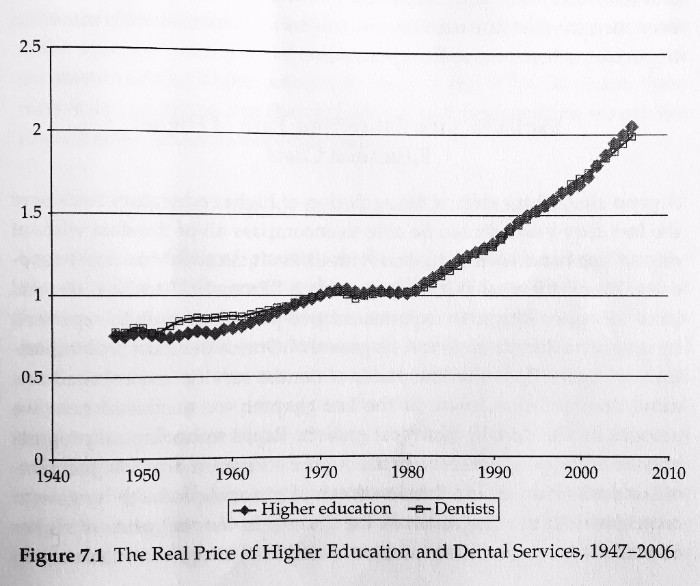
“So, to summarize: in the past fifty years, education costs have doubled, college costs have dectupled, health insurance costs have dectupled, subway costs have at least dectupled, and housing costs have increased by about fifty percent. US health care costs about four times as much as equivalent health care in other First World countries; US subways cost about eight times as much as equivalent subways in other First World countries. I worry that people don’t appreciate how weird this is. I didn’t appreciate it for a long time.”
SCOTT ALEXANDER’s post is an armchair-analysis masterpiece (casual, curious, wide-ranging). Full post here.
From Random Critical Analysis, see a detailed post titled “High US healthcare spending is quite well explained by its high material standard of living”:
“Total per capita health care spending increases as wealth increases because people actually demand more goods and services (volume) per capita and because it is relatively labor intensive sector that does not enjoy the productivity gains found in some other sectors of the economy, i.e., overall costs increase through both volume and price together (volume * price). GDP per capita is a relatively weak measure for these purposes and those few other high GDP countries happen to be much more export dependent (which does not independently predict significant increases in expenditures). If you use a better measure like Actual Individual Consumption (AIC) or run multiple regression analysis on GDP expenditure categories most of the apparent excess health care spending shrinks quite dramatically.”
Chart below from Why does college cost so much?, by Archibald/Feldman. Michael comments:Multiple of price in real terms on the y-axis (70s dollars). In case there was any question as to whether cost disease is a cross-sector phenomenon.
Two articles illustrate the state of thought on moderating user-generated content
Ben Thompson of Stratechery rounds up recent news on content moderation on Twitter/Facebook/Youtube and makes a recommendation:
“Taking political sides always sounds good to those who presume the platforms will adopt positions consistent with their own views; it turns out, though, that while most of us may agree that child exploitation is wrong, a great many other questions are unsettled.
“That is why I think the line is clearer than it might otherwise appear: these platform companies should actively seek out and remove content that is widely considered objectionable, and they should take a strict hands-off policy to everything that isn’t (while — and I’m looking at you, Twitter — making it much easier to avoid unwanted abuse from people you don’t want to hear from). Moreover, this approach should be accompanied by far more transparency than currently exists: YouTube, Facebook, and Twitter should make explicitly clear what sort of content they are actively policing, and what they are not; I know this is complicated, and policies will change, but that is fine — those changes can be transparent too.”
“… If we want to really make progress towards solving these issues we need to recognize there’s not one single type of bad behavior that the internet has empowered, but rather a few dimensions of them.”
The piece goes on to describe four types of bad content. Link.
Michael comments: The discussion of content moderation—and digital curation more broadly—conspicuously ignores the possibility of algorithmic methods for analyzing and disseminating (ethically or evidentiarily) valid information. Thompson and Social Capital default to traditional and cumbersome forms of outright censorship, rather than methods to “push” better content.
We’ll be sharing more thoughts on this research area in future letters.
Hunter Walk, former director of consumer product management at Youtube, describes the process of user-generated content moderation at large sites. Link.
On new attempts to use AI to spot fake news: “Testing a demo version of the AdVerif.ai, the AI recognized the Onion as satire (which has fooled many people in the past). Breitbart stories were classified as ‘unreliable, right, political, bias,’ while Cosmopolitan was considered ‘left.’ It could tell when a Twitter account was using a logo but the links weren’t associated with the brand it was portraying. AdVerif.ai not only found that a story on Natural News with the headline ‘Evidence points to Bitcoin being an NSA-engineered psyop to roll out one-world digital currency was from a blacklisted site, but identified it as a fake news story popping up on other blacklisted sites without any references in legitimate news organizations.” Link.
With a sexpartite fake news typology, researchers present initial analysis and visualizations pertaining the the 2017 French Presidential election: they found platform disparities (more elaborate fake news like conspiracy theories and fact-manipulation dominated on Twitter, while all forms of misinformation, and clickbait in particular, circulated widely on Facebook), and party disparities (Asselineau and Le Pen supporters distributed the lion’s share of suspiciously sourced content). Link (in French). ht Margarita
Related to the above, a possible attempt at promoting accuracy from the middle: “Researchers from Aalto University and University of Rome Tor Vergata have designed an algorithm that is able to balance the information exposure so that social media users can be exposed to information from both sides of the discussion.” Link. ht Margarita
Tangentially related: Gobo from MIT Media Lab. “Sign up for Gobo, link it to your other social media profiles, and you can take control of your feed. Want to read news you aren’t otherwise seeing? Use our ‘Echo Chamber’ filter to see what we call ‘wider’ news.” Link.
“Has the world come to rely on an omaginary technology to save it?” Climate models depend on a carbon-negative technology that barely exists
“But here’s where things get weird. The UN report envisions 116 scenarios in which global temperatures are prevented from rising more than 2°C. In 101 of them, that goal is accomplished by sucking massive amounts of carbon dioxide from the atmosphere—a concept called “negative emissions”—chiefly via BECCS [bioenergy with carbon capture and storage]. And in these scenarios to prevent planetary disaster, this would need to happen by midcentury, or even as soon as 2020. Like a pharmaceutical warning label, one footnote warned that such ‘methods may carry side effects and long-term consequences on a global scale.’
“Indeed, following the scenarios’ assumptions, just growing the crops needed to fuel those BECCS plants would require a landmass one to two times the size of India, climate researchers Kevin Anderson and Glen Peters wrote. The energy BECCS was supposed to supply is on par with all of the coal-fired power plants in the world. In other words, the models were calling for an energy revolution—one that was somehow supposed to occur well within millennials’ lifetimes.”
ABBY RABINOWITZ and AMANDA SIMPSON provide a thorough overview of the key players and technologies in this emerging field. Full piece here. (Some classify these approaches as carbon geoengineering, others use the term “geoengineering” to refer only to solar.)
“Now scientists are documenting how sequestering carbon in soil can produce a double dividend: it reduces climate change by extracting carbon from the atmosphere, and it restores the health of degraded soil and increases agricultural yields.” Link.
See also the New Yorker piece we sent last month. Link.
“The general thrust of the evidence does not point to enterprise zones creating jobs or reducing poverty. Notwithstanding the difficulties mentioned above, careful analysis has found mixed results of place-based policies (as discussed in my research note). Studies generally do not find increasing employment in response to these policies. There is even less evidence of reduced poverty in these zones and there is also some evidence of rising housing prices which could hurt those who rent and live in those areas, as opposed to property owners who may not reside in the Enterprise Zone. The types of place-based policies that may be more effective support infrastructure investment or higher-education institutions. The Tennessee Valley Authority emphasized the construction of hydroelectric dams to bring power generation to the region it covered. This was a classic case where a place-based policy fostered economic growth, in this case through industrialization. More recently, there is evidence that university research facilities attract high-tech, innovative firms which, in turn, can form industry clusters that benefit from agglomeration economies.”
“Interstate mobility nationwide has slowed over the last 30 years. But, more specifically and of greater concern, migration has stalled in the very places with the most opportunity.” Link. ht Jenny
Larissa MacFarqhuar on the small-town American Dream. Link.
“MANY ANALYSTS, ONE DATASET”
Quantifying the consequences of using different analytical frameworks
“Overall 29 different analyses used 21 unique combinations of covariates. We found that neither analysts’ prior beliefs about the effect, nor their level of expertise, nor peer-reviewed quality of analysis readily explained variation in analysis outcomes. This suggests that significant variation in analysis of complex data may be difficult to avoid, even by experts with honest intentions. Crowdsourcing data analysis, a strategy by which numerous research teams are recruited to simultaneously investigate the same research question, makes transparent how defensible, yet subjective analytic choices influence research results.”
“An overarching constraint for free human mobility is that international political borders are only selectively permeable. Drawing on Ernst Bloch’s work on the possible, the author examines open-borders and no-border arguments and explores the conditions of their possibilities.” Link.
In Nature, famous statisticians give opinions on how to fix statistics. Link. (JFI favorite Andrew Gelman is featured; his excellent blog is here.)
Addressing bias through datasets: “We have to teach our algorithms which are good associations and which are bad the same way we teach our kids.” Link. ht Margarita
A new study from the People’s Policy Project: “During the Obama presidency, the homeownership rate crashed by 4.4 percentage points, erasing all the increase of the mortgage bubble, eventually falling to the lowest level since 1965, before slightly rebounding. It was the greatest destruction of middle class wealth since the Great Depression, and its impact disproportionately wounded black wealth.” Link. ht reader Patrick S.
“In an effort to improve our understanding of how political information changes as it propagates from the media to one person to another, I conduct a novel online experiment in which I track information diffusion through individuals in communication chains. I then use content analysis to examine how the information is actually changing, finding that the amount of political information communicated decreases as the number of people in the chain increases. Furthermore, the information is increasingly distorted as the length of the chain increases.” Link.
“During the summer between high school and college, college-related tasks that students must navigate can hinder successful matriculation. We employ conversational artificial intelligence (AI) to efficiently support thousands of would-be college freshmen by providing personalized, text message-based outreach and guidance for each task where they needed support.” Link. ht Will
A special issue of American Behavioral Scientist on “The role of state education policy in ensuring access, achievement, and attainment in higher education,” with several articles. Link. ht Will
“This paper provides evidence of the long-run effects of a permanent increase in agricultural productivity on conflict. We construct a newly digitized and geo-referenced dataset of battles in Europe, the Near East and North Africa covering the period between 1400 and 1900 CE. For variation in permanent improvements in agricultural productivity, we exploit the introduction of potatoes from the Americas to the Old World after the Columbian Exchange. We find that the introduction of potatoes permanently reduced conflict for roughly two centuries. The results are driven by a reduction in civil conflicts.” Link.
A new report argues that quality, not access, is the pivotal challenge for colleges and universities
From the American Academy of Arts and Sciences, a 112-page report with “practical and actionable recommendations to improve the undergraduate experience”:
“Progress toward universal education has expanded most recently to colleges and universities. Today, almost 90 percent of high school graduates can expect to enroll in an undergraduate institution at some point during young adulthood and they are joined by millions of adults seeking to improve their lives. What was once a challenge of quantity in American undergraduate education, of enrolling as many students as possible, is now a challenge of quality—of making sure that all students receive the rigorous education they need to succeed, that they are able to complete the studies they begin, and that they can do this affordably, without mortgaging the very future they seek to improve.”
Link to the full report. Co-authors include Gail Mellow, Sherry Lansing, Mitch Daniels, and Shirley Tilghman. ht Will, who highlights a few of the report’s recommendations that stand out:
From page 40: “Both public and private colleges and universities as well as state policy-makers [should] work collaboratively to align learning programs and expectations across institutions and sectors, including implementing a transferable general education core, defined transfer pathway maps within popular disciplines, and transfer-focused advising systems that help students anticipate what it will take for them to transfer without losing momentum in their chosen field.”
From page 65: “Many students, whether coming straight out of high school or adults returning later to college, face multiple social and personal challenges that can range from homelessness and food insecurity to childcare, psychological challenges, and even imprisonment. The best solutions can often emerge from building cooperation between a college and relevant social support agencies.
From page 72: “Experiment with and carefully assess alternatives for students to manage the financing of their college education. For example, income-share agreements allow college students to borrow from colleges or investors, which then receive a percentage of the student’s after-graduation income.”
On a related note, see this 2016 paper from the Miller Center at the University of Virginia: “Although interest in the ISA as a concept has ebbed and flowed since Milton Friedman first proposed it in the 1950s, today it is experiencing a renaissance of sorts as new private sector partners and institutions look to make the ISA a feasible option for students. ISAs offer a novel way to inject private capital into higher education systems while striking a balance between consumer preferences and state needs for economic skill sets. The different ways ISAs can be structured make them highly suitable as potential solutions for many states’ education system financing problems.” Link.
Meanwhile, Congress is working on the reauthorization of the Higher Education Act: “Much of the proposal that House Republicans released last week is controversial and likely won’t make it into the final law, but the plan provides an indication of Congressional Republicans’ priorities for the nation’s higher education system. Those priorities include limiting the federal government’s role in regulating colleges, capping graduate student borrowing, making it easier for schools to limit undergraduate borrowing — and overhauling the student loan repayment system. Many of those moves have the potential to create a larger role for private industry.” Link.
Chasing Moore’s Law: Director of Research Jay Hodges gives extended comment on the burgeoning field of XAI
The rapid development of machine learning and AI raises a sci-fi specter going back at least to Frankenstein: well-intentioned geniuses use technology to create something they can neither understand nor control, disaster ensues. So it’s not surprising that there’s an emerging sense of urgency around making AI understandable. If we can’t explain how the systems work, the thought goes, we can’t know that we’re not designing them badly, that we’re not leading them astray through hidden assumptions in our data, that we’re not training them to reflect our prejudices. And, to be sure, there are great examples of both practical and moral failures of AI systems in Aaron Borstein’s Nautilus article.
I think, however, that there are reasons for skepticism around the explainable AI (“XAI”) project as it stands. In particular, explanation is an astonishingly difficult concept to define. You could fill a book with attempts to define it and their refutations (people have: Wesley Salmon’s Four Decades of Scientific Explanation is a classic). It’s extraordinarily unlikely that a definition that can be operationalized algorithmically will be discovered any time soon. But this pessimism can be tempered with a higher-order skepticism: explanation is almost certainly a red herring, and not what we need to allay our fears.
First: explanation is hard. Although the notion of explanation, as an object of study, is relatively new to computer science and technology studies, it’s old hat to analytic philosophy (“analytic” philosophers are the folks who brought us formal logic, set theory, and computability theory, as opposed to “continental” philosophers like Derrida and Žižek). There’s a literature in logic, philosophy of science, philosophy of mathematics, ethics, and philosophy of action spanning more than 75 years that treats explanation as its primary focus (for some overviews see the Stanford Encylcopedia of Philosophy’s articles on scientific explanation, reasons for action, and explanation in mathematics). Perhaps the most salient lesson of this literature is that the obvious definitions just don’t work. They all meet with recalcitrant counterexamples.
Writers in XAI unfamiliar with this literature are now recreating the earliest attempts at definitions. So the Bonsai piece seems to think of explanation as a matter of “discriminat[ing] between [a] particular classification and any other classification that could have been derived” — what philosophers call counterfactual dependence. The Harvard interdisciplinary group, meanwhile, endorses both the counterfactual dependence notion (“Would changing a certain factor have changed the decision?”) and a causal notion (“what factor caused a difference in outcomes?”).
But neither of these characterizations correctly captures the notion of explanation. Take the causal notion: to explain an event is to describe its causes. There are all sorts of explanations that don’t meet this definition. Think of someone defending against libel by saying: “What I said isn’t libel, because it’s true, and libelous claims are false by definition.” The truth of the claim, together with the definition of ‘libel,’ explains why the claim isn’t libel, but neither causes anything. The relationship here is constitutive, rather than causal. Likewise, there are explanations of mathematical theorems, explanations from equilibrium states, and statistical explanations that are non-causal.
Or take counterfactual dependence: the event being explained wouldn’t have happened without the explaining factor. This is both too narrow and too broad to work as a definition. Too narrow, since it misses out on the above explanations; it’s simply not true that a non-libelous statement would have been libelous had our definition of ‘libel’ been different, any more than it’s true that horses wouldn’t have had tails if our definition of ‘tail’ had been different (as Steve Yablo puts it, “how people talk doesn’t change the anatomy of horses”). Too broad, since it fails to rule out bad explanations that cite minor or irrelevant factors: say I’m driving drunk and crash; although it’s true that I wouldn’t have crashed if I’d lost my keys, failing to lose my keys doesn’t explain the crash. My drunkenness does!
My point is not to trash these authors; these sorts of well-motivated (but decidedly bad) definitions of explanation are exactly what we’d expect smart people to come up with when they’re just starting off on the project of describing explanation formally. And of course, we can try all sorts of moves, by modifying the definitions slightly, or narrowing their scope, or distinguishing between different kinds of explanation; in fact, this is exactly the game that plays out in the literature. Instead, the point is that, at least to the extent that successful development of XAI depends upon a coherent picture of explanation, those working in the field would do better by learning from the work that’s gone before, rather than trying to re-discover everything from scratch. It’s late in the game, and there are substantially more sophisticated and defensible pictures of explanation around these days (Michael Strevens, Elliott Sober, Philip Kitcher, Bas van Fraassen, Brad Skow, and Robert Batterman are some of the key figures).
Unfortunately, none of the current contenders for a good theory of explanation provides a straightforward way of producing or testing explanations in the XAI context. Fortunately, I don’t think XAI needs to implement a correct theory of explanation, because I don’t think explanation is what AI needs in order to address the moral and practical concerns that motivate the discussion. Saying why will require a bit more on explanations.
Explanations happen on multiple levels. There can be, and there almost always are, multiple concurrent good explanations for the same event. Why did Sally kick Sam? Think of the directions we can go with an explanation. Because he insulted her. Because she was angry at him. Because she wanted to cause Sam pain and predicted that kicking him would effectively do so. Because certain regions of her brain activated in certain ways, signaling her leg to move, causing her foot to impact Sam. Because her neurons fired in a particular way, causing her muscle fibers to contract. Because a vast, complex system of particles underwent a cascade of state changes that eventually ended in one of unfathomably many possible realizations of a Sally-kicks-Sam state.
We can explain the event at a micro-level, involving fundamental particles, we can explain it at the middle level of her cellular and intercellular processes, we can explain it in terms of her brain state, we can explain it in terms of her cognitive state, we can explain it in terms of her motivating and normative reasons. All these, and many others, are possible and (if, for some, only in extreme contexts) potentially appropriate responses to the why-question. The correctness of one doesn’t preclude the correctness of any of the others.
This seems to me a direct analogue of the question that XAI is trying to address. It’s not that we can’t explain how neural networks reach their conclusions. Of course we can – and on multiple levels, at that! We can explain at the level of hardware transitions (including everything from quantum interactions to high-level circuit logic behavior), at the level of the underlying code, at the level of the particular node transformations and value-passing, we can explain at the level of the abstract structures implemented by a neural network design, and more.
So without more clarity about what we’re seeking from explanations, it’s not at all obvious what level we’re hoping XAI explanations will sit at. It’s also not obvious what sorts of analogies are appropriate to the sort of explanations appropriate for human actions. The closest (in terms both of the comfort we’re seeking from such explanations and of the language in which writers seem to discuss them) would seem to be the high-level reasons for action. But there’s a pretty big problem with that: an algorithm doesn’t have reasons in the sense that Sally’s anger is a reason for her kicking Sam. At least in AI’s extant forms, it’s pure metaphor to think about such a system’s beliefs and desires, much less its commitments, motivations, and justifications.
Is there a middle-ground alternative that is appropriate to algorithms? The notion of interpretability found in some XAI writing points to one: we want to be able to articulate in clear, comprehensible terms what features are being used in what ways by the algorithm. One way to cash this out is in terms of rational reconstruction – trying to imagine a fictional rational agent making the decision, and tracking the steps and factors used by that agent as rough parallels to those of the algorithm. This is akin to the reasonable person test used in some legal contexts: rather than try to “get inside the head” of a subject, we simply imagine whether a reasonable person could or would have done the same in the same context.
Yet it’s still not clear how much we can demand along these lines. Many authors (including the Harvard group) demand that the process be determinate and consistent across contexts. Assume that it is. If an algorithm lends itself to rational reconstruction, it seems that the features to which the algorithm responds must be to some extent recognizable to humans, and the decision process by which the algorithm uses them to classify must be to some extent expressible to humans. But this presents a dichotomy. If the features perfectly reflect human-recognizable features, and the process is easily describable, this makes the algorithm look very like a decision tree or similar. For most of the tasks in question, these perform poorly. On the other hand, if the interpretations are themselves only vague or rough analogies, then it’s not clear how reliable such explanations are: our rational reconstructions seem more creation than recreation. There’s a trade-off between how well the algorithms work, and how well they can be explained. The real question, it seems, is how to balance this trade-off.
A critique of the “right to explanation” in Europe’s General Data Protection Regulation: “As the history of industries like finance and credit shows, rights to transparency do not necessarily secure substantive justice or effective remedies. We are in danger of creating a ‘meaningless transparency’ paradigm to match the already well-known ‘meaningless consent’ trope.” Link.
“When Malioutov presented his accurate but inscrutable neural network model to his own corporate client, he also offered them an alternative, rule-based model whose workings he could communicate in simple terms. This second, interpretable, model was less accurate than the first, but the client decided to use it anyway—despite being a mathematically sophisticated insurance company for which every percentage point of accuracy mattered. ‘They could relate to [it] more,’ Malioutov says. ‘They really value intuition highly.’” Link. ht Sara
From the introduction to The Failed Welfare Revolution: America’s Struggle over Guaranteed Income Policy: “…The main obstacle to [guaranteed annual income] legislation was the cultural distinction that Americans draw between different categories of poor people. Put most simply, Americans have long considered some types of people, based on their perceived adherence to the work ethic, to be more worthy of government assistance than others.” More about the book here. ht Will
In a new report, McKinsey looks at the impact of automation on jobs. Link. Marc comments: McKinsey works, in this report, from the same set of (tenuous) assumptions as in their earlier. However, they do start to account for automatable hours (rather than jobs), which is why they’re getting less extreme results.
Andrew Gelman on 80% power: “But what I’m saying right here is that, even knowing nothing about any replication crisis, without any real-world experience or cynicism or sociology or documentation or whatever you want to call it . . . it just comes down to the math. With 80% power, we’d expect to see tons and tons of p-values like 0.0005, 0.0001, 0.00005, etc. This would just be happening all the time. But it doesn’t.” Link. ht Sidhya
A study on “twiplomacy” (Twitter diplomacy). Link. ht Sidhya
The ultimate DIY: a DIY pancreas. “To make and distribute it would violate federal regulations, and to become a company would mean dealing with those regulations. But there is no rule about launching a blueprint on the Internet. ‘So that’s what we did,’ Lewis said, ‘and that’s why we called it Open APS, which stands for open-sourced pancreas system.’” Link.
Oliver Morton tweets in response to a alarm about solar geoengineering: “…Geoengineering is not yet a technology; it is a poorly defined conceptual space where a technology might be—a ‘technological imaginary,’ as social scientists sometimes say. Definitive statements about it are thus unwarranted. It can’t be averred to be unproblematically good, or useful. It could definitely be developed in a dangerous way. But there is no ‘it’ that can be essentially dangerous.” Link.
Upcoming proposals for carbon taxes/cap and trade. Link.
The environmental cost of the bitcoin surge: “Today, each bitcoin transaction requires the same amount of energy used to power nine homes in the U.S. for one day.” Link.
An analysis of 21 studies on unconditional cash transfers, with a focus on health. Link.
“Unfortunately, one of the things the [Library of Congress] learned was that the Twitter data overwhelmed the technical resources and capacities of the institution. By 2013, the library had to admit that a single search of just the Twitter data from 2006 to 2010 could take 24 hours. Four years later, the archive still is not available to researchers. Across the board, the reality began to sink in that these proprietary services hold volumes of data that no public institution can process. And that’s just the data itself.” Link.
Thinking through types of media coverage of fake news, on the Committee for the Anthropology of Science, Technology & Computing blog. Link.
Open borders in the news: “Kenyan President Uhuru Kenyatta announced during his inauguration last week that the East African commercial hub will now give visas on arrival to all Africans. That follows similar measures by nations including Benin and Rwanda. ‘The freer we are to travel and live with one another, the more integrated and appreciative of our diversity we will become,’ Kenyatta said.” Link.
For more on open borders, an Economist overview from the summer is available here.
“If the connection sounds fantastical it’s because it is, even to mathematicians. And for that reason, Kim long kept it to himself. ‘I was hiding it because for many years I was somewhat embarrassed by the physics connection,’ he said. ‘Number theorists are a pretty tough-minded group of people, and influences from physics sometimes make them more skeptical of the mathematics.’” Link. ht Margarita
From a paper titled “Parochial trust and cooperation across 17 societies”: “In a time of increasing parochialism in both domestic and international relations, our findings affirm us of the danger of the strong human universal toward parochial altruism. Yet, our findings suggest that in all societies, there exist people whose cooperation transcends group boundaries and provides a solution to combating parochialism: reputation-based indirect reciprocity.” Link.
A recent longform piece in the New York Times identifies the problem of explaining artificial intelligence. The stakes are high because of the European Union’s controversial and unclear “right-to-explanation” law, which will become active in May 2018.
“Instead of certainty and cause, A.I. works off probability and correlation. And yet A.I. must nonetheless conform to the society we’ve built — one in which decisions require explanations, whether in a court of law, in the way a business is run or in the advice our doctors give us. The disconnect between how we make decisions and how machines make them, and the fact that machines are making more and more decisions for us, has birthed a new push for transparency and a field of research called explainable A.I., or X.A.I. Its goal is to make machines able to account for the things they learn, in ways that we can understand. But that goal, of course, raises the fundamental question of whether the world a machine sees can be made to match our own.”
Full article by CLIFF KUANG here. This page provides a short overview of DARPA’s XAI (Explainable Artificial Intelligence) program.
An interdisciplinary group addresses the problem:
“Contrary to popular wisdom of AI systems as indecipherable black boxes, we find that this level of explanation should often be technically feasible but may sometimes be practically onerous—there are certain aspects of explanation that may be simple for humans to provide but challenging for AI systems, and vice versa. As an interdisciplinary team of legal scholars, computer scientists, and cognitive scientists, we recommend that for the present, AI systems can and should be held to a similar standard of explanation as humans currently are; in the future we may wish to hold an AI to a different standard.”
Full article by FINALE DOSHI-VELEZ et al. here. ht Margarita For the layperson, the most interesting part of the article may be its general overview of societal norms around explanation and explanation in the law.
Michael comments: Human cognitive systems have generated similar questions in vastly different contexts. The problem of chick-sexing (see Part 3) gave rise to a mini-literature within epistemology.
From Michael S. Moore’s book Law and Society: Rethinking the Relationship: “A full explanation in terms of reasons for action requires two premises: the major premise, specifying the agent’s desires (goals, objectives, moral beliefs, purposes, aims, wants, etc.), and the minor premise, specifying the agent’s factual beliefs about the situation he is in and his ability to achieve, through some particular action, the object of his desires.” Link. ht Margarita
A Medium post with an illustrated summary of some XAI techniques. Link.
A few weeks ago, we linked to the winners of the Indigo Prize, which “challenged entrants to consider how to measure economic activity in a 21st Century economy.” The Indigo Prize is only part of a burgeoning movement to reconceive core economic metrics.
“Using GDP as a measure of welfare has well-known problems, which are among the first things macroeconomics principles courses cover. But the point of the discussions at Davos is that in the digital age, those problems are even deeper. […]
“Catherine Rampell provides a nice summary of the alternative measures that have been proposed, including China’s ‘green GDP,’ which attempts to adjust for environmental factors; the OECD’s ‘GDP alternatives,’ which adjust for leisure; the ‘Index of Sustainable Economic Welfare,’ which accounts for both pollution costs and the distribution of income; and the ‘Genuine Progress Indicator,’ which ‘adjusts for factors such as income distribution, adds factors such as the value of household and volunteer work, and subtracts factors such as the costs of crime and pollution.'”
MARK THOMA’s solid overview article is here. A straightforward critical history of GDP from Nature is here.
ERIK BRYNJOLFSSON, one of the leaders of the discussion at Davos, has a recent NBER paper (with coauthors) further connecting metrics to the discussion about AI and the future of work.
“We thus appear to be facing a redux of the Solow (1987) Paradox: we see transformative new technologies everywhere but in the productivity statistics.
“In this paper, we review the evidence and explanation for the modern productivity paradox and propose a solution. Namely, there is no inherent inconsistency between forward-looking technological optimism and backward-looking disappointment. Both can simultaneously exist. Indeed, there are good conceptual reasons to expect them to simultaneously exist when the economy undergoes the kind of restructuring associated with transformative technologies. In essence, the forecasters of future company wealth and the measurers of historical economic performance show the greatest disagreement during times of technological change. In this paper we argue and present some evidence that the economy is in such a period now.”
Nobel prize winning economist Joseph Stiglitz writes in a 2016 essay from Rethinking Capitalism:
“As this essay has emphasized, a key factor underlying the current economic difficulties of rich countries is growing inequality. We need to focus not on what is happening on average— as GDP leads us to do— but on how the economy is performing for the typical citizen, reflected for instance in median disposable income. People care about health, fairness and security, and yet GDP statistics do not reflect their decline. Once these and other aspects of societal well-being are taken into account, recent performance in rich countries looks much worse.”
Full essay here. See also Stiglitz’s 2010 book (with Amartya Sen and Jean Paul Fitoussi) Mismeasuring Our Lives: Why GDP Doesn’t Add Up.
A reference of historical/political/philosophical theories of value (e.g., Smith, Marx, Ricardo). Link.
And at the intersection of this spotlight and that on XAI above, see the Artificial Intelligence Index, released this Thursday by a team including Brynjolfsson. And a great context piece from the New York Times: “The goal of the project is to collect, curate and continually update data to better inform scientists, businesspeople, policymakers and the public.”
Related to the Brynjolfsson paper, more on declining productivity: “If research productivity is declining at the aggregate level, it does not imply that the same must be true for individual products or industries. For this reason, we also examine as many case studies as we could find for which we could carefully measure the inputs and outputs of a given type of research. We find that research productivity has declined in every case.” Link.
Branko Milanovic and Jason Hickel debate de-growth at length. Here’s Milanovic’s first post (“It would make more sense, if we want to think seriously about how to reduce emissions, not to engage in the illusions of degrowth in a very poor and unequal world but to think how the most emission-intensive goods and services could be taxed in order to reduce their consumption”),Hickel’s response (“Milanovic accuses us – incorrectly – of wanting ‘the immiseration of the West’ in order to eradicate poverty in the global South. But his blind faith in growth, and his implicit denial of scientific evidence, is sure to lead to ecological collapse – entrenching the misery of the poor and immiserating the rest of us in the process”), Milanovic again, Hickel again. ht Riccardo Mastini
The Last Generalists: “This paper argues that historians of thought can help to counteract fragmentation because they are special generalists that fulfill multiple functions, for example, in the education of economists, the detection of blind spots in modern theories and the identification of routes for innovation by backtracking.” Link.
“We aim at developing an AI methodology that facilitates attribution of drawings of unknown authors in a way that is not easy to be deceived by forged art. The methodology used is based on quantifying the characteristics of individual strokes in drawings.” (The system got some false negatives but “accuracy 100% for detecting fakes in most settings.”) Link.
“Rather than seeing shame as an unfortunate byproduct of living in poverty, human development planners should consider how poverty undermines human dignity.” Link. ht Sidhya
“This nationally representative survey, fielded in 2014 by the Economic Research Service (ERS) unit at the U.S. Department of Agriculture (USDA), asks rural businesses about the nature and extent of innovative processes within their operations.” Link. ht Will
Borrowing from a fruit fly brain for search engines. Link. ht Margarita
“People have become captivated by the idea that self driving cars must actually enact the old ‘trolley problem’ from philosophy 101…This question is fundamentally broken; the answer is neither yes nor no. The reason is this is not a choice a self driving car CAN make.” Link to a Twitter thread.
How to build justice into algorithmic actuarial tools
Key notions of fairness contradict each other—something of an Arrow’s Theorem for criminal justice applications of machine learning.
“Recent discussion in the public sphere about algorithmic classification has involved tension between competing notions of what it means for a probabilistic classification to be fair to different groups. We formalize three fairness conditions that lie at the heart of these debates, and we prove that except in highly constrained special cases, there is no method that can satisfy these three conditions simultaneously. Moreover, even satisfying all three conditions approximately requires that the data lie in an approximate version of one of the constrained special cases identified by our theorem. These results suggest some of the ways in which key notions of fairness are incompatible with each other, and hence provide a framework for thinking about the trade-offs between them.”
Full paper from JON KLEINBERG, SENDHIL MULLAINATHAN and MANISH RAGHAVAN here. ht Sara, who recently presented on bias in humans, courts, and machine learning algorithms, and who was the source for all the papers in this section.
In a Twitter thread, ARVIND NARAYANAN describes the issue in more casual terms.
“Today in Fairness in Machine Learning class: a comparison of 21 (!) definitions of bias and fairness […] In CS we’re used to the idea that to make progress on a research problem as a community, we should first all agree on a definition. So 21 definitions feels like a sign of failure. Perhaps most of them are trivial variants? Surely there/s one that’s ‘better’ than the rest? The answer is no! Each defn (stat. parity, FPR balance, contextual fairness in RL…) captures something about our fairness intuitions.”
Jay comments: Kleinberg et al. describe their result as choosing between conceptions of fairness. It’s not obvious, though, that this is the correct description. The criteria (calibration and balance) discussed aren’t really conceptions of fairness; rather, they’re (putative) tests of fairness. Particular questions about these tests aside, we might have a broader worry: if fairness is not an extensional property that depends upon, and only upon, the eventual judgments rendered by a predictive process, exclusive of the procedures that led to those judgments, then no extensional test will capture fairness, even if this notion is entirely unambiguous and determinate. It’s worth consideringNozick’s objection to “pattern theories” of justice for comparison, and (procedural) due process requirements in US law.
A paper from Narayanan and others: “Machine learning is a means to derive artificial intelligence by discovering patterns in existing data. Here, we show that applying machine learning to ordinary human language results in human-like semantic biases…Our results indicate that text corpora contain recoverable and accurate imprints of our historic biases, whether morally neutral as toward insects or flowers, problematic as toward race or gender, or even simply veridical, reflecting the status quo distribution of gender with respect to careers or first names.” Link.
A critique of this ProPublica story on the COMPAS algorithm used for criminal sentencing: the issue with the paper comes down to competing definitions of fairness. “In this paper we show that the differences in false positive and false negative rates cited as evidence of racial bias by Angwin et al. are a direct consequence of applying an RPI that that satisfies predictive parity to a population in which recidivism prevalence differs across groups.” Link.
On the AI Now Initiative: “A key challenge, these and other researchers say, is that crucial stakeholders, including the companies that develop and apply machine learning systems and government regulators, show little interest in monitoring and limiting algorithmic bias. Financial and technology companies use all sorts of mathematical models and aren’t transparent about how they operate. O’Neil says, for example, she is concerned about how the algorithms behind Google’s new job search service work.” Link.
Should we build more universities to encourage local, rural economic growth?
Lyman Stone analyzes the economic role of the US higher education system:
“The problems we face are: (1) the regional returns to higher education are too localized, (2) the price of higher education is bid up very high, (3) the traditional entrepreneurial player, state governments, is financially strained or unwilling, (4) private entrance is systematically suppressed by unavoidable market features.”
See also this 2011 paper from the New York Fed, “The Role of Colleges and Universities in Building Local Human Capital.”
“College and universities can contribute to the economic success of a region by deepening the skills and knowledge–or human capital–of its residents. Producing graduates who join the region’s educated workforce is one way these institutions increase human capital levels. In addition, the knowledge and technologies created through research activities at area universities may not only attract new firms to a region but also help existing businesses expand and innovate. These ‘spillover effects’ can in turn raise the region’s demand for high-skilled workers.”
Full paper by JAISON R. AIBEL and RICHARD DEITZ here.
Lyman Stone’s article, above, is part of a conversation that Ross Douthat started in a March column: “…There’s only so much that breaking up D.C. will do. Which is why we’ll go further, starting with the deep-pocketed elite universities clustered around our bloated megalopolises. We’ll tax their endowments heavily, but offer exemptions for schools that expand their student bodies with satellite campuses in areas with well-below-the-median average incomes. M.IT.-in-Flint has a certain ring to it. So does Stanford-Buffalo, or Harvard-on-the-Mississippi.” Link.
Douthat’s article prompted a response from Noah Smith: “Better universities, endowed with more government research dollars, and providing expensive education services to rich foreigners, will help revive struggling places and lessen the dominance of big cities. It’s just the regional industrial policy the country needs right now.” Link.
An engaging overview, with many examples, of feature visualization by neural network. Link. ht Margarita
“Here at Stitch Fix, we work on many fun and interesting areas of Data Science. One of the more unusual ones is drawing maps, specifically internal layouts of warehouses. These maps are extremely useful for simulating and optimizing operational processes. In this post, we’ll explore how we are combining ideas from recommender systems and structural biology to automatically draw layouts and track when they change.” Link. ht Jay
Elizabeth Kolbert writes in the New Yorker about carbon capture—removing CO2 emissions from the air. “‘People told me, “The models show this major need for negative emissions,” he recalled. “But we don’t really know how to do that, nor is anyone really thinking about it.” I was someone who’d been in the business and policy world, and I was, like, wait a minute—what?’” Link.
Climate change divides Americans, but in an unlikely way: The more education that Democrats and Republicans have, the more their beliefs in climate change diverge.” Link. ht Jay
Dealing with low participation in a study: “In a new working paper (joint with Gabriel Lara Ibarra), we discuss how the richness of financial data on clients allows us to combine experimental and non-experimental methods to still estimate the impact of this program for those clients who do take up the program.” Link. ht Sidhya
An ambitious knowledge-mapping interactive project from the World Economic Forum. (You have to sign up with an email address, but it’s free.) Link. ht Leeza
Unconditional cash from a casino in a North Carolina Cherokee community: “McCoy’s kids, and all children in the community, have been accruing payments since the day they were born. The tribe sets the money aside and invests it, so the children cash out a substantial nest egg when they’re 18.” Link. ht Will
“Can attitudes towards minorities, an important cultural trait, be changed? We show that the presence of African American soldiers in the UK during World War II reduced anti-minority prejudice, a result of the positive interactions which took place between soldiers and the local population. The change has been persistent: in locations in which more African American soldiers were posted there are fewer members of the UK’s leading far-right party, less implicit bias against blacks and fewer individuals professing racial prejudice, all measured around 2010.” Link. ht Will
A paper titled “Climate Risk, Cooperation, and the Co-Evolution of Culture and Institutions.” Link. ht Whyvert
ECM released its catalogue on streaming services. Richard Brody comments. Link. ht Michael
 World