
Category Archive: Sources

  1. Inventions that Changed the World

    Comments Off on Inventions that Changed the World

    METARESEARCH AND DEVELOPMENT

    Changes in R & D funding and allocation

    In a new report on workforce training and technological competitiveness, a task force led by former Commerce Secretary Penny Pritzker describes recent trends in research and development investment. Despite the fact that “total U.S. R&D funding reached an all-time high of nearly $500 billion in 2015, nearly three percent of U.S. gross domestic product,” the balance in funding has shifted dramatically to the private sector: “federal funding for R&D, which goes overwhelmingly to basic scientific research, has declined steadily and is now at the lowest level since the early 1950s.” One section of the report contains this striking chart:
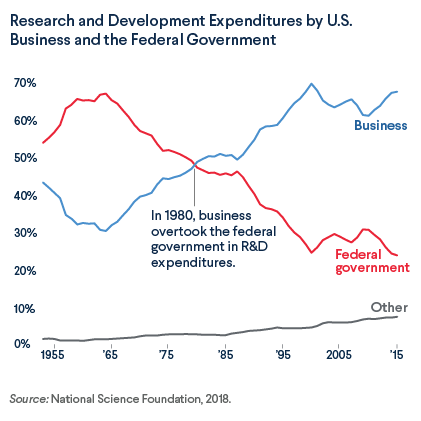
    Link to the full report. ht Will

    • A deeper dive into the report’s sourcing leads to a fascinating repository of data from the American Association for the Advancement of Science on the U.S. government’s investments in research since the 1950s. Alongside the shift from majority federal to majority private R&D funding, the proportion of investments across different academic disciplines has also changed significantly. One table shows that the share of federal R&D funding for environmental science, engineering, and math/computer science has grown the most, from a combined 43.2% in 1970 to 54.8% in 2017. Meanwhile, funding for social science research has decreased the most. In 1970, the social sciences received 4.3% of the government’s R&D funding; but in 2017, that share had fallen to 1.8%. Much more data on public sector R&D investments is available from the AAAS here.
    • A March 2017 article in Science explains some of these shifts.
    • A section of a 1995 report commissioned by the U.S. Senate Committee on Appropriations charts and contextualizes the explosion of federal research and development funding in the immediate aftermath of the Second World War.
    • A study from the Brookings Institution finds that federal funding for research and development accounts for up to 2.8 percent of GDP in some of the largest metropolitan areas in America. The authors have fifty ideas for how municipalities can capture more of the economic impact generated by that R&D.
    • Michael comments: “With the diminishing share (4.3% to 1.8% of total government research) of halved expenditures—and business not naturally inclined to conduct this kind of research (except in, as one would expect, instances of direct business application like surge pricing and Uber)—social science research appears to no longer have a natural home.”

    FUNCTIONAL FORMS

    Current and future effects of machine learning on economics

    SUSAN ATHEY goes into depth on some of the ways in which machine learning is already used in economics, then offers predictions, including an “increase in interdisciplinary research.” The paper contains much of interest, such as discussion of new techniques for causal inference:

    “The emerging literature in econometrics and statistics combining machine learning and causal inference… is providing insights and theoretical results that are novel from the perspective of both ML and statistics/econometrics.

    …

    ‘Outsourcing’ model selection to [an] algorithm works very well when the problem is ‘simple’–for example, prediction and classification tasks, where performance of a model can be evaluated by looking at goodness of fit in a held-out test set. Those are typically not the problems of greatest interest for empirical researchers in economics, who instead are concerned with causal inference, where there is typically not an unbiased estimate of the ground truth available for comparison. Thus, more work is required to apply an algorithmic approach to economic problems. The recent literature at the intersection of ML and causal inference, reviewed in this paper, has focused on providing the conceptual framework and specific proposals for algorithms that are tailored for causal inference.”

    Full paper here.

    • Real-world example: for a recent paper on monopsony, Arindrajit Dube tested out the “double ML” method for causal inference and found it performed “quite well”: “It’s one case, but our findings that estimates from a leading machine-learning based causal inference procedure (“double ML”) compare favorably to those from randomized evaluations are broadly supportive of the core arguments made by Susan Athey.”

    PLURALISTIC VIEW OF EQUALITY

    On Tim Scanlon’s new book, Why Does Inequality Matter?

    In the Boston Review, Martin O’Neill offers context on Scanlon, “one of the most powerful and insightful moral and political philosophers of recent decades.” In regard to the book, O’Neill writes: “Scanlon’s account of equality isn’t simple; it resists capture in a one-line slogan. It is, one might say, frustratingly complicated.” Link to the article.

    In his conclusion, Scanlon points out that inequality comes in many forms:

    “One strength of the pluralistic view of equality that I am offering is that it recognizes the differences between different forms of inequality. In addition to the inequality between the very rich and the rest of us, there is the inequality between the comfortably well off and the very poor, racial inequality, and the various forms of inequality between men and women. These are all troubling, but they are objectionable for different reasons, not simply because they are all violations of a single requirement that the prospects of individuals should be equal (in the absence of some special justification.)

    “Racial inequality involves objectionable inequality in status, lack of economic opportunity, unequal provision of education and other important public services, and unequal treatment by the legal system. It also involves a denial of access to effective means of political influence, including in many cases denial of the right to vote. Similarly, gender inequality also involves objectionable inequality in status, and lack of equal economic opportunity, because of discrimination in hiring and in access to education. It also involves, and has been perpetuated by, discrimination that has prevented women from attaining positions of political influence.

    “Inequality between the very poor and those who are better off involves the lack of economic opportunity, due to lack of access to education, and inadequate provision of other important public services, such as health care. The poor also suffer from a lack of control over important parts of their lives. They are subject to control by others in their working lives, have little choice of occupation, and suffer from what Jiwei Ci calls agency poverty as well as status poverty. Their interests are also inadequately represented in the political system.”

    Scanlon emphasizes that these different forms of inequality can be objected to on different bases. “Unequal Outcomes” (the penultimate chapter) and the conclusion are available in draft form here.

    • In his introduction, Scanlon mentions his 1996 lecture “The Diversity of Objections to Inequality,” accessible here: “My hypothesis is that the bare idea of equal consideration leads us to substantively egalitarian consequences only via other more specific values that I will enumerate, most of which are not essentially egalitarian.”
    • Another work that formed the basis of the book is “When Does Equality Matter,” found here.

    + + +

    • “We take the roads built during the Roman Empire as our point of departure.” A study on the provision of public goods and development persistence maps the road network of the Roman Empire alongside contemporary light intensity at night, finding a link “between the location of ancient roads and economic activity today.” Link.
    • “Living in a more segregated county substantially reduced the impact of GI Bill benefits on white homeownership rates, suggesting that segregated locations potentially hindered both white and black homeownership.” Link.
    • Matthew Desmond’s new project, The Eviction Lab, is the first countrywide database of evictions, going back to 2000. From Desmond’s intro: “This is just the beginning, and we need your help… Use the data. Researchers and journalists can take this information and deepen what we know about the prevalence, causes, and consequences of residential insecurity. Citizen organizers and elected officials can examine trends in their communities to design effective policy solutions.” Link to the site, and link to coverage of its launch in the Times.
    • “In general, small cities will have higher portions of their workforce replaced by machines than large cities. The reason: While cities of all sizes have many easily automated jobs (like card dealers, fisherman, cashiers, and accountants), large cities like Boston also have larger shares of managerial and knowledge professions (like lawyers, scientists, and software developers).” Link. ht Jay
    • Huang’s Law: “However, despite the imminent passing of Moore’s law, we are beginning to see a new and interesting class of phenomena. For a certain class of programs, namely deep networks, code does seem to grow faster almost by magic.” Link. Jack Clark offers commentary. ht Margarita
    • A new study on child labor and wages from the 1200s to 1800s. Link.
    • “Medical expenses account for roughly 4 percent of bankruptcy filings among nonelderly adults in the U.S.… The 4 percent figure is lower than some commonly cited estimates, but the new statistic comes with a twist: It is part of a larger research project that found multiple negative economic consequences of having medical problems, including a 20 percent drop in earnings and an 11 percent drop in employment for adults between ages 50 and 50 who had been hospitalized.” Link. ht Jack B.
    • A brief monetary history of Ireland and the Famine, from the excellent Economic History Society blog The Long Run. Link.
    • Matt Bruenig enters the Job Guarantee discussion again with a critical post at 3P: “One way to go about the hypothetical exercise is to compare the job guarantee idea to a more conventional alternative: unemployment benefits.… The question for a job guarantee is what exactly it delivers that the infinite basic unemployment benefit scheme does not?” Link. (And link to his previous.)
    • Ozan Jaquette, whose work we previously spotlighted, writes in the New York Times: “Our data suggests universities are determined to court wealthier students over others, and they expend substantial resources identifying and reaching them.” Link.
  2. The Worshipper

    Comments Off on The Worshipper

    TARGET VARIABLE

    Big data’s effect on the credit-scoring industry

    A lengthy 2016 article from the Yale Journal of Law and Technology delves into credit-scoring then suggests a new legislative framework.

    Since 2008, lenders have only intensified their use of big-data profiling techniques. With increased use of smartphones, social media, and electronic means of payment, every consumer leaves behind a digital trail of data that companies—including lenders and credit scorers—are eagerly scooping up and analyzing as a means to better predict consumer behavior. The credit-scoring industry has experienced a recent explosion of start-ups that take an ‘all data is credit data’ approach that combines conventional credit information with thousands of data points mined from consumers’ offline and online activities. Many companies also use complex algorithms to detect patterns and signals within a vast sea of information about consumers’ daily lives. Forecasting credit risk on the basis of a consumer’s retail preferences is just the tip of the iceberg; many alternative credit-assessment tools now claim to analyze everything from consumer browsing habits and social media activities to geolocation data.

    Full article by MIKELLA HURLEY and JULIUS ADEBAYO here. ht Will

    PREMIUM MOBILITY

    Tallying the gains of migration

    We recently linked to a paper by LANT PRITCHETT that challenged development orthodoxy by pointing out that the income gains for the subjects of best practice direct development interventions are about 40 times smaller than those from allowing the same people to work in a rich country like the United States.

    Link, again, to that paper.

    That argument was built upon previous scholarship that attempted to put rigorous numbers to the obvious intuition that migration is beneficial for those drawn to wealthy countries by labor markets. From a 2016 paper by Pritchett and co-authors MICHAEL CLEMENS and CLAUDIO MONTENEGRO:

    “We use migrant selection theory and evidence to place lower bounds on the ad valorem equivalent of labor mobility barriers to the United States, with unique nationally-representative microdata on both US immigrant workers and workers in their 42 home countries. The average price equivalent of migration barriers in this setting, for low-skill males, is greater than $13,700 per worker per year.”

    Link to the paper.

    • Pseudoerasmus comments: “The important point is that low human capital is not the greatest barrier to higher GDP in low income countries, assuming institutions are exogenous to human capital.” Link.
    • A post covering an element of Pritchett’s 2006 book on global labor mobility: ghost and zombie economies. “Large and persistent declines in labor demand in a region, perhaps because of technical changes in agriculture or changes in resources, create two possibilities, which I call “ghosts” or “zombies.” If labor is geographically mobile and hence labor supply is elastic, then large declines in labor demand will lead to large outward migration–the process that created “ghost towns” in the United States. However, if labor demand falls in a region and labor is trapped in that region, by national boundaries for instance, the labor supply is inelastic and all the accommodation has to come out of falling wages. A region that cannot become a ghost (losing population) becomes a zombie economy–the economy might be dead, but people are forced to live there.” Link.
    • Branko Milanovic has also published related research on the topic, including a 2015 paper in which he demonstrates that “more than one-half of variability in income of world population classified according to their household per capita in 1% income groups (by country) is accounted for” by country of residence and the income distribution within that country. Link.

    THREE ON HOUSING

    Land value; public housing; a proposed “grand bargain” for NYC

    I. At the Manhattan Institute, ALEX ARMLOVICH proposes a value-capture scheme for NYC.

    “Living in New York City offers many advantages, but affordable housing and high-quality subways and buses are not among them. The city’s strict zoning laws discourage the construction of new developments, keeping the supply of housing artificially low. Public transportation, often bad, is getting worse. This paper proposes a grand bargain that would make housing more plentiful near public transportation hubs—call them “transit growth zones” (TGZs)—and channel the fees and extra tax money from the new homes to the MTA, while still keeping about three-quarters of the city off limits to larger residential buildings.”

    Link to the full report.

    II. A useful addition to our look into land value taxes is this October report by ISSI ROMEM at Buildzoom.

    “Where do people pay the largest premium for land? The following chart ranks the largest U.S. metro areas according to the ratio of home value to replacement cost, a rough gauge of the extent to which home values are driven by the value of land. When home values are much greater than replacement costs it means they derive mostly from land, but when they are similar to replacement costs, it means they derive more heavily from the value of improvements. Home values can also fall below the cost of replacement, i.e. the ratio can drop below one. This occurs when land is very cheap, homes are in a poor state of repair, or both (to see why, recall that home values are the sum of land and improvement values, and consider that improvement values are almost always below replacement costs, because homes are in less than mint condition).”

    The highest home value to replacement cost ratio is in San Jose-Sunnyvale-Santa Clara. Link to the full report.

    • JW Mason responds: “I’m not convinced by the claim that zoning restrictions are the main reason for high housing costs, but the data in this post is still extremely interesting.” Noah Smith responds: “This is why we need a Land Value Tax (or more realistically, higher property tax with deductions for improvements).”
    • Another noteworthy piece by the same author: a post on domestic migration, with data on movements to or away from metropolitan areas. “Positive income sorting and the role of migration in widening the educational gap between metros jointly amount to directly observing polarization–the process whereby America’s metropolitan areas grow increasingly dissimilar along socio-economic dimensions.” Link. ht Jack B

    III. A new report from the People’s Policy Project recommends increasing the amount of municipal housing in the US, using Vienna, Finland, and Sweden as examples.

    “If we are to take the housing crisis in the United States seriously, after reviewing international models, we see only one conclusion—local governments, supported by the federal government, must build a very large amount of affordable, mixed income, publicly-owned housing, initially by developing existing publicly-owned land.”

    Full report by PETER GOWAN and RYAN COOPER, including an appendix on financing, here.

    • Matt Bruenig summarizes the paper in the Guardian: “…Social housing ensures that the public owns the resulting land and housing assets rather than private investors or homeowners. This gives municipalities more flexibility in managing their city’s housing stock, ensures that profits (if charged) flow to the public instead of affluent people, and avoids creating even more people who have an interest in blocking further housing development.” Link.
    • And Marshall Steinbaum responds: “[Bruenig’s] column… makes much more sense than either side in the perennial NIMBY vs. YIMBY debate. Shows the benefits of having new voices at the table unwedded to empirically vacant hereditary nostrums.” Link.

    + + +

    • New research on the relationship between local news and national politics “suggest a substantial supply-side role in the trends toward nationalization and polarization of politics news, with negative implications for accountability of local elected officials and mass polarization.” Link. Another related paper analyzes “how competition in the market for news can have negative welfare consequences even in the absence of behavioral agents or partisan media, therefore offering a new, and to some extent more distressing, perspective on the problem.” Link. ht Michael
    • Chris Blattman, whose work we’ve linked to a number of times, has posted syllabi and slides for his multi-part course on order and violence. Link.
    • Charitable giving as taxpayer-subsidized PACs: “For philanthropic foundations associated with Fortune 500 and S&P500 corporations, we show that grants given to charitable organizations located in a congressional district increase when its representative obtains seats on committees that are of policy relevance to the firm associated with the foundation. This pattern parallels that of publicly disclosed Political Action Committee (PAC) spending.” Link. (And link to coverage in the Times.)
    • On the fascinating social history of the Chinese typewriter. Link.
    • Andrew Gelman with a two-parter on misleading research coverage and the incentives driving sloppy publishing practices: “A 3-day study is called ‘long term,’ and nobody even seems to notice the problem. Whassup with that??” Link to part one, link to part two.
    • “We contrast heteromation, which creates technical systems that function through the actions of heterogeneous actors, with automation, a paradigm oriented to the actions of machines.” Link. ht Lauren
    • “We suggest three main ways to make deployed DPbD [Data Protection by Design] more accountable and data subject–centric: building parallel systems to fulfill rights, including dealing with volunteered data; making inevitable trade-offs more explicit and transparent through Data Protection Impact Assessments; and through ex ante and ex post information rights… which we argue may require the provision of information concerning DPbD trade-offs.” Link.
    • When sudden censorship increases access to information. Link.
    • Noah Smith: “The standard framework that economists traditionally used to understand job markets is just supply and demand, the theory taught to every introductory econ student. But since the 1990s, a steady drumbeat of empirical results has led to questions about that simple model’s usefulness.” Link.
    • Pavlina Tcherneva (whose worked we linked to in a spotlight on job guarantee papers three newsletters ago) of the Levy Institute has published a new paper on the Job Guarante, in which she outlines “core objectives and expected benefits of the program, and suggests an institutional structure, funding mechanism, and project design and administration.” Link.
    • New IMF research links development gaps to cyclical shocks, showing that poorer countries suffer more frequent and more persistent recessions. Link.
    • “This is, of course, the whole problem of scientific communication in a nutshell: Scientific results today are as often as not found with the help of computers. That’s because the ideas are complex, dynamic, hard to grab ahold of in your mind’s eye. And yet by far the most popular tool we have for communicating these results is the PDF—literally a simulation of a piece of paper. Maybe we can do better.” Link.
  3. White Out

    Comments Off on White Out

    URBAN WEALTH FUNDS

    Social wealth funds on the municipal level

    Matt Bruenig, Roger Farmer and Miles Kimball, and Sam Altman have all pushed for versions of a US sovereign wealth fund for social good. Their work focuses on funds at the national level. But another version of the idea comes from Dag Detter and Stefan Fölster, whose 2017 book advocates for “urban wealth funds,” funded via better management of government land and other nonfinancial assets. A few such funds have already had success.

    Using Boston as an example of a city that could profit from an urban wealth fund, Detter writes for the World Economic Forum in February:

    “…Like many other cities, Boston does not assess the market value of its economic assets. Unlocking the public value of poorly utilized real estate or monetizing its transportation and utility assets – smarter asset management, in other words – would yield a return that would enable it to more than double its infrastructure investments. Through smarter asset management, Boston could improve its public transport system and other services without needing to opt for privatization, raise taxes or cut spending elsewhere.

    “What’s the catch? Actually, there isn’t one.”

    Link to the full post. A 2017 Brookings report showed how Copenhagen successfully implemented urban wealth fund policy:

    “This paper explores how the Copenhagen model can revitalize cities and finance large-scale infrastructure by increasing the commercial yield of publicly owned land and buildings without raising taxes. The approach deploys an innovative institutional vehicle—a publicly owned, privately run corporation—to achieve the high-level management and value appreciation of assets more commonly found in the private sector while retaining development profits for public use.”

    Link to the full report.

    • Another successful version of urban value capture: Hong Kong’s metro (the MTR). “Hong Kong is one of the world’s densest cities, and businesses depend on the metro to ferry customers from one side of the territory to another. As a result, the MTR strikes a bargain with shop owners: In exchange for transporting customers, the transit agency receives a cut of the mall’s profit, signs a co-ownership agreement, or accepts a percentage of property development fees. In many cases, the MTR owns the entire mall itself.” Link.
    • Detter and Fölster’s previous book envisions better management of government assets on the national level.

    SOVEREIGN CONFLICT

    A case study in collective ownership

    Related to the above, the Alaska Permanent Fund is a frequently cited example of how a state can capture, grow, and distribute wealth produced from natural resources. But it has also been the site of confusion over who is the actual owner of that wealth: a government or its citizens.

    ANGELA CUMMINE, a political theorist and author of a book on sovereign wealth funds, uncovers an interesting episode in the history of the APF that raises fundamental questions about social wealth funds:

    “In the late 1980s in the early years of the dividend, two Alaskans challenged the government’s right to tax the PFD in a case that went all the way to the U.S. Supreme Court. The petitioners argued that the underlying assets of the Permanent Fund—the natural resources of Alaska—were, according to the Constitution of Alaska, the property of the people. So too, therefore, were windfalls from their sale and the returns earned on the investment of those windfalls by the Permanent Fund. The government should not, on the petitioner’s view, be allowed to tax citizens on what was already their property.”

    Link to a blog post on the topic. And from Cummine’s book on the topic:

    “Is [a SWF] state property, managed primarily for the benefit of the sponsoring government and its agencies, or the people’s property simple managed by governments on the citizenry’s behalf?

    …

    When we look to the real-world experience of sovereign wealth ownership and management, a demand for definitional precision becomes more urgent. On the ground, there is deep disagreement and confusion over these funds’ legitimate owner(s). Any theoretical consensus on the meaning of ‘sovereign’ in the SWF moniker must also translate into a practical consensus within communities that possess sovereign funds.”

    ASYMMETRIC CONTAGION

    Disparate effects of breaking the echo chamber

    A new study expands on research into the backfire effect of exposure to opposing views on social media. Study respondents, all regular Twitter users, were measured on their views before and after exposure to information that countered their partisan views. The results:

    “Though treated Democrats exhibited slightly more liberal attitudes post-treatment (that increase in size with level of compliance), none of these effects were statistically significant. Treated Republicans, by contrast, exhibited substantially more conservative views post-treatment.”

    Link to the study.

    • Frank Pasquale, who shared the above study on Twitter, commented: “asymmetrical polarization derives from asymmetrical persuadability.” In a paper of his from last year, in which he takes stock of the state of polarization and platform controls and offers suggestions for regulation, he writes: “In a situation of asymmetrical persuadability, filter bubble inspired reforms will tend only to consolidate the power of the social group or political party most steadfastly committed to maintaining its own position.” Link to that paper.
    • More along these lines from a study on variations to the hostile media effect. Link.
    • Relatedly, a conversational but rigorous intervention in the “media literacy” discourse by Data & Society’s danah boyd: “I worry about how people judge those they don’t understand or respect. It also seems to me that the narrow version of media literacy that I hear as the ‘solution’ is supposed to magically solve our political divide. It won’t. More importantly, as I’m watching social media and news media get weaponized, I’m deeply concerned that the well-intended interventions I hear people propose will backfire, because I’m fairly certain that the crass versions of critical thinking already have.” Link.

    + + +

    • A new paper on the minimum wage: “We find that raising the minimum wage increases earnings growth at the bottom of the distribution, and those effects persist and indeed grow in magnitude over several years.” Link.
    • Mapping the laureate tree: most Nobel Prize recipients in economics (72 out of 77) can be directly linked through professor-student relationships. Link.
    • “The first step towards transparency must involve attaching significant, standardized information about any dataset, API, or pretrained model. We concentrate specifically on datasets, and recommend a standardized description format with standard questions.” A new working paper co-authored by Kate Crawford, Jamie Morgenstern, Timnit Gebru and several others proposes new standards for fostering transparency in the creation and distribution of datasets. Link.
    • On the increasing wealth gap in college attainment. Link.
    • Facebook is facing a housing discrimination lawsuit over its targeted advertising tools, which allowed advertisers to exclude protected classes from seeing their ads. Link. (ProPublica’s reporting on this issue from last year preceded the suit. Link.) ht Lauren
    • Google engineer Francois Chollet outlines his concerns about AI, and some paths forward. “Using AI as our interface to information isn’t the problem per se. Such AI interfaces, if well-designed, have the potential to be tremendously beneficial and empowering for all of us. The key factor: the user should stay fully in control of the algorithm’s objectives, using it as a tool to pursue their own goals (in the same way that you would use a search engine).” Link.
    • A case for the “C-Word”: “Being explicit about the causal objective of a study reduces the ambiguity in the scientific question, errors in the data analysis, and excesses in the interpretation of the results.” Link.
    • “Great homogeneity of income or wealth, a higher level of wealth, greater community stability, and more ethnic and religious homogeneity fostered high school expansion from 1910 to 1930. The pecuniary returns to secondary school eduction were high… The social capital assembled locally in the early part of the century, which apparently fueled part of the high school movement, continues to contribute to human capital formation.” Link. ht Will
    • On digital forgeries and their detection. Link. ht Margarita
    • 27 stories on “The Surprising Creativity of Digital Evolution.” “A paper recently published to ArXiv highlights just a handful of incredible and slightly terrifying ways that algorithms think. These AI were designed to reflect evolution by simulating generations while other competing algorithms conquered problems posed by their human masters with strange, uncanny, and brilliant solutions.” Link to the coverage in Popular Mechanics. ht Jay
  4. Do I See Right?

    Comments Off on Do I See Right?

    DISTINCT FUSION

    Tracking the convergence of terms across disciplines

    In a new paper, CHRISTIAN VINCENOT looks at the process by which two synonymous concepts developed independently in separate disciplines, and how they were brought together.

    “I analyzed research citations between the two communities devoted to ACS research, namely agent-based (ABM) and individual-based modelling (IBM). Both terms refer to the same approach, yet the former is preferred in engineering and social sciences, while the latter prevails in natural sciences. This situation provided a unique case study for grasping how a new concept evolves distinctly across scientific domains and how to foster convergence into a universal scientific approach. The present analysis based on novel hetero-citation metrics revealed the historical development of ABM and IBM, confirmed their past disjointedness, and detected their progressive merger. The separation between these synonymous disciplines had silently opposed the free flow of knowledge among ACS practitioners and thereby hindered the transfer of methodological advances and the emergence of general systems theories. A surprisingly small number of key publications sparked the ongoing fusion between ABM and IBM research.”

    Link to a summary and context. Link to the abstract. ht Margarita

    • Elsewhere in metaresearch, a new paper from James Evans’s Knowledge Lab examines influence by other means than citations: “Using a computational method known as topic modeling—invented by co-author David Blei of Columbia University—the model tracks ‘discursive influence,’ or recurring words and phrases through historical texts that measure how scholars actually talk about a field, instead of just their attributions. To determine a given paper’s influence, the researchers could statistically remove it from history and see how scientific discourse would have unfolded without its contribution.” Link to a summary. Link to the full paper.

    CROWD BURST

    Novel research for the study of violence

    Leveraging the ubiquity of video recording in public space and advancements made in computer vision, researchers use real-time vector analysis to map the transition from aggression to violence among crowds.

    “Crowd scenes are especially challenging as they present constant, often monotonous, spatially unconstrained human motion. This may not only reduce the effectiveness of a human observing the videos over long periods of time, but it can also flood a Computer Vision system with large quantities of motion information, making methods relying on interest points too time consuming.

    …

    In order to design a system capable of operating in real-time, we forgo high-level shape and motion analysis and intensive processing, instead following the example of methods for dynamic texture recognition in collecting statistics of densely sampled, low-level features.… Our method considers statistics of how flow-vector magnitudes change over time. These statistics, collected for short frame sequences, are represented using the VIolent Flows (ViF) descriptor. ViF descriptors are then classified as either violent or non-violent using linear SVM.”

    Link to the paper.

    • The researchers published their video database and code here. More recent research has developed further descriptors to improve upon the Violent Flows strategy. (Link, link, link.)
    • On the “microregulation” of violence. Sociologists mapping CCTV footage of aggressive incidents find counterintuitive statistical evidence about violence and group size: “Group size was significant.… Group members tended to de-escalate rather than escalate violence, and they appeared to do so more frequently as group size increased.… The consequence of third parties using more conciliatory than escalatory behaviors was a reduction in the likelihood of severe violence.” Link.
    • A book by Randall Collins on the micro-sociology of violence: “Not violent individuals, but violent situations—this is what a micro-sociological theory is about. We seek the contours of situations, which shape the emotions and acts of the individuals who step inside them.” Link. (And link to a PDF of the introductory chapter.)

    FITTED JUSTICE

    Surveying quantitative definitions of fairness

    Researchers SHIRA MITCHELL and JACKIE SHADLEN have published a thorough and accessible systemization of fairness definitions from the statistics and machine learning literatures, assembling and comparing some of the “many conflicting and non-obvious mathematical translations of political intuitions about fairness.”

    Alongside the tutorial, the authors raise forward-looking questions for practitioners:

    “For more than fifty years, understandings of fairness have been shaped by the language of protected classes, disparate treatment and disparate impact.… As new understandings of fairness emerge from the quantitative conversation, we ought to consider:

    • Are we framing a conversation we want to live with for fifty years?
    • Whose concerns become easier or harder to articulate in a new framework?”

    Link to the document. (And link to a slightly older, more condensed version.)

    • Arvind Narayanan’s presentation at FAT also sought to identify a variety of definitions of fairness, aiming to “help policymakers and others better understand what is truly at stake in debates about fairness criteria (such as individual fairness versus group fairness, or statistical parity versus error-rate equality)… [and] to highlight technical observations and discoveries that deserve broader consideration. Many of these can be seen as ‘trolley problems’ for algorithmic fairness, and beg to be connected to philosophical theories of justice.” Link to the video. Link to the text outline.
    • A new paper examines the effects of fairness definitions over time: “Conventional wisdom suggests that fairness criteria promote the long-term well-being of those groups they aim to protect.
      We study how static fairness criteria interact with temporal indicators of well-being, such as long-term improvement, stagnation, and decline in a variable of interest. We demonstrate that even in a one-step feedback model, common fairness criteria in general do not promote improvement over time, and may in fact cause harm in cases where an unconstrained objective would not.” Link.

    + + +

    • A major new study on race and income inequality in the United States authored by Raj Chetty, Nathaniel Hendren, Maggie Jones, and Sonya Porter. Link to the paper, link to a non-technical summary, and link to coverage (with detailed data visualizations) in the New York Times.
    • In brief: colleges should bear the burden of student loan default. Link. ht Bobby
    • Preview the introductory chapter to Glen Weyl and Eric Posner’s new book Radical Markets. Link.
    • At the current rate, “substantially transforming the energy system would take not the next three decades, but nearly the next four centuries.” Link.
    • On the difficulty of reproducibility in machine learning, and some encouraging solutions. “I’ve had several friends contact me about their struggles reproducing published models as baselines for their own papers. If they can’t get the same accuracy that the original authors did, how can they tell if their new approach is an improvement?” Link.
    • The effects of unconditional cash transfers on child emotional health. Link.
    • Washington State has passed automatic voter registration laws. Link. For context, a 2015 paper on voting patterns found that not being registered was by far the most cited reason people stayed away from the polls. Link to that paper. (And link to Brennan Center’s AVR legislation tracker.)
    • “What caused the U.S. income-based repayment program to grow much larger than many experts expected? That is where the Australia case is instructive.… Borrowers pay a low interest rate equal to inflation and are exempt from payments until they earn AU$55,874 (US$36,850). Once a borrower’s income exceeds the threshold, he owes a flat percentage of all his income (i.e., first dollar) toward the loan that year. This rate increases as a borrower’s income rises, creating a progressive repayment structure.” Link. ht Ankit
    • Open Markets’ Matt Stoller and Barry Lynn with advice to the FTC on how to deal with Facebook: restructure it. Link.
    • On the European political roots of post-war international development discourse. Link.
    • A VoxEU post on the state of redistribution through taxes and transfers in OECD countries: “The decline in redistribution over the last two decades documented here took place in a period of flattening market income inequalities – indeed, in many OECD countries redistribution has declined by a sufficient margin to push up inequality after taxes and benefits despite a mild decline or stagnation in market income inequality.” Link.
    • Do autocratic regimes produce higher literacy rates? Link.
    • In a recent paper, Lant Pritchett argues against international development orthodoxy, presenting the case that wealthy state borders impose an extraordinarily high cost on the global poor that outweighs existing development initiatives. “What I mean by ‘the best you can do’ is addressing ‘global poverty’ in the ways that individuals who want to give philanthropy directly to ‘the poor’ seek. As we will see, there are some programs that do modestly better than cash, but not many and not by that much. What I mean by the ‘least you can do’ is just let individuals engage in the perfectly ordinary economic transactions of taking a job and getting paid a wage…. The ‘best you can do’ in situ is much less effective than the ‘least you can do.’” Link. ht Sidhya
  5. Natatorium Undine

    Comments Off on Natatorium Undine

    DEPENDENCE EXTERIOR

    State universities’ reliance on out-of-state enrollment

    Research on enrollment patterns finds that shrinking state funds leads admissions departments to look for out-of-state tuition financing.

    “Fixed effects panel models revealed a strong negative relationship between state appropriations and nonresident freshman enrollment. This negative relationship was stronger at research universities than master’s or baccalaureate institutions. These results provide empirical support for assertions by scholars that state disinvestment in public higher education compels public universities to behave like private universities by focusing on attracting paying customers.

    …

    We contribute to a growing body of evidence that showing that university revenue seeking behaviors are associated with a strong Matthew Effect. Cheslock and Gianneschi showed that only flagship research universities could generate substantial revenues from voluntary support. Therefore, increasing reliance on voluntary support increases the differences between ‘have’ and ‘have-not’ universities. Similarly, our results suggest that relying on nonresident enrollment growth to compensate for declines in state appropriations also increases the difference between the haves and the have-nots. Many public universities may desire tuition revenue from nonresident students. However, descriptive statistics suggest that only research universities are capable of generating substantial nonresident enrollment.”

    Link to the full paper, by OZAN JAQUETTE and BRADLEY CURS.

    • An NBER working paper, from 2016, produces similar findings in the case of international student enrollment: “Our analysis focuses on the interaction between the type of university experience demanded by students from abroad and the supply-side of the U.S. market. For the period between 1996 and 2012, we estimate that a 10% reduction in state appropriations is associated with an increase in foreign enrollment of 12% at public research universities and about 17% at the most resource-intensive public universities.” Link to the paper, link to a summary.
    • From a 2016 paper titled “Tuition Rich, Mission Poor”: “Institution-level panel models revealed that growth in the proportion of nonresident students was associated with a decline in the proportion of low-income students. This negative relationship was stronger at prestigious universities and at universities in high-poverty states.” Link.
    • A state audit report for the University of California claimed the trend was hurting in-state applicants, particularly poor and minority students. Link to the audit. Outrage in response to the findings led the UC system to reverse course. Link to coverage in the NYT.
    • Further research by Jaquette and Curs in 2017 found no effects of nonresident enrollment on residents in the sample of all state research universities, but when the sample was restricted to elite institutions, like those under particular fire in the UC system, there was a a negative effect on resident enrollment. Link.
    • Again from the Times, David Leonhardt’s 2017 column on the College Access Index and the crisis of disinvestment from state universities. Link.

    FULL EMPLOYMENT

    From the Center on Budget and Policy Priorities, “a slate of bold legislation to achieve and maintain full employment and end working poverty in the U.S. economy”

    Dylan Matthews’s tweet elucidates the implications: “It’s fascinating, intellectually but also politically and institutionally, that CBPP published…on a federal job guarantee. A sign it could become a mainstream Dem position.”

    From the paper:

    “A job guarantee would fundamentally transform the current labor market in the United States. Our current conception of full employment is inadequate; we discuss a bold policy in this paper to bring the United States to a permanent, more accurate indicator of full employment­—by which we mean that everyone who seeks a job can find one at non-poverty wages. Beyond providing full employment, the job guarantee could be a turning point for American workers. Workers are faced with stagnating real wages and a continued erosion of labor’s share of income. The job guarantee could significantly alter the current power dynamics between labor and capital—particularly for low-wage workers and traditionally marginalized groups.”

    Full paper by MARK PAUL, WILLIAM A. DARITY JR., and DARRICK HAMILTON here.

    • Cited within the CBPP work is this 2005 paper, “The right to work and basic income guarantees: competing or complementary goals?” Philip Harvey concludes that they are complementary, and makes a distinction between job guarantees and workfare: “Securing the right to work would involve no imposition of a duty to work on anyone. Its goal is to insure that everyone who wants paid employment is able to obtain it.” Another point of note: “Anyone who wanted an income greater than their BI grant would have to work for it. They would have to find a paying job, and that being the case, access to work would remain a vital source of economic opportunity and well-being.” Link.
    • Pavlina Tcherneva at the Levy Institute has written extensively on a job guarantee. In a recent interview she also addresses the overlap with UBI: “I started talking to UBI academics 20 years ago precisely because we have very similar diagnoses of the problems of the labor market. The labor market has become precarious, punitive, and people don’t seem to thrive in it… basic income is probably an add-on to other broader progressive agenda.” Link.
    • Darity and Hamilton’s previous article suggesting a municipal job guarantee. Link.
    • What kinds of work will be available in the future? A December report from Brookings addresses this question. Link. ht Lauren, who comments: “The Brookings report predicts that as tech-skilled laborers grow in numbers, the new high demand skills will be intuitive, perceptive, empathic—’noncognitive’ qualities that are uniquely human (and, may I add, historically characterized as feminine and undervalued).” To this last point, see this December article in the New York Times on MTA workers getting out of subway booths and onto busy subway platforms. Link.
    ‡ labor ubi

    POINTERS BACKWARDS IN TIME

    The intellectual history of bitcoin

    ARVIND NARAYANAN and JEREMY CLARK examine academic work on secure ledgers and proof of work from the 1980s and 1990s, concluding:

    “The history described here offers rich (and complementary) lessons for practitioners and academics. Practitioners should be skeptical of claims of revolutionary technology. As shown here, most of the ideas in bitcoin that have generated excitement in the enterprise, such as distributed ledgers and Byzantine agreement, actually date back 20 years or more. Recognize that your problem may not require any breakthroughs—there may be long-forgotten solutions in research papers.

    “Academia seems to have the opposite problem, at least in this instance: a resistance to radical, extrinsic ideas. The bitcoin white paper, despite the pedigree of many of its ideas, was more novel than most academic research. Moreover, Nakamoto didn’t care for academic peer review and didn’t fully connect it to its history. As a result, academics essentially ignored bitcoin for several years. Many academic communities informally argued that Bitcoin couldn’t work, based on theoretical models or experiences with past systems, despite the fact that it was working in practice.”

    Full post here.

    • Last week, a Berkeley City Council member proposed converting municipal bonds to crypto-assets, in an “initial community offering.” Link.

    + + +

    • “A huge, decade-long experiment involving millions of farmers reports its results this week. Writing in Nature, scientists in China describe how they identified and passed on evidence-based techniques to make smallholder farming in the country more efficient. No sharing of agricultural tools was required; just the gathering and pooling of scientific data on local conditions and agricultural needs.” The short version of the (very impressive) results: “Farmers spent less money on their land and earned more from it—and they continue to do so.” Link to the paper, link to a summary.
    • A new report from Brookings on automation and labor-displacement. Link.
    • Polarized mass or polarized few? A new study suggests that low survey response rates are to blame for the perceived growth of hyperpolarization. Link. For a critical counterpoint: link.
    • “If income differences between countries are large then your income will significantly depend on where you live, or even on where you were born (97% of the world’s population remain in the countries where they were born). This is what I call a ‘citizenship premium’ (or a ‘citizenship penalty’) – a ‘rent’ that a person receives if he or she happens to be born in a rich country, or, if we use the terminology introduced by John Roemer, an ‘exogenous circumstance’ which is independent from any one individual’s effort and episodic luck.” Link.
    • What do trade agreements really do? Link.
    • “This combination of [a] game theoretic view of bargaining, where we see conflict as arising from uncertainty and commitment problems, melded with a set of more psychological issues around emotions, levels of self versus more social interest, and the mistakes people systematically make. That framework, for me, explains an astonishing amount of violence.” Tyler Cowen in conversation with Chris Blattman: on cash transfers, civil war, and development. Link.
    • Making guns obsolete: “The US supposedly has a unique gun culture. Yet, for an economist, culture is a lousy explanation. We seek the origins of culture; the economic and social forces promoting and sustaining it.… The only way to change the US gun culture is by fundamentally changing the economics of the gun industry.” Link.
    • “Non-significant results are informative, and… are more informative than significant results in scenarios that are common, even prevalent, in empirical practice in economics.” Link.
    • On the art market in Nazi-occupied France. Link.
    • Beatrice Cherrier has a long post on her blog covering the history of women in economics, with a focus on “how much thinking about the status of women in economics and what should be done about it was embedded in wider economic debates on how to model the role of women in the economy.” Link.
    • A new IMF working paper on the differential gains from globalization within and between nations. Link.
    • Zeynep Tufekci’s latest in the Times: “Given its billion or so users, YouTube may be one of the most powerful radicalizing instruments of the 21st century.” Link. From Buzzfeed: “YouTube will accompany conspiracy theory videos with links to Wikipedia to better inform viewers, YouTube CEO Susan Wojcicki announced.” Link.
  6. The One With Nothing On It

    Comments Off on The One With Nothing On It

    BRUTAL ATTACHMENTS

    A new report on the criminalization of debt

    Last week, the ACLU published a report entitled “A Pound of Flesh: The Criminalization of Private Debt.” It details the widespread use of the criminal justice system in the collection of debts—including medical, credit card, auto, education and household—in many cases resulting in de facto debtor’s jails.

    “In 44 states, judges—including district court civil judges, small-claims court judges, clerk-magistrates, and justices of the peace—are allowed to issue arrest warrants for failure to appear at post-judgment proceedings or for failure to provide information about finances. These warrants, usually called ‘body attachments’ or ‘capias warrants,’ are issued on the charge of contempt of court.

    …

    At the request of a collection company, a court can enter a judgment against a debtor, authorize a sheriff to seize a debtor’s property, and order an employer to garnish the debtor’s wages.… In most of the country, an unpaid car loan or a utility bill that’s in arrears can result in incarceration.”

    Link to the full report.

    • The report was given a lengthy write-up at The Intercept. “Federal law outlawed debt prisons in 1833, but lenders, landlords and even gyms and other businesses have found a way to resurrect the Dickensian practice. With the aid of private collection agencies, they file millions of lawsuits in state and local courts each year, winning 95 percent of the time.” Link.
    • A brief overview of the history of debtors’ prisons, leading to the upward trend of collectors’ leveraging criminal consequences against debtors. Link.
    • A 2011 paper titled “Creditor’s Contempt” describes the procedural and doctrinal mechanisms linking collectors and courts, and the “difficult balance between the state’s and creditors’ interest in rigorous judgment enforcement and debtors’ interest in imposing reasonable limitations on the coerciveness of debt collection.” Link. And documentation of a Duke Law conference covers the criminalization of debt alongside discussions of credit scoring and consumer bankruptcy. Link.
    • The criminalization of private debt dovetails with the more widely discussed issue of criminal justice debt resulting from fines and fees, which also leads to de facto debtor incarceration. Often called “legal financial obligations” (LFOs), these revenue-raising fees are levied for everything from warrants and case processing to parole check-ins and electronic monitoring devices. For more, see this 2010 report from the Brennan Center for Justice, this 2015 investigation from NPR, and this 2016 reform guide from Harvard’s Criminal Justice Policy Program. (Also from CJPP, an interactive criminal justice debt policy mapping tool. Link.)
    • In a 2014 post on their now-defunct blog House of Debt, Atif Mian and Amir Sufi (authors of a book by the same name) on the history of debt forgiveness. Link. (For attempts at exploiting the imperfections of debt markets to cancel various kinds of debt, see the Rolling Jubilee project, and its relative the Debt Collective.)

    PRIVATIZED CENSORSHIP

    New guidelines for taking illegal content off the internet

    The European Commission’s non-binding guidelines include a “one-hour rule”: “Considering that terrorist content is most harmful in the first hours of its appearance online, all companies should remove such content within one hour from its referral as a general rule.” Link to the press release. News coverage from Bloomberg.

    Jay comments: “The issue of whether sites like YouTube and Facebook are public fora is central when asking questions about censorship, both in terms of what can or should be censored, and in terms of who can or should be censoring.”

    HEATHER WHITNEY examines that question at length, considering various analogies for tech companies: are Facebook and Google like newspapers (the “editorial analogy”)? Are they like shopping malls or “information fiduciaries”?

    “As with the editorial analogy, other proposed analogies highlight certain facts while obscuring others. Yet all these analogies have prima facie purchase. When it comes to programs that organize, rank, and transmit third-party communication to users, some of what they do is similar, in some respects, to some of what publishers or editors do; some of what they do is similar, in some respects, to what fiduciaries do; and some of their functions are similar, in some respects, to what shopping malls and law schools do; and some of what they do makes them look analogous to public squares or to state actors. The question that everything hinges on is this: Which similarities and dissimilarities are the ones that matter from the point of view of free speech principles?”

    Full post here; the sidebar includes responses such as this from Frank Pasquale.

    At the Center for Democracy and Technology, EMMA LLANSÓ and LAURA BLANCO have written two long responses to the European Commission guidelines which illuminate some of the technical questions around content removal and censorship.

    “Regardless of how far [automatic filtering] technology advances, important limitations will always exist on the utility of automated content analysis tools, as parsing context in various forms of human communication is a complex challenge. The legality of content often depends on context, including intent or motivation of the speaker, something far outside of the scope of recognition of these tools. Moreover, the accuracy of natural language processing (NLP) tools for analyzing the text of social media posts and other online content requires clear, consistent definitions of the type of speech to be identified. Such precise definitions simply do not exist for extremist content and hate speech.”

    That’s from Part 1. Link to the full post. Part 2, “Who needs courts? A deeper look at the European Commission’s plans to speed up content takedowns,” is here.

    • At Connected Rights, David Meyer adds: “… This is a self-regulatory thing for now, but it may not stay that way… This sort of deadline will probably lead to the takedown of material after zero human scrutiny, which is bad news for anyone publishing satirical material about terrorism, independent reportage about terrorism, or anyone who has an enemy with a grudge and the will to raise (pardon the pun) false flags.” Link.

    FORMALIZING FAIRNESS

    Using political philosophy to consider digital ethics

    Several of us from JFI attended the recent Conference on Fairness, Accountability, and Transparency. One non-technical highlight presented at the conference was from REUBEN BINNS:

    “This article aims to provide an overview of some of the relevant philosophical literature on discrimination, fairness and egalitarianism in order to clarify and situate the emerging debate within the discrimination-aware and fair machine learning literature. Throughout, I aim to address the conceptual distinctions drawn between terms frequently used in the fair ML literature–including ‘discrimination’ and ‘fairness’–and the use of related terms in the philosophical literature.”

    Link to Binns’s full paper.

    Binns references a classic paper by ELIZABETH ANDERSON, “What is the Point of Equality?” Anderson’s work is highly relevant to the digital ethics conversation:

    “I shall argue that in focusing on correcting a supposed cosmic injustice, recent egalitarian writing has lost sight of the distinctively political aims of egalitarianism. The proper negative aim of egalitarian justice is not to eliminate the impact of brute luck from human affairs, but to end oppression, which by definition is socially imposed. Its proper positive aim is not to ensure that everyone gets what they morally deserve, but to create a community in which people stand in relations of equality to others.”

    Full paper, from 1999, available here.

    + + +

    • A new paper by co-authored by Iona Marinescu, Marshall Steinbaum, and Jose Azar reconfirms the findings of Marinescu and Marshall’s “Labor Market Concentration” paper, which we linked to upon its release last December: “The average labor market is very highly concentrated.” Link to a blog post announcing the study, link to the paper in full.
    • Relatedly, a recent paper from Suresh Naidu, Eric Posner, and Glen Weyl addresses the asymmetry between “the analytic methods for evaluating labor market power” and “the legal rules used to judge product market power,” suggesting methods for judging the effects of mergers on labor markets. Link.
    • Angus Deaton examines welfare metrics. Link.
    • An excerpt from a forthcoming book on solar power: the race to invent the artificial leaf. Link. ht Margarita
    • Replication woes for the grant-giving process: “We found no agreement among reviewers in evaluating the same application. These findings highlight the subjectivity in reviewers’ evaluations of grant applications and underscore the difficulty in comparing the evaluations of different applications from different reviewers—which is how peer review actually unfolds.” Link.
    • Where’s the wage growth? Overview analysis from the U.S. and the Netherlands. Link. ht Ankit
    • From the Capitol Forum, winners and losers of the GDPR: “Likely winners include trusted brands, publishers, privacy-by-design technologies; losers include Facebook, Google, digital ad intermediaries, surveillance economy technologies.” Link.
    • State of machine learning and artificial intelligence in development interventions. Link. ht Sidhya
    • Ranked choice voting in action in Santa Fe. Link to the news, and a great explanatory Twitter thread from Sally Hudson.
    • On abolishing ICE. Link.
    • In February, the London School of Economics hosted a “Citizen’s Basic Income Day”. Link. ht Lauren, who comments: “It’s encouraging to see that the London School of Economics is facilitating and expanding the dialogue around basic income, especially in an academic context. This, in conjunction with similarly-aimed efforts of our friends at Stanford’s Basic Income Lab and the Economic Security Project, may influence academic institutions here in the US to shift more interdisciplinary attention and work toward answering the numerous economic, psycho-social and cultural questions raised by basic income.”
    • “In a randomized field experiment, an intervention group received a letter with personalized cost information. That information was readily available for free and widely advertised. However, this additional step—providing the information rather than having consumers actively access it—had an impact.” Link.
    • Salt Lake City moves towards creating a publicly managed urban wealth fund. Link.
    • “The Singaporean state owns 90 percent of the country’s land. Remarkably, this level of ownership was not present from the beginning. In 1949, the state owned just 31 percent of the country’s land. It got up to 90 percent land ownership through decades of forced sales, or what people in the US call eminent domain. The Singaporean state does not merely own the land. They directly develop it, especially for residential purposes. Over 80 percent of Singapore’s population lives in housing constructed by the country’s public housing agency HDB.” Link.
  7. New Fables

    Comments Off on New Fables

    IVORY MECHANICS

    Regional parochialism and the production of knowledge in universities

    “Scholarly understanding of how universities transform money and intellect into knowledge remains limited. At present we have only rudimentary measures of knowledge production’s inputs: tuition and fees, government subsidies, philanthropic gifts, and the academic credentials of students and faculty. Output measures are equally coarse: counts of degrees conferred; dissertations, articles and books completed; patents secured; dollars returned on particular inventions. As for the black box of knowledge production in between: very little.”

    From the introduction to a new book on American social science research that aims to uncover the institutional pathways that produce (and favor) certain areas of research.

    It continues:

    “The rise of ‘global’ discourse in the US academy has coevolved with fundamental changes in academic patronage, university prestige systems, and the international political economy. America’s great research institutions are now only partly servants of the US nation-state. This fact has very large implications for those who make their careers producing scholarly knowledge.”

    Link to the introduction.

    • A short interview with co-authors Mitchell L. Stevens and Cynthia Miller-Idris. “Sociology department chairs said frankly that they deliberately steer graduate students away from international study because such projects on non-U.S. topics are less likely to have purchase on the tenure-line job market.… The tenure process is largely mediated by disciplines, and because those disciplines prioritize their own theoretical abstractions, contextual knowledge loses out.” Link.
    • A paper examines previous attempts to map the parochialism of a discipline, finding that “conventional measures based on nation-state affiliation capture only part of the spatial structures of inequality.” Employed therein: novel visualizations and mapping the social network structures of authorship and citation. Link. Relatedly, a September 2017 post by Samuel Moyn on parochialism in international law. Link.
    • And a link we sent last fall, by Michael Kennedy, on interdisciplinarity and global knowledge cultures. Link.

    MEANINGFUL OVERSIGHT

    A framework for Algorithmic Impact Assessments

    As New York City’s “Automated Decision Systems” task force gears up, the AI Now Institute recommends four goals for the task force’s consideration.

    1. Respect the public’s right to know which systems impact their lives and how they do so by publicly listing and describing algorithmic systems used to make significant decisions affecting identifiable individuals or groups, including their purpose, reach, and potential public impact;
    2. Ensure greater accountability of algorithmic systems by providing a meaningful and ongoing opportunity for external researchers to review, audit, and assess these systems using methods that allow them to identify and detect problems;
    3. Increase public agencies’ internal expertise and capacity to evaluate the systems they procure, so that they can anticipate issues that might raise concerns, such as disparate impacts or due process violations; and
    4. Ensure that the public has a meaningful opportunity to respond to and, if necessary, dispute an agency’s approach to algorithmic accountability. Instilling public trust in government agencies is crucial — if the AIA doesn’t adequately address public concerns, then the agency must be challenged to do better.

    Full post, with more details on each of the four goals, here. ht Michael

    • The text of the bill on the Automated Decision Systems task force, and committee notes from the New York City Council. Link.
    • From a paper titled “Algorithmic Transparency for the Smart City” by Robert Brauneis and Ellen P. Goodman: “We set out to test the limits of transparency around governmental deployment of big data analytics, focusing our investigation on local and state government use of predictive algorithms. It is here, in local government, that algorithmically-determined decisions can be most directly impactful. And it is here that stretched agencies are most likely to hand over the analytics to private vendors, which may make design and policy choices out of the sight of the client agencies, the public, or both.” Link. ht Will
    • More about the Brauneis/Goodman paper, from Wired. Link.

    “CONTRADICTORY AND INCOMPREHENSIBLE”

    Slate Star Codex on the future (or demise) of work

    Scott Alexander’s lengthy post highlights the confusion in the automation debate among professional economists:

    “Economists very strongly believe automation has not historically reduced employment. But they do believe automation is making wages stagnate right now. I don’t really understand what’s going on here. Are they saying that automation can depress wages, but not reduce employment? Surely (given the existence of a minimum wage) that doesn’t make sense. Or are they saying that automation never caused any problems before, but it is causing problems now?

    “The site offers some of the economists the chance to explain what they meant, and a lot of them seem to be saying that automation has temporarily caused problems in the past, but they always resolved with time as new industries open up. Maybe we’re just in a temporary bad period? Likewise, one economist who agrees that automation caused wage stagnation says that “it may have a short-run impact but there is no reason to believe that it is permanent.”

    “All of this is a mess. But the impression I get from this mess is that there is little sign of technological unemployment happening today in a historically unique way, or even picking up pace. I get this from a few sources.”

    Full post here.

    • Alexander follows up with reader comments. Link.
    • On Twitter, Noah Smith responds.

    + + +

    • “Our results suggest that the assumption of full network knowledge (i) may serve as a poor approximation to the real world and (ii) is not innocuous: allowing for incomplete network knowledge may have first-order implications for a range of qualitative and quantitative results in various contexts.” Link.
    • In a spotlight on RCTs two weeks ago, we noted a (then upcoming) presentation by Lant Pritchett at NYU’s Development Research Institute. The slides from his presentation are now online. “While right about the methodological claims about the superiority of randomization to produce cleaner estimates of the LATE (local average treatment effect) of projects and programs, this, in and of itself, does not change development practice.” Link.
    • “The basis of his argument is that the state and nation of Sudan arose out of the British colonial administrators’ desire to define a self-contained economic entity that could both supply metropolitan markets in a period where Britain needed sterling markets to save on dollars, but also one that could pay its own way.” Link.
    • From a brand new blog focusing on non-western economic history, a post on Chile and the relationship between totalitarianism and economic development. Link.
    • Adam Tooze in the New York Review on Yanis Varoufakis’ memoirs. Link. Further commentary on his blog. Link.
    • On metrics and sustainability: “[Our research] shows that meeting the basic needs of all people on the planet would result in humanity transgressing multiple environmental limits, based on current relationships between resource use and human well-being.” Link. ht Sidhya
    • “State and local governments give away millions in tax abatements, credits, exemptions, and infrastructure assistance to lure Amazon warehouses but don’t get a commensurate ‘return’ on that investment.” Link.
    • From the Prison Policy Initiative, a new report on Youth Confinement in the United States. Link.
    • A study of gender attitudes in Norwegian military boot camps: “We find that living and working with women for 8 weeks causes men to adopt more egalitarian attitudes… an 8 percentage point increase in men who think household work should be shared equally and a 14 percentage point increase in men who do not completely disavow feminine traits.” Link.
    • From OpenAI, a new paper on “Malicious Uses of AI”: “Like our work on concrete problems in AI safety, we’ve grounded some of the problems motivated by the malicious use of AI in concrete scenarios, such as: persuasive ads generated by AI systems being used to target the administrator of a security systems; cybercriminals using neural networks and “fuzzing” techniques to create computer viruses with automatic exploit generation capabilities; malicious actors hacking a cleaning robot so that it delivers an explosives payload to a VIP; and rogue states using omniprescient AI-augmented surveillance systems to pre-emptively arrest people who fit a predictive risk profile.” Link.
    • “No matter how you look at them, Russia’s Facebook ads were almost certainly less consequential than the Trump campaign’s mastery of two critical parts of the Facebook advertising infrastructure: The ads auction, and a benign-sounding but actually Orwellian product called Custom Audiences (and its diabolical little brother, Lookalike Audiences). Both of which sound incredibly dull, until you realize that the fate of our 242-year-old experiment in democracy once depended on them, and surely will again.” Link.
    • Raj Chetty is partnering with Facebook: “Facebook and Chetty declined to talk about the full scope of the research, but veterans of Washington’s domestic policy debates say the social network’s involvement could turbo-charge efforts to map out how geography and social connections play into economic inequality.” Link. ht Will
    • Twitter CEO Jack Dorsey announced a RFP for ways to measure the “collective health” of Twitter discourse, a response to the ongoing issue of harassment and abuse on the platform. Link to the RFP. Link to the thread with the announcement.
    • First “very long term” study of the effect of conditional cash transfers, from a study in Mexico: “We find significant and positive impacts of the program on the likelihood and quality of employment.” Link. ht Sidhya
  8. The Conquest of Space

    Comments Off on The Conquest of Space

    DEFERRED ACTION

    On the effects of DACA

    Last week we linked to a paper that outlines the effects of DACA status on educational attainment and productivity:

    “High school graduation rates increased by 15 percent while teenage births declined by 45 percent.… College attendance increased by 25 percent among women, suggesting that DACA raised aspirations for education above and beyond qualifying for legal status.”

    Given reader interest in that paper, we’ve compiled an overview, inspired by current events, of DACA-related studies across a range of domains.

    • On the economic effects of legal status for DREAMers, including the modeled impact of the DREAM Act: “We estimate DACA increased GDP by almost 0.02% (about $3.5 billion), or $7,454 per legalized worker. Passing the DREAM Act would increase GDP by around 0.08% (or $15.2 billion), which amounts to an average of $15,371 for each legalized worker.” Link.
    • The Cato Institute estimates the fiscal impact of the elimination of DACA, inclusive of projected productivity declines and enforcement costs: “The United States economy would be poorer by more than a quarter of a trillion dollars.” Link.
    • A study finds DACA moved 50 to 75 thousand unauthorized immigrants into the labor force while increasing incomes for immigrants at the bottom of the income distribution. Using these estimates, the author contends that the (now defunct) DAPA, which targeted unauthorized parents of US citizens and LPRs for legalization, would move over 250 thousand unauthorized individuals into employment. Link. Another finds a 38% reduction in the likelihood of poverty for DACA-eligible immigrants. Link.
    • As a complement to the above linked paper on education investment, more fine-grained results on education outcomes for DACA recipients: “the effect of DACA on educational investments depends on how easily colleges accommodate working students.” Link.
    • On the mental health outcomes of children of DACA recipients. Link. On the health outcomes for DACA recipients versus their unqualified DREAMer counterparts. Link. On Medicaid use in mixed-status families, and the effects of deportation risk thereon. Link.
    • Again from Cato, a report on the IRCA (alias “Reagan amnesty”) reviews several studies of the economic effects of that 1986 law, which paired legalization for close to three million unauthorized immigrants with increased border security and employer verification. Alongside specific takeaways regarding wages and tax revenues for/from the population that gained legal status (increases in both), a larger claim emerges: legalization programs are most sensible “within the context of comprehensive immigration reform.” Link. For more on the Reagan Amnesty and its legacy, see this report from the DHS and this post from the Migration Policy Institute.
    • Vox’s Dara Lind, one of the few reliably accurate mainstream reporters on immigration law and policy, gives an overview of the DREAMer generation: “It’s the combination of settledness and the difficulty of getting legal that make DREAMers generationally unique in the history of US immigration policy.” Link. An idea discussed in that post—that increased border enforcement paradoxically kept migrants in the U.S.—is given depth by Princeton sociologist Douglas Massey here and here. For more on the relationship between immigration law, increased enforcement, and the growth of the unauthorized population, see this paper, this book, and this article.

    AGGLOMERATION AND CAPTURE

    New enthusiasm for an old tax idea

    The crisis of New York’s subways has led Governor Andrew Cuomo to advocate for “value capture” schemes, including levying increased property taxes alongside future public infrastructure development. According to the New York Times, “There is a growing consensus that property owners should shoulder more of the cost of a subway system that has nourished their bottom lines.”

    The discussion around value capture has drawn renewed interest to land value taxation (LVT): a theory popularized by Henry George in the late-19th century and long admired by economists and city planners but rarely put into practice. Here’s Tyler Cowen in Bloomberg making the connection between New York’s land value capture proposal and Georgism:

    “The economic theory of taxation… recommends levying tax burdens on relatively inelastic resources, such as land. Because land can’t run away to another country, taxing it may less distort economic activity than taxes on labor or capital.”

    Link to the article.

    • Two Economist articles lay out the non-distortionary nature of a land value tax and some potential political hurdles to its wide implementation. Link, link.
    • A 2013 post on land values and the benefits of Ricardian taxes. Link. More from this author, at Slate, on the ability of LVTs to raise money. Link.
    • Georgist economist Mason Gaffney with an overview of economic thought on the taxation of land rents. Link. And on the capacity of land taxes to finance cities. Link.
    • On the (inconclusive) effects of land value taxation for urban development in Estonia, the only country in the EU with a LVT. Link. Further background on the Estonia case: link. And on the use of a two-rate system in Pittsburgh, and on other cities in Pennsylvania (increased building activity and density). Link, link.
    • In a 2015 paper on the role of land in the increasing wealth income ratio, Joseph Stiglitz proposes that a land tax in the Georgist model can help align productive capital and wealth. Link.
    • In the UK, where LVTs have been a prominent subject of discussion relative to the US, the Institute for Fiscal Studies sees them as a necessary replacement to the inefficiencies of market-evaluated business property taxes. Link.
    • In a post on Forbes, Adam Ozimek offers some fundamental conceptual disagreements on LVT.Link. Noah Smith responds with a detailed defense. Link.
    • Beyond transit: a proposal to use LVT to fund Basic Income. Link. Along the same lines, Matt Bruenig includes LVT in his plans for “nickel and diming” a path to a functioning social wealth fund. Link.
    • And, for fun, a brief history of Georgists in New York City. Link.

    CHILLING EFFECT

    “Does surveillance impact behavior?”

    “…The challenge for documenting, exploring, and understanding the impact of surveillance is really two-fold. The first is one of research methodology and design: designing research to document the impact of surveillance, and a second concerns common assumptions and perceptions as to what surveillance chilling effects might look like—with even experts like Posner or Sklansky assuming widespread speech suppression and conformity due to surveillance.”

    In the first post of a series, JON PENNEY outlines assumptions in the study of surveillance. Full post on the Princeton CITP blog here.

    • Linked within the post is a Slate piece by Penney with some of his findings: “In every scenario examined, I found a statistically significant age effect: The younger the participant, the greater the chilling effect. This association was strongest in the scenario involving government surveillance. This is noteworthy given the common perception that young people care little about privacy or surveillance.” Link.

    +++

    • Three year results from GiveDirectly’s cash transfer pilot: “The treatment effects on all the main outcomes (assets, earnings, expenditure, food security, and psychological wellbeing) were sustained after 3 years. Gains on an education index that were not significant at 9 months also becomes significant at 3 years, driven by increased spending on school fees, uniforms, books and supplies.” Link. ht Sidhya
    • Classifying fairness: “The most prevalent notions of fairness in machine learning are statistical definitions: they fix a small collection of pre-defined groups, and then ask for parity of some statistic of the classifier across these groups… We propose instead to demand statistical notions of fairness across exponentially (or infinitely) many subgroups, defined by a structured class of functions over the protected attributes.” Link.
    • New NBER paper by Daron Acemoglu and Pascual Restrepo: how to model the future of work. Link.
    • On racialized perceptions of public assistance programs. Link. And the media effect thereon.Link, link. ht Sidhya
    • Distrust and Political Turnover. “Severe economic downturns are more likely to cause political turnover in countries that have lower levels of generalized trust.” Link.
    • “We show that personal experiences with the Affordable Care Act informed voting behavior and that these effects could have altered the election outcome in pivotal states, suggesting that Republican efforts to undermine the law’s implementation paid tangible political dividends.” Link.
    • “The 2016 Health Care Cost and Utilization Report shows that spending per privately insured person grew by 4.6 percent, faster than in previous years. Price increases were the primary driver.” Link. ht Ankit
    • “How Thailand built a universal healthcare system.” Link. ht Ankit
    • A new study on “the ‘golden spike’, marking the onset of the Anthropocene Epoch.” Link.
    • From the Atlantic in 1930: “‘Technological unemployment’ this condition is called, to make it sound a little less disastrous, and our public men assure us that it will surely disappear, for these machines will increase our riches, and we shall buy more luxuries, and the luxury trades will ‘take up the slack.'” Link. ht Bobby
    • A report from the Urban Institute: “Who uses income-driven student loan repayment?” Link. ht Will
    • “Industrious” revolution? On construction workers in 18th-century London. Link.
  9. Two Flags

    Comments Off on Two Flags

    BASIC OPPORTUNITY

    Considerations on funding UBI in Britain

    The RSA (Royal Society for the encouragement of Arts, Manufactures and Commerce) published a discussion paper on UBI. ANTHONY PAINTER outlines some key points here, including some thoughts on funding:

    “To fund the ‘Universal Basic Opportunity Fund’ (UBOF), the Government would finance an endowment to cover the fund for 14 years from a public debt issue (at current low interest rates). This endowment would be invested to both fund asset growth and public benefit. The fund could be invested in housing, transport, energy and digital infrastructure and invested for high growth in global assets such as equity and real estate. This seems radical but actually, similar mechanisms have been established in Norway, Singapore and Alaska. In the latter case, Basic Income style dividends are paid to all Alaskans. Essentially, the UBOF is a low-interest mortgage to invest in infrastructure and human growth that brings forward the benefits of a sovereign wealth fund to the present rather than waiting for it to accumulate over time.”

    Full paper is available here. And here is the longer section on “The technicalities of a Universal Basic Opportunity Fund,” including building and administering the fund. ht Lauren

    • A new working paper on the Alaska Permanent Fund: “Overall, our results suggest that a universal and permanent cash transfer does not significantly decrease aggregate employment.” Link.
    ‡ ubi

    FAIRNESS COMMON GROUND

    The surge of digital ethics courses

    “As data-driven decisions increasingly affect every corner of our lives, there is an urgent need to ensure they do not become instruments of discrimination, barriers to equality, threats to social justice, and sources of unfairness.” That’s from a paper co-authored by Solon Barocas, making the case for “a concrete research agenda” on algorithmic decision-making and civil rights. Full paper here. ht Margarita

    Universities are responding to this need with new digital ethics courses. Natasha Singer writes for the NYTimes: “…In the wake of fake news and other troubles at tech companies, universities that helped produce some of Silicon Valley’s top technologists are hustling to bring a more medicine-like morality to computer science.” Link.

    For more on the specifics of these courses, here is a crowd-sourced spreadsheet of 140 tech ethics courses (and counting), including syllabi. Link. This page has the same information sorted with a few trend-revealing charts (by university, by department, etc.). ht Casey Fiesler

    Director of Research Jay Hodges comments:

    It’s incredibly exciting to see the growing energy around the ethics of algorithms. But the article by Barocas, Bradley, Honavar, and Provost recognizes what I see as a core challenge in the still-nascent field:

    “The difficulty of cross-disciplinary collaboration has already led to a rather troubling pattern in work on civil rights and data science. Critical writing often struggles to recognize how machine-learned systems differ from other types of formalized decision-making and how these differences introduce novel dangers for civil rights, only some of which can be effectively addressed with standard policy instruments. Likewise, data science researchers concerned with civil rights have tended to tackle issues of fairness as if such weighty topics have not already received considerable attention in law, social science, and philosophy.”

    Briefly reviewing the proposed materials of the most prominent courses (caveat: I haven’t read all of them!) confirms the existence of this gap. Virtually every discipline that deals with the social world – including, among others, sociology, social work, history, women’s studies, Africana studies, Latino/a studies, urban studies, political science, economics, epidemiology, public policy, and law – addresses questions of fairness and justice in some way. Yet the knowledge accumulated by these fields gets very little attention in these syllabuses. Even ethics and political philosophy, where questions of justice are at the core of the discipline, get short shrift: glancing at the Harvard/MIT syllabus, for instance, I see only a couple of articles by well-known philosophers (Floridi and Searle), neither of whom are ethicists or political philosophers; this despite that MIT has a renowned philosophy department that has housed some of the most influential thinkers in questions of social justice (John Rawls and Judith Thomson, for starters), and Harvard’s department is legendary, with some of the most important minds in the field on its faculty (including Christine Korsgaard, Tommie Shelby, Amartya Sen, and (until very recently) Tim Scanlon).

    Barocas et al. point to a number of challenges that explain this lack, chief among them that simply bringing existing disciplines and competencies together isn’t enough, because the common ground between them is so small: “Future investment in research should foster collaborations that do more than put different communities in contact; investment should support the training necessary to cultivate a future generation of researchers who are simultaneously expert in both fields.” I think, though, that this is too pessimistic a remedy. At JFI, we’ve been lucky to find research fellows who are domain experts, but not just domain experts. These are researchers willing (and even excited) to move beyond their training: data scientists who want to discuss philosophical ethics, and philosophers who want to get their hands dirty with TensorFlow. So while I agree wholeheartedly with the need to train future generations of brilliant polymaths, I also think there’s room to hope for, and work towards, a more proximate solution: cultivating existing researchers eager to learn new tools.

    • From Wired: “Should data scientists adhere to a hippocratic oath?” Link.

    CARBON COST

    Carbon tax, cap and trade, and what to do with the revenues

    More state governments are moving towards instituting carbon taxes, such as the Regional Greenhouse Gas Initative by a group of Eastern states. Link to an overview in the NYTimes.

    Jesse Jenkins, a researcher quoted in the article, responds on Twitter:

    “Political concerns about the impact of carbon prices on households, energy consuming businesses or fossil fuel producers routinely constrain carbon prices the world over well below the full damages from CO2 emissions—the so-called social cost of carbon. My research with [Valerie Karplus] demonstrates that when political constraints limit carbon prices, how you use the resulting revenues is the key to improving economic efficiency and environmental efficacy of carbon pricing policies.”

    Link to the Jenkins/Karplus paper. The detailed paper addresses metrics questions (how to measure the social cost of carbon?), and concludes with some policy recommendations which acknowledge that different regions will have different constraints:

    “…Using revenues to offset consumer and producer surplus loss supports a return to optimal CO2 price levels and a first-best solution—provided compensatory transfers are frictionless and consumers and producers do not exhibit loss aversion… In reality, however, none of the transfers discussed here are likely to be frictionless. It is important therefore to also understand the real and perceived value of these transfers to recipients and the general equilibrium implications of changes in government revenues.”

    Another approach appearing in the news is “cap and dividend”: The Healthy Climate and Family Security Act was introduced in the House and Senate recently (though its chance of passage at the moment is zero), and combines climate and UBI. “It caps fossil fuels, requires energy companies to purchase pollution permits at auction, and returns all the auction revenue in equal amounts to every U.S. resident with a valid Social Security number.” More about the bill.

    However, this 2017 study from Yale suggests that the proposal might not be the public’s favorite option:

    “Regarding the tax revenues [from a carbon tax], Americans are most in support of using the money to invest in clean energy and infrastructure. There is relatively less support for reducing income or payroll taxes, returning dividends to households, and other expenditure categories.”

    And Jesse Jenkins’s thread continues with several notes of skepticism about the idea, including “Dividends only go to households/individuals which are about 1/3 of energy use and probably least organized politically.”

    • Dave Grossman also entered the conversation. Here’s a HuffPost article with his main ideas: “The key is to remember that what is done with carbon price revenues can matter just as much as the carbon price itself.” And here’s a paper on the same topic by Grossman and a colleague at the Climate Law & Policy Project.
    • Charting fuel subsidies in 157 countries: “First, the price you pay at the pump in most countries is higher than the global benchmark price of fuel, i.e., most countries are net taxers—not subsidizers of fuel. As it turns out, 95 percent of global fuel subsidies are concentrated in just 22 countries, all of which are also oil exporters.” Link.
    ‡ climate

    +++

    • On the “Shared Mobility Principles“: “ ‘If you were Uber and Lyft, of course this is what you would embrace, right?’ he asks. ‘If you think the car of the future is coming, and you are in that business, it’s not surprising that you would embrace principles that suggest that the new car should only be used in a manner consistent with your business model.'” Link. A response from the Observational Epidemiology blog: “Doesn’t this create perverse incentives to make public transportation less effective, via lobbying for weaker bus service, especially if AVs become more standard?” Link.
    • What happened when Australia automated its welfare system: “Things changed in December 2016, when the government announced that the system had undergone full automation. Humans would no longer investigate anomalies in earnings. Instead, debt notices would be automatically generated when inconsistencies were detected. The government’s rationale for automating the process was telling. ‘Our aim is to ensure that people get what they are entitled to—no more and no less,’ read the press release. ‘And to crack down hard when people deliberately defraud the system.’” Link. ht Sara
    • Cape Town is running out of water. Naked Capitalism has a good roundup of news and implications. Link.
    • A Wired story widely shared this week: “Inside the two years that shook Facebook—and the world.” Link.
    • From Andreessen Horowitz, the “Crypto Canon” of recommended readings on an array of cryptocurrency topics. Link.
    • Cryptocurrency mining is using up Iceland’s electricity. Link. For more on this topic, Jonathan Koomey is keeping an updated list of articles on bitcoin electricity use. Link.
    • “We implement a difference-in-differences design by comparing DACA eligible to non-eligible individuals over time, and we find that DACA had a significant impact on the investment decisions of undocumented youth. High school graduation rates increased by 15 percent while teenage births declined by 45 percent. Further, we find that college attendance increased by 25 percent among women, suggesting that DACA raised aspirations for education above and beyond qualifying for legal status.” Link.
    • Foreign aid and emigration rates. Link.
    • NBER paper on Progresa cash transfer program in Mexico. Link.
    • Frank Pasquale with a post at LPE Blog about data collection, social scientists, and the ethics of policy research. On researching work-requirements for Medicaid: “As long as it’s other people’s bodies on the line, endless rounds of trial and error are acceptable as a mode of policymaking. Social scientists should also consider the possibility that the proponents of work requirements or wellness programs have no interest at all in their effectiveness.” Link.
  10. No Noise is Good Noise

    Comments Off on No Noise is Good Noise

    AUTOMATIC PRECISION

    Translating randomized controlled trials into policy action

    “A randomized experiment is performed,a statistically significant comparison is found, and then story time begins, and continues and continues—as if the rigor from the randomized experiment somehow suffuses through the entire analysis.”

    From a short paper by ANDREW GELMAN, who adds his analysis to the debate on the use of RCTs in policy development. Link.

    The paper that Gelman is commenting on, by ANGUS DEATON and NANCY CARTWRIGHT, tackles misunderstandings and misuses of the form across disciplines:

    “RCTs are both under- and over-sold. Oversold because extrapolating or generalizing RCT results requires a great deal of additional information that cannot come from RCTs; under-sold, because RCTs can serve many more purposes than predicting that results obtained in a trial population will hold elsewhere…

    The gold standard or ‘truth’ view does harm when it undermines the obligation of science to reconcile RCTs results with other evidence in a process of cumulative understanding.”

    Link to the paper.

    • In a post from last year, Gelman provides further context for Deaton and Cartwright’s arguments: “The implication is not that observational studies are OK, but rather that real-world complexity… should be included in a policy analysis, even if a RCT is part of the story. Don’t expect the (real) virtues of a randomized trial to extend to the interpretation of the results.” Link. Gelman quotes extensively from Christopher Hennessy’s work. A paper of his from 2017: “Evidence from randomization is contaminated by ex post endogeneity if it is used to set policy endogenously in the future.” Link.
    • Deaton, in a 2010 paper, critiqued overreliance on RCTs and quasi-random experiments in development: “I welcome recent trends in development experimentation away from the evaluation of projects and toward the evaluation of theoretical mechanisms.” Link. Also from 2010, Cartwright co-authored a paper on the limits of RCTs for predicting program effectiveness in health and social care. Link.
    • A recent paper examines the path from proof-of-concept studies to scalable policy interventions, evaluating constraints and applications. Link.
    • Similarly, at VoxDev, a case study from Bangladesh on scaling-up from RCT results. “How do we go from results from a tightly controlled experiment to an intervention that can actually improve the lives of millions of people?” Link.
    • For more on RCTs and development, an upcoming lecture by Lant Pritchett at the Development Research Institute at NYU begins with the provocative title: “The Debate about RCTs in Development is over. We won. They lost.” Link to the event. ht Sidhya

    BURN IT DOWN

    Modeling the macroeconomic effects of abolishing student loan debt

    “The reason why such policies of cancelling (or, less ambitiously, refinancing) student debt have been controversial in the past, at least among higher education scholars, is not their expense, nor their purported effect on the macroeconomy—whether positive or negative. Similar policy proposals have faced two main critiques: that they are inequitable and that student debt is not actually burdening the economy, because the education it buys increases earnings for those borrowers. Both of those critiques are much less true than they are commonly believed to be.”

    The Roosevelt Institute’s MARSHALL STEINBAUM on a brand new paper he co-authored that proposes and models the abolition of student debt. The paper articulates and addresses significant dimensions of the student debt crisis, including its effects on the racial wealth gap:

    “Student debt is intimately bound up with the route to financial stability for racial minorities.… The implication is that while higher education is commonly believed to be the route to economic and social mobility, especially by policy-makers, the racialized pattern of the student debt crisis demonstrates how structural barriers to opportunity stand in the way of individual efforts.… The racial wealth gap (the ratio of the median wealth of white households in that age range) is approximately 12:1 in 2016, whereas in the absence of student debt, that ratio is 5:1.”

    And the income distribution of debtors:

    “Student debt used to be a mark of the relatively-rich: something that was necessary only for well-paid professionals who spend a long time obtaining a lucrative graduate degree that likely pays off in the form of a high and stable salary over a lifetime. What the worsening labor market, credentialization rat race, and withdrawal of state support for public higher education has done is shift the distribution of people with a positive student loan balance toward the poor, or at least, the much-less-rich.”

    Link to the announcement post, link to the paper. ht Will

    • In a Twitter thread, Steinbaum situates the findings alongside his other research areas (which we’ve linked to previously), tying the student loan crisis to monopsony power and persistent myths about the labor market: “The expansion of the federal student loan program… did not solve the labor market’s problem, because the labor market’s problem was never a skills gap.” Link.

    BACKFIRE EFFECT

    New research on correcting fake news

    In 2010, Brendan Nyhan and Jason Reifler published an influential paper suggesting that news-story corrections are frequently ineffective:

    “We conducted four experiments in which subjects read mock news articles that included either a misleading claim from a politician, or a misleading claim and a correction. Results indicate that corrections frequently fail to reduce misperceptions among the targeted ideological group. We also document several instances of a ‘backfire effect’ in which corrections actually increase misperceptions among the group in question.”

    Link to the paper.

    A short new study is at odds with the 2010 results:

    “To be sure, there was some evidence of differential response to corrections by ideology. Furthermore, uncorrected subjects were credulous of the claims made by the fake stories. Yet, for no issue was a correction met with factual backfire (Nyhan and Reifler, 2010; Wood and Porter, nd). As with non-fake stories, corrections led to large gains in factually accurate beliefs across the ideological spectrum. While fake news may have had a significant impact on the 2016 election, upon seeing a correction, Americans are willing to disregard fanciful accounts and hew to the truth.”

    Full paper by ETHAN PORTER, THOMAS J. WOOD, and DAVID KIRBY here.

    • In Slate, Daniel Engber writes at length about fake news, echo chambers, and the way the media has perpetuated some faulty ideas. Link.
    • Brendan Nyhan responds in a Twitter thread (and models gracious acknowledgment of replication issues): “Our finding may be an outlier… I now use larger samples and preregister all my experimental studies to try to improve the quality of my research and encourage others to do the same. We are learning a lot about what does and doesn’t work to counter misinformation. I’m encouraged that corrections seem to be effective under some conditions, but that raises another question: if that is true, why are misperceptions so durable even when high-profile corrective info is available? That’s the puzzle we need to grapple with as a field & a society.” Link.
    ‡ fake_news

    +” “

    TRUSTING THE BLACK BOX: JFI fellow DAVID GRAY GRANT responds to a recent New York Times op-ed by VIJAY PANDE:

    Dr. Pande argues that we should not be concerned about the growing trend of replacing human decision-makers with “black box” systems based on artificial intelligence. While we often have only limited understanding of why these systems make particular decisions, he maintains, the same thing can be said of humans.

    Pande’s point is both important and undeniable, but we have many reasons to remain concerned. Here are just a few:

    (1) It’s true that we often have only limited access to the reasons why humans make the decisions they make. However, it clearly does not follow that we cannot (a) gain any real insight into how particular decisions were made or (b) criticize particular decisions as lacking an acceptable justification. For example, if a doctor makes a treatment decision that seems to violate accepted guidelines, we can ask that doctor to explain her reasoning and check that reasoning against the relevant guidelines and what we know about the information available to her at the time. We can also spot problematic patterns of decision-making and ask the decision-maker in question to provide an acceptable explanation for them. To the extent that we don’t yet know how to subject some AI-based systems to similar scrutiny, that is clearly a problem.

    (2) In cases where we discover that human decision-makers are making decisions in an ethically problematic way, we first try to figure out if they are following professional/organizational guidelines correctly. If they are not, and following the guidelines more carefully would fix the problem, we can replace them with someone else or try to get them to do a better job. If they arefollowing existing guidelines correctly, or are failing to do so for reasons beyond their control, we try to replace the guidelines with ones that are more likely to yield acceptable results. (Changes in pain prescription protocols in order to reduce race- and gender-based biases are a good example of this.) Moreover, these interventions often work! If we have little insight into how an automated system is making decisions, then we may not be able to engage in this sort of auditing/corrective intervention process. That is a major cause for concern.

    (3) When these systems are designed, they are typically optimized to achieve a very specific set of goals that simply does not include many other things we care about (e.g. disparate impact on members of vulnerable/marginalized social groups). It’s not hard to see why: for one thing, single-criteria optimization is hard enough; multi-criteria optimization is more difficult still. This is one way in which contemporary A.I.-based systems are more likely to get things wrong than well-intentioned and well-informed teams of human experts: at least the human teams will make efforts to ensure that other ethically important desiderata are factored into the decision-making process, insofar as time and resource constraints allow. If A.I.-based systems do not take into account morally important considerations that their human counterparts would, then we should expect them to be much less reliable at reaching ethically acceptable decisions.

    +++

    • Developing metrics to assess sustainable investment: “Our consortium… is designing a next generation of traceable indicators to quantify external context and impact of investments and place these into a decision-making framework useful to investors.” Link.
    • A new study suggests that the prospects for removing carbon from the atmosphere (via restoring the soil and forests; carbon capture and storage) are much more limited than how they’ve been used in models. “Putting a hypothetical technology into a computer model of future scenarios is rather different than researching, developing, constructing and operating such a technology at the planetary scale required to compensate for inadequate mitigation.” Link.
    • How the APA oversold the effects of violent video games, in order to sell itself as the solution. Link.
    • Making an algorithm to enable human-computer cooperation: “Since Alan Turing envisioned artificial intelligence, technical progress has often been measured by the ability to defeat humans in zero-sum encounters (e.g., Chess, Poker, or Go). Less attention has been given to scenarios in which human–machine cooperation is beneficial but non-trivial, such as scenarios in which human and machine preferences are neither fully aligned nor fully in conflict. Cooperation does not require sheer computational power, but instead is facilitated by intuition, cultural norms, emotions, signals, and pre-evolved dispositions.” Link.
    • Stratechery with some speculations on last week’s Bezos-Buffett-Dimon health insurance announcement. Link.
    • Farhad Manjoo in the NYTimes: “…the online ad machine is also a vast, opaque and dizzyingly complex contraption with underappreciated capacity for misuse — one that collects and constantly profiles data about our behavior, creates incentives to monetize our most private desires and frequently unleashes loopholes that the shadiest of people are only too happy to exploit.” Link. Tangentially related, a report on a new brand of social-media-driven online retailers. Link. ht reader Patrick S.
    • A paper on the effects of the prices of scientific works: “we show that each 10 percent decline in price was associated with a 43 percent increase in citations. Lower prices increased citations by helping to distribute BRP books across US libraries, including less affluent institutions. Results are confirmed by two alternative measures of scientific output: new PhDs and US patents that use knowledge in BRP books.” Link.
    • Related, on Sci-Hub and its creator, Alexandra Elbakyan: “To Open Access activists like Elbakyan and Suber, since most research is publicly funded, paywall journals have essentially made most science a twice-paid product, bought first by taxpayers and secondly by scientists.” Link. ht Ankit