Category Archive: Sources

  1. Absorbs The Shape

    Comments Off on Absorbs The Shape

    POLITICAL TURBULENCE

    How do we meaningfully compare regime change?

    In last week’s newsletter, we spotlighted work by Elliott Ash, Daniel Chen, and Suresh Naidu that provided quantitative analysis of the judicial effects of the law and economics movement. More generally, the paper examined how small-scale intellectual projects—like a series of economic seminars by the Manne Economics Institute—carry significant judicial and ideological outcomes. This week, we examine ideological diffusion on the macroscale and explore the role of external and international influences on democratic uprisings throughout history.

    Democratic uprisings (beginning with the American Revolution and culminating in the Arab Spring) mark the last two hundred years of global democratization. The specific regional, historical, and economic circumstances surrounding these turbulent and diverse democratic revolutions make meaningful and effective comparisons hard to achieve.

    In a recent paper, SEVA GUNITSKY offers a conceptual framework for better comparing democratic regime shifts over time and identifies the recurring mechanisms that catalyze and shape democratic uprisings. The work approaches regime changes as clusterings or cascades and so organizes thirteen democratic ‘waves’ into four typologies along two central dimensions: the origins of external influences (horizontal or vertical) and the role of those influences in timing the democratic wave (contagion or emulation). With this framework, Gunitsky claims that global interactions spark democratic changes:

    “The looming presence of waves suggests that studies of democratization cannot focus only on the local drivers of revolts from below or elite concessions from above. Episodes of mass political contention were often embedded in broader transnational processes that involved regional cross-border ties and global hegemonic rivalries. More generally, examining the causes of democratic waves is a reminder that global democratization is more than the sum of its parts. The spread of democracy embodies multiple facets of a systemic phenomenon, driven by cross-border linkages that cannot be reduced to their individual components. Examining how democracy spreads can offer fundamental insight into the nature of democracy itself.”

    Gunitsky delves further into democratic regime changes—and those that resulted in fascism and communism—offering prescient insight into the election of Jair Bolsonaro in Brazil:

    “Sudden shifts in the structure of hegemonic power have produced some of the most consequential regime cascades in modern history. In some ways, the twentieth century can be imagined as a series of hegemonic shocks and institutional waves. Yet the links between systemic shifts and institutional waves were not limited to democracy: German economic recovery in the 1930s led to the diffusion of fascist ideas and institutions, and the Soviet victory in World War II prompted a global communist wave that spread through both force and admiration. Future hegemonic transitions, including the decline of American dominance, are likely to produce similar anti-democratic cascades, particularly in case of a sudden U.S. decline.”

    Link to the paper, and link to Gunitsky’s book on the same topic.

    • In a 2013 paper, Nathan Nunn and Paola Giuliano examine the importance of local-level democracy—a tradition of electing a local leader through consensus rather than appointment—and its relationship to state and national level democratic institutions. Link.
    • James Kloppenberg’s Toward Democracy probes the Atlantic Democratic Wave and provides a major synthesis of Western intellectual thought. Link.

    +++

    • The Turing Institute’s new review on the future of work. Link.
    • “The major natural resource and environmental statutes, from the acts creating national forests and parks to the Clean Air and Clean Water Acts, have emerged from precisely the activity that discussions of climate change neglect: democratic argument over the value of the natural world and its role in competing ideas of citizenship, national purpose, and the role and scale of government.” The excellent Jedediah Purdy on the political history of “nature” in the United States, and what it tells us about the present climate emergency. Link.
    • Regression to the mean: fixing an error with clinical trials. Link. ht Jay
    • Brad Stetser on foreign currency debt and the Taiwanese life insurance market. Link.
    • A post at TechnoLlama on ownership and copyright questions after Sotheby’s auctioned an AI-generated painting last week for $432,500. Link. (And hyperlinked within, a comparative paper on the problem of machine-created works for copyright. Link.)
    • “What does incorporating group affiliation (religions and castes) into a neoclassical female labor-supply model teach us about effective policy design?” New paper by Ardina Hasanbasri looks at the female employment gap across caste and religion in India. Link.
    • An article from the core organizing team of this week’s Google Walkout explains the action and demands. Link.
    • Ken Opalo on legislative independence and executive rule-making in Kenya from 1963-2013: “Do institutions constrain presidential power in Africa? Conventional wisdom holds that personalist rule grants Africa presidents unchecked powers… Very little research exists on African institutions and their impact on executive authority.” Link.
    • A new study in the Journal of Developmental & Behavioral Pediatrics examines the extent and content of manipulative advertising in digital apps targeted at young children. Link.
    • “Amartya Sen argued that most historical famines were not caused by an overall decline of food availability but by (disastrous) declines in the legal rights to food enjoyed by particular groups in society. A similar decline in entitlement must be taken into account when studying the late medieval Age of Storms. Using examples from Flanders, Southern England, Holland and Northern Germany, an attempt will be made to prove that the massive increase in storm flooding in the later Middle Ages was not only the result of an overall decline in flood protection availability—caused by long-term environmental problems or insufficient technology—but to an important extent also of declining entitlement to flood protection by specific groups preceding the disaster.” Link.
  2. The Seasons

    Comments Off on The Seasons

    EFFICIENT DISPERSION

    Applying quantitative methods to examine the spread of ideology in judicial opinion

    In a recent paper, co-authors ELLIOTT ASH, DANIEL L. CHEN, and SURESH NAIDU provide a quantitative analysis of the judicial effects of the law and economics movement. Comparing attendance at seminars run by the Manne Economics Institute for Federal Judges from 1976 to 1999 against 380,000 circuit court cases and one million criminal sentencing decisions in district courts, the authors identify both the effects on judicial decision-making and the dispersion of economic language and reasoning throughout the federal judiciary.

    “Economics-trained judges significantly impact U.S. judicial outcomes. They render conservative votes and verdicts, are against regulation and criminal appeals, and mete harsher criminal sentences and deterrence reasoning. When ideas move from economics into law, ideas have consequences. Economics likely changed how judges perceived the consequences of their decisions. If you teach judges that markets work, they deregulate government. If you teach judges that deterrence works, they become harsher to criminal defendants. Economics training focusing on efficiency may have crowded out other constitutional theories of interpretation. Economics training accounts for a substantial portion of the conservative shift in the federal judiciary since 1976.”

    Link to the paper.

    • Henry Farrell at Crooked Timber picks out some additional highlights. Link.
    • A Washington Post article from January 1980 provides some contemporaneous context on the Manne seminars. Link.
    • In a relevant 2015 paper, Pedro Bordalo, Nicola Gennaioli, and Andrei Shleifer apply salience theory to model judicial decision-making: “The context of the judicial decision, which is comparative by nature, shapes which aspects of the case stand out and draw the judge’s attention. By focusing judicial attention on such salient aspects of the case, legally irrelevant information can affect judicial decisions.” Link.

    THE PHENOMENAL WORLD

    A new publication from JFI

    This week, we’re pleased to introduce Phenomenal World, a publication featuring writing from JFI staff and external contributors. We’ll be adding posts once a month on metaresearch; basic income, welfare and the commonwealth; digital ethics; education; economic history; and evolving institutions. We hope you’ll enjoy our first set of posts:

    • From JFI Lead Researcher Sidhya Balakrishnan and fellow Gary Tan, a comprehensive literature review on the effects of conditional and unconditional cash transfers: “As a whole, the research also does not show that recipients of cash transfers are spending on temptation goods–rather, they’re putting the money into smoothing consumption, like increased food security and purchases of durable goods.” Link.
    • From JFI fellow David Gray Grant, a digital ethics case study: “The [AI software] agent made a surprising recommendation: it recommended that the intervention team put the youth currently at highest risk of drug abuse into one group, and divide the youth at lower risk among the remaining groups… For obvious reasons, this made the research team deeply uncomfortable, and left them uncertain as to how to proceed.” Link.
    • From Cosmo Grant, on significance tests in statistics: “The very same sequence of coin flips, with the very same conventions, leads to opposite conclusions, depending on which stopping rule was used. That’s what we mean when we say that significance tests are sensitive to the stopping rule.” Link.
    • From Steve Krouse, on Dynamicland, a dream for a new coding interface: “Dynamicland is a new kind of computer. It’s not a gadget that you keep in your pocket, nor one you can slip into your bag. The whole darn room is the computer.” Link.

    +++

    • Annie Lowrey on Kamala Harris’ proposed LIFT The Middle Class Act. Link. And link to a post from our colleagues at the Economic Security Project, some of whose Working Families Tax Creditmade its way into the proposed legislation.
    • Last month, Chicago announced the Resilient Families Task Force, which is “charged with further modernizing and expanding access to the Earned Income Tax Credit (EITC), exploring a potential pilot of a Universal Basic Income (UBI) or other guaranteed income programs, and recommending other opportunities to reduce poverty and reduce financial burdens on low-income residents.” Link. JFI’s UBI team was honored to present to the task force earlier this week about pilot design. (See here for the Onion’s incisive take.)
    • The first analysis of pre-registered studies shows a sharp rise in null findings. Link.
    • From The Century Foundation: an issue brief on higher education funding and community colleges. Link.
    • From 2013, an interesting post on Shinichi Mochizuki’s controversial ABC Conjecture papers, and the social dimensions of mathematical proofs: “A proof in a vacuum is no proof at all.” Link. (Link, also, to some news from this year in the ongoing debates over Mochizuki’s proof.)
    • “The diffusion of salary information has important implications for labor markets, such as for wage discrimination policies and collective bargaining. We provide evidence of significant frictions in how employees search for and share salary information and suggestive evidence that these frictions are due to privacy norms.” Link.
    • “The New Class Blindness” by Cary Franklin in the Yale Law Journal. Link.
    • In a post at Effective Altruism, Amanda Askell discusses the moral value of information. Link.
    • On the mortality crisis in the post-89 transition to market economies in eastern Europe. Link.
    • New from Dani Rodrik: “Global value chains and new technologies exhibit features that limit the upside and may even undermine developing countries’ economic performance.” Link.
    • “Our research analyzes the gradual extensions of suffrage to various segments of the population over the nineteenth and twentieth centuries in 18 countries… [and] provides empirical evidence that extending suffrage to broader segments of the population hampers the development of stock markets. In contrast, broadening suffrage is conducive to banking sector development.” Link.
  3. Action Plan

    Comments Off on Action Plan

    WHAT IS A FAMILY?

    Competing definitons of the term have vast policy implications

    The formal definition of family is “blood, marriage, or adoption,” but that leaves out many possible arrangements, including families of unmarried people, foster children, co-ops, and, until 2015, gay partnerships. In the 1970s, family law became more open to “functional families” outside the formal definition, while zoning law kept to the strictly formal. Legal historian KATE REDBURN writes, “These contradictions leave critical family law doctrines unstable in thirty-two states.”

    In a recent working paper, Redburn examines how these changes came to be, and looks more generally at how legal regimes exist within connected networks and influence each other despite traditional boundaries of scale (local, state, etc.) and subject (family law, zoning law):

    “Viewed through a broader lens, this story might suggest lessons for law and social movements. While progressives oriented their campaigns at the state level, homeowners imbued local governance with conservative social politics in defense of their prejudices and property values. Neither movement, nor the judges adjudicating their case, nor the legislators revising state and local statutes, paid adequate attention to the interlocking nature of legal doctrines, rendering their movements less successful than they have previously appeared. Though we tend to think of legal fields as distinct regimes, ignoring the multifaceted ways that doctrines overlap, connect, and contradict each other can have perilous consequences. Their blind spot has has grown to encompass millions of Americans.”

    Redburn’s case study provides ample evidence that micro-level legal conflicts can uphold and alter legal understandings:

    “Motivated constituencies of voters and their elected representatives can produce legal change quite out of sync with social trends. Such was the case in the zoning definition of family in the late 1960s and early 1970s. Despite social change resulting in more functional families, protective homeowners and the conservative movement successfully shifted zoning law away from the functional family approach.”

    Link to working paper. ht Will

    • In a related working paper, Christopher Elmendorf discusses how California works against the “double veto”—the local embrace of state imposed growth-control missions, environmental reviews and other legal tools that inhibit residential development—and fights for housing affordability on the state and local level. Link.
    • At Stanford University, Clayton Nall and William Marble examine whether self-interest or ideology influence liberal homeowners’ attitudes towards housing density. Their results indicate that “self-interest manifests in local contexts and can jeopardize national policy goals.” Link.
    ‡ ubi metrics

    LIBERTY INTEREST

    On “big data blacklisting”

    An essential 2016 paper by MARGARET HU provides a detail-rich description of existing systems of big data blacklisting—”the process of categorizing individuals as administratively ‘guilty until proven innocent’ by virtue of suspicious digital data and database screening results”—and argues that they pose an accountability challenge that greatly exceeds questions of procedural justice:

    “Big data blacklisting impacts fundamental constitutional rights when digital data is flagged as ‘suspicious’ through big data tools and data tracking systems, and when individuals are categorized as ‘guilty until proven innocent’ through big data-generated inferential guilt. [This article] contends that big data blacklisting harms are not just procedural in nature—that the government has failed to offer proper procedures for remediation of these harms—but that big data dataveillance systems may obstruct fundamental liberty interests. It poses the following question: whether freedom from big data blacklisting harms should be protected as a cognizable fundamental liberty interest under substantive due process.”

    Link to the paper.

    • Frank Pasquale with a post situating Hu’s work more firmly within the algorithmic accountability literature and emphasizing its import: “With the benefit of her comprehensive, trans-substantive critique of big data blacklisting programs, she comes to the conclusion that extant proposals for reform of such programs may not do nearly enough to restore citizens’ footing, vis a vis government, to the level of equality and dignity that ought to prevail in our democracy. Rather, Hu argues that, taken as a whole, the current panoply of big data blacklisting programs offend substantive due process: basic principles that impose duties on government not to treat persons like things.” Link.
    • Not to be missed: an indispensable new law and policy resource from AI Now compiles key journalism, books, papers, cases, and statutes covering automated decision systems. Link.

    FALLING PREMIUM

    A paper on ISAs from JFI’s researchers

    This week, our own SIDHYA BALAKRISHNAN (JFI’s lead researcher) and BARRY CYNAMON (JFI fellow and Better Future Forward CFO) posted “Borrowing Arrangements and Returns to College Education,” a preliminary draft of our work in trying to understand the effects of financing on the value of post-secondary education. Link to the paper on SSRN.

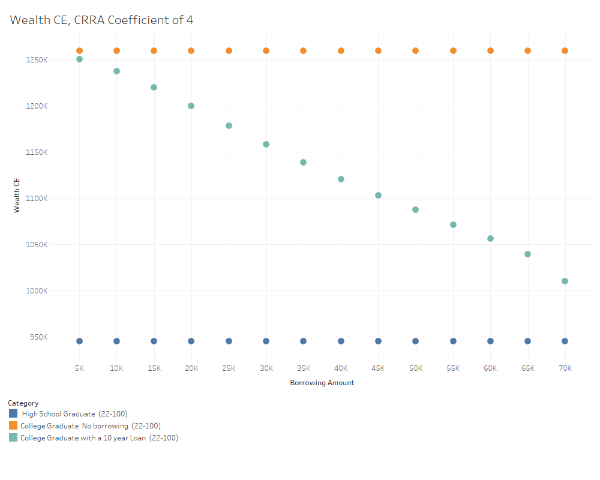
    We’ll have a lot more to say in the coming weeks about this paper and our broader research initiative, but look at this result in particular, which shows that how you pay for college significantly affects its value:

    Y-axis is lifetime wealth, X-axis is borrowing amounts. We assume a 7% interest rate. Greater borrowing significantly reduces the college premium: at 70k of borrowing, it’s reduced by 79%. The decline in the college value premium is dramatic, but the reduction to college returns per se derived from the volatility of post-college earnings and moderate risk aversion (CRRA 4) is already substantial: Many studies evaluate the purely financial returns to college, measured by the net present value of post-college earnings, and find the college premium to be 49.5% (in our model). But accounting for individuals’ risk preferences and the uncertainty of the returns to a post-secondary education the premium drops to 33.2% (wealth CE, our model).

    • For similar results, see Jeffrey Brown’s paper “Risk and Returns to Education Over Time.” Link.
    • There are important caveats, including that mapping CRRA to actual risk preferences is difficult, as Miles Kimball describes in this 2009 paper. Link.
    • For more on the student debt crisis, a new paper from Marshall Steinbaum at the Roosevelt Institute makes four major points: “More education has not led to higher earnings over time. Student debt is a burden for a growing share of young adults. Credentialization better explains these dynamics than the ‘skills gap.’ These trends have had particularly negative impacts on Black and brown Americans.” Link. Jillian Berman summarizes the study on Marketwatch. Link.

    +++

    • From Sidewalk Labs (Google’s “smart city” company), a digital governance proposal for their Toronto development project. Among the proposed ideas: establishing an “independent Civic Data Trust” to manage the data—environmental, personal, and so on—collected by the project. Link to the blog post, link to the proposal presentation.
    • “Kinky labor supply and the attention tax”: Media entertainment, status signaling, and the labor supply of younger demographics. Link. ht Barry
    • Canadian CEOs for Basic Income. Link. ht Lauren
    • On “probabilistic horserace” election coverage: “We hypothesize that it will lower uncertainty about an election’s outcome (perceived potential pivotality), which lowers turnout under the model.” Link.
    • “Why do some ethnic groups vote along ethnic lines while others do not? In this article, we theorize that the level of ethnic voting depends, partially, on how ethnicity interacts with economic cleavages. Specifically, we argue that between–ethnic group inequality (BGI) increases ethnic voting and that its effect strengthens as within–ethnic group inequality (WGI) decreases.” Link. ht Will
    • A new paper explores the increasing heterogeneity among cities and explains that in order to properly address questions of neighborhood effects, researchers must “conduct ethnographic observation in ostensibly unconventional cities, and address the historically extreme conditions in a newly unique subset of cities.” Link.
    • From Douglas Rushkoff: “Instead of kicking over additional, say, 10% in tax for a government UBI fund, how about offering a 10% stake in the company to the people who supply the labor? Or another 10% to the towns and cities who supply the roads and traffic signals? Not just a kickback or tax but a stake.” Link. ht Jay
    • Unifying the “zooful” of identification terms in econometrics literature. Link.
    • “Because they were human bodies, relics held a special position in the medieval economy. Their value was based in part on their connection to the spirit that had once inhabited the body, or the personality of the saint. But because they were objects (and often highly mobile objects too), relics were commoditised by medieval society – traded, bought and sold for profit by the communities that held them.” Link.
  4. Answer to the Question

    Comments Off on Answer to the Question

    CLAIMS THAT CAN’T BE TESTED

    What policy lessons can we derive from UBI experiments?

    Political philosopher KARL WIDERQUIST of Georgetown has published a 92-page book examining historical and current basic income pilots, the difficulties of extrapolating from policy research to policy, and “the practical impossibility of testing UBI.”

    In his introduction, Widerquist mentions that the challenges for translating research into policy stem not only from the science, but also from the audience’s moral preferences and judgments, which are particularly heightened in the basic income discourse:

    “Except in the rare case where research definitively proves a policy fails to achieve its supporters’ goals, reasonable people can disagree whether the evidence indicates the policy works and should be introduced or whether that same evidence indicates the policy does not work and should be rejected. This problem greatly affects the UBI discussion because supporters and opponents tend to take very different moral positions. Many people, including many specialists, are less than fully aware of the extent to which their beliefs on policy issues are driven by empirical evidence about a policy’s effects or by controversial moral evaluation of those effects. For example, mainstream economic methodology incorporates a money-based version of utilitarianism. Non-money-based utilitarianism was the prevailing ethical framework when basic mainstream economic techniques were developed but it lost prominence decades ago.”

    Widerquist also writes lucidly on considerations for how to communicate scientific caveats and takeaways. The full book is available here. ht Lauren who comments: “It’s incredibly difficult to test every aspect of many, many policies (including most that are currently at full national scale). Testing a given welfare policy arguably only has to get decision makers to a point where it can be determined that the policy substantially helps those who need it and doesn’t hurt anyone as a result.”

    • Activist Stanislas Jourdan spoke at the European Parliament in September about a basic income for Europe. Video of the presentation is here; slides are here. On the financing question, Jourdan proposes VAT (“already the most harmonized tax at EU level, large and reliable tax base”), as well as a European Corporation Tax, carbon taxes, and “quantitative easing for the people.”
    ‡ ubi metrics

    REVENUE POSITIVE

    Federal student aid pays for itself

    Research on the efficacy of the Pell Grant Program typically evaluates enrollment effects and attainment outcomes, but less is known about the broader returns of these federal expenditures. In a new working paper, JEFFREY DENNING, BEN MARX, and LESLEY TURNER examine the graduation rates, earning outcomes, and welfare of students eligible for additional grant aid throughout their undergraduate career. The study uses NBER’s TAXISM model and finds, among other things, that federal financial aid more than pays for itself:

    “For students entering four-year institutions, increasing grant aid would enhance welfare and even pay for itself over a relatively short time horizon. Eligibility for additional aid leads students to pay significantly more income taxes, and this positive fiscal externality is large relative to the costs of providing them with additional financial support. The benefits of additional aid provided to low-income students are substantial and increasing grant aid pays for itself through financial gains for the public.”

    The authors add their voices to the argument that federal aid programs should be restructured to allow consistent aid from year to year:

    “The Pell Grant Program does not explicitly target students in their first year of college and does not guarantee a specific level of future funding, as a student’s award is determined anew with each year’s financial aid application. Researchers have proposed changes to the Pell Grant, so that a first-year student can plan for a known level of need that does not vary year to year. Our results provide suggestive evidence that such restructuring could improve student outcomes. It is possible for increases in grant aid to offer a ‘free lunch,’ benefiting students to an extent that they more than repay the additional government spending.”

    Link to the paper.

    • In a blog post adapted from written testimony submitted to the U.S. Senate Committee on Health Education, Labor and Pensions, Judith Scott-Clayton suggests that eligibility for Pell Grants should be fixed for a set number of years, allowing students to properly plan for multiyear degrees. Link.
    • A related working paper on Pell Grants by Lesley Turner discusses that schools capture on average 15 percent of their students federal aid through “tuition increases or reductions in discounts provided through institutional grants and scholarships.” Link.

    +++

    • Adam Tooze reviews two Polanyian analyses of the current democratic crisis. Among the insights: “To understand the current crisis, we need to grasp the couplet of democracy and capitalism at a national level but also the wider system within which they exist.” Link.
    • Is education consumption or investment? Link.
    • A study on refugee migration and electoral outcomes finds that responses to refugee allocation fall along the urban-rural divide. Link.
    • From Mariana Mazzucato and Laurie Macfarlance, a policy report on “the role of state investment banks and their potential to address both the challenges and opportunities of patient strategic finance.” Link.
    • New paper by ScienceDirect examines how cash transfers impact trust in local government and finds there is “little reason to worry that local management of a conditional cash transfer program reduces trust in government or the quality of governance.” Link.
    • Research by Amanda Y. Agan and Michael D. Makowsky that we shared back in January on the EITC, minimum wage, and recidivism is now published as an NBER working paper. “On average the effect of higher wages, drawing at least some released prisoners into the legal labor market, dominates any reduced employment in this population due to the minimum wage.” Link. ht Jack B
    • The results of Access Across America—a first-of-its-kind report on the state of civil legal services throughout the country from 2011—paint a picture of drastic variation in access to civil justice from state to state: “The services available to people from eligible populations who face civil justice problems are determined not by what their problems are or the kinds of services they may need, but rather by where they happen to live.” Link. ht Will
    • Platform impact: “We hypothesize that Twitter affects journalists’ news judgment, impacting coverage decisions. Twitter has become so normalized that tweets were deemed equally newsworthy as headlines appearing to be from the AP wire.” Link. (If you don’t already, follow us there.)
    • Same day registration increases turnout. Link. ht Jack B
    • A paper applying the tools and concepts of network science to model imperial history, using the cases of Imperial China and the Roman Empire. From the abstract: “Results can be connected with actual historical dynamics and hint at underlying network mechanisms of large scale integration and disintegration of political formations.” Link.
  5. Earth Men

    Comments Off on Earth Men

    HARD CAPS

    Economic growth vs. natural resources

    A recent Foreign Policy op-ed by JASON HICKEL examines “green growth,” a policy that calls for the absolute decoupling of GDP from the total use of natural resources. Hickel synthesizes three studies and explains that even in high-efficiency scenarios, economic growth makes it impossible to avoid unsustainably using up natural resources (including fossil fuels, minerals, livestock, forests, etc).

    “Study after study shows the same thing. Scientists are beginning to realize that there are physical limits to how efficiently we can use resources. Sure, we might be able to produce cars and iPhones and skyscrapers more efficiently, but we can’t produce them out of thin air. We might shift the economy to services such as education and yoga, but even universities and workout studios require material inputs. Once we reach the limits of efficiency, pursuing any degree of economic growth drives resource use back up.”

    The op-ed sparked debate about the state of capitalism in the current climate crisis, most notably in an Bloomberg op-ed by NOAH SMITH, who claims that Hickel is a member of “a small but vocal group of environmentalists telling us that growth is no longer possible—that unless growth ends, climate change and other environmental impacts will destroy civilization.” Though Smith’s op-ed doesn’t directly engage with many of Hickel’s points, his general position prompted a clarifying (and heated) response from Hickel:

    “Noah is concerned that if we were to stop global growth, poor countries would be ‘stuck’ at their present level of poverty. But I have never said that poor countries shouldn’t grow—nor has anyone in this field of study (which Noah would know had he read any of the relevant literature). I have simply said that we can’t continue with aggregate global growth.

    …
    While poor countries may need some GDP growth, that should never—for any nation, rich or poor—be the objective as such. The objective should be to improve human well-being: better health, better education, better housing, happiness, etc. The strategy should be to target these things directly. To the extent that achieving these goals entails some growth, so be it. But that’s quite different from saying that GDP needs to grow forever.”

    • From a study on the limits of green growth: “GDP cannot be decoupled from growth in material and energy use. It is therefore misleading to develop growth-oriented policy around the expectation that decoupling is possible. GDP is increasingly seen as a poor proxy for societal wellbeing. Society can sustainably improve wellbeing, including the wellbeing of its natural assets, but only by discarding GDP growth as the goal in favor of more comprehensive measures of societal wellbeing.” Link.
    • In a recent article, Juan Moreno-Cruz, Katharine L. Ricke, and Gernot Wagner discuss ways to approach the climate crisis and argue that “mitigation (the reduction of carbon dioxide and other greenhouse gas emissions at the source) is the only prudent response.” Link.

    LONGEVITY VOUCHER

    Life under the Old Poor Law

    The positive or distortionary effects of welfare are the subject of familiar contemporary policy debate, but these arguments have been ongoing in similar form for centuries—at least since the Poor Laws, early systems of poor relief in England that date back to 1601.

    In an ambitious research project that will bring more evidence to these questions, historians ALANNAH TOMKINS and TIM HITCHCOCK have begun to examine the vast archives of parish-level overseers’ vouchers—”handwritten papers typically generated whenever the parish incurred a debt”—in order to glean detailed information about the lives of regular people, poor and not, during the time of the Old Poor Law. From the project website:

    “Very little is known about the midwives, tailors, workhouse mistresses, butchers and others who serviced the parish. These vouchers provide information about the identities of those who were paid for goods and services for the poor, and also reveal the scale of income to be gained by working on behalf of the parish. Additionally, they expose the networks of traders who benefited from the business—and those who did not—and the longevity of these relationships. The social and economic bonds forged between the poor and the non-poor are fully reflected at the most granular scale in these everyday sources.”

    The project will permit new examinations of the history and effects of welfare that was previously impossible because of the difficulties of using the source materials:

    “The presence of vouchers in parish collections has long been acknowledged, but their utility for historical research has been wholly disregarded owing to the significant technical challenges of using them. Where they survive vouchers can be tightly or chaotically folded, diverse in format, and of variable legibility, offering uncertain returns for the lone investigator.”

    Link to the project titled Small Bills and Petty Finance, 1700-1834.

    • At The Long Run, Tomkins writes a post introducing the project: “A parish workhouse, for example, exerted a considerable influence over a local economy when it routinely (and reliably) paid for foodstuffs, clothing, fuel and other necessaries. This influence or profit-motive has not been studied in any detail for the poor law before 1834.” Link.
    • Mark Blaug’s seminal and critical reappraisal of the 1834 reforms that overhauled the Old Poor Law and ushered in the New: “It is not often realized that the kind of arguments which are used to condemn the Old Poor Law per se would equally condemn most modern welfare legislation.” Link.

    +++

    • Implicit ISA: “The impact of federal grants on earnings alone are enough to fully recoup government expenditures within 10 years, suggesting that financial aid likely pays for itself several times over.” Link.
    • Fascinating VoxEU article on the long-term and wider geographical impacts of highly-localized research infrastructure investment. Link.
    • Danielle Citron on sexual privacy in an environment in which “the efficacy of traditional privacy law is waning, just as digital technologies magnify the scale and scope of the harm.” Link.
    • James Heckman and Sidharth Moktan on the tyranny of the top five economics journals: “Reliance on the T5 to screen talent incentivizes careerism over creativity.” Link. ht Will
    • Arindrajit Dube tweets on Modern Monetary Theory. Link.
    • Managing digital discovery in criminal cases. Link. ht Jack B. (Relatedly, an article from Rebecca Wexler that we shared in June explores the role of trade secret law for technologies used in the criminal justice system. Link.)
    • From HistPhil: “Funders’ inability to solve the problems they set out to address is not necessarily due to lack of strategy but is rather often a result of the limited, yet often strategic, perspectives presented in predominant philanthropic theories of social change which often serve to maintain the status quo.” Link.
    • “For centuries, states lawfully waged war for many reasons that today would appear absurd.” In the UChicago Law Review, a study of over 350 war manifestos spanning 500 years. Link.
  6. Catastrophe Theory

    Comments Off on Catastrophe Theory

    MIDDLE WAGE

    Questioning the great transition into a “global middle class”

    Economist STEVE KNAUSS, in a new paper published by the CANADIAN JOURNAL OF DEVELOPMENT STUDIES, examines the “myth” of the global middle class and the claim that the $2/day measurement tells us anything substantive about poverty and inequality around the world.

    “On the defensive in recent years, advocates of globalization have taken to highlighting achievements in developing countries, where globalization has supposedly pulled the majority out of poverty and catapulted them into the swelling “global middle class” remaking our world. This article provides a critical look at this interpretation. Carefully reviewing the global income distribution data behind such claims, it presents original calculations that generate new stylized facts for the globalization era.

    The global income distribution approach does potentially have much to offer in terms of revealing the complexity of these changes, but in order to do so, greater attention and resources should be devoted to deepening our knowledge of the socio-historical changes underpinning the new realities of class formation and how they relate to the observed changes in global incomes. Instead of, or in addition to, constructing groups according to income thresholds, or national/global based deciles, ventiles or percentiles, more research should start from the other end, identifying national and global groups based on similarities in class formation and then attempting to trace such trajectories through the global income distribution.”

    Link to the article, and link to an ungated manuscript version. Jason Hickel comments:

    “The question is: does their new petty income from the informal sector compensate for their loss of rural land, livestock, etc? It is not clear that it does. Therefore, we cannot say that this is a straightforward narrative of ‘progress’—at least not in all regions.”

    Link to Hickel’s thread.

    • Development economist Morten Jerven with a 2010 paper diving into the metrics question in the context of poverty in Africa: “The article therefore concludes that it is futile to use GDP estimates to prove a link between income today and existence of pro-growth institutions in the past, and recommends a searching reconsideration of the almost exclusive use of GDP as a measure of relative development.” Link.

    MASS COLLABORATION

    A new model for social science research

    The landmark Fragile Families and Child Wellbeing Study has been collecting a variety of data on almost 5,000 children for over 15 years. The rich dataset has allowed for a variety of studies: “These data have been used in hundreds of scientific papers and dozens of dissertations, and insight from these studies are routinely shared with policy makers around the world.”

    One offshoot of the larger study is the Fragile Families Challenge, for which teams of social and data scientists used the Fragile Families data to attempt to build accurate predictive models: “Given all the background data from birth to year 9 and some training data from year 15, how well could participants infer six key outcomes in the year 15 test data?”

    A new paper from IAN LUNDBERG, ARVIND NARAYANAN, KAREN LEVY, and MATTHEW SALGANIK describes how the Challenge navigated the process and ethics of sharing the sensitive data about the people in the study.

    “The detailed nature of the data made the project particularly valuable for developing knowledge about the lives of disadvantaged families, yet these very features also heightened concerns about privacy and ethics. In other words, the Challenge brought the tension between risks and benefits into sharp focus. In this paper, we provide no single solution to the fundamental tension between access and privacy; instead, we describe our process of addressing it. More specifically, this paper describes the privacy and ethics audit that we conducted from December 2016 through March 2017, as well as steps we carried out during the Challenge from March through August 2017.”

    The researchers imagine the various threats that would come from trolls, journalists, nosy neighbors, etc., and then describe how they mitigated those risks. Link to the paper. ht Matt Salganik

    • On the Fragile Families Challenge blog, Lundberg summarizes the new paper. Link.
    • The paper contains the following excellent/illustrative anecdote about how Latanya Sweeney, as a graduate student working on an unrelated project, “was able to re-identify apparently anonymous medical records”: “She did this by combining the apparently anonymous medical records, which contained date of birth, zip code, and sex, with non-anonymous voter registration data, which also contained date of birth, zip code, and sex… Fortunately, rather than posting all of the records online, Sweeney mailed Massachusetts Governor William Weld a copy of his own records.”
    • A second new paper on the Fragile Families Challenge data describes “improving metadata infrastructure for complex surveys.” “We hope that our work will facilitate new applications of machine learning methods to longitudinal surveys and inspire research on data preparation in the social sciences. We have open-sourced the tools we created so that others can use and improve them.” Link.

    +++

    • The Economist covers social wealth funds. Link. (More on Social Wealth Funds in a recent newsletter.)
    • One of Marcy Wheeler’s “heroes of 2018”: the Big Cases twitterbot from Brad Heath. Link.
    • “We find that local ICE partnerships reduce the number of Hispanic students by nearly 10 percent within 2 years. We estimate that the local ICE partnerships enacted before 2012 displaced over 300,000 Hispanic students. These effects appear to be concentrated among elementary-school students.” Link.
    • “Algorithms are not neutral. They are emblematic artifacts that shape our social interactions and social worlds. They open doors on possible futures. We need to understand their concrete effects. We need to imagine how they might work if they were designed and deployed differently, based on different priorities and agendas—and different visions of what our life should be like.” Link.
    • Important new research on the efficacy of various interventions in reducing homelessness. Among the findings: “Priority access to long-term rent subsidies reduced homelessness and food insecurity and improved other aspects of adult and child well-being relative to usual care.” Link.
    • From the Roosevelt Institute: a “blueprint for a robust 21st century antitrust regime that can begin to address today’s market crisis.” Link to the blueprint. Link to the corresponding blog post. For more on antitrust, Suresh Naidu, Glen Weyl, and Eric Posner published a paper at Equitable Growth that proposes methods for accurately assessing the labor market effects of mergers. Link.
    • The second installment of historian Andy Seal’s History of the History of Capitalism series examines “how proletarianization provided a standard plot for older histories of capitalism.” Link.
    • Bloomberg’s Noah Smith imagines a U.S. office of industrial policy that would create place-based policies and local strategies to encourage revitalizations plans that fit each localities specific needs, strengths and resources. Link. (And more on place-based policies in our August newsletter.)
    • At Data For Progress, a deep dive into the demographic distribution of progressive ideology. Link.
    • Excellent Pseudoerasumus thread in response to a post from Branko Milanovic titled “Hayekian Communism.” Covered within: growth in Taiwan under rule of Kuomintang, land reform in China and East Asia, counterfactual development history in China. Link. (And link to Milanovic’s post, the content of which he says will be much expanded in his forthcoming book “Capitalism, alone.”)
  7. Red Wall

    Comments Off on Red Wall

    MATERIAL UNDERSTANDING

    The full resource stack needed for Amazon’s Echo to “turn on the lights”

    In a novel new project, KATE CRAWFORD and VLADAN JOLER present an “anatomical case study” of the human labor, data, and planetary resources necessary for the functioning of an Amazon Echo. A 21-part essay accompanies an anatomical map (pictured above), making the case for the importance of understanding the complex resource networks that make up the “technical infrastructures” threaded through daily life:

    “At this moment in the 21st century, we see a new form of extractivism that is well underway: one that reaches into the furthest corners of the biosphere and the deepest layers of human cognitive and affective being. Many of the assumptions about human life made by machine learning systems are narrow, normative and laden with error. Yet they are inscribing and building those assumptions into a new world, and will increasingly play a role in how opportunities, wealth, and knowledge are distributed.

    The stack that is required to interact with an Amazon Echo goes well beyond the multi-layered ‘technical stack’ of data modeling, hardware, servers and networks. The full stack reaches much further into capital, labor and nature, and demands an enormous amount of each. Put simply: each small moment of convenience – be it answering a question, turning on a light, or playing a song – requires a vast planetary network, fueled by the extraction of non-renewable materials, labor, and data. The scale of resources required is many magnitudes greater than the energy and labor it would take a human to operate a household appliance or flick a switch.”

    Link to the full essay and map.

    • More on the nuanced ethical dilemmas of digital technology: “Instead of being passive victims of (digital) technology, we create technology and the material, conceptual, or ethical environments, possibilities, or affordances for its production of use; this makes us also responsible for the space of possibilities that we create.” Link.
    • As shared in our April newsletter, Tim Hwang discusses how hardware influences the progress and development of AI. Link.

    WIDE OPEN FIELD

    The beginnings of bioethics

    Advances in data-gathering, machine learning, and algorithmic decision-making systems are opening up difficult political, ethical, and legal questions. In the 1960s and 1970s, medicine was forced to address similarly discipline-shifting questions. Technological advances—and corresponding high-profile media coverage and court cases—led to the birth of bioethics.

    From David J. Rothman’s “Strangers at the Bedside: A History of How Law and Bioethics Transformed Medical Decision Making”:

    “The critical period of change was 1966 to 1976. The transformation began when in 1966 a Harvard Medical School professor, Henry Beecher, exposed abuses in human experimentation. Then, in 1973, Congress, under the leadership of senators Walter Mondale and Edward Kennedy, established a national commission to explore medical ethics. The period closed with the New Jersey Supreme Court ordering doctors to yield to parental requests to remove twenty-two-year-old Karen Ann Quinlan from a respirator. The impact of these events, most generally framed, was to make the invisible visible. Outsiders to medicine—that is, lawyers, judges, legislators, and academics—penetrated its every nook and cranny, in the process giving medicine an exceptional prominence on the public agenda and making it the subject of popular discourse. This glare of the spotlight transformed medical decision making, shaping not merely the external conditions under which medicine would be practiced (something that the state, through the regulation of licensure, had always done), but the very substance of medical practice—the decisions that physicians made at the bedside.”

    Link to a preview on Google Books.

    • The Hastings Center, whose founder Daniel Callahan is a key voice in the field, tells a consonant story: “From the first it was understood that bioethics had to cast a wide net, moving from the most intimate doctor-patient encounters at the bedside to the most public kinds of decisions on the provision of health care. Good ethics in that context meant working at both ends of a spectrum: a serious grappling with basic issues of human nature, rights, and dignity—where should medicine be taking us?—and dealing with the most practical of policy matters.” Link.
    • “The mediators came, almost all of them, from the traditional disciplines of theology and philosophy. There were a few physicians, a few lawyers, and an occasional social scientist, but early bioethics was fashioned out of bits and pieces from moral philosophy and moral theology.” From a compilation of reflections on the birth of the field. Link.
    • A 2009 article from Mark Rothstein: “The Role of Law in the Development of American Bioethics.” Link.

    +++

    • From IBM, an open-source toolkit for fostering fairness in AI: “Containing over 30 fairness metrics and 9 state-of-the-art bias mitigation algorithms developed by the research community, it is designed to translate algorithmic research from the lab into the actual practice of domains as wide-ranging as finance, human capital management, healthcare, and education.” Link to the toolkit, link to a blog post introducing the project, and link to a developers tutorials page with interactive Jupyter notebooks detailing the toolkit’s potential application for examining credit scoring, medical expenditure, and gender bias in face classifiers.
    • A look at the long-term relationship between capital shares and income inequality. Link.
    • Researchers Guy Abel and Nikola Sander quantify (for the first time) bilateral migration flows between the world’s 196 countries from 1990-2010. Link to their paper, link to their data.
    • A recent paper by Nichola Bianchi and Michela Giorcelli examines the lasting effects of international reconstruction aid on long-term economic growth in Italy. From the abstract: “Provinces that received more reconstruction grants experienced an increase in the number of industrial firms and workers. The same provinces experienced a faster mechanization of the agricultural sector. Reconstruction grants induced economic growth by allowing Italian provinces to modernize their transportation and communication networks damaged during WWII.” Link. And link to a summary post at ProMarket.
    • The Crimean War, land and rail speculation, and a crisis in Europe. “What caused the panic of 1857?” Link.
    • A recent paper by Carolina Arteaga of graduates from Colombia’s top university tests whether returns to higher education are the result of human capital accumulation or signaling effects. The results “suggest that human capital plays an important role in the determination of wages and reject a pure signaling model.” Link.
    • An Economic Anatomy of Optimal Climate Policy.” Link. Relatedly, Jason Hickel in Foreign Policy: “Why Growth Can’t Be Green.” Link. (More on this next week.)
    • On the history of simulations in economics: “What is striking about the whole simulation movement is the desire to use artificial means to create a stream of outputs which look like the real observations we get from the world, i.e. to create “evidence” which will match or mimic the empirical or real evidence. Boumans suggests that whether we can interpret or treat such “evidence” from model experiments as real evidence is a kind of Turing test in economics.” Link.
    • Published in Nature, new research by Moe Vazifeh at MIT’s Senseable City Lab models how to best size and operate a taxi fleet in New York City. Link.
    • On the liquidity of the Victorian capital market. Link.
    • Major new working paper on intergenerational mobility in India. Link to the paper. And link to an introductory thread from co-author Paul Novosad, which includes a link to their methods paper, illuminating how mobility is calculated “in developing countries when you don’t have linked income data and education is super coarse.”
  8. The Marshes

    Comments Off on The Marshes

    THE JANUS FACE

    The paradoxical outcomes of university-centered economic growth

    A recent paper by RICHARD FLORIDA and RUBEN GAETANI takes an empirical look at the role of research universities in anchoring local economies and driving economic growth. The paper examines the density of patenting and financial investment within the internal geographies of specific American cities and argues that knowledge agglomeration exacerbates economic, occupational, and spatial segregation.

    “Although universities certainly affect national levels of innovation and growth, research has shown that they tend to affect innovation and growth by operating through more localized channels. The roles played by Stanford University in the rise and economic performance of Silicon Valley and of MIT in the Boston-Cambridge ecosystem are cases in point.

    …

    Universities constitute a rare, irreproducible asset at the local level. At the same time, it is increasingly clear that the knowledge-economy metros and so-called college towns suffer from relatively high levels of inequality and segregation.”

    Set to be released in the October issue of MANAGERIAL & DECISION ECONOMICS, the paper presents a nuanced exploration of agglomeration economies and complicates the use of universities as levers for economic revitalization, job creation, and mutual prosperity.

    Link to the working paper.

    • As spotlighted in a November newsletter, Lyman Stone discusses national problems with the role of the US higher education system: “The problems we face are: (1) the regional returns to higher education are too localized, (2) the price of higher education is bid up very high, (3) the traditional entrepreneurial player, state governments, is financially strained or unwilling, (4) private entrance is systematically suppressed by unavoidable market features.” Link.
    • At CityLab, Richard Florida examined venture-capital invested start-ups and found they disproportionately clustered in metropolitan regions with high-performing universities. Link.
    • For a deep dive into the role universities play in economic and spatial development, see Margaret O’Mara’s book on Cold War era “Cities of Knowledge.” Link.

    MIRACLE OF COMPOUND TAXATION

    SRW considers the macroeconomic effects of a Social Wealth Fund

    In a substantial contribution to the Bruenig-SWF discourse, STEVE RANDY WALDMAN looks at funding, scale, political effects, and macroeconomic effects of a social wealth fund for universal basic income.

    “I think it fair to say that it would be difficult to sustain the political will to cumulatively impose new taxes on capital holders, every year, year after year after year over a period that might span decades. But the “gimmick” of actually using the proceeds from a single tax, enacted once and continued indefinitely, to purchase capital assets, generates the same effect as this compounding tax schedule in a way that seems natural and inevitable and legitimate under the norms of present-day capitalism. If we accept that other capital holders get to enjoy the miracle of compound returns, why shouldn’t a fund owned in equal shares by all citizens get to enjoy the same? Actually constituting a SWF delivers a regime of effective taxation that, I think it is fair to say, ordinary politics simply could not.

    Further, the effective taxes embedded in an actually constituted SWF are efficient, in the usual economic sense of not distorting anyone’s behavior.”

    Link to the full post on Interfluidity.

    • For more from Steve, a brief thread on Roger Farmer’s arguments that a SWF could function well as a macrostabilizing buyer: “Most obviously, if a SWF’s purpose is to equalize wealth ownership and maximize citizen dividends, it should seek to buy capital assets as cheaply as possible, rather than support their prices. Of course, one of the explicit purposes of Bruenig’s SWF is to allow business and investment decisions to consider a broader public interest than a vulture capitalist would, so you could argue that the SWF paying above the fire-sale prices it has prevented is making a good tradeoff, trading a narrow opportunity for a broad public interest in a stable economy. But that strikes me as a dangerous kind of tradeoff for a public wealth accumulating SWF to try to make.” Link.
    • Peter Barnes also recently published a response to Bruenig, approvingly summarizing Bruenig’s funding ideas. Link.
    • See last week’s newsletter for more on Bruenig and responses.

    +++

    • From Vitalik Buterin, Zoë Hitzig, and Glen Weyl: “Liberal Radicalism: Formal Rules for a Society Neutral Among Communities.” “The concept extends ideas from Quadratic Voting to a funding mechanism for endogenous community formation. Individuals make public goods contributions to projects of value to them. The amount received by the project is (proportional to) the square of the sum of the square roots of contributions received.” Link.
    • Andrew Goodman on “Difference-in-Differences with Variation in Treatment Timing.” Link. And link to Goodman’s explanatory Twitter thread and many enthusiastic responses from researchers.
    • Arjun Jayadev and J.W. Mason: “Mainstream Macroeconomics and Modern Monetary Theory: What Really Divides Them?” Link.
    • New from Google: Dataset search. Link. A Verge article about the project. Link.
    • Excellent new paper from Arindrajit Dube, Alan Manning and Suresh Naidu finds evidence of monopsony in wages bunched at round numbers: “We consider two hypotheses—worker left-digit bias and employer optimization frictions—and derive tests to distinguish between the two. Symmetry of the missing mass distribution around the round number suggests that optimization frictions are more important.” Link. For an explanatory post on the paper, read this from Owen Davis.
    • “The spread of new products in a networked population is often modeled as an epidemic.” Link.
    • “The revival didn’t happen.” A 1999 paper from Black, Kraakman, and Tarassova examines the failings of mass privatizations in Russia. Link.
    • An interesting thread by David Kaye on what transparency should mean for social media companies. Link.
    • A new NBER paper explores the impact of Chief Diversity Officers on faculty diversity and finds no “significant statistical evidence that growth in diversity for underrepresented racial/ethnic minority groups is affected by the hiring of an executive level diversity officer.” Link.
    • On the demise (and possible resurgence) of oligopolistic models of international trade. Link.
    • A recent paper by Taylor Carlson looks at interpersonal information transfers. “Participants exposed to social information learned significantly less than participants who were exposed to the full news article. However, consistent with classic theories of opinion leadership, individuals exposed to information from an ideal informant who shares their preferences and is more knowledgeable learned the same objective facts as those who received information from the media.” Link.
  9. Very First Stone

    Comments Off on Very First Stone

    WEALTH BEGETS WEALTH

    Matt Bruenig’s Social Wealth Fund proposal, and responses

    Last week, MATT BRUENIG of the PEOPLE’S POLICY PROJECT published the most detailed version of a bold policy he’s been writing about for a long time: a Social Wealth Fund for America.

    “If we want to get serious about reducing wealth and income inequality, then we have to get serious about breaking up this extreme concentration of wealth.

    A dividend-paying social wealth fund provides a natural solution to this problem. It reduces wealth inequality by moving wealth out of the hands of the rich who currently own it and into a collective fund that everyone in the country owns an equal part of. It then reduces income inequality by redirecting capital income away from the affluent and parceling it out as a universal basic dividend that goes out to everyone in society.”

    The full report contains history on Sweden and Norway, information on the Alaska Permanent Fund, and then a sketch of the “American Solidarity Fund,” including funding and governance. The report stakes conceptual ground, and doesn’t offer new macroeconomic analysis. Link.

    • Matt Yglesias summarizes and adds context in Vox, noting that Bruenig’s political angle is not imperative for the SWF idea. Other proposals for government stock ownership “invariably conceptualize the government as a silent partner in the enterprises it would partially own, trying to find a way for the government to reap the fiscal or economic benefits of government stock ownership without the socialistic implications of government officials running private firms. Bruenig’s proposal is the opposite of that, a way to put real meat on the bones of “democratic socialism” at a time when the phrase is gaining momentum as a slogan and an organizing project but also, to an extent, lacks clear definition.” Link.
    • In an illustration of Yglesias’s point, Roger Farmer, who has suggested funding a SWF through countercyclical asset purchases, makes his ideological differences clear on Twitter: “You don’t have to be a Democratic Socialist to see value in a scheme whereby government borrows and invests in the stock market…unlike Matt Bruenig I do not see this as a tool for political control of corporate agendas and I have advocated that the Treasury purchase an index fund of non-voting shares.” Link.
    • Mike Konczal criticizes the SWF idea along multiple lines. “We want shareholders to ruthlessly extract profits, but here for the public, yet we also want the viciousness of market relations subjected to the broader good. Approaching this as shareholders is probably the worst point of contact to try and fix this essential conflict.” Link.
    • Bruenig responds to Konczal. Link.
    • Peter Gowan expands on the idea in Jacobin: “Following [Rudolf] Meidner, I think it is worth considering multiple social wealth funds to be established along sectoral lines.” Link.
    • Rachel Cohen gets responses from Peter Barnes and others in the Intercept. Link.

    DORMANT IMPACT

    On the now-defunct Congressional Office of Technology Assessment

    If Sheryl Sandberg and Jack Dorsey had testified before Congress between 1972 and 1995 (rather than this past week), lawmakers’ questioning would likely have been informed by research from the Congressional Office of Technology Assessment (OTA), which was tasked with providing “objective and authoritative analysis of complex scientific and technical issues.”

    A 2015 Room for Debate column in the NEW YORK TIMES reconsiders the now-defunct OTA (1972-1995) and the more than 750 reports it published to Congress. CELIA WEXLER explains that lawmakers used the OTA to make effective policy decisions on a huge variety of technical issues:

    “A 1984 study questioning the reliability of polygraph tests led Congress to enact limits on their use by employers. Another report from 1994 helped lawmakers assess the Social Security Administration’s computer procurement plan, and ended up saving the government $368 million. OTA reports in 1987 and 1990, which concluded that Pap smears and mammograms for older women could save thousands of lives, were instrumental in extending Medicare reimbursement for these tests.”

    In a 2015 article for THE ATLANTIC, STEVEN TELES and LEE DRUTMAN cite the OTA’s closure in arguing that staff shrinkage leaves Congress increasingly isolated from the knowledge and expertise required for prudent oversight and lawmaking: “Specialization is the hand-maiden of economic growth. But as societies become more specialized, they also become harder to comprehend. With each passing year there are more products and services; there are new technologies; there is more relevant scientific knowledge. To legislate intelligently on any subject requires considerably more information and conceptual sophistication than it did at the dawn of the Reagan administration.” Link to the article.

    ht Will for the links in this spotlight.

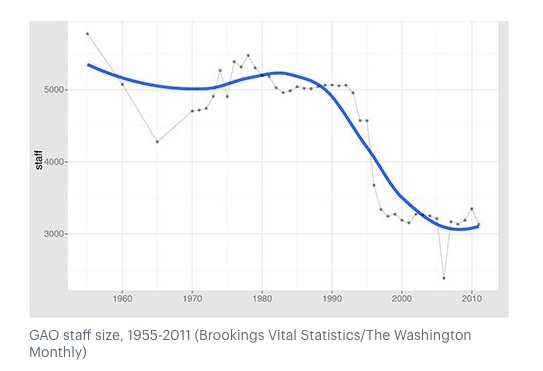
    • The annual Brookings report Vital Statistics on Congress shows that the OTA’s 1995 closure is part of a larger trend of diminishing and stagnating employment for Congressional staff. As CURTLYN KRAMER notes, “growing responsibility without corresponding growth in staff means that Congress’s members and staff must stretch their resources. The problem is, what Congress has to do to stretch the capacity of their existing workforce further does little to increase real efficiency, and instead forces adaptations that hurt congressional independence.” Link.
    • In a highly-cited 2006 American Political Science Review article, RICHARD HALL and ALAN DEARDORFF argue that the most accurate model of lobbyist behavior treats lobbying as a form of legislative subsidy, capitalizing on shrinking legislative resources: “Direct lobbying… typically is not a strategy for changing legislators’ preferences over policies… it is an attempt to subsidize the legislative resources of members who already support the cause of the group… it is akin more to a gift than a trade. It is more like a ‘service bureau’ than a signaling process.” Link.
    • Princeton maintains an OTA archive of “all the formally issued reports of the Office of Technology Assessment, as well as many background papers and contractor papers – over 100,000 pages of the best available analyses of the scientific and technical policy issues of the past two decades.” Link.

    +++

    • The Urban Institute published a research brief on proposed changes to the federal safety net, which utilizes new data on material hardship from their 2017 Well-Being and Basic Needs Survey (WBNS): “Measuring a family’s ability to meet basic needs can provide a broader understanding of well-being than income-based poverty indicators…The (WBNS) tracks individual and family well-being at a time when the economy is improving but the safety net may be changing significantly.” Link. ht Lauren
    • Overstating the filter bubble: “In real-world testing on a diverse sample, news recommendations were homogenous.” Link. (See also this previously shared Knight Foundation review from Brendan Nyhan et all on the same topic. Link.)
    • “Death, Trauma, and God”: new NBER paper by Raul Cesur, Travis Freidman and Joseph Sabia looks at the effects of military service on religiosity. Link.
    • From VoxEU, economists Neil Cummins and Gregory Clark track two centuries of migration in England and suggest that Northern decline “can be explained by persistent outmigration of talent from the North.” Link.
    • From Bloomberg, Noah Smith discusses the role of economists in the revived anti-trust movement: “Economists are growing more concerned about the threat posed by corporate power. The budding antitrust movement will offer them valuable ideas, data and intellectual heft in its quest to stem the rampant power of industrial giants.” Link.
    • A new blog post for Naked Capitalism “emphasize[s] that lack of upward mobility is more powerful than mere inequality in inducing deep economic grievances.” Link. ht Sidhya
    • Roger Farmer weighs in on the secular stagnation debate between Stiglitz and Summers. Link.
    • In response to the Sanders-Khanna Stop BEZOS bill, which requires firms with more than 500 employees to pay taxes equalling safety net benefits received by employees and their families, the CBPP published a blog post warning of perverse consequences. Link. See also these threads from JFI Letter mainstay Arindrajit Dube: “If the problem is low-end pay, a direct tool is to raise the minimum wage. That avoids discriminatory incentives, and incentives to lobby to lower public assistance. Want to go further? Consider wage boards to raise pay for not only those at the very bottom but also the middle.”
    • Historian Andy Seal is writing a series of posts at the Society for US Intellectual History on the new History of Capitalism, the first of which periodizes the field. Link.
    • At Aeon, economist Ola Olsson with an excellent essay delving into his research (published last winter) on the relationship between scurvy and the birth of the Sicillian Mafia. “A major catalyst for the rise of the mafia in Sicily was the surge in demand for lemons and oranges that began in the first half of the 19th century. But to understand how fruit cultivation could lead to organised crime, we need to go back even further, to the conditions prevailing in the British Royal Navy in the 18th century.” Link to the essay, link to the paper.
  10. Table Tests

    Comments Off on Table Tests

    Example table test

    County, State Participation Rate 2016 Population
    DeSoto County, Florida 74.0 35800
    Hardee County, Florida 72.5 27360
    Stewart County, Georgia 72.0 5705
    Taliaferro County, Georgia 78.0 1593
    Telfair County, Georgia 74.5 15965
    Wheeler County, Georgia 77.7 7978
    Holmes County, Ohio 77.8 43936
    Forest County, Pennsylvania 77.4 7321
    Lake County, Tennessee 72.0 7560
    McDowell County, West Virginia 79.6 19141

    Another example table

    County, State American Dream Index: Percentile Percentile Income Mobility Percentile Employment Rate Percentile Housing Affordability Percentile Diversity
    Colfax County, Nebraska 100 77 73 88 51
    Jack County, Texas 96 72 79 80 43
    Rio Blanco County, Colorado 94 100 49 74 34
    Nobles County, Minnesota 91 61 68 81 63